
อ่าน 57 นาที
Red fox
The red fox (Vulpes vulpes) is the largest of the true foxes, and the most widely distributed member of the order Carnivora.
Red fox

| Red fox Temporal range: Middle Pleistocene – present | |
|---|---|
 | |
| In Rautas Fjällurskog Nature Reserve, Sweden | |
Scientific classification | |
| Kingdom: | Animalia |
| Phylum: | Chordata |
| Class: | Mammalia |
| Infraclass: | Placentalia |
| Order: | Carnivora |
| Family: | Canidae |
| Genus: | Vulpes |
| Species: | V. vulpes |
| Binomial name | |
| Vulpes vulpes | |
| Subspecies | |
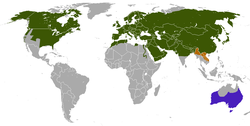 | |
| Distribution of the red fox native introduced presence uncertain | |
| Synonyms | |
| |
| Audio | |
| Calls | |


The red fox (Vulpes vulpes) is the largest of the true foxes, and the most widely distributed member of the order Carnivora. It is present across the entire Northern Hemisphere, including most of North America, Europe and Asia, as well as parts of North Africa. Its range has expanded alongside human settlement, with the species having been introduced to Australia, where it preys on native small and medium-sized rodents and marsupials. The red fox is listed as of least concern on the IUCN Red List. Because of its impact on native species, it is included on the list of the "world's 100 worst invasive species".[4]
The red fox originated in Eurasia during the Middle Pleistocene at least 400,000 years ago[5] and later colonised North America sometime prior to 130,000 years ago.[6] Apart from its large size, the red fox is distinguished from other fox species by its ability to adapt quickly to new environments. Despite its name, the species often produces individuals with other colourings, including leucistic and melanistic individuals. Forty-five subspecies are currently recognised, which can be divided into two categories: the large northern foxes and the small, basal southern grey desert foxes of Asia and North Africa.
Red foxes are usually found in pairs or in small family groups consisting of a mated pair and their young, or a male with several females related to each other. The young of the mated pair stay with their parents to help care for the new kits.[7] The species primarily feeds on small rodents, though it may also target rabbits, squirrels, game birds, reptiles, invertebrates and young ungulates. They also eat fruit and vegetables.[8] Although the red fox tends to kill smaller predators, including other fox species, it is vulnerable to attack from larger predators, such as wolves, coyotes, golden jackals, large predatory birds such as golden eagles and Eurasian eagle-owls,[9] and medium- and large-sized felids.[10]
The species has a long history of association with humans. It has been extensively hunted as a pest and furbearer for many centuries, and is represented in human folklore and mythology. Due to its widespread distribution and large population, the red fox is one of the most important fur-bearing animals harvested for the fur trade.[11]: 229–230 Too small to pose a significant threat to humans, it has greatly benefited from the presence of human habitation, and has successfully colonised many suburban and urban areas. The domestication of the red fox is also underway in Russia, and has resulted in the domesticated silver fox.
Terminology

Males are called tods or dogs, females are called vixens, and young are known as cubs or kits.[12] Although the Arctic fox has a small native population in northern Scandinavia, and while the corsac fox's range extends into European Russia, the red fox is the only fox native to Western Europe. For this reason, it is simply called "the fox" in colloquial British English.[13][14]
Etymology
คำว่า "fox" มาจากภาษาอังกฤษโบราณซึ่งสืบเนื่องมาจากภาษาโปรโตเยอรมัน * fuhsazเปรียบเทียบกับ ภาษาเวส ต์ฟรีเซียนfoks , ภาษาดัตช์vosและภาษาเยอรมันFuchsซึ่งสืบเนื่องมาจากภาษาโปรโตอินโด-ยุโรป * puḱ- 'ขนหนา; หาง' เปรียบเทียบกับภาษาฮินดีpū̃ch 'หาง', ภาษาโทคาเรียน B päkā 'หาง; ขนปุย' และภาษาลิทัวเนียpūkas 'ขน/ปุย' หางที่ฟูของสุนัขจิ้งจอกยังเป็นที่มาของชื่อในภาษาเวลส์llwynogซึ่งแปลตรงตัวว่า 'ฟู' มาจากllwyn 'พุ่มไม้' ในทำนองเดียวกันภาษาโปรตุเกส : raposaมาจากrabo 'หาง', ภาษาลิทัวเนียuodẽgisมาจากuodegà 'หาง' และภาษาโอจิบเวwaagoshมาจากwaaซึ่งหมายถึงการ "กระเด้ง" ขึ้นลงหรือการกระดิกของสัตว์หรือหางของมัน
คำศัพท์ทางวิทยาศาสตร์vulpes มาจากคำภาษาละตินที่แปล ว่าสุนัขจิ้งจอก และให้คำคุณศัพท์vulpineและvulpecular [ 15 ]
วิวัฒนาการ
สุนัขจิ้งจอกแดงมีต้นกำเนิดในยูเรเซียและอาจวิวัฒนาการมาจากVulpes alopecoides หรือ V. chikushanensisของจีนซึ่งทั้งสองชนิดมีชีวิตอยู่ในช่วงVillafranchian ตอนกลาง ของยุคไพลสโตซีน [ 16 ] ฟอสซิลที่เก่าแก่ที่สุดของV. vulpesถูกค้นพบในเขต Baranyaประเทศฮังการีมีอายุตั้งแต่ 3.4 ถึง 1.8 ล้านปีก่อน[ 17 ]สุนัขจิ้งจอกแดงบรรพบุรุษน่าจะมีขนาดเล็กกว่าสุนัขจิ้งจอกที่ยังมีชีวิตอยู่ในปัจจุบัน เนื่องจากฟอสซิลสุนัขจิ้งจอกแดงที่เก่าแก่ที่สุดแสดงให้เห็นว่ามีรูปร่างเล็กกว่าตัวอย่างที่ยังมีชีวิตอยู่[ 16 ] : 115–116 ซากฟอสซิลที่เก่าแก่ที่สุดของสายพันธุ์สมัยใหม่มีอายุย้อนไปถึงช่วงกลางของยุคไพลสโตซีน[ 18 ]พบร่วมกับกองขยะและเศษซากที่เหลือจากการตั้งถิ่นฐานของมนุษย์ยุคแรก สิ่งนี้นำไปสู่ทฤษฎีที่ว่าสุนัขจิ้งจอกแดงถูกล่าโดยมนุษย์ยุคดึกดำบรรพ์ (ทั้งเพื่อเป็นแหล่งอาหารและหนัง) นอกจากนี้ยังมีความเป็นไปได้ที่สุนัขจิ้งจอกแดงจะคุ้ยหาอาหารจากกองขยะหรือซากสัตว์ที่ถูกชำแหละ[ 19 ]
สายพันธุ์พี่น้องของสุนัขจิ้งจอกแดงคือสุนัขจิ้งจอกรูเพลล์แต่ทั้งสองชนิดมีความสัมพันธ์ใกล้ชิดกันอย่างน่าประหลาดใจผ่าน เครื่องหมาย ดีเอ็นเอไมโทคอนเดรียโดยสุนัขจิ้งจอกรูเพลล์อยู่ในสายพันธุ์เดียวกับสุนัขจิ้งจอกแดง[ 20 ] [ 21 ]การที่สายพันธุ์หนึ่งอยู่ภายในอีกสายพันธุ์หนึ่งเรียกว่าพาราไฟลีมีการเสนอสมมติฐานหลายประการเพื่ออธิบายเรื่องนี้ รวมถึง (1) การแยกตัวของสุนัขจิ้งจอกรูเพลล์จากสายพันธุ์สุนัขจิ้งจอกแดงเมื่อไม่นานมานี้ (2) การจัดเรียงสายพันธุ์ที่ไม่สมบูรณ์หรือการถ่ายทอดยีน mtDNA ระหว่างสองสายพันธุ์ จากบันทึกฟอสซิล สถานการณ์สุดท้ายดูเหมือนจะเป็นไปได้มากที่สุด สิ่งนี้ได้รับการสนับสนุนเพิ่มเติมจากความแตกต่างทางนิเวศวิทยาและสัณฐานวิทยาที่ชัดเจนระหว่างสองสายพันธุ์[ 20 ]


การตั้งอาณานิคมในอเมริกาเหนือ

สุนัขจิ้งจอกแดงเข้ามาตั้งถิ่นฐานในทวีปอเมริกาเหนือเป็นสองระลอก คือ ก่อนและระหว่างยุคน้ำแข็งอิลลินอยส์และระหว่างยุคน้ำแข็งวิสคอนซิน [ 23 ]การทำแผนที่ยีนแสดงให้เห็นว่าสุนัขจิ้งจอกแดงในอเมริกาเหนือแยกตัวออกจากสุนัขจิ้งจอกแดงในโลกเก่ามานานกว่า 400,000 ปี ทำให้เกิดความเป็นไปได้ว่าอาจมีการเกิดสปีชีส์ใหม่ และชื่อวิทยาศาสตร์เดิม Vulpes fulva อาจยังคงใช้ได้ [ 24 ]ในทางเหนือสุด พบฟอสซิลสุนัขจิ้งจอกแดงในแหล่งสะสมยุคแซงกาโมเนียน ใกล้กับ เขตแฟร์แบงค์รัฐอะแลสกาและ เม ดิซีนแฮทรัฐอัลเบอร์ตาฟอสซิล ที่ มา จาก ยุควิสคอนซินพบได้ใน 25 แห่งทั่วรัฐอาร์คันซอแคลิฟอร์เนียโคโลราโดไอดาโฮมิสซูรีนิวเม็กซิโกโอไฮโอ[ 25 ]เทนเนสซีเท็กซัสเวอร์จิเนียและไวโอมิงแม้ว่าพวกมันจะกระจายตัวไปทางใต้ไกลในช่วงยุควิสคอนซิน แต่การเริ่มต้นของสภาพอากาศที่อบอุ่นทำให้ขอบเขตการกระจายตัวของพวกมันหดตัวลงไปทางเหนือ และพวกมันเพิ่งจะกลับคืนสู่ขอบเขตเดิมในทวีปอเมริกาเหนือเมื่อไม่นานมานี้เนื่องจากการเปลี่ยนแปลงสภาพแวดล้อมที่เกิดจากมนุษย์[ 26 ]การทดสอบทางพันธุกรรมบ่งชี้ว่า มี แหล่งหลบภัยของ สุนัขจิ้งจอกแดงสองแห่งที่แตกต่างกัน ในทวีปอเมริกาเหนือ ซึ่งแยกออกจากกันตั้งแต่ยุควิสคอนซิน แหล่งหลบภัยทางเหนือ (หรือเขตป่าสน) พบในอลาสก้าและแคนาดาตะวันตก และประกอบด้วยสายพันธุ์ย่อยขนาดใหญ่กว่า ได้แก่ V. v. alascensis , V. v. abietorum , V. v. regalisและV. v. rubricosaแหล่งหลบภัยทางใต้ (หรือเขตภูเขา) พบในอุทยานกึ่งอัลไพน์และทุ่งหญ้าอัลไพน์ทางตะวันตก ตั้งแต่เทือกเขาร็อกกี้ไปจนถึงเทือกเขาแคสเคดและ เทือกเขา เซียร์ราเนวาดาประกอบด้วยสายพันธุ์ย่อยขนาดเล็กกว่า ได้แก่V. v. cascadensis , V. v. macroura , V. v. necatorและV. v. patwin กลุ่มสายพันธุ์หลังนี้แยกตัวออกจากประชากรจิ้งจอกแดงอื่นๆ ทั้งหมดตั้งแต่ช่วงยุคน้ำแข็งครั้งสุดท้ายเป็นอย่างน้อย และอาจมีการปรับตัวทางนิเวศวิทยาหรือทางสรีรวิทยาที่เป็นเอกลักษณ์[ 23 ]
แม้ว่าสุนัขจิ้งจอกยุโรป ( V. v. crucigera ) จะถูกนำเข้ามาในบางส่วนของสหรัฐอเมริกาในช่วงทศวรรษ 1900 แต่การวิจัยทางพันธุกรรมล่าสุดชี้ให้เห็นว่าไม่มีแฮพลอไทป์ไมโทคอนเดรียของสุนัขจิ้งจอกยุโรปอยู่ในประชากรใด ๆ ในอเมริกาเหนือ[ 27 ]นอกจากนี้ สุนัขจิ้งจอกแดงอเมริกาเหนือตะวันออกที่ถูกนำเข้ามาได้ตั้งถิ่นฐานในพื้นที่ส่วนใหญ่ของแคลิฟอร์เนียตอนใน ตั้งแต่แคลิฟอร์เนียตอนใต้ไปจนถึงหุบเขาซานโฮาคิน มอนเทอเรย์และพื้นที่ชายฝั่งทางเหนือ ของ อ่าวซานฟรานซิส โก (รวมถึงเมืองซานฟรานซิสโกและเมืองใกล้เคียง) แม้ว่าสุนัขจิ้งจอกแดงจะปรับตัวเข้ากับชีวิตในเมืองได้ แต่ก็ยังพบพวกมันในจำนวนที่มากกว่าในส่วนเหนือของแคลิฟอร์เนีย (ทางเหนือของพื้นที่อ่าว) มากกว่าทางใต้ เนื่องจากพื้นที่ป่าเป็นแบบอัลไพน์และแยกตัวออกไป สุนัขจิ้งจอกแดงตะวันออกดูเหมือนจะผสมพันธุ์กับ สุนัขจิ้งจอกแดง หุบเขาแซคราเมนโต ( V. v. patwin ) ในเขตลูกผสมที่แคบเท่านั้น[ 28 ]นอกจากนี้ ยังไม่พบหลักฐานการผสมพันธุ์ระหว่างสุนัขจิ้งจอกแดงอเมริกันตะวันออกในแคลิฟอร์เนียกับสุนัขจิ้งจอกแดงภูเขาเซียร์ราเนวาดา ( V. v. necator ) หรือประชากรอื่นๆ ในเทือกเขาอินเตอร์เมาน์เทนเวสต์ (ระหว่างเทือกเขาร็อกกี้ทางตะวันออกและเทือกเขาแคสเคดและเซียร์ราเนวาดาทางตะวันตก) [ 29 ]
อนุกรมวิธาน
สุนัขจิ้งจอกแดงได้รับการตั้งชื่อว่าVulpes vulpesและได้รับการอธิบายทางวิทยาศาสตร์ ครั้งแรก โดยCarl Linnaeusในปี 1758 โดยอิงจากคำอธิบายก่อนหน้านี้[ 3 ] หนังสือ Mammal Species of the World ฉบับที่สาม[ 30 ]ระบุว่ามี 45 ชนิดย่อยที่ถูกต้อง ในปี 2010 มีการระบุชนิดย่อยที่ 46 ที่แตกต่างออกไป คือ สุนัขจิ้งจอกแดงหุบเขาแซคราเมนโต ( V. v. patwin ) ซึ่งอาศัยอยู่ในทุ่งหญ้าของหุบเขาแซคราเมนโต ผ่านการศึกษาแฮพลอไทป์ไมโทคอนเด รีย [ 31 ] Castelló (2018) รับรองว่าสุนัขจิ้งจอกแดงโลกเก่ามี 30 ชนิดย่อย และสุนัขจิ้งจอกแดงอเมริกาเหนือ มี 9 ชนิดย่อย ที่ถูกต้อง[ 32 ]
เป็นที่ทราบกันดีว่า มีการผสมผสาน ยีนพูล จำนวนมาก เกิดขึ้นระหว่างสายพันธุ์ย่อยต่างๆ ตัวอย่างเช่น สุนัขจิ้งจอกแดงของอังกฤษได้ผสมพันธุ์ข้ามสายพันธุ์อย่างกว้างขวางกับสุนัขจิ้งจอกแดงที่นำเข้าจากเยอรมนี ฝรั่งเศส เบลเยียม ซาร์ดิเนีย และอาจรวมถึงไซบีเรียและสแกนดิเนเวียด้วย[ 33 ] : 140 อย่างไรก็ตาม การศึกษาทางพันธุกรรมชี้ให้เห็นว่ามีความแตกต่างกันน้อยมากระหว่างสุนัขจิ้งจอกแดงที่เก็บตัวอย่างจากทั่วยุโรป[ 34 ] [ 35 ]การขาดความหลากหลายทางพันธุกรรมสอดคล้องกับข้อเท็จจริงที่ว่าสุนัขจิ้งจอกแดงเป็นสัตว์ที่มีความว่องไวสูง โดยสุนัขจิ้งจอกแดงตัวหนึ่งสามารถเดินทางได้ 320 กิโลเมตร (200 ไมล์) ในเวลาไม่ถึงหนึ่งปี[ 36 ]
Heptner & Naumov (1998) แบ่งชนิดย่อยในยูเรเซียและแอฟริกาเหนือออกเป็นสองประเภทตามลักษณะทางสัณฐานวิทยา:
- สุนัขจิ้งจอกทางเหนือมีขนาดใหญ่และมีสีสันสดใส
- สุนัขจิ้งจอกทะเลทรายสีเทาใต้ได้แก่ สายพันธุ์ย่อยเอเชียV. v. griffithi , V. v. pusillaและV. v. flavescensสุนัขจิ้งจอกเหล่านี้มีลักษณะที่อยู่ระหว่างสุนัขจิ้งจอกทางเหนือและสุนัขจิ้งจอกสายพันธุ์อื่นที่มีขนาดเล็กกว่า กะโหลกของพวกมันมีลักษณะดั้งเดิมและ คงลักษณะ วัยอ่อน มากกว่า สุนัขจิ้งจอกทางเหนือ และพวกมันมีขนาดเล็กกว่ามาก ขนาดสูงสุดของสุนัขจิ้งจอกทะเลทรายสีเทาใต้จึงมักเล็กกว่าขนาดเฉลี่ยของสุนัขจิ้งจอกทางเหนือ แขนขาของพวกมันก็ยาวกว่าและหูใหญ่กว่าด้วย
สุนัขจิ้งจอกแดงที่อาศัยอยู่ในเอเชียกลางมีลักษณะทางกายภาพอยู่ระหว่างสองชนิดนี้[ 37 ]
| สายพันธุ์ย่อย | อำนาจไตรนาม | ความยาว[ a ] น้ำหนักส่วนสูง[ b ] | คำอธิบาย | พิสัย | คำพ้องความหมาย[ c ] |
|---|---|---|---|---|---|
| สุนัขจิ้งจอกแดงสแกนดิเนเวียV. v. vulpes ( ชนิดย่อยต้นแบบ )
| ลินเนียส 1758 | 70–90 ซม. (28–35 นิ้ว) 5–10 กก. (11–22 ปอนด์) 35–40 ซม. (14–16 นิ้ว) | ขนาดใหญ่ ความยาวสูงสุดของกะโหลกศีรษะสำหรับตัวผู้คือ 163.2 มม. ขนมีสีส้มสดใส มีริ้วสีขาวและเหลืองที่พัฒนาอย่างชัดเจนบริเวณหลังส่วนล่าง[ 37 ]ฟันมีขนาดใหญ่กว่าสายพันธุ์ย่อยทางใต้ และหางกว้างและฟู ตัวผู้มีขนาดใหญ่กว่าตัวเมีย[ 32 ] | สแกนดิเนเวียและป่าทางเหนือและตอนกลางของส่วนยุโรปของอดีตสหภาพโซเวียตทางใต้ไปยังป่าสเตปป์และทางตะวันออกไปยังเทือกเขาอูราลน่าจะเป็นยุโรปกลางและตะวันตก[ 37 ] | |
| สุนัขจิ้งจอกแดงบริติชโคลัมเบียV. v. abietorum [ 38 ]
| เมอร์เรียม1900 | 56–80 ซม. (22–31 นิ้ว) 5–6.5 กก. (11–14 ปอนด์) 35–40 ซม. (14–16 นิ้ว) [ 32 ] | ขนาดใหญ่ หางใหญ่กว่า ขนยาวกว่า คอยาวกว่า และหูเล็กกว่าเล็กน้อยเมื่อเทียบกับสุนัขจิ้งจอกแดงอเมริกาเหนือชนิดอื่น ขนมีสีทองหรือสีเหลืองอมน้ำตาลและบางครั้งมีสีดำที่ขาน้อยกว่าสายพันธุ์ย่อยอื่น[ 32 ]คล้ายกับV. v. alascensis มาก (ด้านล่าง) แต่มีหัวที่เบากว่า ยาวกว่า และผอมกว่า[ 39 ]ตัวผู้มีขนาดใหญ่กว่าตัวเมีย[ 32 ] | ยูคอนตอนใต้ ดินแดน ตะวันตกเฉียงเหนืออัลเบอร์ตา ตอนเหนือ พื้นที่ภายในของบริติชโคลัมเบียและชายฝั่งตะวันออกเฉียงใต้ของอลาสก้าที่ อยู่ติดกัน [ 40 ] | sitkaensis (Brass 1911) |
| สุนัขจิ้งจอกอลาสก้าตอนเหนือV. v. ascensis
| เมอร์เรียม1900 | 56–82 ซม. (22–32 นิ้ว) 2.7–6.8 กก. (6.0–15.0 ปอนด์) 35–50 ซม. (14–20 นิ้ว) [ 32 ] | รวมถึงharrimaniและkenaiensisขนาดใหญ่ มีหางยาวและหูเล็ก ขนสีเหลืองทอง[ 39 ]คล้ายกับV. v. abietorum (ด้านบน) มาก แต่มีหัวที่สั้นและกว้างกว่า มอร์ฟสีไขว้และสีเงินพบได้ทั่วไป[ 32 ] | อลาสก้า ดินแดนตะวันตกเฉียงเหนือ และยูคอน[ 32 ] | |
| สุนัขจิ้งจอกทรานส์คอเคซัสตะวันออกV. v. alpherakyi
| ซาติน1906 | 50 ซม. (20 นิ้ว) 4 กก. (8.8 ปอนด์) 35.5 ซม. (14.0 นิ้ว) [ 32 ] | ขนาดเล็ก ความยาวกะโหลกสูงสุดอยู่ที่ 132–39 มม. ในตัวผู้ และ 121–26 มม. ในตัวเมีย มีขาเรียวยาว และจมูกแหลมเล็ก ขนสั้น หยาบ และบางเบา ขนมีสีเทาอมน้ำตาลหรือสีเหลืองอมน้ำตาล มีแถบสีสนิมที่สว่างกว่าตามแนวกระดูกสันหลัง และมีลายสีดำและสีขาว มีสีดำที่ขามากกว่าสายพันธุ์ย่อยอื่นๆ และมีแถบสีดำจากตาถึงริมฝีปาก ท้องและหน้าอกมีสีเทา[ 37 ] [ 32 ] | ทั่วบริเวณทะเลแคสเปียนทุ่ง หญ้าสเตปป์ คอเคซัสจากทบิลิซี ( จอร์เจีย ) ผ่าน คา ซัคสถานและเข้าสู่เติร์กเมนิสถาน[ 32 ] | |
สุนัขจิ้งจอกอนาโตเลียV. v. anatolica | โทมัส1920 | 46.5–65 ซม. (18.3–25.6 นิ้ว) 2.2–3.2 กก. (4.9–7.1 ปอนด์) 35 ซม. (14 นิ้ว) [ 32 ] | ขนาดกลาง ความยาวหาง 33–46 ซม. สีขนเป็นสีเหลืองอ่อน สีเทาอ่อน สีแดง หรือสีน้ำตาล ขนมีสีแดงน้อยกว่าสายพันธุ์ย่อยอื่นๆ หูและหางยาว[ 32 ] | ตุรกีอาร์เมเนียอิหร่านอิรัก[ 32 ] | สุนัขจิ้งจอกเปอร์เซีย[ 32 ] |
| สุนัขจิ้งจอกแดงอาหรับV. v. arabica
| โทมัส1920 | 52–63 ซม. (20–25 นิ้ว) 2.4–3.2 กก. (5.3–7.1 ปอนด์) 32.5–37.5 ซม. (12.8–14.8 นิ้ว) [ 32 ] | สายพันธุ์ย่อยที่เล็กที่สุด ความยาวหาง 25–38 ซม. มีขนสั้น สีแดงอ่อนหรือสีน้ำตาล หูมีขนาดใหญ่และมีปลายสีดำ ขามีสีเดียวกับส่วนอื่นๆ ของร่างกาย[ 32 ] | กระจาย ตัวเป็นวงกว้างทั่วคาบสมุทรอาหรับได้แก่ซาอุดีอาระเบียสหรัฐอาหรับเอมิเรตส์เยเมนกาตาร์คูเวตโอมานจอร์แดนและอาจรวมถึงอิรักและอิสราเอลด้วย[ 32 ] | |
| แอตลาสฟ็อกซ์วี. วี. แอตแลนติกา
| วากเนอร์ 1841 | 46.5–64.2 ซม. (18.3–25.3 นิ้ว) 1.8–3.8 กก. (4.0–8.4 ปอนด์) 35 ซม. (14 นิ้ว) [ 32 ] | เทือกเขาแอตลาสจังหวัดมิลาประเทศแอลจีเรีย | อัลเจเรียนซิส ( โลเช 1858) | |
สุนัขจิ้งจอกลาบราดอร์V. v. bangsi | เมอร์เรียม1900 | คล้ายกับV. v. fulvaแต่มีหูเล็กกว่าและมีลายสีดำบนหูและขาที่ไม่เด่นชัดนัก[ 39 ] | L'Anse au Loup , ช่องแคบเบลล์ไอล์ , ลาบราดอร์ , แคนาดา | ||
| สุนัขจิ้งจอกบาร์บารีV. v. barbara
| ชอว์ 1800 | ชายฝั่งบาร์บารีทางตะวันตกเฉียงเหนือของแอฟริกา | acaab ( คาเบรรา 1916) | ||
สุนัขจิ้งจอกอนาดีร์V. v. beringiana | มิดเดนดอร์ฟ 1875 | เป็นสายพันธุ์ย่อยขนาดใหญ่ เป็นสุนัขจิ้งจอกแดงโลกเก่าที่มีสีสันสดใสที่สุด ขนมีสีแดงสดเข้มข้นและแทบไม่มีริ้วสีสดใสตามหลังและข้างลำตัว ขนฟูและนุ่ม[ 37 ] | ชายฝั่งช่องแคบบีริงทางตะวันออกเฉียงเหนือของไซบีเรีย | อนาดีเรนซิส (JA Allen 1903) beringensis (Merriam 1902) kamtschadensis (Brass 1911) kamtschatica (Dybowski 1922) schantaricus ( Yudin 1986) | |
สุนัขจิ้งจอกแดงแคสเคดV. v. cascadensis | เมอร์เรียม1900 | สายพันธุ์ย่อยที่มีหางสั้น ฟันเล็ก ขนสีเหลืองแทนที่จะเป็นสีน้ำตาลอมเหลือง เป็นสายพันธุ์ย่อยที่มีแนวโน้มมากที่สุดที่จะสร้างรูปแบบสี "ครอส" [ 39 ] | เทือกเขาแคสเคดเขตสกามาเนียรัฐวอชิงตันสหรัฐอเมริกา | ||
สุนัขจิ้งจอกคอเคซัสเหนือV. v. caucasica | ดินนิค1914 | เป็นสายพันธุ์ย่อยขนาดใหญ่ ขนมีสีหลากหลาย ตั้งแต่สีแดงไปจนถึงสีแดงอมเทาและเกือบเทา ขนสั้นและหยาบ สายพันธุ์ย่อยนี้อาจเป็นลูกผสมที่เกิดจากการผสมกันของประชากรV. v. stepensisและV. v. karagan [ 37 ] | ใกล้เมืองวลาดิกาวคาซเทือกเขาคอเคซัสประเทศรัสเซีย | ||
| สุนัขจิ้งจอกยุโรปV. v. crucigera
| เบคสไตน์ 1789 | เป็นสายพันธุ์ย่อยขนาดกลาง ขนสีเหลืองอมน้ำตาลหรือสีน้ำตาลแดง ขาดเฉดสีขาวที่หลังส่วนบน หางไม่เป็นสีเทาเหมือนในสายพันธุ์ย่อยสุนัขจิ้งจอกแดงอื่นๆ ส่วนใหญ่[ 41 ]โดยหลักแล้วแตกต่างจากV. v. vulpesด้วยขนาดที่เล็กกว่าเล็กน้อย ฟันที่เล็กกว่าอย่างเห็นได้ชัด และฟันกรามหน้าที่มีระยะห่างกันมาก สุนัขจิ้งจอกแดงที่พบในบริเตนใหญ่และออสเตรเลียมักถูกจัดอยู่ในสายพันธุ์ย่อยนี้ แม้ว่าประชากรจำนวนมากในที่นั้นจะแสดงให้เห็นถึงการเรียงตัวของฟันที่หนาแน่นกว่ามาก ซึ่งไม่พบในประชากรสุนัขจิ้งจอกแดงในทวีปยุโรป[ 7 ] | พบได้ทั่วทวีปยุโรป ยกเว้นสแกนดิเนเวีย คาบสมุทรไอบีเรีย และบางเกาะในทะเลเมดิเตอร์เรเนียน และถูกนำไปแพร่พันธุ์ในออสเตรเลียและอเมริกาเหนือ | ||
| สุนัขจิ้งจอกทรานส์-ไบคาลV. v. daurica
| อ็อกเนฟ1931 | เป็นสายพันธุ์ย่อยขนาดใหญ่ สีตามแนวกระดูกสันหลังเป็นสีเหลืองอมแดงอ่อนๆ มีริ้วสีขาวเด่นชัด และมีแถบยาวสีเทาอมน้ำตาลที่ด้านหน้าของขา ขนหยาบแต่ฟู[ 37 ] | Kharangoi ห่างจาก Troizkosavskไซบีเรีย ไปทางตะวันตก 45 กม | อุสซูเรียนซิส (ไดโบวสกี 1922) | |
| สุนัขจิ้งจอกนิวฟาวนด์แลนด์V. v. deletrix
| ผมหน้าม้าปี 1898 | มีลักษณะสีอ่อนมาก ขนสีเหลืองอ่อนคล้ายฟางจะเปลี่ยนเป็นสีเหลืองทองหรือสีเหลืองอมน้ำตาลในบางจุด หางไม่มีจุดสีดำที่โคนหางตามปกติ เท้าหลังและเล็บมีขนาดใหญ่มาก[ 39 ] | อ่าวเซนต์จอร์จ รัฐนิวฟาวนด์แลนด์ประเทศแคนาดา | ||
| สุนัขจิ้งจอก Ussuri V. v. dolichocrania | อ็อกเนฟ1926 | ซิเดมิ , อุสซูรี ตอนใต้ , ไซบีเรียตะวันออกเฉียงใต้ | ognevi (ยูดิน 1986) | ||
| วี. วี. ดอร์ซาลิส | เจ.อี. เกรย์ 1838 | ||||
| สุนัขจิ้งจอกเติร์กเมเนียนV. v. flavescens
| เจ.อี. เกรย์ 1838 | 49–57.5 ซม. 2.2–3.2 กก. | ตัวเล็ก กะโหลกศีรษะดูเหมือนเด็กทารก และขนสีเทาทั้งตัว[ 37 ] | อิหร่านตอนเหนือ | cinerascens ( Birula 1913) งดงาม (Thomas 1902) |
| สุนัขจิ้งจอกแดงอเมริกันV. v. fulva
| เดสมาเรสต์ 1820 | นี่เป็นสายพันธุ์ย่อยที่เล็กกว่าV. v. vulpesโดยมีใบหน้าที่เล็กกว่าและแหลมกว่า หางสั้นกว่า ขนสีอ่อนกว่าและมีแขนขาสีขาวและสีเข้มปะปนกันมากขึ้น[ 39 ] | แคนาดาตะวันออกและสหรัฐอเมริกาตะวันออก | เพนซิลวานิคัส (โรดส์ 1894) | |
| สุนัขจิ้งจอกแดงอัฟกันV. v. griffithi
| บลายธ์ 1854 | มีขนาดเล็กกว่าV. v. montana เล็กน้อย มีขนสีเทาปนเงินมากกว่า[ 42 ] : 121 | กันดาฮาร์อัฟกานิสถาน | ฟลาเวสเซนส์ (ฮัตตัน 1845) | |
| สุนัขจิ้งจอกโคเดียกV. v. harrimani
| เมอร์เรียม1900 | สายพันธุ์ย่อยขนาดใหญ่นี้มีหางขนาดใหญ่และขนหยาบคล้ายหมาป่าที่หางและหลังส่วนล่าง ขนที่คอและไหล่ยาวมากและก่อตัวเป็นแผงคอ[ 39 ] | เกาะโคเดียกรัฐอะแลสกา สหรัฐอเมริกา | ||
| สุนัขจิ้งจอกจีนใต้V. v. hoole | อาร์. สวินโฮ 1870 | ใกล้Amoy , Fukien , จีนตอนใต้[ 43 ] | aurantioluteus ( Matschie 1907) lineiventer (R. Swinhoe 1871) | ||
| สุนัขจิ้งจอกซาร์ดิเนียV. v. ichnusae | มิลเลอร์1907 | สายพันธุ์ย่อยขนาดเล็กที่มีหูเล็กตามสัดส่วน[ 41 ] | Sarrabus , Sardinia , อิตาลี ; อาจถูกนำเข้ามาในมิดแลนด์ของอังกฤษ[ 33 ] : 6 | ||
| สุนัขจิ้งจอกไซปรัสV. v. indutus | มิลเลอร์1907 | ไซปรัส | |||
| สุนัขจิ้งจอกยาคุตสค์V. v. jakutensis
| อ็อกเนฟ1923 | สายพันธุ์ย่อยนี้มีขนาดใหญ่ แต่เล็กกว่าV. v. beringianaหลัง คอ และไหล่มีสีน้ำตาลแดง ในขณะที่สีข้างมีสีเหลืองอมแดงสดใส[ 37 ] | ป่าไทกาทางใต้ของเมืองยาคุตสค์ทางตะวันออกของไซบีเรีย | ซิบิริคัส (ดีโบว์สกี 1922) | |
สุนัขจิ้งจอกญี่ปุ่นV. v. japonica | อ็อกเนฟ1923 | ญี่ปุ่นยกเว้นฮอกไกโด | |||
| สุนัขจิ้งจอกคารากันก้าวี. วี. คารากัน
| เออร์ซเลเบน 1777 | เป็นสายพันธุ์ย่อยที่มีขนาดเล็กกว่าV. v. vulpesขนสั้น หยาบ และมีสีเหลืองทรายอ่อนหรือสีเทาอมเหลือง[ 37 ] | ทุ่งหญ้าสเตปป์คีร์กีซประเทศ คีร์ กีเซียประเทศรัสเซีย | เฟอร์กาเนนซิส (อ็อกเนฟ 1926) melanotus (Pallas 1811) pamirensis (Ognev 1926) tarimensis (Matschie 1907) | |
| สุนัขจิ้งจอกคาบสมุทรเคไนV. v. kenaiensis | เมอร์เรียม1900 | เป็นหนึ่งในสายพันธุ์ย่อยที่ใหญ่ที่สุดในอเมริกาเหนือ มีขนที่นุ่มกว่าV. v. harrimani [ 39 ] | คาบสมุทรเคไน รัฐอะแลสกา สหรัฐอเมริกา | ||
สุนัขจิ้งจอกทรานคอเคเชียน montane V. v. kurdistanica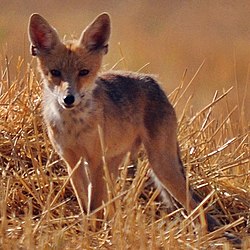 | ซาติน1906 | เป็นรูปแบบที่มีขนาดอยู่ระหว่างV. v. alpheryakiและV. v. caucasicaขนของมันมีสีเหลืองอ่อนหรือสีเทาอ่อน บางครั้งเป็นสีน้ำตาลแดง และฟูและหนาแน่นกว่าของสุนัขจิ้งจอกแดงคอเคซัสอีกสองสายพันธุ์[ 37 ] | ภาคตะวันออกเฉียงเหนือของตุรกี | อัลติโคลา (อ็อกเนฟ 1926) | |
สุนัขจิ้งจอกแห่งเทือกเขา Wasatch V. v. macroura | เบิร์ด 1852 | สุนัขจิ้งจอกตัวนี้คล้ายกับV. v. fulvusแต่มีหางยาวกว่ามาก เท้าหลังใหญ่กว่า และมีสีดำที่ขามากกว่า[ 39 ] | ตั้งชื่อตามเทือกเขา Wasatchใกล้ทะเลสาบเกรตซอลต์รัฐยูทาห์พบได้ในเทือกเขา Rocky Mountainsตั้งแต่รัฐโคโลราโดและยูทาห์ทางตะวันตกของ รัฐ ไวโอมิงและมอนแทนาผ่านรัฐไอดาโฮขึ้นไปทางเหนือจนถึงทางใต้ของรัฐอัลเบอร์ตา | ||
| ฮิลล์ฟ็อกซ์วี. วี. มอนทานา
| เพียร์สัน 1836 | สายพันธุ์ย่อยนี้แตกต่างจากV. v. vulpesตรงที่มีขนาดเล็กกว่า กะโหลกและฟันมีขนาดเล็กกว่าเมื่อเทียบกับสัดส่วน และขนหยาบกว่า ขนที่ฝ่าเท้ามีขนอ่อนนุ่มปนอยู่มาก[ 42 ] : 111 | เทือกเขาหิมาลัยและอนุทวีปอินเดียตอน เหนือ | อะโลเพ็กซ์ (แบลนฟอร์ด 1888) หิมาลัย (Ogilby 1837) ladacensis (Matschie 1907) nepalensis (JE Grey 1837) waddelli (Bonhote 1906) | |
สุนัขจิ้งจอกแดงเซียร์ราเนวาดาหรือ สุนัขจิ้งจอกไฮเซียร์ราV. v. necator | เมอร์เรียม1900 | ภายนอกดูคล้ายกับV. v. fulvus ; มีหางสั้น แต่ส่วนหัวจะคล้ายกับV. v. macroura มากกว่า [ 39 ] | เทือกเขาไฮเซียร์รารัฐแคลิฟอร์เนีย | ||
| สุนัขจิ้งจอกไนล์V. v. niloticus
| อี. เจฟฟรอย แซง-อิแลร์ 1803 | 76.7–105.3 ซม. 1.8–3.8 กก. | ขนาดเล็ก ความยาวหาง 30.2–40.1 ซม. ด้านบนมีสีแดงอมน้ำตาลถึงเทา และสีเข้มกว่าที่ด้านหลังของคอ ด้านข้างมีสีเทาและมีสีเหลืองอ่อนปนอยู่[ 44 ]มีขนาดใหญ่กว่าV. v. arabicaและV. v. palaestina [ 45 ] | อียิปต์และซูดาน | อียิปต์ัส (ซอนนินี 1816) อนูบิส (เฮมพริชและเอห์เรนเบิร์ก 1833) วัลเปคูลา (เฮมพริชและเอห์เรนเบิร์ก 1833) |
| สุนัขจิ้งจอกเตอร์กิสถานV. v. ochroxantha | อ็อกเนฟ1926 | Aksai , Semirechye , Turkestanรัสเซียตะวันออก, Kirgizia | |||
สุนัขจิ้งจอกปาเลสไตน์V. v. palaestina | โทมัส1920 | 45–60 ซม. 2–4 กก. | ขนาดเล็ก ความยาวหาง 30–40 ซม. สีขนเป็นสีแดงอมเทาหรือสีเทาอมแดง โดยเฉพาะบริเวณใบหน้า หูเป็นสีดำ บางครั้งถือว่าเหมือนกับ Vulpes vulpes arabica และยังไม่มีการวิเคราะห์ทางพันธุกรรมเพื่อพิสูจน์ความแตกต่าง[ 32 ] | ปาเลสไตน์อิสราเอลเลบานอนซีเรีย ขอบเขตกับ arabica , aegyptiacus , flavescens และ pusilla ไม่ชัดเจน Palaestina เป็นรูปแบบที่แพร่หลายตามแนวชายฝั่งทะเลเมดิเตอร์เรเนียนจาก Ramleh และ Jerusalem ไปจนถึงเลบานอน[ 32 ] | |
สุนัขจิ้งจอกเกาหลีV. v. peculiosa | คิชิดะ1924 | ภาคตะวันออกเฉียงเหนือของจีน ภาคตะวันออกเฉียงใต้ของรัสเซีย และเกาหลี | คิโยมัสไซ (คิชิดะและโมริ 2472) | ||
| สุนัขจิ้งจอกเท้าขาวV. v. pusilla
| บลายธ์ 1854 | มีขนาดเล็กกว่าV. v. griffithiiเล็กน้อย[ 42 ] : 123 มี ขนาดใกล้เคียงกับสุนัขจิ้งจอกเบงกอล ( V. bengalensis ) แต่มีลักษณะเด่นคือหางและเท้าหลังที่ยาวกว่า [ 42 ] : 129 | เทือกเขาซอลท์เรนจ์รัฐปัญจาบ ประเทศปากีสถาน | ลิวโคปัส (บลายธ์ 1854) เพอร์ซิคัส (แบลนฟอร์ด 1875) | |
| สุนัขจิ้งจอกที่ราบทางเหนือV. v. regalis
| เมอร์เรียม1900 | สุนัขจิ้งจอกแดงสายพันธุ์ย่อยที่ใหญ่ที่สุดในอเมริกาเหนือ มีหูที่ใหญ่และกว้างมาก และหางที่ยาวมาก มีสีเหลืองทองและเท้าสีดำสนิท[ 39 ] | แม่น้ำเอลก์ , เขตเชอร์เบิร์น , มินนิโซตา , สหรัฐอเมริกา | ||
สุนัขจิ้งจอกโนวาสโกเชียV. v. rubricosa | ผมหน้าม้าปี 1898 | เป็นสายพันธุ์ย่อยขนาดใหญ่ที่มีหางขนาดใหญ่และกว้าง มีฟันและจะงอยปากใหญ่กว่าV. v. fulvusและเป็นสายพันธุ์ย่อยที่มีสีเข้มที่สุด[ 39 ] | เขตดิกบี รัฐโนวาสโกเชีย ประเทศแคนาดา | บังซี (เมอร์เรียม 1900) deletrix (Bangs 1898) rubricos (Churcher 1960) vafra (Bangs 1897) | |
| สุนัขจิ้งจอกแดงเอโซV. v. schrencki
| คิชิดะ1924 | เกาะซาคาลินประเทศรัสเซีย และเกาะฮอกไกโดประเทศญี่ปุ่น | |||
| สุนัขจิ้งจอกไอบีเรียV. v. silacea
| มิลเลอร์1907 | แม้ว่าจะมีขนาดเท่ากับV. v. vulpesแต่ก็มีฟันที่เล็กกว่าและฟันกรามหน้าห่างกันมากกว่า ขนมีสีเหลืองอมน้ำตาลอ่อนโดยไม่มีสีเหลืองหรือแดงปน ส่วนท้ายลำตัวมีสีขาวอมเทา และหางมีสีเทาใส[ 46 ] | คาบสมุทรไอบีเรีย | ||
| สุนัขจิ้งจอกหมู่เกาะคูริเลV. v. splendidissima | คิชิดะ1924 | หมู่เกาะคูริลตอนเหนือและตอนกลางประเทศรัสเซีย | |||
| สุนัขจิ้งจอกแดงสเตปป์V. v. stepensis | บราวน์เนอร์1914 | สายพันธุ์ย่อยนี้มีขนาดเล็กกว่าและมีสีอ่อนกว่าV. v. crucigera เล็กน้อย โดยมีขนที่สั้นกว่าและหยาบกว่า ตัวอย่างจากเทือกเขาไครเมียมีขนที่สว่างกว่า ฟูและหนาแน่นกว่า[ 37 ] | ทุ่งหญ้าสเตปป์ใกล้เมืองเคอร์ซอนประเทศยูเครน | krymeamontana (Brauner 1914) ไครเมนซิส (บรอเนอร์ 1914) | |
| สุนัขจิ้งจอกโทบอลสค์V. v. tobolica | อ็อกเนฟ1926 | สายพันธุ์ย่อยขนาดใหญ่นี้มีขนสีเหลืองอมสนิมหรือสีแดงอมสกปรก มีลายขวางที่พัฒนาอย่างดี และมักมีบริเวณสีดำที่ท้อง ขนยาวและฟู[ 37 ] | ออบดอร์สค์ , โทบอลสค์ , รัสเซีย | ||
| สุนัขจิ้งจอกจีนเหนือV. v. tschiliensis
| มัตชี1907 | มีขนาดใหญ่กว่าV. v. hoole เล็กน้อย แต่ต่างจากสุนัขจิ้งจอกแดงจีนชนิดอื่นตรงที่มีขนาด ใกล้เคียงกับ V. v. vulpes [ 47 ] | ปักกิ่งและมณฑลเหอเป่ยประเทศจีน | ฮูลี (ซาวเวอร์บี 1923) |


คำอธิบาย
สร้าง

สุนัขจิ้งจอกแดงมีลำตัวยาวและขาค่อนข้างสั้น หางยาวกว่าครึ่งหนึ่งของความยาวลำตัว[ 37 ] (70 เปอร์เซ็นต์ของความยาวหัวและลำตัว) [ 48 ]มีลักษณะฟูและยาวถึงพื้นเมื่ออยู่ในท่ายืน ม่านตาของพวกมันเป็นรูปวงรีและวางตัวในแนวตั้ง[ 37 ] มี เยื่อหุ้มตาชั้นใน แต่จะเคลื่อนไหวเฉพาะเมื่อหลับตาเท่านั้น อุ้งเท้าหน้ามีห้านิ้ว ในขณะที่อุ้งเท้าหลังมีเพียงสี่นิ้วและไม่มีเล็บติ่ง [ 7 ] พวกมันว่องไวมาก สามารถกระโดดข้ามรั้วสูง 2 เมตร (6 ฟุต 7 นิ้ว) ได้ และว่ายน้ำได้ดี[ 49 ] โดยปกติแล้วสุนัขจิ้งจอกตัวเมียจะมีเต้านมสี่คู่ [ 37 ] แม้ว่าสุนัขจิ้งจอกตัวเมียที่มีเต้านมเจ็ด เก้า หรือสิบเต้าก็ไม่ใช่เรื่องแปลก[ 7 ]อัณฑะ ของ ตัวผู้มีขนาดเล็กกว่าของสุนัขจิ้งจอกอาร์กติก[ 37 ]
กะโหลกของพวกมันค่อนข้างแคบและยาว มีโพรงสมอง ขนาดเล็ก ฟันเขี้ยวของพวกมันค่อนข้างยาวความแตกต่างทางเพศของกะโหลกเด่นชัดกว่าในสุนัขจิ้งจอกคอร์แซค โดยสุนัขจิ้งจอกแดงเพศเมียมีแนวโน้มที่จะมีกะโหลกเล็กกว่าเพศผู้ มีบริเวณจมูกและเพดาน แข็งที่กว้างกว่า รวมถึงมีฟันเขี้ยวที่ใหญ่กว่า[ 37 ]กะโหลกของพวกมันแตกต่างจากของสุนัขตรงที่มีจมูก แคบกว่า ฟัน กรามหน้า ไม่เบียดกัน ฟันเขี้ยวเรียวกว่า และมีลักษณะเว้ามากกว่านูน[ 7 ]
มิติ
สุนัขจิ้งจอก แดงเป็นสายพันธุ์ที่ใหญ่ที่สุดในสกุลVulpes [ 50 ]อย่างไรก็ตาม เมื่อเทียบกับขนาดแล้ว สุนัขจิ้งจอกแดงมีน้ำหนักเบากว่าสุนัขที่มีขนาดใกล้เคียงกันในสกุลCanis มาก ตัวอย่างเช่น กระดูกแขนขาของพวกมันมีน้ำหนักน้อยกว่า 30 เปอร์เซ็นต์ต่อหน่วยพื้นที่ของกระดูกเมื่อเทียบกับสุนัขที่มีขนาดใกล้เคียงกัน[ 51 ] : 122 พวกมันแสดงให้เห็นถึงความแปรผันอย่างมีนัยสำคัญในขนาดตัวตามเพศ อายุ และภูมิศาสตร์ โดยเฉลี่ยแล้ว สุนัขจิ้งจอกแดงที่โตเต็มวัยมีความสูงที่ไหล่ 35–50 ซม. (14–20 นิ้ว) และความยาวลำตัว 45–90 ซม. (18–35 นิ้ว) โดยมีหางยาว 30–55.5 ซม. (11.8–21.9 นิ้ว) หูยาว 7.7–12.5 ซม. (3.0–4.9 นิ้ว) และเท้าหลังยาว 12–18.5 ซม. (4.7–7.3 นิ้ว) น้ำหนักอยู่ในช่วง 2.2–14 กก. (4.9–30.9 ปอนด์) โดยทั่วไปแล้วตัวเมียจะมีน้ำหนักน้อยกว่าตัวผู้ 15–20% [ 52 ] [ 53 ]สุนัขจิ้งจอกแดงโตเต็มวัยมีกะโหลกขนาด 129–167 มม. (5.1–6.6 นิ้ว) ในขณะที่ตัวเมียมีขนาด 128–159 มม. (5.0–6.3 นิ้ว) [ 37 ]รอยเท้าหน้ามีความยาว 60 มม. (2.4 นิ้ว) และกว้าง 45 มม. (1.8 นิ้ว) ในขณะที่รอยเท้าหลังมีความยาว 55 มม. (2.2 นิ้ว) และกว้าง 38 มม. (1.5 นิ้ว) พวกมันวิ่งเหยาะๆ ด้วยความเร็ว 6–13 กม./ชม. (3.7–8.1 ไมล์/ชม.) และมีความเร็วในการวิ่งสูงสุด 50 กม./ชม. (31 ไมล์/ชม.) พวกมันมีช่วงก้าว 25–35 ซม. (9.8–13.8 นิ้ว) เมื่อเดินด้วยความเร็วปกติ[ 51 ] : สุนัขจิ้งจอกแดงอเมริกาเหนือโดยทั่วไปมีรูปร่างเพรียวบาง มีลำตัวยาวเมื่อเทียบกับมวล และมีความแตกต่างทางเพศสูง สุนัขจิ้งจอกแดงอังกฤษมีรูปร่างใหญ่โตแต่เตี้ย ในขณะที่สุนัขจิ้งจอกแดงยุโรปภาคพื้นทวีปมีรูปร่างใกล้เคียงกับค่าเฉลี่ยทั่วไปของประชากรสุนัขจิ้งจอกแดง[ 54 ]สุนัขจิ้งจอกแดงที่ใหญ่ที่สุดเท่าที่บันทึกไว้ในสหราชอาณาจักรคือตัวผู้ยาว 1.4 เมตร (4 ฟุต 7 นิ้ว) หนัก 17.2 กก. (38 ปอนด์) ถูกฆ่าในแอเบอร์ดีนเชียร์ สก็อ ตแลนด์ ในช่วงต้นปี 2012 [ 55 ]
ขน

ขนในฤดูหนาวมีความหนาแน่น นุ่ม ลื่น และค่อนข้างยาว สำหรับสุนัขจิ้งจอกทางเหนือ ขนจะยาวมาก หนาแน่น และฟู แต่ในสายพันธุ์ทางใต้ ขนจะสั้นกว่า บางกว่า และหยาบกว่า[ 56 ]ในบรรดาสุนัขจิ้งจอกทางเหนือ สายพันธุ์อเมริกาเหนือโดยทั่วไปจะมีขนชั้นนอก ที่ลื่นที่สุด [ 11 ] : 231 ในขณะที่สุนัขจิ้งจอกแดงยูเรเซียส่วนใหญ่มีขนที่หยาบกว่า[ 11 ] : 235 ขนในบริเวณต่างๆ เช่น หัวและขาด้านล่าง ซึ่งเรียกว่า "ช่องระบายความร้อน" จะสั้นและหนาแน่นตลอดทั้งปี ในขณะที่ขนในบริเวณอื่นๆ จะเปลี่ยนแปลงไปตามฤดูกาล สุนัขจิ้งจอกควบคุมการขยายตัวและการหดตัวของหลอดเลือด ส่วนปลาย ในบริเวณเหล่านี้อย่างแข็งขันเพื่อควบคุมการสูญเสียความร้อน[ 57 ]มีสี หลักสามแบบ ได้แก่ สีแดง สีเงิน/ดำ และสีผสม (ดูการกลายพันธุ์ ) [ 48 ]ในสีแดงทั่วไป ขนของพวกมันมักจะมีสีแดงสนิมสดใสอมเหลือง ตามแนวกระดูกสันหลังจะมีแถบขนสีน้ำตาล แดง และน้ำตาลแดงจางๆ กระจายอยู่ มีแถบเพิ่มเติมอีกสองแถบพาดลงมาตามกระดูกสะบัก และเมื่อรวมกับแถบตามแนวกระดูกสันหลังจะเกิดเป็นรูปกากบาท ส่วนหลังส่วนล่างมักมีสีเงินปนด่าง สีข้างมีสีอ่อนกว่าหลัง ในขณะที่คาง ริมฝีปากล่าง คอ และหน้าอกส่วนหน้าเป็นสีขาว ส่วนที่เหลือของลำตัวด้านล่างมีสีเข้ม น้ำตาล หรือแดง[ 56 ]ในช่วงให้นมลูก ขนบริเวณท้องของแม่สุนัขจิ้งจอกอาจเปลี่ยนเป็นสีแดงอิฐ[ 7 ]ส่วนบนของขาเป็นสีแดงสนิม ในขณะที่อุ้งเท้าเป็นสีดำ ด้านหน้าของใบหน้าและคอส่วนบนเป็นสีน้ำตาลแดงสดใส ในขณะที่ริมฝีปากบนเป็นสีขาว ด้านหลังของใบหูเป็นสีดำหรือสีน้ำตาลแดง ในขณะที่ด้านในเป็นสีขาว ส่วนบนของหางเป็นสีน้ำตาลแดง แต่มีสีอ่อนกว่าหลังและสีข้าง ด้านล่างของหางมีสีเทาอ่อนอมสีเหลืองอ่อน มักจะมีจุดสีดำอยู่ที่โคนหาง ซึ่งเป็นที่ตั้งของต่อมซูพราคอดัล ปลายหางมีสีขาว[ 58 ]
การเปลี่ยนสี

สุนัขจิ้งจอกแดงป่ามีสีหลัก 3 แบบ ได้แก่ สีแดง สีผสม (เมลานิสติกบางส่วน) และสีเงิน (เมลานิสติก) สุนัข จิ้งจอกเผือกอาจพบได้ในป่า แม้ว่าจะหายากก็ตาม สีอื่นๆ นั้นหายากมากในป่า และส่วนใหญ่พบเฉพาะในสุนัขจิ้งจอกเลี้ยงเพื่อเอาขนเท่านั้น[ 59 ] [ 60 ]
| ชื่อ | ภาพ | ผิว | คำอธิบาย |
|---|---|---|---|
| สีแดง |  |  | สีขนโดยทั่วไป (ดูภาพขนด้านบน) |
| ข้าม |  |  | สะโพกและหลังส่วนล่างมีสีน้ำตาลเข้มหรือสีเทาเข้ม โดยมีสีเงินปนอยู่บนขนชั้นนอกในระดับต่างๆ กัน บริเวณไหล่มีสีดำหรือสีน้ำตาล บางครั้งมีขนสีเงินอ่อนๆ หัวและเท้ามีสีน้ำตาล[ 37 ] |
| เงิน | 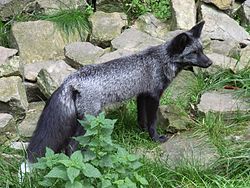 |  | สุนัขจิ้งจอกแดงอเมริกาเหนือมีสีเมลานิสติก แต่ถูกนำเข้ามาในโลกเก่าโดยการค้าขนสัตว์ มีลักษณะเป็นสีดำสนิท โดยผิวหนังมักมีสีเงินผสมอยู่บ้าง (ครอบคลุมพื้นที่ผิวหนัง 25–100%) [ 37 ] |
| สโมคกี้ | สะโพกและกระดูกสันหลังมีสีน้ำตาลหรือสีเทา โดยมีแถบสีเหลืองอ่อนบนขนชั้นนอก กากบาทบนไหล่มีสีน้ำตาล สีน้ำตาลสนิม หรือสีน้ำตาลแดง ขามีสีน้ำตาล[ 37 ] | ||
| สีน้ำตาลอมดำ |  | ลักษณะสีเมลานิสติกของสุนัขจิ้งจอกแดงยูเรเซีย มีผิวสีน้ำตาลอมดำหรือดำอมน้ำตาลอ่อน บริเวณผิวหนังมักมีสีเงินปะปนอยู่บ้าง ขนสีแดงอาจไม่มีเลยหรือมีเพียงเล็กน้อย[ 37 ] | |
| แพลทินัม |  |  | แตกต่างจากสีเงินโดยมีขนสีอ่อนเกือบขาวเงินอมฟ้า[ 11 ] : 251 |
| แอมเบอร์ |  | ||
| แซมซัน |  | โดดเด่นด้วยขนปุยที่ไม่มีขนป้องกัน[ 11 ] : 230 |
ประสาทสัมผัส
สุนัขจิ้งจอกแดงมีการมองเห็นแบบสองตา [ 7 ] แต่การมอง เห็นของพวกมันตอบสนองต่อการเคลื่อนไหวเป็นหลัก พวกมันมีประสาทการได้ยิน ที่เฉียบคม สามารถได้ยิน เสียง ไก่ป่าดำเปลี่ยนที่นอนในระยะ 600 ก้าว เสียงอีกาบินในระยะ 0.25–0.5 กม. (0.16–0.31 ไมล์) และเสียงหนูร้องในระยะประมาณ 100 เมตร (330 ฟุต) [ 61 ]พวกมันสามารถระบุตำแหน่งของเสียงได้อย่างแม่นยำถึงหนึ่งองศาที่ความถี่ 700–3,000 เฮิรตซ์ แม้ว่าจะแม่นยำน้อยลงที่ความถี่สูงกว่า[ 49 ]ประสาทการดมกลิ่นของพวกมันดี แต่ด้อยกว่าสุนัขที่เชี่ยวชาญด้านการดมกลิ่น[ 61 ]
ต่อมกลิ่น
สุนัขจิ้งจอกแดงมี ถุงทวารหนักคู่หนึ่งที่บุด้วยต่อมไขมันซึ่งเปิดผ่านท่อเดียว[ 62 ]ขนาดและปริมาตรของถุงทวารหนักจะเพิ่มขึ้นตามอายุ โดยมีขนาดตั้งแต่ 5–40 มม. ในแนวยาว 1–3 มม. ในแนวเส้นผ่านศูนย์กลาง และมีความจุ 1–5 มล. [ 63 ]ถุงทวารหนักทำหน้าที่เป็นห้องหมักซึ่งแบคทีเรียแอโรบิกและ แอนแอโรบิก จะเปลี่ยนไขมันให้เป็นสารประกอบที่มีกลิ่น รวมถึงกรดอะลิฟาติกต่อมหางรูปไข่มีความยาว 25 มม. (0.98 นิ้ว) และกว้าง 13 มม. (0.51 นิ้ว) และมีรายงานว่ามีกลิ่นเหมือนดอกไวโอเล็ต [ 37 ] การมีอยู่ของต่อมที่เท้ายังไม่แน่ชัด โพรงระหว่างนิ้วเท้าลึก มีสีแดงอมส้มและมีกลิ่นแรง ต่อมไขมันมีอยู่บริเวณมุมของขากรรไกรและขากรรไกรล่าง[ 7 ]
การกระจายตัวและถิ่นที่อยู่

สุนัขจิ้งจอกแดงเป็นสมาชิกที่แพร่หลายที่สุดในอันดับสัตว์กินเนื้อและพบได้ในทุกทวีปยกเว้นอเมริกาใต้และแอนตาร์กติกา[ 48 ]อาณาเขตการกระจายพันธุ์ครอบคลุมพื้นที่เกือบ 70,000,000 ตารางกิโลเมตร( 27,000,000 ตารางไมล์) ขยายไปทางเหนือสุดถึงวงกลมอาร์กติกพบได้ทั่วยุโรป ในแอฟริกาทางเหนือของทะเลทรายซาฮารา ทั่วเอเชียยกเว้นเอเชียตะวันออกเฉียงใต้สุด และทั่วอเมริกาเหนือยกเว้นส่วนใหญ่ทางตะวันตกเฉียงใต้ของสหรัฐอเมริกาและเม็กซิโก ไม่พบในหมู่เกาะอาร์กติก ส่วนเหนือสุดของไซบีเรีย ตอนกลาง และในทะเลทรายสุดขั้ว[ 1 ] ไม่พบในนิวซีแลนด์และจัดเป็น "สิ่งมีชีวิตใหม่ต้องห้าม" ภายใต้พระราชบัญญัติสารอันตรายและสิ่งมีชีวิตใหม่ พ.ศ. 2539ซึ่งไม่อนุญาตให้นำเข้า[ 64 ]
ออสเตรเลีย

ในออสเตรเลีย การประมาณการในปี 2012 ระบุว่ามีสุนัขจิ้งจอกแดงมากกว่า 7.2 ล้านตัว[ 65 ]โดยมีถิ่นที่อยู่กระจายไปทั่วแผ่นดินใหญ่เกือบทั้งหมด[ 51 ] : 14 พวกมันถูกนำเข้ามาในออสเตรเลียในช่วงทศวรรษ 1830 และ 1840 โดยผู้ตั้งถิ่นฐานในอาณานิคมของอังกฤษในแวนไดเมนส์แลนด์ (เร็วที่สุดในปี 1833) และเขตพอร์ตฟิลลิปของนิวเซาท์เวลส์ (เร็วที่สุดในปี 1845) ผู้ตั้งถิ่นฐานต้องการส่งเสริมกีฬาล่าสุนัขจิ้งจอก แบบดั้งเดิมของอังกฤษ อย่างไรก็ตาม ประชากรสุนัขจิ้งจอกแดงถาวรไม่ได้ตั้งรกรากบนเกาะแทสเมเนียและเป็นที่เชื่อกันอย่างกว้างขวางว่าสุนัขจิ้งจอกถูกแย่งชิงพื้นที่โดยปีศาจแทสเมเนีย[ 66 ]อย่างไรก็ตาม บนแผ่นดินใหญ่ สัตว์ชนิดนี้ประสบความสำเร็จในฐานะ ผู้ ล่าสูงสุดโดยทั่วไปแล้ว สุนัขจิ้งจอกจะพบได้น้อยในพื้นที่ที่ มี หมาป่าดิงโกชุกชุมกว่า แต่สุนัขจิ้งจอกสามารถปรับตัวให้เข้ากับ สภาพแวดล้อมใหม่ได้ โดยอาศัยพฤติกรรมการขุดโพรงเป็นหลัก ส่งผลให้ สุนัขจิ้งจอกกลายเป็นหนึ่งในชนิดพันธุ์ต่างถิ่นที่สร้างความเสียหายมากที่สุดในทวีปนี้
สุนัขจิ้งจอกแดงมีส่วนเกี่ยวข้องกับการสูญพันธุ์หรือการลดลงของสัตว์พื้นเมืองของออสเตรเลียหลายชนิด โดยเฉพาะอย่างยิ่งสัตว์ในวงศ์Potoroidaeซึ่งรวมถึงหนูจิงโจ้ทะเลทราย[ 67 ]การแพร่กระจายของสุนัขจิ้งจอกแดงไปทั่วภาคใต้ของทวีปเกิดขึ้นพร้อมกับการแพร่กระจายของกระต่ายในออสเตรเลียและสอดคล้องกับการลดลงของการกระจายตัวของสัตว์เลี้ยงลูกด้วยนมขนาดกลางที่อาศัยอยู่บนพื้นดินหลายชนิด รวมถึงเบตตองหางพู่เบตตองขุดดิน เบตตองสีน้ำตาลแดงบิลบี้นัมแบต วอลลาบี้หางเล็บและควอกก้า [ 68 ] ปัจจุบันสัตว์ส่วนใหญ่เหล่านี้จำกัดอยู่ในพื้นที่ (เช่น เกาะ) ที่ไม่มีสุนัขจิ้งจอกแดงหรือมีน้อยมาก มีโครงการกำจัดสุนัขจิ้งจอกในท้องถิ่นอยู่ แต่การกำจัดนั้นทำได้ยากเนื่องจากพฤติกรรมการสร้างรังและการล่าในเวลากลางคืนของสุนัขจิ้งจอก ดังนั้นจึงเน้นที่การจัดการ รวมถึงการแนะนำรางวัลจากรัฐ[ 69 ]ตามข้อมูลของรัฐบาลแทสเมเนีย สุนัขจิ้งจอกแดงถูกนำเข้ามาในเกาะแทสเมเนียโดยไม่ได้ตั้งใจ ซึ่งก่อนหน้านี้ไม่มีสุนัขจิ้งจอกอาศัยอยู่เลย ในปี 1999 หรือ 2000 ก่อให้เกิดภัยคุกคามอย่างมากต่อสัตว์ป่าพื้นเมือง รวมถึงบีทตองตะวันออกและได้มีการริเริ่มโครงการกำจัด โดยดำเนินการโดยกรมอุตสาหกรรมหลักและน้ำของแทสเมเนีย[ 70 ]
ซาร์ดิเนีย

แหล่งกำเนิดของ สายพันธุ์ ย่อยอิคนูเซในซาร์ดิเนียประเทศอิตาลี ยังไม่แน่นอน เนื่องจากไม่พบในแหล่งสะสมไพลสโตซีนในถิ่นกำเนิดปัจจุบัน เป็นไปได้ว่ามันมีต้นกำเนิดในช่วงยุคหินใหม่หลังจากที่มนุษย์นำเข้ามาในเกาะ ดังนั้นจึงเป็นไปได้ว่าประชากรจิ้งจอกซาร์ดิเนียสืบเชื้อสายมาจากการนำสัตว์จากแหล่งต่างๆ ในแถบเมดิเตอร์เรเนียนเข้ามาซ้ำๆ ทฤษฎีหลังนี้อาจอธิบายความหลากหลายทางฟีโนไทป์ของสายพันธุ์ย่อยได้[ 19 ]
พฤติกรรมและนิเวศวิทยา


พฤติกรรมทางสังคมและอาณาเขต
สุนัขจิ้งจอกแดงอาจสร้างอาณาเขตหากินที่มั่นคงภายในพื้นที่เฉพาะ หรืออาจเป็นสัตว์เร่ร่อนที่ไม่มีที่อยู่อาศัยถาวร[ 51 ] : 117 พวกมันใช้ปัสสาวะเพื่อทำเครื่องหมายอาณาเขตของตน [ 71 ] [ 72 ] สุนัขจิ้งจอกตัวผู้จะยกขาหลังข้างหนึ่งขึ้น พ่นปัสสาวะไปข้างหน้า ในขณะที่สุนัขจิ้งจอกตัวเมียจะนั่งยองๆ พ่นปัสสาวะลงบนพื้นระหว่างขาหลัง[ 73 ]ปัสสาวะยังใช้เพื่อทำเครื่องหมายบริเวณที่เก็บอาหารที่ว่างเปล่าซึ่งเป็นการเตือนไม่ให้เสียเวลาสำรวจ[ 51 ] : 125 [ 74 ] [ 75 ]โดยทั่วไปแล้ว ตัวผู้จะมีอัตราการทำเครื่องหมายด้วยปัสสาวะสูงกว่าในช่วงปลายฤดูร้อนและฤดูใบไม้ร่วง แต่ในช่วงเวลาที่เหลือของปี อัตราระหว่างตัวผู้และตัวเมียจะใกล้เคียงกัน[ 76 ]การใช้ท่าทางการปัสสาวะมากถึง 12 ท่าที่แตกต่างกัน ช่วยให้พวกมันควบคุมตำแหน่งของเครื่องหมายกลิ่นได้อย่างแม่นยำ[ 77 ]
สุนัขจิ้งจอกแดงอาศัยอยู่เป็นกลุ่มครอบครัวที่ใช้อาณาเขตเดียวกัน ในถิ่นที่อยู่อาศัยที่เหมาะสมและ/หรือพื้นที่ที่มีแรงกดดันจากการล่าต่ำ อาจพบสุนัขจิ้งจอกรองได้หลายตัว อาจมีสุนัขจิ้งจอกรองหนึ่งหรือสองตัว หรือบางครั้งอาจมากถึงแปดตัวในอาณาเขตเดียวกัน สุนัขจิ้งจอกรองเหล่านี้อาจเคยเป็น สัตว์ ที่เหนือกว่า มาก่อน แต่ส่วนใหญ่เป็นลูกสุนัขจิ้งจอกจากปีที่แล้วและทำหน้าที่ช่วยเหลือในการเลี้ยงลูกของแม่สุนัขจิ้งจอกที่กำลังผสมพันธุ์ หรืออีกนัยหนึ่ง การปรากฏตัวของพวกมันได้รับการอธิบายว่าเป็นการตอบสนองต่ออาหารส่วนเกินชั่วคราวที่ไม่เกี่ยวข้องกับการช่วยให้การสืบพันธุ์ประสบความสำเร็จ แม่สุนัขจิ้งจอกที่ไม่ผสมพันธุ์จะคอยเฝ้าดูแล เล่นกับลูกสุนัขจิ้งจอก ทำความสะอาด จัดหาอาหาร และเก็บลูกสุนัขจิ้งจอก[ 7 ]ซึ่งเป็นตัวอย่างของการคัดเลือกญาติสุนัขจิ้งจอกแดงอาจออกจากครอบครัวเมื่อโตเต็มวัยหากมีโอกาสชนะสูง มิฉะนั้น พวกมันจะอยู่กับพ่อแม่ โดยเลื่อนการสืบพันธุ์ของตนเองออกไป[ 51 ] : 140–141
การสืบพันธุ์และการพัฒนา


สุนัขจิ้งจอกแดงสืบพันธุ์ปีละครั้งในฤดูใบไม้ผลิ สองเดือนก่อนถึงฤดูผสมพันธุ์ (โดยทั่วไปคือเดือนธันวาคม) อวัยวะสืบพันธุ์ของสุนัขจิ้งจอกตัวเมียจะเปลี่ยนรูปร่างและขนาด เมื่อถึงฤดูผสมพันธุ์มดลูก ของพวกมัน จะมีขนาดใหญ่ขึ้นเป็นสองเท่า และรังไข่จะมีขนาดใหญ่ขึ้น 1.5–2 เท่าการสร้างอสุจิในตัวผู้เริ่มขึ้นในเดือนสิงหาคม–กันยายน โดยอัณฑะจะมีน้ำหนักมากที่สุดในเดือนธันวาคม–กุมภาพันธ์[ 78 ]ฤดูผสมพันธุ์ของสุนัขจิ้งจอกตัวเมียกินเวลาสามสัปดาห์[ 7 ]ในช่วงเวลานั้น สุนัขจิ้งจอกตัวผู้จะผสมพันธุ์กับสุนัขจิ้งจอกตัวเมียเป็นเวลาหลายวัน มักจะอยู่ในโพรงต่อมน้ำลายของตัวผู้จะขยายใหญ่ขึ้นระหว่างการผสมพันธุ์[ 8 ]ทำให้เกิดการเชื่อมต่อในการผสมพันธุ์ซึ่งอาจกินเวลานานกว่าหนึ่งชั่วโมง[ 7 ]ระยะเวลาตั้งครรภ์กินเวลา 49–58 วัน[ 78 ]แม้ว่าสุนัขจิ้งจอกส่วนใหญ่จะเป็นสัตว์คู่เดียว[ 79 ] หลักฐานดีเอ็นเอจากประชากรกลุ่มหนึ่งบ่งชี้ว่ามี การผสมพันธุ์ แบบหลายคู่ การร่วมประเวณีระหว่าง ญาติและลูกครอกที่มีพ่อต่างกันในระดับสูง[ 7 ]สุนัขจิ้งจอกตัวเมียที่ด้อยกว่าอาจตั้งครรภ์ได้ แต่มักจะไม่สามารถคลอดลูกได้ หรือลูกของพวกมันถูกฆ่าหลังคลอดโดยตัวเมียที่เด่นกว่าหรือตัวเมียที่ด้อยกว่าตัวอื่น[ 7 ]
โดยเฉลี่ยแล้วครอกหนึ่งจะมีลูกสี่ถึงหกตัว แม้ว่าจะมีรายงานว่าครอกหนึ่งอาจมีลูกมากถึง 13 ตัวก็ตาม[ 80 ]ครอกขนาดใหญ่เป็นเรื่องปกติในพื้นที่ที่มีอัตราการตายของสุนัขจิ้งจอกสูง[ 51 ] : 93 ลูกสุนัขจิ้งจอกเกิดมาตาบอด หูหนวก และไม่มีฟัน มีขนสีน้ำตาลเข้มฟูฟ่อง เมื่อแรกเกิด พวกมันมีน้ำหนัก 56–110 กรัม (2.0–3.9 ออนซ์) และมีความยาวลำตัว 14.5 เซนติเมตร (5.7 นิ้ว) และความยาวหาง 7.5 เซนติเมตร (3.0 นิ้ว) เมื่อแรกเกิด พวกมันมีขา pendek หัวใหญ่ และอกกว้าง[ 81 ]แม่สุนัขจิ้งจอกจะอยู่กับลูกเป็นเวลา 2–3 สัปดาห์ เนื่องจากพวกมันไม่สามารถควบคุมอุณหภูมิร่างกาย ได้ ในช่วงเวลานี้ พ่อหรือแม่สุนัขจิ้งจอกที่เป็นหมันจะป้อนอาหารให้แม่[ 7 ]แม่สุนัขจิ้งจอกจะปกป้องลูกของมันอย่างมาก และเป็นที่รู้กันว่าพวกมันถึงกับต่อสู้กับสุนัขเทอร์เรียเพื่อป้องกันตัวเอง[ 33 ] : 21–22 ถ้าแม่ตายก่อนที่ลูกจะพึ่งพาตัวเองได้ พ่อจะรับหน้าที่เป็นผู้หาเลี้ยงแทน[ 33 ] : 13 ลูกกระต่ายจะลืมตาได้หลังจาก 13–15 วัน ในช่วงเวลานั้น ช่องหูของพวกมันจะเปิดออกและฟันบนจะงอกออกมา โดยฟันล่างจะงอกออกมาในอีก 3–4 วันต่อมา[ 81 ]ดวงตาของพวกมันเป็นสีฟ้าเมื่อแรกเกิด แต่จะเปลี่ยนเป็นสีเหลืองอำพันเมื่ออายุ 4–5 สัปดาห์ ขนของพวกมันเริ่มเปลี่ยนสีเมื่ออายุสามสัปดาห์ โดยจะมีเส้นสีดำปรากฏขึ้นรอบดวงตา เมื่ออายุได้หนึ่งเดือน จะมีจุดสีแดงและสีขาวปรากฏขึ้นบนใบหน้า ในช่วงเวลานี้ หูของพวกมันจะตั้งตรงและจมูกจะยาวขึ้น[ 7 ]ลูกกระต่ายเริ่มออกจากรังและทดลองกินอาหารแข็งที่พ่อแม่จัดหาให้เมื่ออายุ 3–4 สัปดาห์ ระยะเวลา การให้นมจะนาน 6–7 สัปดาห์[ 81 ]ขนปุยของพวกมันจะเริ่มมีขนชั้นนอกที่เงางามปกคลุมหลังจาก 8 สัปดาห์[ 7 ]เมื่ออายุได้ 3-4 เดือน ลูกจิ้งจอกจะมีขายาว อกแคบ และผอมเพรียว พวกมันจะมีขนาดเท่าตัวเต็มวัยเมื่ออายุ 6-7 เดือน[ 81 ]จิ้งจอกตัวเมียบางตัวอาจถึงวัยเจริญพันธุ์เมื่ออายุ 9-10 เดือน จึงสามารถให้กำเนิดลูกครอกแรกได้เมื่ออายุครบ 1 ปี[ 78 ]ในกรงเลี้ยง พวกมันมีอายุยืนยาวได้ถึง 15 ปี แต่ในป่าโดยทั่วไปพวกมันมักจะมีชีวิตอยู่ได้ไม่เกิน 5 ปี[ 82 ]
พฤติกรรมการสร้างรัง

Outside of the breeding season, most red foxes prefer to live in the open, in densely vegetated areas, although they may enter burrows to escape bad weather.[7] Their burrows are often dug on hill or mountain slopes, in ravines and on steep riverbanks, as well as in ditches, depressions and gutters, and in rock clefts and neglected human environments. Red foxes prefer to dig their burrows in well-drained soil. Dens built among tree roots can last for decades, whereas those dug in steppe regions only last several years.[37] They may permanently abandon their dens during mange outbreaks, possibly as a defence mechanism against the spread of disease.[7] In the Eurasian desert regions, foxes may use the burrows of wolves, porcupines and other large mammals, as well as those dug by gerbil colonies. Compared to burrows constructed by Arctic foxes, badgers, marmots and corsac foxes, red fox dens are not overly complex. Red fox burrows consist of a den and temporary burrows. The latter comprise only a small passage or cave for concealment. The main entrance of the burrow leads downwards (40–45°) and opens into a den, from which numerous side tunnels branch off. The depth of the burrow ranges from 0.5–2.5 m (1 ft 8 in – 8 ft 2 in), rarely extending to ground water. The main passage can reach 17 m (56 ft) in length, standing an average of 5–7 m (16–23 ft). In spring, red foxes clear their dens of excess soil by making rapid movements with their forepaws and hind legs. They throw the discarded soil up to 2 m (6 ft 7 in) from the burrow. Once kits are born, the discarded debris is trampled to form an area where the kits can play and receive food.[37] They may share their dens with woodchucks[8] or badgers.[37] Unlike badgers, which fastidiously clean their earths and defecate in latrines, red foxes habitually leave pieces of prey around their dens.[33]: 15–17 The average sleep time of a captive red fox is 9.8 hours per day.[83]
Communication

ภาษากายของสุนัขจิ้งจอกแดงประกอบด้วยการเคลื่อนไหวของหูและหาง รวมถึงท่าทางต่างๆ เครื่องหมายบนตัวของพวกมันเน้นย้ำท่าทางบางอย่าง ท่าทางเหล่านี้สามารถแบ่งได้เป็นก้าวร้าว/มีอำนาจ หรือหวาดกลัว/ยอมจำนน บางท่าทางอาจผสมผสานทั้งสองอย่างเข้าด้วยกัน[ 51 ] : 42–43 สุนัขจิ้งจอกที่อยากรู้อยากเห็นจะหมุนและสะบัดหูขณะที่พวกมันดมกลิ่น ตัวที่ขี้เล่นจะตั้งหูขึ้นและยืนบนขาหลัง สุนัขจิ้งจอกตัวผู้จะหันหูออกไปด้านนอกและยกหางขึ้นในแนวนอนโดยให้ปลายหางชี้ขึ้นเมื่อเกี้ยวพาราสีตัวเมียหรือหลังจากขับไล่ผู้บุกรุกได้สำเร็จ เมื่อหวาดกลัว สุนัขจิ้งจอกแดงจะยิ้มอย่างยอมจำนน โค้งหลัง โค้งตัว ย่อตัวลง และสะบัดหางไปมาโดยให้หูชี้ไปข้างหลังและแนบกับกะโหลกศีรษะ เมื่อเพียงแค่แสดงความยอมจำนนต่อสัตว์ที่เหนือกว่า พวกมันจะใช้ท่าทางที่คล้ายกัน แต่ไม่โค้งหลังหรือโค้งตัว สุนัขจิ้งจอกที่ยอมจำนนจะเข้าหาสัตว์ที่เหนือกว่าโดยยื่นจมูกขึ้นเพื่อทักทายในท่าทางต่ำ เมื่อสุนัขจิ้งจอกสองตัวที่สูสีกันเผชิญหน้ากันเพื่อแย่งอาหาร พวกมันจะเข้าหากันเคียงข้างและดันกันที่ข้างลำตัว พวกมันแสดงออกถึงความกลัวและความก้าวร้าวผสมปนเปกันผ่านการกระทำ: พวกมันสะบัดหางและโก่งหลัง แต่จะไม่หมอบหรือดึงหูไปด้านหลังและแนบกับกะโหลก เมื่อโจมตีอย่างเด็ดขาด สุนัขจิ้งจอกแดงจะเข้าหาโดยตรงโดยยกหางขึ้นสูงและหมุนหูไปด้านข้าง[ 51 ] : 43 ในระหว่างการต่อสู้ดังกล่าว สุนัขจิ้งจอกแดงจะยืนบนตัวของกันและกันด้วยขาหน้า โดยใช้การข่มขู่ด้วยการอ้าปาก การต่อสู้ดังกล่าวโดยทั่วไปมักเกิดขึ้นเฉพาะในกลุ่มลูกสุนัขจิ้งจอกหรือสุนัขจิ้งจอกโตเต็มวัยเพศเดียวกัน[ 7 ]

สุนัขจิ้งจอกแดงมีช่วงเสียงที่กว้าง และสร้างเสียงที่แตกต่างกันครอบคลุมห้าอ็อกเทฟซึ่งผสมผสานเข้าด้วยกัน[ 51 ] : 28 การวิเคราะห์ล่าสุดได้ระบุเสียงที่แตกต่างกัน 12 เสียงที่ผลิตโดยตัวเต็มวัยและ 8 เสียงที่ผลิตโดยลูกสุนัขจิ้งจอก[ 7 ]เสียงส่วนใหญ่สามารถจัดประเภทได้เป็นเสียง "ติดต่อ" หรือ "ปฏิสัมพันธ์" เสียงแบบแรกจะแตกต่างกันไปตามระยะห่างระหว่างแต่ละตัว ในขณะที่เสียงแบบหลังจะแตกต่างกันไปตามระดับความก้าวร้าว[ 51 ] : 28
- เสียงเรียกติดต่อ: เสียงเรียกติดต่อที่ได้ยินบ่อยที่สุดคือเสียงเห่าที่มีสามถึงห้าพยางค์ ถอดเสียงเป็น " ว้าว ว้าว ว้าว " ซึ่งมักจะเป็นเสียงที่สุนัขจิ้งจอกสองตัวเปล่งออกมาเมื่อเข้าใกล้กัน เสียงเรียกนี้ได้ยินบ่อยที่สุดในช่วงเดือนธันวาคมถึงกุมภาพันธ์ (ซึ่งอาจสับสนกับเสียงร้องแสดงอาณาเขตของนกฮูกสีน้ำตาล ) เสียงเรียก " ว้าว ว้าว ว้าว " จะแตกต่างกันไปในแต่ละตัว สุนัขจิ้งจอกที่ถูกเลี้ยงไว้จะถูกบันทึกเสียงตอบรับเสียงเรียกที่บันทึกไว้ล่วงหน้าของเพื่อนร่วมกรง แต่ไม่ตอบรับเสียงเรียกของคนแปลกหน้า ลูกสุนัขจิ้งจอกเริ่มเปล่งเสียง " ว้าว ว้าว ว้าว " เมื่ออายุ 19 วัน เมื่อต้องการความสนใจ เมื่อสุนัขจิ้งจอกแดงเข้าใกล้กัน พวกมันจะเปล่งเสียงร้องทักทายสามพยางค์คล้ายกับเสียงร้องของไก่ ผู้ใหญ่จะทักทายลูกๆ ด้วยเสียงหอบห้าวๆ[ 51 ] : 28
- เสียงร้องโต้ตอบ: เมื่อทักทายกัน สุนัขจิ้งจอกแดงจะส่งเสียงร้องแหลมสูง โดยเฉพาะอย่างยิ่งเมื่อสัตว์ที่ยอมจำนนเข้าใกล้ สุนัขจิ้งจอกที่ยอมจำนนเมื่อถูกสัตว์ที่เหนือกว่าเข้าใกล้จะส่งเสียงร้องโหยหวนคล้ายเสียงไซเรน ในระหว่างการเผชิญหน้าอย่างก้าวร้าวกับสุนัขจิ้งจอกชนิดเดียวกัน พวกมันจะส่งเสียงสั่นในลำคอคล้ายกับเสียงเฟืองเรียกว่า "เก็กเกอริง" เก็กเกอริงเกิดขึ้นส่วนใหญ่ในช่วงฤดูเกี้ยวพาราสีจากตัวผู้หรือตัวเมียที่เป็นคู่แข่งที่ปฏิเสธการเกี้ยวพาราสี[ 51 ] : 28
เสียงร้องอีกเสียงหนึ่งที่ไม่เข้าข่ายทั้งสองประเภทคือเสียง " วาาาาห์ " ยาวๆ ที่มีพยางค์เดียว ซึ่งมักได้ยินในช่วงฤดูผสมพันธุ์ จึงเชื่อกันว่าเป็นเสียงที่แม่สุนัขจิ้งจอกเปล่งออกมาเพื่อเรียกตัวผู้ เมื่อตรวจพบอันตราย สุนัขจิ้งจอกจะส่งเสียงเห่าที่มีพยางค์เดียว ในระยะใกล้จะเป็นเสียงไอเบาๆ แต่ในระยะไกลจะแหลมกว่า ลูกสุนัขจิ้งจอกจะส่งเสียงครางเบาๆ ขณะดูดนม โดยเสียงร้องเหล่านี้จะดังเป็นพิเศษเมื่อพวกมันไม่พอใจ[ 51 ] : 28
อาหารและการล่าสัตว์


The red fox is an omnivore with a highly varied diet.[85][86] It consumes over 300 animal species including small rodents like mice, ground squirrels, hamsters, gerbils, woodchucks, muskrats, voles, pocket gophers, deer mice, leporids, porcupines, raccoons, opossums, birds with passeriformes, galliformes and waterfowl predominating, reptiles, insects and invertebrates.[37][8] It attacks young or small ungulates on rare occasions.[37] It typically targets mammals with a weight of up to 3.5 kg (7.7 lb) and requires 500 g (18 oz) of food daily.[49] It hunts its preferred prey when it is abundant, but it can still survive on different prey, as well as seeds and fruit, when it is not available.[87] It occasionally commits acts of surplus killing; during one breeding season, four red foxes were recorded to have killed around 200 black-headed gulls each, with peaks during dark, windy hours when flying conditions were unfavourable. Losses to poultry and penned game birds can be substantial because of this.[7][51]: 164 In some areas, fruit amounts to 100% of its diet in autumn, including blueberry, blackberry, raspberry, cherry, persimmon, mulberry, apple, plum, grape and acorn. Other plant material includes grass, sedge and tuber.[8]
In southern Italy, red foxes were observed eating pond slider eggs excavated from nests.[88] Camera traps at an Australian rookery documented red foxes preying on flatback sea turtle eggs.[89] The behavior of red foxes hunting wolf cubs was documented in Italy in 2025.[90]
Visual cues are the most important ones for the hunting behaviour of the red fox.[91] It prefers to hunt in the early morning hours before sunrise and late evening.[37] Successful hunting in long vegetation or under snow appears to involve its alignment with the Earth's magnetic field.[92] It typically forages alone, but occasionally aggregates in resource-rich environments.[82] When hunting mouse-like prey, it first pinpoints the prey's location by sound, then leap, sailing high above the quarry, steering in mid-air with its tail before landing on target up to 5 m (16 ft) away.[1] It feeds on carrion in the late evening hours and at night.[37] It seem to dislike the taste of moles, but nonetheless catches them alive and presents them to its young for playing.[51]: 41 It is possessive of its food and defends its catches even from dominant animals.[51]: 58
Competitors

The red fox typically dominates other fox species. Where the red fox and Arctic fox are sympatric, the Arctic fox feeds on lemmings and flotsam rather than voles, as favoured by red foxes. Both species kill each other's kits, given the opportunity.[37] The southern range of the Arctic fox is limited by the presence of the red fox; both were introduced to almost every island from the Aleutian Islands to the Alexander Archipelago during the 1830s–1930s by fur companies. The red fox invariably displaced the Arctic fox, with one male red fox having been reported to have killed off all resident Arctic foxes on a small island in 1866.[51]: 85
The red fox is a competitor of the corsac fox, as they hunt the same prey all year. The red fox is stronger, better adapted to hunting in snow deeper than 10 cm (3.9 in) and is more effective in hunting and catching medium-sized to large rodents. The corsac fox seems to only outcompete the red fox in semi-desert and steppe areas.[37][93] In Israel, the Blanford's fox escapes competition with the red fox by being restricted to rocky cliffs and actively avoiding the open plains inhabited by the red fox.[51]: 84–85 The red fox dominate kit and swift foxes. Kit foxes usually avoid competition with their larger cousins by living in more arid environments, though red foxes have been increasing in ranges formerly occupied by kit foxes due to human-induced environmental changes. Red foxes will kill both species and compete with them for food and den sites.[8] The gray fox dominates the red fox wherever their ranges meet. Historically, interactions between the two species were rare, as the gray fox favoured heavily wooded or semiarid habitats as opposed to the open and mesic ones preferred by the red fox. However, interactions have become more frequent due to deforestation, allowing the red fox to colonise gray fox-inhabited areas.[8]

The wolf is known to kill and eat the red fox in disputes over carcasses.[37][94] In North America where the red fox and coyote are sympatric, their home ranges do not overlap, and interactions between the two species vary in nature, ranging from active antagonism to indifference. The majority of aggressive encounters are initiated by coyotes, and there are few reports of red foxes acting aggressively toward coyotes except when attacked or when their kits were approached. Foxes and coyotes have sometimes been seen feeding together.[95] In Israel, the red fox shares habitat with the golden jackal, and where their ranges meet, they compete due to near-identical diets. The red fox ignores golden jackal scents or tracks and avoids close physical proximity; in areas where the golden jackal is abundant, the red fox population decreases significantly, apparently because of competitive exclusion.[96] However, multiple red foxes interacting peacefully with a golden jackal have been observed in southwestern Germany.[97]
The red fox is dominant over the raccoon dog and will sometimes kill its kits or bite adults to death. There are documented cases of red foxes killing raccoon dogs by entering their dens. Both species compete for prey similar in size to mice. This competition peaks in early spring when food is scarce. In Tatarstan, red fox predation accounted for 11.1% of deaths among 54 raccoon dogs and amounted to 14.3% of 186 raccoon dog deaths in northwestern Russia.[37]
The red fox occasionally kills small mustelids like least weasel,[8]stone marten,[98]pine marten, stoat, Siberian weasel, European polecat and young sables. Eurasian badgers may live alongside red foxes in isolated sections of large burrows.[37] The two species may tolerate each other out of mutualism: red foxes provide Eurasian badgers with food scraps, while Eurasian badgers keep the shared burrow clean.[33]: 15 However, there are known cases of Eurasian badgers driving vixens from their dens and destroying their litters without eating them.[37]Wolverines may kill red foxes, often while the latter is sleeping or near carrion.[37]: 546 In turn, red foxes may kill young wolverines.[37]
The red fox competes with the striped hyena over large carcasses. The striped hyena's stronger jaws can easily tear open flesh that is too tough for the red fox. When harassing striped hyenas, it avoids attacks by outrunning them. Sometimes, red foxes seem to deliberately torment striped hyenas even when food is not at stake. However, some red foxes misjudge their attacks and are killed.[51]: 77–79 The remains of red foxes are often found in striped hyena dens, and striped hyenas steal red foxes from traps.[37]
The red fox may be preyed upon by the leopard, caracal and Eurasian lynx. The Eurasian lynx chases the red fox into deep snow, where its long legs and larger paws gives it an advantage over the red fox, especially when the depth of the snow exceeds one meter.[37] In the Velikoluksky District in Russia, the red fox is absent or seen only occasionally where the Eurasian lynx established permanent territories.[37] In North America, the red fox is predated by the cougar, Canada lynx and bobcat.[48]
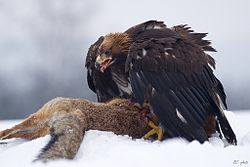
The red fox competes with common buzzard (Buteo buteo) and northern goshawk (Accipiter gentilis) and even steals their kills.[99] The golden eagle (Aquila chrysaetos) regularly takes young red foxes and preys on adults if needed.[100] Other large eagles such as the wedge-tailed eagle (Aquila audax), eastern imperial eagle (Aquila heliaca), white-tailed eagle (Haliaeetus albicilla) and steller's sea eagle (Haliaeetus pelagicus) occasionally kill red foxes.[101][102][103] Large owls such as the Eurasian eagle-owl (Bubo bubo) and snowy owl (Bubo scandiacus) prey on young foxes and adults on occasions.[104][105]
Diseases and parasites

Red foxes are the most important rabies vector in Europe. In London, arthritis is common in foxes, being particularly frequent in the spine.[7] Foxes may be infected with leptospirosis and tularemia, though they are not overly susceptible to the latter. They may also fall ill from listeriosis and spirochetosis, as well as acting as vectors in spreading erysipelas, brucellosis and tick-borne encephalitis. A mysterious fatal disease near Lake Sartlan in the Novosibirsk Oblast occurred among red foxes, but the cause was unclear. Individual cases of foxes infected with Yersinia pestis are known.[37]
Red foxes are not readily prone to infestation with fleas. Species like Spilopsyllus cuniculi are probably only caught from the fox's prey species, while others like Archaeopsylla erinacei are caught whilst traveling. Fleas that feed on red foxes include Pulex irritans, Ctenocephalides canis and Paraceras melis. Ticks such as Ixodes ricinus and I. hexagonus are not uncommon in red foxes, and are typically found on nursing vixens and kits still in their earths. The louseTrichodectes vulpis specifically targets red foxes, but is found infrequently. The miteSarcoptes scabiei is the most important cause of mange in red foxes. It causes extensive hair loss, starting from the base of the tail and hindfeet, then the rump before moving on to the rest of the body. In the final stages of the condition, red foxes can lose most of their fur, 50% of their body weight and may gnaw at infected extremities. In the epizootic phase of the disease, it usually takes red foxes four months to die after infection. Other endoparasites include Demodex folliculorum, Notoderes, Otodectes cynotis (which is frequently found in the ear canal), Linguatula serrata (which infects the nasal passages) and ringworms.[37] Up to 60 helminth species are known to infect captive-bred foxes in fur farms, while 20 are known in the wild. Several coccidian species of the generaIsospora and Eimeria are also known to infect them.[37] The most common nematode species found in red fox guts are Toxocara canis and Uncinaria stenocephala, Capillaria aerophila[106] and Crenosoma vulpis; the latter two infect their lungs and trachea.[107]Capillaria plica infects the red fox's bladder. Trichinella spiralis rarely affects them. The most common tapeworm species in red foxes are Taenia spiralis and T. pisiformis. Others include Echinococcus granulosus and E. multilocularis. Eleven trematode species infect red foxes,[7] including Metorchis conjunctus.[108] A red fox from was found to be a host of intestinal parasitic acanthocephalan worms, Pachysentis canicola in Bushehr Province, Iran,[109]Pachysentis procumbens and Pachysentis ehrenbergi in both in Egypt.[110]
Relationship with humans
In folklore, religion and mythology

The red fox features prominently in the folklore and mythology. In Greek mythology, the Teumessian fox,[111] or Cadmean vixen, was a gigantic fox that was destined never to be caught. The fox was one of the children of Echidna.[112]
In Celtic mythology, the red fox is a symbolic animal. In the Cotswolds, witches were thought to transform into foxes in order to steal butter from their neighbours.[113] In later European folklore, the figure of Reynard the Fox symbolises trickery and deceit. He first appeared as a secondary character under the name of "Reinardus" in the 1150 poem "Ysengrimus", and then in Pierre Saint Cloud's Le Roman de Renart in 1175. He made his debut in England in Geoffrey Chaucer's The Nun's Priest's Tale. Many of Reynard's adventures may stem from actual observations of fox behaviour: he is an enemy of the wolf and has a fondness for blackberries and grapes.[51]: 32–33
Chinese folk tales tell of fox-spirits called huli jing that may have up to nine tails, or kumiho as they are known in Korea.[114] In Japanese mythology, the kitsune are fox-like spirits possessing magical abilities that increase with their age and wisdom. Foremost among these is the ability to disguise as human. While some folktales speak of kitsune employing this ability to trick others, other stories portray them as faithful guardians, friends, lovers and wives.[115] In Arab folklore, the fox is considered a cowardly, weak, deceitful and cunning animal that feigns death by filling its abdomen with air to appear bloated, then lies on its side, awaiting the approach of unwitting prey.[45] The animal's cunning was noted by the authors of the Bible who applied the word "fox" to false prophets in the Book of Ezekiel 13:4 and the hypocrisy of Herod Antipas in Luke 13:32.[116]
The cunning Fox is a common character in native American mythology, where it is often portrayed as a constant companion to Coyote. Fox, however, is a deceitful companion who often steals Coyote's food. In the Achomawicreation myth, Fox and Coyote are the co-creators of the world, that leave just before the arrival of humans. The Yurok tribe believed that in a fit of anger, Fox captured the Sun and tied him to a hill, causing him to burn a great hole in the ground. In an Inuit story, Fox is portrayed as a beautiful woman who tricks a hunter into marrying her, only to resume her true form and leave after he offends her. A Menominee story tells of how Fox is an untrustworthy friend to Wolf.[117]
Hunting

The earliest historical records of fox hunting date back to the 4th century BC; Alexander the Great is known to have hunted foxes, and a seal dated from 350 BC depicts a Persian horseman in the process of spearing a fox. Xenophon, who believed that hunting was part of a cultured man's education, promoted killing foxes as pests because they distracted hounds from hares. The Romans were hunting foxes by AD 80. During the Dark Ages in Europe, foxes were considered a secondary quarry, but gradually grew in importance. Cnut the Great reclassified foxes as Beasts of the Chase, which was a lower category of quarry than Beasts of Venery. Foxes were gradually hunted less as vermin and more as Beasts of the Chase, to the point that by the late 1200s, Edward I had a royal pack of foxhounds and a specialised fox huntsman. In this period, foxes were increasingly hunted above ground with hounds, rather than underground with terriers. Edward, Second Duke of York assisted the climb of foxes as more prestigious quarries in his The Master of Game. By the Renaissance, fox hunting became a traditional sport of the nobility. After the English Civil War caused a drop in deer populations, fox hunting grew in popularity. By the mid-1600s, Great Britain was divided into fox hunting territories, with the first fox hunting clubs being formed (the first was the Charlton Hunt Club in 1737). The popularity of fox hunting in Great Britain reached a peak during the 1700s.[51]: 21 Although already native to North America, red foxes from England were imported for sporting purposes to Virginia and Maryland in 1730 by prosperous tobacco planters.[118] These American fox hunters considered the red fox more sporting than the grey fox.[118]
The grays furnished more fun, the reds more excitement. The grays did not run so far, but usually kept near home, going in a circuit of six or eight miles. 'An old red, generally so called irrespective of age, as a tribute to his prowess, might lead the dogs all day, and end by losing them as evening fell, after taking them a dead stretch for thirty miles. The capture of a gray was what men boasted of; a chase after 'an old red' was what they 'yarned' about.[118]
Red foxes are still widely persecuted as pests, with human-caused deaths being one of the main causes of mortality for the species. Annual red fox kills are: UK 21,500–25,000 (2000); Germany 600,000 (2000–2001); Austria 58,000 (2000–2001); Sweden 58,000 (1999–2000); Finland 56,000 (2000–2001); Denmark 50,000 (1976–1977); Switzerland 34,832 (2001); Norway 17,000 (2000–2001); Saskatchewan (Canada) 2,000 (2000–2001); Nova Scotia (Canada) 491 (2000–2001); Minnesota (US) 4,000–8,000 (average annual trapping harvest 2002–2009);[119]New Mexico (US) 69 (1999–2000).[98]
Fur use


Red foxes are among the most important fur-bearing animals harvested by the fur trade. Their pelts are used for trimmings, scarfs, muffs, jackets and coats. They are primarily used as trimming for both cloth coats and fur garments, including evening wraps.[11]: 229–230 The pelts of silver foxes are popular as capes,[11]: 246 while cross foxes are mostly used for scarves and rarely for trimming.[11]: 252 The number of sold fox scarves exceeds the total number of scarves made from other fur-bearers. However, this amount is overshadowed by the total number of red fox pelts used for trimming purposes.[11]: 229–230 The silver colour morphs are the most valued by furriers, followed by the cross colour morphs and the red colour morphs, respectively.[33]: 207 In the early 1900s, over 1,000 American red fox skins were imported to Great Britain annually, while 500,000 were exported annually from Germany and Russia.[33]: 6 The total worldwide trade of wild red foxes in 1985–86 was 1,543,995 pelts. Red foxes amounted to 45% of U.S. wild-caught pelts worth $50 million.[98] Pelt prices are increasing, with 2012 North American wholesale auction prices averaging $39 and 2013 prices averaging $65.78.[120]
Red foxes in North America, particularly those in northern Alaska, are highly valued for their fur. They have guard hairs with a silky texture that allows unrestricted mobility after dressing. However, red foxes living in southern Alaska's coastal areas and the Aleutian Islands are an exception, as their pelts are extremely coarse and rarely fetch more than a third of the price of those from northern Alaska.[11]: 231 Compared to North American varieties, most European peltries have coarse-textured fur. The only exceptions are Nordic and Far Eastern Russian pelts, which are still inferior to North American pelts in terms of silkiness.[11]: 235
Livestock and pet predation


Red foxes may occasionally prey on lambs. Usually but not always, the lambs targeted are physically weakened specimens. Lambs belonging to smaller breeds, such as the Scottish Blackface, are more vulnerable than larger breeds, such as the Merino. Twins may be more vulnerable to red foxes than single lambs, as ewes cannot effectively defend both simultaneously. Crossbreeding small, upland ewes with larger, lowland rams can result in difficult and prolonged labour for ewes due to the heaviness of the resulting offspring, making them more vulnerable to predation by red foxes. Lambs born to first-time mothers (gimmers) are more often killed by red foxes than lambs born to experienced mothers, who stick closer to their young.[51]: 166–167
Red foxes may prey on domestic rabbits and guinea pigs if they are kept in open runs or are allowed to roam freely in gardens. This problem can be avoided by housing them in robust hutches and runs. Urban red foxes often encounter cats and may feed alongside them. In physical confrontations, the cats usually have the upper hand. Cases where red foxes have killed cats usually involve kittens. While most red foxes do not prey on cats, some may do so and may treat them more as competitors rather than food.[51]: 180–181
Taming and domestication

In their unmodified wild state, red foxes are generally unsuitable as pets.[121] Many supposedly abandoned kits are adopted by well-meaning people in spring, although it is unlikely that vixens would abandon their young. Actual orphans are rare, and those that are adopted are probably just kits that have strayed from their dens.[122] Kits require almost constant supervision; when still suckling, they require milk at four-hour intervals day and night. Once weaned, they may become destructive to leather objects, furniture and electric cables.[51]: 56 Though generally friendly toward people when young, captive red foxes become fearful of humans, save for their handlers, once they reach 10 weeks of age.[51]: 61 They maintain their wild counterparts' strong instinct of concealment and may pose a threat to domestic birds, even when well-fed.[33]: 122 Although suspicious of strangers, they can form bonds with cats and dogs, even ones bred for fox hunting. Tame red foxes were once used to draw ducks close to hunting blinds.[33]: 132–133
White to black individual red foxes have been selected and raised on fur farms as "silver foxes". In the second half of the 20th century, a lineage of domesticated silver foxes was developed by Russian geneticist Dmitry Belyayev who, over a 40-year period, bred several generations selecting only those individuals that showed the least fear of humans. Eventually, Belyayev's team selected only those that showed the most positive response to humans, thus resulting in a population of silver foxes whose behaviour and appearance was significantly changed. After about 10 generations of controlled breeding, these foxes no longer showed any fear of humans and often wagged their tails and licked their human caretakers to show affection. These behavioural changes were accompanied by physical alterations, which included piebald coats, floppy ears in kits and curled tails, similar to the traits that distinguish domestic dogs from grey wolves.[123]
Urban red foxes

Distribution
Red foxes have been extremely successful in colonising built-up environments, particularly lower-density suburbs,[49] although they have also been sighted in densely populated urban areas far from the countryside. Throughout the 20th century, they have established themselves in many Australian, European, Japanese and North American cities. The species first colonised British cities during the 1930s, entering Bristol and London during the 1940s, and later established themselves in Cambridge and Norwich. In Ireland, they are now common in suburban Dublin. In Australia, red foxes were recorded in Melbourne as early as the 1930s, while in Zurich, Switzerland, they only started appearing in the 1980s.[124]
Urban red foxes are most common in residential suburbs consisting of privately owned, low-density housing. They are rare in areas where industry, commerce or council-rented houses predominate.[49] In these latter areas, the distribution is of a lower average density because they rely less on human resources; the home range of these foxes average from 80–90 ha (0.80–0.90 km2; 200–220 acres), whereas those in more residential areas average from 25–40 ha (0.25–0.40 km2; 62–99 acres).[125]
In the UK, it is estimated that the number of urban foxes rose from 33,000 in 1995 to 150,000 foxes in 2017.[126] City-dwelling red foxes may scavenge food from litter bins and bin bags: research in 2025 suggests that human-generated food comprises 35% of urban fox diet, compared to just 6% for their rural counterparts.[127] As a result of this difference in diet between urban and rural populations, city-dwelling red foxes tend to grow larger than their rural counterparts.[128] It has been observed that urban foxes tend to have shorter and wider muzzles, smaller braincases and reduced sexual dimorphism relative to rural individuals: this is thought to be as a result of differing biomechanical demands of feeding or cognition between habitats.[129]
Behaviour
Urban red foxes are most active at dusk and dawn, when they do most of their hunting and scavenging. They are rarely seen during the day, but can sometimes be spotted sunbathing on the roofs of houses or sheds. They will often make their homes in hidden, undisturbed spots in urban areas, as well as on the outskirts of cities, visiting at night to find food. They sleep in dens at night.
While urban red foxes can scavenge successfully in cities, eating anything that humans eat, some people deliberately leave food out for them, finding them endearing. Doing this regularly can attract red foxes to one's home, where they can become accustomed to human presence. They may even allow themselves to be approached or played with, particularly the young kits.[125]
Urban red fox control
Urban red foxes can cause problems for local residents. They are known to steal chickens, rummage through rubbish bins and damage gardens. Most complaints about urban red foxes made to local authorities occur during the breeding season, which is from late January/early February to late April/early August.[125]
In the UK, hunting red foxes in urban areas is banned, and shooting them in an urban environment is not a suitable alternative. Trapping them appears to be a more viable alternative to hunting urban red foxes.[130] However, killing red foxes has little effect on their urban population; the foxes that are killed are quickly replaced by new kits during the breeding season or by other foxes moving into the territory of those that were killed. A more effective method of controlling red foxes in urban areas is to deter them from specific areas. Deterrents such as creosote, diesel oil or ammonia can be used for this purpose. Cleaning up and blocking access to dens can also discourage red foxes from returning to urban areas.[125]
Relationship between urban and rural red foxes
In January 2014 it was reported that "Fleet", a relatively tame urban red fox tracked as part of a wider study by the University of Brighton in partnership with the BBC TV series Winterwatch, had unexpectedly traveled 195 miles in 21 days from his neighbourhood in Hove at the western edge of East Sussex across rural countryside as far as the town of Rye, near the eastern edge of the county. He was still continuing his journey when the GPS collar stopped transmitting due to suspected water damage. Along with setting a record for the longest journey undertaken by a tracked red fox in the United Kingdom, his travels have highlighted the fluidity of movement between rural and urban red fox populations.[131][132]
 An urban red fox crossing a city street in Denver, Colorado
- An urban red fox in a built-up area in London, England
 An urban red fox eating from a bag of biscuits in Dorset, England
 "Fleet", the urban red fox from the BBC TV series Winterwatch


Notes
Further reading
- Osborn, Dale. J. & Helmy, Ibrahim (1980). "The contemporary land mammals of Egypt (including Sinai)". Fieldiana. New Series (5). Field Museum of Natural History.
- Sillero-Zubiri, Claudio; Hoffman, Michael & MacDonald, David W. (2004). Canids: Foxes, Wolves, Jackals and Dogs – 2004 Status Survey and Conservation Action Plan. IUCN/SSC Canid Specialist Group. ISBN 978-2-8317-0786-0. Archived from the original on 6 October 2011.
- Spagnesi, Mario & De Marina Marinis, Maria (2002). "Mammiferi d'Italia". Quaderni di Conservazione della Natura. ISSN 1592-2901.
External links


- "Vulpes vulpes (Linnaeus, 1758)". Integrated Taxonomic Information System. Retrieved 18 March 2006.
- Red Fox, National Geographic
- Natural History of the Red Fox, Wildlife Online
- Sacramento Valley red fox info1
- Red Fox, Fletcher Wildlife Garden
สรุปเนื้อหา
ข้อมูลสำคัญจากบทความ
ข้อมูลสำคัญเกี่ยวกับ Red fox
The red fox (Vulpes vulpes) is the largest of the true foxes, and the most widely distributed member of the order Carnivora.
Terminology
Males are called tods or dogs, females are called vixens, and young are known as cubs or kits.
Etymology
คำว่า "fox" มาจาก ภาษาอังกฤษโบราณ ซึ่งสืบเนื่องมาจาก ภาษาโปรโตเยอรมัน * fuhsaz เปรียบเทียบกับ ภาษาเวส ต์ฟรีเซียน foks , ภาษาดัตช์ vos และ ภาษาเยอรมัน Fuchs ซึ่งสืบเนื่องมาจาก ภาษาโปรโตอินโด-ยุโรป * puḱ- 'ขนหนา; หาง' เปรียบเทียบกับภาษา ฮินดี pū̃ch 'หาง',...
วิวัฒนาการ
สุนัขจิ้งจอกแดงมีต้นกำเนิดในยูเรเซียและอาจวิวัฒนาการมาจาก Vulpes alopecoides หรือ V. chikushanensis ของจีนซึ่งทั้งสองชนิดมีชีวิตอยู่ในช่วง Villafranchian ตอนกลาง ของ ยุคไพลสโตซีน [ 16 ] ฟอสซิล ที่เก่าแก่ที่สุดของ V.