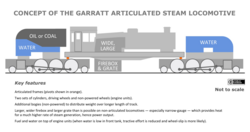
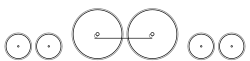
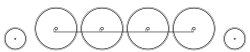
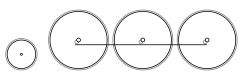
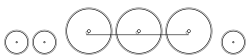
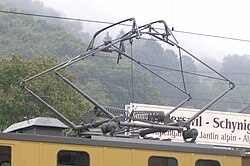
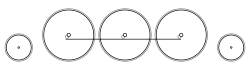
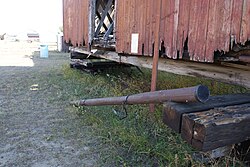
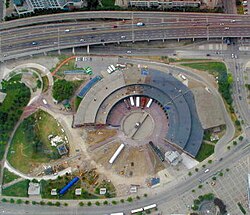
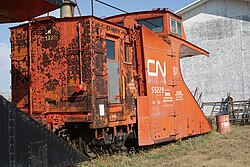
A type of geared steam locomotive built to the patents of Ephraim Shay[227]
Shunt
In UK and Australian parlance, to make up and divide trains in sidings, to move trains to or from sidings, or to move trains between platforms in a station[240]
Shoofly
Temporary track used to avoid an obstacle that blocks movement on the normal track section
A train, usually a passenger service, that runs back and forth, usually over a relatively short distance, such as between a junction station and a branch-line terminus.
A section of track off the main line. Sidings are often used for storing rolling stock or freight. A siding is also used as a form of rail access for warehouses and other businesses, where the siding often meets up with loading docks at rail car height. In the U.S. the term also covers the British term loop. Also, a passing track in the U.S.
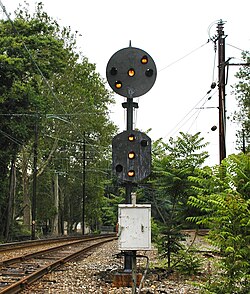
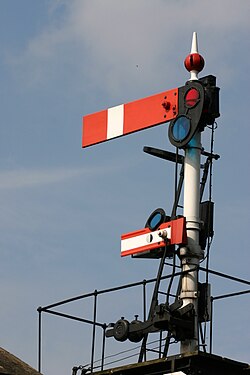
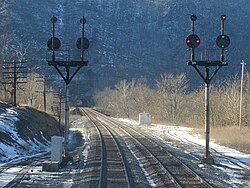
A two-head color position signal on a CSXT mainline where the left head displays "Stop" and the right, "Clear"A device that indicates the condition of the line ahead to the driver of a train
The condition of fallen leaves or other debris lying on and clinging to a railroad track that could cause train wheel slippage, resulting in premature wheel wear and train delays
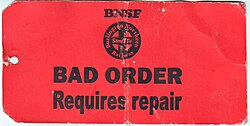
A local speed restriction below the track's normal speed limit often designated by yellow and green flags. Slow orders can be imposed on a temporary basis to protect, for example, maintenance of way employees while sections of track are under repair. Widely used in areas where track is substandard and in need of repair.
A locomotive that contains traction motors yet lacks the diesel engine to create its own power, which is instead supplied by a connected mother locomotive[227]
An enclosed (normally cylindrical) space attached to the end of the boiler opposite the firebox on a steam locomotive (normally the front). Supports the stack; steam pipes to and from the cylinders pass through here; contains the blastpipe where the exhaust steam is used to provide draft for the fire. In superheated locomotives, also contains the superheater header and (optionally) a front-end throttle.
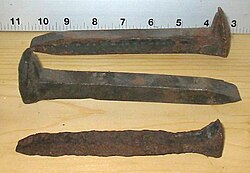
Two unused and one heavily corroded spikes, with an inch ruler shown for scaleA bolt, pin, or nail used to hold rails, or plates connected to the rails (known as tie plates), to sleepers (ties)
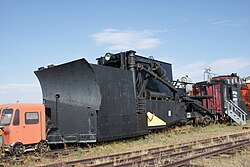
A Jordan spreaderMaintenance of way equipment designed to spread or shape ballast profiles, remove snow, clean and dig ditches as well as trim embankments
A device generally used in passenger trains to create steam for heating. The steam generator is usually in the locomotive but may also be located in other cars.[227]
A mechanical device that boosts the pressure of engine intake air to above atmospheric level, causing an increase in power. Not to be confused with the blower used to scavenge the cylinders of a naturally aspirated two-stroke Diesel engine.
Superelevation
Areas on curves where the outside rail is elevated higher than the inside rail, creating a banked curve, generally allowing higher speeds and more comfort for passengers (on passenger trains).
A device in a steam locomotive that raises the temperature of saturated steam substantially beyond the boiling point of water, increasing power and efficiency[227]
To determine the position of constructed objects, including rail infrastructure, in relation to the earth's surface. This is accomplished by measuring angles and distances based on the principles of triangulation.
A method of climbing and descending steep gradients, where shallow-gradient track reverses direction for a while, and then reverses again to continue in the original direction
A track tamping machineGenerally, a locomotive used in track maintenance and equipped with track lifting facilities, and paddles that push ballast beneath a rail track to assure its level and cant
A company in the United States that owns no cars of its own and transports only the railroad cars of other companies around a specific terminal station[247]
Texas type
The Texas wheel arrangementA steam locomotive with a 2-10-4 wheel arrangement
A passenger coach that is disconnected from one train and attached to another before continuing on with its journey, thus avoiding the need for passengers themselves to switch trains[248]
Through platform
The standard platform and track arrangement at a station. The train pulls alongside the platform, arriving from one end of the station, and may pass out the other end of the station by continuing along the same track[249]
In North America, a form used by railroad employees that shows the locations of slow orders, maintenance of way work locations, and other conditions affecting the track and movement of trains
An electrical circuit that detects the presence of locomotives or cars (as their wheelsets electrically bond the rails) in a block of track, and provides real-time input to signaling logic
The gradual application of superelevation and tighter curve radius, calculated with reference to the anticipated line speed and the final curve radius, on the approach to a bend. Also known as the transition spiral and spiral easement.
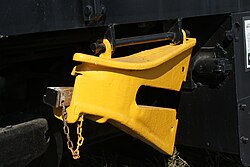
The mechanical interface that links vehicles so a driver can operate them together. The coupler can be a purely mechanical device such as a screw coupler or bar coupler. Alternatively the coupler can also incorporate electrical or pneumatic connections.[250]
The warning horn in a locomotive or in a control car
Trainman
In North America, an employee assigned to train service, such as a conductor, brakeman, or switchman
Train inauguration
The automated process of train bus configuration that includes detecting all bus nodes and their orientation, assigning the numbers to particular bus nodes and collecting their properties.[251]
Train operation and management
In Europe, the procedures and related equipment enabling a coherent operation of the different structural subsystem, both during normal and degraded operation, including in particular train driving, traffic planning and management[252]
Trainmaster, terminal manager, or road manager
In North America, an employee who supervises operations over a given territory[253]
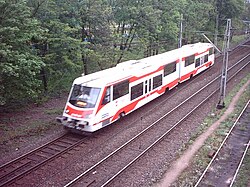
A group of rolling stock that is permanently or semi-permanently coupled together to form a unified set of equipment. Trainsets are most often used in passenger train configurations.
Trams that are designed to run both on the tracks of a city-based rail system and on the existing railway networks. Tram-trains' dual-voltage capability makes it possible to operate at lower speeds on city streets and at over 60 miles per hour (97 km/h) on main line tracks allowing travel in an extended geographical area without changing the method of transport.
A mechanical or electrical device for detecting the presence of a rail vehicle with pin-point accuracy, unlike a track circuit, which provides detection over an arbitrary distances
A train in which all cars (wagons) carry the same commodity and are shipped from the same origin to the same destination, without being split up or stored en route[255]
Underbridge
In the parlance of rail transport in the United Kingdom, an 'underbridge' is a bridge that allows a roadway to cross under the course of a railway line, in contrast to an overbridge, or overpass, that crosses over the railway.
A continuous train brake that is fail-safe in operation. It is powered by a vacuum from the locomotive but the application is actually by atmospheric pressure when the vacuum is released. Primarily used historically in Britain and in countries influenced by British practice. Now largely superseded by the air brake.
The linkage mechanism that operates the valve for a driving cylinder, to alternately admit steam to the cylinder and then exhaust it when the piston's stroke is nearly complete[257]
A boiler having the steam dome over the firebox and a sloping course from in front of the firebox to the cylindrical shell.
Waist (of boiler)
That part of the boiler shell immediately in front of the firebox.
Waist brace
A vertical steel plate riveted to the waist sheet crosstie and to an angle piece which is also fastened to the waist of a boiler to secure that part to the frame, and at the same time allow a small amount of expansion and contraction.
Waist brace angle
A steel strip riveted to the shell of a boiler and having its edge bent to a right angle, and to which a plate or strut is fastened for the purpose of bracing the waist of a boiler to the frames.
Waist sheet
The plate forming that portion of a boiler directly ahead of the outside firebox sheet. It is sometimes made cylindrical in shape and sometimes tapering or conical.
Waist sheet crosstie
A transverse brace or casting binding the frames together in front of the firebox and usually having a plate fastened to it and to the boiler to support the waist of the boiler at this point.
Waist sheet wearing plate
A steel strip riveted to the waist sheet of a boiler and to the angle of the waist sheet brace or expansion plate, to reinforce the bearing or support of the boiler at this point.
Walschaerts valve gear
A valve gear socalled from its inventor, largely in use in Europe and being rapidly introduced in the United States. It has no eccentric and is entirely outside of the frames.
Washer
A plate of metal or other material, usually annular, which is placed under a nut or bolt head to give it a better bearing. Two or more washers are sometimes combined and called washer plates, strap washers, double or twin washers, triple washers, etc. They are sometimes made beveled or triangular for a rod or bolt, which is oblique, with reference to the bearing surface. A socket washer or Hush washer is one provided with a recess for the bolt head, so as to leave it Hush with the adjoining parts. Cut or wrought washers are those stamped out of rolled iron plates. Cast washers are made from cast iron. Both kinds are used.
Wash-out plug
A short, solid metal cylinder with a screw thread cut on the outside and a square or hexagonal head for convenience in applying a wrench, screwed into the water leg and above the crown sheet of a locomotive boiler. Wash-out plugs are usually located near the bottom of a water leg, a little above the mud ring, or above the crown sheet, and from four to eight are provided in order to allow mud to be thoroughly washed out.
Waste
The spoiled bobbins of cotton or woolen mills, used for wiping machinery and for Journal Packing, which sec.
Waste cock or waste valve
An arrangement attached to and forming part of the body of an injector, consisting of a valve provided with a handle or lever. If this valve is left open when the steam and water supply valves to the injector are also open, steam passes back through the injector feetf pipe and may thus be used to prevent the water in the tender tank from freezing.
Water
A liquid composed of two gases, hydrogen and oxygen in the proportion of 8 to 1 by weight, colorless and transparent in the pure state. It is never obtained pure for locomotive use, always holding in solution a quantity of solid matter such as sulphates and carbonates of lime and magnesia that may form objectionable quantities of scale in a boiler. See Steam. Boilers fed with water that forms much scale must be washed out at frequent intervals; in some districts even at the completion of every trip. The best practice at present is to install water-treating plants at water stations, by means of which the scale forming matters in the water are chemically treated and removed before the water reaches the locomotives.
Water brake
An arrangement, consisting of a set of pipes and valves connected to a locomotive boiler below the water line, for admitting water to the cylinders to retard the motion of the pistons and thus act as a brake on the locomotive, which is run with the reverse lever back of the center. It is used on lines having long, steep grades.
Water brake valve
A globe valve with its connecting pipe screwed in the boiler back head below the water line, for operating the water brake.
Water cooler
A tank or vessel for carrying drinking water which is usually cooled with ice. The sides are generally made double, and the space between Tilled with some non-conducting substance. When used on locomotives they are commonly located on the tender tank.
Water column (railroad) or standpipe
A device used for delivering a large volume of water into the tank or tender of a steam locomotive.
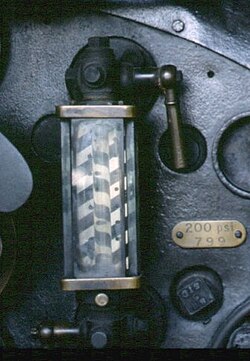
A device to enable an engineman or fireman to observe the height of water in a locomotive boiler. It consists of two brass fittings screwed into the back head, one above the other, and connected by a stout glass tube which communicates, through the fittings, with the water and steam in the boiler. The water level showing in the glass tube must be the same as that inside the boiler.
Water gage casing
A covering or protector around a water gage glass. The casing prevents the glass from flying about in case of breakage.
Water gage cock
One of two brass fittings screwed into a locomotive boiler head, having a valve or plug cock for opening or closing communication between the boiler and the water gage glass. The end of the glass tube rests in an opening in the gage cock and is held in place by a coupling nut which is screwed down on an elastic washer surrounding the tube.
Water gage cock extension
A piece of pipe leading from an opening in a boiler to one of the water gage cocks.
Water gage cock gland
A neck or extension formed on a water gage cock to receive the end of the glass tube, or the stem of the cock or plug.
Water gage nut
A hexagonal brass nut surrounding a water gage glass near the end and holding an elastic washer so as to prevent leakage of water or steam around it.
Water grate
See Grate and Water Pull Bar Grate.
Water leg
The space between the inner and outer sheets of a firebox. At the bottom, where the two sheets are riveted to the mud ring, the width of the water leg is from three to five inches, increasing more or less rapidly, according to the design and size of the firebox.
Water pull bar grate
A grate designed for burning anthracite coal, consisting of tubes running longitudinally through the bottom of the firebox and communicating with the front and back water legs, usually screwed into the tube sheet and expanded into the back sheet, a copper ferrule being used to insure a tight joint. Between the water tubes, iron pull bars, enclosed in short tubes, pass completely through the back water leg and project a snort distance outside the back head. These outer ends have slots in them, into which a rod can be put, and the bars pulled out for the purpose of dumping or cleaning the fire. Midway of the length of tfye firebox is a bearer or bridge that supports both the tubes and bars that form the grate. A similar bearer is placed at the front end of the box to hold the bars.
Water scoop
A device for putting water in a locomotive tender, while it is in motion, from a trough laid between the rails, and sometimes called a track tank. It consists of a cast-iron or steel plate conduit of rectangular cross section, about 8 x 12 inhes, passing up through the tender tank and turned over at the top so as to discharge the water downward. The lower end, underneath the tender frame, is fitted with a scoop or dipper that can be lowered into the trough by a lever worked by hand, or by compressed air applied in a cylinder whose piston rod is connected to the mechanism for raising and lowering the scoop. Owing to its inertia, the water is forced up through the siphon pipe into the tender tank when the scoop moves through the trough at a speed of from 25 to 40 miles per hour.
Water scoop air cylinder
A small cast-iron cylinder fastened underneath a tender for operating the water scoop. Compressed air is conveyed to it from the main air reservoir through a valve, thus moving the piston. The piston rod is connected to the levers that lower the dipper into the water trough between the rails. To insure the rapid raising of the dipper, when the locomotive reaches the end of the track tank, a coil spring is fastened to the scoop mechanism.
Water scoop air cylinder piston
A metal disk fitted inside a water scoop air cylinder and having attached to it a rod connected to the operating mechanism of the scoop.
Water scoop arm
A bent lever or bell crank, to one end of which the air cylinder piston rod is attached, while to the other the links for raising and lowering the dipper are bolted.
Water scoop body
That portion of a water scoop shaped like the frustum of a pyramid that is lowered into the track trough and to the lower end of which the dipper or nozzle is attached. It is usually made of cast iron.
Water scoop cylinder connecting rod
A short rod attached to the end of the piston rod of a water scoop cylinder, and with a coil spring attached to the end. This spring raises the scoop out of the water when the end of the track tank is reached and holds it in that position.
Water scoop cylinder piston rod
A wrought-iron or cast-steel rod attached to the piston of the air cylinder at one end, and to the bell crank for operating the water scoop at the other.
Water scoop cylinder support
A metal carrier secured underneath a tender frame for the purpose of holding the water scoop air cylinder, which is bolted to it.
Water scoop delivery pipe
The square pipe which joins the scoop with the siphon pipe in the tender tank.
Water scoop delivery pipe brace
A rod secured to the tender frame center sills to stiffen the delivery pipe.
Water scoop delivery pipe bracket
A cast-iron support riveted on to the end of the delivery pipe and having a hole or bearing in its outer end for one of the trunnions of the water scoop.
Water Scoop dipper
A hinged extension or hood at the end of a water scoop. That portion of the scoop that goes into the water.
Water Scoop dipper adjusting bracket
A support or holder fastened underneath a tender to limit the movement of the dipper arm and thus prevent the scoop from hanging too low and striking the ties or ballast.
Water scoop dipper lifting link
A short metal bar attached to the bell crank or arm of the scoop-lifting mechanism and to the dipper, for raising it out of the water.
Water scoop end support
A metal rod fastened to either side of the outer end of a water scoop, next to the dipper, a.nd to the under side of the tender frame.
Water scoop hanger
The bracket or frame fastened underneath a tender frame to support a water scoop and the mechanism for raising and lowering it.
Water scoop lifter
One of two links or bars attached to a water scoop at one end and to the water scoop arm at the other.
Water scoop locking cylinder
A small air cylinder whose function is to hold the water scoop in place and prevent it from dropping down on the track.
Water scoop neck
The upper end of a water scoop; that portion that joins the water scoop pipe directly under the tender tank.
Water scoop operating lever
The arm or lever by which the water scoop is raised or lowered by hand. It extends up through the tender deck alongside the tank leg.
Water scoop operating lever connecting rod
A long piece of pipe or solid rod, attached to the water scoop operating lever at one end and the scoop lifting arm at the other.
Water scoop operating lever fulcrum
A cast iron support fastened on a tender frame and holding a bolt or pin that passes through the water scoop operating lever.
Water scoop pipe
The cast iron or steel plate conduit passing up through a tender for conveying the water forced into the scoop to the top of the tank.
Water scoop pneumatic valve
The valve for admitting compressed air to a water scoop cylinder.
Water scoop rod
The rod connecting the water scoop lever with the arm or bell crank.
Water scoop shaft
A pivot fastened at right angles to a water scoop arm and resting in bearings in supports or hangers attached to the tender frame by bolts or rivets.
Water scoop shaft bracket
A carrier attached to a tender frame and holding the ends of the water scoop shaft.
Water scoop side brace
A rod fastened on either side of a water scoop and to the side sill of a tender to give transverse stiffness to the scoop.
Water scoop spring
The spring used to assist in lowering or raising a water scoop.
Water scoop spring rod
A shaft attached to a water scoop operating mechanism and to the coil spring which forms a part of it.
Water space
That part of a locomotive boiler that is filled with water, in contrast with the part normally occupied by steam. A Water Leg, which see, is also called a water space.
Water table
A device for improving the combustion of fuel in a locomotive firebox. The form invented by William Buchanan, of the N. Y. C. & H. R. R. R., consists of two flat, parallel plates, extending diagonally upward from the tube sheet to the back sheet of the firebox. These plates are about 4 Ms inches apart, are strengthened with staybolts in the same manner as are the inner and outer firebox sheets, and form an inclined water leg connecting the front and back legs of the firebox. A hole 18 or 20 inches in diameter is made through the center of the water table for the passage of the products of combustion to the upper part of the firebox on their way to the tubes. Not extensively used.
Water tube
A pipe containing water and surrounded with hot gases in contrast to a lire tube surrounded by water and having hot gases passing through it. See below.
Water tube boiler
A boiler in which water circulates through tubes surrounded by hot gases, the products of combustion in the firebox. Not extensively used for locomotives although tried on the London & South Western.
An electrical unit expressing the rate at which energy is transformed, or work done. It is used to express the product of the voltage of an electric circuit and the current or amperage. As it is a very small unit, a multiple of it, 1,000 times as large, and called a kilowatt, is commonly used. One kilowatt is about 1.34 horsepower.
A flat wagon with a depressed centre used for carrying extra tall loads.
Westinghouse Air Brake.
A system of continuous brakes invented and patented (the first patent in 1869) by Mr. George Westinghouse, which is operated by compressed air. The air is compressed, by a steam air pump on the locomotive or an electric motor compressor on the car. and is stored up in a tank called the main reservoir on the engine or tender. By the original form of brake the compressed air was conveyed from the tank by pipes connected together between the cars by flexible brake hose to brake cylinders under each car. by means of which the pressure of the air was communicated to the brake levers, and thence to the brake shoes. A later and improved form is the Westinghouse automatic air brake, commonly called simply Westinghouse brake, which is now in universal use. At the present time the Westinghouse brake, unless otherwise specified, is always understood to mean the automatic air brake. The change made from the original form of the Westinghouse air brake in order to make it automatic was to carry a full pressure of air at all times in the brake pipes and cause the brakes to be applied by a reduction of this pressure instead of by the admission of pressure, so that the breaking apart of the train or a reduction of pressure by escape of air at any point on the brake pipe would apply the brakes to the whole train at once. A further advantage was that the action of the brakes was made quicker by saving the appreciable interval of time required for the compressed air to flow from a single reservoir at one end of the train in sufficient quantities to fill all the brake cylinders. An auxiliary reservoir is placed under each car, containing air at the same pressure as in the brake pipes. An ingenious valve called the triple valve connects the brake pipe, auxiliary reservoir and brake cylinder together in such manner that any reduction of pressure in the brake pipe opens a passage for the air from the auxiliary reservoir to the brake cylinder, applying the brakes, and closes the connection between brake pipe and reservoir. To release the brakes, the pressure in the brake pipes is restored, when the triple valve closes the connection between the auxiliary reservoir and brake cylinder and opens one between the brake cylinder and the outer air and between the auxiliary reservoir and the brake pipe. In order that the train brakes may be applied from any car, each car is fitted with a valve called the conductor's valve, connected to the brake pipe so that the compressed air therein can be permitted to escape by opening the valve.
A new arrangement of air brake apparatus as applied to a locomotive. It differs from previous locomotive brake schedules principally in that the details are centralized and simplified so as to reduce the total number required, occupy less space, and give the engineman a mere certain and flexible control of the locomotive brakes. It has all the good features of any of the older equipment, besides a number of new ones, viz., uniform brake cylinder pressure on engine and tender, and a pressure-maintaining feature by which the brake-cylinder pressure is automatically held to that resulting from the brake application as long as such application lasts. See Distributing Valve.
Westinghouse friction draft gear
A form of draft gear in which the forces are absorbed and dissipated by friction. The friction device is encased in a malleable iron cylinder open at the front end. The front follower bears against a preliminary spring, the other end of which bears against the center wedge of the shape of the frustum of an octagonal pyramid. Surrounding the wedge are four pairs of segmental carriers having one rib each which lies in a groove in the cylinder. The other grooves in the cylinder are filled by friction strips resting on the carriers. These strips are of wrought iron and have lugs formed on them which engage in corresponding cavities in the carriers so that the friction strips must move with the carriers. The function of the preliminary spring is to absorb the light shocks without bringing into action the friction parts. The main release spring, placed back of the carriers, forces the carriers to their normal position when the pressure is removed and also adds to the capacity of the device. When the follower plates are moved toward each other, the preliminary spring is compressed until its capacity of 20,000 pounds is exceeded, when the follower bears against the release pin and forces it forward, relieving the wedge from the pressure of the auxiliary release spring, thereby allowing the compression of the preliminary and auxiliary preliminary springs to force the wedge forward and press the segmental carriers and friction strips firmly into the cylinder grooves. The follower then strikes and forces the segmental carriers in, producing friction between the friction strips and the grooves. The complete movement gives a resistance of 100,000 pounds. In releasing, the preliminary spring is gradually restored, and the auxiliary release spring then forces the wedge out, while the release spring returns the friction strips and carriers, giving a complete release. Owing to the varying width of the slots and lugs on the friction strips and carriers the strips are released four at a time through successive small distances. The operations of buffing and pulling are exactly the same, except that the load comes on the front or rear follower first, as the case may be. See Draft Gear.
Westinghouse SWA-SWB locomotive brake equipment
See Combined automatic and Straight-air locomotive brake.
Westinghouse traction brake
The adaptation of the Westinghouse air brake equipments to electrically propelled cars or trains. The changed conditions of motive power and method of operating such cars or trains have necessitated various changes in the details of the equipments, while the general principles of the Westinghouse straight-air and automatic brakes, which are the foundation of all known air brake equipments, remains the same. A motor-driven air compressor furnishes the compressed air; an electric pump governor controls the operation of the same; the brake and triple valves are of different design to accord with the conditions for which they are required. Otherwise the description of the Westinghouse Air Brake, which see, covers the traction brake also.
Westinghouse train air signal apparatus.
A device for utilizing the supply of compressed air required for operating the Westinghouse brakes to transmit signals to the engine or motorman's cab instead of using the ordinary bell cord.
Westinghouse unit switch system of control
A system of control for railway and other motors by means of low potential train line circuits taken from a storage battery under the car which operate electro-magnets controlling pneumatic valves and cylinders operating the main controller circuits under each car by air taken from the brake pipe. The main controller under each car consists of a group of electro-pneumatic switches which give the desired combinations to the motor circuits. A reverse switch and auxiliary resistance are essential parts of the apparatus'under each car. The apparatus is applicable for cither direct current or alternating current motors. Also called Westinghouse electro-pneumatic system of control.
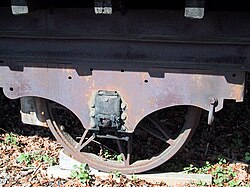
The rolling component typically pressed onto an axle and mounted on a rail car or locomotive truck or bogie. Wheels are cast or forged (wrought) and are heat treated to have a specific hardness. New wheels are trued to a specific profile before being pressed onto an axle. All wheel profiles must be periodically monitored to insure proper wheel to rail interface. Improperly trued wheels increase rolling resistance, reduce energy efficiency and may create unsafe operation. A railroad wheel typically consists of two main parts: the wheel itself, and the tire around the outside. A railway tire is itself steel, and is typically heated and pressed onto the wheel, where it remains firmly as it shrinks and cools.
Wheel
1. A circular frame or solid piece of wood or metal which revolves on an axis.
A circular frame or disk, revolving on an axle, serving to support a moving vehicle. Engine truck wheels are sometimes made of chilled cast iron, but more commonly have a cast iron or cast steel center with a steel tire fastened on, as are also tender truck wheels. See Wheel Center.' Driving wheels and trailing wheels are always made with a spoke center of cast iron or cast steel with a steel tire shrunk on. In addition to shrinkage, driving wheel tires are held on by bolts through the rim and by retaining rings also held by bolts.. {{{content}}}
Wheels
(Specification for Cast Iron, A. R. M. M. Recommended Practice). At the convention of 1888 the following specifications and tests for castiron wheels were adopted as standard. In 1801 these were changed to Recommendations. The specifications and tests are as follows: 1. The cliills in which the wheels of any one wheelmakcr are cast shall be of equal diameters, and the same chill must not vary at different points more than one-sixteenth of an inch in diameter. 2. There shall not be a variation of more than one-half inch in the circumference of any given number of wheels of the same nominal diameter, furnished by any one maker, and the same wheel must not vary more than one-sixteenth of an inch in diameter. The body of the wheel must be smooth and free from slag or blow holes. The tread must be free from deep and irregular wrinkles, slag, chill cracks and sweat or beads in the throat which are one-eighth of an inch or over in diameter, or which occur in clusters of more than six inches in length. 3. The wheels broken must show clean, gray iron in the plates; the depth of pure white iron must not exceed seven-eighths of an inch or be less than three-eighths of an inch in the middle of the tread, and shall not be less than three-sixteenths of an inch in the throat. The depth of the white iron shall not vary more than one-fourth of an inch around the tread on the rail line in the same wheel. 4. Wheels shall not vary from the specified weight more than two per cent. 5. The flange shall not vary in the same wheel more than three thirty-seconds of an inch from its mean thickness. 6. The single plate part of a 33-inch wheel, known as the Washburn pattern, shall not be less than five-eighths of an inch in thickness in a wheel weighing from 550 to 575 pounds, and not less than three-fourths of an inch in thickness in a wheel weighing from 575 to 600 pounds.
Wheel base
The horizontal distance between centers of the first and last axles of a locomotive or tender. It is usual, in stating locomotive dimensions, to give the rigid wheel base, the truck wheel base and the total wheel base.
Wheel bore
The hole through the hub or central part of a wheel in which an axle is fitted. Also called axle seat.
Wheel boss (British)
American term hub. The center of the wheel, which is bored out to receive the axle.
Wheel center
The portion of a wheel inside of the tire and between it and the hub or boss. The centers of engine and tender truck wheels are sometimes in one piece and sometimes made up of two parts, the hub or boss, and the # central filling piece. Face plates, front and back, are also used. The term is seldom applied to chilled, cast or rolled steel wheels. Driving and trailing wheel centers are made of cast iron or cast steel. In Great Britain, wheel centers are frequently made of wrought iron.
Wheel climb
The process of a wheel climbing up and often off the inside or gauge side of the rail. It is a major source of derailments. Wheel climb is more likely to occur in curves with wheels whose flanges are worn or have improper angles.
Wheel cover
A strip of thin steel plate, curved to a radius slightly greater than that of a wheel, to prevent mud and oil being spattered over the locomotive. Wheel covers are usually bolted to the engine truck frame for the truck wheels, and the under side of the running board for the driving wheels. British, splasher.
Wheel cover block
A small piece of metal fastened to a running board or engine truck frame for the attachment of a wheel cover.
Wheel cover bracket
A small cast iron post or holder, for the attachment of a wheel cover.
Wheel cover edge
A heading or molding formed on the outer edge of a wheel cover.
Wheel fit
That part of a driving or truck wheel that is forced on an axle or crank pin.
Wheel flange
The inner section of a wheel that rides between the two rails. The angle between the wheel tread and flange is often specific to the rail to prevent wheel climb and possible derailments. The wheel flange is part of the wheel tire.
Wheel flange
The projecting edge or rim on the periphery of a car wheel for keeping it on the rail.
Wheel hub
The center of a wheel surrounding the axle on which it is mounted. British, boss.
Wheel hub liner
A brass or bronze disk secured to the inside hub of a wheel to form a wearing surface between the hub and the outside face of the box. Such liners are used on engine truck wheels, driving and trailing wheels.
Wheel key
A piece of steel slightly tapered, driven into a slot or keyway cut longitudinally in the wheel seat of a driving axle and a corresponding slot in the bore through a driving wheel hub to key or secure the wheel to the axle.
Wheel plates
That part of a cast iron engine truck or tender truck wheel which connects the rim and the hub. It occupies the place and fulfils the same purpose as the spokes in an open or spoke wheel. On steel-tired wheels the plates connecting the tire and hub, and bolted or fastened to each, are called wheel plates. Distinguished as front and back face plates.
Wheel press (hydraulic)
A hydraulic press for forcing locomotive driving wheels on and off their axles. They are fitted with a pressure gage which is usually graduated for total tons pressure and for pounds per square inch on the rams. They are made with capacities up to 400 tons pressure.
The on-contact interaction between wheels and rails. The term is used in connection with the design and management of their interaction.
Wheel ribs (cast iron wheels)
More commonly, brackets. Projections cast usually on the inner side of plate car wheels to strengthen them. They are placed in a radial position and are often curved so as to permit the wheel to contract when it cools.
Wheel rim filling piece
A flat steel strip inserted in one of the radial spaces left to allow for shrinkage in casting in the rim of a driving wheel center.
Wheel seat
That portion of an axle that is forced into a driving wheel or truck wheel.
The loss of traction due to a slippery rail or wheel. Wheel slip was common with steam engines as they started to move due to the excessive torque often generated at low speed. Steam engines carried sand dispensing gear to increase traction at the start of motion.[258]
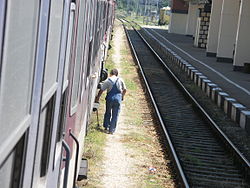
An historical railway occupation; people employed to tap train wheels with hammers and listen to the sound made to determine the integrity of the wheel; cracked wheels, like cracked bells, do not sound the same as their intact counterparts. The job was associated with the steam age, but they still operate in some eastern European countries. Modern planned maintenance procedures have mostly obviated the need for the wheel-tapper.
Wheel tread
The slightly conical section (often with a 1 in 20 slope) of a railroad wheel that is the primary contact point with the rail.
Wheel tread
The exterior cylindrical surface of a wheel which bears on the rails. The usual width of wheel tread is about 4 inches, measured from outside of wheel tread to the throat or inside of flange. The standard width from outside of wheel tread to inside face of flange, i. e.. including the entire thickness of flange, is 5!£ inches. For driving wheels the width varies from to 7 inches.
Wheel web
That portion of a cast iron truck wheel center between the huh and the rim.
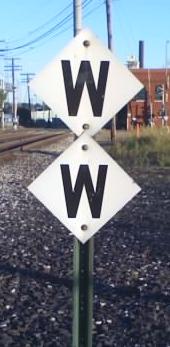
Train whistles are used as a safety warning and also by the engineer to communicate to other railroad workers. See train whistle for a description of the whistle code used to communicate. Also a nickname for an air horn on a diesel locomotive. Steam engine whistles were historically known as chimes in the US during the 19th century.
Whistle bell
A cylindrical brass chamber with flat or hemispherical top, for producing a sound by steam blown against the edge. It is screwed on a stem directly over the whistle bowl.
Whistle bowl
A hemispherical brass cup with a cylindrical extension below it containing a valve for admitting steam. The bowl has a disk over it that docs not come quite to the edge, thus leaving an annular opening through which the steam escapes, and in the center of which the steam passing up through the bell is secured.
Whistle crank
A short metal arm attached to the whistle lever in the cab for imparting motion to the lever or bar that opens the whistle valve.
Whistle crank fulcrum
A cast-iron bracket fastened in the cab of a locomotive to form a bearing for the whistle shaft.
Whistle extension
The cylindrical pipe below the bowl of a whistle, containing the whistle valve.
Whistle lever
An arm or bar in the cab of a locomotive for operating the whistle valve. It is attached to a crank that moves the lever on the whistle through the medium of a link or bar.
Whistle lever fulcrum
A small bracket attached to a whistle extension to hold the pin on which the whistle lever is pivoted.
Whistle lever rod
A link or bar connecting the whistle lever on the whistle with the operating lever in the cab.
Whistle nut
A square or hexagonal brass nut screwed on the upper end of a whistle stem to secure the whistle bell in place, and usually surmounted by an acorn-shaped top called the whistle ornament.
An advance warning to the engineer of an upcoming grade crossing. It is the point at which the engineer should begin sounding the whistle or horn.
Whistle reservoir (train air signal)
A small steel reservoir sometimes installed for storing air to be used by an air whistle on electric locomotives.
Whistle shaft
A short metal rod in the cab, supported by a hanger or fulcrum at each end, and having the whistle lever and whistle crank attached to it.
Whistle stem
A steel or malleable iron standard, screwed in the center of a whistle bowl, and supporting the whistle bell. The bell has a hole through the top, tapped with a thread to fit that cut on the upper end of the whistle stem, which allows the height of the bell above the bowl to be adjusted.
Whistle valve
A disk with a shank or stem attached, fitting in an opening in the whistle extension for admitting steam to the whistle to cause it to sound. It is operated by a set of levers in the cab.
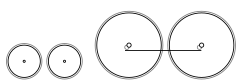
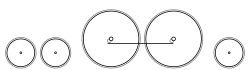
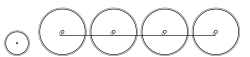
A system of describing steam locomotive wheel arrangements (e.g. 4-6-4, 2-10-2). The first number indicates the number of "pilot" wheels that help lead the engine into turns. The second is the number of coupled wheels ("drivers"). Third are the trailing idler wheels, usually to provide support to larger fireboxes. Articulated locomotives are similarly described. For example, a Union Pacific "Big Boy" would be described as a 4-8-8-4, wherein the pilot has four wheels, followed by two sets of drivers, eight wheels per set, and a four-wheel trailing bogie under the firebox. The numbers include the wheels on both sides of the engine, so a 2-8-2 engine would have one idler, four drivers, and a final idler on each side of the engine.
Wide firebox boiler
A boiler with a wide, shallow firebox resting on the frames and extending out beyond them at the sides. The Wootten Firebox, which see, is a wide firebox for burning anthracite coal.
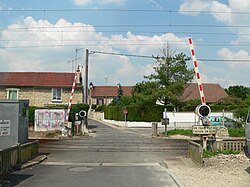
A largely superseded Level or grade crossing warning signal that consists of a swinging disc facing road traffic, with a red light in the centre. The disc normally hangs straight down, but an approaching train sets it swinging from side to side, the red light illuminates or flashes, and a bell rings.
Window
"An opening in the wall of a building or cab for the admission of light and of air when necessary. This opening has a frame on the sides, in winch are set movable sashes containing panes of glass." – Webster. Hence the window itself, especially in compound words, is often termed simply the sash.[259]>
Window glass
Panes of glass used for windows. They are either plate or rolled glass, made by pouring the molten glass onto a table having the height of the desired thickness of the plate, and then passing a roller over the top; or blown, or common window glass, the latter being by far the cheapest and most widely used, but of very much inferior quality. It is made by blowing the glass into a largo bulb, which is then slit open while still hot and flattened out.[260]
Window sill
A horizontal piece of wood or metal under a window, on which the cab sashes rest when down.[260]
Working water, foaming, or priming
The condition of a steam locomotive drawing water through its throttle valve, cylinders, and smokestack, often causing damage to the cylinders or running gear.
Wootten firebox
A locomotive firebox, very wide and shallow and having a curved crown sheet of large radius, used for anthracite coal burning locomotives which require a large grate area.[260]
Worn flat (car wheels)
Irregular wear under fair usage, due to unequal hardness of the tread of the wheel, and to be carefully distinguished from slid flat, which is a defect produced by the slipping of the wheels from excessive brake pressure.[260]
Wrecking chain
A heavy steel chain, carried on a locomotive for use in emergencies.[260]
1. A contrivance for screwing and unscrewing a nut.[260]
2. A socket wrench is one having a cavity to receive a square or hexagonal end. The wrenches for the Westinghouse brake are packing nut and cap screw wrenches, and the discharge valve seat wrench.
3. A spanner is a wrench for use on round or many sided nuts, like hose couplings, to which lugs or slots are added for engaging with the wrench.
4. An alligator wrench for use on pipe or other cylindrical surfaces has immovable jaws, one serrated and the other smooth, inclined to each other at an acute angle.
5. A monkey wrench has smooth, parallel jaws, one of which is fastened to the handle or stem, while the other can be moved up to or away from it by a sleeve nut working on a thread cut on the stem.
A wye (like the 'Y' glyph) or triangular junction is a triangular joining arrangement of three rail lines with a railroad switch (set of points) at each corner connecting to each incoming line.
Y
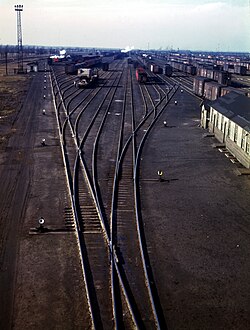
Railroad yard in Chicago, Illinois, as seen in December 1942
Yard
An arrangement of tracks where rolling stock is switched to and from trains, freight is loaded or unloaded, and consists made up.[261][31]
A method of climbing and descending steep gradients, where shallow-gradient track reverses direction for a while, and then reverses again to continue in the original direction.
^McAuliffe, Des (1999). "The Snowtown to Port Pirie Line". Proceedings of the 1999 Convention. Modelling the Railways of South Australia. Adelaide. p. 1–129.
^"Transport Thesaurus". UIC.org. 1995. Archived from the original on 6 June 2015. Retrieved 20 May 2009.
^"Combined Adhesion ad Cog-Wheel Railways". The Railway News and Joint Stock Journal. 51 (1307). London: 100–101. 19 January 1889.
^McClellan, George B. (21 November 1854). "Memoranda on Railways". Reports of Explorations and Surveys to Ascertain the Most Practicable and Economical Route for a Railroad from the Mississippi River to the Pacific Ocean. Vol. 1. p. 116.
^"§ 238.237: Automated monitoring". The Code of Federal Regulations of the United States of America – 49: Transportation. Washington, DC: Office of the Federal Register, National Archives and Records Administration. 1 October 2006. p. 691.
^"EPR 012: Testing of locomotive all weather adhesion"(PDF). RailCorp. October 2011. Archived from the original(PDF) on 21 June 2014. Retrieved 25 October 2014.
^Aylmer-Small, Sidney (1908). "Lesson 28: Alternators". Electrical railroading; or, Electricity as applied to railroad transportation. Chicago: Frederick J. Drake & Co. pp. 456–463.
^ ab"Railroading Glossary: A". TRN.Trains.com. Kalmbach Publishing. Archived from the original on 31 August 2014. Retrieved 20 February 2013.
^Solomon, Brian (2009). Alco Locomotives. MBI Publishing Company. p. 8. ISBN 978-1-61673-136-6.
^Lamb, J. Parker (2003). "4: The Second Generation". Perfecting the American Steam Locomotive. Bloomington, IN: Indiana University Press. p. 47. ISBN 0-253-34219-8.
^IEC 60050-821:1998 – International Electrotechnical Vocabulary – Part 821: Signalling and security apparatus for railways. International Electrotechnical Commission. 1998.
^ ab"ERA Glossary"(PDF). ERA.Europa.eu. Retrieved 23 March 2017.
^"The Evolution of Railway Axlebox Technology". Evolution. SKF. 7 December 2010. Retrieved 18 September 2014.
^"Glossary: A". Railway-Technical.com. Railway Technical Web Pages. 2014. Archived from the original on 7 October 2014. Retrieved 19 November 2014.
^ abcdef"Railroading Glossary: B". TRN.Trains.com. Kalmbach Publishing. Archived from the original on 21 August 2014. Retrieved 20 February 2013.
^"§ 215.9 Movement of defective cars for repair". The Code of Federal Regulations of the United States of America – 49: Transportation. Washington, DC: Office of the Federal Register, National Archives and Records Administration. 1 October 2006. pp. 177–178.
^"Air Brake/Train Handling Rulebook – Procedure 3.2.2"(PDF). Mid Continent railway museum. Archived from the original(PDF) on 20 October 2014. Retrieved 19 September 2014.
^Bianculli, Anthony J. (2003). Trains and Technology: The American Railroad in the Nineteenth Century. Vol. 3: Track and Structures. Rosemont Publishing & Printing Corp. p. 40. ISBN 0-87413-802-7.
^"Glossary"(PDF). MTA.info. MTA. p. 2. Archived from the original(PDF) on 26 February 2021. Retrieved 12 October 2014.
^Martin, Douglas (17 November 1996). "Subway Planners' Lofty Ambitions Are Buried as Dead-End Curiosities". The New York Times. Retrieved 27 June 2015.
^Lamb, J. Parker (2003). Perfecting the American Steam Locomotive. Bloomington, IN: Indiana University Press. pp. 85–88. ISBN 0-253-34219-8.
^Springirth, Kenneth C. (2010). Northwestern Pennsylvania Railroads. Images of Rail. Arcadia Publishing. p. 68. ISBN 978-0-7385-7347-2.
^ abSolomon, Brian (2009). Alco Locomotives. MBI Publishing Company. p. 52. ISBN 978-1-61673-136-6.
^ abc"ERA Glossary of Railway Terms". 8 November 2010. Archived from the original on 7 August 2018. Retrieved 7 August 2018.
^"Railroad Dictionary: B". CSX.com. CSX Transportation. 2012. Archived from the original on 29 July 2014. Retrieved 15 November 2014.
^"Trailer Booster". Official Proceedings of the New York Railroad Club. Vol. 30. 1920. pp. 6072–6074.
^"Air Brakes – Basics". Railway Technical Web Pages. Archived from the original on 7 October 2014. Retrieved 19 September 2014.
^"50 years of the Bubble car". Chiltern Railways. Archived from the original on 14 July 2014. Retrieved 19 September 2014.
^"Question VII". Proceedings: Seventh Session, Washington, May 1905. Vol. II (English ed.). Brussels: P. Weissenbruch, Printer to the King. 1906. pp. 3–20.
^Sobey, Ed (2006). A Field Guide to Roadside Technology. Chicago Review Press. p. 20. ISBN 978-1-61374-179-5.
^Halberstadt, Hans (1996). Modern Diesel Locomotives. Osceola, WI: MBI Publishing Co. pp. 61–63. ISBN 0-7603-0199-9.
^ abcd"Railroading Glossary: C". TRN.Trains.com. Kalmbach Publishing. Archived from the original on 13 September 2014. Retrieved 20 February 2013.
^Solomon, Brian (2009). Alco Locomotives. MBI Publishing Company. p. 70. ISBN 978-1-61673-136-6.
^Lamb, J. Parker (2003). Perfecting the American Steam Locomotive. Bloomington, Indiana: Indiana University Press. p. 107. ISBN 0-253-34219-8.
^Taylor, John (June 1952). "Name That Locomotive". Boys' Life. Boy Scouts of America. p. 40.
^Wegman, Mark (2008). "34: The City Streamliners". American Passenger Trains and Locomotives Illustrated. Minneapolis: Voyageur Press, an imprint of MBI Publishing Company. p. 144. ISBN 978-0-7603-3475-1.
^"Locomotive Stoker and Coal Pusher". RailArchive.net. Retrieved 2 October 2014.
^"Railway Investigation Report R02V0057". Transportation Safety Board of Canada. 28 April 2002. Retrieved 19 October 2014.
^Velazquez, Matthew (15 October 2014). How to Operate a Diesel Locomotive (slide presentation). Retrieved 19 October 2014.
^"2013 Elec.P32BWH-P40-P42 Study Guide". Quizlet.com. Retrieved 19 October 2014.
^"Industrial process measurement control functions and instrumentation – Symbolic representation – Part 4: Basic symbols for process computer, interface, and shared display/control functions"(PDF). 15 August 1985. p. 1.
^"IEC 61375-2-3:2017-02: Electronic railway equipment – Train communication network (TCN) – Part 2-3: TCN communication profile". DIN.de. Retrieved 28 June 2017.(registration required)
^"New Locomotives, Swiss State Railways". The Locomotive Magazine. Vol. XII, no. 166. 15 June 1906. p. 98.
^Mallaband, P.; Bowles, L. J. (1982). Coaching Stock of British Railways 1978. RCTS Railway Correspondence and Travel Society. p. 91. ISBN 0-901115-44-4.
^"Introductory Handbook on Microprocessor Controlled Electric Locomotives"(PDF).
^Welsh, Joe (2006) [first published 1999 by Andover Junction Publications]. The American Railroad: Working for the Nation. St. Paul, MN: MBI Publishing Company. p. 58. ISBN 978-0-7603-1631-3.
^Illinois. Appellate Court (1913). "Jorte v. Chicago & Alton R. Co., 171 Ill. App. 179". Reports of Cases Determined in the Appellate Courts of Illinois. Vol. 171. Chicago: Callaghan & Co. p. 182.
^John L. Nolan v. A. Vedder Magee, Blakeslee Lumber Company, Veeder & Brown, Knapp & Hotchkiss Lumber Company and The Crane & Veeder Company, The Reporter Co. (Supreme Court Appellate Division – Third Department 1913).
^"Railroad Related Terms". AlaskaRails.org. Retrieved 2 October 2014.
^"Steam Locomotive Glossary". Railway-Technical.com. Archived from the original on 28 January 2008.
^Annual Report, Part 1. Albany, New York: The Argus Company. 1903. p. 918.
^Holloway, Keith (13 June 2006). "Failure to adhere to track warrant control rules caused collision". NTSB press release. National Transportation Safety Board. Retrieved 29 May 2009. Non-signaled (dark) territory presents a unique problem for rail safety
^Prince, Richard E. (2000) [1966]. Seaboard Air Line Railway: Steam Boats, Locomotives, and History. Bloomington, IN: Indiana University Press. p. 163. ISBN 0-253-33695-3.
^"Development of American Steam Locomotives". Locomotive Firemen and Enginemen's Magazine. Vol. 43, no. 6. Indianapolis, IN: Brotherhood of Locomotive Firemen and Enginemen. December 1907. p. 777.
^ abcdef"Railroading Glossary: D". TRN.Trains.com. Kalmbach Publishing. Archived from the original on 30 August 2014. Retrieved 20 February 2013.
^"Ditch Lights". American Rails. Retrieved 2 October 2014.
^"Railroad Dictionary: D". CSX.com. CSX Transportation. 2012. Archived from the original on 25 July 2015. Retrieved 24 July 2015.
^Railway Track Engineering (fourth ed.). New Delhi, India: Tata McGraw Hill Education Private Ltd. 2010 [first edition published 2000]. p. 122. ISBN 978-0-07-068012-8.
^Fitch, Ron J. (2006). Australian Railwayman: From Cadet Engineer to Railways Commissioner. Rosenberg Publishing Pty Ltd. ISBN 1-877058-48-3.
^"Grades and Curves". Trains. Archived from the original on 22 November 2008. Retrieved 29 January 2010.
^"Railroading Glossary: E". TRN.Trains.com. Kalmbach Publishing. Archived from the original on 22 August 2014. Retrieved 20 February 2013.
^Ellis, Iain (2006). Ellis' British Railway Engineering Encyclopaedia. Lulu.com. p. 105. ISBN 978-1-84728-643-7.
^"TRT Home – Transportation Research Thesaurus (TRT)". trt.trb.org. Retrieved 30 August 2017.
^"Train Technical Specification"(PDF). Retrieved 2 October 2014.
^"International Electrotechnical Vocabulary – Part 821: Signalling and security apparatus for railways". 29 April 1998. Retrieved 15 December 2017.
^"Air brakes". Railroad.net. Archived from the original on 16 May 2015. Retrieved 2 October 2014.
^Phillips, Edmund John (1942). Railroad Operation and Railway Signalling. Chicago: Simmons-Boardman Publishing Co. p. 40. Retrieved 13 October 2014.
^Dalby, Harry Andrews (1904). Train Rules and Train Dispatching: A Practical Guide for Train Dispatchers, Enginemen, Trainmen and All who Have to Do with the Movement of Trains (first ed.). New York and London: The Locomotive Publishing Co. p. 129. Retrieved 13 October 2014.
^"FM 55-20, Chapter 4, Rail Dispatching Operations and Procedures". GlobalSecurity.org. Retrieved 13 October 2014.
^"What Are Fall Plates?". WiseGEEK. Retrieved 2 October 2014.
^Darbee, Jeffrey T. (7 September 2017). "The Belt and the Union Today". Indianapolis Union and Belt Railroads. Bloomington, Indiana: Indiana University Press. pp. 207–208. ISBN 978-0-253-02950-8. OCLC 987437589.
^"An Introduction to Train Brakes". The Traffic Accident Reconstruction Origin. Retrieved 2 October 2014.
^Ellis, Iain (2006). Ellis' British Railway Engineering Encyclopaedia. Lulu.com. p. 141. ISBN 978-1-84728-643-7. Retrieved 2 October 2014.
^"North American Freight Train Brakes". Railway technical web pages. Archived from the original on 6 October 2014. Retrieved 2 October 2014.
^Durrant, A. E. (1969). The Garratt Locomotive. London: David & Charles Locomotive Studies. p. 13. ISBN 7-153-43564-6.
^"Railroading Glossary: G". TRN.Trains.com. Kalmbach Publishing. Archived from the original on 21 August 2014. Retrieved 20 February 2013.
^Operation and Maintenance of Diesel–electric Locomotives. October 1965. p. 107.
^Gamst, Frederick C. (1980). The Hoghead: An Industrial Ethnology of the Locomotive Engineer. Holt, Rinehart and Winston. p. 96. ISBN 978-0-03-052636-7.
^Proceedings. Railway Fuel and Operating Officers Association. 1966. pp. 72, 92.
^Wilson, Jeff (2009). The Model Railroader's Guide to Diesel Locomotives. Waukesha, WI: Kalmbach Publishing. ISBN 978-0-89024-761-7.
^"GE and Kazakhstan Temir Zholy (KTZ) Announce GE Evolution Series Passenger Locomotive to be Manufactured in Astana" (Press release). 19 September 2012. Archived from the original on 11 March 2017. Retrieved 14 October 2014.
^"Go-devil". Merriam-Webster Dictionary. Retrieved 14 October 2014.
^"Safety Appliances". The Railroad Trainman. 27 (7). Cleveland, OH: Brotherhood of Railroad Trainmen: 581–584. July 1910.
^Dukkipati, Rao V.; Amyot, Joseph R. (1988). Computer-Aided Simulation in Railway Dynamics. New York: Marcel Dekker, Inc. p. 31. ISBN 0-8247-7787-5.
^Railroad Engineering. John Wiley & Sons, Inc. 1982. pp. 664–666. ISBN 0-471-36400-2.
^ abcde"Railroading Glossary: H". TRN.Trains.com. Kalmbach Publishing. Archived from the original on 21 August 2014. Retrieved 20 February 2013.
^Webb, Brian (1982). The Deltic Locomotives of British Rail. Newton Abbot: David & Charles. p. 40. ISBN 0-7153-8110-5.
^"Glossary". Railway Technical Web Pages. Archived from the original on 7 October 2014. Retrieved 29 August 2012.
^"About IHHA". International Heavy Haul Association. Archived from the original on 15 October 2014. Retrieved 14 October 2014.
^Liu, Jianxin; Wang, Kaiyun; Zhang, Bin; Nong, Hanbiao; Wang, Jun (October 2010). "Dangerous Condition Monitoring Technology of Heavy-haul Train". ICLEM 2010: Logistics for Sustained Economic Development – Infrastructure, Information, Integration. American Society of Civil Engineers. ISBN 978-0-7844-7611-6.
^Wang, Wang Jianxi; Li, Xiangguo; Huang, Shougang (2 July 2010). "Selection of Rail Types for High-speed Railway and Heavy-haul Railway". ICCTP 2010: Integrated Transportation Systems Green, Intelligent, Reliable. American Society of Civil Engineers. ISBN 978-0-7844-7605-5.
^Gertler, Judith B.; Acton, Sarah (2003). Railroad dispatcher communications training materials. United States Federal Railroad Administration, Office of Research and Development. p. 24.
^Graham, John Hector (10 February 1903). "Paper by John Hector Graham". New England Railroad Club. Boston, MA: 34–65.
^"Locomotive Journals and Bearings". The Railway Engineer. XXIX (345): 320–321. October 1908.
^"hostling". Definition of HOSTLING. Merriam-Webster (2014 ed.). 2014. Retrieved 11 October 2014.
^"Hotbox". The Hotbox. North Central Region National Model Railroad Association. Retrieved 24 January 2008.{{cite journal}}: CS1 maint: deprecated archival service (link)
^US 4659043, Gallagher, Cornelius A., "Railroad hot box detector", published 21 April 1987, assigned to Servo Corporation of America
^ abSolomon, Brian (2012). North American Locomotives: A Railroad-by-Railroad Photohistory. MBI Publishing Company. p. 6. ISBN 978-1-61058-685-6.
^1000 Practical Air Brake Questions and Answers for Railroad Men. Lasrobe, Pennsylvania: Walter's Print. 1913.
^Boyd, Jim (2001). The American Freight Train. MBI Publishing Company. p. 27. ISBN 978-0-7603-0833-2.
^ abc"Railroading Glossary: I". TRN.Trains.com. Kalmbach Publishing. Archived from the original on 13 September 2014. Retrieved 20 February 2013.
^Loumiet, James R.; Jungbauer, William G.; Abrams, Bernard S. (2005). Train Accident Reconstruction and FELA and Railroad Litigation (fourth ed.). Tucson, Arizona: Lawyers & Judges Publishing Company. p. 62. ISBN 978-1-930056-93-0.
^"3.16: Insulated Rail Joints". Railway Track Engineering (fourth ed.). New Delhi, India: Tata McGraw Hill Education Private Ltd. 2010 [first edition published 2000]. p. 86. ISBN 978-0-07-068012-8.
^Koester, Tony (2004). Realistic Model Railroad Design. Waukesha, Wisconsin: Kalmbach Publishing. p. 73. ISBN 0-89024-581-9.
^Hartong, Mark; Goel, Rajni; Wijesekera, Duminda (23 March 2009). "14: Secure Cross-Domain Train Scheduling". Critical Infrastructure Protection III: Third IFIP WG 11.10 International Conference. Hanover, New Hampshire: Springer Science & Business Media. pp. 199–211. ISBN 978-3-642-04797-8.
^"ERA Glossary of Railway Terms"(PDF). ERA.Europa.eu. February 2009. Retrieved 30 March 2017.
^IEC 62290-1:2014: Railway applications – Urban guided transport management and command/control systems, Part 1: System principles and fundamental concepts. Geneva: IEC Publications. 2014.
^ ab"Railroading Glossary: J". TRN.Trains.com. Kalmbach Publishing. Archived from the original on 13 September 2014. Retrieved 20 February 2013.
^ ab"Railroad Dictionary: J". CSX.com. CSX Corporation. 2012. Archived from the original on 29 July 2014. Retrieved 15 November 2014.
^"Dictionary of Car and Locomotive Terms". Car and Locomotive Encyclopedia. Simmons-Boardman Publishing. 1970.
^Sanders, Craig (2014). Cleveland Mainline Railroads. Images of Rail. Charleston, SC: Arcadia Publishing. p. 12. ISBN 978-1-4671-1137-9.
^Technical Manual TM 5-370: Railroad Construction. United States Department of the Army. September 1970. p. Glossary 6.
^The Code of Federal Regulations of the United States of America – 49: Transportation. Office of the Federal Register, National Archives and Records Administration. October 2006. p. 115.
^Reading, J. W. (September 1905). "Taking Chances". Railroad Men. XVIII (12): 460.
^Bibel, George (2012). Train Wreck: The Forensics of Rail Disasters. Baltimore, MD: Johns Hopkins University Press. pp. 145–146. ISBN 978-1-4214-0590-2.
^Simon Iwnicki, ed. (2006). Handbook of Railway Vehicle Dynamics. Boca Raton, Florida: CRC Press. p. 184. ISBN 0-8493-3321-0.
^US patent 936046, Schroeder, William S., "Car-coupling", published 5 October 1909, assigned to National Malleable Castings Company
^Thomas J. Michie, ed. (1913). "MacKenzie v. New York Cent. & H. R. R. Co.". Railroad Reports: A collection of all cases affecting railroads of every kind, decided by the courts of last resort in the United States. Vol. 67. Charlottesville, VA: The Michie Company. pp. 315–316.
^ ab"Railroading Glossary: L". TRN.Trains.com. Kalmbach Publishing. Archived from the original on 26 August 2014. Retrieved 20 February 2013.
^"What is Light Rail?". LRTA.org. Light Rail Transit Association. Archived from the original on 5 June 2016. Retrieved 6 July 2009.
^Grutzik, Joe (2005). Adventure Lessons: Teachings of an Existential Vagabond. Los Angeles, California: Good & Brown Publishers. p. 34. ISBN 0-9768915-1-4.
^Elliott, W. H. (January 1906). "Signaling". Railroad Men. XIX (4): 128–137.
^Solomon, Brian (2003). Railroad Signaling. MBI Publishing Company. p. 48.
^Operation and Maintenance of Diesel–Electric Locomotives. United States Departments of the Army and the Air Force. October 1965. p. 77.
^Fowler, George L. (2008). Locomotive Dictionary. Vol. 1. Lulu.com. pp. 55, 65. ISBN 978-1-935327-61-5.
^"Railroading Glossary: M". TRN.Trains.com. Kalmbach Publishing. Archived from the original on 21 August 2014. Retrieved 20 February 2013.
^Bedwell, Harry (2006) [1936]. The Boomer: A Story of the Rails. Minneapolis, MN: First University of Minnesota Press. p. 322. ISBN 978-1-4529-0908-0.
^Green, Jonathon (2005) [first edition published 1998]. Cassell's Dictionary of Slang (second ed.). London: Weidenfeld & Nicolson. p. 923. ISBN 0-304-366366.
^Bianculli, Anthony J. (2003). Trains and Technology: The American Railroad in the Nineteenth Century. Vol. 4: Bridges and Tunnels, Signals. Rosemont Publishing & Printing Corp., Associated University Presses. p. 172. ISBN 0-87413-803-5.
^Braman B. Adams; Rodney Hitt, eds. (1908). The Railroad Signal Dictionary. New York: Railroad Age Gazette.
^"Railroad Glossary: Definitions And Terms". American-Rails.com. Retrieved 26 October 2020.
^Compendium of Definitions and Acronyms for Rail Systems(PDF). Washington, D.C.: American Public Transportation Association. 20 June 2019. p. 180. Retrieved 26 October 2020. Siding (passing track, side track): A track adjacent to a main or a secondary track, for meeting, passing, or storing cars or trains
^"Glossary of Train Speak". TasRail. Retrieved 26 October 2020. crossing loop: ... a facility that permits trains to both cross and pass each other.
^James, W. P. (2008) [first edition published 1916]. "Mikado Type Locomotives". Locomotive Engineman's Manual (fifteenth ed.). Periscope Film. pp. 24–27. ISBN 978-0-9816526-8-9.
^Glazier, Stephen (1998). Random House Webster's word menu. Random House. p. 212. ISBN 978-0-375-70083-5.
^Tom Dalzell; Terry Victor, eds. (2006). The New Partridge Dictionary of Slang and Unconventional English. Vol. II: J-Z. New York: Routledge. p. 1295. ISBN 0-415-25938-X.
^World Book Dictionary. Chicago: World Book, Inc. 2003. p. 1318. ISBN 0-7166-0299-7.
^Duffy, Michael C. (2008) [first edition published 2003]. Electric Railways 1880–1990. History of Technology. Stevenage, UK: The Institution of Engineering and Technology. pp. 191–193. ISBN 978-0-85296-805-5.
^"Railroading Glossary: N". TRN.Trains.com. Kalmbach Publishing. Archived from the original on 22 August 2014. Retrieved 23 March 2017.
^Glischinski, Steve (1997). Santa Fe Railway. Railroad Color History. Andover Junction Publishing. p. 104. ISBN 0-7603-0380-0.
^Wilson, Jeff (2009). The Model Railroader's Guide to Diesel Locomotives. Waukesha, WI: Kalmbach Publishing. p. 15. ISBN 978-0-89024-761-7.
^Loumiet, James R.; jungbauer, William G. (2005). Train Accident Reconstruction and FELA and Railroad Litigation (fourth ed.). Tucson, Arizona: Lawyers & Judges Publishing Co. p. 226. ISBN 978-1-930056-93-0.
^"Railroading Glossary: O". TRN.Trains.com. Kalmbach Publishing. Archived from the original on 13 September 2014. Retrieved 20 February 2013.
^Henry Harrison Suplee, B.Sc.; J.H. Cuntz, C.E. M.E.; Charles Buxton Going, Ph.B., eds. (1906). The Engineering Index. Vol. IV: 1901–1905. New York and London: The Engineering Magazine. p. 714.
^ abcde"Railroading Glossary: P". TRN.Trains.com. Kalmbach Publishing. Archived from the original on 13 September 2014. Retrieved 20 February 2013.
^Hay, William Walter (1982). Railroad Engineering. John Wiley & Sons, Inc. pp. 134–135. ISBN 0-471-36400-2.
^"MyLIRR – July 2018". Archived from the original on 2 February 2019.
^Treese, Lorett (2003). Railroads of Pennsylvania: Fragments of the Past in the Keystone Landscape. Mechanicsburg, Pennsylvania: Stackpole Books. p. 5. ISBN 0-8117-2622-3.
^Arbitration Cases No. 1 – No. 61; Decided by the Per Diem Rules Arbitration Committee. New York: The American Railway Association. June 1913.
^Publication 1194-B: A Selection of ... Internal Revenue Service Tax Information Publications. Vol. 2. United States Internal Revenue Service. 2000. p. 247.
^"Locomotive Engineers Journal". Locomotive Engineers Journal. Vol. 56, no. 3. Des Moines, Iowa: Brotherhood of Locomotive Engineers. March 1922. p. 197.
^Weiser, Eugene (2013). The Pennsylvania Railroad: A Brief Look in Time. The History of the American Railroads. Seaford, DE: Dragonwick Publishing. pp. 30–31. ISBN 978-1-300-64078-3.
^Solomon, Brian (2003). Railroad Signaling. MBI Publishing Company. p. 103. ISBN 978-1-61673-897-6.
^Hyman, Anthony (1982). Charles Babbage: Pioneer of the Computer. Oxford University Press. pp. 142–143. ISBN 978-0-198-58170-3. Babbage suggested to Hodgson of the railway company what was later called a 'cow-catcher' for sweeping obstacles off the line.
^1980 Census of Population: Classified Index of Industries and Occupations. United States Department of Commerce, Bureau of the Census. November 1982. p. O-143.
^United States National Railroad Adjustment Board. Awards ... First Division, National Railroad Adjustment Board. Washington, DC: U.S. Government Printing Office. p. 83.
^ abHawkins, Nehemiah (1909). Hawkins' mechanical dictionary. New York and London: Theodore Audel & Co. Publishers. p. 400.
^The Encyclopaedic Dictionary. Vol. 5, part 2. London, Paris, New York & Melbourne: Cassell & Co., Ltd. 1886. p. 519.
^Ogilvie, LL.D., John (1883). Charles Annandale, M.A. (ed.). The Imperial Dictionary of the English Language. Vol. III: L-Screak. London: Blackie & Son. p. 445.
^Wilson, Jeff (2009). The Model Railroader's Guide to Diesel Locomotives. Waukesha, WI: Kalmbach Publishing. p. 48. ISBN 978-0-89024-761-7.
^"The Potential for Increased On-Rail Competition"(PDF). Renaissance Trains/Office of Rail Regulation UK. Archived from the original(PDF) on 5 September 2012. Retrieved 15 February 2013.
^"Further written evidence from Jonathan Tyler, Passenger Transport Networks (HSR 138A)". House of Commons. Retrieved 15 February 2013.
^Ellis, Iain (2006). Ellis' British Railway Engineering Encyclopaedia. Lulu.com. p. 269. ISBN 978-1-84728-643-7. OCLC 683418325.
^Loumiet, James R.; Jungbauer, William G. (2005). Train Accident Reconstruction and FELA and Railroad Litigation (fourth ed.). Tucson, Arizona: Lawyers & Judges Publishing Co. p. 42. ISBN 978-1-930056-93-0.
^Simon Iwnicki, ed. (2006). Handbook of Railway Vehicle Dynamics. Boca Raton, Florida: CRC Press. pp. 240–241. ISBN 0-8493-3321-0.
^"Railway Track and Structures: RT & S". Railway Track and Structures. Vol. 92. Simmons-Boardman Publishing. 1996. p. 27.
^McCulloch, David S.; Bonilla, Manuel G. (1970). The Alaska Earthquake, March 27, 1964: Effects on Transportation and Utilities. Geological Survey Professional Paper. Washington, DC: United States Government Printing Office. p. D135.
^"1 Killed, 20 Hurt in Jersey Wreck; Freight Car Jumps Rails and Rips Sides of Passenger Cars at Stevens. Fire Follows Collision Edward Lawrence of Bordentown, Brakeman, Crushed Between Freight Car and Coach"(PDF). 26 June 1920. Retrieved 5 October 2008.
^1,000 Places to See Before You Die, p. 272 ["Completed in 1910, the Bernina line is the highest railway crossing in the Alps."]
^Thompson, David (2009). Railway Noise and Vibration: Mechanisms, Modelling and Means of Control (first ed.). Oxford: Linacre House. p. 8. ISBN 978-0-08-045147-3.
^ ab"railway line". The Free Dictionary. Retrieved 19 October 2014.
^"China, Russia mull high-speed Moscow-Beijing rail line: report". Yahoo News. 17 October 2014. Retrieved 19 October 2014.
^"China to build new East Africa railway line". BBC News. 12 May 2014. Retrieved 19 October 2014.
^"Named Railway Lines". National Rail Enquiries. Retrieved 19 October 2014.
^"Rail Lines (total route-km)". The World Bank. Retrieved 19 October 2014.
^"Railway Lines Network"(PDF). JR East Group. 16 March 2013. Retrieved 19 October 2014.
^"Red Zone Working". Safety.NetworkRail.co.uk. Archived from the original on 6 May 2015. Retrieved 19 October 2014.
^"CSX Safety Requirements for Corridor Activity". CSX Transportation. Archived from the original on 23 August 2014. Retrieved 19 October 2014.
^Ellis, Iain (2006). Ellis' British Railway Engineering Encyclopaedia. Lulu.com. p. 292. ISBN 978-1-84728-643-7.
^Barry, Steve (2008). Railroad Rolling Stock. Minneapolis, MN: Voyageur Press, an imprint of MBI Publishing Company. p. 71. ISBN 978-0-7603-3260-3.
^ abcd"Railroading Glossary: R". TRN.Trains.com. Kalmbach Publishing. Archived from the original on 13 September 2014. Retrieved 20 February 2013.
^"Guide for Railroads"(PDF). Association of American Railroads. 30 May 2013. Retrieved 19 October 2014.
^"Understanding railroad reporting marks". Trains Magazine. Waukesha, WI: Kalmbach Publishing. 1 May 2006. Retrieved 19 October 2014.
^Skrabec, Quentin R. Jr. (2007). George Westinghouse: Gentle Genius. Algora Publishing. p. 34. ISBN 978-0-87586-507-2.
^"Safety at the Switches". Popular Science Monthly. Vol. 107, no. 4. New York: Popular Science Publishing Co. October 1925. p. 38.
^Ellis, Iain (2006). Ellis' British Railway Engineering Encyclopaedia. Lulu.com. p. 300. ISBN 978-1-84728-643-7.
^Ellis, Iain (2006). Ellis' British Railway Engineering Encyclopaedia. Lulu.com. p. 302. ISBN 978-1-84728-643-7.
^Internal Revenue Code: §§1-860G. Vol. 1. United States Internal Revenue Service. 1 July 2007. p. 1067. ISBN 978-0-8080-1684-7.
^"§1.48-1 Definition of section 38 property". The Code of Federal Regulations of the United States of America – 49: Transportation. Washington, DC: Office of the Federal Register, National Archives and Records Administration. 1 April 2003. pp. 321–330.
^Scribbins, Jim (2008) [1990]. Milwaukee Road Remembered. Fesler-Lempert Minnesota Heritage Book Series (University of Minnesota Press ed.). Kalmbach Publishing. p. 115. ISBN 978-0-8166-5625-7.
^"Subway Signals: Interlocking". NYCSubway.org. Retrieved 25 November 2015.
^"Utah Transit Authority Light Rail Design Criteria: Chapter 1 General Requirements"(PDF). Utah Transit Authority. November 2007. Archived from the original(PDF) on 26 November 2015. Retrieved 25 November 2015.
^Jameson, C. D.; Forney, M. N. (July 1888). "The Principles of Railroad Location". The Railroad and Engineering Journal. LXII (7). New York: 297–301.
^"Catching a Runaway Engine". Railroad Men. XVII (4): 141–142. January 1904.
^Railroad Design and Construction at Army and Air Force Installations. Washington, DC: United States Departments of the Army and the Air Force. July 1980. p. 2.
^Niemann, Linda G. (2010). Railroad Noir: The American West at the End of the Twentieth Century. Bloomington, IN: Indiana University Press. p. 151. ISBN 978-0-253-35446-4.
^R.L. Banks & Associates (1977). Study of merger alternatives: run-through trains: a report to the Rail Services Planning Office, Interstate Commerce Commission. Interstate Commerce Commission, Rail Services Planning Office.
^ abcdefghi"Railroading Glossary: S". TRN.Trains.com. Kalmbach Publishing. Archived from the original on 21 August 2014. Retrieved 20 February 2013.
^"Part 1: System Principles and Fundamental Concepts". Railway Applications – Urban Guided Transport Management and Command/Control Systems. 10 July 2014.
^Macfarlane, Ian (2002). Railway Safety: Block Safeworking. Engineers Australia. ISBN 978-0-85825-826-6.
^"Baldwin Locomotives and the Santa Fe "Power" Supremacy". The Santa Fe Magazine. Vol. XVII, no. 2. Chicago: Atchison, Topeka and Santa Fe Railroad. January 1923. pp. 131–133.
^"Sustained Tractive Power With Superheater Locomotives". Brotherhood of Locomotive Firemen and Enginemen's Magazine. 57 (4). Columbus, Ohio: Brotherhood of Locomotive Firemen and Enginemen: 406–409. October 1914 – via Google Books.
^The Code of Federal Regulations of the United States of America – 49: Transportation. Washington, DC: Office of the Federal Register, National Archives and Records Administration. 1 October 2012. p. 543. ISBN 978-0-16-091487-4.
^Vantuono, William C. (14 June 2012). "Kasgro builds "World's Largest Railroad Car"". Railway Age. Retrieved 28 December 2016.
^Koester, Tony (2003). Realistic Model Railroad Operation: How to Run Your Trains Like the Real Thing. Waukesha, Wisconsin: Kalmbach Books. p. 64. ISBN 0-89024-418-9 – via Google Books.
^Pinkepank, Jerry A. (1973). The Second Diesel Spotter's Guide. Milwaukee, Wisconsin: Kalmbach Publishing. p. EMD-123. ISBN 978-0-89024-026-7.
^Returns of Accidents and Casualties as Reported to the Board of Trade by the Several Railway Companies in the United Kingdom. London: Darling & Son. 1898. p. 137 – via Google Books.
^"Section-Foremen". Eastern Railroad Co. General Rules and Regulations. Boston: Franklin Press; Rand, Avery & Co. June 1882. p. 40 – via Google Books.
^Car Builders' Cyclopedia of American Practice. Vol. 6. New York City and Chicago: Railway Gazette. 1909. p. 153 – via Google Books.
^Ellis, Iain (2006). Ellis' British Railway Engineering Encyclopaedia. Lulu.com. p. 322. ISBN 978-1-84728-643-7.
^"Rotary Snow Plow". RailFame.ca. Canadian Railway Hall of Fame. 2006. Retrieved 3 October 2008.{{cite web}}: CS1 maint: deprecated archival service (link)
^Ellis, Iain (2006). Ellis' British Railway Engineering Encyclopaedia. Lulu.com. p. 341. ISBN 978-1-84728-643-7.
^"ICF Rolls Out Prototype Cars to Test Rails". TheHinduBusinessLine.com. 2 October 2005. Retrieved 30 January 2008.
^"Railroad Dictionary: S". CSX.com. CSX Transportation. 2012. Archived from the original on 25 July 2015. Retrieved 24 July 2015.
^ abcd"Railroading Glossary: T". TRN.Trains.com. Kalmbach Publishing. Archived from the original on 22 August 2014. Retrieved 20 February 2013.
^Judicial and Statutory Definitions of Words and Phrases. West Publishing Company. 22 December 2017. p. 802 – via Internet Archive. Terminal Railroad definition.
^"Railway Operations – I". IRFCA.org. Indian Railways Fan Club. 2010. Retrieved 15 October 2014.
^Ellis, Iain (2006). Ellis' British Railway Engineering Encyclopaedia. Lulu.com. p. 377. ISBN 978-1-84728-643-7.
^PD IEC/TS 62580-2:2016: Electronic railway equipment. On-board multimedia and telematic subsystems for railways. Video surveillance/CCTV services. 7 June 2016. p. 17.
^"Railroading Glossary: Y". TRN.Trains.com. Kalmbach Publishing. Archived from the original on 22 August 2014. Retrieved 20 February 2013.
Further reading
Canadian National Railways: Linguistic Services. Freight Car Inspection & Maintenance: English-French Vocabulary = Surveillance et entretien des wagons: vocabulaire anglais-français. Montréal: Canadian National Railways, 1973. Without ISBN or SBN
Forney, Matthias N. (1879). The Railroad Car Builder's Dictionary. Dover Publications.


 พอร์ทัลการขนส่ง