
อ่าน 92 นาที
งานรื่นเริง
เทศกาลคาร์นิวัล (หรือที่รู้จักกันในชื่อ Shrovetide ใน บางพื้นที่) เป็น เทศกาล เฉลิมฉลอง ที่จัดขึ้นในช่วงท้ายของ ช่วงก่อนเข้าพรรษาของ ศาสนา คริสต์ [ 2 ] ซึ่งประกอบด้วย...
งานรื่นเริง


เทศกาลคาร์นิวัล (หรือที่รู้จักกันในชื่อShrovetideในบางพื้นที่) เป็นเทศกาลเฉลิมฉลอง ที่จัดขึ้นในช่วงท้ายของช่วงก่อนเข้าพรรษาของศาสนา คริสต์ [ 2 ]ซึ่งประกอบด้วยQuinquagesimaหรือ Shrove Sunday, Shrove MondayและShrove TuesdayหรือMardi Gras [ 3 ]
เทศกาลคาร์นิวัลโดยทั่วไปเกี่ยวข้องกับ การเฉลิมฉลองสาธารณะรวมถึงกิจกรรมต่างๆ เช่นขบวนพาเหรดงานเลี้ยงริมถนนและความบันเทิงอื่นๆ โดยผสมผสานองค์ประกอบบางอย่างของละครสัตว์เครื่องแต่งกายและหน้ากากที่ประณีตทำให้ผู้คนสามารถละทิ้งความเป็นปัจเจกในชีวิตประจำวันและสัมผัสถึงความสามัคคีทางสังคมที่เพิ่มมากขึ้น[ 4 ]ผู้เข้าร่วมมักจะดื่มด่ำกับการบริโภคเครื่องดื่มแอลกอฮอล์[ 5 ]เนื้อสัตว์ และอาหารอื่นๆ ที่จะงดเว้นในช่วงเทศกาลมหาพรตที่จะมาถึง ตามประเพณีแล้ว เนย นม และผลิตภัณฑ์จากสัตว์อื่นๆ ไม่ได้ถูกบริโภค "มากเกินไป" แต่จะถูกบริโภคจนหมดในช่วงเทศกาลชโรเวไทด์เพื่อลดของเสีย เทศกาลนี้เป็นที่รู้จักกันว่าเป็นช่วงเวลาแห่งการดื่มด่ำอย่างมากก่อนเทศกาลมหาพรต (ซึ่งเป็นช่วงเวลาที่เน้นสิ่งที่ตรงกันข้าม) โดยมีการดื่ม การกินมากเกินไป และกิจกรรมการดื่มด่ำต่างๆ มากมาย ตัวอย่างเช่นแพนเค้ก โดนัท และของหวานอื่นๆ จะถูกเตรียมและรับประทานเป็นครั้งสุดท้าย ในช่วงเทศกาลมหาพรต จะมีการรับประทานผลิตภัณฑ์จากนมและสัตว์น้อยลง หรืออาจจะไม่รับประทานเลย และแต่ละคนจะทำการเสียสละในช่วงมหาพรตโดยการงดเว้นสิ่งของที่ตนปรารถนา (เช่น ขนมหวาน) และเงินที่ควรจะนำไปซื้อสิ่งของที่เสียสละนั้น จะถูกนำไปบริจาคที่โบสถ์เป็นทานสำหรับคนยากจน[ 6 ]
ด้วยเหตุนี้ ในช่วงเทศกาลชโรเวไทด์ คริสเตียนจึงมักไตร่ตรองถึงการเสียสละในเทศกาลมหาพรตที่จะมาถึง[ 7 ]ประเพณีการถือไม้ชโรเวไทด์และการรับประทานขนมปังชโรเวไทด์หลังจากการไปโบสถ์ยังคงได้รับการเฉลิมฉลอง[ 8 ] [ 9 ]ในวันสุดท้ายของเทศกาล คือวันอังคารก่อนวันชโรเวไทด์ คริสเตียนดั้งเดิมหลายกลุ่ม เช่น ลูเธอรัน แองกลิกัน และโรมันคาทอลิก[ 10 ] “จะพิจารณาตนเองเป็นพิเศษ ไตร่ตรองถึงความผิดที่ต้องสำนึกผิด และการแก้ไขชีวิตหรือด้านการเติบโตทางจิตวิญญาณใดที่ต้องขอความช่วยเหลือจากพระเจ้าเป็นพิเศษ” [ 11 ]ในช่วงเทศกาลชโรเวไทด์ โบสถ์หลายแห่งจะวางตะกร้าไว้ในโถงทางเข้า เพื่อเก็บกิ่งปาล์มจาก สัปดาห์ศักดิ์สิทธิ์ของปีที่แล้วซึ่งได้รับการอวยพรและแจกจ่ายในระหว่างพิธี มิสซาใน วันอาทิตย์ปาล์มในวันอังคารก่อนวันพุธรับเถ้า (วันสุดท้ายของเทศกาลก่อนวันพุธรับเถ้า) โบสถ์ต่างๆ จะเผาต้นปาล์ม เหล่านี้ เพื่อทำเถ้าถ่านที่ใช้ในพิธีซึ่งจัดขึ้นในวันพุธรับเถ้าในวันถัดไป[ 12 ]
คำว่า "Carnival" มักใช้ในพื้นที่ที่มี ชาว คาทอลิก จำนวนมาก รวมถึงในประเทศกรีซ ด้วย การเฉลิม ฉลองนี้เรียกว่าFastelavnในประเทศลูเธอรันสายอีแวนเจลิคัล ในอดีต [ 13 ] [ 14 ]เรียกว่า Shrovetide ในพื้นที่ที่มีชาวแองกลิกัน ( คริสตจักรแห่งอังกฤษ / คริสตจักรเอพิสโคปัลของสหรัฐอเมริกา ) ชาวเมธอดิสต์และโปรเตสแตนต์ อื่น ๆ จำนวนมาก [ 15 ]ในประเทศ สลาฟออร์ โธดอกซ์ตะวันออก จะมีการเฉลิมฉลอง Maslenitsaในสัปดาห์สุดท้ายก่อนมหาพรตในยุโรปที่ใช้ภาษาเยอรมันและเนเธอร์แลนด์ฤดูกาล Carnival จะเปิดในวันที่ 11/11 (มักจะเป็นเวลา 11:11 น.) ซึ่งมีที่มาจากการเฉลิมฉลองก่อน ฤดูกาล Adventหรือการเฉลิมฉลองการเก็บเกี่ยวในวันเซนต์มาร์ติน
นิรุกติศาสตร์

กล่าวกันว่าคำว่าcarnival มาจาก สำนวนภาษาละตินตอนปลายcarne levareซึ่งหมายถึง "เอาเนื้อออก" หรือการตีความตามความเชื่อพื้นบ้านว่ามาจากcarne valeซึ่งหมายถึง "อำลาเนื้อ" ไม่ว่าจะด้วยเหตุผลใดก็ตาม คำนี้สื่อถึงการถือศีลอดในช่วงเทศกาลมหาพรตที่ กำลังจะมาถึง [ 16 ]คำว่าcarneอาจแปลว่าเนื้อได้เช่นกัน ทำให้เกิดวลี "อำลาเนื้อ" ซึ่งเป็นวลีที่ผู้ร่วมเฉลิมฉลองเทศกาล Carnival บางกลุ่มใช้เพื่อเสริมสร้างจิตวิญญาณที่ไร้กังวลของเทศกาล[ 16 ]
นักวิชาการคนอื่นๆ โต้แย้งว่าต้นกำเนิดของคำนี้มาจากงานเลี้ยงอาหารพื้นบ้านทั่วไป (ในภาษาละตินcarnualia ) [ 17 ]หรือเทศกาลNavigium Isidis ("เรือของไอซิส") ซึ่งมีการนำรูปของไอซิสไปที่ชายทะเลเพื่ออวยพรให้เริ่มต้นฤดูการเดินเรือ[ 18 ]เทศกาลนี้ประกอบด้วยขบวนแห่หน้ากากตามหลังเรือไม้ที่ตกแต่งอย่างสวยงาม ซึ่งในภาษาละตินเรียกว่าcarrus navalis [ 17 ] ซึ่งอาจเป็นที่มาของทั้งชื่อและขบวนแห่
ประวัติศาสตร์
ต้นกำเนิด

ลักษณะของการเฉลิมฉลองเทศกาลคาร์นิวัลมีต้นกำเนิดมาจากเทศกาลโบราณของยุโรป เช่น เทศกาลไดโอนิเซียน ของกรีก ( Anthesteria ) หรือเทศกาลซาเทอร์นาเลีย ของโรมัน ในช่วงเทศกาลเหล่านี้ จะมีการปลดปล่อยจากภาระผูกพันทางสังคมและลำดับชั้นชั่วคราว เพื่อเปิดทางให้กับการล้มล้างระเบียบ การล้อเล่น และแม้กระทั่งการมั่วสุม จากมุมมองทางประวัติศาสตร์และศาสนา เทศกาลคาร์นิวัลจึงแสดงถึงช่วงเวลาแห่งการเฉลิมฉลอง แต่เหนือสิ่งอื่นใดคือการฟื้นฟูเชิงสัญลักษณ์ ซึ่งความวุ่นวายเข้ามาแทนที่ระเบียบที่จัดตั้งขึ้น แต่เมื่อช่วงเวลาแห่งการเฉลิมฉลองสิ้นสุดลง ระเบียบใหม่หรือได้รับการฟื้นฟูก็จะปรากฏขึ้นอีกครั้งและรับประกันสำหรับวัฏจักรที่ใช้ได้จนถึงการเริ่มต้นของเทศกาลคาร์นิวัลครั้งต่อไป[ 19 ]
จาก มุมมอง ทางมานุษยวิทยาเทศกาลคาร์นิวัลเป็นพิธีกรรมแบบกลับด้าน ซึ่งบทบาททางสังคมจะถูกพลิกกลับ และบรรทัดฐานเกี่ยวกับพฤติกรรมที่พึงปรารถนาจะถูกระงับ[ 20 ] [ 21 ]ในสมัยโบราณฤดูหนาวถูกมองว่าเป็นยุคแห่งวิญญาณแห่งฤดูหนาว ซึ่งจำเป็นต้องขับไล่วิญญาณเหล่านี้ออกไปเพื่อให้ฤดูร้อนกลับมา ดังนั้นเทศกาลคาร์นิวัลจึงอาจถือได้ว่าเป็นพิธีกรรมแห่งการเปลี่ยนผ่านจากความมืดสู่แสงสว่าง จากฤดูหนาวสู่ฤดูร้อน: การเฉลิมฉลองความอุดมสมบูรณ์ เทศกาลฤดูใบไม้ผลิแรกของปีใหม่[ 22 ]
ชนเผ่า เยอรมันหลายเผ่าเฉลิมฉลองการกลับมาของแสงสว่างในตอนกลางวัน พวกเขาจะขับไล่ฤดูหนาวออกไปเพื่อให้แน่ใจว่าความอุดมสมบูรณ์จะกลับมาในฤดูใบไม้ผลิ[ 20 ]บุคคลสำคัญในพิธีกรรมนี้อาจเป็นเทพีแห่งความอุดมสมบูรณ์เนอร์ทัสนอกจากนี้ ยังมีข้อบ่งชี้บางประการว่ารูปปั้นของเนอร์ทัส[ 23 ]หรือเฟรย์ถูกวางไว้บนเรือที่มีล้อและมีขบวนแห่ของผู้คนที่ปลอมตัวเป็นสัตว์และผู้ชายที่สวมเสื้อผ้าผู้หญิง[ 24 ] [ 25 ] [ 26 ]บนเรือจะมีการแต่งงานเพื่อเป็นพิธีกรรมแห่งความอุดมสมบูรณ์[ 27 ] [ 28 ]
ทาสิทัสเขียนในGermania ของเขา ว่าGermania 9.6: Ceterum nec cohibere parietibus deos neque in ullam humani oris speciem adsimulare ex magnitudine caelestium อนุญาโตตุลาการ - "อย่างไรก็ตาม ชาวเยอรมันไม่ถือว่าสิ่งนี้สอดคล้องกับความยิ่งใหญ่ของสิ่งมีชีวิตบนท้องฟ้าเพื่อกักขังเทพเจ้าไว้ภายในกำแพง หรือเปรียบเสมือนรูปลักษณ์ภายนอกของมนุษย์" เจอร์มาเนีย 40: mox vehiculum et vestis et, si credere velis, numen ipsum secreto lacu abluitur – "หลังจากนั้น รถ เสื้อคลุม และถ้าคุณอยากจะเชื่อ ความเป็นพระเจ้าเองก็ได้รับการชำระให้บริสุทธิ์ในทะเลสาบลับ" [ 29 ]
ยุคกลาง

ในยุคกลางเทศกาลคาร์นิวัลหมายถึงช่วงเวลาหลังเทศกาลเอพิฟานีซึ่งถึงจุดสูงสุดก่อนเที่ยงคืนของวันอังคารก่อนวันพุธรับเถ้า [ 30 ] จอห์น บอสซีนักประวัติศาสตร์ชาวอังกฤษเขียนเกี่ยวกับที่มาของประเพณีในช่วงเทศกาลคาร์นิวัลว่า "แม้จะมีบางส่วนที่ดูเหมือนเป็นประเพณีคริสเตียน แต่ประเพณีเหล่านี้มีต้นกำเนิดในยุคกลาง แม้ว่าจะมีการสันนิษฐานกันอย่างกว้างขวางว่าประเพณีเหล่านี้สืบทอดมาจากลัทธิก่อนคริสต์ศาสนา แต่ในความเป็นจริงแล้วไม่มีหลักฐานว่าประเพณีเหล่านี้มีอยู่ก่อนปี 1200 มากนัก" [ 31 ]เนื่องจากเทศกาลมหาพรตเป็นช่วงเวลาแห่งการถือศีลอด "ดังนั้นเทศกาลคาร์นิวัลจึงเป็นช่วงเวลาสุดท้ายของการจัดงานเลี้ยงและการเฉลิมฉลองก่อนความเคร่งครัดทางจิตวิญญาณของเทศกาลมหาพรต" [ 30 ]เนื้อสัตว์มีมากมายในช่วงนี้ของปฏิทินคริสเตียนและมีการบริโภคเนื้อสัตว์ในช่วงเทศกาลคาร์นิวัล เนื่องจากผู้คนงดเว้นการบริโภคเนื้อสัตว์ในช่วงเทศกาลทางศาสนาถัดไป คือ เทศกาลมหาพรต[ 30 ]ความขัดแย้งที่รุนแรงระหว่างเทศกาลมหาพรตและเทศกาลคาร์นิวัลนี้สะท้อนให้เห็นในวัฒนธรรมวรรณกรรมยุคกลาง โดยเฉพาะอย่างยิ่งในบทกวีภาษาฝรั่งเศสในศตวรรษที่ 13 เรื่องLa bataille de Caresme et de Charnage (การต่อสู้ระหว่างเทศกาลคาร์นิวัลและเทศกาลมหาพรต)ซึ่งนำเสนอความขัดแย้งเชิงอุปมาอุปไมยระหว่างความฟุ่มเฟือยในเทศกาลและการถือศีลอดในเทศกาลมหาพรต
ในช่วงเทศกาลคาร์นิวัล หรือที่รู้จักกันในชื่อ ชโรเวไทด์ ผู้คนจะสารภาพบาป (ชไรด์) เพื่อเตรียมตัวเข้าสู่เทศกาลมหาพรตเช่นกัน บทละครเรื่องThe Merchant of Venice ของเชกสเปียร์ในปี ค.ศ. 1601 ฉากที่ 5 ขององก์ที่ 2 กล่าวถึงชาวคริสต์ที่ทาสีหน้าเพื่อเฉลิมฉลองเทศกาลนี้:
อะไรนะ มีหน้ากากด้วยเหรอ ฟังฉันนะ เจสสิก้า ล็อกประตูบ้านฉันไว้ และเมื่อเจ้าได้ยินเสียงกลอง และเสียงแหลมต่ำของขลุ่ยคอเบี้ยว อย่าปีนขึ้นไปที่หน้าต่างเลย และอย่ายื่นหัวออกไปที่ถนนสาธารณะ เพื่อมองดูคนโง่ชาวคริสต์ที่มีใบหน้าเคลือบเงา[ 32 ]
ตามธรรมเนียมแล้ว งานเลี้ยงฉลองเทศกาลคาร์นิวัลเป็นโอกาสสุดท้ายที่คนทั่วไปจะได้กินอาหารดีๆ เพราะโดยทั่วไปแล้วจะมีอาหารขาดแคลนในช่วงปลายฤดูหนาวเนื่องจากเสบียงหมดลง จนกว่าจะมีผลผลิตในฤดูใบไม้ผลิ ผู้คนจึงต้องกินอาหารให้น้อยที่สุดเท่าที่จำเป็นในช่วงเวลานี้ ในสิ่งที่ปัจจุบันเรียกว่าvastenavond (วันก่อนการถือศีลอด ) เสบียงอาหารที่เหลือจากฤดูหนาวทั้งหมด เช่น ไขมันหมู เนย และเนื้อสัตว์ จะถูกนำมาบริโภค เพราะมิเช่นนั้นอาหารเหล่านี้จะเริ่มเน่าเสียและเสื่อมสภาพไปอย่างรวดเร็ว สัตว์เลี้ยงที่เลือกไว้ได้ถูกฆ่าไปแล้วในเดือนพฤศจิกายน และเนื้อสัตว์จะไม่สามารถเก็บรักษาได้อีกต่อไป อาหารทั้งหมดที่รอดพ้นจากฤดูหนาวจะต้องถูกบริโภคเพื่อให้แน่ใจว่าทุกคนมีอาหารเพียงพอที่จะมีชีวิตรอดจนกว่าฤดูใบไม้ผลิจะมาถึงและนำแหล่งอาหารใหม่ๆ มาให้[ 24 ]
ตามธรรมเนียมแล้ว งานเลี้ยงนี้ยังเป็นช่วงเวลาแห่งการสนองความต้องการทางเพศซึ่งควรจะระงับไว้ในช่วงอดอาหารในเวลาต่อมา[ 24 ] [ 33 ]ก่อนที่เทศกาลมหาพรตจะเริ่มต้นขึ้น อาหารและเครื่องดื่มที่อุดมสมบูรณ์ทั้งหมดจะถูกบริโภคในสิ่งที่กลายเป็นการเฉลิมฉลองครั้งใหญ่ที่เกี่ยวข้องกับชุมชนทั้งหมด และเชื่อกันว่าเป็นต้นกำเนิดของเทศกาลคาร์นิวัล[ 34 ]
ในบทเทศน์และข้อความของคริสเตียนจำนวนมาก มีการใช้ตัวอย่างของเรือเพื่ออธิบายหลักคำสอนของคริสเตียน เช่น "ส่วนกลางของโบสถ์แห่งการรับบัพติศมา" "เรือของพระแม่มารี " เป็นต้น งานเขียนแสดงให้เห็นว่ามีการจัดขบวนแห่โดยใช้รถม้าที่มีลักษณะคล้ายเรือ และมีการจัดงานเลี้ยงฉลองอย่างหรูหราในวันก่อนวันเข้าพรรษาหรือการต้อนรับฤดูใบไม้ผลิในช่วงต้นยุคกลาง[ 24 ] [ 27 ]
ช่วงเทศกาลมหาพรตในปฏิทินพิธีกรรมซึ่งเป็นช่วงเวลาหกสัปดาห์ก่อนวันอีสเตอร์นั้น ในอดีตถือเป็นช่วงเวลาแห่งการถือศีลอด การศึกษา และการปฏิบัติทางศาสนาหรือการสำนึกผิดอื่นๆ ในช่วงมหาพรต จะไม่มีการจัดงานเลี้ยงหรือการเฉลิมฉลองใดๆ และผู้คนจะงดเว้นจากการรับประทานอาหารที่มีไขมันสูง เช่น เนื้อสัตว์ ผลิตภัณฑ์นม ไขมัน และน้ำตาล ชั้นเรียนสามชั้นแรกมักจะไม่มีให้บริการเลยในช่วงเวลานี้เนื่องจากปัญหาการขาดแคลนในช่วงปลายฤดูหนาว[ 35 ]
ในขณะที่เทศกาลคริสเตียน เช่นคอร์ปัสคริสตีเป็นการเฉลิมฉลองที่ได้รับการรับรองจากคริสตจักร เทศกาลคาร์นิวัลก็เป็นการแสดงออกถึงวัฒนธรรมพื้นบ้าน ของยุโรปเช่นกัน ในประเพณีคริสเตียน การถือศีลอดเป็นการระลึกถึง40 วันที่พระเยซูทรงอดอาหารในทะเลทรายตามพระคัมภีร์ใหม่และยังเป็นการไตร่ตรองถึงคุณค่าของคริสเตียนด้วย เป็นช่วงเวลาที่ ผู้ที่กำลังเตรียมตัว รับบัพติศมา (ผู้ที่เปลี่ยนมานับถือศาสนาคริสต์ ) เตรียมตัวรับบัพติศมาในวันอีสเตอร์ [ 36 ]
เทศกาลคาร์นิวัลในยุคกลางไม่ได้กินเวลาเพียงไม่กี่วัน แต่กินเวลาเกือบตลอดช่วงระหว่างคริสต์มาสกับช่วงเริ่มต้นของเทศกาลมหาพรต ในช่วงสองเดือนนั้น ประชากรคริสเตียนใช้เทศกาลต่างๆ ของพวกเขาเป็นช่องทางระบายความคับข้องใจในชีวิตประจำวัน[ 37 ]
สภาและสังคายนาหลายแห่งพยายามแก้ไขสิ่งต่างๆ ให้ "ถูกต้อง" ซีซาริอุสแห่งอาร์ลส์ (470–542) ได้ประท้วงต่อต้านการปฏิบัติของพวกนอกรีตในราวปี ค.ศ. 500 ในคำเทศนาของเขา หลายศตวรรษต่อมา คำกล่าวของเขาถูกนำมาปรับใช้เป็นพื้นฐานของIndiculus superstitionum et paganiarum ("ดัชนีขนาดเล็กของการปฏิบัติที่งมงายและนอกรีต") ซึ่งร่างโดยสภาเลปไทน์ในปี ค.ศ. 742 โดยประณามSpurcalibus en februario [ 24 ] [ 27 ]
สมเด็จพระสันตะปาปาเกรกอรีมหาราช (590–604) ทรงตัดสินใจว่าการถือศีลอดจะเริ่มต้นในวันพุธเถ้า งานเทศกาลคาร์นิวัลทั้งหมดถูกกำหนดไว้ก่อนการถือศีลอด เพื่อแบ่งแยกอย่างชัดเจนระหว่างการเฉลิมฉลองและการสำนึกผิด[ 38 ]พระองค์ยังทรงส่งมิชชันนารีไปชำระล้างความเกินเลยใดๆ ในประเพณีคาร์นิวัลที่เป็นที่นิยม[ 39 ]นอกจากนี้ยังเป็นธรรมเนียมในช่วงเทศกาลคาร์นิวัลที่ชนชั้นปกครองจะถูกล้อเลียนอย่างสนุกสนานโดยใช้หน้ากากและการปลอมตัว [ 24 ] [ 27 ]

ในปี ค.ศ. 743 สภาสังคายนาที่เลปทีนส์ (ตั้งอยู่ใกล้เมืองบินเชในเบลเยียม) ได้กล่าวประณามอย่างรุนแรงต่อความเกินเลยในเดือนกุมภาพันธ์[ 27 ]ในช่วงเวลาเดียวกันนี้ยังมีวลีที่ว่า “ใครก็ตามในเดือนกุมภาพันธ์ที่พยายามขับไล่ฤดูหนาวด้วยการกระทำที่ไม่น่าเคารพต่างๆ นั้นไม่ใช่คริสเตียน แต่เป็นคนนอกศาสนา” หนังสือสารภาพบาปจากราวปี ค.ศ. 800 มีข้อมูลเพิ่มเติมเกี่ยวกับวิธีที่ผู้คนจะแต่งกายเป็นสัตว์หรือหญิงชราในช่วงเทศกาลในเดือนมกราคมและกุมภาพันธ์ แม้ว่านี่จะเป็นบาปที่มีโทษไม่น้อยก็ตาม[ 24 ] [ 27 ] [ 40 ]ในสเปนในศตวรรษที่ 7 นักบุญอิซิโดโรแห่งเซบียาได้บ่นในงานเขียนของเขาเกี่ยวกับผู้คนที่ออกมาตามท้องถนนโดยปลอมตัวเป็นเพศตรงข้ามในหลายกรณี[ 41 ]
การพัฒนา


เมื่อเวลาผ่านไป อำนาจทางศาสนาเริ่มตระหนักว่าผลลัพธ์ที่ต้องการไม่สามารถบรรลุได้ด้วยการห้ามเทศกาลคาร์นิวัล ซึ่งในที่สุดก็นำไปสู่การทำให้ ประเพณีเหล่านั้น กลายเป็นส่วนหนึ่งของพิธีกรรมและปีพิธีกรรม[ 27 ]ในยุคกลาง "เทศกาลคาร์นิวัลและเทศกาลมหาพรตต่างก็เป็นเหตุการณ์ที่จำเป็นและหลีกเลี่ยงไม่ได้ในวัฏจักรนิรันดร์ของปีคริสตจักร" [ 42 ]ในขณะที่เป็นส่วนสำคัญของปฏิทินคริสเตียน โดยเฉพาะในภูมิภาคคาทอลิก ประเพณีคาร์นิวัลหลายอย่างก็คล้ายคลึงกับประเพณีที่มีมาก่อนศาสนาคริสต์[ 43 ]
ในขณะที่ขบวนแห่และเทศกาลในยุคกลาง เช่นCorpus Christiได้รับการรับรองจากศาสนจักร เทศกาลคาร์นิวัลก็เป็นอีกหนึ่งการแสดงออกของวัฒนธรรมพื้นบ้าน ในยุคกลาง เช่นกัน ประเพณีท้องถิ่นของเทศกาลคาร์นิวัลหลายอย่างอ้างว่ามีที่มาจากพิธีกรรมท้องถิ่นก่อนคริสต์ศาสนา เช่น พิธีกรรมอันซับซ้อนที่เกี่ยวข้องกับบุคคลสวมหน้ากากในFastnacht ของชาวสวาเบีย-อาเลมันนิคอย่างไรก็ตาม หลักฐานไม่เพียงพอที่จะพิสูจน์ต้นกำเนิดโดยตรงจาก Saturnalia หรือเทศกาลโบราณอื่นๆ ไม่มีบันทึกที่สมบูรณ์เกี่ยวกับ Saturnalia หลงเหลืออยู่ และลักษณะร่วมกันของการจัดงานเลี้ยง การสลับบทบาท ความเท่าเทียมทางสังคมชั่วคราว หน้ากาก และการอนุญาตให้ฝ่าฝืนกฎ ไม่ได้หมายความว่าเทศกาลนี้จะมีความสอดคล้องกันหรือเชื่อมโยงเทศกาลเหล่านี้เข้าด้วยกัน[ 44 ]ความคล้ายคลึงกันเหล่านี้อาจแสดงถึงแหล่งทรัพยากรทางวัฒนธรรมที่สามารถรวบรวมความหมายและหน้าที่ได้หลายอย่าง ตัวอย่างเช่น เทศกาลอีสเตอร์เริ่มต้นด้วยการฟื้นคืนชีพของพระเยซูตามด้วยช่วงเวลาเปลี่ยนผ่าน และจบลงด้วยการเกิดใหม่ เทศกาลคาร์นิวัลกลับกันโดยที่กษัตริย์คาร์นิวัลมีชีวิตขึ้นมา และมีช่วงเวลาเปลี่ยนผ่านตามมาก่อนที่เขาจะตาย เทศกาลทั้งสองคำนวณตามปฏิทินจันทรคติทั้งพระเยซูและพระราชาคาร์นิวัลอาจถูกมองว่าเป็นบุคคลผู้ไถ่บาปที่มอบของขวัญให้แก่ผู้คนด้วยความตายของพวกเขา ในกรณีของพระเยซู ของขวัญนั้นคือชีวิตนิรันดร์ในสวรรค์และในกรณีของพระราชาคาร์นิวัล คือการยอมรับว่าความตายเป็นส่วนที่จำเป็นของวัฏจักรแห่งชีวิต[ 45 ]นอกจากการต่อต้านชาวยิวในศาสนาคริสต์แล้ว ความเหมือนกันระหว่างพิธีกรรมและภาพลักษณ์ของโบสถ์และเทศกาลคาร์นิวัลยังชี้ให้เห็นถึงรากเหง้าร่วมกัน ในศาสนาคริสต์ยุคแรกพระคริสต์ถูกมองว่าเป็นเหยื่อของการพิพากษาอย่างรวดเร็วและถูกทรมานและประหารชีวิตโดยชาวโรมันต่อหน้าฝูงชนชาวยิว ("พระโลหิตของพระองค์ตกอยู่บนเราและบนลูกหลานของเรา!" มัทธิว 27:24–25 )
ขบวนแห่ใน สัปดาห์ศักดิ์สิทธิ์ในสเปนมีฝูงชนที่ตะโกนด่าทอรูปพระเยซูอย่างดุเดือด ความไม่เคารพ การล้อเลียน การดูหมิ่น และการหัวเราะเยาะรูปจำลอง อันน่าเศร้าและตลก ของพระเจ้า สามารถมองได้ว่าเป็นการเพิ่มความเข้มข้นของระเบียบอันศักดิ์สิทธิ์[ 46 ]ในปี ค.ศ. 1466 ในงานเฉลิมฉลองที่ได้รับการสนับสนุนจากสมเด็จพระสันตะปาปาปอลที่ 2ชาวยิวถูกบังคับให้วิ่งเปลือยกายไปตามถนนในเมืองโรม สมเด็จพระสันตะปาปาเคลเมนต์ที่ 9 ทรงยุติการปฏิบัติเหล่านี้และแทนที่ด้วยการเก็บภาษีจำนวนมากจากชาวยิวเพื่อช่วยจ่ายค่าใช้จ่ายในการจัดงานเฉลิมฉลองเทศกาลคาร์นิวัลของเมือง[ 47 ]
ประเพณีที่รู้จักกันดีที่สุดบางส่วน รวมถึงขบวน แห่ทางเพศ และงานเลี้ยงสวมหน้ากากถูกบันทึกไว้ครั้งแรกในอิตาลียุคกลางเทศกาลคาร์นิวัลแห่งเวนิสเคยเป็นเทศกาลคาร์นิวัลที่มีชื่อเสียงที่สุด (แม้ว่านโปเลียนจะยกเลิกไปในปี 1797 และประเพณีนี้ได้รับการฟื้นฟูอีกครั้งในปี 1979) จากอิตาลี ประเพณีคาร์นิวัลได้แพร่กระจายไปยังสเปน โปรตุเกส และฝรั่งเศส และจากฝรั่งเศสไปยังนิวฟรานซ์ในอเมริกาเหนือ จากสเปนและโปรตุเกส ประเพณีนี้ได้แพร่กระจายไปพร้อมกับการล่าอาณานิคมไปยังแคริบเบียนและละตินอเมริกา ในช่วงต้นศตวรรษที่ 19 ใน ไรน์แลนด์ของเยอรมนีและเนเธอร์แลนด์ตอนใต้ประเพณีในยุคกลางที่อ่อนแอลงก็ได้รับการฟื้นฟูขึ้นมาอีกครั้ง อย่างต่อเนื่องในศตวรรษที่ 18 และ 19 ในฐานะส่วนหนึ่งของการล่วงละเมิดเทศกาลคาร์นิวัลประจำปีในกรุงโรม บรรดารับบีใน เขต เกตโตถูกบังคับให้เดินขบวนไปตามถนนในเมืองโดยสวมชุดที่ตลกขบขัน ถูกเยาะเย้ยและถูกขว้างปาด้วยสิ่งของต่างๆ จากฝูงชน คำร้องของชุมชนชาวยิวแห่งโรมที่ส่งถึงสมเด็จพระสันตะปาปาเกรกอรีที่ 16 ในปี พ.ศ. 2479 เพื่อขอให้หยุดการละเมิดประจำปีนั้นถูกปฏิเสธ: "ยังไม่เหมาะสมที่จะเปลี่ยนแปลงใดๆ" [ 47 ]
ในปี ค.ศ. 1823 ขบวนพาเหรดงานคาร์นิวัลสมัยใหม่ครั้งแรกเกิดขึ้นที่เมืองโคโลญใน แคว้นไรน์แลนด์ [ 48 ]งานคาร์นิวัล ( Karneval , FaschingหรือFastnachtในเยอรมนี) ผสมผสานประเพณีของศาสนาเพแกนเข้ากับประเพณีของศาสนาคริสต์ การเฉลิมฉลองก่อนเทศกาลมหาพรตประกอบด้วยขบวนพาเหรด เครื่องแต่งกาย และหน้ากาก เพื่อแสดงถึงการงดเว้นจากความสุขทางโลกในช่วงเทศกาลมหาพรต[ 49 ]

พื้นที่อื่นๆ พัฒนาประเพณีของตนเองขึ้นมา ในสหราชอาณาจักร ผู้อพยพ ชาวเวสต์อินเดียได้นำประเพณีงานคาร์นิวัลของแคริบเบียน มาด้วย อย่างไรก็ตาม งานคาร์นิวัลที่จัดขึ้นในน็อตติงฮิลล์ลีดส์ยอร์กเชียร์ และสถานที่อื่นๆ ในปัจจุบัน ได้แยกตัวออกจากต้นกำเนิดทางศาสนาและกลายเป็น งาน ทางโลกที่จัดขึ้นในช่วงฤดูร้อน
ทฤษฎี
การตีความเทศกาลคาร์นิวัลนำเสนอว่าเป็นสถาบันทางสังคมที่ลดทอนหรือ "ปลดมงกุฎ" หน้าที่อันสูงส่งของความคิด คำพูด และจิตวิญญาณ โดยการแปลงสิ่งเหล่านี้ให้กลายเป็นร่างกายที่น่าเกลียดน่ากลัวซึ่งทำหน้าที่ในการฟื้นฟูสังคมและโลก[ 4 ]เป็นการปลดปล่อยแรงกระตุ้นที่คุกคามระเบียบสังคม ซึ่งในที่สุดก็เสริมสร้างบรรทัดฐานทางสังคม[ 50 ]เป็นการเปลี่ยนแปลงทางสังคม[ 51 ]หรือเป็นเครื่องมือสำหรับกลุ่มต่างๆ ในการมุ่งเน้นความสนใจไปที่ความขัดแย้งและความไม่ลงรอยกัน โดยการแสดงออกผ่านการกระทำที่ "ไร้สาระ" [ 52 ]
นอกจากนี้ บางวัฒนธรรมยังใช้เทศกาลคาร์นิวัลเป็นวิธีการเพิ่มอำนาจให้ตนเองแม้จะมีข้อขัดแย้งทางสังคม ตัวอย่างเช่น เมื่อเทศกาลคาร์นิวัลในแคริบเบียนก่อตั้งขึ้นอันเป็นผลมาจากผู้ตั้งถิ่นฐานชาวฝรั่งเศส แม้แต่ทาสก็ยังมี การแสดง หน้ากาก ในแบบของตนเอง โดยพวกเขาจะสลับบทบาทเพื่อเยาะเย้ยผู้ที่มีสถานะทางสังคมสูงกว่า[ 53 ]นอกจากการเพิ่มอำนาจให้บุคคลในช่วงเวลาหนึ่ง แม้จะมีสถานะตามปกติแล้ว เทศกาลคาร์นิวัลยังนำชุมชนมารวมกัน ในวันที่ทุกคนต้องสวม "หน้ากาก" ที่แตกต่างจากตัวตนตามปกติของตน สมาชิกทุกคนในสังคมสามารถเชื่อมต่อกันได้ผ่านการแสดงละครและการเสียดสี[ 54 ]
Mircea Eliadeนักประวัติศาสตร์ศาสนา เขียนว่า: "ปีใหม่ใดๆ ก็คือการฟื้นคืนชีพของเวลา ณ จุดเริ่มต้น เป็นการทำซ้ำของจักรวาลวิทยา การต่อสู้ตามพิธีกรรมระหว่างกลุ่มพิเศษสองกลุ่ม การปรากฏตัวของคนตาย เทศกาลซาเทอร์ นาเลียและออร์จี ล้วนเป็นองค์ประกอบที่บ่งชี้ว่า ณ สิ้นปีและในการรอคอยปีใหม่ ช่วงเวลาในตำนานของการเปลี่ยนผ่านจากความโกลาหลไปสู่จักรวาลวิทยาจะถูกทำซ้ำ" [ 55 ] Eliade ยังเขียนอีกว่า: "จากนั้นคนตายจะกลับมา เพราะกำแพงกั้นระหว่างคนตายกับคนเป็นถูกทำลายทั้งหมด (ความโกลาหลดั้งเดิมไม่ได้ฟื้นคืนชีพหรือ?) และจะกลับมาเพราะ – ในช่วงเวลาที่ขัดแย้งนี้ – เวลาจะถูกขัดจังหวะ เพื่อให้คนตายสามารถเป็นคนร่วมสมัยกับคนเป็นได้อีกครั้ง" Eliade คาดการณ์ว่าผู้คนมี "ความต้องการอย่างลึกซึ้งที่จะฟื้นฟูตัวเองเป็นระยะๆ โดยการลบล้างเวลาที่ผ่านไปและทำให้จักรวาลวิทยาเป็นเรื่องปัจจุบัน" สำหรับหน้ากาก (สัตว์ประหลาด สัตว์ ปีศาจ) เขาให้ความหมาย ในเชิงป้องกันสิ่งชั่วร้าย แก่หน้ากากเหล่านั้น
การกระจายทางภูมิศาสตร์
แอฟริกา
สำหรับข้อมูลเกี่ยวกับหมู่เกาะคานารี โปรดดู ใน ส่วนของยุโรป
หมู่เกาะเคปเวอร์เด
เทศกาลคาร์นิวัลได้รับการริเริ่มโดยผู้ตั้งถิ่นฐานชาวโปรตุเกส มีการเฉลิมฉลองบนเกาะที่มีผู้คนอาศัยอยู่ทั้งเก้าเกาะของหมู่เกาะนี้ ในเมืองมินเดโล เกาะเซาวินเซนเตกลุ่มต่างๆ จะแข่งขันกันเพื่อชิงรางวัลประจำปี เทศกาลนี้ได้นำประเพณีคาร์นิวัลของบราซิลเข้ามาหลายอย่าง การเฉลิมฉลองในเซา นิโคเลาเป็นแบบดั้งเดิมมากกว่า โดยกลุ่มต่างๆ จะเดินขบวนผ่านริเบรา บราวาและรวมตัวกันที่จัตุรัสกลางเมืองแม้ว่าจะมีการนำกลอง ขบวนแห่ และเครื่องแต่งกายจากบราซิลมาใช้ก็ตาม ในเซา นิโคเลา มีสามกลุ่ม ได้แก่ โคปา คาบานา เอสเตรลา อาซูล และบริลโฮ ดา โซนา ร่วมกันสร้างขบวนแห่ที่ทาสีโดยใช้ไฟ กระดาษหนังสือพิมพ์เป็นแม่พิมพ์ และเหล็กและเหล็กกล้าเป็นโครงสร้าง เทศกาลคาร์นิวัลเซา นิโคเลาจัดขึ้นเป็นเวลาสามวัน ได้แก่ รุ่งอรุณวันเสาร์ บ่ายวันอาทิตย์ และวันอังคาร[ 56 ]การเฉลิมฉลองนี้ถูกบันทึกไว้ในสารคดีเรื่องTchindas ที่ได้รับรางวัล ซึ่งได้รับการเสนอชื่อเข้าชิงรางวัลAfrica Movie Academy Awards ครั้งที่ 12
นามิเบีย
เทศกาลคาร์นิวัลถูกนำเข้ามาโดยผู้ตั้งถิ่นฐานชาวเยอรมัน การเฉลิมฉลองนี้มีพื้นฐานมาจากประเพณีคาร์นิวัล "ไรน์นิช"
เซเชลส์
เทศกาล คาร์นิวัล เซเชลส์เริ่มต้นในปี 2011 จัดขึ้นในเมืองหลวงวิกตอเรียและกินเวลาสามวัน ในวันที่ 1 จะมีพิธีเปิดอย่างยิ่งใหญ่ในใจกลางเมืองใกล้หอนาฬิกา วันที่สองเป็นวันขบวนพาเหรด และในวันที่ 3 จะมีพิธีปิดและประกาศผู้โชคดีจากการจับฉลาก[ 57 ] [ 58 ]
ซิมบับเว

งาน คาร์นิวัล ฮาราเรจัดขึ้นในช่วงปลายเดือนพฤษภาคม กิจกรรมต่างๆ ได้แก่ การแสดงแฟชั่นและดนตรี จุดสูงสุดคือปาร์ตี้ริมถนนที่มีการแสดงเครื่องแต่งกายและดนตรี[ 59 ]
ทวีปอเมริกา
แอนติกา
เทศกาล คาร์นิวัล ของแอนติกาจัดขึ้นตั้งแต่ปลายเดือนกรกฎาคมถึงวันอังคารแรกของเดือนสิงหาคม วันที่สำคัญที่สุดคือวันj'ouvert (หรือjuvé ) ซึ่งมีการแสดงของวงดนตรีทองเหลืองและวงดนตรีเหล็ก เทศกาลคาร์นิวัลของ บาร์บูดาซึ่งจัดขึ้นในเดือนมิถุนายนเรียกว่า "Caribana" เทศกาลคาร์นิวัลของแอนติกาและบาร์บูดาเข้ามาแทนที่เทศกาลคริสต์มาสแบบดั้งเดิมในปี 1957 โดยหวังว่าจะกระตุ้นการท่องเที่ยว[ 60 ]
อาร์เจนตินา

ในอาร์เจนตินาเทศกาลคาร์นิวัลที่โดดเด่นที่สุดคือเทศกาลที่เรียกว่าMurgaแม้ว่าจะมีเทศกาลคาร์นิวัลที่มีชื่อเสียงอื่นๆ เช่นของบราซิล ซึ่งจัดขึ้นในเมโสโปเตเมีย ของอาร์เจนตินา และทางตะวันออกเฉียงเหนือ ก็ตาม เมือง Gualeguaychúทางตะวันออกของจังหวัด Entre Ríosเป็นเมืองสำคัญที่สุดของเทศกาลคาร์นิวัลและมีขบวนพาเหรดที่ใหญ่ที่สุดแห่งหนึ่ง โดยมีดนตรีประกอบที่คล้ายกับเทศกาลคาร์นิวัลของบราซิลหรืออุรุกวัย เมืองCorrientesเป็นอีกเมืองหนึ่งที่มีประเพณีเทศกาลคาร์นิวัลChamaméเป็นรูปแบบดนตรีที่ได้รับความนิยม เทศกาลคาร์นิวัลมีการเฉลิมฉลองในเมืองใหญ่ทุกแห่งและเมืองเล็กๆ หลายแห่งทั่วประเทศ[ 61 ]
เทศกาลฮูมาฮัวกาเป็นงานเฉลิมฉลองยอดนิยม ซึ่งจัดขึ้นในช่วงเริ่มต้นของเทศกาลมหาพรต (40 วันก่อนสัปดาห์ศักดิ์สิทธิ์) ในพื้นที่เกบราดา เด ฮูมาฮัวกา จังหวัดฮูฮูย ประเทศอาร์เจนตินา
เนื่องจากเทศกาลคาร์นิวัลตรงกับฤดูร้อนในซีกโลกใต้ ในหลายพื้นที่ของอาร์เจนตินา เด็ก ๆ จึงเล่นน้ำกัน ประเพณีการเติมน้ำลงในเปลือกไข่ที่ว่างเปล่าในศตวรรษที่ 19 ได้พัฒนามาเป็นเกมเล่นน้ำที่รวมถึงการปาบอลน้ำด้วย[ 61 ]
อารูบา
เทศกาลคาร์นิวัลในอารูบาหมายถึงกิจกรรมหลายสัปดาห์ที่นำมาซึ่งขบวนรถแห่ที่ตกแต่งอย่างสวยงาม ดนตรีที่เร้าใจ กลุ่มผู้ร่วมเฉลิมฉลองทุกวัยที่แต่งกายอย่างหรูหรา การเลือกตั้งกษัตริย์และราชินี การเดินขบวนแห่ที่เร้าใจ และขบวนแห่คบไฟ ช่วงเช้าของเทศกาลจูเวิร์ต: ขบวนแห่ของเด็กๆ และสุดท้ายคือขบวนพาเหรดใหญ่ การเฉลิมฉลองที่ยิ่งใหญ่ที่สุดของอารูบาเป็นกิจกรรมที่กินเวลานานหนึ่งเดือน ประกอบด้วยการเดินขบวนแห่ตามท้องถนน ขบวนพาเหรดที่น่าตื่นตาตื่นใจ และการประกวดความคิดสร้างสรรค์ ดนตรีและเครื่องแต่งกายที่ฉูดฉาดมีบทบาทสำคัญ ตั้งแต่การเลือกตั้งราชินีไปจนถึงขบวนพาเหรดใหญ่ การเดินขบวนแห่ตามท้องถนนยังคงดำเนินต่อไปในเขตต่างๆ ตลอดทั้งเดือน พร้อมด้วยวงดนตรีทองเหลือง วงดนตรีเหล็กและ เพลง เดินขบวนในช่วงเย็นก่อนเข้าสู่เทศกาลมหาพรต เทศกาลคาร์นิวัลจะสิ้นสุดลงด้วยการเผารูปปั้นกษัตริย์โมโมอย่างเป็นสัญลักษณ์[ 62 ]
บาฮามาส
จุนคานูเป็นขบวนแห่บนท้องถนนที่สำคัญที่สุดในบาฮามาส ซึ่งมีการจัดขึ้นในบาฮามาสทั้งก่อนและหลังการปลดปล่อยทาสในจักรวรรดิอังกฤษในปี 1834
บาฮามาสประกาศจัดงานเทศกาลจุนคานูแห่งบาฮามาสครั้งแรกในเดือนพฤษภาคม พ.ศ. 2558 [ 63 ] เทศกาลคาร์นิวัลในบาฮามาสมีความโดดเด่นไม่แพ้เทศกาลคาร์นิวัลอื่นๆ ทั่วแคริบเบียน เนื่องจากเป็นการผสมผสานระหว่างจุนคานูอันเป็นที่เคารพและเทศกาลคาร์นิวัลแบบดั้งเดิม เทศกาลที่ค่อนข้างใหม่นี้ได้รับการขนานนามว่าเป็นการเฉลิมฉลองขั้นสุดยอดของทุกสิ่งทุกอย่างที่เป็นบาฮามาส
บาร์เบโดส
"Crop Over" (เดิมเรียกว่า "Harvest Home") เป็นเทศกาลเก็บเกี่ยวแบบดั้งเดิมที่เฉลิมฉลองในบาร์เบโดสจุดเริ่มต้นในยุคแรกเริ่มนั้นเกิดขึ้นในไร่อ้อย ในช่วงยุคอาณานิคม Crop Over เริ่มขึ้นในปี 1688 โดยมีการร้องเพลง เต้นรำ และบรรเลงดนตรีประกอบโดยshak-shak , แบนโจ , ไทรแอง เกิล , ไวโอลิน , กีตาร์, ขวดที่บรรจุน้ำ และกระดูก ประเพณีอื่นๆ ได้แก่ การปีนเสาที่ทาด้วยน้ำมัน การจัดงานเลี้ยง และการแข่งขันดื่ม เดิมทีเป็นสัญญาณบ่งบอกถึงการสิ้นสุดของการเก็บเกี่ยวอ้อยประจำปี แต่ต่อมาได้พัฒนาเป็นเทศกาลระดับชาติ ในช่วงปลายศตวรรษที่ 20 Crop Over เริ่มมีความคล้ายคลึงกับเทศกาลคาร์นิวัลของตรินิแดดมากขึ้น โดยเริ่มตั้งแต่เดือนมิถุนายน Crop Over จะดำเนินไปจนถึงวันจันทร์แรกของเดือนสิงหาคม ซึ่งจะสิ้นสุดลงด้วยงานใหญ่ Grand Kadooment [ 64 ]
สำหรับชาวเกาะหลายคน ช่วงเวลาเก็บเกี่ยวผลผลิตถือเป็นงานเฉลิมฉลองครั้งใหญ่ ตลาดงานฝีมือ เต็นท์/แผงขายอาหาร งานเลี้ยงริมถนน และขบวนแห่จะเต็มไปด้วยผู้คนทุกสัปดาห์[ 64 ]
หนึ่งในไฮไลท์สำคัญคือ การประกวดเพลง คาลิปโซเพลงคาลิปโซมีต้นกำเนิดในตรินิแดด ใช้จังหวะซิงโคเพตและเนื้อเพลงที่เกี่ยวกับเหตุการณ์ปัจจุบัน เป็นสื่อกลางในการเสียดสีการเมืองท้องถิ่นท่ามกลางงานรื่นเริงทั่วไป เต็นท์คาลิปโซซึ่งมีต้นกำเนิดในตรินิแดดเช่นกัน มีกลุ่มนักดนตรีที่แสดงการวิพากษ์วิจารณ์สังคมอย่างเจ็บแสบ การเปิดโปงทางการเมือง หรือการปลุกเร้าให้ "wuk dah waistline" และ "roll dat bumper" กลุ่มต่างๆ แข่งขันกันเพื่อชิงรางวัล Calypso Monarch Award ในขณะที่กลิ่น อาหาร บาจัน อบอวลไปทั่ว ในงานBridgetown Market Street Fair เทศกาล Cohobblopot ผสมผสานการเต้นรำ ละคร และดนตรีเข้าด้วยกัน พร้อมกับการสวมมงกุฎให้กับราชาและราชินีแห่งวงดนตรีแต่งกาย ทุกเย็นจะมีการแสดง "Pic-o-de-Crop" หลังจากที่ราชาแห่งคาลิปโซได้รับการสวมมงกุฎแล้ว จุดสูงสุดของเทศกาลคือวันคาดูเมนท์ ซึ่งมีการเฉลิมฉลองเป็นวันหยุดราชการ โดยวงดนตรีแต่งกายแฟนซีจะออกมาแสดงตามท้องถนนพร้อมจังหวะดนตรีบาร์เบโดสที่เร้าใจและดอกไม้ไฟ[ 64 ]
เบลีซ
ซานเปโดรเป็นหนึ่งในไม่กี่เมืองของเบลีซ ที่จัดงานคาร์นิวัลก่อนเทศกาลมหาพรต ที่อื่น ๆ งานคาร์นิวัล (บางครั้งเรียกว่า Carnival) มักจะจัดขึ้นในเดือนกันยายน งาน Fiesta de Carnaval มักจะเป็นงานเฉลิมฉลองที่ได้รับความนิยมมากที่สุด โดยปกติจะจัดขึ้นเป็นเวลาสามวันก่อนวันพุธเถ้า แต่การเฉลิมฉลองมักจะขยายไปตลอดทั้งสัปดาห์ [ 65 ]เทศกาลนี้ "มักจะมีดนตรี การเต้นรำ เครื่องแต่งกาย และขบวนพาเหรด" [ 66 ]
ขบวนแห่ Comparsaจัดขึ้นตลอดทั้งสัปดาห์ ประกอบด้วยกลุ่มนักเต้นจำนวนมากที่เต้นรำและเดินทางไปตามท้องถนน ตามด้วย Carrosa (รถม้า) ที่มีนักดนตรีเล่นดนตรี Comparsa เป็นการพัฒนามาจากขบวนแห่ของชาวแอฟริกัน ซึ่งกลุ่มผู้ศรัทธาจะติดตามนักบุญหรือเทพเจ้าองค์ใดองค์หนึ่งในช่วงเทศกาลทางศาสนา หนึ่งในขบวนแห่ Comparsa ที่ได้รับความนิยมมากที่สุดใน Fiesta de Carnaval คือขบวนแห่ Comparsa ของกลุ่มผู้ชาย ซึ่งมักประกอบด้วยชายผู้มีชื่อเสียงจากชุมชนที่แต่งกายด้วยชุดแปลกประหลาดหรือแต่งกายข้ามเพศและเต้นรำเพื่อแข่งขันชิงเงินและรางวัล[ 67 ]กิจกรรมยอดนิยมอื่นๆ ได้แก่ การเพ้นท์ร่างกายและการต่อสู้ด้วยแป้ง[ 68 ] [ 69 ] “ในวันสุดท้ายของเทศกาลคาร์นิวัล จิตรกรจะออกมาตามท้องถนนเพื่อเพ้นท์กันเอง ซึ่งหมายความว่ามีการใช้สีน้ำผสมกับน้ำหรือไข่ดิบเพื่อเพ้นท์ผู้คนบนท้องถนน โดยมีเป้าหมายคือการเพ้นท์ให้ได้มากที่สุดเท่าที่จะทำได้” [ 67 ]
การทะเลาะวิวาทบนท้องถนนมักเกิดขึ้นในช่วงเทศกาล – ชาวบ้านบางคนถือว่าเทศกาลนี้เป็นโอกาสในการแก้แค้นศัตรูของพวกเขา การทำลายทรัพย์สินเป็นเรื่องปกติ และ “ธุรกิจต่างๆ ต้องเตรียมการปิดบังหรือทาสีโฆษณาของตนใหม่ตลอดช่วงเทศกาลคาร์นิวัลเนื่องจากการก่อกวน” [ 70 ]ประเพณีนี้ยังคงดำเนินต่อไปแม้จะมีนักวิจารณ์ที่สนับสนุนให้ยุติเทศกาลเหล่านี้[ 69 ]
โบลิเวีย

La Diablada Carnival takes place in Oruro in central Bolivia. It is celebrated in honor of the miners' patron saint, Vírgen de Socavon (the Virgin of the Tunnels).[71] Over 50 parade groups dance, sing, and play music over a five kilometre-long course. Participants dress up as demons, devils, angels, Incas, and Spanish conquistadors. Dances include caporales and tinkus. The parade runs from morning until late at night, 18 hours a day, for three days before Ash Wednesday. It was declared the 2001 "Masterpieces of Oral Heritage and Intangible Heritage of Humanity" by UNESCO.[72] Throughout the country, celebrations are held involving traditional rhythms and water parties. In Santa Cruz de la Sierra, on the east side of the country, tropical weather allows a Brazilian-type Carnival, with Comparsas dancing traditional songs in matching uniforms.[73]
Brazil


The Carnival in Brazil (Portuguese: Carnaval) is a major part of Brazilian culture. The first expression of this festivity took place in Rio de Janeiro in 1641, with the préstitos, very similar to musical processions that were held on public streets when John IV of Portugal was crowned King.
Rio de Janeiro
The street carnival of Rio de Janeiro is designated by Guinness World Records as the largest carnival in the world, with approximately two million people each day.[74]
โรงเรียนสอนเต้นแซมบ้าเป็นหน่วยงานทางสังคมขนาดใหญ่ที่มีสมาชิกหลายพันคน และมีธีมสำหรับเพลงและขบวนพาเหรดของพวกเขาในแต่ละปี ในริโอคาร์นิวัลโรงเรียนสอนเต้นแซมบ้าจะพาเหรดในแซมบาโดรม ( sambodromoในภาษาโปรตุเกส) สถานที่ที่มีชื่อเสียงที่สุดบางแห่ง ได้แก่GRES Estação Primeira de Mangueira , GRES Portela , GRES Acadêmicos do Salgueiro , GRES Imperatriz Leopoldinense , GRES Beija-Flor de Nilópolis , GRES Mocidade Independente de Padre Miguelและล่าสุดคือUnidos da TijucaและGRES União da Ilha do Governador นักท่องเที่ยวในท้องถิ่นจ่ายเงิน 500–950 ดอลลาร์ ขึ้นอยู่กับเครื่องแต่งกาย เพื่อซื้อชุดแซมบ้าและเต้นรำในขบวนพาเหรดBlocosเป็นกลุ่มเล็กๆ ที่ไม่เป็นทางการซึ่งมีธีมที่ชัดเจนในแซมบ้า ซึ่งมักจะล้อเลียนสถานการณ์ทางการเมือง โรงเรียนประมาณ 30 แห่งในริโอรวบรวมผู้เข้าร่วมหลายแสนคน มี บล็อกมากกว่า 440 แห่งในริโอ วงดนตรี Bandasเป็นวงดนตรีแซมบ้า หรือเรียกอีกอย่างว่า "วงดนตรีงานรื่นเริงริมถนน" ซึ่งมักก่อตั้งขึ้นภายในย่านเดียวกันหรือกลุ่มดนตรีเดียวกัน อุตสาหกรรม Carnival มีรายได้เกือบ 1 พันล้านดอลลาร์สหรัฐในปี 2012 [ 75 ]
เรซิเฟ, เปร์นัมบูโก
เมืองเรซิเฟโดดเด่นด้วยขบวนพาเหรดงานคาร์นิวัลที่ใหญ่ที่สุดในโลก นั่นคือขบวนพาเหรดGalo da Madrugadaขบวนพาเหรดนี้จัดขึ้นในวันเสาร์แรกของเทศกาลคาร์นิวัล (วันเสาร์ของ Zé Pereira) ผ่านใจกลางเมืองเรซิเฟ และมีสัญลักษณ์เป็นไก่ตัวผู้ยักษ์ที่ตั้งอยู่บนสะพาน Duarte Coelho ในขบวนพาเหรดนี้มีดนตรีหลากหลายประเภท แต่Frevoเป็นประเภทที่พบมากที่สุด เป็นดนตรีประจำถิ่นของทั้งเรซิเฟและโอลินดาและได้รับการขึ้นทะเบียนเป็นมรดกทางวัฒนธรรมที่จับต้องไม่ได้ของมนุษยชาติโดยยูเนสโก
ซัลวาดอร์, บาเฮีย
ซัลวาดอร์มีการเฉลิมฉลองเทศกาลคาร์นิวัลขนาดใหญ่ รวมถึงAxéซึ่งเป็นดนตรีพื้นเมืองของบาเฮีย รถบรรทุกที่มีลำโพงขนาดใหญ่และเวทีที่นักดนตรีเล่นเพลงพื้นเมือง เช่น Axé, แซมบ้า-เร็กเก้และArrochaจะขับผ่านเมืองโดยมีฝูงชนติดตามไปพร้อมกับการเต้นรำและร้องเพลง การแสดงนี้จัดขึ้นครั้งแรกโดยนักดนตรีชาวซัลวาดอร์สองคน คือ Dodo และ Osmar ในช่วงทศวรรษ 1950 หลังจากเทศกาลคาร์นิวัลของซัลวาดอร์แล้วPorto Seguroก็ยังคง จัดงานเฉลิมฉลองต่อไป [ 76 ]
เทศกาลนี้ประกอบด้วยเส้นทางหลัก 3 เส้นทาง เส้นทาง Campo Grande เป็นเส้นทางที่ยาวที่สุดและเป็นเส้นทางดั้งเดิมที่สุด เส้นทาง Barra-Ondina เป็นเส้นทางที่มีชื่อเสียงที่สุด ตั้งอยู่ริมทะเล Pelourinho และชายหาด Barra และ Ondina [ 77 ]
นักร้องระดับนานาชาติอย่างDavid Guetta , will.i.am , PsyและBob Sinclarเคยมาแสดงที่ซัลวาดอร์[ 78 ] Ivete Sangalo , Claudia Leitte , Daniela Mercury , Margareth Menezes , Chiclete com BananaและBanda Evaเป็นศิลปินที่มีชื่อเสียงมายาวนาน งานปาร์ตี้จัดขึ้นอย่างเป็นทางการเป็นเวลาหกวัน แต่อาจจะจัดนานกว่านั้นก็ได้[ 79 ]
แคนาดา
เทศกาลคาร์นิวัลแคริบเบียนโทรอนโต [ 80 ]ซึ่งจัดขึ้นในโทรอนโต ในช่วงสุดสัปดาห์แรกของ เดือนสิงหาคมเพื่อใช้ประโยชน์จากสภาพอากาศที่สบายกว่า มีต้นกำเนิดมาจากประเพณีคาร์นิวัลแคริบเบียน โดยปกติแล้วนักท่องเที่ยวที่เข้าร่วมขบวนพาเหรดจะมีจำนวนมากกว่าหนึ่งล้านคน[ 81 ]
เทศกาลฤดูหนาวควิเบกเป็นหนึ่งในเทศกาลฤดูหนาวที่ใหญ่ที่สุดในโลก[ 82 ]ขึ้นอยู่กับปริมาณหิมะและสภาพอากาศที่หนาวจัด เพื่อรักษา เส้นทาง สกี ที่ปกคลุมด้วยหิมะ ให้อยู่ในสภาพดีและประติมากรรมน้ำแข็งให้คงสภาพแข็งตัว เทศกาลนี้จัดขึ้นในช่วงปลายเดือนมกราคมและต้นเดือนกุมภาพันธ์[ 83 ]

 เทศกาลฤดูหนาว ถ่ายที่เมืองควิเบกรัฐควิเบกประเทศแคนาดา


แคริบเบียน

เกาะ ส่วนใหญ่ในแถบแคริบเบียน เฉลิมฉลองเทศกาลคาร์นิวัล เทศกาลที่ใหญ่ที่สุดและเป็นที่รู้จักมากที่สุดคือที่ตรินิแดดและ โตเบโก แอน ติ กาอารูบาบาร์เบโดสโบแนร์หมู่เกาะเคย์แมนคิวบาคูราเซาโดมินิกาสาธารณรัฐโดมินิกันเกรนาดากัวเดลูป กายอานาเฮติจาเมกามาร์ตินิกเปอร์โตริโกซาบาซินต์เอวสตาเชียส ( สตาเทีย) ซิ น ต์ มาร์เทนเซนต์ลูเซียเซนต์คิตส์ เซนต์ โทมัส หมู่เกาะเวอร์จินของสหรัฐอเมริกาเซนต์วินเซนต์และ เก รนาดีนส์ ต่างก็มีเทศกาลคาร์นิวัลที่ยาวนานและการเฉลิมฉลองที่ยิ่งใหญ่[ 84 ]
เทศกาลคาร์นิวัลเป็นกิจกรรมทางวัฒนธรรมที่สำคัญในแคริบเบียนของเนเธอร์แลนด์การเฉลิมฉลองประกอบด้วยขบวนพาเหรด "jump-up" ที่มีชุดแต่งกายสีสันสวยงาม รถแห่ และวงดนตรีสด รวมถึงการประกวดความงาม และการแข่งขันอื่นๆ การเฉลิมฉลองยังรวมถึงขบวนพาเหรด j'ouvert ( juvé ) ในช่วงกลางดึกซึ่งสิ้นสุดลงเมื่อพระอาทิตย์ขึ้นด้วยการเผาหุ่นฟางรูปกษัตริย์โมโมเพื่อชำระล้างบาปและโชคร้าย บนเกาะสตาเทีย เขาถูกเรียกว่าเจ้าชายโง่[ 85 ]
เทศกาลคาร์นิวัลมีการเฉลิมฉลองในคิวบามาตั้งแต่ศตวรรษที่ 18 ผู้เข้าร่วมจะสวมชุดที่แสดงถึงความหลากหลายทางวัฒนธรรมและชาติพันธุ์ของเกาะ
โคลอมเบีย

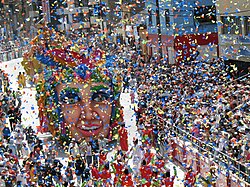
เทศกาลคาร์นิวัลถูกนำเข้ามาโดยชาวสเปนและผสมผสานองค์ประกอบจากวัฒนธรรมยุโรปนอกจากนี้ยังได้ตีความประเพณีดั้งเดิมของวัฒนธรรมแอฟริกันและอเมริกันพื้นเมือง ของโคลอมเบีย ใหม่ หลักฐานทางเอกสารแสดงให้เห็นว่าเทศกาลคาร์นิวัลมีอยู่ในโคลอมเบียตั้งแต่ศตวรรษที่ 18 และเคยเป็นสาเหตุให้ทางการอาณานิคมกังวลใจ โดยได้ทำการเซ็นเซอร์การเฉลิมฉลอง โดยเฉพาะอย่างยิ่งในศูนย์กลางทางการเมืองหลัก เช่นการ์ตาเฮนาโบโกตาและโปปายัน
เทศกาลคาร์นิวัลยังคงพัฒนาต่อไปในเมืองเล็กๆ หรือเมืองที่ไม่สำคัญ ซึ่งอยู่นอกสายตาของผู้ปกครอง ผลที่ได้คือการเฉลิมฉลองเทศกาลคาร์นิวัลอย่างต่อเนื่องในเมืองบาร์รังกียา (ดูเทศกาลคาร์นิวัลของบาร์รังกียา ) ซึ่งปัจจุบันได้รับการยอมรับว่าเป็นหนึ่งในผลงานชิ้นเอกของมรดกทางวัฒนธรรมที่จับต้องไม่ได้และมรดกทางวาจาของมนุษยชาติ เทศกาลคาร์นิวัลของบาร์รังกียาประกอบด้วยขบวนพาเหรดหลายขบวนในคืนวันศุกร์และวันเสาร์ เริ่มตั้งแต่วันที่ 11 มกราคม และสิ้นสุดด้วยเทศกาลต่อเนื่องหกวัน เริ่มตั้งแต่วันพุธก่อนวันพุธเถ้า และสิ้นสุดในคืนวันอังคารเที่ยงคืน การเฉลิมฉลองอื่นๆ เกิดขึ้นในหมู่บ้านต่างๆ ตามแม่น้ำมา Magdalena ตอนล่าง ทางตอนเหนือของโคลอมเบีย และในเมืองปาสโตและนาริญโญ (ดูเทศกาลคาร์นิวัลของคนดำและคนขาว ) ทางตอนใต้ของประเทศ ในช่วงต้นศตวรรษที่ 20 ความพยายามที่จะนำเทศกาลคาร์นิวัลมาจัดในโบโกตาถูกรัฐบาลปฏิเสธเทศกาลคาร์นิวัลของโบโกตาได้รับการฟื้นฟูขึ้นอีกครั้งในศตวรรษที่ 21
โดมินิกา
เทศกาลคาร์นิวัลในโดมินิกาจัดขึ้นในเมืองหลวงโรโซ [ 86 ] และมีองค์ประกอบของเทศกาลคาร์นิวัลที่พบได้ในเกาะใกล้เคียงของฝรั่งเศสอย่างมาร์ตินิกและกัวเดลูปรวมถึงตรินิแดดกิจกรรมที่น่าสนใจก่อนเทศกาลคาร์นิวัล ได้แก่ พิธีเปิดงานเฉลิมฉลองคาร์นิวัล การแข่งขันดนตรี Calypso Monarch การประกวดความงาม Queen of Carnival [ 87 ]และวงดนตรีบูยอง[ 88 ]การเฉลิมฉลองจะจัดขึ้นในวันจันทร์และวันอังคารก่อนวันพุธเถ้า[ 89 ]
สาธารณรัฐโดมินิกัน

เทศกาลคาร์นิวัล โดมินิกันมีการเฉลิมฉลองในเมืองและหมู่บ้านส่วนใหญ่ตามถนนสายหลักในช่วงเดือนกุมภาพันธ์ ลักษณะเด่นประการหนึ่งคือเครื่องแต่งกายที่ฉูดฉาดและดนตรีที่ดังสนั่น เทศกาลที่จัดขึ้นในลาเวกาซึ่งเป็นหนึ่งในเทศกาลที่ใหญ่ที่สุดในประเทศ และขบวนพาเหรดระดับชาติในซานโตโดมิงโกเป็นสถานที่จัดเทศกาลคาร์นิวัลแห่งอเมริกาครั้งแรก[ 90 ]
หน้ากากงานคาร์นิวัลมีความประณีตและมีสีสัน เครื่องแต่งกายที่ใช้ในขบวนพาเหรดเป็นการล้อเลียนปีศาจและเรียกว่า "Diablos Cojuelos" พวกเขาเต้นรำและวิ่งไปตามจังหวะดนตรีเมอเรนเกที่ผสมผสานกับเทคโน ฮิปฮอป และเร็กเกตอน ตัวละคร เชิงเปรียบเทียบเพิ่มเติมแสดงถึงประเพณีของสาธารณรัฐโดมินิกัน เช่น "Roba la Gallina" และ "Califé" [ 90 ]
หนึ่งในขบวนพาเหรดระดับนานาชาติมากที่สุดจัดขึ้นที่ซานเปโดรเดมาโคริสมีขบวนพาเหรด "กูโลยาส" ที่มีกลุ่มคนแต่งกายแฟนซีเต้นรำไปตามท้องถนน ผู้ร่วมขบวนพาเหรดต่างวิ่งหนี "ดิอาโบลส โคฮูเอโลส" ที่พยายามจะตีพวกเขาด้วย "เวฮิกาส" [ 90 ]
ช่วงเวลาของเทศกาลต่างๆ ได้แยกออกจากการประสานทางศาสนาดั้งเดิมกับช่วงเทศกาลมหาพรต โดยมีวันประกาศอิสรภาพแห่งชาติในวันที่ 27 กุมภาพันธ์ และวันเกิดของฮวน ปาโบล ดูอาร์เต บิดาผู้ก่อตั้งประเทศ ในวันที่ 26 มกราคม การเฉลิมฉลองเทศกาลคาร์นิวัลจึงจัดขึ้นตลอดทั้งเดือนกุมภาพันธ์โดยไม่คำนึงถึงปฏิทินมหาพรต [ 91 ]
เอกวาดอร์


ในเอกวาดอร์การเฉลิมฉลองเริ่มขึ้นก่อนการมาถึงของศาสนาคาทอลิก ชาวอินเดียนฮัวรังกัส (จากชนชาติชิมบอส) เคยเฉลิมฉลองพระจันทร์ดวงที่สองของปีด้วยเทศกาลที่พวกเขาโยนแป้ง ดอกไม้ และน้ำหอม ประเพณีพื้นเมืองนี้ได้ผสมผสานเข้ากับการเฉลิมฉลองเทศกาลคาร์นิวัลของคาทอลิก[ 92 ]
ลักษณะเด่นอย่างหนึ่งของเทศกาลคาร์นิวัลในเอกวาดอร์คือดิอาบลิโตส (ปีศาจน้อย) ที่เล่นน้ำ เช่นเดียวกับการปาหิมะ การสาดหรือเทน้ำใส่เหยื่อที่ไม่ทันตั้งตัวเป็นที่ชื่นชอบของเด็กและวัยรุ่น แม้ว่าผู้ใหญ่บางคนจะหวาดกลัวก็ตาม การปาบอลลูนน้ำ บางครั้งอาจปาไข่และแป้งใส่ทั้งเพื่อนและคนแปลกหน้าเป็นเรื่องสนุก แต่ก็อาจทำให้ผู้ที่ไม่รู้เรื่องรู้สึกไม่สบายใจได้[ 93 ]
แม้ว่ารัฐบาลและหน่วยงานทางการศึกษาจะห้ามการเล่นเกมเหล่านี้ แต่ก็ยังมีการเล่นกันอย่างแพร่หลาย นักประวัติศาสตร์เล่าถึงเรื่องราวของบาทหลวงท่านหนึ่งในปี ค.ศ. 1867 ที่ขู่ว่าจะขับไล่ผู้คนออกจากศาสนาเนื่องจากบาปของการเล่นเกมในงานเทศกาล
เทศกาลต่างๆ แตกต่างกันไปทั่วประเทศ ชาวบ้านจะสวมหน้ากากหลากสีสันและเต้นรำ โดยปกติแล้ว การเฉลิมฉลองจะเริ่มต้นด้วยการเลือกตั้งTaita Carnival (พ่อแห่งเทศกาล) ซึ่งเป็นหัวหน้างานเฉลิมฉลองและนำขบวนพาเหรดในแต่ละเมือง[ 94 ]
เทศกาลคาร์นิวัลที่มีชื่อเสียงที่สุดอยู่ในเมืองกัวรันดา (จังหวัดโบลิวาร์) และอัมบาโต (จังหวัดตุนกูราฮัว) ในอัมบาโต เทศกาลนี้เรียกว่าFiesta de las Flores y las Frutas (เทศกาลดอกไม้และผลไม้) เมืองอื่นๆ ได้ฟื้นฟูประเพณีคาร์นิวัลด้วยขบวนพาเหรดที่มีสีสัน เช่น ในอาโซเกส (จังหวัดกาญาร์) ในอาโซเกสและเทือกเขาแอนดี สตอนใต้ โดยทั่วไปเทศกาลคาร์นิวัลไทตาเป็นของชาวกาญารี พื้นเมืองเสมอ เมื่อไม่นานมานี้ การเฉลิมฉลองได้รับความนิยมมากขึ้นในภาคเหนือของเทือกเขาแอนดีสในหุบเขาโชตาในอิม บาบูรา ซึ่งเป็นเขตที่มี ประชากร ชาวแอฟริกัน-เอกวาดอร์ จำนวนมาก ดังนั้นเทศกาลคาร์นิวัลจึงมีการเฉลิมฉลองด้วยดนตรีบอมบาเดลโชตา[ 95 ]
เมืองลาตาคุงกาเฉลิมฉลองเทศกาลคาร์นิวัลในสามรูปแบบ: [ 96 ]เทศกาลคาร์นิวัลเล่นน้ำซึ่งผู้คนเล่นน้ำกัน เทศกาลคาร์นิวัลทางศาสนาซึ่งผู้คนจัดงานเฉลิมฉลองทางศาสนา และขบวนพาเหรดคาร์นิวัลในเมืองซึ่งผู้คนเดินขบวนไปตามถนนในเมืองลาตาคุงกาโดยสวมหน้ากากขณะเต้นรำไปกับวงดนตรี
เฟรนช์กายอานา
เทศกาลคาร์นิวัลของเฟรนช์กายอานามีรากฐานมาจาก วัฒนธรรม ครีโอลทุกคนมีส่วนร่วม ไม่ว่าจะเป็นชาวฝรั่งเศสแผ่นดินใหญ่ ชาวบราซิล (กายอานามีพรมแดนติดกับบราซิล) ชาวจีน รวมถึงชาวครีโอลด้วย[ 97 ]
ระยะเวลาของเทศกาลนี้ไม่แน่นอน ขึ้นอยู่กับเทศกาลทางศาสนาที่เปลี่ยนแปลงได้ เช่น เทศกาลคาร์นิวัลเริ่มต้นในวันสมโภช พระเยซูทรงปรากฏ และสิ้นสุดในวันพุธเถ้า ดังนั้นโดยทั่วไปจึงกินเวลาเกือบตลอดเดือนมกราคมและกุมภาพันธ์ ในช่วงเวลานี้ ตั้งแต่เย็นวันศุกร์จนถึงเช้าวันจันทร์ ทั่วทั้งประเทศจะคึกคักไปด้วยงานเต้นรำสวมหน้ากากและขบวนพาเหรดตามท้องถนน[ 98 ]
บ่ายวันศุกร์เป็นเวลาสำหรับการรับประทานกา เล็ตต์ เดส์ รัวส์ (เค้กของพระราชา) และดื่มแชมเปญ เค้กอาจมีรสชาติของดอกลีลาวดีฝรั่งหรือมะพร้าว
ในบ่ายวันอาทิตย์ ขบวนพาเหรดใหญ่จะเต็มท้องถนนในเมืองกาเยนน์คูรูและแซงต์-โลรองต์ ดู มาโรนี กลุ่มที่เข้าร่วมแข่งขันต่างเตรียมตัวกันเป็นเดือนๆ โดยแต่งกายตามธีมที่ตกลงกันไว้ในแต่ละปี พวกเขาจะเดินขบวนพร้อมกับรถแห่ กลอง และวงดนตรีทองเหลือง
กลุ่มนักแสดงชาวบราซิลได้รับการยกย่องในเรื่องเครื่องแต่งกายที่ประดับประดาด้วยขนนกและเลื่อมอย่างวิจิตรตระการตา อย่างไรก็ตาม พวกเขาไม่มีสิทธิ์เข้าร่วมการแข่งขัน เนื่องจากเครื่องแต่งกายไม่เปลี่ยนแปลงไปตามกาลเวลา
ตัวละครในตำนานมักปรากฏตัวในขบวนแห่เป็นประจำ:
- คาโรลิน − คนตัวเล็กที่สวม หาง นกกาและหมวกทรงสูงขี่อยู่บนตัวชรูว์ ;
- เลส์ เน็กมาร์รองส์ (Les Nèg'marrons) – กลุ่มชายสวมผ้าเตี่ยว สีแดง คาบมะเขือเทศสุกไว้ในปาก ขณะที่ร่างกายถูกทาด้วยไขมันหรือกากน้ำตาลพวกเขาจงใจเข้าใกล้ผู้ชม ทำให้เสื้อผ้าของผู้ชมสกปรก
- มาคูเม (Les makoumés ) − ผู้ชาย แต่งกายข้ามเพศ (นอกบริบทของเทศกาลคาร์นิวัลมาคูเมเป็นคำดูถูกสำหรับผู้รักร่วมเพศ )
- ซูซูริส (ค้างคาว) – ตัวละครที่สวมชุดรัดรูปมีปีกตั้งแต่หัวจรดเท้า โดยปกติจะเป็นสีดำ ตามธรรมเนียมแล้ว ตัวละครนี้มักมีนิสัยชั่วร้าย และมีแนวโน้มที่จะไล่ล่าผู้ชมและ "ต่อย" พวกเขา

ประเพณีที่เป็นเอกลักษณ์ของชาวครีโอลอย่างหนึ่งคือประเพณี ทู ลูลู (Touloulous ) ผู้หญิงเหล่านี้สวมชุดประดับประดา ถุงมือ หน้ากาก และเครื่องประดับศีรษะที่ปกปิดร่างกายอย่างมิดชิด ทำให้ไม่สามารถจดจำพวกเธอได้ แม้กระทั่งสีผิว ในคืนวันศุกร์และวันเสาร์ของเทศกาลคาร์นิวัล จะมีการจัดงานเต้นรำทูลูลูในสถานที่ที่เรียกว่า "มหาวิทยาลัย" ซึ่งเป็นห้องเต้นรำขนาดใหญ่ที่เปิดเฉพาะช่วงเทศกาลคาร์นิวัลเท่านั้น ทูลูลูสามารถเข้างานได้ฟรี และยังได้รับถุงยางอนามัยเพื่อสุขภาพทางเพศของชุมชน ผู้ชายก็เข้าร่วมงานได้เช่นกัน แต่ต้องจ่ายค่าเข้าและไม่ได้แต่งกายปลอมตัว ทูลูลูจะเป็นผู้เลือกคู่เต้นรำของตนเอง ซึ่งคู่เต้นรำไม่สามารถปฏิเสธได้ การจัดงานแบบนี้ออกแบบมาเพื่อให้ผู้หญิงสามารถสร้างความสัมพันธ์ชั่วคราวกับผู้ชายได้อย่างลับๆ ผู้หญิงที่ไม่ได้แต่งกายปลอมตัวจะไม่ได้รับการต้อนรับ ตามประเพณี หากผู้หญิงเช่นนั้นลุกขึ้นเต้นรำ วงดนตรีจะหยุดเล่นทันที บาร์ต่างๆ มีบริการเครื่องดื่มแอลกอฮอล์ โดยหญิงสาวที่ปลอมตัวจะกระซิบกับชายเหล่านั้นว่า "กระหายน้ำ" ซึ่งคาดว่าจะมีการเสิร์ฟเครื่องดื่มให้รอบหนึ่ง โดยต้องดื่มผ่านหลอดเพื่อปกปิดตัวตน
ในยุคสมัยใหม่นี้ ผู้ชายชาวกายอานาได้พยายามพลิกสถานการณ์ด้วยการจัดงานsoirées tololoซึ่งเป็นงานที่ผู้ชายปลอมตัวเป็นชายแล้วออกไปหาคู่จากผู้หญิงที่ไม่ได้ปลอมตัวเป็นหญิง
สี่วันสุดท้ายของเทศกาลคาร์นิวัลเป็นไปตามตารางเวลาที่เข้มงวด และจะไม่มีการทำงานใดๆ ทั้งสิ้น:
- วันอาทิตย์ − ขบวนพาเหรดใหญ่ ซึ่งเป็นการแข่งขันของกลุ่มต่างๆ
- วันจันทร์ − การแสดงล้อเลียนงานแต่งงาน โดยผู้ชายแต่งตัวเป็นเจ้าสาวและผู้หญิงแต่งตัวเป็นเจ้าบ่าว
- วันอังคาร − วันปีศาจแดง ซึ่งทุกคนจะสวมเสื้อผ้าสีแดงหรือสีดำ
- วันพุธเถ้า (Ash Wednesday) − การแต่งกายต้องเป็นสีดำและสีขาวเท่านั้น สำหรับพิธีใหญ่ในการเผาหุ่นจำลองของวาวัล กษัตริย์แห่งเทศกาลคาร์นิวัล
กัวเตมาลา
งาน คาร์นิวัล มาซาเตนังโกเป็นการเฉลิมฉลองสองหรือสามวันซึ่งจัดขึ้นในเมืองนี้มานานกว่าศตวรรษ แม้ว่าจะมีลักษณะทางโลก แต่ก็จัดขึ้นทันทีก่อนเริ่มเทศกาลมหาพรตของศาสนาคริสต์การเฉลิมฉลองในยุคแรกๆ มีการต่อสู้กับวัวกระทิง และการเฉลิมฉลองในยุคปัจจุบันมีการสวมหน้ากากและเครื่องแต่งกาย การเลือกราชาและราชินีที่น่าเกลียดของงานคาร์นิวัล การเต้นรำ และเกมต่างๆ มากมาย[ 99 ] [ 100 ]
เฮติ
เทศกาลคาร์นิวัลในเฮติเริ่มต้นขึ้นในปี 1804 ในเมืองหลวงปอร์โตแปรงซ์หลังจากการประกาศอิสรภาพเทศกาลคาร์นิวัลปอร์โตแปรงซ์เป็นหนึ่งในเทศกาลที่ใหญ่ที่สุดในอเมริกาเหนือ ในภาษาครีโอล เรียกว่า "คานาวาล" เทศกาล เริ่มต้นในเดือนมกราคม ซึ่งเรียกว่า "พรี-คานาวาล" ในขณะที่กิจกรรมคาร์นิวัลหลักเริ่มในเดือนกุมภาพันธ์ ในเดือนกรกฎาคมปี 2012 เฮติได้จัดเทศกาลคาร์นิวัลอีกงานหนึ่งชื่อ "คานาวาล เดอ เฟลอร์" เครื่องแต่งกายที่สวยงาม ขบวนแห่ ขบวนพาเหรดเทศกาลรารา[ 101 ]หน้ากาก อาหาร และ ดนตรี เรซิน ยอดนิยม (เช่นBoukman Eksperyans , Foula Vodoule, Tokay, Boukan Ginen และ Eritaj) และ วงดนตรี Kompa (เช่น T-Vice, Djakout No. 1, Sweet Micky , Kreyòl La, DP Express, Mizik Mizik, Ram, T-Micky, Carimi, Djakout Mizik และ Scorpio Fever) เล่นให้กับนักเต้นบนถนนของจัตุรัส Champ-de-Mars, Port-au-Prince มีการประกวดร้องเพลง
สถานที่อื่นๆ ในเฮติมีการเฉลิมฉลองเทศกาลคาร์นิวัล รวมถึงJacmelและAux Cayesในปี 2013 มีการเฉลิมฉลอง Kanaval ใน Okap ( Cap-Haïtien ) [ 102 ]
เทศกาลคาร์นิวัลสิ้นสุดลงในวันพุธเถ้า ตามด้วยเทศกาลรารา ซึ่งเป็นประเพณีดนตรีเดินขบวนอีกแบบหนึ่งที่รู้จักกันดีในเฮติและสาธารณรัฐโดมินิกัน เทศกาลนี้เน้นเรื่องศาสนา มีการแต่งเพลงขึ้นใหม่ทุกปี และวงดนตรีจะเล่นท่อไม้ไผ่ ( vaksin ) และแตรทำเอง ( konèt ) นอกจากนี้ยังมีการแสดงราราในProspectและCentral Parkในนิวยอร์กช่วงฤดูร้อน อีกด้วย [ 103 ]
ฮอนดูรัส
ในเมืองลาเซบาประเทศฮอนดูรัสมีการจัดงานคาร์นิวัลในวันเสาร์ที่สามหรือสี่ของเดือนพฤษภาคมทุกปี เพื่อรำลึกถึงนักบุญอิซิโดร [ 104 ] [ 105 ] นับเป็นงานเฉลิมฉลองคาร์นิวัลที่ใหญ่ที่สุดในอเมริกากลาง[ 106 ] [ 107 ]
เม็กซิโก
ในเม็กซิโกเทศกาลคาร์นิวัลมีการเฉลิมฉลองในเมืองและหมู่บ้านประมาณ 225 แห่ง เมืองที่ใหญ่ที่สุดอยู่ในมาซาตลันและเมืองเวราครูซโดยมีเมืองอื่นๆ อยู่ในบาฮาแคลิฟอร์เนียและยูกาตันเทศกาลคาร์นิวัลในเมืองใหญ่ๆ มีการใช้เครื่องแต่งกาย ราชินีที่ได้รับการเลือกตั้ง และขบวนพาเหรดที่มีรถแห่ แต่การเฉลิมฉลองคาร์นิวัลในพื้นที่เล็กๆ และชนบทนั้นแตกต่างกันอย่างมาก ขึ้นอยู่กับระดับอิทธิพลของยุโรปในช่วงยุคอาณานิคมของเม็กซิโก เทศกาลที่ใหญ่ที่สุดอยู่ในฮูเอโฮตซิงโกรัฐ ปว ยบลาซึ่งชาวเมืองส่วนใหญ่มีส่วนร่วมในการต่อสู้จำลองด้วยปืนไรเฟิลที่ยิงกระสุนเปล่า โดยอิงจาก ยุทธการ ปวยบลารัฐสำคัญอื่นๆ ที่มีประเพณีท้องถิ่น ได้แก่โมเรโลสโออาซากาทลักสกาลาและเชียปัส [ 108 ] เทศกาลคาร์นิวัลของกัมเปเชมีมานานกว่า 400 ปี ย้อนกลับไปถึงปี 1582 [ 109 ]
นิการากัว
บนชายฝั่งทะเลแคริบเบียนของบลูฟิลด์สประเทศนิการากัวเทศกาลคาร์นิวัลเป็นที่รู้จักกันดีในชื่อ "Palo de Mayo" (หรือ Mayo Ya!) และมีการเฉลิมฉลองทุกวันในเดือนพฤษภาคม[ 110 ]
ในมานากัวมีการเฉลิมฉลองเป็นเวลาสองวัน ที่นั่นเรียกว่าAlegria por la vida ("ความสุขเพื่อชีวิต") และมีธีมที่แตกต่างกันในแต่ละปี อีกเทศกาลหนึ่งในมานากัวเฉลิมฉลองนักบุญอุปถัมภ์ โดมิงโก เดอ กุซมัน และกินเวลาสิบวัน[ 111 ]
ปานามา


ตามธรรมเนียมแล้ว เทศกาลคาร์นิวัลจะเริ่มต้นในวันศุกร์และสิ้นสุดในวันอังคารก่อนวันพุธเถ้า ซึ่งชาวปานามาเรียกกันว่า "โลส คาร์นาวาเลส" (Los Carnavales) เทศกาลนี้เฉลิมฉลองกันทั่วประเทศ โดยเฉพาะอย่างยิ่งในเมืองลาส ตาบลาส (Las Tablas ) เมืองเล็กๆ ที่เงียบสงบ ประชากรเพิ่มขึ้นอย่างมากเนื่องจากการเฉลิมฉลองคาร์นิวัลที่ยิ่งใหญ่ การเฉลิมฉลองคาร์นิวัลในเมืองปานามาซิตี้และเกือบทั้งหมดของคาบสมุทรอาซูเอโร (Azuero Peninsula ) เป็นสถานที่ท่องเที่ยวที่ได้รับความนิยม ส่วนเปโนโนเม (Penonomé) มีขบวนพาเหรดบนแม่น้ำซาราติ (Rio Zarati) ซึ่งเป็นกิจกรรมคาร์นิวัลที่ไม่เหมือนใคร
นอกจากลาสตาบลาสแล้ว ยังมีสถานที่อื่นๆ อีกหลายแห่งในปานามาที่จัดงานเฉลิมฉลองเทศกาลคาร์นิวัล ได้แก่ เปดาซี โทโนซี ชิเตร และโอคู ซึ่งตั้งอยู่บนคาบสมุทรอาซูเอโรเช่นเดียวกับลาสตาบลาส ในโคเคล เทศกาลคาร์นิวัลจะจัดขึ้นที่เปโนโนเมและอากัวดุลเซ รวมถึงในเมืองปานามาซิตี้ ซึ่งพยายามจัดงานเฉลิมฉลองเพื่อดึงดูดนักท่องเที่ยว เทศกาลคาร์นิวัลยังจัดขึ้นในเมืองใกล้เคียง เช่น ลา ชอร์เรรา และ 24 เด ดิเซียมเบร บนชายฝั่งทะเลแคริบเบียนของปานามา เทศกาลคาร์นิวัลจะจัดขึ้นในสถานที่ต่างๆ เช่น โบกัส เดล โตโร และปอร์โตเบโล อย่างไรก็ตาม ไม่มีราชินี แต่กลับพบเห็นปีศาจได้ทั่วไป[ 112 ]
เทศกาลคาร์นิวัลของปานามาได้รับความนิยมอย่างมากเนื่องจากมีการจัดคอนเสิร์ตของศิลปินชื่อดังในพื้นที่ที่มีผู้คนพลุกพล่านที่สุด คอนเสิร์ตมักจัดขึ้นในเวลากลางคืนและต่อเนื่องไปจนถึงเช้าวันรุ่งขึ้น
สัปดาห์เทศกาลคาร์นิวัลเป็นวันหยุดประจำชาติในปานามา โดยธุรกิจและหน่วยงานราชการส่วนใหญ่จะปิดทำการในช่วงเทศกาล และชาวปานามาส่วนใหญ่เลือกที่จะเดินทางไปยังพื้นที่ชนบทของประเทศเพื่อเข้าร่วมงานคาร์นิวัลและเยี่ยมญาติ
งานคาร์นิวัลในปานามายังมีการนำรถบรรทุกน้ำมันขนาดใหญ่มาดัดแปลงเพื่อใช้ฉีดน้ำใส่ผู้เข้าร่วมงาน โดยใช้สายยางดับเพลิงที่ควบคุมและฉีดน้ำโดยคนหนึ่งคนหรือมากกว่าที่ยืนอยู่บนแท่นที่ติดตั้งอยู่บนรถบรรทุก การกระทำนี้เรียกว่า "culecos" หรือ "los culecos" รถบรรทุกจะนำน้ำมาจากแม่น้ำใกล้เคียงที่ได้รับการอนุมัติจากรัฐบาล และน้ำจะได้รับการตรวจสอบความสะอาดก่อนนำมาใช้ การแสดง culecos มักจะจัดขึ้นตั้งแต่เวลา 10.00 น. ถึง 15.00 น. ซึ่งเป็นช่วงเวลาที่แดดแรงที่สุด เด็กและสตรีมีครรภ์ถูกห้ามไม่ให้เข้าร่วมใน culecos และรถบรรทุกเหล่านี้มักได้รับการสนับสนุนจากบริษัทหรือแบรนด์ที่มีชื่อเสียงของปานามา นอกจากนี้ culecos มักจะมีการแสดงคอนเสิร์ตเร็กเกตอนควบคู่ไปด้วย[ 113 ] [ 114 ] [ 115 ] [ 116 ]
การดื่มเบียร์เย็นๆ ที่มีแอลกอฮอล์ต่ำหรือSmirnoff ในปริมาณมากอย่างเปิดเผย ซึ่งเก็บไว้ในกระติกน้ำแข็ง เป็นเรื่องปกติในหมู่ผู้เข้าร่วมงาน เช่นเดียวกับในริโอเดจาเนโร งานคาร์นิวัลบางแห่งก็มีขบวนแห่เช่นกัน แต่บางครั้งอาจมีหญิงสาวแต่งกายด้วยชุดแฟนซีที่ประณีตบรรจง ทำหน้าที่เป็น "ราชินี" แห่ง "Calle Arriba" และ "Calle Abajo" ซึ่งเป็นตัวแทนของคนร่ำรวยและชนชั้นแรงงานตามลำดับ ราชินีเหล่านี้จะถูกเลือกผ่านการประกวดและประกาศในเดือนตุลาคมของปีที่แล้ว และจะมีการเปลี่ยนตัวทุกปี ราชินีจะได้รับการแนะนำตัวในวันแรกของงานคาร์นิวัล และมักจะมีวงดนตรีบรรเลงประกอบอยู่เสมอเมื่อใดก็ตามที่ราชินีปรากฏตัว มีการจุดพลุในคืนสุดท้ายของงานคาร์นิวัล เพื่อเป็นสัญญาณสิ้นสุดงานคาร์นิวัล[ 117 ]
เปรู
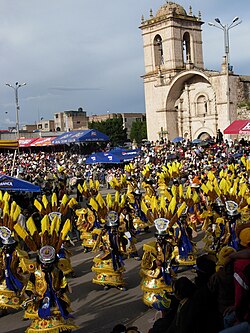
กาจามาร์กา
เมืองกาฮามาร์กาถือเป็นเมืองหลวงของเทศกาลคาร์นิวัลในเปรูชาวเมืองทุกเพศทุกวัยจะเต้นรำรอบต้นอุนชาหรือยุนซาซึ่งประดับประดาด้วยริบบิ้น ลูกโป่ง ของเล่น ผลไม้ ขวดเหล้า และของรางวัลอื่นๆ[ 118 ]
เมื่อถึงจุดหนึ่งมาโยร์โดโม (ผู้จัดงานเลี้ยง) จะเดินเข้ามาในวงกลม ผู้จัดจะเลือกคู่หนึ่งให้ไปที่ต้นอุนชาซึ่งพวกเขาจะพยายามตัดต้นไม้โดยใช้มีดพร้าฟัน สามครั้ง มีดพร้าจะถูกส่งต่อจากคู่หนึ่งไปยังอีกคู่หนึ่ง โดยแต่ละคู่จะฟันต้นไม้สามครั้ง เมื่อต้นอุนชาล้มลงในที่สุด ฝูงชนจะรีบวิ่งไปคว้าของรางวัล
ผู้ที่โค่นล้มอุนชาได้สำเร็จจะได้เป็นผู้ว่าราชการในปีถัดไป[ 119 ]
อาชญากรรม
แม้โดยทั่วไปจะสงบสุข แต่ก็มีปัญหาเกี่ยวกับการใช้เทศกาลคาร์นิวัลเป็นข้ออ้างในการก่ออาชญากรรม โดยเฉพาะการปล้นหรือการทำลายทรัพย์สิน โดยเฉพาะในบางพื้นที่ของลิมา[ 120 ]
ตรินิแดดและโตเบโก

ในตรินิแดดและโตเบโกเทศกาลคาร์นิวัลกินเวลานานหลายเดือนและสิ้นสุดลงด้วยการเฉลิมฉลองครั้งใหญ่ในสามวันก่อนวันพุธเถ้า โดยมี Dimanche Gras, J'ouvertและ Mas (การสวมหน้ากาก) การเฉลิมฉลองของโตเบโกสิ้นสุดลงในวันจันทร์และวันอังคารในขนาดที่เล็กกว่ามาก อย่างไรก็ตาม โตเบโกได้จัดเทศกาลคาร์นิวัลเดี่ยวครั้งแรกในวันที่ 28–30 ตุลาคม 2022 [ 121 ]เทศกาลคาร์นิวัลผสมผสานเครื่องแต่งกาย การเต้นรำ ดนตรี การแข่งขัน เหล้ารัม และการจัดงานปาร์ตี้ (fete-ing) รูปแบบดนตรี ได้แก่ โซกา คาลิปโซแร็ปโซและล่าสุดคือชัทนีย์และชัทนีย์โซกา[ 122 ]
การแข่งขัน ดนตรีเหล็กประจำปีของเทศกาลคาร์นิวัลหรือที่รู้จักกันในชื่อการแข่งขัน National Panorama จะจัดการแข่งขันรอบชิงชนะเลิศในวันเสาร์ก่อนงานหลัก ผู้เล่นดนตรีเหล็กจะแข่งขันกันในประเภทต่างๆ เช่น "วงดนตรีเหล็กแบบดั้งเดิม" หรือ "วงดนตรีเหล็กเดี่ยว" โดยการแสดงเพลงคาลิปโซประจำปี[ 123 ]
"Dimanche Gras" จัดขึ้นในคืนวันอาทิตย์ก่อนวันพุธเถ้า ที่นี่ มีการเลือก ราชาคาลิปโซ (หลังจากการแข่งขัน) และมอบเงินรางวัลและรถยนต์ให้ มีการสวมมงกุฎให้กับราชาและราชินีของวงดนตรี โดยแต่ละวงจะเดินขบวนพาเหรดชุดแต่งกายเป็นเวลาสองวันและส่งราชาและราชินี จากนั้นจึงเลือกผู้ชนะโดยรวม โดยปกติแล้วชุดแต่งกายจะมีขนาดใหญ่ ซับซ้อน สวยงาม และประณีต ซึ่งรวมถึงการดัดลวดด้วย[ 124 ]
J'ouvert หรือ "Dirty Mas" จัดขึ้นก่อนรุ่งสางในวันจันทร์ (ที่รู้จักกันในชื่อ Carnival Monday) ก่อนวันพุธเถ้า (Ash Wednesday) ซึ่งมีความหมายว่า "การเปิดวันใหม่" ผู้ร่วมงานจะแต่งกายด้วยชุดแฟนซีที่ล้อเลียนเหตุการณ์ปัจจุบัน โดยเฉพาะเหตุการณ์ทางการเมืองและสังคม "โคลนสะอาด" (โคลนดินเหนียว) สีน้ำมัน และสีทาตัว เป็นสิ่งที่คุ้นเคยในงาน J'ouvert ตัวละครที่นิยมคือ "Jab-jabs" (ปีศาจ สีน้ำเงิน สีดำ หรือสีแดง) พร้อมด้วยส้อมสามง่าม เขาแหลม และหาง มีการเลือกกษัตริย์และราชินีแห่ง J'ouvert โดยพิจารณาจากข้อความทางการเมือง/สังคมที่เฉียบแหลมของพวกเขา[ 125 ]

วันจันทร์คาร์นิวัลมีการเดินขบวนพาเหรดของวงดนตรีมาส ผู้ร่วมงานจะสวมชุดเพียงบางส่วนเท่านั้น เพื่อความสนุกสนานมากกว่าการแสดงหรือการแข่งขัน มาสในคืนวันจันทร์เป็นที่นิยมในเมืองส่วนใหญ่ โดยเฉพาะในเมืองหลวง ซึ่งมีวงดนตรีขนาดเล็กเข้าร่วมแข่งขัน นอกจากนี้ยังมี "การแข่งขันบอมบ์" ซึ่งเป็นการตัดสินวงดนตรีเหล็กขนาดเล็กอีกด้วย[ 126 ]
วันอังคารของเทศกาลคาร์นิวัลเป็นวันที่มีกิจกรรมหลัก ผู้เข้าร่วมจะสวมชุดแฟนซีเต็มรูปแบบ พร้อมแต่งหน้าและทาสี/ประดับประดาร่างกาย โดยปกติแล้วจะสวมรองเท้า "Mas Boots" ที่เข้ากับชุดแฟนซี แต่ละวงดนตรีจะมีโชว์ชุดแฟนซีตามธีมเฉพาะ และประกอบด้วยส่วนต่างๆ (บางส่วนมีผู้เข้าร่วมหลายพันคน) ที่สะท้อนถึงธีมเหล่านั้น มีการเดินขบวนพาเหรดบนถนนและการประกวดชุดแฟนซีของวงดนตรี ในที่สุดวงดนตรีแฟนซีจะมารวมตัวกันที่ Queen's Park Savannah เพื่อผ่าน "เวที" เพื่อให้กรรมการตัดสิน นักร้องที่ร้องเพลงได้มากที่สุดจะได้รับการสวมมงกุฎเป็นราชาหรือราชินีแห่ง Road March และได้รับเงินรางวัลและโดยปกติแล้วจะได้รับรถยนต์ด้วย
ขบวนแห่และการเฉลิมฉลองนี้ดำเนินต่อไปจนถึงเที่ยงคืนวันอังคาร วันพุธเถ้า แม้จะไม่ใช่วันหยุดราชการ แต่ก็มีผู้คนจำนวนมากแห่กันไปที่ชายหาดในท้องถิ่น ชายหาดที่ได้รับความนิยมมากที่สุดคือหาดมาราคัสและหาดมันซานิลลาซึ่งมีการจัดงานปาร์ตี้ริมหาดขนาดใหญ่ในวันพุธเถ้า
สหรัฐอเมริกา

การเฉลิมฉลองเทศกาลคาร์นิวัล ซึ่งมักเรียกกันว่ามาร์ดิกราส์ ("วันอังคารอ้วน" ในภาษาฝรั่งเศส) เริ่มมีการเฉลิมฉลองครั้งแรกใน บริเวณ ชายฝั่งอ่าวแต่ปัจจุบันมีการจัดขึ้นในหลายรัฐ[ 127 ] ประเพณีเหล่านี้มีต้นกำเนิดมาจาก เมืองหลวงอาณานิคมฝรั่งเศสในอดีต ได้แก่ โมบิล (ปัจจุบันอยู่ในรัฐแอละแบมา ) นิวออร์ลีนส์ ( รัฐลุยเซียนา ) และบิโลซี ( รัฐมิสซิสซิปปี ) ซึ่งเมืองเหล่านี้ได้เฉลิมฉลองกันมาหลายปีแล้วด้วยขบวนพาเหรดตามท้องถนนและงานเลี้ยงสวมหน้ากาก เมืองใหญ่อื่นๆ ในอเมริกาที่มีการเฉลิมฉลอง ได้แก่วอชิงตัน ดี.ซี. [ 128 ] เซนต์หลุยส์รัฐมิสซูรี[ 129 ]ซานฟรานซิสโก[ 130 ]และซานดิเอโก [ 131 ] รัฐแคลิฟอร์เนีย; กัลเวสตัน รัฐเท็กซัส [ 132 ]และเพนซาโคลา[ 133 ]แทมปา [ 134 ] ออร์แลนโด [ 135 ] และไมอามี[ 136 ]ในรัฐ ฟลอริดา
งานเฉลิมฉลองที่เป็นที่รู้จักและได้รับความนิยมมากที่สุดในสหรัฐอเมริกาจัดขึ้นที่นิวออร์ลีนส์ซึ่งกลุ่มต่างๆจะจัดขบวนพาเหรด งานเต้นรำ และกิจกรรมอื่นๆ เริ่มต้นด้วยขบวนพาเหรดรถราง Phunny Phorty Phellows ในคืนวันที่สิบสองและสิ้นสุดด้วยการปิดถนน Bourbon Street ในเวลาเที่ยงคืนของวันอังคารอ้วน[ 137 ]มักเรียกกันว่า "งานปาร์ตี้ฟรีที่ยิ่งใหญ่ที่สุดในโลก" [ 138 ]เมืองอื่นๆ ในรัฐหลุยเซียนา เช่นเลคชาร์ลส์บาตันรูจชรีฟพอร์ต ลาฟา แย ตมามูฮูมาและธิโบโดซ์ซึ่งส่วนใหญ่เคยอยู่ภายใต้การปกครองของฝรั่งเศสในบางช่วงเวลา ก็จัดงานเฉลิมฉลองเทศกาลคาร์นิวัลเช่นกัน[ 139 ]ในเขตที่ราบทางตะวันตกเฉียงเหนือของลาฟาแยต รัฐหลุยเซียนา ชาวเคจัน เฉลิมฉลอง Courir de Mardi Grasแบบดั้งเดิมซึ่งมีรากฐานมาจากการเฉลิมฉลองในชนบทของฝรั่งเศสในยุคกลาง[ 140 ]
In Puerto Rico, the most popular festivals are the Carnaval de Loíza and Carnaval de Ponce. The Carnaval de Ponce (officially "Carnaval Ponceño") is celebrated annually in Ponce. The celebration lasts one week and ends on the day before Ash Wednesday. It is one of the oldest carnivals of the Western Hemisphere, dating to 1858.[141] Some authorities trace the Ponce Carnaval to the eighteenth century.[142][143]
In New York City, a Caribbean Carnival known as the West Indian Day Parade is held in Crown Heights, Brooklyn on Labor Day. Founded by immigrants from Trinidad, the event was initially held at the beginning of Lent, but was later moved to Labor Day in order to allow an outdoor event in the summer.[144]
Starting in 2013, the Slovenian-American community located in the St. Clair-Superior neighborhood of Cleveland began hosting a local version of Kurentovanje, the Carnival event held in the city of Ptuj, Slovenia.[145] The event is conducted on the Saturday prior to Ash Wednesday.[145]
Uruguay

The Carnival in Uruguay lasts more than 40 days, generally beginning towards the end of January and running through mid March. Celebrations in Montevideo are the largest. The festival is performed in the European parade style with elements from Bantu and AngolanBenguela cultures imported with slaves in colonial times. The main attractions of Uruguayan Carnival include two colorful parades called Desfile de Carnaval (Carnival Parade) and Desfile de Llamadas (Calls Parade, a candombe-summoning parade).[146]
ในระหว่างการเฉลิมฉลอง โรงละครที่เรียกว่าtabladosจะถูกสร้างขึ้นในหลายแห่งทั่วเมือง โดยเฉพาะในมอนเตวิเดโอ[ 147 ] กลุ่มคาร์นิวัลต่างๆ ( Murgas , Lubolos หรือ Parodistas) ซึ่งเดิมทีประกอบด้วยผู้ชาย แต่ปัจจุบันเริ่มเปิดรับผู้หญิงมากขึ้น จะทำการแสดงโอเปร่าพื้นบ้านที่ tabladosโดยร้องเพลงและเต้นรำที่เกี่ยวข้องกับสถานการณ์ทางสังคมและการเมือง กลุ่ม 'Calls' ซึ่งโดยพื้นฐานแล้วประกอบด้วยมือกลองที่เล่น tamboril จะทำการแสดงจังหวะ candombe คาร์นิวัลในอุรุกวัยยังมีescolas de sambaด้วย และขบวนพาเหรดแซมบ้าที่ใหญ่ที่สุดอยู่ในArtigasและในมอนเตวิเดโอผู้ร่วมงานจะสวมใส่เสื้อผ้าเทศกาลVedettesซึ่งเป็นผู้หญิงที่ร่าเริงสวมชุดที่สวยงามและสดใสก็เป็นส่วนหนึ่งของขบวนพาเหรดด้วย แต่ละกลุ่มมีธีมของตัวเอง
ต้นแบบของยุโรป( ปิแอร์โรต์ฮาร์เลควินและโคลัมบินา ) ผสานรวมกับองค์ประกอบบรรพบุรุษของแอฟริกา ( แม่เฒ่า หรือมามา วีเอจาหมอพื้นบ้านหรือ กรา มิลเล โร และนักมายากลหรือเอสโคเบโร ) ในงานเทศกาล[ 148 ]
เวเนซุเอลา
เทศกาลคาร์นิวัลในเวเนซุเอลากินเวลาสองวัน 40 วันก่อนวันอีสเตอร์ เป็นช่วงเวลาที่เยาวชนในเมืองชนบทหลายแห่งเล่นสาดน้ำกัน (รวมถึงการใช้ลูกโป่งน้ำและปืนฉีดน้ำ) คนเดินเท้าทุกคนเสี่ยงที่จะเปียกปอน เมืองชายฝั่งและจังหวัดต่างๆ เฉลิมฉลองเทศกาลคาร์นิวัลอย่างคึกคักกว่าที่อื่นๆ ในประเทศ ชาวเวเนซุเอลาถือว่าเทศกาลคาร์นิวัลมีความหมายคล้ายกับเทศกาลคริสต์มาสและเซมานาซานตา ( สัปดาห์ศักดิ์สิทธิ์ ; สัปดาห์ก่อนวันอาทิตย์อีสเตอร์) ซึ่งเป็นช่วงเวลาที่พวกเขาใช้โอกาสนี้ไปเยี่ยมครอบครัว[ 149 ]
เอเชีย
อินเดีย


ในอินเดีย เทศกาลคาร์นิวัลมีการเฉลิมฉลองเฉพาะในรัฐกัว เท่านั้น และเดิมทีเป็นประเพณีท้องถิ่นของนิกายโรมันคาทอลิกที่เรียกว่าIntruzซึ่งหมายถึง "นักต้มตุ๋น" ในภาษาโกนกานีขณะที่Entrudoเป็นคำที่เหมาะสมในภาษาโปรตุเกสสำหรับ "เทศกาลคาร์นิวัล" เทศกาลคาร์นิวัลเชิงพาณิชย์ในปัจจุบันของกัว ( เช่น กษัตริย์โมโมขบวนแห่ ฯลฯ) ถูกสร้างขึ้นโดยอิงจากเทศกาลคาร์นิวัลริโอในช่วงทศวรรษ 1960 เพื่อดึงดูดนักท่องเที่ยว[ 150 ]การเฉลิมฉลองที่ยิ่งใหญ่ที่สุดเกิดขึ้นในเมืองหลวงปานาจีงานเทศกาลคาร์นิวัลเชิงพาณิชย์เกิดขึ้นในช่วงสามวันสามคืนก่อนวันพุธเถ้า Sixtus Eric Dias จาก Candolim เป็นกษัตริย์โมโมสำหรับเทศกาลคาร์นิวัลปี 2021 มีขบวนพาเหรดตลอดทั้งคืนทั่วทั้งรัฐพร้อมวงดนตรี การเต้นรำ และขบวนแห่ มีการจัดงานเลี้ยงใหญ่ในตอนเย็น[ 151 ]
อินโดนีเซีย
ในอินโดนีเซียคำว่า "คาร์นิวัล" หรือ " คาร์นาวัล " ไม่ได้เกี่ยวข้องกับงานเฉลิมฉลองก่อนเทศกาลเข้าพรรษาแต่หมายถึงเทศกาลโดยทั่วไป โดยเฉพาะเทศกาลที่มีขบวนแห่และเครื่องแต่งกายที่หรูหรา หนึ่งในคาร์นิวัลที่ใหญ่ที่สุดในอินโดนีเซียคือโซโล บาติก คาร์นิวัลซึ่งจัดขึ้นที่โซ โล จังหวัดชวาตอนกลาง และเจมเบอร์ แฟชั่น คาร์นิวัล ก็จัดขึ้นที่เจมเบอร์จังหวัดชวาตะวันออก[ 152 ]
ชุมชนนิกายโรมันคาธอลิกแห่งกูปังนูซาเต็งการาตะวันออกได้จัดขบวนแห่อีสเตอร์ในรูปแบบของเทศกาลอีสเตอร์ที่เรียกว่าPawai Paskah Kupang [ 153 ]
อิสราเอล
ฟิลิปปินส์

ในประเทศฟิลิปปินส์เทศกาลมานิลา ( ภาษาสเปนฟิลิปปินส์ : Carnaval de Manila ) เคยเป็นงานประจำปีที่สำคัญในมานิลาในช่วงต้นยุคอาณานิคมอเมริกันจนถึงช่วงก่อนสงครามโลกครั้งที่สองงานนี้จัดขึ้นโดยฝ่ายบริหารอาณานิคมอเมริกันเพื่อแสดงให้เห็นถึงการพัฒนาทางเศรษฐกิจของฟิลิปปินส์จุดเด่นของงานคือการสวมมงกุฎให้กับราชินีแห่งเทศกาล ซึ่งเป็นต้นกำเนิดของการประกวดระดับชาติในเวลาต่อมา เช่นมิสฟิลิปปินส์[ 154 ] [ 155 ] [ 156 ]นอกจากนี้ยังเป็นที่น่าสังเกตว่าได้ก่อตั้งและเป็นเจ้าภาพจัดการแข่งขันกีฬาชิงแชมป์ตะวันออกไกล ครั้งแรก (ซึ่งในขณะนั้นรู้จักกันในชื่อ "การแข่งขันกีฬาโอลิมปิกตะวันออกครั้งแรก") ซึ่งกลายเป็นต้นกำเนิดของการแข่งขันกีฬาเอเชียนเกมส์ ในปัจจุบัน [ 157 ] [ 158 ]


งานรื่นเริงกินเวลาประมาณสองสัปดาห์ ซึ่งมีการแสดงหลากหลายรูปแบบ เช่นละครสัตว์วอเดวิลล์ตลกเสียดสีและละครเวที [ 159 ] นอกจากนี้ยังมีการจัดขบวนพาเหรด 5 ขบวน ได้แก่ ขบวนพาเหรดเปิดงาน ขบวนพาเหรดทหาร ขบวนพาเหรดโรงเรียน ขบวนพาเหรดธุรกิจและอุตสาหกรรม (ซึ่งมีผู้เข้าร่วมจากต่างประเทศ) และขบวนพาเหรดดอกไม้ (ซึ่งมีผู้ชนะการประกวดราชินีงานรื่นเริง) [ 160 ]
งานคาร์นิวัลจัดขึ้นครั้งแรกในเดือนกุมภาพันธ์ พ.ศ. 2451 และในตอนแรกเป็นเพียงการเฉลิมฉลองในเมืองเท่านั้น ต่อมาได้ขยายขอบเขตไปทั่วประเทศในปี พ.ศ. 2455 [ 154 ]ซึ่งเป็นปีที่จัดขึ้นพร้อมกับงานนิทรรศการฟิลิปปินส์[ 161 ]งานนี้ถูกยกเลิกในปี พ.ศ. 2482 เนื่องจากการระบาดของสงครามโลกครั้งที่สอง และไม่ได้จัดขึ้นในช่วงที่ญี่ปุ่นยึดครองฟิลิปปินส์ (พ.ศ. 2484 ถึง พ.ศ. 2487) หลังจากฟิลิปปินส์ได้รับเอกราชในปี พ.ศ. 2489 ก็ไม่เคยมีการจัดอีกเลย[ 154 ] [ 162 ]
ในประเทศฟิลิปปินส์สมัยใหม่ มีเทศกาลและงานเฉลิม ประจำปีหลายพัน งานทั่วทั้งเกาะ ซึ่งมีการเฉลิมฉลองสาธารณะและการแข่งขันขบวนพาเหรดตามท้องถนนพร้อมเครื่องแต่งกายที่ประณีตคล้ายกับงานคาร์นิวัล อย่างไรก็ตาม ในบรรดาเทศกาลมากมายเหล่านี้ ยังมีเทศกาลก่อนเข้าพรรษาที่ยังคงหลงเหลืออยู่บ้าง ในเทศบาลเมืองปาโออายจังหวัดอิโลโคส นอร์เตพวกเขาเฉลิมฉลองเทศกาลกูลิง-กูลิง[ 163 ] [ 164 ]ซึ่งจัดขึ้นในวันอังคารก่อนเข้าพรรษา ชาวเมืองเชื่อว่านี่เป็นวันสุดท้ายที่จะได้สนุกสนานรื่นเริงทุกรูปแบบก่อนเข้าพรรษา คำว่ากูลิง-กูลิง มาจากคำภาษาอิโลกา โนว่า กูลิงซึ่งหมายถึง "การทำเครื่องหมาย การป้าย หรือการทำเครื่องหมาย" ในสมัยก่อน อัลคาลเด (ปัจจุบันคือนายกเทศมนตรี) ของเมืองจะประทับเครื่องหมายกางเขนบนหน้าผากของบุคคลโดยใช้แป้งข้าวเหนียวเปียกที่เปียกและเหนียว ซึ่งเป็นสัญลักษณ์ของความบริสุทธิ์ และด้วยเครื่องหมายนี้ บุคคลนั้นจะได้รับการชำระล้างบาปในอดีต[ 163 ]
ชาวปาโอเยโญสจะสวมชุดพื้นเมืองที่ดีที่สุดของพวกเขา จากนั้นพวกเขาก็จะทำขนมข้าวเหนียวหวานที่เรียกว่าดูดอลซึ่งเป็นอาหารหลักที่เสิร์ฟในระหว่างงานเทศกาล จากนั้นพวกเขาก็จะได้รับการต้อนรับจากนายกเทศมนตรีซึ่งจะนำแป้งข้าวเจ้าสีขาวที่เปียกมาทาเป็นรูปกากบาท และชาวบ้านเชื่อว่าเป็นลางร้ายหากพวกเขาไม่มีกูลิง หลังจากพิธีกรรมเสร็จสิ้น ผู้คนก็จะรับประทานดูดอลและบาซีขบวนแห่จะดำเนินต่อไปยังโบสถ์ ถนน และจัตุรัสกลางเมือง ซึ่งเป็นจุดที่การเฉลิมฉลองถึงจุดสูงสุด ผู้คนจะเต้นรำพื้นเมือง เช่น ซาบุนกานาย อาริเกน-เกน อามอโรซา บินัตบาตัน และลา โจตา[ 163 ] [ 165 ]
ภูมิภาคตากาล็อกยังมีการจัดงานเฉลิมฉลองเทศกาลคาร์นิวัลที่ยังคงหลงเหลืออยู่บ้าง ซึ่งเกี่ยวข้องกับเทศกาลมหาพรต ตามที่El Folklore Filipino กล่าวไว้ Isabelo de los Reyes เขียนว่าชาวตากาล็อกมีการเฉลิมฉลองเทศกาลคาร์นิวัลประเภทหนึ่ง ซึ่งมักจัดขึ้นในวันอาทิตย์ก่อนวันพุธเถ้า พวกเขาเรียกว่าde la pazซึ่งพวกเขาจะกินเนื้อสัตว์และหมูหันเป็นจำนวนมากใน Pambansang Diksiyonaryo คำว่า lapas มาจากภาษาสเปน la paz หมายถึงการเฉลิมฉลองเป็นเวลาสามวันก่อนวันพุธเถ้า[ 166 ]ในบันทึกภาษาสเปน Viajes por Filipinas: de Manila a Tayabas [ 167 ]ได้มีการบันทึกไว้ว่า:
" อัล aproximarse ลา cuaresma el indio de Tayabas se prepara á despedirse de comer carne, con las fiestas de lapasan, las que siempre se celebran en las sementeras. Si los que las dan son ricos, asiste la música; si no lo son, la Guitarra, las voces y las palmas la ช่วยเหลือ. En los aristocráticos lapasan, se bailan habaneras y rigodones, se cantan trozos de cualquier cosa, y se bebe vino de Europa en vaso: mientras que en los lapasan tradicionales, en los puros tagalos, se empina coquillo, se baila cumintang, se canta cutang-cutang, se bebe en tabo, se มาlechón, y por todo mantel está el verde césped, por todo tenedor los cinco dedos, y por todo pan sendas pelotas de morisqueta ”
"เมื่อเทศกาลมหาพรตใกล้เข้ามา ชาวอินเดียนแดงเผ่าตายาบัสเตรียมตัวอำลาการกินเนื้อสัตว์ด้วยงานเฉลิมฉลองลาปาซาน ซึ่งมักจัดขึ้นในทุ่งนา หากเจ้าภาพร่ำรวย ก็จะมีดนตรีบรรเลง แต่ถ้าไม่ ก็จะใช้กีตาร์ เสียงร้อง และเสียงปรบมือแทน ในงานลาปาซานของชนชั้นสูง จะมีการเต้นรำฮาบาเนราและริโกดอน ร้องเพลงหลากหลายประเภท และดื่มไวน์ยุโรปจากแก้ว ในขณะที่งานลาปาซานแบบดั้งเดิมของชาวตากาล็อก จะมีการจิบโคควิลโล เต้นรำคุมินตัง ร้องเพลงคูตัง-คูตัง ดื่มเครื่องดื่มจากภาชนะดินเผา กินหมูหัน และใช้หญ้าเขียวเป็นผ้าปูโต๊ะ ใช้ห้านิ้วเป็นส้อม และใช้ขนมปังโมริสเกตาปั้นเป็นก้อนเล็กๆ เป็นขนมปัง"
ในบัญชีเดียวกัน[ 167 ]ได้มีการบันทึกไว้ว่าชาวพื้นเมืองเฉลิมฉลองวันฉลองนักบุญยอห์นผู้ให้บัพติศมาและเทศกาลรื่นเริงสามวันด้วยการสาดน้ำและการแข่งขันเรือพื้นเมือง
มีคำศัพท์ภาษาตากาล็อกอีกคำหนึ่งสำหรับการเฉลิมฉลองงานรื่นเริงและวันฉลองนักบุญจอห์นแบปทิสต์ เมื่อตรวจสอบ Vocabulario de la lengua Tagala โดย Juan de Noceda [ 168 ]คำภาษาตากาล็อกสำหรับcarnestolendasคือ Boling-Boling หรือ Buling-Buling เมื่อตรวจสอบ Pambansang Diksiyonaryo อีกครั้ง Buling-Buling ถูกนิยามว่าเป็นการสาดน้ำในวันฉลองนักบุญจอห์นแบปทิสต์[ 169 ]คำว่า Buling-Buling มาจากคำภาษาตากาล็อก buling ซึ่งหมายถึง "คราบสกปรก เขม่า รอยเปื้อน หรือรอยเปื้อน" ในภาษาฟิลิปปินส์อื่นๆ เช่นเซบูอาโนและฮิลิกายโนนคำว่า buling หมายถึงสิ่งสกปรก เขม่า หรือคราบ และส่วนใหญ่ใช้ในบริบทของวันพุธเถ้า ในเมืองโมกป็อกจังหวัดมารินดูเกะพวกเขามีพิธีกรรมที่ทำในคืนก่อนวันพุธเถ้า เรียกว่า บูลิง หรือ บูลิง-บูลิง โดยพวกเขาจะเต้นรำและร้องเพลงต่อหน้าบาทหลวงประจำตำบลก่อนที่จะมีพิธีเผาใบปาล์มที่ได้รับการอวยพร[ 170 ] [ 171 ]
ในเมืองคาตานาอวนจังหวัดเกซอนพวกเขาเฉลิมฉลองเทศกาลโบลิง-โบลิงเป็นเวลาสามวันก่อนวันพุธเถ้า ผู้คนสวมชุดแฟนซีหรือชุดใดๆ ก็ได้ตามที่ต้องการ ในขณะที่บางคนเลือกที่จะแต่งตัวเป็นคาร์นาบัลซึ่งเป็นตัวตลกที่เป็นเอกลักษณ์ของเมืองนี้ คาร์นาบัลจะโยนผงสีขาวให้กับผู้เข้าร่วมงานรื่นเริง นอกจากนี้ยังมีบางคนที่ปกคลุมตัวเองด้วยโคลนและใบไม้แห้ง หรือปกคลุมตัวเองด้วยเขม่า กล่าวกันว่านี่เป็นสัญลักษณ์ว่าเราทุกคนมาจากฝุ่นและเราจะกลับคืนสู่ฝุ่น นอกจากนี้ยังมีหญิงชราที่เต้นรำโดยสวมหมวกประดับและชุดพื้นเมืองที่เรียกว่าเดโนญาสพวกเธอเต้นรำและร้องเพลงไปตามบ้านต่างๆ เพื่อแลกกับเงินบริจาคเพื่อระดมทุนสำหรับกิจกรรมและงานเฉลิมฉลองของโบสถ์ในอนาคต[ 172 ]
ในเมืองใกล้เคียงอย่างกินายังกัน จังหวัดเกซอนก็มีพิธีกรรมก่อนเข้าพรรษาที่เรียกว่า บูลิง-บูลิง เช่นกัน โดยจะจัดขึ้นในวันอังคารก่อนวันพุธเถ้า หรือวันพุธเถ้า กลุ่มคนทั้งชายและหญิงจะเต้นรำไปตามบ้านต่างๆ คล้ายกับเดโนญาสแห่งกาตาเนา เพื่อระดมทุน พวกเขาจะแสดงการเต้นรำพื้นบ้านบูลิง-บูลิง[ 173 ]
ในเขตวัดซานตูอาริโอ เด ซาน อันโตนิโอในเมืองมากาติพวกเขายังจัดงานเฉลิมฉลองบูลิง-บูลิงก่อนวันพุธเถ้า ซึ่งมีการแสดงรำพื้นบ้านแบบดั้งเดิม รำสมัยใหม่ และการร้องเพลง[ 174 ] [ 175 ]
เทศกาล บูลิง-บูลิงยังมีการเฉลิมฉลองในเมืองลิปาจังหวัดบาตังกัส ด้วย โดยจะจัดขึ้นในวันอาทิตย์ก่อนวันพุธเถ้า ผู้เข้าร่วมจะจัดงานเทศกาลน้ำที่ครึกครื้นคล้ายกับเทศกาลวัตตะห์ วัตตะห์ของเมืองซานฮวนปัจจุบันเทศกาลนี้กำลังถูกจับตามองเนื่องจากมีลักษณะที่ครึกครื้นและมีการเล่นน้ำกับผู้คนโดยไม่คำนึงถึงว่าพวกเขาจะเข้าร่วมหรือไม่[ 176 ]การเฉลิมฉลองนี้เป็นเทศกาลที่สอดคล้องกับการเฉลิมฉลองงานรื่นเริงที่บันทึกไว้ใน Viajes por Filipinas: De Manila a Tayabas [ 167 ]ซึ่งมีการเฉลิมฉลองด้วยน้ำเช่นเดียวกับวันฉลองนักบุญยอห์นผู้ให้บัพติศมา
งานเทศกาล Buling-Buling ดูเหมือนจะเชื่อมโยงกับงานเฉลิมฉลอง Buling-Buling ที่จัดขึ้นในวันนักบุญฮวน ตามประเพณีแล้ว การเฉลิมฉลอง Basaanที่จัดขึ้นในวันนี้เรียกว่า Buling-Buling เมืองบางแห่งที่ยังคงใช้ชื่อนี้สำหรับงานเทศกาลนักบุญยอห์นผู้ให้บัพติศมา ได้แก่ การเฉลิมฉลองทางน้ำ Basaan หรือ Buling-Buling ที่จัดขึ้นในBalayanจังหวัดBatangasซึ่งเกี่ยวข้องกับparada ng lechonที่ มีชื่อเสียง [ 177 ]และ Buling-Buling ของTiaong จังหวัด Quezon ซึ่งเกี่ยวข้องกับการเฉลิมฉลองทางน้ำเช่นกัน[ 178 ]
สุดท้ายนี้ มีการบันทึกไว้ว่าเมืองอันติโปโล คาร์โดนา และเทเรซา เคยเฉลิมฉลองหรืออย่างน้อยก็มีกิจกรรมที่เกี่ยวข้องกับเทศกาลก่อนเข้าพรรษา ในแต่ละฤดูกาลของเทศกาล มีการบันทึกไว้ว่าภรรยาของเจ้าหน้าที่เทศบาลสวมหมวกเดินไปรอบเมืองพร้อมกับวงดนตรีที่เดินตามหลัง พวกเธอเต้นรำอย่างไม่เป็นทางการและตามใจชอบ บางครั้งพวกเธอก็ไปเยี่ยมบ้านของบุคคลสำคัญ ซึ่งพวกเธอจะได้รับเครื่องดื่มแอลกอฮอล์และของขวัญ เช่น เงินจำนวนหนึ่ง ซึ่งพวกเธอใช้เพื่อความบันเทิงหรือเพื่อพิธีมิสซา ประเพณีนี้เสื่อมถอยลงเนื่องจากคนรุ่นใหม่มองว่าประเพณีนี้ล้าสมัย[ 179 ]
ยุโรป
แอลเบเนีย
งานคาร์นิวัลเริ่มมีการเฉลิมฉลองในเมืองคอร์ชาตั้งแต่ก่อนปี 1940 ซึ่งเป็นช่วงเวลาที่ชีวิตทางวัฒนธรรมในเมืองนี้มีความหลากหลาย แม้จะเป็นเทศกาลของศาสนาเพแกน แต่ต่อมางานคาร์นิวัลก็ถูกจัดขึ้นในวันฉลองในเดือนกุมภาพันธ์ นอกเหนือจากผู้คนที่แต่งกายด้วยชุดคาร์นิวัลมากมายแล้ว ยังมีวงดนตรีที่เล่นกีตาร์ คันชัก และสวมหน้ากากแปลกๆ เช่น หัวสัตว์และหัวคน งานคาร์นิวัลของคอร์ชาได้รับผลกระทบอย่างมากหลังจากมีการก่อตั้งสมาคมทางวัฒนธรรม เช่น "เยาวชนคอร์ชา" ในช่วงเวลานั้น งานคาร์นิวัลจึงมีดนตรีประกอบด้วยแมนโดลิน กีตาร์ และเพลงตลกขบขัน การเฉลิมฉลองงานคาร์นิวัลหยุดชะงักลงหลังจากปี 1960 และกลับมาจัดอีกครั้งในสภาพสังคมที่แตกต่างออกไปหลังจากปี 1990 คอร์ชาเป็นหนึ่งในเมืองแรกๆ ที่ฟื้นฟูประเพณีคาร์นิวัลโดยการจัดตั้งสมาคมคาร์นิวัลในปี 1992 ซึ่งเป็นส่วนหนึ่งของสมาคมคาร์นิวัลแห่งชาติของแอลเบเนีย เมื่อวันที่ 10 เมษายน 1994 เทศกาลคาร์นิวัลนานาชาติครั้งแรกในแอลเบเนียได้จัดขึ้นที่คอร์ชา และในปีต่อมา เทศกาลคาร์นิวัลนานาชาติครั้งที่สองก็ยิ่งใหญ่กว่าเดิม นับตั้งแต่ปีนี้จนถึงปี 2008 คณะคาร์นิวัลเมืองคอร์ชาได้เข้าร่วมงานเทศกาลนานาชาติหลายงานที่จัดขึ้นในประเทศต่างๆ ในยุโรป
เบลเยียม
หลายพื้นที่ในเบลเยียมเฉลิมฉลองเทศกาลคาร์นิวัล ซึ่งโดยทั่วไปจะมีขบวนพาเหรดแต่งกายแฟนซี งานเลี้ยงสังสรรค์ และดอกไม้ไฟ พื้นที่เหล่านี้ได้แก่ จังหวัดลิมบูร์ก ซึ่งมีเมืองมาสเมเชเลนมาเซคและลานาเคน ริมแม่น้ำเมิส รวมถึงเมืองอาลสต์นิโนฟบินเช ออยเปน ฮัลเลไฮสต์ เคลมิสมัลเมดีและสตาเวล็อต[ 180 ]

เทศกาลคาร์นิวัลแห่งบินเชมีมาอย่างน้อยตั้งแต่ศตวรรษที่ 14 มีการจัดขบวนพาเหรดในช่วงสามวันก่อนเข้าสู่เทศกาลมหาพรต ผู้เข้าร่วมที่สำคัญที่สุดคือชาวจิลส์ซึ่งสวมชุดพื้นเมืองในวันอังคารก่อนเข้าสู่เทศกาลมหาพรตและโยนส้มสีเลือดให้ฝูงชน[ 181 ]ในปี 2003 เทศกาลคาร์นิวัลแห่งบินเชได้รับการยอมรับว่าเป็นหนึ่งในผลงานชิ้นเอกของมรดกทางวาจาและมรดกทางวัฒนธรรมที่จับต้องไม่ได้ของมนุษยชาติ[ 182 ]
เทศกาลคาร์นิวัลแห่งอาลสต์ซึ่งจัดขึ้นในช่วงสามวันก่อนวันพุธเถ้า ได้รับการยอมรับเช่นเดียวกันในปี 2010 [ 183 ]
ขบวนพาเหรดที่เก่าแก่ที่สุดของเบลเยียมคือขบวนพาเหรดงานคาร์นิวัลของมาเซกซึ่งจัดขึ้นในวันอาทิตย์ลาเอตาเรเช่นกัน โดยมีต้นกำเนิดในปี พ.ศ. 2408 [ 184 ]

เทศกาลคาร์นิวัลแห่งมัลเมดีเรียกกันในท้องถิ่นว่าCwarmêแม้ว่ามัลเมดีจะตั้งอยู่ทางตะวันออกของเบลเยียม ใกล้กับพื้นที่ที่พูดภาษาเยอรมัน แต่Cwarmêเป็นเทศกาลคาร์นิวัลแบบวอลลูนและละตินแท้ๆ การเฉลิมฉลองจัดขึ้นในช่วงสี่วันก่อนวันอังคารก่อนวันพุธรับเถ้า วันอาทิตย์ Cwarmêเป็นวันที่สำคัญและน่าสนใจที่สุด ผู้คนจะเดินขบวนพาเหรดชุดพื้นเมืองดั้งเดิมไปตามท้องถนนCwarmêเป็น "เทศกาลคาร์นิวัลบนท้องถนน" ไม่ใช่แค่ขบวนพาเหรดเท่านั้น ผู้คนที่แต่งกายด้วยชุดแฟนซีจะเดินผ่านฝูงชนและแสดงส่วนหนึ่งของชุดพื้นเมืองที่พวกเขาสวมใส่ ชุดพื้นเมืองดั้งเดิมที่มีชื่อเสียงในCwarmêแห่งมัลเมดี ได้แก่Haguète , Longuès-BrèssesและLong-Né [ 185 ]
เมืองบางแห่งในเบลเยียมจัดงานคาร์นิวัลในช่วงเทศกาลมหาพรต หนึ่งในเมืองที่มีชื่อเสียงที่สุดคือเมืองสตาเวล็อตซึ่งมีการจัดงานคาร์นิวัลเดอลาลาเอตาเร ใน วันอาทิตย์ลาเอตาเร ซึ่งเป็นวันอาทิตย์ที่สี่ของเทศกาลมหาพรต ผู้เข้าร่วมงานประกอบด้วยกลุ่มบลองส์-มูสซีส์ซึ่งแต่งกายด้วยชุดสีขาว ถือจมูกสีแดงยาว และเดินขบวนไปทั่วเมืองพร้อมกับปาเศษกระดาษสีและกระเพาะหมู แห้งใส่ผู้คนรอบข้าง เมืองฮัลเลก็จัดงานเฉลิมฉลองในวันอาทิตย์ลาเอตาเรเช่นกัน
บอสเนียและเฮอร์เซโกวีนา
ในบอสเนียและเฮอร์ เซโกวี นาเมืองลูบูสกีซึ่ง มีประชากรส่วนใหญ่เป็น ชาวโครเอเชียจัดงานคาร์นิวัลแบบดั้งเดิม ( ภาษาบอสเนีย : Karneval ) ลูบูสกีเป็นสมาชิกของสหพันธ์เมืองคาร์นิวัลแห่งยุโรป (FECC) [ 186 ]
โครเอเชีย
เทศกาลคาร์นิวัล ที่มีชื่อเสียงที่สุดของโครเอเชีย (ภาษาโครเอเชีย: karnevalหรือเรียกอีกอย่างว่าmaškareหรือfašnik ) คือเทศกาลคาร์นิวัลเมืองริเยกาซึ่งในระหว่างเทศกาล นายกเทศมนตรีเมืองริเยกาจะมอบกุญแจเมืองให้กับหัวหน้าคาร์นิวัล ( meštar od karnevala ) เทศกาลนี้ประกอบด้วยกิจกรรมมากมาย โดย culminates ในวันอาทิตย์สุดท้ายด้วยขบวนแห่สวมหน้ากาก (ขบวนแห่ที่คล้ายกันสำหรับเด็กจะจัดขึ้นในสุดสัปดาห์ก่อนหน้า)

เมืองหลายแห่งในภูมิภาค ควาร์เนอร์ของโครเอเชีย(และในส่วนอื่นๆ ของประเทศ เช่น ในเขตเมดิมูร์เย ทางตอนเหนือ ของโครเอเชีย ) จัดงานเฉลิมฉลองเทศกาลคาร์นิวัล โดยผสมผสานประเพณีท้องถิ่นและเฉลิมฉลองวัฒนธรรมท้องถิ่น เมืองและสถานที่บางแห่ง ได้แก่ โกรบนิก เพอร์มานี คาสตาฟ และอีกหลายแห่งใกล้กับริเยกา รวมถึงชาโคเวช ซาโมบอร์เป็นต้น ก่อนสิ้นสุดเทศกาลคาร์นิวัล เมืองต่างๆ ในควาร์เนอร์จะเผาตุ๊กตาที่มีลักษณะคล้ายคนเรียกว่า "พุสต์" ซึ่งเชื่อกันว่าเป็นต้นเหตุของความขัดแย้งทั้งหมดในปีที่ผ่านมา กลุ่มซวอนชารีหรือผู้ตีระฆัง จะขับไล่ฤดูหนาวและสิ่งเลวร้ายทั้งหมดในปีที่ผ่านมา และประกาศการมาของฤดูใบไม้ผลิ พวกเขาจะสวมระฆังและเครื่องประดับศีรษะขนาดใหญ่ที่แสดงถึงพื้นที่ต้นกำเนิดของพวกเขา (ตัวอย่างเช่น ผู้ที่มาจากฮาลูบเยจะสวมเครื่องประดับรูปหัวสัตว์) อาหารดั้งเดิมของเทศกาลคาร์นิวัลคือฟริตูเลซึ่งเป็นขนมอบชนิดหนึ่ง เทศกาลนี้อาจเรียกว่า โปคลาเด ก็ได้

Masks are worn to many of the festivities, including concerts and parties. Children and teachers are commonly allowed to wear masks to school for a day, and also wear masks at school dances or while trick-or-treating. Carnivals also take place in summer. One of the most famous is the Senj Summer Carnival – first celebrated in 1968. The towns of Cres, Pag, Novi Vinodolski, and Fužine also organise Summer Carnivals.
Cyprus
Carnival has been celebrated in Cyprus for centuries. The tradition was likely established under Venetian rule around the 16th century. It may have been influenced by Greek traditions, such as festivities for deities such as Dionysus. The celebration originally involved dressing in costumes and holding masked balls or visiting friends. In the twentieth century, it became an organized event held during the 10 days preceding Lent (according to the Greek Orthodox calendar). The festival is celebrated almost exclusively in the city of Limassol.
Three main parades take place during Carnival. The first is held on the first day, during which the "Carnival King" (either a person in costume or an effigy) rides through the city on his carriage. The second is held on the first Sunday of the festival, and the participants are mainly children. The third and largest takes place on the last day of Carnival and involves hundreds of people walking in costume along the town's longest avenue. The latter two parades are open to anyone who wishes to participate.
Czech Republic

In the Czech Republic, the Masopust Festival takes place from Epiphany (Den tří králů) through Ash Wednesday (Popeleční středa). The word masopust translates literally from old Czech to mean "meat fast", and the festival often includes a pork feast. The tradition is most common in Moravia but also occurs in Bohemia. While practices vary, masks and costumes are present everywhere.[187]
Denmark
Carnival in Denmark is called Fastelavn, and is held on the Sunday or Monday before Ash Wednesday. The holiday is sometimes described as a Nordic Halloween, with children dressing in costume and gathering treats for the Fastelavn feast. One popular custom is the fastelavnsris, a switch that children use to flog their parents to wake them up on Fastelavns Sunday.[188]
Norway
In Norway, students having seen celebrations in Paris introduced Carnival processions, masked balls, and Carnival balls to Christiana in the 1840s and 1850s. From 1863, the artist federation Kunstnerforeningen held annual Carnival balls in the old Freemasons lodge, which inspired Johan Svendsen's compositions Norsk Kunstnerkarneval and Karneval in Paris. The following year, Svendsen's Festpolonaise was written for the opening procession. Edvard Grieg attended and wrote "Aus dem Karneval" (Folkelivsbilleder Op. 19). Since 1988, the student organization Tårnseilerne has produced annual masquerade balls in Oslo, with masks, costumes, and processions after attending an opera performance. The Carnival season also includes Fastelavens søndag (with cream buns) and fastelavensris with decorated branches.[189]
Finland

The Helsinki Samba Carnaval, modelled after the samba carnivals in Brazil, takes place every year in middle June. The carnival lacks a proper historical tradition and has instead mostly grown from experimenting.
France

Some major Carnivals of mainland France are the Nice Carnival, the Dunkirk Carnival and the Limoux Carnival. The Nice Carnival was held as far back as 1294, and annually attracts over a million visitors during the two weeks preceding Lent.
Since 1604, a characteristic masked Carnival is celebrated in Limoux.
The Dunkirk Carnival is among the greatest and most exuberant carnivals celebrated in Europe. Its traditions date back to the 17th century and are based on the vischerbende as fishermen went from one café to another accompanied by their relatives and friends just before departing to Icelandic fishing grounds.[190]
In the French West Indies, it occurs between the Sunday of Epiphany and Ash Wednesday;[191] this dates back to the arrival of French colonists in the islands.[192]
Germany and Austria
Germany
The earliest written record of Carnival in Germany was in 1296 in Speyer.[193] The first worldwide Carnival parade took place in Cologne in 1823.[48] The most active Carnival week begins on the Thursday before Ash Wednesday, with parades during the weekend, and finishes the night before Ash Wednesday, with the main festivities occurring around Rosenmontag (Rose Monday). This time is also called the "Fifth Season". Shrove Tuesday, called Fastnacht or Veilchendienstag, is celebrated in some cities.
Parties feature self-made and more fanciful costumes and occasional masks. The parties become more exuberant as the weeks progress and peak after New Year, in January and February. The final Tuesday features all-night parties, dancing, hugging, and smooching. Some parties are for all, some for women only and some for children. Fasnachtsküchle (similar to Kreppel or donuts) are the traditional Fasching food and are baked or fried.
In Germany, Rheinischer Karnival and Schwäbische Fastnacht are distinct; first is less formal and more political, second is much more traditional.[194]
"Rhenish Carnival" (Rheinischer Karneval, Fasnacht, Fasnet, Fastabend, Fastelovend, Fasteleer, Fasching)
The "Rheinische" Carnival is held in the west of Germany, mainly in the states of North Rhine-Westphalia and Rhineland-Palatinate, but also in Hesse (including Upper Hesse). Similar forms of the festival occur in Bavaria, and other states. Some cities are more famous for celebrations such as parades and costume balls. The Cologne Carnival, as well as those in Mainz, Eschweiler and Düsseldorf, are the largest and most famous. Other cities have their own, often less well-known celebrations, parades, and parties, such as Aachen, Bonn, Worms am Rhein, Speyer, Kaiserslautern, Frankfurt, Darmstadt, Duisburg, Dortmund, Essen, Mannheim, Münster, Krefeld, Ludwigshafen, Mönchengladbach, Stuttgart, Augsburg, Munich, and Nuremberg. The biggest German carnival club is located in the relatively small town of Dieburg in South Hesse. Festivities start as early as 11 November at 11:11am for some carnival organizations, but the main events usually take place after the Christmas season.[195] On Carnival Thursday (called "Old Women Day" or "The Women's Day" in commemoration of an 1824 revolt by washer-women), women storm city halls, cut men's ties, and are allowed to kiss any passing man. Special acrobatic show dances in mock uniforms are a traditional contribution to most festive balls. They may or may not have been a source of inspiration to American cheerleading. The Fasching parades and floats make fun of individual politicians and other public figures. Many speeches do the same.[196]
Traditions often also include the "Faschingssitzung" – a sit-only party with dancing and singing presentations, and often many speeches given that humorously criticize politics.
"Swabian-Alemannic" Carnival (Schwäbische Fastnacht)

The Swabian-Alemannic Fastnacht, known as Schwäbische Fastnacht, takes place in Baden, Swabia, the Allgäu, Alsace, and Vorarlberg (western Austria). During the pagan era, it represented the time of year when the reign of the grim winter spirits is over, and these spirits are hunted and expelled. It then adapted to Catholicism. The first official record of Karneval, Fasching or Fastnacht in Germany dates to 1296.[197][198] Often the costumes and masks on parades strictly follow traditional designs and represent specific historical characters, public figures – or specific daemons.
Switzerland
Swiss Fasnacht

In Switzerland, Fasnacht takes place in the Catholic cantons of Switzerland, e.g. in Lucerne (Lozärner Fasnacht), but also in Protestant Basel. However, the Basler Fasnacht begins on the Monday after Ash Wednesday. Both began in the Late Middle Ages. Smaller Fasnacht festivities take place across German Switzerland, e.g. in Bern and Olten, or in the eastern part (Zürich, St. Gallen, Appenzell).
Greece
In Greece, Carnival is known as Apókries (Απόκριες, lit. '[goodbye] to meat'), and officially begins with the "Opening of the Triodion", the liturgical book used by the Orthodox Church from then until Holy Week.[199] Apokries is made up of three themed weeks of celebration known as Prophoní (Προφωνή, 'preannouncement week'), Kreatiní (Κρεατινή, 'meat week'), and Tiriní (Τυρινή, 'cheese week'). One of the season's high points during Kreatini is Tsiknopémpti (lit. 'Smoky-Thursday'), when celebrants throw large outdoor parties and roast huge amounts of meat; the ritual is repeated the following Sunday, after which point meat is forbidden until Easter. The following week, Tirini, is marked by similar festivities revolving around the consumption of cheese, eggs, and dairy and culminates with a "Cheese Sunday". Great Lent, and its restrictive fasting rules, begins in earnest the next day on Clean Monday. Throughout the Carnival season, festivals, parades, and balls are held all over the country. Many people disguise themselves as maskarádes ("masqueraders") and engage in pranks and revelry throughout the season.[200]

Patras holds the largest annual Carnival in Greece, and one of the largest in the world. The famous Patras Carnival is a three-day spectacle replete with concerts, theatre performances, parading troupes, an elaborate treasure hunt game, three major parades, parallel celebrations specifically for children, and many masquerade balls including the famous Bourboúlia (Μπουρμπούλια) ball in which women wear special robe-like costumes called a dómino to hide their identy.[201] The festivities come to a crescendo on "Cheese Sunday" when The Grand Parade of troupes and floats leads celebrators to the harbor for the ceremonial burning of the effigy of King Carnival.[202]

The Carnival in Corfu is much influenced by the Carnival of Venice. During this period, various theatrical sketches are presented on the island, called Petególia or Petegolétsa (Πετεγολέτσα) in the local dialect. In previous centuries, existed also the custom of "Giostra" (jousting).[203]
The second biggest Carnival in Greece takes place in Xanthi (Eastern Macedonia and Thrace) since 1966 and it is the major event of its kind in Northern Greece. The Xanthi Carnival manages to attract visitors from the nearby countries such as Bulgaria, Turkey, and Romania.[204] Other regions host festivities of smaller extent, focused on the reenactment of traditional carnival customs, such as Tyrnavos (Thessaly), Kozani (Western Macedonia), Rethymno (Crete). Tyrnavos holds an annual Phallus festival, a traditional "phallkloric" event[205] in which giant, gaudily painted effigies of phalluses made of papier-mâché are paraded, and which women are asked to touch or kiss. Their reward for so doing is a shot of the famous local tsipouro alcohol spirit.[206]
Every year, from the 1st to the 8th of January, mostly in regions of Western Macedonia, traditional Carnival festivals erupt. Best known of these is the Ragoutsária (Ραγκουτσάρια)[207] festival in the city of Kastoria whose celebration may date back to antiquity and whose name derives from the Latin word rogatores 'beggars', in reference to the beggars who could mingle with the rich in their masks.[208] It takes place from 6–8 January with mass participation and is noted for its brass bands, flutes, and Macedoniandrums. It is an ancient celebration of nature's rebirth akin to ancient festivals for Dionysus (Dionysia) and Kronos (Saturnalia).[208]
Hungary
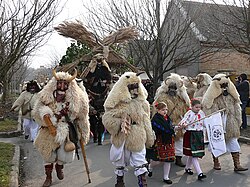
Carnival season called "Farsang" in Hungarian happens between Epiphany (January 6) and Shrove Tuesday and is the time when costume parties traditionally take place, primarily for children (similar to Halloween).
In Mohács, Hungary, the Busójárás is a celebration held at the end of the Carnival season. It involves locals dressing in woolly costumes, with scary masks and noise-makers. According to legend, the festival celebrates both the conclusion of the winter season and a victory by the local people over invading Ottomans in 1526.[209]
Italy
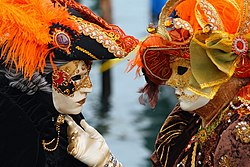


Carnival in Italy is a farewell party to eat, drink, and have fun before the limitations and solemnity of Lent. About a month before Ash Wednesday, Italians celebrate over many weekends with parades, masks, and confetti. The origins of this event may be traced to ancient Greece and Rome, when they worshipped Bacchus and Saturn. Some think they date back to archaic winter-to-spring ceremonies. Despite its pagan origins, the event was so extensively celebrated and the tradition so powerful that it was swiftly altered to fit into Catholic rituals. Carnival in Italy is traditionally celebrated on Fat Tuesday, but the weekend prior features activities as well.
Carnival traditions vary across Italy. In the Ambrosian rite regions around Milan, Carnival ends on the first Sunday of Lent. The Carnival of Venice and Carnival of Viareggio are particularly renowned, featuring sophisticated masquerades and parades. In Sardinia, a distinct carnival form survives, possibly rooted in pre-Christian winter rituals of awakening the earth. These Carnivals include masquerades and parades.
The Carnival in Venice was first documented in 1296, with a proclamation by the Venetian Senate announcing a public festival the day before the start of Lent. Its subversive nature is reflected in Italy's many laws over the centuries attempting to restrict celebrations and the wearing of masks. Carnival celebrations in Venice were halted after the city fell under Austrian control in 1798, but were revived in the late 20th century.[210]
The Carnival of Viareggio is the second-most popular in Italy. It lasts a month with night and day celebrations, floats, parades, district celebrations, masked dances, and other shows. The first masquerade took place in 1873, in response to the upper classes' dissatisfaction with having to pay hefty taxes. Thousands of travelers go to Italy for parades, Carnival masks and costumes, concerts, and music.In 2001, the town built a new "Carnival citadel" dedicated to Carnival preparations and entertainment.[211]
The Carnival of Ivrea is famous for its "Battle of the Oranges" fought with fruit between the people on foot and the troops of the tyrant on carts, to remember the wars of the Middle Ages,[212] allegory of struggle for freedom. It is considered one of the most ancient Carnivals in the world. The fight commemorates Ivrea's rebellion against tyrannical rule in the Middle Ages. The miller's daughter, "la Mugnaia", allegedly killed the city's dictator after he tried to kidnap her, sparking an uprising that gave the inhabitants more freedom. Ivrea's Carnival celebration now includes parades in medieval costumes, folkloric ensembles, and musical performances from Italy and Europe. A bean soup, fagiolata, is associated with the festival.
The Ambrosian Rite (Italian: rito ambrosiano)[213] is a Latin liturgical rite of the Catholic Church and the Eastern Orthodox Church (specifically The Divine Liturgy of Saint Ambrose). The rite is named after Saint Ambrose, a bishop of Milan in the fourth century. It is used by around five million Catholics in the greater part of the Archdiocese of Milan (excluding Monza, Treviglio and Trezzo sull'Adda), in some parishes of the Diocese of Como, Bergamo, Novara, Lodi, in the Diocese of Lugano, Canton of Ticino, Switzerland, less prominently in some Western Rite orthodox parishes and on special occasions of other jurisdictions.[214] In the most part of the Archdiocese of Milan, the Carnival lasts four more days, ending on the Saturday after Ash Wednesday, because of the Ambrosian Rite.[215]
In Sardinia, the Carnival (in Sardinian languageCarrasecare or Carrasegare[216]) varies greatly from the one in the mainland of Italy. the majority of the Sardinian celebrations features not only feasts and parades but also crude fertility rites such as bloodsheds to fertilize the land,[217] the death and the resurrection of the Carnival characters[218] and representations of violence and torture.[217] The typical characters of the Sardinian Carnival are zoomorphic and/or androgynous, such as the Mamuthones and Issohadores[219] from Mamoiada, the Boes and Merdules[220] from Ottana and many more.[221] The Carnival is celebrated with street performances[222] that are typically accompanied by Sardinian dirges called attittidus,[223] meaning literally "cry of a baby when the mother doesn't want nursed him/her anymore" (from the word titta meaning breasts[224]). Other particular and important Carnival instances in Sardinia are the Sartiglia in Oristano and the Tempio Pausania Carnival.[225]
Lithuania
Užgavėnės is a Lithuanian festival that takes place on Shrove Tuesday. Its name in English means "the time before Lent". The celebration corresponds to Carnival holiday traditions.[226]
Užgavėnės begins on the night before Ash Wednesday, when an effigy of winter (usually named Morė) is burnt. A major element symbolizes the defeat of winter in the Northern Hemisphere. It is a staged battle between Lašininis ("porky") personifying winter and Kanapinis ("hempen man") personifying spring. Devils, witches, goats, the grim reaper, and other joyful and frightening characters appear in costumes during the celebrations.[227]
Eating pancakes is an important part of the celebration. Eating pancakes during Užgavėnės is a traditional practice symbolizing the sun's return and the anticipation of a bountiful harvest, aligning with the festival's theme of bidding farewell to winter and welcoming spring.[227]
Luxembourg
In Luxembourg, the pre-Lenten holiday season is known as Fuesend. Throughout the Grand-Duchy, parades and parties are held.[228]
Pétange is the home of the Grand-Duchy's largest pre-Lenten Karneval celebration. Annually hosting a cavalcade with roughly 1,200 participants and thousand of celebrants, the official name is Karneval Gemeng Péiteng or "Kagepe" (the initials in Luxembourgish are pronounced "Ka", "Ge" and "Pe").
The town of Remich holds a three-day-long celebration, notable for two special events in addition to its parades. The first is the Stréimännchen, which is the burning of a male effigy from the Remich Bridge that crosses the Moselle River separating the Grand Duchy from Germany. The Stréimännchen symbolizes the burning away of winter. The other special event at the Remich Fuesend celebrations is the Buergbrennen or bonfire that closes the celebration.[229]
Like Remich, the town of Esch-sur-Alzette holds a three-day celebration. Other major Fuesend parades in Luxembourg are held in the towns of Diekirch and Schifflange.[230]
Malta


Carnival in Malta (Maltese: il-Karnival ta' Malta) was introduced to the islands by Grand MasterPiero de Ponte in 1535. It is held during the week leading up to Ash Wednesday, and typically includes masked balls, fancy dresses, and grotesque mask competitions, lavish late-night parties, a colourful, ticker-tape parade of allegorical floats presided over by King Carnival (Maltese: ir-Re tal-Karnival), marching bands, and costumed revellers.[231]
The largest celebration takes place in and around the capital city of Valletta and Floriana; several more "spontaneous" Carnivals take place in more remote areas. The Nadur Carnival is notable for its darker themes. In 2005, the Nadur Carnival hosted the largest-ever gathering of international Carnival organizers for the FECC's global summit.
Traditional dances include the parata, a lighthearted re-enactment of the 1565 victory of the Knights Hospitaller over the Turks, and an 18th-century court dance known as il-Maltija.[231] Carnival food includes perlini (multi-coloured, sugar-coated almonds) and the prinjolata, which is a towering assembly of sponge cake, biscuits, almonds, and citrus fruits, topped with cream and pine nuts.
Netherlands
Carnival in the Netherlands is called carnaval, vastenavond ("Eve of Lent") or, in Limburgish, vastelaovend(j), and is mostly celebrated in traditionally Catholic regions, particularly in the southern provinces of North Brabant and Limburg, but also in Overijssel, especially in Twente. While Dutch carnival is officially celebrated on the Sunday through Tuesday preceding Ash Wednesday, since the 1970s the feast has gradually started earlier and generally includes now the preceding weekend and sometimes even multiple weekends before that. Although traditions vary from town to town, Dutch carnival usually includes a parade, a "Prince Carnival" plus cortège ("Council of 11", sometimes with a Jester or Adjutant), sometimes also the handing over by the mayor of the symbolic keys of the town to Prince Carnival, the burning or burial of a symbolic figure, a peasant wedding (boerenbruiloft), and eating herring (haring happen) on Ash Wednesday.
Two main variants can be distinguished: the Rhineland carnaval, found in the province of Limburg, and the Bourgondische carnaval, found mainly in North Brabant. Maastricht, Limburg's capital, holds a street carnival that features elaborate costumes.[232]
The first known documentation dates from the late 8th century (Indiculus superstitionum et paganiarum), but carnaval was already mentioned during the First Council of Nicaea in 325 and by Caesarius of Arles (470–542) around 500 CE. In the Netherlands itself, the first documentation is found in 1383 in 's-Hertogenbosch. The oldest-known images of Dutch carnival festivities date from 1485, also in 's-Hertogenbosch.
Normal daily life comes to a stop for about a week in the southern part of the Netherlands during the carnival, with roads temporary blocked and many local businesses closed for the week as a result of employees who are en masse taking the days off during and the day after the carnival.[233][234]
North Macedonia
The most popular Carnivals in North Macedonia are in Vevčani and Strumica.[235]
The Vevčani Carnival (Macedonian: Вевчански Kарневал, translated Vevchanski Karneval) has been held for over 1,400 years, and takes place on 13 and 14 January (New Year's Eve and New Year's Day by the old calendar). The village becomes a live theatre where costumed actors improvise on the streets in roles such as the traditional "August the Stupid".[236]
The Strumica Carnival (Macedonian: Струмички Карневал, translated Strumichki Karneval) has been held since at least 1670, when the Turkish author Evlija Chelebija wrote while staying there, "I came into a town located in the foothills of a high hillock and what I saw that night was masked people running house–to–house, with laughter, scream and song." The Carnival took an organized form in 1991; in 1994, Strumica became a member of FECC and in 1998 hosted the XVIII International Congress of Carnival Cities. The Strumica Carnival opens on a Saturday night at a masked ball where the Prince and Princess are chosen; the main Carnival night is on Tuesday, when masked participants (including groups from abroad) compete in various subjects. As of 2000, the Festival of Caricatures and Aphorisms has been held as part of Strumica's Carnival celebrations.[237]
Poland
The Polish Carnival season includes Fat Thursday (Polish: Tłusty Czwartek), when pączki (doughnuts) are eaten, and Śledzik (Shrove Tuesday) or Herring Day. The Tuesday before the start of Lent is also often called Ostatki (literally "leftovers"), meaning the last day to party before the Lenten season.[238]
The traditional way to celebrate Carnival is the kulig, a horse-drawn sleigh ride through the snow-covered countryside. In modern times, Carnival is increasingly seen as an excuse for intensive partying and has become more commercialized, with stores offering Carnival-season sales.[239]
Portugal

Carnival is Carnaval in Portugal, celebrated throughout the country, most famously in Ovar, Sesimbra, Madeira, Loulé, Nazaré, Mealhada, and Torres Vedras. Carnaval in Podence and Lazarim incorporates pagan traditions such as the careto, while the Torres Vedras celebration is probably the most typical.[240]
Azores
On the islands of the Azores, local clubs and Carnival groups create colorful and creative costumes that jab at politics or culture.[241]
On São Miguel Island, Carnival features street vendors selling fried dough, called a malassada. The festival on the biggest island starts off with a black tie grand ball, followed by Latin music at Coliseu Micaelense. A children's parade fills the streets of Ponta Delgada with children from each school district in costume. A massive parade continues past midnight, ending in fireworks.[241]
The event includes theatre performances and dances. In the "Danças de Entrudo", hundreds of people follow the dancers around the island. Throughout the show the dancers act out scenes from daily life. The "Dances de Carnival" are allegorical and comedic tales acted out in the streets. The largest is in Angra do Heroísmo, with more than 30 groups performing. More Portuguese-language theatrical performances occur there than anywhere else.[241]
Festivities end on Ash Wednesday, when locals sit down for the "Batatada" or potato feast, in which the main dish is salted cod with potatoes, eggs, mint, bread and wine. Residents then return to the streets for the burning of the "Carnival clown", ending the season.[241]
Madeira

On the island of Madeira, the island's capital, Funchal, wakes up on the Friday before Ash Wednesday to the sound of brass bands and Carnival parades throughout downtown. Festivities continue with concerts and shows in the Praça do Município for five consecutive days. The main Carnival street parade takes place on Saturday evening, with thousands of samba dancers filling the streets. The traditional street event takes place on Tuesday, featuring daring caricatures.[242]
Arguably, Brazil's Carnival could be traced to the period of the Portuguese Age of Discoveries when their caravels passed regularly through Madeira, a territory that emphatically celebrated Carnival.[243][244]
Ovar

Carnival in the town of Ovar, in the Aveiro Region, began in 1952 and is the region's largest festivity, representing a large investment and the most important touristic event to the city. It is known for its creative designs, displayed in the Carnival Parade, which features troupes with themed costumes and music, ranging from the traditional to pop culture. Along with the Carnival Parade, there are five nights of partying, finishing with the famous 'Magical night' where people come from all over the country, mostly with their handmade costumes, only to have fun with the locals.[245]
Other regions
In Estarreja, in the Central region of Portugal, the town's first documented references to Carnival date to the early twentieth century, with "Flower Battles",[246] richly decorated floats that paraded through the streets. At the beginning of the twentieth century, these festivities ended with the deaths of its main promoters, only to reappear again in the 1960s to become one of many important Carnival festivals in Portugal.[247]
In the Northern region of Podence, children appear from Sunday to Tuesday with tin masks and colorful multilayered costumes made from red, green and yellow wool. In the Central Portugal towns of Nelas and Canas de Senhorim, Carnival is an important tourist event. Nelas and Canas de Senhorim host four festive parades that offer colorful and creative costumes: Bairro da Igreja and Cimo do Povo in Nelas and do Paço and do Rossio in Canas de Senhorim.[248]
In Lisbon, Carnival offers parades, dances and festivities featuring stars from Portugal and Brazil. The Loures Carnival celebrates the country's folk traditions, including the enterro do bacalhau or burial of the cod, which marks the end of Carnival and the festivities.[249]
North of Lisbon is the famous Torres Vedras Carnival, described as the "most Portuguese in Portugal". The celebration highlight is a parade of creatively decorated streetcars that satirize society and politics.[250]
Other Central Portugal towns, such as Fátima and Leiria, offer colorful, family-friendly celebrations. In these towns, everyone dresses up as if it were Halloween. Children and adults wear masks.
In the Algarve region, several resort towns offer Carnival parades. Besides the themed floats and cars, the festivities include "samba" groups, bands, dances, and music.[251]
In Lazarim, a civil parish in the municipality of Lamego, celebrations follow the pagan tradition of Roman Saturnalias. It celebrates by burning colorful effigies and dressing in home-made costumes. Locally-made wooden masks are worn. The masks are effigies of men and women with horns, but both roles are performed by men. They are distinguished by their clothes, with caricature attributes of both men and women.[252]
The Lazarim Carnaval cycle encompasses two periods, the first starting on the fifth Sunday before Quinquagesima Sunday. Masked figures and people wearing large sculpted heads walk through the town. The locals feast on meats, above all pork. The second cycle, held on Sundays preceding Ash Wednesday, incorporates the tradition of the Compadres and Comadres, with men and women displaying light-hearted authority over the other.[253]
Over the five weeks, men prepare large masked heads and women raise funds to pay for two mannequins that will be sacrificed in a public bonfire. This is a key event and is unique to Portugal. During the bonfire, a girl reads the Compadre's will and a boy reads the Comadre's will. The executors of the will are named, a donkey is symbolically distributed to both female and male "heirs", and then there is the final reckoning in which the Entrudo, or Carnival doll, is burned.[254]
Russia

Maslenitsa (Масленица, also called "Pancake Week" or "Cheese Week") is a Russian folk holiday that incorporates some pagan traditions. It is celebrated during the last week before Lent. The essential element is bliny, Russian pancakes, popularly taken to symbolize the sun. Round and golden, they are made from the rich foods allowed that week by the Orthodox traditions: butter, eggs, and milk. (In the tradition of Orthodox Lent, the consumption of meat ceases one week before that of milk and eggs.)[255]
Maslenitsa also includes masquerades, snowball fights, sledding, swinging on swings, and sleigh rides. The mascot is a brightly dressed straw effigy of Lady Maslenitsa, formerly known as Kostroma. The celebration culminates on Sunday evening, when Lady Maslenitsa is stripped of her finery and put to the flames of a bonfire.[256]
Slovakia
In Slovakia, the Fašiangy (fašiang, fašangy) takes place from Three Kings Day (Traja králi) until the midnight before Ash Wednesday (Škaredá streda or Popolcová streda). At the midnight marking the end of fašiangy, a symbolic burial ceremony for the contrabass is performed, because music ceases for Lent.[257]
Slovenia
The Slovenian name for carnival is pust. The Slovenian countryside displays a variety of disguised groups and individual characters, among which the most popular and characteristic is the Kurent (plural: Kurenti), a monstrous and demon-like, but fluffy figure. The most significant festival is held in Ptuj (see: Kurentovanje). Its special feature are the Kurents themselves, magical creatures from another world, who visit major events throughout the country, trying to banish the winter and announce spring's arrival, fertility, and new life with noise and dancing. The origin of the Kurent is a mystery, and not much is known of the times, beliefs, or purposes connected with its first appearance. The origin of the name itself is obscure.[258]
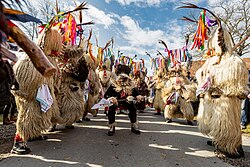
The Cerknica Carnival is heralded by a figure called "Poganjič" carrying a whip. In the procession, organised by the "Pust society", a monstrous witch named Uršula is driven from the mountain Slivnica, to be burned at the stake on Ash Wednesday. Unique to this region is a group of dormice, driven by the Devil and a huge fire-breathing dragon. Cerkno and its surrounding area are known for the Laufarji, Carnival figures with artistically carved wooden masks.[259]
The Maškare from Dobrepolje used to represent a triple character: the beautiful, the ugly (among which the most important represented by an old man, an old woman, a hunchback, and a Kurent), and the noble (imitating the urban elite).
The major part of the population, especially the young and children, dress up in ordinary non-ethnic costumes, going to school, work, and organized events, where prizes are given for the best and most original costumes. Costumed children sometimes go from house to house asking for treats.
Spain

Arguably the most famous Carnivals in Spain are Santa Cruz, Las Palmas, Sitges, Vilanova i la Geltrú, Tarragona, Águilas, Solsona, Cádiz, Badajoz, Bielsa (an ancestral Carnival celebration), Plan, San Juan de Plan, Laza, Verín, Viana, and Xinzo de Limia.[260]
One of the oldest pre-Indo-European carnival in Europe takes place in Ituren and Zubieta in Navarre in late January/early February. The carnival symbolises the eternal struggle between the forces of good and evil, light and darkness, winter and spring.
Andalusia

In Cádiz, the costumes worn are often related to recent news, such as the bird flu epidemic in 2006, during which many people were disguised as chickens. The feeling of this Carnival is the sharp criticism, the funny play on words and the imagination in the costumes, more than the glamorous dressings. It is traditional to paint the face with lipstick as a humble substitute of a mask.[261]
The most famous groups are the chirigotas, choirs, and comparsas. The chirigotas are well known witty, satiric popular groups who sing about politics, new times, and household topics, wearing the same costume, which they prepare for the whole year. The Choirs (coros) are wider groups that go on open carts through the streets singing with an orchestra of guitars and lutes. Their signature piece is the "Carnival Tango", alternating comical and serious repertory. The comparsas are the serious counterpart of the chirigota in Cádiz, and the poetic lyrics and the criticism are their main ingredients. They have a more elaborated polyphony that is easily recognizable by the typical countertenor voice.[262]
Canary Islands
The Santa Cruz Carnival is the most important festival for Spanish tourism and Spain's largest Carnival.[263][264][265][266] In 1980, it was declared a Festival Tourist International Interest.[267] Every February, Santa Cruz de Tenerife, the capital of the largest of the Canary Islands, hosts the event, attracting around a million people.[267]
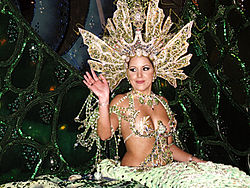
In 1987, Cuban singer Celia Cruz with orchestra Billo's Caracas Boys performed at the "Carnival Chicharrero", attended by 250,000 people. This was registered in the Guinness Book of World Records as the largest gathering of people in an outdoor plaza to attend a concert, a record she holds today.[268]
The Carnival of Las Palmas (Gran Canaria) has a drag queen's gala where a jury chooses a winner.[269]
Catalonia

In Catalonia, people dress in masks and costume (often in themed groups) and organize a week-long series of parties, pranks, outlandish activities such as bed races, street dramas satirizing public figures, and raucous processions to welcome the arrival of Sa Majestat el Rei Carnestoltes ("His Majesty King Carnival"), known by various titles, including el Rei dels poca-soltes ("King of the crackpots"), Princep etern de Cornudella ("eternal Prince of Cuckoldry"), Duc de ximples i corrumputs ("Duke of the fool and corrupt"), Marquès de la bona mamella ("Marquis of the lovely breast"), Comte de tots els barruts ("Count of the insolent"), Baró de les Calaverades ("Baron of mocturnal debaucheries"), and Senyor de l'alt Plàtan florit, dels barraquers i gamberrades i artista d'honor dalt del llit ("Lord of the tall blooming Banana, of the voyeurs and punks and the artist of honor upon the bed").[270]
The King presides over a period of misrule in which conventional social rules may be broken and reckless behavior is encouraged. Festivities are held in the open air, beginning with a cercavila, a ritual procession throughout the town to call everyone to attend. Rues of masked revelers dance alongside. On Thursday, Dijous Gras (Fat Thursday) is celebrated, also called 'omelette day' (el dia de la truita), on which coques (de llardons, butifarra d'ou, butifarra), and omelettes are eaten. The festivities end on Ash Wednesday with elaborate funeral rituals marking the death of King Carnival, who is typically burned on a pyre in what is called the "burial of the sardine" (enterrament de la sardina), or, in Vilanova, as l'enterro.[271]
The Carnival of Vilanova i la Geltrú has a documented history from 1790[272] and is one of the richest in the variety of its acts and rituals. It adopts an ancient style in which satire, the grotesque body[4] (particularly cross-dressing and displays of exaggerated bellies, noses, and phalli), and, above all, active participation are valued over glamorous, media-friendly spectacles that Vilanovins mock as "thighs and feathers".[273] It is best known for Les Comparses, a tumultuous dance held on Sunday in which thousands of dancers in traditional dresses and Mantons de Manila (Manila Shawls), organized into groups of couples march in the street forming lines while throwing tons of hard candies at one another. Vilanovinians organize several rituals during the week. On Dijous Gras, Vilanovin children are excused from school to participate in the Merengada, a day-long scene of eating and fighting with sticky, sweet meringue while adults have a meringue battle at midnight at the historic Plaça de les Cols.

On Friday citizens are called to a parade for the arrival of King Carnival called l'Arrivo that changes every year. It includes a raucous procession of floats and dancers lampooning current events or public figures and a bitingly satiric sermon (el sermo) delivered by the King himself. On Saturday, the King's procession and his concubines scandalize the town with their sexual behavior; the mysterious Moixo Foguer (Little-Bird-Bonfire) is shown accompanied by the Xerraire (jabberer), who try to convince the crowd about the wonders that this mighty bird carries in a box (which ends up being in fact a naked person covered in feathers);[274] and other items such as: sport acts and barbecues in the streets; the talking-dance of the Mismatched Couples (Ball de Malcasats); the children's King Caramel whose massive belly, long nose and sausage-like hair hint at his insatiable appetites; or the debauched Nit dels Mascarots dance.

After Sunday, vilanovinians continue its Carnival with the children's party Vidalet, the satirical chorus of Carnestoltes songs and the last night of revelry, the Vidalot. For the King's funeral, people dress in elaborate mourning costume, many of them cross-dressing men who carry bouquets of phallic vegetables. In the funeral house, the body of the King is surrounded by weeping concubines, crying over the loss of sexual pleasure brought about by his death. The King's body is carried to the Plaça de la Vila where a satiric eulogy is delivered while the townspeople eat salty grilled sardines with bread and wine, suggesting the symbolic cannibalism of the communion ritual. Finally, amid rockets and explosions, the King's body is burned in a massive pyre.[271][272]

Carnaval de Solsona takes place in Solsona, Lleida. It is one of the longest; free events in the streets and nightly concerts run for more than a week. The Carnival is known for a legend that explains how a donkey was hung at the tower bell − because the animal wanted to eat grass that grew on the top of the tower. To celebrate this legend, locals hang a stuffed donkey at the tower that "pisses" above the excited crowd using a water pump. This event is the most important and takes place on Saturday night. For this reason, the inhabitants are called matarrucs ("donkey killers").[275]
"Comparses" groups organize free activities. These groups of friends create and personalize a uniformed suit to wear during the festivities.
In Sitges, special feasts include xatonades (xató is a traditional local salad of the Penedès coast) served with omelettes. Two important moments are the Rua de la Disbauxa (Debauchery Parade) on Sunday night and the Rua de l'Extermini (Extermination Parade) on Tuesday night.[276] In 2022, the Rua de la Disbauxa hosted 34 floats and over 1,200 participants.[277]
Tarragona has one of the region's most complete ritual sequences. The events start with the building of a huge barrel and ends with its burning with the effigies of the King and Queen. On Saturday, the main parade takes place with masked groups, zoomorphic figures, music, and percussion bands, and groups with fireworks (the devils, the dragon, the ox, the female dragon). Carnival groups stand out for their clothes full of elegance, showing brilliant examples of fabric crafts, at the Saturday and Sunday parades. About 5,000 people are members of the parade groups.
Galicia
In Galicia, the celebration is commonly known as Entroido, or otherwise Antroido, Entroiro, Entruido or Entrudio.[278] Throughout history, the cities, towns and villages of Galicia had poor connections between each other, so Entroidos are very diverse with different cultural traditions and characters based in the zone you're in. Nine Entroido celebrations have been declared as places of touristic interest in Galicia: Xinzo de Limia, Cobres, Laza, Verín, Felos de Maceda, Xenerais do Ulla, Vilariño de Conso, Androlla and Viana do Bolo and Manzaneda.[279]

In Galician cuisine, there are various traditional dishes of Entroido, such as Filloas (a dish similar to crêpes) and Orellas (A traditional dish of Catalonia and the Valencian Community, but also traditionally served in Galician and French carnivals). Other traditional foods include Chorizo, Lacón, Caldo, Androlla and Pig Heads.

Valencian Community
One of the most important Spanish Carnival Festivals is celebrated in Vinaròs, a small town situated in the northern part of the province of Castellón, Valencian Community.
The Carnival Festival in Vinaròs has been declared of Regional Touristic Interest and in 2017, this outstanding and ancient show celebrated 35 years of History. The Carnival Festival in Vinaròs became a forbidden celebration during the Spanish Civil War but after the dictatorship, the party regained importance with the democracy's arrival.
Every year in February, forty days before the Spanish Cuaresma, thirty-three "comparsas" go singing, dancing and walking down the streets in a great costumes' parade in Vinaròs. In addition, many other festive, cultural and musical activities of all ages take place, such as an epic battle of confetti and flour, funny karaoke contests or the so-called "Entierro de la Sardina" (Burial of the Sardine).
Nevertheless, the most important event is the gala performance of the Carnival's Queen. In this breathtaking show, it is elected the Queen of the Carnival, the major representative of the Carnival in Vinaròs all year round.[280]
Turkey
For almost five centuries, local GreekOrthodox communities throughout Istanbul celebrated Carnival with weeks of bawdy parades, lavish balls, and street parties.[281] This continued for weeks before Lent. Baklahorani took place on Shrove Monday or Clean Monday, the last day of the carnival season. The event was led by the Greek Orthodox community, but the celebrations were public and inter-communal. The final celebration was sited in the Kurtuluş district.[282] In 2010, the festival was revived.[283]
United Kingdom
In England, the three days before Lent were called Shrovetide. A time for confessing sins ("shriving"), it had fewer festivities than the continental Carnivals. Today, Shrove Tuesday is celebrated as Pancake Day, but little else of the Lent-related Shrovetide survived the 16th-century English Reformation.
Since 2012, Hastings in East Sussex has celebrated with its own Mardi Gras, or Fat Tuesday. Five days of music and street events culminating with a Grand Ball on Fat Tuesday itself. Loosely based on the New Orleans style of carnival, Hastings has taken its own course.[284]
- Birmingham International Carnival
- West Country Carnival
- Dover Carnival[285]
- Leicester Caribbean Carnival
- Notting Hill Carnival
- Leeds West Indian Carnival
- St Pauls Carnival
See also
- Adloyada
- Boeuf gras
- Calabar Carnival
- Careto
- Carnival of Basel
- Carny
- Cirque du Soleil
- Cologne Carnival
- Culture of Popular Laughter
- Fair
- Feast of Fools
- Federation of European Carnival Cities
- Jamaica Carnival
- Mardi Gras
- Mardi Gras in Mobile, Alabama
- New Orleans Mardi Gras
- Sitalsasthi
- Narrenmarsch
- Traveling carnival
Notes
- ^"Largest carnival". Guinness World Records. 1 January 2004. Archived from the original on 15 April 2016. Retrieved 11 February 2016.
- ^"carnival (n.)". Oxford English Dictionary (online ed.). Oxford University Press. doi:10.1093/OED/8045197810.
The season immediately preceding Lent, devoted in Italy and other Roman Catholic countries to revelry and riotous amusement, Shrovetide; the festivity of this season. High Carnival: the revelry of the Carnival at its height.
(Subscription or participating institution membership required.) - ^"Shrovetide (n.)". Oxford English Dictionary (online ed.). Oxford University Press. doi:10.1093/OED/2819425396.
The period comprising Quinquagesima Sunday and the two following days, 'Shrove' Monday and Tuesday.
(Subscription or participating institution membership required.) - ^ abcBakhtin, Mikhail. 1984. Rabelais and his world. Translated by H. Iswolsky. Bloomington: Indiana University Press. Original edition, Tvorchestvo Fransua Rable i narodnaia kul'tura srednevekov'ia i Renessansa, 1965.
- ^Barrows, Susanna; Room, Robin (1991). Drinking: Behavior and Belief in Modern History. University of California Press. pp. 404–. ISBN 9780520070851. Retrieved 17 February 2015.
- ^Vanspall, Julie (25 February 2021). "The benefits of discipline ... even giving up chocolate". The B.C. Catholic. Retrieved 2 March 2025.
As a Lenten sacrifice, it can "train" me with a reminder to pray for someone with less, to give the money I would have spent on chocolate to someone in need, and to strive to live in gratitude for Christ's gift of salvation.
- ^Kelvey, Jon (13 February 2018). "Strawbridge United Methodist keeps Shrove Tuesday pancake tradition". The Baltimore Sun. Archived from the original on 16 March 2023. Retrieved 25 February 2020.
- ^"Shrovetide". Evangelical Lutheran Church in Denmark. Archived from the original on 24 September 2020. Retrieved 8 February 2021.
- ^Beadle, Richard (17 March 1994). The Cambridge Companion to Medieval English Theatre. Cambridge University Press. p. 69. ISBN 9780521459167.
One of these was the pre-Lent Carnival extravaganza of Shrovetide, though this seems to have been celebrated to a much lesser extent in Britain than it was (and still is) on the continent: however, we know of English Shrovetide plays, and Mankind bears signs of being one of them (335).
- ^Walker, Katie (7 March 2011). "Shrove Tuesday inspires unique church traditions". Daily American. Archived from the original on 14 February 2016. Retrieved 4 January 2016.
Many local churches will celebrate Shrove Tuesday tomorrow, a day of feasting commonly known as "pancake day." Shrove Tuesday is typically observed by Episcopal, Lutheran, Methodist and Catholic denominations, but each church celebrates the day in its own, unique way. The Rev. Lenny Anderson of the St. Francis-in-the-Fields Episcopal Church in Somerset said the primary focus of Shrove Tuesday is to prepare for Lent, the period of the liturgical year leading up to Easter.
- ^Kiefer, James. Shrove Tuesday. Rowan University.
- ^"Shrove Tuesday". The Times-Reporter. 18 February 2020. Archived from the original on 6 August 2020. Retrieved 4 April 2020.
- ^Ruprecht, Tony (14 December 2010). Toronto's Many Faces. Dundurn. p. 115. ISBN 9781459718043.
Fastelavn, held the week before Lent, is the Danish Mardi Gras. This event takes place at the Danish Lutheran Church and at Sunset Villa.
- ^"Frequently Asked Questions". The Danish Lutheran Church & Cultural Center. 2014. Archived from the original on 18 February 2015. Retrieved 17 February 2015.
We celebrate Danish traditions during our church year such as Fastelavn at lent (a Carnival for the kids at the beginning of the Lenten season), a Harvest Service in Fall and preparing for Advent and Christmas with a Klippe-Klistre (Cut & Paste Decorations) in late November. Our Danish history and heritage is continuously incorporated into our services and events through the year and its seasons.
- ^Melitta Weiss Adamson, Francine Segan (2008). Entertaining from Ancient Rome to the Super Bowl. ABC-CLIO.
In Anglican countries, Mardis Gras is known as Shrove Tuesday – from shrive meaning 'confess' – or Pancake Day – after the breakfast food that symbolizes one final hearty meal of eggs, butter, and sugar before the fast. On Ash Wednesday, the morning after Mardi Gras, repentant Christians return to church to receive upon the forehead the sign of the cross in ashes.
- ^ ab"Online Etymology Dictionary". Etymonline.com. Archived from the original on 2 October 2012. Retrieved 12 February 2011.
- ^ ab"Carnevale". Etimo (in Italian). Archived from the original on 18 September 2018. Retrieved 25 September 2019.
- ^"Isis Rising". Carnival.com. Archived from the original on 26 April 2021. Retrieved 12 February 2011.
- ^Universo, De Agostini, Novara, 1966, Vol. III, p. 113
- ^ ab"Carnaval"Archived 8 July 2017 at the Wayback Machine. Meertens.knaw.nl. Retrieved on 13 May 2015.
- ^Miller, John F. "Roman Festivals," in The Oxford Encyclopedia of Ancient Greece and Rome (Oxford University Press, 2010), p. 172.
- ^"Vitaberna"Archived 4 March 2016 at the Wayback Machine. Jansimons.nl. Retrieved on 13 May 2014.
- ^Tacitus, Germania 9.6: Ceterum nec cohibere parietibus deos neque in ullam humani oris speciem adsimulare ex magnitudine caelestium arbitrantur – "The Germans, however, do not consider it consistent with the grandeur of celestial beings to confine the gods within walls, or to liken them to the form of any human countenance." Germania 40: mox vehiculum et vestis et, si credere velis, numen ipsum secreto lacu abluitur – "Afterwards the car, the vestments, and, if you like to believe it, the divinity herself, are purified in a secret lake." Trans. Alfred John Church and William Jackson Brodribb, The Agricola and Germany of Tacitus. London: Macmillan, 1868, OCLC 776555615
- ^ abcdefg"Wat is carnaval?" | Fen VlaanderenArchived 22 April 2016 at the Wayback Machine. Fenvlaanderen.be. Retrieved on 13 May 2015.
- ^Davidson, Hilda Ellis (1990). Gods and Myths of Northern Europe. Penguin Books. ISBN 0-14-013627-4.
- ^Eduardo Fabbro, M.A., "Germanic Paganism among the Early Salian Franks". University of Brasilia, The Journal of Germanic Mythology and Folklore, Volume 1, Issue 4, August 2006
- ^ abcdefg"Geschiedenis van het carnavalsfeest". Members.ziggo.nl. Archived from the original on 26 March 2013. Retrieved 29 October 2013.
- ^Federatie Europese Narren Nederland – Federatie Europese Narren NederlandArchived 3 March 2016 at the Wayback Machine. Fen-nederland.nl. Retrieved on 13 May 2015.
- ^Trans. Alfred John Church and William Jackson Brodribb, The Agricola and Germany of Tacitus. London: Macmillan, 1868, OCLC 776555615
- ^ abcRuff, Julius R. (4 October 2001). Violence in Early Modern Europe 1500–1800. Cambridge University Press. p. 164. ISBN 9780521598941.
- ^Bossy, John (1985). Christianity in the West, 1400–1700. Oxford University Press. ISBN 978-0-19-289162-4.
- ^Rolfe, William James (1911). Shakespeare's Comedy of The Merchant of Venice. New York, N.Y.: American Book Company. p. 70. Retrieved 24 September 2023.
- ^"Oorsprong van het Carnaval in de geschiedenis van Nederland IsGeschiedenis". Isgeschiedenis.nl. 11 November 2011. Archived from the original on 29 October 2013. Retrieved 29 October 2013.
- ^"Carnival". Encyclopedia of Easter, Carnival, and Lent. 30 November 2001.
- ^Gaignebet, Claude. 1984. El Carnaval: Ensayos de mitologia popular. Barcelona: Editorial Alta Fulla. Original edition: Le carnaval. Essais de mythologie populaire, Editions Payot, Paris, 1974.
- ^John Chapman (1913). . In Herbermann, Charles (ed.). Catholic Encyclopedia. New York: Robert Appleton Company.
- ^"Geschiedenis van carnaval in de middeleeuwen IsGeschiedenis". Isgeschiedenis.nl. Archived from the original on 29 October 2013. Retrieved 29 October 2013.
- ^Halmo, Joan (1989). Celebrating the Church Year with Young Children. Liturgical Press. p. 79. ISBN 9780814615805.
Carnival is a time of revelry and excess before the dying of Lent, a time of feasting before the fasting.
- ^Davidson, Alan (21 August 2014). The Oxford Companion to Food. Oxford University Press. p. 145. ISBN 9780191040726.
- ^Oorsprong Carnaval: Middencommiteit LommelArchived 25 February 2016 at the Wayback Machine. Middencommiteit.be. Retrieved on 13 May 2015.
- ^"Historia del Carnaval". carnavales.net (in Spanish). 6 November 2003. Archived from the original on 6 February 2016. Retrieved 31 May 2016.
- ^Bowen, Barbara C. (2004). Humour and Humanism in the Renaissance. Ashgate. p. 507. ISBN 9780860789543.
To the Middle Ages Carnival and Lent were both necessary, inevitable episodes in the eternal cycle of the Church year.
- ^"O que é o Carnaval?". Cantao.net. Archived from the original on 29 January 2009.
- ^"Carnival | Definition, Festival, Traditions, Countries, & Facts | Britannica". www.britannica.com. 3 May 2024. Retrieved 17 May 2024.
- ^Erickson, Brad. 2008. Sensory Politics: Catalan Ritual and the New Immigration. University of California at Berkeley.
- ^Delgado Ruiz, Manuel. 2001. "Luces iconoclastas: Anticlericalism, espacio, y ritual en la España contemporánia", Ariel Antropología. Barcelona: Editorial Ariel.
- ^ abKertzer, David I. (2001). The Popes Against the Jews: The Vatican's Role in the Rise of Modern Anti-Semitism. New York: Alfred A. Knopf. pp. 74–75. ISBN 978-0375406232.
- ^ ab"Das Kölner Dreigestirn". koelner-karneval.info. Archived from the original on 25 March 2016. Retrieved 31 May 2016.
- ^"Fasching | History, Meaning, Traditions, & Facts | Britannica". www.britannica.com. 1 March 2024. Retrieved 10 March 2024.
- ^Abner Cohen, 1993. Masquerade politics. Berkeley: University of California Press.
- ^Turner, Victor. 1982. From ritual to theater: The human seriousness of play. New York: PAJ Publications.
- ^Abrahams, Roger. 1972. "Christmas and Carnival on Saint Vincent". Western Folklore 13 (4):275–289.
- ^Marshall, Emily Zobel; Farrar, Max; Farrar, Guy (9 February 2018). "Popular political cultures and the Caribbean carnival: Carnival is a rich resource for cultural resistance as well as pleasure". Soundings: A Journal of Politics and Culture. 67 (67): 34–49. ISSN 1741-0797. Archived from the original on 28 February 2021. Retrieved 30 April 2020.
- ^"Carnival: A reversal of the roles". Frank G. Bosman (in Dutch). 12 February 2018. Archived from the original on 21 September 2020. Retrieved 30 April 2020.
- ^Mircea Eliade, The myth of the eternal return.
- ^"CaboVerdeOnline.com – The Carnival of São Nicolau – a procession rich in history". caboverdeonline.com. Archived from the original on 18 January 2018. Retrieved 18 January 2018.
- ^"Seychelles Carnival | Mauritius, Seychelles, Reunion: Holidays & Travel". Archived from the original on 15 January 2019. Retrieved 15 January 2019.
- ^"seychelles carnival – Creolepay Seychelles". Archived from the original on 15 January 2019. Retrieved 15 January 2019.
- ^"Zimbabwe: Biggest Street Party Comes to Harare". allAfrica.com. Archived from the original on 18 December 2014. Retrieved 31 May 2016.
- ^"The Caribbean's Greatest Summer Festival". Antigua's Carnival 2020 | Antigua Barbuda Festivals Commission. Archived from the original on 8 April 2020. Retrieved 15 January 2020.
- ^ abMohsin, Haroon (12 August 2022). "Argentina Carnival". National Today. Archived from the original on 30 November 2023. Retrieved 10 February 2024.
- ^"Grandi Yama: The Burning of King Momo". LargeUp. 4 March 2014. Archived from the original on 7 July 2020. Retrieved 7 July 2020.
- ^"Bahamas Junkanoo Carnival". Archived from the original on 21 April 2009.
- ^ abcKinas, Roxan (1 May 1997). "Barbados Crop Over". Caribbean Beat Magazine. Retrieved 17 May 2024.
- ^"Belizean Minds". belizeanminds.blogspot.ca. Archived from the original on 5 March 2014. Retrieved 26 February 2014.
- ^Samuel Brown, J.; Vorhees, M. (2013). Belize. Lonely Planet Publishing.
- ^ ab"Ambergris Caye, Belize, Festivals". goambergriscaye.com. Archived from the original on 22 September 2013. Retrieved 26 February 2014.
- ^"Fiesta de Carnaval". Lonely Planet. Archived from the original on 3 March 2014. Retrieved 26 February 2014.
- ^ ab"Carnaval de San Pedro, Belize". joseluiszapata.com. Archived from the original on 2 April 2015.
- ^"Teen Talk – Is Carnival A Messy Situation?". ambergristoday.com. Archived from the original on 3 April 2015. Retrieved 26 February 2014.
- ^Taub, Matthew (28 February 2022). "Bolivia's Dance of the Devils Is a Party and a Battle Between Good and Evil". Atlas Obscura. Retrieved 17 May 2024.
- ^UNESCO – Intangible Heritage Section. "UNESCO Culture Sector – Intangible Heritage – 2003 Convention". Archived from the original on 5 February 2015. Retrieved 20 April 2015.
- ^"The joy of eastern Bolivia in the Santa Cruz Carnival". livetheworld. 23 November 2022. Retrieved 31 August 2024.
- ^5 Reasons Trinidad Has the World’s Greatest CarnivalArchived 22 February 2017 at the Wayback Machine, HuffPost, 12 March 2015
- ^Sarah de Sainte Croix. "Rio's Carnival: Not just a local party anymore". MarketWatch. Archived from the original on 29 June 2013. Retrieved 12 March 2012.
- ^"Micareta: Celebrations outside of carnival | Aventura do Brasil". www.aventuradobrasil.com. Retrieved 17 May 2024.
- ^"Carnaval.salvador.ba.gov.br". Archived from the original on 6 June 2013.
- ^"G1 – Psy, Claudia Leitte e Sabrina Sato dançam juntos em Salvador – notícias em Carnaval 2013 na Bahia". Carnaval 2013 na Bahia. Archived from the original on 12 February 2013. Retrieved 13 February 2013.
- ^"BANDA HABEAS COPOS – CARNAVAL 2014". bandahabeascopos.com.br. Archived from the original on 13 July 2012.
- ^"The Online Guide to Toronto's Summer Carnival". Caribana.Com. 15 August 2010. Archived from the original on 21 June 2016. Retrieved 9 March 2011.
- ^Karamali, Kamil (4 August 2018). "Caribbean Carnival's 51st annual Grande Parade brings out Toronto's movers and shakers". Global News. Archived from the original on 30 October 2020. Retrieved 21 September 2020.
- ^"Quebec Winter Carnival | Events in Québec City". Visit Québec City. Archived from the original on 25 September 2020. Retrieved 30 April 2020.
- ^"A bit of history". carnaval.qc.ca. Archived from the original on 26 January 2021. Retrieved 28 December 2020.
- ^"Things to do in Kingston - Find out why I love it so much". 4 December 2022. Retrieved 27 February 2024.
- ^Staff, Caribbean Journal (13 July 2023). "Statia Kicks Off the Dutch Caribbean's Hottest Summer Carnival". Caribbean Journal. Retrieved 27 February 2024.
- ^Dreisinger, Baz (9 October 2015). "On Dominica, a Carnival Celebration as It Was Meant to Be". The New York Times. Archived from the original on 16 February 2024. Retrieved 16 February 2024.
- ^"8 of the best Caribbean carnivals". Travel. 14 July 2023. Retrieved 17 May 2024.
- ^"2023 Carnival in Dominica Entices with Fringe Events". St Vincent Times. 30 January 2023. Archived from the original on 16 February 2024. Retrieved 16 February 2024.
- ^Scott, Chadd (30 January 2023). "Get Away To Dominica For Mas Dominik Carnival Festival". Forbes. Archived from the original on 16 February 2024. Retrieved 16 February 2024.
- ^ abcGirma, Lebawit Lily (20 February 2018). "Why You Should Experience Carnival in the Dominican Republic". Medium. Retrieved 19 May 2024.
- ^"Independence Day in the Dominican Republic". AnydayGuide. Archived from the original on 15 April 2021. Retrieved 18 January 2021.
- ^Mohsin, Haroon (25 August 2022). "Ecuador Carnival". National Today. Archived from the original on 28 September 2023. Retrieved 12 February 2024.
- ^Mota, Anabel (23 November 2012). "Water Fight! The Andean Roots of Carnival in Ecuador". Latin America For Less. Retrieved 19 May 2024.
- ^Biegerl, Sabrina (29 June 2020). "Carnival in Ecuador: How and Where to Celebrate". Peru For Less. Retrieved 15 May 2024.
- ^Lara, Francisco; Ruggiero, Diana (2016). "Highland Afro-Ecuadorian Bomba and Identity along the Black Pacific at the Turn of the Twenty-First Century". Latin American Music Review / Revista de Música Latinoamericana. 37 (2): 135–164. doi:10.7560/LAMR37201. ISSN 0163-0350. JSTOR 44163003. S2CID 191623539. Archived from the original on 7 October 2022. Retrieved 7 October 2022.
- ^"Carnival Latacunga". Archived from the original on 17 November 2015. Retrieved 6 November 2015.
- ^"French Guiana - Colonialism, Multiculturalism, Autonomy | Britannica". www.britannica.com. Retrieved 17 May 2024.
- ^"Carnival | Definition, Festival, Traditions, Countries, & Facts | Britannica". www.britannica.com. 3 May 2024. Retrieved 19 May 2024.
- ^Aldana, por Marysabel (15 February 2023). "Carnaval 2023 en Guatemala: Cuándo se celebra, su historia y otros detalles". Prensa Libre (in Spanish). Archived from the original on 5 January 2024. Retrieved 5 January 2024.
- ^PL, por Hemeroteca (10 February 2018). "El carnaval de Mazatenango: tradición centenaria". Prensa Libre (in Spanish). Archived from the original on 5 January 2024. Retrieved 5 January 2024.
- ^"Rara Festivals in Haiti and its Diaspora". Wesleyan University. Archived from the original on 17 January 2016. Retrieved 5 November 2012.
- ^"Haiti Carnaval 2013 - Cap Haitien". The Haitian Internet Newsletter. Retrieved 27 February 2024.
- ^McAlister, Elizabeth (2002). Rara! Vodou, Power, and Performance in Haiti and its Diaspora. Berkeley: University of California Press. ISBN 0-520-22823-5.
- ^"HONDURAS Carnival, ROATAN Events". Active Caribbean. Archived from the original on 15 January 2019. Retrieved 15 January 2019.
- ^"Carnival in Honduras – CaribbeanChoice". caribbeanchoice.com. Archived from the original on 15 January 2019. Retrieved 15 January 2019.
- ^"La Ceiba Carnival 2019 in Honduras – Dates & Map". rove.me. Archived from the original on 15 January 2019. Retrieved 15 January 2019.
- ^Dupuis, John (1 May 2017). "Is the La Ceiba Carnival the Honduran Mardi Gras?". Honduras Travel. Archived from the original on 15 January 2019. Retrieved 15 January 2019.
- ^https://www.sinembargo.mx/12-02-2018/3384548Archived 1 January 2019 at the Wayback Machine accessed 1 January 2019
- ^https://www.barcelo.com/pinandtravel/es/carnaval-campeche-2017-el-carnaval-con-mas-historia-de-mexico/Archived 2 January 2019 at the Wayback Machine accessed 1 January 2019
- ^Herrera-Sobek, María (1 January 2012). Celebrating Latino Folklore: An Encyclopedia of Cultural Traditions. ABC-CLIO. ISBN 9780313343391. Archived from the original on 17 February 2017. Retrieved 16 February 2017.
- ^Gleeson, Bridget; Egerton, Alex (1 September 2016). Lonely Planet Nicaragua. Lonely Planet. ISBN 9781786573049.
- ^libelulaspedasi_vt8fma (22 March 2026). "Where to celebrate Carnival in Panama? - Libelulas Pedasi". Retrieved 30 March 2026.
{{cite web}}: CS1 maint: numeric names: authors list (link) - ^"Prohíben ingreso de embarazadas y niños a culecos – en Segundos Panamá". Archived from the original on 20 February 2020. Retrieved 20 February 2020.
- ^"Culecos serán de diez de la mañana hasta las tres de la tarde". Archived from the original on 20 February 2020. Retrieved 20 February 2020.
- ^"Minsa hará doble verificación de cisternas que participarán de culecos en carnavales | Telemetro". Archived from the original on 20 February 2020. Retrieved 20 February 2020.
- ^"MiAmbiente supervisa carga de agua a carros cisternas para los "culecos" – en Segundos Panamá". Archived from the original on 20 February 2020. Retrieved 20 February 2020.
- ^"Archived copy"(PDF). Archived from the original(PDF) on 28 April 2017. Retrieved 27 April 2017.
{{cite web}}: CS1 maint: archived copy as title (link) - ^Leon, Jose d (23 February 2018). "Cajamarca Carnival, a Party and Celebration for Everyone". Best Peru Tours. Retrieved 19 May 2024.
- ^CRUMP, WILLIAM D. (2020). ENCYCLOPEDIA OF EASTER CELEBRATIONS WORLDWIDE. [S.l.]: MCFARLAND. p. 207. ISBN 978-1-4766-4196-6. OCLC 1240280170.
- ^"Carnivales en Lima: unos cinco mil policías reforzarán la seguridad| Perú21". Peru21.pe. Archived from the original on 18 May 2012. Retrieved 12 February 2011.
- ^Connelly, Corey (7 January 2023). "Festivals CEO: Tobago can support two carnivals - Trinidad and Tobago Newsday". newsday.co.tt. Retrieved 11 March 2023.
- ^Dudley, Shannon (2003). "Creativity and Control in Trinidad Carnival Competitions". Small Axe (12): 109–125.
- ^"Panorama Steelband Competition". Archived from the original on 11 November 2021. Retrieved 11 November 2021.
- ^"Costume Prototypes Shi'dor LLC". Shi'dor. Archived from the original on 20 January 2021. Retrieved 22 February 2021.
- ^Tobago, Discover Trinidad & (22 October 2013). "Trinidad Carnival: the birth & evolution". Discover Trinidad & Tobago. Archived from the original on 20 June 2023. Retrieved 20 June 2023.
- ^"Carnival in Trinidad – Trinidad & Tobago – The true caribbean – Trinidad & Tobago – The true caribbean". gotrinidadandtobago.com. Archived from the original on 7 February 2017. Retrieved 21 February 2017.
- ^Andrews, Travis (6 January 2017). "The Obscure Origins of American Mardi Gras". The Washington Post. Archived from the original on 19 April 2019.
- ^"Mystick Krewe of Louisianians - Washington Mardi Gras". mkofl.com. Archived from the original on 24 November 2018. Retrieved 12 June 2019.
- ^"Soulard Mardi Gras 2019 | St. Louis, MO". stlmardigras.org. Archived from the original on 26 June 2019. Retrieved 12 June 2019.
- ^"About - Carnaval San Francisco". www.carnavalsanfrancisco.org. Archived from the original on 4 October 2018. Retrieved 12 June 2019.
- ^"About | 2017 San Diego Mardi Gras Masquerade Parade & Celebration". Mardigras. Archived from the original on 23 February 2019. Retrieved 12 June 2019.
- ^"Mardi Gras! Galveston 2019 | February 22nd - March 5th". Mardi Gras! Galveston. Archived from the original on 29 April 2019. Retrieved 12 June 2019.
- ^"Pensacola Mardi Gras – Pensacola Mardi Gras". Archived from the original on 23 December 2018. Retrieved 12 June 2019.
- ^CitySparkJB (6 February 2019). "Mardi Gras Parade & Festival". WUSF Public Media. Retrieved 12 June 2019.
- ^"Universal Orlando". www.universalorlando.com. Retrieved 12 June 2019.
- ^"Miami Broward Carnival 2023". rove.me. 15 March 2023. Archived from the original on 1 August 2023. Retrieved 31 July 2023.
- ^"Phunny Phorty Phellows | Mardi Gras New Orleans". mardigrasneworleans.com. Archived from the original on 12 July 2019. Retrieved 12 June 2019.
- ^"Mardi Gras in New Orleans: The greatest free party on earth". The Advocate. 24 February 2014. Archived from the original on 7 March 2023. Retrieved 12 June 2019.
- ^"Mardi Gras in New Orleans and Louisiana". Archived from the original on 17 January 2019. Retrieved 12 June 2019.
- ^Barry Jean Ancelet (1989). Capitaine, voyage ton flag : The Traditional Cajun Country Mardi Gras. Center for Louisiana Studies, University of Southwestern Louisiana. ISBN 0-940984-46-6.
- ^Ponce Carnival Goes International in Its 150th Anniversary Edition. Let's Go to Ponce.Archived 11 March 2016 at the Wayback Machine Ponce Carnival. Retrieved 12 April 2010.
- ^"The Smithsonian Institution. "A Puerto Rican Carnival: How to Dress for the Ponce Carnival.""(PDF). Archived(PDF) from the original on 25 January 2012. Retrieved 31 May 2016.
- ^AttendanceArchived 3 March 2016 at the Wayback Machine Retrieved 12 April 2010.
- ^"The history of Brooklyn's Caribbean Carnival, the most colorful event in New York City". 6sqft. Archived from the original on 27 July 2019. Retrieved 13 June 2019.
- ^ ab"Cleveland Kurentovanje". Archived from the original on 23 February 2014. Retrieved 18 February 2014.
- ^"UruguayNow - Travel Guide to Uruguay - Carnival is coming". uruguay-now.com. Archived from the original on 17 January 2012.
- ^* Fornaro Bordolli, Marita. "The Uruguayan Carnival Stages of the First Half of the Twentieth Century between Transgression and 'Measured Joy'", Music in Art: International Journal for Music Iconography XLIII/1-2 (2018), 123–140 (includes 19 photographs of tablados participating in Montevideo festivities between 1919 and 1951).
- ^Gittens, William Anderson (2019). Culture Demystify A Cultural Conversation First. Devgro Media Arts Services. pp. 374–375. ISBN 9789769635616.
- ^"Carnival in Venezuela". CaribbeanChoice. 5 February 2008. Archived from the original on 8 July 2011. Retrieved 9 March 2011.
- ^"The dawn of Viva Carnaval in Goa". O Heraldo. 1 March 2019. Archived from the original on 4 April 2019. Retrieved 2 June 2021.
- ^"The official festival of Goa, Carnival". The Navhind Times. 5 March 2011. Archived from the original on 7 March 2011.
- ^"Jember Fashion Carnival". Jember Fashion Carnival. Archived from the original on 12 August 2017. Retrieved 11 August 2017.
- ^Kornelis Kaha (5 April 2015). "Pemuda lintas agama akan ramaikan Pawai Paskah di Kupang". Archived from the original on 18 April 2015. Retrieved 20 April 2015.
- ^ abc"Oh, Meet Me at the Carnival". Manila Carnivals, Alex R. Castro. 20 July 2008. Retrieved 20 July 2008.
- ^"Manila Carnivals 1908–1939". Carnivals RSS. Retrieved 12 August 2012.
- ^Clutario, Genevieve Alva (2023). Beauty Regimes: A History of Power and Modern Empire in the Philippines, 1898–1941. Duke University Press. ISBN 9781478024279.
- ^Keyes, Mary Eleanor (October 1964). John Howard Crocker LL. D., 1870–1959 (Thesis). London, Ontario: University of Western Ontario. p. 52. OCLC 61578234.
- ^Jones, Gordon R. (29 October 1914). "Disappearance of German Merchantmen a Sore Blow". Brantford Expositor. Brantford, Ontario. p. 10. Archived from the original on 21 April 2023. Retrieved 28 May 2023.
- ^"A Man, A Plan, A Carnival". Manila Carnivals, Alex R. Castro. 16 July 2008. Retrieved 16 July 2008.
- ^"1908 Carnival in the Philippines". Manila Carnivals. Retrieved 3 August 2011.
- ^Governor, Philippines (2005). Report of the governor general of the Philippine Islands. [1912].
- ^United States Army Service Forces (25 April 1944). Civil Affairs Handbook: Philippine Islands, Volumes 1–15. Headquarters, Army Service Forces.
- ^ abc"GULING - GULING FESTIVAL". PAOAY. Retrieved 22 June 2026.
- ^"GULING - GULING FESTIVAL". PAOAY. Retrieved 22 June 2026.
- ^": Paoay's Guling-guling becomes a nat'l festival, showcases centuries-old faith and resiliency of Ilocanos". Tawid News Magazine. 22 February 2015. Retrieved 22 June 2026.
- ^"Diksiyonaryo.ph". Diksiyonaryo.ph. Retrieved 22 June 2026.
- ^ abcGuerra, Juan Alvarez (1 September 2025). Viajes por Filipinas: De Manila á Tayabas (in Spanish). Primento Digital sprl. ISBN 978-2-5280-2679-3.
- ^Noceda, Juan de (1754). Vocabulario de la lengua Tagala (in Spanish). Imprenta de la compañia de Jesus.
- ^"Diksiyonaryo.ph". Diksiyonaryo.ph. Retrieved 22 June 2026.
- ^"CULTURE & TRADITION | Bayan ng Mogpog". Retrieved 22 June 2026.
- ^"Buling: The Revised Custom of Mogpog, Marinduque". www.scribd.com. Retrieved 22 June 2026.
- ^Online, Balita (18 March 2018). "Boling-Boling Festival sa Catanauan, Quezon". Balita. Retrieved 22 June 2026.
- ^admin (12 March 2021). "Buling-Buling – ROFG". Retrieved 22 June 2026.
- ^""First-Time, Buling-Buling and Lent" by Cristina Castillo". Santuario de San Antonio Parish. 18 March 2014. Retrieved 22 June 2026.
- ^"Buling-Buling in Santuario de San Antonio". Santuario de San Antonio Parish. 25 March 2014. Retrieved 22 June 2026.
- ^Team, Batangas History, Culture and Folklore. "[CULTURE: Traditions] Origins of the Bulingbuling Tradition of Batangas and Elsewhere". Batangas History, Culture and Folklore. Retrieved 22 June 2026.
{{cite web}}: CS1 maint: multiple names: authors list (link) - ^Proud to be Batangueño (23 June 2020). Buling-Buling / Basaan , Parada ng lechon sa San Juan , Balayan Batangas. Retrieved 22 June 2026 – via YouTube.
- ^Bulletin, Manila (21 June 2023). "Quezon town lines up activities for 'BayanNiJuan' festival". Manila Bulletin. Retrieved 22 June 2026.
- ^"NLP Digital Collection OB01.NLPOBMN0037002088". nlpdl.nlp.gov.ph. Retrieved 22 June 2026.
- ^Delmarcelle, Camille (30 January 2016). "Why Is The Carnival of Binche Celebrated in Belgium?". Culture Trip. Archived from the original on 21 June 2022. Retrieved 21 June 2022.
- ^Anne Shapiro Devreux (22 January 1989). "Masked Revels of a Belgian Mardi Gras". The New York Times. Archived from the original on 28 July 2018. Retrieved 29 January 2009.
- ^"UNESCO Culture Sector – Intangible Heritage – 2003 Convention: Belgium". Archived from the original on 1 July 2009. Retrieved 29 January 2009.
- ^"Erfgoed Vlaamse gemeenschap". Retrieved 12 February 2010.
- ^Wong, Keane. "Carnival: Limburg's traditional popular festival_news_www.newsgd.com". newsgd.com. Archived from the original on 19 November 2018. Retrieved 19 November 2018.
- ^"Historique". malmedy.be. Archived from the original on 2 February 2016. Retrieved 5 January 2016.
- ^"Evens calendar". FECC - Federation of European Carnival Cities. 9 July 2018. Archived from the original on 13 December 2022. Retrieved 13 December 2022.
- ^"The Masopust carnival tradition has revived in recent years – Prague, Czech Republic". Expats.cz for Jobs in Prague – Prague Real Estate in the Czech Republic. 11 January 2012. Archived from the original on 5 December 2018. Retrieved 4 December 2018.
- ^"HVorfor har man fastelavnsris?". Nationalmuseet (in Danish). Retrieved 4 July 2024.
- ^"Hvorfor har man fastelavnsris?". Nationalmuseet (in Danish). Retrieved 4 July 2024.
- ^"Dunkirk Carnival | Carnivale de Dunkerque". thegoodlifefrance.com. 4 December 2012. Retrieved 19 May 2024.
- ^"Guadeloupe Guide – Events in Guadeloupe – French West Indies". Archived from the original on 19 April 2015. Retrieved 20 April 2015.
- ^"History of Caribbean Carnival". The Caribbean Views. 14 December 2020. Retrieved 19 May 2024.
- ^Geschichte der Stadt Speyer. Band 1, Kohlhammer Verlag, Stuttgart 1982, ISBN 3-17-007522-5
- ^Clownin. "Formen und Verbreitung". Virtuelles Fastnachtsmuseum (in German). Retrieved 17 October 2025.
- ^"Fasching and Karneval". The German Way & More. Archived from the original on 16 October 2021. Retrieved 11 November 2021.
- ^"Cologne Carnival traditions explained in English"(PDF). Archived(PDF) from the original on 7 March 2023. Retrieved 11 March 2023.
- ^mdr.de. "Warum wir Fasching, Fastnacht oder Karneval feiern | MDR.DE". mdr.de (in German). Archived from the original on 15 February 2021. Retrieved 9 February 2021.
- ^Tagespost, Die (12 February 2018). "Die Tagespost". die-tagespost.de (in German). Archived from the original on 15 April 2021. Retrieved 9 February 2021.
- ^"Greek Customs". Hellenic Republic: Ministry of Foreign Affairs. Archived from the original on 28 August 2017. Retrieved 28 August 2017.
- ^"Your Ultimate Guide to Attending Patras Carnival Greece". Carnivaland. 9 November 2018. Archived from the original on 9 April 2020. Retrieved 9 April 2020.
- ^"BOURBOULIA". Patras Carnival. Archived from the original on 25 March 2019. Retrieved 9 April 2020.
- ^"THE BIG PARADE". Patras Carnival. Archived from the original on 9 April 2020. Retrieved 9 April 2020.
- ^"Πετεγολέτσα Κέρκυρας". Archived from the original on 27 April 2019. Retrieved 1 December 2020.
- ^"Έπεσε η "αυλαία" του καρναβαλιού στην Ξάνθη - Πλήθος επισκεπτών από Τουρκία, Βουλγαρία και Ρουμανία". thestival.gr (in Greek). 27 February 2017. Archived from the original on 1 March 2017. Retrieved 16 February 2020.
- ^"The Annual Phallus Festival in Greece"Archived 22 January 2009 at the Wayback Machine, Der Spiegel, English edition, 3 June 2008, Retrieved on 15 December 2008
- ^Mendonca, Shawn; Pan, Jessica; Brandes*, Steven (April 2020). "Fr01-16 Festival of the "Steel Phallus" and the "Bourani" Carnival of Tynavos: Phallic Festivals of Contemporary Japan and Greece". The Journal of Urology. 203 (Supplement 4): e289–e290. doi:10.1097/JU.0000000000000850.016. ISSN 0022-5347.
- ^"TA NEA On-line – Τριήμερο γλεντιού στα Ραγκουτσάρια". Tanea.gr. 29 April 2010. Retrieved 9 March 2011.
- ^ ab"Ραγκουτσάρια" [Ragoutsaria]. Δήμος Καστοριάς (in Greek). Archived from the original on 17 September 2019. Retrieved 9 April 2020.
- ^Ronan, Alex (16 March 2017). "A Magical Festival to Scare Off Winter". The New York Times. Archived from the original on 17 June 2020. Retrieved 16 June 2020.
- ^Magazine, Smithsonian; Djinis, Elizabeth. "A Brief History of How Carnival Is Celebrated Around the World". Smithsonian Magazine. Retrieved 19 May 2024.
- ^"The History of the Viareggio Carnival". Italia Kids. 18 January 2009. Archived from the original on 5 October 2021. Retrieved 5 October 2021.
- ^"The Carnival of Ivrea - History". Storico Carenevale di Ivrea. Archived from the original on 9 August 2020. Retrieved 16 June 2020.
- ^"Rito ambrosiano". Chiesa di Milano (in Italian). 23 June 2023. Retrieved 10 April 2024.
- ^"Metropolitan of Piraeus celebrates ancient Liturgy of St. Ambrose of Milan". OrthoChristian.Com. Retrieved 2 December 2024.
- ^"Ambrosian Carnival 2023: dates and programme". Italia.it. Retrieved 19 May 2024.
- ^"Ditzionàriu in Línia". Archived from the original on 28 February 2021.
- ^ ab"Carnevale Luvulesu Su battileddu". 2 March 2014. Archived from the original on 11 December 2021 – via YouTube.
- ^""Sa Filonzana", personaggio femminile del carnevale in Sardegna". 4 February 2014. Archived from the original on 11 December 2021 – via YouTube.
- ^"MAMUTHONES E ISSOHADORES". Archived from the original on 17 January 2019. Retrieved 16 January 2019.
- ^"Cultural Association "Boes and Merdules" Ottana - Italy -". Cultural Association "Boes and Merdules" Ottana - Italy. Archived from the original on 8 February 2018. Retrieved 16 January 2019.
- ^"Maschere della Sardegna - Elenco delle maschere tipiche sarde | Maschere Sarde". mascheresarde.com. Archived from the original on 18 November 2018. Retrieved 16 January 2019.
- ^"Il Carnevale Tradizionale Sardo e le sue Maschere 2011". 28 March 2012. Archived from the original on 11 December 2021 – via YouTube.
- ^Tuttologi, I. (10 May 2008). "Tradizioni popolari della Sardegna: Attittidu". Archived from the original on 17 January 2019. Retrieved 16 January 2019.
- ^"Vocabolario Sardo-Logudorese / Italiano di Pietro Casu - tìtta". vocabolariocasu.isresardegna.it. Archived from the original on 17 January 2019. Retrieved 16 January 2019.
- ^"Carrasciali Timpiesu - Carnevale Tempiese - 2019". carnevaletempiese.it. Archived from the original on 17 January 2019. Retrieved 16 January 2019.
- ^Balbieriūtė, Vaida (20 February 2019). "Unmasking Užgavėnės. What is ancient Lithuanian cosplay?". Vilniaus universitetas. Archived from the original on 25 December 2025. Retrieved 25 December 2025.
- ^ ab"Užgavėnės: Lithuanian Pancake Day | Lithuania Travel". lithuania.travel. Archived from the original on 15 January 2025. Retrieved 5 April 2025.
- ^Rao, Sarita (6 February 2021). "Carnival: burning men, fancy dress and nuns' farts". Luxembourg Times. Archived from the original on 6 February 2023. Retrieved 6 February 2023.
- ^"Visit RemichCarnival". Visit Remich. Archived from the original on 3 March 2022. Retrieved 3 March 2022.
- ^"Fuesent". luxembourg.public.lu. 8 February 2023. Archived from the original on 18 April 2023. Retrieved 18 April 2023.
The best-known cavalcades are those in Diekirch, Schifflange, Esch-sur-Alzette, Remich and Pétange. A cavalcade especially for children is organised in Kayl.
- ^ abCremona, Vicki Ann. Carnival and Power: Play and Politics in a Crown Colony. Germany, Springer International Publishing, 2018. Page 89.
- ^Pauwels, Anne (1 January 1986). Immigrant Dialects and Language Maintenance in Australia: The Case of the Limburg and Swabian Dialects. Walter de Gruyter. ISBN 9783110883497. Archived from the original on 15 February 2017. Retrieved 27 January 2017.
- ^"Wat is carnaval?". fenvlaanderen.be. Archived from the original on 22 April 2016. Retrieved 31 May 2016.
- ^"Geschiedenis van het carnavalsfeest". ziggo.nl. Archived from the original on 3 March 2016. Retrieved 31 May 2016.
- ^Caucaso, Osservatorio Balcani e. "Carnivals in Macedonia: Between Paganism and Modernity". OBC Transeuropa (in Italian). Retrieved 15 May 2024.
- ^"Vevcani Carnival". Macedonia.co.uk. Archived from the original on 27 September 2011. Retrieved 12 February 2011.
- ^"Explore MK". Explore Macedonia. Retrieved 19 May 2024.
- ^"Page 3". Chicago History Museum. Retrieved 19 May 2024.
- ^"Fat Thursday: Poland's Tastiest Tradition". Culture.pl. Retrieved 31 May 2024.
- ^"The Portugal Carnival". www.portugalproperty.com. Archived from the original on 30 May 2023. Retrieved 10 February 2024.
- ^ abcd"Carnaval in Portugal, and the Azores". Portugal Adventures. Archived from the original on 9 March 2021. Retrieved 23 May 2020.
- ^Biddle, Anthony (1900). The Madeira Islands Vol.1. Philadelphia and New York: Hurst & Blackett, limited. p. 278.
- ^"Carnaval da Madeira poderá ter influenciado festividades no Brasil". sapo.pt. Archived from the original on 8 March 2016. Retrieved 29 July 2018.
- ^"SIC Notícias – Cultura". SIC Notícias. Archived from the original on 28 August 2018. Retrieved 29 July 2018.
- ^"Carnival in Portugal | Portugal Voyager". Archived from the original on 30 September 2019. Retrieved 16 April 2020.
- ^"Carnaval de Estarreja". carnavalestarreja.pt. Retrieved 5 May 2026.
- ^"Carnaval de Estarreja". carnavalestarreja.pt. Retrieved 5 May 2026.
- ^"Discovering pagan parades and pyrotechnics as part of Portugal's ancient mountain carnival". Travel. 19 March 2022. Retrieved 19 May 2024.
- ^"Events". www.cm-loures.pt. Archived from the original on 5 July 2022. Retrieved 12 February 2024.
- ^"▷ Torres Vedras Carnival, Portugal ▷ BEST Guide with Dates and info". ▷ Discover the Best CARNIVALS of 2021 from around the world. 31 May 2020. Retrieved 12 February 2024.
- ^"Carnival-gmtlight". Archived from the original on 11 October 2017. Retrieved 11 October 2017.
- ^"The "Mascarados" (masked figures) in Lazarim | www.visitportugal.com". www.visitportugal.com. Retrieved 5 May 2026.
- ^"The "Mascarados" (masked figures) in Lazarim | www.visitportugal.com". www.visitportugal.com. Retrieved 5 May 2026.
- ^"The "Mascarados" (masked figures) in Lazarim | www.visitportugal.com". www.visitportugal.com. Retrieved 19 May 2024.
- ^"Origin of Russian Maslenitsa – Taste of Russia". blogs.uoregon.edu. Retrieved 23 October 2024.
- ^"Carnival-gmtlight". gmtlight.com. Archived from the original on 11 October 2017. Retrieved 11 October 2017.
- ^a.s, Petit Press. "Carnival, or Fašiangy, symbolises time of merriment and feasts". spectator.sme.sk. Retrieved 23 October 2024.
- ^"Kurent". Kurentovanje. Retrieved 23 October 2024.
- ^"A Parade of Fools in Cerknica, Slovenia". John W Bills. Retrieved 23 October 2024.
- ^"Unmissable Carnivals in Spain". Spain.info. Retrieved 23 October 2024.
- ^"Carnival 2016, celebrations around the world". 6tour MAGAZINE. 19 January 2016. Archived from the original on 25 July 2016. Retrieved 23 January 2020.
- ^Torres, Javier (21 February 2012). "The Carnival of Cádiz | choirs, chirigotas, spain, couplet, pasodoble". iNMSOL. Retrieved 23 October 2024.
- ^Jorge. "Fiestas de España. El Carnival de Tenerife". Fiestas.edreams.es. Retrieved 12 February 2011.
- ^A. A. "El Carnival de Tenerife". Tenerife-abc.com. Archived from the original on 21 February 2014. Retrieved 12 February 2011.
- ^Ciudades hermanadas con Santa Cruz de Tenerife, Wikipedia
- ^"Ciudades hermanadas con Santa Cruz de Tenerife". Santacruzmas.com. Archived from the original on 16 July 2011. Retrieved 12 February 2011.
- ^ ab"Santacruzmas.com". Retrieved 11 March 2023.
- ^"Celia Cruz's Guinness Record: The Day the Queen of Salsa Captivated 250,000 People in Tenerife". CiberCuba. 5 January 2025. Retrieved 13 February 2025.
- ^"Las Palmas gets its Carnival Drag Queen at last – Daily News – Gran Canaria – ISLANDCONNECTIONS.EU". islandconnections.eu. Archived from the original on 4 February 2018. Retrieved 3 February 2018.
- ^Erickson, Brad. 2008. Sensory Politics: Catalan Ritual and the New Immigration. University of California, Berkeley. pp. 123–4
- ^ abErickson, Brad. 2008. Sensory Politics: Catalan Ritual and the New Immigration. University of California, Berkeley.
- ^ abGarcia, Xavier. 1972. Vilanova i la Geltrú i el seu gran Carnaval. Barcelona: Editorial Pòrtic.
- ^Diari de Vilanova. 2006. "Surten 50 carrosses a rebre un Carnestoltes que no ve". 24, 22 February.
- ^Diari de Vilanova. 2006. "Plomes amb control sanitari per al Moixó". 24 February 23.
- ^"OnSortir". onsortir.cat. Archived from the original on 19 February 2010.
- ^"Protocol del Carnaval de Sitges"(PDF) (in Catalan). Ajuntament de Sitges. Archived from the original on 28 September 2019. Retrieved 14 August 2022.
{{cite web}}: CS1 maint: bot: original URL status unknown (link) - ^"Sàtira i espectacularitat, protagonistes de la Rua de la Disbauxa". Ajuntament de Sitges (in Catalan). 28 August 2022. Archived from the original on 7 March 2023. Retrieved 14 August 2022.
- ^""Antroido ou Entroido". Pregúntalle á Academia" (in Galician). Archived from the original on 17 February 2021. Retrieved 25 February 2023.
- ^"Fiestas de interés turístico en Galicia" (in European Spanish). Archived from the original on 25 February 2023. Retrieved 25 February 2023.
- ^"Let's get dressed up! Spanish Carnival Festival in Vinaròs – Slow Living Mediterráneo". Slow Living Mediterráneo (in European Spanish). 16 February 2017. Archived from the original on 7 February 2018. Retrieved 22 February 2017.
- ^"Baklahorani Carnival". Greek Minority of Istanbul. Archived from the original on 1 November 2013. Retrieved 13 January 2012.
- ^Heneghan, Tom (9 March 2011). "Istanbul celebrates carnival after nearly 70 years". Reuters. Archived from the original on 26 October 2011. Retrieved 1 November 2011.
- ^Mullins, Ansel (27 February 2011). "Reviving Carnival in Istanbul". The New York Times. Archived from the original on 11 October 2011. Retrieved 1 November 2011.
- ^"Hastings Fat Tuesday". hastingsfattuesday.co.uk. Archived from the original on 5 December 2018. Retrieved 4 December 2018.
- ^Dover Town Carnival

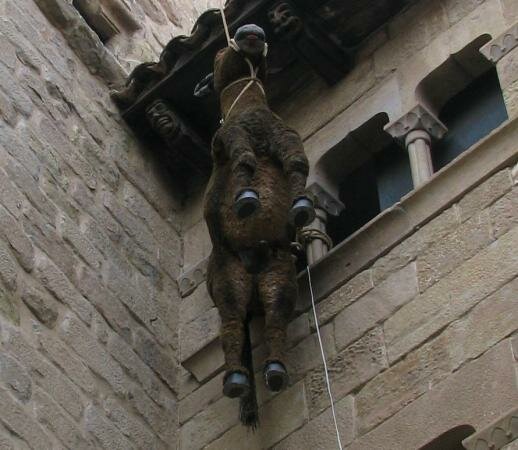
สรุปเนื้อหา
ข้อมูลสำคัญจากบทความ
ข้อมูลสำคัญเกี่ยวกับ งานรื่นเริง
เทศกาลคาร์นิวัล (หรือที่รู้จักกันในชื่อ Shrovetide ใน บางพื้นที่) เป็น เทศกาล เฉลิมฉลอง ที่จัดขึ้นในช่วงท้ายของ ช่วงก่อนเข้าพรรษาของ ศาสนา คริสต์ [ 2 ] ซึ่งประกอบด้วย...
นิรุกติศาสตร์
กล่าวกันว่าคำว่า carnival มาจาก สำนวน ภาษาละตินตอนปลาย carne levare ซึ่งหมายถึง "เอาเนื้อออก" หรือ การตีความตามความเชื่อพื้นบ้านว่า มาจาก carne vale ซึ่งหมายถึง "อำลาเนื้อ" ไม่ว่าจะด้วยเหตุผลใดก็ตาม คำนี้สื่อถึงการถือศีลอดในช่วง เทศกาลมหาพรต ที่ กำลังจะมาถึง...
ต้นกำเนิด
ลักษณะของการเฉลิมฉลองเทศกาลคาร์นิวัลมีต้นกำเนิดมาจากเทศกาลโบราณของยุโรป เช่น เทศกาล ไดโอนิเซียน ของกรีก ( Anthesteria ) หรือ เทศกาลซาเทอร์นาเลีย ของโรมัน ในช่วงเทศกาลเหล่านี้ จะมีการปลดปล่อยจากภาระผูกพันทางสังคมและลำดับชั้นชั่วคราว...
ยุคกลาง
ใน ยุคกลาง เทศกาลคาร์นิวัลหมายถึงช่วงเวลาหลัง เทศกาลเอพิฟานี ซึ่งถึงจุดสูงสุดก่อนเที่ยงคืนของวันอังคารก่อน วันพุธรับเถ้า [ 30 ] จอ ห์น บอสซี นักประวัติศาสตร์ชาวอังกฤษเขียนเกี่ยวกับที่มาของประเพณีในช่วงเทศกาลคาร์นิวัลว่า...