
อ่าน 103 นาที
สถาปัตยกรรมอิสลาม
สถาปัตยกรรมอิสลาม ประกอบด้วย รูปแบบสถาปัตยกรรม ของ อาคาร ที่เกี่ยวข้องกับ อารยธรรม อิสลาม ครอบคลุมทั้ง รูปแบบ ทางโลก และทางศาสนาตั้งแต่ยุคแรกเริ่ม ของประวัติศาสตร์อิสลาม...
สถาปัตยกรรมอิสลาม
| สถาปัตยกรรมอิสลาม | |
|---|---|
  
| |
| ที่ตั้ง | ตะวันออกกลาง , แอฟริกาเหนือ , อนุทวีปอินเดีย , เอเชียตะวันออกเฉียงใต้ , แอฟริกาตะวันตก , แอฟริกาตะวันออก , เอเชียกลาง |
สถาปัตยกรรมอิสลามประกอบด้วยรูปแบบสถาปัตยกรรมของอาคารที่เกี่ยวข้องกับ อารยธรรม อิสลามครอบคลุมทั้ง รูปแบบ ทางโลกและทางศาสนาตั้งแต่ยุคแรกเริ่มของประวัติศาสตร์อิสลามจนถึงปัจจุบันโลกอิสลามครอบคลุมพื้นที่ทางภูมิศาสตร์ที่กว้างขวางในเชิงประวัติศาสตร์ ตั้งแต่แอฟริกาตะวันตกและยุโรปไปจนถึงเอเชียตะวันออกรูปแบบสถาปัตยกรรมอิสลามในภูมิภาคเหล่านี้มีลักษณะร่วมกันบางประการ แต่เมื่อเวลาผ่านไป ภูมิภาคต่างๆ ได้พัฒนารูปแบบของตนเองตามวัสดุและเทคนิคในท้องถิ่น ราชวงศ์และผู้อุปถัมภ์ในท้องถิ่น ศูนย์กลางการผลิตทางศิลปะในภูมิภาคต่างๆ และบางครั้งก็รวมถึงความเชื่อทางศาสนาที่แตกต่างกันด้วย[ 1 ] [ 2 ]
สถาปัตยกรรมอิสลามยุคแรกได้รับอิทธิพลจาก สถาปัตยกรรม โรมันไบแซนไทน์อิหร่านและเมโสโปเตเมียรวมถึงดินแดนอื่นๆ ที่ชาวมุสลิมยุคแรกพิชิตได้ในช่วงศตวรรษที่ 7 และ 8 [ 3 ] [ 4 ] [ 5 ] [ 6 ] [ 7 ]ต่อมาได้พัฒนาลักษณะเฉพาะที่โดดเด่นในรูปแบบของอาคารและการตกแต่งพื้นผิวด้วย อักษรวิจิตร แบบอิสลามลวดลายอาหรับและลวดลายเรขาคณิต [ 8 ] องค์ประกอบทางสถาปัตยกรรมใหม่ๆ เช่นหอคอยมินาเร็ตมุการ์นาและซุ้มโค้งหลายแฉกได้ถูกประดิษฐ์ขึ้น ประเภทของอาคารทั่วไปหรือที่สำคัญในสถาปัตยกรรมอิสลาม ได้แก่มัสยิด โรงเรียนสอนศาสนาสุสานพระราชวังฮัมมัม ( ห้องอาบน้ำสาธารณะ) สถานพักพิง ของซูฟี (เช่นคานกะห์หรือซาวียา ) น้ำพุและซาบิลอาคารพาณิชย์ (เช่นคาราวานเซไรและบาซาร์ ) และป้อมปราการ ทางทหาร [ 2 ]
ประวัติศาสตร์ยุคต้น (จนถึงศตวรรษที่ 10)
ต้นกำเนิด
| ส่วนหนึ่งของชุดบทความเกี่ยวกับ |
| วัฒนธรรมอิสลาม |
|---|
|

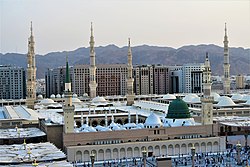
ยุคอิสลามเริ่มต้นด้วยการก่อตั้งศาสนาอิสลามภายใต้การนำของมูฮัมหมัดในช่วงต้นศตวรรษที่ 7 ในอาระเบียมัสยิดแห่งแรกเป็นสิ่งก่อสร้างที่มูฮัมหมัดสร้างขึ้นในเมดินาในปี 622 หลังจากที่ท่านอพยพ (ฮิจเราะห์) จากเมกกะ ซึ่งตรงกับที่ตั้งของ มัสยิดของท่านศาสดา ( อัล-มัสยิด อัน-นาบาวี ) ในปัจจุบัน[ 10 ] [ 9 ]โดยทั่วไปแล้วมักอธิบายว่าเป็นบ้านของท่าน แต่อาจได้รับการออกแบบให้เป็นศูนย์กลางชุมชนตั้งแต่แรกเริ่ม[ 10 ]ประกอบด้วย โครงสร้าง ลานบ้าน ที่เรียบง่าย สร้างด้วยอิฐดิบ มีผังพื้นเป็นรูปสี่เหลี่ยมผืนผ้า เกือบเป็นสี่เหลี่ยมจัตุรัส ขนาดประมาณ 53 คูณ 56 เมตร[ 10 ] [ 11 ]มีระเบียงที่มีร่มเงาซึ่งรองรับด้วยลำต้นของต้นปาล์มตั้งอยู่ทางด้านทิศเหนือของลานบ้าน ( ศอห์น )ในทิศทางของการละหมาด (กิบลัต ) ซึ่งในตอนแรกหันไปทางเยรูซาเล็มเมื่อ มีการเปลี่ยน ทิศกิบลัตให้หันไปทางเมกกะในปี 624 ก็มีการเพิ่มระเบียงที่คล้ายกันทางด้านทิศใต้ หันไปทางเมืองนั้น[ 10 ]มูฮัมหมัดและครอบครัวอาศัยอยู่ในห้องแยกต่างหากที่ติดกับมัสยิด และตัวมูฮัมหมัดเองก็ถูกฝังไว้ในห้องหนึ่งในห้องเหล่านี้เมื่อเสียชีวิตในปี 632 [ 10 ]ตลอดช่วงที่เหลือของศตวรรษที่ 7 และในศตวรรษที่ 8 มัสยิดได้รับการขยายซ้ำแล้วซ้ำเล่าเพื่อรวมห้องละหมาดหลังคาแบนขนาดใหญ่ที่รองรับด้วยเสา ( ห้องโถง ไฮโปสไตล์ ) พร้อมลานกลาง[ 10 ]มันกลายเป็นหนึ่งในแบบจำลองหลักสำหรับมัสยิดยุคแรกที่สร้างขึ้นในที่อื่น[ 10 ] [ 11 ]นักวิชาการโดยทั่วไปเห็นพ้องกันว่า นอกเหนือจากมัสยิด/บ้านของมูฮัมหมัดแล้ว สถาปัตยกรรมของคาบสมุทรอาหรับดูเหมือนจะมีบทบาทจำกัดในการกำหนดรูปแบบสถาปัตยกรรมอิสลามในภายหลัง[ 12 ] [ 13 ] [ 14 ] [ 15 ]
ก่อนการเริ่มต้นการพิชิตของชาวอาหรับ-มุสลิมในศตวรรษที่ 7 มหาอำนาจหลักสองแห่งในตะวันออกกลาง และ โลกเมดิเตอร์เรเนียนตะวันออกคือจักรวรรดิไบแซนไทน์ (จักรวรรดิโรมันตะวันออก)และจักรวรรดิซาสาเนียนจักรวรรดิทั้งสองนี้ต่างก็พัฒนาประเพณีทางสถาปัตยกรรมที่สำคัญของตนเอง ดินแดนชายแดนระหว่างจักรวรรดิทั้งสองนี้ – ในภูมิภาคทะเลทรายและ ทุ่ง หญ้า สเตปป์ ของซีเรียปาเลสไตน์เมโสโปเตเมียและอาระ เบียตอนเหนือ – คือ รัฐบริวารของชนเผ่าอาหรับสองรัฐได้แก่ ลัคมิดซึ่งเป็นบริวารของซาสาเนียนและมีเมืองหลวงอยู่ที่อัล-ฮิรา (ในอิรักปัจจุบัน) และกัสซานิดซึ่งเป็นบริวารของไบแซนไทน์และปกป้องพรมแดนด้านตะวันออกของพวกเขา[ 16 ]ราชวงศ์อาหรับทั้งสองนี้เป็นผู้อุปถัมภ์สถาปัตยกรรมที่สำคัญในภูมิภาคของตน[ 16 ]สถาปัตยกรรมของพวกเขายังไม่เป็นที่เข้าใจดีนักเนื่องจากซากที่สามารถระบุได้ในปัจจุบันมีน้อย แต่พวกเขายืมและดัดแปลงสถาปัตยกรรมของผู้ปกครองไบแซนไทน์และซา สาเนียนของพวก เขา[ 17 ] [ 18 ]อาคารบางส่วนของพวกเขาเป็นที่รู้จักจากโบราณคดีหรือตำราประวัติศาสตร์ เช่น พระราชวังลัคมิดแห่งคาวาร์นาคและอัล-ซาดีร์ในอัล-ฮิรา โบสถ์กัสซานิดที่มีการตกแต่งด้วยโมเสกที่นิทิล (ใกล้มาดาบา ) และห้องโถงรับรองของกัสซานิดที่รวมอยู่ในที่พักอาศัยในชนบทของราชวงศ์อุมัยยะฮ์ในภายหลังที่อาร์-รูซาฟา [ 16 ] [ 19 ] [ 20 ] วัฒนธรรมและสถาปัตยกรรมของลัคมิดและกัสซานิดน่าจะมีบทบาทในการถ่ายทอดและกรองประเพณีทางสถาปัตยกรรมของโลกซาสาเนียนและไบแซนไทน์/โรมันไปยังราชวงศ์อาหรับอิสลามในภายหลังซึ่งได้ก่อตั้งศูนย์กลางทางการเมืองของตนในภูมิภาคเดียวกัน[ 21 ] [ 22 ] [ 23 ]
เมื่อการพิชิตของชาวอาหรับ-มุสลิมในยุคแรกแผ่ขยายออกไปจากคาบสมุทรอาหรับในศตวรรษที่ 7 และรุกคืบไปทั่วตะวันออกกลางและแอฟริกาเหนือ เมืองป้อมปราการใหม่จึงถูกสร้างขึ้นในดินแดนที่ถูกพิชิต เช่นฟุสตัตในอียิปต์และคูฟาในอิรักในปัจจุบันมัสยิด กลาง ของเมืองเหล่านี้สร้างขึ้นในรูปแบบไฮโปสไตล์[ 10 ]ในเมืองอื่นๆ โดยเฉพาะในซีเรีย มัสยิดใหม่ถูกสร้างขึ้นโดยการดัดแปลงหรือยึดครองบางส่วนของโบสถ์ที่มีอยู่แล้วในเมืองต่างๆ เช่น ในดามัสกัสและฮามา [ 10 ] มัสยิดในยุคแรกเหล่านี้ไม่มีหอคอยมินาเร็ตแม้ว่าอาจมีการสร้างที่พักเล็กๆ บนหลังคาเพื่อปกป้องมุอัซซินขณะประกาศเรียกละหมาด[ 24 ]
ยุคอุมัยยะฮ์

รัฐกาหลิบอุมัยยาด (661–750) ผสมผสานองค์ประกอบของสถาปัตยกรรมไบแซนไทน์และสถาปัตยกรรมซาสาเนียนแต่สถาปัตยกรรมอุมัยยาดได้นำเสนอการผสมผสานรูปแบบใหม่ๆ ของสไตล์เหล่านี้[ 26 ]การนำองค์ประกอบจาก ศิลปะ โรมันและไบแซนไทน์แบบคลาสสิกกลับมาใช้ใหม่ยังคงเห็นได้ชัดเจน เนื่องจากอำนาจทางการเมืองและการอุปถัมภ์มีศูนย์กลางอยู่ที่ซีเรีย ซึ่งเป็นอดีตจังหวัดของโรมัน/ไบแซนไทน์[ 27 ]โครงสร้างบางส่วนของอดีตราชวงศ์กัสซานิดก็ดูเหมือนจะถูกนำกลับมาใช้ใหม่และดัดแปลงในช่วงเวลานี้ เช่นกัน [ 28 ]อย่างไรก็ตาม มีการทดลองเกิดขึ้นเป็นจำนวนมาก เนื่องจากผู้อุปถัมภ์ของอุมัยยาดได้ว่าจ้างช่างฝีมือจากทั่วทั้งจักรวรรดิ และสถาปนิกได้รับอนุญาต หรือแม้แต่ได้รับการสนับสนุน ให้ผสมผสานองค์ประกอบจากประเพณีทางศิลปะที่แตกต่างกัน และไม่สนใจขนบธรรมเนียมและข้อจำกัดแบบดั้งเดิม[ 27 ]ส่วนหนึ่งเป็นผลมาจากสิ่งนี้ สถาปัตยกรรมอุมัยยาดจึงโดดเด่นด้วยขอบเขตและความหลากหลายของการตกแต่ง รวมถึงโมเสกภาพเขียนฝาผนัง ประติมากรรม และภาพแกะสลักนูนต่ำ[ 29 ] [ 27 ]ในขณะที่ฉากรูปคนปรากฏให้เห็นอย่างเด่นชัดในอนุสรณ์สถานต่างๆ เช่นQusayr 'Amraการตกแต่งที่ไม่ใช่รูปคนและฉากนามธรรมได้รับความนิยมอย่างมาก โดยเฉพาะอย่างยิ่งในสถาปัตยกรรมทางศาสนา[ 30 ] [ 27 ]ดังนั้นยุคอุมัยยะฮ์จึงมีบทบาทสำคัญในการเปลี่ยนแปลงและเสริมสร้างประเพณีทางสถาปัตยกรรมที่มีอยู่เดิมในช่วงการก่อตัวของวัฒนธรรมทางสายตาของสังคมอิสลามยุคแรก[ 31 ]

ราชวงศ์อุมัยยะฮ์เป็นกลุ่มแรกที่เพิ่มมิห์ราบเข้าไปในการออกแบบมัสยิด ซึ่งเป็นช่อง เว้า ใน ผนัง กิบลัตของมัสยิด[ 32 ] มีรายงานว่า มิห์ราบแรก ปรากฏขึ้นที่มัสยิดของมูฮัมหมัดในเมดินาเมื่อ อัล-วาลิดที่ 1สร้างใหม่ในปี 707 ดูเหมือนว่าจะแสดงถึงสถานที่ที่มูฮัมหมัดยืนเมื่อนำละหมาด[ 32 ]สิ่งนี้กลายเป็นคุณลักษณะมาตรฐานของมัสยิดทั้งหมดแทบจะในทันที[ 32 ]อนุสรณ์สถานสำคัญหลายแห่งในยุคแรกของสถาปัตยกรรมอิสลามที่สร้างขึ้นภายใต้ราชวงศ์อุมัยยะฮ์ ได้แก่โดมแห่งศิลาในเยรูซาเลม (สร้างโดยกาหลิบอับดุลมาลิก ) และมัสยิดใหญ่แห่งดามัสกัส (สร้างโดยอัล-วาลิดที่ 1) มัสยิดอัลอักซาใน บริเวณ อัลอักซาในเยรูซาเลมก็ได้รับการสร้างใหม่โดยอัลวาลิดที่ 1 แทนที่โครงสร้างเรียบง่ายเดิมที่สร้างขึ้นราวปี ค.ศ. 670 [ 10 ]พระราชวังจำนวนหนึ่งจากยุคนี้ยังคงหลงเหลืออยู่บางส่วนหรือได้รับการขุดค้นในยุคปัจจุบัน[ 27 ] [ 29 ]ซุ้มโค้งรูปเกือกม้าปรากฏขึ้นเป็นครั้งแรกในสถาปัตยกรรมอุมัยยะฮ์ ต่อมาได้พัฒนาไปสู่รูปแบบที่ก้าวหน้าที่สุดในอัลอันดาลุส ( คาบสมุทรไอบีเรีย ) [ 33 ]

โดมแห่งศิลามีผังพื้นแบบศูนย์กลางที่มีโครงสร้างแปดเหลี่ยม ซึ่งน่าจะจำลองมาจากวิหารไบแซนไทน์ในภูมิภาคที่มีรูปแบบคล้ายกัน เช่นโบสถ์คาธิสมา [ 35 ] [ 36 ] แม้ว่าโดมแห่งศิลาจะมีความสำคัญทางศาสนาและประวัติศาสตร์ แต่ผังของมันก็ไม่ค่อยถูกนำมาใช้เป็นแบบจำลองสำหรับอนุสรณ์สถานอิสลามที่สำคัญในภายหลัง[ 27 ]ในมัสยิดแบบไฮโปสไตล์ ราชวงศ์อุมัยยะฮ์ได้นำประเพณีการทำให้ "ทางเดินกลาง" หรือทางเดินด้านหน้ามิห์ราบกว้างกว่าส่วนอื่นๆ มาใช้ โดยแบ่งห้องละหมาดตามแกนกลาง[ 32 ]นวัตกรรมนี้อาจได้รับแรงบันดาลใจจากผังของโบสถ์ คริสต์ที่มีอยู่แล้ว ในภูมิภาค[ 32 ] [ 37 ]ทั้งมัสยิดอัลอักซาและมัสยิดใหญ่แห่งดามัสกัสมีห้องโถงไฮโปสไตล์ในลักษณะนี้ โดยมีโดมอยู่เหนือพื้นที่ด้านหน้ามิห์ราบและทั้งสองแห่งมีอิทธิพลต่อการออกแบบมัสยิดในภายหลังในที่อื่นๆ[ 10 ]โดมแห่งศิลาและมัสยิดอุมัยยะฮ์ยังโดดเด่นด้วยโครงการตกแต่งโมเสกที่ครอบคลุมซึ่งดึงเอาลวดลายและฝีมือช่างจากยุคโบราณตอนปลายมาใช้[ 38 ] [ 39 ] [ 31 ] [ 36 ]อย่างไรก็ตาม การตกแต่งโมเสกก็เสื่อมความนิยมลงในสถาปัตยกรรมอิสลามในที่สุด[ 27 ]
ยุคราชวงศ์อับบาซิด

สถาปัตยกรรมของราชวงศ์อับ บาซิด (ค.ศ. 750–1513) ได้รับอิทธิพลอย่างมากจากสถาปัตยกรรมของราชวงศ์ซาสาเนียน ซึ่งมีองค์ประกอบที่ปรากฏมาตั้งแต่สมัยเมโสโปเตเมียโบราณ[ 41 ] [ 40 ]นอกจากนี้ยังพบอิทธิพลอื่นๆ เช่น สถาปัตยกรรม ซอกเดีย โบราณ ในเอเชียกลาง[ 41 ]ซึ่งส่วนหนึ่งเป็นผลมาจากการที่ศูนย์กลางทางการเมืองของราชวงศ์ย้ายไปทางตะวันออกมากขึ้นไปยังเมืองหลวงแห่งใหม่คือแบกแดดในประเทศอิรักปัจจุบัน[ 40 ]ราชวงศ์อับบาซิดยังสร้างเมืองหลวงอื่นๆ เช่นซามาร์ราในศตวรรษที่ 9 ซึ่งปัจจุบันเป็นแหล่งโบราณคดีสำคัญที่ให้ข้อมูลเชิงลึกมากมายเกี่ยวกับการวิวัฒนาการของ ศิลปะ และสถาปัตยกรรมอิสลาม ในช่วงเวลานั้น [ 42 ] [ 40 ]ในช่วงยุคทองของราชวงศ์อับบาซิดในศตวรรษที่ 8 และ 9 อำนาจและความเป็นเอกภาพอันยิ่งใหญ่ของราชวงศ์ทำให้รูปแบบและนวัตกรรมทางสถาปัตยกรรมแพร่กระจายอย่างรวดเร็วไปยังพื้นที่อื่นๆ ของโลกอิสลามภายใต้อิทธิพลของราชวงศ์[ 43 ]

ลักษณะเด่นจากยุคปลายราชวงศ์อุมัยยะฮ์ เช่น เพดานโค้ง ปูนปั้นแกะสลักและการตกแต่งผนังด้วยสี ได้รับการสืบทอดและพัฒนาต่อยอดในยุคราชวงศ์อับบาซิด[ 40 ]ซุ้มโค้งสี่จุดศูนย์กลางซึ่งเป็นรูปแบบที่ซับซ้อนกว่าของซุ้มโค้งแหลมปรากฏให้เห็นครั้งแรกในยุคราชวงศ์อับบาซิดในอนุสรณ์สถานต่างๆ ที่เมืองซามาร์รา เช่นพระราชวังกัสร์ อัล-อาชิก[ 45 ] [ 40 ]และถูกนำมาใช้กันอย่างแพร่หลายในบางภูมิภาคในยุคต่อมา[ 46 ]เมืองซามาร์รายังได้เห็นการปรากฏตัวของรูปแบบการตกแต่งใหม่ๆ โดยเฉพาะอย่างยิ่งในงานปูนปั้น ซึ่งเปลี่ยนลวดลายพืชพรรณดั้งเดิมของยุคโบราณตอนปลายให้กลายเป็นรูปแบบนามธรรมและมีสไตล์มากขึ้น ดังเช่นตัวอย่างในรูปแบบที่เรียกว่า "แบบเฉียง" เทคนิคการตกแต่งเหล่านี้แพร่กระจายไปยังภูมิภาคอื่นๆ อย่างรวดเร็ว ซึ่งการตกแต่งปูนปั้นมีบทบาทสำคัญ[ 47 ]

มัสยิดของราชวงศ์อับบาซิดทั้งหมดมีผังแบบลานภายในพร้อมห้องโถงเสาเรียงราย มัสยิดที่เก่าแก่ที่สุดคือมัสยิดใหญ่ที่กาหลิบอัล-มันซูร์สร้างขึ้นในแบกแดด (ซึ่งถูกทำลายไปแล้ว) มัสยิดใหญ่แห่งซามาร์ราที่สร้างโดยอัล-มุตาวักกิลมีขนาด 256 คูณ 139 เมตร (840 คูณ 456 ฟุต) มีหลังคาไม้แบนที่รองรับด้วยเสา และตกแต่งด้วยแผ่นหินอ่อนและโมเสกแก้ว[ 48 ]ห้องละหมาดของมัสยิดอะบูดูลัฟที่ซามาร์รามีซุ้มโค้งบนเสาอิฐรูปสี่เหลี่ยมผืนผ้าที่ตั้งฉากกับ ผนัง กิบลัต มัสยิดทั้งสองแห่งในซามาร์รามีหอคอยมินาเร็ตแบบเกลียว ซึ่งเป็นตัวอย่างเดียวในอิรัก[ 48 ]มัสยิดที่บัลค์ในปัจจุบันคืออัฟกานิสถานมีขนาดประมาณ 20 คูณ 20 เมตร (66 คูณ 66 ฟุต) เป็นรูปสี่เหลี่ยมจัตุรัส มีช่องสี่เหลี่ยมสามแถว แถวละสามช่อง รองรับโดมโค้งเก้าโดม[ 49 ]
แม้ว่าต้นกำเนิดของหอคอยมินาเร็ตจะไม่แน่นอน แต่เชื่อกันว่าหอคอยมินาเร็ตที่แท้จริงแห่งแรกปรากฏขึ้นในยุคนี้[ 50 ] [ 24 ]มัสยิดของราชวงศ์อับบาซิดหลายแห่งที่สร้างขึ้นในช่วงต้นศตวรรษที่ 9 มีหอคอยมินาเร็ตซึ่งตั้งอยู่ที่ปลายด้านเหนือของอาคาร ตรงข้ามกับมิห์ราบ กลาง หอคอยมินาเร็ต ที่มีชื่อเสียงที่สุดแห่งหนึ่งคือหอคอยมินาเร็ตมัลวิยา ซึ่งเป็นหอคอยเดี่ยวที่มีรูปทรง "เกลียว" สร้างขึ้นสำหรับมัสยิดใหญ่แห่งซามาร์รา[ 51 ]
รูปแบบภูมิภาคยุคแรก

หลังจากการโค่นล้มรัฐกาหลิบอุมัยยาดในปี 750 โดยราชวงศ์อับบาสิด สาขาใหม่ของราชวงศ์อุมัยยาดก็ประสบความสำเร็จในการเข้าควบคุมอัลอันดาลุสในปี 756 ก่อตั้งเอมิเรตแห่งกอร์โดบาและถึงจุดสูงสุดของอำนาจในฐานะกาหลิบที่ประกาศตนเองในศตวรรษที่ 10 มัสยิดใหญ่แห่งกอร์โดบาซึ่งสร้างขึ้นในปี 785–786 ถือเป็นอนุสรณ์สถานสำคัญแห่งแรกของสถาปัตยกรรมมัวร์ในคาบสมุทรไอบีเรีย รูปแบบสถาปัตยกรรมนี้ที่ก่อตั้งขึ้นในอัลอันดาลุสยังมีลักษณะร่วมกับสถาปัตยกรรมของแอฟริกาเหนือตะวันตก ( มาเกร็บ ) ซึ่งต่อมาอาณาจักรต่างๆ ในภูมิภาคนี้ก็ถือกำเนิดขึ้นและมีส่วนช่วยในการพัฒนาทางศิลปะ[ 52 ] [ 53 ]มัสยิดใหญ่แห่งกอร์โดบาเดิมนั้นโดดเด่นด้วยห้องโถงเสาที่มีเอกลักษณ์เฉพาะตัว โดยมีแถวของซุ้มโค้งสองชั้นสองสีที่ทำซ้ำและคงไว้ในการต่อเติมอาคารในภายหลัง มัสยิดได้รับการขยายหลายครั้ง โดยการขยายโดยอัล-ฮาคัมที่ 2 (ครองราชย์ ค.ศ. 961–976) ได้นำนวัตกรรมด้านสุนทรียศาสตร์ที่สำคัญมาใช้ เช่นซุ้มโค้งที่สานกันและ โดม ที่มีซี่โครงซึ่งได้รับการเลียนแบบและขยายความในอนุสรณ์สถานต่างๆ ในภูมิภาคในภายหลัง[ 52 ] [ 53 ]การก่อสร้างมาดินัต อัล-ซาห์ราเมืองหลวงใหม่และเมืองพระราชวังอันยิ่งใหญ่ในศตวรรษที่ 10 ยังได้สร้างกลุ่มอาคารสถาปัตยกรรมและการอุปถัมภ์ของราชวงศ์ที่สำคัญอีกด้วย อนุสรณ์สถานขนาดเล็ก เช่นมัสยิดบาบ อัล-มาร์ดุมในโตเลโดและหอคอยมินาเร็ตที่เพิ่มเข้าไปใน มัสยิด คาราวียินและอันดาลูซียินในเฟซ (ประเทศโมร็อกโกในปัจจุบัน) แสดงให้เห็นถึงความแพร่หลายขององค์ประกอบทางสไตล์เดียวกันทั่วทั้งภูมิภาค[ 54 ]
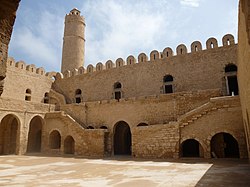
หลังจากช่วงรุ่งเรืองที่สุดในช่วงแรก รัฐกาหลิบอับบาซิดก็แตกแยกออกเป็นรัฐระดับภูมิภาคบางส่วนในศตวรรษที่ 9 ซึ่งอยู่ภายใต้การปกครองของกาหลิบในแบกแดดอย่างเป็นทางการ แต่โดยพฤตินัยแล้ว เป็น อิสระ[ 55 ]ราชวงศ์อัฆลาบิดในอิฟรีคียา (โดยประมาณคือประเทศตูนิเซียในปัจจุบัน) เป็นผู้อุปถัมภ์สถาปัตยกรรมที่โดดเด่น โดยรับผิดชอบในการสร้างมัสยิดใหญ่แห่งไครูอัน (เดิมสร้างโดยอุกบา อิบนุ นาฟีในปี 670) และมัสยิดซัยตูนาแห่งตูนิสขึ้นใหม่ในรูปแบบปัจจุบัน รวมถึงการสร้างสิ่งก่อสร้างอื่นๆ อีกมากมายในภูมิภาคนี้[ 56 ] [ 57 ]ในอียิปต์อะห์มัด อิบนุ ตูลุนได้ก่อตั้งราชวงศ์ตูลุนิดซึ่ง มีอายุสั้น และสร้างเมืองหลวงใหม่ ( อัล-กอตาอี ) พร้อมกับมัสยิดใหม่ที่เรียกว่ามัสยิดอิบนุ ตูลุนซึ่งสร้างเสร็จในปี 879 มัสยิดแห่งนี้ได้รับอิทธิพลอย่างมากจากสถาปัตยกรรมอับบาซิดในซามาร์รา และยังคงเป็นหนึ่งในตัวอย่างสถาปัตยกรรมในศตวรรษที่ 9 ที่โดดเด่นและได้รับการอนุรักษ์ไว้อย่างดีที่สุดจากรัฐกาลิฟาอับบาซิด[ 58 ]

ในอิหร่านและเอเชียกลาง ราชวงศ์ท้องถิ่นและภูมิภาคอื่นๆ อีกหลายราชวงศ์ได้ปกครองมาก่อนการมาถึงของเซลจุกในศตวรรษที่ 11 ในศตวรรษที่ 10 อิหร่านตอนกลางและใจกลางอิรักของราชวงศ์อับบาซิดอยู่ภายใต้การปกครองโดยพฤตินัยของราชวงศ์บูยิด อิหร่านตอนเหนืออยู่ภายใต้การปกครอง ของราชวงศ์ บาวันดิดและซียาริดและภูมิภาคตะวันออกเฉียงเหนือของคูราซานและทรานส์ออกเซียนาอยู่ภายใต้การปกครองของราชวงศ์ซามานิด [ 60 ] ในช่วงเวลานี้เองที่ลักษณะเด่นหลายประการของ สถาปัตยกรรม อิหร่านและเอเชียกลาง ในยุคต่อมา ได้ปรากฏขึ้นเป็นครั้งแรก รวมถึงการใช้อิฐเผาสำหรับการก่อสร้างและการตกแต่ง การใช้กระเบื้องเคลือบสำหรับการตกแต่งพื้นผิว และการพัฒนาของมูการ์นาจากสควินช์มัสยิดแบบไฮโปสไตล์ยังคงถูกสร้างขึ้น และยังมีหลักฐานของมัสยิดที่มีโดมหลายโดม แม้ว่าส่วนใหญ่จะถูกดัดแปลงหรือสร้างใหม่ในยุคต่อมา[ 60 ]มัสยิดจาเมห์แห่งนาอินซึ่งเป็นหนึ่งในมัสยิดที่เก่าแก่ที่สุดที่ยังหลงเหลืออยู่ในอิหร่าน มีลักษณะที่ได้รับการอนุรักษ์ไว้อย่างดีที่สุดจากยุคนี้ รวมถึงงานก่ออิฐ ตกแต่ง จารึกอักษร คูฟิกและการตกแต่งปูนปั้นอันงดงามที่มีลวดลายเถาวัลย์และใบอะแคนทัส ซึ่งได้รับอิทธิพลมาจากรูปแบบยุคก่อนหน้าของซามาร์รา[ 60 ] [ 61 ]แนวโน้มทางสถาปัตยกรรมที่สำคัญอีกประการหนึ่งที่เกิดขึ้นในช่วงศตวรรษที่ 10 ถึง 11 คือการพัฒนาสุสาน ซึ่งมีรูปแบบอนุสรณ์สถานเป็นครั้งแรก สุสานประเภทหนึ่งคือหอคอยสุสาน เช่นกุนบาด-อิ-กาบุส (ประมาณปี 1006–7) ในขณะที่อีกประเภทหลักคือทรงสี่เหลี่ยมมีโดม เช่นสุสานของราชวงศ์ซามานิดในบูคารา (ก่อนปี 943) [ 62 ] [ 60 ]

ในศตวรรษที่ 10 รัฐกาหลิบฟาติมิดขึ้นสู่อำนาจในอิฟรีคียา ซึ่งได้สร้างเมืองหลวงที่มีป้อมปราการแห่งใหม่ที่มะห์เดียในปี ค.ศ. 970 ฟาติมิดได้ย้ายศูนย์กลางอำนาจไปยังอียิปต์และก่อตั้งเมืองหลวงแห่งใหม่คือไคโร[ 63 ] สถาปัตยกรรมฟาติมิดในอียิปต์ใช้เทคนิคของทูลูนิดและใช้วัสดุที่คล้ายคลึงกัน แต่ก็พัฒนาลักษณะเฉพาะของตนเองด้วย มัสยิดแห่งแรกของฟาติมิดในไคโรคือมัสยิดอัล-อัซฮาร์ซึ่งก่อตั้งขึ้นพร้อมกับการก่อตั้งเมือง (ค.ศ. 970) ซึ่งกลายเป็นศูนย์กลางทางจิตวิญญาณของ นิกาย อิสมาอีลีชีอะห์ในศาสนาอิสลาม อนุสรณ์สถานสำคัญอื่นๆ ได้แก่มัสยิดอัลฮาคิม ขนาดใหญ่ (ก่อตั้งในปี 990 ในสมัยของอัลอาซีซแต่สร้างเสร็จสมบูรณ์ราวปี 1013 ในสมัยของอัลฮาคิม ) มัสยิดอักมาร์ ขนาดเล็ก (1125) ที่มีด้านหน้าอาคารประดับประดาอย่างหรูหรา และมัสยิดมัชฮัดของซัยยิดา รุกัยยา (1133) ที่มีโดม ซึ่งโดดเด่นด้วยมิห์ราบที่แกะสลักปูนปั้นอย่างประณีต[ 63 ]ในสมัยของวิเซียร์ ผู้ทรงอำนาจ บัดร์ อัลจามาลี (ครองราชย์ 1073–1094) กำแพงเมืองได้รับการสร้างใหม่ด้วยหิน พร้อมด้วยประตูขนาดใหญ่หลายแห่ง ซึ่งสามแห่งยังคงอยู่มาจนถึงปัจจุบัน ได้แก่บาบ อัลฟุตูห์ บาบ อัลนัสร์และบาบ ซูไวลา[ 64 ] [ 63 ]
ลักษณะเฉพาะ
ลานภายใน

ในสถาปัตยกรรมของโลกมุสลิมนั้น ลานภายในพบได้ทั้งในอาคารทางโลกและทางศาสนา
- โดยทั่วไปแล้ว ที่อยู่อาศัยและอาคารฆราวาสอื่นๆ มักมีลานส่วนตัวหรือสวนที่มีกำแพงล้อมรอบอยู่ตรง กลาง ซึ่งในภาษาอาหรับเรียกว่าwast ad-dar ("กลางบ้าน") ประเพณีบ้านที่มีลานภายในแพร่หลายในโลกเมดิเตอร์เรเนียนโบราณและตะวันออกกลางดังที่เห็นได้ในบ้านแบบกรีก-โรมัน (เช่น domus ของโรมัน ) การใช้พื้นที่นี้รวมถึงผลทางด้านสุนทรียศาสตร์ของพืชและน้ำ การส่องผ่านของแสงธรรมชาติ การปล่อยให้ลมและอากาศไหลเวียนเข้าไปในโครงสร้างในช่วงฤดูร้อน เป็นพื้นที่ที่เย็นกว่าด้วยน้ำและร่มเงา และเป็นสถานที่ที่ได้รับการปกป้องและสงวนไว้ซึ่งผู้หญิงในบ้านไม่จำเป็นต้องสวม ผ้า คลุมศีรษะ (ฮิญาบ)ตามประเพณีที่จำเป็นในที่สาธารณะ[ 65 ] [ 66 ]
- ṣaḥn (ภาษาอาหรับ: صحن ) คือลานภายในที่เป็นทางการซึ่งพบได้ในมัสยิดเกือบทุกแห่ง ในสถาปัตยกรรมอิสลาม ลานเหล่านี้เปิดโล่งสู่ท้องฟ้าและล้อมรอบด้วยโครงสร้างที่มีห้องโถงและห้องต่างๆ และมักจะมีซุ้มประตูแบบกึ่งเปิดโล่งที่มีร่มเงาเรียกว่าriwaqลานมัสยิดใช้สำหรับทำพิธีชำระล้างร่างกายและเป็นลานสำหรับพักผ่อนหรือรวมตัวกันSaṣaḥnมักจะมีสระน้ำหรือน้ำพุอยู่ตรงกลางเพื่อช่วยในการชำระล้างร่างกาย บางครั้งอาจมีหลังคาคลุมอยู่ใต้ศาลาทรงโดมแบบเปิดโล่ง[ 10 ] [ 67 ] [ 68 ]ในอดีต เนื่องจากสภาพอากาศที่อบอุ่นของเมดิเตอร์เรเนียนและตะวันออกกลาง ลานแห่งนี้ยังใช้เพื่อรองรับผู้ละหมาดจำนวนมากในระหว่างการละหมาดวันศุกร์อีกด้วย[ 69 ]

ห้องโถงเสา

ห้องโถงแบบ ไฮโปสไตล์ซึ่งก็คือห้องโถงเปิดโล่งที่รองรับด้วยเสา ถือว่ามีที่มาจากประเพณีทางสถาปัตยกรรมของหอประชุมเปอร์เซียสมัยอาเคเมนิด ( อาปาดานา ) อาคารประเภทนี้มีต้นกำเนิดมาจากบาซิลิกาแบบโรมันที่มีลานภายในล้อมรอบด้วยเสาเช่นเดียวกับฟอรัมของทราจันในกรุงโรม อาคารแบบโรมันพัฒนามาจากอะโกราของกรีก[ 71 ]ในสถาปัตยกรรมอิสลาม ห้องโถงไฮโปสไตล์เป็นคุณลักษณะหลักของมัสยิดไฮโปสไตล์ นักวิชาการบางคนเรียกมัสยิดไฮโปสไตล์ยุคแรกที่มีลานภายในว่า "แบบอาหรับ" หรือ "มัสยิดแบบอาหรับ" [ 69 ] [ 10 ]
แบบจำลองแรกเริ่มของมัสยิดแบบเสาเรียงรายคือมัสยิดของท่านศาสดาในมะดีนะฮ์ ซึ่งได้รับการขยายให้เป็นรูปแบบนี้ในช่วงศตวรรษที่ 7 และต้นศตวรรษที่ 8 และมีอิทธิพลต่อรูปแบบของมัสยิดในยุคแรกๆ[ 10 ]มัสยิดประเภทนี้ถูกสร้างขึ้นเพิ่มเติมภายใต้ราชวงศ์อุมัยยะฮ์และอับบาซิด อย่างไรก็ตาม ความเรียบง่ายของแผนผังประเภทนี้จำกัดโอกาสในการพัฒนาต่อไป และเป็นผลให้มัสยิดเหล่านี้ค่อยๆ เสื่อมความนิยมลงในบางภูมิภาค[ 69 ]
การกระโดดข้าม
ในอาคารอิสลามการสร้างหลังคาโค้งเป็นไปตามรูปแบบสถาปัตยกรรมสองแบบที่แตกต่างกัน: สถาปัตยกรรมอุมัยยะฮ์ทางตะวันตกสืบทอดประเพณีซีเรียในศตวรรษที่ 6 และ 7 ในขณะที่สถาปัตยกรรมอิสลามทางตะวันออกได้รับอิทธิพลหลักจากรูปแบบและสไตล์ของราชวงศ์ซาสาเนียน
ซุ้มโค้งไดอะแฟรมและหลังคาโค้งทรงกระบอกของราชวงศ์อุมัยยะฮ์

ใน โครงสร้าง เพดานโค้งอาคารสมัยอุมัยยะฮ์แสดงให้เห็นถึงการผสมผสานระหว่างสถาปัตยกรรมโรมันโบราณและเปอร์เซียซุ้มโค้งแบบไดอะแฟรมที่มีคานไม้หรือหิน หรืออาจเป็นเพดานโค้งทรงกระบอก เป็นที่รู้จักกันในดินแดนเลแวนต์มาตั้งแต่สมัยคลาสสิกและ สมัย นาบาเทียนโดยส่วนใหญ่ใช้สำหรับคลุมบ้านและบ่อน้ำ อย่างไรก็ตาม รูปแบบสถาปัตยกรรมของการใช้เพดานโค้งทรงกระบอกคลุมซุ้มโค้งแบบไดอะแฟรมนั้น น่าจะเพิ่งนำเข้ามาจากสถาปัตยกรรมอิหร่านเนื่องจากโครงสร้างเพดานโค้งลักษณะนี้ไม่เป็นที่รู้จักในบิลาด อัล-ชามก่อนการมาถึงของราชวงศ์อุมัยยะฮ์ แต่รูปแบบนี้เป็นที่รู้จักกันดีในอิหร่านมาตั้งแต่ สมัย พาร์เธีย ตอนต้น ดังตัวอย่างในอาคารพาร์เธียแห่ง อั ชชูร์ตัวอย่างที่เก่าแก่ที่สุดของเพดานโค้งทรงกระบอกที่วางอยู่บนซุ้มโค้งแบบไดอะแฟรมจากสถาปัตยกรรมอุมัยยะฮ์นั้น พบได้ที่กัสร์ ฮารานในซีเรีย ในช่วงแรก ซุ้มโค้งไดอะแฟรมถูกสร้างขึ้นจากแผ่นหินปูนที่ตัดหยาบๆ โดยไม่ใช้โครงสร้างค้ำยัน ชั่วคราว ซึ่งเชื่อมต่อกันด้วยปูนปลาสเตอร์ ต่อมามีการสร้างเพดาน โค้งโดยใช้ซี่โครงด้านข้างที่ขึ้นรูปไว้ล่วงหน้าจากปูนปลาสเตอร์ ซึ่งทำหน้าที่เป็นแบบหล่อชั่วคราวเพื่อนำทางและจัดตำแหน่งเพดานโค้ง ซี่โครงเหล่านี้ซึ่งถูกทิ้งไว้ในโครงสร้างในภายหลังนั้นไม่ได้รับน้ำหนักใดๆ ซี่โครงเหล่านี้ถูกหล่อไว้ล่วงหน้าบนแถบผ้า ซึ่งยังคงสามารถมองเห็นรอยประทับได้ในซี่โครงในปัจจุบัน โครงสร้างที่คล้ายกันนี้พบได้ในสถาปัตยกรรมสมัยซาสาเนียน ตัวอย่างเช่น จากพระราชวังฟิรูซาบาดเพดานโค้งประเภทนี้ในสมัยอุมัยยะฮ์พบได้ในป้อมปราการอัมมานและในกัสร์อัมรา[ 72 ]
อิวานส์

อิวานคือห้องโถงที่มีกำแพงล้อมรอบสามด้านและเปิดโล่งด้านหนึ่ง[ 73 ] [ 74 ]โดยทั่วไปแล้วจะมีหลังคาโค้งคลุมอยู่ แม้ว่าอาจจะแตกต่างกันไป[ 74 ]ลักษณะนี้มีอยู่ในสถาปัตยกรรมสมัยซาสาเนียน แม้ว่าต้นกำเนิดที่แท้จริงจะเก่าแก่กว่าและยังคงเป็นที่ถกเถียงกันอยู่[ 74 ]ต่อมาได้ถูกนำมาใช้ในสถาปัตยกรรมอิสลาม การใช้งานอิวานแพร่หลายมากขึ้นในสมัยเซลจุกในศตวรรษที่ 10 [ 73 ]อิวานถูกนำไปใช้ในหลากหลายวิธีและจัดวางในตำแหน่งที่แตกต่างกันเมื่อเทียบกับส่วนอื่นๆ ของอาคาร พบได้ในอาคารหลายประเภท รวมถึงมัสยิด มาดราซา พระราชวัง และคาราวานเซไร รูปแบบที่พบได้ทั่วไปคือแผนผังแบบสี่อิวาน
คำศัพท์ภาษาเปอร์เซียที่เกี่ยวข้อง คือ pishtaqซึ่งหมายถึงประตูทางเข้า (บางครั้งเรียกว่า iwan) ที่ยื่นออกมาจากด้านหน้าของอาคาร มักตกแต่งด้วยแถบอักษรวิจิตรกระเบื้อง เคลือบ และลวดลายเรขาคณิต[ 75 ] [ 76 ]
โดม
โดมในอิหร่านและเอเชียกลาง
เนื่องจากมีประวัติศาสตร์อันยาวนานของการสร้างและบูรณะใหม่ ซึ่งครอบคลุมช่วงเวลาตั้งแต่สมัยราชวงศ์อับบาสิดจนถึงราชวงศ์กาจาร์และอยู่ในสภาพการอนุรักษ์ที่ดีเยี่ยมมัสยิดจาเมห์แห่งอิสฟาฮานจึงเป็นตัวอย่างให้เห็นภาพรวมของการทดลองที่สถาปนิกอิสลามได้ดำเนินการกับโครงสร้างโค้งที่ซับซ้อน[ 77 ]
ระบบสควินช์ซึ่งเป็นโครงสร้างที่เติมเต็มมุมด้านบนของห้องสี่เหลี่ยมเพื่อสร้างฐานรองรับ โดมทรง แปดเหลี่ยมหรือ ทรง กลม เป็นที่รู้จักกันอยู่แล้วในสถาปัตยกรรมสมัยซาสาเนียน[ 78 ]สามเหลี่ยมทรงกลมของสควินช์ถูกแบ่งออกเป็นส่วนย่อยหรือระบบช่องเพิ่มเติม ส่งผลให้เกิดการทำงานร่วมกันที่ซับซ้อนของโครงสร้างรองรับที่สร้างรูปแบบเชิงพื้นที่ประดับตกแต่งซึ่งซ่อนน้ำหนักของโครงสร้างไว้
ประเพณีการสร้างโดมอิฐสองชั้นในอิหร่านสามารถสืบย้อนไปได้ถึงศตวรรษที่ 11 [ 79 ] [ 80 ]ในช่วงต้นศตวรรษที่ 15 อนุสรณ์สถานสำคัญของราชวงศ์ติมูริด เช่นสุสานกูร์-อิ อามีร์และมัสยิดบีบี ขานุม (ทั้งสองแห่งสร้างเสร็จราวปี 1404) โดดเด่นในด้านการใช้โดมสองชั้นขนาดใหญ่ โดมเหล่านี้ประกอบด้วยเปลือกชั้นในที่มองเห็นได้จากภายใน และเปลือกชั้นนอกที่ใหญ่กว่า มองเห็นได้จากภายนอก และมักจะมีรูปร่างที่แตกต่างกันเล็กน้อย โดมของสุสานกูร์-อิ อามีร์ ซึ่งเป็นโดมที่เก่าแก่ที่สุดที่ยังคงเหลืออยู่จนถึงปัจจุบัน มีลักษณะเป็นโครงสร้างซี่โครงด้านนอกพร้อมแถบมูการ์นาสรอบฐาน[ 81 ]อย่างไรก็ตาม โดมที่มีรูปร่างและสไตล์นี้อาจถูกสร้างขึ้นก่อนหน้านี้ ดังที่เห็นได้จากสุสานสุลต่านยาในกรุงไคโร ซึ่งสร้างขึ้นก่อนหน้านี้ในช่วงปี 1350 และดูเหมือนว่าจะลอกเลียนแบบการออกแบบเดียวกันนี้จากประเพณีของอิหร่าน[ 79 ]
"เพดานโค้งซี่โครงที่ไม่เป็นแนวรัศมี" ซึ่งเป็นรูปแบบสถาปัตยกรรมของเพดานโค้งซี่โครงที่มีโดมทรงกลมซ้อนทับอยู่ เป็นรูปแบบเพดานโค้งที่เป็นเอกลักษณ์ของสถาปัตยกรรมอิสลามตะวันออก ตั้งแต่เริ่มแรกในมัสยิดจาเมห์แห่งอิสฟาฮาน รูปแบบของเพดานโค้งนี้ถูกนำไปใช้ในอาคารสำคัญหลายแห่งจนถึงสมัย สถาปัตยกรรม ซาฟาวิดลักษณะสำคัญของมันคือ: [ 77 ]
- ซี่โครงสี่ซี่ที่ตัดกัน บางครั้งอาจซ้อนกันและตัดกันจนเกิดเป็นรูปดาวแปดแฉก
- การละเว้นพื้นที่เชื่อมต่อระหว่างส่วนโค้งและโครงสร้างรองรับ;
- โดมกลางหรือโคมไฟหลังคาอยู่บนยอดโค้งแบบมีสันนูน
ในขณะที่ซี่โครงคู่ที่ตัดกันเป็นองค์ประกอบตกแต่งหลักของสถาปัตยกรรมเซลจุกซี่โครงเหล่านี้ถูกซ่อนไว้หลังองค์ประกอบทางสถาปัตยกรรมเพิ่มเติมในยุคต่อมา ดังเช่นที่เห็นได้ในโดมของสุสานของอาห์เหม็ด ซันจาร์ในเมืองเมอร์ฟจนกระทั่งในที่สุดก็หายไปอย่างสมบูรณ์หลังเปลือกสองชั้นของ โดม ปูนปั้นดังที่เห็นได้ในโดมของอาลี กาปูในเมืองอิสฟาฮาน[ 77 ]
![โดมที่มีสควินช์ในพระราชวังอาร์ดาชีร์แห่งเปอร์เซียก่อนยุคอิสลาม สควินช์เป็นหนึ่งในผลงานที่สำคัญที่สุดของราชวงศ์ซาสาเนียนที่มีต่อสถาปัตยกรรมอิสลาม[82]](//upload.wikimedia.org/wikipedia/commons/thumb/c/c6/Ardeshir_Palace%2C_Firoozabad%2C_Fars_%28%DA%A9%D8%A7%D8%AE_%D8%A7%D8%B1%D8%AF%D8%B4%DB%8C%D8%B1_%D8%B3%D8%A7%D8%B3%D8%A7%D9%86%DB%8C%D8%8C_%D9%81%DB%8C%D8%B1%D9%88%D8%B2%D8%A2%D8%A8%D8%A7%D8%AF%D8%8C_%D9%81%D8%A7%D8%B1%D8%B3%29_-_panoramio_%282%29.jpg/250px-Ardeshir_Palace%2C_Firoozabad%2C_Fars_%28%DA%A9%D8%A7%D8%AE_%D8%A7%D8%B1%D8%AF%D8%B4%DB%8C%D8%B1_%D8%B3%D8%A7%D8%B3%D8%A7%D9%86%DB%8C%D8%8C_%D9%81%DB%8C%D8%B1%D9%88%D8%B2%D8%A2%D8%A8%D8%A7%D8%AF%D8%8C_%D9%81%D8%A7%D8%B1%D8%B3%29_-_panoramio_%282%29.jpg) โดมที่มีสควินช์ในพระราชวังอาร์ดาชีร์แห่งเปอร์เซียก่อนยุคอิสลาม สควินช์เป็นหนึ่งในผลงานที่สำคัญที่สุดของราชวงศ์ซาสาเนียนที่มีต่อสถาปัตยกรรมอิสลาม[ 82 ]
โดมที่มีสควินช์ในพระราชวังอาร์ดาชีร์แห่งเปอร์เซียก่อนยุคอิสลาม สควินช์เป็นหนึ่งในผลงานที่สำคัญที่สุดของราชวงศ์ซาสาเนียนที่มีต่อสถาปัตยกรรมอิสลาม[ 82 ]
 เพดานโค้งซี่โครงที่ไม่เป็นแนวรัศมีในมัสยิดจาเมห์แห่งอิสฟาฮาน
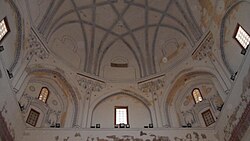 โดมสุสานของอะห์เหม็ด ซันจาร์ ในเมืองเมอร์ฟ
 โดมด้านบนของอาลี กาปู อิสฟาฮาน
![โดมที่มีสควินช์ในพระราชวังอาร์ดาชีร์แห่งเปอร์เซียก่อนยุคอิสลาม สควินช์เป็นหนึ่งในผลงานที่สำคัญที่สุดของราชวงศ์ซาสาเนียนที่มีต่อสถาปัตยกรรมอิสลาม[82]](https://upload.wikimedia.org/wikipedia/commons/thumb/c/c6/Ardeshir_Palace%2C_Firoozabad%2C_Fars_%28%DA%A9%D8%A7%D8%AE_%D8%A7%D8%B1%D8%AF%D8%B4%DB%8C%D8%B1_%D8%B3%D8%A7%D8%B3%D8%A7%D9%86%DB%8C%D8%8C_%D9%81%DB%8C%D8%B1%D9%88%D8%B2%D8%A2%D8%A8%D8%A7%D8%AF%D8%8C_%D9%81%D8%A7%D8%B1%D8%B3%29_-_panoramio_%282%29.jpg/250px-Ardeshir_Palace%2C_Firoozabad%2C_Fars_%28%DA%A9%D8%A7%D8%AE_%D8%A7%D8%B1%D8%AF%D8%B4%DB%8C%D8%B1_%D8%B3%D8%A7%D8%B3%D8%A7%D9%86%DB%8C%D8%8C_%D9%81%DB%8C%D8%B1%D9%88%D8%B2%D8%A2%D8%A8%D8%A7%D8%AF%D8%8C_%D9%81%D8%A7%D8%B1%D8%B3%29_-_panoramio_%282%29.jpg)




โดมในเอเชียใต้
การใช้โดมในเอเชียใต้เริ่มต้นขึ้นพร้อมกับการก่อตั้งรัฐสุลต่านเดลีในปี ค.ศ. 1204 แตกต่างจาก โดม ของออตโตมันและยิ่งกว่าโดมของเปอร์เซีย โดมในเอเชียใต้มีแนวโน้มที่จะมีลักษณะป่องมากกว่า[ 83 ]โดมขนาดใหญ่ของราชวงศ์โมกุลหลายแห่งก็มีโครงสร้างสองชั้นและได้รับอิทธิพลมาจากประเพณีของอิหร่าน การออกแบบสุสานของฮูมายุน (สร้างเสร็จราวปี ค.ศ. 1571–72) รวมถึงโดมสองชั้น แสดงให้เห็นว่าสถาปนิกคุ้นเคยกับอนุสรณ์สถานของราชวงศ์ติมูริดในซามาร์กันด์[ 84 ]โดมกลางของทัชมาฮาลก็มีลักษณะป่องและโครงสร้างสองชั้นเช่นกัน[ 85 ]
 ภาพมุมมองโดมหลักของสุสานฮูมายุนในเดลี
 โดมของทัชมาฮาลในเมืองอักรา
 โดมทรงกลมของมัสยิดบาดชาฮีในเมืองลาฮอร์
 โดมหลักของมัสยิดชาห์จาฮาน เมืองทัตตามีกระเบื้องเรียงตัวเป็น รูป ดาวเพื่อแสดงถึงท้องฟ้ายามค่ำคืน
 ภายในโดมหลักของโรงอาบน้ำชาฮีฮัมมามในเมืองลาฮอร์


โดมทรงซี่โครงในอัลอันดาลุสและมาเกร็บ

มัสยิดใหญ่แห่งกอร์โดบาในอัลอันดาลุสถูกสร้างขึ้นครั้งแรกด้วยระบบซุ้มโค้งคู่ที่รองรับเพดานไม้เรียบ เสาของซุ้มโค้งเชื่อมต่อกันด้วยซุ้มโค้งรูปเกือกม้าซึ่งรองรับเสาอิฐ ซึ่งเชื่อมต่อกันด้วยซุ้มโค้งครึ่งวงกลม[ 86 ] : 40–42 ระบบซุ้มโค้งนี้ถูกคัดลอกในระหว่างการขยายมัสยิดในภายหลัง แต่การขยายโดยอัลฮาคัมที่ 2 หลังปี 961 ยังได้นำโดมซี่โครงที่ประดับประดาอย่างวิจิตรมาด้วย[ 87 ]โดมสามหลังครอบคลุมเพดานโค้งด้านหน้ากำแพงมิห์ราบ ในขณะที่อีกหลังหนึ่งครอบคลุมพื้นที่ซึ่งปัจจุบันรู้จักกันในชื่อภาษาสเปนว่าCapilla de Villaviciosaซึ่งตั้งอยู่หลายช่วงก่อนมิห์ราบ ในส่วนที่รองรับโดมเหล่านี้ในปัจจุบัน จำเป็นต้องมีโครงสร้างรองรับเพิ่มเติมเพื่อรับแรงผลักของโดม สถาปนิกแก้ปัญหานี้โดยการสร้างซุ้มโค้งที่ตัดกัน[ 88 ] [ 89 ]โดมเหล่านี้สร้างขึ้นด้วยซี่โครงหินแปดซี่ที่ตัดกัน แทนที่จะมาบรรจบกันที่จุดศูนย์กลางของโดม ซี่โครงเหล่านี้จะตัดกันที่จุดกึ่งกลาง ทำให้พื้นที่ตรงกลางถูกครอบครองโดยโดมขนาดเล็กกว่า สำหรับโดมที่อยู่ด้านหน้ามิห์ราบ ซี่โครงจะก่อตัวเป็นรูปดาวแปดแฉกและโดมแปดเหลี่ยมอยู่ตรงกลาง สำหรับโดมเหนือCapilla de Villaviciosaซี่โครงจะเว้นพื้นที่สี่เหลี่ยมตรงกลางระหว่างกัน โดยมีโดมแปดเหลี่ยมเพิ่มอยู่ด้านบน[ 89 ] [ 90 ]
โดมซี่โครงของมัสยิด-มหาวิหารแห่งกอร์โดบาเป็นต้นแบบสำหรับการสร้างมัสยิดในยุคต่อมาในอิสลามตะวันตกของอัลอันดาลุสและมาเกร็บ ประมาณปี ค.ศ. 1000 มัสยิดบาบ อัล-มาร์ดุมในโตเลโดถูกสร้างขึ้นด้วยโดมซี่โครงแปดซี่ที่คล้ายกัน ล้อมรอบด้วยโดมซี่โครงอีกแปดโดมที่มีการออกแบบที่แตกต่างกัน[ 91 ]โดมที่คล้ายกันนี้ยังพบเห็นได้ในอาคารมัสยิดของอัลจาเฟเรียแห่งซาราโกซารูปแบบสถาปัตยกรรมของโดมซี่โครงได้รับการพัฒนาเพิ่มเติมในมาเกร็บ: โดมกลางของมัสยิดใหญ่แห่งเทลเมนเซนซึ่งเป็นผลงานชิ้นเอกของราชวงศ์อัลโมราวิดที่สร้างขึ้นในปี ค.ศ. 1082 มีซี่โครงเรียวสิบสองซี่ และช่องว่างระหว่างซี่โครงนั้นเต็มไปด้วยงานปูนปั้นฉลุลาย[ 89 ]
โดมแบบออตโตมัน

สถาปัตยกรรมออตโตมันพัฒนารูปแบบเฉพาะของอาคารอนุสรณ์สถานอันโอ่อ่าและเป็นตัวแทน: โดมกลางขนาดใหญ่ถูกสร้างขึ้นบนอาคารที่มีการวางผังแบบศูนย์กลาง[ 93 ]หลังจากที่ออตโตมันพิชิตคอนสแตนติโนเปิลในปี 1453 พวกเขาพบโบสถ์คริสเตียนไบแซนไทน์หลายแห่ง ซึ่งที่ใหญ่ที่สุดและโดดเด่นที่สุดคือฮาเกียโซเฟียซี่โครงก่ออิฐและปูนและเปลือกทรงกลมของโดมกลางของฮาเกียโซเฟียถูกสร้างขึ้นพร้อมกัน เป็นโครงสร้างที่รองรับตัวเองได้โดยไม่ต้องใช้โครง ไม้ [ 94 ]ในโบสถ์ไบแซนไทน์ยุคแรกของฮาเกียไอรีนซี่โครงของโดมโค้งถูกรวมเข้ากับเปลือกอย่างสมบูรณ์ คล้ายกับ โดม โรมัน ตะวันตก ดังนั้นจึงมองไม่เห็นจากภายในอาคาร[ 95 ]ในโดมของฮาเกียโซเฟีย ซี่โครงและเปลือกของโดมรวมกันเป็นเหรียญกลางที่ยอดของโดม ปลายด้านบนของซี่โครงถูกรวมเข้ากับเปลือก เปลือกและซี่โครงประกอบกันเป็นโครงสร้างเดียว[ 96 ]การเปลี่ยนผ่านโครงสร้างด้านล่างโดมเกิดขึ้นจากเพนเดนทีฟ สี่อัน และพื้นที่โดมขยายออกไปโดยโดมครึ่งวงกลมสองอัน การออกแบบนี้พร้อมกับการออกแบบออตโตมันในยุคแรกๆ ทำหน้าที่เป็นแบบจำลองสำหรับการพัฒนาในภายหลัง[ 97 ]
สถาปนิกออตโตมันมิมาร์ ซินานพยายามแก้ไขปัญหาโครงสร้างของโดมฮาเกียโซเฟียโดยการสร้างระบบเสาสมมาตรตรงกลางที่มีโดมครึ่งวงกลมขนาบข้าง ดังตัวอย่างจากการออกแบบมัสยิดสุไลมานิเย (เสาสี่ต้นพร้อมกำแพงโล่ขนาบข้างสองด้านและโดมครึ่งวงกลมสองอัน ค.ศ. 1550–1557) และมัสยิดเซลิมิเยในเอดีร์เน (เสาแปดต้นพร้อมโดมครึ่งวงกลมแนวทแยงสี่อัน ค.ศ. 1568–1574) [ 98 ] [ 99 ]การออกแบบมัสยิดเซลิมิเย ซึ่งเกิดขึ้นหลังจากการทดลองเชิงพื้นที่และโครงสร้างมากมายในงานก่อนหน้านี้ เป็นผลงานชิ้นเอกของซินานและเป็นจุดสูงสุดของสถาปัตยกรรมโดมออตโตมัน มันเพิ่มประสิทธิภาพพื้นที่โดม ทำให้องค์ประกอบทั้งหมดของอาคารอยู่ภายใต้โดม แหล่งข้อมูลของออตโตมันอ้างว่าโดมของมัสยิดนี้เหนือกว่าโดมของฮาเกียโซเฟียเป็นครั้งแรก[ 98 ] [ 99 ] [ 100 ]
 ภาพร่างแผนผังของโดมเพนเดนทีฟ
 โดมกลางและโดมครึ่งวงกลมของวิหารฮาเกียโซเฟีย (ศตวรรษที่ 6 - ก่อนยุคอิสลาม)
![มัสยิดเชห์ซาเด (ค.ศ. 1543–8) ประกอบด้วยโดมกลางที่รองรับด้วยเสาสี่ต้นและโดมครึ่งวงกลมสี่หลัง[101]](//upload.wikimedia.org/wikipedia/commons/thumb/1/15/Shezade_mosque_9510.jpg/250px-Shezade_mosque_9510.jpg)
![มัสยิดสุไลมานียะห์ (ค.ศ. 1550–7) มีลักษณะคล้ายกับการออกแบบของฮาเกียโซเฟีย โดยมีโดมกลางและโดมครึ่งวงกลมสองอัน[102]](//upload.wikimedia.org/wikipedia/commons/thumb/b/b6/Suleymaniye_Mosque_1319.jpg/250px-Suleymaniye_Mosque_1319.jpg) มัสยิดสุไลมานียะห์ (ค.ศ. 1550 – 7) จำลองแบบมาจากฮาเกียโซเฟีย โดยมีโดมกลางและโดมครึ่งวงกลมสองอัน[ 102 ]
มัสยิดสุไลมานียะห์ (ค.ศ. 1550 – 7) จำลองแบบมาจากฮาเกียโซเฟีย โดยมีโดมกลางและโดมครึ่งวงกลมสองอัน[ 102 ]![มัสยิดคารา อาห์เหม็ด ปาชา (ค.ศ. 1554) ใช้ระบบค้ำยันรูปหกเหลี่ยมสำหรับโดมหลัก[103]](//upload.wikimedia.org/wikipedia/commons/thumb/a/a6/Gazi_Ahmet_Pasha_Mosque_2834.jpg/250px-Gazi_Ahmet_Pasha_Mosque_2834.jpg) มัสยิดคารา อาห์เหม็ด ปาชา (ค.ศ. 1554) ใช้ระบบค้ำยันรูปหกเหลี่ยมสำหรับโดมหลัก[ 103 ]
มัสยิดคารา อาห์เหม็ด ปาชา (ค.ศ. 1554) ใช้ระบบค้ำยันรูปหกเหลี่ยมสำหรับโดมหลัก[ 103 ]![มัสยิด Rüstem Pasha ขนาดเล็ก (ค.ศ. 1561) เป็นตัวอย่างแรกๆ ของการใช้ระบบค้ำยันรูปแปดเหลี่ยมของ Sinan[104]](//upload.wikimedia.org/wikipedia/commons/thumb/4/44/101N-3442_DSC_%284610160431%29.jpg/250px-101N-3442_DSC_%284610160431%29.jpg) มัสยิด Rüstem Pashaขนาดเล็ก(ค.ศ. 1561) เป็นตัวอย่างแรกๆ ของการใช้ระบบค้ำยันแปดเหลี่ยมของ Sinan [ 104 ]
มัสยิด Rüstem Pashaขนาดเล็ก(ค.ศ. 1561) เป็นตัวอย่างแรกๆ ของการใช้ระบบค้ำยันแปดเหลี่ยมของ Sinan [ 104 ]


![มัสยิดเชห์ซาเด (ค.ศ. 1543–8) ประกอบด้วยโดมกลางที่รองรับด้วยเสาสี่ต้นและโดมครึ่งวงกลมสี่หลัง[101]](https://upload.wikimedia.org/wikipedia/commons/thumb/1/15/Shezade_mosque_9510.jpg/250px-Shezade_mosque_9510.jpg)
![มัสยิดสุไลมานียะห์ (ค.ศ. 1550–7) มีลักษณะคล้ายกับการออกแบบของฮาเกียโซเฟีย โดยมีโดมกลางและโดมครึ่งวงกลมสองอัน[102]](https://upload.wikimedia.org/wikipedia/commons/thumb/b/b6/Suleymaniye_Mosque_1319.jpg/250px-Suleymaniye_Mosque_1319.jpg)
![มัสยิดคารา อาห์เหม็ด ปาชา (ค.ศ. 1554) ใช้ระบบค้ำยันรูปหกเหลี่ยมสำหรับโดมหลัก[103]](https://upload.wikimedia.org/wikipedia/commons/thumb/a/a6/Gazi_Ahmet_Pasha_Mosque_2834.jpg/250px-Gazi_Ahmet_Pasha_Mosque_2834.jpg)
![มัสยิด Rüstem Pasha ขนาดเล็ก (ค.ศ. 1561) เป็นตัวอย่างแรกๆ ของการใช้ระบบค้ำยันรูปแปดเหลี่ยมของ Sinan[104]](https://upload.wikimedia.org/wikipedia/commons/thumb/4/44/101N-3442_DSC_%284610160431%29.jpg/250px-101N-3442_DSC_%284610160431%29.jpg)
สวน

สวนและน้ำมีบทบาทสำคัญในวัฒนธรรมอิสลามมาหลายศตวรรษ และมักถูกเปรียบเทียบกับสวนสวรรค์การเปรียบเทียบนี้มีต้นกำเนิดมาจากจักรวรรดิอะเคเมนิดในบทสนทนา " โอเอโคโนมิคัส " ของเซ โน ฟอน โซคราตีสได้เล่าเรื่องราวการเยี่ยมเยียนของนายพลไลแซนเดอร์ แห่งสปาร์ตา ไปยังเจ้าชายไซรัสผู้เยาว์แห่งเปอร์เซียซึ่งได้แสดงให้ชาวกรีกเห็น "สวรรค์ที่ซาร์ดิส" ของเขา[ 105 ]รูปแบบคลาสสิกของสวนสวรรค์ เปอร์เซีย หรือชาร์บากห์ประกอบด้วยพื้นที่ชลประทานรูปสี่เหลี่ยมผืนผ้าที่มีทางเดินยกระดับ ซึ่งแบ่งสวนออกเป็นสี่ส่วนที่มีขนาดเท่ากัน:
หนึ่งในเอกลักษณ์ของสวนเปอร์เซียคือสวนสี่ส่วนที่จัดวางด้วยทางเดินแกนที่ตัดกันที่ใจกลางสวน แผนผังทางเรขาคณิตที่มีโครงสร้างสูงนี้เรียกว่า chahar bagh ซึ่งกลายเป็นอุปมาอุปไมยที่ทรงพลังสำหรับการจัดระเบียบและการควบคุมภูมิทัศน์ ซึ่งเป็นสัญลักษณ์ของอาณาเขตทางการเมือง[ 106 ]
สวนชาร์บากห์จากสมัยอาเคเมนิดได้รับการค้นพบในการขุดค้นทางโบราณคดีที่ปาสาร์ กาเด สวน เชเฮลโซตูน ( อิสฟาฮา น ) , สวนฟิน(คา ชาน ) , สวนเอราม ( ชีราซ) , สวนชาซเดห์ ( มาฮาน), สวนดาวลาตาบาด ( ยา ซด์ ), สวนอับบาสาบาด (อับบาสาบาด), สวนอัคบาริเยห์ ( จังหวัดโคราซานใต้), สวนปาห์เลวันปูร์ซึ่งทั้งหมดอยู่ในอิหร่าน เป็นส่วนหนึ่งของมรดกโลกของยู เนสโก [ 107 ]สวนสวรรค์ขนาดใหญ่ยังพบได้ที่ทัชมาฮาล ( อักรา ) และที่สุสานฮูมายุน ( นิวเดลี ) ในอินเดียสวนชาลิมาร์ ( ลาฮอร์ปากีสถาน) หรือที่อัลฮัมบราและเจเนราลิเฟในกรานาดาสเปน[ 108 ]
เครื่องประดับ
ลักษณะทั่วไปของสถาปัตยกรรมอิสลามคือการใช้รูปแบบการตกแต่งเฉพาะซึ่งรวมถึงลวดลายเรขาคณิตที่ซับซ้อนทางคณิตศาสตร์ ลวดลายดอกไม้ เช่น ลวดลายอาหรับและ จารึก อักษรวิจิตรรูปทรงเรขาคณิตหรือดอกไม้ที่สานกันนั้น เมื่อรวมกันแล้วจะกลายเป็นรูปแบบที่ซ้ำกันไม่รู้จบ ซึ่งขยายออกไปนอกเหนือโลกวัตถุที่มองเห็นได้[ 109 ]ลวดลายรูปคน เช่น สัตว์ มนุษย์ และสิ่งมีชีวิตในจินตนาการ มีประเพณีอันยาวนานในศิลปะอิสลาม แม้ว่าโดยทั่วไปแล้วจะมีลักษณะเป็นแบบแผนมากกว่าแบบธรรมชาติ[ 110 ]อย่างไรก็ตาม เนื่องจากข้อห้ามทางศาสนาเกี่ยวกับการแสดงภาพบุคคลการตกแต่งที่ไม่ใช่รูปคนจึงยังคงมีบทบาทเด่นกว่าโดยรวม และลวดลายรูปคนโดยทั่วไปจะถูกยกเว้นจากอาคารทางศาสนาโดยสิ้นเชิง[ 2 ] [ 111 ]
ความสำคัญของคำเขียนในศาสนาอิสลามทำให้การตกแต่งด้วยจารึกหรือการเขียนอักษรวิจิตรมีบทบาทสำคัญในสถาปัตยกรรม[ 112 ]การตกแต่งด้วยจารึกยังสามารถบ่งบอกถึงข้อความทางการเมืองหรือศาสนาเพิ่มเติมผ่านการเลือกโปรแกรมข้อความจารึก[ 113 ]ตัวอย่างเช่น จารึกอักษรวิจิตรที่ประดับโดมแห่งศิลาประกอบด้วยข้อความจากอัลกุรอานที่อ้างถึงปาฏิหาริย์ของพระเยซูและธรรมชาติของมนุษย์ (เช่นอัลกุรอาน 19 :33–35) ความเป็นหนึ่งเดียวของพระเจ้า (เช่นอัลกุรอาน 112 ) และบทบาทของมูฮัมหมัดในฐานะ "ตราประทับแห่งศาสดา" ซึ่งได้รับการตีความว่าเป็นความพยายามที่จะประกาศการปฏิเสธแนวคิดเรื่องตรีเอกภาพของคริสเตียนและประกาศชัยชนะของศาสนาอิสลามเหนือศาสนาคริสต์และศาสนายูดาย[ 114 ] [ 115 ] [ 116 ]นอกจากนี้ จารึกการก่อตั้งอาคารมักจะระบุถึงผู้ก่อตั้งหรือผู้อุปถัมภ์ วันที่ก่อสร้าง พระนามของกษัตริย์ที่ครองราชย์ และข้อมูลอื่นๆ[ 112 ]
ลวดลายตกแต่งเหล่านี้แสดงออกในสื่อหลากหลายประเภท ได้แก่การแกะสลักหินงานก่ออิฐ ปูนปั้นแกะสลัก งานกระเบื้อง สี โมเสกแก้ว แผ่นหินอ่อนหรือหิน และหน้าต่างกระจกสี[ 112 ]หัวเสา ซึ่งเป็นส่วนบนหรือส่วนยอดของเสา ทำหน้าที่เป็นส่วนเชื่อมต่อและมักมีการแกะสลักตกแต่ง หัวเสามีดีไซน์และรูปทรงที่หลากหลายในสถาปัตยกรรมอิสลาม อาคารอิสลามยุคแรกในอิหร่านมีหัวเสาแบบ "เปอร์เซีย" ซึ่งรวมถึงการออกแบบหัววัว ในขณะที่โครงสร้างแบบเมดิเตอร์เรเนียนแสดงให้เห็นถึงอิทธิพลแบบคลาสสิกมากกว่า[ 117 ]
 หัวเสาหินอ่อนแกะสลักจากสมัยกาลิฟแห่งเมืองกอร์โดบา (ศตวรรษที่ 10)
 ลวดลายพืชพรรณและจารึกที่แกะสลักบนปูนปั้นในมัสยิดวันศุกร์แห่งอาร์เดสถาน (ศตวรรษที่ 11 สมัยเซลจุก)
 ภาพสลักรูปสิงโตและวัวบนหิน ณมัสยิดใหญ่แห่งดิยาบาคีร์ (ศตวรรษที่ 12 สมัย ราชวงศ์ อาร์ทูคิด )
 ภาพแกะสลักหินที่ประตูทางเข้าของคาราวานเซไรสุลต่านฮันในตุรกี (ศตวรรษที่ 13 สมัยเซลจุกอนาโตเลีย )
 ลวดลายเรขาคณิตที่ซับซ้อนในzellij (งานกระเบื้องโมเสก) ที่Bou Inania Madrasaในเมืองเฟซ (ศตวรรษที่ 14 สมัย Marinid )
 จารึกอักษรวิจิตรและลวดลายอาหรับที่แกะสลักบนปูนปั้นในพระราชวังอัลฮัมบรา (ศตวรรษที่ 14 สมัย ราชวงศ์ นาสริด )
 การตกแต่ง กระเบื้องอิซนิคที่พระราชวังโทพคาปึในอิสตันบูล (ศตวรรษที่ 16 สมัยออตโตมัน)
 หน้าต่างกระจกสีในมัสยิดสุไลมานิเยในอิสตันบูล (ศตวรรษที่ 16 สมัยออตโตมัน)
 งานประติมากรรมดินเผาแบบอาหรับของมัสยิดคานิยา ดิฆีในเขตนาวับกันจ์ ประเทศบังกลาเทศ (ศตวรรษที่ 15 สมัยสุลต่านแห่งเบงกอล )
 ลวดลายอาหรับและอักษรวิจิตรบนโดมที่ปูด้วยกระเบื้องของมัสยิดชาห์ในเมืองอิสฟาฮาน (ศตวรรษที่ 17 สมัยราชวงศ์ซาฟาวิด)
 เพดานที่วาดภาพในมัสยิดมาฮาบัต ข่านในเมืองเปชาวาร์ (ศตวรรษที่ 17 สมัยราชวงศ์โมกุล)


มุการ์นัส
มุการ์นัสเป็นลวดลายแกะสลักสามมิติที่สร้างขึ้นโดยการแบ่งโครงสร้างโค้งออกเป็นโครงสร้างย่อยหรือช่องโค้งแหลมขนาดเล็กที่ซ้อนทับกัน ซึ่งเรียกอีกอย่างว่าโค้งแบบ "รังผึ้ง" หรือ "หินงอก" [ 118 ]สามารถสร้างจากวัสดุต่างๆ เช่น หิน อิฐ ไม้ หรือปูนปั้น อนุสาวรีย์ที่เก่าแก่ที่สุดที่ใช้ลักษณะนี้มีอายุตั้งแต่ศตวรรษที่ 11 และพบได้ในอิรัก แอฟริกาเหนือ อิหร่าน เอเชียกลาง และอียิปต์ตอนบนการพัฒนาที่เกิดขึ้นเกือบพร้อมกันในภูมิภาคที่ห่างไกลของโลกอิสลามนี้ นำไปสู่ทฤษฎีทางวิชาการมากมายเกี่ยวกับต้นกำเนิดและการแพร่กระจาย โดยทฤษฎีหนึ่งในปัจจุบันเสนอว่ามีต้นกำเนิดในภูมิภาคหนึ่งอย่างน้อยหนึ่งศตวรรษก่อนหน้านี้ แล้วจึงแพร่กระจายจากที่นั่น[ 118 ]ตัวอย่างที่เก่าแก่ที่สุดที่ยังคงหลงเหลืออยู่และได้รับการอนุรักษ์ไว้ในสถานที่เดิมได้แก่ สควินช์สามส่วนที่ใช้เป็นส่วนเชื่อมต่อสำหรับโดมและครึ่งโดม เช่น ที่สุสานอาราบ-อาตา (977–978) ในเมืองทิม ( อุซเบกิสถาน ) กุนบาด-อิ กาบุส (1006–1007) ในภาคตะวันออกเฉียงเหนือของอิหร่าน และสุสานอิหม่ามดูวาซดาห์ (1037–1038) ในเมืองยาซด์ [ 118 ] ตั้งแต่ศตวรรษที่ 12 เป็นต้นมา การใช้งานสควินช์กลายเป็นเรื่องปกติในโลกอิสลาม และรูปแบบท้องถิ่นต่างๆ ก็พัฒนาขึ้นตามกาลเวลา นอกจากการใช้เป็นสควินช์และเพนเดนทีฟแล้วมูการ์นาสยังถูกนำมาใช้ตกแต่งบัวเชิงชายประตู มุฮรับ หน้าต่าง ซุ้มประตู และโดมทั้งหมด อีกด้วย [ 118 ]
 ตัวอย่างแรกเริ่มของโครงสร้างมุการ์นาสแบบสามส่วนพื้นฐานใต้โดมของสุสานอิหม่ามดูวาซดาห์ในเมืองยาซด์ (ค.ศ. 1037–1038)
 ช่องมุการ์นัส (ซ้ายและขวา) บนด้านหน้าของมัสยิดอักมาร์ในกรุงไคโร (ค.ศ. 1125–1126 สมัยราชวงศ์ฟาติมิด )
 ระเบียงมุการ์นาสในพระราชวังอับบาซิดในกรุงแบกแดด (ศตวรรษที่ 12 หรือ 13 สมัยอับบาซิด)
 โดม Muqarnas ในสุสานของ Zumurrud Khatun (ก่อนปี 1202, Abbasid) [ 119 ]
 ประตูทางเข้าที่มีลวดลายมุการ์นาส ณมัสยิดเซลิมิเยในเมืองเอดีร์เน (ปลายศตวรรษที่ 16 สมัยจักรวรรดิออตโตมัน)
 มุการ์นัส ณ ประตูทางเข้าของโรงเรียนสอนศาสนาของอับดุลอะซีซในบูคารา (ศตวรรษที่ 17 สมัยอาณาจักรบูคารา )


ระเบียงและฉากกั้น
ระเบียงเป็นลักษณะทั่วไปของสถาปัตยกรรมที่อยู่อาศัยของชาวอิสลามเนื่องจากสภาพอากาศที่อบอุ่นในประเทศส่วนใหญ่ หนึ่งในประเภทของมัสยิดที่รู้จักกันดีคือมัชราบียา ซึ่งเป็นฉาก กั้นไม้ ระแนง ที่ยื่นออกมาจากด้านข้างของอาคารและช่วยปกป้องความเป็นส่วนตัวโดยอนุญาตให้ผู้ที่อยู่ภายในมองออกไปข้างนอกได้โดยไม่ถูกมองเห็นจากภายนอก[ 120 ] [ 121 ]ฉากกั้นระแนงอีกประเภทหนึ่ง ซึ่งไม่จำกัดเฉพาะระเบียง คือจาลีซึ่งพบได้ทั่วไปในสถาปัตยกรรมอินโด-อิสลามและทำจากหินเจาะรู[ 122 ]ตัวอย่างอื่นๆ ของระเบียงและโครงสร้างที่เกี่ยวข้อง ได้แก่จาโรคาใน สถาปัตยกรรม ราชสถานและอินโด-อิสลาม และมิราดอร์ซึ่ง เป็นคำ ภาษาสเปนที่ใช้กับระเบียงหรือศาลาชมวิวในพระราชวังอันดาลูซี เช่น อัลฮัมบรา[ 123 ]ระเบียงยังกลายเป็นองค์ประกอบทางสถาปัตยกรรมภายในมัสยิดบางแห่ง เช่นhünkâr mahfiliในมัสยิดออตโตมัน ซึ่งเป็นพื้นที่แยกต่างหากและได้รับการปกป้องซึ่งสุลต่านสามารถทำการละหมาดได้ (คล้ายกับmaqsura ) ลักษณะที่คล้ายกันนี้ยังพบได้ใน กลุ่มอาคาร Bara Gunbad (ปลายศตวรรษที่ 15) ในเดลี[ 123 ]

 หน้าต่างมัชราบียา (หรือโรชัน ) ใน เมืองเก่าเจดดาห์ประเทศซาอุดีอาระเบีย
 Hünkâr Mahfili (พื้นที่สวดมนต์สำหรับสุลต่าน) ภายใน Hagia Sophiaในอิสตันบูล
 การใช้ ฉาก กั้นลายฉลุที่ป้อมลาฮอร์ประเทศปากีสถาน


องค์ประกอบอื่นๆ ของสถาปัตยกรรมทางศาสนา
ทิศกิบลัต
กิบลัต ( قِـبْـلَـة ) คือทิศทางที่เมืองเมกกะตั้งอยู่จากสถานที่ใดๆ ก็ตาม ซึ่งชาวมุสลิมจะหันหน้าไปทางนั้นขณะละหมาด ในสถาปัตยกรรมอิสลาม กิบลัตเป็นองค์ประกอบสำคัญทั้งในด้านลักษณะและทิศทางของอาคาร[ 124 ]มัสยิดและสิ่งก่อสร้างทางศาสนาถูกสร้างขึ้นโดยให้ด้านหนึ่งอยู่ในแนวเดียวกับทิศทางนี้ ซึ่งมักจะทำเครื่องหมายไว้ด้วยลักษณะทางสายตาที่เรียกว่ามิห์ราบผังเมืองของเมืองมุสลิมบางแห่งอาจได้รับอิทธิพลจากทิศทางนี้เช่นกัน[ 124 ]อย่างไรก็ตาม ในทางปฏิบัติ การ จัดวาง กิบลัตของมัสยิดที่สร้างขึ้นในยุคสมัยและสถานที่ต่างๆ ไม่ได้ชี้ไปยังที่เดียวกันทั้งหมด[ 124 ]นี่เป็นเพราะความคลาดเคลื่อนในการคำนวณของนักวิทยาศาสตร์อิสลามในอดีตที่กำหนดว่าเมืองเมกกะตั้งอยู่ที่ใดจากสถานที่ต่างๆ ของพวกเขา นักวิชาการตั้งข้อสังเกตว่าความแตกต่างเหล่านี้เกิดขึ้นจากหลายสาเหตุ เช่น ความเข้าใจผิดเกี่ยวกับความหมายของกิบลัตความจริงที่ว่าพิกัดทางภูมิศาสตร์ในอดีตไม่ตรงกับพิกัดในปัจจุบัน และการกำหนดทิศทางนี้เป็นการคำนวณทางดาราศาสตร์มากกว่าทางคณิตศาสตร์ มัสยิดในยุคแรกสร้างขึ้นตามการคำนวณว่ากิบลัตอยู่ทิศใดโดยประมาณ หรือโดย ให้ มิห์ราบหันไปทางทิศใต้ เนื่องจากเป็นทิศที่มูฮัมหมัดหันหน้าไปเมื่อท่านละหมาดในมะดีนะฮ์ ซึ่งเป็นเมืองที่อยู่ทางทิศเหนือของเมกกะโดยตรง[ 124 ]
มิห์ราบ
มิห์ราบเป็นช่องหรือซอกที่มีลักษณะเว้า โดยทั่วไปจะตั้งอยู่ใน ผนัง กิบลัต (ผนังที่หันไปทางทิศละหมาด) ของมัสยิดหรือสถานที่ละหมาดอื่นๆ มันเป็นสัญลักษณ์และบ่งบอกทิศทางของกิบลัตแก่ผู้ละหมาด นอกจากนี้มันยังมีความสำคัญทางพิธีกรรมและงานเฉลิมต่างๆ มากขึ้นเรื่อยๆ และรูปทรงของมันยังถูกใช้เป็นสัญลักษณ์บนเหรียญกษาปณ์บางชนิดอีกด้วย[ 125 ] [ 126 ]มัสยิดแรกๆ ไม่มีมิห์ราบ ช่องมิห์ราบเว้าที่รู้จักกันเป็นครั้งแรกคือช่องที่เพิ่มเข้าไปในมัสยิดของท่านศาสดาในมะดีนะฮ์โดยกาหลิบอัล-วาลิดที่ 1 ในปี 706 หรือ 707 [ 125 ] [ 32 ]ในมัสยิดในยุคต่อมามิห์ราบได้พัฒนาจนกลายเป็นจุดสนใจหลักของการตกแต่งทางสถาปัตยกรรมในอาคาร รายละเอียดของรูปทรงและวัสดุแตกต่างกันไปในแต่ละภูมิภาค[ 126 ]ในมัสยิดที่ผู้คนมารวมตัวกัน มักจะมีมิห์ราบขนาบข้างมินบาร์ (แท่นเทศน์) และมัสยิดบางแห่งในอดีตก็มีมักซูรา อยู่ใกล้ๆ (พื้นที่คุ้มครองสำหรับผู้ปกครองในระหว่างการละหมาด)
 มุฮ์ราบ (ช่องแสงเหนือประตู) ของมัสยิดใหญ่แห่งคอร์โดบา (ศตวรรษที่ 10)
 มุฮ์ ราบแกะสลักจากปูนปั้นของอุลจายตูณ มัสยิดจาเมห์แห่งอิสฟาฮาน (ต้นศตวรรษที่ 14)
 มิห์รอบแห่งมัสยิดมาดราซาแห่งสุลต่านฮาซันในกรุงไคโร (ศตวรรษที่ 14)
 มุฮ์ราบแบบออตโตมันประดับด้วยกระเบื้องอิซนิกในมัสยิดรุสเต็มปาชาอิสตันบูล (ศตวรรษที่ 16)
 มิห์รอบแห่งมัสยิดจามาในเดลี (กลางศตวรรษที่ 17)


หอคอยมินาเร็ต
หอคอยมินาเร็ตเป็นหอคอยที่มักสร้างคู่กับอาคารมัสยิด หน้าที่อย่างเป็นทางการของมันคือเป็นจุดสังเกตสำหรับการประกาศเรียกละหมาด หรืออะซานการประกาศเรียกละหมาดจะทำวันละห้าครั้ง ได้แก่ รุ่งอรุณ เที่ยง บ่ายแก่ๆ พระอาทิตย์ตก และกลางคืน ในมัสยิดสมัยใหม่ส่วนใหญ่อะซานจะทำโดยตรงจากห้องละหมาดและส่งผ่านไมโครโฟนไปยัง ระบบ ลำโพงบนหอคอยมินาเร็ต[ 127 ]
ที่มาของหอคอยมินาเร็ตและหน้าที่เริ่มต้นของมันยังไม่เป็นที่ทราบแน่ชัดและเป็นหัวข้อถกเถียงทางวิชาการมายาวนาน[ 128 ] [ 129 ]มัสยิดในยุคแรกไม่มีหอคอยมินาเร็ต และการเรียกให้ละหมาดมักจะกระทำจากโครงสร้างหอคอยขนาดเล็ก[ 130 ] [ 131 ] [ 132 ]ชุมชนมุสลิมยุคแรกของเมดินาเรียกให้ละหมาดจากประตูหรือหลังคาบ้านของมูฮัมหมัดซึ่งใช้เป็นสถานที่ละหมาดด้วย[ 133 ]หอคอยมินาเร็ตที่ได้รับการยืนยันเป็นครั้งแรกในรูปแบบของหอคอยมีอายุย้อนไปถึงต้นศตวรรษที่ 9 ภายใต้การปกครองของราชวงศ์อับบาสิด และไม่ได้กลายเป็นส่วนประกอบมาตรฐานของมัสยิดจนกระทั่งศตวรรษที่ 11 [ 134 ] [ 135 ]หอคอยมินาเร็ตแรกเหล่านี้ตั้งอยู่ตรงกลางกำแพงตรงข้ามกับกำแพงกิบลัต[ 136 ]ในบรรดาหอคอยเหล่านั้น หอคอยมัสยิดใหญ่แห่งไครูอันในตูนิเซีย ซึ่งสร้างขึ้นในปี 836 เป็นหนึ่งในหอคอยที่เก่าแก่ที่สุดที่ยังคงหลงเหลืออยู่ในโลก และเป็นหอคอยที่เก่าแก่ที่สุดในแอฟริกาเหนือ[ 24 ] [ 135 ] [ 137 ]มีรูปทรงเป็นหอคอยขนาดใหญ่ที่มีฐานเป็นรูปสี่เหลี่ยมจัตุรัส มีสามชั้นที่มีความกว้างลดลงเรื่อยๆ และมีความสูงรวม 31.5 เมตร[ 138 ] [ 139 ]
Minarets have had various forms (in general round, squared, spiral or octagonal) depending on the period and architectural tradition. The number of minarets by mosques is not fixed; originally one minaret would accompany each mosque, but some architectural styles can include multiple minarets.[140]
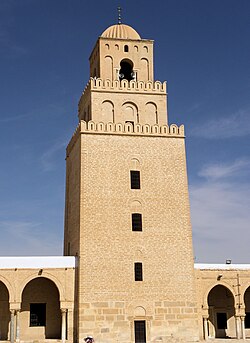 Minaret of the Great Mosque of Kairouan (early 9th century)
 Minaret of Jam, Afghanistan (12th century)
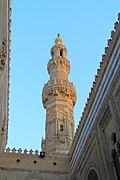 Minaret of Sultan Qaytbay (15th century) at the al-Azhar Mosque in Cairo
 Ottoman minarets of the Sultan Ahmed Mosque in Istanbul (early 17th century)
 Minaret at the Jama Masjid in Delhi (mid-17th century)





Towns and cities
| Part of a series on |
| Islamic studies |
|---|
| Jurisprudence |
| Science in medieval times |
| Arts |
| Other topics |
Early Muslim garrison towns
In the newly conquered areas of the early Muslim expansion, military settlements were often founded, known individually as a misr (Arabic: مصر, pl. amṣār).[141][142] This policy continued up to the Umayyad period.[26] Like frontier colonies, these towns served as bases for further conquests. Initially, they appear to have been modest settlements consisting of an agglomeration of tents, perhaps similar to ancient Roman legionary camps. They were established outside existing non-Muslim cities.[143] They were often unfortified and the residents were organized according to tribal origins.[26] Rather than maintaining their original purpose to serve as a military base, many amṣār developed into urbanized administrative and commercial centers. In particular, this happened in the case of the Iraqi cities of Kufa and Basra (which became known as al-miṣrān, "the two forts"[144]), as well as Fustat and Kairouan in North Africa.[145][26] Basic facilities like a mosque, a governor's residence (dār al-imāra), and a market were likely the first major constructions to appear, located at the center of the town.[146][142]
Transformation of conquered towns
More often than founding new cities, the new Islamic rulers took over existing towns. Most of the new Arab settlers nonetheless settled into previously existing urban centers throughout the conquered territories.[147] These cities were transformed according to the needs of the new Islamic society and Islamic facilities were inserted into the existing urban fabric after the conquest. In the case of Damascus and Aleppo, for example, the cities were largely of Roman-Byzantine heritage and their topography changed slowly. The Islamic presence was signaled at first only by the presence of a mosque (and, in Damascus, the royal palace).[148] This transformation, which resulted in what is often regarded as the traditional "Islamic" city, occurred over a long period and was shaped by multiple social and economic causes that varied according to region and period. The arrival of Islamic rule was only one stage in a process that had already begun by the 6th century.[149]
The principle of arranging buildings is known as "horizontal spread". Residencies and public buildings as well as private housing tend to be laid out separately, and are not directly related to each other architectonically. Archaeological excavations at the city of Jerash, the Gerasa of Antiquity, have revealed how the Umayyads have transformed the city plan.[150]
Experiments with ideal city models
The antique concept of the architecture of a metropolis is based on a structure of main and smaller roads running through the entire city, and dividing it into quarters. The streets are oriented towards public buildings like a palace, temple, or a public square. Two main roads, (cardo and decumanus) cross each other at right angles in the center of the city. A few cities were founded during the early Islamic Umayyad Caliphate, the outlines of which were based on the Ancient Roman concept of the ideal city. An example of a city planned according to such concepts was excavated at Anjar in Lebanon.[151] Donald Whitcomb argues that the early Muslim conquests initiated a conscious attempt to recreate specific morphological features characteristic of earlier western and southwestern Arabian cities.[152]
The Arab elite of the early Islam were city dwellers of Mecca, Medina, Ta'if and the highly urbanized society of Yemen whose Arabian traditions contributed to the urban development of the early Islamic cities.[153][154] Outside Arabia, the early military encampments of Kufa, Basra, Fustat, and Kairouan were rapidly transformed into permanent foundations and planned cities. One of the traditions contributing to the early Islamic city was the south Arabian city, such as Sana'a, to which type Mecca and Fustat belonged.[155] Two urban types based on social organization have been proposed by Walter Dostal. The first is called the San'a-formation, developed from a market center and inhabited by groups of the same tribe with social differentiation based on his "farmer-craftsman" technological specializations. The second urban type is the Tarim-formation, in which quarter organization reflects the social structure of a multi-tribal settlement.[156]
Urban morphology
The architecture of the "oriental" Islamic town is based on cultural and sociological concepts which differ from those of European cities. In both cultures, a distinction is made between the areas used by the rulers and their government and administration, public places of everyday common life, and the areas of private life. While the structures and concepts of European towns originated from a sociological struggle to gain basic rights of freedom—or town privileges—from political or religious authorities during the Middle Ages, an Islamic town or city is fundamentally influenced by the preservation of the unity of secular and religious life throughout time.[157]
In a Muslim city, palaces and residences as well as public places like charitable or religious complexes (mosques, madrasas, and hospitals) and private living spaces rather coexist alongside each other. The buildings tend to be more inwardly oriented, and are separated from the surrounding "outside" either by walls or by the hierarchical ordering of the streets, or both. Streets tend to lead from public main roads to cul-de-sac byroads and onwards into more private plots, and then end there. There are no, or very few, internal connections between different quarters of the city. In order to move from one quarter to the next, one has to go back to the main road again.[157]
Within a city quarter, byroads lead towards individual building complexes or clusters of houses. The individual house is frequently also oriented towards an inner atrium, and enclosed by walls, which mostly are unadorned, unlike European outward-oriented, representative façades. Thus, the spatial structure of a Muslim city essentially reflects the ancient nomadic tradition of living in a family group or tribe, held together by asabiyyah ("bond of cohesion", or "family loyalty"), strictly separated from the "outside". In general, the morphology of an Islamic city is granting—or denying—access according to the basic concept of hierarchical degrees of privacy. The inhabitants move from public space to the living quarters of their tribe, and onwards to their family home. Within a family house, there are again to be found common and separate spaces, the latter, and most private, usually reserved for women and children. In the end, only the family heads have free and unlimited access to all rooms and areas of their private home, as opposed to the more European concept of interconnecting different spaces for free and easy access. The hierarchy of privacy thus guides and structures the entire social life in a city, from the ruler to the commoner, from the town to the house.[158]
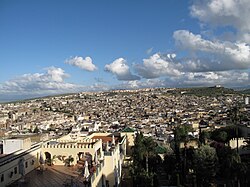

 Figure-ground diagram of a European town (1819)



Influences
Greco-Roman and Sasanian influences
Early Islamic architecture was influenced by two different ancient traditions:
- Greco-Roman tradition: In particular, the regions of the newly conquered Byzantine Empire (Southwestern Anatolia, Syria, Egypt and the Maghreb) supplied architects, masons, mosaicists and other craftsmen to the new Islamic rulers. These artisans were trained in Byzantine architecture and decorative arts, and continued building and decorating in Byzantine style, which had developed out of Hellenistic and ancient Roman architecture.[108]
- Eastern tradition: Mesopotamia and Persia, despite adopting elements of Hellenistic and Roman representative style, retained their independent architectural traditions, which derived from Sasanian architecture and its predecessors.[108]
The transition process between late antiquity, or post-classical, and Islamic architecture is exemplified by archaeologic findings in North Syria and Palestine, the Bilad al-Sham (Levant region) of the Umayyad and Abbasid Caliphates. In this region, late antique, or Christian, architectural traditions merged with the pre-Islamic Arabian heritage of the conquerors.[159]
Arabian
References on Islamic architecture generally agree that pre-Islamic architecture in the Arabian Peninsula had only limited influence on the development of Islamic architecture, at least by comparison with the influences of existing architectural traditions in the conquered territories beyond the peninsula.[14][13][12][15] In western scholarship, a traditional assumption was that the Arabs of the early 7th century, at the time of Muhammad, were nomadic pastoralists who did not have strong architectural traditions. Thanks to more recent studies and archeological investigations, this view has since been revised and is now considered obsolete.[160][161] According to scholar Beatrice Saint Laurent, early academic investigations into the history of Islamic monumental architecture led to the "flawed view that saw the roots of an Early Islamic monumental architecture and art solely in the traditions of the conquered regions".[162] Scholars now agree that a rich architectural tradition also preceded the appearance of Islam in Arabia and the first Islamic monuments.[163][164]
The major architectural contribution that took place in Arabia during the early Islamic period was the development of a distinctive Muslim mosque.[165] The hypostyle mosque constructed by Muhammad in Medina served as a model for early mosque design throughout the Islamic world.[10] Umayyad religious architecture was the earliest expression of Islamic art on a grand scale[166] and the Umayyad Mosque of Damascus reproduced the hypostyle model at a monumental scale.[167] Moreover, the Umayyads did not come from a cultural void and were aware of their own Arabian cultural history.[168][169] Some scholars suggest they sought to continue the pre-Islamic Arabian architectural tradition of building tall palaces to symbolize the ruler's power.[170]
Regional styles (after the 10th century)
Iran and Central Asia

Starting in the 10th century and especially during the period of Seljuk domination, the eastern Islamic world – including Iran and Central Asia – generally shared a common architectural style.[60][172][173] This style was characterized by the prominent use of brick as both construction material and decoration, extensive arcades, glazed tile decoration on the outside of buildings, the privileged use of domes and vaulting, and the increasing use of muqarnas.[60]

Turkic peoples began moving into the Middle East from the 8th century onward and, after converting to Islam, became major political and military forces in the region. The first major Turkic dynasty was the Ghaznavids, who ruled from Ghazna in present-day Afghanistan and adopted a Persianate culture. In the second half of the 12th century the Ghurids, of uncertain ethnic origin, replaced them as the major power in the region from northern India to the edge of the Caspian Sea.[174][175] Among the most remarkable monuments of these two dynasties are a number of ornate brick towers and minarets that have survived as stand-alone structures and whose exact functions are unclear. They include the Tower of Mas'ud III near Ghazna (early 12th century) and the Minaret of Jam built by the Ghurids (late 12th century).[176][177] Around the same time, between the late 10th century and the early 13th century, the Turkic Qarakhanids ruled in Transoxiana. This period is regarded as a "classical" age of Central Asian architecture, with many constructions taking place in Bukhara and Samarkand.[178]

More significant was the arrival of the Seljuk Turks and the formation of the Great Seljuk Empire in the 11th century, which conquered all of Iran and other extensive territories in Central Asia and the Middle East. The most important religious monument from the Great Seljuk period is the Jameh Mosque of Isfahan, which was expanded and modified by various Seljuk patrons in the late 11th century and early 12th century. Two major and innovative domed chambers were added to it in the late 11th century. Four large iwans were then erected around the courtyard around the early 12th century, giving rise to the four-iwan plan.[179][180][181] The four-iwan plan revolutionised the form and function of the mosques in the region and introduced new types of buildings involving madrasas and caravanserais which spread through Iran, Anatolia, and Syria.[182]

Iran and Central Asia were conquered by the Mongols in the 13th century, which led to the establishment of the Ilkhanate. The Ilkhanate period provided several innovations to the design of domed structures and advancements in techniques of tile decoration.[183][184] The pinnacle of Ilkhanid architecture was the construction of Uljaytu's mausoleum in Soltaniyeh, Iran, which features a multi-level octagonal structure topped by a massive dome.[1] The dome measures almost 25 metres (82 ft) in diameter and about 50 metres (160 ft) high, making it the largest dome in historical Iranian architecture[183] and the largest domed space at the time of its construction.[184] Its thin, double-shelled construction was reinforced by arches between the layers. The addition of an external vaulted gallery wrapping around the upper part of the building was a feature that would be further developed in later periods and ultimately be perfected in the Taj Mahal.[183]
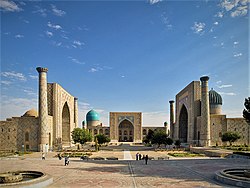
Iranian architecture and city planning also reached an apogee under the Timurids, the dynasty founded by Timur (r. 1370–1405). Timurid architecture is marked by its grand scale, prominent double-shelled domes, extensive use of ceramic tiles on the outside, and elaborate geometric vaulting on the inside.[185][186][1] It drew on the previous developments of Ilkhanid architecture and refined them,[1] developing an imperial style that was influential beyond its original borders, such as in the early Ottoman Empire to the west and the Mughal Empire on the Indian subcontinent.[187][188] The monuments erected by Timur and his successors are found across the region but concentrated especially in Samarkand and Herat, the main capitals.[185]

The renaissance in Persian mosque and dome building came during the Safavid dynasty, when Shah Abbas, in 1598 initiated the reconstruction of Isfahan, with the Naqsh-e Jahan Square as the centerpiece of his new capital.[189] The distinct feature of Persian domes, which separates them from those domes created in the Christian world or the Ottoman and Mughal empires, was the colorful tiles, with which they covered the exterior of their domes, as they would on the interior. These domes soon numbered dozens in Isfahan, and the distinct, blue-colored shape came to dominate the skyline of the city. This distinct style of architecture was perfected during the Safavid period, which saw the advent of the haft-rang, or seven-colour style of tile burning, a process that enabled them to apply more colours to each tile, creating richer patterns, sweeter to the eye.[190] The colours that the Persians favoured were golden, white and turquoise patterns on a dark- blue background.[191] The extensive inscription bands of calligraphy and arabesque on most of the major buildings where carefully planned and executed by Ali Reza Abbasi, who was appointed head of the royal library and Master calligrapher at the Shah's court in 1598,[192] while Shaykh Bahai oversaw the construction projects. Reaching 53 meters in height, the dome of the Shah Mosque would become the tallest in the city when it was finished in 1629. It was built as a double-shelled dome, with 14 m spanning between the two layers, and resting on an octagonal dome chamber.[193]
Post-Seljuk Syria and Mesopotamia
As the Seljuk Empire began to break up in the 12th century, various Seljuk elites established autonomous local dynasties throughout the Middle East, particularly in the western half of the empire, which included Iraq and Syria.[194] Under Zengid and Artuqid rule, cities like Mosul, Diyarbakir, Hasankeyf, and Mardin in Upper Mesopotamia (or al-Jazira in Arabic) became important centers of architectural development that had a long-term influence in the wider region.[195][196] One of the most notable monuments is the Great Mosque of Diyarbakir, founded in the 7th century but rebuilt under the Seljuks and the Artuqids in the 12th century.[197][198] It is similar in form to the Umayyad Mosque of Damascus and has ornate Classical-like elements on its courtyard façade.[199][200] The city walls of Diyarbakir also feature several towers built by the Artuqids and decorated with a mix of calligraphic inscriptions and figurative images of animals and mythological creatures carved in stone. One of the culminations of later Artuqid architecture is the Zinciriye or Sultan Isa Madrasa in Mardin, dating from 1385.[201] In Mosul, the Zengid ruler Nur al-Din Zengi built the al-Nuri Mosque (1148 and 1170–1172), of which only the original minaret was preserved up to modern times.[199] (The minaret and the rebuilt mosque were recently destroyed in the Battle of Mosul.[202])
Zengid rule helped to spread architectural forms from the eastern Islamic world to the region of Syria.[203] Damascus regained some prominence after it came under Nur al-Din's control in 1154. That same year, Nur al-Din founded a hospital complex, the Maristan al-Nuri or Bimaristan of Nur al-Din, which was highly influential in the Islamic world and is notable for the muqarnas vaulting of its entrance portal and a muqarnas dome of Mesopotamian influence over the vestibule.[204][205][206] The Zengids and their successors, the Kurdish Ayyubid dynasty, built many more madrasas, hammams, and other charitable buildings in the cities of Syria. Unlike Seljuk and Iranian madrasas, the Syrian madrasas are smaller and more diverse in their layouts, adapted to the dense urban fabric of cities like Damascus and Aleppo (e.g. Adiliya Madrasa in Damascus and Firdaws Madrasa in Aleppo).[207][208]
The Ayyubids also built or refortified numerous castles and urban citadels in Egypt and the Syrian region, including the Cairo Citadel, Aleppo Citadel, Damascus Citadel, Ajloun Castle, Qal'at Najm, Qal'at al-Jindi, and others.[209][210] Motivated in part by advances in siege warfare, military architecture evolved significantly during this period. Defensive towers and curtain walls became taller, more massive, and accommodated a greater array of chambers, platforms, or machicolations from which projectiles could be shot at the enemy.[209][210] The defensive systems of gates became more sophisticated and bent entrances became common.[209] Some fortifications also show greater attention to aesthetic considerations, perhaps due to their role as displays of the ruler's power.[210]
![The minaret of the Great Mosque of Aleppo (prior to its destruction in 2013), built circa 1090 during the Great Seljuk period[116]](//upload.wikimedia.org/wikipedia/commons/thumb/8/8a/Aleppo_Great_Mosque_minaret_from_courtyard_8973.jpg/120px-Aleppo_Great_Mosque_minaret_from_courtyard_8973.jpg) The minaret of the Great Mosque of Aleppo (prior to its destruction in 2013), built circa 1090 during the Great Seljuk period[211]
The minaret of the Great Mosque of Aleppo (prior to its destruction in 2013), built circa 1090 during the Great Seljuk period[211] Courtyard façade of the Great Mosque of Diyarbakir, founded in the 7th century and rebuilt by the Seljuks and Artuqids in the 11th–12th centuries
 Minaret of the al-Nuri Mosque in Mosul (before its destruction in 2017), dating from the 12th century
 Hospital of Nur al-Din in Damascus (1154)
 Yedi Kardeş Tower in the city walls of Diyarbakir, built by Artuqid sultan Nasir al-Din Mahmud in 1208–1209
![Northern section of the Cairo Citadel, whose walls still largely date from the Ayyubid period (late 12th and early 13th centuries)[212]](//upload.wikimedia.org/wikipedia/commons/thumb/c/c1/Cairo_Citadel_northeast_towers_DSCF8861.jpg/250px-Cairo_Citadel_northeast_towers_DSCF8861.jpg) Northern section of the Cairo Citadel, whose walls still largely date from the Ayyubid period (late 12th and early 13th centuries)[212]
Northern section of the Cairo Citadel, whose walls still largely date from the Ayyubid period (late 12th and early 13th centuries)[212] Firdaws Madrasa in Aleppo (1236), built under the Ayyubids
 Zinciriye or Sultan Isa Madrasa in Mardin (1385), built by the Artuqids
![The minaret of the Great Mosque of Aleppo (prior to its destruction in 2013), built circa 1090 during the Great Seljuk period[116]](https://upload.wikimedia.org/wikipedia/commons/thumb/8/8a/Aleppo_Great_Mosque_minaret_from_courtyard_8973.jpg/120px-Aleppo_Great_Mosque_minaret_from_courtyard_8973.jpg)


![Northern section of the Cairo Citadel, whose walls still largely date from the Ayyubid period (late 12th and early 13th centuries)[212]](https://upload.wikimedia.org/wikipedia/commons/thumb/c/c1/Cairo_Citadel_northeast_towers_DSCF8861.jpg/250px-Cairo_Citadel_northeast_towers_DSCF8861.jpg)


Anatolian Seljuks and Beyliks
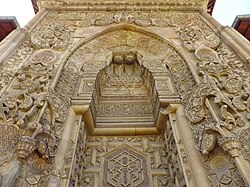
The Anatolian Seljuks ruled a territory that was multi-ethnic and only newly settled by Muslims. As a result, their architecture was eclectic and incorporated influences from other cultures such as Iranian, Armenian, and local Byzantine architecture.[213][214][215] In contrast with Seljuk constructions further east, Anatolian architecture was largely built of stone.[215] The golden age of their Anatolian empire, with its capital at Konya, was in the early 13th century. Seljuk authority declined after their defeat by the Mongols in 1243. The Mongol Ilkhanids then ruled eastern Anatolia indirectly through Seljuk vassals until 1308, when they took direct control.[216][217] Smaller principalities and local emirates, known collectively as the Beyliks, progressively emerged. Despite this decline, the Seljuk tradition of architecture largely persisted and continued to evolve under these new rulers.[217]
Decoration in Anatolian Seljuk architecture was concentrated on entrance portals, windows, and mihrabs. Stone-carving was one of the most accomplished techniques, with motifs ranging from earlier Iranian stucco motifs to local Byzantine and Armenian motifs. The madrasas of Sivas and the Ince Minareli Medrese (c. 1265) in Konya are among the most notable examples, while the Great Mosque and Hospital complex of Divriği is distinguished by some of the most eclectic and extravagant stone-carving in the region. Syrian-style ablaq striped marble also appears on some entrance portals in Konya. Anatolian architecture innovated further in the use of tile revetments to cover entire surfaces independently of other forms of decoration, as seen in the Karatay Medrese (1251–1252) in Konya and evidenced by the mosaic tiles recovered from the Kubadabad Palace (c. 1236 or early 13th century).[218][214][219]
Anatolian Seljuk mosques included more conservative hypostyle constructions alongside less traditional floor plans. An important hypostyle example is the Alaeddin Mosque of Konya (built between 1156 and 1235, with later additions).[214][220] Mosques in the later Beylik period were more diverse in form, such as the Saruhanid congregational mosque in Manisa (1371), the Isa Bey Mosque in Selçuk (1374), and the İlyas Bey Mosque in Miletus (1304).[217] Madrasas were typically centered around either a traditional open courtyard bordered by a varying number of iwans (e.g. Çifte Minareli Medrese in Erzurum and the Gök Medrese in Sivas) or a central court covered by a dome (e.g. the Karatay and Ince Minareli madrasas in Konya).[221][214][222] Monumental caravanserais were also built along trade routes, typically with a fortified exterior appearance, a tall entrance portal decorated with carved stone, and an interior courtyard that sometimes contained a cubic prayer room elevated in the center (e.g. the Sultan Han southwest of Aksaray and another Sultan Han northeast of Kayseri).[223][214]
 Hypostyle interior of the Alâeddin Mosque in Konya (12th-13th centuries)
 Seljuk mosaic tile decoration from the Kubadabad Palace (early 13th-century Anatolia)
 Courtyard of the Sultan Han caravanserai, built in 1229 on the road between Aksaray and Konya
 Entrance portal of the Karatay Madrasa in Konya (c. 1251), with muqarnas and ablaq decoration
 Tile decoration inside the Karatay Madrasa in Konya (c. 1251)
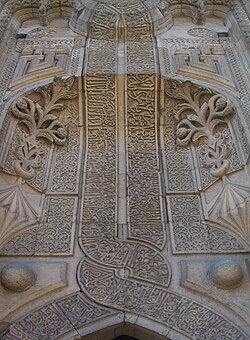 Stone-carved decoration in the entrance portal of the Ince Minareli Medrese in Konya (c. 1265)
 Entrance and minarets of the Gök Medrese in Sivas (1271–2)
 Döner Kümbet in Kayseri (1276), the tomb of a Seljuk princess
 Eşrefoğlu Mosque in Beyşehir (1297), an example of a wooden hypostyle mosque





Mamluk
The Mamluks were a military corps recruited from slaves that served under the Ayyubid dynasty and eventually took over from that dynasty in 1250, ruling over Egypt, the Levant, and the Hijaz until the Ottoman conquest of 1517. Despite their often tumultuous and violent internal politics, the Mamluk sultans were prolific patrons of architecture and contributed enormously to the repertoire of monuments in historic Cairo, their capital.[224][225] Some long-reigning sultans, such as Al-Nasir Muhammad (r. 1293–1341, with interruptions) and Qaytbay (r. 1468–1496), were especially prolific. While Cairo was the main center of patronage, Mamluk architecture also appears in other cities of their realm such as Damascus, Jerusalem, Aleppo, and Medina.[226]
Mamluk architecture is distinguished in part by the construction of multi-functional buildings whose floor plans became increasingly creative and complex due to the limited available space in the city and the desire to make monuments visually dominant in their urban surroundings.[227][224][225] Patrons, including sultans and high-ranking emirs, typically set out to build mausoleums for themselves but attached to them various charitable structures such as madrasas, khanqahs, sabils, or mosques.[225][227] The cruciform or four-iwan floor plan was adopted for madrasas and became more common for new monumental complexes than the traditional hypostyle mosque, although the vaulted iwans of the early period were replaced with flat-roofed iwans in the later period.[228][229] The decoration of monuments also became more elaborate over time, with stone-carving and colored marble paneling and mosaics (including ablaq) replacing stucco as the most dominant architectural decoration. Monumental decorated entrance portals became common compared to earlier periods, often carved with muqarnas. Influences from the Syrian region, Ilkhanid Iran, and possibly even Venice were evident in these trends.[230][231] Minarets, which were also elaborate, usually consisted of three tiers separated by balconies, with each tier having a different design than the others.[232][233] Domes also transitioned from wooden or brick structures, sometimes of bulbous shape, to pointed stone domes with complex geometric or arabesque motifs carved into their outer surfaces.[234] The peak of this stone dome architecture was achieved under the reign of Qaytbay in the late 15th century.[235]
After the Ottoman conquest of 1517, new Ottoman-style buildings were introduced, however the Mamluk style continued to be repeated or combined with Ottoman elements in many subsequent monuments.[236] Some building types from the late Mamluk period, such as sabil-kuttabs (a combination of sabil and kuttab) and multi-storied caravanserais (wikalas or khans), actually grew in number during the Ottoman period.[236] In modern times, from the late 19th century onwards, a Neo-Mamluk style was also used, partly as a nationalist response against Ottoman and European styles, in an effort to promote local "Egyptian" styles (though the architects were sometimes Europeans).[237][238][239] Examples of this style are the Museum of Islamic Arts in Cairo, the Al-Rifa'i Mosque, the Abu al-Abbas al-Mursi Mosque in Alexandria, and numerous private and public buildings such as those of Heliopolis.[237][238][239][240]
 Mihrab of the Mausoleum of Sultan Baybars in Damascus (built 1277–1281)
![Complex of Sultan Qalawun in Cairo (built in 1284–85). It included a mausoleum, a madrasa, and a highly important maristan (hospital).[241]](//upload.wikimedia.org/wikipedia/commons/thumb/c/c3/Minaret_of_the_Qalawun_complex.jpg/250px-Minaret_of_the_Qalawun_complex.jpg) Complex of Sultan Qalawun in Cairo (built in 1284–85). It included a mausoleum, a madrasa, and a highly important maristan (hospital).[241]
Complex of Sultan Qalawun in Cairo (built in 1284–85). It included a mausoleum, a madrasa, and a highly important maristan (hospital).[241] Mosque of al-Nasir Muhammad (built in 1318 and modified in 1335) at the Citadel of Cairo
![The Madrasa-Mosque of Sultan Hasan (built between 1356 and 1361), the largest Mamluk monument[242][243]](//upload.wikimedia.org/wikipedia/commons/thumb/2/25/Sultan-Hassan-Moschee_2015-11-14zc.jpg/250px-Sultan-Hassan-Moschee_2015-11-14zc.jpg) The Madrasa-Mosque of Sultan Hasan (built between 1356 and 1361), the largest Mamluk monument[242][243]
The Madrasa-Mosque of Sultan Hasan (built between 1356 and 1361), the largest Mamluk monument[242][243]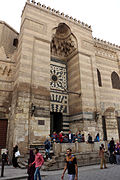 Projecting entrance portal of the Madrasa-Mosque of Sultan Barquq (built between 1384 and 1386)
 Interior of a mausoleum in the Khanqah-Mosque of Faraj ibn Barquq (built between 1400 and 1411)
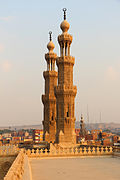 Twin minarets of Bab Zuweila, built between 1415 and 1420 for the nearby Mosque of al-Mu'ayyad Shaykh
 Carved stone dome of the Funerary complex of Sultan Qaytbay (completed in 1474) in the Northern Cemetery of Cairo
 Sabil of Qaytbay (1482) at Al-Aqsa, Jerusalem
 Wikala of Sultan al-Ghuri (1505), example of an urban caravanserai in Cairo
![Sabil-Kuttab of Abd ar-Rahman Katkhuda (1744), which combines Mamluk and Ottoman elements[244]](//upload.wikimedia.org/wikipedia/commons/thumb/6/6c/Cairo%2C_sabil_di_abdel_katkhuda_04.JPG/120px-Cairo%2C_sabil_di_abdel_katkhuda_04.JPG) Sabil-Kuttab of Abd ar-Rahman Katkhuda (1744), which combines Mamluk and Ottoman elements[244]
Sabil-Kuttab of Abd ar-Rahman Katkhuda (1744), which combines Mamluk and Ottoman elements[244] Abu al-Abbas al-Mursi Mosque in Alexandria, built in the 1940s in a neo-Mamluk style

![Complex of Sultan Qalawun in Cairo (built in 1284–85). It included a mausoleum, a madrasa, and a highly important maristan (hospital).[241]](https://upload.wikimedia.org/wikipedia/commons/thumb/c/c3/Minaret_of_the_Qalawun_complex.jpg/250px-Minaret_of_the_Qalawun_complex.jpg)

![The Madrasa-Mosque of Sultan Hasan (built between 1356 and 1361), the largest Mamluk monument[242][243]](https://upload.wikimedia.org/wikipedia/commons/thumb/2/25/Sultan-Hassan-Moschee_2015-11-14zc.jpg/250px-Sultan-Hassan-Moschee_2015-11-14zc.jpg)





![Sabil-Kuttab of Abd ar-Rahman Katkhuda (1744), which combines Mamluk and Ottoman elements[244]](https://upload.wikimedia.org/wikipedia/commons/thumb/6/6c/Cairo%2C_sabil_di_abdel_katkhuda_04.JPG/120px-Cairo%2C_sabil_di_abdel_katkhuda_04.JPG)

Ottoman
The architecture of the Ottoman Empire developed from earlier Seljuk architecture, with influences from Byzantine and Iranian architecture along with architectural traditions of the Balkans and other parts of Middle East.[245][246][247][248][249][250] The classical architecture of the Ottoman Empire was a mixture of native Turkish tradition and influences from Hagia Sophia.[248][249] One of the best representatives of this period is Mimar Sinan, whose works include the Süleymaniye Mosque in Istanbul and the Selimiye Mosque in Edirne.[251][252]
Beginning in the 18th century, Ottoman architecture was influenced by the Baroque architecture in Western Europe.[253]Nuruosmaniye Mosque is one of the surviving examples from this period.[253] The last Ottoman period saw more influences from Western Europe, brought in by architects such those from the Balyan family.[254] This period also saw the development of a new architectural style called neo-Ottoman or Ottoman revivalism, also known as the First National Architectural Movement,[255] by architects such as Mimar Kemaleddin and Vedat Tek.[254]
While Istanbul was the main site of imperial patronage for most of the empire's history, the early capitals of Bursa and Edirne also contain a concentration of Ottoman monuments. Ottoman architecture is also found across the empire's provinces, ranging from Eastern Europe to the Middle East to North Africa.[256][257][258] Major religious monuments, such as those sponsored by sultan and his family, were typically architectural complexes, known as a külliye, which had multiple elements providing various charitable services. These complexes were governed and managed with the help of a vakif agreement (Arabic waqf).[256] For example, the Fatih Mosque in Istanbul was part of a very large külliye founded by Mehmed II, built between 1463 and 1470, which also included: a tabhane (guesthouse for travelers), an imaret (charitable kitchen), a darüşşifa (hospital), a caravanserai, a mektep (primary school), a library, a hammam (bathhouse), a cemetery with the founder's mausoleum, and eight madrasas along with their annexes. The buildings were arranged in a regular, partly symmetrical layout with the monumental mosque at its center, although not all the structures have survived to the present day.[252][257]
![The Green Mosque in Iznik (late 14th century)[259]](//upload.wikimedia.org/wikipedia/commons/thumb/1/10/Iznik_Green_mosque_8159.jpg/120px-Iznik_Green_mosque_8159.jpg)
 The Grand Mosque of Bursa (end of 14th century)
 Tiled mihrab of the Green Mosque in Bursa (early 15th century)
 Courtyard of the Bayezid II Mosque, Istanbul (late 15th century)
 Süleymaniye Mosque, Istanbul (16th century), designed by Mimar Sinan
 One of the chambers of the Topkapı Palace
 Interior of Sultan Ahmed Mosque, Istanbul (early 17th century)
 Nuruosmaniye Mosque, Istanbul (mid-18th century), an example of the Ottoman Baroque style
![The sebil of Abdülhamid I, Istanbul (late 18th century)[260]](//upload.wikimedia.org/wikipedia/commons/thumb/f/f4/Abdulhamit_I_sebil.jpg/250px-Abdulhamit_I_sebil.jpg)
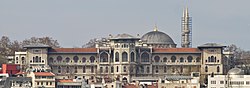 Istanbul High School (19th century)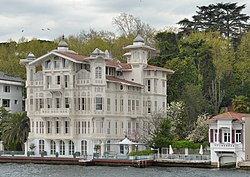
 Traditional Ottoman domestic architecture in Safranbolu
![The Green Mosque in Iznik (late 14th century)[259]](https://upload.wikimedia.org/wikipedia/commons/thumb/1/10/Iznik_Green_mosque_8159.jpg/120px-Iznik_Green_mosque_8159.jpg)


![The sebil of Abdülhamid I, Istanbul (late 18th century)[260]](https://upload.wikimedia.org/wikipedia/commons/thumb/f/f4/Abdulhamit_I_sebil.jpg/250px-Abdulhamit_I_sebil.jpg)



Iberian Peninsula and western North Africa
The architectural style which developed in the westernmost territories of the historic Muslim world is often referred to as "Moorish architecture",[86][261] though scholars often refer to it as "Western Islamic architecture" or "architecture of the Islamic west".[52][53] This architectural style developed primarily in al-Andalus (present-day Spain and Portugal) and in the Maghreb (mostly present-day Morocco, Algeria, and Tunisia).[52][53] Its most recognizable features include the horseshoe arch, riad gardens (symmetrically divided courtyard gardens), and elaborate geometric and arabesque motifs in wood, stucco, and tilework (notably zellij).[52][262][86][263] Major centers of this artistic development included the main capitals of the empires and Muslim states in the region's history, such as Cordoba, Kairouan, Fes, Marrakesh, Seville, Granada and Tlemcen.[52][53] Among the best-known monuments from these areas are the Great Mosque of Kairouan, the Great Mosque of Cordoba, the palace-city of Madinat al-Zahra (near Cordoba), the Qarawiyyin Mosque (in Fes), the Great Mosque of Tlemcen, the Kutubiyya Mosque (Marrakesh), the Giralda tower (Seville), and the fortified palace-complex of the Alhambra (Granada).[52][53]
Even after the Christian conquests of Al-Andalus the legacy of Moorish architecture was still carried on in the Mudéjar style in Spain, which made use of Moorish techniques and designs and adapted them to Christian patrons.[264][265] In North Africa, the medieval Moorish style was perpetuated in Moroccan architecture with relatively few changes, while in Algeria and Tunisia it became blended with Ottoman architecture after the Ottoman conquest of the region in the 16th century.[52][53] Much later, particularly in the 19th century, the Moorish style was frequently imitated or emulated in the Neo-Moorish or Moorish Revival style which emerged in Europe and America as part of the Romanticistinterest in the "Orient" and also, notably, as a recurring choice for new Jewish Synagogue architecture.[266][267]
In addition to the general Moorish style, some styles and structures in North Africa are distinctively associated with areas that have maintained strong Berber populations and cultures, including but not limited to the Atlas Mountain regions of Morocco, the Aurès and M'zab regions of Algeria, and southern Tunisia.[268] They do not form one single style but rather a diverse variety of local vernacular styles.[268] In Morocco, the largely Berber-inhabited rural valleys and oases of the Atlas and the south are marked by numerous kasbahs (fortresses) and ksour (fortified villages), typically flat-roofed structures made of rammed earth and decorated with local geometric motifs, as with the famous example of Ait Benhaddou.[268][269][270] Likewise, southern Tunisia is dotted with hilltop ksour and multi-story fortified granaries (ghorfa), such as the examples in Medenine and Ksar Ouled Soltane, typically built with loose stone bound by a mortar of clay.[268] The island of Jerba in Tunisia has a traditional mosque architecture featuring low-lying structures built in stone and covered in whitewash. Their prayer halls are domed and they have short, round minarets.[271][268] The M'zab region of Algeria (e.g. Ghardaïa) also has distinctive mosques and houses that are completely whitewashed, but built in rammed earth. Its structures also make frequent use of domes and barrel vaults. Unlike Jerba, the distinctive minarets here are tall and have a square base, tapering towards the end and crowned with "horn"-like corners.[271][268]
 Reception Hall of Abd ar-Rahman III at Madinat al-Zahra (10th century, caliphal period)
 Almoravid Qubba in Marrakesh (early 12th century, Almoravid period)
 Kutubiyya Mosque in Marrakesh (12th century, Almohad period)
 Giralda tower in Seville: former Almohad minaret (12th century) converted into a Christian bell tower
![Alèdua castle, Ribera Alta (12th–13th century)[272]](//upload.wikimedia.org/wikipedia/commons/thumb/5/50/Castell_d%27Al%C3%A8dua.jpg/250px-Castell_d%27Al%C3%A8dua.jpg) Alèdua castle, Ribera Alta (12th–13th century)[272]
Alèdua castle, Ribera Alta (12th–13th century)[272]
 Bou Inania Madrasa in Fes (14th century, Marinid period)
 The Court of the Lions at the Alhambra, Granada (14th century, Nasrid period)
 Dome of the Hall of Ambassadors in the Alcazar of Seville (14th century), an example of Mudéjar architecture (built for Christian patrons)
 Youssef Dey Mosque in Tunis (17th century): an example of Ottoman influence blended with local styles
 Central mosque of Ghardaïa: an example of local architecture in the M'zab region (Algeria)


![Alèdua castle, Ribera Alta (12th–13th century)[272]](https://upload.wikimedia.org/wikipedia/commons/thumb/5/50/Castell_d%27Al%C3%A8dua.jpg/250px-Castell_d%27Al%C3%A8dua.jpg)


Yemeni

Yemeni architecture can be characterized as "conservative", as it combines both pre-Islamic and Islamic features.[273][274] In Antiquity, Yemen was home to several wealthy city-states and an indigenous tradition of South Arabian architecture.[275][276] By the 5th century AD, there is evidence that the indigenous styles were being influenced by Byzantine and late antique Mediterranean art.[275] Yemen was Islamized in the 7th century, but few buildings from the early Islamic period have been preserved intact today. It is only from the 10th century onward that distinctive Islamic architectural styles can be documented.[273]
One type of mosque attested during the early period of Sulayhid and Rasulid rule consisted of a large cubic chamber with one entrance, which had antecedents in the pre-Islamic temple architecture of the region.[273][275] Another type consisted of a rectangular chamber with a transverse orientation, with multiple entrances and supporting columns inside, sometimes preceded by a courtyard.[273] The hypostyle mosque with courtyard, common elsewhere, was comparatively rare in early Islamic Yemen.[273] The Great Mosque of Sanaa, originally commissioned by the Umayyad caliph al-Walid (r. 705–15) and reconstructed at later times, was one of the few mosques of this type in the region.[273][275] The mosque's decoration reflects Yemeni techniques of carved and painted wood, carved stone, and carved stucco.[277]

The Ayyubids introduced domed mosque types as well as Sunni-syle madrasas to the region, but none of their buildings in Yemen have survived. The Rasulids who followed them (13th–15th centuries) were prolific patrons of architecture and perpetuated these new building types, influenced by their political links with Egypt.[273][278] During the same period, the Zaydi imams in northern Yemen were buried in richly decorated domed tombs.[278] With the advent of Ottoman rule in Yemen after 1538, Rasulid-style architecture continued to be the local norm in Sunni-controlled areas, but elements of Ottoman architecture began to be introduced in the late 16th century.[275]

Yemen is also notable for its historic tower-houses, built on two or more floors. These houses vary in form and materials from region to region. They are typically built of mud (rammed earth or sun-dried mud-brick), stone, or a combination of both, with timber used for roofs and floors.[276][279] While these structures are repaired and restored over time, this architectural style has remained generally unchanged for hundreds of years.[276] The old city of Sanaa, a UNESCO World Heritage Site today, contains many examples.[277][280] Some villages and towns, such as Rada'a, were built around a fortified citadel (e.g. the Citadel of Rada'a), others were encircled by a high mud-brick wall (e.g. Shibam), and some were built so that the houses themselves formed an outer wall along the perimeter (e.g. Khawlan).[279]
Indian subcontinent

Indo-Islamic architecture on the Indian subcontinent began in Sindh in the 8th century, where remains of a congregational mosque at Banbhore dating to 725 have been uncovered.[282] The Ghurids laid the foundations of the Delhi Sultanate and built monuments in northern India in the 12th and 13th centuries. The most notable monument of this period is the Quwwat al-Islam Mosque complex and the Qutb Minar, which were begun in the 1190s by Sultan Qutb al-Din Aybak. The mosque's initial construction reused spolia from Hindu and Jain temples and the complex became a prototype for many mosques built in the region afterwards.[281][283] The progress of Islamization in the region during the 14th and 15th centuries resulted in the emergence of a more distinctive Indo-Islamic style around this time, as exemplified by the monuments built under the Tughluq dynasty and other local states. Among other features, this style made increased use of arches, vaulted spaces, domes, and water features, while also integrating them with indigenous Indian architectural elements.[284] In the northwestern part of the subcontinent, some notable examples from this period include the Tomb of Rukn-i Alam in Multan and the congregational mosque of Ahmedabad (1423), the latter of which is a particularly harmonious example of Islamic and indigenous Indian elements combined in one building.[284][285]
The best known style of Indo-Islamic architecture is Mughal architecture, mostly built between about 1560 and 1720. Early Mughal architecture developed from existing Indo-Islamic architecture but also followed the model of Timurid architecture, due in part to the Timurid ancestry of the Mughal dynasty's founder, Babur.[286][287][288][188] Mughal architecture's most prominent examples are the series of imperial mausolea, which started with the pivotal Tomb of Humayun. The most famous is the Taj Mahal in Agra, completed in 1648 by emperor Shah Jahan in memory of his wife Mumtaz Mahal who died while giving birth to their 14th child. The Taj Mahal is completely symmetrical except for Shah Jahan's sarcophagus, which is placed off center in the crypt room below the main floor. This symmetry extended to the building of an entire mirror mosque in black marble to complement the Mecca-facing mosque placed to the west of the main structure. Another slightly later imperial mausoleum is the Bibi Ka Maqbara in Aurangabad (1678) which was commissioned by the sixth Mughal emperor, Aurangzeb, in memory of his wife.[289]
The Mughals also built monumental palaces and mosques. A famous example of the charbagh style of Mughal garden is the Shalimar Gardens in Lahore, where the domeless Tomb of Jahangir is also located. The Red Fort in Delhi and the Agra Fort are huge castle-like fortified palaces, and the abandoned city of Fatehpur Sikri, 26 miles (42 km) west of Agra, was built for Akbar in the late 16th century.[290] Major mosques built by Mughal emperors and their family include the Jama Masjid (Friday Mosque) in Delhi, the Badshahi Mosque in Lahore, and other mosques of similar form which were often built near or within other imperial complexes. Even the Mughal nobility were able to build relatively major monuments, as with the example of the Wazir Khan Mosque in Lahore (1635), built by Wazir Khan when he was governor of the Punjab under Shah Jahan.[287][291] In the later Mughal period some local governors became semi-autonomous, prompting them to build their own monuments and embellish their own regional capitals with highly-creative local styles of architecture. The Bara Imambara complex (c. 1780) built by Asaf al-Dawla in Lucknow is an example of this.[292]
The Deccan sultanates in the southern regions of the Indian subcontinent also developed their local Indo-Islamic Deccani architectural styles, exemplified by monuments such as the Charminar in Hyderabad (1591) and Gol Gumbaz in Bijapur (1656).[293][294][295] In the eastern part of the Indian subcontinent, the Bengali region developed a distinct regional style under the independent Bengal Sultanate, which flourished between the 14th and 16th centuries. It incorporated influences from Persia, Byzantium and North India,[296] which were with blended indigenous Bengali elements, such as curved roofs, corner towers and complex terracotta ornamentation. One feature in the sultanate was the relative absence of minarets.[297] Many small and medium-sized medieval mosques, with multiple domes and artistic niche mihrabs, were constructed throughout the region.[297] The grand mosque of Bengal was the Adina Mosque (1374–75), the largest mosque in the Indian subcontinent, though partially ruined today. Built of stone demolished from temples, it featured a monumental ribbed barrel vault over the central nave, the first such giant vault used anywhere in the subcontinent. The mosque was modeled on the imperial Sasanian style of Persia.[298] Another exceptional example which survives in present-day Bangladesh is the Sat Gumbaz ("Sixty-Dome") Mosque in Bagerhat (c. 1450).[299] Later, a provincial style influenced by North India evolved in Mughal Bengal during the 17th and 18th centuries. The Mughals also copied the Bengali do-chala roof tradition for mausoleums in North India.[300]
 The Qutb Minar and Quwwat al-Islam Mosque complex in Delhi, begun in the 1190s and expanded in the 13th to 14th centuries[281]
![Tomb of Shah Rukn-e-Alam in Multan (circa 1335–1340), built under the Tughluq dynasty[285]](//upload.wikimedia.org/wikipedia/commons/thumb/6/6a/Tomb_of_Shah_Rukn-e-Alam_%28_Sunrise%29.jpg/250px-Tomb_of_Shah_Rukn-e-Alam_%28_Sunrise%29.jpg)
![The Friday Mosque of Ahmedabad (1423), which prominently combines Islamic and indigenous Indian architectural forms[284]](//upload.wikimedia.org/wikipedia/commons/thumb/f/fc/Jama_Masjid-Ahmedabad.jpg/250px-Jama_Masjid-Ahmedabad.jpg) The Friday Mosque of Ahmedabad (1423), which prominently combines Islamic and indigenous Indian architectural forms[284]
The Friday Mosque of Ahmedabad (1423), which prominently combines Islamic and indigenous Indian architectural forms[284]![Sixty Dome Mosque in Bagerhat (circa 1450)[299]](//upload.wikimedia.org/wikipedia/commons/thumb/4/4f/Sixty_Dome_Mosque%2CBagerhat.jpg/250px-Sixty_Dome_Mosque%2CBagerhat.jpg)
![Humayun's Tomb in Delhi, the first fully developed Mughal imperial tomb (1560–1570)[281]](//upload.wikimedia.org/wikipedia/commons/thumb/3/38/Delhi%2C_Humayuns_Tomb_%286254434217%29.jpg/250px-Delhi%2C_Humayuns_Tomb_%286254434217%29.jpg) Humayun's Tomb in Delhi, the first fully developed Mughal imperial tomb (1560–1570)[281]
Humayun's Tomb in Delhi, the first fully developed Mughal imperial tomb (1560–1570)[281]
![Charminar in Hyderabad (1591), an example of architecture in the Deccan Sultanates[294]](//upload.wikimedia.org/wikipedia/commons/thumb/d/d1/Charminar-Pride_of_Hyderabad.jpg/250px-Charminar-Pride_of_Hyderabad.jpg)
![Room with fountain in the Muthamman Burj (1628–30), added by Shah Jahan inside the Agra Fort built by Akbar[302]](//upload.wikimedia.org/wikipedia/commons/thumb/0/07/India_2015-167_%2816977396170%29.jpg/250px-India_2015-167_%2816977396170%29.jpg) Room with fountain in the Muthamman Burj (1628–30), added by Shah Jahan inside the Agra Fort built by Akbar[302]
Room with fountain in the Muthamman Burj (1628–30), added by Shah Jahan inside the Agra Fort built by Akbar[302]![Wazir Khan Mosque in Lahore (1635), notable for its tile-decorated surfaces[291]](//upload.wikimedia.org/wikipedia/commons/thumb/c/c4/Wazir_khan_iwan.jpg/250px-Wazir_khan_iwan.jpg) Wazir Khan Mosque in Lahore (1635), notable for its tile-decorated surfaces[291]
Wazir Khan Mosque in Lahore (1635), notable for its tile-decorated surfaces[291]![The Red Fort in Delhi, built between 1639 and 1648 as the citadel of Shah Jahan's new capital[303]](//upload.wikimedia.org/wikipedia/commons/thumb/0/0d/Red_Fort_in_Delhi_03-2016_img3.jpg/250px-Red_Fort_in_Delhi_03-2016_img3.jpg) The Red Fort in Delhi, built between 1639 and 1648 as the citadel of Shah Jahan's new capital[303]
The Red Fort in Delhi, built between 1639 and 1648 as the citadel of Shah Jahan's new capital[303]![Gol Gumbaz in Bijapur (1656), another example built by a Deccan sultanate[295]](//upload.wikimedia.org/wikipedia/commons/thumb/0/08/Gol_Gumbaz_-4%2C_Bijapur%2C_Karnataka.jpg/250px-Gol_Gumbaz_-4%2C_Bijapur%2C_Karnataka.jpg)

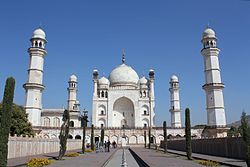
![The Asfi Mosque of the Bara Imambara complex in Lucknow (c. 1780)[304]](//upload.wikimedia.org/wikipedia/commons/thumb/0/05/Imambara_of_Asa-Ud-Daula.jpg/250px-Imambara_of_Asa-Ud-Daula.jpg)

![Tomb of Shah Rukn-e-Alam in Multan (circa 1335–1340), built under the Tughluq dynasty[285]](https://upload.wikimedia.org/wikipedia/commons/thumb/6/6a/Tomb_of_Shah_Rukn-e-Alam_%28_Sunrise%29.jpg/250px-Tomb_of_Shah_Rukn-e-Alam_%28_Sunrise%29.jpg)
![The Friday Mosque of Ahmedabad (1423), which prominently combines Islamic and indigenous Indian architectural forms[284]](https://upload.wikimedia.org/wikipedia/commons/thumb/f/fc/Jama_Masjid-Ahmedabad.jpg/250px-Jama_Masjid-Ahmedabad.jpg)
![Sixty Dome Mosque in Bagerhat (circa 1450)[299]](https://upload.wikimedia.org/wikipedia/commons/thumb/4/4f/Sixty_Dome_Mosque%2CBagerhat.jpg/250px-Sixty_Dome_Mosque%2CBagerhat.jpg)
![Humayun's Tomb in Delhi, the first fully developed Mughal imperial tomb (1560–1570)[281]](https://upload.wikimedia.org/wikipedia/commons/thumb/3/38/Delhi%2C_Humayuns_Tomb_%286254434217%29.jpg/250px-Delhi%2C_Humayuns_Tomb_%286254434217%29.jpg)

![Charminar in Hyderabad (1591), an example of architecture in the Deccan Sultanates[294]](https://upload.wikimedia.org/wikipedia/commons/thumb/d/d1/Charminar-Pride_of_Hyderabad.jpg/250px-Charminar-Pride_of_Hyderabad.jpg)
![Room with fountain in the Muthamman Burj (1628–30), added by Shah Jahan inside the Agra Fort built by Akbar[302]](https://upload.wikimedia.org/wikipedia/commons/thumb/0/07/India_2015-167_%2816977396170%29.jpg/250px-India_2015-167_%2816977396170%29.jpg)
![Wazir Khan Mosque in Lahore (1635), notable for its tile-decorated surfaces[291]](https://upload.wikimedia.org/wikipedia/commons/thumb/c/c4/Wazir_khan_iwan.jpg/250px-Wazir_khan_iwan.jpg)
![The Red Fort in Delhi, built between 1639 and 1648 as the citadel of Shah Jahan's new capital[303]](https://upload.wikimedia.org/wikipedia/commons/thumb/0/0d/Red_Fort_in_Delhi_03-2016_img3.jpg/250px-Red_Fort_in_Delhi_03-2016_img3.jpg)
![Gol Gumbaz in Bijapur (1656), another example built by a Deccan sultanate[295]](https://upload.wikimedia.org/wikipedia/commons/thumb/0/08/Gol_Gumbaz_-4%2C_Bijapur%2C_Karnataka.jpg/250px-Gol_Gumbaz_-4%2C_Bijapur%2C_Karnataka.jpg)


![The Asfi Mosque of the Bara Imambara complex in Lucknow (c. 1780)[304]](https://upload.wikimedia.org/wikipedia/commons/thumb/0/05/Imambara_of_Asa-Ud-Daula.jpg/250px-Imambara_of_Asa-Ud-Daula.jpg)
Malay-Indonesian
Islam spread gradually in the Malay Peninsula and the surrounding Indonesian archipelago from the 12th century onwards, and especially during the 15th century as the Sultanate of Malacca and its surrounding cultural sphere politically dominated the region. The introduction of Islam was slow and gradual. The advent of Islam did not lead to the introduction of a new building tradition but saw the appropriation of existing architectural forms, which were reinterpreted to suit Muslim requirements. Existing architectural features in Malay-Indonesia such as the candi bentar gate, paduraksa (normally marks the entrance to the most sacred precincts), balai nobat (a tower supposedly used to store royal musical instruments) and the sacred pyramidal roof was used for Islamic architecture. Prayer times are often signalled in advance by striking a large drum known as beduk, thus minarets weren't of need to these mosques let alone domes which multi-layered pyramidal roofs. One rare example of an old mosque with a minaret is that of the Menara Kudus Mosque.
Malay-Indonesian mosque architecture also features strong influence from the Middle Eastern architecture styles.[305] This style of architecture can be found on the design of mosques in Brunei, Indonesia, Malaysia, Singapore, the Philippines and Thailand. Today, with increasing Muslim pilgrimage to Mecca, Malay-Indonesian mosques are developing a more standard, international style, with a dome and minaret.
Indonesia
The oldest surviving mosque in Indonesia is the Great Mosque of Demak which is the royal mosque of the Sultanate of Demak, although this is not the oldest Islamic structure. The oldest Islamic structure in Indonesia are parts of the royal palace in Sultanate of Cirebon, Cirebon. The palace complex contains a chronogram which can be read as the Saka equivalent of 1454 CE. Early Islamic palaces retain many features of pre-Islamic architecture which is apparent in the gates or drum towers. The Kasepuhan Palace was probably begun in the late pre-Islamic period and continued to grow during the Hinduism-to-Islam transitional period. The complex contains clues to the stages of the process of the gradual changes as Islam become incorporated into Indonesian architecture. Two of the Hindu features adopted into Islam in the palace is the two types of gateways – the split portal (candi bentar) which provides access to the public audience pavilion and the lintel gate (paduraksa) which leads to the frontcourt.[306][307]
![Ampel Mosque in Surabaya One of the oldest surviving mosques in Indonesia.[308]](//upload.wikimedia.org/wikipedia/commons/thumb/b/b5/Ampel_Mosque_in_2008.jpg/250px-Ampel_Mosque_in_2008.jpg)
 Great Mosque of Banten in Serang, the construction of the mosque was started around 1552 and was completed in 1566, its 24 meter high minaret was added in 1632, one of the few oldest mosques in Indonesia.
 Arch gate of the Great Mosque of Cirebon, built during the 15th century.
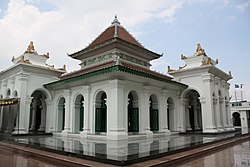 The Great Mosque of Palembang in Palembang, Sumatra built in 1738, together with other post-Demak regions, adopted a mix of Islamic Javanese and Chinese mosque architecture.
![The Menara Kudus Mosque in Kudus employs a Hindu-Buddhist temple-like structure.[309]](//upload.wikimedia.org/wikipedia/commons/thumb/8/85/Masjid_Menara_Kudus.jpg/250px-Masjid_Menara_Kudus.jpg)

![Ampel Mosque in Surabaya One of the oldest surviving mosques in Indonesia.[308]](https://upload.wikimedia.org/wikipedia/commons/thumb/b/b5/Ampel_Mosque_in_2008.jpg/250px-Ampel_Mosque_in_2008.jpg)



![The Menara Kudus Mosque in Kudus employs a Hindu-Buddhist temple-like structure.[309]](https://upload.wikimedia.org/wikipedia/commons/thumb/8/85/Masjid_Menara_Kudus.jpg/250px-Masjid_Menara_Kudus.jpg)

Malaysia
The original mosque in Malaysia had a basic architectural style and structure: four support pillars or one large one (saka guru or tiang macu) for the main foundation, and palm fronds for the pyramidal roof.[310] In Malacca, the architectural design is a cross between local Malay, Indian and Chinese architecture. Traditionally, the minaret resembles a pagoda with the style of a balai nobat, a special building where traditional palace music instruments are stored. An ancient cemetery also usually lies next to the mosque where notable local preachers and teachers are buried.[306]


 Sultan Alaeddin Royal Mosque
 Paloh Mosque


Chinese

As in other regions, Chinese Islamic architecture reflects local architecture in its style. Some Chinese mosques, especially in eastern China, resemble traditional Chinese temples, with flared Buddhist-style roofs and minarets resembling pagodas. In western China, mosques resemble those of the Middle East, with slender minarets, arches, and domed roofs. In northwest China, the Chinese Hui built their mosques in a combination of eastern and western styles. The mosques are set in walled courtyards entered through archways and they feature flared roofs, miniature domes, and minarets.[311]
The first Chinese mosque was established in the seventh century during the Tang dynasty in Xi'an. The Great Mosque of Xi'an, whose current buildings date from the Ming dynasty, does not replicate many of the features often associated with traditional mosques. Instead, it follows traditional Chinese architecture.[311]
 Huaisheng Mosque (est. in the 7th century)
 Phoenix Mosque in Hangzhou (est. 1281)
 Tongxin Great Mosque (ca.1400)
 Minaret of the Niujie Mosque in Beijing (Est. 996)


Volga Tatar
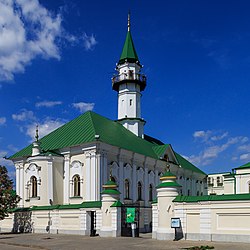
Tatar architecture has evolved through the periods of the Golden Horde, the Tatar khanates and under the rule of the Russian Empire. Many traditional Tatar mosques built by the Volga Tatars have a gabled roof and a minaret placed in the center of the mosque, above the roof, rather than at the side or corner of the building. Examples of such mosques survive from the 18th and 19th centuries and were restored in modern times.[312] This style is also found among the wooden mosques of the Lithuanian Tatars, whose mosque architecture was influenced by the Kazan (Volga) Tatars.[313] Another type of mosque, with a domed roof and a minaret standing above the entrance, appeared in the mid-19th century.[312]
Sahel and West Africa

In West Africa, Muslim merchants played a vital role in the western Sahel region since the 9th century through trans-Saharan trade networks.[315] While the Islamic architecture of this region shares a certain style, a wide variety of materials and local styles are evident across this wide geographic range.[315][316] In the more arid western Sahara and northern Sahel regions, stone predominates as a building material and is often associated with Berber cultures. In the southern Sahel and savannah regions mud-brick and rammed earth are the main material and is now associated with the most monumental examples of West African Islamic architecture. In some places, like Timbuktu and Oualata, both building materials are used together, with stone constructions either covered or bound with a mud plaster.[317]

The earliest mosques discovered in sub-Saharan Africa are at Kumbi Saleh (in present-day southern Mauritania), the former capital of the Ghana Empire.[315] Here, a mosque has been discovered which consisted of a courtyard, a prayer hall, and a square minaret, built in dry stone covered in red mud used as plaster. On both the exterior and interior of the mosque, this plaster was painted with floral, geometric, and epigraphic motifs. A similar stone mosque from the same period has been found at Awdaghust.[319] Both mosques are dated generally between the 9th and 14th centuries.[319] At Kumbi Saleh, locals lived in domed-shaped dwellings in the king's section of the city, surrounded by a great enclosure. Traders lived in stone houses in a section which possessed 12 mosques (as described by Al-Bakri), one centered on Friday prayer.[320]

As Islamization progressed across the region, more variations developed in mosque architecture, including the adoption of traditional local forms not previously associated with Islamic architecture.[315] Under Songhai influence, minarets took on a more pyramidal appearance and became stepped or tiered on three levels, as exemplified by the tower of the mosque–tomb of Askia al-Hajj Muhammad in Gao (present-day Mali). In Timbuktu, the Sankoré Mosque (established in the 14th-15th centuries[322] and rebuilt in the 16th century, with later additions[321]), had a tapering minaret and a prayer hall with rows of arches.[315] The presence of tapering minarets may also reflect cultural contacts with M'zab region to the north,[315] while decoration found at Timbuktu may reflect contacts with Berber communities in what is now Mauritania.[323]
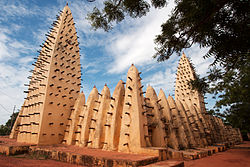
In the earthen (mud) architecture of the region, scholar Andrew Petersen distinguishes two main styles: a "western" style that may have its roots in Djenné (present-day Mali), and an "eastern" style associated with Hausa architecture that may have its roots in Kano (present-day Nigeria).[325] The eastern or Hausa style is generally more plain on the exterior of buildings, but is characterized by diverse interior decoration and the much greater use of wood.[325] Mosques often have prayer halls with pillars supporting flat or slightly domed roofs of wood and mud.[315][326] An exceptional example is the 19th-century Great Mosque of Zaria (present-day Nigeria), which has parabolic arches and a roof of shallow domes.[315][327] The western or "Sudan" style is characterized by more elaborate and decorated exterior façades whose compositions emphasize verticality. They have tapering buttresses with cone-shaped summits, mosques have a large tower over the mihrab, and wooden stakes (toron) are often embedded in the walls – used for scaffolding but possibly also for some symbolic purpose.[325]

More hybrid styles also arose further south and on the edge of Islamized areas.[315] In the Fouta Djallon region, in the Guinea Highlands, mosques were built with a traditional rectangular or square layout, but then covered by a huge conical thatched roof which protects from the rain. This type of roof was an existing feature of the traditional circular huts inhabited by the locals, re-adapted to cover new rectangular mosques when the mostly Muslim Fula people settled the region in the 18th century.[329][325] A good example is the Friday mosque of Dinguiraye in Guinea, built in 1850 (with later restorations). Many others are attested in the same region overlapping with southern Senegal, western Mali, and Burkina Faso.[328]
During the French colonial occupation of the Sahel, French engineers and architects had a role in popularizing a "Neo-Sudanese" style based on local traditional architecture but emphasizing symmetry and monumentality.[325][315][314] The Great Mosque of Djenné, which was previously established in the 14th century but demolished in the early 19th century,[315] was rebuilt in 1906–1907 under the direction of Ismaila Traoré and with guidance from French engineers.[314][325] Now the largest earthen building in sub-Saharan Africa, it served as a model for the new style and for other mosques in the region, including the Grand Mosque of Mopti built by the French administration in 1935.[314][325] Other 20th-century and more recent mosques in West Africa have tended to replicate a more generic style similar to that of modern Egypt.[315]
East Africa

East African architecture lacks some features typical of Islamic architecture, such as the construction of hammams.[330] Historic mosques were generally rectangular in plan, lacked courtyards, and featured side rooms.[331] Along the East African coast, common construction materials included coral stone, sundried bricks, and limestone.[332][330] in the Somali coastal towns, local architecture reflected a certain degree of influence from Islamic architecture in other regions. New buildings were often built on the ruins of older structures, a practice that continued for centuries.[332]
The oldest known mosques in the region were excavated at Shanga in present-day Kenya, where a succession of mosques on one site were built and rebuilt from the 9th to 14th centuries.[330] Other early mosques include the Great Mosque of Kilwa (described below), the Kizimkazi Mosque in Zanzibar (rebuilt in the 18th century over 12th foundations), and three 13th-century mosques in Mogadishu.[331] Ruins of early mosques and other structures are also found at Gedi.[333]
The Fakhr al-Din Mosque in Mogadishu, dated to 1269, is the most architecturally sophisticated mosque in East Africa.[334][335] It consists of a courtyard leading to a square hypostyle prayer of nine bays, with a dome over the central bay which resembles the conical domes of Anatolian Seljuk architecture. The mihrab is carved from marble from northern India.[334][335] It also features the oldest known minaret in East Africa, a feature which did not become common in the region until the 19th century.[336]

Kilwa, off the coast of Tanzania, hosts the remains of multiple historic mosques and palaces.[337] The Great Mosque is most impressive, the largest in East Africa before the 19th century. It was built and modified in multiple phases, with the oldest surviving section dating possibly to the 11th century, to which was later added a courtyard with porticos of coral stone columns and a side chamber with the largest historic dome on the East African coast (5 meters in diameter).[338] The courtyard is the only known medieval example of its kind in the region, though it was rebuilt and covered with domes and barrel vaults in the 15th century.[339]
Apart from mosques, the most common type of historic building to have survived, even if only partially, are palaces. Monumental palaces have been excavated at Shanga and at Manda which date from before 1000 CE.[340] The largest pre-19th-century palace along the coastal region is Husuni Kubwa at Kilwa, dating possibly to the 13th century, which has an imposing entrance and multiple sections arranged around internal courtyards.[340] Starting in the early 19th century, the Omanis introduced a new type of palace with multiple stories.[340]
In modern times
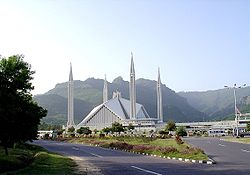

In modern times, the architecture of Islamic buildings, not just religious ones, has gone through some changes. The new architectural style doesn't stick with the same fundamental aspects that were seen in the past, but mosques for the most part still feature the same parts—the miḥrāb (مِـحْـرَاب), the minarets, four-iwan plan, and the pishtaq. A difference to note is the appearance of mosques without domes, as in the past mosques for the most part all had them, but these new dome-less mosques seem to follow a function over form design, and are created by those not of the Islamic faith, in most cases. The influence of Islam still pervades the style of creation itself, and provides a 'conceptual framework',[341] for the making of a building that exemplifies the styles and beliefs of Islam. It has also been influenced by the now meeting of many different cultures, such as European styles meeting Islamic styles, leading to Islamic architects incorporating features of other architectural and cultural styles.[342]
Urban design and Islam
Urban design and the tradition of Islamic styled architecture have begun to combine to form a new 'neo-Islamic' style, where the efficiency of the urban style meshes with the spirituality and aesthetic characteristics of Islamic styles.[343] Islamic Architecture in itself is a style that showcases the values and the culture of Islam, but in modern times sticking to tradition is falling out of practice, so a combination style formed. Examples showing this are places such as the Marrakesh Menara Airport, the Islamic Cultural Center and Museum of Tolerance, Masjid Permata Qolbu, the concept for The Vanishing Mosque, and the Mazar-e-Quaid. All of these buildings show the influence of Islam over them, but also the movements of things like minimalism which are rising to popularity in the architectural field. Designers that use the aspects of both modern styles and the Islamic styles found a way to have the Western-inspired modernism[343] with the classical cultural aspects of Islamic architecture. This concept though brings up the controversy of the identity of the traditional Islamic community within a space that doesn't follow the way they knew it.[344]
Debates on status as a style of architecture
There are some who also debate whether Islamic architecture can truly be called a style, as the religious aspect is seen as separate and having no bearing on the architectural style,[341] while on the other side people also argue that the newfound trend and divergence from the style of old Islamic Architecture is what is causing the style to lose its status. There are scholars that also believe that the distinguishing features of the Islamic architecture style were not necessarily found within the architecture, but were rather environmental markers, such as the sounds of prayer, the city around it, the events that occurred there.[345] The example given is that we can only truly know that a building is a mosque by what happens there, rather than by visual cues.[345] Specific features that are notably related to Islamic architecture – the mihrab, the minaret, and the gate[345] – are seen in multiple locations and do not always serve the same use, and symbolism for being Islamic in nature is seen to be demonstrated more culturally than it is architecturally. Islamic architecture is also sometimes referred to as a 'hidden architecture', one that doesn't necessarily show the physical traits of the style, rather it is something that is experienced.[346]
Contemporary Muslim architects
Connections and deeper meanings

Difficulty forming connections
Islamic architecture is a neglected subject within historical studies of world architecture. Many scholars that study historical architecture often gloss over, if not completely ignore Islamic structures. This is caused by multiple elements, one being that there are little historic literary works that express an Islamic architect's motives with their structures.[347][348] Due to the wide geographic range of the Islamic religion, there is a large variation between thousands of existing mosques with little consistency between them. Lastly, since it is against the Islamic faith to idolize earthly beings, any depictions of earthly beings lack religious connection. These characteristics combine to make it difficult for historians to form symbolic connections from architecture in Islamic places of worship.[348] Some authors have attempted to ascribe mystical or mathematical symbolisms to various aspects Islamic architecture. However, while these symbolic meanings may be plausible for certain specific buildings, they are not necessarily applicable to the rest of Islamic architecture.[349]
Religious and societal connections
Unlike Christianity, Islamic art tends to not depict living beings because it is viewed as a conflict with the Qur'an. From an Islamic viewpoint, anything created by God is under his order and thus should not be idolized.[347] This leaves typical religious Western symbols out of the picture, and replaces them with an emphasis on complex geometrical shapes and patterns.[347]
There are several aspects of Islamic architecture that to modern knowledge lack a symbolic religious meaning, but there are connections that do exist. A repeated and significant motif in mosques is calligraphy. Calligraphy plays a huge role in delivering religious connections through artistic design.[347] Calligraphy, in a mosque setting, is specifically used to reference excerpts from both the Qur'an and Muhammad's teachings. These references are one of the few religious connections architects include within their work.[347][348]
Status and hierarchy
Islamic architecture varies vastly across the world. Specifically, some mosques have different goals and intentions than others. These intentions often highlighted religious and social hierarchies within the mosque. Mosques are designed to have the least significant portions of the layout closest to the entrance, as people move deeper into the building more significant religious areas are revealed.[348] Hierarchy is also present because certain Islamic architects are tasked to design specifically for the presence of royalty, although in Islamic belief all Muslims in the mosque are equal. Designated locations had been carefully chosen in the mosque to highlight an individual's position in society. This emphasis could be made by being within view to all attendees, by being placed in the focal point of artistry, or with a maqsurah.[350]
Maintaining a sociological hierarchy within a mosque would typically represent a recognition by a higher being aware of a delegation of power. This hierarchy does exist but not with any sort of religious message as Hillenbrand points out, "in neither case is this hierarchy employed for especially portentous ends."[351] Hierarchy exists in the church in different forms, but is meant for purely functional purposes.[347]
Structural intentions
Deeper meanings in Islamic architecture often take form as functional purposes. For example, mosques are built around the idea that it should not just be a place of mesmerizing aesthetics, but a place where the aesthetics' fluidity guide the person into proper worship.[347]
A key feature of the mosque is the mihrab, a universal part of any Islamic place of worship.[350] The mihrab is easily identifiable through a receding wall and a gable overhead often consisting of intricate patterns. Upon entering, the most crucial religious function the architecture of the mosque serves to deliver is the qibla.[347] The qibla is necessary for proper Islamic worship, and is revealed through architectural means.[352]
See also
- Archnet, database of Islamic architecture
- Gozo Farmhouse
- Turbah
- Well House
Further reading
- Fletcher, Banister (1996) [1896]. Cruickshank, Dan (ed.). Sir Banister Fletcher's a History of Architecture (20th ed.). Architectural Press. ISBN 978-0-7506-2267-7.
- Abdullahi, Yahya; Bin Embi, Mohamed Rashid (2013). "Evolution of Islamic geometric patterns". Frontiers of Architectural Research. 2 (2): 243–251. doi:10.1016/j.foar.2013.03.002.
- Abdullahi, Yahya; Bin Embi, Mohamed Rashid (2015). "Evolution Of Abstract Vegetal Ornaments on Islamic Architecture". International Journal of Architectural Research: ArchNet-IJAR. 9: 31. doi:10.26687/archnet-ijar.v9i1.558.
External links
- ARCHITECTURE OF ISLAM by Takeo Kamiya (Half in English and half in Japanese)
- ARCHNET Open access, online resource on architecture and art of Muslim societies, globally and throughout history to our times
- Fatimid-era Ayyubid Wall of Cairo Digital Media Archive (creative commons-licensed photos, laser scans, panoramas), data from an Aga Khan Foundation/CyArk research partnership
- Islamic Arts and Architecture website
- Tehranimages. Contemporary photos taken in some of the oldest districts of Tehran.
- 10,000+ Architectural collections worldwide Archived 2020-05-07 at the Wayback Machine Islamic Art And Architecture designs worldwide.
สรุปเนื้อหา
ข้อมูลสำคัญจากบทความ
ข้อมูลสำคัญเกี่ยวกับ สถาปัตยกรรมอิสลาม
สถาปัตยกรรมอิสลาม ประกอบด้วย รูปแบบสถาปัตยกรรม ของ อาคาร ที่เกี่ยวข้องกับ อารยธรรม อิสลาม ครอบคลุมทั้ง รูปแบบ ทางโลก และทางศาสนาตั้งแต่ยุคแรกเริ่ม ของประวัติศาสตร์อิสลาม...
ต้นกำเนิด
ยุค อิสลาม เริ่มต้นด้วยการก่อตั้งศาสนาอิสลามภายใต้การนำของ มูฮัมหมัด ในช่วงต้นศตวรรษที่ 7 ใน อาระเบีย มัสยิดแห่งแรกเป็นสิ่งก่อสร้างที่มูฮัมหมัดสร้างขึ้นใน เมดินา ในปี 622 หลังจากที่ท่าน อพยพ (ฮิจเราะห์) จาก เมกกะ ซึ่งตรงกับที่ตั้งของ มัสยิดของท่านศาสดา (...
ยุคอุมัยยะฮ์
รัฐ กาหลิบอุมัยยาด (661–750) ผสมผสานองค์ประกอบของ สถาปัตยกรรมไบแซนไทน์ และ สถาปัตยกรรมซาสาเนียน แต่ สถาปัตยกรรมอุมัยยาด ได้นำเสนอการผสมผสานรูปแบบใหม่ๆ ของสไตล์เหล่านี้ [ 26 ] การนำองค์ประกอบจาก ศิลปะ โรมัน และไบแซนไทน์แบบคลาสสิกกลับมาใช้ใหม่ยังคงเห็นได้ชัดเจน...
ยุคราชวงศ์อับบาซิด
สถาปัตยกรรมของ ราชวงศ์ อับ บาซิด (ค.ศ. 750–1513) ได้รับอิทธิพลอย่างมากจากสถาปัตยกรรมของราชวงศ์ซาสาเนียน ซึ่งมีองค์ประกอบที่ปรากฏมาตั้งแต่สมัยเมโสโปเตเมียโบราณ [ 41 ] [ 40 ] นอกจากนี้ยังพบอิทธิพลอื่นๆ เช่น สถาปัตยกรรม ซอกเดีย โบราณ ใน เอเชียกลาง [ 41 ]...