
อ่าน 102 นาที
ดอกนาร์ซิสซัส (พืช)
นาร์ซิสซัส เป็น สกุล ของพืช ยืนต้นที่ ออกดอกส่วนใหญ่ในฤดูใบไม้ผลิในวงศ์อะมาริลลิส ( Amaryllidaceae ) ชื่อสามัญต่างๆ เช่น แดฟโฟดิล [ หมายเหตุ 1 ] นาร์ซิสซัส (พหูพจน์ นาร์ซิส ซี )...
ดอกนาร์ซิสซัส (พืช)
| นาร์ซิสซัส ช่วงเวลา: ปลายยุคโอลิโกซีน – ปัจจุบัน | |
|---|---|
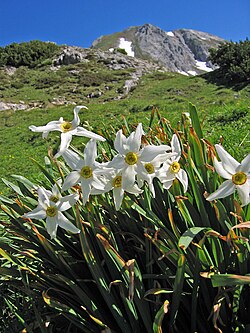 | |
| Narcissus poeticus | |
การจำแนกทางวิทยาศาสตร์ | |
| อาณาจักร: | พืช |
| กลุ่มสายพันธุ์ : | เอ็มบริโอไฟต์ |
| กลุ่มสายพันธุ์ : | พืชมีท่อลำเลียง |
| กลุ่มสายพันธุ์ : | สเปิร์มมาโตไฟต์ |
| กลุ่มสายพันธุ์ : | พืชดอก |
| กลุ่มสายพันธุ์ : | พืชใบเลี้ยงเดี่ยว |
| คำสั่ง: | หน่อไม้ฝรั่ง |
| ตระกูล: | วงศ์ Amaryllidaceae |
| อนุวงศ์: | Amaryllidoideae |
| เผ่า: | ดอกนาร์ซิสซา |
| ประเภท: | นาร์ซิสซัสแอล. [ 1 ] |
| ชนิดต้นแบบ | |
| Narcissus poeticus | |
| สกุลย่อย | |
ดูเนื้อหา | |
| คำพ้องความหมาย | |
รายการ
| |
| สูตรดอกไม้ | |
| Br ✶ ☿ P3+3+Corona A3+3 G (3) ใบประดับ, สมมาตรแบบรัศมี, ไบเซ็กชวล กลีบดอก: 6 กลีบ เรียงเป็น 2 วง วงละ 3 กลีบ เกสรตัวผู้: 2 วง วงละ 3 เกสร รังไข่: เหนือรังไข่ – คาร์เพล 3 อันเชื่อมติดกัน |


นาร์ซิสซัสเป็นสกุล ของพืช ยืนต้นที่ออกดอกส่วนใหญ่ในฤดูใบไม้ผลิในวงศ์อะมาริลลิส ( Amaryllidaceae ) ชื่อสามัญต่างๆ เช่นแดฟโฟดิล [หมายเหตุ 1 ]นาร์ซิสซัส (พหูพจน์นาร์ซิส ซี ) และจอนควิลถูกใช้เพื่ออธิบายสมาชิกบางส่วนหรือทั้งหมดของสกุลนี้
ดอก นาร์ซิสซัส มีลักษณะเด่นคือมี กลีบดอก 6 กลีบประกบกันเป็นรูปทรงถ้วยหรือแตรดอกมักมีสีขาวและเหลือง (บางครั้งก็มีสีส้มหรือชมพูในพันธุ์ที่ปลูกในสวน) โดยกลีบดอกและส่วนยอดอาจมีสีเดียวกันหรือตัดกันก็ได้
ดอกนาร์ซิสซัสเป็นที่รู้จักกันดีในอารยธรรมโบราณทั้งในด้านการแพทย์และพฤกษศาสตร์ แต่ได้รับการอธิบายอย่างเป็นทางการโดยลินเนียสใน หนังสือ Species Plantarum ของเขา (1753) โดยทั่วไปถือว่าสกุลนี้มีประมาณสิบส่วน โดยมีประมาณ 70–80 ชนิด ฐานข้อมูล Plants of the World Onlineในปัจจุบันยอมรับ 76 ชนิดและลูกผสมที่มีชื่อ 93 ชนิด[ 3 ]จำนวนชนิดแตกต่างกันไป ขึ้นอยู่กับวิธีการจัดจำแนก เนื่องจากความคล้ายคลึงกันระหว่างชนิดและการ ผสมข้ามพันธุ์
สกุลนี้ถือกำเนิดขึ้นในช่วงปลาย ยุค โอลิโกซีนถึงต้น ยุค ไมโอซีนในคาบสมุทรไอบีเรียและบริเวณใกล้เคียงทางตะวันตกเฉียงใต้ของยุโรป ที่มาที่แท้จริงของชื่อนาร์ซิสซัสยังไม่เป็นที่ทราบแน่ชัด แต่มักเชื่อมโยงกับคำภาษากรีก (ภาษากรีกโบราณναρκῶ narkō , "ทำให้ชา") และตำนานของชายหนุ่มชื่อนั้นที่ตกหลุมรักเงาสะท้อนของตนเอง คำภาษาอังกฤษ "daffodil" ดูเหมือนจะมาจาก " asphodel " ซึ่งมักถูกนำมาเปรียบเทียบกัน[ 4 ]
พืชสกุลนาร์ซิสซัสมีถิ่นกำเนิดในทุ่งหญ้าและป่าไม้ทางตอนใต้ของยุโรปและแอฟริกาเหนือ โดยมีศูนย์กลางความหลากหลายทางชีวภาพอยู่ในแถบเมดิเตอร์เรเนียนตะวันตก ทั้งพืชป่าและพืชที่ปลูกได้แพร่กระจายไปอย่างกว้างขวาง และถูกนำเข้าไปในตะวันออกไกลก่อนศตวรรษที่สิบ นาร์ซิสซัสส่วนใหญ่เป็นพืชหัวที่มีอายุยืนยาว ขยายพันธุ์โดยการแบ่งกอ แต่ก็สามารถผสมเกสรโดยแมลงได้เช่นกัน ศัตรูพืช โรค และความผิดปกติที่พบ ได้แก่ ไวรัส เชื้อรา ตัวอ่อนของแมลงวันไรและไส้เดือนฝอยนาร์ซิสซัสบางชนิดสูญพันธุ์ไปแล้ว ในขณะที่บางชนิดกำลังถูกคุกคามจากการขยายตัวของเมืองและการท่องเที่ยวที่เพิ่มขึ้น
บันทึกทางประวัติศาสตร์ชี้ให้เห็นว่าดอกนาร์ซิสซัสได้รับการปลูกฝังมาตั้งแต่สมัยโบราณ แต่ได้รับความนิยมมากขึ้นในยุโรปหลังศตวรรษที่ 16 และในช่วงปลายศตวรรษที่ 19 กลายเป็นพืชเศรษฐกิจที่สำคัญ โดยส่วนใหญ่มีศูนย์กลางอยู่ที่ประเทศเนเธอร์แลนด์ ปัจจุบัน ดอกนาร์ซิสซัสเป็นที่นิยมในฐานะดอกไม้ตัดและไม้ประดับ ประวัติศาสตร์อันยาวนานของการผสมพันธุ์ส่งผลให้เกิดสายพันธุ์ ต่างๆ นับพันสายพันธุ์ สำหรับวัตถุประสงค์ทางพืชสวน ดอกนาร์ซิสซัสถูกจัดจำแนกออกเป็นกลุ่มต่างๆ ครอบคลุมรูปทรงและสีสันที่หลากหลาย ดอกนาร์ซิสซัสผลิต สารอัลคาลอยด์หลายชนิดซึ่งให้การป้องกันแก่พืชได้บ้าง แต่อาจเป็นพิษหากรับประทานเข้าไปโดยไม่ได้ตั้งใจ คุณสมบัตินี้ถูกนำมาใช้ประโยชน์ทางการแพทย์ในการรักษาแบบดั้งเดิม และส่งผลให้มีการผลิตกาแลนตามีนเพื่อรักษาภาวะสมองเสื่อมจากโรคอัลไซเมอร์ ดอกนาร์ซิสซัสมีความเกี่ยวข้องกับหลายแง่มุมในวัฒนธรรมต่างๆ ตั้งแต่ความตายไปจนถึงโชคลาภ และเป็นสัญลักษณ์ของฤดูใบไม้ผลิ ดอกแดฟโฟดิลเป็นดอกไม้ประจำชาติของเวลส์ และเป็นสัญลักษณ์ขององค์กรการกุศลเพื่อผู้ป่วยมะเร็งในหลายประเทศ การปรากฏตัวของดอกไม้ป่าในฤดูใบไม้ผลิมีความเกี่ยวข้องกับเทศกาลต่างๆ ในหลายแห่ง
คำอธิบาย


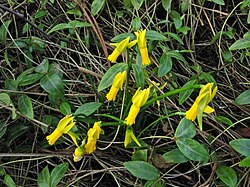

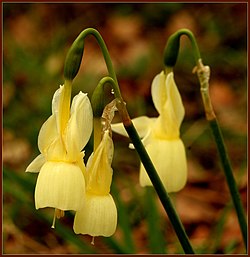


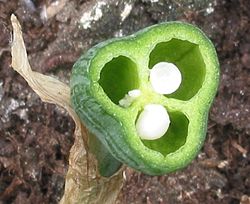

ทั่วไป
นาร์ซิสซัสเป็นสกุลของพืชหัวใต้ดินยืนต้น ซึ่งจะเหี่ยวเฉาลงหลังออกดอกเหลือเพียงหัวเก็บสะสมอาหารใต้ดิน พวกมันจะงอกใหม่ในปีถัดไปจากหัวรูปไข่ เปลือกสีน้ำตาล ที่มีคอเด่นชัด และมีความสูง 5–80 เซนติเมตร (2.0–31.5 นิ้ว) ขึ้นอยู่กับชนิด พันธุ์แคระ เช่นN. asturiensisมีความสูงสูงสุด 5–8 เซนติเมตร (2.0–3.1 นิ้ว) ในขณะที่Narcissus tazettaอาจสูงได้ถึง 80 เซนติเมตร (31 นิ้ว) [ 5 ] [ 6 ]
พืชชนิดนี้ มี ก้านดอกกลวงที่ไม่มีใบอยู่ตรงกลางเพียงก้านเดียว(scape) ใบสีเขียวหรือเขียวอมฟ้าแคบๆ รูปทรงคล้ายสายรัดหลายใบงอกออกมาจากหัว ก้านดอกมักจะมีดอกเดี่ยว แต่บางครั้งก็มีดอกเป็นช่อ ( umbel ) ดอกมักจะเด่นชัดและมีสีขาวหรือเหลือง บางครั้งก็มีทั้งสองสี หรือบางครั้งก็เป็นสีเขียว ดอกประกอบด้วยกลีบดอกสามส่วน ส่วนที่อยู่ใกล้ก้านดอกที่สุด (proximal) คือท่อดอกอยู่เหนือรังไข่จากนั้นเป็นวงแหวนด้านนอกที่ประกอบด้วยกลีบดอก หกกลีบ (กลีบเลี้ยงและกลีบดอกที่แยกไม่ออก) และส่วนกลางเป็นแผ่นกลมหรือรูปกรวยดอกอาจห้อยลง (pendant) หรือตั้งตรง มีเกสร ตัวผู้ หกอันล้อมรอบก้านเกสรตัวเมียตรงกลาง รังไข่อยู่ต่ำกว่าส่วนดอก (inferior) ประกอบด้วยสามช่อง (trilocular) ผลประกอบด้วยแคปซูล แห้ง ที่แตกออก ( dehisces ) ปล่อยเมล็ดสีดำจำนวนมาก[ 6 ]
หัวจะพักตัวหลังจากใบและก้านดอกเหี่ยวเฉา และมีราก ที่หดตัวได้ ซึ่งดึงหัวลงไปในดินมากขึ้น ก้านดอกและใบจะก่อตัวขึ้นในหัวเพื่อโผล่ขึ้นมาในฤดูกาลถัดไป ส่วนใหญ่จะพักตัวตั้งแต่ฤดูร้อนจนถึงปลายฤดูหนาว และออกดอกในฤดูใบไม้ผลิ แม้ว่าจะมีบางชนิดที่ออกดอกในฤดูใบไม้ร่วงก็ตาม[ 6 ]
เฉพาะเจาะจง
พืช
- หลอดไฟ
หัวใต้ดินรูปไข่สีน้ำตาลอ่อนมี เปลือกบางคล้ายเยื่อบางๆ และมีแผ่นลำต้น (ฐานหรือฐาน) ที่เป็นเนื้อไม้ก๊อก ซึ่งมีรากฝอยงอก ออกมา เป็นวงรอบขอบ ยาวได้ถึง 40 มม. (1.6 นิ้ว) เหนือแผ่นลำต้นเป็นอวัยวะเก็บสะสมอาหาร ประกอบด้วยเกล็ดหัวใต้ดิน ล้อมรอบก้านดอกเดิมและตา ปลายยอด เกล็ดมีสองประเภท คือ อวัยวะเก็บสะสมอาหารที่แท้จริงและฐานของใบ เกล็ดเหล่านี้มีปลายที่หนากว่าและมีรอยแผลเป็นจากการที่แผ่นใบหลุดออก เกล็ดใบชั้นในสุดมีรูปครึ่งวงกลม ห่อหุ้มก้านดอกเพียงบางส่วน (หุ้มครึ่งเดียว) (ดูรูปที่ 1.3 ของ Hanks) หัวใต้ดินอาจมีหน่วยหัวใต้ดินแตกแขนงหลายหน่วย แต่ละหน่วยมีเกล็ดที่แท้จริงสองถึงสามเกล็ดและฐานใบสองถึงสามฐาน แต่ละหน่วยหัวใต้ดินมีอายุประมาณสี่ปี[ 6 ] [ 7 ]
เมื่อใบเหี่ยวเฉาในฤดูร้อน รากก็จะเหี่ยวเฉาตามไปด้วย หลังจากนั้นไม่กี่ปี รากจะสั้นลง ดึงหัวให้ลึกลงไปในดิน ( รากหดตัว ) หัวจะเจริญเติบโตจากภายใน ดันชั้นที่เก่ากว่าออกไปด้านนอก ซึ่งจะกลายเป็นสีน้ำตาลและแห้ง ก่อตัวเป็นเปลือกนอก เปลือกหุ้ม หรือผิว ในบางสายพันธุ์ป่า มีการนับชั้นได้มากถึง 60 ชั้น ในขณะที่พืชดูเหมือนจะพักตัวอยู่เหนือพื้นดิน ก้านดอกซึ่งจะเริ่มเติบโตในฤดูใบไม้ผลิถัดไป จะเจริญเติบโตอยู่ภายในหัว ล้อมรอบด้วยใบที่ร่วงหล่น 2-3 ใบและกาบใบ ก้านดอกจะอยู่ในซอกใบจริงใบที่สอง[ 6 ]
- ลำต้น
ลำต้นหรือก้านดอกเดี่ยวที่ไม่มีใบปรากฏตั้งแต่ต้นฤดูใบไม้ผลิจนถึงปลายฤดูใบไม้ผลิ ขึ้นอยู่กับชนิด มีดอกตั้งแต่ 1 ถึง 20 ดอก[ 8 ]รูปร่างของลำต้นขึ้นอยู่กับชนิด บางชนิดแบนมากและมีรอยต่อที่เห็นได้ชัด ในขณะที่บางชนิดกลม ลำต้นตั้งตรงและอยู่ตรงกลางของใบ ในบางชนิด เช่นN. hedraeanthusลำต้นจะเอียง ลำต้นกลวงในส่วนบน แต่ส่วนที่อยู่ใกล้หัวจะแข็งกว่าและเต็มไปด้วยวัสดุที่เป็นฟองน้ำ[ 9 ]
- ออกจาก
ต้น นาร์ซิสซัส มี ใบที่โคนต้นหนึ่งถึงหลาย ใบ ซึ่งมีรูปร่างเป็นเส้นตรง เรียว หรือเป็นแถบ (ยาวและแคบ) บางครั้งมีร่อง ที่ด้านบนหรือกึ่งกลม และอาจมีก้านใบ (มีก้านใบ) หรือไม่มีก้านใบ ( ไม่มีก้านใบ) [ 10 ]ใบมีลักษณะแบนและกว้างถึงทรงกระบอกที่โคน และงอกออกมาจากหัว[ 11 ]ต้นอ่อนมักมีสองใบ แต่ต้นที่โตเต็มที่มักมีสามใบ นานๆ ครั้งจะมีสี่ใบ และใบเหล่านี้ปกคลุมด้วยคิวติเคิ ล ที่มีคิวตินทำให้ใบมีลักษณะเป็นมันวาว สีของใบเป็นสีเขียวอ่อนถึงเขียวอมฟ้า ในต้นที่โตเต็มที่ ใบจะยื่นสูงกว่าก้านดอก แต่ในบางชนิด ใบจะห้อยต่ำ โคนใบถูกหุ้มด้วยปลอกที่ไม่มีสี หลังจากออกดอก ใบจะเปลี่ยนเป็นสีเหลืองและเหี่ยวเฉาไปเมื่อฝักเมล็ด (ผล) สุก[ 6 ]
โดยทั่วไปแล้วต้นจอนควิลจะมีใบสีเขียวเข้ม กลม คล้ายใบกก[ 12 ]
เจริญพันธุ์
- ช่อดอก
ช่อดอกเป็นแบบก้านเดี่ยว ก้านเดี่ยวหรือก้านช่อดอกอาจมีดอกเดียวหรือรวมกันเป็นช่อแบบร่มที่มีดอกมากถึง 20 ดอก[ 8 ]ชนิดที่มีดอกเดียว ได้แก่ ส่วนBulbocodiumและส่วนใหญ่ของส่วนPseudonarcissusชนิดที่มีช่อดอกแบบร่มจะมีช่อดอกแบบช่อกระจะอวบ( ไม่แตกแขนง มีก้านดอกสั้น) มีดอก 2 ถึง 15 หรือ 20 ดอก เช่นN. papyraceus (ดูภาพประกอบด้านซ้าย) และN. tazetta (ดูตารางที่ 1 ) [ 13 ] [ 14 ]การจัดเรียงดอกบนช่อดอกอาจมีก้านดอก ( pedicellate ) หรือไม่มีก้านดอก ( sessile ) ก็ได้ [ 9 ]
ก่อนที่ดอกตูมจะบาน จะถูกห่อหุ้มและปกป้องด้วยกาบดอก ที่บาง แห้ง คล้ายกระดาษ หรือเป็นเยื่อบางๆ ( คล้ายวุ้น ) กาบดอกประกอบด้วยใบประดับ เพียงใบเดียว ที่มีร่อง และยังคงห่อหุ้มรอบฐานของดอกที่บานแล้ว เมื่อดอกตูมเจริญเติบโต กาบดอกจะแยกออกตามแนวยาว[ 15 ] [ 16 ]ใบประดับย่อยมีขนาดเล็กหรือไม่มีเลย[ 9 ] [ 15 ] [ 14 ] [ 17 ]
- ดอกไม้
ดอกนาร์ซิสซัสเป็นดอกสมบูรณ์เพศ (มีทั้งเกสรตัวผู้และตัวเมีย) [ 18 ]มีสามส่วน (สามส่วน) และบางครั้งก็มีกลิ่นหอม (ดูกลิ่นหอม ) [ 19 ]สมมาตรของดอกเป็นแบบรัศมี (รัศมี) ถึงสมมาตรแบบไซโกมอร์ฟิกเล็กน้อย (สมมาตรแบบทวิภาค) เนื่องจากเกสร ตัวผู้ โค้งลงแล้วงอขึ้นที่ปลาย ดอก นาร์ซิสซัสมีลักษณะเด่นคือมงกุฎ (แตร) ที่มักจะเห็นได้ชัดเจน [ 9 ]
ส่วนประกอบหลักสามส่วนของดอก (ในทุกชนิดยกเว้นN. cavanillesiiซึ่งแทบไม่มีกลีบมงกุฎ - ตารางที่ 1 : ส่วนTapeinanthus ) ได้แก่:
- (i) ท่อดอก ส่วนต้น (ไฮแพนเทียม)
- (ii) กลีบดอกอิสระโดยรอบและ
- (iii) โคโรนา ส่วนปลายที่ไกลออกไป (พาราโครอลลา พาราเพอริกอน พาราเพอริโกเนียม) [ 20 ]
ทั้งสามส่วนอาจถือได้ว่าเป็นส่วนประกอบของกลีบดอก (perigon, perigonium) กลีบดอกเกิดขึ้นเหนือปลายของรังไข่ ที่อยู่ต่ำกว่า โดยฐานของมันก่อตัว เป็นท่อดอก hypanthial [ 20 ]
ท่อดอกเกิดจากการรวมตัวของส่วนฐานของกลีบดอก (เชื่อมติดกันที่โคน) รูปร่างของท่อดอกมีตั้งแต่รูปกรวยคว่ำ ( obconic ) ไปจนถึงรูปกรวย (funneliform) หรือรูปทรงกระบอก และมีมงกุฎดอกอยู่ด้านบนสุด ท่อดอกอาจมีตั้งแต่ยาวและแคบ (ในส่วนApodanthiและJonquilla ) ไปจนถึงเล็กมาก ( N. cavanillesii ) [ 21 ]
ล้อมรอบท่อดอกและมงกุฎดอก และโค้งงอ (งอไปด้านหลัง) จากส่วนที่เหลือของกลีบดอก คือกลีบดอกหรือใบดอกที่แผ่กว้างออกเป็นสองวง ซึ่งอาจชี้ขึ้นที่ปลาย โค้งงอ (พับไปด้านหลัง) หรือเป็นรูปหอก เช่นเดียวกับพืชใบเลี้ยงเดี่ยว หลายชนิด กลีบดอกเป็นแบบโฮโมแคลไมเดียส ซึ่งไม่แยกความแตกต่างระหว่างกลีบเลี้ยง (sepals) และกลีบดอก (petals) แต่มีกลีบดอกหกกลีบ กลีบดอกสามส่วนด้านนอกอาจถือได้ว่าเป็นกลีบเลี้ยงและสามส่วนด้านใน ถือได้ว่าเป็น กลีบดอก จุดเปลี่ยนระหว่างท่อดอกและมงกุฎดอกนั้นถูกกำหนดโดยการแทรกของกลีบดอกอิสระบนกลีบดอกที่เชื่อมติดกัน[ 7 ]
โคโรนาหรือพาราคอรอลลามีลักษณะแตกต่างกันไป เช่น รูปทรงระฆัง (รูปทรงกรวย, รูปทรงแตร), รูปทรงชาม (รูปทรงถ้วย, รูปทรงหลุมอุกกาบาต, รูปทรงถ้วย) หรือรูปทรงแผ่นดิสก์ที่มีขอบหยัก และแยกจากเกสรตัวผู้ ในบางกรณี โคโรนาอาจเป็นวงแหวนแข็ง (หนา) เพียงอย่างเดียว โคโรนาเกิดขึ้นระหว่างการพัฒนาของดอกไม้โดยเป็นส่วนที่ยื่นออกมาเป็นท่อจากเกสรตัวผู้ซึ่งรวมกันเป็นโครงสร้างท่อ อับเรณูลดขนาดลง ที่ฐานของโคโรนาจะมีการสร้างกลิ่นหอมที่ดึงดูดแมลงผสมเกสร ทุกชนิดผลิตน้ำหวานที่ส่วนบนของรังไข่[ 13 ]สัณฐานวิทยาของโคโรนาแตกต่างกันไปตั้งแต่แผ่นดิสก์สีเล็กๆ ของN. serotinus (ดูตารางที่ 1 ) หรือโครงสร้างที่ยังไม่พัฒนาในN. cavanillesiiไปจนถึงแตรยาวของส่วนPseudonarcissus (ดอกแดฟโฟดิลรูปทรงแตร ตารางที่ 1) [ 10 ] [ 13 ] [ 14 ] [ 7 ]
ในขณะที่กลีบดอกอาจชี้ไปข้างหน้า ในบางชนิดเช่นN. cyclamineus กลีบดอก จะพับกลับ (สะท้อนกลับ ดูภาพประกอบด้านซ้าย) ในขณะที่ในบางชนิดเช่นN. bulbocodium ( ตารางที่ 1 ) กลีบดอกจะลดลงเหลือเพียงส่วนปลายแหลมที่แทบมองไม่เห็นไม่กี่ส่วนพร้อมกับมงกุฎที่เด่นชัด[ 20 ]
สีของกลีบดอกเป็นสีขาว เหลือง หรือสองสี ยกเว้นN. viridiflorus ที่ออกดอกในเวลากลางคืน ซึ่งมีสีเขียว นอกจากนี้ กลีบรองดอกของN. poeticus ยัง มีขอบหยักสีแดง (ดูตารางที่ 1 ) [ 11 ]เส้นผ่านศูนย์กลางของดอกแตกต่างกันไปตั้งแต่ 12 มม. ( N. bulbocodium ) ถึงมากกว่า 125 มม. ( N. nobilis = N. pseudonarcissus subsp. nobilis ) [ 21 ]
การวางตัวของดอกไม้แตกต่างกันไป ตั้งแต่ห้อยลง (downling) ดังเช่นในN. triandrus (ดูภาพประกอบด้านซ้าย) ไปจนถึงเอียงขึ้น (declinate-ascendant) ดังเช่นในN. alpestris = N. pseudonarcissus subsp. moschatus , แผ่กว้าง (patent, spreading) เช่นN. gaditanusหรือN. poeticus , ตั้งตรงดังเช่นในN. cavanillesii , N. serotinusและN. rupicola ( ตารางที่ 1 ) หรืออยู่ระหว่างตำแหน่งเหล่านี้ (erecto-patent) [ 9 ] [ 11 ] [ 13 ] [ 14 ] [ 17 ] [ 22 ] [ 21 ]
ดอกนาร์ซิสซัสแสดงให้เห็นถึงความหลากหลายของดอกไม้และความหลากหลาย ทางเพศ ที่ โดดเด่น [ 17 ]โดยส่วนใหญ่ขึ้นอยู่กับขนาดของกลีบดอกและความยาวของท่อดอก ซึ่งเกี่ยวข้องกับ กลุ่ม ผู้ผสมเกสร (ดูตัวอย่างเช่น รูปที่ 1 และ 2 ใน Graham และ Barrett [ 13 ] ) Barrett และ Harder (2005) อธิบายรูปแบบดอกไม้ที่แตกต่างกันสามแบบ:
- แบบฟอร์ม "ดอกแดฟโฟดิล"
- แบบฟอร์ม "กระดาษขาว"
- รูปแบบ "Triandrus" [ 20 ]
รูปแบบที่เด่นชัดคือรูปแบบ 'ดอกแดฟโฟดิล' และ 'ดอกกระดาษขาว' ในขณะที่รูปแบบ "ไตรแอนดรัส" พบได้น้อยกว่า แต่ละรูปแบบสอดคล้องกับกลุ่มผู้ผสมเกสรที่แตกต่างกัน (ดูการผสมเกสร ) [ 17 ]
รูปแบบ "ดอกแดฟโฟดิล" ซึ่งรวมถึงส่วนPseudonarcissusและBulbocodiumมีท่อดอกที่ค่อนข้างสั้น กว้าง หรือเป็นรูปกรวยสูง (คล้ายกรวย) ซึ่งค่อยๆ เปลี่ยนไปเป็นมงกุฎดอกที่ยาว มีขนาดใหญ่และเป็นรูปกรวย ก่อตัวเป็นกลีบดอกที่กว้าง ทรงกระบอก หรือรูปแตร ส่วนPseudonarcissusประกอบด้วยดอกที่มีขนาดค่อนข้างใหญ่ โดยมีความยาวของกลีบดอกประมาณ 50 มม. (2.0 นิ้ว) โดยทั่วไปจะเป็นดอกเดี่ยว แต่พบเป็นช่อดอก 2-4 ดอกได้ยาก ดอกมีท่อดอกสีเขียวกว้างและมีมงกุฎดอกสีเหลืองสดใสรูปกรวย กลีบดอกทั้งหกกลีบอาจมีสีแตกต่างจากมงกุฎดอกและอาจมีสีครีมถึงสีเหลืองอ่อน[ 18 ]
รูปแบบ "ดอกกระดาษขาว" ซึ่งรวมถึงส่วนJonquilla , ApodanthiและNarcissusมีท่อที่ค่อนข้างยาวและแคบ และมีมงกุฎที่สั้น ตื้น และบานออก ดอกไม้อยู่ในแนวนอนและมีกลิ่นหอม[ 17 ]
รูปแบบ "triandrus" พบได้ในเพียงสองชนิดเท่านั้น คือN. albimarginatus (พืชเฉพาะถิ่นของโมร็อกโก) และN. triandrusโดยมีลักษณะผสมผสานระหว่างรูปแบบ "daffodil" และ "paperwhite" มีท่อที่ยาวและแคบพัฒนาดี และมีมงกุฎรูปทรงระฆังที่ยื่นออกมาซึ่งมีความยาวเกือบเท่ากัน ดอกไม้ห้อยลง[ 17 ]
มีเกสรตัวผู้ หกอันเรียง เป็นแถวหนึ่งถึงสองแถว ( วง ) โดยก้านเกสรแยกออกจากโคโรนา ติดอยู่ที่คอหรือฐานของท่อ (epipetalous) มักมีความยาวสองเส้นแยกกัน ตรงหรือโค้งลงแล้วขึ้น (โค้งลงแล้วขึ้น) อับเรณูติดอยู่ที่ฐาน (ติดอยู่ที่ฐาน) [ 10 ] [ 7 ]
รังไข่อยู่ต่ำกว่าส่วนดอกและมี 3 ช่อง และมีเกสรตัวเมีย ที่มี ปลาย เกสรตัวเมียเป็น แฉกเล็กๆ 3 แฉกและก้านเกสรตัวเมียเป็นเส้นเล็กๆซึ่งมักจะยื่นออกมา (ยื่นออกมาจากท่อ) [ 23 ] [ 7 ]
- ผลไม้
ผลประกอบด้วยแคปซูลที่แตก ออกตามช่อง (แยกออกระหว่างช่อง) ซึ่งมีรูปร่าง เป็นรูปไข่ ถึงเกือบกลม (เกือบเป็นทรงกลม) และมีเนื้อสัมผัสเป็นกระดาษถึงหนัง[ 9 ]
- เมล็ดพันธุ์
ผลไม้ประกอบด้วยเมล็ด ทรงกลมจำนวนมาก ซึ่งมีลักษณะกลมและบวม มีเปลือกแข็ง บางครั้งมีเอไลโอโซม ติดอยู่ด้วย เปลือกผลมีสีดำ[ 10 ]และเปลือกผลแห้ง[ 14 ]
โดยส่วนใหญ่แล้วพืชชนิดนี้จะมีไข่ 12 ฟอง และเมล็ด 36 เมล็ด แต่บางชนิด เช่นN. bulbocodiumจะมีมากกว่านั้น สูงสุดถึง 60 เมล็ด เมล็ดใช้เวลาห้าถึงหกสัปดาห์ในการเจริญเติบโตเต็มที่ เมล็ดของกลุ่มJonquillaและBulbocodiumมีรูปร่างคล้ายลิ่มและสีดำด้าน ในขณะที่เมล็ดของกลุ่มอื่นๆ มีรูปร่างเป็นรูปไข่และสีดำมันเงา ลมพัดแรงหรือการสัมผัสกับสัตว์ที่ผ่านไปมาก็เพียงพอที่จะกระจายเมล็ดที่เจริญเติบโตเต็มที่แล้วได้
โครโมโซม
จำนวน โครโมโซมประกอบด้วย 2n=14, 22, 26 พร้อมด้วย อนุพันธ์ แอนยูพลอยด์และโพลีพลอยด์ จำนวนมาก จำนวนโครโมโซมพื้นฐานคือ 7 ยกเว้นN. tazetta , N. elegansและN. broussonetiiซึ่งมี 10 หรือ 11 สกุลย่อยนี้ ( Hermione ) มีลักษณะเฉพาะนี้ สปีชีส์โพลีพลอยด์ ได้แก่N. papyraceus (4x=22) และN. dubius (6x=50) [ 7 ]
ไฟโตเคมี
อัลคาลอยด์
เช่นเดียวกับพืชสกุลอื่นๆ ในวงศ์ Amaryllidaceae ดอกนาร์ซิสซัสมีสารอัลคาลอยด์ไอโซควิโนลี นที่เป็นเอกลักษณ์ อัลคาลอยด์ชนิดแรกที่ถูกระบุคือไลโคไรน์จากN. pseudonarcissusในปี 1877 สารเหล่านี้ถือเป็นกลไกการปรับตัวเพื่อการป้องกันตัวและถูกนำมาใช้ในการจำแนกชนิดของพืช มีการระบุอัลคาลอยด์ในสกุลนี้แล้วเกือบ 100 ชนิด คิดเป็นประมาณหนึ่งในสามของอัลคาลอยด์ทั้งหมดในวงศ์ Amaryllidaceae ที่รู้จัก แม้ว่าจะยังไม่ได้มีการทดสอบกับทุกชนิดก็ตาม จากอัลคาลอยด์แบบวงแหวน 9 ชนิดที่ระบุในวงศ์นี้ พืชในสกุลนาร์ ซิสซัสส่วนใหญ่มักมีอัลคาลอยด์จากกลุ่มไลโคไรน์ (ไลโคไรน์, กาแลนทีน, พลูวีน) และโฮโมไลโคไรน์ (โฮโมไลโคไรน์, ไลโคเรนีน) นอกจากนี้ยังพบอัลคาลอยด์เฮแมนทามีน, ทาเซตทีน, นาร์ซิคลาซีน , มอนทานีน และ กา แลนทามีนด้วย โปรไฟล์อัลคาลอยด์ของพืชแต่ละชนิดจะแตกต่างกันไปตามเวลา สถานที่ และระยะการเจริญเติบโต[ 24 ] นอกจากนี้ ดอก นาร์ซิสซัสยังมีฟรุกแทน และ กลูโคแมนแนนที่มีน้ำหนักโมเลกุลต่ำในใบและลำต้นของพืช
น้ำหอม
กลิ่นหอมส่วนใหญ่เป็นไอโซพรี นอยด์ โมโน เทอร์พีน โดยมีเบนซีนอยด์ ในปริมาณเล็กน้อย แม้ว่าN. jonquillaจะมีทั้งสองชนิดในปริมาณเท่าๆ กันก็ตาม ข้อยกเว้นอีกประการหนึ่งคือN. cuatrecasasiiซึ่งผลิตอนุพันธ์ของกรดไขมันเป็นหลัก สารตั้งต้นโมโนเทอร์พีนพื้นฐานคือ เจอ รานิลไพโรฟอสเฟตและโมโนเทอร์พีนที่พบได้บ่อยที่สุดคือลิโมนีนไมร์ซีนและทรานส์ -β- โอซิมี น เบนซีน อยด์ส่วนใหญ่ไม่มีหมู่เมทอกซี ในขณะที่บางชนิดมี รูปแบบ ที่มีหมู่เมทอกซี ( อีเทอร์ ) เช่นN. bujeiส่วนประกอบอื่นๆ ได้แก่อินโดล ไอโซเพนเทนอยด์ และ เซสควิเทอร์พีนในปริมาณน้อยมากรูปแบบของกลิ่นหอมสามารถสัมพันธ์กับแมลงผสมเกสร ได้ และแบ่งออกเป็นสามกลุ่มหลัก (ดูการผสมเกสร ) [ 19 ]
อนุกรมวิธาน
ประวัติศาสตร์
Genus valde intricatum et numerosissimis dubiis oppressumเป็นสกุลที่ซับซ้อนมากและเต็มไปด้วยความไม่แน่นอนมากมาย
— Schultes & Schultes fil., ระบบ ผักพ.ศ. 2372 [ 25 ]
แต่แรก
สกุลNarcissusเป็นที่รู้จักกันดีในหมู่ชาวกรีกและโรมันโบราณในวรรณกรรมกรีกTheophrastus [ 26 ]และDioscorides [ 27 ]ได้บรรยายถึงνάρκισσοςซึ่งอาจหมายถึงN. poeticusแม้ว่าชนิดที่แน่นอนที่กล่าวถึงในวรรณกรรมคลาสสิกจะไม่สามารถระบุได้อย่างแม่นยำ ต่อมา Pliny the Elderได้นำรูปแบบภาษาละตินnarcissusมา ใช้ [ 28 ] [ 29 ] [ 30 ] [ 31 ]นักเขียนยุคแรกเหล่านี้สนใจในคุณสมบัติทางยาที่เป็นไปได้ของพืชชนิดนี้มากพอๆ กับลักษณะทางพฤกษศาสตร์ และบันทึกของพวกเขายังคงมีอิทธิพลจนถึงอย่างน้อยยุคฟื้นฟูศิลปวิทยา (ดูเพิ่มเติมที่ยุคโบราณ ) นักเขียนในยุคกลางและยุคฟื้นฟูศิลปวิทยา ได้แก่Albert MagnusและWilliam Turnerแต่Linnaeusเป็นผู้บรรยายและตั้งชื่อNarcissus อย่างเป็นทางการ ในฐานะสกุลในSpecies Plantarum (1753) ของเขา ซึ่งในขณะนั้นมีหกชนิดที่เป็นที่รู้จัก[ 1 ] [ 32 ]
ทันสมัย
เดอ จุสซิเยอ (1789) จัดกลุ่มนาร์ซิสซัสไว้ใน "วงศ์" [ 33 ] [ 34 ]ซึ่งเขาเรียกว่า นาร์ซิสซัส[ 35 ] ต่อ มาได้รับการเปลี่ยนชื่อเป็น Amaryllideae โดยJaume Saint-Hilaireในปี 1805 [ 36 ] ซึ่งตรงกับ Amaryllidaceaeในปัจจุบันระยะหนึ่งนาร์ซิสซัสถูกพิจารณาว่าเป็นส่วนหนึ่งของLiliaceae (ดังเช่นในภาพประกอบของNarcissus candidissimus ที่เห็นในที่นี้ ) [ 37 ] [ 38 ] [ 39 ]แต่ต่อมา Amaryllidaceae ก็ถูกแยกออกจากวงศ์นี้[ 40 ] [ 41 ]

ผู้เขียนหลายคนได้นำเอา การตีความสกุลนี้มาใช้ในเชิงแคบ (เช่น Haworth [ 42 ] [ 43 ] Salisbury [ 44 ] ) หรือเชิงกว้าง (เช่น Herbert [ 45 ] Spach [ 46 ] ) [ 47 ] มุมมองเชิงแคบถือว่าหลายชนิดเป็นสกุลที่แยกจากกัน [ 48 ] เมื่อเวลาผ่าน ไป มุมมองเชิงกว้างก็ได้รับความนิยม มากขึ้น โดยมีการตีพิมพ์เอกสารสำคัญเกี่ยวกับสกุลนี้โดยBaker (1875) [ 49 ]หนึ่งในสกุลที่มีข้อโต้แย้งมากที่สุดคือTapeinanthus [ 50 ] [ 48 ] แต่ ปัจจุบันรวมอยู่ในNarcissus [ 22 ]
ตำแหน่งสุดท้ายของNarcissusภายในวงศ์Amaryllidaceae เพิ่งได้รับการกำหนดในศตวรรษนี้ด้วยการเกิดขึ้นของการวิเคราะห์เชิงวิวัฒนาการและระบบAngiosperm Phylogeny Group [ 32 ] [ 51 ]ภายในวงศ์ Amaryllidaceae สกุลNarcissusอยู่ในเผ่าNarcisseaeซึ่งเป็นหนึ่งใน 13 เผ่าภายในวงศ์ย่อย Amaryllidoideae [ 24 ] เป็นหนึ่งในสองกลุ่มพี่น้องที่สอดคล้องกับสกุลในเผ่า Narcisseae [ 52 ]โดยแตกต่างจากSternbergiaด้วยการมีparaperigonium [ 6 ]และเป็นกลุ่มโมโนฟิเลติก[ 13 ]
การแบ่งย่อย
วิวัฒนาการภายในสกุลของNarcissusยังคงไม่แน่นอน[ 24 ]เนื่องจากอนุกรมวิธานมีความซับซ้อนและยากที่จะแก้ไข[ 14 ] [ 18 ] [ 22 ] อันเนื่อง มาจากความหลากหลายของสายพันธุ์ป่า ความง่ายใน การเกิด การผสมข้าม สายพันธุ์ตามธรรมชาติ และการเพาะปลูกและการผสมพันธุ์อย่างกว้างขวางพร้อมกับการหลุดรอดและการแพร่กระจายตามธรรมชาติ[ 24 ] [ 53 ]ด้วยเหตุนี้ จำนวนสายพันธุ์ที่ได้รับการยอมรับจึงแตกต่างกันอย่างมาก[ 53 ]
เดอ แคนดอลล์ ในการจำแนกอนุกรมวิธานอย่างเป็นระบบครั้งแรกของนาร์ซิสซัสได้จัดเรียงสายพันธุ์ต่างๆ เป็นกลุ่มที่มีชื่อ และชื่อเหล่านั้นส่วนใหญ่ยังคงใช้มาจนถึงปัจจุบันสำหรับการแบ่งย่อยต่างๆ และใช้ชื่อของเขาเป็นหลักฐานอ้างอิง[ 38 ] [ 39 ]สถานการณ์เกิดความสับสนเนื่องจากการรวมพันธุ์ที่ไม่รู้จักหรือพันธุ์ที่ปลูกในสวนจำนวนมาก และจนกระทั่งงานของเบเกอร์ สายพันธุ์ป่าทั้งหมดจึงถูกจัดกลุ่มเป็นส่วนๆ ภายใต้สกุลเดียวคือนาร์ซิสซัส[ 49 ]
ระบบการจำแนกประเภทที่ใช้กันทั่วไปคือระบบของ Fernandes [ 54 ] [ 55 ] [ 56 ]ซึ่งอิงตามเซลล์วิทยาตามที่ Blanchard (1990) [ 57 ] [ 58 ]และMathew (2002) ปรับปรุงแก้ไข [ 22 ]อีกระบบหนึ่งคือระบบของ Meyer (1966) [ 59 ] Fernandes เสนอสกุลย่อย สองสกุล โดยอิงตามจำนวนโครโมโซมพื้นฐาน จากนั้นแบ่งย่อยสกุลย่อยเหล่านี้ออกเป็นสิบส่วนเช่นเดียวกับที่ Blanchard ทำ[ 58 ]
ผู้เขียนคนอื่นๆ (เช่น Webb [ 14 ] [ 48 ] ) ให้ความสำคัญกับสัณฐานวิทยามากกว่าพันธุศาสตร์ โดยละทิ้งสกุลย่อย แม้ว่าระบบของ Blanchard จะเป็นหนึ่งในระบบที่มีอิทธิพลมากที่สุดก็ตาม ในขณะที่การจัดกลุ่มย่อยภายในสกุล Narcissusนั้นค่อนข้างคงที่ แต่สถานะของพวกมัน (สกุล สกุลย่อย ส่วน ส่วนย่อย ชุด ชนิด) กลับไม่คงที่[ 22 ] [ 24 ]ระบบที่ถูกอ้างถึงมากที่สุดคือระบบของRoyal Horticultural Society (RHS) ซึ่งระบุส่วนต่างๆ ไว้สิบส่วน โดยสามส่วนเป็นแบบโมโนไทป์ (มีเพียงชนิดเดียว) ในขณะที่อีกสองส่วนมีเพียงสองชนิด ส่วนใหญ่แล้วชนิดต่างๆ จะถูกจัดอยู่ในส่วนPseudonarcissus [ 60 ] [ 61 ] การแบ่งย่อยเหล่านี้จำนวนมากสอดคล้องกับชื่อที่นิยมใช้เรียกดอกแดฟโฟดิลเช่น Trumpet Daffodils, Tazettas, Pheasant's Eyes, Hoop Petticoats, Jonquils [ 22 ]
ระบบ ที่มีลำดับชั้นมากที่สุดคือระบบของแมทธิว ดังภาพประกอบนี้:
| สกุลย่อย | ส่วน | ส่วนย่อย | ชุด | ชนิดต้นแบบ |
|---|---|---|---|---|
| นาร์ซิสซัสแพ็กซ์ | นาร์ซิสซัสแอล. | 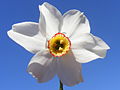 N. poeticus L. N. poeticus L. | ||
| Pseudonarcissus DC syn. Ajax Spach |  น. ซูโดนาร์ซิสซัสแอล. น. ซูโดนาร์ซิสซัสแอล. | |||
| Ganymedes Salisbury อดีต Schultes และ Schultes fil | 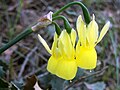 N. triandrus L. N. triandrus L. | |||
| Jonquillae De Candolle | จอนควิลเล่ ดีซี | 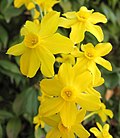 N. jonquilla L. N. jonquilla L. | ||
| อโปดันธี(อ. เฟอร์นันเดส) ดา เวบบ์ | 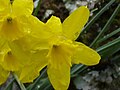 เอ็น. รูพิโคลาดูฟูร์ เอ็น. รูพิโคลาดูฟูร์ | |||
| คลอรานธีดี.เอ. เวบบ์ | 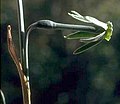 N. viridiflorus Schousboe N. viridiflorus Schousboe | |||
| Tapeinanthus (Herbert) Traub |  N. cavanillesii A. Barra และ G. López N. cavanillesii A. Barra และ G. López | |||
| เฮอร์ไมโอนี(ซอลส์เบอรี) สปาช | เฮอร์ไมโอนี่ซินทาเซตเตเดอ แคนดอลล์ | เฮอร์ไมโอนี่ | เฮอร์ไมโอนี่ | 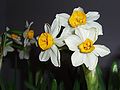 N. tazetta L. N. tazetta L. |
| Albiflorae Rouy. |  N. papyraceusเคอร์-กอว์เลอร์ N. papyraceusเคอร์-กอว์เลอร์ | |||
| Angustifoliae (เอ. เฟอร์นันเดส) FJ Fernándes-Casas |  N. elegans (Haw.) Spach N. elegans (Haw.) Spach | |||
| เซโรตินีปาร์ลาโตเร |  เอ็น. เซโรตินัสแอล. เอ็น. เซโรตินัสแอล. | |||
| ออเรเลีย(เจ. เกย์) เบเกอร์ |  N. broussonetii Lagasca N. broussonetii Lagasca | |||
| Corbularia (Salisb.) Pax syn. Bulbocodium De Candolle |  N. bulbocodium L. N. bulbocodium L. |
วิวัฒนาการทางสายพันธุ์
การวิเคราะห์เชิงวิวัฒนาการของ Graham และ Barrett (2004) สนับสนุนการแบ่งสกุลย่อยของNarcissusออกเป็นสองกลุ่มย่อยที่สอดคล้องกับสกุลย่อยของ Fernandes แต่ไม่สนับสนุนความเป็นกลุ่มเดียวของทุกส่วน[ 13 ]การวิเคราะห์เพิ่มเติมในภายหลังโดยRønsted et al. (2008) พร้อมด้วยกลุ่มอนุกรมวิธานเพิ่มเติมได้ยืนยันรูปแบบนี้[ 62 ]
การวิเคราะห์โมเลกุลขนาดใหญ่โดยZonneveld (2008) มุ่งที่จะลด พาราไฟลีบางส่วนที่ระบุโดย Graham และ Barrett ซึ่งนำไปสู่การแก้ไขโครงสร้างส่วน[ 53 ] [ 61 ] [ 63 ] ในขณะที่ Graham และ Barrett (2004) [ 13 ]ได้ระบุว่าสกุลย่อยHermioneเป็นโมโนฟิเลติก แต่ Santos-Gally et al. (2011) [ 61 ]ไม่ได้ระบุเช่นนั้น หากนำสองชนิดที่ถูกยกเว้นในการศึกษาก่อนหน้านี้ออกจากการวิเคราะห์ การศึกษาทั้งสองจะสอดคล้องกัน โดยชนิดที่กล่าวถึงจะก่อตัวเป็นกลุ่มกับสกุลย่อยNarcissus แทน มีการเสนอสิ่งที่เรียกว่า nothosections เพื่อรองรับลูกผสมตามธรรมชาติ ('โบราณ') (nothospecies) [ 63 ]
สายพันธุ์

การประมาณจำนวนชนิดของดอกนาร์ซิสซัสมีความแตกต่างกันอย่างมาก ตั้งแต่ 16 ถึงเกือบ 160 ชนิด[ 53 ] [ 57 ]แม้กระทั่งในยุคปัจจุบัน ลินเนียสได้รวมไว้ 6 ชนิดในปี 1753 ต่อมาในปี 1784 มี 14 ชนิด[ 64 ]และในปี 1819 มี 16 ชนิด [ 65 ]และในปี 1831 เอเดรียน ฮาวอร์ธได้อธิบายลักษณะของดอกนาร์ซิสซัสถึง 150 ชนิด[ 42 ]
ความแปรผันส่วนใหญ่เกิดจากนิยามของสปีชีส์ดังนั้น มุมมองที่กว้างมากของแต่ละสปีชีส์ เช่นของ Webb [ 14 ]ส่งผลให้มีสปีชีส์น้อย ในขณะที่มุมมองที่แคบมาก เช่นของ Fernandes [ 54 ]ส่งผลให้มีจำนวนสปีชีส์มากขึ้น[ 22 ]อีกปัจจัยหนึ่งคือสถานะของลูกผสมโดยมีการแบ่งแยกระหว่าง "ลูกผสมโบราณ" และ "ลูกผสมสมัยใหม่" คำว่า "ลูกผสมโบราณ" หมายถึงลูกผสมที่พบว่าเติบโตในพื้นที่กว้างใหญ่ และจึงถือว่าเป็นสปีชีส์ที่แยกจากกัน ในขณะที่ "ลูกผสมสมัยใหม่" หมายถึงพืชเดี่ยวที่พบอยู่ท่ามกลางพ่อแม่ โดยมีขอบเขตที่จำกัดกว่า[ 53 ]
เฟอร์นันเดส (1951) เดิมยอมรับ 22 ชนิด[ 56 ]เว็บบ์ (1980) 27 ชนิด[ 14 ]ภายในปี 1968 เฟอร์นันเดสมี 63 ชนิด[ 54 ]บลานชาร์ด (1990) 65 ชนิด[ 57 ]และเออร์ฮาร์ดต์ (1993) 66 ชนิด[ 66 ]ในปี 2006 ทะเบียนและรายการจำแนกประเภทดอกแดฟโฟดิลนานาชาติของสมาคมพืชสวนหลวง (RHS) [ 60 ] [ 67 ] [ 68 ]ระบุ 87 ชนิด ในขณะที่การศึกษาทางพันธุกรรมของซอนเนเวลด์ (2008) ส่งผลให้มีเพียง 36 ชนิด [ 53 ]ณ เดือนกันยายน 2014 รายการตรวจสอบวงศ์พืชที่เลือกของโลกยอมรับ 52 ชนิด พร้อมกับลูกผสมอย่างน้อย 60 ชนิด[ 69 ]ในขณะที่ RHS มีชื่อที่ยอมรับ 81 ชื่อในรายการเดือนตุลาคม 2014 [ 70 ]
วิวัฒนาการ
ภายในกลุ่มNarcisseaeนั้นNarcissus ( เมดิเตอร์เรเนียนตะวันตก ) แยกตัวออกจากSternbergia ( ยูเรเซีย ) ในช่วงปลายยุคโอลิโกซีนถึงต้นยุคไมโอซีน ประมาณ 29.3–18.1 ล้านปีก่อน ต่อมาสกุลนี้ได้แบ่งออกเป็นสองสกุลย่อย ( HermioneและNarcissus ) ระหว่าง 27.4 ถึง 16.1 ล้านปีก่อน การแบ่งแยกระหว่างส่วนต่างๆ ของHermioneเกิดขึ้นในช่วงยุคไมโอซีน 19.9–7.8 ล้านปีก่อน[ 61 ] ดูเหมือนว่า Narcissusจะเกิดขึ้นในบริเวณคาบสมุทรไอบีเรีย ทางตอนใต้ของฝรั่งเศส และทางตะวันตกเฉียงเหนือของอิตาลี ส่วนสกุลย่อยHermioneเกิดขึ้นในเมดิเตอร์เรเนียนตะวันตกเฉียงใต้และแอฟริกาตะวันตกเฉียงเหนือ[ 61 ]
ชื่อและที่มาของชื่อ
นาร์ซิสซัส


รากศัพท์ภาษาละตินnarcissus [ 71 ]มาจากภาษากรีกνάρκισσος narkissos [ 72 ] [ 73 ]ตามที่พลูตาร์ค กล่าวไว้ narkissos มีความเกี่ยวข้องกับคุณสมบัติในการทำให้มึนงงของพืชชนิดนี้ ร่วมกับnarkē ซึ่งหมายถึง "อาการชา" [ 72 ] [ 74 ] นอกจากนี้ ยังอาจมีความเกี่ยวข้องกับนรกด้วย[ 75 ] ในทางกลับกัน บีคส์ถือว่ารากศัพท์นี้มี ต้นกำเนิดมา จากภาษากรีก อย่างชัดเจน [ 76 ]
มักเชื่อมโยงกับตำนานของนาร์ซิสซัสผู้ซึ่งหลงใหลในภาพสะท้อนของตนเองในน้ำจนจมน้ำตาย และต้นนาร์ซิสซัสก็งอกขึ้นจากที่ที่เขาตาย ไม่มีหลักฐานว่าดอกไม้ชนิดนี้ได้รับการตั้งชื่อตามนาร์ซิสซัสนาร์ซิสซัส โพเอติคัสซึ่งเติบโตในกรีซ มีกลิ่นหอมที่ถูกอธิบายว่าทำให้มึนเมา[ 77 ]พลินีเขียนว่าพืชชนิดนี้ได้รับการตั้งชื่อตามกลิ่นหอม ( ναρκάω narkao , "ฉันรู้สึกชา") มากกว่านาร์ซิสซัส[ 24 ] [ 28 ] [ 78 ] [ 79 ] [ 80 ]ยิ่งไปกว่านั้นยังมีบันทึกเกี่ยวกับนาร์ซิสซัสที่เติบโตมานานก่อนที่เรื่องราวของนาร์ซิสซัสจะปรากฏขึ้น (ดูวัฒนธรรมกรีก ) [ 75 ] [ 81 ] [หมายเหตุ 2 ]ยังมีข้อเสนอแนะว่าดอกนาร์ซิสซัสที่โน้มตัวลงเหนือลำธารนั้นเป็นตัวแทนของชายหนุ่มที่ชื่นชมเงาสะท้อนของตนเอง[ 82 ]ลินเนียสใช้ชื่อภาษาละตินว่า "narcissus" สำหรับพืชชนิดนี้ แต่มีผู้อื่นที่ใช้ชื่อนี้มาก่อน เช่นมัทธิอัส เดอ โลเบล (1591) [ 83 ]และคลูเซียส (1576) [ 84 ]ชื่อนาร์ซิสซัสไม่ใช่ชื่อที่แปลกสำหรับผู้ชายในสมัยโรมัน
รูปแบบพหูพจน์ของชื่อสามัญ "narcissus" เป็นสาเหตุของความสับสนบางประการ พจนานุกรมระบุ "narcissi", "narcissuses" และ "narcissus" [ 77 ] [ 85 ] [ 86 ]อย่างไรก็ตาม ตำราเกี่ยวกับการใช้งาน เช่น Garner [ 87 ]และ Fowler [ 88 ]ระบุว่า "narcissi" เป็นรูปแบบที่นิยมใช้มากกว่า
ดอกแดฟโฟดิล
ชื่อ "daffodil" มาจาก "affodell" ซึ่งเป็นรูปแบบหนึ่งของasphodel [ 89 ] ดอกนาร์ซิ สซัสมักถูกเรียกว่า asphodel [ 78 ] (ดูAntiquity ) ส่วน asphodel นั้นดูเหมือนจะมาจากภาษากรีก "asphodelos" ( ภาษากรีกโบราณ : ἀσφόδελος ) [ 78 ] [ 90 ] [ 91 ] [ 92 ]ไม่ทราบสาเหตุของการเติม "d" ตัวแรก[ 93 ]อย่างน้อยตั้งแต่ศตวรรษที่ 16 เป็นต้นมา "daffadown dilly" และ "daffydowndilly" ได้ปรากฏขึ้นเป็นชื่อทางเลือก[ 77 ]ชื่ออื่นๆ ได้แก่ "Lent lily" [ 94 ] [ 95 ]
ในภาษาอื่นๆ
ชื่อ ภาษา ฮกเกี้ยนของดอกนาร์ซิสซั สคือ chúi-sianซึ่งสามารถแปลตรงตัวได้ว่า "นางฟ้าแห่งน้ำ" โดยที่chúi (水) หมายถึงน้ำ และsian (仙) หมายถึงอมตะเป็นดอกไม้ประจำมณฑลอย่างเป็นทางการของ ฝู เจี้ยน[ 96 ]
การกระจายตัวและถิ่นที่อยู่
การกระจาย

แม้ว่าวงศ์Amaryllidaceaeส่วนใหญ่จะอยู่ในเขตร้อนหรือกึ่งเขตร้อนโดยรวม แต่Narcissusพบได้เป็นหลักในภูมิภาคเมดิเตอร์เรเนียนโดยมีศูนย์กลางความหลากหลายอยู่ที่คาบสมุทรไอบีเรีย (สเปนและโปรตุเกส) [ 22 ]บางชนิดขยายขอบเขตไปถึงทางตอนใต้ของฝรั่งเศสอิตาลีบอลข่าน ( N. poeticus , N. serotinus , N. tazetta ) และเมดิเตอร์เรเนียนตะวันออก ( N. serotinus ) [ 22 ] [ 6 ]รวมถึงอิสราเอลและปาเลสไตน์ ( N. tazetta ) [ 13 ] [ 24 ]การพบN. tazettaในเอเชียตะวันตกและเอเชียกลาง รวมถึงเอเชียตะวันออก ถือเป็นการนำเข้ามาแม้ว่าจะเก่าแก่ก็ตาม[ 6 ] (ดูวัฒนธรรมตะวันออก ) ในขณะที่ขอบเขตทางเหนือที่แน่นอนของช่วงการกระจายตัวตามธรรมชาติยังไม่เป็นที่ทราบแน่ชัด การพบN. pseudonarcissus ป่า ในสหราชอาณาจักร ยุโรปตอนกลางและตอนเหนือ ก็ถือเป็นการนำเข้ามาในสมัยโบราณเช่นกัน[ 22 ] [ 97 ] [ 98 ]
แม้ว่า Amaryllidaceae จะไม่ใช่พืชพื้นเมืองของอเมริกาเหนือ แต่Narcissusก็เจริญเติบโตได้ดีในเขตความทนทาน ของ USDA โซน 3B ถึง 10 ซึ่งครอบคลุมพื้นที่ส่วนใหญ่ของสหรัฐอเมริกาและแคนาดา[ 99 ]
N. elegansพบได้ตามชายฝั่งตะวันตกเฉียงเหนือของแอฟริกา (โมร็อกโกและลิเบีย) รวมถึงชายฝั่งของคอร์ซิกาซาร์ดิเนีย และอิตาลี และ N. bulbocodiumพบระหว่างเมืองแทนเจียร์และแอลเจียร์และจากแทนเจียร์ถึงมาราเกชแต่ยังพบในคาบสมุทรไอบี เรียด้วย N. serotinusพบได้ตลอดแนวชายฝั่งทะเลเมดิเตอร์เรเนียน N. tazettaพบได้ไกลถึงทางตะวันออกในอิหร่านและแคชเมียร์เนื่องจากเป็นหนึ่งในสายพันธุ์ที่เก่าแก่ที่สุดที่พบในการเพาะปลูก จึงเป็นไปได้ว่าถูกนำเข้าไปในแคชเมียร์ N. poeticusและ N. pseudonarcissusมีช่วงการกระจายพันธุ์ที่กว้างที่สุด N. poeticus มี ช่วงการกระจายพันธุ์ตั้งแต่เทือกเขาพิเรนีสไปตามเทือกเขาคาร์พาเทียนของโรมาเนียจนถึงทะเลดำและไปตามชายฝั่งดัลมาเชียจนถึงกรีซ N. pseudonarcissus มีช่วงการกระจายพันธุ์ ตั้งแต่คาบสมุทรไอบีเรีย ผ่านเทือกเขาโวสเกสไปยังทางตอนเหนือของฝรั่งเศสและเบลเยียม และสหราชอาณาจักร ซึ่งยังมีประชากรป่าอยู่ในทางตอนใต้ของสกอตแลนด์ การพบเพียงครั้งเดียวในลักเซมเบิร์กตั้งอยู่ใกล้กับเลลลิงเงน ในเขตเทศบาลคีชเปลต์ในเยอรมนีพบได้ส่วนใหญ่ในเขตอนุรักษ์ธรรมชาติที่เพอร์เลนบัค-ฟูร์ทสบัคทาลและอุทยานแห่งชาติไอเฟลซึ่งในฤดูใบไม้ผลิที่มอนส์เชาทุ่งหญ้าจะเต็มไปด้วยดอกไม้สีเหลือง [ 100 ]การพบทางตะวันออกสุดครั้งหนึ่งสามารถพบได้ที่มิสเซลเบิร์กใกล้กับนัสเซาบนแม่น้ำลาห์น

อย่างไรก็ตาม ต่างจากตัวอย่างข้างต้น สปีชีส์ส่วนใหญ่มีขอบเขตเฉพาะถิ่น ที่จำกัดมาก [ 61 ] [ 101 ]ซึ่งอาจทับซ้อนกันส่งผลให้เกิดลูกผสมตามธรรมชาติ[ 53 ]ตัวอย่างเช่น ในบริเวณใกล้เคียงเมืองปอร์โต ประเทศโปรตุเกส ซึ่งทั้งN. pseudonarcissusและN. triandrusอาศัยอยู่ พบว่ามีการผสมข้ามสายพันธุ์ของทั้งสองชนิดในหลายพื้นที่ ขณะที่ในพื้นที่เล็กๆ ตามแนวแม่น้ำมอนเดโกของโปรตุเกส พบลูกผสมข้ามสายพันธุ์ระหว่างN. scaberulusและN. triandrus
ภูมิศาสตร์ชีวภาพแสดงให้เห็นถึง ความสัมพันธ์ ทางวิวัฒนาการตัวอย่างเช่น สกุลย่อยHermioneมีการกระจายตัวในที่ราบต่ำ แต่สกุลย่อยNarcissusส่วนApodanthiเป็นพืชภูเขาและจำกัดอยู่ในโมร็อกโก สเปน และโปรตุเกส ส่วนอื่นๆ ภายในสกุลย่อยNarcissusมีทั้งถิ่นที่อยู่ที่ราบต่ำและบนภูเขา[ 61 ]ส่วนPseudonarcissusแม้ว่าจะแพร่กระจายไปในธรรมชาติอย่างกว้างขวาง แต่ก็เป็นพืชเฉพาะถิ่นในเทือกเขา Baeticทางตะวันออกเฉียงใต้ของคาบสมุทรไอบีเรีย[ 18 ]
แหล่งที่อยู่อาศัย
ถิ่น ที่อยู่ตามธรรมชาติของพวกมันมีความหลากหลายมาก มีระดับความสูงพื้นที่ทางชีวภูมิอากาศและพื้นผิว ที่แตกต่างกัน [ 61 ] โดย ส่วนใหญ่พบในพื้นที่เปิดโล่งตั้งแต่หนองน้ำ ต่ำ ไปจนถึงเนินเขาหินและทุ่งหญ้าบนภูเขา รวมถึง ทุ่ง หญ้าพุ่มไม้ป่าไม้ริมฝั่งแม่น้ำและ รอยแตก ของหิน[ 13 ] [ 24 ]แม้ว่าความต้องการจะแตกต่างกัน แต่โดยรวมแล้วพวกมันชอบ ดิน ที่เป็นกรดแม้ว่าบางชนิดจะเติบโตบนหินปูนได้ก็ตามNarcissus scaberulusจะเติบโตบน ดิน หินแกรนิตที่มีความชื้นในฤดูปลูก แต่แห้งในฤดูร้อน ในขณะที่Narcissus dubiusเจริญเติบโตได้ดีที่สุดในภูมิภาคที่มีฤดูร้อนที่ร้อนและแห้ง
กลุ่มPseudonarcissusในถิ่นที่อยู่ตามธรรมชาติชอบสภาพแวดล้อมที่ชื้น เช่น ริมลำธาร บ่อน้ำ ทุ่งหญ้าเปียก พื้นที่โล่งในป่าหรือพุ่มไม้ที่มีดินชื้น และเนินเขาชื้น ถิ่นที่อยู่เหล่านี้มักไม่ต่อเนื่องกันในเทือกเขาเมดิเตอร์เรเนียน ทำให้เกิดประชากรที่แยกตัวออกจากกัน[ 18 ]ในประเทศเยอรมนีซึ่งมีหินปูนค่อนข้างน้อยNarcissus pseudonarcissusเติบโตเป็นกลุ่มเล็กๆ บนทุ่งหญ้าบนภูเขาโล่งหรือในป่าผสมของต้นสน ต้นบีช ต้นโอ๊กต้นอัลเดอร์ ต้นแอชและต้นเบิร์ชที่มีดินระบายน้ำได้ดี
นิเวศวิทยา
วงจรชีวิต
นาร์ซิสซัสเป็นพืชหัวใต้ดินยืนต้นที่มีอายุยืนยาว มีหัวที่เจริญเติบโตในฤดูหนาวและพักตัวในฤดูร้อน[ 18 ]ซึ่งส่วนใหญ่เป็นแบบซินแนนทัส (ใบและดอกปรากฏพร้อมกัน) [ 6 ]ในขณะที่สายพันธุ์ส่วนใหญ่จะออกดอกในช่วงปลายฤดูหนาวถึงฤดูใบไม้ผลิ แต่มีห้าสายพันธุ์ที่ออกดอกในฤดูใบไม้ร่วง ( N. broussonetii , N. cavanillesii , N. elegans , N. serotinus , N. viridiflorus ) [ 13 ]ในทางตรงกันข้าม สายพันธุ์เหล่านี้เป็นแบบฮิสเทอแรนทัส (ใบปรากฏหลังจากดอกบาน) [ 6 ]
อายุการออกดอกแตกต่างกันไปตามชนิดและสภาพแวดล้อม โดยมีช่วงตั้งแต่ 5–20 วัน[ 102 ]หลังจากออกดอกแล้ว ใบและราก จะเริ่ม แก่ตัวลง และพืชจะดูเหมือน 'พักตัว' จนถึงฤดูใบไม้ผลิถัดไป เพื่อรักษาความชุ่มชื้น อย่างไรก็ตาม ช่วงเวลาพักตัวนี้ยังเป็นช่วงเวลาที่มีกิจกรรมมากมายภายในหัวอ่อนของพืช นอกจากนี้ ยังเป็นช่วงเวลาที่หัวของพืชอาจอ่อนแอต่อผู้ล่าเช่นเดียวกับพืชหัวหลายชนิดจาก เขต อบอุ่นจำเป็นต้องมีช่วงเวลาที่สัมผัสกับความเย็นก่อนที่การเจริญเติบโตในฤดูใบไม้ผลิจะเริ่มต้นขึ้น ซึ่งจะช่วยปกป้องพืชจากการเจริญเติบโตในช่วงฤดูหนาวเมื่อความเย็นจัดอาจทำให้เสียหายได้ จากนั้นอุณหภูมิที่อบอุ่นขึ้นในฤดูใบไม้ผลิจะกระตุ้นการเจริญเติบโตจากหัว การเจริญเติบโตในช่วงต้นฤดูใบไม้ผลิมีข้อดีหลายประการ รวมถึงการแข่งขันกับแมลงผสมเกสร น้อยลง และไม่มี ร่มเงา จากไม้ผลัดใบ [ 6 ]ข้อยกเว้นที่ไม่ต้องการอุณหภูมิเย็นเพื่อเริ่มต้นการออกดอกคือN. tazetta [ 7 ]
พืชอาจขยายพันธุ์แบบโคลนโดยการสร้างหัวลูกและการแบ่งตัว ทำให้เกิดกอ[ 18 ]พันธุ์นาร์ซิสซัสผสมพันธุ์กันได้ง่าย แม้ว่าความอุดมสมบูรณ์ของลูกหลานจะขึ้นอยู่กับความสัมพันธ์ของพ่อแม่ก็ตาม[ 24 ]
การผสมเกสร
ดอกไม้ได้รับการผสมเกสรโดยแมลง โดยแมลงผสมเกสรหลักได้แก่ผึ้งผีเสื้อแมลงวันและผีเสื้อกลางคืน ในขณะที่ N. viridiflorus ซึ่งมีกลิ่นหอมมากและออกดอกในเวลากลางคืนจะได้รับการผสมเกสรโดย ผีเสื้อกลางคืนที่ออกหากิน ในเวลาพลบค่ำกลไกการผสมเกสรแบ่งออกเป็นสามกลุ่มตามลักษณะทางสัณฐานวิทยาของดอกไม้ (ดูคำอธิบาย - ดอกไม้ ) [ 102 ]
- รูปแบบของดอกแดฟโฟดิล ได้รับการผสมเกสรโดยผึ้งที่หาละอองเกสรจากอับเรณูภายในกลีบดอกชั้นใน กลีบดอกที่กว้างช่วยให้ผึ้ง ( Bombus , Anthophora , Andrena ) สามารถเข้าไปในดอกได้อย่างเต็มที่เพื่อค้นหาน้ำหวานและ/หรือละอองเกสร ในชนิดนี้ เกสรตัวเมียจะอยู่ตรงปากกลีบดอกชั้นใน ยื่นออกมาเหนืออับเรณูทั้งหกอัน ซึ่งเรียง ตัวเป็นวงเดียว อยู่ภายในกลีบดอกชั้นใน ผึ้งจะสัมผัสกับเกสรตัวเมียก่อนที่ขา อก และท้องของมันจะสัมผัสกับอับเรณู และลักษณะการผสมเกสร แบบนี้ ทำให้เกิดการผสมข้ามพันธุ์
- รูปทรง 'กระดาษขาว' ลักษณะนี้ปรับตัวให้เข้ากับผีเสื้อ ที่มีลิ้นยาว โดยเฉพาะผีเสื้อกลางคืนวงศ์ Sphingidaeเช่นMacroglossum , PieridaeและNymphalidae แต่ก็รวมถึงผึ้งและ แมลงวันที่มีลิ้นยาวบางชนิดด้วยซึ่งทั้งหมดนี้ต่างก็แสวงหาน้ำหวาน เป็นหลัก ท่อแคบๆ นั้นยอมให้เฉพาะ งวงของแมลงเข้าไปได้ ในขณะที่ส่วนโคโรนาที่สั้นทำหน้าที่เหมือนกรวยนำปลายงวงเข้าไปในปากของท่อกลีบดอก เกสรตัวเมียจะอยู่ตรงปากของท่อ เหนืออับเรณูสองวงที่มีสามอัน หรือซ่อนอยู่ต่ำกว่าอับเรณู จากนั้นแมลงผสมเกสรจะนำละอองเรณูติดไปกับงวงหรือใบหน้า ผึ้งที่มีลิ้นยาวไม่สามารถเข้าถึงน้ำหวานที่ฐานของท่อได้ จึงเก็บได้เพียงละอองเรณูเท่านั้น
- รูปแบบ 'Triandrus' ได้รับการผสมเกสรโดยผึ้งเดี่ยวลิ้นยาว ( Anthophora , Bombus ) ซึ่งหาทั้งเกสรและน้ำหวาน กลีบดอกขนาดใหญ่ช่วยให้ผึ้งคลานเข้าไปในกลีบดอกได้ แต่ท่อแคบๆ จะขัดขวางการคืบหน้า ทำให้ผึ้งต้องเจาะลึกเข้าไปหาน้ำหวาน ดอกไม้ที่ห้อยลงมาป้องกันการผสมเกสรโดยผีเสื้อ ในN. albimarginatusอาจมีเกสรตัวเมียยาวและอับเรณูสั้นและยาวปานกลาง หรือเกสรตัวเมียสั้นและอับเรณูยาว ( ภาวะสองรูปแบบ ) ในN. triandrusมีรูปแบบของอวัยวะสืบพันธุ์สามแบบ (ภาวะสามรูปแบบ) แต่ทั้งหมดมีอับเรณูบนที่ยาว แต่แตกต่างกันในตำแหน่งของเกสรตัวเมียและความยาวของอับเรณูล่าง[ 13 ] [ 17 ]
โดยทั่วไปแล้ว การผสมข้ามพันธุ์ ( การผสมข้าม ) จะถูกบังคับผ่านระบบ การไม่เข้ากันเองแบบออกฤทธิ์ช้า ( รังไข่ ) แต่บางสายพันธุ์ เช่นN. dubiusและN. longispathusสามารถผสมพันธุ์เองได้ ทำให้เกิดเมล็ดผสมระหว่างเมล็ดที่ผสมพันธุ์เองและเมล็ดที่ผสมข้ามพันธุ์[ 19 ] [ 17 ]
ศัตรูพืชและโรค
โรคของดอกนาร์ซิสซัสเป็นเรื่องที่น่ากังวลเนื่องจากส่งผลกระทบทางเศรษฐกิจจากการสูญเสียในการเพาะปลูกเชิงพาณิชย์ ศัตรูพืช ได้แก่ ไวรัส แบคทีเรีย และเชื้อรา รวมถึงแมลงและหอยทาก สำหรับวิธีการควบคุมศัตรูพืช โปรดดูที่หัวข้อการใช้ประโยชน์เชิงพาณิชย์
เพลี้ยอ่อนเช่นMacrosiphum euphorbiaeสามารถแพร่กระจาย โรค ไวรัสที่ส่งผลต่อสีและรูปร่างของใบได้ เช่นเดียวกับไส้เดือนฝอย [ 103 ] มีการอธิบายไวรัสมากถึง 25 ชนิดว่าสามารถติดเชื้อในดอกนาร์ซิสซัสได้[ 104 ] [ 105 ] [ 106 ]ซึ่งรวมถึงไวรัสแฝงทั่วไปของนาร์ซิสซัส (NCLV, ไวรัสที่เกี่ยวข้องกับลายด่างของนาร์ซิสซัส[ 107 ] ), [หมายเหตุ 3 ]ไวรัสแฝงของนาร์ซิสซัส (NLV, ไวรัสลายด่างอ่อนของนาร์ซิสซัส[ 107 ] ) ซึ่งทำให้เกิดลายด่างสีเขียวใกล้ปลายใบ, [ 108 ] [ 109 ]ไวรัสเสื่อมสภาพของนาร์ซิสซัส (NDV), [ 110 ]ไวรัสใบเหลืองปลายฤดูของนาร์ซิสซัส (NLSYV) ซึ่งเกิดขึ้นหลังดอกบาน ทำให้เกิดลายบนใบและลำต้น, [ 111 ] [ 112 ]ไวรัสโมเสกของนาร์ซิสซัส , ไวรัสลายเหลืองของนาร์ซิส ซัส (NYSV, ไวรัสลายเหลืองของนาร์ซิสซั ส [ 107 ] ), ไวรัสเนื้อตายปลายใบของนาร์ซิสซัส (NTNV) ซึ่งทำให้เกิดเนื้อตาย ของปลายใบหลังดอกบาน[ 113 ]และไวรัสลายขาวนาร์ซิสซัส (NWSV) [ 114 ]
ไวรัสที่มีความจำเพาะต่อโฮสต์น้อยกว่า ได้แก่ไวรัสจุดวงแหวนราสเบอร์รี่ , ไวรัสแฝง เนริน (NeLV) = ไวรัสไร้อาการนาร์ซิสซัส[ 115 ] ไวรัสโมเสกอาราบิส (ArMV), [ 116 ]ไวรัสเหี่ยวถั่วปากอ้า ( BBWV) [ 117 ] ไวรัสโมเสกแตงกวา (CMV) , ไวรัสวงแหวนดำมะเขือเทศ (TBRV), ไวรัสจุดวงแหวนมะเขือเทศ (TomRSV) และไวรัสสั่นยาสูบ (TRV) [ 117 ] [ 114 ]
ในบรรดาไวรัสเหล่านี้ ไวรัสที่ร้ายแรงและแพร่หลายที่สุด ได้แก่ NDV, NYSV และ NWSV [ 114 ] [ 105 ] NDV เกี่ยวข้องกับ อาการใบ เหลืองเป็นแถบในN. tazetta [ 110 ] การติดเชื้อ NYSV ทำให้เกิดแถบหรือจุดสีเขียวอมเทาหรือสีเหลืองบนส่วนบนสองในสามของใบ ซึ่งอาจมีลักษณะขรุขระหรือบิดเบี้ยว ดอกไม้ซึ่งอาจมีขนาดเล็กกว่าปกติก็อาจมีแถบหรือจุดด่างได้เช่นกัน NWSV ทำให้เกิดแถบสีม่วงอมเขียวบนใบและลำต้นที่เปลี่ยนเป็นสีขาวถึงเหลือง และการแก่ก่อนวัยทำให้ขนาดหัวและผลผลิตลดลง[ 104 ]ไวรัสเหล่านี้ส่วนใหญ่เป็นโรคของเรือนเพาะชำเชิงพาณิชย์ การยับยั้งการเจริญเติบโตที่เกิดจากการติดเชื้อไวรัสอาจก่อให้เกิดความเสียหายทางเศรษฐกิจอย่างมาก[ 118 ] [ 119 ] [ 120 ]
- แบคทีเรีย
โรคที่เกิด จากแบคทีเรียนั้นพบได้ไม่บ่อยในดอกนาร์ซิสซัสแต่รวมถึงPseudomonas (โรคใบไหม้จากแบคทีเรีย) และPectobacterium carotovorum sp. carotovorum (โรคเน่าอ่อนจากแบคทีเรีย) [ 114 ]
- เชื้อรา
ปัญหาที่ร้ายแรงกว่าสำหรับพืชที่ไม่ใช่เชิงพาณิชย์คือเชื้อราFusarium oxysporum f. sp. narcissiซึ่งทำให้เกิดโรคเน่าที่โคนต้น (เน่าของหัวและใบเหลือง) นี่เป็นโรคที่ร้ายแรงที่สุดของนาร์ซิสซัสเนื่องจากเชื้อราสามารถคงอยู่ในดินได้หลายปี จึงจำเป็นต้องกำจัดพืชที่ติดเชื้อออกทันที และหลีกเลี่ยงการปลูกนาร์ซิสซัสเพิ่มเติมในจุดนั้นเป็นเวลาอีกห้าปี ไม่ใช่ทุกสายพันธุ์และพันธุ์จะมีความอ่อนแอเท่ากัน สายพันธุ์ที่ค่อนข้างต้านทาน ได้แก่N. triandrus , N. tazettaและN. jonquilla [ 121 ] [ 114 ] [ 122 ] [ 123 ]
เชื้อราอีกชนิดหนึ่งที่โจมตีหัวดอกไม้ ทำให้เกิดโรคเน่าดำของดอกนาร์ซิสซัส คือBotrytis narcissicola ( Sclerotinia narcissicola ) และ Botrytisชนิดอื่นๆรวมถึงBotrytis cinerea [ 124 ] [ 125 ] โดยเฉพาะอย่างยิ่งหากเก็บรักษาไม่ถูกต้อง มีการใช้คอปเปอร์ซัลเฟตเพื่อต่อต้านโรคนี้ และหัวดอกไม้ที่ติดเชื้อจะถูกเผา โรคเน่าสีน้ำเงินของหัวดอกไม้ อาจเกิดจากการติดเชื้อPenicillium ชนิดต่างๆ หากหัวดอกไม้ได้รับความเสียหายจากการบาดเจ็บทางกลหรือการรุกรานของไร (ดูด้านล่าง) [ 126 ] Rhizopusชนิดต่างๆ( เช่นRhizopus stolonifer , Rhizopus nigricans ) ทำให้เกิดโรคเน่าอ่อนของหัวดอกไม้[ 119 ] [ 127 ]และSclerotinia bulborum ทำให้ เกิดโรคเมือกดำ[ 128 ]การรวมกันของทั้งPeyronellaea curtisii ( Stagonosporopsis curtisii ) และBotrytis narcissicolaทำให้เกิดโรคเน่าที่คอของหัว[ 114 ]
เชื้อราที่ส่งผลต่อราก ได้แก่Nectria radicicola ( Cylindrocarpon destructans ) ซึ่งเป็นสาเหตุของโรครากเน่า[ 128 ]และRosellinia necatrixที่ทำให้เกิดโรครากเน่าสีขาว[ 129 ]ในขณะที่เชื้อราอื่นๆ ส่งผลต่อรากและหัว เช่นAspergillus niger (ราดำ) และเชื้อราสกุลTrichodermaรวมถึงT. virideและT. harzianum (= T. narcissi ) ซึ่งเป็นสาเหตุของราเขียว[ 127 ]
เชื้อราอื่นๆ ส่งผลกระทบต่อส่วนที่เหลือของพืชเชื้อราBotrytis อีกชนิดหนึ่งคือ Botrytis polyblastis ( Sclerotinia polyblastis ) ทำให้เกิดจุดสีน้ำตาลบนดอกตูมและลำต้น (โรคไฟไหม้ดอกนาร์ซิสซัส) โดยเฉพาะอย่างยิ่งในสภาพอากาศชื้น และเป็นภัยคุกคามต่ออุตสาหกรรมดอกไม้ตัด[ 130 ] [ 131 ] Ramularia vallisumbrosaeเป็นเชื้อราที่ทำให้เกิดจุดบนใบ พบได้ในสภาพอากาศที่อบอุ่นกว่า ทำให้เกิดโรคราขาวบนดอกนาร์ซิสซัส[ 132 ] Peyronellaea curtisiiซึ่งเป็นสาเหตุของโรคใบไหม้ดอกนาร์ซิสซัส ก็ส่งผลกระทบต่อใบเช่นกัน[ 118 ] [ 119 ] [ 133 ] [ 134 ] [ 135 ]เช่นเดียวกับเชื้อราในกลุ่มเดียวกันPhoma narcissi ( โรคใบไหม้ปลายใบ) [ 136 ] [ 114 ] Aecidium narcissiทำให้เกิด แผล สนิมบนใบและลำต้น[ 128 ]
- สัตว์
สัตว์ขาปล้องที่เป็น ศัตรูพืชของ นาร์ซิสซัสได้แก่ แมลง เช่นแมลงวัน สามชนิด ที่มีตัวอ่อนที่โจมตีพืช แมลงวันหัวนาร์ซิสซัสMerodon equestrisและแมลงวันดอกไม้ สองชนิด คือ แมลงวันหัวนาร์ซิสซัส Eumerus tuberculatus [ 137 ]และEumerus strigatusแมลงวันเหล่านี้วางไข่ในช่วงปลายเดือนมิถุนายนในดินรอบๆ ดอกนาร์ซิสซัส โดยแมลงวันตัวเมียหนึ่งตัวสามารถวางไข่ได้มากถึงห้าสิบฟองตัวอ่อนที่ ฟักออกมา จะขุดลงไปในดินไปยังหัวและกินส่วนภายใน จากนั้นพวกมันจะจำศีลในเปลือกหัวที่ว่างเปล่า และออกมาในเดือนเมษายนเพื่อเข้าดักแด้ในดิน จากนั้นแมลงวันตัวเต็มวัยจะออกมาในเดือนพฤษภาคม[ 118 ] [ 138 ]ตัวอ่อนของผีเสื้อกลางคืน บางชนิด เช่นKorscheltellus lupulina (ผีเสื้อกลางคืนชนิด Common Swift Moth) ก็โจมตีหัวนาร์ซิสซัส เช่นกัน [ 139 ] [ 118 ]
สัตว์ขาปล้องอื่นๆ ได้แก่ไรเช่นSteneotarsonemus laticeps (ไรเกล็ดหัว) [ 140 ] RhizoglyphusและHistiostomaส่วนใหญ่จะเข้าทำลายหัวที่เก็บไว้และขยายพันธุ์ได้ดีโดยเฉพาะที่อุณหภูมิแวดล้อมสูง แต่จะไม่โจมตีหัวที่ปลูก[ 118 ]
หัวที่ปลูกมีความเสี่ยงต่อไส้เดือนฝอยโดยไส้เดือนฝอยที่ร้ายแรงที่สุดคือDitylenchus dipsaci (ไส้เดือนฝอยนาร์ซิสซัส) ซึ่งเป็นสาเหตุหลักของโรคโคนใบ[ 141 ]ซึ่งทำให้ใบเปลี่ยนเป็นสีเหลืองและผิดรูป หัวที่ติดเชื้อต้องถูกทำลาย หากมีการระบาดอย่างรุนแรง ควรหลีกเลี่ยงการปลูกนาร์ซิสซัสเพิ่มเติมอีกเป็นเวลาห้าปี[ 118 ] [ 142 ] [ 143 ] [ 144 ]ไส้เดือนฝอยชนิดอื่น ๆ ได้แก่Aphelenchoides subtenuisซึ่งแทรกซึมเข้าไปในรากทำให้เกิดโรคโคนใบ[ 141 ] [ 145 ]และPratylenchus penetrans (ไส้เดือนฝอยแผล) ซึ่งเป็นสาเหตุหลักของโรครากเน่าในนาร์ซิสซัส[ 146 ] [ 114 ]ไส้เดือนฝอยชนิดอื่นๆ เช่น ไส้เดือน ฝอยชนิด Longodorids ( Longidorus spp. หรือไส้เดือนฝอยเข็ม และXiphinema spp. หรือไส้เดือนฝอยมีดสั้น) และไส้เดือนฝอยชนิด Stubby-root หรือTrichodorids ( Paratrichodorus spp. และTrichodorus spp.) ยังสามารถทำหน้าที่เป็นพาหะนำโรคไวรัส เช่น TBRV และ TomRSV นอกเหนือจากการทำให้รากแคระแกร็น[ 103 ] [ 145 ]
หอยทากและทากยังก่อให้เกิดความเสียหายต่อการเจริญเติบโตอีกด้วย[ 118 ] [ 119 ] [ 114 ]
การอนุรักษ์
หลายชนิดที่มีขนาดเล็กที่สุดได้สูญพันธุ์ไปแล้ว จึงจำเป็นต้องมีการเฝ้าระวังในการอนุรักษ์พันธุ์ไม้ป่า[ 6 ] [ 24 ] [ 78 ] [ 147 ]นาร์ซิสซัสกำลังถูกคุกคามมากขึ้นเรื่อยๆ จากการเก็บเกี่ยวมากเกินไปและภัยคุกคามต่อถิ่นที่อยู่ตามธรรมชาติจากการพัฒนาเมืองและการท่องเที่ยวN. cyclamineusเคยถูกพิจารณาว่าสูญพันธุ์ไปแล้วหรือหายากมาก[ 22 ]แต่ปัจจุบันยังไม่ถือว่าใกล้สูญพันธุ์ และได้รับการคุ้มครอง[ 148 ]บัญชีแดงของ IUCN ระบุว่ามี 5 ชนิดที่ ' ใกล้สูญพันธุ์ ' ( Narcissus alcaracensis , Narcissus bujei , Narcissus longispathus , Narcissus nevadensis , Narcissus radinganorum ) ในปี 1999 มี 3 ชนิดที่ถูกพิจารณาว่าใกล้สูญพันธุ์ 5 ชนิดอยู่ในภาวะเสี่ยง และ 6 ชนิดอยู่ในภาวะหายาก[ 6 ]
เพื่อตอบสนองต่อสถานการณ์ดังกล่าว จึงมีการออกกฎหมายคุ้มครองพันธุ์ไม้หลายชนิด และจัดตั้งพื้นที่คุ้มครอง (ทุ่งหญ้า) ขึ้น เช่นทุ่งดอกแดฟโฟดิลเนกราซีในโรมาเนีย หรือทุ่งดอกแดฟโฟดิลเคมเพลย์ในสหราชอาณาจักร พื้นที่เหล่านี้มักจัดงานเทศกาลดอกแดฟโฟดิลในช่วงฤดูใบไม้ผลิ
การเพาะปลูก
ประวัติศาสตร์
Magna cura ผู้ไม่ยากจน Narcissiการเพาะปลูกที่ง่ายที่สุดคือ Narcissus
— Peter Lauremberg , Apparatus plantarius: de plantis bulbosis และ plantis tuberosis 1632 [ 149 ]
 N. serotinus , John Gerard , The Herball 1597
 นาร์ซิสซี, Hortus Eystettensis 1613
 N. poeticus , Thomas Hale , Eden: Or, a Compleat Body of Gardening 1757
 นาร์ซิสซัส, ปีเตอร์ ลอเรมเบิร์ก 1632
 นาร์ซิสซัส, จอห์น พาร์กินสัน , Paradisus Terrestris 1629. (8. ดอกแดฟโฟดิลสเปนสีเหลืองกลีบซ้อนขนาดใหญ่)


ในบรรดาพืชดอกทั้งหมด พืชหัวเป็นที่นิยมในการเพาะปลูกมากที่สุด[ 150 ]ในบรรดาพืชหัวเหล่านี้ ดอกนาร์ซิสซัสเป็นหนึ่งในพืชหัวที่ออกดอกในฤดูใบไม้ผลิที่สำคัญที่สุดในโลก[ 151 ] [ 10 ]มีถิ่นกำเนิดในยุโรป ประชากรป่าของสายพันธุ์ดั้งเดิมเป็นที่รู้จักกันมาตั้งแต่สมัยโบราณดอกนาร์ซิสซัสได้รับการเพาะปลูกอย่างน้อยที่สุดตั้งแต่ศตวรรษที่ 16 ในเนเธอร์แลนด์ เมื่อมีการนำเข้าหัวจำนวนมากจากแหล่งเพาะปลูก โดยเฉพาะอย่างยิ่งNarcissus hispanicusซึ่งในไม่ช้าก็เกือบจะสูญพันธุ์ในถิ่นกำเนิดของมันในฝรั่งเศสและสเปน แม้ว่าจะยังคงพบได้ในภาคใต้ของประเทศนั้น[ 152 ]การผลิตขนาดใหญ่เพียงอย่างเดียวในเวลานั้นเกี่ยวข้องกับดอกนาร์ซิสซัสกลีบซ้อน "Van Sion" และพันธุ์ต่างๆ ของN. tazettaที่นำเข้าในปี 1557 [ 153 ]
มีการบันทึกการเพาะปลูกในสหราชอาณาจักรในช่วงเวลานี้เช่นกัน[ 154 ] [ 155 ] [ 156 ]แม้ว่าบันทึกร่วมสมัยจะแสดงให้เห็นว่าเป็นที่รู้จักกันดีว่าเป็นดอกไม้สวนและดอกไม้ป่าที่ได้รับความนิยมมานานก่อนหน้านั้น และถูกนำมาใช้ทำพวงมาลัย[ 157 ] นี่เป็นช่วงเวลาที่การพัฒนาสวนและอุทยานแบบทางการที่แปลกใหม่กำลังได้รับความนิยม โดยเฉพาะอย่างยิ่งในสิ่งที่เรียกว่า "ยุคตะวันออก" (1560–1620) ในHortus Medicus (1588) ซึ่งเป็นแคตตาล็อกแรกของพืชในสวนเยอรมัน[ 158 ]โยอาคิม คาเมราเรียส ผู้เยาว์ระบุว่ามีดอกแดฟโฟดิลถึงเก้าชนิดที่แตกต่างกันในสวนของเขาในนูเรมเบิร์ก [ 159 ] หลังจากที่เขาเสียชีวิตในปี 1598 พืชของเขาถูกย้ายโดยบาซิลิอุส เบสเลอร์ไปยังสวนที่พวกเขาออกแบบไว้ที่วิลลิบัลด์สบู ร์ ก พระราชวังของบิชอปที่ไอช์สเตทท์ บาวาเรียตอนบน สวนดังกล่าวได้รับการอธิบายไว้ในHortus Eystettensis ของ Besler (1613) ซึ่งในเวลานั้นมีพันธุ์ที่แตกต่างกันถึง 43 ชนิด[ 160 ]แหล่งข้อมูลภาษาเยอรมันอีกแหล่งหนึ่งในเวลานั้นคือPeter Laurembergซึ่งได้บันทึกเกี่ยวกับพันธุ์ที่เขารู้จักและการเพาะปลูกไว้ในApparatus plantarius: de plantis bulbosis et de plantis tuberosis (1632) [ 161 ]
แม้ว่าดอกแดฟโฟดิลของเชกสเปียร์ จะเป็นดอกแดฟโฟดิลป่าหรือดอกแดฟโฟดิลอังกฤษแท้ ( N. pseudonarcissus ) [ 157 ]แต่ก็มีการนำสายพันธุ์อื่นๆ เข้ามาอีกหลายชนิด ซึ่งบางชนิดหลุดรอดและแพร่กระจายไปตามธรรมชาติ โดยเฉพาะN. biflorus (ลูกผสม) ในเดวอนและทางตะวันตกของอังกฤษ[ 162 ] เจอ ราร์ดในการอภิปรายอย่างละเอียดเกี่ยวกับดอกแดฟโฟดิล ทั้งแบบป่าและแบบปลูก ("ดอกแดฟโฟดิลลูกผสม") ได้อธิบายถึง 24 สายพันธุ์ในสวนลอนดอน (1597) [ 162 ] [ 163 ] [ 164 ] ("เรามีพวกมันทั้งหมดและทุกสายพันธุ์ในสวนลอนดอนของเราอย่างมากมาย" หน้า 114)
ในช่วงต้นศตวรรษที่ 17 พาร์กินสันช่วยส่งเสริมความนิยมของดอกแดฟโฟดิลในฐานะพืชที่ปลูก[ 162 ]โดยการบรรยายถึงพันธุ์ต่างๆ กว่าร้อยพันธุ์ในหนังสือ Paradisus Terrestris (1629) ของเขา [ 165 ]และแนะนำดอกแดฟโฟดิลสเปนสีเหลืองกลีบซ้อนขนาดใหญ่ ( Pseudonarcissus aureus Hispanicus flore plenoหรือดอกแดฟโฟดิลของพาร์กินสัน ดูภาพประกอบ) สู่ประเทศอังกฤษ[ 166 ]
ฉันคิดว่าคงไม่มีใครเคยมีพืชชนิดนี้มาก่อนฉัน และฉันเองก็ไม่เคยเห็นมันมาก่อนปี 1618 เพราะฉันเป็นผู้ที่เพาะพันธุ์และออกดอกเป็นครั้งแรกในสวนของฉันเอง
— จอห์น พาร์กินสัน , Paradisus Terrestris 1632 [ 166 ]
แม้ว่าจะไม่โด่งดังเท่าดอกทิวลิปแต่ดอกแดฟโฟดิลและดอกนาร์ซิสซัสก็ได้รับการยกย่องอย่างมากในงานศิลปะและวรรณกรรมความต้องการหัวดอกนาร์ซิสซัสมากที่สุดคือดอกแดฟโฟดิลทรงแตรขนาดใหญ่N. poeticusและN. bulbocodiumและอิสตันบูลก็กลายเป็นศูนย์กลางการขนส่งหัวดอกไม้ไปยังยุโรปตะวันตก ในช่วงต้น ยุค บาโรกทั้งดอกทิวลิปและดอกนาร์ซิสซัสเป็นส่วนประกอบสำคัญของสวนในฤดูใบไม้ผลิ ในปี 1739 แคตตาล็อกของเรือนเพาะชำชาวดัตช์ระบุพันธุ์ต่างๆ ไว้ถึง 50 ชนิด ในปี 1757 ฮิลล์ได้บันทึกประวัติและการเพาะปลูกดอกแดฟโฟดิลไว้ในฉบับที่เขาเรียบเรียงจากผลงานของโทมัส เฮลโดยเขียนว่า "ในสวนไม่มีพืชชนิดใดที่สวยงามกว่านี้ และเราก็ไม่รู้จักพืชชนิดใดที่ถูกกล่าวถึงมานานหรือได้รับการยกย่องจากนักเขียนทุกประเภทเช่นนี้" (ดูภาพประกอบ) [ 167 ]ความสนใจเพิ่มมากขึ้นเมื่อมีพันธุ์ที่สามารถปลูกในบ้านได้ โดยส่วนใหญ่เป็นช่อดอก (หลายหัว) N. tazetta (Polyanthus Narcissus) [ 150 ]อย่างไรก็ตามความสนใจแตกต่างกันไปในแต่ละประเทศ Maddock (1792) ไม่ได้รวมนาร์ซิสซีไว้ในรายชื่อไม้ดอกที่เพาะปลูกที่สำคัญที่สุดแปดชนิดในอังกฤษ[ 168 ]ในขณะที่ในประเทศเนเธอร์แลนด์ van Kampen (1760) ระบุว่าN. tazetta ( Narcisse à Bouquet ) เป็นพืชที่สำคัญที่สุดอันดับที่ห้า - " Le Narcisse à Bouquet est la premiere fleur, après les Jacinthes, les Tulipes les Renoncules, et les Anemones (อย่า nous avons déja parlé) qui merite nôtre ความสนใจ " [ 169 ] [ 170 ]ในทำนองเดียวกันฟิลิป มิลเลอร์ในพจนานุกรมของชาวสวน (ค.ศ. 1731–1768) กล่าวถึงการเพาะปลูกในฮอลแลนด์ ฟลานเดอร์ส และฝรั่งเศส แต่ไม่ใช่ในอังกฤษ[ 171 ]เพราะมันยากเกินไปเซอร์เจมส์ จัสติส ก็ได้สังเกตในทำนองเดียวกัน ในช่วงเวลานี้[ 172 ]อย่างไรก็ตาม สำหรับนาร์ซิสซัสสายพันธุ์ส่วนใหญ่ คำกล่าวของลอเรมเบิร์กที่ว่าMagna cura non indigent Narcissiได้รับการอ้างถึงบ่อยครั้ง[ 173 ]
ดอก นาร์ซิสซัสกลายเป็นพืชสวนที่สำคัญในยุโรปตะวันตกในช่วงปลายศตวรรษที่สิบเก้า โดยเริ่มในอังกฤษระหว่างปี 1835 ถึง 1855 และในปลายศตวรรษในเนเธอร์แลนด์[ 7 ]ในช่วงต้นศตวรรษที่ยี่สิบ มีการส่งออกหัวของN. tazetta "Paperwhite" จำนวน 50 ล้านหัวต่อปีจากเนเธอร์แลนด์ไปยังสหรัฐอเมริกา ด้วยการผลิตพันธุ์ไตรพลอยด์เช่น "Golden Spur" ในช่วงปลายศตวรรษที่สิบเก้า และในช่วงต้นศตวรรษที่ยี่สิบ พันธุ์เตตราพลอยด์ เช่น "King Alfred" (1899) อุตสาหกรรมนี้จึงได้รับการจัดตั้งขึ้นอย่างดี โดยดอกแดฟโฟดิลรูปทรงแตรครองตลาด[ 152 ]สมาคมพืชสวนหลวงเป็นปัจจัยสำคัญในการส่งเสริมดอกนาร์ซิสซัส โดยได้จัดการประชุมดอกแดฟโฟดิลครั้งแรกในปี 1884 [ 174 ]ในขณะที่สมาคมดอกแดฟโฟดิล ซึ่งเป็นองค์กรแรกที่อุทิศให้กับการเพาะปลูกดอกนาร์ซิสซัส ได้ก่อตั้งขึ้นในเมืองเบอร์มิงแฮมในปี 1898 ประเทศอื่นๆ ก็ได้ดำเนินการตามมา และสมาคมดอกแดฟโฟดิลแห่งอเมริกาซึ่งก่อตั้งขึ้นในปี 1954 ได้ตีพิมพ์วารสารดอกแดฟโฟดิลรายไตรมาส ซึ่งเป็นสิ่งพิมพ์ทางการค้าชั้นนำ


ดอก นาร์ซิสซัสเป็นที่นิยมในปัจจุบันในฐานะไม้ประดับสำหรับสวนสาธารณะและดอกไม้ตัดดอกซึ่งให้สีสันตั้งแต่ปลายฤดูหนาวถึงต้นฤดูร้อนใน เขต อบอุ่นเป็นหนึ่งในดอกไม้ฤดูใบไม้ผลิที่ได้รับความนิยมมากที่สุด[ 175 ]และเป็นหนึ่งในพืชหัวดอกไม้ฤดูใบไม้ผลิที่สำคัญ โดยมีการผลิตทั้งเพื่อหัวและดอกไม้ตัดดอก แม้ว่าการปลูกในพื้นที่ส่วนตัวและสาธารณะจะมีมากกว่าพื้นที่การผลิตเชิงพาณิชย์[ 24 ]การผสมพันธุ์มานานกว่าศตวรรษส่งผลให้มีพันธุ์และสายพันธุ์ นับพัน ให้เลือกซื้อจากทั้งผู้จำหน่ายทั่วไปและผู้จำหน่ายเฉพาะทาง[ 13 ]โดยปกติจะขายเป็นหัวแห้งเพื่อปลูกในปลายฤดูร้อนและฤดูใบไม้ร่วง เป็นหนึ่งในไม้ประดับที่มีความสำคัญทางเศรษฐกิจมากที่สุด[ 13 ] [ 24 ]นักปรับปรุงพันธุ์พืชได้พัฒนาแดฟโฟดิลบางชนิดที่มีแถวและชั้นของกลีบดอกเป็นคู่ สามแถว หรือหลายแถวอย่างคลุมเครือ[ 8 ]โครงการปรับปรุงพันธุ์จำนวนมากมุ่งเน้นไปที่โคโรนา (แตรหรือถ้วย) ในแง่ของความยาว รูปร่าง และสี และกลีบดอกโดยรอบ[ 22 ]หรือแม้กระทั่งในรูปแบบที่ลดลงมาก ในพันธุ์ที่ได้มาจาก N. poeticus
ในสวน
แม้ว่าดอกนาร์ซิสซัสป่าบางชนิดจะมีข้อกำหนดเฉพาะในแง่ของความต้องการทางนิเวศวิทยา แต่พันธุ์ที่ปลูกในสวนส่วนใหญ่ค่อนข้างทนต่อสภาพดิน[ 176 ]อย่างไรก็ตาม ดินที่เปียกมากและดินเหนียวอาจได้รับประโยชน์จากการเติมทรายเพื่อปรับปรุงการระบายน้ำ[ 177 ]ดินที่เหมาะสมที่สุดคือดินที่มีค่าpH เป็นกลางถึงเป็นกรดเล็กน้อย ที่ 6.5–7.0 [ 176 ]
หัวที่นำมาขายจะถูกเรียกว่า 'หัวกลม' หรือ 'หัวคู่' หัวกลมจะมีหน้าตัดเป็นวงกลมและมีก้านดอกเพียงก้านเดียว ในขณะที่หัวคู่จะมีก้านหัวมากกว่าหนึ่งก้านติดอยู่ที่ฐานและมีก้านดอกสองก้านขึ้นไป แต่หัวที่มีก้านมากกว่าสองก้านนั้นพบได้ไม่บ่อย[ 178 ]หัวนาร์ซิสซัสที่ปลูกจะสร้างหัวลูกในซอกของเกล็ดหัว ทำให้เกล็ดด้านนอกตายไป[ 176 ]เพื่อป้องกันไม่ให้หัวที่ปลูกสร้างหัวเล็กๆ มากขึ้นเรื่อยๆ สามารถขุดขึ้นมาทุกๆ 5-7 ปี และแยกหัวลูกออกแล้วนำไปปลูกใหม่แยกต่างหาก โดยต้องเก็บรักษาชิ้นส่วนของแผ่นฐานซึ่งเป็นที่ที่รากฝอยก่อตัวขึ้น สำหรับดอกแดฟโฟดิลที่จะออกดอกในช่วงปลายฤดูหนาวหรือต้นฤดูใบไม้ผลิ จะต้องปลูกหัวในฤดูใบไม้ร่วง (กันยายน-พฤศจิกายน) พืชชนิดนี้เจริญเติบโตได้ดีในดินทั่วไป แต่จะเจริญเติบโตได้ดีที่สุดในดินที่อุดมสมบูรณ์ ดอกแดฟโฟดิลชอบแดด แต่ก็ทนต่อร่มเงาบางส่วนได้เช่นกัน[ 179 ]
ดอกนาร์ซิสซัสเหมาะสำหรับปลูกใต้พุ่มไม้ขนาดเล็ก โดยสามารถปลูกรวมกันได้ 6-12 หัว[ 180 ]นอกจากนี้ยังเจริญเติบโตได้ดีในแปลงไม้ดอกยืนต้น[ 176 ]โดยเฉพาะอย่างยิ่งเมื่อปลูกร่วมกับดอกลิลลี่กลางวันซึ่งเริ่มแตกใบเมื่อดอกนาร์ซิสซัสเริ่มเหี่ยวเฉา[ 177 ]พันธุ์ป่าและลูกผสมหลายชนิด เช่น "Dutch Master", "Golden Harvest", "Carlton", "Kings Court" และ "Yellow Sun" สามารถเจริญเติบโตได้ดีในสนามหญ้า[ 176 ]แต่สิ่งสำคัญคืออย่าตัดหญ้าจนกว่าใบจะเริ่มเหี่ยวเฉา เนื่องจากใบมีความสำคัญต่อการบำรุงหัวเพื่อเตรียมพร้อมสำหรับฤดูออกดอกครั้งต่อไป[ 176 ] ดอก บลูสคิลลาและดอกมัสคารีซึ่งเจริญเติบโตได้ดีในสนามหญ้าและออกดอกพร้อมกับดอกนาร์ซิสซัส ทำให้เกิดความแตกต่างที่น่าสนใจกับดอกสีเหลืองของดอกนาร์ซิสซัส ต่างจากดอกทิวลิป หัวของดอกนาร์ซิสซัสไม่ดึงดูดหนู และบางครั้งก็ถูกปลูกไว้ใกล้รากต้นไม้ในสวนผลไม้เพื่อป้องกัน[ 181 ]
การขยายพันธุ์
วิธีการขยายพันธุ์เชิงพาณิชย์ที่พบได้บ่อยที่สุดคือการใช้เกล็ดคู่โดยที่หัวจะถูกตัดเป็นชิ้นเล็กๆ จำนวนมาก แต่เกล็ดทั้งสองยังคงเชื่อมต่อกันด้วยชิ้นส่วนเล็กๆ ของแผ่นฐาน ชิ้นส่วนเหล่านั้นจะถูกฆ่าเชื้อและวางลงในอาหารเลี้ยงเชื้อ สามารถผลิตต้นใหม่ได้ประมาณ 25–35 ต้นจากหัวเดียวหลังจากสี่ปี วิธี การขยายพันธุ์แบบไมโครโพรพาเกชันไม่ได้ใช้สำหรับการผลิตเชิงพาณิชย์ แต่ใช้สำหรับการสร้างสต็อกเชิงพาณิชย์[ 182 ] [ 143 ]
การผสมพันธุ์
สำหรับการใช้งานเชิงพาณิชย์ พันธุ์ที่มีความยาวลำต้นอย่างน้อย 30 เซนติเมตร (12 นิ้ว) เป็นที่ต้องการ ทำให้เหมาะสำหรับดอกไม้ตัด ดอกไม้ที่ร้านขายดอกไม้ต้องการจะบานก็ต่อเมื่อถึงร้านค้าปลีกเท่านั้น สำหรับพืชสวน เป้าหมายคือการขยายขอบเขตสีอย่างต่อเนื่องและผลิตพันธุ์ที่แข็งแรง และมีความต้องการพันธุ์ขนาดเล็กเป็นพิเศษ พันธุ์ที่ผลิตได้มักจะมีขนาดใหญ่และแข็งแรงกว่าพันธุ์ป่า[ 6 ]สายพันธุ์หลักที่ใช้ในการผสมพันธุ์ ได้แก่N. bulbocodium , N. cyclamineus , N. jonquilla , N. poeticus , N. pseudonarcissus , N. serotinusและN. tazetta [ 183 ]
Narcissus pseudonarcissusก่อให้เกิดพันธุ์ ดอกแตร ที่มีกลีบดอกและมงกุฎสีต่างๆ ในขณะที่สายพันธุ์ย่อยN. pseudonarcissus subsp. bicolorถูกนำมาใช้สำหรับพันธุ์ที่มีกลีบดอกสีขาว ในการผลิตพันธุ์ที่มีกลีบดอกขนาดใหญ่N. pseudonarcissusจะถูกผสมข้ามกับN. poeticusและในการผลิตพันธุ์ที่มีกลีบดอกขนาดเล็ก จะทำการผสมข้ามกลับกับN. poeticusพันธุ์ที่มีดอกหลายหัว ซึ่งมักเรียกว่า "Poetaz" ส่วนใหญ่เป็นลูกผสมของN. poeticusและN. tazetta [ 6 ]
การจำแนกประเภท
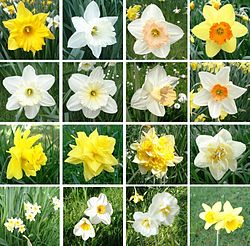
เพื่อวัตถุประสงค์ทางพืชสวน พันธุ์ นาร์ซิสซัส ทั้งหมด ถูกแบ่งออกเป็น 13 กลุ่มตามที่ Kington (1998) [ 184 ] อธิบายไว้เป็นครั้งแรก สำหรับสมาคมพืชสวนหลวง (RHS) [ 8 ]โดยพิจารณาจากรูปร่างของดอก (รูปร่างและความยาวของกลีบดอก) จำนวนดอกต่อก้าน ระยะเวลาการออกดอก และพื้นฐานทางพันธุกรรม กลุ่มที่ 13 ซึ่งรวมถึงดอกแดฟโฟดิลป่า ถือเป็นข้อยกเว้นของแผนการนี้[ 185 ]
Growers register new daffodil cultivars by name and colour with the Royal Horticultural Society, which is the international registration authority for the genus.[67] Their International Daffodil Register is regularly updated with supplements available online[67] and is searchable.[22][68] The most recent supplement (2014) is the sixth (the fifth was published in 2012).[186] More than 27,000 names were registered as of 2008,[186] and the number has continued to grow. Registered daffodils are given a division number and colour code[187] such as 5 W-W ("Thalia").[188] In horticultural usage it is common to also find an unofficial Division 14: Miniatures, which although drawn from the other 13 divisions, have their miniature size in common.[189] Over 140 varieties have gained the Royal Horticultural Society's Award of Garden Merit (See List of Award of Garden Merit narcissus).
Colour code

Daffodil breeding has introduced a wide range of colours, in both the outer perianth tepal segment and the inner corona. In the registry, daffodils are coded by the colours of each of these two parts. Thus "Geranium", Tazetta (Division 8) as illustrated here with a white outer perianth and orange corona is classified as 8 W-O.[187]
Toxicity
Pharmacology
All Narcissus species contain the alkaloid poison lycorine, mostly in the bulb but also in the leaves.[190] Members of the monocot subfamily Amaryllidoideae present a unique type of alkaloids, the norbelladine alkaloids, which are 4-methylcatechol derivatives combined with tyrosine. They are responsible for the poisonous properties of a number of the species. Over 200 different chemical structures of these compounds are known, of which 79 or more are known from Narcissus alone.[191]
พิษจากการบริโภคผลิตภัณฑ์จาก ดอกนาร์ซิสซัสส่งผลเสียต่อทั้งมนุษย์และสัตว์ (เช่น วัว แพะ หมู และแมว) มานานแล้ว และมีการนำไปใช้ในการพยายามฆ่าตัวตาย การบริโภคN. pseudonarcissusหรือN. jonquillaจะทำให้เกิด อาการ น้ำลายไหลปวดท้องอย่างรุนแรงคลื่นไส้อาเจียน และท้องเสียจากนั้นจะเกิดอาการทางระบบประสาทและหัวใจ รวมถึงอาการสั่น ชักและเป็นอัมพาตอาจถึงแก่ชีวิตได้หากบริโภคในปริมาณมาก
ความเป็นพิษของดอกนาร์ซิสซัสแตกต่างกันไปตามสายพันธุ์ เช่นN. poeticusมีความเป็นพิษมากกว่าN. pseudonarcissus การกระจายตัวของสารพิษภายในพืชก็แตกต่างกันไปด้วย ตัวอย่างเช่น ลำต้นของ N. papyraceusมีความเข้มข้นของอัลคาลอยด์สูงกว่าหัวถึงห้าเท่าทำให้เป็นอันตรายต่อสัตว์กินพืชที่มักจะกินลำต้นมากกว่าหัว และเป็นส่วนหนึ่งของกลไกการป้องกันของพืช การกระจายตัวของอัลคาลอยด์ภายในเนื้อเยื่ออาจสะท้อนถึงการป้องกันปรสิตด้วย[ 24 ]หัวของดอกนาร์ซิสซัสยังอาจเป็นพิษต่อพืชชนิดอื่นที่อยู่ใกล้เคียง เช่น กุหลาบ ข้าว และกะหล่ำปลี ทำให้การเจริญเติบโตถูกยับยั้ง[ 24 ]ตัวอย่างเช่น การวางดอกไม้ที่ตัดแล้วในแจกันร่วมกับดอกไม้ชนิดอื่นจะทำให้อายุของดอกไม้ชนิดหลังสั้นลง[ 192 ]
การวางยาพิษ
มีหลายกรณีของการเป็นพิษหรือเสียชีวิตเกิดขึ้นเมื่อหัวนาร์ซิสซัสถูกเข้าใจผิดว่าเป็นต้นหอมหรือหัวหอมและนำไปปรุงสุกรับประทาน โดยปกติแล้วผู้ป่วยจะฟื้นตัวได้ภายในไม่กี่ชั่วโมงโดยไม่ต้องมีการรักษาใดๆ เป็นพิเศษ ในกรณีที่รุนแรงกว่านั้น เช่น การรับประทานหัวนาร์ซิสซัส ในปริมาณมาก อาจต้องใช้ ถ่าน กัมมันต์เกลือ และยาระบาย และสำหรับอาการรุนแรง อาจต้องใช้ยาอะโทรพีนทางหลอดเลือดดำ และยาทำให้อาเจียนหรือการล้างกระเพาะอาหารอย่างไรก็ตาม การรับประทานในปริมาณมากโดยไม่ได้ตั้งใจนั้นเป็นเรื่องผิดปกติเนื่องจากมีรสชาติที่ไม่พึงประสงค์อย่างมาก เมื่อเปรียบเทียบนาร์ซิสซัสกับพืชชนิดอื่นๆ ที่สัตว์ไม่กินตามปกติ นาร์ซิสซัสเป็นพืชที่ขับไล่สัตว์ได้มากที่สุด โดยเฉพาะอย่างยิ่งN. pseudonarcissusดังนั้น สารอัลคาลอยด์ในนาร์ซิสซัสจึงถูกนำมาใช้เป็นสารขับไล่สัตว์และอาจช่วยยับยั้งเชื้อรา รา และแบคทีเรียได้ด้วย[ 24 ]
ผลกระทบเฉพาะที่
หนึ่งใน ปัญหา โรคผิวหนัง ที่พบบ่อยที่สุด สำหรับคนเก็บดอกไม้ คนบรรจุดอกไม้ คนขายดอกไม้ และคนทำสวน คือ "อาการคันจากดอกแดฟโฟดิล" ซึ่งเกี่ยวข้องกับอาการแห้ง แตกเป็นร่อง ลอกเป็นขุย และแดงที่มือ มักมีภาวะ ผิวหนัง หนาใต้ เล็บร่วมด้วย (ผิวหนังใต้เล็บหนาขึ้น) สาเหตุมาจากการสัมผัสกับแคลเซียมออกซาเลตกรดเชลิโดนิกหรืออัลคาลอยด์ เช่นไลโคไรน์ในน้ำยาง ไม่ว่าจะเป็นผลจากการระคายเคืองโดยตรงหรือปฏิกิริยาแพ้[ 193 ] [ 194 ]เป็นที่ทราบกันมานานแล้วว่าพันธุ์บางชนิดก่อให้เกิดโรคผิวหนังได้ง่ายกว่าพันธุ์อื่นN. pseudonarcissusและพันธุ์ "Actaea", "Camparelle", "Gloriosa", "Grande Monarque", "Ornatus", "Princeps" และ "Scilly White" เป็นที่ทราบกันว่าก่อให้เกิดโรคดังกล่าว[ 24 ] [ 195 ]
หากสารสกัดจากหัวสัมผัสกับบาดแผล อาจส่งผลให้เกิดอาการทางระบบประสาทส่วนกลางและหัวใจได้ นอกจากนี้กลิ่นยังอาจทำให้เกิดปฏิกิริยาเป็นพิษ เช่น ปวดศีรษะและอาเจียนจากN. bulbocodiumได้ อีกด้วย [ 24 ]
การใช้งาน
การแพทย์แผนโบราณ
แม้ว่าสารอัลคาลอยด์จาก ดอก นาร์ซิสซัส จะมีศักยภาพในการฆ่า แต่ก็มีการใช้เป็นยาแผนโบราณ มานานหลายศตวรรษ เพื่อรักษาอาการเจ็บป่วยต่างๆ รวมถึงโรคมะเร็ง พืชที่เชื่อว่าเป็นN. poeticusและN. tazettaถูกกล่าวถึงในพระคัมภีร์ไบเบิลในการรักษาที่เชื่อว่าเป็นโรคมะเร็ง[ 192 ] [ 196 ] [ 197 ] [ 198 ]ในโลกกรีกโบราณฮิปโปเครติส (ประมาณ 460–370 ปีก่อนคริสตกาล) แนะนำให้ใช้ยาเหน็บที่เตรียมจากน้ำมันดอกนาร์ซิสซัสสำหรับเนื้องอกในมดลูกซึ่งเป็นแนวปฏิบัติที่สืบทอดต่อมาโดยเปดานิอุส ดิออสคอริเดส (ประมาณ ค.ศ. 40–90) และโซรานัสแห่งเอเฟซัส (ค.ศ. 98–138) ในศตวรรษที่ 1 และ 2 หลังคริสตกาล ในขณะที่พลินีผู้เฒ่าแห่งโรมัน (ค.ศ. 23–79) สนับสนุนการใช้เฉพาะที่[ 192 ]หัวของN. poeticusมี สาร ต้านมะเร็งนาร์ซิคลาซีน การใช้นี้ยังพบได้ในยาของ ชาว อาหรับ แอฟริกาเหนือ อเมริกากลาง และ จีน ใน ยุคกลาง[ 192 ]ในประเทศจีนN. tazetta var. chinensis ถูกปลูกเป็นไม้ประดับ แต่หัวของมันถูกนำมาใช้ทาเฉพาะที่กับเนื้องอกในยาพื้นบ้านแบบดั้งเดิม หัวเหล่านี้มีพรีทาเซตทีน ซึ่งเป็นสารประกอบต้านมะเร็งที่ออกฤทธิ์[ 24 ] [ 198 ] [ 199 ]
ผลิตภัณฑ์จาก ดอกนาร์ซิสซัสมีการนำไปใช้ประโยชน์หลากหลาย แพทย์ชาวโรมันอูลุส คอร์เนลิอุส เซลซัส ได้ ระบุรากของดอกนาร์ซิสซัสไว้ในตำรา แพทย์ ว่าเป็นหนึ่งในสมุนไพรโดยอธิบายว่าเป็นสารที่ ช่วยให้ผิว นุ่มชุ่มชื้นช่วยขับสารพิษ และ "มีประสิทธิภาพในการขับสิ่งที่สะสมอยู่ในส่วนต่างๆ ของร่างกาย" หัวของดอกนาร์ซิสซั ส (N. tazetta ) ถูกนำมาใช้ในตุรกีเป็นยารักษาฝี โดยเชื่อว่า มีฤทธิ์ต้าน การอักเสบ และบรรเทาปวดการนำไปใช้อื่นๆ ได้แก่ การทาบาดแผล อาการเคล็ดขัดยอก ข้อต่อที่ปวด และโรคเฉพาะที่ต่างๆ ในรูปของขี้ผึ้งที่เรียกว่า 'Narcissimum' ผงดอกไม้ยังถูกนำมาใช้ทางการแพทย์เป็นยาทำให้อาเจียน ยาแก้คัดจมูกและบรรเทาอาการท้องร่วงในรูปแบบของน้ำเชื่อมหรือน้ำชงชาวฝรั่งเศสใช้ดอกไม้เป็นยาแก้ปวดเกร็งชาวอาหรับใช้น้ำมันจากดอกไม้รักษาอาการศีรษะล้าน และ เป็นยาปลุกอารมณ์ทางเพศด้วยในศตวรรษที่สิบแปดสมุนไพร ไอริช ของJohn K'Eoghแนะนำให้ตำรากในน้ำผึ้งเพื่อใช้รักษาแผลไหม้ ฟกช้ำข้อเคลื่อนและกระ ฝ้ารวมถึงใช้ดึงหนามและเศษไม้ที่ฝังอยู่ในผิวหนังออก หัวของ N. tazettaยังถูกนำมาใช้เพื่อการคุมกำเนิดในขณะที่ดอกของมันได้รับการแนะนำให้ใช้รักษาโรคฮิสทีเรียและโรคลมชัก [ 24 ] ในการแพทย์แผนโบราณของญี่ปุ่นที่เรียกว่าคัมโปบาดแผลได้รับการรักษาด้วยรากนาร์ซิสซัสและแป้งสาลีบด [ 200 ] อย่างไรก็ตามพืชชนิดนี้ไม่ได้ปรากฏอยู่ในรายการสมุนไพรคัมโปสมัยใหม่
นอกจากนี้ยังมีประวัติศาสตร์อันยาวนานของการใช้ดอกนาร์ซิสซัสเป็นสารกระตุ้นและเพื่อชักนำให้เกิดสภาวะคล้ายภวังค์และภาพหลอนโซโฟคลีสเรียกดอกนาร์ซิสซัสว่า "พวงมาลัยแห่งเทพเจ้านรก" [ 75 ]ซึ่งเป็นคำกล่าวที่มักถูกเข้าใจผิดว่าเป็นของโสกราตีส (ดูยุคโบราณ ) [ 24 ]
คุณสมบัติทางชีวภาพ
สารสกัดจากดอก นาร์ซิ สซัสแสดง ให้เห็น ถึง คุณสมบัติ ทางชีวภาพที่มีประโยชน์หลายประการ ได้แก่ฤทธิ์ต้านไวรัสการเหนี่ยวนำโปรฟาจ ฤทธิ์ต้านแบคทีเรียฤทธิ์ต้านเชื้อรา ฤทธิ์ต้านมาลาเรียฤทธิ์ฆ่า แมลง ฤทธิ์ เป็นพิษต่อเซลล์ ฤทธิ์ต้านเนื้องอก ฤทธิ์ต้านการแบ่งตัวของเซลล์ ฤทธิ์ต้านเกล็ดเลือดฤทธิ์ลดความดัน โลหิต ฤทธิ์ทำให้อาเจียน ฤทธิ์ยับยั้งอะเซทิ ลโคลีนเอสเตอเรส ฤทธิ์ ต้านการเจริญพันธุ์ฤทธิ์ระงับ ปวด ฤทธิ์เร่งจังหวะ การเต้นของหัวใจ ฤทธิ์ฟีโรโมนฤทธิ์ยับยั้งการเจริญเติบโตของพืชและฤทธิ์อัลเลโลพาธี [ 24 ] พบว่าสารสกัดเอทานอลจากหัวดอกนาร์ซิสซัสมีประสิทธิภาพในแบบจำลองหนูทดลองที่ทำให้เกิดอาการ ปวด ซึ่งก็คือการหดตัวของช่องท้องที่เกิดจาก พาราเบนโซควิโนนแต่ไม่มีประสิทธิภาพในแบบจำลองอื่น คือการทดสอบแผ่นความร้อน[ 201 ]คุณสมบัติเหล่านี้ส่วนใหญ่เกิดจากอัลคาลอยด์ แต่บางส่วนก็เกิดจากเลคตินที่จับกับแมนโนสด้วย อัลคาลอยด์ที่ได้รับการศึกษามากที่สุดในกลุ่มนี้ ได้แก่กาแลนตามีน (galanthamine) [ 202 ]ไลโคไรน์นาร์ซิคลาซีน และพรีทาเซตทีน
เป็นไปได้ว่าการใช้ดอกนาร์ซิสซัสแบบดั้งเดิมในการรักษาโรคมะเร็งนั้นเป็นผลมาจากการมีส่วนประกอบของไอโซคาร์โบสไตรล เช่นนาร์ซิคลาซีนแพนคราติส ตาติ น และสารประกอบที่เกี่ยวข้องN. poeticusมีนาร์ซิคลาซีนประมาณ 0.12 กรัมต่อหัวสด 1 กิโลกรัม[ 192 ]
การยับยั้งอะเซทิลโคลีนเอสเทอเรสได้รับความสนใจมากที่สุดในฐานะการแทรกแซงการรักษาที่เป็นไปได้ โดยมีกิจกรรมที่แตกต่างกันถึงพันเท่าระหว่างสายพันธุ์ และกิจกรรมสูงสุดพบในสายพันธุ์ที่มีกาแลนทามีนหรือเอปินอร์กาแลนทามีน[ 62 ]
คุณสมบัติในการขับไล่ หนูของ อั ล คาลอยด์ นาร์ซิสซัสถูกนำมาใช้ในการทำสวนเพื่อปกป้องหัวพืชที่อ่อนแอ[ 203 ]
การบำบัดรักษา

Of all the alkaloids, only galantamine has made it to therapeutic use in humans, as the drug galantamine for Alzheimer's disease. Galantamine is an acetylcholine esterase inhibitor which crosses the blood brain barrier and is active within the central nervous system.[24] Daffodils are grown commercially near Brecon in Powys, Wales, to produce galantamine.[204]
Commercial uses
Throughout history the scent of narcissi has been an important ingredient of perfumes, a quality that comes from essential oils rather than alkaloids.[24] Narcissi are also an important horticultural crop,[53][78] and source of cut flowers (floriculture).
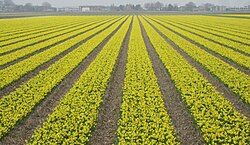
The Netherlands, which is the most important source of flower bulbs worldwide is also a major centre of narcissus production. Of 16,700 hectares (ha) under cultivation for flower bulbs, narcissi account for about 1,800 hectares. In the 1990s narcissus bulb production was at 260 million, sixth in size after tulips, gladioli, irises, crocuses and lilies and in 2012 it was ranked third.[151] About two-thirds of the area under cultivation is dedicated to about 20 of the most popular varieties. In the 2009/2010 season, 470 cultivars were produced on 1578 ha. By far the largest area cultivated is for the miniature 'Tête-à-Tête', followed at some distance by 'Carlton'. The largest production cultivars are shown in Table II.[205]
| Cultivar | Division | Colour | Area (ha) |
|---|---|---|---|
| "Tête-à-Tête" | 6: Cyclamineus | Yellow | 663 |
| "Carlton" | 2: Large cup | Yellow | 54 |
| "Bridal Crown" | 4: Double | White–Yellow | 51 |
| "Dutch Master" | 1: Trumpet | Yellow | 47 |
| "Jetfire" | 6: Cyclamineus | Yellow–Orange | 42 |
| "Ice Follies" | 2: Large cup | White | 36 |
"Carlton" and "Ice Follies" (Division 2: Large cup) have a long history of cultivation, together with "Dutch Master" and "Golden Harvest" (1: yellow). "Carlton" and "Golden Harvest" were introduced in 1927, and "Ice Follies" in 1953. "Carlton", with over 9 billion bulbs (350 000 tons), is among the more numerous individual plants produced in the world.[206] The other major areas of production are the United States,[151] Israel which exported 25 million N. tazetta cultivar bulbs in 2003,[205] and the United Kingdom.
In the United Kingdom a total of 4100 ha were planted with bulbs, of which 3800 ha were Narcissi, the UK's most important bulb crop, much of which is for export,[207] making this the largest global production centre, about half of the total production area. While some of the production is for forcing, most is for dry bulb production. Bulb production and forcing occurs in the East, while production in the south west is mainly for outdoor flower production.[208] The farm gate value was estimated at £10m in 2007.[209]

Production of both bulbs and cut flowers takes place in open fields in beds or ridges, often in the same field, allowing adaptation to changing market conditions. Narcissi grow best in mild maritime climates. Compared to the United Kingdom, the harsher winters in the Netherlands require covering the fields with straw for protection. Areas with higher rainfall and temperatures are more susceptible to diseases that attack crops. Production is based on a 1 (UK) or 2 (Netherlands) year cycle. Optimal soil pH is 6.0–7.5. Prior to planting disinfection by hot water takes place, such as immersion at 44.4 °C for three hours.[143]
Bulbs are harvested for market in the summer, sorted, stored for 2–3 weeks, and then further disinfected by a hot (43.5 °C) bath. This eliminates infestations by narcissus fly and nematodes. The bulbs are then dried at a high temperature, and then stored at 15.5 °C.[6] The initiation of new flower development in the bulb takes place in late spring before the bulbs are lifted, and is completed by mid summer while the bulbs are in storage. The optimal temperature for initiation is 20 °C followed by cooling to 13 °C.[7]
Traditionally, sales took place in the daffodil fields prior to harvesting the bulbs, but today sales are handled by Marketing Boards although still before harvesting. In the Netherlands there are special exhibition gardens for major buyers to view flowers and order bulbs, some larger ones may have more than a thousand narcissus varieties on display. While individuals can visit these gardens they cannot buy bulbs at retail, which are only available at wholesale, usually at a minimum of several hundredweight. The most famous display is at Keukenhof, although only about 100 narcissus varieties are on display there.
Forcing
There is also a market for forced blooms, both as cut flowers and potted flowers through the winter from Christmas to Easter, the long season requiring special preparation by growers.
Cut flowers
For cut flowers, bulbs larger than 12 cm in size are preferred. To bloom in December, bulbs are harvested in June to July, dried, stored for four days at 34 °C, two weeks at 30 and two weeks at 17–20 °C and then placed in cold storage for precooling at 9 degrees for about 15–16 weeks. The bulbs are then planted in light compost in crates in a greenhouse for forcing at 13–15 °C and the blooms appear in 19–30 days.[6][143]
Potted flowers
For potted flowers a lower temperature is used for precooling (5 °C for 15 weeks), followed by 16–18 °C in a greenhouse. For later blooming (mid- and late-forcing), bulbs are harvested in July to August and the higher temperatures are omitted, being stored a 17–20 °C after harvesting and placed in cold storage at 9 °C in September for 17–18 (cut flowers) or 14–16 (potted flowers) weeks. The bulbs can then be planted in cold frames, and then forced in a greenhouse according to requirements.[143]N. tazetta and its cultivars are an exception to this rule, requiring no cold period. Often harvested in October, bulbs are lifted in May and dried and heated to 30 °C for three weeks, then stored at 25 °C for 12 weeks and planted. Flowering can be delayed by storing at 5–10 °C.[114]
Culture
Symbols

The daffodil is the national flower of Wales, associated with Saint David's Day (1 March). The narcissus is also a national flower symbolising the new year or Nowruz in the Kurdish culture.
In the West the narcissus is perceived as a symbol of vanity, in the East as a symbol of wealth and good fortune , while in Persian literature, the narcissus is a symbol of beautiful eyes.
In western countries the daffodil is also associated with spring festivals such as Lent and its successor Easter. In Germany the wild narcissus, N. pseudonarcissus, is known as the Osterglocke or "Easter bell". In the United Kingdom the daffodil is sometimes referred to as the Lenten lily.[94][95][Note 4]
Although prized as an ornamental flower, some people consider narcissi unlucky, because they hang their heads implying misfortune.[24] White narcissi, such as N. triandrus "Thalia", are especially associated with death, and have been called grave flowers.[210][211] In Ancient Greece narcissi were planted near tombs, and Robert Herrick describes them as portents of death, an association which also appears in the myth of Persephone and the underworld.
Art
Antiquity

The decorative use of narcissi dates as far back as ancient Egyptian tombs, and frescoes at Pompeii.[212] They are mentioned in the King James Version of the Bible[213] as the Rose of Sharon[78][214][215][216] and make frequent appearances in classical literature.[167]
Greek culture
The narcissus appears in two Graeco-Romanmyths, that of the youth Narcissus who was turned into the flower of that name, and of the Goddess Persephonesnatched into the Underworld by the god Hades while picking the flowers. The narcissus is considered sacred to both Hades and Persephone,[217] and grows along the banks of the river Styx in the underworld.[211]
The Greek poet Stasinos mentioned them in the Cypria amongst the flowers of Cyprus.[218] The legend of Persephone comes to us mainly in the seventh century BC Homeric HymnTo Demeter,[219] where the author describes the narcissus, and its role as a lure to trap the young Persephone. The flower, she recounts to her mother, was the last flower she reached for before being seized.

Other Greek authors making reference to the narcissus include Sophocles and Plutarch. Sophocles, in Oedipus at Colonus utilises narcissus in a symbolic manner, implying fertility,[220] allying it with the cults of Demeter and her daughter Kore (Persephone),[221] and by extension, a symbol of death.[222]Jebb comments that it is the flower of imminent death with its fragrance being narcotic, emphasised by its pale white colour. Just as Persephone reaching for the flower heralded her doom, the youth Narcissus gazing at his own reflection portended his own death.[221] Plutarch refers to this in his Symposiacs as numbing the nerves causing a heaviness in the limbs.[223] He refers to Sophocles' "crown of the great Goddesses", which is the source of the English phrase "Chaplet of the infernal Gods" incorrectly attributed to Socrates.[75]
A passage by Moschus, describes fragrant narcissi.[224][225][226]Homer in his Odyssey[227][228][229][230] described the underworld as having Elysian meadows carpeted with flowers, thought to be narcissus, as described by Theophrastus.[78][231][Note 5] A similar account is provided by Lucian describing the flowers in the underworld.[232][233][234] The myth of the youth Narcissus is also taken up by Pausanias. He believed that the myth of Persephone long antedated that of Narcissus, and hence discounted the idea the flower was named after the youth.[81]
Roman culture
Virgil, the first known Roman writer to refer to the narcissus, does so in several places, for instance twice in the Georgics.[235] Virgil refers to the cup shaped corona of the narcissus flower, allegedly containing the tears of the self-loving youth Narcissus.[236]Milton makes a similar analogy "And Daffodillies fill their Cups with Tears".[237] Virgil also mentions narcissi three times in the Eclogues.[238][239]
The poet Ovid also dealt with the mythology of the narcissus. In his Metamorphoses, he recounts the story of the youth Narcissus who, after his death, is turned into the flower,[240][241] and it is also mentioned in Book 5 of his poem Fasti.[242][243] This theme of metamorphosis was broader than just Narcissus; for instance see crocus, laurel and hyacinth.[244]
Western culture
I wandered lonely as a Cloud That floats on high o'er Vales and Hills, When all at once I saw a crowd A host of dancing Daffodils; Along the Lake, beneath the trees, Ten thousand dancing in the breeze. The waves beside them danced, but they Outdid the sparkling waves in glee: – A poet could not but be gay In such a laughing company: I gaz'd – and gaz'd – but little thought What wealth the shew to me had brought: For oft when on my couch I lie In vacant or in pensive mood, They flash upon that inward eye Which is the bliss of solitude, And then my heart with pleasure fills, And dances with the Daffodils.
Although there is no clear evidence that the flower's name derives directly from the Greek myth, this link between the flower and the myth became firmly part of western culture. The narcissus or daffodil appears frequently in English literature. Many English writers have referred to the cultural and symbolic importance of Narcissus.[246][247][248][249] No flower has received more poetic description except the rose and the lily, with poems by authors from John Gower, Shakespeare, Milton (see Roman culture, above), Wordsworth, Shelley and Keats. Frequently, the poems deal with self-love derived from Ovid's account.[250][251] Gower's reference to the yellow flower of the legend has been assumed to be the daffodil or Narcissus,[252] though as with all references in the older literature to the flower that sprang from the youth's death, there is room for some debate as to the exact species of flower indicated, some preferring Crocus.[253] Spenser announces the coming of the Daffodil in Aprill of his Shepheardes Calender (1579).[254]
Shakespeare, who frequently uses flower imagery,[249] refers to daffodils twice in The Winter's Tale[255] and also The Two Noble Kinsmen. Robert Herrick alludes to their association with death in a number of poems.[256][257] Among the English romantic movement writers none is better known than William Wordsworth's short 1804 poem I Wandered Lonely as a Cloud[245] which has become linked in the popular mind with the daffodils that form its main image.[78][211][250][258] Wordsworth also included the daffodil in other poems.[259] Yet the description given of daffodils by his sister, Dorothy is just as poetic, if not more so,[173] just that her poetry was prose and appears almost an unconscious imitation of the first section of the Homeric Hymn to Demeter (see Greek culture, above).[260][173][261] Among their contemporaries, Keats refers to daffodils among those things capable of bringing "joy for ever".[262]
More recently A. E. Housman, using one of the daffodil's more symbolic names (see Symbols), wrote The Lent Lily in A Shropshire Lad, describing the traditional Easter death of the daffodil.[263]
In Black Narcissus, Rumer Godden describes the disorientation of English nuns in the Indian Himalayas, and gives the plant name an unexpected twist, alluding both to narcissism and the effect of the perfume Narcisse Noir (Caron) on others. The novel was later adapted into the 1947 British film of the same name. The narcissus also appears in German literature such as that of Paul Gerhardt.[264]
In the visual arts, narcissi are depicted in three different contexts, mythological (Narcissus, Persephone), floral art, or landscapes. The Narcissus story has been popular with painters and the youth is frequently depicted with flowers to indicate this association.[77][244] The Persephone theme is also typified by Waterhouse in his Narcissus, the floral motif by van Scorel and the landscape by Van Gogh's Undergrowth.
Narcissi first started to appear in western art in the late Middle Ages, in panel paintings, particularly those depicting crucifixion. For instance that of the Westfälischer Meister in Köln in the Wallraf-Richartz-Museum, Cologne,[265] where daffodils symbolise not only death but also hope in the resurrection, because they are perennial and bloom at Easter.[211][266][267]
 Jan van Scorel: Madonna of the Daffodils with the Child and Donors, 1535
 Waterhouse: Narcissus, 1912
 Crucifixion, Westfälischer Meister c. 1415


Eastern cultures
In Chinese cultureNarcissus tazetta subsp. chinensis (Chinese sacred lilies), which can be grown indoors, is widely used as an ornamental plant.[268][269] It was probably introduced to China by Arab traders travelling the Silk Road prior to the Song dynasty for medicinal use.[53][268][269] Spring-flowering, they became associated with Chinese New Year, signifying good fortune, prosperity and good luck[270] and there are many legends in Chinese culture associated with Narcissus.[271][272][273] In contrast to the West, narcissi have not played a significant part in Chinese Garden art,[274] however, Zhao Mengjian in the Southern Song dynasty was noted for his portrayal of narcissi.[275][276] Narcissus bulb carving and cultivation has become an art akin to Japanese bonsai. The Japanese novel Narcissu contains many references to the narcissus, where the main characters set out for the famed narcissus fields on Awaji Island.[277][278]
Islamic culture
Narcissi are one of the most popular garden plants in Islamic culture.[279] Prior to the Arab conquest of Persia, the Persian ruler Khosrau I (r. 531–579) is said to have not been able to tolerate them at feasts because they reminded him of eyes, an association that persists to this day.[280] The Persian phrase نرگس شهلا (narges-e šahlâ, literally "a reddish-blue narcissus")[281] is a well-known metonymy for the "eye(s) of a mistress"[281] in the classical poetries of the Persian, Urdu,[282]Ottoman Turkish, Azerbaijani and Chagatai languages; to this day also the vernacular names of some narcissus cultivars (for example, Shahla-ye Shiraz and Shahla-ye Kazerun).[283] As described by the poet Ghalib (1797–1869), "God has given the eye of the narcissus the power of seeing".[280] The eye imagery is also found in a number of poems by Abu Nuwas.[284][285][286][287] Another poet who refers to narcissi, is Rumi. Even the prophet Muhammad is said to have praised the narcissus,[288] though some of the sayings that were cited as proof are considered "weak" records.[289] Narcissus is also considered a symbol in Shia Islam and likewise in Iran for Mahdi.[290]
 Chinese Sacred Lily
 Chinese decorative carved Narcissus bulb
 N. poeticus symbolising the eye in Islamic culture


Popular culture
The word "daffodil" has been used widely in popular culture, from Dutch cars (DAF Daffodil) to films (Daffodils) to slurs against homosexuals and cross-dressers (as in the film J. Edgar, when Hoover's mother explains why real-life cross-dresser Barton Pinkus[291] was called "Daffy" (short for "Daffodil" and the equivalent of a pansy[292]), and admonishes, "I'd rather have a dead son than a daffodil for a son").[293][294][295][296][297]
Festivals
In some areas where narcissi are prevalent, their blooming in spring is celebrated in festivals. For instance, the slopes around Montreux, Switzerland and its associated riviera come alive with blooms each May (May Snow) at the annual Narcissi Festival.[298] Festivals are also held in many other countries.
Cancer
Various cancer charities around the world, such as the American Cancer Society,[299]Cancer Society,[300]Cancer Council,[301]Irish Cancer Society,[302] and Marie Curie in the UK[303] use the daffodil as a fundraising symbol on "Daffodil Days".[304]
See also
Notes
- ^The word "daffodil" is also applied to related genera such as Sternbergia, Ismene, and Fritillaria meleagris. It has been suggested that the word "Daffodil" be restricted to the wild species of the British Isles, N. pseudonarcissus. (Halevy 1985, Rees A.R. Narcissus, pp. 268–271)
- ^Prior here refers to the poet Pamphilus, but it is likely he meant Pamphos.
- ^This Carlavirus should not be confused with the similarly named Narcissus latent virus which is a Macluravirus.
- ^Rarely "Lentern", especially ecclesiastical usage as here, or dialect, particularly Scottish (Masefield 2014, p. 104)(Jamieson 1879, Care Sonday vol I p. 284)(Wright 1905, vol 3 H–L, Lentren p. 575)
- ^The Asphodel of the Greek underworld has been variously associated with the white Asphodelus ramosus (Macmillan (1887)) or the yellow Asphodeline lutea (Graves (1949)), previously classified as Asphodelus luteus.
Bibliography
General
Antiquity
- Plinius Secundus, Gaius (Pliny the Elder) (1856). Bostock, John; Riley, H. T. (eds.). Natural History Book XXI (Volume Four). London: Henry G Bohn. Retrieved 3 October 2014.
- Plinius Secundus, Gaius (Pliny the Elder) (1906). Mayhoff, Karl Friedrich Theodor (ed.). "Naturalis Historia". Perseus Digital Library. Retrieved 3 October 2014.
- Vergilius Maro, Publius (Virgil) (1770). Davidson, Joseph (ed.). The Works of Virgil: Translated Into English Prose, as Near the Original as the Different Idioms of the Latin and English Languages Will Allow & etc (5th ed.). London: J Beecroft et al. Retrieved 27 September 2014.
- Pausanias (1918). Jones, W.H.S. (ed.). "Description of Greece". Perseus Digital Library. Cambridge, MA: Harvard University Press. Retrieved 19 October 2014.
- Dioscuridis Anazarbei, Pedanii (1906). Wellman, Max (ed.). De materia medica libri quinque. Volume II. Berlin: Apud Weidmannos. OL 20439608M.
- Theophrastus (1916) [4th century BC]. Hort, Arthur (ed.). Περὶ φυτῶν ἱστορία [Enquiry into Plants]. Loeb Classical Library. Vol. II. London and New York: William Heinemann and G.P. Putnam's Sons.
- Theocritus; Bion; Moschus (1880). Lang, Andrew (ed.). Theocritus, Bion and Moschus rendered into English prose. London: Macmillan. Retrieved 8 November 2014.
- Moschus (1919). "Εὐρώπη". In Edmonds, John Maxwell (ed.). Moschus. The Greek Bucolic Poets (Perseus Digital Library ed.). London: William Heinemann. Retrieved 8 November 2014.
Renaissance
- Turner, William (1995) [Reproduces parts II and III, originally published in 1562 and 1568 respectively]. Chapman, George T. L.; Tweddle, Marilyn N.; McCombie, Frank (eds.). William Turner: A New Herball Parts II and III. Cambridge University Press. ISBN 978-0-521-44549-8. Retrieved 2 November 2014. Original at Rare Book Room Spread 188
- Clusius, Carolus (1576). Atrebat Rariorum alioquot stirpium per Hispanias observatarum historia: libris duobus expressas. Antwerp: Plantinus. Retrieved 5 November 2014.
- Camerarius, Joachim (The Younger) (1588). Hortus medicus et philosophicus: In quo plurimorum stirpium breves descriptiones. Frankfurt: S. Feyerabend, H. Dack, & P. Fischer. Retrieved 10 October 2014.
- de l'Obel, Matthias (1591). Icones stirpium. Antwerp: Ex officina plantiniana, Apud Viduam et Ioannem Moretum. Retrieved 26 October 2014.
- Gerard, John (1597). The Herball or Generall Historie of Plantes. London: John Norton. Retrieved 26 November 2014.
- Besler, Basilius (1613). Hortus Eystettensis, sive, Diligens et accurata omnium plantarum, florum, stirpium: ex variis orbis terrae partibus, singulari studio collectarum, quae in celeberrimis viridariis arcem episcopalem ibidem cingentibus, olim conspiciebantur delineatio et ad vivum repraesentatio et advivum repraesentatio opera. doi:10.5962/bhl.title.45339. Retrieved 10 October 2014.
- Parkinson, John (1629). Paradisi in Sole Paradisus Terrestris: Or A Garden of All Sorts of Pleasant Flowers which our English Ayre will Permitt to be Noursed Vp. With a Kitchen Garden of All Manner of Herbes, Rootes, & Fruites, for Meate or Sause Vsed with Vs, and an Orchard of All Sorte of Fruitbearing Trees and Shrubbes Fit for Our Land. Together with the Right Orderinge, Planting & Preserving of Them and Their Uses and Vertues Collected by Iohn Parkinson Apothecary of London. London: Hvmfrey Lownes and Robert Yovng Hill. doi:10.5962/bhl.title.7100. Retrieved 29 December 2014.
- Lauremberg, Peter (1632). Apparatus plantarius: de plantis bulbosis et de plantis tuberosis (in Latin). Frankfurt: Matthias Merian. Retrieved 24 December 2014.
Eighteenth century
- Miller, Philip (1735). The Gardeners Dictionary: containing the methods of cultivating and improving the kitchen, fruit and flower garden, as also the physick garden, wilderness, conservatory, and vineyard (Abridged ed.). London: Rivington. doi:10.5962/bhl.title.28437. hdl:2027/uma.ark:/13960/t44q8633p. Retrieved 27 December 2014.
- Linnaeus, Carl (1753). Species Plantarum: exhibentes plantas rite cognitas, ad genera relatas, cum differentiis specificis, nominibus trivialibus, synonymis selectis, locis natalibus, secundum systema sexuale digestas. Stockholm: Impensis Laurentii Salvii. Retrieved 13 October 2016. see also Species Plantarum
- Hale, Thomas (1757). Hill, John (ed.). Eden, or, A compleat body of gardening: containing plain and familiar directions for raising the several useful products of a garden, fruits, roots, and herbage, from the practice of the most successful gardeners, and the result of a long experience. London: Osborne. Retrieved 3 November 2014.
- van Kampen et fils, Nicolas (1760). Traité des fleurs à oignons: contenant tout ce qui est nécessaire pour les bien cultiver, fondé sur une expérience de plusieurs années (in French). Harlem: Bohn. Retrieved 26 December 2014.translated into English as (van Kampen & Son 1764)
- van Kampen & Son, Nicolas (1764). The Dutch florist, or, True method of managing all sorts of flowers with bulbous roots(translated (Harrison) from French: (van Kampen et fils 1760)) (2nd ed.). London: Baldwin. Retrieved 26 December 2014.
Next to the Hyacinths, Tulips, Ranunculuses, and Anemones, of which we have treated already, the Polyanthus Narcissus holds the first place and demands our chief attention
- Justice, James (1771). The British gardener's new director: chiefly adapted to the climate of the northern counties: directing the necessary works in the kitchen, fruit and pleasure gardens, and in the nursery, greenhouse, and stove (5th ed.). Dublin: Exshaw. doi:10.5962/bhl.title.26951. hdl:2027/uc2.ark:/13960/t6445sk1k. Retrieved 27 December 2014.
- Maddock, James (1792). The florist's directory: or, A treatise on the culture of flowers ; to which is added a supplementary dissertation on soils, manures, &c. London: B. White & Sons. doi:10.5962/bhl.title.16498. hdl:2027/ncs1.ark:/13960/t25b0nj3t. Retrieved 26 December 2014.
Nineteenth century
- "Narcissus". Encyclopaedia Perthensis; or, Universal dictionary of Knowledge vol. 25. Perth: C. Mitchel & Co. 1806. pp. 565–566. Retrieved 28 November 2014.
- Linné, Carl von (1784). Murray, Johann Andreas (ed.). Systema vegetabilium (14th edition of Systema Naturae). Typis et impensis Jo. Christ. Dieterich. Retrieved 3 November 2014.
- Brown, Robert (1810). Prodromus florae Novae Hollandiae et Insulae Van-Diemen, exhibens characteres plantarum. London: Taylor. Retrieved 30 October 2014.
- De Lamarck, Jean-Baptiste; De Candolle, Augustin Pyramus (1815a). Flore française ou descriptions succinctes de toutes les plantes qui croissent naturellement en France disposées selon une nouvelle méthode d'analyse ; et précédées par un exposé des principes élémentaires de la botanique. Vol. III (3rd ed.). Paris: Desray. Retrieved 29 October 2014.
- De Lamarck, Jean-Baptiste; De Candolle, Augustin Pyramus (1815b). Flore française ou descriptions succinctes de toutes les plantes qui croissent naturellement en France disposées selon une nouvelle méthode d'analyse ; et précédées par un exposé des principes élémentaires de la botanique. Vol. V (3rd ed.). Paris: Desray. Retrieved 29 October 2014.
- Redouté, Pierre Joseph; De Candolle, Augustin Pyramus (1805–1808). Les liliacées. Paris: Redouté. Retrieved 1 November 2014.
- A. P. de Candolle (1813). Théorie élémentaire de la botanique, ou exposition des principes de la classification naturelle et de l'art de décrire et d'etudier les végétaux. Retrieved 5 February 2014.
- Wilkes, John, ed. (1819). "Narcissus". Encyclopaedia Londinensis vol. 16. London: James Adlard and Sons. pp. 576–580. Retrieved 2 November 2014.
- Anonymous (1823). "Narcissus". Flora Domestica, Or, The Portable Flower-garden: with Directions for the Treatment of Plants in Pots and Illustrations From the Works of the Poets. London: Taylor and Hessey. pp. 264–269. Retrieved 21 December 2014.Later attributed to Elizabeth Kent and Leigh Hunt.
- Linnaeus, Carl (1829). Schultes, Josef August; Schultes, Julius Hermann (eds.). Systema vegetabilium. Stuttgardt: J. G. Cottae. Retrieved 25 October 2014.
- Herbert, William (1837). "Suborder 5. Narcisseae". Amaryllidaceae: Preceded by an Attempt to Arrange the Monocotyledonous Orders, and Followed by a Treatise on Cross-bred Vegetables, and Supplement. London: Ridgway. Retrieved 20 October 2014.
- Curtis, Thomas, ed. (1839). "Narcissus". London Encyclopaedia vol. 15. London: Thomas Tegg. pp. 449–451. Retrieved 27 November 2014.
- Spach, Edouard (1846). Histoire naturelle des végétaux: Phanérogames. Vol. 12. Paris: Roret. Retrieved 20 October 2014.
- Burnett, M. A. (1850). "Narcissus angustifolius". Plantae utiliores: or illustrations of useful plants, employed in the arts and medicine, Part VIII. London: Whittaker. Retrieved 2 November 2014.
- Wilkinson, Lady Caroline Catharine (1858). Weeds and wild flowers: their uses, legends, and literature. London: J. Van Voorst. Retrieved 26 November 2014.
- Salisbury, Richard Anthony; Gray, J. E. (1866). The Genera of Plants(Unpublished fragment). J. Van Voorst. Retrieved 26 October 2014.
- Prior, Richard Chandler Alexander (1870). On the popular names of British Plants, being an explanation of the origin and meaning of the names of our indigenous and most commonly cultivated species (2nd ed.). London: Williams & Norgate. Retrieved 6 October 2014.
- Earley, W (1877). "The Narcissus". The Villa Gardener vol. 7 (December). London: Virtue & Co. pp. 394–396. Retrieved 8 November 2014.
- Ellacombe, Henry Nicholson (1884). The Plant-lore & Garden-craft of Shakespeare (2nd ed.). London: W Satchell and Co. Retrieved 26 November 2014.
Twentieth century
- Chisholm, Hugh, ed. (1911). . Encyclopædia Britannica. Vol. 7 (11th ed.). Cambridge University Press. p. 728.
- Doorenbos, J. (1954). "Notes on the history of bulb breeding in the Netherlands". Euphytica. 3 (1 February): 1–18. Bibcode:1954Euphy...3....1D. doi:10.1007/BF00028123. S2CID 5615677.
- Rees, A.R., ed. (1972). The Growth of Bulbs: Applied Aspects of the Physiology of Ornamental Bulbous Crops. Oxford: Elsevier Science. ISBN 978-0-323-15586-1. Retrieved 15 December 2014.
- Halevy, Abraham H., ed. (1985). CRC Handbook of flowering vol. I. Boca Raton, Fla.: CRC Press. ISBN 978-0-8493-3911-0. Retrieved 29 October 2014.
- Huxley, Anthony; Griffiths, Mark; Levy, Margot (1992). The New Royal Horticultural Society Dictionary of Gardening. (4 vols.). London: Macmillan. ISBN 978-0-333-47494-5.
- Lloyd, David G; Barrett, Spencer C.H., eds. (1995). Floral biology: studies on floral evolution in animal-pollinated plants. New York: Chapman & Hall. ISBN 978-0-412-04341-3. Retrieved 29 October 2014.
- Leeds, Rod; Hedge, Ronald; Hawthorne, Linden, eds. (1997). RHS Plant Guides: Bulbs. London: Dorling Kindersley. ISBN 978-0-7513-0305-6.
- Kubitzki, K., ed. (1998). The families and genera of vascular plants. Vol.3. Berlin, Germany: Springer-Verlag. ISBN 978-3-540-64060-8. Retrieved 14 January 2014.
Twenty first century
- Singh, A.K. (2006). Flower crops: cultivation & management. New Delhi: New India Pub. Agency. ISBN 978-81-89422-35-6. Retrieved 7 November 2014.
- Duke, James A. (2007). Duke's Handbook of Medicinal Plants of the Bible. Hoboken: Taylor & Francis Ltd. ISBN 978-0-8493-8203-1. Retrieved 29 October 2014.
- Leyel, C. F. (2007). "Herbs for the Skin". Cinquefoil. Pomeroy, WA: Health Research Books. p. 289. ISBN 978-0-7873-1413-2. Retrieved 3 November 2014.
- Mabberley, David J (2008). Mabberley's Plant-Book (3rd ed.). Cambridge University Press. ISBN 978-1-107-78259-4. Retrieved 8 January 2014.
- Williams, D. M.; Knapp, Sandra, eds. (2010). Beyond Cladistics: The Branching of a Paradigm. University of California Press. ISBN 978-0-520-26772-5. Retrieved 15 February 2014.
- Okubo, Hiroshi; Sochacki, Dariusz (2012). "Botanical and horticultural aspects of major ornamental geophytes: VII Narcissi". In Kamenetsky, Rina; Okubo, Hiroshi (eds.). Ornamental Geophytes: From Basic Science to Sustainable Production. CRC Press. pp. 103–108. ISBN 978-1-4398-4924-8.
- S.J. Enna, S.J.; Norton, Stata (2012). "12. Daffodil (Narcissus pseudonarcissus)". Herbal Supplements and the Brain: Understanding Their Health Benefits and Hazards. Upper Saddle River, New Jersey: FT Press Science. pp. 149–160. ISBN 978-0-13-282501-6. Retrieved 29 October 2014.
Flora
- Cullen, James (2011). "Narcissus". In Cullen, James; Knees, Sabina G.; Cubey, H. Suzanne Cubey (eds.). The European Garden Flora, Flowering Plants: A Manual for the Identification of Plants Cultivated in Europe, Both Out-of-Doors and Under Glass: Vol. 1. Alismataceae to Orchidaceae (2nd ed.). Cambridge: Cambridge University Press. pp. 205 ff. ISBN 978-0-521-76147-5. Retrieved 21 October 2014.
- Tutin, T. G.; et al., eds. (1980). Flora Europaea. Volume 5, Alismataceae to Orchidaceae (monocotyledones) (Reprinted ed.). Cambridge: Cambridge University Press. ISBN 978-0-521-20108-7. Retrieved 4 October 2014.
- Thomé, Otto Wilhelm (1903). Flora von Deutschland, Österreich und der Schweiz. Vol. I (2nd ed.). Gera: Zezschwitz. Retrieved 22 October 2014.
- Sell, Peter; Murrell, Gina (1996). "Narcissus". Flora of Great Britain and Ireland:: Volume 5, Butomaceae - Orchidaceae. Cambridge: Cambridge Univ. Press. pp. 285–293. ISBN 978-0-521-55339-1. Retrieved 29 October 2014.
- "Narcissus". Flora Iberica. Real Jardín Botánico. 2014. Retrieved 29 October 2014.
- Aedo C (2014). "Narcissus L."(PDF). In Talavera S, Andrés C, Arista M, Fernández Piedra MP, Rico E, Crespo MB, Quintanar A, Herrero A, Aedo C (eds.). Flora Iberica. Vol 20 (in Spanish). Madrid: Real Jardín Botánico, Consejo Superior de Investigaciones Científicas. Retrieved 30 November 2014.
- Blanca G, Cabezudo B, Cueto M, Salazar C, Morales-Torres C, eds. (2009). "Narcissus"(PDF). Flora vascular de Andalucía oriental (in Spanish). Vol. I. Sevilla: Consejería de Medio Ambiente, Junta de Andalucía. pp. 171–180. ISBN 978-84-92807-13-0.
- 2nd ed. 2011. Narcissus pp. 173–182 ISBN 9788433852175
- Cebrian, Jordi (2014). "Flora Catalana". Archived from the original on 30 December 2014. Retrieved 31 December 2014.
- Quiles, José (2014). "Flora silvestre del Mediterráneo". Retrieved 1 January 2015.
- "Narcissus". Flora of China: Vol. 24. p. 269. Retrieved 15 October 2014.
- Straley, Gerald B.; Utech, Frederick H. (2003). "Narcissus". Flora of North America vol 26. pp. 53–54. Retrieved 19 October 2014.
- Gathe, J; Watson, L (2008). "Narcissus L."Florabase: Western Australian Flora. Western Australian Herbarium. Retrieved 2 December 2014.
Narcissus
Articles
- Krelage, JH (17 April 1890). "On Polyanthus Narcissi". Journal of the Royal Horticultural Society. 12 (Daffodil Conference and Exhibition): 339–346. Retrieved 25 December 2014.
- Wylie, Ann P (1952). "The history of the garden Narcissi". Heredity. 6 (2): 137–156. Bibcode:1952Hered...6..137W. doi:10.1038/hdy.1952.16.
- Meyer, Frederick G (April 1961). "Exploring for Wild Narcissus"(PDF). The American Horticultural Magazine. 40 (2): 211–220. Retrieved 19 October 2014.
- American Horticultural Society (January 1966). "The Daffodil Handbook". Am. Hort. Mag. 45 (1). Retrieved 19 October 2014.
- Mcintosh, P. D.; Allen, R. B. (January 1992). "Narcissi bulb production at southern South island sites, New Zealand". New Zealand Journal of Crop and Horticultural Science. 20 (1): 17–27. Bibcode:1992NZJCH..20...17M. doi:10.1080/01140671.1992.10422321.
- Chow, Y (1993). "Basal Plate Tissue in Narcissus Bulbs and in Shoot Clump Cultures: Its Structure and Role in Organogenic Potential of Single Leaf Cultures". Annals of Botany. 71 may (5): 437–443. Bibcode:1993AnBot..71..437C. doi:10.1006/anbo.1993.1057.
- Dobson, Heidi E.M.; Arroyo, Juan; Bergström, Gunnar; Groth, Inga (December 1997). "Interspecific variation in floral fragrances within the genus Narcissus (Amaryllidaceae)". Biochemical Systematics and Ecology. 25 (8): 685–706. Bibcode:1997BioSE..25..685D. CiteSeerX 10.1.1.493.2278. doi:10.1016/S0305-1978(97)00059-8.
- Dana, Michael N.; Lerner, B. Rosie (1 April 2001). "The Narcissus". Purdue Extension: Horticulture (HO-11-W). Archived from the original on 23 December 2018. Retrieved 20 December 2014.
- Spaulding, Daniel D.; Barger, T. Wayne (2014). "Key to the wild daffodils (Narcissus, Amaryllidaceae) of Alabama and adjacent states"(PDF). Phytoneuron. 82: 1–10. ISSN 2153-733X. Retrieved 3 November 2014.
Taxonomy
- Pugsley, H.W (1933). "A monograph of Narcissus, subgenus Ajax"(PDF). Journal of the Royal Horticultural Society. 58: 17–93. Retrieved 20 October 2014.
- Meyer, F. G. (January 1966). "Narcissus species and wild hybrids"(PDF). Am. Hort. Mag. 45 (1): 47–76. Retrieved 19 October 2014.
- Webb, DA (June 1978). "Taxonomic notes on Narcissus L". Bot J Linn Soc. 76 (4): 298–307. doi:10.1111/j.1095-8339.1978.tb01817.x.
- Fernández-Casas, Francisco Javier (2005). "Narcissorum notulae, VI"(PDF). Fontqueria. 55: 265–272. Retrieved 25 November 2014.
- Fernández-Casas, Francisco Javier (2008). "Narcissorum notulae, X"(PDF). Fontqueria. 55: 547–558. Archived from the original(PDF) on 20 October 2014. Retrieved 20 October 2014.
- Jiménez, Juan F.; Sánchez-Gómez, Pedro; Guerra, Juan; Molins, Arántzazu; Rosselló, Josep A. (12 June 2009). "Regional Speciation or Taxonomic Inflation? The Status of Several Narrowly Distributed and Endangered Species of Narcissus Using ISSR and Nuclear Ribosomal ITS Markers". Folia Geobotanica. 44 (2): 145–158. Bibcode:2009FolGe..44..145J. doi:10.1007/s12224-009-9040-2. S2CID 13095365.
- Medrano, M.; Herrera, C. M. (12 May 2008). "Geographical Structuring of Genetic Diversity Across the Whole Distribution Range of Narcissus longispathus, a Habitat-specialist, Mediterranean Narrow Endemic". Annals of Botany. 102 (2): 183–194. doi:10.1093/aob/mcn086. PMC 2712358. PMID 18556752.
- Aedo, Carlos (2010). "Typifications of the names of Iberian accepted species of Narcissus L. (Amaryllidaceae)"(PDF). Acta Botanica Malacitana. 35: 133–142. doi:10.24310/abm.v35i0.2860. Retrieved 29 November 2014.
- Fernández-Casas, Francisco Javier (2011). "Narcissorum Notulae, XXXI"(PDF). Fontqueria. 56 (26): 239–248. Archived from the original(PDF) on 6 October 2014. Retrieved 5 October 2014.
Phylogenetics
- Graham, S. W.; Barrett, S. C. H. (1 July 2004). "Phylogenetic reconstruction of the evolution of stylar polymorphisms in Narcissus (Amaryllidaceae)". American Journal of Botany. 91 (7): 1007–1021. doi:10.3732/ajb.91.7.1007. PMID 21653457.
- Barrett, Spencer C. H.; Harder, Lawrence D. (2 September 2004). "The evolution of polymorphic sexual systems in daffodils (Narcissus)". New Phytologist. 165 (1): 45–53. Bibcode:2005NewPh.165...45B. doi:10.1111/j.1469-8137.2004.01183.x. PMID 15720619.
- Rønsted, Nina; Savolainen, Vincent; Mølgaard, Per; Jäger, Anna K. (May–June 2008). "Phylogenetic selection of Narcissus species for drug discovery". Biochemical Systematics and Ecology. 36 (5–6): 417–422. Bibcode:2008BioSE..36..417R. doi:10.1016/j.bse.2007.12.010.
- Zonneveld, B. J. M. (24 September 2008). "The systematic value of nuclear DNA content for all species of Narcissus L. (Amaryllidaceae)". Plant Systematics and Evolution. 275 (1–2): 109–132. Bibcode:2008PSyEv.275..109Z. doi:10.1007/s00606-008-0015-1. hdl:1887/13962.
- Zonneveld, B. J. M. (8 July 2010). "The involvement of Narcissus hispanicus Gouan in the origin of Narcissus bujei and of cultivated trumpet daffodils (Amaryllidaceae)". Anales del Jardín Botánico de Madrid. 67 (1): 29–39. Bibcode:2010AJBM...67...29Z. doi:10.3989/ajbm.2219.
- Marques, I.; Nieto Feliner, G.; Martins-Loucao, M. A.; Fuertes Aguilar, J. (11 November 2011). "Genome size and base composition variation in natural and experimental Narcissus (Amaryllidaceae) hybrids". Annals of Botany. 109 (1): 257–264. doi:10.1093/aob/mcr282. PMC 3241596. PMID 22080093.
- Gage, Ewan; Wilkin, Paul; Chase, Mark W.; Hawkins, Julie (2011). "Phylogenetic systematics of Sternbergia (Amaryllidaceae) based on plastid and ITS sequence data". Botanical Journal of the Linnean Society. 166 (2): 149–162. doi:10.1111/j.1095-8339.2011.01138.x. S2CID 84007862.
- Santos-Gally, Rocío; Vargas, Pablo; Arroyo, Juan (April 2012). "Insights into Neogene Mediterranean biogeography based on phylogenetic relationships of mountain and lowland lineages of Narcissus (Amaryllidaceae)". Journal of Biogeography. 39 (4): 782–798. Bibcode:2012JBiog..39..782S. doi:10.1111/j.1365-2699.2011.02526.x. S2CID 82002008. Retrieved 30 October 2014.
- Medrano, Mónica; López-Perea, Esmeralda; Herrera, Carlos M. (June 2014). "Population Genetics Methods Applied to a Species Delimitation Problem: Endemic Trumpet Daffodils (Narcissus Section Pseudonarcissi) from the Southern Iberian Peninsula"(PDF). International Journal of Plant Sciences. 175 (5): 501–517. Bibcode:2014IJPlS.175..501M. doi:10.1086/675977. hdl:10261/101673. JSTOR 675977. S2CID 44161272.
Pharmacology
- Riddle, John M. (September 1985). "Ancient and Medieval Chemotherapy for Cancer"(PDF). Isis. 76 (3): 319–330. doi:10.1086/353876. PMID 3902714. S2CID 44932623. Retrieved 31 October 2014.
- Bastida, Jaume; Lavilla, Rodolfo; Viladomat, Francesc Viladomat (2006). Cordell, G. A. (ed.). Chemical and biological aspects of "Narcissus" alkaloids. The Alkaloids: Chemistry and Biology. Vol. 63. pp. 87–179. doi:10.1016/S1099-4831(06)63003-4. ISBN 978-0-12-469563-4. PMC 7118783. PMID 17133715.
- Hartwell, J. L. (1967). "Plants Used Against Cancer". Lloydia. 30: 379–436.
- Kornienko, Alexander; Evidente, Antonio (2008). "Chemistry, Biology, and Medicinal Potential of Narciclasine and its Congeners". Chemical Reviews. 108 (6): 1982–2014. Bibcode:2008ChRv..108.1982K. doi:10.1021/cr078198u. PMC 2856661. PMID 18489166.
- Pettit, GR; Cragg, GM; Singh, SB; Duke, JA; Doubek, DL (1990). "Antineoplastic agents, 162. Zephyranthes candida". Journal of Natural Products. 53 (1): 176–178. Bibcode:1990JNAtP..53..176P. doi:10.1021/np50067a026. PMID 2348199.
- Pettit, George R.; Tan, Rui; Bao, Guan-Hu; Melody, Noeleen; Doubek, Dennis L.; Gao, Song; Chapuis, Jean-Charles; Williams, Lee (27 April 2012). "Antineoplastic Agents. 587. Isolation and Structure of 3-Epipancratistatin from Narcissus cv. Ice Follies". Journal of Natural Products. 75 (4): 771–773. Bibcode:2012JNAtP..75..771P. doi:10.1021/np200862y. PMC 3372531. PMID 22413911.
- Pigni, Natalia B.; Ríos-Ruiz, Segundo; Martínez-Francés, Vanessa; Nair, Jerald J.; Viladomat, Francesc; Codina, Carles; Bastida, Jaume (28 September 2012). "Alkaloids from Narcissus serotinus". Journal of Natural Products. 75 (9): 1643–1647. Bibcode:2012JNAtP..75.1643P. doi:10.1021/np3003595. PMID 22917000.
- Pigni, Natalia B.; Ríos-Ruiz, Segundo; Luque, F. Javier; Viladomat, Francesc; Codina, Carles; Bastida, Jaume (November 2013). "Wild daffodils of the section Ganymedes from the Iberian Peninsula as a source of mesembrane alkaloids". Phytochemistry. 95: 384–393. Bibcode:2013PChem..95..384P. doi:10.1016/j.phytochem.2013.07.010. PMID 23932506.
- Takos, Adam; Rook, Fred (31 May 2013). "Towards a Molecular Understanding of the Biosynthesis of Amaryllidaceae Alkaloids in Support of Their Expanding Medical Use". International Journal of Molecular Sciences. 14 (6): 11713–11741. Bibcode:2013IJMSc..1411713T. doi:10.3390/ijms140611713. PMC 3709753. PMID 23727937.
- Berkov, Strahil; Martínez-Francés, Vanessa; Bastida, Jaume; Codina, Carles; Ríos, Segundo (March 2014). "Evolution of alkaloid biosynthesis in the genus Narcissus". Phytochemistry. 99: 95–106. Bibcode:2014PChem..99...95B. doi:10.1016/j.phytochem.2013.11.002. PMID 24461780.
- "Galanthamine CID 9651". PubChem. National Institutes of Health. Retrieved 9 March 2015.
Books
- Atta-ur-Rahman, ed. (1998). Studies in natural products chemistry. Vol 20 Structure and Chemistry (Part F). Amsterdam: Elsevier. ISBN 978-0-08-054199-0. Retrieved 2 April 2015.
- Haworth, Adrian Hardy (1831). Narcissinearum Monographia(PDF) (2nd ed.). London: Ridgway. Retrieved 20 October 2014.
- Burbidge, Frederick William (1875). The Narcissus: Its History and Culture: With Coloured Plates and Descriptions of All Known Species and Principal Varieties. London: L. Reeve & Company. Retrieved 28 September 2014. (also available as pdf)
- Barr, Peter; Burbidge, F.W. (1884). Ye Narcissus Or Daffodyl Flowere, Containing Hys Historie and Culture, &C., With a Compleat Liste of All the Species and Varieties Known to Englyshe Amateurs. London: Barre & Sonne. Retrieved 2 November 2014.
- Blanchard, J. W. (1990). Narcissus: a guide to wild daffodils. Surrey, UK: Alpine Garden Society. ISBN 978-0-900048-53-1. Retrieved 2 October 2014.
- Erhardt, Walter (1993). Narzissen: Osterglocken, Jonquillen, Tazetten. Stuttgart (Hohenheim): E. Ulmer. ISBN 978-3-8001-6489-9. Retrieved 18 October 2014.
- Hanks, Gordon R (2002). Narcissus and Daffodil: The Genus Narcissus. London: Taylor and Francis. ISBN 978-0-415-27344-2. Retrieved 2 October 2014.
- Kingsbury, Noël; Whitworth, Jo (2013). Daffodil: the remarkable story of the world's most popular spring flower. Timber Press. ISBN 978-1-60469-559-5. Retrieved 8 November 2014.
Websites
- Cook, Danielle. "Daffodil". Archived from the original on 31 May 2014. Retrieved 14 November 2014.
- Johnston, Brian (April 2007). "A Close-up View of the "Daffodil""(Close up images). Micscape Magazine. Retrieved 14 November 2014.
- Kraft, Rachel (30 April 2001). "Propagation of Daffodils (Narcissus pseudonarcissus)". Plant Propagation. North Dakota State University, Department of Plant Sciences. Archived from the original on 16 June 2019. Retrieved 14 November 2014.
- Trinklein, David (2007). "Spring Flowering Bulbs: Daffodils". University of Missouri Extension. Retrieved 25 October 2014.
- Van Beck, John; Christman, Steve (3 October 2005). "Narcissus". Floridata. Retrieved 25 October 2014.
- Vigneron, Pascal. "Narcissus". Amaryllidaceae.org (in French). Archived from the original on 29 December 2014. Retrieved 23 October 2014.
- "Daffodil Festivals and Fields". Archived from the original on 10 March 2008. Retrieved 3 November 2014.
- "Narcissus". Dryad Nursery. 2014. Archived from the original(Image galleries) on 28 September 2020. Retrieved 12 November 2014.
- Steinbergs, A (2008). "Daffodils". Spring-flowering Bulbs. The Plant Expert. Archived from the original on 19 March 2015. Retrieved 26 November 2014.
- "Narcissus Horticultural Tips". Van Engelen. 2014. Archived from the original on 6 December 2014. Retrieved 27 November 2014.
History
- Libertiny, Susan (5 February 2013). "Peter Barr – The King of Daffoldils". All about my garden. Archived from the original on 2 November 2014. Retrieved 2 November 2014.
- "John Gerard (1545–1612)". Historical Collections at the Claude Moore Health Sciences Library. University of Virginia. 2007. Retrieved 26 November 2014.
Pests and diseases
Books
- Alford, David, ed. (2000). Pest and Disease Management Handbook. Chichester: John Wiley & Sons. ISBN 978-0-470-68019-3. Retrieved 4 December 2014.
- Pirone, Pascal Pompey (1978). Diseases and pests of ornamental plants (5th ed.). New York: Wiley. ISBN 978-0-471-07249-2. Retrieved 4 December 2014.
- Gratwick, Marion, ed. (1992). Crop Pests in the UK. Dordrecht: Springer Netherlands. doi:10.1007/978-94-011-1490-5. ISBN 978-94-011-1490-5. S2CID 38067491.
- Horst, R. Kenneth (2013). Field manual of diseases on garden and greenhouse flowers. Dordrecht: Springer. ISBN 978-94-007-6049-3. Retrieved 4 December 2014.Additional excerpts
- Dreistadt, Steve H. (2001). Integrated pest management for floriculture and nurseries. Oakland, Calif.: University of California, Statewide Integrated Pest Management Project, Division of Agriculture and Natural Resources. ISBN 978-1-879906-46-4.
- Smith, I.M., ed. (1988). European Handbook of Plant Diseases. Oxford: Wiley. ISBN 978-1-4443-1418-2. Retrieved 8 December 2014.
Fungi
- Elad, Yigal; Williamson, Brian; Tudzynski, Paul; Delen, Nafiz, eds. (2007). Botrytis biology, pathology and control. Dordrecht, Netherlands: Springer. doi:10.1007/978-1-4020-2626-3. ISBN 978-1-4020-2626-3. S2CID 83681757.Further excerpts
- Moore, WC (1959). British Parasitic Fungi. Cambridge: Cambridge University Press. Retrieved 22 November 2014.
Viruses
- Fauquet, C.M.; et al., eds. (2005). Virus taxonomy classification and nomenclature of viruses ; 8th report of the International Committee on Taxonomy of Viruses. Oxford: Elsevier/Academic Press. ISBN 978-0-08-057548-3. Retrieved 12 December 2014.
- King, Andrew M. Q.; et al., eds. (2012). Virus taxonomy : classification and nomenclature of viruses: ninth report of the International Committee on Taxonomy of Viruses. London: Academic Press. ISBN 978-0-12-384684-6. Retrieved 9 December 2014.
- Tidona, Christian; Darai, Gholamreza, eds. (2012). The Springer index of viruses (2nd ed.). New York, NY: Springer. doi:10.1007/978-0-387-95919-1. ISBN 978-0-387-95919-1.
Nematodes
- Lee, Donald L, ed. (2010). The biology of nematodes. London: Taylor & Francis. ISBN 978-0-415-27211-7. Retrieved 16 December 2014.
- Zuckerman, Bert M.; Rohde, Richard A., eds. (1981). Plant Parasitic Nematodes vol. 3. Oxford: Elsevier Science. ISBN 978-0-323-14703-3. Retrieved 14 December 2014.
- Ravichandra, N. G. (2014). Horticultural Nematology. New Delhi: Springer. ISBN 978-81-322-1841-8. Retrieved 14 December 2014.
- Perry, Roland N.; Moens, Maurice, eds. (2013). Plant nematology (2nd ed.). Boston, MA: CABI. ISBN 978-1-78064-151-5. Retrieved 16 December 2014.
Articles
- McWhorter, Frank P.; Weiss, Freeman (June 1932). "Diseases of Narcissus"(PDF). Station Bulletin. 304. Retrieved 6 December 2014.
- "Narcissus pests, 6th ed"(PDF). Ministry of Agriculture, Fisheries and Food Bulletin (51). 1970. Retrieved 20 December 2014.
- Mor, M.; Spiegel, Y. (1993). "Infection of Narcissus Roots by Aphelenchoides subtenuis". J. Nematol. 25 (3, September): 476–479. PMC 2619407. PMID 19279798.
- Slootweg, A.F.G. (1 January 1956). "Rootrot of Bulbs Caused By Pratylenchus and Hoplolaimus Spp". Nematologica. 1 (3): 192–201. doi:10.1163/187529256X00041.
- Singh, S. K.; Hodda, M.; Ash, G. J. (August 2013). "Plant-parasitic nematodes of potential phytosanitary importance, their main hosts and reported yield losses". EPPO Bulletin. 43 (2): 334–374. doi:10.1111/epp.12050. Retrieved 15 December 2014.
Fungi
- Hong, Sung Kee; Kim, Wan Gyu; Cho, Weon Dae; Kim, Hong Gi (2007). "Occurrence of Narcissus Smoulder Caused by Botrytis narcissicola in Korea". Mycobiology. 35 (4): 235–7. Bibcode:2007Mycob..35..235H. doi:10.4489/MYCO.2007.35.4.235. PMC 3763179. PMID 24015104.
- Hanks, G.R. (1996). "Control of Fusarium oxysporum f.sp. narcissi, the cause of narcissus basal rot, with thiabendazole and other fungicides". Crop Protection. 15 (6 September): 549–558. Bibcode:1996CrPro..15..549H. doi:10.1016/0261-2194(96)00023-3.
- Hanks, Gordon; Carder, John (2003). "Management of basal rot - the narcissus disease". Pesticide Outlook. 14 (6): 260. doi:10.1039/B314848N. S2CID 54515245.
- O'Neill, T.M; Mansfield, J.W. (1980). "Infection of Narcissus by Borytis narcissicola and Botrytis cinerea". Acta Hort. (109): 403–408. doi:10.17660/ActaHortic.1980.109.57. Retrieved 4 December 2014.
- Boerema, G. H.; Hamers, Maria E. C. (May 1989). "Check-list for scientific names of common parasitic fungi. Series 3b: Fungi on bulbs: Amaryllidaceae and Iridaceae". Netherlands Journal of Plant Pathology. 95 (S3): 1–29. Bibcode:1989EJPP...95....1B. doi:10.1007/BF01981520. S2CID 9422139.
- Mantell, S.H.; Wheeler, B.E.J. (February 1973). "Rosellinia and white root rot of Narcissus in the Scilly Isles". Transactions of the British Mycological Society. 60 (1): 23–IN1. doi:10.1016/S0007-1536(73)80056-7.
- Fellows, Jane; Hanks, Gordon (October 2007). Narcissus: The cause of 'physiological rust' disorder(PDF) (Report). Horticultural Development Council. Archived from the original(PDF) on 20 December 2014. Retrieved 7 December 2014.
- Crous, P.W.; Summerell, B.A.; Shivas, R.G.; Romberg, M.; Mel'nik, V.A.; Verkley, G.J.M.; Groenewald, J.Z. (31 December 2011). "Fungal Planet description sheets: 92–106". Persoonia. 27 (1): 130–162. Bibcode:2011PMPEF..27..130C. doi:10.3767/003158511X617561. PMC 3251320. PMID 22403481.
Viruses
- Asjes, C.J. (1996). "Control situation of virus diseases in Narcissus in the Netherlands". Acta Hort. 432 (432): 166–175. doi:10.17660/ActaHortic.1996.432.21.
- Berniak, Hanna; Komorowska, Beata; Sochacki, Dariusz (January 2013). "Detection of Narcissus Latent Virus Isolates Using One-Step Rt-Pcr Assay"(PDF). Journal of Horticultural Research. 21 (1): 11–14. doi:10.2478/johr-2013-0002. S2CID 3700211. Retrieved 12 December 2014.
- Brunt, A. A. (1970). "Virus diseases of Narcissus"(PDF). Daffodil Tulip Yb. 36: 18–37. Retrieved 8 December 2014.
- Brunt, A.A. (1971). "Occurrence and importance of viruses infecting narcissus in Britain". Acta Hort. 23 (23): 292–299. doi:10.17660/ActaHortic.1971.23.47. Retrieved 11 December 2014.
- Chen, J.; Shi, Y.-H.; Adams, M. J.; Zheng, H.-Y.; Qin, B.-X.; Chen, J.-P. (February 2007). "Characterisation of an isolate of Narcissus degeneration virus from Chinese narcissus (Narcissus tazetta var. chinensis)". Archives of Virology. 152 (2): 441–448. doi:10.1007/s00705-006-0841-9. PMID 16932980. S2CID 28044644. Retrieved 9 December 2014.
- Chen, J.; Shi, Y.-H.; Lu, Y.-W.; Adams, M. J.; Chen, J.-P. (9 June 2006). "Narcissus symptomless virus: a new carlavirus of daffodils". Archives of Virology. 151 (11): 2261–2267. doi:10.1007/s00705-006-0801-4. PMID 16763730. S2CID 19997956.
- Iwaki, Mitsuro; Komuro, Yasuo (1970). "Viruses Isolated from Narcissus (Narcissus spp.) in Japan I. Narcissus mosaic virus". Japanese Journal of Phytopathology (in Japanese). 36 (2): 81–86. doi:10.3186/jjphytopath.36.81.
- Iwaki, Mitsuro; Komuro, Yasuo (1971). "Viruses Isolated from Narcissus (Narcissus spp.) in Japan II. Tomato ringspot virus and its transmission by Xiphinema americanum". Japanese Journal of Phytopathology (in Japanese). 37 (2): 108–116. doi:10.3186/jjphytopath.37.108.
- Iwaki, Mitsuro; Komuro, Yasuo (1972). "Viruses Isolated from Narcissus (Narcissus spp.) in Japan III. Cucumber mosaic virus, tobacco rattle virus and broad bean wilt virus". Japanese Journal of Phytopathology (in Japanese). 38 (2): 137–145. doi:10.3186/jjphytopath.38.137.
- Iwaki, Mitsuro; Komuro, Yasuo (1973). "Viruses Isolated from Narcissus (Narcissus spp.) in Japan IV. Tomato black ring virus". Japanese Journal of Phytopathology (in Japanese). 39 (4): 279–287. doi:10.3186/jjphytopath.39.279. Retrieved 11 December 2014.
- Iwaki, Mitsuro; Komuro, Yasuo (1974). "Viruses isolated from Narcissus (Narcissus spp.) in Japan V. Arabis mosaic virus". Japanese Journal of Phytopathology (in Japanese). 40 (4): 344–353. doi:10.3186/jjphytopath.40.344.
- Mowat, W.P.; Duncan, G.H.; Dawson, S. (1988a). "An appraisal of the identities of Potyviruses infecting Narcissus". Acta Hort. 234 (234): 207–208. doi:10.17660/ActaHortic.1988.234.24.
- Mowat, W.P.; Duncan, G.H.; Dawson, S. (December 1988b). "Narcissus late season yellows potyvirus: symptoms, properties and serological detection". Annals of Applied Biology. 113 (3): 531–544. doi:10.1111/j.1744-7348.1988.tb03330.x.
Websites
- "Narcissus (Narcissus spp.)". UC Pest Management Guidelines. Agriculture and Natural Resources, University of California. Integrated pest management program. March 2009. Retrieved 21 November 2014.
- "Daffodil viruses". Royal Horticultural Society. 2014. Retrieved 8 December 2014.
- "Daffodil (Narcissus spp.)-Virus Diseases". Pacific Northwest Plant Disease Management Handbook. Oregon State University. 2014. Archived from the original on 17 December 2014. Retrieved 8 December 2014.
- "Virus Taxonomy: 2013 Release". International Committee on Taxonomy of Viruses (ICTV). 2014. Retrieved 10 December 2014.
- Adams, Mike (2013). "Overview". Descriptions of Plant Viruses. Association of Applied Biologists. Retrieved 22 December 2014.
Historical research
- Anonymous (May–October 1887). "Homer the botanist". Macmillan's Magazine. 56: 428–436. Retrieved 3 November 2014.
- Graves, Robert (1949). The Common Asphodel (1970 ed.). New York: Haskell. pp. 327–330. Retrieved 20 November 2014.
- Arber, Agnes (1912). Herbals, Their Origin and Evolution: A Chapter in the History of Botany 1470-1670. Cambridge University Press 1912. Retrieved 2 November 2014.
- Krausch, Heinz D (2012). 'Kaiserkron und Päonien rot?': Entdeckung und Einführung unserer Gartenblumen. Munich: Dölling und Galitz Verlag G. ISBN 978-3-86218-022-6. Retrieved 16 October 2014.
Literature and art
- Ferber, Michael (2007). "Daffodil". A Dictionary of Literary Symbols (2nd ed.). Cambridge University Press. ISBN 978-1-139-46639-4. Retrieved 24 November 2014.
Antiquity
- Singer, Samuel Weller, ed. (1846). Hesperides: or, The works both humane and divine of Robert Herrick, Volume 1. London: William Pickering. Retrieved 1 October 2014.
- Jebb, Sir Richard Claverhouse, ed. (1889). Sophocles: the plays and fragments with critical notes, commentary, and translation in English prose. Part II. The Oedipus Coloneus (2nd ed.). Cambridge University Press.
- McClintock, John; Strong, James (1889). Cyclopaedia of Biblical, Theological, and Ecclesiastical Literature, Vol. IX RH-ST. New York: Harper & Brothers. Retrieved 8 October 2014.
- Zimmerman, Clayton (1994). The pastoral Narcissus: a study of the first idyll of Theocritus. Lanham: Rowman & Littlefield. ISBN 978-0-8476-7962-1. Retrieved 19 October 2014.
- Jashemski, Wilhelmina Feemster; Meyer, Frederick G., eds. (2002). The natural history of Pompeii. New York: Cambridge University Press. ISBN 978-0-521-80054-9. Retrieved 19 October 2014.
- Reece, Steve (2007). "Homer's Asphodel Meadow". Greek, Roman, and Byzantine Studies. 47 (4): 389–400. Retrieved 7 October 2014.
- Markantonatos, Andreas (2002). Tragic narrative: a narratological study of Sophocles' Oedipus at Colonus. Berlin: Walter de Gruyter. ISBN 978-3-11-089588-9. Retrieved 23 November 2014.
- Cyrino, Monica S. (2010). Aphrodite. Milton Park, Abingdon, Oxon: Routledge. ISBN 978-0-415-77522-9. Retrieved 23 November 2014.
- Stasinos (1914). "Homerica: The Cypria (fragments)"(translated by Hugh G. Evelyn-White 1914). Internet Sacred Text Archive. Retrieved 23 November 2014.
- West, Martin L., ed. (2003). Greek epic fragments from the seventh to the fifth centuries BC (in Greek and English). Cambridge, Mass.: Harvard Univ. Press. ISBN 978-0-674-99605-2. Retrieved 25 November 2014.
Mediaeval and Renaissance
- Gower, John (2008). Confessio Amantis or Tales of the Seven Deadly Sins. Liber primus. Retrieved 30 November 2014 – via Project Gutenberg.
- Gower, John (1390). Pauli, Reinhold (ed.). Confessio Amantis of John Gower, Volume 1 (1857 ed.). Bell and Daldy 1857. Retrieved 30 November 2014.
- Yeager, R.F. (1990). John Gower's poetic: the search for a new Arion. Cambridge: Brewer. ISBN 978-0-85991-280-8. Retrieved 30 November 2014.
- Spenser, Edmund (1579). "The Shepheardes Calender". Renascence Editions. Retrieved 25 November 2014.
- Constable, Henry (1859). Hazlitt, WC (ed.). Diana: The Sonnets and other poems by Henry Constable. London: Basil Montagu Pickering. Retrieved 25 November 2014.
- Shakespeare, William (1623). "The Winter's Tale". The Complete Works of William Shakespeare. Retrieved 6 November 2014.
- Shakespeare, William (1634). "The Two Noble Kinsmen". Classic Literature Library. Retrieved 26 November 2014.
- D'Ancona, Mirella Levi (1977). Garden of the Renaissance: Botanical Symbolism in Italian Painting. Firenze: Casa Editrice Leo S.Olschki. ISBN 978-88-222-1789-9.
- Sparrow, Lady Amie (November 2007). "Flowers and Their Renaissance Symbolism". The Bull, Newsletter for the Barony of Stierbach, Vol. 10 Issue XI. Retrieved 6 October 2014.
Modern
- Wordsworth, William (1807). Poems in Two Volumes, VOL. II. Longman, Hurst, Rees and Orme. Retrieved 12 October 2014.
- Wordsworth, Dorothy (1802). "Excerpt from Dorothy Wordsworth's Grasmere Journal, 15 April 1802". Journals of Dorothy Wordsworth: The Alfoxden Journal 1798, The Grasmere Journals 1800-1803, ed. Mary Moorman. New York: Oxford UP, 1971. pp. 109–110. Archived from the original on 5 September 2017. Retrieved 22 December 2014.
- Keats, John (1818). "The Poetical Works of John Keats. 1884. 32: Endymion". Great Books Online. Bartleby. Retrieved 22 December 2014.
- Shelley, Percy Bysshe (1820). "The Sensitive Plant". The Complete Poetical Works, by Percy Bysshe Shelley: Volume 25. Poems written in 1820. 1. University of Adelaide. Archived from the original(Oxford Edition 1914, edited by Thomas Hutchinson) on 22 December 2014. Retrieved 22 December 2014.
- Wordsworth, Chistoper (January 1853). "Memoirs of William Wordsworth, Poet-Laureate, D.C.L."London Quarterly Review. Vol. 92. pp. 96–124. Retrieved 24 December 2014.
- Housman, A. E. (1896). A Shropshire Lad (1919 ed.). Gutenberg. Retrieved 11 November 2014.
- Lewis, C. Day (1992). The Complete Poems. Stanford, California: Stanford University Press. ISBN 978-0-8047-2585-9. Retrieved 5 November 2014.
- Masefield, Richard (2014). Brimstone. Red Door Publishing. ISBN 978-1-78301-332-6. Retrieved 17 November 2014.
if you ain't as white as a lentern lily
Islam
- Schimmel, Annemarie (1984). Stern und Blume: die Bilderwelt der persischen Poesie. Wiesbaden: O. Harrassowitz. ISBN 978-3-447-02434-1. Retrieved 16 October 2014.
- Schimmel, Annemarie (1992). Two-colored brocade: the imagery of Persian poetry. Univ Of North Carolina. ISBN 978-0-8078-5620-8. Retrieved 15 October 2014.
- Schimmel, Annemarie (1998). Die Träume des Kalifen: Träume und ihre Deutung in der islamischen Kultur. München: Beck. ISBN 978-3-406-44056-4. Retrieved 16 October 2014.
- Schimmel, Annemarie (2001). Kleine Paradiese: Blumen und Gärten im Islam. Freiburg im Breisgau: Herder. ISBN 978-3-451-05192-0.
- Meisami, Julie Scott; Starkey, Paul, eds. (1998). Encyclopedia of Arabic literature, vol. 2. London: Routledge. ISBN 978-0-415-18572-1. Retrieved 16 October 2014.
Eastern
- Hearn, Maxwell K. (2008). How to read Chinese paintings. New York: Metropolitan Museum of Art. ISBN 978-1-58839-281-7. Retrieved 17 November 2014.
- Hu, William C. (1989). Narcissus, Chinese new year flower: legends and folklore. Ann Arbor, Mich.: Ars Ceramica with the Honolulu Academy of Arts. ISBN 978-0-89344-035-0.
- Bailey, LH (1890). "Legend Of The Chinese Lily (Narcissus Orientalis)". The American Garden vol XI. The Rural Publishing Company. Retrieved 20 November 2014.
- Anonymous (12 September 1946). "The legend of the Chinese lily". Gippsland Times. p. 10. Retrieved 20 November 2014.
Databases
- "Narcissus". The Plant List (2013). Version 1.1. 2013. Archived from the original on 5 September 2017. Retrieved 3 November 2014.
- "Narcissus L."International Plant Names Index. Retrieved 16 October 2014.
- "Narcissus". World Checklist of Selected Plant Families. Royal Botanic Gardens, Kew. Retrieved 16 October 2014.
- "Narcissus L."eMonocot. 2014. Archived from the original on 1 January 2015. Retrieved 31 December 2014. Distribution maps
- "Narcissus". Euro+Med Plantbase. Botanic Garden and Botanical Museum Berlin-Dahlem. Retrieved 1 January 2015.
- Stevens, P. F. (2015) [1st. Pub. 2001], Angiosperm Phylogeny Website: Amaryllidaceae - 3. Amaryllidoideae - 3H. Narcisseae
Societies and organisations
- "The Daffodil Society". 2014. Archived from the original(UK) on 17 November 2014. Retrieved 16 November 2014.
- "The American Daffodil Society". 2014. Retrieved 4 November 2014.
- "DaffLibrary – books, articles, and journals about daffodils". American Daffodil Society. Retrieved 4 November 2014.
- "DaffSeek – Daffodil Database with Photos". American Daffodil Society. Retrieved 4 November 2014.
- "International Daffodil Organizations". American Daffodil Society. Retrieved 16 November 2014.
- "Daffodils". Royal Horticultural Society. Retrieved 4 November 2014.
- "Daffodil cultivar registration". Royal Horticultural Society. Retrieved 20 November 2014.
- "IBS Gallery". Gallery of the world's bulbs. International Bulb Society. 2012. Archived from the original on 4 November 2014. Retrieved 4 November 2014.
- "National Daffodil Society of New Zealand". 2014. Retrieved 23 October 2014.
- "Narcissus". Plant Encyclopaedia. Alpine Garden Society. 2011. Retrieved 29 October 2014.
- "Narcissus". Pacific Bulb Society. 2014. Retrieved 29 December 2014.
- "Overview of the Narcissus Species". Pacific Bulb Society. 2014. Retrieved 29 December 2014.
Cultivation
- "Flower Bulb Research Program". Department of Horticulture, College of Agriculture and Life Sciences, Cornell University. Retrieved 3 November 2014.
- "Research Newsletter". Retrieved 3 November 2014.
- "International Flower Bulb Centre". Archived from the original on 3 November 2014. Retrieved 3 November 2014.
- "Bulb flower production: Narcissus". Archived from the original on 23 September 2015. Retrieved 3 November 2014.
- "Narcissus". Narcissus, Hyacinth & Special Flower Bulbs Picture Book. Archived from the original on 3 November 2014. Retrieved 3 November 2014.
Reference material
- "The IUCN Red List of Threatened Species". International Union for Conservation of Nature and Natural Resources. 2014. Retrieved 18 November 2014.
- "Oxford Dictionaries". Oxford dictionaries online. Oxford University Press. 2014. Archived from the original on 16 May 2001. Retrieved 17 November 2014.
- Jamieson, John (1879). An Etymological Dictionary of the Scottish Language (Forgotten Books ed.). Paisley: Alexander Gardener. Retrieved 25 November 2014.
- Wright, Joseph (1905). The English dialect dictionary. Oxford: Frowde. Retrieved 25 November 2014.
Geography
- Gold, Sara; Eshel, Amram; Plotnizki, Abraham (2014). "Wild Flowers of Israel". Archived from the original on 28 January 2013. Retrieved 7 October 2014.
- "Awaji Yumebutai International Conference Center". Awaji Island, Japan. 2006. Archived from the original(Narcissus fields) on 3 January 2015. Retrieved 17 November 2014.
External links
 The dictionary definition of Narcissus at Wiktionary
 Media related to Narcissus at Wikimedia Commons
 Data related to Narcissus at Wikispecies


สรุปเนื้อหา
ข้อมูลสำคัญจากบทความ
ข้อมูลสำคัญเกี่ยวกับ ดอกนาร์ซิสซัส (พืช)
นาร์ซิสซัส เป็น สกุล ของพืช ยืนต้นที่ ออกดอกส่วนใหญ่ในฤดูใบไม้ผลิในวงศ์อะมาริลลิส ( Amaryllidaceae ) ชื่อสามัญต่างๆ เช่น แดฟโฟดิล [ หมายเหตุ 1 ] นาร์ซิสซัส (พหูพจน์ นาร์ซิส ซี )...
คำอธิบาย
พืช หัวดอก นาร์ซิสซัส พร้อมหน่อและ ราก หน่อดอก นาร์ซิสซัส เริ่มผลิออกมา โดยมี ใบ หุ้มอยู่ ลักษณะทางสัณฐานวิทยาของดอก นาร์ซิสซัส ดอก นาร์ซิสซัส เดี่ยวก่อนบาน โผล่ออกมาจาก กาบดอก N.
ทั่วไป
นาร์ซิสซัส เป็นสกุลของ พืช หัว ใต้ดิน ยืนต้น ซึ่งจะเหี่ยวเฉาลงหลังออกดอกเหลือเพียงหัวเก็บสะสมอาหารใต้ดิน พวกมันจะงอกใหม่ในปีถัดไปจาก หัวรูปไข่ เปลือกสีน้ำตาล ที่มีคอเด่นชัด และมีความสูง 5–80 เซนติเมตร (2.0–31.5 นิ้ว) ขึ้นอยู่กับชนิด พันธุ์แคระ เช่น N.
เฉพาะเจาะจง
หัว ใต้ดินรูปไข่ สีน้ำตาลอ่อน มี เปลือกบางคล้ายเยื่อบางๆ และมีแผ่นลำต้น (ฐานหรือฐาน) ที่เป็น เนื้อไม้ ก๊อก ซึ่งมีรากฝอยงอก ออกมา เป็นวงรอบขอบ ยาวได้ถึง 40 มม. (1.