
Ukraine–European Union relations
 | |
 European Union European Union |  Ukraine Ukraine |
|---|---|
| Diplomatic mission | |
| European Union Delegation, Kyiv | Mission of Ukraine, Brussels |
 |
|---|
 Ukraineportal Ukraineportal |
International relations between the European Union (EU) and Ukraine are shaped through the Ukraine–European Union Association Agreement and the Deep and Comprehensive Free Trade Area (DCFTA). Ukraine is a priority partner within the Eastern Partnership and the European Neighbourhood Policy (ENP). The EU and Ukraine developed an increasingly close relationship, going beyond co-operation, to gradual economic integration and deepening of political co-operation.[1] On 23 June 2022, the European Council granted Ukraine the status of a candidate for accession to the European Union.[2]
ข้อตกลงความร่วมมือเริ่มต้นขึ้นในปี 2012 แต่รัฐบาลยูเครนได้ระงับการเตรียมการลงนามข้อตกลงความร่วมมือ ในวันที่ 21 พฤศจิกายน 2013 ในช่วงที่ วิกเตอร์ ยานูโควิชดำรงตำแหน่งประธานาธิบดี [ 3 ] [ 4 ]ซึ่งได้เข้าร่วมการประชุมสุดยอดสหภาพยุโรปที่วิลนีอุสในวันที่ 28-29 พฤศจิกายน 2013 ซึ่งเดิมทีวางแผนไว้ว่าจะลงนามข้อตกลงความร่วมมือที่นั่น[ 5 ] [ 6 ]การตัดสินใจเลื่อนการลงนามข้อตกลงความร่วมมือทำให้เกิดการเคลื่อนไหวEuromaidan ที่สนับสนุนสหภาพยุโรป [ 7 ] ซึ่งนำไปสู่การปลดยานูโควิชและ รัฐบาลของเขาออก จากตำแหน่ง โดยรัฐสภาหลังจากการปฏิวัติยูเครนปี 2013-2014ในเดือนกุมภาพันธ์ 2014 [ 3 ] [ 8 ]
The political part of the Association Agreement was signed on 21 March 2014, by Prime Minister, Arseniy Yatsenyuk.[1] Meanwhile, the EU froze assets of Russians and Ukrainians suspected of corruption and granted financial aid to Ukraine.[1][3][9] The economic part of the Ukraine–European Union Association Agreement was signed on 27 June 2014, by the new president, Petro Poroshenko.[10] On 1 January 2016, Ukraine joined the DCFTA with the EU. Ukrainian citizens were granted visa-free travel to the Schengen Area for up to 90 days during any 180-day period on 11 June 2017, and the Association Agreement formally came into effect on 1 September 2017.[11] On 21 February 2019, the Constitution of Ukraine was amended, the norms on the strategic course of Ukraine for membership in the European Union and NATO were enshrined in the preamble of the Basic Law, three articles and transitional provisions.[12][13] On 28 February 2022, during the 2022 Russian invasion of Ukraine, Ukrainian President Volodymyr Zelenskyy officially signed an EU membership application for Ukraine.[14] Prime Ministers Mateusz Morawiecki of Poland, Janez Janša of Slovenia and Petr Fiala of the Czech Republic, all being member states of the European Union, visited Kyiv and met with Ukrainian PresidentVolodymyr Zelenskyy to express their solidarity and support during the invasion.
Ukraine shares borders with four EU member states; Hungary, Poland, Slovakia, and Romania—that stretch about 2,235 kilometres (1,389 mi) in total, with 33 border crossings by road, rail, ferry, and walking and bicycle path.
On 14 December 2023, the European Council agreed to open accession negotiations with Ukraine. Accession negotiations began on 25 June 2024, at the same time as those with Moldova.[15]
History


Early relations
The European project has not been completed as yet. It has not been completed because there is no full-fledged participation of Ukraine. We envy Poland, but we believe that Ukraine will be in the European Union.
Ukraine's desire to join the European Union dates back to 1993 when the government declared that integration to the EU was the main foreign policy objective.[17] The Delegation of the European Commission to Ukraine was opened in Kyiv in September 1993. In reality, little was done since Kyiv had to take into account that Russia was its major trade partner and natural gas and fossil energy supplier.
The political dialogue between the EU and Ukraine started in 1994 when the Partnership and Cooperation Agreement (PCA) was signed. That document was focused on economic and social issues and the necessity of conducting public administration reforms and guaranteeing free press and civil rights. The framework set for political discussions was a yearly meeting between EU Troika and Ukrainian leadership and some inter-ministerial consultations. The first EU–Ukraine summit took place in September 1997 in Kyiv. The Partnership and Cooperation Agreement of 1994 entered into force in 1998 and expired in 2008.[18] During the second summit in October 1998 in Vienna, EU–Ukraine relations were defined as a strategic and unique partnership and Ukraine first declared its desire to acquire associate membership in the EU.[18] None of the top-level meetings brought major changes to a reserved EU approach. Leaders focused chiefly on post-communism economic transition and human rights records as well as on issues connected to the Chernobyl nuclear power plant and its containment.
In 2002, EU Enlargement Commissioner Günter Verheugen said that membership within 10 to 20 years was a possibility. The same year Ukrainian PresidentLeonid Kuchma stated that Ukraine would meet all EU membership requirements by 2007–2011.[18]
Post-Orange Revolution relations

The Orange Revolution of late 2004 improved Ukraine's European prospects; the opposition leader Viktor Yushchenko hinted that he would press the EU for deeper ties and described a four-point plan: acknowledgment of Ukraine as a market economy, entry in the World Trade Organization, associate membership in the European Union, and, finally, full membership.[19]Ukrainian President Viktor Yushchenko asked Brussels mid-December 2004 for a clearer indication of Ukraine's prospects for membership, saying that, "The approved Action Plan reflects only the level of Ukraine–EU relations that we could have reached before the presidential elections in 2004."[20]
On 13 January 2005, the European Parliament almost unanimously (467 votes to 19 in favour) passed a motion stating the wish of the European Parliament to establish closer ties with Ukraine in view of the possibility of EU membership.[21] The European Commission stated that future EU membership would not be ruled out. Several EU leaders stated strong support for closer economic ties with Ukraine.
On 21 March 2005, Polish Foreign Minister Adam Daniel Rotfeld noted that Poland will, in every way, promote Ukraine's desire to be integrated with the EU, achieve the status of a market-economy country, and join the World Trade Organization. He also said, "At the present moment, we should talk concrete steps in cooperation instead of engaging in empty talk about European integration." Three days later, a poll of the six largest EU nations conducted by a French research company showed that the European public would be more likely to accept Ukraine as a future EU member than any other country that is not currently an official candidate.
ในเดือนตุลาคม พ.ศ. 2548 ประธานคณะกรรมาธิการJosé Manuel Barrosoกล่าวว่าอนาคตของยูเครนอยู่ในสหภาพยุโรป อย่างไรก็ตาม ในวันที่ 9 พฤศจิกายน พ.ศ. 2548 คณะกรรมาธิการยุโรปได้เสนอในเอกสารกลยุทธ์ฉบับใหม่ว่าวาระการขยายตัวในปัจจุบัน ( โครเอเชีย และในอนาคตประเทศอดีต ยูโกสลาเวีย อื่นๆ ) อาจขัดขวางความเป็นไปได้ในการเข้าเป็นสมาชิกของยูเครนอาร์เมเนียเบลารุสจอร์เจียและมอลโดวาในอนาคตกรรมาธิการOlli Rehnกล่าวว่าสหภาพยุโรปควรหลีกเลี่ยงการขยายตัวมากเกินไป โดยเสริมว่าวาระการขยายตัวในปัจจุบันค่อนข้างเต็มแล้ว[ 22 ]
ตามที่ทางการยูเครนระบุ ENP ไม่ใช่เครื่องมือทางการเมืองที่เหมาะสม เนื่องจากการเข้าเป็นสมาชิกสหภาพยุโรปเป็นหนึ่งในเป้าหมายหลักของรัฐบาลทุกชุดตั้งแต่ปี 1993 [ 17 ]หลังจากการปฏิวัติสีส้มในปี 2004 ที่นำวิกเตอร์ ยูเชนโก ขึ้นสู่อำนาจ คณะกรรมาธิการสหภาพยุโรปตอบสนองช้ามาก มีความคืบหน้าเพียงเล็กน้อยในการผลักดันประเทศที่ใหญ่ที่สุดในยุโรปไปสู่การเป็นสมาชิกในที่สุด
การเจรจาสมาคม
ในเดือนมีนาคม พ.ศ. 2550 สหภาพยุโรปและยูเครนเริ่มเจรจาเกี่ยวกับ "ข้อตกลงที่ครอบคลุมมากขึ้น" ฉบับใหม่ โดยมีเป้าหมายเพื่อวางกรอบทางกฎหมายสำหรับการร่วมมือทางเศรษฐกิจที่ใกล้ชิดยิ่งขึ้นและการเจรจาทางการเมืองที่ดีขึ้น มีการตกลงกันว่ายูเครนและสหภาพยุโรปจะเริ่มการเจรจาคู่ขนานเกี่ยวกับการจัดตั้งเขตการค้าเสรี ต่อมาในปีเดียวกัน มีการประกาศว่าประเด็นนี้จะถูกรวมไว้ในร่างข้อตกลงในฐานะบทแยกต่างหาก
ในแนวทางของเรา ซึ่งมุ่งเป้าไปที่การกลับเข้าร่วมเป็นส่วนหนึ่งของยุโรปอย่างเต็มรูปแบบของยูเครน เราไม่ต้องการทางเลือกอื่น
ก่อนการประชุมสุดยอดไม่กี่วัน รัฐมนตรีต่างประเทศของประเทศสมาชิกได้ตกลงกันในการประชุมที่เมืองอาวิญง (ฝรั่งเศส) ว่าข้อตกลงความร่วมมือที่จะลงนามกับยูเครนจะไม่มีส่วนเกี่ยวข้องกับข้อตกลงความร่วมมือที่สหภาพยุโรปได้ลงนามกับประเทศในยุโรปตะวันออกหลายประเทศ (ตั้งแต่โปแลนด์ถึงโรมาเนียในช่วงต้นทศวรรษ 1990 และประเทศในแถบคาบสมุทรบอลขานตะวันตกในช่วงปลายทศวรรษ 1990) สื่อรายงานว่าเนเธอร์แลนด์ เบลเยียม ลักเซมเบิร์ก และเยอรมนี คัดค้านอย่างรุนแรงต่อการรวมข้อความ "ยูเครนเป็นรัฐในยุโรป" ไว้ในเอกสารที่มีผลผูกพันทางกฎหมายของสหภาพยุโรป เรื่องนี้ถูกมองว่าเป็นความล้มเหลวของนายโรมัน ชเป็ก นักการเมืองในยุคของคูชมา ซึ่งดำรงตำแหน่งเอกอัครราชทูตยูเครนประจำกรุงบรัสเซลส์ในขณะนั้น เขาถูกแทนที่โดยนายอันดรีย์ เวเซโลฟสกีนักการทูตที่มีประสบการณ์มากกว่า
A Joint EU–Ukraine Action Plan was endorsed by the European Council on 21 February 2005. It was based on the Partnership and Cooperation Agreement of 1994 and provided, according to the European Commission, a comprehensive and ambitious framework for joint of work with Ukraine in all key areas of reform.[24]
Talks on a free trade agreement between Ukraine and the European Union started on 18 February 2008 between the Ukrainian government and the EU Trade Commissioner.[25]
Portugal publicly stated it supports Ukraine's EU accession in July 2008.[26]
On 22 July 2008, it was announced that a "Stabilisation and Association"-type agreement would be signed between Ukraine and the EU on 8 September 2008 in Évian-les-Bains.[27]
Second Tymoshenko government
On 2 October 2008, Ukraine President Yushchenko announced that the Association agreement between the country and the EU would be signed "within six-eight months". On that day, he met with the King of Sweden Charles XVI Gustav, who paid a state visit to Kyiv. According to Yushchenko, "the agreement is half-ready, and he hopes that there will be a possibility to finalise and sign it under Swedish presidency in the EU." He also welcomed the initiative of Eastern Partnership suggested earlier by Polish and Swedish Foreign Ministers.

On 20–24 October 2008, the EU and Ukraine held a negotiation round on the free trade area chapter of the Association agreement. According to some Ukrainian media, the "EU promised to liberalise trade relations". Ukraine's representative told that one must not "focus too much" on negotiation since there is much to be done by the Ukrainian government to meet certain criteria. He also said, that "soon, the Balkans will enter into the European trade space and therefore Ukraine might lose these markets". This was seen as a reason for Ukraine to move forward as least as soon as Balkans, the EU did not comment on that perception.
On 29 October 2008, the EU Commissioner Jacques Barrot and Ukrainian officials met in Brussels to launch negotiations on visa-free travel. Kyiv had been asking for a "road map" to visa lifting, including travel document security, irregular migration, public order and foreign relations. But the EU justice commissioner avoided to give any specific dates. Moreover, the Ukrainian side argued that the 2007 visa facilitation agreement is not fully implemented by the EU member states. The European Commission representative was quoted as saying that Brussels is ready to impose sanctions against those who do not respect the agreement. Spanish, Dutch, German and Belgian embassies were cited among the most active rule breakers. Making visa processing lengthy and expensive is one of the major agreement violations. On 28 October 2008, Belgian PMYves Leterme told that Ukrainians need to avoid middlemen in visa procedures if they want to reduce their cost. The problem is that some consulates, including Belgian, oblige visa seekers to deal with a middleman.
According to Ukrainian President Yushchenko, some embassies of EU countries often require Ukrainians to present documents, which had not been foreseen in the agreement on simplification of visa regulations. Around five per cent of Ukrainians willing to travel to the EU are denied visas, which, according to Yushchenko, "does not meet the standards of our agreements with the EU."[28]
On 4 June 2009, some media outlets reported that Germany's Free Democratic Party openly stated in its programme that Ukraine has the right for the EU membership in the long term. This was the first major German political party to state this.[29]
On 16 June 2009, a new practical instrument was adopted—the EU-Ukraine Association Agenda.[30]
In September 2009, high-ranking Ukrainian diplomats proposed that Ukraine apply for EU membership after the presidential election in January 2010, around March 2010, which would mean that the official response to the application would probably take place in early 2011 during the Polish presidency of the European Union.[31][32] However, this has not happened.
On 5 October 2009, the Chairman of the Committee of the Verkhovna Rada on issues of European integrationBorys Tarasiuk commented "the EU see the implementation of a free visa regime for Ukrainians travelling to member states of the European Union only as a long-term prospect". Ukrainian politicians continue to insist that the implementation of that free visa regime take place by 2012, when the European Football Championship will be held in Ukraine and Poland. According to Tarasiuk, the main obstacles to the implementation of a free visa regime between Ukraine and EU is the fact that Ukraine "hasn't finished its work on legislation concerning forming a demographic [database], which then could become a good basis for issuing biometric passports" and the fact that there is no general database on the issuing of foreign passports to Ukrainian citizens. According to Tarasiuk the EU fear that this grants the opportunity for mass falsification.[33]
On 16 December 2009, the European Commission PresidentJose Manuel Barroso stated that "our Ukrainian friends need to do more if they want us to help them more". He also stated that "enlargement is not possible in the current situation".[34]
Eastern Partnership (2009)
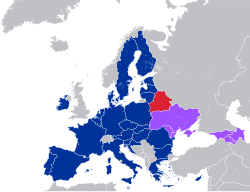
Ukraine is one of six post-Soviet nations to be invited to cooperate with the EU within the new multilateral framework that the Eastern Partnership is expected to establish. However, Kyiv pointed out that it remains pessimistic about the "added value" of this initiative. Indeed, Ukraine and the EU have already started the negotiations on new, enhanced political and free-trade agreements (Association and Free-Trade Agreements). Also, there has been some progress in liberalising the visa regime despite persistent problems in the EU Member States' visa approach towards Ukrainians.
That is why Ukraine has a specific view of the Eastern Partnership project. According to the Ukrainian presidency, it should correspond, in case of his country, to the strategic foreign policy objective, i.e. the integration with the EU.[35] Yet, the Eastern Partnership documents (the European Council Declaration of May 2009)[36] do not confirm such priorities as political and economic integration or lifting visas.
Ukraine has expressed enthusiasm about the project. Ukraine deputy premier Hryhorii Nemyria said that the project is the way to modernise the country and that they welcome the Eastern Partnership policy, because it uses 'de facto' the same instruments as for EU candidates.[37]
Under the Eastern Partnership, Poland and Ukraine have reached a new agreement replacing visas with simplified permits for Ukrainians residing within 30 km of the border. Up to 1.5 million people may benefit from this agreement, which took effect on 1 July 2009.[38]
Viktor Yanukovych presidency
In May 2010, President Viktor Yanukovych promised to adopt in June 2010 the legislation necessary for creating a free trade zone between Ukraine and the European Union (EU).[nb 1] Yanukovych expected visas between Ukraine and EU member states to be abolished and that a free trade zone will be created by March 2011.[40]
The Azarov Government continued to pursue EU-integration. During May and June 2010, both Prime Minister Mykola Azarov and Ukrainian Foreign MinisterKostiantyn Hryshchenko stated that integration into Europe has been and remains the priority of domestic and foreign policy of Ukraine.[41][42][43] The policies of the Azarov Government do not exclude EU integration, the EU Commissioner for EnlargementŠtefan Füle stated on 12 May 2010.[44]
"An action plan for Ukraine toward the establishment of a visa-free regime for short-stay travel" between the European Council and Ukraine was agreed on 22 November 2010.[45] This roadmap requests major improvements in Ukrainian border control, migration and asylum policies.[46]
Attempts to change the French constitution are currently being carried forward in order to remove the compulsory referendum on all EU accessions of countries with a population of more than 5% of the EU's total population; this clause would apply to Ukraine and Turkey.[47]
Ukraine–European Union Association Agreement
ข้อตกลงความร่วมมือของสหภาพยุโรป (AA) ได้รับการลงนามเบื้องต้นเมื่อวันที่ 30 มีนาคม 2012 ที่กรุงบรัสเซลส์[ 48 ]แต่ ณ เดือนพฤศจิกายน 2012 รัฐบาลของสหภาพยุโรป 27 ประเทศและรัฐสภายุโรปยังไม่ได้ลงนามในข้อตกลง[ 49 ] [ 50 ] [ 51 ]การปฏิบัติและการตัดสินลงโทษ (ซึ่งผู้นำสหภาพยุโรปถือว่าเป็นการพิจารณาคดีที่มีแรงจูงใจทางการเมือง) [ 52 ]ของอดีตนายกรัฐมนตรีของยูเครนยูเลีย ติโมเชนโกทำให้ความสัมพันธ์ระหว่างสหภาพยุโรปและยูเครนตึงเครียด[ 52 ] [ 53 ]สหภาพยุโรปและรัฐสมาชิกหลายประเทศ โดยเฉพาะเยอรมนี ได้กดดันประธานาธิบดีวิกเตอร์ ยานูโควิชและรัฐบาลอาซารอฟของยูเครน ให้ยุติการกักขังติโมเชนโก เนื่องจากเกรงว่าสุขภาพของเธอจะทรุดโทรมลง[ 54 ] ผู้นำสหภาพยุโรปหลายคน รวมถึงประธานาธิบดีเยอรมนี โยอาคิม เกาค์ได้ยกเลิกการประชุมกับยานูโควิชหลายครั้ง[ 55 ] [ 56 ]
ตามคำขอของนักการเมืองฝ่ายค้านในยูเครน เจ้าหน้าที่รัฐบาลสหภาพยุโรปได้คว่ำบาตร การแข่งขันฟุตบอล ยูโร 2012 ของยูฟ่าในยูเครน[ 51 ] [ 55 ] [ 57 ]ผู้นำสหภาพยุโรปได้เสนอแนะว่า AA และข้อตกลงการค้าเสรีเชิงลึกและครอบคลุมจะไม่ได้รับการให้สัตยาบันเว้นแต่ยูเครนจะแก้ไขข้อกังวลเกี่ยวกับ "การเสื่อมถอยอย่างรุนแรงของประชาธิปไตยและหลักนิติธรรม " ซึ่งรวมถึงการจำคุก Tymoshenko และYurii Lutsenkoในปี 2011 และ 2012 [ 58 ] [ 59 ] [ 60 ]
แถลงการณ์ของสภาการต่างประเทศของสหภาพยุโรป เมื่อวันที่ 10 ธันวาคม 2012 "ยืนยันความมุ่งมั่นในการลงนามในข้อตกลงความร่วมมือที่ได้ร่างไว้แล้ว ซึ่งรวมถึงเขตการค้าเสรีที่ลึกซึ้งและครอบคลุม ทันทีที่ทางการยูเครนแสดงให้เห็นถึงการดำเนินการที่แน่วแน่และความคืบหน้าที่เป็นรูปธรรมในสามด้านที่กล่าวถึงข้างต้น ซึ่งอาจเกิดขึ้นได้ภายในช่วงการประชุมสุดยอดหุ้นส่วนตะวันออกในวิลนีอุสในเดือนพฤศจิกายน 2013 " สามด้านดังกล่าวได้แก่ "การปฏิรูปการเลือกตั้ง ตุลาการ และรัฐธรรมนูญ (ซึ่งสอดคล้องกับมาตรฐานสากลเป็นส่วนสำคัญและเป็นลำดับความสำคัญที่ตกลงกันไว้ร่วมกัน)" [ 61 ]
Kostiantyn Yelisieiev, Ukraine's Ambassador to the EU, responded in February 2013 by rejecting any preconditions by the EU for signing the AA.[62] However, on 22 February 2013 a resolution was approved by 315 of the 349 registered members of the Verkhovna Rada stating that "within its powers" the parliament would ensure that 10 December 2012 EU Foreign Affairs Council "recommendations" are implemented.[63] At the 16th EU-Ukraine summit of 25 February 2013,[64]President of the European CouncilHerman Van Rompuy followed up on the December 2012 EU Foreign Affairs Council statement by reiterating the EU's "call for determined action and tangible progress in these areas – at the latest by May, this year".[65]
The same day President Yanukovych stated Ukraine will "do its best" to satisfy the EU's requirements.[65] At the time President Yanukovych was also in negotiations with Russia to "find the right model" for cooperation with the Customs Union of Belarus, Kazakhstan and Russia.[65] But also on 25 February 2013, President of the European CommissionJosé Manuel Barroso made it clear that "one country cannot at the same time be a member of a customs union and be in a deep common free-trade area with the European Union".[65]
To coordinate preparation of Ukraine for European integration, the Government of Ukraine has adopted a Plan on Priority Measures for European Integration of Ukraine for 2013. Successful implementation of the plan is assumed as one of the conditions necessary for signing of the Association Agreement, planned for 29 November 2013 during Eastern Partnership Summit in Vilnius.[5][66]
In March 2013, Stefan Fuele, the EU's Commissioner for Enlargement, informed the European Parliament that while Ukrainian authorities had given their "unequivocal commitment" to address the issues raised by the EU, several "disturbing" recent incidents, including the annulment of Tymoshenko's lawyer Serhii Vlasenko's mandate in the Verkhovna Rada (Ukraine's parliament), could delay the signing of the agreements. However, the next day the Ukrainian Ministry of Foreign Affairs expressed its optimism that they would still be signed in November.[67]
On 7 April 2013, a decree by President Yanukovych freed Lutsenko from prison and exempted him, and his fellow Minister in the second Tymoshenko GovernmentHeorhii Filipchuk, from further punishment.[68]
On 3 September 2013, (at the opening session of the Verkhovna Rada after the summer recess) President Yanukovych urged his parliament to adopt laws so that Ukraine will meet the EU criteria and it can sign the Association Agreement in November 2013.[69]
On 18 September, the Ukrainian cabinet unanimously approved the draft association agreement.[70]
On 25 September 2013, Chairman of the Verkhovna RadaVolodymyr Rybak stated that he was sure that his parliament would pass all the laws needed to fit the EU criteria for the Association Agreement since, except for the Communist Party of Ukraine,[nb 2] "The Verkhovna Rada has united around these bills."[71]
On 20 November 2013, EU's Commissioner for Enlargement Fuele stated he expected that the Verkhovna Rada would consider and adopt the remaining bills necessary for the signing of the association agreement, planned for 29 November 2013, the next day.[5]
Suspension of association agreement signature
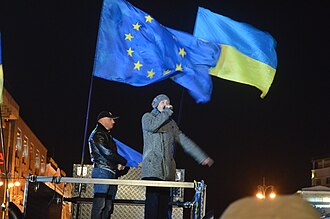
On 21 November 2013, the Verkhovna Rada failed to pass any of the six motions on allowing former Prime Minister Yulia Tymoshenko to receive medical treatment abroad, which was an EU demand for signing the association agreement.[73][74] The same week Tymoshenko had stated that she was ready to ask the EU to drop the demand for her freedom if it meant President Viktor Yanukovych would sign the association agreement.[75] The same day a Ukrainian government decree suspended preparations for signing of association agreement; instead it proposed the creation of a three-way trade commission between Ukraine, the European Union and Russia that would resolve trade issues between the sides.[73] Prime Minister Mykola Azarov issued the decree in order to "ensure the national security of Ukraine" and in consideration of the possible ramifications of trade with Russia (and other CIS countries[76]) if the agreement was signed on a 28–29 November summit in Vilnius.[73]
The suspension of the association agreement signature initiated a wave of protests that would ultimately overthrow Viktor Yanukovych and his government.[3]
Relations since suspension of association agreement till fall of Yanukovych
เมื่อวันที่ 2 ธันวาคม 2013 ประธานคณะกรรมาธิการยุโรปโฮเซ่ มานูเอล บาร์โรโซตกลงที่จะพบกับคณะผู้แทนจากยูเครนเพื่อหารือเกี่ยวกับความสัมพันธ์ที่ใกล้ชิดยิ่งขึ้นกับสหภาพยุโรป แต่ระบุว่าจะไม่มีการเปิดการเจรจาใหม่เกี่ยวกับข้อตกลงความร่วมมือที่เสนอ[ 77 ]ในวันเดียวกันนั้น รองนายกรัฐมนตรีคนแรกของยูเครนเซอร์ฮีย์ อาร์บูซอฟประกาศว่ายูเครนวางแผนที่จะลงนามใน "แผนงาน" กับสหภาพยุโรป "ผมไม่ได้พูดถึงเงื่อนไขของความร่วมมือ แต่พูดถึงเงื่อนไขที่เราวางแผนจะแก้ไขก่อนและหลังการลงนาม" [ 78 ]ยูเครนและสหภาพยุโรปเริ่ม "ดำเนินการเตรียมการทางเทคนิคสำหรับการเจรจาที่จะเกิดขึ้นระหว่างยูเครนและสหภาพยุโรปเกี่ยวกับบางแง่มุมของการดำเนินการตามข้อตกลงความร่วมมือ" เมื่อวันที่ 5 ธันวาคม 2013 [ 79 ]อย่างไรก็ตาม เมื่อวันที่ 15 ธันวาคม ฟูเอเลกล่าวว่าจุดยืนในการเจรจาของรัฐบาลยูเครนนั้น "ไม่มีพื้นฐานในความเป็นจริง" และพวกเขากำลังระงับการเจรจาต่อไป[ 80 ]บาร์โรโซกล่าวว่า "เรากำลังเริ่มต้นการเดินทางอันยาวนาน เพื่อช่วยให้ยูเครนกลายเป็นประเทศสมาชิกใหม่เช่นเดียวกับประเทศอื่นๆ แต่เราต้องละทิ้งการคำนวณทางการเมืองระยะสั้น" [ 81 ]
เมื่อวันที่ 17 ธันวาคม ยูเครนได้ลงนามในสนธิสัญญากับรัสเซีย โดยรัสเซียจะซื้อพันธบัตรยูโร ของยูเครนมูลค่า 15 พันล้าน ดอลลาร์ และต้นทุนก๊าซธรรมชาติของรัสเซียที่ส่งไปยังยูเครนจะลดลง[ 82 ] [ 83 ]แม้ว่าปูตินจะกล่าวว่า "วันนี้เรายังไม่ได้หารือเกี่ยวกับประเด็นที่ยูเครนจะเข้าร่วมสหภาพศุลกากร [ของเบลารุส คาซัคสถาน และรัสเซีย]เลย" [ 84 ] [ nb 3 ]สามวันต่อมา เจ้าหน้าที่ระดับสูงของสหภาพยุโรปกล่าวว่า สหภาพยุโรปยังคงพร้อมที่จะลงนามในข้อตกลงความร่วมมือ "ทันทีที่ยูเครนพร้อม" ข้อตกลงนี้เป็นประโยชน์ต่อรัสเซียเช่นกัน และสหภาพยุโรป "ไม่ได้กังวลเลยเกี่ยวกับข้อเท็จจริงที่ว่ายูเครนกำลังลงนามในข้อตกลงกับรัสเซีย" [ 86 ] [ 87 ] [ 88 ] [ 89 ] [ 90 ]เมื่อวันที่ 23 ธันวาคม พ.ศ. 2556 ยูริ อูชาคอฟ ผู้ช่วยประธานาธิบดีรัสเซียกล่าวว่า "ไม่มีความขัดแย้ง" ในการที่ยูเครนเข้าร่วมกับสหภาพยุโรปและสถานะผู้สังเกตการณ์ในสหภาพศุลกากรของเบลารุส คาซัคสถาน และรัสเซียและสหภาพเศรษฐกิจยูเรเซีย[ 91 ]
On 20 December 2013, Chairman of the Verkhovna Rada (Ukraine's parliament) Volodymyr Rybak did not rule out the possibility of signing an Association Agreement between Ukraine and the EU without the creation of a free trade area (FTA).[92] On 24 December 2013, Minister of Foreign Affairs of Ukraine Leonid Kozhara stated that "at the present time" his Ministry's "and other government agencies' efforts are focused on further negotiations with the EU to provide conditions for implementing the association agreement".[93] He added that "Ukraine will resume the negotiations on this agreement after the holidays" and that the text of the Association Agreement itself would not be changed, but that Ukraine intended to focus on the issues related to its implementation.[94]
On 15 January 2014, Ukrainian Prime Minister Mykola Azarov gave an interagency (ministries and other agencies) working group two months to draw up a plan "on conditions of the implementation of the Association Agreement" for negotiations with the EU.[95]
Euromaidan and ratification of the Association Agreement
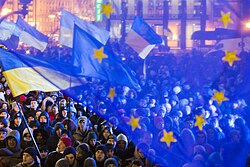

วิกเตอร์ ยานูโควิชและรัฐบาล ของเขา ถูกปลดออกจากตำแหน่งโดยรัฐสภาหลังจากการปฏิวัติแห่งศักดิ์ศรีในเดือนกุมภาพันธ์ พ.ศ. 2557 [ 3 ] [ 8 ]หลังจากการขับไล่ยานูโควิชรัสเซียได้รุกรานไครเมียและสงครามในดอนบาส ก็ เริ่มต้นขึ้น[ 1 ] [ 3 ]ในเดือนมีนาคม พ.ศ. 2557 สหภาพยุโรปประณามการผนวกไครเมียโดยรัสเซียและ "การละเมิดอธิปไตยและบูรณภาพดินแดนของยูเครนอย่างชัดเจนโดยการกระทำที่ก้าวร้าวของกองกำลังติดอาวุธของรัสเซีย" สหภาพยุโรปยังได้อายัด (และพยายามกู้คืน) "เงินทุนของรัฐยูเครนที่ถูกยักยอก" และอายัดทรัพย์สินและปิดกั้นการเข้าประเทศของชาวรัสเซียและยูเครนที่ถูกมองว่ารับผิดชอบต่อความไม่สงบในยูเครน[ 1 ] [ 3 ]ส่วนทางการเมืองของข้อตกลงความร่วมมือได้รับการลงนามเมื่อวันที่ 21 มีนาคม 2014 โดยนายกรัฐมนตรีคนใหม่อาร์เซนี ยัตเซนิอุคโดยส่วนที่เหลือของข้อตกลงเกี่ยวกับการค้าเสรีถูกเลื่อนออกไปจนกว่าจะมีการเลือกตั้งในเดือนพฤษภาคม [ 96 ] [ 1 ] ภาษีศุลกากรสำหรับการส่งออกของยูเครนไปยังสหภาพยุโรปถูกยกเลิกชั่วคราวในเดือนเมษายน 2014 [ 1 ]นอกจากนี้ยังมีการสัญญาว่าจะให้ความช่วยเหลือทางการเงินแก่ยูเครน[ 1 ] [ 3 ]ยูเครนได้รับ เงินกู้ ทวิภาคีเพื่อความช่วยเหลือทางการเงินมหภาคจำนวนหนึ่งพันล้านยูโรในเดือนพฤษภาคม 2014 [ 9 ]หลังจากการเลือกตั้งประธานาธิบดีคนใหม่ของยูเครนเปโตร โปโรเชนโกและสหภาพยุโรปได้ลงนามในส่วนเศรษฐกิจของข้อตกลงความร่วมมือเมื่อวันที่ 27 มิถุนายน 2014 [ 10 ]ประธานสภายุโรปเฮอร์มัน ฟาน รอมปุยกล่าวถึงการลงนามว่าเป็น "วันที่ยิ่งใหญ่สำหรับยุโรป" [ 10 ]เปโตร โปโรเชนโก ประธานาธิบดี คนใหม่ของยูเครนผู้ลงนามกล่าวว่า "ยูเครนกำลังเน้นย้ำทางเลือกอธิปไตยของตนเพื่อสนับสนุนการเป็นสมาชิกสหภาพยุโรป" [ 10 ]และยังอธิบายว่าเป็น "ก้าวแรกแต่เป็นก้าวที่สำคัญที่สุด" ของยูเครนสู่การเป็นสมาชิกสหภาพยุโรป[ 97 ]โปโรเชนโกยังตั้งเป้าหมายไว้ที่ปี 2020 สำหรับการยื่นขอเป็นสมาชิกสหภาพยุโรป[ 98 ]ตามที่Voice of America กล่าวไว้ reported on 27 June, "Terms of the EU agreements require Georgia, Moldova and Ukraine not enter into similar free trade agreements with the Kremlin."[99] On 16 September 2014, the Verkhovna Rada approved the draft law on ratification of the Association Agreement between Ukraine and the European Union, which was signed the same day by President Petro Poroshenko.[100]
Same year, EU and Ukraine, upon Ukrainian Government's request, agreed to establish European Union Advisory Mission Ukraine (EUAM Ukraine), which is a civilian Common Security & Defence Policy mission of the EU for Ukraine's civilian security sector reform that formally began operating in Ukraine on 1 December 2014. EUAM Ukraine, employing over 300 personnel working in main headquarters in Kyiv, as well as in field offices in Lviv, Kharkiv and Odesa and a Mobile Unit today, provides strategic advice and practical support to Ukrainian counterparts. By working with a number of law-enforcement and rule of law agencies (Ministry of Internal Affairs, National Police, National Anti-Corruption Agency, State Border Guard Service, State Bureau of Investigations to name but a few), EUAM Ukraine aims to make civilian security sector more efficient, transparent and enjoying public trust.
The 17th EU-Ukraine summit took place on 27 April 2015 in Kyiv.[101] During an Eastern Partnership summit in Riga in May 2015, EU agreed on a €1.8 bln loan to Ukraine.[102] On 1 January 2016, the Deep and Comprehensive Free Trade Area between Ukraine and the EU entered into force. By April 2016, the Association Agreement had been ratified by Ukraine and all EU member states except the Netherlands, which held a referendum on approval of the treaty. Following the rejection of the agreement in the referendum, Prime Minister of the Netherlands Mark Rutte said that ratification would be put on hold during negotiations with the other parties to the treaty to find a compromise.[103][104] In December 2016, a decision of the heads of state or government of the EU member states was approved which made legally binding interpretations of the agreement to address the concerns raised in the referendum. In particular, it stated that it did not commit the EU to grant Ukraine EU membership candidate status, provide security guarantees, military of financial aid, or free movement within the EU.[105][106] The decision would enter into force if the Netherlands ratified the agreement, which needed to be approved by its parliament.[107] In late January 2017, the Dutch government introduced a bill to confirm approval of the agreement.[108] The Dutch House of Representatives approved the bill on 23 February 2017.[109] The Senate approved the bill on 30 May 2017.[110]
During the 23rd Ukraine-European Union Summit, on 12 October 2021, the Prime Minister of Ukraine Denys Shmyhal, the Vice President of the European Commission, the High Representative of the European Union for Foreign Affairs and Security Policy Josep Borrell and the Ambassador Extraordinary and Plenipotentiary of Slovenia to Ukraine Tomaž Mentsin signed an agreement between Ukraine and the European Union and its member states on the Common Aviation Area.[111]
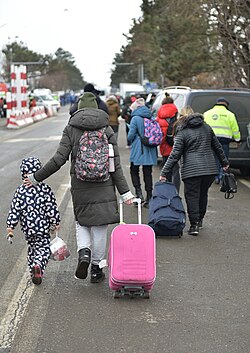
In March 2022, the Council of the European Union invoked the Temporary Protection Directive for the first time in its history, in response to the refugee crisis caused by the Russian invasion of Ukraine.[112]
On 27 April 2022, the EU Commission proposed to temporarily drop all its tariffs on imports from Ukraine to help Ukrainian industry weather Russian aggression.[113]
On 29 May 2022, in order to support Ukraine's path to the European future,[114] in particular to obtain the status of a candidate for membership in the European Union on 25–26 June 2022,[115][116] the Government of Ukraine launched a communication campaign «Embrace Ukraine. Strengthen the Union».
On 31 March 2026, the EU's statistics agency Eurostat recorded a total of 4.33 million Ukrainians living in the bloc under temporary protection status.[117] The countries hosting the largest numbers of refugees under this framework were Germany (nearly 1.3 million), Poland (950,000), and the Czech Republic (380,000).[117] On 26 June 2026, the European Commission formally proposed extending the temporary protection framework for displaced Ukrainians until March 2028.[118] At the request of Kyiv, the proposal introduced restrictions excluding newly arriving Ukrainian men of military age from receiving automatic temporary protection status.[117]
Legal instruments
Partnership and Cooperation Agreement (1994)
The political dialogue between the EU and Ukraine started in 1994 when the Partnership and Cooperation Agreement (PCA) was signed. That document was focused on economic and social issues as well as on the necessity of improving public government and guaranteeing free press and civil rights. The framework set for political discussions was modest: yearly meeting between EU Troika and Ukrainian leadership and some inter ministerial consultations. The Partnership and Cooperation Agreement of 1994 entered into force in 1998 and expired in 2008. None of the top level meetings brought any major changes to a reserved EU approach. Leaders focused chiefly on economic transition and human rights records as well as on issues connected to the Chernobyl nuclear power plant and its containment.
European Neighbourhood Policy (ENP)
| ENP partner | EU contract | FTA provisions | Country Report | แผนปฏิบัติการ | การรับรองโดยสหภาพยุโรป | การรับเลี้ยงบุตรบุญธรรมโดยพันธมิตรของ ENP | ระยะเวลา AP | คำเชิญ CFSP [ nb 4 ] | ความปรารถนาของสหภาพยุโรป[ nb 5 ] | กลุ่มย่อย |
|---|---|---|---|---|---|---|---|---|---|---|
| ยูเครน[ nb 6 ] | พีซีเอ มีนาคม 2541 | เลขที่ | พฤษภาคม 2547 | สิ้นปี 2547 | 21 กุมภาพันธ์ 2548 | 21 กุมภาพันธ์ 2548 | 3 ปี | ใช่[ nb 7 ] | ใช่ | ทิศตะวันออก |
แหล่งที่มา: Wayback Machine , คณะกรรมาธิการยุโรป - ข่าวประชาสัมพันธ์ - นโยบายเพื่อนบ้านยุโรป: ความก้าวหน้าหนึ่งปี , หน้าเว็บทางการของ ENP, EEAS - สำนักงานบริการด้านการต่างประเทศของยุโรป
แผนปฏิบัติการร่วมระหว่างสหภาพยุโรปและยูเครนได้รับการรับรองโดยสภายุโรปเมื่อวันที่ 21 กุมภาพันธ์ 2548 แผนดังกล่าวมีพื้นฐานมาจากข้อตกลงความร่วมมือและหุ้นส่วนปี 1994 และตามที่คณะกรรมาธิการยุโรประบุไว้ แผนนี้เป็นกรอบการทำงานที่ครอบคลุมและทะเยอทะยานสำหรับการทำงานร่วมกันกับยูเครนในทุกด้านสำคัญของการปฏิรูป
หุ้นส่วนภาคตะวันออก (EaP)
หุ้นส่วนตะวันออกเป็นเวทีที่มุ่งปรับปรุงความสัมพันธ์ทางการค้าทางการเมืองและเศรษฐกิจของรัฐหลังโซเวียตทั้ง หก ที่มี "ความสำคัญเชิงยุทธศาสตร์" ได้แก่ยูเครนเบลารุสมอลโดวา อาเซอร์ไบจานอาร์เมเนียและจอร์เจียกับสหภาพยุโรป[ 120 ]ร่างของสหภาพยุโรปเกี่ยวกับหุ้นส่วนตะวันออกระบุว่า "ค่านิยมร่วมกัน ได้แก่ ประชาธิปไตยหลักนิติธรรมและการเคารพสิทธิมนุษยชน จะเป็นหัวใจสำคัญ เช่นเดียวกับหลักการของเศรษฐกิจตลาดการพัฒนาที่ยั่งยืนและธรรมาภิบาล " หุ้นส่วนนี้มีจุดประสงค์เพื่อเป็นรากฐานสำหรับข้อตกลงความร่วมมือใหม่ระหว่างสหภาพยุโรปและพันธมิตรที่ได้มีความก้าวหน้าเพียงพอต่อหลักการและค่านิยมที่กล่าวถึง[ 121 ]
ยูเครนเป็นหนึ่งในหกประเทศหลังยุคโซเวียตที่ได้รับเชิญให้ร่วมมือกับสหภาพยุโรปภายใต้กรอบความร่วมมือพหุภาคีใหม่ที่คาดว่าจะจัดตั้งขึ้นภายใต้โครงการหุ้นส่วนตะวันออก อย่างไรก็ตาม เคียฟชี้ว่ายังคงมองในแง่ร้ายเกี่ยวกับ "มูลค่าเพิ่ม" ของโครงการริเริ่มนี้ ที่จริงแล้ว ยูเครนและสหภาพยุโรปได้เริ่มการเจรจาเกี่ยวกับข้อตกลงทางการเมืองและการค้าเสรีฉบับใหม่ที่ได้รับการปรับปรุงแล้ว (ข้อตกลงความร่วมมือและการค้าเสรี) นอกจากนี้ ยังมีความคืบหน้าบ้างในการผ่อนปรนระบอบวีซ่า แม้จะมีปัญหาต่อเนื่องในแนวทางการออกวีซ่าของประเทศสมาชิกสหภาพยุโรปต่อชาวยูเครนก็ตาม
ด้วยเหตุนี้ ยูเครนจึงมีมุมมองที่เฉพาะเจาะจงเกี่ยวกับโครงการหุ้นส่วนตะวันออก ตามความเห็นของประธานาธิบดีของยูเครน โครงการนี้ควรสอดคล้องกับวัตถุประสงค์เชิงนโยบายต่างประเทศเชิงกลยุทธ์ของประเทศตน นั่นคือ การบูรณาการกับสหภาพยุโรป[ 35 ]อย่างไรก็ตาม เอกสารหุ้นส่วนตะวันออก (ปฏิญญาสภายุโรปเดือนพฤษภาคม 2009) [ 36 ]ไม่ได้ยืนยันถึงลำดับความสำคัญเช่น การบูรณาการทางการเมืองและเศรษฐกิจ หรือการยกเลิกวีซ่า
ยูเครนแสดงความกระตือรือร้นต่อโครงการนี้ รองนายกรัฐมนตรีของยูเครนHryhorii Nemyriaกล่าวว่าโครงการนี้เป็นหนทางสู่การพัฒนาประเทศให้ทันสมัย และพวกเขายินดีต้อนรับนโยบายหุ้นส่วนตะวันออก เพราะนโยบายนี้ใช้เครื่องมือที่คล้ายคลึงกันกับประเทศผู้สมัครเข้าเป็นสมาชิกสหภาพยุโรป[ 37 ]
ภายใต้ความร่วมมือภาคตะวันออกโปแลนด์และยูเครนได้บรรลุข้อตกลงใหม่โดยเปลี่ยนวีซ่าเป็นใบอนุญาตแบบง่ายสำหรับชาวยูเครนที่อาศัยอยู่ภายในระยะ 30 กม. จากชายแดน ประชาชนมากถึง 1.5 ล้านคนอาจได้รับประโยชน์จากข้อตกลงนี้ซึ่งมีผลบังคับใช้เมื่อวันที่ 1 กรกฎาคม พ.ศ. 2552 [ 38 ]
การเจรจาข้อตกลงความร่วมมือ (AA)
ข้อตกลงความร่วมมือ (AA) ระหว่างยูเครนและสหภาพยุโรปได้รับการเจรจาตั้งแต่ปี 2009 ถึง 2011 และควรจะเข้ามาแทนที่ข้อตกลงความร่วมมือทางการเมือง (PCA) ที่มีอยู่เดิม ข้อตกลง AA มีเป้าหมายเพื่อความร่วมมือทางการเมืองและการบูรณาการทางเศรษฐกิจ รวมถึง " เขตการค้าเสรี ที่ลึกซึ้งและครอบคลุม " และดำเนินควบคู่ไปกับการเจรจาเรื่องการยกเว้นวีซ่าข้อตกลงนี้ไม่ได้ระบุถึงการเป็นสมาชิกสหภาพยุโรปของยูเครน แม้ว่าจะระบุว่ายูเครนเป็น "ประเทศในยุโรปที่มีอัตลักษณ์แบบยุโรป" และกล่าวว่า "สหภาพยุโรปยอมรับความปรารถนาของยูเครนที่จะเป็นส่วนหนึ่งของยุโรป"
On 16 June 2009, a new practical instrument was adopted—the EU-Ukraine Association Agenda.[30] 19 December 2011 EU-Ukraine summit, which was intended to lead to the signature of the Agreement, fell short due to the EU's concerns over the jailing of former premier Yulia Tymoshenko. The end of negotiations were announced, but the text of the agreement was not signed with EU leaders deciding to wait until the October 2012 Parliamentary elections as a test of the vitality of democracy and rule of law in Ukraine.[122][123] The AA was initialed shortly thereafter, on 30 March 2012.[49][50] Before it enters into force it must be ratified by the Ukrainian Parliament, the European Parliament, and each EU member state.[50][51] However, EU leaders have suggested that the agreement will not be ratified unless Ukraine addresses concerns over a "stark deterioration of democracy and the rule of law", including the imprisonment of Yulia Tymoshenko and Yurii Lutsenko in 2011 and 2012.[58][59][60] In November 2012, EU Commissioner for Enlargement and European Neighbourhood PolicyStefan Fule stated that the AA, and DCFTA, could be signed in November 2013 if the EU's concerns were addressed.[124][125]
However, in February 2013 Fule warned Ukraine that the agreements could be abandoned if the required reforms are not made quickly. He also stated that Ukrainian membership in the Customs Union of Belarus, Kazakhstan and Russia would be incompatible with the agreements with the EU.[126]
Deep and Comprehensive Free Trade Agreement (DCFTA)
While work on signing a deep and comprehensive free trade agreement between Ukraine and the EU first began in 1999,[18] formal negotiations between the Ukrainian government and the EU Trade Commissioner were not launched until 18 February 2008 .[127] As of May 2011 there remained three outstanding issues to be resolved in the free trade deal: quotas on Ukrainian grain exports, access to the EU's services market and geographical names of Ukrainian commodities. Aside from these issues, the deal was ready.[128] Despite those outstanding issues, Ukraine was ready to sign the agreement as it stood. Although it wanted stronger wording on enlargement prospects and access to the EU market for its truckers, Ukraine had more than many other candidates at the equivalent stage of the process. The finalised agreement was initialed on 19 July 2012.[49] Ratification of the DCFTA, like the AA, has been stalled by the EU concerns over the rule of law in Ukraine.[58][59][60] This includes the application of selective justice, as well as amending electoral laws. As a result, the role of Ukrainian oligarchs in sanctioning the agreement was also questioned.[129]
If Ukraine would choose the agreement, the Eurasian Economic Commission's Customs Union of Belarus, Kazakhstan and Russia would withdraw from free trade agreements with the country, according to Russian presidential advisor Sergei Glazyev.[130] However, on 21 November 2013 a Ukrainian government decree suspended preparations for signing the agreement[nb 8] that was scheduled to be signed during a 28–29 November 2013 EU summit in Vilnius, and it was not signed.[5][6][73][74][135][136][137][nb 9] The decision to put off signing the association agreement led to 2013–2014 Ukrainian revolution.[7]
EU sanctions against Russia related to its military intervention in eastern Ukraine have been extended until July, 2016.[138] On 1 January 2016, the DCFTA entered into force.
Visa liberalisation dialogue and visa-free regime
- 2006 Readmission Agreement
- 2007 Visa Facilitation Agreement
- 2010 Visa Liberalisation Action Plan
On 22 November 2010, the European Council and Ukraine announced "an action plan for Ukraine toward the establishment of a visa-free regime for short-stay travel".[45] This roadmap outlined major improvements in Ukrainian border control, migration and asylum policies.[46] According to The Wall Street Journal, for the EU, "the visa-free regimes are a key tool for binding their neighbors closer and for advancing reforms in those countries."[139] Negotiations for an amendment to the 2007 Visa Facilitation agreement, which expanded the subset of individuals eligible for simplified visa procedures to include students, NGO representatives and holders of official passports, were finalised in December 2011,[123] and the Visa Facilitation Agreement was ratified by the Verkhovna Rada on 22 March 2013.[140] On 18 April 2013, the European Parliament followed suit,[141][142] and the European Council finalised the agreement on 13 May 2013.[141][143]
ในเดือนธันวาคม พ.ศ. 2554 ประธานาธิบดีวิกเตอร์ ยานูโควิช แห่งยูเครน คาดหวังว่าการเจรจาเรื่องการเดินทางโดยไม่ต้องขอวีซ่าจะเสร็จสิ้นภายในสิ้นปี พ.ศ. 2557 [ 123 ]คณะกรรมาธิการยุโรประบุในเดือนพฤศจิกายน พ.ศ. 2556 ว่ายูเครนต้องเสริมสร้างกฎหมายต่อต้านการเลือกปฏิบัติก่อนที่จะมีการจัดตั้งระบบการเดินทางโดยไม่ต้องขอวีซ่า[ 144 ]รัฐสภา แห่งยูเครน ( Verkhovna Rada ) ได้รับรองร่างกฎหมายที่เหลืออีก 4 ฉบับที่จำเป็นสำหรับการเปลี่ยนผ่านไปสู่ระยะที่สอง (การดำเนินการ) ของแผนปฏิบัติการยกเลิกวีซ่าในเดือนพฤษภาคม พ.ศ. 2557 (รวมถึงร่างกฎหมายเกี่ยวกับการปรับปรุงกฎหมายต่อต้านการเลือกปฏิบัติ) [ 145 ]เมื่อกล่าวปราศรัยต่อสมาชิกรัฐสภาก่อนการลงคะแนนเสียงในร่างกฎหมายเหล่านี้ประธานรัฐสภาและรักษาการประธานรัฐสภา[ 3 ]โอเล็กซานเดอร์ ตูร์ชินอฟได้ทำนายไว้ว่า "ระบบการเดินทางโดยไม่ต้องขอวีซ่าจะถูกนำมาใช้ภายในสิ้นปีนี้" [ 145 ]อย่างไรก็ตาม ยูเครนควรจะได้ผ่านร่างกฎหมายที่กล่าวถึงเงื่อนไขหกประการ[ nb 10 ]ที่จำเป็นสำหรับการปฏิบัติตามแผนปฏิบัติการยกเว้นวีซ่าก่อนวันที่ 15 ธันวาคม 2015 [ 146 ]ในวันนั้น สหภาพยุโรปจะตัดสินใจว่าประเทศนี้จะได้รับสิทธิไม่ต้องขอวีซ่าในปี 2016 หรือไม่[ 146 ]ในเดือนธันวาคม 2015 คณะกรรมาธิการได้ออกรายงานความคืบหน้าซึ่งพบว่ายูเครนได้ปฏิบัติตามเงื่อนไขทั้งหมดเพื่อให้พลเมืองของตนสามารถเดินทางเข้าสู่เขตเชงเก้นโดยไม่ ต้องขอวีซ่า [ 147 ]
คณะกรรมาธิการยุโรปเสนออย่างเป็นทางการให้ยูเครนได้รับสิทธิ์เดินทางโดยไม่ต้องขอวีซ่าในเดือนเมษายน พ.ศ. 2559 [ 148 ]ต่อมาสหภาพยุโรปได้เลื่อนเรื่องนี้ออกไป[ 149 ] [ 150 ]โดยเลื่อนวันที่อาจมีการตกลงกันไปเป็นเดือนกันยายน พ.ศ. 2559 [ 139 ]คณะกรรมการผู้แทนถาวรได้อนุมัติในเดือนพฤศจิกายน พ.ศ. 2559 [ 151 ] [ 152 ]โครงการเดินทางโดยไม่ต้องขอวีซ่า ซึ่งจะอนุญาตให้ชาวยูเครนที่มีหนังสือเดินทางไบโอเมตริกซ์สามารถเข้าเยี่ยมชมเขตเชงเก้นได้เป็นระยะเวลา 90 วันในทุกๆ 180 วัน จะมีผลบังคับใช้เมื่อรัฐสภายุโรปและสภายุโรปเห็นชอบและรับรองอย่างเป็นทางการแล้ว[ 151 ] [ 153 ]ในเดือนธันวาคม สหภาพยุโรปตกลงว่าคณะกรรมาธิการยุโรปหรือรัฐสมาชิกสหภาพยุโรปจะสามารถระงับการยกเว้นวีซ่าสำหรับชาวยูเครนได้นานถึงเก้าเดือนในกรณีฉุกเฉิน[ 154 ]เช่น หาก “ยูเครนไม่ให้ความร่วมมือในการรับผู้อพยพผิดกฎหมายกลับประเทศ มีจำนวนผู้ยื่นขอลี้ภัยเพิ่มขึ้น หรือเกิดปัญหาด้านความมั่นคง” [ 155 ]ข้อตกลงเรื่องระบอบการยกเว้นวีซ่าได้รับการเห็นชอบโดยรัฐสภายุโรปและสภาเมื่อวันที่ 28 กุมภาพันธ์ 2017 [ 156 ]ได้รับการอนุมัติโดยสมาชิกสภาผู้แทนราษฎรยุโรปเมื่อวันที่ 6 เมษายน[ 157 ]และโดยสภายุโรปเมื่อวันที่ 11 พฤษภาคม[ 158 ]มีผลบังคับใช้เมื่อวันที่ 11 มิถุนายน 2017 [ 159 ]
สนธิสัญญาพลังงานและชุมชนพลังงาน
ทั้งยูเครนและรัฐสมาชิกสหภาพยุโรปทั้งหมดเป็นผู้ลงนามในสนธิสัญญาพลังงาน (ECT) ซึ่งเป็นสนธิสัญญาที่มีผลผูกพันทางกฎหมายที่เจรจาต่อรองกันหลังจากการประกาศหลักการทางการเมืองเรื่องพลังงานระหว่างประเทศในปี 1991 รวมถึงการค้า การขนส่ง และการลงทุน[ 160 ] ECTได้ลงนามในเดือนธันวาคม 1994 และมีผลบังคับใช้ในเดือนเมษายน 1998 ยูเครนและรัฐสมาชิกสหภาพยุโรปทั้งหมดยังเป็นผู้ลงนามในการแก้ไขเพิ่มเติมทางการค้าปี 1998 ซึ่งสะท้อนถึงการเปลี่ยนแปลงจากGATTไปเป็นWTO [ 160 ]
After its entry into force, Ukraine held an Observer status for the Treaty establishing the Energy Community (also referred as European Energy Community), a community established between the European Union (EU) and a number of third countries in order to extend the EU internal energy market to South East Europe and beyond. The Treaty establishing the Energy Community was signed in Athens, Greece, on 25 October 2005, and entered into force on 1 July 2006. Ukraine soon expressed its interest in full membership. Mandated by the Energy Community Ministerial Council, the European Commission had the first round of formal negotiations with Ukraine in late 2008. After three negotiation rounds, the technical negotiations with Ukraine were concluded in 2009. The Ministerial Council, however, made the membership conditional on legislative amendments. In concrete, it requested Ukraine to revise its gas law so that it complies with EU's Gas Directive 2003/55/EC.[161] Following the amendment of the gas law in July 2010, Ukraine signed the Energy Community Accession Protocol on 24 September 2010,[162] ratified the Treaty on 15 December 2010[163] and officially acceded the Energy Community on 1 February 2011.
Ukraine–European Union Association Agreement
Economic relations
During the 1990s, Germany, the Netherlands and Italy remained major trading partners of Ukraine. According to Eurostat, between 2000 and 2007 EU trade in goods with Ukraine more than tripled in value: exports rose from 5.5 bn Euro to 22.4 bn, while imports increased from 4.8 bn Euro to 12.4 bn. Nevertheless, this increase did not make Ukraine one of the EU's major trading partners. In 2007, Ukraine accounted for only 2% of EU exports and a mere 1% of European Union imports which is toward the bottom of the EU's top 20 trading partners (16th).[164]
According to the European commission paper, trade with Ukraine is dominated by manufactured goods. Nearly half of the EU exports to Ukraine in 2007 were machinery and vehicles and a further quarter were other manufactured articles. A quite similar structure can be seen in imports: unspecified manufactured articles accounted for two-fifths followed by a crude metal for a further fifth. At the more detailed level, the main EU exports to Ukraine in 2007 were medicine, motor vehicles and mobile phones, while the main imports were iron and steel products, as well as sunflower seed oil, ferro-nickel, iron ores and oil.[164]
ในบรรดารัฐสมาชิก EU27 เยอรมนี (5.9 พันล้านยูโร หรือ 26% ของการส่งออกของ EU) เป็นผู้ส่งออกรายใหญ่ที่สุด รองลงมาคือโปแลนด์ (4.1 พันล้านยูโร หรือ 18%) อิตาลี (2.4 พันล้านยูโร หรือ 19%) เป็นผู้นำเข้ารายใหญ่ที่สุด รองลงมาคือบัลแกเรีย (1.6 พันล้านยูโร หรือ 13%) และเยอรมนี (1.3 พันล้านยูโร หรือ 11%) [ 164 ]
ในปี พ.ศ. 2550 ส่วนเกินทางการค้ากับยูเครนที่มากที่สุดพบในเยอรมนี (+ 4.6 พันล้านยูโร) และโปแลนด์ (+ 2.8 พันล้านยูโร) ในขณะที่บัลแกเรียมีการขาดดุลสูงสุด (-1.4 พันล้านยูโร) [ 164 ]
ความช่วยเหลือทางการเงินจากสหภาพยุโรปแก่ยูเครน
สำหรับช่วงงบประมาณปี 2000–2006 ความช่วยเหลือทางการเงินของสหภาพยุโรปแก่ยูเครนนั้นอยู่ภายใต้กรอบ โครงการ ความช่วยเหลือทางเทคนิคแก่กลุ่มประเทศเครือรัฐเอกราช (TACIS) ซึ่งก่อตั้งขึ้นในปี 1991 เป็นโครงการความช่วยเหลือทางเทคนิคที่สนับสนุนกระบวนการเปลี่ยนผ่านไปสู่เศรษฐกิจแบบตลาด สำหรับประเทศ สมาชิกCISทั้ง 11 ประเทศและจอร์เจีย
สำหรับช่วงงบประมาณปี 2550–2556 เครื่องมือความร่วมมือและความเป็นหุ้นส่วนของยุโรป (ENPI) ครอบคลุมประเทศ ENP และแทนที่กองทุน TACIS สำหรับยูเครน[ 165 ]
ภายในเดือนพฤษภาคม พ.ศ. 2557 สหภาพยุโรปได้จ่ายเงินช่วยเหลือจำนวน 11 พันล้านยูโรให้แก่ยูเครน[ 166 ]
ยูเครนมีสิทธิ์เข้าร่วมในเครื่องมือทางการเงินแบบแนวนอน ซึ่งครอบคลุมประเทศต่างๆ โดยไม่คำนึงถึงภูมิภาค เช่น:
- เครื่องมือเพื่อความมั่นคง (Instrument for Stability ) เป็นเครื่องมือใหม่ในการจัดการกับวิกฤตและความไม่มั่นคงในประเทศที่สาม และแก้ไขปัญหาข้ามพรมแดน รวมถึงความปลอดภัยทางนิวเคลียร์และการไม่แพร่กระจายอาวุธนิวเคลียร์ การต่อต้านการค้ามนุษย์ อาชญากรรม organised crime และการก่อการร้าย
- โครงการ ความช่วยเหลือทางการเงินมหภาคในปี 2023 ธนาคารเพื่อการลงทุนแห่งยุโรป (EIB) ได้จัดตั้งกองทุน EU for Ukraine เพื่อตอบสนองความต้องการเร่งด่วนของยูเครน กองทุนนี้มุ่งเน้นไปที่การปรับปรุงสิ่งอำนวยความสะดวกของเทศบาล การยกระดับบริการสาธารณะ และการให้การสนับสนุนทางการเงินและคำแนะนำแก่ธุรกิจขนาดเล็กหรือขนาดใหญ่ ประเทศสมาชิกสหภาพยุโรปได้ให้คำมั่นสัญญาว่าจะสนับสนุนโครงการริเริ่มนี้ประมาณ 400 ล้านยูโร[ 167 ] [ 168 ]
กองทุนนี้เป็นแพ็คเกจความช่วยเหลือทางการเงินมูลค่า 50 พันล้านยูโรจากสหภาพยุโรป และกำหนดให้ดำเนินการตั้งแต่ปี 2024 ถึง 2027 [ 169 ]
ณ ปี 2024 โรงพยาบาล สถานพักอาศัยสำหรับผู้มีรายได้น้อย โรงเรียน และโรงเรียนอนุบาลกว่า 300 แห่งได้รับการปรับปรุงใหม่ใน 150 เมือง[ 167 ] [ 170 ]
ภายใต้โครงการ 3E4U สหภาพยุโรปและเยอรมนีให้ทุนสนับสนุนโครงการริเริ่มที่สอดคล้องกับกฎหมายยูเครนในกลุ่ม "พื้นฐาน" โดยมอบเงินช่วยเหลือสูงสุด 85,000 ยูโรต่อโครงการสำหรับงานในบทที่ 23 และ 24 [ 171 ]
การเป็นสมาชิกองค์การการค้าโลกของยูเครน (ปี 2009)
นับตั้งแต่ปี 2009 ที่ยูเครน เข้า ร่วมองค์การการค้าโลกความสัมพันธ์ทางเศรษฐกิจระหว่างสหภาพยุโรปและยูเครนต้องเคารพหลักเกณฑ์ขององค์การการค้าโลก สหภาพยุโรปเชื่อเสมอมาว่าการเป็นสมาชิกองค์การการค้าโลกมีบทบาทสำคัญในการสนับสนุนการปฏิรูปเศรษฐกิจของยูเครน โดยเฉพาะอย่างยิ่งในบริบทของเศรษฐกิจช่วงเปลี่ยนผ่าน การเข้าร่วมองค์การการค้าโลกทำให้ยูเครนได้รับประโยชน์จากการเข้าถึงตลาดของประเทศสมาชิกองค์การการค้าโลกอย่างมั่นคง และมุ่งมั่นที่จะสร้างสภาพแวดล้อมทางการค้าและการลงทุนที่มั่นคง ซึ่งจะดึงดูดการค้าและการลงทุนเพิ่มเติมในอนาคต
การประชุมสุดยอด
การประชุมสุดยอดสหภาพยุโรป-ยูเครน
- การประชุมสุดยอด EU-ยูเครนครั้งที่ 1: 5 กันยายน 2540 ณเคียฟ[ 18 ]
- การประชุมสุดยอดสหภาพยุโรป-ยูเครนครั้งที่ 2: 16 ตุลาคม 2541 ณกรุงเวียนนา[ 18 ]
- การประชุมสุดยอดสหภาพยุโรป-ยูเครนครั้งที่ 3: 23 กรกฎาคม 2542 ณ เคียฟ[ 18 ]
- การประชุมสุดยอดสหภาพยุโรป-ยูเครนครั้งที่ 4: 15 กันยายน พ.ศ. 2543 ณกรุงปารีส[ 18 ]
- การประชุมสุดยอดสหภาพยุโรป-ยูเครนครั้งที่ 5: 11 กันยายน 2544 ณ เมืองยัลตา[ 18 ]
- การประชุมสุดยอดสหภาพยุโรป-ยูเครนครั้งที่ 6: 4 กรกฎาคม 2545 ณ โคเปนเฮเกน[ 18 ]
- การประชุมสุดยอดสหภาพยุโรป-ยูเครนครั้งที่ 7: 7 ตุลาคม 2546 ณ เมืองยัลตา[ 18 ]
- การประชุมสุดยอดสหภาพยุโรป-ยูเครนครั้งที่ 8: 8 กรกฎาคม 2547 ณ กรุงเฮก[ 18 ]
- การประชุมสุดยอดสหภาพยุโรป-ยูเครน ครั้งที่ 9: 1 ธันวาคม พ.ศ. 2548 ณ เคียฟ[ 18 ]
- การประชุมสุดยอดสหภาพยุโรป-ยูเครนครั้งที่ 10: 10 ตุลาคม 2549 ณ เฮลซิงกิ[ 18 ]
- การประชุมสุดยอดสหภาพยุโรป-ยูเครนครั้งที่ 11: 14 กันยายน 2550 ณ เคียฟ[ 18 ]
- การประชุมสุดยอดสหภาพยุโรป-ยูเครน ครั้งที่ 12 : กันยายน 2551 ณ กรุงปารีส[ 18 ]
- การประชุมสุดยอดสหภาพยุโรป-ยูเครน ครั้งที่ 13: 4 ธันวาคม พ.ศ. 2552 [ 18 ]
- การประชุมสุดยอดสหภาพยุโรป-ยูเครน ครั้งที่ 14: 22 พฤศจิกายน 2010 ณ กรุงบรัสเซลส์[ 18 ]
- การประชุมสุดยอดสหภาพยุโรป-ยูเครน ครั้งที่ 15: 19 ธันวาคม 2011 [ 18 ]
- การประชุมสุดยอดสหภาพยุโรป-ยูเครน ครั้งที่ 16: 25 กุมภาพันธ์ 2013 ณ กรุงบรัสเซลส์[ 18 ]
- การประชุมสุดยอดสหภาพยุโรป-ยูเครน ครั้งที่ 17: 27 เมษายน 2558 ณ กรุงเคียฟ[ 101 ]
- การประชุมสุดยอดสหภาพยุโรป-ยูเครน ครั้งที่ 18: 24 พฤศจิกายน 2016 ณ กรุงบรัสเซลส์[ 152 ] [ 172 ]
- การประชุมสุดยอดสหภาพยุโรป-ยูเครน ครั้งที่ 19: 12–13 กรกฎาคม 2560 ณ กรุงเคียฟ[ 173 ]
- การประชุมสุดยอดสหภาพยุโรป-ยูเครน ครั้งที่ 20: 9 กรกฎาคม 2018 ณ กรุงบรัสเซลส์[ 174 ]
- การประชุมสุดยอดสหภาพยุโรป-ยูเครน ครั้งที่ 21: 8 กรกฎาคม 2562 ณ เคียฟ[ 175 ]
- การประชุมสุดยอดสหภาพยุโรป-ยูเครน ครั้งที่ 22: 6 ตุลาคม 2020 ณ กรุงบรัสเซลส์[ 176 ]
- การประชุมสุดยอดสหภาพยุโรป-ยูเครน ครั้งที่ 23: 12 ตุลาคม 2021 ณ กรุงเคียฟ[ 177 ]
- 24th EU-Ukraine Summit: 3 February 2023 in Kyiv[18]
Other EU summits with notable Ukrainian participation
- Eastern Partnership Summit in Prague in May 2009[178]
- Eastern Partnership Summit in Warsaw in September 2011[179]
- Eastern Partnership Summit in Vilnius in November 2013[180]
- Eastern Partnership Summit in Riga in May 2015
- Eastern Partnership Summit in Brussels on 24 November 2017[181]
- 25th EU-Ukraine Business Summit: April 10–11, 2025, in Brussels (Autoworld), co-organized by the European Commission, the Government of Ukraine, the Polish Presidency of the EU Council, and Italy.
Embassies
Representative of Ukraine to the European Union
- Volodymyr Vasylenko (1992–1995)
- Ihor Mityukov (1995–1997)
- Borys Hudyma (1997–2000)
- Roman Shpek (2000–2007)
- Andrii Veselovsky (2008–2010)
- Kostiantyn Yelisieiev (2010–2015)
- Liubov Nepop (interim, 2015–2016)
- Mykola Tochytskyi (2016–present)[182]
Delegation to Ukraine
The Delegation of the European Union to Ukraine was opened in Kyiv in September 1993, having the status of a diplomatic mission and officially represents the EU in the Republic of Ukraine.
Delegations such as the one in Ukraine exist all over the world. Altogether there are over 136.
The Delegation's mandate includes:
- Promotion of the political and economic relations between the countries of accreditation and the European Union;
- Monitoring the implementation of the Partnership and Cooperation Agreements (PCA) between the EU and Ukraine;
- Informing the public of the development of the EU and to explain and defend individual EU policies;
- Participating in the implementation of the EU's external assistance programmes (mainly TACIS, FSP, ENP), focusing on the support of democratic development and good governance, regulatory reform and administrative capacity building, poverty reduction and economic growth.
Popular support of Ukraine's integration with the European Union
In a November 2014 poll by Rating joining the EU was supported by all but two Oblasts of Ukraine (provinces); in Luhansk Oblast and Donetsk Oblast (an area known as Donbas[183]) people preferred Ukraine's accession to the Eurasian Customs Union.[184]
Traditionally Western Ukraine is found to be generally more enthusiastic about EU membership than Eastern Ukraine.[185][186][187] In July 2012 and in May 2014 residents of West Ukraine (74% in July 2012 and 81% in May 2014), Central Ukraine (59% and 64%) and North Ukraine (56% and 71%) were the biggest supporters for EU membership.[186][187] A June 2013 poll, on behalf of Deutsche Welle, found that 52% of Eastern Ukraine was in favor of joining the EU.[188] But in a poll by ComRes (for CNN) in May 2014 only 19% of Eastern Ukraine considered Ukraine joining the European Union "Good".[187] The Deutsche Welle poll was limited to respondents no older than 65 years in cities with more than 50,000 people. The May 2014 ComRes poll found out that in the three most eastern Oblasts of Ukraine (provinces), Kharkiv Oblast, Donetsk Oblast and Luhansk Oblast, 37% favored an alliance with Russia, 14% backed an alliance with the European Union and 49% stated Ukraine would be better off if it did not ally with either.[187]
Citizens aged between 20 and 39 appeared to be the strongest supporters of joining the EU in May 2010 and December 2011 (in December 2011 the opinion of the age group 18–29 did not vary from one region to another).[189][190] In the May 2014 ComRes poll people aged between 36 and 55 where the strongest supporters of joining the EU.[187]
Ukraine's EU ambassador, Kostiantyn Yelisieiev, stated in July 2011 that business tycoons and politicians from Ukraine's Russian speaking east were as much pro-EU as the Ukrainian speaking west of the country: "If any politician today in Ukraine declared himself to be against European integration, he would be politically dead."[191]
According to a poll conducted in February 2015 in all regions of Ukraine except Crimea, 66.4% would have voted in favor of joining the EU and 33.6% against with a turnout of 76.4%.[192]
ร้อยละ 91 ของชาวยูเครนสนับสนุนการเข้าร่วมสหภาพยุโรปในช่วงที่รัสเซียรุกรานยูเครนในปี 2022 [ 193 ] [ 194 ] ตามผลสำรวจที่จัดทำโดยกลุ่มวิจัยด้านสังคมวิทยาเมื่อวันที่ 30-31 มีนาคม 2022 [ 195 ]
| การสนับสนุนในยูเครนสำหรับการเป็นสมาชิก สหภาพยุโรปและ สหภาพศุลกากรยูเรเซียหรือสหภาพเศรษฐกิจยูเรเซีย[ 196 ] | ||||||||||||||||||||||||||||||||||||||||||||||||||||||||||||||||||||||||||||||||||||||||||||||||||||||||||||||||||||||||||||||||||||||||||||||||||||||||||||||||||||||||||||||||||||||||
|---|---|---|---|---|---|---|---|---|---|---|---|---|---|---|---|---|---|---|---|---|---|---|---|---|---|---|---|---|---|---|---|---|---|---|---|---|---|---|---|---|---|---|---|---|---|---|---|---|---|---|---|---|---|---|---|---|---|---|---|---|---|---|---|---|---|---|---|---|---|---|---|---|---|---|---|---|---|---|---|---|---|---|---|---|---|---|---|---|---|---|---|---|---|---|---|---|---|---|---|---|---|---|---|---|---|---|---|---|---|---|---|---|---|---|---|---|---|---|---|---|---|---|---|---|---|---|---|---|---|---|---|---|---|---|---|---|---|---|---|---|---|---|---|---|---|---|---|---|---|---|---|---|---|---|---|---|---|---|---|---|---|---|---|---|---|---|---|---|---|---|---|---|---|---|---|---|---|---|---|---|---|---|---|---|
| ||||||||||||||||||||||||||||||||||||||||||||||||||||||||||||||||||||||||||||||||||||||||||||||||||||||||||||||||||||||||||||||||||||||||||||||||||||||||||||||||||||||||||||||||||||||||
| ||||||||||||||||||||||||||||||||||||||||||||||||||||||||||||||||||||||||||||||||||||||||||||||||||||||||||||||||||||||||||||||||||||||||||||||||||||||||||||||||||||||||||||||||||||||||
| ||||||||||||||||||||||||||||||||||||||||||||||||||||||||||||||||||||||||||||||||||||||||||||||||||||||||||||||||||||||||||||||||||||||||||||||||||||||||||||||||||||||||||||||||||||||||
การเข้าเป็นสมาชิกสหภาพยุโรปของยูเครน
พ.ศ. 2545–2548
เมื่อวันที่ 12 มกราคม พ.ศ. 2545 รัฐสภายุโรปได้ตั้งข้อสังเกตว่ายูเครนอาจเข้าเป็นสมาชิกสหภาพยุโรปในอนาคต[ 249 ]ในปี พ.ศ. 2545 Guenther Verheugen กรรมาธิการด้านการขยายตัวของสหภาพยุโรปกล่าวว่า "มุมมองของยุโรปสำหรับยูเครนไม่ได้หมายความว่าจะต้องเป็นสมาชิกในอีก 10-20 ปีข้างหน้าเสมอไป แม้ว่าจะเป็นไปได้ก็ตาม" ในการเข้าร่วมสหภาพยุโรป รัฐผู้สมัครจะต้องมีคุณสมบัติตรงตามเงื่อนไขทางการเมืองและเศรษฐกิจที่รู้จักกันทั่วไปในชื่อเกณฑ์โคเปนเฮเกน (ซึ่งได้รับการรับรองในการประชุมสุดยอดโคเปนเฮเกนในปี พ.ศ. 2536) กล่าวคือ รัฐบาลประชาธิปไตยที่ยอมรับหลักนิติธรรมและเสรีภาพและสถาบันที่เกี่ยวข้อง ตามสนธิสัญญามาastricht รัฐสมาชิกปัจจุบันแต่ละรัฐ รวมถึงรัฐสภายุโรป จะต้องเห็นด้วยกับการขยายตัวใดๆ
ในปี พ.ศ. 2546 สถาบันกิจการระหว่างประเทศของฟินแลนด์ (FIIA) ได้เผยแพร่รายงานภายใต้ชื่อ «ยูเครนในยุโรปแห่งอนาคต» โดย Arkady Moshes [ 250 ]ในเอกสารดังกล่าวได้อธิบายถึงวิธีการต่างๆ ที่จะช่วยให้ยูเครนได้รับการบูรณาการเข้าสู่สหภาพยุโรปและในทางกลับกัน รวมถึงวิธีการลดอิทธิพลของรัสเซียในยูเครน[ 251 ] [ 250 ]
การได้รับสถานะสมาชิกเต็มรูปแบบของสหภาพยุโรปเป็นเป้าหมายเชิงกลยุทธ์ของยูเครน ซึ่งประธานาธิบดีวิกเตอร์ ยูเชนโกแห่งยูเครนได้ประกาศเป็นครั้งแรกทันทีหลังจากการเลือกตั้งของเขาในช่วงต้นปี 2548 [ 252 ]เมื่อวันที่ 13 มกราคม 2548 รัฐสภายุโรปได้ลงมติเห็นชอบเกือบเป็นเอกฉันท์ (467 เสียงเห็นชอบ 19 เสียงคัดค้าน) เกี่ยวกับเจตนารมณ์ของรัฐสภายุโรปที่จะร่วมมือกับยูเครนในการเป็นสมาชิก คณะกรรมาธิการยุโรปตั้งข้อสังเกตว่า แม้ว่าระยะเวลาเตรียมการบางอย่างยังไม่ผ่านไป แต่ก็ไม่ได้ตัดความเป็นไปได้ที่จะรับสมาชิกใหม่ ซึ่งประธานาธิบดียูเชนโกตอบกลับด้วยเจตนารมณ์ที่จะสมัครเป็นสมาชิก "ในอนาคตอันใกล้"
ผู้นำสหภาพยุโรปที่มีอิทธิพลหลายคนในขณะนั้นแสดงการสนับสนุนการปรับปรุงความสัมพันธ์กับยูเครน โดยเฉพาะอย่างยิ่ง อดัม รอทเฟลด์ รัฐมนตรีต่างประเทศโปแลนด์ กล่าวเมื่อวันที่ 21 มีนาคม 2548 ว่าโปแลนด์จะสนับสนุนความปรารถนาของยูเครนในการเข้าร่วมเป็นสมาชิกยุโรปไม่ว่าในสถานการณ์ใดก็ตาม โดยเฉพาะอย่างยิ่ง เขากล่าวว่า "ในขั้นตอนนี้ เราควรเน้นที่ขั้นตอนความร่วมมือที่เป็นรูปธรรม แทนที่จะเป็นการพูดคุยที่ว่างเปล่าเกี่ยวกับการร่วมมือในระดับยุโรป" สามวันต่อมา ผลสำรวจในหกประเทศสมาชิกสหภาพยุโรปที่ใหญ่ที่สุดแสดงให้เห็นถึงความมุ่งมั่นของพลเมืองสหภาพยุโรปที่จะยอมรับยูเครนเป็นสมาชิกเต็มรูปแบบในอนาคต
In October 2005, European Commission President Jose Manuel Barroso said that "Ukraine's future is in the EU". However, on 9 October 2005, the European Commission, in a new version of the Development Strategy Paper, stated that the implementation of enlargement plans (Croatia and the former Yugoslav Republics) could block the accession of Ukraine, Belarus and Moldova. Enlargement Commissioner Olli Rehn said the EU should avoid "too much enlargement", stressing that the current enlargement plan looks complete.[253]
Although Ukrainian officials and political scientists mentioned several specific dates for possible membership, only Ukraine's European Neighborhood Policy has been officially proposed to Ukraine by the EU so far. The presidential administration has been critical of the proposed status of neighborhood relations.
2007–2014
In March 2007, Ukraine was offered a Free Trade Agreement with the EU. Although this proposal provoked a much stronger reaction from the Ukrainian state, it did not contain specific plans for Ukraine's accession to the EU in the near future. Some Western European politicians have spoken of the temporary "fatigue of enlargement" of European institutions. Ukrainian observers identify the so-called "resistance group" of Ukraine's accession to the EU. In particular, when concluding the text of the Enhanced Agreement between Ukraine and the EU in March 2007, references to the prospect of membership were excluded from it. "Any mention of the prospect of Ukraine's accession to the European Union has been excluded from the draft enhanced Ukraine-EU agreement due to France's position", wrote the influential German newspaper Frankfurter Allgemeine Zeitung. Italy's position depends on the domestic political situation of this country. Thus, during the election campaign in this country, the government of Silvio Berlusconi gave diplomatic signals that he was ready to support Ukraine's European integration aspirations. His political opponent Romano Prodi, on the other hand, said that "Ukraine's prospects for joining the EU are the same as in New Zealand".
ตามนโยบายหุ้นส่วนตะวันออก ยูเครนสามารถเป็นสมาชิกของสหภาพยุโรปได้[ 254 ]เมื่อวันที่ 27 กุมภาพันธ์ 2557 รัฐสภายุโรปได้ผ่านมติรับรองสิทธิของยูเครนในการ "ยื่นสมัครเป็นสมาชิกของสหภาพ โดยมีเงื่อนไขว่าต้องยึดมั่นในหลักการประชาธิปไตย เคารพเสรีภาพขั้นพื้นฐาน สิทธิมนุษยชน และสิทธิของชนกลุ่มน้อย และรับรองหลักนิติธรรม" [ 255 ] [ 256 ]รัฐสภายุโรปรับทราบว่า ตามมาตรา 49 ของสนธิสัญญากับสหภาพยุโรป จอร์เจีย มอลโดวา และยูเครน เช่นเดียวกับประเทศอื่นๆ ในยุโรป มีมุมมองแบบยุโรปและสามารถสมัครเป็นสมาชิกสหภาพยุโรปได้ตามหลักการประชาธิปไตย - กล่าวไว้ในมติของรัฐสภายุโรปในบรัสเซลส์ ซึ่งรับรองในสมัยประชุมสุดท้ายก่อนการเลือกตั้งรัฐสภายุโรป ซึ่งจัดขึ้นระหว่างวันที่ 23-25 พฤษภาคม 2557 [ 257 ] 27 มิถุนายน 2557 ประธานคณะกรรมาธิการยุโรป โฮเซ มานูเอล บาร์โรโซ กล่าวว่า ข้อตกลงความร่วมมือเป็นจุดเริ่มต้นของการเข้าเป็นสมาชิกสหภาพยุโรปของยูเครน[ 258 ]ในวันเดียวกันนั้น สเตฟาน ฟูเอเล กรรมาธิการด้านการขยายตัวของสหภาพยุโรป กล่าวว่า เขาเชื่อมั่นในอนาคตการเป็นสมาชิกสหภาพยุโรปของยูเครน[ 259 ]
2014–2022
ในเดือนมีนาคม พ.ศ. 2559 ประธานคณะกรรมาธิการยุโรปฌอง-คล็อด จุงเกอร์กล่าวว่ายูเครนจะต้องใช้เวลาอย่างน้อย 20-25 ปีจึงจะเข้าร่วมสหภาพยุโรปและองค์การสนธิสัญญาแอตแลนติก เหนือได้ [ 260 ] ในเดือนมิถุนายน พ.ศ. 2561 ประธานาธิบดี เปโตร โปโรเชนโกแห่งยูเครนกล่าวว่าเขาคาดหวังว่ายูเครนจะเข้าร่วมสหภาพยุโรปและองค์การสนธิสัญญาแอตแลนติกเหนือภายในปี พ.ศ. 2573
ในการประชุมสมัชชารัฐสภาระหว่างยูเครน-โปแลนด์-ลิทัวเนีย ครั้งที่ 10 ซึ่งสิ้นสุดลงเมื่อวันที่ 8 มิถุนายน 2019 ที่เคียฟ ฝ่ายต่างๆ ได้ลงนามในเอกสารฉบับสุดท้ายซึ่งมีข้อตกลงเกี่ยวกับยุทธศาสตร์ปี 2025 และ 2027 เป็นช่วงเวลาสำหรับความเป็นไปได้ที่ยูเครนจะเข้าเป็นสมาชิกสหภาพยุโรป ในปี 2027 เมื่อลิทัวเนียดำรงตำแหน่งประธานสหภาพยุโรปเป็นครั้งที่สอง ประเด็นของยูเครนจะเป็นประเด็นหลักในวาระการประชุม หากไม่ใช้โอกาสนี้ "โอกาส" ครั้งต่อไปจะเปิดขึ้นในปี 2039 เมื่อโปแลนด์ดำรงตำแหน่งประธานสหภาพยุโรป และลิทัวเนียจะดำรงตำแหน่งประธานในปี 2041 เท่านั้น[ 261 ]
เมื่อวันที่ 23 กรกฎาคม 2563 โปแลนด์ ลิทัวเนีย และยูเครน ได้ร่วมกันสร้างแพลตฟอร์มสามฝ่ายเพื่อความร่วมมือทางการเมือง เศรษฐกิจ วัฒนธรรม และสังคม ซึ่งก็คือ " สามเหลี่ยมลูบลิน"โดยมีเป้าหมายเพื่อสนับสนุนการรวมตัวของยูเครนเข้าสู่สหภาพยุโรปและนาโต
ในเดือนกุมภาพันธ์ พ.ศ. 2564 อาร์มิน ลาเชตผู้นำ พรรคสหภาพประชาธิปไตยคริสเตียนแห่งเยอรมนีซึ่งถือกันว่าเป็นผู้สืบทอดตำแหน่งนายกรัฐมนตรีเยอรมนีต่อจากแองเจลา เมอร์เคล สนับสนุนแนวคิดการขยายสหภาพยุโรปและให้ยูเครนมีมุมมองแบบยุโรป: [ 262 ]
ประเด็นเรื่องการเข้าเป็นสมาชิกสหภาพยุโรปของยูเครนยังไม่เกิดขึ้นในขณะนี้ แต่จะเกิดขึ้นอย่างหลีกเลี่ยงไม่ได้ในอนาคต เราต้องสนับสนุนยูเครนในเส้นทางที่ยากลำบากนี้ และในขณะเดียวกันก็ต้องเปิดมุมมองสู่ยุโรปด้วย
ผู้เชี่ยวชาญหลายคนเชื่อว่าในช่วงเวลาที่ความสัมพันธ์ระหว่างรัสเซียและสหภาพยุโรปกำลังเสื่อมถอยลง[ 263 ]ยูเครนมีโอกาสที่จะเข้าร่วมสหภาพยุโรปได้ปาฟโล คลิมกิน ตั้งข้อสังเกตว่ายูเครนยังไม่ตรงตามเกณฑ์ใดๆ สำหรับการเข้าร่วมสหภาพยุโรป เนื่องจากยังไม่มีประชาธิปไตยที่มั่นคง หลักนิติธรรม และเศรษฐกิจตลาดที่สมบูรณ์แบบ ตามที่เขากล่าว โอกาสแรกได้สูญเสียไปแล้วในช่วงต้นปี 2548 เมื่อยูเชนโกถูกโน้มน้าวไม่ให้ยื่นสมัคร และในปี 2557 ก็ยากขึ้นมากที่จะทำเช่นนั้น[ 264 ]
เมื่อวันที่ 11 กุมภาพันธ์ 2021 รัฐสภายุโรปได้เผยแพร่รายงานเกี่ยวกับความสำเร็จของยูเครนในการดำเนินการตามข้อตกลงความร่วมมือกับสหภาพยุโรป เอกสารดังกล่าวเน้นย้ำทั้งความสำเร็จหลักของยูเครนในเส้นทางนี้ ตลอดจนความล้มเหลวหรือช่วงเวลาที่ขัดขวางกระบวนการปฏิรูปในประเทศ โดยทั่วไปแล้ว สหภาพยุโรปยังไม่พร้อมที่จะพูดคุยอย่างเป็นทางการเกี่ยวกับโอกาสที่ยูเครนจะเข้าเป็นสมาชิก แต่ได้ยอมรับถึงมุมมองของยูเครนในยุโรปแล้ว[ 265 ]ในปี 2021 ยูเครนกำลังเตรียมที่จะยื่นสมัครเป็นสมาชิกสหภาพยุโรปอย่างเป็นทางการในปี 2024 เพื่อเข้าร่วมสหภาพยุโรปในช่วงทศวรรษ 2030 [ 266 ]
ปี 2022 – ปัจจุบัน


หลังจากการรุกรานยูเครนของรัสเซียในปี 2022มีการเรียกร้องเพิ่มเติมให้เริ่มกระบวนการเข้าร่วมอย่างเป็นทางการ ยูเครนย้ำความปรารถนาที่จะเป็นสมาชิกของสหภาพ[ 267 ]และประธานคณะกรรมาธิการยุโรปUrsula von der Leyenกล่าวว่ายูเครนควรอยู่ในสหภาพยุโรป[ 268 ]นายกรัฐมนตรีสโลวาเกียEduard Hegerแสดงการสนับสนุนกระบวนการเข้าร่วมที่รวดเร็ว[ 269 ]
เมื่อวันที่ 28 กุมภาพันธ์ ยูเครนได้ยื่นหนังสือสมัครเป็นสมาชิกอย่างเป็นทางการ เนื่องจากวิกฤตการณ์ที่กำลังดำเนินอยู่ ประธานาธิบดีโวโลดีมีร์ เซเลนสกีจึงขอให้รับยูเครนเข้าเป็นสมาชิกสหภาพยุโรปโดยทันทีภายใต้กระบวนการพิเศษ[ 270 ] [ 271 ] [ 14 ]ประเทศสมาชิกสหภาพยุโรป 8 ประเทศ ( บัลแกเรียสาธารณรัฐเช็ก เอสโตเนียลัต เวี ยลิทัวเนีย โปแลนด์ สโลวาเกีย และสโลวีเนีย ) ได้ลงนามในหนังสือสนับสนุนกระบวนการเร่งด่วนในการเข้าเป็นสมาชิกของยูเครน[ 272 ]เมื่อวันที่ 1 มีนาคม รัฐมนตรีต่างประเทศฮังการีปีเตอร์ ซิจจาร์โตกล่าวว่าประเทศของเขาจะสนับสนุนกระบวนการเร่งด่วนเช่นกัน[ 273 ]
เมื่อวันที่ 1 มีนาคม 2022 รัฐสภายุโรป หลังจากการอภิปรายซึ่งประธานาธิบดีของยูเครนได้กล่าวปราศรัยและได้รับเสียงปรบมือ ได้แนะนำให้ยูเครนเป็น "ผู้สมัคร" อย่างเป็นทางการสำหรับการเป็นสมาชิกสหภาพยุโรป[ 274 ]รัฐสภายุโรปได้ลงมติเห็นชอบให้ยูเครนเป็นสมาชิกสหภาพยุโรปด้วยคะแนนเสียง 637 เสียง คัดค้าน 13 เสียง และงดออกเสียง 26 เสียง[ 275 ] [ 276 ]อย่างไรก็ตาม เมื่อวันที่ 2 มีนาคม รัฐมนตรีต่างประเทศของสเปนโฆเซ่ มานูเอล อัลบาเรสกล่าวว่า "การเป็นสมาชิกของสหภาพยุโรปไม่ใช่กระบวนการตามอำเภอใจหรือสิ่งที่สามารถทำได้ด้วยการตัดสินใจทางการเมืองเพียงอย่างเดียว" โดยย้ำว่าประเทศผู้สมัคร "ต้องเป็นไปตามมาตรฐานทางสังคม การเมือง และเศรษฐกิจบางประการ" [ 277 ]
On 7 March, the EU said it will formally assess Ukraine's application.[278] On 8 April, European Commission president Ursula von der Leyen and EU foreign policy chief Josep Borrell visited Kyiv.[279] Von der Leyen presented president Zelenskyy with a questionnaire for membership.[279] Borrell announced that the EU delegation to Ukraine, headed by Matti Maasikas, will return to Kyiv after it was evacuated at the outbreak of war.[280] On 18 April, Ukraine completed the questionnaire.[281] On 24 May, the Council of the European Union adopted a regulation enabling for temporary trade liberalisation with Ukraine, interrupting all tariffs under Title IV of the association agreement, anti-dumping duties and the enforcement of common rules for imports.[282]

On 17 June 2022, the EU Commission officially announced its recommendation to grant Ukraine EU candidate status.[283] On 23 June 2022, the European Parliament adopted a resolution calling for the immediate granting of candidate status for membership in the European Union to Ukraine.[284][285] On 23 June 2022, the European Council granted Ukraine the status of a candidate for accession to the European Union.[2] In January 2023, the prime minister of Ukraine claimed that the country would join the EU "within the next two years", however, this is seen as overly optimistic within the bloc.[286]

On 8 May 2023, the President of Ukraine[287] established a decree to celebrate Europe Day on 9 May, coinciding with EU member states.[288][289][290][291] Representative of the European Commission Dana Spinant welcomed Ukraine's decision to start celebrating Europe Day on 9 May, noting that this decision is a reflection of the European identity of the Ukrainian people.[292]
In October 2023, former European Commission PresidentJean Claude Juncker called Ukraine "massively corrupt" at all levels of society. Juncker, a most experienced expert of EU-Ukraine relations said in an article by the Augsburger Allgemeine that the admission of Ukraine to the EU "would be neither good for the EU nor for Ukraine". Juncker's statements stand in sharp contrast to the acting EU Commission President Ursula von der Leyen's drive to allow the opening of accession negotiations for Ukraine to join the EU as soon as December 2023. Membership of Ukraine in the EU is seen as a major factor to win the war against Russia as the country relies on military and economic support from other European nations.[293]
On 8 November 2023, the European Commission recommended starting accession talks with Ukraine and Moldova.[294] On 14 December 2023, the European Council agreed to open accession negotiations with Ukraine, as well as Moldova.[295]Hungary long opposed talks starting accession negotiations, did not veto the move. Prime Minister Viktor Orban left the room momentarily in what officials described as a pre-agreed and constructive manner, while the other 26 leaders went ahead with the vote.
On 21 June 2024, the European Union agreed to start membership negotiations with Ukraine.[296][297] Accession negotiations began on 25 June 2024, at the same time as those with Moldova.[296][15] On 2 September 2025, Russian President Vladimir Putin announced that Russia did not oppose Ukraine's membership in the EU, but opposed its membership in NATO.[298]
On 24 July 2024, despite the Donald Tusk government's positive stance towards Ukraine, Poland's deputy prime minister Władysław Kosiniak-Kamysz declared that Ukraine would not join the European Union "if the Volhynia issue is not resolved".[299]
On 23 April 2026, the EU approved a €90 billion loan for Ukraine. On 24 April 2026, German Chancellor Friedrich Merz stated that Ukraine cannot join the EU while at war, contrary to President Zelensky's goal of EU membership by 2027.[300]
Following Orban's defeat in the 2026 Hungarian parliamentary election, succeeding Hungarian prime minister Péter Magyar indicated an end to his country's veto of opening accession negotiations as well as EU defense assistance.[301][302] However, Magyar remained opposed to fast-tracking Ukraine's accession, actively blocking it by claiming to have removed related clauses from a European Council summit declaration in June 2026.[303]
Ukraine's foreign relations with EU member states


See also
- Accession of Armenia to the European Union
- Accession of Georgia to the European Union
- Accession of Moldova to the European Union
- Accession of Ukraine to the European Union
- Armenia–European Union relations
- Azerbaijan–European Union relations
- Association Trio
- Eastern Partnership
- European Political Community
- Euronest Parliamentary Assembly
- Georgia–European Union relations
- Moldova–European Union relations
- INOGATE
- Poland–Ukraine relations
- Russia–European Union relations
- Ukraine–NATO relations
- 2022 Russian invasion of Ukraine
- Borders with EU members
Notes
- ↑Late September 2013 President Yanukovych stated establishing a free trade zone between Ukraine and the EU "will have a significant positive impact on the economic situation in Europe at large and will help the process of Europe's emergence from the crisis" and that according to experts, this establishment would increase the EU market by almost 7%, the production of goods services in Europe by more than 1%, and the exports of European goods and services to the world markets by almost 1%.[39]
- ↑พรรคคอมมิวนิสต์แห่งยูเครนต้องการให้ยูเครนเข้าร่วมสหภาพศุลกากรของเบลารุส คาซัคสถาน และรัสเซีย [ 71 ] [ 72 ]
- ↑การที่ยูเครนเป็นสมาชิกสหภาพศุลกากรของเบลารุส คาซัคสถาน และรัสเซียจะทำให้ความเป็นไปได้ของข้อตกลงความร่วมมือสิ้นสุดลง ตามคำแถลงของประธานคณะกรรมาธิการยุโรปโฮเซ่ มานูเอล บาร์โรโซในเดือนเมษายน พ.ศ. 2554 [ 85 ]
- ↑สหภาพยุโรปอาจเชิญประเทศสมาชิก ENP ให้ปฏิบัติตามแถลงการณ์ของสหภาพยุโรปในด้านนโยบายต่างประเทศและความมั่นคงร่วมกันเป็นรายกรณี ปัจจุบัน นอกเหนือจากประเทศสมาชิก ENP แล้ว สหภาพยุโรปยังเชิญประเทศผู้สมัคร เข้าร่วมสหภาพยุโรป ประเทศ สมาชิก SApและ EFTA ให้ปฏิบัติตามแถลงการณ์ ด้วย โดยแต่ละประเทศจะตัดสินใจเป็นรายกรณีว่าจะปฏิบัติตามแถลงการณ์ที่ได้รับเชิญหรือไม่
- ↑สหภาพยุโรปรับทราบถึงความปรารถนาของยุโรปที่แสดงออกโดยประเทศสมาชิกโครงการนโยบายชีพจรยุโรป (ENP)
- ↑รองรัฐมนตรีว่าการกระทรวงการต่างประเทศของยูเครนประกาศว่า ด้วยการนำแผนปฏิบัติการสำหรับข้อตกลงความร่วมมือระหว่างสหภาพยุโรปและยูเครนมาใช้ ประเทศจึงถอนตัวออกจาก ENP อย่างมีประสิทธิภาพเพื่อมุ่งสู่ความสัมพันธ์ที่แน่นแฟ้นยิ่งขึ้นกับสหภาพยุโรป อย่างไรก็ตาม เว็บไซต์ ENP ของสหภาพยุโรปยังคงแสดงยูเครนเป็นประเทศที่เข้าร่วม ณ วันที่ 21 มิถุนายน 2552 [ 119 ]
- ↑ไม่ได้ระบุไว้ในแผนปฏิบัติการ แต่ยูเครนได้ส่งคำเชิญและตอบรับแล้ว
- ↑นายกรัฐมนตรีของยูเครนมิโคลา อาซารอฟกล่าวว่า ปัญหาที่ขัดขวางข้อตกลงกับสหภาพยุโรปในท้ายที่สุดคือเงื่อนไขที่เสนอสำหรับ การกู้ยืมเงิน จากกองทุนการเงินระหว่างประเทศ ( IMF) ซึ่งกำลังเจรจากันในเวลาเดียวกัน ซึ่งจะต้องมีการลดงบประมาณครั้งใหญ่และเพิ่มค่าก๊าซขึ้น 40% [ 131 ] [ 132 ]เมื่อวันที่ 7 ธันวาคม 2013 IMF ชี้แจงว่าไม่ได้ยืนกรานให้เพิ่มอัตราค่าก๊าซธรรมชาติในยูเครนขึ้น 40% ในคราวเดียว แต่แนะนำให้ค่อยๆ เพิ่มขึ้นจนถึงระดับที่เหมาะสมทางเศรษฐกิจ พร้อมทั้งชดเชยกลุ่มประชากรที่ยากจนที่สุดสำหรับความสูญเสียจากการเพิ่มขึ้นดังกล่าวโดยการเสริมสร้างความช่วยเหลือทางสังคมที่ตรงเป้าหมาย [ 133 ]ในวันเดียวกันนั้น ผู้แทนประจำของ IMF ในยูเครนเจอโรม วาเชอร์กล่าวว่า เงินกู้จาก IMF ครั้งนี้มีมูลค่า 4 พันล้านดอลลาร์สหรัฐและจะเชื่อมโยงกับ "นโยบายที่จะขจัดความไม่สมดุลและกระตุ้นการเติบโต" [ 134 ]
- ↑Ukraine and the EU started "conducting technical preparations for the upcoming dialogue between Ukraine and the EU on certain aspects of the implementation of an Association Agreement" on 5 December 2013.[79]
- ↑The six conditions are:[146]
- 1. Security of Documents
- 2. Refugee Policy
- 3. Fighting Against Discrimination
- 4. Fighting Against Drugs Dealers, Organised Crime in Ukraine and Terror Acts
- 5. Fight Against Corruption in Ukraine
- 6. Safety of Internally Displaced people and Personal Data
Literature
- Anatolij Ponomarenko: "Die europäische Orientierung der Ukraine: Dekret des Präsidenten der Ukraine über die Strategie der Integration der Ukraine in die Europäische Union; Partnerschaftsabkommen zwischen der EU und der Ukraine". Zentrum für Europäische Integrationsforschung, Bonn 1999. 42 S. ISBN 3-933307-39-2(in German)
- Dezseri, Kalman [ed.]: Economic and political relations after the EU enlargement: the Visegrad countries and Russia, Ukraine, Belarus and Moldova, Budapest 2004.
- Wolfgang Tiede and Sabina Krispenz: "Die Ukraine auf dem Weg in die Europäische Union?" ("Ukraine on the way to the European Union?" in Osteuropa-Recht (OER)) 2008 (German Law Journal), vol. 6, pp. 417–426.
- Wolfgang Tiede and Christina Schröder: Die Ukraine auf dem Weg in die NATO? ("Ukraine on the Way to NATO Membership?"), in Osteuropa-Recht (OER) 2009 (German Law Journal), vol. 3, pp. 294–304 (in German).
- Andreas Umland: "Europa und die ukrainische Misere: Weil die EU dem Land eine Mitgliedschaft gar nicht in Aussicht stellt, trägt sie zum Chaos in Kiew bei. Ein historischer Fehler", in: Frankfurter Allgemeine Sonntagszeitung, 1 November 2009, p. 15 (in German).
- Wolfgang Tiede and Jakob Schirmer: "Strategische Notwendigkeit – Die Östliche Partnerschaft der Europäischen Union" ("The EU's Eastern Partnership"), in "WeltTrends" (Zeitschrift für internationale Politik und vergleichende Studien), 71/2010, pp. 10–14 (in German).
- Dmitry Yefremenko. Life after Vilnius. A new geopolitical configuration for Ukraine. - Russia in Global Affairs. - Vol. 11, No. 3 - July – September 2013. Electronic version: Life after VilniusArchived 2 February 2014 at the Wayback Machine
Further reading
External links

- The European Commission's Delegation to UkraineArchived 9 February 2015 at the Wayback Machine
- Mission of Ukraine to the European Union
- Ministry of Foreign Affairs of Ukraine
- European Union External Action Service: Ukraine
- Text of association agreement between EU, Ukraine