
อ่าน 128 นาที
ประวัติศาสตร์ของออสเตรีย
ประวัติศาสตร์ ของออสเตรีย ครอบคลุมประวัติศาสตร์ของประเทศ ออสเตรีย และรัฐก่อนหน้า ในช่วงปลาย ยุคเหล็ก ออสเตรียถูกครอบครองโดยผู้คนจาก วัฒนธรรม เซลติก ฮัลล์สตัดท์ ( ประมาณ 800...
ประวัติศาสตร์ของออสเตรีย
| ประวัติศาสตร์ของออสเตรีย |
|---|
 |
 พอร์ทัลออสเตรีย พอร์ทัลออสเตรีย |
ประวัติศาสตร์ของออสเตรียครอบคลุมประวัติศาสตร์ของประเทศออสเตรียและรัฐก่อนหน้า ในช่วงปลายยุคเหล็กออสเตรียถูกครอบครองโดยผู้คนจาก วัฒนธรรม เซลติกฮัลล์สตัดท์ ( ประมาณ 800 ปีก่อนคริสตกาล) พวกเขาได้รวมตัวกันเป็นอาณาจักรเซลติกที่ชาวโรมันเรียกว่าโนริคัมซึ่งมีอายุตั้งแต่ประมาณ800ถึง 400 ปีก่อนคริสตกาล ในช่วงปลายศตวรรษที่ 1 ก่อนคริสตกาล ดินแดนทางใต้ของแม่น้ำดานูบกลายเป็นส่วนหนึ่งของจักรวรรดิโรมันในยุคการอพยพศตวรรษที่ 6 ชาว บาวารีซึ่งเป็น ชนเผ่า เยอรมันได้เข้าครอบครองดินแดนเหล่านี้จนกระทั่งตกอยู่ภายใต้จักรวรรดิแฟรงก์ที่ก่อตั้งโดยชาวแฟรงก์ในศตวรรษที่ 9 ในปี ค.ศ. 976 รัฐแรกของออสเตรียได้ก่อตั้งขึ้น ชื่อOstarrîchi (ออสเตรีย) ถูกใช้มาตั้งแต่ปี ค.ศ. 996 เมื่อครั้งที่ยังเป็นมาร์กราฟแห่งดัชชีบาวาเรียและตั้งแต่ปี ค.ศ. 1156 ก็เป็นดัชชี อิสระ (ต่อมาเป็นอาร์คดัชชี ) แห่งจักรวรรดิโรมันอันศักดิ์สิทธิ์ (ค.ศ. 962–1806)
ออสเตรียอยู่ภายใต้การปกครองของราชวงศ์ฮับส์บูร์กและราชวงศ์ฮับส์บูร์ก-ลอร์เรนตั้งแต่ปี 1273 ถึง 1918 ในปี 1806 เมื่อจักรพรรดิฟรานซิสที่ 2แห่งออสเตรียยุบจักรวรรดิโรมันอันศักดิ์สิทธิ์ ออสเตรียจึงกลายเป็นจักรวรรดิออสเตรียและเป็นส่วนหนึ่งของสมาพันธรัฐเยอรมันจนกระทั่งสงครามระหว่างออสเตรียและปรัสเซียในปี 1866 ในปี 1867 ออสเตรียได้ก่อตั้งระบอบกษัตริย์คู่กับฮังการี คือจักรวรรดิออสเตรีย-ฮังการี เมื่อจักรวรรดินี้ล่มสลายหลัง สงครามโลกครั้งที่ 1สิ้นสุดลงในปี 1918 ออสเตรียจึงเหลือเพียงพื้นที่หลักๆ ที่ส่วนใหญ่พูดภาษาเยอรมัน (พรมแดนปัจจุบัน) และใช้ชื่อว่าสาธารณรัฐเยอรมัน-ออสเตรียอย่างไรก็ตาม การรวมกับเยอรมนีและชื่อประเทศที่เลือกใช้นั้นถูกห้ามโดยฝ่ายสัมพันธมิตรในสนธิสัญญาแวร์ซายส์ซึ่งนำไปสู่การก่อตั้งสาธารณรัฐออสเตรียแห่งแรก (1919–1933)
หลังจากสาธารณรัฐแรกคูร์ท ชูชนิกและแนวร่วมปิตุภูมิพยายามรักษาความเป็นอิสระของออสเตรียจากจักรวรรดิเยอรมันเอนเกลเบิร์ต ดอลฟุสยอมรับว่าชาวออสเตรียส่วนใหญ่เป็นชาวเยอรมันและออสเตรีย แต่ต้องการให้ออสเตรียยังคงเป็นอิสระจากเยอรมนี ในปี 1938 อดอล์ฟ ฮิตเลอร์ ผู้เกิดในออสเตรีย ได้ผนวกออสเตรียเข้ากับเยอรมนีซึ่งได้รับการสนับสนุนจากชาวออสเตรียส่วนใหญ่[ 1 ]หลังจากการพ่ายแพ้ของเยอรมนีในสงครามโลกครั้งที่สอง อัตลักษณ์ความเป็นเยอรมันในออสเตรียก็อ่อนแอลง สิบปีหลังสงครามโลกครั้งที่สองออสเตรียก็กลับมาเป็นสาธารณรัฐอิสระอีกครั้งในฐานะสาธารณรัฐออสเตรียที่สองในปี 1955 ออสเตรียเข้าร่วมสหภาพยุโรปในปี 1995
ประวัติศาสตร์นิพนธ์
เนื่องจากอาณาเขตที่เข้าใจในคำว่า 'ออสเตรีย' มีการเปลี่ยนแปลงอย่างมากเมื่อเวลาผ่านไป การศึกษาประวัติศาสตร์ของออสเตรียจึงก่อให้เกิดคำถามหลายประการ เช่น ประวัติศาสตร์นั้นจำกัดอยู่เฉพาะสาธารณรัฐออสเตรียในปัจจุบันหรือในอดีต หรือครอบคลุมถึงดินแดนทั้งหมดที่เคยอยู่ภายใต้การปกครองของผู้ปกครองออสเตรียด้วยหรือไม่ ยิ่งไปกว่านั้น ประวัติศาสตร์ของออสเตรียควรจะรวมช่วงปี 1938–1945 ด้วยหรือไม่ ในเมื่อออสเตรียยังไม่มีอยู่จริงในนาม ดินแดนที่ปัจจุบันเป็นส่วนหนึ่งของสาธารณรัฐออสเตรียที่สองนั้น หลายแห่งถูกผนวกเข้ามาเมื่อเวลาผ่านไป มีเพียงสองจังหวัดจากเก้าจังหวัด (ออสเตรียตอนล่างและออสเตรียตอนบน ) เท่านั้นที่เป็น 'ออสเตรีย' อย่างแท้จริง ในขณะที่ส่วนอื่นๆ ของดินแดนอธิปไตยเดิมของออสเตรียเป็นส่วนหนึ่งของประเทศอื่นๆ เช่นอิตาลีโครเอเชียสโลวีเนียและสาธารณรัฐเช็ก ภายในออสเตรีย เองยังมีความสัมพันธ์ที่แตกต่างกันไปตามภูมิภาคและเวลาของประเทศเพื่อนบ้าน[ 2 ]
ยุคก่อนประวัติศาสตร์
ยุคหินเก่า
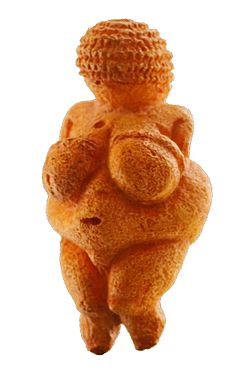
เทือกเขาแอลป์ไม่สามารถเข้าถึงได้ในช่วงยุคน้ำแข็งดังนั้นการอยู่อาศัยของมนุษย์จึงมีอายุไม่เก่าไปกว่า ยุค หินเก่าตอนกลางในช่วงเวลาของมนุษย์นีแอนเดอร์ทาลร่องรอยการอยู่อาศัยของมนุษย์ที่เก่าแก่ที่สุดในออสเตรีย ซึ่งมีอายุมากกว่า 250,000 ปี ถูกค้นพบในถ้ำเรโพลัสต์ที่บาดล์ ใกล้กับเพ็กเกาใน เขต กราซ-อุมเกบุงของรัฐสไตเรียหลักฐานเหล่านี้รวมถึงเครื่องมือหิน เครื่องมือกระดูก และเศษเครื่องปั้นดินเผา พร้อมด้วยซากสัตว์เลี้ยงลูกด้วยนม นอกจากนี้ ยังพบหลักฐานที่มีอายุประมาณ 70,000 ปี ในถ้ำกูเดนัส ทางตะวันตกเฉียงเหนือของออสเตรียตอนล่าง
ซาก โบราณสถานยุคหินเก่าตอนบนมีจำนวนมากกว่าในออสเตรียตอนล่าง ที่รู้จักกันดีที่สุดอยู่ใน ภูมิภาค วาเคารวมถึงแหล่งโบราณสถานที่มีงานศิลปะที่เก่าแก่ที่สุดสองชิ้นในออสเตรีย งานศิลปะเหล่านี้เป็นภาพเหมือนของผู้หญิง ได้แก่ วีนัสแห่งกัลเกนเบิร์กที่พบใกล้กับสแตรตซิงซึ่งเชื่อว่ามีอายุ 32,000 ปี และวีนัสแห่งวิลเลนดอร์ฟ ที่อยู่ใกล้เคียง (อายุ 26,000 ปี) ที่พบที่วิ ลเลนดอร์ฟ ใกล้กับเครมส์ อัน แดร์ โดเนาในปี 2005 ในพื้นที่เดียวกันนี้ มีการค้นพบแหล่งฝังศพทารกคู่ที่เครมส์-วาคท์เบิร์ก ซึ่งมีอายุย้อนไปถึง วัฒนธรรม กราเวตเตียน (อายุ 27,000 ปี) ซึ่งเป็นสุสานที่เก่าแก่ที่สุดที่พบในออสเตรียจนถึงปัจจุบัน[ 3 ] [ 4 ]
ยุคเมโซลิธิก
ซาก โบราณสถานยุคเมโซลิธิกได้แก่ที่พักอาศัยในถ้ำหิน (abris) จากทะเลสาบคอนสแตนซ์และหุบเขาไรน์ในเทือกเขาแอลป์สถานที่ฝังศพที่เอลส์เบเธน และแหล่ง โบราณสถานอื่นๆ อีกหลายแห่งที่มี สิ่งประดิษฐ์หินขนาดเล็ก ซึ่งแสดงให้เห็นถึงการเปลี่ยนแปลงจากการดำรงชีวิตแบบล่าสัตว์และเก็บของป่าไปสู่การ ทำเกษตรกรรมและเลี้ยงปศุสัตว์ แบบอยู่กับที่
ยุคหินใหม่

ใน ยุค หินใหม่พื้นที่ส่วนใหญ่ของออสเตรียที่เหมาะสมกับการเกษตรและเป็นแหล่งวัตถุดิบได้ถูกตั้งถิ่นฐาน หลักฐานที่พบได้แก่ หลักฐานของวัฒนธรรมเครื่องปั้นดินเผาแบบเส้นตรงซึ่งเป็นหนึ่งในวัฒนธรรมเกษตรกรรมแรกๆ ในยุโรปการตั้งถิ่นฐานในชนบทแห่งแรกที่บันทึกไว้ในยุคนี้คือที่Brunn am GebirgeในMödlingอนุสรณ์สถานทางอุตสาหกรรมแห่งแรกของออสเตรีย คือ เหมือง หิน เชิร์ต ที่Mauer-Antonshöheใน ย่าน MauerของเขตLiesing ทางตอนใต้ของเวียนนา ก็มีอายุย้อนไปถึงยุคนี้ ในวัฒนธรรม Lengyelซึ่งเกิดขึ้นหลังจากวัฒนธรรมเครื่องปั้นดินเผาแบบเส้นตรงในออสเตรียตอนล่างมีการสร้าง คูน้ำเป็นวงกลม
ยุคทองแดง
ร่องรอยของยุคทองแดงในออสเตรียถูกค้นพบในแหล่งโบราณคดีแอ่งคาร์พาเทียนที่สตอลฮอฟโฮเฮอ วานด์ในออสเตรียตอนล่าง ชุมชนบนยอดเขาจากยุคนี้พบได้ทั่วไปในออสเตรียตะวันออก ในช่วงเวลานั้น ผู้คนได้ค้นหาและพัฒนาวัตถุดิบในพื้นที่เทือกเขาแอลป์ตอนกลาง การค้นพบที่สำคัญที่สุดคือ มัมมี่มนุษย์น้ำแข็งโอตซีซึ่งได้รับการอนุรักษ์ไว้อย่างดี มีอายุราว 3,300 ปีก่อนคริสตกาล แม้ว่าปัจจุบันสิ่งของเหล่านี้จะอยู่ในอิตาลีติดกับชายแดนออสเตรียแล้วก็ตาม อีกวัฒนธรรมหนึ่งคือกลุ่มมอนด์ซีซึ่งแสดงให้เห็นได้จากบ้านยกพื้นในทะเลสาบแอลป์
ยุคสำริด
ในช่วงต้นยุคสำริด ป้อม ปราการ เริ่มปรากฏขึ้นเพื่อปกป้องศูนย์กลางการค้าของการทำเหมือง การแปรรูป และการค้าขายทองแดงและดีบุกวัฒนธรรมที่เจริญรุ่งเรืองนี้สะท้อนให้เห็นในสิ่งของที่พบในหลุมฝังศพ เช่น ที่พิตเทน ในเมืองนูสส์ดอร์ฟ ออบ แดร์ ไตรเซนรัฐโลเวอร์ออสเตรีย ในช่วงปลายยุคสำริดวัฒนธรรมทุ่งอัฐิ ปรากฏขึ้น โดยเริ่ม จากการทำเหมืองเกลือในเหมืองเกลือทางเหนือที่ฮัลล์สตัดท์
ยุคเหล็ก

ยุคเหล็กในออสเตรียแสดงให้เห็นได้จากวัฒนธรรมฮัลล์สตัดต์ซึ่งสืบทอดมาจากวัฒนธรรมเออร์นฟิลด์ โดยได้รับอิทธิพลจากอารยธรรมเมดิเตอร์เรเนียนและ ชนเผ่าจากทุ่งหญ้าสเต ปป์จากนั้นจึงค่อยๆ เปลี่ยนผ่านไปสู่วัฒนธรรมลาเตเนของ ชาวเคล ต์
วัฒนธรรมฮัลล์สตัดท์
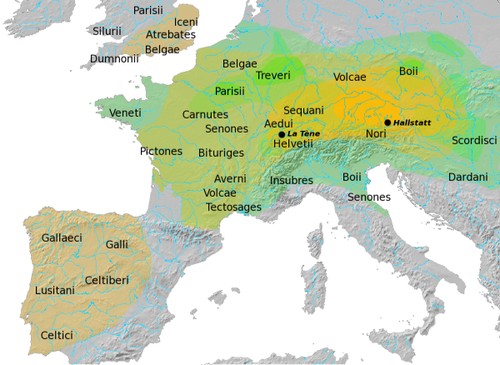
วัฒนธรรมยุคเหล็กตอนต้นนี้ตั้งชื่อตามฮัลล์สตัดท์ (Hallstatt) ซึ่ง เป็น แหล่งโบราณสถานสำคัญในอัปเปอร์ออสเตรียวัฒนธรรมนี้มักถูกแบ่งออกเป็นสองเขต คือ เขตตะวันตกและเขตตะวันออก โดยมีแม่น้ำเอ็นนส์ (Enns ) อิบส์ ( Ybbs)และอินน์ (Inn ) ไหลผ่าน เขตฮัลล์สตัดท์ทางตะวันตกมีการติดต่อกับ อาณานิคม กรีกบน ชายฝั่ง ลิกูเรียในเทือกเขาแอลป์มีการติดต่อกับชาวเอตรัสกันและในภูมิภาคที่ได้รับอิทธิพลจากกรีกในอิตาลี ส่วนทางตะวันออกมีความเชื่อมโยงอย่างใกล้ชิดกับชนเผ่าจากทุ่งหญ้าสเตปป์ที่อพยพข้ามแอ่งคาร์พาเทียนมาจากทุ่งหญ้าสเตปป์ทางตอนใต้ของรัสเซีย
ประชากรของฮัลล์สตัดท์ได้รับความมั่งคั่งจากอุตสาหกรรมเกลือ มีการค้นพบหลักฐานการนำเข้าสินค้าฟุ่มเฟือยจากทะเลเหนือและทะเลบอลติกไปจนถึงแอฟริกาในสุสานของฮัลล์สตัดท์ หลักฐานที่เก่าแก่ที่สุดของอุตสาหกรรมไวน์ออสเตรียถูกค้นพบในซาเกอร์สดอร์ฟ บูร์เกนลันด์ในเนินฝังศพรถเทียมเกวียนบูชาแห่งสเตรทเวกสไตเรียเป็นหลักฐานของชีวิตทางศาสนาในยุคนั้น
วัฒนธรรมลาเตเน (เซลติก)
ในช่วงปลายยุคเหล็กวัฒนธรรมลาเตเนของชาว เคลต์ ได้แพร่กระจายไปยังออสเตรีย วัฒนธรรมนี้ได้ก่อให้เกิดชื่อชนเผ่าท้องถิ่น ( Taurisci , Ambidravi , Ambisontes ) และชื่อสถานที่ที่ได้รับการบันทึกไว้เป็นครั้งแรก จากนั้นจึงเกิดเป็นโนริคุม (ศตวรรษที่ 2 ถึงประมาณ 15 ปีก่อนคริสตกาล ) ซึ่งเป็นสมาพันธ์ของชนเผ่าเคลต์ในเทือกเขาแอลป์ (ตามธรรมเนียมแล้วมีสิบสองเผ่า) ภายใต้การนำของชาวโนริซี สมา พันธ์ นี้จำกัดอยู่เฉพาะในพื้นที่ทางตอนใต้และตะวันออกของออสเตรียในปัจจุบัน และบางส่วนของสโลวีเนียส่วนทางตะวันตกนั้นเป็นที่อยู่อาศัยของชาวราเอติ
ดือร์นแบร์กและฮัลไลน์ (ซาลซ์บูร์ก) เป็นแหล่งตั้งถิ่นฐานของชาวเคลต์ที่ทำเหมืองเกลือ ในสไตเรีย ตะวันออก และเบอร์เกนลันด์ (เช่น โอ เบอร์ พุลเลนดอร์ฟ ) มีการขุดและแปรรูปแร่เหล็กคุณภาพสูง จากนั้นส่งออกไปยังชาวโรมันในชื่อเฟอร์รัม นอริคัม ( เหล็กนอริก ) ซึ่งนำไปสู่การสร้างด่านการค้าของโรมันบนภูเขามากดาเลนส์แบร์กในช่วงต้นศตวรรษที่ 1 ก่อนคริสต์ศักราชต่อมาถูกแทนที่ด้วยเมืองโรมันวิรูนุมชุมชนบนเนินเขา ที่มีป้อมปราการ เช่นคูล์ม ( สไตเรีย ตะวันออก ) อิดูนุม (ปัจจุบันคือวิลลาช ) บูร์ก ( ชวาร์เซนบัค ) และบราวน์สแบร์ก ( ไฮน์บูร์ก ) เป็นศูนย์กลางของชีวิตสาธารณะ เมืองบางแห่ง เช่นลินซ์ก็มีอายุย้อนไปถึงช่วงเวลานี้เช่นกัน
ยุคโรมัน

ในสมัยจักรวรรดิโรมันดินแดนของประเทศออสเตรียในปัจจุบันนั้นตรงกับมณฑลนอริคัม ของโรมัน ซึ่งถูกผนวกเข้ากับจักรวรรดิราวปี 15 ก่อนคริสต์ศักราช ก่อให้เกิด "ออสเตรียโรมัน" (ซึ่งเป็นชื่อที่ใช้ในศตวรรษที่ 19) เป็นเวลา 500 ปี ส่วนปลายด้านตะวันตกและตะวันออกของประเทศออสเตรียในปัจจุบันนั้นอยู่ในเขตมณฑลรา เอเทียและพันโนเนีย ของโรมัน
ใน รัชสมัยของ จักรพรรดิคลอเดียส (ค.ศ. 41–54) ดินแดนโนริคัมมีอาณาเขตทางตะวันออกติดกับป่าเวียนนาซึ่งเป็นพรมแดนด้านตะวันออกของรัฐสไตเรีย ในปัจจุบัน และบางส่วนของแม่น้ำดานูบไอแซคและดราวา ในสมัยของ จักรพรรดิไดโอเคลเชียน (ค.ศ. 284–305) โนริคัมถูกแบ่งออกตามแนวสันเขาแอลป์หลักเป็นส่วนเหนือและส่วนใต้ ( โนริคัม ริเปนเซและโนริคัม เมดิเทอร์ราเนียม ) ทางตะวันตกของแม่น้ำซิลเลอร์ ซึ่งตรงกับจังหวัดโวราร์ลแบร์กและไทโรล ในปัจจุบัน คือจังหวัดราเอเทีย ทางตะวันออกของ เบอร์เกนแลนด์ในปัจจุบันอยู่ในแพนโนเนีย ทางใต้คือเขตที่ 10 เวเนเซียและฮิสเตรีย[ 5 ] แนวป้องกัน ดานูเบียนลิมส์ก่อตัวเป็นแนวป้องกันที่แยกออสเตรียตอนบนและตอนล่างออกจากกลุ่มชนชาติเยอรมันที่มีอำนาจ โดยเฉพาะอย่างยิ่ง ชาว มาร์โคมานนิและควาดีซึ่งมีความสัมพันธ์ใกล้ชิดกับจักรวรรดิโรมัน และถูกขัดจังหวะเป็นครั้งคราวด้วยความขัดแย้งครั้งใหญ่
ชาวโรมันสร้างเมืองต่างๆ ในออสเตรียจำนวนมากที่ยังคงอยู่มาจนถึงปัจจุบัน ได้แก่ วินโดโบนา ( เวียนนา ), จูวาวุม ( ซาลซ์บูร์ก ), วัลดิเดนา ( อินส์ บรุค ) และบริกันเทียม ( เบรเกนซ์ ) [ 6 ]เมืองสำคัญอื่นๆ ได้แก่วิรูนุม (ทางเหนือของเมืองคลาเกนฟูร์ท ในปัจจุบัน ), เทอร์เนีย (ใกล้สปิตทัล ) และลอเรียคุม ( เอ็นนส์ ) แหล่งโบราณคดีจากยุคโรมัน ได้แก่ไคลน์ไคลน์ (สไตเรีย) และโซลเฟลด์ ( แม็กดาเลนส์เบิร์ก ) ศาสนาคริสต์ปรากฏขึ้นในออสเตรียของโรมันในศตวรรษที่ 2 ทำให้เกิดการจัดตั้งคริสตจักรซึ่งสามารถสืบย้อนไปได้ถึงศตวรรษที่ 4
ชาวมาร์โคมานนิและพันธมิตรของพวกเขาได้ต่อสู้กับโรมในการสู้รบครั้งใหญ่ในช่วงปลายศตวรรษที่ 2 ซึ่งเรียกว่าสงครามมาร์โคมานนิแม้ว่าชาวมาร์โคมานนิจะสามารถบุกอิตาลีได้ แต่ในที่สุดพวกเขาก็พ่ายแพ้และถูกบังคับให้ยอมรับสถานะที่อ่อนแอลงมาก ภายในปี ค.ศ. 300 หลายคนหรืออาจจะส่วนใหญ่ได้ย้ายไปทางใต้ของแม่น้ำดานูบ เข้าไปในจักรวรรดิ ชาวรูกีและชาวเฮรูลีอาจย้ายเข้าไปอยู่ในภูมิภาคดั้งเดิมของชาวมาร์โคมานนิทางเหนือของแม่น้ำดานูบในศตวรรษที่ 3 หรือ 4 แล้วLaterculus Veronensisแสดงให้เห็นว่าชาวเฮรูลีและชาวรูกีมีอยู่แล้วในบริเวณใกล้กับจักรวรรดิในยุโรปตะวันตกประมาณปี ค.ศ. 314 รายการที่คล้ายกันจากช่วงปลายศตวรรษที่ 4 CosmographiaของJulius HonoriusและอาจรวมถึงLiber Generationisด้วย ต่างก็ระบุรายชื่อชาวเฮรูลีร่วมกับชาวมาร์โคมานนิและเพื่อนบ้านทางตะวันตกของพวกเขาคือชาวควาดี[ 7 ]
ในปี ค.ศ. 378 กองกำลังโรมันประสบความพ่ายแพ้ครั้งใหญ่ในยุทธการที่เอเดรียโนเปิลซึ่งเกิดจากการเคลื่อนย้ายของผู้คนจากทางตะวันออกอย่างกะทันหัน โดยเฉพาะอย่างยิ่งชาวกอธ ชาวอลันและชาวฮุนในแพนโนเนีย ทางตะวันออกของออสเตรีย ชาวโรมันถูกบังคับให้ลองวิธีการใหม่ในการตั้งถิ่นฐานของผู้มาใหม่จำนวนมาก[ 8 ]หนึ่งในกลุ่มติดอาวุธที่สำคัญที่สุดในเอเดรียโนเปิล นำโดยอลาเทอุสและซาฟรักซ์ได้รับอนุญาตให้ตั้งถิ่นฐานที่นั่น และคาดหวังว่าจะรับใช้ทางการทหารให้กับโรม และหยุดการปล้นสะดมไปทางตะวันตก ในทางปฏิบัติ ภูมิภาคทางตะวันออกของออสเตรียไม่ได้อยู่ภายใต้การควบคุมของโรมันอย่างเต็มที่อีกต่อไป
ยุคกลาง
ศตวรรษที่ 5 ถึง 7
เมื่อการควบคุมของจักรวรรดิโรมันเหนือภูมิภาคชายแดนออสเตรียเริ่มล่มสลาย ความสามารถของราเอเทีย โนริคัม และโดยเฉพาะอย่างยิ่งปันโนเนียในการป้องกันตนเองก็กลายเป็นปัญหามากขึ้นเรื่อยๆ ผู้นำกอทนามว่า ราดาไกซัสได้เข้ายึดครองบางส่วนของประเทศในปี 405 [ 9 ]หลังจากการโจมตีอิตาลีหลายครั้งชาววิซิโกทของอลาริกที่ 1ก็มาถึงโนริคัมในปี 408 [ 10 ] ตามที่ โซซิมัสบรรยายอลาริกออกเดินทางจากเอโมนา ( ลูบลิยานา ในปัจจุบัน ) ซึ่งอยู่ระหว่างปันโนเนียซูพีเรียร์และโนริคัมข้ามเทือกเขาคาร์นิกแอลป์ มาถึงวิรูนุมในโนริคัม ตามที่นายพลโรมัน สติลิโชได้ตกลงกันไว้หลังจากมีการปะทะกันหลายครั้งระหว่างทั้งสองฝ่าย ตาม คำแนะนำของ สติลิโชวุฒิสภาโรมันลงมติจ่ายเงินจำนวนมากให้แก่อลาริกเพื่อรักษาสันติภาพ[ 10 ]ความขัดแย้งยังคงดำเนินต่อไป โดยอลาริกเรียกร้องดินแดนโนริคัมและดินแดนอื่นๆ และถึงกับปล้นสะดมกรุงโรมในปี 410 เขาเสียชีวิตระหว่างเดินทางกลับบ้านในปีนั้น[ 11 ]ในช่วงเวลานี้ ในปี 409 นักบุญเจอโรมได้เขียนจดหมายกล่าวถึงว่าผู้คนจำนวนมากจากบริเวณที่ปัจจุบันคือออสเตรียตะวันออก แม้กระทั่งจากภายในจักรวรรดิ ได้ย้ายไปทางตะวันตกและเข้ายึดครองแคว้นกอลในเวลานั้น: "ชาวควาดี ชาวแวนดัล ชาวซาร์มาเทียน ชาวอลัน ชาวเกปิด ชาวเฮรูล ชาวแซกซอน ชาวเบอร์กันเดียน ชาวอเลมันนี และ—อนิจจา! เพื่อประโยชน์ส่วนรวม!—แม้กระทั่งชาวแพนโนเนียน" [ 12 ]
ในปี 427 พงศาวดารของมาร์เซลลินัส โคเมสกล่าวว่าจังหวัดปันโนเนีย “ซึ่งถูกพวกฮั่นยึดครองมาเป็นเวลาห้าสิบปี ได้ถูกโรมันยึดคืนมา” ประมาณปี 430 นายพลโรมันเอติอุสได้ต่อสู้ในภูมิภาคนี้กับพวกจูทุงกิ เป็นอันดับแรก จากนั้นก็ต่อสู้กับพวกกบฏในโนริคัมเขายังเอาชนะพวกวินเดลิซีซึ่งเป็นผู้อยู่อาศัยในส่วนเหนือของโรมันราเอเทีย ได้อีกด้วย [ 13 ]มีช่วงเวลาแห่งความมั่นคงสั้นๆ ประมาณปี 431 [ 14 ]อย่างไรก็ตาม ในปี 433 เอติอุส ได้ ยกปันโนเนียให้แก่อัตติลาและพวกฮั่นของ เขาอย่างมีประสิทธิภาพ [ 15 ]ในปี 451 พวกฮั่นและพันธมิตรของพวกเขาต้องหลั่งไหลผ่านโนริคัมและราเอเทียระหว่างทางไปกอล ซึ่งพวกเขาพ่ายแพ้ต่อเอติอุสและพันธมิตรของเขาในการรบที่ที่ราบคาตาเลาเนียนในปีนั้น อัตติลาเสียชีวิตในอีกไม่กี่ปีต่อมาในปี 453 และตามมาด้วยยุทธการที่เนดาโอในปี 454 เมื่อบุตรชายของอัตติลาและพันธมิตรชาวออสโตรกอทถูกขุนศึกอื่น ๆ ที่ยังคงอยู่ในภูมิภาคนั้นเอาชนะ ผู้ชนะสามารถรวมอาณาจักรอิสระทางเหนือและตะวันออกของแม่น้ำดานูบตอนกลางได้ ทางตอนเหนือของออสเตรียในปัจจุบัน ซึ่งเคยเป็นที่ตั้งของชาวมาร์โคมานนิ ปัจจุบันเป็นที่ตั้งของชาวรูกีและชาวเฮรูลี ทางใต้ของแม่น้ำดานูบยังคงมีประชากรโรมันจำนวนมาก ดังที่บรรยายไว้ในชีวประวัติของเซเวรินัสแห่งโนริคัมโดยยูจิปปิอุส
ในปี 468 ชาวออสโตรกอธได้รับชัยชนะในยุทธการโบเลียทำให้พวกเขามีอำนาจเหนืออาณาจักรริมแม่น้ำดานูบในและใกล้ภูมิภาคแพนโนเนียทางตะวันออกของออสเตรียมากขึ้น ในบรรดาผู้ที่พ่ายแพ้อย่างหนัก ชาวสคิรี นำโดยเอเดโกผู้ซึ่งเคยเป็นผู้นำสำคัญภายใต้การปกครองของอัตติลา สูญเสียการควบคุมดินแดนของตน และหลายคนเข้าร่วมกองทัพโรมันในอิตาลีฮูนิมุนด์ผู้ปกครอง อาณาจักร ซูเอเวียนในภูมิภาคนี้ ย้ายไปทางตะวันตก เขาได้ก่อตั้งสมาพันธ์กับชาวอาเลมันนีในภูมิภาคเทือกเขาแอลป์ โดยมีชาวไบอูวารีอยู่ทางตะวันออก นี่เป็นหนึ่งในบันทึกแรกๆ เกี่ยวกับชาวบาวาเรียยุคแรก ในปี 476 โอโดอาเซอร์บุตรชายของเอเดโก ขึ้นเป็นผู้ปกครองอิตาลีของโรมัน โดยใช้กองกำลังอนารยชน รวมถึงชาวเฮรูลี ชาวสคิรี และชาวรูกี และชนเผ่าอื่นๆ จากภูมิภาคออสเตรีย ยูจิปปิอุสบรรยายถึงเศษซากขององค์กรทางทหารโรมันที่ยังคงหลงเหลืออยู่ทางใต้ของแม่น้ำดานูบในโนริคัม แม้ว่าประเทศส่วนใหญ่จะอยู่ภายใต้การควบคุมของชาวรูกีก็ตาม เขาบันทึกการโจมตีจากชาวฮูนิมุนด์ ชาวอัลเลมานี ชาวทูริงเกียน และชาวเฮรูลี (แต่ยังไม่ใช่ชาวบาวาเรีย) ที่ส่งผลกระทบต่อการตั้งถิ่นฐานใกล้เมืองปัสเซา พันธมิตรระหว่างชาวรูกี ชาวออสโตรกอธ และจักรพรรดิแห่งตะวันออก ทำให้โอโดอาเซอร์และกองกำลังของเขาบุกเข้ามาและนำเฟเลเทอุสและกีซา กษัตริย์และราชินีแห่งชาวรูกี กลับไปยังอิตาลี ซึ่งพวกเขาถูกประหารชีวิต เมื่อฟรีเดอริก บุตรชายของพวกเขา กลับมายังพื้นที่ พวกเขาก็โจมตีอีกครั้ง และในปี 488 พวกเขาได้อพยพประชากรโรมันออกจากโนริคัม[ 16 ]ฟรีเดอริกและชาวรูกีที่เหลืออยู่ได้ย้ายไปเข้าร่วมกับชาวออสโตรกอธ ในขณะที่ชาวลอมบาร์ดเข้ามาในภูมิภาครูกีนจากทางเหนือ ในปี 491 ทางเหนือของแม่น้ำดานูบ ชาวเฮรูลีเอาชนะชาวลอมบาร์ด บังคับให้พวกเขาจ่ายบรรณาการ และกลายเป็นกองกำลังที่โดดเด่นในภูมิภาคออสเตรียในช่วงเวลาสั้นๆ
ในปี ค.ศ. 493 ธีโอเดอริคผู้ยิ่งใหญ่กษัตริย์ออสโตรกอธผู้ปกครองแพนโนเนียอยู่แล้ว ได้เข้ายึดครองอิตาลีด้วยกองกำลังซึ่งรวมถึงชาวรูกีจำนวนมาก และสังหารโอโดอาเซอร์ เช่นเดียวกับโอโดอาเซอร์ ธีโอเดอริคเป็นผู้นำที่ได้รับอิทธิพลจากโรมัน โดยบิดาของเขาเคยเป็นแม่ทัพภายใต้การปกครองของอัตติลา ทางเหนือของพวกเขา ในปี ค.ศ. 500 อาณาจักรเฮรูเลียนที่เหลืออยู่บนแม่น้ำดานูบ ภายใต้การปกครองของกษัตริย์โรดูล์ฟได้กลายเป็นพันธมิตรกับธีโอเดอริค ซึ่งได้เขียนจดหมายถึงพวกเขาและชาวทูริงกีเกี่ยวกับความกังวลของเขาเรื่องความเสี่ยงที่จะเกิดสงครามระหว่างชาวกอธและชาวแฟรงก์ในกอลทางตะวันตกของพวกเขา
ในช่วงปี ค.ศ. 493-511 พระเจ้าโรดูล์ฟแห่งราชวงศ์เฮรูลีถูกสังหารในการรบกับชาวลอมบาร์ด และชาวลอมบาร์ดได้ขยายอาณาเขตไปทางตะวันออกของออสเตรีย ในขณะที่ราชวงศ์เฮรูลีแตกออกเป็นกลุ่มเล็กๆ และอพยพไปยังภูมิภาคอื่นๆ ธีโอเดอริกมหาราชทรงมีอิทธิพลเหนือดินแดนออสเตรียจนกระทั่งสิ้นพระชนม์ในปี ค.ศ. 526 โดยทรงมอบอำนาจให้แก่พระธิดาคืออมาลาซูอินธาในปี ค.ศ. 527 จัสติเนียนที่ 1ขึ้นเป็นจักรพรรดิโรมันในคอนสแตนติโนเปิลและในปี ค.ศ. 535 หลังจากการลอบสังหารอมาลาซูอินธา พระองค์ทรงเริ่มทำสงครามกับอาณาจักรกอทที่อ่อนแอในอิตาลี ในดินแดนออสเตรีย อำนาจของชาวแฟรงก์ขยายตัว และธีโอเดอริกที่ 1เข้าควบคุมทูริงเกีย ที่อยู่ใกล้เคียง ในช่วงทศวรรษ ค.ศ. 530 พระโอรสของพระองค์คือธีโอเดอเบิร์ตที่ 1กลายเป็นพันธมิตรของจัสติเนียนในอิตาลีในตอนแรก และต่อมาก็กลายเป็นคู่แข่งแย่งชิงอำนาจ ธีโอเดอเบิร์ตอ้างในจดหมายถึงจัสติเนียนว่าพระองค์ควบคุมพื้นที่ตั้งแต่ทะเลเหนือไปจนถึงปันโนเนียซึ่งรวมถึงออสเตรียส่วนใหญ่ด้วย หลังจากการเสียชีวิตของเขา ลุงของเขาChlothar Iได้แต่งตั้งGaribald Iเป็นดยุคแห่งบาวาเรียในเทือกเขาแอลป์ทางเหนือ ชาวบาวาเรียได้ก่อตั้งเป็นดัชชีแห่งสเต็มแฟรง ก์ตะวันออก ราวปี 550 ภายใต้ การปกครองของ Agilolfingจนถึงปี 788 ดินแดนที่ชาวบาวาเรียครอบครองนั้นขยายไปทางใต้จนถึงบริเวณที่เป็นเซาท์ไทโรล ในปัจจุบัน และไปทางตะวันออกจนถึงแม่น้ำ Ennsศูนย์กลางการบริหารอยู่ที่เรเกนส์บูร์ก ชาวบาวาเรียผสมผสานกับ ประชากร Rhaeto-Romanicและรุกเข้าไปในภูเขาตามหุบเขาPuster [ 17 ]
ในขณะที่อำนาจของชาวแฟรงก์กำลังรวมศูนย์ในบาวาเรียและออสเตรียตะวันตก ในช่วงทศวรรษที่ 540 ชาวลอมบาร์ดได้ปกครองแพนโนเนียในปัจจุบันคือฮังการีและออสเตรียตะวันออกสุด ซึ่งก่อนหน้านี้เคยอยู่ภายใต้การปกครองของชาวออสโตรกอธ ทำให้เกิดความขัดแย้งกับชาวเกปิดทางตะวันออก จัสติเนียนในที่สุดก็เข้าข้างชาวลอมบาร์ด และชาวเกปิดก็พ่ายแพ้ในปี 551 ในปี 554 จัสติเนียนได้ทำลายอาณาจักรกอธในอิตาลีด้วยการสนับสนุนจากชาวลอมบาร์ด และขับไล่การท้าทายจากชาวแฟรงก์ได้ แต่อิตาลีก็อยู่ในสภาพพังพินาศ และจักรวรรดิก็สูญเสียการควบคุมอย่างมีประสิทธิภาพ ในปี 567อาณาจักรเกปิดถูกทำลายลงหลังจากพ่ายแพ้ต่อชาวอวาร์แห่งแพนโนเนียซึ่งเป็นผู้มาใหม่จากทางตะวันออก ในปี 568 ชาวลอมบาร์ดซึ่งได้เกณฑ์กำลังพลจำนวนมากจากบริเวณลุ่มแม่น้ำดานูบ ได้เคลื่อนพลเข้าสู่อิตาลีตอนเหนือ
ในขณะที่บาวาเรียทางตะวันตกของออสเตรียยังคงอยู่ภายใต้อิทธิพลของชาวแฟรงก์ ชาวอวาร์และชาวสลาฟที่เป็นข้าราชบริพารของพวกเขาก็ได้ครอบครองพื้นที่แพนโนเนียทางตะวันออกของออสเตรียในเวลาต่อมา โดยก่อนหน้านี้พวกเขาได้ตั้งรกรากตั้งแต่ทะเลบอลติกไปจนถึงคาบสมุทรบอลข่าน [ 18 ] ทางตอนใต้ของออสเตรียในปัจจุบัน ชาวสลาฟยังได้ตั้งถิ่นฐานในหุบเขาของแม่น้ำดราวามูราและซาเวภายในปี 600 การอพยพของชาวสลาฟไปทางตะวันตกได้หยุดยั้งการขยายตัวของบาวาเรียไปทางตะวันออกเพิ่มเติมภายในปี 610 การขยายตัวไปทางตะวันตกมากที่สุดของพวกเขาเกิดขึ้นในปี 650 ที่หุบเขาปุสเตอร์แต่ค่อยๆ ถอยกลับไปยังเอนส์ภายในปี 780 [ 18 ]พรมแดนระหว่างชาวสลาฟและชาวบาวาเรียโดยประมาณตรงกับเส้นจากไฟรสตัดท์ผ่านลินซ์ ซาลซ์บูร์ก ( ลุงเกา ) ไปจนถึงไทโรลตะวันออก ( เลซัคทาล ) โดยชาวอวาร์และชาวสลาฟครอบครองออสเตรียตะวันออกและ โบฮีเมียในปัจจุบันอาณาจักรคารันตาเนีย (ต่อมาคือคารินเทีย ) ซึ่งครอบคลุมพื้นที่ส่วนใหญ่ทางตะวันออกและตอนกลางของออสเตรีย เป็นรัฐสลาฟอิสระแห่งแรกในยุโรป โดยมีศูนย์กลางอยู่ที่โซลเฟลด์ด้วยความร่วมมือกับประชากรพื้นเมือง พวกเขาสามารถต่อต้านการรุกรานเพิ่มเติมของชาวแฟรงก์และชาวอวาร์ที่อยู่ใกล้เคียงในเทือกเขาแอลป์ทางตะวันออกเฉียงใต้ได้
ดัชชีแห่งบาวาเรีย (ศตวรรษที่ 8-10)
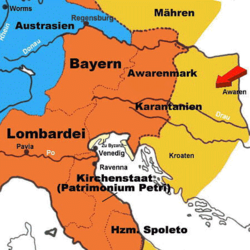

ความสัมพันธ์ระหว่างชาวบาวาเรียกับชาวแฟรงก์นั้นมีความหลากหลาย ชาวบาวาเรียได้รับเอกราชชั่วคราวในปี 717 แต่ก็ถูกชาร์ลส์ มาร์เตล ยึดครองเสียก่อน ชาวสลาฟแห่งคารินเทียกลายเป็นข้าราชบริพารของบาวาเรียในปี 745 โดยเลือกโอดีโล ดยุกแห่งบาวาเรียเป็นเคานต์ และสามารถต่อต้านการยึดครองของชาวอาวาร์ได้สำเร็จ ออสเตรียกลายเป็นเป้าหมายของการเผยแพร่ศาสนาครั้งใหม่จากทางตะวันตกของชาวแฟรงก์ เช่น รูเพิร์ตและเวอร์จิลจากคณะ เผยแพร่ศาสนาไอริช- ส ก็อตแลนด์
จักรพรรดิชาร์เลมาญ ปลด ทัสซิโลที่ 3ดยุกแห่งบาวาเรียองค์สุดท้ายจากราชวงศ์ อากิลอลฟิง และ เข้าควบคุมโดยตรง ของราชวงศ์ คาโรลิงในปี 788 ผ่านทางกษัตริย์บาวาเรียที่ไม่สืบทอดทางสายเลือด ต่อมาชาร์เลมาญนำชาวแฟรงก์และชาวบาวาเรียต่อสู้กับชาวอวาร์ในปี 791 จนกระทั่งในปี 803 พวกเขาล่าถอยกลับไปทางตะวันออกของแม่น้ำฟิสชาและไลธา[ 18 ]การพิชิตเหล่านี้ทำให้เกิดการจัดตั้งระบบชายแดนป้องกัน (ดินแดนชายแดนทางทหาร) จากแม่น้ำดานูบไปจนถึงทะเลเอเดรียติก[ 19 ]ในบรรดาดินแดนเหล่านี้มีชายแดนทางตะวันออก คือชายแดนอวาร์ ซึ่งตรงกับ ออสเตรียตอนล่างในปัจจุบันโดยประมาณมีแม่น้ำเอ็นนส์ราบและดราวาเป็นพรมแดน ในขณะที่ทางใต้คือชายแดนคารินเทียชายแดนทั้งสองนี้เรียกรวมกันว่ามาร์ชา โอเรียนทาลิส (ชายแดนตะวันออก) ซึ่งเป็นเขตปกครองของดัชชีบาวาเรีย ประมาณปี 800 ออสเตรีย หรือ "ราชอาณาจักรแห่งตะวันออก" ได้เข้าร่วมกับจักรวรรดิโรมันอันศักดิ์สิทธิ์[ 6 ]ในตอนแรก คารินเทียเป็นมาร์กราฟเผ่าภายใต้ดยุคสลาฟ และหลังจากกบฏของลูเดวิต โปซาฟสกี ล้มเหลว ในช่วงต้นศตวรรษที่ 9 ก็อยู่ภายใต้ขุนนางที่ได้รับการแต่งตั้งจากแฟรงก์ ในช่วงหลายศตวรรษต่อมา ผู้ตั้งถิ่นฐานชาวบาวาเรียได้เดินทางลงไปตามแม่น้ำดานูบและขึ้นไปบนเทือกเขาแอลป์ ซึ่งเป็นกระบวนการที่ทำให้ออสเตรียกลายเป็นประเทศที่พูดภาษาเยอรมันเป็นส่วนใหญ่ มีเพียงในคารินเทียตอนใต้เท่านั้นที่ชาวสลาฟยังคงรักษาภาษาและเอกลักษณ์ของตนไว้จนถึงต้นศตวรรษที่ 20 เมื่อการกลืนกลายทางวัฒนธรรมทำให้พวกเขากลายเป็นชนกลุ่มน้อย ในปี 805 ชาวอาวาร์ ด้วยการอนุญาตของชาร์เลมาญ นำโดยข่านอาวาร์ ได้ตั้งถิ่นฐานทางตะวันออกเฉียงใต้จากเวียนนา[ 20 ]
ภัยคุกคามใหม่ปรากฏขึ้นในปี 862 คือชาวฮังการีซึ่งดำเนินตามรูปแบบของการเคลื่อนพลจากดินแดนทางตะวันออกมากขึ้นโดยกองกำลังที่เหนือกว่า ในปี 896 ชาวฮังการีปรากฏตัวเป็นจำนวนมากในที่ราบฮังการีซึ่งพวกเขาได้บุกโจมตีดินแดนของชาวแฟรงก์ พวกเขาเอาชนะชาวโมราเวียและในปี 907 เอาชนะชาวบาวาเรียในการรบที่เพรสเบิร์กและในปี 909 ก็ได้ยึดครองชายแดน บังคับให้ชาวแฟรงก์และชาวบาวาเรียถอยกลับไปยังแม่น้ำเอนส์[ 19 ]
แคว้นบาวาเรียกลายเป็นมาร์กราฟภายใต้ การปกครองของ เอนเกลเดโอ (890–895) และได้รับการสถาปนาขึ้นใหม่เป็นดัชชีภายใต้ การปกครองของ อาร์นูลฟ์ผู้ชั่วร้าย (907–937) ซึ่งรวมเข้ากับดัชชีแห่งคารินเทียครอบครองพื้นที่ส่วนใหญ่ของเทือกเขาแอลป์ทางตะวันออก แต่การปกครองนี้มีอายุสั้น บุตรชายของเขาเอเบอร์ฮาร์ด (937–938) พบว่าตัวเองขัดแย้งกับกษัตริย์เยอรมันออตโตที่ 1 (ออตโตมหาราช) ซึ่งปลดเขาออกจากตำแหน่ง ดยุคคนต่อไปคือเฮนรีที่ 1 (947–955) ซึ่งเป็นน้องชายของออตโต ในปี 955 ออตโตประสบความสำเร็จในการขับไล่ชาวฮังการีในการรบที่เลชเฟลด์เริ่มต้นการยึดคืนดินแดนทางตะวันออกอย่างช้าๆ รวมถึงอิสเตรียและคาร์นิโอลา
ในรัชสมัยของพระเจ้าเฮนรีที่ 2 (ผู้ชอบทะเลาะวิวาท) พระโอรสของพระเจ้าเฮนรี (ค.ศ. 955–976) ออตโตได้ขึ้นเป็น จักรพรรดิโรมันอันศักดิ์สิทธิ์องค์แรก(ค.ศ. 962) และบาวาเรียก ลายเป็น ดัชชี หนึ่งของ จักรวรรดิโรมันอันศักดิ์สิทธิ์ออตโตที่ 1 ได้ฟื้นฟูพรมแดนตะวันออก และได้รับการสืบทอดตำแหน่งโดยออตโตที่ 2ในปี ค.ศ. 967 และพบว่าตนเองขัดแย้งกับพระเจ้าเฮนรี ซึ่งพระองค์ได้ปลดออกจากตำแหน่ง ทำให้พระองค์สามารถจัดระเบียบดัชชีต่างๆ ในจักรวรรดิของพระองค์ใหม่ได้
ออตโตลดขนาดแคว้นบาวาเรียลงอย่างมาก และสถาปนาแคว้นคารินเทียขึ้นใหม่ทางตอนใต้ ทางตะวันออก เขาได้สถาปนาแคว้นชายแดนตะวันออกของบาวาเรียขึ้น ใหม่ ซึ่งต่อมาเป็นที่รู้จักในนามออสเตรีย ภายใต้ การปกครองของ เลโอโปลด์เคานต์แห่งบาเบนเบิร์กในปี 976 เลโอโปลด์ที่ 1 หรือที่รู้จักกันในนามเลโอโปลด์ผู้ทรงเกียรติ ปกครองออสเตรียตั้งแต่ปี 976 ถึง 994
บาเบนแบร์ก ออสเตรีย (976–1246)
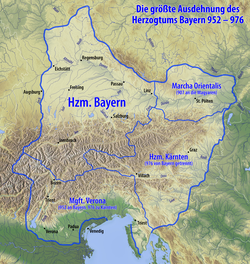
มาร์เกรเวียต (ค.ศ. 976–1156)

ดินแดนชายแดนอยู่ภายใต้การปกครองของเคานต์หรือดยุคที่ได้รับการแต่งตั้งจากจักรพรรดิ คำเหล่านี้มักแปลว่าเคานต์หรือดยุค แต่คำเหล่านี้มีความหมายแตกต่างกันมากในยุคกลางตอนต้นดังนั้นเพื่อหลีกเลี่ยงความเข้าใจผิด นักประวัติศาสตร์จึงมักใช้ คำในภาษา ละตินเมื่อกล่าวถึงตำแหน่งและผู้ดำรงตำแหน่ง ใน ประเทศที่พูด ภาษาลอมบาร์ด ตำแหน่งนี้ได้รับการกำหนดให้เป็น มาร์เกรฟ (ภาษาเยอรมัน: markgraf ) หรือ "เคานต์แห่งมาร์ก" ในที่สุด
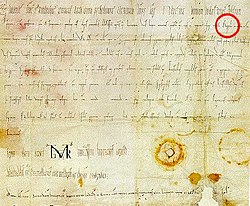
บันทึกแรกสุดเกี่ยวกับชื่อ 'ออสเตรีย' ปรากฏขึ้นในปี 996 ในเอกสารของพระเจ้าออตโตที่ 3ซึ่งเขียนว่าOstarrîchiโดยอ้างถึงดินแดนบาเบนเบิร์กมาร์ช นอกจากนี้ รูปแบบOsterlantยังถูกใช้มาเป็นเวลานาน โดยเรียกผู้อยู่อาศัยว่าOstermannหรือOsterfrauชื่อภาษาละตินAustriaที่ใช้เรียกพื้นที่นี้ปรากฏในงานเขียนในศตวรรษที่ 12 ในสมัยของ พระเจ้า เลโอโปลด์ที่ 3 (1095–1136) (เปรียบเทียบกับAustrasiaซึ่งเป็นชื่อเรียกส่วนตะวันออกเฉียงเหนือของจักรวรรดิแฟรงก์) คำว่าOstmark นั้น ไม่แน่ชัดทางประวัติศาสตร์และดูเหมือนจะเป็นการแปลจากmarchia orientalisซึ่งปรากฏขึ้นในภายหลังมาก
ราชวงศ์บาเบนเบิร์กดำเนินนโยบายการตั้งถิ่นฐานในประเทศ โดยการถางป่า สร้างเมือง และอาราม พวกเขาปกครองดินแดนชายแดนจากเมืองเพอชลาร์นในตอนแรก และต่อมาจากเมืองเมลค์โดยขยายอาณาเขตไปทางตะวันออกอย่างต่อเนื่องตาม หุบเขาแม่น้ำ ดานูบจนกระทั่งในปี ค.ศ. 1002 อาณาเขตของพวกเขาก็ไปถึงเวียนนาการขยายตัวไปทางตะวันออกถูกหยุดยั้งในที่สุดโดยชาวฮังการี ที่เพิ่งเปลี่ยนมานับถือศาสนาคริสต์ ในปี ค.ศ. 1030 เมื่อพระเจ้าสตีเฟน (ค.ศ. 1001–1038) แห่งฮังการีเอาชนะจักรพรรดิคอนราดที่ 2 (ค.ศ. 1024–1039) ที่เวียนนา
ในที่สุดก็มีการจัดตั้งดินแดน 'หลัก' ขึ้น ดินแดนนี้ประกอบด้วยซากอารยธรรมก่อนหน้ามากมาย แต่ชาวบาวาเรียเป็นชนชาติที่มีอำนาจเหนือกว่า ยกเว้นใน บริเวณ ทะเลสาบคอนสแตนซ์ทางตะวันตกซึ่งเป็นที่อยู่อาศัยของชาวอาเลมันนี ( โวราร์ลแบร์ก ) ประชากรเซลติก-โรมันยังคงหลงเหลืออยู่บ้าง เช่น บริเวณรอบๆซาลซ์บูร์กและชื่อสถานที่แบบโรมันก็ยังคงอยู่ เช่นจูวาวุม (ซาลซ์บูร์ก) นอกจากนี้ ประชากรกลุ่มนี้ยังมีความโดดเด่นด้วยศาสนาคริสต์และภาษาของพวกเขา ซึ่งเป็นภาษาละตินสำเนียงหนึ่ง ( โรมันช์ ) ซาลซ์บูร์กเป็นเขตปกครองของบิชอปแล้ว (739) และในปี 798 ก็เป็นเขตปกครองของอัครสังฆราช
แม้ว่าชาวบาวาเรียเชื้อสายเยอรมันจะค่อยๆ เข้ามาแทนที่ภาษาโรมันช์ในฐานะภาษาหลัก แต่พวกเขาก็รับเอาขนบธรรมเนียมของชาวโรมันมาใช้หลายอย่างและหันมานับถือศาสนาคริสต์มากขึ้นเรื่อยๆ ในทำนองเดียวกันทางตะวันออก ภาษาเยอรมันก็เข้ามาแทนที่ภาษาสลาฟ ดินแดนชายแดนของออสเตรียมีเพื่อนบ้านได้แก่ ดัชชีบาวาเรียทางตะวันตก ราชอาณาจักรโบฮีเมียและโปแลนด์ทางเหนือ ราชอาณาจักรฮังการีทางตะวันออก และดัชชีคารินเทียทางใต้ ในสภาพแวดล้อมเช่นนี้ ออสเตรียซึ่งยังคงอยู่ภายใต้การปกครองของบาวาเรียจึงเป็นผู้เล่นรายเล็กเมื่อเทียบกับประเทศอื่นๆ
มาร์เกรฟแห่งบาเบนเบิร์กควบคุมดินแดนออสเตรียสมัยใหม่ได้เพียงเล็กน้อย ซาลซ์บูร์กซึ่งในอดีตเป็นส่วนหนึ่งของบาวาเรียกลายเป็นดินแดนทางศาสนา ในขณะที่สไตเรียเป็นส่วนหนึ่งของดัชชีคารินเทีย ราชวงศ์บาเบนเบิร์กมีดินแดนค่อนข้างน้อย โดยไม่เพียงแต่ซาลซ์บูร์กเท่านั้น แต่ดินแดนของสังฆมณฑลปัสเซาก็อยู่ในมือของศาสนจักร และขุนนางควบคุมดินแดนส่วนใหญ่ที่เหลือ อย่างไรก็ตาม พวกเขาได้เริ่มดำเนินโครงการเพื่อเสริมสร้างฐานอำนาจของตน วิธีหนึ่งคือการจ้างคนรับใช้แบบมีสัญญา เช่นตระกูลคูเอ็นริงเงิร์น ให้เป็นรัฐมนตรีและมอบหน้าที่ทางทหารและการบริหารจำนวนมาก[ 21 ]พวกเขายังคงดำรงอยู่เป็นราชวงศ์ด้วยโชคลาภและความเชี่ยวชาญทางการเมืองในยุคนั้นซึ่งถูกครอบงำด้วยการต่อสู้อย่างต่อเนื่องระหว่างจักรพรรดิและสันตะปาปา
เส้นทางไม่ได้ราบรื่นเสมอไป มาร์เกรฟองค์ที่ห้าเลโอโปลด์ที่ 2 'ผู้ยุติธรรม' (1075–1095) ถูกจักรพรรดิเฮนรีที่ 4 (1084–1105) ปลดออกจากตำแหน่งชั่วคราวหลังจากพบว่าตนเองอยู่ฝ่ายผิดในข้อพิพาทเรื่องการแต่งตั้งอย่างไรก็ตาม เลโอโปลด์ที่ 3 'ผู้ดี' (1095–1136) โอรสของเลโอโปลด์ ได้สนับสนุนเฮน รี ที่ 5 (1111–1125) โอรสผู้ก่อกบฏของเฮนรี มีส่วนช่วยให้เฮนรีได้รับชัยชนะ และได้รับรางวัลเป็นการได้ แต่งงานกับ อักเนส ฟอน ไวบลิงเงน น้องสาวของเฮนรี ในปี 1106 จึงทำให้เขากลายเป็นพันธมิตรกับราชวงศ์ เลโอโปลด์จึงมุ่งเน้นไปที่การทำให้ขุนนางสงบลง การก่อตั้ง อาราม ของเขา โดยเฉพาะอย่างยิ่งคลอสเตอร์นอยบวร์กและไฮลิเก นครอยซ์ นำไปสู่การประกาศเป็นนักบุญหลังมรณกรรม ในปี 1458 และเขากลายเป็นนักบุญอุปถัมภ์ ของ ออสเตรีย[ 22 ]
การรวมตัวกับบาวาเรีย (1139)
พระเจ้าเลโอโปลด์ที่ 3 ทรงมีพระโอรสคือ พระเจ้าเลโอโปลด์ที่ 4ผู้ทรงพระกรุณาธิคุณ (ค.ศ. 1137–1141) พระเจ้าเลโอโปลด์ที่ 4 ทรงยกระดับสถานะของออสเตรียให้สูงขึ้นไปอีกขั้นด้วยการขึ้นเป็นดยุคแห่งบาวาเรียในปี ค.ศ. 1139 ในนามพระเจ้าเลโอโปลด์ที่ 1 ดินแดนบาวาเรียเคยอยู่ภายใต้ การปกครองของราชวงศ์ เวลฟ์ (กเวลฟ์) ซึ่งต่อต้านราชวงศ์โฮเฮนสเตาเฟน ราชวงศ์โฮเฮนสเตาเฟนขึ้นครองราชบัลลังก์จักรวรรดิในปี ค.ศ. 1138 โดยพระเจ้าคอนราดที่ 3 (ค.ศ. 1138–1152) พระเจ้าเฮนรีผู้หยิ่งผยอง ดยุคแห่งบาวาเรียเองก็เป็นผู้ท้าชิงบัลลังก์จักรวรรดิและคัดค้านการเลือกตั้งของพระเจ้าคอนราด ต่อมาพระองค์จึงถูกริบดินแดนดยุค ซึ่งตกเป็นของพระเจ้าเลโอโปลด์ที่ 4 เมื่อพระเจ้าเลโอโปลด์สิ้นพระชนม์ ดินแดนของพระองค์ตกทอดไปยังพระอนุชาคือ พระเจ้าเฮนรีที่ 2 (ไฮน์ริช ยาโซมีร์กอตต์) (ค.ศ. 1141–1177)
ในระหว่างนั้น จักรพรรดิคอนราดได้ถูกสืบทอดตำแหน่งโดยหลานชายของเขาเฟรเดอริกที่ 1 บาร์บารอสซา (ค.ศ. 1155–1190) ซึ่งสืบเชื้อสายมาจากทั้งราชวงศ์เวลฟ์และโฮเฮนสเตาฟ์เฟน และทรงพยายามยุติความขัดแย้งภายในเยอรมนี ด้วยเหตุนี้ พระองค์จึงทรงคืนแคว้นบาวาเรียให้แก่ราชวงศ์เวลฟ์ในปี ค.ศ. 1156 แต่เพื่อเป็นการชดเชย พระองค์ทรงยกฐานะออสเตรียให้เป็นดยุคโดยผ่านเอกสารที่เรียกว่าPrivilegium Minusดังนั้น เฮนรีที่ 2 จึงได้เป็นดยุคแห่งออสเตรียโดยแลกกับการเสียตำแหน่งดยุคแห่งบาวาเรีย
ดัชชีแห่งออสเตรีย (ค.ศ. 1156–1246)
ออสเตรียได้กลายเป็นดินแดนเอกราชภายในจักรวรรดิโรมันอันศักดิ์สิทธิ์แล้ว และพระเจ้าเฮนรีที่ 4 ได้ย้ายที่ประทับอย่างเป็นทางการไปยังกรุงเวียนนาในปีนั้น
เลโอโปลด์ที่ 5 ผู้ทรงคุณธรรมและการรวมชาติกับสไตเรีย (ค.ศ. 1177–1194)
ในปี ค.ศ. 1186 สนธิสัญญาจอร์เจนเบิร์กได้ยกดินแดนทางใต้ของออสเตรีย ซึ่งก็ คือดัชชีสไตเรียให้แก่ออสเตรีย เมื่อดยุคแห่งสไตเรียออตโตการ์ที่ 4 ผู้ไม่มีทายาท สิ้นพระชนม์ในปี ค.ศ. 1192 สไตเรียถูกแบ่งแยกออกมาจากชายแดนทางเหนือของคารินเทียและได้รับการยกฐานะเป็นดัชชีในปี ค.ศ. 1180 อย่างไรก็ตาม อาณาเขตของดัชชีสไตเรียแผ่ขยายออกไปไกลกว่ารัฐสไตเรีย ในปัจจุบัน รวมถึงบางส่วนของ สโลวีเนียในปัจจุบัน( สไตเรียตอนล่าง ) และบางส่วนของออสเตรียตอนบน (เทราน์เกา บริเวณรอบๆเวลส์และสไตเออร์ ) และออสเตรียตอนล่าง (เทศมณฑลพิตเทนปัจจุบันคือเขตเวียนเนอร์ นอยชตัดท์และนอยน์เคอร์เชน )
เลโอโปลด์ที่ 5 ผู้ทรงคุณธรรม (ค.ศ. 1177–1194) ดยุกแห่งออสเตรียองค์ที่สอง ซึ่งเป็นโอรสของพระเจ้าเฮนรีที่ 2 ได้ขึ้นเป็นดยุกแห่งดินแดนที่รวมกันนี้ เลโอโปลด์เป็นที่รู้จักกันดีที่สุดจากการคุมขังพระเจ้าริชาร์ดที่ 1 แห่งอังกฤษ หลังสงครามครูเสดครั้งที่ 3 (ค.ศ. 1189–1192) ในปี ค.ศ. 1192 ที่เมืองดือร์นสไตน์เงินค่าไถ่ที่เขาได้รับช่วยสนับสนุนโครงการต่างๆ ของเขามากมาย
ในเวลานั้น ดยุกบาเบนเบิร์กกลายเป็นหนึ่งในตระกูลผู้ปกครองที่มีอิทธิพลมากที่สุดในภูมิภาค โดยถึงจุดสูงสุดในรัชสมัยของเลโอโปลด์ที่ 6ผู้รุ่งโรจน์ (ค.ศ. 1198–1230) หลานชายของเฮนรี ซึ่งเป็นดยุกองค์ที่ 4 [ 17 ]ภายใต้การปกครองของพระองค์ วัฒนธรรมของยุคกลางตอนปลายเฟื่องฟู รวมถึงการนำศิลปะโกธิก เข้ามา ด้วย
ฟรีเดอริคผู้ชอบทะเลาะวิวาท: การแบ่งแยกดินแดนและการสิ้นสุดของราชวงศ์ (ค.ศ. 1230–1246)
เมื่อเลโอโปลด์สิ้นพระชนม์ พระโอรสของพระองค์คือเฟรเดอริกที่ 2ผู้ชอบทะเลาะวิวาท (ค.ศ. 1230–1246) ได้ขึ้นครองราชย์ต่อ ในปี ค.ศ. 1238 พระองค์ทรงแบ่งดินแดนออกเป็นสองส่วนโดยมีแม่น้ำเอ็นนส์ เป็นเส้นแบ่ง ส่วนที่อยู่เหนือแม่น้ำเอ็นนส์กลายเป็นOb(erhalb) der Enns (เหนือแม่น้ำเอ็นนส์) หรือ 'อัปเปอร์ออสเตรีย' แม้ว่าจะมีชื่ออื่นๆ เช่นsupra anasum (มาจากชื่อภาษาละตินโบราณของแม่น้ำ) และAustria superiorที่ใช้กันอยู่ก็ตาม ดินแดนที่อยู่ใต้แม่น้ำเอ็นนส์หรือunter der Ennsกลายเป็นที่รู้จักในชื่อโลเวอร์ออสเตรีย แม่น้ำ Traungau และ Steyr กลายเป็นส่วนหนึ่งของอัปเปอร์ออสเตรียแทนที่จะเป็นสไตเรีย ความสำเร็จอีกประการหนึ่งของเฟรเดอริกคือสิทธิบัตรคุ้มครองชาวยิวในปี ค.ศ. 1244 [ 23 ]
อย่างไรก็ตาม พระเจ้าฟรีดริชถูกสังหารในยุทธการที่แม่น้ำไลธาในการรบกับชาวฮังการี และไม่มีโอรสธิดาที่รอดชีวิต ดังนั้นราชวงศ์บาเบนบูร์กจึงสิ้นสุดลงในปี 1246
สมัยว่างเว้นกษัตริย์ (ค.ศ. 1246–1278)
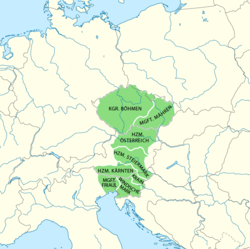
สิ่งที่ตามมาคือ ช่วงเวลา ว่างเว้นการปกครองซึ่งเป็นช่วงเวลาหลายทศวรรษที่สถานะของประเทศถูกโต้แย้ง และในช่วงนั้นดัชชีของพระเจ้าฟรีดริชที่ 2 ตกเป็นเหยื่อของการแย่งชิงอำนาจที่ยืดเยื้อระหว่างกองกำลังคู่แข่ง ในช่วงเวลานี้มีผู้เรียกร้องสิทธิ์ในตำแหน่งหลายคน รวมถึงวลาดิสลาอุส มาร์เกรฟแห่งโมรา เวีย โอรส ของพระเจ้าเวนเซสลาอุสที่ 1 แห่งโบฮีเมีย พระเจ้าเวนเซสลาอุสทรงมุ่งหมายที่จะได้ดัชชีออสเตรียมาครองโดยการจัดงานแต่งงานของวลาดิสลาอุสกับ เกอร์ทรูดหลานสาวของดยุคองค์สุดท้าย ซึ่งเป็นทายาทและผู้เรียกร้องสิทธิ์ที่มีศักยภาพเช่นกัน
ตามพระราชกฤษฎีกาPrivilegium Minusที่ออกโดยจักรพรรดิฟรีดริช บาร์บารอสซาในปี 1156 ดินแดนออสเตรียสามารถตกทอดผ่านทางสายสตรีได้ วลาดิสลาอุสได้รับการถวายความเคารพจากขุนนางออสเตรีย แต่เสียชีวิตในเวลาต่อมาไม่นาน ในวันที่ 3 มกราคม 1247 ก่อนที่จะได้ครอบครองดัชชี ต่อมาคือเฮอร์มันแห่งบาเดนในปี 1248 เขาก็อ้างสิทธิ์โดยขอแต่งงานกับเกอร์ทรูด แต่ไม่ได้รับการสนับสนุนจากขุนนาง เฮอร์มันเสียชีวิตในปี 1250 และการอ้างสิทธิ์ของเขาตกทอดไปยังฟรีดริชผู้ เป็นบุตรชาย แต่การอ้างสิทธิ์ของเขาก็ถูกขัดขวางโดยการรุกรานออสเตรียของโบฮีเมีย
เพื่อยุติความวุ่นวาย กลุ่มขุนนางออสเตรียจึงเชิญกษัตริย์แห่งโบ ฮีเมีย ออตโตการ์ที่ 2 เปรมีสล์ พระอนุชา ของวลาดิสลาอุส ให้ขึ้นครองราชย์เป็นกษัตริย์ออสเตรียในปี 1251 พระบิดาของพระองค์เคยพยายามรุกรานออสเตรียในปี 1250 จากนั้นออตโตการ์ก็ร่วมมือกับตระกูลบาเบนเบิร์กโดยการแต่งงานกับมาร์กาเร็ตพระน้องสาวของดยุคเฟรเดอริกที่ 2 [ 24 ]และพระธิดาของเลโอโปลด์ที่ 6 ทำให้เขากลายเป็นผู้มีสิทธิ์อ้างสิทธิ์ในราชบัลลังก์ในปี 1252 เขาปราบปรามเหล่าขุนนางที่ทะเลาะวิวาทกันและตั้งตนเป็นผู้ปกครองพื้นที่ส่วนใหญ่ รวมถึงออสเตรียสไตเรีย (ซึ่งก่อนหน้านี้อยู่ภายใต้การปกครองของฮังการี ) ตลอดจนคาร์นิโอลาและคารินเทียซึ่งทั้งสองแห่งนี้เขาอ้างสิทธิ์โดยสิทธิสืบทอดมรดกที่น่าสงสัย[ 24 ]
ออตโตการ์เป็นทั้งนักกฎหมายและนักก่อสร้าง หนึ่งในผลงานสำคัญของเขาคือการก่อตั้งพระราชวังฮอฟบูร์กในกรุงเวียนนา ออตโตการ์อยู่ในฐานะที่จะสถาปนาจักรวรรดิใหม่ได้ เนื่องจากจักรวรรดิโรมันอันศักดิ์สิทธิ์ อ่อนแอลง หลังจากการสิ้นพระชนม์ของพระเจ้าฟรีดริชที่ 2 (ค.ศ. 1220–1250) โดยเฉพาะอย่างยิ่งหลังจาก ราชวงศ์ โฮเฮนสเตาฟ์เฟนสิ้นสุดลงในปี ค.ศ. 1254 ด้วยการสิ้นพระชนม์ของ พระเจ้า คอนราดที่ 4และช่วงเวลาว่างเว้นการปกครองของจักรวรรดิ ที่ตามมา (ค.ศ. 1254–1273) ดังนั้น ออตโตการ์จึงเสนอตัวเป็นผู้สมัครชิงบัลลังก์จักรพรรดิ แต่ก็ไม่ประสบความสำเร็จ
การกดขี่ทางศาสนา
ในช่วงระหว่างการว่างเว้นอำนาจของกษัตริย์ ออสเตรียเป็นสถานที่ที่มีการปราบปรามพวกนอกรีต อย่างรุนแรง โดยศาลศาสนากรณีแรกปรากฏขึ้นในปี 1260 ในกว่าสี่สิบตำบลในภูมิภาคแม่น้ำดานูบตอนใต้ ระหว่างซาลซ์คัมเมอร์กุตและป่าเวียนนาและส่วนใหญ่เป็นการมุ่งเป้าไปที่พวกวาลเดนเซียน
การขึ้นครองอำนาจของราชวงศ์ฮับส์บูร์กและการสิ้นพระชนม์ของออตโตการ์ (ค.ศ. 1273–1278)
ใน ปี ค.ศ. 1273 ออตโตการ์ได้ท้าชิงบัลลังก์จักรพรรดิอีกครั้ง โดยแทบจะเป็นฝ่ายเดียวที่อยู่ในสถานการณ์เช่นนี้ในคณะผู้เลือกตั้ง คราวนี้เขาปฏิเสธที่จะยอมรับอำนาจของผู้ชนะการเลือกตั้ง คือรูดอล์ฟแห่งฮับส์บูร์ก (จักรพรรดิ ค.ศ. 1273–1291) ในเดือนพฤศจิกายน ค.ศ. 1274 สภาจักรวรรดิที่นูเรมเบิร์กมีคำตัดสินว่าทรัพย์สินของราชวงศ์ทั้งหมดที่ถูกยึดไปนับตั้งแต่การสวรรคตของจักรพรรดิเฟรเดอริกที่ 2 (ค.ศ. 1250) จะต้องได้รับการคืน และกษัตริย์ออตโตการ์ที่ 2 จะต้องชี้แจงต่อสภาที่ไม่ยอมรับจักรพรรดิองค์ใหม่ รูดอล์ฟ ออตโตการ์ปฏิเสธที่จะปรากฏตัวหรือคืนดัชชีออสเตรียสไตเรียและคารินเทียพร้อมกับมาร์ชแห่งคาร์นิโอลาซึ่งเขาอ้างสิทธิ์ผ่านทางภรรยาคนแรกของเขา ซึ่ง เป็นทายาทของ ราชวงศ์บาเบนเบิร์กและซึ่งเขาได้ยึดมาในขณะที่กำลังแย่งชิงกับทายาทอีกคนหนึ่งของราชวงศ์บาเบนเบิร์ก คือ มาร์เกรฟเฮอร์มันน์ที่ 6 แห่งบาเดน
รูดอล์ฟปฏิเสธการสืทอดตำแหน่งกษัตริย์ออตโตการ์ในราชวงศ์บาเบนเบิร์ก โดยประกาศว่ามณฑลเหล่านั้นต้องกลับคืนสู่ราชบัลลังก์จักรวรรดิเนื่องจากขาดทายาทชาย (ซึ่งขัดแย้งกับบทบัญญัติของกฎหมายPrivilegium Minus ของออสเตรีย ) กษัตริย์ออตโตการ์ถูกเนรเทศออกจากราชบัลลังก์และในเดือนมิถุนายน ค.ศ. 1276 ก็มีการประกาศสงครามกับพระองค์ โดยรูดอล์ฟได้ปิดล้อมกรุงเวียนนา หลังจากโน้มน้าว ให้ดยุคเฮนรีที่ 13 แห่งบาวาเรียตอนล่าง ซึ่งเคยเป็นพันธมิตรของออตโตการ์เปลี่ยนข้าง รูดอล์ฟก็บังคับให้กษัตริย์โบฮีเมียยอมยกสี่มณฑลให้แก่การปกครองของจักรวรรดิในเดือนพฤศจิกายน ค.ศ. 1276
เมื่อออตโตการ์สละดินแดนที่อยู่นอกเขตเช็ก รูดอล์ฟจึงมอบราชอาณาจักรโบฮีเมีย ให้แก่เขาอีกครั้ง หมั้นหมาย จูดิธแห่งฮับส์บูร์ก พระธิดาองค์เล็ก ของออตโตการ์ (กับเวนเซสเลาส์ที่ 2 โอรส ของออตโตการ์ ) และเสด็จเข้ากรุงเวียนนาอย่างยิ่งใหญ่ อย่างไรก็ตาม ออตโตการ์ตั้งคำถามเกี่ยวกับการปฏิบัติตามสนธิสัญญา ทำพันธมิตรกับ หัวหน้า เผ่าปิอาสต์ บางคน ในโปแลนด์และได้รับการสนับสนุนจากเจ้าชายเยอรมันหลายพระองค์ รวมถึงเฮนรีที่ 13 แห่งบาวาเรียตอนล่าง เพื่อตอบโต้พันธมิตรนี้ รูดอล์ฟจึงทำพันธมิตรกับกษัตริย์ลาดีสเลาส์ที่ 4 แห่งฮังการีและมอบสิทธิพิเศษเพิ่มเติมให้แก่พลเมืองเวียนนา
ในวันที่ 26 สิงหาคม ค.ศ. 1278 กองทัพของทั้งสองฝ่ายได้ปะทะกันในการรบที่มาร์ชเฟลด์ทางตะวันออกเฉียงเหนือของเวียนนา ซึ่งออตโตการ์พ่ายแพ้และถูกสังหารทันทีหลังจากการรบสิ้นสุด ลง มาร์เกรเวียตแห่งโมราเวียถูกปราบปรามและรัฐบาลถูกมอบหมายให้แก่ตัวแทนของรูดอล์ฟ ทำให้คุนิกุนดาแห่งสลาโวเนีย ภรรยาม่ายของออตโตการ์ควบคุมได้เพียงจังหวัดรอบกรุงปรากเท่านั้น ในขณะที่เวนเซสเลาส์ที่ 2 หนุ่มได้หมั้นหมายกับจูดิธอีก ครั้ง [ 25 ]
ด้วยเหตุนี้ รูดอล์ฟจึงสามารถเข้าควบคุมออสเตรียแต่เพียงผู้เดียวในฐานะดยุคแห่งออสเตรียและสไตเรีย (ค.ศ. 1278–1282) ซึ่งอยู่ภายใต้ การปกครองของราชวงศ์ ฮับส์บูร์กมานานกว่าหกศตวรรษ จนกระทั่งถึงปี ค.ศ. 1918
การสถาปนาราชวงศ์ฮับส์บูร์ก: ดัชชีแห่งออสเตรีย (ค.ศ. 1278–1453)

ด้วยเหตุนี้ ออสเตรียและจักรวรรดิจึงอยู่ภายใต้ราชบัลลังก์ฮับส์บูร์กเดียว และหลังจากนั้นไม่กี่ศตวรรษ (ค.ศ. 1438) ก็ยังคงอยู่ภายใต้การปกครองเช่นนั้นเกือบต่อเนื่อง (ดูด้านล่าง) จนถึงปี ค.ศ. 1806 เมื่อจักรวรรดิถูกยุบ ทำให้ความขัดแย้งที่เกิดขึ้นบ่อยครั้งก่อนหน้านี้หมดไป
พระเจ้ารูดอล์ฟที่ 1 และระบบสืบทอดตำแหน่งโดยบุตรคนโต (ค.ศ. 1278–1358)
รูดอล์ฟที่ 1ใช้เวลาหลายปีในการสร้างอำนาจของตนในออสเตรีย โดยพบกับความยากลำบากในการสถาปนาราชวงศ์ของตนให้สืบทอดอำนาจการปกครองมณฑล ในที่สุด ความเป็นปรปักษ์ของเหล่าเจ้าชายก็ถูกเอาชนะได้ และเขาก็สามารถยกออสเตรียให้แก่โอรสทั้งสองของเขาได้ ในเดือนธันวาคม ค.ศ. 1282 ในการประชุมสภาแห่งเอาส์บวร์ก รูดอล์ฟได้มอบดัชชีแห่งออสเตรียและสไตเรียให้แก่โอรสของเขาอัลเบิร์ตที่ 1 (ค.ศ. 1282–1308) และรูดอล์ฟที่ 2 ผู้สง่างาม (ค.ศ. 1282–1283) ในฐานะผู้ปกครองร่วมกัน "ทั้งโดยส่วนรวมและโดยส่วนรวม" และด้วยเหตุนี้จึงเป็นการวางรากฐานของราชวงศ์ฮับส์บูร์ก รูดอล์ฟยังคงดำเนินการรุกรานและขยายอาณาเขตของตนต่อไป จนกระทั่งเสียชีวิตในปี ค.ศ. 1291 แต่ทิ้งความไม่มั่นคงทางราชวงศ์ไว้ในออสเตรีย ซึ่งดัชชีแห่งออสเตรียมักถูกแบ่งปันระหว่างสมาชิกในครอบครัว อย่างไรก็ตาม รูดอล์ฟไม่ประสบความสำเร็จในการรับประกันการสืบทอดราชบัลลังก์จักรพรรดิสำหรับดยุคแห่งออสเตรียและสไตเรีย
การปกครองแบบดยุคร่วมนี้ดำรงอยู่เพียงหนึ่งปี จนกระทั่งสนธิสัญญาไรน์เฟลเดนในปี 1283 ได้สถาปนาระบบการสืราช บัลลังก์ของราชวงศ์ฮับส์บูร์ก โดยกำหนดให้เป็นการสืราชบัลลังก์โดยบุตรคนโต ดยุครูดอล์ฟที่ 2 ซึ่งมีพระชนมายุเพียง 11 พรรษา ต้องสละสิทธิ์ในบัลลังก์ออสเตรียและสไตเรียทั้งหมดให้แก่พระเชษฐา อัลเบิร์ตที่ 1 แม้ว่ารูดอล์ฟควรได้รับการชดเชย แต่ก็ไม่ได้เกิดขึ้น เขาเสียชีวิตในปี 1290 และต่อมาจอห์น โอรส ของ เขาได้สังหารอัลเบิร์ตที่ 1 ผู้เป็นลุงในปี 1308 ในช่วงเวลาสั้นๆ อัลเบิร์ตที่ 1 ก็ได้แบ่งการปกครองแบบดยุคกับรูดอล์ฟที่ 3ผู้ทรงคุณธรรม (1298–1307) และในที่สุดก็ได้ขึ้นครองบัลลังก์จักรพรรดิในปี 1298
เมื่ออัลเบิร์ตที่ 1 สิ้นพระชนม์ ดัชชีตกเป็นของพระโอรสของพระองค์คือเฟรเดอริกผู้เที่ยงธรรม (ค.ศ. 1308–1330) แต่จักรวรรดิไม่ได้ตกเป็นของพระองค์ อย่างน้อยก็จนกระทั่งปี ค.ศ. 1314 เมื่อพระองค์ได้ขึ้นเป็นผู้ปกครองร่วมกับหลุยส์ที่ 4 แห่งจักรวรรดิ เฟรเดอริกยังต้องแบ่งดัชชีกับพระอนุชาของพระองค์คือ เลโอโปลด์ที่ 1ผู้ทรงเกียรติ (ค.ศ. 1308–1326) ต่อมา พระอนุชาอีกพระองค์คืออัลเบิร์ตที่ 2ผู้พิการ (ค.ศ. 1330–1358) ก็ได้สืบทอด ราชบัลลังก์ ต่อจากเฟรเดอริก

รูปแบบการปกครองแบบโครูลยังคงดำเนินต่อไป เนื่องจากอัลเบิร์ตต้องแบ่งบทบาทนี้กับน้องชายอีกคนหนึ่งคือออตโตที่ 1ผู้ร่าเริง (ค.ศ. 1330–1339) แม้ว่าเขาจะพยายามวางกฎการสืทอดตำแหน่งใน "กฎของราชวงศ์อัลเบิร์ต" แต่ก็ไม่ประสบความสำเร็จ เมื่อออตโตเสียชีวิตในปี ค.ศ. 1339 โอรสทั้งสองของเขาคือ เฟรเดอริกที่ 2 และเลโอโปลด์ที่ 2 ได้ขึ้นครองราชย์แทน ทำให้มีดยุคแห่งออสเตรียถึงสามคนพร้อมกันตั้งแต่ปี ค.ศ. 1339 ถึง 1344 ก่อนที่ทั้งสองจะเสียชีวิตในวัยรุ่นโดยไม่มีทายาท การปกครองแบบเดียวในดัชชีแห่งออสเตรียจึงกลับคืนมาอีกครั้งเมื่อรูดอล์ฟที่ 4 โอรสของเขาขึ้นครองราชย์ในปี ค.ศ. 1358
ในศตวรรษที่ 14 ราชวงศ์ฮับส์บูร์กเริ่มสะสมดินแดนจังหวัดอื่นๆ ในบริเวณใกล้เคียงกับดัชชีออสเตรีย ซึ่งเดิมเป็นดินแดนเล็กๆ ตามแนวแม่น้ำดานูบ และสไตเรีย ซึ่งพวกเขาได้มาพร้อมกับออสเตรียจากออตโตการ์ ในปี ค.ศ. 1335 อัลเบิร์ตที่ 2 ได้รับมรดกเป็นดัชชีคารินเทียและมาร์ชคาร์นิโอลาจากผู้ปกครองในขณะนั้น คือราชวงศ์โกริเซีย
รูดอล์ฟที่ 4 และพระราชกฤษฎีกาPrivilegium Maius (1358–1365)
พระเจ้ารูดอล์ฟที่ 4ผู้ก่อตั้ง (ค.ศ. 1358–1365) เป็นบุคคลแรกที่อ้างสิทธิ์ในตำแหน่งอาร์ชดยุคแห่งออสเตรีย ผ่านทางพระราชกฤษฎีกาPrivilegium Maiusในปี ค.ศ. 1359 ซึ่งแท้จริงแล้วเป็นเอกสารปลอมและไม่ได้รับการยอมรับนอกประเทศออสเตรียจนกระทั่งปี ค.ศ. 1453 อย่างไรก็ตาม การได้รับพระราชกฤษฎีกานี้จะทำให้พระองค์มีฐานะทัดเทียมกับเจ้าชายผู้เลือกตั้งองค์ อื่นๆ ในจักรวรรดิโรมันอันศักดิ์สิทธิ์ พระเจ้ารูดอล์ฟทรงเป็นผู้ปกครองที่กระตือรือร้นที่สุดพระองค์หนึ่งในยุคของพระองค์ โดยทรงริเริ่มมาตรการต่างๆ มากมายและยกระดับความสำคัญของนครเวียนนา
ในเวลานั้น เวียนนาอยู่ภายใต้การปกครองทางศาสนาของสังฆมณฑลปัสเซาซึ่งรูดอล์ฟได้ล้มล้างอำนาจนั้นโดยการก่อตั้งมหาวิหารเซนต์สตีเฟนและแต่งตั้งเจ้าอาวาสเป็นอัครมหาเสนาบดีแห่งออสเตรีย เขายังได้ก่อตั้งมหาวิทยาลัยเวียนนาปรับปรุงเศรษฐกิจ และสร้างสกุลเงินที่มั่นคง คือ เพนนีเวียนนา เมื่อเขาเสียชีวิตในปี 1365 เขาไม่มีทายาท และการสืทอดตำแหน่งจึงตกเป็นของพี่น้องของเขาร่วมกันภายใต้กฎของราชวงศ์รูดอล์ฟ
In 1363, the County of Tyrol was acquired by Rudolph IV from Margaret of Tyrol. Thus Austria was now a complex country in the Eastern Alps, and these lands are often referred to as the Habsburg Hereditary Lands, as well as simply Austria, since the Habsburgs also began to accumulate lands far from their Hereditary Lands.[26]
Albert III and Leopold III: A house divided (1365–1457)
Almost the entire 15th Century was a confusion of estate and family disputes, which considerably weakened the political and economic importance of the Habsburg lands. It was not until 1453 in the reign of Frederick V the Peaceful (1457–1493) that the country (at least the core territories) would be finally united again. Rudolph IV's brothers Albert III the Pigtail and Leopold III the Just quarreled ceaselessly and eventually agreed to split the realm in the Treaty of Neuberg in 1379, which was to result in further schisms later. Altogether this resulted in three separate jurisdictions.
- Lower Austrian Territories or Niederösterreich (Upper and Lower Austria)
- Albertinian Line – extinct 1457, passed to Leopoldians
- Inner Austrian Territories or Innerösterreich (Styria, Carinthia, Carniola, and the Austrian Littoral of Istria and Trieste)
- Leopoldian Line then Elder Ernestine Line 1406–1457, continuing as Archduchy of Austria.
- Further Austrian Territories or Vorderösterreich (Tyrol, Vorarlberg and the Swabian and Alsatian territories)
- Leopoldian Line then Junior Tyrolean Line 1406–1490, passed back to Leopoldians
Albertinian line (1379–1457)
ในปี ค.ศ. 1379 อัลเบิร์ตที่ 3 ทรงปกครองออสเตรียอย่างถาวร และครองราชย์จนถึงปี ค.ศ. 1395 พระองค์ถูกสืบทอดราชบัลลังก์โดยพระโอรสอัลเบิร์ตที่ 4 (ค.ศ. 1395–1404) และพระโอรสอัลเบิร์ตที่ 5 ( ค.ศ. 1404–1439) ซึ่งทรงกอบกู้ราชบัลลังก์จักรวรรดิกลับคืนมาให้แก่ราชวงศ์ฮับส์บูร์ก และด้วยดินแดนที่พระองค์ได้มา พระองค์จึงทรงมีพระทัยที่จะกลายเป็นหนึ่งในผู้ปกครองที่ทรงอำนาจที่สุดในยุโรป หากพระองค์ไม่สิ้นพระชนม์ในเวลานั้น โดยทิ้ง ทายาทที่เกิดหลัง การสิ้นพระชนม์ เพียง สี่เดือน ( ลาดีสเลาส์ผู้สืบราชบัลลังก์หลังการสิ้นพระชนม์ ค.ศ. 1440–1457) แต่กลับเป็นผู้ปกครองและผู้สืบทอดราชบัลลังก์ของลาดีสเลาส์ คือพระเจ้าฟรีดริชที่ 5ผู้รักสันติ (ค.ศ. 1457–1493) แห่งราชวงศ์เลโอโปลด์ ที่ได้รับประโยชน์ เนื่องจากราชวงศ์อัลเบอร์ทีนสิ้นสุดลงแล้ว ตำแหน่งจึงตกกลับไปอยู่กับราชวงศ์เลโอโปลด์ พระเจ้าฟรีดริชทรงตระหนักถึงศักยภาพในการเป็นผู้ปกครองของลาดีสเลาส์ จึงทรงปฏิเสธที่จะปล่อยให้ลาดีสเลาส์ปกครองอย่างอิสระเมื่อบรรลุนิติภาวะ (อายุ 12 ปีในออสเตรียในขณะนั้น) [ 27 ]ในช่วงต้นเดือนกันยายน พ.ศ. 2495 หลังจากปิดล้อมเฟรเดอริคในเวียนเนอร์ นอย ชตัดท์ สมาคมเมล์เบอร์เกอร์ บุนด์ (สมาคมเมล์เบิร์ก ซึ่งเป็นสหภาพของขุนนางในต่างจังหวัด) ได้ดำเนินการส่งตัวลาดีสเลาส์กลับมา ในวันที่ 6 กันยายน พ.ศ. 2495 เคานต์อุลริช ฟอน ซิลลีและลาดีสเลาส์หนุ่มได้เข้ากรุงเวียนนาอย่างเป็นทางการ
ราชวงศ์เลโอโปลเดียน (ค.ศ. 1379–1490)
เลโอโปลด์ที่ 3 เข้ายึดครองดินแดนที่เหลืออยู่ และปกครองจนถึงปี 1386 ต่อมาบุตรชายสองคนของเขาได้สืบทอดตำแหน่งต่อ คือวิลเลียมผู้สุภาพ (1386–1406) และเลโอโปลด์ที่ 4 ผู้มั่งคั่ง (1386–1411) ในปี 1402 เกิดการแตกแยกในดัชชีอีกครั้ง เนื่องจากเลโอโปลด์ที่ 3 มีบุตรชายสี่คน และทั้งเลโอโปลด์ที่ 4 และวิลเลียมไม่มีทายาท พี่น้องที่เหลืออยู่จึงแบ่งดินแดนกัน
เออร์เนสต์ผู้แข็งแกร่ง (ค.ศ. 1402–1424) ปกครองออสเตรียตอนใน ขณะที่เฟรเดอริกที่ 4 แห่งกระเป๋าว่างเปล่า (ค.ศ. 1402–1439) ปกครองออสเตรียตอนไกล เมื่อวิลเลียมสิ้นพระชนม์ในปี ค.ศ. 1406 การปกครองนี้จึงมีผลอย่างเป็นทางการ โดยมีราชวงศ์ดยุคสองสายแยกกัน คือสายเออร์เนสต์ผู้เฒ่าและสายไทโรลผู้เยาว์ตามลำดับ
ราชวงศ์เออร์เนสทีน (ออสเตรียตอนใน ค.ศ. 1406–1457)
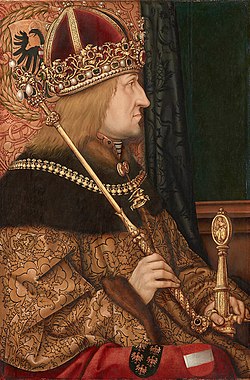
ราชวงศ์เออร์เนสทีนประกอบด้วยเออร์เนสต์และการปกครองร่วมกันโดยบุตรชายสองคนของเขาหลังจากที่เขาเสียชีวิตในปี 1424 ได้แก่อัลเบิร์ตที่ 6ผู้ฟุ่มเฟือย (1457–1463) และเฟรเดอริกที่ 5ผู้รักสันติ (1457–1493) พวกเขาก็ทะเลาะกันและแบ่งดินแดนที่กลายเป็นออสเตรียตอนล่างและออสเตรียตอนในหลังจากที่ลาดีสเลาส์เสียชีวิตในปี 1457 และราชวงศ์อัลเบอร์ทีนสิ้นสุดลง อัลเบิร์ตยึดครองออสเตรียตอนบนได้ในปี 1458 ปกครองจากลินซ์แต่ในปี 1462 เขาได้ล้อมพระราชวังฮอฟบูร์กในเวียนนาซึ่งเป็นพี่ชายของเขา และยึดครองออสเตรียตอนล่างได้ด้วย อย่างไรก็ตาม เนื่องจากเขาเสียชีวิตโดยไม่มีทายาทในปีถัดมา (1463) ทรัพย์สินของเขาจึงตกเป็นของพี่ชายโดยอัตโนมัติ และเฟรเดอริกจึงควบคุมทรัพย์สินทั้งหมดของราชวงศ์อัลเบอร์ทีนและเออร์เนสทีน
เส้นทางการเมืองของเฟรเดอริกก้าวหน้าไปอย่างมากนับตั้งแต่เขาได้รับสืบทอดตำแหน่งดยุคแห่งออสเตรียตอนในในปี 1424 จากตำแหน่งดยุค เขาได้ขึ้นเป็นกษัตริย์เยอรมันในนามเฟรเดอริกที่ 4 ในปี 1440 และเป็นจักรพรรดิโรมันอันศักดิ์สิทธิ์ในนามเฟรเดอริกที่ 3 (1452–1493)
ราชวงศ์ไทโรล (ออสเตรียตอนเหนือ) ค.ศ. 1406–1490
ราชวงศ์ไทโรลประกอบด้วยพระเจ้าฟรีดริชที่ 4 และพระโอรสของพระองค์ซิกิสมุนด์ผู้มั่งคั่ง (ค.ศ. 1439–1490) พระเจ้าฟรีดริชทรงย้ายราชสำนักไปยังอินส์บรุคแต่ทรงสูญเสียดินแดนบางส่วนให้กับสวิตเซอร์แลนด์ ซิกิสมุนด์ผู้สืบทอดราชบัลลังก์ต่อจากพระองค์ได้ขายดินแดนบางส่วนให้กับชาร์ลส์ผู้กล้าหาญในปี ค.ศ. 1469 และได้รับการแต่งตั้งเป็นอาร์ชดยุคโดยจักรพรรดิฟรีดริชที่ 3 ในปี ค.ศ. 1477 พระองค์สิ้นพระชนม์โดยไม่มีพระโอรสธิดา แต่ในปี ค.ศ. 1490 พระองค์ทรงสละราชสมบัติเนื่องจากไม่เป็นที่นิยม และออสเตรียตอนเหนือจึงกลับคืนสู่การปกครองของอาร์ชดยุคแม็กซิมิเลียนที่ 1อัศวินองค์สุดท้าย (ค.ศ. 1490–1493) พระโอรสของพระเจ้าฟรีดริชที่ 5 ผู้ซึ่งควบคุมดินแดนทั้งหมดของราชวงศ์ฮับส์บูร์กเป็นครั้งแรกนับตั้งแต่ปี ค.ศ. 1365
การกดขี่ทางศาสนา

ศาลศาสนาได้ดำเนินการอย่างแข็งขันภายใต้การปกครองของราชวงศ์ฮับส์บูร์ก โดยเฉพาะอย่างยิ่งระหว่างปี 1311 ถึง 1315 เมื่อมีการจัดศาลศาสนาขึ้นในเมืองสไต เออ ร์เครมส์เซนต์โพลเทน และเวียนนา ปี เตอร์ ซวิคเกอร์ผู้เป็นหัวหน้าศาลศาสนาได้ทำการปราบปรามอย่างรุนแรงในเมืองสไต เออ ร์ เอนส์ฮา ร์ ตเบิร์กโซพรอนและเวียนนา ระหว่างปี 1391 ถึง 1402 ในปี 1397 มีชาววาลเดนเซียน ประมาณ 80-100 คน ถูกเผาในเมืองสไตเออร์เพียงแห่งเดียว ซึ่งปัจจุบันได้รับการรำลึกถึงด้วยอนุสาวรีย์ที่สร้างขึ้นในปี 1997
ดัชชีและราชอาณาจักร
ในสมัยที่ราชวงศ์ฮับส์บูร์กปกครอง มีดยุคสืบทอดตำแหน่งติดต่อกันถึง 13 พระองค์ โดยในจำนวนนี้มี 4 พระองค์ที่ได้รับการสวมมงกุฎ เป็นกษัตริย์ แห่งเยอรมนีได้แก่รูดอล์ฟที่ 1 , อัลเบิร์ ตที่ 1 , เฟรเดอริกที่ 5 และอัลเบิร์ตที่ 5 (อัลเบิร์ตที่ 2 ในฐานะกษัตริย์แห่งเยอรมนี) แม้ว่าจะไม่มีพระองค์ใดได้รับการยอมรับจากพระสันตะปาปา ว่าเป็น จักรพรรดิโรมันอันศักดิ์สิทธิ์ก็ตาม
เมื่อดยุคอัลเบิร์ตที่ 5 (ค.ศ. 1404–1439) ได้รับเลือกเป็นจักรพรรดิในปี ค.ศ. 1438 (ในนามอัลเบิร์ตที่ 2) ในฐานะผู้สืบทอดตำแหน่งต่อจากซิกิสมุนด์ ฟอน ลักเซมเบิร์ก (ค.ศ. 1433–1437) พระบิดาของพระสวามี มงกุฎจักรพรรดิจึงกลับคืนสู่ราชวงศ์ฮับส์บูร์กอีกครั้ง แม้ว่าอัลเบิร์ตเองจะครองราชย์เพียงปีเดียว (ค.ศ. 1438–1439) แต่นับจากนั้นเป็นต้นมา จักรพรรดิทุกพระองค์ล้วนมาจากราชวงศ์ฮับส์บูร์ก (ยกเว้นเพียงพระองค์เดียวคือชาร์ลส์ที่ 7ค.ศ. 1742–1745) และผู้ปกครองออสเตรียก็เป็นจักรพรรดิโรมันอันศักดิ์สิทธิ์จนกระทั่งจักรวรรดิถูกยุบในปี ค.ศ. 1806
ราชรัฐออสเตรีย: การก้าวสู่การเป็นมหาอำนาจ (ค.ศ. 1453–1564)
พระเจ้าฟรีดริชที่ 5 (ค.ศ. 1453–1493): การยกฐานะดัชชี

พระเจ้าฟรีดริชที่ 5 (ดยุค ค.ศ. 1424 อาร์ชดยุค ค.ศ. 1453 สิ้นพระชนม์ ค.ศ. 1493) ผู้ทรงสันติ ( จักรพรรดิฟรีดริชที่ 3ค.ศ. 1452–1493) ทรงยืนยันพระราชทานสิทธิพิเศษ Privilegium Maiusของจักรพรรดิรูดอล์ฟที่ 4 ในปี ค.ศ. 1453 ส่งผลให้ออสเตรียกลายเป็นอาร์ชดัชชีอย่างเป็นทางการของจักรวรรดิโรมันอันศักดิ์สิทธิ์ ซึ่งเป็นก้าวต่อไปของการขึ้นมามีอำนาจในยุโรป และลาดีสเลาส์ผู้สืบราชสมบัติ (ค.ศ. 1440–1457) กลายเป็นอาร์ชดยุคอย่างเป็นทางการคนแรกในช่วงเวลาสั้นๆ ก่อนจะสิ้นพระชนม์ในเวลาต่อมาไม่นาน เอกสารดังกล่าวเป็นเอกสารปลอมที่อ้างว่าเขียนโดยจักรพรรดิฟรีดริชที่ 1และ "ถูกค้นพบใหม่" พระเจ้าฟรีดริชทรงมีแรงจูงใจที่ชัดเจนในเรื่องนี้ พระองค์เป็นสมาชิกราชวงศ์ฮับส์บูร์ก ทรงเป็นดยุคแห่งออสเตรียตอนใน นอกเหนือจากการเป็นจักรพรรดิ และจนถึงปีก่อนหน้านั้น ทรงเป็นผู้ปกครองของลาดีสเลาส์ ดยุคแห่งออสเตรียตอนล่าง เขายังมีสิทธิ์สืบทอดตำแหน่งของลาดีสเลาส์ และเขาก็ได้สืบทอดตำแหน่งนั้นเมื่อลาดีสเลาส์เสียชีวิตในอีกสี่ปีต่อมา กลายเป็นอาร์ชดยุคคนที่สอง
บัดนี้ บรรดาอาร์ชดยุคแห่งออสเตรียมีสถานะเท่าเทียมกับเจ้าชายผู้เลือกตั้งองค์ อื่นๆ ที่เป็นผู้เลือกจักรพรรดิ การปกครองของออสเตรียจึงยึดหลักสืบทอดตำแหน่งโดยบุตรคนโตและการแบ่งแยกไม่ได้ ต่อมาออสเตรียจึงมีชื่อเรียกอย่างเป็นทางการว่า " Erzherzogtum Österreich ob und unter der Enns " (อาร์ชดัชชีแห่งออสเตรียเหนือและใต้แม่น้ำเอนส์) และในปี ค.ศ. 1861 ก็ถูกแบ่งออกเป็น ออสเตรีย ตอนบนและออสเตรียตอนล่างอีก ครั้ง
อำนาจของจักรพรรดิในระบอบกษัตริย์นั้นไม่มากนัก เนื่องจากราชวงศ์ขุนนางอื่นๆ อีกหลายราชวงศ์ต่างก็แสวงหาอำนาจทางการเมืองของตนเองทั้งภายในและภายนอกระบอบกษัตริย์ อย่างไรก็ตาม แม้ว่าเฟรเดอริกจะไม่โดดเด่นนัก แต่เขาก็ปกครองอย่างเข้มแข็งและมีประสิทธิภาพ เขาแสวงหาอำนาจผ่านพันธมิตรทางราชวงศ์ ในปี 1477 แม็กซิมิเลียน (อาร์คดยุกและจักรพรรดิ ค.ศ. 1493–1519) โอรสเพียงคนเดียวของเฟรเดอริก ได้แต่งงานกับ แมรีดัชเชสแห่งเบอร์กันดีทำให้ได้ดินแดนส่วนใหญ่ในกลุ่มประเทศต่ำ (Low Countries ) มาอยู่ในครอบครองของราชวงศ์ ความสำคัญเชิงยุทธศาสตร์ของพันธมิตรนี้คือ เบอร์กันดี ซึ่งตั้งอยู่บนพรมแดนด้านตะวันตกของจักรวรรดิ กำลังแสดงแนวโน้มการขยายอำนาจ และในขณะนั้นเป็นหนึ่งในรัฐชาติที่ร่ำรวยและทรงอำนาจที่สุดในยุโรปตะวันตก โดยมีอาณาเขตครอบคลุมตั้งแต่ทางใต้ของฝรั่งเศสไปจนถึง ทะเลเหนือ
พันธมิตรนี้เกิดขึ้นด้วยต้นทุนที่ไม่น้อยเลย เนื่องจากฝรั่งเศสซึ่งอ้างสิทธิ์ในแคว้นเบอร์กันดีเช่นกัน ได้คัดค้านการได้มาซึ่งดินแดนนี้ และแม็กซิมิเลียนต้องปกป้องดินแดนของภรรยาใหม่ของเขาจากหลุยส์ที่ 11ในที่สุดก็ทำได้สำเร็จเมื่อแมรีสิ้นพระชนม์ในปี 1482 ในสนธิสัญญาอาร์ราสความสัมพันธ์กับฝรั่งเศสยังคงยากลำบาก หลุยส์ที่ 11 พ่ายแพ้ในยุทธการกีเนเกตในปี 1479 เรื่องราวกับฝรั่งเศสได้รับการยุติลงในปี 1493 ในสนธิสัญญาเซนลิสหลังจากที่แม็กซิมิเลียนขึ้นเป็นจักรพรรดิแล้ว
พันธมิตรราชวงศ์นี้และของแม็กซิมิเลียนในภายหลังทำให้เกิดคำกล่าวที่ว่า: [ 28 ]
Bella gerant alii, tu felix Austria nube , Nam quae Mars aliis, dat tibi regna Venus [ a ]
ซึ่งกลายเป็นคติพจน์ของราชวงศ์ รัชสมัยของเฟรเดอริคเป็นจุดเปลี่ยนสำคัญในประวัติศาสตร์ออสเตรีย พระองค์ทรงรวมดินแดนหลักเข้าด้วยกันโดยการมีชีวิตยืนยาวกว่าสมาชิกคนอื่นๆ ในครอบครัว ตั้งแต่ปี ค.ศ. 1439 เมื่ออัลเบิร์ตที่ 5 สิ้นพระชนม์ และความรับผิดชอบในดินแดนหลักทั้งสองตกอยู่กับเฟรเดอริค พระองค์ทรงรวบรวมฐานอำนาจของพระองค์อย่างเป็นระบบ ปีต่อมา (ค.ศ. 1440) พระองค์ทรงยกทัพไปยังกรุงโรมในฐานะกษัตริย์แห่งชาวโรมันพร้อมกับลาดีสเลาส์ ดยุกอัลเบอร์ทีเนียนองค์สุดท้าย และเมื่อพระองค์ทรงได้รับการสวมมงกุฎในกรุงโรมในปี ค.ศ. 1452 พระองค์ไม่เพียงแต่เป็นกษัตริย์ฮับส์บูร์กองค์แรกเท่านั้น แต่ยังเป็นกษัตริย์เยอรมันองค์สุดท้ายที่ได้รับการสวมมงกุฎในกรุงโรมโดยพระสันตะปาปาอีกด้วย[ 29 ]
ราชวงศ์กำลังมุ่งหน้าสู่การเป็นมหาอำนาจโลก แนวคิดเรื่องpietas austriacae (หน้าที่อันศักดิ์สิทธิ์ในการปกครอง) มีต้นกำเนิดมาจากรูดอล์ฟที่ 1 แต่เฟรเดอริคได้ปรับปรุงใหม่เป็นAEIOU , Alles Erdreich ist Österreich untertanหรือAustriae est imperare orbi universo (ชะตากรรมของออสเตรียคือการปกครองโลก) ซึ่งกลายเป็นสัญลักษณ์ของอำนาจของออสเตรีย[ 29 ]อย่างไรก็ตาม เหตุการณ์ต่างๆ ไม่ได้ราบรื่นสำหรับเฟรเดอริคเสมอ ไป สงครามออสเตรีย-ฮังการี (1477–1488)ส่งผลให้กษัตริย์ฮังการีมัทธิอัส คอร์วินัสตั้งตนอยู่ในเวียนนาในปี 1485 จนกระทั่งสิ้นพระชนม์ในปี 1490 ฮังการียึดครองออสเตรียตะวันออกทั้งหมด ดังนั้นเฟรเดอริคจึงพบว่าตนเองมีราชสำนักที่เดินทางไปมา โดยส่วนใหญ่อยู่ในเมือง ลินซ์เมืองหลวง ของออสเตรียตอนบน
แม็กซิมิเลียนที่ 1 (ค.ศ. 1493–1519): การรวมชาติ

แม็กซิมิเลียนที่ 1 แบ่งอำนาจการปกครองกับพระบิดาในช่วงปลายรัชสมัยของเฟรเดอริก โดยได้รับการเลือกตั้งเป็นกษัตริย์แห่งโรมันในปี 1486 เมื่อได้ดินแดนของราชวงศ์ฮับส์บูร์กสายไทโรลมาในปี 1490 พระองค์จึงรวมดินแดนออสเตรียที่แบ่งแยกมาตั้งแต่ปี 1379 ให้เป็นหนึ่งเดียวอีกครั้ง นอกจากนี้ พระองค์ยังต้องจัดการกับปัญหาฮังการีเมื่อมาเธียสที่ 1 สิ้นพระชนม์ในปี 1490 แม็กซิมิเลียนยึดดินแดนออสเตรียที่สูญเสียไปคืนมาและสถาปนาสันติภาพกับวลาดิสลาฟที่ 2 ผู้สืบทอดตำแหน่งของมาเธียส ณสนธิสัญญาเพรสเบิร์กในปี 1491 อย่างไรก็ตาม รูปแบบการแบ่งแยกและการรวมชาติของราชวงศ์ก็ยังคงเกิดขึ้นซ้ำแล้วซ้ำเล่า เนื่องจากพรมแดนไม่แน่นอน แม็กซิมิเลียนจึงพบว่าอินส์บรุคในไทโรลเป็นสถานที่ที่ปลอดภัยกว่าสำหรับเป็นเมืองหลวง เนื่องจากอยู่ระหว่างดินแดนเบอร์กันดีและออสเตรียของพระองค์ ถึงแม้ว่าพระองค์จะไม่ค่อยได้อยู่ที่ใดที่หนึ่งนานนัก เพราะทรงตระหนักดีว่าพระบิดาของพระองค์ถูกล้อมกรุงเวียนนาซ้ำแล้วซ้ำเล่า
แม็กซิมิเลียนยกระดับศิลปะแห่งการสร้างพันธมิตรทางราชวงศ์ไปสู่ระดับใหม่ และเริ่มสร้างประเพณีทางราชวงศ์อย่างเป็นระบบ แม้ว่าจะมีการปรับเปลี่ยนแก้ไขอย่างมากก็ตาม ภรรยาของเขา แมรี เสียชีวิตในปี 1482 เพียงห้าปีหลังจากแต่งงานกัน จากนั้นเขาจึงแต่งงานกับแอนน์ ดัชเชสแห่งบริตตานี (โดยตัวแทน) ในปี 1490 ซึ่งการกระทำนี้จะทำให้บริตตานีซึ่งในขณะนั้นเป็นอิสระ เข้ามาอยู่ภายใต้อิทธิพลของราชวงศ์ฮับส์บูร์ก ซึ่งถือเป็นการยั่วยุต่อราชวงศ์ฝรั่งเศส ชาร์ลส์ที่ 8 แห่งฝรั่งเศส มีแนวคิดอื่น และผนวกบริตตานีและแต่งงานกับแอนน์ สถานการณ์ยิ่งซับซ้อนขึ้นไปอีกเนื่องจากเขาได้หมั้นหมายกับมาร์กาเร็ตดัชเชสแห่งซาวอยธิดา ของแม็ ก ซิมิเลียนอยู่แล้ว ฟิลิปผู้ยุติธรรม (ค.ศ. 1478–1506) โอรสของแม็กซิมิเลียน แต่งงานกับ โจแอน นา ทายาทแห่งคาสตีลและอารากอนในปี ค.ศ. 1496 จึงได้ครอบครองสเปนและดินแดนในอิตาลี ( เนเปิลส์ราชอาณาจักรซิซิลีและซาร์ดิเนีย ) แอฟริกา และดินแดน ในโลกใหม่ ให้กับราชวงศ์ฮับส์บูร์ก
อย่างไรก็ตามบทกวี Tu felix Austria nubeอาจมีความโรแมนติกมากกว่าความเป็นจริงอย่างเคร่งครัด เนื่องจากแม็กซิมิเลียนไม่ลังเลที่จะทำสงครามเมื่อใดก็ตามที่เป็นประโยชน์ต่อจุดประสงค์ของเขา หลังจากจัดการเรื่องต่างๆ กับฝรั่งเศสในปี 1493 เขาก็เข้าไปเกี่ยวข้องกับสงครามอิตาลี อันยาวนาน กับฝรั่งเศส (1494–1559) ในไม่ช้า นอกจากสงครามกับฝรั่งเศสแล้ว ยังมีสงครามเพื่อเอกราช ของ สวิตเซอร์แลนด์สงครามสวาเบียนในปี 1499 ถือเป็นช่วงสุดท้ายของการต่อสู้กับราชวงศ์ฮับส์บูร์ก หลังจากพ่ายแพ้ในยุทธการดอร์นาคในปี 1499 ออสเตรียถูกบังคับให้ยอมรับ เอกราชของ ส วิตเซอร์แลนด์ ในสนธิสัญญาบาเซิลในปี 1499 ซึ่งกระบวนการนี้ได้รับการรับรองอย่างเป็นทางการในที่สุดในสนธิสัญญาเวสต์ฟาเลียในปี 1648 นี่เป็นเรื่องสำคัญเนื่องจากราชวงศ์ฮับส์บูร์กมีต้นกำเนิดในสวิตเซอร์แลนด์บ้านบรรพบุรุษของพวกเขาคือปราสาทฮับส์บูร์ก
ในนโยบายภายในประเทศ แม็กซิมิเลียนได้ริเริ่มการปฏิรูปหลายชุดในการประชุมสภาเวิร์มส์ในปี 1495 ซึ่งศาลจักรพรรดิได้ถูกจัดตั้งขึ้นเป็นศาลสูงสุด สถาบันใหม่แห่งอื่นในปี 1495 คือ ไรช์สเรกิเมนต์หรือรัฐบาลจักรวรรดิ ซึ่งมีการประชุมที่นูเรมเบิร์กการทดลองประชาธิปไตยเบื้องต้นนี้ล้มเหลวและถูกยุบในปี 1502 ความพยายามในการสร้างรัฐที่เป็นเอกภาพไม่ประสบความสำเร็จมากนัก แต่กลับทำให้แนวคิดเรื่องการแบ่งออสเตรียออกเป็นสามส่วนที่เคยมีอยู่ก่อนการรวมชาติของเฟรเดอริกและแม็กซิมิเลียนกลับมาปรากฏอีกครั้ง[ 30 ]
เนื่องจากขาดแคลนเงินทุนสำหรับโครงการต่างๆ ของเขา เขาจึงต้องพึ่งพาตระกูลธนาคารอย่างเช่น ตระกูล ฟุกเกอร์ อย่างมาก และเป็นธนาคารเหล่านี้เองที่ติดสินบนเจ้าชายผู้เลือกตั้งให้เลือกชาร์ลส์ หลานชายของแม็กซิมิเลียนเป็นผู้สืบทอดตำแหน่ง หนึ่งในประเพณีที่เขายกเลิกคือธรรมเนียมที่สืบทอดมาหลายศตวรรษที่จักรพรรดิโรมันอันศักดิ์สิทธิ์ต้องได้รับการสวมมงกุฎโดยพระสันตะปาปาในกรุงโรม เนื่องจากไม่สามารถเดินทางไปถึงกรุงโรมได้เพราะความเป็นปรปักษ์ของเวนิส ในปี 1508 แม็กซิมิเลียนจึงได้รับพระราชทานพระยศว่าErwählter Römischer Kaiser ("จักรพรรดิโรมันผู้ได้รับการเลือกตั้ง") โดยได้รับความเห็นชอบจาก พระสันตะปาปาจูเลียสที่ 2ดังนั้นเฟรเดอริก พระบิดาของเขาจึงเป็นจักรพรรดิองค์สุดท้ายที่ได้รับการสวมมงกุฎโดยพระสันตะปาปาในกรุงโรม แม้ว่าชาร์ลส์ที่ 5 หลานชายของเขาจะได้รับการสวมมงกุฎโดยพระสันตะปาปาที่อื่นนอกกรุงโรมก็ตาม ไม่มีจักรพรรดิโรมันอันศักดิ์สิทธิ์องค์ใดได้รับการสวมมงกุฎโดยพระสันตะปาปาอีกเลย
พระเจ้าชาร์ลส์ที่ 1 และพระเจ้าเฟอร์ดินานด์ที่ 1 (ค.ศ. 1519–1564)
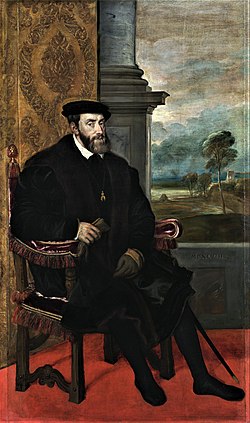
เนื่องจากพระเจ้าฟิลิปที่ 5 (ค.ศ. 1478–1506) สิ้นพระชนม์ก่อนพระบิดาคือพระเจ้าแม็กซิมิเลียน การสืราชสมบัติจึงตกเป็นของพระเจ้าชาร์ลส์ที่ 1 (ค.ศ. 1519–1521) พระโอรสของพระเจ้าฟิลิป ซึ่งต่อมาได้เป็นจักรพรรดิชาร์ลส์ที่ 5 เมื่อพระเจ้าแม็กซิมิเลียนสิ้นพระชนม์ในปี ค.ศ. 1519 พระองค์ทรงครองราชย์เป็นจักรพรรดิระหว่างปี ค.ศ. 1519 ถึง 1556 เมื่อพระสุขภาพไม่แข็งแรงจึงสละราชสมบัติ และสิ้นพระชนม์ในปี ค.ศ. 1558 แม้ว่าพระองค์จะได้รับการสวมมงกุฎโดยสมเด็จพระสันตะปาปาเคลเมนต์ที่ 7ที่เมืองโบโลญญาในปี ค.ศ. 1530 (พระเจ้าชาร์ลส์ได้ปล้นสะดมกรุงโรมในปี ค.ศ. 1527) แต่พระองค์ก็เป็นจักรพรรดิองค์สุดท้ายที่ได้รับการสวมมงกุฎโดยสมเด็จพระสันตะปาปา แม้ว่าในที่สุดพระองค์จะไม่บรรลุวิสัยทัศน์เรื่องระบอบกษัตริย์สากล แต่พระเจ้าชาร์ลส์ที่ 1 ก็ยังได้รับการยกย่องว่าเป็นผู้ทรงอำนาจที่สุดในบรรดาราชวงศ์ฮับส์บูร์กทั้งหมด อัครมหาเสนาบดีของเขา เมอร์คูริโน กัตตินารากล่าวในปี 1519 ว่าเขา "กำลังมุ่งสู่ระบอบกษัตริย์สากล ... รวมคริสตจักรทั้งหมดไว้ภายใต้คทาเดียว" [ 31 ]ซึ่งทำให้เขาเข้าใกล้กับวิสัยทัศน์ของเฟรเดอริกที่ 5 ในเรื่อง AEIOU มากขึ้น และคำขวัญของชาร์ลส์Plus ultra (ไกลออกไปอีก) บ่งชี้ว่านี่คือความทะเยอทะยานของเขา[ 32 ]
เมื่อได้รับมรดกจากบิดาในปี ค.ศ. 1506 พระองค์ก็ทรงเป็นผู้ปกครองที่มีอำนาจและมีอาณาเขตกว้างขวางอยู่แล้ว เมื่อแม็กซิมิเลียนสิ้นพระชนม์ อาณาเขตของพระองค์ก็ขยายใหญ่ขึ้น พระองค์ทรงเป็นผู้ปกครองราชวงศ์ชั้นนำ 3 ราชวงศ์ของยุโรป ได้แก่ราชวงศ์ฮับส์บูร์กแห่งราชวงศ์ฮับส์บูร์ก ราชวงศ์วาโลอิส-เบอร์กันดีแห่งเนเธอร์แลนด์เบอร์กันดีและราชวงศ์ทราสตามาราแห่งราชบัลลังก์ กั สตี ล และอารากอนทำให้พระองค์ทรงเป็นผู้ปกครองดินแดนกว้างใหญ่ในยุโรปกลาง ยุโรปตะวันตก และยุโรปใต้ รวมถึงอาณานิคมของสเปนในทวีปอเมริกาและเอเชีย ในฐานะกษัตริย์องค์แรกที่ปกครองกัสตีลเลออนและอารากอนพร้อมกันด้วยพระองค์เอง พระองค์จึงทรงเป็นกษัตริย์องค์แรกของสเปน[ 33 ]จักรวรรดิของพระองค์ครอบคลุมพื้นที่เกือบ 4 ล้านตารางกิโลเมตรทั่วทั้งยุโรป ตะวันออกไกล และทวีปอเมริกา[ 34 ]
ชาร์ลส์ต้องเผชิญกับความท้าทายหลายประการ ซึ่งจะส่งผลต่อประวัติศาสตร์ของออสเตรียไปอีกนาน ความท้าทายเหล่านั้นได้แก่ ฝรั่งเศส การปรากฏตัวของจักรวรรดิออตโตมันทางทิศตะวันออก และมาร์ติน ลูเทอร์ (ดูด้านล่าง)
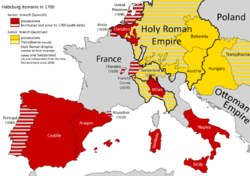
ตามธรรมเนียมราชวงศ์ ดินแดนที่สืบทอดทางสายเลือดของราชวงศ์ฮับส์บูร์กถูกแยกออกจากจักรวรรดิอันกว้างใหญ่ไพศาลนี้ในการประชุมสภาเวิร์มส์ในปี 1521 เมื่อพระเจ้าชาร์ลส์ที่ 1 ทรงมอบดินแดนเหล่านั้นให้แก่พระอนุชาคือพระเจ้าเฟอร์ดินานด์ที่ 1 (1521–1564) แม้ว่าพระองค์จะยังคงขยายดินแดนให้กับราชวงศ์ฮับส์บูร์กต่อไปก็ตาม เนื่องจากพระเจ้าชาร์ลส์ทรงมอบจักรวรรดิสเปนให้แก่พระโอรสคือพระเจ้าฟิลิปที่ 2 แห่งสเปนดินแดนของสเปนจึงแยกตัวออกจากดินแดนทางเหนือของราชวงศ์ฮับส์บูร์กอย่างถาวร แม้ว่าจะยังคงเป็นพันธมิตรกันมาหลายศตวรรษก็ตาม
เมื่อเฟอร์ดินานด์สืบทอดตำแหน่งจักรพรรดิโรมันอันศักดิ์จากพระอนุชาในปี 1558 ราชวงศ์ฮับส์บูร์กก็ได้เปลี่ยนตำแหน่งที่มาจากการเลือกตั้งให้กลายเป็น ตำแหน่งที่สืบทอด ทางสายเลือดโดยพฤตินัย เฟอร์ดินานด์ยังคงสืบทอดประเพณีการอภิเษกสมรสของราชวงศ์โดยการอภิเษกแอนน์แห่งโบฮีเมียและฮังการีในปี 1521 ซึ่งเป็นการเพิ่มอาณาจักรทั้งสองนี้เข้ามาในอาณาเขตของราชวงศ์ฮับส์บูร์ก พร้อมกับดินแดนใกล้เคียงอย่างโมรา เวี ยไซลีเซียและลูซาเทียเหตุการณ์นี้เกิดขึ้นเมื่อหลุยส์ที่ 2 พระอนุชาของแอนน์ กษัตริย์แห่งฮังการีและโบฮีเมีย (และราชวงศ์ยาเกียลลอน ) สิ้นพระชนม์โดยไม่มีทายาทในยุทธการโมฮาชในปี 1526 ในการต่อสู้กับสุลต่านสุไลมานผู้ยิ่งใหญ่และพวกออตโตมัน อย่างไรก็ตาม ในปี 1538 ราชอาณาจักรฮังการีถูกแบ่งออกเป็นสามส่วน:
- ราชอาณาจักรฮังการี (ฮังการีในสมัยราชวงศ์) (ปัจจุบันคือแคว้นเบอร์เกนลันด์ บางส่วนของโครเอเชีย ส่วนใหญ่เป็นสโลวาเกีย และบางส่วนของฮังการีในปัจจุบัน) ยอมรับราชวงศ์ฮับส์บูร์กเป็นกษัตริย์
- ฮังการีในสมัยจักรวรรดิออตโตมัน (ศูนย์กลางของประเทศ)
- อาณาจักรฮังการีตะวันออกซึ่งต่อมากลายเป็นราชรัฐทรานซิลเวเนีย ปกครองโดยกษัตริย์ฝ่ายตรงข้ามกับราชวงศ์ฮับส์บูร์ก แต่ก็อยู่ภายใต้การคุ้มครองของจักรวรรดิออตโตมันด้วย
การเลือกตั้งเฟอร์ดินานด์ขึ้นเป็นจักรพรรดิในปี 1558 ทำให้ดินแดนออสเตรียรวมเป็นหนึ่งเดียวอีกครั้ง พระองค์ต้องเผชิญกับการกบฏในดินแดนของตนเอง ความวุ่นวายทางศาสนา การรุกรานของจักรวรรดิออตโตมัน และแม้กระทั่งการแย่งชิงบัลลังก์ฮังการีจากจอห์น ซิกิสมุนด์ ซาโปลยาดินแดนของพระองค์ไม่ได้ร่ำรวยที่สุดในบรรดาดินแดนของราชวงศ์ฮับส์บูร์ก แต่พระองค์ก็ประสบความสำเร็จในการฟื้นฟูความสงบเรียบร้อยภายในและป้องกันการรุกรานของชาวเติร์ก ในขณะเดียวกันก็ขยายพรมแดนและสร้างระบบบริหารส่วนกลาง
เมื่อเฟอร์ดินานด์เสียชีวิตในปี 1564 ดินแดนต่างๆ ก็ถูกแบ่งให้กับบุตรชายทั้งสามของเขาอีกครั้ง ซึ่งเป็นข้อกำหนดที่เขาได้ทำไว้ในปี 1554 [ 35 ]
ออสเตรียในยุคปฏิรูปศาสนาและยุคต่อต้านการปฏิรูปศาสนา (ค.ศ. 1517–1564)
มาร์ติน ลูเทอร์และการปฏิรูปศาสนาโปรเตสแตนต์ (ค.ศ. 1517–1545)
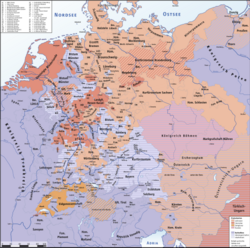
เมื่อมาร์ติน ลูเทอร์ ติดประกาศ ข้อเสนอ 95 ข้อของเขาไว้ที่ประตูโบสถ์ปราสาทในเมืองวิทเทนเบิร์กในปี 1517 เขาได้ท้าทายรากฐานของจักรวรรดิโรมันอันศักดิ์สิทธิ์ ศาสนาคริสต์นิกายคาทอลิก และอำนาจของราชวงศ์ฮับส์บูร์ก หลังจากที่จักรพรรดิชาร์ลส์ที่ 5สอบสวนและประณามลูเทอร์ใน การประชุมสภา แห่งเวิ ร์มส์ในปี 1521 ลัทธิ ลูเทอร์และการปฏิรูป ศาสนาโปรเตสแตนต์ ก็แพร่กระจายอย่างรวดเร็วในดินแดนของราชวงศ์ฮับส์บูร์ก หลังจากที่ได้รับการปลดปล่อยจากสงครามกับฝรั่งเศสชั่วคราวโดยสนธิสัญญาแคมเบร ในปี 1529 และการประณามการห้ามลูเทอร์โดยเจ้าชายโปรเตสแตนต์ที่สเปเยอร์ในปีนั้น จักรพรรดิได้หยิบยกประเด็นนี้ขึ้นมาอีกครั้งในการประชุมสภาแห่งเอาส์บูร์กในปี 1530 ซึ่งในเวลานั้นลัทธิลูเทอร์ได้แพร่หลายอย่างกว้างขวางแล้ว
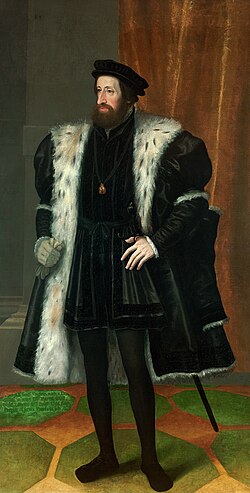
ด้วยภัยคุกคามจากจักรวรรดิออตโตมันที่เพิ่มมากขึ้น (ดูด้านล่าง) พระองค์จึงจำเป็นต้องแน่ใจว่าพระองค์จะไม่เผชิญกับความแตกแยกครั้งใหญ่ภายในศาสนาคริสต์ พระองค์จึงปฏิเสธจุดยืนของลูเทอร์ ( คำสารภาพแห่งเอาส์บูร์ก ) ด้วยเอกสารConfutatio Augustanaและทรงเลือกตั้งเฟอร์ดินานด์ เป็น กษัตริย์แห่งโรมันในวันที่ 5 มกราคม ค.ศ. 1531 เพื่อรับรองการสืราชสมบัติในฐานะกษัตริย์คาทอลิก ในการตอบโต้ เจ้าชายและขุนนางโปรเตสแตนต์ได้ก่อตั้งสันนิบาตชมาลคาลด์ในเดือนกุมภาพันธ์ ค.ศ. 1531 โดยได้รับการสนับสนุนจากฝรั่งเศส การรุกคืบของตุรกีเพิ่มเติมในปี ค.ศ. 1532 (ซึ่งทำให้พระองค์ต้องขอความช่วยเหลือจากโปรเตสแตนต์) และสงครามอื่นๆ ทำให้จักรพรรดิไม่สามารถดำเนินการใดๆ เพิ่มเติมในด้านนี้ได้จนกระทั่งปี ค.ศ. 1547 เมื่อกองทัพจักรวรรดิเอาชนะสันนิบาตชมาลคาลด์ในการรบที่มือห์ลเบิร์กทำให้พระองค์สามารถบังคับใช้ศาสนาคาทอลิกได้อีกครั้ง
ในปี ค.ศ. 1541 เฟอร์ดินานด์ได้ขอความช่วยเหลือจากสภาฐานันดรเพื่อต่อต้านชาวเติร์ก แต่ได้รับการตอบสนองด้วยการเรียกร้องให้มีการยอมรับความแตกต่างทางศาสนา ชัยชนะในปี ค.ศ. 1547 กลับกลายเป็นชัยชนะที่อยู่ได้ไม่นาน เพราะกองกำลังฝรั่งเศสและโปรเตสแตนต์ได้ท้าทายจักรพรรดิอีกครั้งในปี ค.ศ. 1552 และจบลงด้วยสนธิสัญญาแห่งเอาส์บวร์กในปี ค.ศ. 1555 ด้วยความอ่อนล้า ชาร์ลส์จึงเริ่มถอนตัวจากวงการการเมืองและมอบอำนาจให้ผู้อื่น โปรเตสแตนต์ได้พิสูจน์แล้วว่าหยั่งรากลึกเกินกว่าจะถอนรากถอนโคนได้
ออสเตรียและมณฑลอื่นๆ ที่สืบทอดทางสายเลือดของราชวงศ์ฮับส์บูร์ก (รวมถึงฮังการีและโบฮีเมียด้วย) ได้รับผลกระทบอย่างมากจากการปฏิรูปศาสนา แต่ยกเว้นไทโรลแล้วดินแดนของออสเตรียส่วนใหญ่ปิดกั้นนิกายโปรเตสแตนต์ แม้ว่าผู้ปกครองราชวงศ์ฮับส์บูร์กเองจะยังคงนับถือนิกายคาทอลิก แต่มณฑลที่ไม่ใช่ของออสเตรียส่วนใหญ่เปลี่ยนไปนับถือนิกายลูเธอรานิสม์ ซึ่งเฟอร์ดินานด์ที่ 1 ทรงยอมรับได้เป็นส่วนใหญ่
การปฏิรูปศาสนาคาทอลิก (ค.ศ. 1545–1563)
การตอบสนองของคาทอลิกต่อการปฏิรูปโปรเตสแตนต์นั้นเป็นไปในเชิงอนุรักษ์นิยม แต่ก็ได้กล่าวถึงประเด็นที่ลูเทอร์ยกขึ้นมา ในปี ค.ศ. 1545 สภาเทรนต์ ที่ดำเนินมายาวนาน ได้เริ่มดำเนินการปฏิรูปและการปฏิรูปต่อต้านที่ชายแดนของอาณาจักรฮับส์บูร์ก สภาดังกล่าวได้ดำเนินต่อไปเป็นระยะๆ จนถึงปี ค.ศ. 1563 เฟอร์ดินานด์และราชวงศ์ฮับส์บูร์กแห่งออสเตรียมีความอดทนอดกลั้นมากกว่าพี่น้องชาวสเปน และกระบวนการที่เริ่มต้นที่เทรนต์อย่างไรก็ตาม ความพยายามในการปรองดองของเขาในสภาในปี ค.ศ. 1562 ถูกปฏิเสธ และถึงแม้ว่าจะมีปฏิบัติการต่อต้านของคาทอลิกในดินแดนของฮับส์บูร์กตั้งแต่ช่วงปี ค.ศ. 1550 แต่ก็อาศัยการโน้มน้าวใจ ซึ่งเป็นกระบวนการที่คณะเยสุอิตและปีเตอร์ คานิซิอุสเป็นผู้นำ เฟอร์ดินานด์เสียใจอย่างมากต่อความล้มเหลวในการปรองดองความแตกต่างทางศาสนาก่อนที่เขาจะเสียชีวิต (ค.ศ. 1564) [ 36 ]
การมาถึงของชาวออตโตมัน (ค.ศ. 1526–1562)
เมื่อพระเจ้าเฟอร์ดินานด์ที่ 1 ทรงอภิเษกสมรสกับราชวงศ์ฮังการีในปี 1521 ออสเตรียก็ได้เผชิญหน้ากับการขยายอำนาจไปทางตะวันตกของจักรวรรดิออตโตมันซึ่งเคยขัดแย้งกับฮังการีมาแล้วในช่วงทศวรรษ 1370 สงครามสิ้นสุดลงเมื่อพระเจ้าหลุยส์ พระอนุชา ของพระเจ้า เฟอร์ดินานด์ ที่ 1 สิ้นพระชนม์ในการต่อสู้กับกองทัพเติร์กภายใต้ การนำของสุลต่านสุไล มานผู้ยิ่งใหญ่ในยุทธการโมฮาช ในปี 1526 ทำให้รัชทายาทตกเป็นของพระเจ้าเฟอร์ดินานด์ที่ 1 พระนางแม รีพระมเหสีม่ายของพระเจ้าหลุยส์ทรงลี้ภัยไปขอความคุ้มครองจากพระเจ้าเฟอร์ดินานด์
หลังจากชัยชนะครั้งนี้ ชาวเติร์กได้ถอนกำลังออกไปในตอนแรก แต่กลับมาปรากฏตัวอีกครั้งในปี 1528 โดยรุกคืบเข้าสู่เวียนนาและปิดล้อมเมืองในปีถัดมา พวกเขาถอนกำลังออกไปในช่วงฤดูหนาวปีนั้นจนถึงปี 1532 เมื่อการรุกคืบของพวกเขาถูกหยุดยั้งโดยพระเจ้าชาร์ลส์ที่ 5แม้ว่าพวกเขาจะควบคุมดินแดนส่วนใหญ่ของฮังการีก็ตาม เฟอร์ดินานด์จึงถูกบังคับให้ยอมรับจอห์น ซาโปลยาเฟอร์ดินานด์และชาวเติร์กยังคงทำสงครามกันระหว่างปี 1537 จนถึงการสงบศึกชั่วคราวในปี 1547 เมื่อฮังการีถูกแบ่งแยก อย่างไรก็ตาม การสู้รบยังคงดำเนินต่อไปเกือบจะทันทีจนถึงสนธิสัญญาคอนสแตนติโนเปิลในปี 1562 ซึ่งยืนยันพรมแดนปี 1547 ภัยคุกคามจากจักรวรรดิออตโตมันยังคงดำเนินต่อไปอีก 200 ปี
การแบ่งดินแดนของราชวงศ์ฮับส์บูร์กใหม่ (ค.ศ. 1564–1620)
พระเจ้าเฟอร์ดินานด์ที่ 1มีพระโอรสสามพระองค์ที่ทรงเติบโตจนถึงวัยผู้ใหญ่ และพระองค์ทรงปฏิบัติตามธรรมเนียมของราชวงศ์ฮับส์บูร์กซึ่งอาจก่อให้เกิดหายนะได้ นั่นคือการแบ่งดินแดนของพระองค์ให้แก่พระโอรสทั้งสามเมื่อสิ้นพระชนม์ในปี 1564 การกระทำนี้ทำให้จักรวรรดิออสเตรียอ่อนแอลงอย่างมาก โดยเฉพาะอย่างยิ่งเมื่อเผชิญกับการขยายอำนาจของจักรวรรดิออตโตมัน ดินแดนจึงได้รวมกันอีกครั้งในรัชสมัยของพระเจ้าเฟอร์ดินานด์ที่ 3 (อาร์คดยุก 1590–1637) ในปี 1620 แม้จะเป็นเพียงช่วงสั้นๆ จนถึงปี 1623 และในที่สุดก็ต้องยกเลิกในปี 1665 ในรัชสมัยของพระเจ้าเลโอโปลด์ที่ 1 ดินแดนของออสเตรียจึงได้รวมกันอย่างถาวร
ในช่วง 60 ปีต่อมา ราชวงศ์ฮับส์บูร์กถูกแบ่งออกเป็นสามเขตอำนาจปกครอง:
- "ออสเตรียตอนล่าง" – ดัชชีโบฮีเมียของออสเตรีย ตกอยู่ภายใต้การปกครองของพระเจ้าชาร์ลส์ที่ 2 ในปี ค.ศ. 1619
- แม็กซิมิเลียนที่ 2 (ค.ศ. 1564–1576); รูดอล์ฟที่ 5 (ค.ศ. 1576–1608); มาเธียส (ค.ศ. 1608–1619)
- "อัปเปอร์ออสเตรีย" – ไทโรลและออสเตรียตอนเหนือตกอยู่ภายใต้การปกครองของราชวงศ์แม็กซิมิเลียนที่ 2 ในปี 1595 (อยู่ภายใต้การปกครองของแม็กซิมิเลียนที่ 3 ตั้งแต่ ปี 1595 ถึง 1618)
- เฟอร์ดินานด์ที่ 2 (ค.ศ. 1564–1595)
- "ออสเตรียตอนใน"
- ชาร์ลส์ที่ 2 (1564–1590); พระเจ้าเฟอร์ดินานด์ที่ 2 (1590–1637)
ในฐานะโอรสองค์โต แม็กซิมิเลียนที่ 2 และโอรสของพระองค์ได้รับดินแดน "หลัก" ของออสเตรียตอนล่างและออสเตรียตอนบน เมื่อเฟอร์ดินานด์ที่ 2 สิ้นพระชนม์โดยไม่มีทายาทสืบสกุล ดินแดนของพระองค์จึงกลับคืนสู่ดินแดนหลักเมื่อพระองค์สิ้นพระชนม์ในปี 1595 จากนั้นจึงตกอยู่ภายใต้การ ปกครองของ รูดอล์ฟที่ 5 (1576–1608) โอรสของแม็กซิมิเลียนที่ 2
พระเจ้าแม็กซิมิเลียนที่ 2 ทรงมีพระโอรสสามพระองค์สืบราชบัลลังก์ต่อจากพระองค์ แต่ไม่มีพระโอรสองค์ใดสืบราชบัลลังก์ต่อจากพระองค์ ทำให้ราชวงศ์ฮับส์บูร์กสิ้นสุดลงในปี ค.ศ. 1619 เมื่อพระเจ้าอัลเบิร์ตที่ 7 สละราชสมบัติ (ค.ศ. 1619–1619) ดังนั้น พระเจ้าเฟอร์ดินานด์ที่ 3 พระโอรสของพระเจ้าชาร์ลส์ที่ 2 จึงได้สืบทอดดินแดนทั้งหมดของราชวงศ์ฮับส์บูร์ก แต่พระองค์ก็เสียโบฮีเมีย ไปในทันที เนื่องจากโบฮีเมียก่อกบฏในปี ค.ศ. 1619 และอยู่ภายใต้การปกครองของ พระเจ้าฟรีดริชที่ 1ชั่วคราว (ค.ศ. 1619–1620) ดังนั้น ดินแดนทั้งหมดจึงกลับมาอยู่ภายใต้การปกครองเดียวกันอีกครั้งในปี ค.ศ. 1620 เมื่อพระเจ้าเฟอร์ดินานด์ที่ 3 บุกโบฮีเมียและเอาชนะพระเจ้าฟรีดริชที่ 1 ได้
แม้ว่าในทางเทคนิคแล้วตำแหน่งจักรพรรดิโรมันอันศักดิ์สิทธิ์จะมาจากการเลือกตั้ง แต่ก็สืบทอดกันมาทางจักรพรรดิแม็กซิมิเลียนที่ 2 และพระโอรสทั้งสองพระองค์ (รูดอล์ฟที่ 5 และมาเธียส) ที่สืบทอดตำแหน่งต่อจากพระองค์ อัลเบิร์ตที่ 7 ดำรงตำแหน่งอาร์ชดยุคเพียงไม่กี่เดือนก่อนจะสละราชสมบัติให้แก่เฟอร์ดินานด์ที่ 3 ซึ่งต่อมาได้ขึ้นเป็นจักรพรรดิเช่นกัน
"ออสเตรียตอนล่าง"

รูดอล์ฟที่ 5 (อาร์คดยุก จักรพรรดิรูดอล์ฟที่ 2 ค.ศ. 1576–1612) พระโอรสองค์โตของแม็กซิมิเลียน ทรงย้ายเมืองหลวงจากเวียนนาไปยังปรากซึ่งปลอดภัยกว่า เนื่องจากภัยคุกคามจากจักรวรรดิออตโตมัน พระองค์ทรงได้รับการยกย่องว่าเป็นผู้อุปถัมภ์ศิลปะและวิทยาศาสตร์อย่างมาก แต่เป็นผู้ปกครองที่ไม่เก่งกาจนัก หนึ่งในมรดกของพระองค์คือมงกุฎจักรพรรดิแห่งราชวงศ์ฮับส์บูร์กพระองค์ทรงเลือกที่จะแบ่งความรับผิดชอบของพระองค์ให้กับพระอนุชาหลายพระองค์ (ซึ่งมีเพียงหกพระองค์เท่านั้นที่ทรงมีชีวิตอยู่จนถึงวัยผู้ใหญ่) ส่งผลให้มีนโยบายที่แตกต่างกันอย่างมากในแต่ละดินแดน หนึ่งในการมอบหมายอำนาจเหล่านั้นคือการแต่งตั้งมาเธียส พระอนุชาของพระองค์ เป็นผู้ว่าการออสเตรียในปี ค.ศ. 1593
เมื่อได้ดินแดน "อัปเปอร์ออสเตรีย" มาในปี 1595 อำนาจของพระองค์ก็เพิ่มขึ้นอย่างมาก เนื่องจากดินแดนออสเตรียตอนในที่เหลืออยู่นั้นอยู่ในมือของเฟอร์ดินานด์ที่ 3 ซึ่งขณะนั้นมีพระชนมายุเพียง 17 พ.ศ. อย่างไรก็ตาม พระองค์ได้มอบการปกครองให้แก่แม็กซิมิเลียนที่ 3พระอนุชาอีกพระองค์หนึ่ง ในปี 1593 พระองค์ได้ก่อสงครามครั้งใหม่กับพวกออตโตมัน ซึ่งได้กลับมาโจมตีอีกครั้งในปี 1568 ในสงครามที่เรียกว่าสงครามยาวนานหรือสงครามสิบห้าปี ระหว่างปี 1593 ถึง 1606 ด้วยความไม่ยอมประนีประนอม และมองเห็นโอกาสในการทำ สงครามครูเสดครั้งใหม่ผลลัพธ์จึงเลวร้ายอย่างยิ่ง ชาวฮังการีที่อ่อนล้าได้ก่อการจลาจลในปี 1604 ปัญหาของฮังการีทวีความรุนแรงขึ้นไปอีกจากการพยายามที่จะบังคับใช้การปฏิรูปศาสนาในที่นั่น ผลที่ตามมาคือ เขาได้มอบฮังการีให้กับมาเธียส ซึ่งได้ทำสนธิสัญญาเวียนนากับชาวฮังการี และสนธิสัญญาซิทวาทอรกกับชาวเติร์กในปี ค.ศ. 1606 ส่งผลให้ทรานซิลวาเนียกลายเป็นรัฐอิสระและนับถือศาสนาโปรเตสแตนต์[ 37 ]
เหตุการณ์เหล่านี้ทำให้เกิดความขัดแย้งระหว่างพี่น้อง[ 38 ]เมลคิออร์ เคลสล์วางแผนสมคบคิดกับอาร์ชดยุคเพื่อให้แน่ใจว่ามาเธียสจะขึ้นครองราชย์ ในปี 1608 รูดอล์ฟได้ยกดินแดนส่วนใหญ่ของเขาให้กับมาเธียส ความขัดแย้งเพิ่มเติมทำให้มาเธียสจับกุมน้องชายของเขาในปี 1611 ซึ่งตอนนี้ได้สละอำนาจทั้งหมด ยกเว้นตำแหน่งจักรพรรดิที่ว่างเปล่า เสียชีวิตในปีถัดมาและมาเธียสได้ขึ้นครองราชย์ต่อ
ดังนั้น มาเธียสจึงสืบทอดตำแหน่งอาร์ชดัชชีในปี 1608 และขึ้นเป็นจักรพรรดิในปี 1612 จนกระทั่งสิ้นพระชนม์ในปี 1619 รัชสมัยของพระองค์เต็มไปด้วยความขัดแย้งกับพระอนุชาแม็กซิมิเลียนที่ 3ซึ่งเป็นคาทอลิกที่ดื้อรั้นกว่า และสนับสนุนเฟอร์ดินานด์ที่ 2 แห่ง "ออสเตรียใน" ซึ่งมีความศรัทธาอย่างแรงกล้าเช่นกัน ให้เป็นผู้สืบทอดตำแหน่ง โดยมาเธียสเคยดำรงตำแหน่งผู้สำเร็จราชการแทนระหว่างปี 1593 ถึง 1595 ก่อนที่จะเข้าปกครอง "ออสเตรียบน" ความขัดแย้งเหล่านี้ทำให้ราชวงศ์ฮับส์บูร์กอ่อนแอลงเมื่อเทียบกับทั้งขุนนางและผลประโยชน์ของโปรเตสแตนต์ มาเธียสย้ายเมืองหลวงกลับไปยังเวียนนาจากปราก และซื้อสันติภาพเพิ่มเติมจากตุรกีด้วยสนธิสัญญาในปี 1615 ในขณะเดียวกัน ความศรัทธาทางศาสนาในจักรวรรดิก็เพิ่มสูงขึ้น และแม้แต่เคลส์ล ซึ่งดำรงตำแหน่งเป็นบิชอปแห่งเวียนนา (1614) และพระคาร์ดินัล (1615) ก็ยังถูกมองว่าอ่อนโยนเกินไปโดยกลุ่มคาทอลิกหัวรุนแรง รวมถึงเฟอร์ดินานด์ที่ 2 ด้วย บรรยากาศแห่งสงครามกำลังคุกคาม และการโจมตีเจ้าหน้าที่สองคนในกรุงปรากเมื่อวันที่ 23 พฤษภาคม ค.ศ. 1618 ( การโยนคนออกจากหน้าต่างในปราก ) เป็นจุดเริ่มต้นของสงครามเต็มรูปแบบ มาเธียส เช่นเดียวกับรูดอล์ฟผู้เป็นพี่ชาย ถูกเฟอร์ดินานด์ผู้ซึ่งจับกุมเคลสล์ไปคุมขัง ยิ่งโดดเดี่ยวมากขึ้นเรื่อย ๆ
พระอนุชาองค์ถัดไปที่อยู่ในลำดับการสืราชบัลลังก์ในปี ค.ศ. 1619 คือ อัลเบิร์ตที่ 7 แต่พระองค์ถูกโน้มน้าวให้สละราชสมบัติและยกให้เฟอร์ดินานด์ที่ 2 ขึ้นครองราชย์แทนภายในเวลาไม่กี่เดือน
การปฏิรูปศาสนาและการต่อต้านการปฏิรูปศาสนา
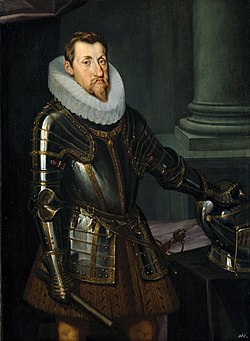
ศาสนามีบทบาทสำคัญในทางการเมืองในยุคนี้ และแม้แต่ความอดทนก็ยังมีข้อจำกัดเมื่อเผชิญกับความต้องการที่ไม่สอดคล้องกันของทั้งสองฝ่าย ในฐานะอาร์ชดยุคที่ใกล้ชิดกับภัยคุกคามจากตุรกีมากที่สุด แม็กซิมิเลียนที่ 2 จึงดำเนินนโยบายความอดทนและการปรองดองของบิดาต่อไป โดยให้การรับรอง (การทำให้ศาสนาโปรเตสแตนต์ถูกกฎหมายสำหรับขุนนาง) ในปี 1571 เช่นเดียวกับชาร์ลส์ที่ 2 ที่ให้การรับรองศาสนาในปี 1572 ในขณะที่ในไทโรลที่อยู่ห่างไกล เฟอร์ดินานด์ที่ 2 สามารถดำเนินนโยบายที่ก้าวร้าวได้มากกว่า นโยบายของแม็กซิมิเลียนที่ 2 ได้รับการสานต่อโดยโอรสของเขา รูดอล์ฟที่ 5 และมาเธียส ความแข็งแกร่งของการปฏิรูปศาสนาในอัปเปอร์ออสเตรียถูกบั่นทอนลงด้วยความแตกแยกภายใน ในขณะที่ในโลเวอร์ออสเตรียเมลคิออร์ คเลสล์นำการตอบโต้คาทอลิกอย่างแข็งขัน ขับไล่นักเทศน์โปรเตสแตนต์และส่งเสริมการเปลี่ยนศาสนา[ 39 ]การผ่อนปรนเพิ่มเติมโดยชาร์ลส์ที่ 2 ในปี 1578 การรับรองศาสนา บรูคเกอร์ (Brucker Pazifikation ) พบกับการต่อต้านมากขึ้น[ 37 ]
การฟื้นฟูศาสนาคาทอลิกเริ่มต้นอย่างจริงจังในปี 1595 เมื่อเฟอร์ดินานด์ที่ 2ซึ่งได้รับการศึกษาจากคณะเยสุอิต บรรลุนิติภาวะ พระองค์ทรงสืบทอดราชบัลลังก์ต่อจากพระบิดา ชาร์ลส์ที่ 2 ในออสเตรียตอนในในปี 1590 และทรงกระตือรือร้นในการปราบปรามลัทธินอกรีตในจังหวัดที่พระองค์ทรงปกครอง คณะกรรมการปฏิรูปศาสนาได้ริเริ่มกระบวนการบังคับให้กลับมานับถือศาสนาคาทอลิกอีกครั้ง และภายในปี 1600 ก็ได้บังคับใช้กับเมืองกราซและคลาเกนฟูร์ท [ 37 ] [ 40 ] แตกต่างจากผู้ปกครองออสเตรียก่อนหน้านี้ เฟอร์ดินานด์ที่ 2 ไม่ได้กังวลเกี่ยวกับผลกระทบของความขัดแย้งทางศาสนาต่อความสามารถในการต้านทานพวกออตโตมัน การปฏิรูปศาสนาคาทอลิกยังคงดำเนินต่อไปจนถึงสิ้นสุดสงครามสามสิบปีในปี 1648
ออสเตรียและสงครามสามสิบปี (ค.ศ. 1618–1648)
เฟอร์ดินานด์ที่ 2 (ค.ศ. 1619–1637) และอิทธิพลที่มากเกินไปของราชวงศ์ฮับส์บูร์ก
เมื่อ เฟอร์ดินานด์ที่ 2 (ค.ศ. 1619–1637) ผู้เคร่งศาสนาและไม่ยอมอ่อนข้อ ได้รับเลือกเป็นจักรพรรดิ (ในนามเฟอร์ดินานด์ที่ 2) ในปี ค.ศ. 1619 เพื่อสืบทอดตำแหน่งต่อจากมาเธียส ลูกพี่ลูกน้องของเขา เขาได้เริ่มดำเนินการอย่างแข็งขันเพื่อนำศาสนาคาทอลิกกลับมาใช้ใหม่ ไม่เพียงแต่ในมณฑลที่สืบทอดทางสายเลือดเท่านั้น แต่ยังรวมถึงโบฮีเมียและฮังการีของราชวงศ์ฮับส์บูร์ก ตลอดจนยุโรปส่วนใหญ่ที่เป็นโปรเตสแตนต์ภายในจักรวรรดิโรมันอันศักดิ์สิทธิ์ด้วย
นอกดินแดนของพระองค์ ชื่อเสียงของเฟอร์ดินานด์ที่ 2 ในเรื่องความดื้อรั้นและไม่ยอมประนีประนอมได้ก่อให้เกิดสงครามศาสนาสามสิบปีในเดือนพฤษภาคม ค.ศ. 1618 ในระยะแรกที่แบ่งขั้ว ซึ่งรู้จักกันในชื่อการกบฏในโบฮีเมีย เมื่อการกบฏในโบฮีเมียถูกปราบปรามลงในปี ค.ศ. 1620 พระองค์จึงเริ่มดำเนินการอย่างจริงจังเพื่อกำจัดลัทธิโปรเตสแตนต์ในโบฮีเมียและออสเตรีย ซึ่งประสบความสำเร็จอย่างมาก เช่นเดียวกับความพยายามของพระองค์ในการลดอำนาจของสภาไดเอท การปราบปรามทางศาสนาของการปฏิรูปศาสนาคาทอลิกถึงจุดสูงสุดในปี ค.ศ. 1627 ด้วยพระราชบัญญัติประจำจังหวัด[ 41 ]
หลังจากประสบความพ่ายแพ้ในช่วงแรกหลายครั้ง พระเจ้าเฟอร์ดินานด์ที่ 2 ก็ทรงยอมอ่อนข้อมากขึ้น แต่เมื่อฝ่ายคาทอลิกพลิกสถานการณ์และเริ่มประสบความสำเร็จในการรบอย่างต่อเนื่อง พระองค์จึงทรงออกพระราชกฤษฎีกาการฟื้นฟูในปี 1629 เพื่อพยายามฟื้นฟูสถานะเดิมของปี 1555 ( สนธิสัญญาแห่งเอาส์บวร์ก ) ซึ่งทำให้การเจรจาเพื่อการยุติข้อพิพาทมีความซับซ้อนมากขึ้นและยืดเยื้อสงครามออกไปอีก ด้วยความฮึกเหิมจากความสำเร็จในช่วงกลางสงคราม เฟอร์ดินานด์ที่ 2 จึงยิ่งใช้อำนาจมากขึ้น ส่งผลให้กองทัพของพระองค์ก่อเรื่องอื้อฉาว เช่น ลอตเตอรีแฟรงเกนบูร์ก ( Frankenburger Würfelspiel ) (1625) การปราบปรามการกบฏของชาวนาในปี 1626 และการปล้นสะดมเมืองมักเดบูร์ก (1631) [ 42 ]แม้ว่าจะได้ลงนามใน สนธิสัญญา สันติภาพปราก (1635)กับแซกโซนีและด้วยเหตุนี้จึงเกิดสงครามภายในหรือสงครามกลางเมืองกับโปรเตสแตนต์ สงครามก็ยังคงยืดเยื้อต่อไปเนื่องจากการแทรกแซงของรัฐต่างชาติหลายแห่ง
พระเจ้าเฟอร์ดินานด์ที่ 3 และกระบวนการสันติภาพ (ค.ศ. 1637–1648)
เมื่อถึงเวลาที่เฟอร์ดินานด์ที่ 2 สิ้นพระชนม์ในปี 1637 สงครามกำลังดำเนินไปอย่างเลวร้ายสำหรับราชวงศ์ฮับส์บูร์ก และพระโอรสของพระองค์เฟอร์ดินานด์ที่ 3 (1637–1657) ซึ่งเป็นหนึ่งในผู้บัญชาการทหารของพระองค์ ต้องเผชิญกับภารกิจในการกอบกู้ผลที่ตามมาจากการสุดโต่งของพระบิดา เฟอร์ดินานด์ที่ 3 มีความคิดที่เน้นสันติภาพมากกว่า และได้รับการพิจารณาว่าเป็นผู้นำของฝ่ายสนับสนุนสันติภาพในราชสำนัก และได้ช่วยเจรจาสันติภาพแห่งปรากในปี 1635 อย่างไรก็ตาม ด้วยความสูญเสียอย่างต่อเนื่องในสงคราม พระองค์จึงถูกบังคับให้ทำสนธิสัญญาสันติภาพแห่งเวสต์ฟาเลีย ในปี 1648 ซึ่ง เป็นการยุติสงคราม หนึ่งในพระราชดำรัสของพระองค์ในช่วงท้ายของสงครามคือการให้เอกราชแก่รัฐเยอรมันมากขึ้น ( ius belli ac pacis — สิทธิในยามสงครามและสันติภาพ) ซึ่งจะค่อยๆ เปลี่ยนดุลอำนาจระหว่างจักรพรรดิและรัฐต่างๆ ไปในทิศทางที่เอื้อประโยชน์ต่อรัฐมากขึ้น
การประเมิน
แม้ว่าสาเหตุที่แท้จริงของสงครามจะยังไม่ชัดเจน แต่สงครามครั้งนี้กลับกลายเป็นสงครามที่พลิกผันไปมา เนื่องจากความทะเยอทะยานเกินขอบเขตของราชวงศ์ฮับส์บูร์กทำให้สงครามลุกลามจากความขัดแย้งภายในประเทศไปสู่ประเทศส่วนใหญ่ในยุโรป และแม้ว่าในบางครั้งดูเหมือนจะช่วยให้ราชวงศ์ฮับส์บูร์กบรรลุเป้าหมายในการครอบงำทางการเมืองและควบคุมความเชื่อทางศาสนา แต่ในที่สุดแล้วเป้าหมายนั้นก็ไม่ประสบความสำเร็จ ยกเว้นในดินแดนส่วนกลางของตนเอง
การบังคับเปลี่ยนศาสนาหรือการขับไล่ที่เกิดขึ้นในช่วงสงครามสามสิบปีควบคู่ไปกับความสำเร็จโดยทั่วไปของฝ่ายโปรเตสแตนต์ในเวลาต่อมา ส่งผลเสียอย่างมากต่อการควบคุมจักรวรรดิโรมันอันศักดิ์สิทธิ์ของราชวงศ์ฮับส์บูร์ก แม้ว่าการสูญเสียดินแดนของราชวงศ์ฮับส์บูร์กจะค่อนข้างน้อย แต่จักรวรรดิก็เสื่อมถอยลงอย่างมาก อำนาจของผู้ปกครองลดลง และดุลอำนาจในยุโรปเปลี่ยนแปลงไป โดยมีศูนย์กลางใหม่ๆ เกิดขึ้นตามพรมแดนของจักรวรรดิ ชนชั้นต่างๆ จึงต้องทำหน้าที่คล้ายกับรัฐชาติมากขึ้น
แม้จะพลาดเป้าหมายในการสถาปนาระบอบกษัตริย์สากล แต่การรณรงค์ภายในดินแดนสืบทอดของราชวงศ์ฮับส์บูร์กก็ประสบความสำเร็จในระดับหนึ่งในการชำระล้างทางศาสนา แม้ว่าฮังการีจะไม่เคยกลับมานับถือศาสนาคาทอลิกอย่างสมบูรณ์ก็ตาม มีเพียงในออสเตรียตอนล่าง และเฉพาะในหมู่ขุนนางเท่านั้นที่ยอมรับศาสนาโปรเตสแตนต์ ผู้คนจำนวนมากอพยพหรือเปลี่ยนศาสนา ในขณะที่บางคนประนีประนอมโดยการแอบนับถือศาสนาโปรเตสแตนต์ ส่งผลให้เกิดความสอดคล้องในระดับหนึ่ง การปราบปรามการกบฏของโบฮีเมียยังทำลายวัฒนธรรมเช็กและทำให้ภาษาเยอรมันกลายเป็นเครื่องมือของระบอบสมบูรณาญาสิทธิราชย์ของราชวงศ์ฮับส์บูร์ก กษัตริย์ออสเตรียจึงมีอำนาจควบคุมภายในฐานอำนาจสืบทอดมากขึ้น การควบคุมของระบอบสมบูรณาญาสิทธิราชย์กระชับแน่นขึ้น และอำนาจของขุนนางลดลง ในทางกลับกัน ออสเตรียประสบปัญหาด้านประชากรและเศรษฐกิจ จึงทำให้ความเป็นรัฐ ชาติ อ่อนแอลง
ระบอบกษัตริย์ออสเตรียในยุคบาโรคได้ถือกำเนิดขึ้น แม้จะมีความขัดแย้งระหว่างความเป็นจริงภายนอกและความเชื่อภายใน แต่โลกภายนอกกลับมองว่าออสเตรียเป็นตัวอย่างของการบังคับให้ปฏิบัติตาม และการผนวกรวมศาสนากับรัฐเข้าด้วยกันอย่างสุดขั้ว
ผลกระทบจากสงคราม
ในแง่ของความสูญเสียทางมนุษย์สงครามสามสิบปีได้ก่อให้เกิดความปั่นป่วนทางเศรษฐกิจ สังคม และประชากรอย่างมาก อันเนื่องมาจากมาตรการที่เข้มงวดของพระเจ้าเฟอร์ดินานด์ที่ 2 ในการปราบปรามการปฏิรูปศาสนา และการจ้างทหารรับจ้างอย่างต่อเนื่อง ซึ่งส่งผลให้มีผู้เสียชีวิตและประชากรลดลงอย่างน่าเศร้าในทุกรัฐของเยอรมนีในช่วงสงครามที่บางประมาณการระบุว่าพลเรือนเสียชีวิตมากถึง 50% โดยรวม การศึกษาส่วนใหญ่ระบุสาเหตุการเสียชีวิตว่าเกิดจากความอดอยาก หรือเกิดจาก (ท้ายที่สุดเกิดจากการขาดแคลนอาหาร) การสูญเสียภูมิคุ้มกันต่อโรคระบาดที่แพร่ระบาดซ้ำแล้วซ้ำเล่าในหมู่ประชากรทั่วไปของยุโรปกลาง รัฐเยอรมันเป็นสนามรบและพื้นที่เตรียมการของกองทัพทหารรับจ้างที่ใหญ่ที่สุดในขณะนั้น และกองทัพเหล่านี้ได้ออกหาเสบียงในหลายจังหวัด ขโมยอาหารจากผู้คนที่ถูกบังคับให้ออกไปตามท้องถนนในฐานะผู้ลี้ภัย หรือยังคงอยู่ในพื้นที่ โดยไม่คำนึงถึงศาสนาและความจงรักภักดีของพวกเขา ทั้งชาวเมืองและชาวนาต่างถูกกองทัพทั้งสองฝ่ายทำลายล้างและทำร้ายซ้ำแล้วซ้ำเล่า ทำให้ประชากรที่ได้รับผลกระทบจากผู้ลี้ภัยจากสงครามหรือผู้ที่หนีจากการปราบปรามการปฏิรูปศาสนาคาทอลิกภายใต้การปกครองของเฟอร์ดินานด์มีทรัพยากรเหลือน้อย[ 43 ]
การสืบทอดราชวงศ์และการแบ่งแยกดินแดนใหม่
ดินแดนออสเตรียรวมเป็นหนึ่งเดียวในปี 1620 แต่เฟอร์ดินานด์ที่ 2 ได้แบ่งดินแดนเหล่านั้นใหม่ในปี 1623 ตามธรรมเนียมของราชวงศ์ฮับส์บูร์ก โดยแบ่ง "ออสเตรียตอนบน" (ออสเตรียตอนเหนือและทิโรล) ให้แก่เลโอโปลด์ที่ 5 (1623–1632) พระอนุชาของพระองค์ ซึ่งดำรงตำแหน่งผู้ว่าการอยู่ที่นั่นอยู่แล้ว ออสเตรียตอนบนจะอยู่ภายใต้ผู้สืบทอดของเลโอโปลด์จนถึงปี 1665 เมื่อกลับไปอยู่ภายใต้สายราชวงศ์อาวุโสภายใต้เลโอโปลด์ที่ 1 อีกครั้ง
เฟอร์ดิ นานด์ ชาร์ลส์ โอรสของพระเจ้าเลโอโปลด์ที่ 5 ขึ้นครองราชย์ต่อจากพระองค์ในออสเตรียตอนบนในปี 1632 อย่างไรก็ตาม ขณะนั้นพระองค์มีพระชนมายุเพียงสี่ขวบ ทำให้พระมารดาคือคลอเดีย เดอ เมดิชีเป็นผู้สำเร็จราชการแทนจนถึงปี 1646
การสถาปนาสถาบันพระมหากษัตริย์: การขึ้นสู่อำนาจของออสเตรีย (ค.ศ. 1648–1740)
แม้จะประสบกับความพ่ายแพ้ในช่วงสงครามสามสิบปี ออสเตรียก็สามารถฟื้นตัวทางเศรษฐกิจและประชากร และรวมอำนาจใหม่ซึ่งมักเรียกว่าบาโรกออสเตรีย[ 44 ]ในปี 1714 ออสเตรียได้กลายเป็นมหาอำนาจอีกครั้ง อย่างไรก็ตาม รากฐานของความชอบธรรมของราชวงศ์ฮับส์บูร์ก ซึ่งอาศัยความสอดคล้องทางศาสนาและการเมือง ทำให้มันล้าสมัย มากขึ้นเรื่อยๆ ในยุคแห่งการตรัสรู้ถึงกระนั้น ศิลปะและสถาปัตยกรรมแบบบาโรกก็เฟื่องฟูในออสเตรีย ในช่วงเวลาแห่งสันติสุขเฟอร์ดินานด์ที่ 3 (1637–1657) พิสูจน์ให้เห็นว่าเป็นผู้อุปถัมภ์ศิลปะที่ยิ่งใหญ่และเป็นนักดนตรีด้วย
เมื่อพระเจ้าเฟอร์ดินานด์สวรรคตในปี 1657 พระโอรสของพระองค์คือพระเจ้าเลโอโปลด์ที่ 1 (1657–1705) ขึ้นครองราชย์ต่อ โดยทรงครองราชย์ค่อนข้างยาวนาน ในขณะเดียวกัน ใน "ออสเตรียตอนบน" พระเจ้าเฟอร์ดินานด์ชาร์ลส์ (1632–1662) แม้จะเป็นผู้อุปถัมภ์ศิลปะ แต่ก็ทรงปกครองด้วยระบอบสมบูรณาญาสิทธิราชย์และฟุ่มเฟือย พระอนุชาของพระองค์คือพระเจ้าซิกิสมุนด์ฟรานซิส (1662–1665) ขึ้นครองราชย์ต่อจากพระองค์ในช่วงสั้นๆ ในปี 1662 แต่เนื่องจากสิ้นพระชนม์โดยไม่มีทายาทในปี 1665 ดินแดนของพระองค์จึงตกเป็นของพระเจ้าเลโอโปลด์ที่ 1 ดังนั้น ตั้งแต่ปี 1665 เป็นต้นมา ออสเตรียจึงรวมเป็นหนึ่งเดียวภายใต้ราชรัฐเดียวอีกครั้ง
เลโอโปลด์ที่ 1 (ค.ศ. 1657–1705): การรวมชาติและการปลดปล่อยจากจักรวรรดิออตโตมันในที่สุด
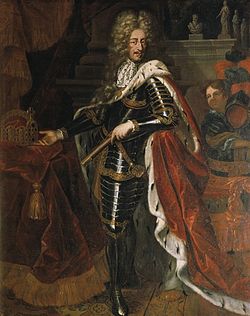
รัชสมัยของเลโอโปลด์ที่ 1 โดดเด่นด้วยการกลับมาของสงครามต่อเนื่อง แม้กระทั่งก่อนที่เขาจะสืบทอดตำแหน่งต่อจากพระบิดาในปี 1657 เขาก็เข้าไปเกี่ยวข้องกับสงครามเหนือครั้งที่สอง (1655–1660) ซึ่งเป็นผลสืบเนื่องมาจากการที่สวีเดนเข้าไปมีส่วนร่วมในสงครามสามสิบปี ซึ่งออสเตรียเข้าข้างโปแลนด์และเอาชนะ ทราน ซิล วาเนีย พันธมิตรของสวีเดนและดินแดนในอารักขาของจักรวรรดิออตโตมัน
เมื่อสงครามสิ้นสุดลงในปี 1660 จักรวรรดิออตโตมันก็เข้ายึดครองนาจีวารัดในทรานซิลวาเนีย ซึ่งถือเป็นจุดเริ่มต้นของการเสื่อมถอยของอาณาจักรนั้นและอิทธิพลของราชวงศ์ฮับส์บูร์กที่เพิ่มมากขึ้น ชาวทรานซิลวาเนียได้ร้องขอความช่วยเหลือจากเวียนนา แต่ก็ไร้ผล โดยไม่รู้ถึงข้อตกลงลับระหว่างออตโตมันและฮับส์บูร์ก
โชคดีสำหรับออสเตรียที่ตุรกีกำลังยุ่งอยู่กับสงครามอื่นในช่วงสงครามสามสิบปีซึ่งทำให้ออสเตรียเสี่ยงต่อการถูกโจมตีทางด้านตะวันออก จนกระทั่งปี 1663 ที่พวกเติร์กเริ่มแสดงเจตนาที่จะโจมตีออสเตรียอย่างจริงจัง ซึ่งนำไปสู่เหตุการณ์ที่เลวร้ายสำหรับกองทัพออตโตมัน โดยพ่ายแพ้ในยุทธการที่เซนต์ก็อตฮาร์ดในปีถัดมา
เงื่อนไขต่างๆ ที่กำหนดขึ้นเพื่อรับมือกับฝรั่งเศสทางตะวันตกนั้นเสียเปรียบอย่างมากจนทำให้ชาวฮังการีโกรธแค้นและก่อการจลาจล ที่แย่ไปกว่านั้น หลังจากประหารผู้นำแล้ว เลโอโปลด์ยังพยายามที่จะทำการปฏิรูปศาสนาเพื่อต่อต้าน ทำให้เกิดสงครามกลางเมืองทางศาสนาขึ้น แม้ว่าเขาจะยอมประนีประนอมบ้างในปี 1681 ก็ตาม ดังนั้นในช่วงต้นทศวรรษ 1680 เลโอโปลด์จึงเผชิญกับการจลาจลของชาวฮังการี ซึ่งได้รับการสนับสนุนจากพวกออตโตมันและได้รับการสนับสนุนจากฝรั่งเศสทางฝั่งตรงข้าม

ในขณะเดียวกัน ออสเตรียก็เข้าไปพัวพันกับสงครามฝรั่งเศส-ดัตช์ (ค.ศ. 1672–1678) ซึ่งจบลงด้วยสนธิสัญญาไนจ์เมเกนทำให้ฝรั่งเศสได้เปรียบอย่างมาก กิจกรรมของฝรั่งเศสซึ่งขณะนั้นเป็นมหาอำนาจสำคัญ ได้เบี่ยงเบนความสนใจของเลโอโปลด์จากการใช้ประโยชน์จากความได้เปรียบที่มีต่อพวกเติร์ก และความสัมพันธ์ระหว่างออสเตรียและออตโตมันอยู่ภายใต้สนธิสัญญาวาสวาร์ซึ่งจะช่วยบรรเทาความตึงเครียดได้ประมาณยี่สิบปี อย่างไรก็ตาม การกลับมารวมชาติทำให้ฝรั่งเศสวางตัวเป็นกลางซึ่งเป็นสิ่งที่จำเป็นอย่างยิ่ง ในขณะที่ออสเตรียยังคงเฝ้าระวังทางตะวันออก ต่อมาพวกออตโตมันได้เคลื่อนทัพเข้าโจมตีออสเตรียในปี ค.ศ. 1682 เพื่อตอบโต้การโจมตีของราชวงศ์ฮับส์บูร์ก โดยเข้ายึดกรุงเวียนนาได้ในปี ค.ศ. 1683 ซึ่งปรากฏว่ามีการป้องกันอย่างแน่นหนา และเริ่มทำการปิดล้อมเมือง ในที่สุดกองกำลังพันธมิตรก็พิสูจน์ได้ว่าเหนือกว่า และการยกเลิกการปิดล้อมตามมาด้วยชัยชนะหลายครั้งในปี 1686, 1687 และ 1697 ส่งผลให้เกิดสนธิสัญญาคาร์โลวิตซ์ (1699) โดยเบลเกรด ตกอยู่ภายใต้การยึดครองในปี 1688 (แต่ถูกยึดคืนในปี 1690) สิ่งนี้ทำให้เกิดอำนาจครอบงำของออสเตรียเหนือยุโรปกลางตอนใต้ และนำ ชาวเซิร์บจำนวนมากเข้ามาในจักรวรรดิ ซึ่งจะมีอิทธิพลอย่างมากต่อนโยบายต่างๆ ในช่วงหลายศตวรรษต่อมา
เมื่อพรมแดนด้านตะวันออกได้รับการยึดครองอย่างมั่นคงแล้ว เวียนนาจึงสามารถเจริญรุ่งเรืองและขยายตัวออกไปนอกเหนือขอบเขตเดิมได้ ทางด้านตะวันออก เลโอโปลด์ได้เรียนรู้ว่ามาตรการที่รุนแรงนั้นไม่ได้ก่อให้เกิดประโยชน์อะไรมากนัก ซึ่งนโยบายนี้ทำให้เขาได้รับการยอมรับ และเขาก็ได้มอบสิทธิในการประชุมสภาฮังการีผ่านทางประกาศนียบัตรเลโอโปลด์ (Diploma Leopoldianum ) ในปี 1691 อย่างไรก็ตาม ในด้านการทหาร สิ่งนี้กลับทำให้ออสเตรียมีอิสระที่จะเข้าร่วมในสงครามในยุโรปตะวันตกมากขึ้น ออสเตรียเริ่มเข้าไปแข่งขันกับฝรั่งเศสในยุโรปตะวันตกมากขึ้น โดยได้ต่อสู้กับฝรั่งเศสในสงครามสันนิบาตแห่งเอาส์บวร์ก (1688–1697)
ในด้านกิจการภายในประเทศ รัชสมัยของเลโอโปลด์โดดเด่นด้วยการขับไล่ชาวยิวออกจากเวียนนาในปี 1670 โดยพื้นที่ดังกล่าวได้รับการเปลี่ยนชื่อเป็นเลโอโปลด์สตัด ท์ ขณะที่ในปี 1680 เลโอโปลด์ได้นำสิ่งที่เรียกว่าPragmatica มาใช้ ซึ่งเป็นการกำหนดความสัมพันธ์ระหว่างเจ้าของที่ดินและชาวนาขึ้นใหม่[ 45 ]
สงครามสืบราชบัลลังก์สเปน (ค.ศ. 1701–1714): โจเซฟที่ 1 และชาร์ลส์ที่ 3
สงครามที่ซับซ้อนที่สุดคือสงครามสืบราชบัลลังก์สเปน (ค.ศ. 1701–1714) ซึ่งฝรั่งเศสและออสเตรีย (รวมถึงพันธมิตรอย่างอังกฤษ ดัตช์ และคาตาลัน) ต่อสู้แย่งชิงมรดกดินแดนอันกว้างใหญ่ของราชวงศ์ฮับส์บูร์กแห่งสเปน สาเหตุที่เห็นได้ชัดคือพระเจ้าชาร์ลส์ที่ 3 แห่งออสเตรีย (ค.ศ. 1711–1740) ในอนาคต อ้างสิทธิ์ในราชบัลลังก์สเปนที่ว่างลงในปี ค.ศ. 1701 พระเจ้าเลโอโปลด์เข้าร่วมสงครามแต่ไม่ได้มีชีวิตอยู่จนเห็นผลลัพธ์ของสงคราม โดยพระเจ้าโจเซฟที่ 1 ขึ้นครองราชย์ ต่อในปี ค.ศ. 1705 รัชสมัยของพระเจ้าโจเซฟนั้นสั้น และสงครามสิ้นสุดลงในปี ค.ศ. 1714 ซึ่งในเวลานั้นพระเจ้าชาร์ลส์ที่ 3 พระอนุชาของพระองค์ ได้ขึ้นครองราชย์ต่อแล้ว
แม้ว่าฝรั่งเศสจะเข้าควบคุมสเปนและอาณานิคมของสเปนให้กับหลานชายของหลุยส์ที่ 14แต่ออสเตรียก็ได้รับผลประโยชน์อย่างมากในยุโรปตะวันตก รวมถึงอดีตเนเธอร์แลนด์ของสเปน (ปัจจุบันเรียกว่าเนเธอร์แลนด์ของออสเตรีย ซึ่งรวมถึงเบลเยียมส่วนใหญ่ในปัจจุบัน) ดัชชีแห่งมิลานในอิตาลีตอนเหนือ และเนเปิลส์และซาร์ดิเนียในอิตาลีตอนใต้ (ส่วนหลังถูกแลกเปลี่ยนกับซิซิลีในปี 1720) [ 46 ]เมื่อสงครามสิ้นสุดลงในปี 1714 ออสเตรียก็ได้รับตำแหน่งสำคัญในการเมืองอำนาจของยุโรป
เมื่อสงครามสิ้นสุดลง พันธมิตรของออสเตรียก็ละทิ้งเธอไปในแง่ของการทำสนธิสัญญากับฝรั่งเศส ในที่สุดชาร์ลส์ก็ลงนามในสนธิสัญญาราสตัดต์ในปี 1714 แม้ว่าราชวงศ์ฮับส์บูร์กอาจไม่ได้สิ่งที่ต้องการทั้งหมด แต่พวกเขาก็ได้รับผลประโยชน์อย่างมากจากทั้งสนธิสัญญาราสตัดต์และคาร์โลวิตซ์ และได้สถาปนาอำนาจของตนขึ้น ในช่วงเวลาที่เหลือของการครองราชย์ ออสเตรียได้สูญเสียผลประโยชน์ที่น่าประทับใจเหล่านี้ไปมากมาย ส่วนใหญ่เป็นเพราะความกังวลของชาร์ลส์เกี่ยวกับการล่มสลายของราชวงศ์ฮับส์บูร์กที่กำลังจะเกิดขึ้น
พระเจ้าชาร์ลส์ที่ 3: การสืราชบัลลังก์และพระราชทานอำนาจตามหลักปฏิบัติ (ค.ศ. 1713–1740)

เพราะบัดนี้ชาร์ลส์เองก็ประสบปัญหาเรื่องการสืทอดราชบัลลังก์ เนื่องจากเหลือธิดาเพียงสองคนเท่านั้น วิธีแก้ปัญหาของเขาคือการยกเลิกการสืทอดราชบัลลังก์โดยผู้ชายแต่เพียงผู้เดียว ด้วยพระราชบัญญัติว่าด้วยการปกครองแบบปฏิบัติ (Pragmatic Sanction ) ในปี 1713 ในปี 1703 พระบิดาของเขา เลโอโปลด์ที่ 6 ได้ทำข้อตกลงกับโอรสทั้งสองของพระองค์ ซึ่งอนุญาตให้มีการสืทอดราชบัลลังก์โดยผู้หญิงได้ แต่รายละเอียดไม่ชัดเจนและเปิดช่องให้เกิดความไม่แน่นอน พระราชบัญญัติว่าด้วยการปกครองแบบปฏิบัติได้เสริมความแข็งแกร่งให้กับข้อตกลงนี้ และยังได้กำหนดให้ดินแดนของราชวงศ์ฮับส์บูร์กไม่สามารถแยกออกจากกันได้อีกด้วย
นี่เป็นการวางรากฐานทางกฎหมายสำหรับการรวมกับฮังการีและเพื่อสร้างความชอบธรรมให้แก่ราชวงศ์ฮับส์บูร์ก ข้อตกลงนี้ได้รับการยืนยันโดยสนธิสัญญาออสเตรีย-ฮังการีในปี 1867และคงอยู่จนถึงปี 1918 จากนั้นเขาจำเป็นต้องเสริมสร้างความแข็งแกร่งให้กับข้อตกลงนี้โดยการเจรจากับรัฐรอบข้าง การเจรจาภายในประเทศพิสูจน์แล้วว่าค่อนข้างง่าย และข้อตกลงนี้ได้กลายเป็นกฎหมายในปี 1723
บัดนี้ชาร์ลส์ทรงเต็มใจที่จะเสนอผลประโยชน์ที่เป็นรูปธรรมในด้านดินแดนและอำนาจเพื่อแลกกับการยอมรับที่ไร้ค่าของชาติมหาอำนาจอื่น ๆ เกี่ยวกับการพระราชทานอำนาจที่ทำให้มาเรีย เทเรซาพระธิดาของพระองค์เป็นทายาท ความท้าทายอีกประการหนึ่งคือเรื่องการแต่งงานของทายาทผู้สืบราชบัลลังก์และผลกระทบต่อดุลอำนาจของยุโรป การเลือกฟรานซิส สตีเฟนแห่งลอร์เรนในปี 1736 นั้นไม่เป็นที่นิยมในหมู่ชาติมหาอำนาจอื่น ๆ โดยเฉพาะฝรั่งเศส
สงครามยังคงเป็นส่วนหนึ่งของชีวิตชาวยุโรปในช่วงต้นศตวรรษที่ 18 ออสเตรียมีส่วนร่วมในสงครามพันธมิตรสี่ฝ่ายและสนธิสัญญากรุงเฮก ในปี 1720 ที่เกิดขึ้นจากสงครามนี้ ทำให้ดินแดนของราชวงศ์ฮับส์บูร์กขยายอาณาเขตได้มากที่สุด สงครามกับฝรั่งเศสปะทุขึ้นอีกครั้งในปี 1733 ด้วยสงครามสืบราชบัลลังก์โปแลนด์ซึ่งการยุติสงครามในสนธิสัญญาเวียนนา ในปี 1738 ทำให้ออสเตรียต้องยกเนเปิลส์และซิซิลีให้แก่เจ้าชาย ดอนคาร์ลอสแห่งสเปนเพื่อแลกกับดัชชีปาร์มาขนาดเล็กและการที่สเปนและฝรั่งเศสยึดมั่นในสนธิสัญญาปฏิรูป ในช่วงปีหลังๆ ของรัชสมัยของชาร์ลส์ ยังมีสงครามกับชาวเติร์กอีกหลายครั้ง เริ่มต้นด้วยการปะทะที่ประสบความสำเร็จในปี 1716–1718 ซึ่งจบลงด้วยสนธิสัญญาปัสซาโรวิตซ์ สงครามใน ปี 1737–1739 ประสบความสำเร็จน้อยกว่า โดยส่งผลให้ออสเตรียสูญเสียเบลเกรดและดินแดนชายแดนอื่นๆ ตามสนธิสัญญาเบลเกรด [ 47 ]
ในด้านการเมืองและการทหาร ออสเตรียประสบความสำเร็จควบคู่ไปกับการขยายตัวทางเศรษฐกิจและการเพิ่มจำนวนประชากร เข้าสู่ยุคบาโรกตอนปลายด้วยการสร้างอาคารใหม่จำนวนมาก รวมถึงพระราชวังเบลเวเดเร (ค.ศ. 1712–1783) และ โบสถ์ คาร์ลสเคียร์เช (ค.ศ. 1716–1737) ซึ่งเป็นผลงานของสถาปนิกผู้ยิ่งใหญ่ในยุคนั้น เช่นฟิชเชอร์ฮิลเดบรันด์และปรานด์เทาเออร์อย่างไรก็ตาม ฐานะการเงินของราชวงศ์ฮับส์บูร์กนั้นเปราะบาง พวกเขาพึ่งพานายธนาคารชาวยิว เช่นซามูเอล ออปเพนไฮเมอร์ในการระดมทุนทำสงคราม และต่อมาก็ทำให้เขาล้มละลาย อย่างไรก็ตาม ระบบการเงินในออสเตรียยังคงล้าสมัยและไม่เพียงพอ เมื่อถึงเวลาที่ชาร์ลส์สิ้นพระชนม์ในปี ค.ศ. 1740 คลังหลวงก็แทบจะหมดสิ้นไปแล้ว
ความไม่ยอมรับความแตกต่างทางศาสนาในออสเตรีย ซึ่งครั้งหนึ่งเคยเป็นเรื่องปกติในแคว้นเออร์บลันด์และดินแดนคาทอลิกใกล้เคียง กลับกลายเป็นประเด็นที่ถูกตรวจสอบอย่างเข้มข้นมากขึ้นในปี 1731 เมื่อเจ้าชายอาร์คบิชอปแห่งซาลซ์บูร์กขับไล่ผู้ต้องสงสัยว่าเป็นโปรเตสแตนต์แอบแฝง 22,000 คนออกจากซาลซ์บูร์กและซาลซ์คัม เมอร์กุต ความไม่ยอมรับในลักษณะเดียวกันนี้เกิดขึ้นกับประชากรชาวยิวในโบฮีเมียและพื้นที่โดยรอบภายใต้การปกครองของฟามิเลียนเทนในปี 1726 และ 1727 สถานการณ์อาจเลวร้ายกว่านี้หากไม่มีการตระหนักถึงผลกระทบทางเศรษฐกิจและจำเป็นต้องปรับตัวให้เข้ากับ แนวคิดเหตุผล นิยมของยุโรปตะวันตก หนึ่งในนั้นคือลัทธิคาเมราลิสม์ซึ่งส่งเสริมการพึ่งพาตนเองทางเศรษฐกิจในรัฐชาติ ดังนั้นอุตสาหกรรมภายในประเทศ เช่น โรงงานผลิตผ้าขนสัตว์ลินเซอร์จึงถูกก่อตั้งและส่งเสริม แต่บ่อยครั้งที่แนวคิดดังกล่าวถูกกดขี่โดยกลุ่มผลประโยชน์ เช่น ขุนนางและศาสนจักร แนวคิดเหตุผลนิยมที่เน้นความเป็นธรรมชาติและความนิยมชมชอบนั้นเป็นสิ่งที่ตรงกันข้ามกับลัทธิชนชั้นสูงและอำนาจศักดิ์สิทธิ์ของราชวงศ์ฮับส์บูร์ก ในที่สุดอำนาจภายนอกก็บีบบังคับให้ออสเตรียยอมรับแนวคิดเหตุผลนิยม
เมื่อถึงเวลาที่พระเจ้าชาร์ลส์ที่ 3 สิ้นพระชนม์ในปี 1740 พระองค์ทรงได้รับการยอมรับจากมหาอำนาจส่วนใหญ่ในยุโรปเกี่ยวกับหลักการปฏิบัติ (Pragmatic Sanction) แล้ว คำถามที่เหลืออยู่คือ หลักการปฏิบัตินี้จะใช้ได้ผลจริงหรือไม่ในเกมอำนาจที่ซับซ้อนของราชวงศ์ต่างๆ ในยุโรป
มาเรีย เทเรซาและการปฏิรูป (ค.ศ. 1740–1780)
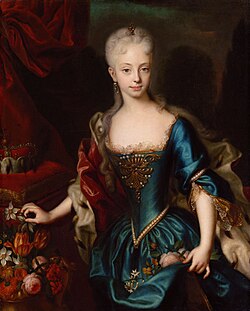
พระเจ้าชาร์ลส์ที่ 3 สิ้นพระชนม์เมื่อวันที่ 20 ตุลาคม ค.ศ. 1740 และพระธิดาของพระองค์คือมาเรีย เทเรซา ได้ขึ้นครองราชย์ต่อ อย่างไรก็ตาม พระองค์ไม่ได้ขึ้นเป็นจักรพรรดินีในทันที ตำแหน่งนั้นตกเป็นของพระเจ้าชาร์ลส์ที่ 7 (ค.ศ. 1742–1745) ซึ่งเป็นช่วงเวลาเดียวที่มงกุฎจักรพรรดิตกไปอยู่นอกราชวงศ์ฮับส์บูร์ก ตั้งแต่ปี ค.ศ. 1440 ถึง 1806 โดยพระเจ้าชาร์ลส์ที่ 7 เป็นหนึ่งในหลายพระองค์ที่ปฏิเสธพระราชบัญญัติปฏิรูปปี ค.ศ. 1713 ดังที่หลายคนคาดการณ์ไว้ การรับรองจากมหาอำนาจอื่นๆ เหล่านั้นกลับไม่มีค่าอะไรมากนักสำหรับมาเรีย เทเรซา
สงครามสืบราชบัลลังก์ออสเตรีย (ค.ศ. 1740–1748)
เมื่อวันที่ 16 ธันวาคม ค.ศ. 1740 กองทัพปรัสเซียภายใต้การนำของพระเจ้าฟรีดริชมหาราช ได้บุกเข้า ไซลีเซีย นี่เป็น สงครามไซลีเซียครั้งแรกจากทั้งหมดสามครั้งที่เกิดขึ้นระหว่างออสเตรียและปรัสเซียในช่วงเวลานี้ (ค.ศ. 1740–1742, ค.ศ. 1744–1745 และ ค.ศ. 1756–1763) ในไม่ช้า มหาอำนาจอื่นๆ ก็เริ่มใช้ประโยชน์จากความอ่อนแอของออสเตรีย พระเจ้าชาร์ลส์ที่ 7 ทรงอ้างสิทธิ์ในดินแดนมรดกและโบฮีเมีย และได้รับการสนับสนุนจากกษัตริย์แห่งฝรั่งเศส ซึ่งปรารถนาเนเธอร์แลนด์ของออสเตรีย ชาวสเปนและชาวซาร์ดิเนียหวังที่จะได้ดินแดนในอิตาลี และชาวแซกซอนหวังที่จะได้ดินแดนเพื่อเชื่อมต่อแซกโซนีกับราชอาณาจักรโปแลนด์ของเจ้าผู้ครองแคว้น ฝรั่งเศสถึงกับเตรียมการแบ่งแยกออสเตรีย[ 48 ]
Austria's allies, Britain, the Dutch Republic, and Russia, were all wary of getting involved in the conflict; ultimately, only Britain provided significant support. Thus began the War of the Austrian Succession (1740–1748), one of the more confusing and less eventful wars of European history, which ultimately saw Austria holding its own, despite the permanent loss of most of Silesia to the Prussians. That represented the loss of one of its richest and most industrialised provinces. For Austria the War of Succession was more a series of wars, the first concluding in 1742 with the Treaty of Breslau, the second (1744–1745) with the Treaty of Dresden. The overall war however continued until the Treaty of Aix-la-Chapelle (1748).
In 1745, following the reign of the BavarianElector as Emperor Charles VII, Maria Theresa's husband Francis of Lorraine, Grand Duke of Tuscany, was elected Emperor, restoring control of that position to the Habsburgs (or, rather, to the new composite house of Habsburg-Lorraine),[49] Francis holding the titular crown until his death in 1765, but his empress consort Maria Theresa carrying out the executive functions. The Pragmatic Sanction of 1713 applied to the hereditary possessions of the Habsburgs and Archduchy of Austria but not the position of Holy Roman Emperor, which could not be held by women, thus Maria Theresa was Empress Consort not Empress Regnant.
Seven Years' War and Third Silesian War (1756–1763)
For the eight years following the Treaty of Aix-la-Chapelle that ended the War of the Austrian Succession, Maria Theresa plotted revenge on the Prussians. The British and Dutch allies who had proved so reluctant to help her in her time of need were dropped in favour of the French in the so-called Reversal of Alliances of 1756, under the advice of Kaunitz, Austrian Chancellor (1753–1793). This resulted in the Treaty of Versailles of 1756. That same year, war once again erupted on the continent as Frederick, fearing encirclement, launched a pre-emptive invasion of Saxony and the defensive treaty became offensive. The ensuing Third Silesian War (1756–1763, part of the larger Seven Years' War) was indecisive, and its end saw Prussia holding onto Silesia, despite Russia, France, and Austria all combining against him, and with only Hanover as a significant ally on land.
The end of the war saw Austria, poorly prepared at its start, exhausted. Austria continued the alliance with France (cemented in 1770 with the marriage of Maria Theresa's daughter Archduchess Maria Antonia to the Dauphin), but also facing a dangerous situation in Central Europe, faced with the alliance of Frederick the Great of Prussia and Catherine the Great of Russia. The Russo-Turkish War of 1768–1774 caused a serious crisis in east-central Europe, with Prussia and Austria demanding compensation for Russia's gains in the Balkans, ultimately leading to the First Partition of Poland in 1772, in which Maria Theresa took Galicia from Austria's traditional ally.
War of Bavarian Succession (1778–1779)
Over the next several years, Austro-Russian relations began to improve. When the War of Bavarian Succession (1778–1779) erupted between Austria and Prussia following the extinction of the Bavarian line of the Wittelsbach dynasty, Russia refused to support Austria, its ally from the Seven Years' War, but offered to mediate and the war was ended, after almost no bloodshed, on 13 May 1779, when Russian and French mediators at the Congress of Teschen negotiated an end to the war. In the agreement Austria received the Innviertel from Bavaria, but for Austria it was a case of status quo ante bellum. This war was unusual for this era in that casualties from disease and starvation exceeded wounds, and is considered the last of the Cabinet wars in which diplomats played as large a part as troops, and as the roots of German Dualism (Austria–Prussia rivalry).
Reform

Although Maria Theresa and her consort were Baroque absolutist conservatives, this was tempered by a pragmatic sense and they implemented a number of overdue reforms. Thus these reforms were pragmatic responses to the challenges faced by archduchy and empire, not ideologically framed in the Age of Enlightenment as seen by her successor, Joseph II.[50]
The collision with other theories of nation states and modernity obliged Austria to perform a delicate balancing act between accepting changing economic and social circumstances while rejecting their accompanying political change. The relative failure to deal with modernity produced major changes in Habsburg power and Austrian culture and society. One of the first challenges that Maria Theresa and her advisers faced was to restore the legitimacy and authority of the dynasty, although was slowly replaced by a need to establish the needs of State.
Governance and finance
Maria Theresa promulgated financial and educational reforms, with the assistance of her advisers, notably Count Friedrich Wilhelm von Haugwitz and Gerard van Swieten. Many reforms were in the interests of efficiency. Her financial reforms considerably improved the state finances, and notably introduced taxation of the nobility for the first time, and achieved a balanced budget by 1775. At an administrative level, under Haugwitz she centralised administration, previously left to the nobility and church, along Prussian models with a permanent civil service. Haugwitz was appointed head of the new Directorium in publicis und cameralibus in 1749. By 1760 it was clear this was not solving Austria's problems and further reform was required. Kaunitz' proposal for a consultative body was accepted by Maria Theresa. This Council of State was to be based on the French Conseil d'État which believed that an absolutist monarch could still be guided by Enlightenment advisors. The council was inaugurated in January 1761, composed of Kaunitz the state chancellor, three members of the high nobility, including von Haugwitz as chair, and three knights, which served as a committee of experienced people who advised her. The council of state lacked executive or legislative authority. This marked Kaunitz' ascendency over von Haugwitz. The Directory was abolished and its functions absorbed into the new united Austrian and Bohemian chancelleries (Böhmisch-Österreichische Hofkanzlei) in 1761.[51]
Education
While Von Haugwitz modernised the army and government, van Swieten reformed health care and education. Educational reform included that of Vienna University by Swieten from 1749, the founding of the Theresianum (1746) as a civil service academy as well as military and foreign service academies. An Education Commission was established in 1760 with a specific interest in replacing Jesuitical control, but it was the papal dissolution of the order in 1773 that accomplished this. The confiscation of their property enabled the next step. Aware of the inadequacy of bureaucracy in Austria and, in order to improve it, Maria Theresa and what was now referred to as the Party of Enlightenment radically overhauled the schools system. In the new system, based on the Prussian one, all children of both genders from the ages of 6 to 12 had to attend school, while teacher training schools were established. Education reform was met with hostility from many villages and the nobility to whom children represented labour. Maria Theresa crushed the dissent by ordering the arrest of all those opposed. Although the idea had merit, the reforms were not as successful as they were expected to be; in some parts of Austria, half of the population was illiterate well into the 19th century. However widespread access to education, education in the vernacular language, replacement of rote learning and blind obedience with reasoning was to have a profound effect on the relationship between people and state.
Civil rights, industry and labour relations
Other reforms were in civil rights which were defied under the Codex Theresianus, begun in 1752 and finished in 1766. Specific measures included abolition of torture, and witch burning. Also in industrial and agrarian policy along cameralist lines, the theory was to maximise the resources of the land to protect the integrity of the state. Widespread problems arising from war, famine unrest and abuse made implementation of landlord-peasant reforms both reasonable and reasonable. Maria Theresa and her regime had sought a new more direct link with the populace, now that administration was no longer to be farmed out, and this maternalism combined with cameralist thinking required taking a closer interest in the welfare of the peasantry and their protection, which transpired in the 1750s. However these had been more noted than observed. In the 1770s more meaningful control of rents became practical, further eroding privilege.
While reforms assisted Austria in dealing with the almost constant wars, the wars themselves hindered the implementation of those reforms.
Religion
A pious Catholic, her reforms which affected the relation between state and church in favour of the former, did not extend to any relaxation of religious intolerance, but she preempted Pope Clement XIV's suppression of the Jesuits in 1773[52][53] by issuing a decree which removed them from all the institutions of the monarchy. There was both a suspicion of their excesses and of their tendency to political interference which brought them into conflict with the progressive secularisation of culture. Thus they were removed from control of censorship in 1751, and the educational reforms threatened their control over education. She was hostile to Jews and Protestants but eventually abandoned efforts for conversion, but continued her father's campaign to exile crypto-Protestants (mainly to Transylvania as in 1750). In 1744 she even ordered the expulsion of Jews, but relented under pressure by 1748. In her later years though she took some measures to protect the Jewish population.
Succession and co-regency
Maria Theresa had a large family, sixteen in all, of whom six were daughters that lived to adulthood. They were only too aware that their fate was to be used as political pawns. The best known of these was the tragic figure of Maria Antonia (1755–1793).
When Maria Theresa's consort Francis died in 1765, he was succeeded by his son Joseph II as emperor (1765–1790) because of male primogeniture. Joseph was also made co-ruler or co-regent with his mother. Joseph, 24 at the time, was more ideologically attuned to modernity and frequently disagreed with his mother on policy, and was often excluded from policy making. Maria Theresa always acted with a cautious respect for the conservatism of the political and social elites and the strength of local traditions. Her cautious approach repelled Joseph, who always sought the decisive, dramatic intervention to impose the one best solution, regardless of traditions or political opposition. Joseph and his mother's quarrels were usually mediated by Chancellor Wenzel Anton von Kaunitz who served for nearly 40 years as the principal minister to both Maria Theresa and Joseph.
Joseph frequently used his position as leverage, by threatening resignation. The one area he was allowed more say on was in foreign policy. In this, he showed similar traits to Austria's arch-enemy Frederick the Great of Prussia (1740–1786),[54] also his intellectual model. He was successful in siding with Kaunitz in Realpolitik, undertaking the first partition of Poland in 1772 over his mother's principled objections. However his enthusiasm for interfering in Bavarian politics by invoking his ties to his former brother in law, Maximilian III, ended Austria in the War of Bavarian Succession in 1778. Although largely shut out of domestic policy, he used his time to acquire knowledge of his lands and people, encouraged policies he was in accord with and made magnanimous gestures such as opening the Royal Parks of Prater and Augarten to the public in 1766 and 1775 (Alles für das Volk, nichts durch das Volk—Everything for the people, nothing by the people).
On her husband's death Maria Theresa was therefore no longer empress, the title of which fell to her daughter-in-law Maria Josepha of Bavaria until her death in 1767 when the title fell vacant. When Maria Theresa died in 1780 she was succeeded in all her titles by Joseph II.
The Habsburg-Lorraine Dynasty: Joseph II and Leopold VII (1780–1792)
Joseph II (1780–1790): Josephinism and enlightened despotism

As the first of the Habsburg-Lorraine (Habsburg-Lothringen) Dynasty Joseph II was the archetypical embodiment of The Enlightenment spirit of the 18th century reforming monarchs known as the "enlightened despots".[55] When his mother Maria Theresa died in 1780, Joseph became the absolute ruler over the most extensive realm of Central Europe. There was no parliament to deal with. Joseph was always positive that the rule of reason, as propounded in the Enlightenment, would produce the best possible results in the shortest time. He issued edicts—6,000 in all, plus 11,000 new laws designed to regulate and reorder every aspect of the empire. The spirit was benevolent and paternal. He intended to make his people happy, but strictly in accordance with his own criteria.[49]
Josephinism (or Josephism) as his policies were called, is notable for the very wide range of reforms designed to modernize the creaky empire in an era when France and Prussia were rapidly upgrading. Josephinism elicited grudging compliance at best, and more often vehement opposition from all sectors in every part of his empire. Failure characterized most of his projects. Joseph set about building a rational, centralized, and uniform government for his diverse lands, a pyramid with himself as supreme autocrat. He expected government servants to all be dedicated agents of Josephinism and selected them without favor for class or ethnic origins; promotion was solely by merit. To impose uniformity, he made German the compulsory language of official business throughout the Empire. The Hungarian assembly was stripped of its prerogatives, and not even called together.
As President of the Court Audit Office, Count Karl von Zinzendorf (1781–1792)[56] introduced Appalt, a uniform system of accounting for state revenues, expenditures, and debts of the territories of the Austrian crown. Austria was more successful than France in meeting regular expenditures and in gaining credit. However, the events of Joseph II's last years also suggest that the government was financially vulnerable to the European wars that ensued after 1792.[57] Joseph reformed the traditional legal system, abolished brutal punishments and the death penalty in most instances, and imposed the principle of complete equality of treatment for all offenders. He ended censorship of the press and theatre.
To equalize the incidence of taxation, Joseph ordered a fresh appraisal of the value of all properties in the empire; his goal was to impose a single and egalitarian tax on land. The goal was to modernize the relationship of dependence between the landowners and peasantry, relieve some of the tax burden on the peasantry, and increase state revenues. Joseph looked on the tax and land reforms as being interconnected and strove to implement them at the same time. The various commissions he established to formulate and carry out the reforms met resistance among the nobility, the peasantry, and some officials. Most of the reforms were abrogated shortly before or after Joseph's death in 1790; they were doomed to failure from the start because they tried to change too much in too short a time, and tried to radically alter the traditional customs and relationships that the villagers had long depended upon.
In the cities the new economic principles of the Enlightenment called for the destruction of the autonomous guilds, already weakened during the age of mercantilism. Joseph II's tax reforms and the institution of Katastralgemeinde (tax districts for the large estates) served this purpose, and new factory privileges ended guild rights while customs laws aimed at economic unity. The intellectual influence of the Physiocrats led to the inclusion of agriculture in these reforms.
Civil and criminal law
In 1781–82 he extended full legal freedom to serfs. Rentals paid by peasants were to be regulated by imperial (not local) officials and taxes were levied upon all income derived from land. The landlords saw a grave threat to their status and incomes, and eventually reversed the policy. In Hungary and Transylvania, the resistance of the landed nobility was so great that Joseph compromised with halfway measures—one of the few times he backed down. After the great peasant revolt of Horea, 1784–85, however, the emperor imposed his will by fiat. His Imperial Patent of 1785 abolished serfdom but did not give the peasants ownership of the land or freedom from dues owed to the landowning nobles. It did give them personal freedom. Emancipation of the Hungarian peasantry promoted the growth of a new class of taxable landholders, but it did not abolish the deep-seated ills of feudalism and the exploitation of the landless squatters.
Capital punishment was abolished in 1787, although restored in 1795. Legal reforms gained comprehensive "Austrian" form in the civil code (ABGB: Allgemeine Bürgerliche Gesetzbuch) of 1811 and have been seen as providing a foundation for subsequent reforms extending into the 20th century. The first part of the ABGB appeared in 1786, and the criminal code in 1787. These reforms incorporated the criminological writings of Cesare Beccaria, but also first time made all people equal in the eyes of the law.
Education and medicine
To produce a literate citizenry, elementary education was made compulsory for all boys and girls, and higher education on practical lines was offered for a select few. He created scholarships for talented poor students, and allowed the establishment of schools for Jews and other religious minorities. In 1784 he ordered that the country change its language of instruction from Latin to German, a highly controversial step in a multilingual empire.
By the 18th century, centralization was the trend in medicine because more and better educated doctors requesting improved facilities; cities lacked the budgets to fund local hospitals; and the monarchies wanted to end costly epidemics and quarantines. Joseph attempted to centralize medical care in Vienna through the construction of a single, large hospital, the famous Allgemeines Krankenhaus, which opened in 1784. Centralization worsened sanitation problems causing epidemics a 20% death rate in the new hospital, which undercut Joseph's plan, but the city became preeminent in the medical field in the next century.[58]
Religion
Joseph's Catholicism was that of Catholic Reform and his goals were to weaken the power of the Catholic Church and introduce a policy of religious toleration that was the most advanced of any state in Europe. In 1789 he issued a charter of religious toleration for the Jews of Galicia, a region with a large, Yiddish-speaking, traditional Jewish population. The charter abolished communal autonomy whereby the Jews controlled their internal affairs; it promoted "Germanization" and the wearing of non-Jewish clothing.
Probably the most unpopular of all his reforms was his attempted modernization of the highly traditional Roman Catholic Church. Calling himself the guardian of Catholicism, Joseph II struck vigorously at papal power. He tried to make the Catholic Church in his empire the tool of the state, independent of Rome. Clergymen were deprived of the tithe and ordered to study in seminaries under government supervision, while bishops had to take a formal oath of loyalty to the crown. He financed the large increase in bishoprics, parishes, and secular clergy by extensive sales of monastic lands. As a man of the Enlightenment he ridiculed the contemplative monastic orders, which he considered unproductive, as opposed to the service orders. Accordingly, he suppressed a `` of the monasteries (over 700 were closed) and reduced the number of monks and nuns from 65,000 to 27,000. Church courts were abolished and marriage was defined as a civil contract outside the jurisdiction of the Church. Joseph sharply cut the number of holy days and reduced ornamentation in churches. He greatly simplified the manner of celebration. Critics alleged that these reforms caused a crisis of faith, reduced piety and a decline in morality, had Protestant tendencies, promoted Enlightenment rationalism and a class of liberal bourgeois officials, and led to the emergence and persistence of anti-clericalism. Many traditional Catholics were energized in opposition to the emperor.
Foreign policy

The Habsburg Empire developed a policy of war and trade as well as intellectual influence across the borders. While opposing Prussia and Turkey, Austria was friendly to Russia, though tried to remove Romania from Russian influence.
In foreign policy, there was no Enlightenment, only hunger for more territory and a willingness to undertake unpopular wars to get the land. Joseph was a belligerent, expansionist leader, who dreamed of making his Empire the greatest of the European powers. Joseph's plan was to acquire Bavaria, if necessary in exchange for Belgium (the Austrian Netherlands). Thwarted by King Frederick II of Prussia in 1778 in the War of Bavarian Succession, he renewed his efforts again in 1785 but Prussian diplomacy proved more powerful. This failure caused Joseph to seek territorial expansion in the Balkans, where he became involved in an expensive and futile war with the Turks (1787–1791), which was the price to be paid for friendship with Russia.
The Balkan policy of both Maria Theresa and Joseph II reflected the Cameralism promoted by Prince Kaunitz, stressing consolidation of the border lands by reorganization and expansion of the military frontier. Transylvania had been incorporated into the frontier in 1761 and the frontier regiments became the backbone of the military order, with the regimental commander exercising military and civilian power. Populationistik was the prevailing theory of colonization, which measured prosperity in terms of labor. Joseph II also stressed economic development. Habsburg influence was an essential factor in Balkan development in the last half of the 18th century, especially for the Serbs and Croats.
Reaction
The nobility throughout his empire disliked Joseph's taxes, egalitarianism, despotism and puritanism. In Belgium and Hungary, his attempts to subordinate everything to his own personal rule in Vienna were not well received. Even commoners were affected by Joseph's reforms, such as a ban on baking gingerbread because Joseph thought it bad for the stomach, or a ban on corsets. Only a few weeks before Joseph's death, the director of the Imperial Police reported to him: "All classes, and even those who have the greatest respect for the sovereign, are discontented and indignant."[59]
In Lombardy (in northern Italy) the cautious reforms of Maria Theresa in Lombardy had enjoyed support from local reformers. Joseph II, however, by creating a powerful imperial officialdom directed from Vienna, undercut the dominant position of the Milanese principate and the traditions of jurisdiction and administration. In the place of provincial autonomy he established an unlimited centralism, which reduced Lombardy politically and economically to a fringe area of the Empire. As a reaction to these radical changes the middle class reformers shifted away from cooperation to strong resistance. From this basis appeared the beginnings of the later Lombard liberalism.
By 1788 Joseph's health but not his determination was failing. By 1789 rebellion had broken out in protest against his reforms in Belgium (Brabant Revolution) and Hungary, and his other dominions were restive under the burdens of his war with Turkey. His empire was threatened with dissolution, and he was forced to sacrifice some of his reform projects. The emperor died on 20 February 1790 at 48, mostly unsuccessful in his attempts to curtail feudal liberties.[60]
Behind his numerous reforms lay a comprehensive program influenced by the doctrines of enlightened absolutism, natural law, mercantilism, and physiocracy. With a goal of establishing a uniform legal framework to replace heterogeneous traditional structures, the reforms were guided at least implicitly by the principles of freedom and equality and were based on a conception of the state's central legislative authority. Joseph's accession marks a major break since the preceding reforms under Maria Theresa had not challenged these structures, but there was no similar break at the end of the Josephinian era. The reforms initiated by Joseph II had merit despite the way they were introduced. They were continued to varying degrees under his successors. They have been seen as providing a foundation for subsequent reforms extending into the 20th century.
Upon his death in 1790, Joseph was briefly succeeded by his younger brother Leopold VII.
Leopold II (1790–1792)

Joseph's death proved a boon for Austria, as he was succeeded by his younger brother, Leopold II, previously the more cautiously reforming Grand Duke of Tuscany. Leopold knew when to cut his losses, and soon cut deals with the revolting Netherlanders and Hungarians. He also managed to secure a peace with Turkey in 1791, and negotiated an alliance with Prussia, which had been allying with Poland to press for war on behalf of the Ottomans against Austria and Russia. While restoring relative calm to what had been a crisis situation on his accession in 1790, Austria was surrounded by potential threats. While many reforms were by necessity rescinded, other reforms were initiated including more freedom of the press and restriction on the powers of the police. He replaced his brother's police minister, Johann Anton von Pergen, with Joseph Sonnenfels an advocate of social welfare rather than control.
Leopold's reign also saw the acceleration of the French Revolution. Although Leopold was sympathetic to the revolutionaries, he was also the brother of the French queen. Furthermore, disputes involving the status of the rights of various imperial princes in Alsace, where the revolutionary French government was attempting to remove rights guaranteed by various peace treaties, involved Leopold as Emperor in conflicts with the French. The Declaration of Pillnitz, made in late 1791 jointly with the Prussian King Frederick William II and the Elector of Saxony, in which it was declared that the other princes of Europe took an interest in what was going on in France, was intended to be a statement in support of Louis XVI that would prevent the need from taking any kind of action. However, it instead inflamed the sentiments of the revolutionaries against the Emperor. Although Leopold did his best to avoid war with the French, he died in March 1792. The French declared war on his inexperienced eldest son Francis II a month later.
The Arts
Vienna and Austria dominated European music during the late 18th and early 19th centuries, typified by the First Viennese School. This was the era of Haydn, and Mozart's Vienna period extended from 1781 to 1791 during which he was court composer. Opera, particularly German opera was flourishing. Mozart wrote many German operas including the Magic Flute. Initially the pillars of the establishment—the monarchy, such as Joseph II and to a lesser extent his mother, the aristocracy and the religious establishment were the major patrons of the arts, until rising middle class aspirations incorporated music into the lives of the bourgeoisie. Meanwhile, the Baroque was evolving into the less grandiose form, the Rococo.
The virtual abolition of censorship under van Swieten also encouraged artistic expression and the themes of artistic work often reflected enlightenment thinking.
Francis II: French Revolution and wars (1792–1815)

Francis II (1792–1835) was only 24 when he succeeded his father Leopold VII in 1792, but was to reign for nearly half a century and a radical reorganisation of European politics. He inherited a vast bureaucracy created by his uncle whose legacy of reform and welfare was to last throughout the next two centuries. The image of the monarch had profoundly changed, as had the relationship between monarch and subject. His era was overshadowed by events in France, both in terms of the evolving Revolution and the onset of a new form of European warfare with mass citizen armies. Austria recoiled in horror at the execution of Francis' aunt Maria Antonia in 1793 (despite futile attempts at rescue and even negotiation for release), leading to a wave of repression to fend off such dangerous sentiments influencing Austrian politics. At the same time Europe was consumed by the French Revolutionary (1792–1802) and Napoleonic Wars (1803–1815). The French Revolution effectively ended Austria's experiment with modernity and reform from above, and marked a retreat to legitimacy.
Domestic policy
Francis started out cautiously. The bureaucracy was still Josephist and the legal reforms under the guidance of Sonnenfels resulting in the Criminal Code of 1803 and the Civil Code of 1811. On the other hand, he restored Pergen to his position of Chief of Police. The discovery of a Jacobin plot in 1794 was a catalyst to the onset of repression. The leaders were executed or imprisoned, but there was little evidence of a tangible threat to the Habsburgs. Suppression of dissent with the Recensorship Commission of 1803 created a void in cultural and intellectual life, yet some of the world's greatest music comes from this time (see below). There were still elements of Josephism abroad, and Stadion, the foreign minister with his propagandist Friedrich von Gentz was able to appeal to popular nationalism to defeat Napoleon.
What exactly such nationalism actually represented is difficult to precisely identify—certainly it was directed to German culture within the Habsburg lands, but it is not clear to what degree it differentiated between 'Austrian' and 'German'. Certainly many of those such nationalism appealed to were German romantics such as Karl Wilhelm Friedrich Schlegel, such that patriotism rather than true nationalism appeared to be the goal. Cultural museums were established and citizens militia established— but in the German-speaking lands.
Josephism remained alive and well in the other members of Francis' generation. Archduke Johann (1782–1859) was a nationalism advocate who was behind the Landwehr movement, and with Joseph Hormayr incited revolt in Bavarian occupied Tyrol, while Archduke Charles carried out reform of the military. A statue to Joseph was even set up in Josephsplatz in 1807 to rally the populace. In this way the Archdukes' centralism contrasted with Stadion's decentralisation and attempt to give more say to the estates. Nevertheless, such nationalism was successful in rebuilding Austria throughout its various military and political setbacks of the French wars.
Following Austria's resounding defeat in 1809, Francis blamed reform, and removed the Archdukes from their position. Stadion was replaced by Metternich, who, although a reformer, placed loyalty to the monarch above all. The Landwehr was abolished, and following the discovery of yet another planned Tyrolean uprising Hormayr and Archduke Johann were interned, and Johann exiled to Styria.
Revolutionary wars (1792–1802)
War of the First Coalition (1792–1797)
France declared war on Austria on 20 April 1792. The increasing radicalization of the French Revolution (including the execution of the king on 21 January 1793), as well as the French occupation of the Low Countries, brought Britain, the Dutch Republic, and Spain into the war, which became known as the War of the First Coalition. This first war with France, which lasted until 1797, proved unsuccessful for Austria. After some brief successes against the utterly disorganized French armies in early 1792, the tide turned, and the French overran the Austrian Netherlands in the last months of 1792. By the Battle of Valmy in September it was evident to Austria and their Prussian allies that victory against France would elude them, and Austria suffered a further defeat in November at Jemappes, losing the Austrian Netherlands (Belgium). While the Austrians were so occupied, their erstwhile Prussian allies stabbed them in the back with the 1793 Second Partition of Poland, from which Austria was entirely excluded. This led to the dismissal of Francis's chief minister, Philipp von Cobenzl, and his replacement with Franz Maria Thugut in March 1793.[61]
Once again, there were initial successes against the disorganized armies of the French Republic in 1793, and the Netherlands were recovered. But in 1794 the tide turned once more, and Austrian forces were driven out of the Netherlands again—this time for good. Meanwhile, the Polish Crisis again became critical, resulting in a Third Partition (1795), in which Austria managed to secure important gains. The war in the west continued to go badly, as most of the coalition made peace, leaving Austria with only Britain and Piedmont-Sardinia as allies. In 1796, the French Directory planned a two-pronged campaign in Germany to force the Austrians to make peace, with a secondary thrust planned into Italy. French forces entered Bavaria and the edge of the Tyrol, before encountering Austrian forces under Archduke Charles, the Emperor's brother, at Amberg (24 August 1796) who was successful in driving the French back in Germany. Meanwhile, the French Army of Italy, under the command of the young Corsican General Napoleon Bonaparte, was brilliantly successful, forcing Piedmont out of the war, driving the Austrians out of Lombardy and besieging Mantua. Following the capture of Mantua in early 1797, Bonaparte advanced north through the Alps against Vienna, while new French armies moved again into Germany. Austria sued for peace. By the terms of the Treaty of Campo Formio of 1797, Austria renounced its claims to the Netherlands and Lombardy, in exchange for which it was granted the territories of the Republic of Venice with the French. The Austrians also provisionally recognized the French annexation of the Left Bank of the Rhine, and agreed in principle that the German princes of the region should be compensated with ecclesiastical lands on the other side of the Rhine.
War of the Second Coalition (1798–1801)
The peace did not last for long. Soon, differences emerged between the Austrians and French over the reorganization of Germany, and Austria joined Russia, Britain, and Naples in the War of the Second Coalition in 1799. Although Austro-Russian forces were initially successful in driving the French from Italy, the tide soon turned—the Russians withdrew from the war after a defeat at Zürich (1799) which they blamed on Austrian recklessness, and the Austrians were defeated by Bonaparte who was now the First Consul, at Marengo, which forced them to withdraw from Italy, and then in Germany at Hohenlinden. These defeats forced Thugut's resignation, and Austria, now led by Ludwig Cobenzl, to make peace at Lunéville in early 1801. The terms were mild—the terms of Campo Formio were largely reinstated, but now the way was clear for a reorganization of the Empire on French lines. By the Imperial Deputation Report of 1803, the Holy Roman Empire was entirely reorganized, with nearly all of the ecclesiastical territories and free cities, traditionally the parts of the Empire most friendly to the House of Austria, eliminated.
Napoleonic wars and end of Empire (1803–1815)
With Bonaparte's assumption of the title of Emperor of the First French Empire on 18 May 1804, Francis II, seeing the writing on the wall for the old Empire, and arbitrarily took the new title of "Emperor of Austria" as Francis I, in addition to his title of Holy Roman Emperor. This earned him the title of Double Emperor (Francis II of the Holy Roman Empire, Francis I of Austria). The arrival of a new, French, emperor on the scene and the restructuring of the old presented a larger threat to the Habsburgs than their territorial losses to date, for there was no longer any certainty that they would continue to be elected. Francis had himself made emperor of the new Austrian Empire on 11 August not long after Napoleon. The new empire referred to not a new state but to the lands ruled by Austria, that is the Habsburgs, which was effectively many states.
War of the Third Coalition (1805)
Soon, Napoleon's continuing machinations in Italy, including the annexation of Genoa and Parma, led once again to war in 1805—the War of the Third Coalition, in which Austria, Britain, Russia, and Sweden took on Napoleon. The Austrian forces began the war by invading Bavaria, a key French ally in Germany, but were soon outmaneuvered and forced to surrender by Napoleon at Ulm, before the main Austro-Russian force was defeated at Austerlitz on 2 December. Napoleon entered Vienna itself, as much a celebrity as conqueror. By the Treaty of Pressburg, Austria was forced to give up large amounts of territory—Dalmatia to France, Venetia to Napoleon's Kingdom of Italy, the Tyrol to Bavaria, and Austria's various Swabian territories to Baden and Württemberg, although Salzburg, formerly held by Francis's younger brother, the previous Grand Duke of Tuscany, was annexed by Austria as compensation.
The defeat meant the end of the old Holy Roman Empire. Napoleon's satellite states in southern and Western Germany seceded from the Empire in the summer of 1806, forming the Confederation of the Rhine, and a few days later Francis proclaimed the Empire dissolved, and renounced the old imperial crown on 6 August 1806.
War of the Fifth Coalition (1809)

Over the next three years Austria, whose foreign policy was now directed by Philipp Stadion, attempted to maintain peace with France, avoiding the War of the Fourth Coalition (1806–1807) but obliged to do France's bidding. The overthrow of the Spanish Bourbons in 1808 was deeply disturbing to the Habsburgs, who rather desperately went to war once again in 1809, the War of the Fifth Coalition this time with no continental allies, but the United Kingdom. Stadion's attempts to generate popular uprisings in Germany were unsuccessful, and the Russians honoured their alliance with France, so Austria was once again defeated at the Battle of Wagram, although at greater cost than Napoleon, who had suffered his first battlefield defeat in this war, at Aspern-Essling, had expected. However Napoleon had already re-occupied Vienna. The terms of the subsequent Treaty of Schönbrunn were quite harsh. Austria lost Salzburg to Bavaria, some of its Polish lands to Russia, and its remaining territory on the Adriatic (including much of Carinthia and Styria) to Napoleon's Illyrian Provinces. Austria became a virtual subject state of France.
War of the Sixth Coalition (1812–1814)
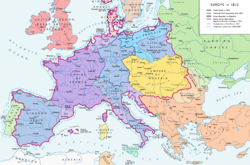
Klemens von Metternich, the new Austrian foreign minister, aimed to pursue a pro-French policy.[62] Francis II's daughter Marie Louise, was married to Napoleon in 1810. Austria was effectively bankrupt by 1811 and the paper money lost considerable value, but contributed an army to Napoleon's invasion of Russia in March 1812. With Napoleon's disastrous defeat in Russia at the end of the year, and Prussia's defection to the Russian side in March 1813, Metternich began slowly to shift his policy. Initially he aimed to mediate a peace between France and its continental enemies, but when it became apparent that Napoleon was not interested in compromise, Austria joined the allies and declared war on France in August 1813 in the War of the Sixth Coalition (1812–1814). The Austrian intervention was decisive. Napoleon was defeated at Leipzig in October, and forced to withdraw into France itself. As 1814 began, the Allied forces invaded France. Initially, Metternich remained unsure as to whether he wanted Napoleon to remain on the throne, a Marie Louise regency for Napoleon's young son, or a Bourbon restoration, but he was eventually brought around by British Foreign Secretary Lord Castlereagh to the last position. Napoleon abdicated on 3 April 1814, and Louis XVIII was restored, soon negotiating a peace treaty with the victorious allies at Paris in June, while Napoleon was exiled to Elba.
War of the Seventh Coalition (1815)
Napoleon escaped in February 1815, Louis fled and thus the final phase of the war, the War of the Seventh Coalition, ensued—the so-called Hundred Days of Napoleon's attempt at restoration. This culminated with the decisive Battle of Waterloo in June. The Napoleonic wars ended with the second Treaty of Paris that year, and Napoleon's final exile to St Helena.
Congress of Vienna (1815)

With the completion of the long running French wars a new order was required in Europe and the heads of the European states gathered in Vienna for a prolonged discussion of Europe's future, although the Congress was actually convened in September 1814 prior to Napoleon's attempted return, and completed on 9 June 1815, nine days before the Battle of Waterloo. At the completion of the Napoleonic wars, Austria found itself on the winning side as a new European leader, largely due to Metternich's diplomatic skills. It was as much a grand social event of the representatives of the great powers as a true Congress and was chaired by Metternich. Its purpose was to restore a new European order to emerge from the chaos of the Napoleonic wars. While Austria was the diplomatic leader, the military victory was largely that of Russia and Prussia, aided by Britain and Spain, and Austria had little to add to the final defeat of Napoleon on 18 June 1815 at Waterloo.[63] Metternich's intent was to create a balance of power in Europe, under a new entity, the German Confederation with Austrian leadership, out of the ashes of the Holy Roman Empire.[64]

The resulting order was referred to as the Concert of Europe, which would now meet regularly to resolve outstanding differences. In addition to redrawing the political map, it established spheres of influence. Achieving the presidency of this new entity was Austria's greatest gain from the Congress. What the Congress could not do was to recover the old order or ancien régime on which Austrian and Habsburg authority had rested. In the new order, a Holy Alliance was created between Austria, Russia and Prussia. This was subsequently enlarged to include most European nations. Notable exceptions were Great Britain, wary of Metternich's strategy of repressive interventionism, and the Ottoman Empire. In the redrawing of the European map, Austrian gains were modest compared to Russia and Prussia, reflecting its relatively weak negotiating position. Austria regained most of the territory it had lost to Napoleon in the western part of the nation (Tyrol, Salzburg and Vorarlberg). In Italy it gained the Kingdom of Lombardy-Venetia, Tuscany, Modena, Parma and Piacenza. These latter political entities were ruled by various branches of the Habsburgs. It did not, however, regain Belgium and the Austrian Netherlands, but the trading of territories restored a contiguous territory, as envisaged by Joseph II, and gave Austria control over Italy. The Emperor Francis was unwilling to adapt to this new order, requiring diplomacy on Metternich's part, depicting it as conservative Romanticism, religion and order versus the revolutionary spirit of 1789. Thus, the Holy Alliance became a mechanism for countering any moves against legitimate order. Metternich has therefore been portrayed Europe's fireman, extinguishing any signs of revolutionary spirit. The resultant onset of peace provided the opportunity for both reforms and prosperity in Austria, but its backward looking policies within a Europe characterised by rapid change set the scene for eventual failure.[65][66]
The arts
Napoleonic Vienna was the Vienna of Beethoven, whose single opera Fidelio was premiered there in 1805, attended by the French military. It was also the era of the third (Eroica) (1805) with its ambivalent relation to Napoleon, and the fifth (Schicksals-) and the sixth (Pastorale) symphonies (1808).
Post Napoleonic wars (1815–1867)
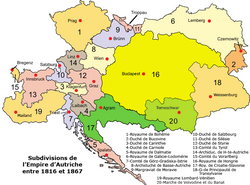
Biedermaier period (1815–1848)
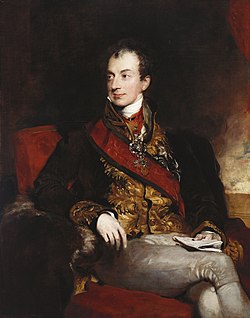
The period following the Congress of Vienna was one of relative political stability and is better known for its culture (Biedermeier). Other names for the years 1815–1848 include Vormärz ("before March") referring to period before the revolution of March 1848 and "The Age of Metternich" referring to his dominant position in European politics. Under the control of Metternich (who became Chancellor in 1821), the Austrian Empire entered a period of censorship and a police state, with surveillance spying and imprisonment of the opposition, while others emigrated. For Europe it was a period characterised by increasing industrialisation, the social consequences of economic cycles, population mobility and nationalism. All of these were regarded warily by governments intent on preserving the existing order.[67][64]
In 1823, the Emperor of Austria made the five Rothschild brothers barons. Nathan Mayer Rothschild in London chose not to take up the title. The family became famous as bankers in the major countries of Europe.[68]
Foreign policy
The Congress of Vienna was followed by a series of other congresses, referred to as the Congress System, including the Congresses of Aix-la-Chapelle (1818), Troppau (1820), Laibach (1821) and Verona (1822). These largely served to further suppress change, though a notable exception was the reintegration of France at the first of these, resulting in the Quintuple Alliance of the five great powers (Britain, Austria, Prussia, Russia and then France). Within the Quintuple Alliance, the more conservative Holy Alliance of Russia, Austria and Prussia tended to dominate the discourse. The Congress System of dispute resolution did not survive the 1820s, and in particular the intervention in the War of Greek Independence (1821-1832) over Metternich's objections, revealed the limits of his power. Further cracks in the old order appeared as South America broke away from Spain and Portugal, a liberal regime appeared in Portugal, and French Revolution and the independence of Belgium in 1830. Throughout there had been a division within the Quintuple Alliance between the more liberal western nations of Britain and France and the more conservative Holy Alliance in the east. The London conference of 1830 to decide on Belgian independence from the Netherlands effectively led to Britain's withdrawal from the Alliance. 1840 saw a number of related events that reflected on the unity of the Great Powers. Austria relied on Russia over the Eastern Question, and the Oriental crisis of that year split those powers, at least temporarily. While in the west, the Rhine crisis between France and the German Confederation, further fuelled the nascent German nationalism movement, typified by Die Wacht am Rhein[69]
Closer to home, Metternich exerted his influence in suppressing German nationalism. The Wartburg Festival of 1817 with its calls for German unity and condemnation of conservatism created alarm. Metternich prevented Austrian universities participating and further activism in 1819 with the assassination of August von Kotzebue in 1819 resulted in the Carlsbad Decrees of that year, suppressing free speech, and the Vienna Final Act[b] of 1820 empowering the German Confederation to act against member states. Neither fully succeeded in delaying the nationalist movement for long.[69]
Domestic policy and the rise of nationalism
Early efforts among the Italians to create a unified nation, including the Carbonari in Lombardy-Venetia were put down by Metternich with military intervention, similarly in Poland. Meanwhile, the minority populations within the empire, such as the Slavs and Poles were seeking national identities, distinct from Austria. Metternich sought to deflect these movements into cultural identity. Similarly in Germany, a Prussian led German Customs Union of the German states was formed in 1833, but Austria did not join, identifying within it German nationalism.[64][70] One of the few administrative reforms was the granting of a diet to Galicia.[71]
Metternich kept a firm hand on government resisting the constitutional freedoms demanded by the liberals. Government was by custom and by imperial decree. He was both an oppressive reactionary opportunist but also a true conservative politician. His role in directing European affairs gave the Habsburgs a disproportionate influence relative to their actual powers.[67] The extensive security mechanism was headed by Count Joseph Sedlnitzky, under Metternich's personal supervision, while religion was seen merely as a tool for supporting authority.[71]
Economy
State intervention in fiscal matters was relatively restrained, although the National Bank of Austria was established in 1816 to restore the nation's credit status. Taxation was largely left to the provinces and uneven within the empire, Hungary paying disproportionally less. The aristocrats were also undertaxed. One of the results was that the military budget was relatively small, and thus unable to give much force to Metternich's foreign policies. Economic growth was relatively small and did not keep pace with population growth.[72] Industrialisation in Austria began around 1830, primarily in Vienna and Vorarlberg. 1838 saw the first railway, connecting Vienna and Deutsch-Wagram, a distance of about 15 km, and construction on the Austrian Southern Railway (Österreichische Südbahn) started the following year. In shipping, the Danube Steam Navigation Company was established in 1829, while Austrian Lloyd became the largest shipping company in the Mediterranean. These economic developments came at a cost as large numbers of farm workers migrated to the growing urban industries to form an expanding proletariat.[73]
Monarchy
Francis firmly resisted Metternich's proposals for overhauling the Monarchy.[71] When Francis died in 1835, his son Ferdinand I ("the Benign"; 1835–1848) succeeded him, but proved unfit to govern due to illness, with much of the decision making falling to his uncle Archduke Louis of Austria and Metternich. Consequently, Austria entered a period of political stagnation with Francis being unwilling to make reforms and Ferdinand being incapable of so doing, and Metternich committed to preserving the status quo.[74]
1848 Revolution
During this period both liberalism and nationalism were on the rise, which resulted in the Revolutions of 1848. Metternich and the mentally handicapped Emperor Ferdinand I were forced to resign to be replaced by the emperor's young nephew Franz Joseph.
Franz Joseph I and the Belle Époque (1848–1914)
Post-revolutionary Austria (1848–1866)
Separatist tendencies (especially in Lombardy and Hungary) were suppressed by military force. A constitution was enacted in March 1848, but it had little practical impact, although elections were held in June. The 1850s saw a return to neoabsolutism and abrogation of constitutionalism. That said, one of the concessions to revolutionaries with a lasting impact was the freeing of peasants in Austria. This facilitated industrialization, as many flocked to the newly industrializing cities of the Austrian domain (in the industrial centers of Bohemia, Lower Austria, Vienna, and Upper Styria). Social upheaval led to increased strife in ethnically mixed cities, leading to mass nationalist movements.
On the foreign policy front, Austria with its non-German constituencies, was faced with a dilemma in 1848 when Germany's Constituent National Assembly, of which Austria was a member, stated that members could not have a state connection with non-German states, leaving Austria to decide between Germany or its Empire and Hungarian union. These plans came to nothing for the time being, but the concept of a smaller Germany that excluded Austria was to re-emerge as the solution in 1866. Austria's neutrality during the Crimean War (1853–1856), while the emperor was preoccupied with his wedding, antagonized both sides and left Austria dangerously isolated, as subsequent events proved.[75]
The Italian question (1859–1860)
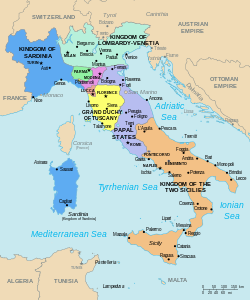
While Austria and the Habsburgs held hegemony over northern Italy, the south was the Kingdom of the Two Sicilies, with the Papal States intervening. Italy had been in a turmoil since the Congress of Vienna in 1815, with insurrections starting in 1820. King Ferdinand II of the Two Sicilies, an absolutist monarch, sought to strengthen his position by a further dynastic alliance with Austria. He already had a connection through his second wife, Maria Theresa, granddaughter of the emperor Leopold II. This he achieved by marrying his son, Francis II, to Duchess Maria Sophie of Bavaria in February 1859. Marie was a younger sister of the Empress Elisabeth of Austria, making Francis brother in law to the Emperor. Ferdinand died a few months later in May, and Francis and Maria Sophie ascended the throne.
In the meantime Austria had fallen into a trap set by the Italian risorgimento. Piedmont, jointly ruled with Sardinia had been the site of earlier insurrections. This time they formed a secret alliance with France (Patto di Plombières) whose emperor Napoleon III was a previous Carbonari. Piedmont then proceeded to provoke Vienna with a series of military manoeuvres, successfully triggering an ultimatum to Turin on 23 April. Its rejection was followed by an Austrian invasion, and precipitated war with France (Second Italian War of Independence 1859). Austria mistakenly expected support and received none, and the country was ill-prepared for war, which went badly. The Habsburg rulers in Tuscany and Modena were forced to flee to Vienna.
In May 1859 Austria suffered a military defeat at the Battle of Varese and in June at Magenta against the combined forces of France and Sardinia. The emperor refused to acknowledge the seriousness of the situation which was causing great hardship at home, and took over direct command of the army, though not a professional soldier. Later that month a further defeat at Solférino sealed Austria's fate, and the emperor found himself having to accept Napoleon's terms at Villafranca. Austria agreed to cede Lombardy, and the rulers of the central Italian states were to be restored. The latter never happened, and the following year in plebiscites, all joined the Kingdom of Sardinia-Piedmont. By April 1860 Garibaldi had invaded and quickly subdued Sicily, and by February 1861 the Kingdom of the Two Sicilies ceased to exist; Francis and Maria fled to Austria.
Aftermath—constitutional concessions
These events severely weakened the emperor's position. The government's absolutist policies were unpopular and these setbacks led to domestic unrest, Hungarian secessionism, criticism of Austria's governance and allegations of corruption. The first casualties were the emperor's ministers. The Finance Minister, Karl Ludwig von Bruck killed himself. Other casualties were Count Karl Ferdinand von Buol (Foreign Minister), Interior Minister Baron Alexander von Bach, Police Minister Johann Freiherr von Kempen von Fichtenstamm, Adjutant General Karl Ludwig von Grünne, together with army generals.
The result was a reluctant undertaking by the emperor and his chief advisor Goluchowski to return to constitutional government, culminating in the October Diploma (October 1860) establishing constitutional monarchy through a legislative assembly and provincial autonomy. This was never completely implemented due to Hungarian resistance, demanding the full autonomy lost in 1849. Consequently, the October Diploma was replaced by the February Patent, in 1861 establishing a bicameral legislative body, the Reichsrat. The upper house consisted of appointed and hereditary positions, while the lower house, the House of Deputies was appointed by the provincial diets. The Reichsrat would meet with or without the Hungarians, depending on the issues being considered. This was a first step towards the establishment of a separate Cisleithanian legislature, on the other hand the more limited role of the diets in the February Patent, compared to the October Diploma, angered the champions of regionalism. The Reichsrat was dominated by liberals, who were to be the dominant political force for the next two decades.
The Danish question (1864–1866)

Prussia and Denmark had already fought one war in 1848–1851 over the territories that lined their common border, Schleswig-Holstein which resulted in Denmark retaining them. By 1864 Austria was at war again, this time allying itself with Prussia against Denmark in the Second Schleswig War, which although successful this time, turned out to be Austria's last military victory. The war concluded with the Treaty of Vienna by which Denmark ceded the territories. The following year the Gastein Convention resolved the control of the new territories, Holstein being allocated to Austria, after initial conflicts between the allies. This did little to ease the Austria–Prussia rivalry over the German question. The ongoing efforts by Otto von Bismarck, the Prussian Minister President, to revoke the agreement and wrest control of the territories would soon lead to all out conflict between the two powers and achieve the desired weakening of Austria's position in central Europe.
The Hungarian question
From the 1848 revolution, in which much of the Hungarian aristocracy had participated, Hungary remained restless, restoration of the constitution and de-throne the House of Habsburg, opposing the centralist trials of Vienna and refusing to pay taxes.[76] Hungary had little support in the court at Vienna which was strongly Bohemian and considered the Hungarians as revolutionaries. From the loss of the Italian territories in 1859, the Hungarian question became more prominent. Hungary was negotiating with foreign powers to support it, and most significantly with Prussia. Therefore, Hungary represented a threat to Austria in any opposition to Prussia within the German Confederation over the German Question. Therefore, cautious discussions over concessions, referred to as Conciliation by the Hungarians,[77] started to take place. Emperor Franz Joseph traveled to Budapest in June 1865 and made a few concessions, such as abolishing the military jurisdiction, and granting an amnesty to the press. This fell far short of the requests of the Hungarian liberals whose minimal demands were restoration of the constitution and the emperor's separate coronation as King of Hungary. Chief among these were Gyula Andrássy and Ferenc Deák, who endeavoured to improve their influence at the court in Vienna.[78] In January 1866 a delegation of the Hungarian parliament traveled to Vienna to invite the imperial family to make an official visit to Hungary, which they did, at some length from January to March.
Austro-Prussian War (1866)
While Andrássy was making frequent visits to Vienna from Budapest during early 1866, relations with Prussia were deteriorating. There was talk of war. Prussia had signed a secret treaty with the relatively new Kingdom of Italy on 8 April, while Austria concluded one with France on 12 June, in exchange for Venetia.
While the motives for the war, Prussian masterplan or opportunism, are disputed, the outcome was a radical re-alignment of power in Central Europe. Austria brought the continuing dispute over Holstein before the German diet and also decided to convene the Holstein diet. Prussia, declaring that the Gastein Convention had thereby been nullified, invaded Holstein. When the German diet responded by voting for a partial mobilization against Prussia, Bismarck declared that the German Confederation was ended. Thus this may be considered a Third Schleswig War.
Hostilities broke out on 14 June as the Austro-Prussian War (June–August 1866), in which Prussia and the north German states faced not only Austria but much of the rest of Germany, especially the southern states. Three days later Italy declared war on Austria in the Third Italian War of Independence, Italy now being Prussia's ally. Thus Austria had to fight on two fronts. Their first engagement resulted in a minor victory against the Italians at Custoza near Verona on 24 June. Yet, on the northern front Austria suffered a major military defeat at the Battle of Königgrätz in Bohemia on 3 July. Although Austria had a further victory against the Italians in a naval battle at Lissa on 20 July, it was clear by then that the war was over for Austria, Prussian armies threatening Vienna itself, forcing the evacuation of the court to Budapest. Napoleon III intervened resulting in an armistice at Nikolsburg on 21 July, and a peace treaty in Prague on 23 August. In the meantime the Italians who collected a series of successes throughout July, signed an armistice at Cormons on 12 August rather than face the remaining Austrian army freed from its northern front.
As a result of these wars Austria had now lost all its Italian territory and was now excluded from further German affairs, that were now reorganised under Prussian dominance in the new North German Confederation. The Kleindeutschland concept had prevailed. For the Austrians in Italy, the war had been tragically pointless, since Venetia had already been ceded.
Dual Monarchy (1867–1918)
Conciliation
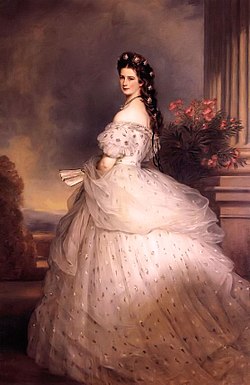
While Austria was reeling from the effects of war, the Hungarians increased the pressure for their demands. Andrássy was regularly in Vienna, as was Ferenc Deák and the Hungarian position was backed by constitutionalists and liberals. While anti-Hungarian sentiments ran high at the court, the Emperor's position was becoming increasingly untenable, with the Prussian army now at Pressburg (now Bratislava), and Vienna crammed with exiles, while hope for French intervention proved to be fruitless. The Hungarians recruited Empress Elisabeth who became a strong advocate for their cause. György Klapka had organised a legion fighting for the Prussians, which Bismarck had supported, that entered Hungary and agitated for Hungarian independence.

However the needs of the other provinces had to be considered before entering into any form of Hungarian dualism which would give Hungary special privileges, and started to fan the flames of Czech nationalism, since Slavic interests were likely to be submerged. People started to talk about the events of 1848 again. By February 1867 Count Belcredi resigned as Minister President over his concerns about Slavic interests, and was succeeded by foreign minister Ferdinand Beust, who promptly pursued the Hungarian option which had become a reality by the end of the month.
Ausgleich (Compromise) 1867
Austria-Hungary was created through the mechanism of the Austro-Hungarian Compromise of 1867. Thus the Hungarians finally achieved much of their aims. The western half of the realm known as (Cisleithania) and the eastern Hungarian (Transleithania), that is the realms lying on each side of the Leithatributary of the Danube river, now became two realms with different interior policy - there was no common citizenship and dual-citizenship was banned either -, but with a common ruler and a common foreign and military policy. The empire now had two capitals, two cabinets and two parliaments. Only three cabinet positions served both halves of the monarchy, war, foreign affairs and finance (when both sectors were involved). Costs were assigned 70:30 to Cisleithania, however the Hungarians represented a single nationality while Cisleithania included all the other kingdoms and provinces. Andrássy was appointed as the first Minister President of the new Hungary on 17 February. Feelings ran high in the provinces, and the Diets in Moravia and Bohemia were shut down in March.
Emperor Franz Joseph made a speech from the throne in May to the Reichsrat (Imperial Council) asking for retroactive ratification and promising further constitutional reforms and increased autonomy to the provinces. This was a major retreat from absolutism. On 8 June, the Emperor and Empress were crowned King and Queen of Hungary in a ceremony whose pomp and splendour seemed out of keeping with Austria's recent military and political humiliation and the extent of financial reparations. As part of the celebrations the emperor announced further concessions that aggravated relationships between Hungary and the rest of the monarchy. An amnesty was declared for all political offences since 1848 (including Klapka and Kossuth) and reversal of the confiscation of estates. In addition the coronation Gift was directed to the families and veterans of the revolutionary Honvéds, which was revived as the Royal Hungarian Honvéd.
In return for the Liberals support of the Ausgleich, concessions were made to parliamentary prerogatives in the new constitutional law. The law of 21 December 1867, although frequently amended, was the foundation of Austrian governance for the remaining 50 years of the empire, and was largely based on the February Patent, the Imperial Council and included a bill of rights. Ultimately the political balance of the dual monarchy represented a compromise between authoritarianism and parliamentarianism (Rechtsstaat) (Hacohen 2002). Like most compromises it was rejected by extremists on both sides, including Kossuth.
Austria-Hungary, 1867–1914

The year 1873 marked the Silver Jubilee of Franz Joseph, and provided not only an occasion for celebration but also one of reflection on the progress of the monarchy since 1848. Vienna had grown from a population of 500,000 to over a million, the walls and fortifications had been demolished and the Ringstrasse constructed with many magnificent new buildings along it. The Danube was being regulated to reduce the risk of flooding, a new aqueduct constructed to bring fresh water into the city, and many new bridges, schools, hospitals, churches and a new university built.
Foreign policy
What was supposed to be a temporary emergency measure was to last for half a century. Austria succeeded in staying neutral during the Franco Prussian War of 1870–71 despite those who saw an opportunity for revenge on Prussia for the events of 1866. However Austria's allies among the South German States were now allied with Prussia, and it was unlikely that Austria's military capacity had significantly improved in the meantime. Any residual doubts were rapidly dispelled by the speed of the Prussian advance and the subsequent overthrow of the Second Empire.
In November 1871 Austria made a radical change in foreign policy. Ferdinand Beust, the First Prime Minister (to 1867), Chancellor and Foreign Minister (1866–1871) of the Dual Monarchy, was dismissed. Beust was an advocate of revanche against Prussia, but was succeeded by the Hungarian Prime Minister, the liberal Gyula Andrássy as Foreign Minister (1871–1879), although both opposed the federalist policies of Prime Minister Karl Hohenwart (1871) while Prince Adolf of Auersperg became the new Prime Minister (1871–1879). Andrássy 's appointment caused concern among the conservative Court Party, but he worked hard to restore relationships between Berlin and Vienna, culminating in the Dual Alliance of 1879.
In 1878, Austria-Hungary occupied Bosnia and Herzegovina, which had been cut off from the rest of the Ottoman Empire by the creation of new states in the Balkans following the Russo-Turkish War of 1877–78 and the resulting Congress of Berlin (June–July 1878). The territory was ceded to Austria-Hungary, and Andrássy prepared to occupy it. This led to a further deterioration of relations with Russia and was to lead to tragic consequences in the next century. Austrian troops encountered stiff resistance and suffered significant casualties. The occupation created controversy both within and without the empire and led to Andrássy's resignation in 1879. This territory was finally annexed in 1908 and put under joint rule by the governments of both Austria and Hungary.

The departure of the Liberal Government and of Andrássy from the Foreign Office (k. u. k. Ministerium des Äußern) marked a sharp shift in Austria-Hungary's foreign policy, particularly in relation to Russia, Count Gustav Kálnoky (1881–1895) Andrássy's Conservative replacement pursuing a new rapprochement.
Economy
The second half of the 19th century saw a lot of construction, expansion of cities and railway lines, and development of industry. During the earlier part of this period, known as Gründerzeit, Austria became an industrialized country, even though the Alpine regions remained characterized by agriculture. Austria was able to celebrate its newfound grandeur in the Vienna World Exhibition of 1873, attended by all the crowned heads of Europe, and beyond. This period of relative prosperity was followed by the 1873 Stock market crash.
Politics and governance
Liberalism in Cisleithania 1867–1879
Political parties became legitimate entities in Austria from 1848, apart from a brief lapse in the 1850s. However the structure of the legislative body created by the 1861 February Patent provided little scope for party organisation. Initial political organisation resembled the cleavages in Austrian culture. Since the time of the Counter-Reformation the Catholic Church had assumed a major role in the political life of the empire, in conjunction with the aristocracy and conservative rural elements. Allied against these forces were a more secular urban middle class, reflecting the Enlightenment and the French Revolution with its anti-clericism (Kulturkampf). Other elements on the left were German nationalism, defending Greater German interests against the Slavs, and found support among urban intelligentsia. However party structure was far from cohesive and both groupings contained factions which either supported or opposed the government of the day. These parties reflected the traditional right/left split of political vision. The left, or Liberal factions were known as the Constitutional Party, but both left and right were fragmented into factions. Without direct elections there was no place for constituency organisation, and affinities were intellectual not organisational. Nor, without ministerial responsibility, was there a need for such organisation. The affinities were driven by respective visions of the representative institutions. The left derived its name from its support in principle of the 1861–1867 constitution and were the driving elements of the 1848 revolution, the right supported historic rights. The left drew its support from the propertied bourgeoisie (Besitzbürgertum), affluent professionals and the civil service. These were longstanding ideological differences.[79] The 1867 elections saw the Liberals take control of the lower house under Karl Auersperg (1867–1868) and were instrumental in the adoption of the 1867 constitution and in abrogating the 1855 Concordat (1870).
Suffrage progressively improved during the period 1860–1882. The selection of deputies to the Reichsrat by provincial legislatures proved unworkable particularly once the Bohemian diet effectively boycotted the Reichsrat in an attempt to acquire equal status with the Hungarians in a tripartite monarchy. As a result, suffrage was changed to direct election to the Reichsrat in 1873.
Even then by 1873 only six percent of the adult male population were franchised (Hacohen 2002). The initial divisions into Catholic, liberal, national, radical and agrarian parties differed across ethnic grounds further fragmenting the political culture. However, there was now emerging the presence of extra-parliamentary parties whereas previously parties were purely intra-parliamentary. This provided an opportunity for the disenfranchised to find a voice. These changes were taking place against a rapidly changing backdrop of an Austrian economy that was modernising and industrialising and economic crises such as that of 1873 and its resultant depression (1873–1879), and the traditional parties were slow to respond to the demands of the populace. By the election of 1901, the last election under the defined classes of franchisement extraparliamentary parties won 76 of the 118 seats.
This era saw anti-liberal sentiments and declining fortunes of the Liberal party which had held power since 1867 apart from a brief spell of conservative government in 1870–71. In 1870 Liberal support for Prussia in the 1870 Franco-Prussian War displeased the Emperor and he turned to the Conservatives to form a government under Count Karl Sigmund von Hohenwart (1871). Hohenwart was the conservative leader in parliament, and the Emperor believed his more sympathetic views to Slavic aspirations and federalism would weaken the Austro-German Liberals. Hohenwart appointed Albert Schäffle as his commerce minister and drew up a policy known as the Fundamental Articles of 1871. The policy failed, the Emperor withdrew his support and the Liberals regained power.
The Liberal party became progressively unliberal and more nationalistic, and against whose social conservatism the progressive intellectuals would rebel (Hacohen 2002). During their 1870–71 opposition they blocked attempts to extend the dual monarchy to a tripartite monarchy including the Czechs, and promoted the concept of Deutschtum (the granting of all rights of citizenship to those who displayed the characteristics of the solid German Bürger). They also opposed the extension of suffrage because restricted suffrage favoured their electoral base (Hacohen 2002). In 1873 the party fragmented, with a radical faction of the Constitutional Party forming the Progressive Club, while a right-wing faction formed the conservative Constitutionalist Landlordism leaving a rump of 'Old Liberals'. The result was a proliferation of German Liberal and German National groups.
Political realignment 1879
While Liberal achievements had included economic modernisation, expanding secular education and rebuilding the fabric and culture of Vienna, while collaborating with the Administration (Verwaltung), after 1873 a progressive series of schisms and mergers continued to weaken the party which effectively disappeared by 1911.
The Liberal cabinet of Adolf Auersperg (1871–1879) was dismissed in 1879 over its opposition to Foreign MinisterGyula Andrássy's (1871–1879) Balkan policy and the occupation of Bosnia-Herzegovina, which added more Slavs and further diluted German nationalism and identity. In the ensuing elections the Liberals lost control of parliament and went into opposition, the incoming government under Count Edward Taaffe (1879–1893) basically consisting of a group of factions (farmers, clergy and Czechs), the "Iron Ring", united in a determination to keep the Liberals out of power.
Andrássy, who had nothing in common with Taaffe, tended his resignation on the grounds of poor health and to his surprise it was accepted. His name was raised again when the new Foreign minister, Haymerle died in office in 1881, but Taaffe and his coalition had no time for a Liberal foreign minister (let alone a Hungarian and Freemason), and he was passed over in favour of Count Gustav Kálnoky (1881–1895).[80]
However the Liberal opposition filibustered leading the government to seek electoral reform as a strategy to weaken their position, which was enacted in 1882. Despite this, the coalition, nominally conservative and committed to anti-socialism passed a series of social reforms over the decade 1880–1890, following the examples of Germany and Switzerland. These were reforms which the Liberals had been unable to get past a government strongly tied to the concept of individual's rights to self-determination free from government interference[81] Such measures had the support of both the Liberals, now the United Left (Vereinigte Linke 1881) and the German National Party (Deutsche Nationalpartei 1891), an offshoot of the German National Movement. The electoral reforms of 1882 were the most influential in that it enfranchised proportionally more Germans.
Social reform now moved to become a platform of conservative Catholics like Prince Aloys de Paula Maria of Liechtenstein, Baron Karl von Vogelsang, and Count Egbert Belcredi[82] The era of electoral reform saw the emergence of Georg von Schonerer's Pan-German League (1882), appealing to an anti-clerical middle class, and Catholic social reformers such as L. Psenner and A. Latschka created the Christian Social Association (Christlich-Sozialer Verein) (1887). Around the same time F. Piffl, F. Stauracz, Ae. Schoepfer, A. Opitz, Karl Lueger and Prince Aloys Liechtenstein formed the United Christians to advocate Christian social reform.[83] These two organisations merged in 1891 under Karl Lueger to form the Christian Social Party (Christlichsoziale Partei, CS).
However the Taaffe government's policy of ethnic inclusiveness fuelled nationalism among the German-speaking population. The Liberals had maintained the strong centralism of the absolutist era (with the exception of Galicia in 1867) while the Conservatives attempted a more federalist state that ultimately led to the fall of the Taaffe government in 1893, including a second attempt at Bohemian Ausgleich (Tripartite monarchy) in 1890[81][84]
On the left the spread of anarchical ideas and oppressive government saw the emergence of a Marxist Social Democratic Party (Sozialdemokratische Arbeiterpartei Österreichs, SDAPÖ) in 1889 which succeeded in winning seats in the 1897 elections which followed further extension of suffrage in 1896 to include peasants and the working classes, establishing universal male suffrage, though not equal.
Direct and equal suffrage for the Reichsrat (1907)

The universal male suffrage introduced in 1907 by Minister-President Freiherr von Beck changed the balance of power, formally tilted towards German Austrians, and revealed that they were now a minority in a predominantly Slavic empire. In the 1900 census, Germans were 36% of the Cisleithanian population but the largest single group, but never acted as a cohesive group (nor did any other national group), although they were the dominant group in the political life of the monarchy. Germans were followed by Czechs and Slovaks (23%), Poles (17), Ruthenians (13), Slovenes (5), Serbo-Croats (3), Italians (3) and Romanians 1%. However these national groups, especially the Germans were often scattered geographically. The Germans also dominated economically, and in level of education.

The post reform 1907 parliament (Reichsrat) was elected along national lines, with only the Christian-Social and Social Democrat parties predominantly German. However Austria was governed by the Emperor who appointed the Imperial Council of Ministers, who in turn answered to him, parliament being left free to criticise government policy. Technically it had the power to legislate from 1907, but in practice the Imperial government generated its own legislation, and the Emperor could veto his own minister's bills. The major parties were divided geographically and socially, with the social democrats base being the towns, predominantly Vienna, and having a very different perspective to the devout but illiterate peasantry in the countryside. The latter were joined by the aristocracy and bourgeoisie in supporting the status quo of the monarchy.
The 1911 elections elected a parliament that would carry Austria through the war and the end of the empire in 1918.[85][86] However, the effectiveness of parliamentarism was hampered by conflicts between parties representing different ethnic groups, and meetings of the parliament ceased altogether during World War I.
The arts

The initial years of the 19th century following the Congress of Vienna, up until the revolution of 1848 was characterised by the Biedermeier period of design and architecture, partly fueled by the repressive domestic scene that diverted attention to domesticity and the arts.
With the reign of Franz Joseph (1848–1916) came a new era of grandeur, typified by the Belle Époque style, with extensive building and the construction of the Ringstrasse in Vienna with its monumental buildings (officially opened 1 May 1865, after seven years). Architects of the period included Heinrich Ferstel (Votivkirche, Museum für angewandte Kunst Wien), Friedrich von Schmidt (Rathaus), Theophil Hansen (Parliament), Gottfried Semper (Kunsthistorisches Museum, Kunsthistorisches Museum, Burgtheater), Eduard van der Nüll (Opera) and August Sicardsburg (Opera).
1897 saw the resignation of a group of artists from the Association of Austrian Artists (Gesellschaft bildender Künstler Österreichs), headed by Gustav Klimt who became the first president of this group which became known as the Vienna Secession or Wiener Secession (Vereinigung Bildender Künstler Österreichs). The movement was a protest against the historicism and conservatism of the former organisation, following similar movements in Berlin and Munich. Partly this was a revolt against the perceived excesses of the earlier Ringstrasse era, and a yearning to return to the relative simplicity of Biedermaier. From this group Josef Hoffman and Koloman Moser formed the Vienna Arts and Crafts Workshop (Wiener Werkstätte) in 1903 to promote the development of applied arts. The Secession became associated with a specific building, the Secession Building (Wiener Secessionsgebäude) built in 1897 and which housed their exhibitions, starting in 1898. The Secession as originally conceived splintered in 1905 when Klimt and others left over irreconcilable differences. The group however lasted until 1939 and the outbreak of the Second World War.[87]
Architecturally this was the era of Jugendstil (Art Nouveau) and the contrasting work of men like Otto Wagner (Kirche am Steinhof) known for embellishment and Adolf Loos, who represented restraint. Art Nouveau and the modern style came relatively late to Austria, around 1900, and was distinguishable from the earlier movement in other European capitals.[88]
One of the prominent literary figures was Karl Kraus, the essayist and satirist, known for his newspaper "The Torch", founded in 1899.
On the musical scene, Johan Strauss and his family dominated the Viennese scene over the entire period, which also produced Franz Schubert, Ludwig van Beethoven, Anton Bruckner, Johannes Brahms, Arnold Schoenberg, Franz Lehár and Gustav Mahler among others.
By the opening years of the 20th century (Fin de siècle) the avant garde were beginning to challenge traditional values, often shocking Viennese society, such as Arthur Schnitzler's play Reigen, the paintings of Klimt, and the music of Schoenberg, Anton Webern and Alban Berg and the Second Viennese School.
Austria in the First World War (1914–1918)

Nationalist strife increased during the decades until 1914. The assassination in Sarajevo by a Serb nationalist group of Archduke Franz Ferdinand, the heir to Franz Joseph as Emperor, helped to trigger World War I. In November 1916 the Emperor died, leaving the relatively inexperienced Charles (Karl) in command. The defeat of the Central Powers in 1918 resulted in the disintegration of Austria-Hungary, and the Emperor went into exile.
German Austria and the First Republic (1918–1933)
Republic of German-Austria (1918–1919)
1918


The First World War ended for Austria on 3 November 1918, when its defeated army signed the Armistice of Villa Giusti at Padua following the Battle of Vittorio Veneto. This applied just to Austria-Hungary, but Hungary had withdrawn from the conflict on 31 October 1918. Austria was forced to cede all territory occupied since 1914, plus accept the formation of new nations across most of its pre-war territory, and the allies were given access to Austria. The empire was thus dissolved.
The Provisional National Assembly met in Vienna from 21 October 1918 to 19 February 1919, as the first parliament of the new Austria, in the Lower Austria parliamentary buildings. It consisted of those members of the Imperial Council elected in 1911 from German speaking territories with three presidents, Franz Dinghofer, Jodok Fink, and Karl Seitz. The National Assembly continued its work till 16 February 1919 when elections were held. On 30 October it adopted a provisional constitution and on 12 November it adopted German Austria as the name of the new state. Since the Emperor, Charles I (Karl I) had stated on 11 November that he no longer had "any share in the affairs of state", although he always said that he never abdicated, Austria was now a republic.
However the provisional constitution stated that it was to be part of the new German (Weimar) Republic proclaimed three days earlier. Article 2 stated: "German Austria is part of the German Republic".
Karl Renner was proclaimed Chancellor of Austria, succeeding Heinrich Lammasch and led the first three cabinets (12 November 1918 – 7 July 1920) as a grand coalition of the largest parties, although some were composed of a large number of splinter groups of the German National and German Liberal movements, and were numerically the largest group in the assembly.
On 22 November Austria claimed the German-speaking territories of the former Habsburg Empire in Czechoslovakia (German Bohemia and parts of Moravia), Poland (Austrian Silesia) and the South Tyrol, annexed by Italy. However Austria was in no position to enforce these claims against either the victorious allies or the new nation states that emerged from the dissolution of the Empire and all the lands in question remained separated from the new Austria.
French premier Georges Clemenceau said: "Austria is what's left". An empire of over 50 million had been reduced to a state of 6.5 million.
1919
On 19 February elections were held for what was now called the Constituent National Assembly. Although the Social Democrats won the most seats (41%) they did not have an absolute majority and formed a grand coalition with the second-largest party, the Christian Socialists. On 12 March the National Assembly declared "German Austria" to be part of the "German Republic".
Large sections of the population and most representatives of political parties were of the opinion that this "residual" or "rump state" – without Hungary's agriculture sector and Bohemia's industry – would not be economically viable. The journalist Hellmut Andics (1922–1998) expressed this sentiment in his book entitled Der Staat, den keiner wollte (The state that nobody wanted) in 1962.
Austria's exact future remained uncertain until formal treaties were signed and ratified. This process began with the opening of the Peace Conference in Paris on 18 January 1919 and culminated in the signing of the Treaty of Saint Germain on 10 September that year, although the National Assembly initially rejected the draft treaty on 7 June.
The First Republic, 1919–1933
Treaty of Saint Germain 1919
The fledgling Republic of German-Austria was to prove short lived. The proposed merger with the German Empire (Weimar Republic) was vetoed by the Allied victors in the Treaty of Saint-Germain-en-Laye (10 September 1919) under Article 88 which prohibited economic or political union. The allies were fearful of the long-held Mitteleuropa dream—a union of all German-speaking populations. The treaty was ratified by parliament on 21 October 1919. Austria was to remain independent, and was obliged to be so for at least 20 years.
The treaty also obliged the country to change its name from the "Republic of German Austria" to the "Republic of Austria", i.e., the First Republic, a name that persists to this day. The German-speaking bordering areas of Bohemia and Moravia (later called the "Sudetenland") were allocated to the newly founded Czechoslovakia. Many ethnic Germans regarded this as hypocrisy since U.S. president Woodrow Wilson had proclaimed in his famous "Fourteen Points" the "right of self-determination" for all nations. In Germany, the constitution of the Weimar Republic explicitly stated this in article 61: Deutschösterreich erhält nach seinem Anschluß an das Deutsche Reich das Recht der Teilnahme am Reichsrat mit der seiner Bevölkerung entsprechenden Stimmenzahl. Bis dahin haben die Vertreter Deutschösterreichs beratende Stimme.—"German Austria has the right to participate in the German Reichsrat (the constitutional representation of the federal German states) with a consulting role according to its number of inhabitants until unification with Germany." In Austria itself, almost all political parties together with the majority of public opinion continued to cling to the concept of unification laid out in Article 2 of the 1918 constitution.[94]
Although Austria-Hungary had been one of the Central Powers, the allied victors were much more lenient with a defeated Austria than with either Germany or Hungary. Representatives of the new Republic of Austria convinced the allies that it was unfair to penalize Austria for the actions of a now dissolved Empire, especially as other areas of the Empire were now perceived to be on the "victor" side, simply because they had renounced the Empire at the end of the war. Austria never did have to pay reparations because allied commissions determined that the country could not afford to pay.
However, the Treaty of Saint Germain also confirmed Austria's loss of significant German-speaking territories, in particular the southern part of the County of Tyrol (now South Tyrol) to Italy and the German-speaking areas within Bohemia and Moravia to Czechoslovakia. In compensation (as it were) it was to be awarded most of the German-speaking part of Hungary in the Treaty of Trianon concluded between the Allies and that country; this was constituted the new federal state of Burgenland.
End of grand coalition and new constitution (1920–1933)
The grand coalition was dissolved on 10 June 1920, being replaced by a CS- SDAPÖ coalition under Michael Mayr as Chancellor (7 July 1920 – 21 June 1921), necessitating new elections which were held on 17 October, for what now became the National Council, under the new constitution of 1 October. This resulted in the Christian Social party now emerging as the strongest party, with 42% of the votes and subsequently forming Mayr's second government on 22 October as a CS minority government (with the support of the GDVP) without the Social Democrats. The CS were to continue in power until the end of the first republic, in various combinations of coalitions with the GDVP and Landbund (founded 1919).
The borders continued to be somewhat uncertain because of plebiscites in the tradition of Woodrow Wilson. Plebiscites in the regions of Tyrol and Salzburg between 1919 and 1921 (Tyrol 24 April 1921, Salzburg 29 May 1921) yielded majorities of 98% and 99% in favour of unification with Germany, fearing that "rump" Austria was not economically viable. However such mergers were not possible under the treaty.
On 20 October 1920, a plebiscite in part of the Austrian state of Carinthia was held in which the population chose to remain a part of Austria, rejecting the territorial claims of the Kingdom of Serbs, Croats and Slovenes to the state. Mostly German-speaking parts of western Hungary was awarded to Austria as the new province Burgenland in 1921, with the exception of the city of Sopron and adjacent territories, whose population decided in a referendum (which is sometimes considered by Austrians to have been rigged) to remain with Hungary. The area had been discussed as the site of a Slavic corridor uniting Czechoslovakia to Yugoslavia. This made Austria the only defeated country to acquire additional territory as part of border adjustments.

Despite the absence of reparations, Austria under the coalition suffered hyperinflation similar to that of Germany, destroying some of the financial assets of the middle and upper classes, and disrupting the economy. Adam Ferguson attributes hyperinflation to the existence of far too many people on the government payroll, failure to tax the working class, and numerous money losing government enterprises. The conservatives blamed the left for the hyperinflation; Ferguson blames policies associated with the left.[95] Massive riots ensued in Vienna in which the rioters demanded higher taxes on the rich and reduced subsidies to the poor. In response to the riots, the government increased taxes but failed to reduce subsidies.
The terms of the Treaty of Saint Germain were further underlined by the Geneva Protocols of the League of Nations (which Austria joined on 16 December 1920) on 4 October 1922 between Austria and the Allies. Austria was given a guarantee of sovereignty provided it did not unite with Germany over the following 20 years. Austria also received a loan of 650 million Goldkronen which was successful in halting hyperinflation, but required major restructuring of the Austrian economy. The Goldkrone was replaced by the more stable Schilling, but resulted in unemployment and new taxes, loss of social benefits and major attrition of the public service.[94]
The First World Congress of Jewish Women was held in Vienna in May 1923.[96]
Politics and government
Emerging from the war, Austria had two main political parties on the right and one on the left. The right was split between clericalism and nationalism. The Christian Social Party, (Christlichsoziale Partei, CS), had been founded in 1891 and achieved plurality from 1907–1911 before losing it to the socialists. Their influence had been waning in the capital, even before 1914, but became the dominant party of the First Republic, and the party of government from 1920 onwards. The CS had close ties to the Roman Catholic Church and was headed by a Catholic priest named Ignaz Seipel (1876–1932), who served twice as Chancellor (1922–1924 and 1926–1929). While in power, Seipel was working for an alliance between wealthy industrialists and the Roman Catholic Church. The CS drew its political support from conservative rural Catholics. In 1920 the Greater German People's Party (Großdeutsche Volkspartei, GDVP) was founded from the bulk of liberal and national groups and became the junior partner of the CS.[97]
On the left the Social Democratic Workers' Party of Austria (Sozialdemokratische Arbeiterpartei Österreichs, SDAPÖ) founded in 1898, which pursued a fairly left-wing course known as Austromarxism at that time, could count on a secure majority in "Red Vienna" (as the capital was known from 1918 to 1934), while right-wing parties controlled all other states. The SDAPÖ were the strongest voting bloc from 1911 to 1918.
Between 1918 and 1920, there was a grand coalition government including both left and right-wing parties, the CS and the Social Democratic Workers' Party. This gave the Social Democrats their first opportunity to influence Austrian politics. The coalition enacted progressive socio-economic and labour legislation such as the vote for women on 27 November 1918, but collapsed on 22 October 1920. In 1920, the modern Constitution of Austria was enacted, but from 1920 onwards Austrian politics were characterized by intense and sometimes violent conflict between left and right. The bourgeois parties maintained their dominance but formed unstable governments while socialists remained the largest elected party numerically.
Both right-wing and left-wing paramilitary forces were created during the 20s. The Heimwehr (Home Resistance) first appeared on 12 May 1920 and became progressively organised over the next three years and the Republikanischer Schutzbund was formed in response to this on 19 February 1923. From 2 April 1923 to 30 September there were violent clashes between Socialists and Nazis in Vienna. That on 2 April, referred to as Schlacht auf dem Exelberg (Battle of Exelberg), involved 300 Nazis against 90 Socialists.[98] Further episodes occurred on 4 May and 30 September 1923. A clash between those groups in Schattendorf, Burgenland, on 30 January 1927 led to the death of a man and a child. Right-wing veterans were indicted at a court in Vienna, but acquitted in a jury trial. This led to massive protests and a fire at the Justizpalast in Vienna. In the July Revolt of 1927, 89 protesters were killed by the Austrian police forces.
Political conflict escalated until the early 1930s. The elections of 1930 which returned the Social Democrats as the largest bloc turned out to be the last till after World War II. On 20 May 1932, Engelbert Dollfuß, Christian Social Party Agriculture Minister became Chancellor, with a majority of one.
Federal State of Austria (1933–1938)
Engelbert Dollfuss (1933–1934)
1933: Dissolution of parliament and the formation of the Patriotic Front
Dollfuss and the Christian Social Party, moved Austria rapidly towards centralized power similar to the Fascist model. He was concerned that German National Socialist leader Adolf Hitler had become Chancellor of Germany on 30 January 1933, after his party had become the largest group in the parliament and was quickly assuming absolute power. Similarly the Austrian National Socialists (DNSAP) could easily become a significant minority in future Austrian elections. Fascism scholar Stanley G. Payne, estimated that if elections had been held in 1933, the DNSAP could have secured about 25% of the votes. Time magazine suggested an even higher level of support of 50%, with a 75% approval rate in the Tyrol region bordering Nazi Germany.[99][100][101] The events in Austria during March 1933 echoed those of Germany, where Hitler also effectively installed himself as dictator in the same month.
March coup d'état
On 4 March 1933, there occurred an irregularity in the parliamentary voting procedures. Karl Renner (Social Democratic Party of Austria, Sozialdemokratische Partei Österreichs SPÖ), president of the National Council (Nationalrat: lower house of parliament) resigned in order to be able to cast a vote on a controversial proposal to deal with the railroad strike that was likely to pass by a very small margin, which he was not able to do while holding that office. Consequently, the two vice-presidents representing the other parties, Rudolf Ramek (Christian Social Party) and Sepp Straffner (Greater German People's Party) also resigned for the same reason. In the absence of the President the session could not be concluded.
Although there were procedural rules which could have been followed in this unprecedented and unforeseen event, the Dollfuss cabinet seized the opportunity to declare the parliament unable to function. While Dollfuss described this event as "self-elimination of Parliament" it was actually the beginning of a coup d'etat that would establish the "Ständestaat" lasting to 1938.
Using an emergency provision enacted during the First World War, the Economic War Powers Act (Kriegswirtschaftliches Ermächtigungsgesetz, KWEG 24. Juli 1917 RGBl.[102] Nr. 307) the executive assumed legislative power on 7 March and advised President Wilhelm Miklas to issue a decree adjourning it indefinitely. The First Republic and democratic government therefore effectively ended in Austria, leaving Dollfuss to govern as a dictator with absolute powers. Immediate measures included removing the right of public assembly and freedom of the press. The opposition accused him of violating the constitution.[103][104][105]
An attempt by the Greater German People's Party and the Social Democrats to reconvene the council on 15 March was prevented by barring the entrance with police and advising PresidentWilhelm Miklas to adjourn it indefinitely. Dollfuss would have been aware that Nazi troops had seized power in neighbouring Bavaria on 9 March. Finally, on 31 March, the Republikanischer Schutzbund (paramilitary arm of the Social Democratic Party) was dissolved (but continued illegally).
Subsequent events
Dollfuss then met with Benito Mussolini for the first time in Rome on 13 April. On 23 April, the National Socialists (DNSAP) gained 40 per cent of the vote in the Innsbruck communal elections, becoming the largest voting bloc, so in May all state and communal elections were banned.
On 20 May 1933, Dollfuss replaced the "Democratic Republic" with a new entity, merging his Christian Social Party with elements of other nationalist and conservative groups, including the Heimwehr, which encompassed many workers who were unhappy with the radical leadership of the socialist party, to form the Patriotic Front (Vaterländische Front), though the Heimwehr continued to exist as an independent organization until 1936, when Dollfuss' successor Kurt von Schuschnigg forcibly merged it into the Front, instead creating the unabidingly loyal Frontmiliz as a paramilitary task force. The new entity was allegedly bipartisan and represented those who were "loyal to the government".
The DNSAP was banned in June 1933. Dollfuss was also aware of the Soviet Union's increasing influence in Europe throughout the 1920s and early 1930s, and also banned the communists, establishing a one-party conservative dictatorship largely modeled after Italian fascism, tied to Catholiccorporatism and anti-secularism. He dropped all pretence of Austrian reunification with Germany so long as the Nazi Party remained in power there.
Although all Austrian parties, including the Social Democratic Labour Party (SDAPÖ) were banned, Social Democrats continued to exist as an independent organization, including its paramilitary Republikaner Schutzbund, which could muster tens of thousands against Dollfuss' government.
In August 1933, Mussolini's government issued a guarantee of Austrian independence ("if necessary, Italy would defend Austria's independence by force of arms"). Dollfuss also exchanged 'Secret Letters' with Benito Mussolini about ways to guarantee Austrian independence. Mussolini was interested in Austria forming a buffer zone against Nazi Germany. Dollfuss always stressed the similarity of the regimes of Hitler in Germany and Joseph Stalin in the Soviet Union, and was convinced that Austria and Italy could counter totalitarian national socialism and communism in Europe.
Dollfuss escaped an assassination attempt in October 1933 by Rudolf Dertil, a 22-year-old who had been ejected from the military for his national socialist views.
1934: Civil war and assassination
Despite the March coup d'état, the SPÖ continued to seek a peaceful resolution, but when the government tried to search the party's office in Linz for weapons on 12 February 1934, members of the Schutzbund fought back. The resistance spread and became the Austrian Civil War, in which the weakened party and its supporters were quickly defeated and the party and its various ancillary organisations were banned.[106]
On 1 May 1934, the Dollfuss cabinet approved a new constitution that abolished freedom of the press, established one party system and created a total state monopoly on employer-employee relations. This system remained in force until Austria became part of Nazi Germany in 1938. The Patriotic Front government frustrated the ambitions of pro-Hitlerite sympathizers in Austria who wished both political influence and unification with Germany, leading to Dollfuss' assassination by a group of Nazis on 25 July 1934.[107]
Kurt Schuschnigg (1934–1938)
His successor Kurt Schuschnigg maintained the ban on pro-Hitlerite activities in Austria, but was forced to resign on 11 March 1938 following a demand by Adolf Hitler for power-sharing with pro-German circles. Following Schuschnigg's resignation, German troops occupied Austria with no resistance.
Anschluss and unification with Germany (1938–1945)
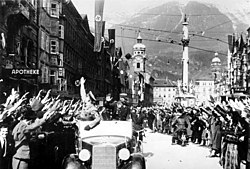
Although the Treaty of Versailles and the Treaty of St. Germain had explicitly forbidden the unification of Austria and Germany, the native AustrianHitler was vastly striving to annex Austria during the late 1930s, which was fiercely resisted by the Austrian Schuschnigg dictatorship. When the conflict was escalating in early 1938, Chancellor Schuschnigg announced a plebiscite on the issue on 9 March, which was to take place on 13 March. On 12 March, German troops entered Austria, who met celebrating crowds, in order to install Nazi puppet Arthur Seyss-Inquart as Chancellor. With a Nazi administration already in place the country was now integrated into Nazi Germany renamed as "Ostmark" until 1942, when it was renamed again as "Alpen-und Donau-Reichsgaue" ("Alpine and Danubian Gaue"). A rigged[108]referendum on 10 April was used to demonstrate the alleged approval of the annexation with a majority of 99.73% for the annexation.[109]
As a result, Austria ceased to exist as an independent country. This annexation was enforced by military invasion but large parts of the Austrian population were in favour of the Nazi regime, and many Austrians participated in its crimes. The Jews, Communists, Socialist and hostile politicians were sent to concentration camps, murdered or forced into exile.[110]
Just before the end of the war, on 28 March 1945, American troops entered Austria and the Soviet Union's Red Army crossed the eastern border two days later, taking Vienna on 13 April. American and British forces occupied the western and southern regions, preventing Soviet forces from completely overrunning and controlling the country.
The Second Republic (since 1945)
Allied occupation
According to the plans by Winston Churchill, a south German state would be formed including Austria and Bavaria.[111]

However, in April 1945 Karl Renner, an Austrian elder statesman, declared Austria separate from the other German-speaking lands and set up a government which included socialists, conservatives and communists. A significant number of these were returning from exile or Nazi detention, having thus played no role in the Nazi government. This contributed to the Allies' treating Austria more as a liberated, rather than defeated, country, and the government was recognized by the Allies later that year. The country was occupied by the Allies from 9 May 1945, and under the Allied Commission for Austria established by an agreement on 4 July 1945, it was divided into Zones occupied respectively by American, British, French and Soviet Army personnel, with Vienna being also divided similarly into four sectors, with an International Zone at its heart.
Though under occupation, this Austrian government was officially permitted to conduct foreign relations with the approval of the Four Occupying Powers under the agreement of 28 June 1946. As part of this trend, Austria was one of the founding members of the Danube Commission, which was formed on 18 August 1948. Austria would benefit from the Marshall Plan, but economic recovery was slow.
Unlike the First Republic, which had been characterized by sometimes violent conflict between the different political groups, the Second Republic became a stable democracy. The two largest leading parties, the Christian-democraticAustrian People's Party (ÖVP) and the Social Democratic Party (SPÖ), remained in a coalition led by the ÖVP until 1966. The Communist Party of Austria (KPÖ), who had hardly any support in the Austrian electorate, remained in the coalition until 1950 and in parliament until the 1959 election. For much of the Second Republic, the only opposition party was the Freedom Party of Austria (FPÖ), which included German nationalist and liberal political currents. It was founded in 1955 as a successor organisation to the short-lived Federation of Independents (VdU).
The United States countered starvation in 1945–46 with emergency supplies of food delivered by the US Army, by the United Nations Relief and Rehabilitation Administration (UNRRA), and by the privately organized Cooperative for American Remittances to Europe (CARE). Starting in 1947, it funded the Austrian trade deficit. Large-scale Marshall Plan aid began in 1948 and operated in close cooperation with the Austrian government. However, tensions arose when Austria—which never joined NATO—was ineligible for the American shift toward rearmament in military spending.[112] The US was also successful in helping Austrian popular culture adopt American models. In journalism, for example, it sent in hundreds of experts (and controlled the newsprint), closed down the old party-line newspapers, introduced advertising and wire services, and trained reporters and editors, as well as production workers. It founded the Wiener Kurier, which became popular, as well as many magazines such as Medical News from the United States, which informed doctors on new treatments and drugs. The Americans also thoroughly revamped the radio stations, in part with the goal of countering the Soviet-controlled stations. On an even larger scale the education system was modernized and democratized by American experts.[113]
Independence and political development during the Second Republic

The two major parties strove towards ending allied occupation and restoring a fully independent Austria. The Austrian State Treaty was signed on 15 May 1955. Upon the termination of allied occupation, Austria was proclaimed a neutral country, and everlasting neutrality was incorporated into the Constitution on 26 October 1955.
The political system of the Second Republic came to be characterized by the system of Proporz, meaning that posts of some political importance were split evenly between members of the SPÖ and ÖVP. Interest group representations with mandatory membership (e.g., for workers, businesspeople, farmers etc.) grew to considerable importance and were usually consulted in the legislative process, so that hardly any legislation was passed that did not reflect widespread consensus. The Proporz and consensus systems largely held even during the years between 1966 and 1983, when there were non-coalition governments.
The ÖVP-SPÖ coalition ended in March 1966, when the ÖVP gained a majority in the National Council. Josef Klaus (ÖVP) formed his second cabinett (de). The ÖVP lost its majority of seats in March 1970, when SPÖ leader Bruno Kreisky formed a minority government (de) tolerated by the FPÖ. In the elections of 1971, of 1975 and of 1979 he obtained an absolute majority. The 1970s were then seen as a time of liberal reforms in social policy. Later, the economic policies of the Kreisky era often have been criticized, as the accumulation of a large national debt began, and non-profitable nationalized industries were strongly subsidized.
Following severe losses in the April 1983 election, the SPÖ entered into a coalition with the FPÖ under the leadership of Fred Sinowatz (de). In Spring 1986, Kurt Waldheim was electedpresident amid considerable national and international protest because of his possible involvement with the Nazi regime and war crimes during World War II. Fred Sinowatz resigned in June 1986. Franz Vranitzky became chancellor and formed his first government (de).
In September 1986, in a confrontation between the German-national and liberal wings, Jörg Haider became leader of the FPÖ. Chancellor Vranitzky rescinded the coalition pact between FPÖ and SPÖ, and after a snap election on 23 November 1986, entered into a coalition with the ÖVP, which was then led by Alois Mock. Vranitzki formed a second (de), a third (de) and a fourth government (de ). Jörg Haider's populism and criticism of the Proporz system allowed him to gradually expand his party's support in elections, rising from 4% in 1983 to 27% in 1999. From 1986 onwards, the Green Party has been elected to every National council.[114]
Since 1989/90
1989/90, the Iron Curtain fell, the Eastern Bloc and the Warsaw Pact dissoluted and the Revolutions of 1989/90 took place. Austria's neighbours Hungary, Czechoslovakia (and 1991 Slovenia) became independent democratic states.This improved the conditions for the Economy of Austria.
The SPÖ–ÖVP coalition persisted until 1999. On 1 January 1995, Austria, Sweden and Finland joined the European Union (Video of the signing in 1994), and Austria was set on the track towards joining the Eurozone, when it was established on 1 January 1999.
In 1993, the Liberal Forum was founded by dissidents from the FPÖ. It managed to remain in parliament until 1999. Viktor Klima succeeded Vranitzky as chancellor in 1997 (de).
In 1999, the ÖVP fell back to third place behind the FPÖ in the elections. Even though ÖVP chairman and Vice ChancellorWolfgang Schüssel had announced that his party would go into opposition in that case, he entered into a coalition with the FPÖ—with himself as chancellor—in early 2000 under considerable national and international outcry. Jörg Haider resigned as FPÖ chairman, but retained his post as governor of Carinthia and kept substantial influence within the FPÖ.
In 2002, disputes within the FPÖ resulting from losses in state elections caused the resignation of several FPÖ government members and a collapse of the Schüssel government. Schüssel's ÖVP emerged as the winner of the snap election in October 2002, ending up in first place for the first time since 1966. The FPÖ lost more than half of its voters, but reentered the coalition with the ÖVP. Despite the new coalition, the voter support for the FPÖ continued to dwindle in almost all local and state elections. Disputes between "nationalist" and "liberals" wings of the party resulted in a split, with the founding of a new liberal party called the Alliance for the Future of Austria (BZÖ) and led by Jörg Haider. Since all FPÖ government members and most FPÖ members of parliament decided to join the new party, the Schüssel coalition remained in office (now in the constellation ÖVP–BZÖ, with the remaining FPÖ in opposition) until the next elections. On 1 October 2006 the SPÖ won a head on head elections and negotiated a grand coalition with the ÖVP.[115] This coalition started its term on 11 January 2007 with Alfred Gusenbauer as Chancellor of Austria.[116] For the first time, the Green Party of Austria became the third-largest party in a nationwide election, overtaking the FPÖ by a narrow margin of only a few hundred votes.
The SPÖ-ÖVP coalition headed by Gusenbauer collapsed in the early summer of 2008 over disagreements about the country's EU policy. The early elections held on 28 September resulted in extensive losses for the two ruling parties and corresponding gains for Heinz-Christian Strache's FPÖ and Jörg Haider's BZÖ (the Green Party was relegated to the 5th position). Nevertheless, SPÖ and ÖVP renewed their coalition under the leadership of the new SPÖ party chairman Werner Faymann.[117] Gusenbauer dissolved his first government on 8 December 2008; the first Faymann government followed.
In 2008 Haider died in a controversial car accident[118] and was succeeded as BZÖ party chairman by Herbert Scheibner and as governor of Carinthia by Gerhard Dörfler.
In the legislative election of September 2013, SPÖ received 27% of the vote and 52 seats; ÖVP 24% and 47 seats, thus controlling together the majority of the seats. FPÖ received 40 seats and 21% of the votes, while the Greens received 12% and 24 seats. Two new parties, Stronach and the NEOS, received less than 10% of the vote, and 11 and nine seats respectively.[119]
On 17 May 2016, Christian Kern (SPÖ) was sworn in as new chancellor. He continued governing in a "grand coalition" with ÖVP (Kern government). He took the office after Werner Faymann (SPÖ) had resignated.[120]
On 26 January 2017, Alexander Van der Bellen was sworn into as the mostly ceremonial - but symbolically significant - role of Austrian president.[121]

After the Grand Coalition broke in Spring 2017 a snap election was proclaimed for October 2017. ÖVP with its new young leader Sebastian Kurz emerged as the largest party in the National Council, winning 31.5% of votes and 62 of the 183 seats. SPÖ finished second with 52 seats and 26.9% votes, slightly ahead of FPÖ, which received 51 seats and 26%. NEOS finished fourth with 10 seats (5.3 percent of votes), and PILZ (which split from the Green Party at the start of the campaign) entered parliament for the first (and last) time and came in fifth place with 8 seats and 4.4% The Green Party failed with 3.8% to cross the 4% threshold and was ejected from parliament, losing all of its 24 seats.[122] The ÖVP decided to form a coalition with the FPÖ. The new government between the centre-right wing and the right-wing populist party under the new chancellor Sebastian Kurz was sworn in on 18 December 2017,[123] but the coalition government later collapsed in the wake of the “Ibiza” corruption scandal[124] and a new election was called for 29 September 2019. The elections lead to another landslide victory (37.5%) of the ÖVP who formed a coalition-government with the reinvigorated (13.9%) Greens, which was sworn in with Kurz as chancellor on 7 January 2020 (second Kurz government).[125]
On 11 October 2021, Chancellor Kurz resigned, after pressure triggered by a corruption scandal. Foreign Minister Alexander Schallenberg of ÖVP succeeded him as chancellor (Schallenberg government).[126] Following a corruption scandal involving the ruling ÖVP, Austria got its third conservative chancellor in two months after Karl Nehammer was sworn into office on 6 December 2021. His predecessor Schallenberg had left the office after less than two months. ÖVP and the Greens continued to govern together (Nehammer government).[127]
See also
Articles
Austria
Other
Lists
- List of famous Austrians
- List of German monarchs
- List of rulers of Austria
- List of Austrian consorts
- List of Holy Roman emperors
- List of Holy Roman empresses
- List of chancellors of Austria
- List of presidents of Austria
- List of minister-presidents of Austria
- List of foreign ministers of Austria-Hungary
- List of political parties in Austria
Notes
Works cited
- Alföldy, Géza (1974). Noricum. Routledge & K. Paul. ISBN 978-1-3177-0092-0.
- Beller, Steven (2006). A Concise History of Austria. Cambridge University Press. ISBN 978-0-5214-7305-7. OL 3270803W.
- Bischof, Günter; Petschar, Hans (2017). The Marshall Plan: Saving Europe, Rebuilding Austria. University of New Orleans Publishing.
- Boyer, John W. (1995). Political Radicalism in Late Imperial Vienna: Origins of the Christian Social Movement, 1848–1897. University of Chicago Press. ISBN 978-0-2260-6956-2.
- Brook-Shepherd, Gordon (1997). The Austrians: A Thousand-Year Odyssey. New York: Carroll & Graf Publishers. ISBN 978-0-7867-0520-7. OL 3359797W.
- Bukey, Evan (2002). Hitler's Austria: Popular Sentiment in the Nazi Era, 1938–1945. The University of North Carolina Press. ISBN 978-0-8078-2516-7.
- Dickson, P. G. M. (1995). "Monarchy and Bureaucracy in Late Eighteenth-Century Austria". The English Historical Review. 110 (436): 323–367. doi:10.1093/ehr/CX.436.323. JSTOR 576012.
- Erbe, Michael (2000). Die Habsburger 1493–1918. Urban (in German). Kohlhammer Verlag. ISBN 978-3-1701-1866-9.
- Gale, Thomson (1998). Worldmark Encyclopedia of the Nations (9th ed.). Farmingtom Hills, Michigan: Gale. ISBN 978-0-7876-0079-2.
- Grandner, Margarete (1994). Conservative Social Politics in Austria, 1880–1890(PDF) (Thesis). Working Paper 94-2. University of Minnesota Center for Austrian Studies. Archived from the original(PDF) on 14 January 2013.
- Gruber, Stephan (2022). "The peace-loving mother-figure versus the neurotic megalomaniac?"., in Schönbrunn 2022
- Hamann, Brigitte (2012) [1986 Knopf New York]. The Reluctant Empress: A Biography of Empress Elisabeth of Austria [Elizabeth: Kaiserin wider Willen, Amalthea Verlag, Vienna and Munich 1982]. Translated by Hein, Ruth. Faber & Faber. ISBN 978-0-5712-8756-7.(Other editions: Ullstein Buchverlage, Berlin 1998, 8th ed. 2006 ISBN 3-548-35479-3)
- Ingrao, Charles W. (2000). The Habsburg Monarchy, 1618–1815 (2nd ed.). Cambridge University Press. ISBN 978-0-5217-8505-1.
- Kann, Robert A. (1980). A History of the Habsburg Empire: 1526–1918 (2nd ed.). University of California Press. ISBN 978-0-5200-4206-3. OL 7708659M.
- Kissinger, Henry (1957). A World Restored: Metternich, Castlereagh and the Problems of Peace, 1812–22.
- Mutschlechner, Martin (2022). "The dark side of Maria Theresa"., in Schönbrunn 2022
- Pech, Stanley Z. (June 1989). "Political Parties among Austrian Slavs: A Comparative Analysis of the 1911 Reichsrat Election Results". Canadian Slavonic Papers. Essays in Honour of Peter Brock. 31 (2): 170–193. doi:10.1080/00085006.1989.11091913. JSTOR 40869049.
- Pohanka, Reinhard (2011). Austria: A History of the Country. Vienna: Pichler-Verlag in the Styria Publ. Group. ISBN 978-3-8543-1579-7. OL 44789816M.
- Pulzer, Peter (July 1969). "The Legitimizing Role of Political Parties: the Second Austrian Republic". Government and Opposition. 4 (3): 324–344. doi:10.1111/j.1477-7053.1969.tb00804.x. Archived from the original on 12 July 2015.
- Schönbrunn (2022). "Die Welt der Habsburger" [The World of the Habsburgs]. Die Welt der Habsburger. Schönbrunn Group. Retrieved 8 December 2022.
- Scott, H. M. (1990). Enlightened Absolutism: Reform and Reformers in Later Eighteenth-Century Europe. Bloomsbury Publishing. ISBN 978-1-3492-0592-9. OL 17924876W.
- Steininger, Rolf; Bischof, Günter; Gehler, Michael, eds. (2008). Austria In the Twentieth Century. Transaction Publishers. ISBN 978-1-4128-0854-5.
- Encyclopædia Britannica (5 December 2022). Austria: History. Encyclopædia Britannica. Retrieved 11 December 2022.
Further reading
General
- Johnson, Lonnie (1989). Introducing Austria: A Short History. Riverside, California: Ariadne Press. ISBN 978-0-9294-9703-7. OL 2188561M.
- Ricket, Richard (1998). A Brief Survey of Austrian History (12th ed.). Prachner.
Culture
- Barzun, Jacques (18 October 2022). The Aufklärung. Encyclopædia Britannica. Retrieved 10 December 2022.
Politics
- Malachi Haim Hacohen. Karl Popper – The Formative Years, 1902–1945: Politics and Philosophy in Interwar Vienna. Cambridge University Press, 2002. ISBN 0-5218-9055-1, 9780521890557
- Kirk, Timothy. Nazism and the Working Class in Austria: Industrial Unrest and Political Dissent in the 'National Community'. Cambridge University Press, 2002. ISBN 0-5215-2269-2, 9780521522694
- Mangham, Arthur Neal. The Social Bases of Austrian Politics: the German Electoral Districts of Cisleithania, 1900–1914Archived 27 December 2022 at the Wayback Machine. Ph.D. thesis 1974
- "Demokratiezentrum Wien: Politische Entwicklung in Österreich 1918–1938"Archived 4 March 2016 at the Wayback Machine ("Political development in Austria 1918–1938")
- Austria's political parties and their historyArchived 14 January 2013 at the Wayback Machine. City of Vienna.
General European history
- Hayes, Bascom Barry (1994). Bismarck and Mitteleuropa. Fairleigh Dickinson University Press. ISBN 978-0-8386-3512-4.
- Stone, Norman (1983). Europe Transformed 1878–1919. Fontana. ISBN 978-0-0063-4262-5.
Habsburg Empire
- Evans, R. J. W. (2006). Austria, Hungary, and the Habsburgs: Central Europe c.1683-1867. Oxford University Press. ISBN 978-0-1915-3586-4.
- Ingrao, Charles W., ed. State and Society in Early Modern Austria (1994) (Sixteenth-Eighteenth Century)
- Jelavich, Barbara (1987). Modern Austria: Empire and Republic, 1815-1986. Cambridge University Press. ISBN 978-0-5213-1625-5.(Available here at Internet Archive)
- Judson, Pieter M. The Habsburg Empire: A New History (2016). Downplays the disruptive impact of ethnic nationalism.
- Mamatey Victor S. Rise of the Habsburg Empire: 1526–1815 (1994)
- Robert John Weston Evans, The Making of the Habsburg Monarchy, 1550–1700: An Interpretation, Oxford University Press, 1979. ISBN 0-1987-3085-3.
Early
- Oakes, Elizabeth; Roman, Eric (2003). Austria-Hungary and the Successor States: A Reference Guide from the Renaissance to the Present.
Eighteenth century
- Bassett, Richard (2015). For God and Kaiser: The Imperial Austrian Army, 1619–1918.
- Beales, Derek (1975). "The False Joseph II". Historical Journal. 18 (3): 467–495. doi:10.1017/S0018246X00008414. JSTOR 2638606.
- Beales, Derek. Joseph II vol 1: In the shadow of Maria Theresa, 1741–1780 (1987); Joseph II: Volume 2, Against the World, 1780–1790 (2009)
- Henderson, Nicholas. "Joseph II", History Today 1991 41 (March): 21–27.
- Ingrao, Charles W. In Quest and Crisis: Emperor Joseph I and the Habsburg Monarchy (1979)
Nineteenth century
- Boyer, John W. (2022). Austria 1867-1955. Oxford University Press. ISBN 978-0-1925-6177-0.
- Jenks, William Alexander. Austria under the Iron Ring, 1879–1893. University Press of Virginia, 1965
- Macartney, Carlile Aylmer “The Austrian monarchy, 1793–1847” in C.W. Crawley, ed. ‘’The New Cambridge Modern History: IX. War and Peace in an age of upheaval 1793–1830’’ (Cambridge University Press, 1965) pp 395–411. online
- Macartney, Carlile AylmerThe Habsburg Empire, 1790–1918, New York, Macmillan 1969.
- Taylor, A. J. P. (1990) [1948]. The Habsburg Monarchy 1809-1918: A History of the Austrian Empire and Austria-Hungary. Penguin Books Limited. ISBN 978-0-1419-3238-5.(Available here at Internet Archive)
Modern era
- Bischof, Günter, and Anton Pelinka, eds. The Kreisky Era in Austria (Transaction publishers, 1994).
- Kann, Robert A. et al., eds. The Habsburg Empire in World War I: Essays on the Intellectual, Military, Political, and Economic Aspects of the Habsburg War Effort (1979)
- Rathkolb, Oliver. The Paradoxical Republic: Austria, 1945–2005 (Berghahn Books; 2010) Translation of 2005 study of paradoxical aspects of Austria's political culture and society.
- Secher, H. Pierre. Bruno Kreisky, Chancellor of Austria: A political biography (Dorrance Publishing, 1993).
- Thaler, Peter. The Ambivalence of Identity: The Austrian Experience of Nation-Building in a Modern Society. West Lafayette: Purdue University Press, 2001.
- University of Minnesota Center for Austrian Studies Working PapersArchived 2 October 2012 at the Wayback Machine
External links

- History of Austria: Primary Documents
- HABSBURG, an e-mail discussion list dealing with the culture and history of the Habsburg monarchy and its successor states in central Europe since 1500, with discussions, syllabi, book reviews, queries, conferences; edited daily by scholars since 1994
- Gustav Spann: Fahne, Staatswappen und Bundeshymne der Republik ÖsterreichArchived 21 February 2016 at the Wayback Machine (Flag, Coat of Arms and Federal Hymn of the Republic of Austria) (pdf; 4.7 MB)
- www.akustische-chronik.at – Multimedia Chronicle of Austria 1900–2000 (Österreichische Mediathek)
- www.staatsvertrag.at – An acoustic web exhibition (Österreichische Mediathek)
- Die Ostarrichi-Urkunde, "digitalised image". Photograph Archive of Old Original Documents (Lichtbildarchiv älterer Originalurkunden). University of Marburg.
- Ernst Hanisch: Österreich – Die Dominanz des Staates. Zeitgeschichte im Drehkreuz von Politik und Wissenschaft (Archived 11 August 2020 at the Wayback Machine). Version: 1.0, in: Docupedia Zeitgeschichte, 22 March 2011
- "Austria". The World Factbook (2025 ed.). Central Intelligence Agency.
- Austria at the U.S. State Department website
สรุปเนื้อหา
ข้อมูลสำคัญจากบทความ
ข้อมูลสำคัญเกี่ยวกับ ประวัติศาสตร์ของออสเตรีย
ประวัติศาสตร์ ของออสเตรีย ครอบคลุมประวัติศาสตร์ของประเทศ ออสเตรีย และรัฐก่อนหน้า ในช่วงปลาย ยุคเหล็ก ออสเตรียถูกครอบครองโดยผู้คนจาก วัฒนธรรม เซลติก ฮัลล์สตัดท์ ( ประมาณ 800...
ประวัติศาสตร์นิพนธ์
เนื่องจากอาณาเขตที่เข้าใจในคำว่า 'ออสเตรีย' มีการเปลี่ยนแปลงอย่างมากเมื่อเวลาผ่านไป การศึกษา ประวัติศาสตร์ของออสเตรีย จึงก่อให้เกิดคำถามหลายประการ เช่น ประวัติศาสตร์นั้นจำกัดอยู่เฉพาะสาธารณรัฐออสเตรียในปัจจุบันหรือในอดีต...
ยุคหินเก่า
เทือกเขาแอลป์ ไม่สามารถเข้าถึงได้ในช่วง ยุคน้ำแข็ง ดังนั้นการอยู่อาศัยของมนุษย์จึงมีอายุไม่เก่าไปกว่า ยุค หินเก่าตอนกลาง ในช่วงเวลาของ มนุษย์นีแอนเดอร์ทาล ร่องรอยการอยู่อาศัยของมนุษย์ที่เก่าแก่ที่สุดในออสเตรีย ซึ่งมีอายุมากกว่า 250,000 ปี...
ยุคเมโซลิธิก
ซาก โบราณสถานยุคเมโซลิธิก ได้แก่ ที่พักอาศัยในถ้ำหิน (abris) จาก ทะเลสาบคอนสแตนซ์ และ หุบเขาไรน์ในเทือกเขาแอลป์ สถานที่ฝังศพที่ เอลส์เบเธน และแหล่ง โบราณสถาน อื่นๆ อีกหลายแห่งที่มี สิ่งประดิษฐ์หินขนาดเล็ก ซึ่งแสดงให้เห็นถึงการเปลี่ยนแปลงจากการดำรงชีวิตแบบ...