
สวัสติกะ

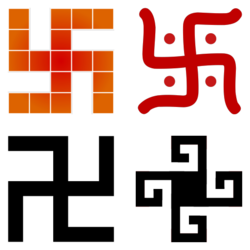

สวัสติกะ( / ˈ s w ɒ s t ɪ k ə / SWOST -ik-ə , สันสกฤต: [ ˈsʋɐstikɐ ] ;卐หรือ卍) เป็นสัญลักษณ์ทางเรขาคณิตโบราณข้ามวัฒนธรรมที่ถูกใช้ในหลายวัฒนธรรมและศาสนาของยูเรเซียรวมถึงบางวัฒนธรรมในแอฟริกาและอเมริกามานานหลายพันปี สวัสติกะถูกใช้และยังคงถูกใช้เป็นสัญลักษณ์ของความเป็นเทพและจิตวิญญาณในหลายศาสนารวมถึงศาสนาฮินดูพุทธศาสนาและศาสนาเชน [ 1 ] [ 2 ] [ 3 ] [ 4 ] [ 5 ] ในโลกตะวันตกสวัสติกะมักเกี่ยวข้องกับลัทธินาซีโดยถูกนำมาใช้และแสดงอย่างแพร่หลายในสัญลักษณ์ของนาซี ที่โดดเด่นที่สุดคือถูกใช้ในธงของนาซีเยอรมนี นอกจากนี้ยังเป็นสัญลักษณ์ของความเกลียดชังการต่อต้านชาวยิวและการฆ่าล้างเผ่าพันธุ์การนำไปใช้ในลักษณะนี้ยังคงดำเนินต่อไปด้วยความนิยมของสัญลักษณ์นี้ในหมู่พวกนีโอนาซีทั่วโลก[ 1 ] [ 6 ] [ 7 ] [ 8 ]
คำภาษาอังกฤษswastikaมาจากภาษาสันสกฤต ( स्वस्तिकแปลว่า ' ส่งเสริมความเป็นอยู่ที่ดี' ) [ 1 ] [ 9 ]ในศาสนาฮินดู สัญลักษณ์ที่หันไปทางขวา (卐) เรียกว่าswastikaซึ่งเป็นสัญลักษณ์ของสุริยะความเจริญรุ่งเรือง และโชคดี ในขณะที่สัญลักษณ์ที่หันไปทางซ้าย (卍) บางครั้งเรียกว่าsauvastikaซึ่งเป็นสัญลักษณ์ของกลางคืนหรือ แง่มุม ตันตระของกาลี[ 1 ]ในสัญลักษณ์ของศาสนาเชนสัญลักษณ์นี้เป็นส่วนหนึ่งของธงเชน [ 10 ]และเป็นตัวแทนของสุปราศวนาถ ซึ่ง เป็น ติรถังการะ องค์ที่เจ็ดจาก 24 องค์ (ครูทางจิตวิญญาณและผู้ช่วยให้รอด) ในสัญลักษณ์ของพุทธศาสนาสัญลักษณ์นี้เป็นตัวแทนของรอยพระบาทอันเป็นมงคลของพระพุทธเจ้า[ 1 ] [ 11 ] [ 12 ]ในประเพณีอินโด-ยุโรป ที่แตกต่างกัน สัญลักษณ์สวัสติกะหมายถึงไฟ สายฟ้า และดวงอาทิตย์[ 13 ]พบสัญลักษณ์นี้ในซากโบราณสถานของอารยธรรมลุ่มแม่น้ำสินธุ[ 14 ]และวัฒนธรรมซามาร์ราใน ยุค หินใหม่ของเมโสโปเตเมียนอกจากนี้ยังพบใน งานศิลปะ ไบแซนไทน์และคริสเตียนยุค ต้นอีกด้วย [ 1 ] [ 15 ]
สัญลักษณ์สวัสติกะถูกมองว่าเป็นสัญลักษณ์แห่งความเป็นมงคลและโชคดีสำหรับโลกตะวันตกส่วนใหญ่จนถึงทศวรรษ 1930 [ 6 ]นักการเมืองฝ่ายขวาจัดชาวโรมาเนียAC Cuzaใช้สัญลักษณ์นี้เป็นครั้งแรกก่อนสงครามโลกครั้งที่ 1 [ 16 ] [ 17 ] [ 18 ]การรับ รู้ของสาธารณชนในวงกว้างจะเปลี่ยนไปก็ต่อเมื่อพรรคนาซีเยอรมันนำสวัสติกะมาใช้เป็นสัญลักษณ์ของ เผ่าพันธุ์ที่เรียกว่าอารยันผลจากสงครามโลกครั้งที่ 2และการฆ่าล้างเผ่าพันธุ์ชาวยิวสังคมตะวันตกยังคงเชื่อมโยงสัญลักษณ์นี้กับลัทธินาซีการต่อต้านชาว ยิว [ 19 ] [ 20 ]ลัทธิคนขาวเหนือกว่า[ 21 ] [ 22 ]หรือเพียงแค่ ความ ชั่วร้าย[ 23 ] [ 24 ]ด้วยเหตุนี้ การแสดงสัญลักษณ์นี้จึงถูกห้ามตามกฎหมายในหลายประเทศ โดยมีข้อยกเว้นสำหรับสัญลักษณ์ทางศาสนา อย่างไรก็ตาม สัญลักษณ์สวัสติกะยังคงเป็นสัญลักษณ์แห่งโชคดีและความเจริญรุ่งเรืองในศาสนาฮินดู พุทธ เชน และชุมชนชาวเอเชียอื่นๆ และยังคงเป็นสัญลักษณ์ทางวัฒนธรรมที่สงบสุขในประเทศต่างๆ เช่นศรีลังกามองโกเลียอินเดียญี่ปุ่นจีนและเนปาล นอกจาก นี้ยังมีความหมายอื่นๆ อีกมากมายสำหรับผู้คนทั่วโลก เช่นชาวอะกัน ชาวโฮปิชาวนาวาโฮและชาวทลิงกิต
นิรุกติศาสตร์และระบบการตั้งชื่อ
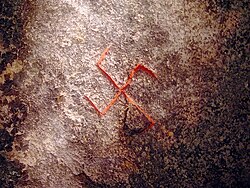
ด้วยความสุข ( สวัสติ ) เราจะก้าวเดินไปตามเส้นทางของเรา เหมือนดวงอาทิตย์และดวงจันทร์ ขอให้เราได้พบกับผู้ที่ให้ตอบแทน ผู้ที่ไม่ทำร้าย และผู้ที่รู้แจ้ง
คำว่าสวัสติกะมาจากรากศัพท์ภาษาสันสกฤตว่าswastiซึ่งประกอบด้วยsu 'ดี, สบายดี' และasti 'คือ; มันเป็น; มี' [ 27 ]คำว่าswastiปรากฏบ่อยครั้งในพระเวทและวรรณกรรมคลาสสิก หมายถึง 'สุขภาพ, โชค, ความสำเร็จ, ความเจริญรุ่งเรือง' และมักใช้เป็นคำทักทาย[ 28 ] [ 29 ] kaในตอนท้ายเป็นคำต่อท้ายทั่วไปที่อาจมีความหมายได้หลายอย่าง[ 30 ]
ตามที่Monier Monier-Williams นักวิชาการสันสกฤตในศตวรรษที่ 19 กล่าวไว้ นักวิชาการส่วนใหญ่ถือว่าสวัสติกะเดิมทีเป็นสัญลักษณ์ของดวงอาทิตย์[ 28 ]สัญลักษณ์นี้สื่อถึงความเป็นอยู่ที่ดี โชคดี หรือเป็นมงคล[ 28 ] [ 31 ] ใน ตำราร่วมสมัยสะกดอีกแบบ ว่า svastika [ 32 ] และบางครั้งก็มีการใช้การสะกดแบบอื่นในช่วงศตวรรษที่ 19 และต้น ศตวรรษที่ 20 เช่นsuastika [ 33 ]มาจากคำภาษาสันสกฤต(เทวนาครีस्वस्तिक ) ซึ่งถอดเสียงเป็นsvastika ตาม ระบบการถอดเสียง IASTที่ใช้กันทั่วไปแต่ออกเสียงใกล้เคียงกับswastikaมากกว่า
การใช้คำว่าสวัสติกะที่เก่าแก่ที่สุดเท่าที่ทราบคือในAṣṭādhyāyīของPāṇiniซึ่งใช้เพื่ออธิบายกฎไวยากรณ์ภาษาสันสกฤต ในบริบทของเครื่องหมายระบุตัวตนบนหูวัว[ 27 ] Pāṇini มีชีวิตอยู่ในช่วงหรือก่อนศตวรรษที่ 4 ก่อนคริสต์ศักราช[ 34 ] [ 35 ]อาจจะเป็นในศตวรรษที่ 6 หรือ 5 ก่อนคริสต์ศักราช[ 36 ] [ 37 ]
การใช้สวัสติกะในข้อความยุโรปครั้งแรกเกิดขึ้นในปี พ.ศ. 2414 ในสิ่งพิมพ์ของไฮน์ริช ชลีมันน์ซึ่งค้นพบสวัสติกะและรูปแบบต่างๆ ในสมัยโบราณมากกว่า 1,800 ตัวอย่าง ขณะขุดค้นเนิน ดิน ฮิสาร์ลิกใกล้ชายฝั่งทะเลอีเจียนเพื่อศึกษาประวัติศาสตร์ของเมืองทรอย ชลีมันน์เชื่อมโยงสิ่งที่เขาค้นพบกับสวัสติกะใน ภาษาสันสกฤต [ 38 ] [ 39 ] [ 40 ]
ในศตวรรษที่ 19 คำว่าสวัสติกะถูกนำมาใช้ในภาษาอังกฤษ[ 41 ] แทนที่คำว่า แกมมาเดียนจากภาษากรีกγαμμάδιονในปี 1878 นักวิชาการชาวไอริชชาร์ลส์ เกรฟส์ใช้สวัสติกะเป็นชื่อภาษาอังกฤษทั่วไปสำหรับสัญลักษณ์นี้ หลังจากให้คำจำกัดความว่าเทียบเท่ากับคำภาษาฝรั่งเศสcroix gamméeซึ่งเป็นไม้กางเขนที่มีแขนเป็นรูปตัวอักษรกรีกแกมมา( Γ) [ 42 ]หลังจากนั้นไม่นาน นักโบราณคดีชาวอังกฤษเอ็ดเวิร์ด โทมัสและโรเบิร์ต เซเวลล์ได้ตีพิมพ์งานวิจัยเกี่ยวกับสัญลักษณ์นี้แยกกัน โดยใช้สวัสติกะเป็นคำภาษาอังกฤษทั่วไป[ 43 ] [ 44 ]
สัญลักษณ์สวัสติกะแบบ "กลับด้าน" น่าจะได้รับการคิดค้นขึ้นครั้งแรกโดยEugène Burnoufในหมู่นักวิชาการชาวยุโรปในปี พ.ศ. 2495 และต่อมาได้รับการนำไปใช้โดยSchliemannในIlios (พ.ศ. 2423) โดยอ้างอิงจากจดหมายของMax Müllerที่อ้างถึง Burnouf คำว่าsauwastikaถูกใช้ในความหมายของ 'สวัสติกะกลับด้าน' โดยEugène Goblet d'Alviella (พ.ศ. 2437): "ในอินเดีย [สัญลักษณ์แกมมาเดียน ] มีชื่อว่าสวัสติกะเมื่อแขนของมันงอไปทางขวา และเรียกว่าsauwastikaเมื่อแขนของมันหันไปในทิศทางอื่น" [ 45 ]
ชื่ออื่นๆ ของสัญลักษณ์นี้ ได้แก่:
- tetragammadion (กรีก: τετραγαμμάδιον ) หรือ cross gammadion (ละติน: crux gammata ; ฝรั่งเศส: croix gammée ) เนื่องจากแต่ละแขนมีลักษณะคล้ายกับตัวอักษรกรีก Γ ( gamma ) [ 46 ]
- ไม้กางเขนแบบขอเกี่ยว (ภาษาเยอรมัน: Hakenkreuz ), ไม้กางเขนแบบเฉียง ( Winkelkreuz ) หรือไม้กางเขนแบบคด ( Krummkreuz )
- ตราประจำตระกูลที่เรียกว่า "กากบาทติดเหล็กแหลม" ( cross cramponned , cramponnée , หรือcramponny ) ในศาสตร์ตราประจำตระกูล หมายถึง แขนแต่ละข้างมีลักษณะคล้ายเหล็กแหลมหรือเหล็กฉาก ( ภาษาเยอรมัน: Winkelmaßkreuz )
- ฟิลฟอต (fylfot)โดยเฉพาะอย่างยิ่งในด้านตราประจำตระกูลและสถาปัตยกรรม
- tetraskelion (กรีก: τετρασκέлιον ) แปลว่า 'สี่ขา' โดยเฉพาะอย่างยิ่งเมื่อประกอบด้วยขาทรงจำสี่ขา (เปรียบเทียบ triskelion /triskele [กรีก: τρισκέлιον ]) [ 47 ]
- ugunskrusts (ภาษาลัตเวีย แปลว่า 'ไม้กางเขนแห่งไฟ'; ชื่ออื่นๆ– pērkonkrusts ('ไม้กางเขนแห่งฟ้าร้อง'), ไม้กางเขนของPerunหรือของPerkūnas), ไม้กางเขนแห่งกิ่งไม้, ไม้กางเขนของLaima)
- ท่อนไม้หมุนวน (นาวาโฮ): สามารถสื่อถึงความอุดมสมบูรณ์ ความเจริญรุ่งเรือง การรักษา และโชคลาภ[ 48 ]
ในภาษาต่างๆ ของยุโรป เรียกว่าfylfot , gammadion , tetraskelionหรือcross cramponnée (ซึ่งเป็นคำในตราประจำตระกูลแองโกล-นอร์มัน ); ภาษาเยอรมัน: Hakenkreuz ; ภาษาฝรั่งเศส: croix gammée ; ภาษาอิตาลี: croce uncinata ; ภาษาลัตเวีย : ugunskrustsในภาษามองโกลเรียกว่าхас ( khas ) และส่วนใหญ่ใช้ในตราประทับ ในภาษาจีนเรียกว่า 卍字 ออกเสียงว่าwànzìในภาษาจีนกลาง, manjiในภาษาจีนกวางตุ้ง, manjiในภาษาญี่ปุ่น, manja (만자) ในภาษาเกาหลี และvạn tựหรือchữ vạnใน ภาษา เวียดนามใน ภาษา บัลติ / ทิเบตเรียกว่าyung drung [ 49 ] [ 50 ] [ 51 ]
รูปร่าง


สัญลักษณ์สวัสติกะทั้งหมดเป็นรูปกากบาทโค้งที่อิงตาม สมมาตรแบบ ไครัลแต่มี รายละเอียด ทางเรขาคณิต ที่แตกต่างกัน ออกไป เช่น กากบาทขนาดกะทัดรัดที่มีขา pendek กากบาทที่มีแขนยาว และลวดลายในรูปแบบของเส้นที่ไม่ขาดตอน สมมาตรแบบไครัลอธิบายถึงการไม่มีสมมาตรแบบสะท้อนโดยมีสองรูปแบบที่เป็นภาพสะท้อนของกันและกัน รูปแบบภาพสะท้อนมักถูกอธิบายว่าหันไปทางซ้ายหรือมือซ้าย (卍) และหันไปทางขวาหรือมือขวา (卐)
สวัสติกะขนาดกะทัดรัดสามารถมองได้ว่าเป็นรูปยี่สิบเหลี่ยม ด้านไม่เท่าแบบไครัล ( รูปหลายเหลี่ยม 20 ด้าน) ที่มีสมมาตรการหมุน สี่เท่า (90°) สวัสติกะดังกล่าวที่มีสัดส่วนบนตารางสี่เหลี่ยมจัตุรัส 5 × 5 และส่วนที่ขาดของขาถูกทำให้สั้นลงหนึ่งหน่วย สามารถปูระนาบได้ด้วยการเลื่อนเพียงอย่างเดียว สวัสติกะธงนาซีหลักใช้ตารางแนวทแยง 5 × 5 แต่ขาไม่ได้ถูกทำให้สั้นลง[ 54 ]
ตัวละครที่เขียน


สัญลักษณ์สวัสติกะถูกนำมาใช้เป็นอักษรมาตรฐานในภาษาจีน "卍" ( พินอิน: wàn ) และด้วยเหตุนี้จึงถูกนำไป ใช้ ในภาษา อื่นๆ ในเอเชียตะวันออกรวมถึงอักษรจีน ด้วย ในภาษาญี่ปุ่น สัญลักษณ์นี้เรียกว่า"卍" ( เฮปเบิร์น : manji )หรือ"卍字" ( manji )
สัญลักษณ์สวัสติกะถูกรวมอยู่ใน ชุดอักขระ ยูนิโค้ดของสองภาษา ในบล็อกภาษาจีนคือ U+534D卍(หันหน้าไปทางซ้าย) และ U+5350 สำหรับสวัสติกะ卐(หันหน้าไปทางขวา) [ 55 ]แบบหลังมีการแมปในชุดอักขระBig5 ดั้งเดิม [ 56 ]แต่แบบแรกไม่มี (แม้ว่าจะอยู่ใน Big5+ [ 57 ] ก็ตาม ) ใน Unicode 5.2 มีการเพิ่มสัญลักษณ์สวัสติกะสองแบบและสวัสติกะสองแบบลงในบล็อกภาษาทิเบตได้แก่ สวัสติกะU+0FD5 ࿕สัญลักษณ์สวัสติกะหันหน้าไปทางขวา , U+0FD7 ࿗สัญลักษณ์สวัสติกะหันหน้าไปทางขวาพร้อมจุดและสวัสติกะU+0FD6 ࿖สัญลักษณ์สวัสติกะหันหน้าไปทางซ้าย , U+0FD8 ࿘สัญลักษณ์สวัสติกะหันหน้าไปทางซ้ายพร้อมจุด[ 58 ]
ต้นทาง
การใช้สัญลักษณ์สวัสติกะในยุโรปมักถูกพิจารณาควบคู่ไปกับสัญลักษณ์กากบาทโดยทั่วไป เช่นกากบาทดวงอาทิตย์ของศาสนาในยุคสำริดนอกเหนือจากการปรากฏอยู่ในระบบสัญลักษณ์ " การเขียนเบื้องต้น " เช่นอักษร Vinča [ 59 ]ซึ่งปรากฏขึ้นในช่วงยุคหินใหม่[ 60 ] ยังไม่มีสิ่งใดที่ทราบแน่ชัดเกี่ยวกับที่มาของสัญลักษณ์นี้
ขั้วโลกเหนือ

ตามที่René Guénon กล่าวไว้ สวัสติกะเป็นตัวแทนของขั้วโลกเหนือ และการเคลื่อนที่แบบหมุนรอบศูนย์กลางหรือแกนที่ไม่เปลี่ยนแปลง ( axis mundi ) และประการที่สอง มันเป็นตัวแทนของดวงอาทิตย์ในฐานะฟังก์ชันสะท้อนของขั้วโลกเหนือ ดังนั้นจึงเป็นสัญลักษณ์ของชีวิต บทบาทอันมีชีวิตชีวาของหลักการสูงสุดของจักรวาล พระเจ้า สัมบูรณ์ในความสัมพันธ์กับระเบียบจักรวาล มันเป็นตัวแทนของกิจกรรม ( Logos ของกรีก OmของฮินดูTaiyiของจีน'ผู้ยิ่งใหญ่') ของหลักการของจักรวาลในการสร้างโลก[ 61 ]ตามที่ Guénon กล่าว สวัสติกะในคุณค่าขั้วของมันมีความหมายเดียวกันกับสัญลักษณ์หยินและหยางของประเพณีจีน และสัญลักษณ์ดั้งเดิมอื่นๆ ของการทำงานของจักรวาล รวมถึงตัวอักษร Γ ( แกมมา ) และ G ซึ่งเป็นสัญลักษณ์ของสถาปนิกผู้ยิ่งใหญ่แห่งจักรวาลในความคิดของเมสัน[ 62 ] [ A ]
ตามที่นักวิชาการ Reza Assasi กล่าวไว้ สัญลักษณ์สวัสติกะแสดงถึงขั้วโลกเหนือสุริยวิถีที่มีจุดศูนย์กลางอยู่ที่ζ Draconisโดยมีกลุ่มดาวDracoเป็นหนึ่งในลำแสง เขาโต้แย้งว่าสัญลักษณ์นี้ได้รับการยืนยันในภายหลังว่าเป็นรถม้าสี่ตัวของมิธราในวัฒนธรรมอิหร่านโบราณ พวกเขาเชื่อว่าจักรวาลถูกลากโดยม้าสวรรค์สี่ตัวที่หมุนรอบจุดศูนย์กลางคงที่ในทิศทางตามเข็มนาฬิกา เขาเสนอว่าแนวคิดนี้เฟื่องฟูในลัทธิมิธรา ของโรมันในภายหลัง เนื่องจากสัญลักษณ์ปรากฏในภาพสัญลักษณ์ของมิธราและการแสดงทางดาราศาสตร์[ 63 ]
According to the Russian archaeologist Gennady Zdanovich, who studied some of the oldest examples of the symbol in Sintashta culture, the swastika symbolises the universe, representing the spinning constellations of the celestial north pole centred in α Ursae Minoris, specifically the Little and Big Dipper (or Chariots), or Ursa Minor and Ursa Major.[64] Likewise, according to René Guénon-the swastika is drawn by visualising the Big Dipper/Great Bear in the four phases of revolution around the pole star.[65]
Comet
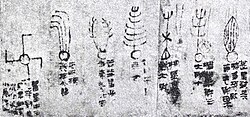
In their 1985 book Comet, Carl Sagan and Ann Druyan argue that the appearance of a rotating comet with a four-pronged tail as early as 2,000 years BCE could explain why the swastika is found in the cultures of both the Old World and the pre-Columbian Americas. The Han dynastyBook of Silk (2nd century BCE) depicts such a comet with a swastika-like symbol.[66]
Bob Kobres, in a 1992 paper, contends that the swastika-like comet on the Han-dynasty manuscript was labelled a "long-tailed pheasant star" (dixing) because it resembled a bird's foot or footprint.[67] Similar comparisons had been made by J. F. Hewitt in 1907,[68] as well as a 1908 article in Good Housekeeping.[69] Kobres goes on to suggest an association of mythological birds and comets also outside of China.[67]
Four winds

In Native American culture, particularly among the Pima people of Arizona, the swastika is a symbol of the four winds. Anthropologist Frank Hamilton Cushing noted that among the Pima, the symbol of the four winds is made from a cross with the four curved arms (similar to a broken sun cross) and concludes "the right-angle swastika is primarily a representation of the circle of the four wind gods standing at the head of their trails, or directions."[70]
Historical uses
Prehistory
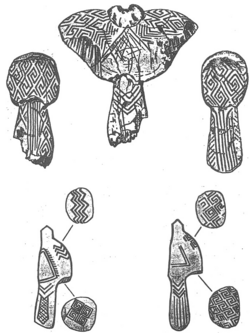
สัญลักษณ์สวัสติกะที่เก่าแก่ที่สุดที่รู้จักมีอายุตั้งแต่ 10,000 ถึง 17,000 ปีก่อนคริสตกาลซึ่งเป็นส่วนหนึ่งของ "ลวดลายคดเคี้ยวที่ซับซ้อนของสวัสติกะที่เชื่อมต่อกัน" ที่พบในรูปนกยุค หินเก่าตอนปลาย แกะสลักจากงาช้าง แมม มอ ธ พบในเมืองเมซีนประเทศยูเครน[ 71 ] [ 72 ]มีการเสนอแนะว่าสวัสติกะนี้อาจเป็นภาพนกกระสาที่ กำลัง บินในรูป แบบที่ประดิษฐ์ขึ้น [ 73 ]เนื่องจากพบการแกะสลักใกล้กับ วัตถุรูป อวัยวะเพศชายนี่อาจสนับสนุนแนวคิดที่ว่าลวดลายนี้เป็นสัญลักษณ์แห่งความอุดมสมบูรณ์[ 6 ]
ในภูเขาของอิหร่านมีสัญลักษณ์สวัสติกะหรือวงล้อหมุนสลักอยู่บนกำแพงหิน ซึ่งคาดว่ามีอายุมากกว่า 7,000 ปี ตัวอย่างหนึ่งอยู่ที่ Khorashad, Birjandบนกำแพงศักดิ์สิทธิ์ Lakh Mazar [ 74 ] [ 75 ]
พบสัญลักษณ์สวัสติกะแบบภาพสะท้อน (ตามเข็มนาฬิกาและทวนเข็มนาฬิกา) บนเครื่องปั้นดินเผาในถ้ำเดเวตาชกาประเทศบัลแกเรีย ซึ่งมีอายุย้อนไปถึง 6,000 ปีก่อนคริสตกาล[ 76 ]
ในเอเชียใต้ สัญลักษณ์สวัสติกะปรากฏครั้งแรกในบันทึกทางโบราณคดีราว[ 77 ] 3000 ปีก่อนคริสตกาลในอารยธรรมลุ่มแม่น้ำสินธุ[ 78 ] [ 79 ]นอกจากนี้ยังปรากฏใน วัฒนธรรม ยุคสำริดและยุคเหล็กบริเวณทะเลดำและทะเลแคสเปียนในวัฒนธรรมเหล่านี้ทั้งหมด สัญลักษณ์สวัสติกะไม่ได้ปรากฏอยู่ในตำแหน่งหรือความสำคัญที่โดดเด่นใดๆ โดยปรากฏเป็นเพียงรูปแบบหนึ่งของสัญลักษณ์ที่คล้ายคลึงกันหลายแบบที่มีความซับซ้อนแตกต่างกัน ใน ศาสนา โซโรแอสเตอร์ของเปอร์เซียสวัสติกะเป็นสัญลักษณ์ของดวงอาทิตย์ที่โคจร ความไม่มีที่สิ้นสุด หรือการสร้างสรรค์ที่ต่อเนื่อง[ 80 ] [ 81 ]เป็นหนึ่งในสัญลักษณ์ที่พบได้บ่อยที่สุดบนเหรียญเมโสโปเตเมีย[ 1 ] ในอังกฤษ มีการค้นพบ รูปแกะสลักหินยุคหินใหม่หรือยุคสำริดของสัญลักษณ์นี้บนIlkley Moorเช่นหินสวัสติกะ[ 82 ]
นอกจากนี้ยังพบสัญลักษณ์สวัสติกะบนเครื่องปั้นดินเผาในการขุดค้นทางโบราณคดีในแอฟริกา ในพื้นที่คุชและบนเครื่องปั้นดินเผาที่วัดเจเบล บาร์ กัล [ 83 ]ใน การออกแบบ ยุคเหล็กของคอเคซัส ตอนเหนือ ( วัฒนธรรมโคบัน ) และในจีนยุคหินใหม่ในวัฒนธรรมมาจิยาโอ[ 84 ]
สัญลักษณ์สวัสติกะยังพบเห็นได้ในอียิปต์ในช่วงยุคคอปติก ผ้าทอหมายเลข T.231-1923 ที่จัดแสดงอยู่ที่พิพิธภัณฑ์ V&A ในลอนดอนมีสัญลักษณ์สวัสติกะขนาดเล็กอยู่ในลวดลาย ผ้าทอชิ้นนี้ถูกค้นพบที่ Qau-el-Kebir ใกล้กับAsyutและมีอายุระหว่าง 300 ถึง 600 ปีคริสต์ศักราช[ 85 ]
Tierwirbel (ภาษาเยอรมันแปลว่า "วงสัตว์" หรือ "การหมุนวนของสัตว์" [ 86 ] ) เป็นลวดลายลักษณะเฉพาะในเอเชียกลางยุคสำริด ทุ่งหญ้าสเต ปป์ยูเรเซียและต่อมาใน วัฒนธรรม สคิเธียนและยุโรป ยุคเหล็ก ( บอลติก[ 87 ]และเยอรมัน ) ซึ่งแสดงการจัดเรียงแบบสมมาตรหมุนของลวดลายสัตว์มักจะเป็นหัวนกสี่หัว การแพร่กระจายที่กว้างขวางยิ่งขึ้นของธีม "เอเชีย" นี้ได้รับการเสนอให้ไปถึงแปซิฟิกและแม้แต่ทวีปอเมริกาเหนือ (โดยเฉพาะMoundville ) [ 88 ]
 ภาพเขียนบนหินในถ้ำของเทือกเขาเกกัมประเทศอาร์เมเนีย
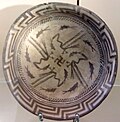 ชามซามาร์ราจากอิรัก ประมาณ 4,000 ปีก่อนคริสตกาล จัดแสดงอยู่ที่พิพิธภัณฑ์เพอร์กามอนในเบอร์ลิน สัญลักษณ์สวัสติกะตรงกลางของลวดลายเป็นการสร้างขึ้นใหม่[ 89 ]
 เครื่องปั้นดินเผาสมัยมาชางวัฒนธรรมหม่าเจยา ตอนปลาย (ประมาณ 3300 ถึง 2000 ปีก่อนคริสตกาล) ทางตะวันตกของจีน
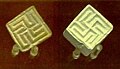 ตราประทับสวัสติกะจากโมเฮนโจดาโรประเทศปากีสถาน จากอารยธรรมลุ่มแม่น้ำสินธุประมาณ 2,100–1,750 ปีก่อนคริสตกาล เก็บรักษาไว้ที่พิพิธภัณฑ์บริติช[ 90 ]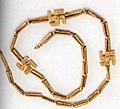
 สัญลักษณ์สวัสติกะที่ท้าย จารึก ถ้ำกรรณะเชาปาร์ของพระเจ้าอโศก
คอเคซัส

ในอาร์เมเนีย สัญลักษณ์สวัสติกะเรียกว่า " arevakhach " และ "kerkhach" ( ภาษาอาร์เมเนีย: կեռխաչ ) [ 91 ]และเป็นสัญลักษณ์โบราณของความเป็นนิรันดร์และแสงสว่างนิรันดร์ (เช่น พระเจ้า) พบสวัสติกะในอาร์เมเนียบนภาพสลักหินในยุคทองแดง ซึ่งมีอายุเก่าแก่กว่ายุคสำริด ในยุคสำริด สวัสติกะถูกวาดลงบนหม้อเข็มขัดเหรียญและสิ่งของอื่นๆ[ 92 ]
สัญลักษณ์ สวัสติกะยังสามารถพบได้ในโบสถ์และป้อมปราการสมัยต้นยุคกลาง รวมถึงหอคอยหลักในเมืองหลวงทางประวัติศาสตร์ของอาร์เมเนียที่เมืองอานี [ 91 ] สัญลักษณ์เดียวกันนี้ยังสามารถพบได้บนพรมอาร์เมเนียหินกางเขน ( khachkar ) และในต้นฉบับยุคกลาง รวมถึงบนอนุสาวรีย์สมัยใหม่ในฐานะสัญลักษณ์แห่งความเป็นนิรันดร์[ 93 ]
มีการบันทึก ภาพสลักหินโบราณของสวัสติกะสี่แฉกและสวัสติกะอื่นๆ ในดาเกสถานโดยเฉพาะอย่างยิ่งในหมู่ชาวอ วา ร์[ 94 ]ตามคำกล่าวของวาคุชติแห่ง การ์ตลี ธงประจำเผ่าของข่านอวาร์มีรูปหมาป่าพร้อมธงที่มีสวัสติกะเกลียวคู่[ 95 ]
ภาพสลักหินรูปสวัสติกะปรากฏอยู่บนสถาปัตยกรรมหอคอย Vainakh ในยุคกลาง (ดูภาพร่างโดยนักวิชาการ Bruno Plaetschke จากช่วงปี 1920) [ 96 ]ดังนั้น สวัสติกะรูปสี่เหลี่ยมผืนผ้าจึงถูกสลักไว้ที่ทางเข้าของหอคอยที่พักอาศัยในหมู่บ้านKhimoy ประเทศ เชชเนีย[ 96 ]
 ภาพสลักหินรูปสัญลักษณ์สวัสติกะภูเขาเกกัมประเทศอาร์เมเนีย ประมาณ 8,000–5,000 ปีก่อนคริสตกาล[ 97 ]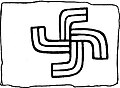
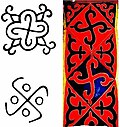 สัญลักษณ์สวัสติกะพื้นบ้านของชาวอวาร์
 สัญลักษณ์สวัสติกะบนซุ้มประตูหอคอยยุคกลางในเมืองคิมอยประเทศเชชเนีย
 ทหารอาร์เมเนียจากลชาเชนศตวรรษที่ 15-14 ก่อนคริสต์ศักราช สร้างขึ้นใหม่โดยศาสตราจารย์ เอ.ดี. ชาฆาริอัน ในพิพิธภัณฑ์ซาร์ดาราบัต
ยุโรป
หลักฐานการใช้สัญลักษณ์สวัสติกะในยุคเหล็กสามารถเชื่อมโยงกับ วัฒนธรรม อินโด-ยุโรปเช่น ชาวอิลลีเรียน [ 98 ] ชาวอินโด-อิหร่านชาวเคลต์ชาวกรีก ชาวอิ ตาลิกชาวเยอรมันและชาวสลาฟใน " ดินแดนแห่งเมือง " ของวัฒนธรรมซินทาชตา ซึ่งเป็นแหล่งที่อยู่อาศัยของ ชาวอินโด-ยุโรปโบราณในรัสเซียตอนใต้ พบว่ามีรูปแบบสวัสติกะที่เก่าแก่ที่สุดจำนวนมาก[ 64 ]
รูปทรงสวัสติกะถูกพบในสิ่งประดิษฐ์จำนวนมากจากยุคเหล็กของยุโรป[ 91 ] [ 99 ] [ 100 ] [ 98 ] [ 46 ]
รูปทรงสวัสติกะปรากฏบนสิ่งประดิษฐ์ต่างๆในยุคการอพยพ ของชาวเยอรมัน และยุคไวกิ้งเช่นเข็มกลัด Værløseจากศตวรรษที่ 3 จากเกาะซีแลนด์ ประเทศเดนมาร์ก หัวหอก แบบกอธิคจากเบรสต์-ลิตอฟสก์ ซึ่งปัจจุบันอยู่ในประเทศเบลารุส หิน Snoldelev จาก ศตวรรษที่ 9 จากเมืองแรมโซประเทศเดนมาร์ก และแผ่น โลหะประดับจำนวนมากในยุคการอพยพ ที่วาดหันไปทางซ้ายหรือขวา[ 101 ]
หลุมฝังศพเรือของชาวแองโกล-แซกซอนนอกรีต ที่ซัตตันฮูประเทศอังกฤษ มีสิ่งของจำนวนมากที่มีสัญลักษณ์สวัสติกะ ซึ่งปัจจุบันจัดแสดงอยู่ในคอลเลกชันของพิพิธภัณฑ์โบราณคดีและมานุษยวิทยาเคมบริดจ์ [ 102 ] สัญลักษณ์สวัสติกะปรากฏให้เห็นอย่างชัดเจนบนด้ามดาบและเข็มขัดดาบที่พบในบิฟรอนส์ในเคนต์ ในหลุมฝังศพที่มีอายุราวศตวรรษที่ 6
ฮิลดา เอลลิส เดวิดสันตั้งสมมติฐานว่าสัญลักษณ์สวัสติกะมีความเกี่ยวข้องกับธอร์อาจเป็นตัวแทนของค้อนมโยลเนียร์ ของเขา ซึ่งเป็นสัญลักษณ์ของฟ้าร้องและอาจเชื่อมโยงกับกากบาทดวงอาทิตย์ในยุคสำริด[ 102 ] เดวิดสันอ้างถึง "ตัวอย่างมากมาย" ของสัญลักษณ์สวัสติกะจากหลุมฝังศพของชาวแองโกล-แซ กซอนในยุคนอกรีต โดยเฉพาะอย่างยิ่งบนโกศบรรจุเถ้ากระดูกจากสุสานในอีสต์แองเกลีย[ 102 ]สวัสติกะบางส่วนบนสิ่งของที่จัดแสดงอยู่ที่พิพิธภัณฑ์โบราณคดีและมานุษยวิทยาเคมบริดจ์นั้นถูกวาดด้วยความเอาใจใส่และศิลปะอย่างมาก ซึ่งตามที่เดวิดสันกล่าวไว้ พวกมันต้องมีความสำคัญเป็นพิเศษในฐานะสัญลักษณ์งานศพ [ 102 ] จารึกอักษรรูน บน ดาบเซโบในศตวรรษที่ 8 ถูกนำมาใช้เป็นหลักฐานของสวัสติกะในฐานะสัญลักษณ์ของธอร์ในศาสนานอกรีตของชาวนอร์ส
แผ่น หน้าโล่สำริดของพิธีกรรมก่อนคริสต์ศาสนา ( ประมาณ350–50 ปีก่อนคริสต์ศักราช ) ที่พบในแม่น้ำเทมส์ใกล้สะพานแบตเตอร์ซี (จึงเป็นที่มาของชื่อ " โล่แบตเตอร์ซี ") มีรูปสลักสวัสติกะ 27 อัน ทำจากสำริดและเคลือบสีแดง[ 103 ]หินอ็อกแฮมที่พบในแอกลิช เคาน์ตีเคอร์รีประเทศไอร์แลนด์ ( CIIC 141) ถูกดัดแปลงเป็นศิลาจารึกหลุมศพของชาวคริสต์ยุคแรก และตกแต่งด้วยกากบาทแพทเต้และสวัสติกะสองอัน[ 104 ]หนังสือแห่งเคลล์ส ( ประมาณ800 ปีคริสต์ศักราช ) มีเครื่องประดับรูปสวัสติกะ สวัสติกะบางส่วนถูกพบในรูปแบบนูนต่ำบน งานโลหะ ของชาวกาลิเซียและแกะสลักบนหิน ส่วนใหญ่มาจาก ยุค วัฒนธรรมคาสโตรแม้ว่าจะมีตัวอย่างร่วมสมัย (เลียนแบบรูปแบบเก่าเพื่อจุดประสงค์ในการตกแต่ง) อยู่บ้างก็ตาม[ 105 ] [ 106 ]
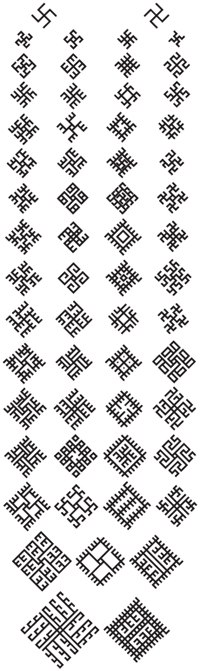
สัญลักษณ์กากบาทสายฟ้าบอลติกโบราณ ( pērkona krustsหรือperkūno kryžius (กากบาทของPerkūnas ); รวมถึงกากบาทไฟugunskrusts ) เป็นสัญลักษณ์สวัสติกะที่ใช้ตกแต่งวัตถุ เสื้อผ้าแบบดั้งเดิม และในการขุดค้นทางโบราณคดี[ 107 ] [ 108 ]
ในลิทัวเนียตั้งแต่สมัยโบราณสัญลักษณ์สวัสติกะ ซึ่งพบได้บนวัตถุที่ทำจากเขากวาง ไม้ โลหะ และดินเหนียว ได้ทำหน้าที่เป็นสัญลักษณ์ทางวัฒนธรรมและศาสนาที่สำคัญ ซึ่งฝังรากลึกในประเพณีบอลติกของชาวลิทั วเนีย นักวิจัยจากมหาวิทยาลัยไคลเปดา ค้น พบว่าไม่มีรูปแบบมาตรฐานหรือแบบแผนของสัญลักษณ์นี้: บนวัตถุที่มีด้านเดียว แขนของสวัสติกะอาจหมุนตามเข็มนาฬิกาหรือทวนเข็มนาฬิกา ในขณะที่วัตถุที่มีสองด้านอาจแสดงทิศทางทั้งสองพร้อมกัน ซึ่งบ่งชี้ถึงเจตนาเชิงสัญลักษณ์ที่ครอบคลุมหรือหลากหลาย ที่สำคัญ บริบทที่ปรากฏของสวัสติกะมักเชื่อมโยงกับเทพเจ้าสององค์ในตำนานลิทั วเนีย ได้แก่ เพอร์คูนัส เทพเจ้าแห่งฟ้าร้อง และคาลเวลิสช่างตีเหล็ก ความเชื่อมโยงนี้ตอกย้ำแนวคิดของสวัสติกะในฐานะการแสดงออกของ "กากบาทแห่งไฟ" ซึ่งเป็นกากบาทด้านเท่าที่ symbolizing ไฟหรือฟ้าร้อง ซึ่งเป็นลวดลายที่ยั่งยืนในสัญลักษณ์ทางศาสนาของบอลติกและลิทัวเนียโบราณ[ 109 ]
ตามที่ Stanisław Jakubowski จิตรกรกล่าวไว้ว่า "ดวงอาทิตย์น้อย" (ภาษาโปแลนด์: słoneczko ) เป็น สัญลักษณ์ของดวงอาทิตย์ในศาสนาเพแกนของชาวสลาฟ ยุคต้นเขาอ้างว่าสัญลักษณ์นี้ถูกสลักไว้บนอนุสาวรีย์ไม้ที่สร้างขึ้นใกล้กับสถานที่ฝังศพของชาวสลาฟที่เสียชีวิตเพื่อเป็นตัวแทนของชีวิตนิรันดร์ สัญลักษณ์นี้ปรากฏครั้งแรกในคอลเลกชันสัญลักษณ์และลักษณะทางสถาปัตยกรรมของชาวสลาฟยุคต้นของเขา ซึ่งเขาตั้งชื่อว่าPrasłowiańskie motywy architektoniczne (ภาษาโปแลนด์: ลวดลายทางสถาปัตยกรรมของชาวสลาฟยุคต้น ) ผลงานของเขาได้รับการตีพิมพ์ในปี 1923 [ 110 ]
ตราประจำตระกูลโบเรย์โกที่มีสวัสติกะสีแดงถูกใช้โดยตระกูลขุนนางหลายตระกูลในเครือจักรภพโปแลนด์-ลิทัวเนีย[ 111 ]
ตามที่บอริส คูฟติน กล่าว ชาวรัสเซียมักใช้สัญลักษณ์สวัสติกะเป็นองค์ประกอบตกแต่งและเป็นพื้นฐานของการประดับตกแต่งบนผลิตภัณฑ์ทอแบบดั้งเดิม[ 112 ]สามารถพบเห็นได้มากมายบนชุดพื้นเมืองของผู้หญิงจากที่ราบเมชเชรา[ 112 ]
ตามที่ผู้เขียนบางคนกล่าวไว้ ชื่อรัสเซียที่นิยมใช้ซึ่งเกี่ยวข้องกับสวัสติกะ ได้แก่veterok (“สายลม”) [ 113 ] ognevtsi (“เปลวไฟเล็กๆ”), “ห่าน”, “กระต่าย” (ผ้าเช็ดตัวที่มีสวัสติกะเรียกว่าผ้าเช็ดตัวที่มี “กระต่าย”) หรือ “ม้าตัวเล็ก” [ 114 ]คำที่คล้ายกันคือ “ koleso “ (“ล้อ”) ถูกใช้สำหรับเครื่องรางรูปดอกกุหลาบ เช่นล้อสายฟ้าหกเหลี่ยม ในนิทานพื้นบ้าน โดยเฉพาะใน ภาคเหนือ ของรัสเซีย[ 115 ] [ 116 ]
วัตถุที่มีลักษณะคล้ายค้อนหรือขวานสองคมปรากฏอยู่ท่ามกลางสัญลักษณ์เวทมนตร์บนกลองโนไอดี ของ ชาวซามิ ซึ่งใช้ในพิธีกรรมทางศาสนาก่อนที่ศาสนาคริสต์จะเข้ามา ชื่อของเทพเจ้าสายฟ้าของชาวซามิคือโฮรากัลเลสซึ่งเชื่อกันว่ามาจาก "ธอร์ผู้เฒ่า" ( Þórr karl ) บางครั้งบนกลองจะมีรูปผู้ชายถือวัตถุคล้ายค้อนอยู่ในมือทั้งสองข้าง และบางครั้งก็มีลักษณะคล้ายไม้กางเขนที่มีปลายคดงอ หรือสัญลักษณ์สวัสติกะ[ 102 ]
 สัญลักษณ์โบราณคือพระหัตถ์ของพระเจ้าหรือ "พระหัตถ์ของสวาร็อก" (ภาษาโปแลนด์: Ręce Swaroga ) [ 117 ]
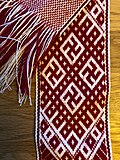 สวัสดิกะบนแถบลีลวาร์เดประเทศลัตเวีย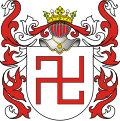
 แหวนของชาวลิทัวเนียสมัยนอกรีต ศตวรรษที่ 13-14 ประดับด้วยสัญลักษณ์สวัสติกะ พบในเมืองเคอร์นาเวสัญลักษณ์สวัสติกะถูกนำมาใช้กันอย่างแพร่หลายในเครื่องประดับของชาวลิทัวเนียมาตั้งแต่สมัยโบราณ รวมถึงวัตถุอื่นๆ ด้วย
เอเชียใต้และเอเชียตะวันออก
สัญลักษณ์นี้มีความสำคัญทางจิตวิญญาณต่อศาสนาอินเดีย เช่น ศาสนาฮินดู ศาสนาพุทธ และศาสนาเชน[ 5 ] [ 1 ]สวัสติกะเป็นสัญลักษณ์ศักดิ์สิทธิ์ใน ศาสนา บอน ซึ่งเป็น ศาสนาพื้นเมืองของทิเบต
ศาสนาฮินดู

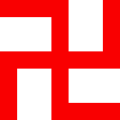

สวัสติกะเป็นสัญลักษณ์สำคัญของศาสนาฮินดู[ 1 ] [ 5 ]สัญลักษณ์สวัสติกะมักใช้หน้าทางเข้าหรือบนประตูบ้านหรือวัด เพื่อทำเครื่องหมายหน้าแรกของงบการเงินและมัณฑลาที่สร้างขึ้นสำหรับพิธีกรรมต่างๆ เช่น งานแต่งงานหรือการต้อนรับทารกแรกเกิด[ 1 ] [ 118 ]
สัญลักษณ์สวัสติกะมีความเกี่ยวข้องเป็นพิเศษกับเทศกาลดิวาลีโดยจะวาดเป็นรังโกลี (ทรายสี) หรือสร้างเป็นรูปทรงด้วย แสงไฟ ดีปักบนพื้นนอกบ้านของชาวฮินดู และบนผ้าม่านแขวนผนังและของตกแต่งอื่นๆ[ 119 ]
ในประเพณีที่หลากหลายภายในศาสนาฮินดู พบสัญลักษณ์สวัสติกะทั้งแบบตามเข็มนาฬิกาและทวนเข็มนาฬิกา ซึ่งแต่ละแบบมีความหมายแตกต่างกัน สัญลักษณ์ทวนเข็มนาฬิกาหรือสัญลักษณ์มือซ้ายบางครั้งเรียกว่าเสาวาสติกะหรือเสาวาสติกะ [ 1 ] สวัสติกะ ตาม เข็มนาฬิกาเป็นสัญลักษณ์ของดวงอาทิตย์ ( สุริยะ ) ซึ่งบ่งบอกถึงการเคลื่อนที่ของดวงอาทิตย์ในอินเดีย (ซีกโลกเหนือ) โดยปรากฏว่าดวงอาทิตย์เข้ามาจากทางทิศตะวันออก จากนั้นขึ้นไปทางทิศใต้ในตอนเที่ยง และออกไปทางทิศตะวันตก[ 1 ]สวัสติกะทวนเข็มนาฬิกาใช้น้อยกว่า มีความหมายถึงกลางคืน และในประเพณีตันตระเป็นสัญลักษณ์ของเทพีกาลีซึ่งเป็นร่างที่น่าเกรงขามของเทวีทุรคา [ 1 ] สัญลักษณ์นี้ยังแสดงถึงกิจกรรม กรรม การเคลื่อนไหว ล้อ และในบางบริบทคือดอกบัว[ 2 ] [ 3 ]ตามที่นอร์แมน แมคเคลแลนด์กล่าว สัญลักษณ์ของการเคลื่อนไหวและดวงอาทิตย์อาจมาจากรากฐานทางวัฒนธรรมยุคก่อนประวัติศาสตร์ร่วมกัน[ 120 ]
- สัญลักษณ์สวัสติกะเป็นสัญลักษณ์ที่พบได้ทั่วไปในวัดฮินดู
 วัดฮินดูแห่งหนึ่งในรัฐราชสถานประเทศอินเดีย
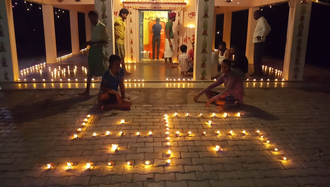 ลวดลายสวัสติกะที่สร้างขึ้นจากตะเกียงดินเผาภายในวัดฮินดู
 ศาลเจ้าฮินดูบาหลี
พุทธศาสนา
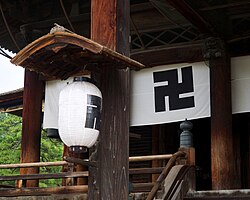
ในพุทธศาสนาเครื่องหมายสวัสติกะถือเป็นสัญลักษณ์แทนรอยพระบาทอันเป็นมงคลของพระพุทธเจ้า[ 1 ] [ 11 ]สวัสติกะที่หันไปทางซ้ายมักจะประทับอยู่บนหน้าอก เท้า หรือฝ่ามือของพระพุทธรูป เป็นสัญลักษณ์อันโดดเด่นของพระพุทธเจ้าในหลายส่วนของเอเชียและมีความคล้ายคลึงกับธรรมจักร[ 3 ] รูปทรงนี้เป็นสัญลักษณ์ของวัฏสงสารอันเป็นนิรันด ร์ซึ่งเป็นแนวคิดที่พบใน หลัก ธรรมสังสารวัฏของพุทธศาสนา[ 3 ]
สัญลักษณ์สวัสติกะพบได้ทั่วไปในประเพณีตันตระลึกลับของพุทธศาสนาเช่นเดียวกับในศาสนาฮินดู ซึ่งเกี่ยวข้องกับ ทฤษฎี จักระและเครื่องมือช่วยในการทำสมาธิอื่นๆ[ 118 ]สัญลักษณ์แบบหมุนตามเข็มนาฬิกาพบได้บ่อยกว่า และแตกต่างจากแบบหมุนทวนเข็มนาฬิกาที่พบได้ทั่วไปใน ประเพณี บอน ของทิเบต และเรียกกันในท้องถิ่นว่ายุงดรุง[ 121 ]
ในเอเชียตะวันออก สัญลักษณ์สวัสติกะพบได้ทั่วไปในวัดและชุมชนชาวพุทธ มักพบได้ในวัดพุทธ วัตถุมงคล ตำราพุทธ และโรงเรียนที่ก่อตั้งโดยกลุ่มชาวพุทธ นอกจากนี้ยังปรากฏเป็นลวดลายหรือรูปแบบ (ทั้งแบบเดี่ยวหรือถักทอเป็นลวดลาย) บนสิ่งทอ สถาปัตยกรรม และวัตถุตกแต่งต่างๆ ซึ่งเป็นสัญลักษณ์ของโชคลาภและความโชคดี สัญลักษณ์นี้ยังพบได้ในฐานะสัญลักษณ์ศักดิ์สิทธิ์ในประเพณีบอน แต่ในทิศทางหันไปทางซ้าย[ 52 ] [ 122 ]
เชน
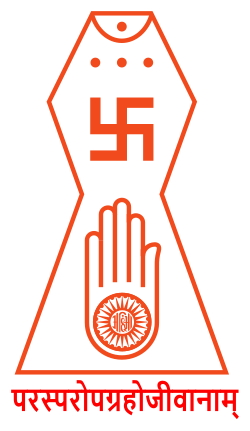

ในศาสนาเชนสัญลักษณ์นี้เป็นสัญลักษณ์ของพระติรถังการะ องค์ที่เจ็ด คือสุปราศวนาถ [ 1 ] ในประเพณีศเวตัมบาระ สัญลักษณ์ นี้ยังเป็นหนึ่งในอัษฏมังคละหรือสัญลักษณ์มงคลแปดประการวัดเชนและคัมภีร์ศักดิ์สิทธิ์ทั้งหมดต้องมีสัญลักษณ์สวัสติกะ และพิธีกรรมมักจะเริ่มต้นและสิ้นสุดด้วยการสร้างเครื่องหมายสวัสติกะหลายครั้งด้วยข้าวรอบแท่นบูชา ชาวเชนใช้ข้าวทำสวัสติกะหน้าเทวรูปแล้ววางเครื่องบูชาลงไป โดยปกติจะเป็นผลไม้สุกหรือผลไม้แห้ง ขนมหวาน ( ภาษาฮินดี: मिठाई miṭhāī ) หรือเหรียญหรือธนบัตร แขนทั้งสี่ของสวัสติกะเป็นสัญลักษณ์ของสถานที่ทั้งสี่ที่วิญญาณสามารถเกิดใหม่ในสังสารวัฏวัฏจักรแห่งการเกิดและการตายได้แก่สวรรค์ (สวรรค์) นรก (นรก ) มนุษย์ (มนุษยชาติ) หรือติรยันฉะ (พืชหรือสัตว์) ก่อนที่วิญญาณจะบรรลุโมกษะ (ความรอด) ในฐานะสิทธาหลังจากสิ้นสุดวัฏจักรแห่งการเกิดและการตายและกลายเป็นผู้รู้แจ้ง[ 4 ]
อัตราการแพร่ระบาดในเอเชียใต้
ในภูฏาน อินเดีย เนปาล และศรีลังกา สัญลักษณ์สวัสติกะเป็นเรื่องปกติ วัด ธุรกิจ และองค์กรอื่นๆ เช่น ห้องสมุดพุทธศาสนาตลาดหลักทรัพย์อาห์เมดาบัดและหอการค้าเนปาล[ 123 ]ใช้สัญลักษณ์สวัสติกะในรูปแบบนูนต่ำหรือโลโก้[ 122 ]สัญลักษณ์สวัสติกะพบได้ทั่วไปในชุมชนชาวอินเดียและเนปาล ตั้งอยู่บนร้านค้า อาคาร ยานพาหนะ และเสื้อผ้า สัญลักษณ์สวัสติกะยังคงโดดเด่นในพิธีกรรมฮินดู เช่น งานแต่งงาน สัญลักษณ์สวัสติกะที่หันไปทางซ้ายพบได้ในพิธีกรรมตันตระ[ 1 ]
วิทยาลัยมูเซอุสในโคลัมโบ ประเทศศรีลังกา ซึ่งเป็นโรงเรียนหญิงล้วนของพุทธศาสนา มีสัญลักษณ์สวัสติกะหันไปทางซ้ายอยู่ในโลโก้ของโรงเรียน
ในอินเดีย คำ ว่า SwastikและSwastika (มีตัวสะกดหลายแบบ) ใช้เป็นชื่อแรกของผู้ชายและผู้หญิงตามลำดับ เช่นSwastika Mukherjeeตราสัญลักษณ์ของรัฐพิหารก็มีสัญลักษณ์สวัสติกะสองอัน
ในประเทศภูฏาน ลวดลายสวัสติกะพบได้ในงานสถาปัตยกรรม ผ้าทอ และพิธีกรรมทางศาสนา
ในหมู่ประชากรส่วนใหญ่ที่นับถือศาสนาฮินดูในบาหลีประเทศอินโดนีเซีย สัญลักษณ์สวัสติกะพบเห็นได้ทั่วไปในวัด บ้าน และพื้นที่สาธารณะ ในทำนองเดียวกัน สวัสติกะเป็นสัญลักษณ์ที่พบเห็นได้ทั่วไปซึ่งเกี่ยวข้องกับรอยพระพุทธบาทในชุมชนพุทธศาสนาเถรวาดของเมียนมาร์ ไทย และกัมพูชา[ 122 ]
ขบวนการทางศาสนาใหม่ที่อิงตามตันตระ ชื่อ อนันดามาร์กา (อักษรเทวนาครี: आनन्द मार्ग, แปลว่า 'เส้นทางแห่งความสุข') ใช้ลวดลายคล้ายกับพวกราเอเลียน แต่ในกรณีของพวกเขา ดาวแห่งดาวิดที่ปรากฏนั้นถูกนิยามว่าเป็นรูปสามเหลี่ยมที่ตัดกัน โดยไม่มีการอ้างอิงถึงวัฒนธรรมยิวโดยเฉพาะ
 หนึ่งในลวดลายแกะสลักที่พบได้ทั่วไปในหมู่ชาวโตราจันในอินโดนีเซีย
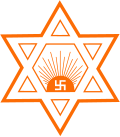 สัญลักษณ์ของขบวนการอนันดามาร์กา
แพร่กระจายไปยังเอเชียตะวันออก
สัญลักษณ์สวัสติกะเป็นสัญลักษณ์มงคลในประเทศจีน ซึ่งนำเข้ามาจากอินเดียพร้อมกับพุทธศาสนา [ 124 ] ในปี ค.ศ. 693 ในสมัยราชวงศ์ถัง ได้มีการประกาศว่าสัญลักษณ์นี้เป็น "แหล่งที่มาของโชคลาภทั้งหมด" และ อู๋เจ๋อเทียนเรียกว่า"ว่าน " ซึ่งต่อมากลายเป็นคำภาษาจีน[ 124 ]อักษรจีนสำหรับคำว่า "ว่าน" ( พินอิน: wàn ) มีรูปร่างคล้ายกับสวัสติกะและมีสองรูปแบบที่แตกต่างกันคือ 《卐》และ 《卍》 เนื่องจากอักษรจีน " ว่าน " (卐หรือ卍) เป็นคำพ้องเสียงกับคำภาษาจีนว่า "หมื่น" (万) และ "อนันต์" ดังนั้นอักษรจีนนี้จึงเป็นสัญลักษณ์ของความเป็นอมตะ[ 125 ]และอนันต์[ 126 ] : 175นอกจากนี้ยังเป็นตัวแทนของอายุยืนยาว อีกด้วย [ 126 ] : 175
อักษรจีนwanสามารถใช้เป็นอักษรเดี่ยว 《卐》หรือ 《卍》หรือใช้เป็นคู่ 《卐卍》ในศิลปะภาพวาด ศิลปะการตกแต่ง และเครื่องแต่งกายของจีนได้ เนื่องจากมีความหมายที่เป็นมงคล[ 126 ] : 175
การเพิ่มอักษรว่าน (卐หรือ卍) ลงในสัญลักษณ์หรือลวดลายมงคลอื่นๆ ของจีน สามารถเพิ่มความปรารถนานั้นได้ถึง 10,000 เท่า[ 124 ] [ 126 ] : 175นอกจากนี้ยังสามารถนำไปรวมกับอักษรจีนอื่นๆ ได้ เช่น อักษรจีนโชว《壽》สำหรับอายุยืน ซึ่งบางครั้งอาจนำไปรวมกับอักษรจีนโชวเพื่อเพิ่มความหมายของอายุยืนอีกด้วย[ 126 ] : 175
สัญลักษณ์สวัสติกะคู่ (卐และ卍) ถูกรวมไว้อย่างน้อยตั้งแต่สมัยราชวงศ์เหลียว (ค.ศ. 907–1125) เป็นส่วนหนึ่งของระบบการเขียนภาษาจีนและเป็นอักษรต่าง ๆของ 《萬》 หรือ 《万》 ( wànในภาษาจีนกลาง, 《만》 ( man ) ในภาษาเกาหลี กวางตุ้ง และญี่ปุ่น, vạnในภาษาเวียดนาม) ซึ่งหมายถึง " มากมาย " [ 127 ]
ตัวอักษร"ว่าน"สามารถเขียนในรูปแบบ " เซียงหยุน"ซึ่งเป็นเมฆมงคลของจีน ได้เช่นกัน

เมื่อระบบการเขียนภาษาจีนถูกนำเข้ามาในญี่ปุ่นในศตวรรษที่ 8 สัญลักษณ์สวัสติกะก็ถูกนำมาใช้ในภาษาและวัฒนธรรมญี่ปุ่น โดยทั่วไปเรียกว่า มันจิ ( แปลตรงตัวว่า' อักษรหมื่นตัว' ) ตั้งแต่ยุคกลาง สัญลักษณ์นี้ถูกใช้เป็นตราประจำตระกูลโดยตระกูลต่างๆ ของญี่ปุ่น เช่นตระกูลสึการุตระกูลฮาจิสุกะและตระกูลต่างๆ ประมาณ 60 ตระกูลที่อยู่ในตระกูลโทกูงาวะ [ 128 ] เมือง ฮิโรซากิในจังหวัดอาโอโมริกำหนดให้สัญลักษณ์นี้เป็นธงประจำเมืองอย่างเป็นทางการ ซึ่งมีที่มาจากสัญลักษณ์ที่ใช้ในตราประจำตระกูลสึการุเจ้าเมืองฮิโรซากิในช่วงสมัยเอโดะ
ในญี่ปุ่น สัญลักษณ์สวัสติกะยังถูกใช้เป็นสัญลักษณ์บนแผนที่และถูกกำหนดโดยพระราชบัญญัติสำรวจและกฎระเบียบของรัฐบาลญี่ปุ่นที่เกี่ยวข้องเพื่อบ่งบอกถึงวัดพุทธ[ 129 ]ญี่ปุ่นเคยพิจารณาที่จะเปลี่ยนแปลงสิ่งนี้เนื่องจากความขัดแย้งและความเข้าใจผิดที่เกิดขึ้นเป็นครั้งคราวโดยชาวต่างชาติ[ 130 ]สัญลักษณ์นี้บางครั้งถูกเซ็นเซอร์ในเวอร์ชันต่างประเทศของผลงานญี่ปุ่น เช่น อนิเมะ[ 131 ]การเซ็นเซอร์สัญลักษณ์นี้ในญี่ปุ่นและในสื่อญี่ปุ่นในต่างประเทศเป็นประเด็นถกเถียงที่เกิดขึ้นเป็นครั้งคราวเกี่ยวกับเสรีภาพในการพูด โดยนักวิจารณ์การเซ็นเซอร์โต้แย้งว่าไม่เคารพประวัติศาสตร์หรือเสรีภาพในการพูด[ 130 ] [ 131 ]
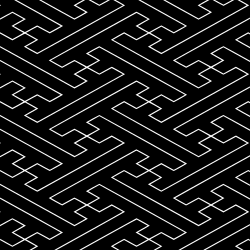
ใน ศิลปะ จีนและญี่ปุ่นมักพบสัญลักษณ์สวัสติกะเป็นส่วนหนึ่งของรูปแบบที่ซ้ำกัน รูปแบบทั่วไปอย่างหนึ่งที่เรียกว่าซายากาตะในภาษาญี่ปุ่น ประกอบด้วยสวัสติกะที่หันไปทางซ้ายและขวาเชื่อมต่อกันด้วยเส้น[ 132 ]เนื่องจากช่องว่างระหว่างเส้นมีรูปร่างที่โดดเด่น รูปแบบซายากาตะจึงบางครั้งเรียกว่า ลวดลาย ร่องกุญแจในภาษาอังกฤษ
ศาสนาจีนหลาย ศาสนา ใช้สัญลักษณ์สวัสติกะ รวมถึงศาสนากุ้ยอี้เต๋าและศาสนาซานเหรินเต๋าสมาคมสวัสติกะแดงซึ่งก่อตั้งขึ้นในประเทศจีนในปี 1922 ในฐานะสาขาการกุศลของศาสนากุ้ยอี้เต๋า ได้กลายเป็นผู้จัดหาความช่วยเหลือฉุกเฉินรายใหญ่ที่สุดในประเทศจีนในช่วงสงครามโลกครั้งที่สองในลักษณะเดียวกับสภากาชาดในส่วนอื่นๆ ของโลก สมาคมสวัสติกะแดงได้ละทิ้งแผ่นดินใหญ่ของจีนในปี 1954 โดยไปตั้งถิ่นฐานที่ฮ่องกงก่อน แล้วจึงไปที่ไต้หวัน พวกเขายังคงใช้สวัสติกะแดงเป็นสัญลักษณ์ของพวกเขา[ 133 ]
ขบวนการชี่กงฟาลุนกงซึ่งก่อตั้งขึ้นในประเทศจีนในช่วงต้นทศวรรษ 1990 ใช้สัญลักษณ์ที่มีสวัสติกะขนาดใหญ่ล้อมรอบด้วยสวัสติกะขนาดเล็กกว่า (และกลม) สี่อัน สลับกับสัญลักษณ์หยินหยาง[ 134 ]
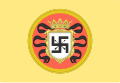 ธงประดับตราอาร์มของฮาเซคุระ สึเนนากะ
 อักษรจีน " wan"ถูกผสานรวมเข้ากับรูปแบบหนึ่งของอักษรจีน " shou"
 ภาพคู่ของพระนางหวังบนเสื้อคลุมมังกรสมัยราชวงศ์ชิง
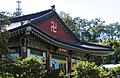 สัญลักษณ์สวัสติกะบนวัดแห่งหนึ่งในเกาหลี
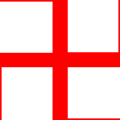 สัญลักษณ์ของซานเหรินเต๋าขบวนการ ทางศาสนา ขงจื๊อ-เต๋าในภาคตะวันออกเฉียงเหนือของจีน
 ธงของสมาคมสวัสติกะแดงกลุ่มบรรเทาทุกข์ฉุกเฉินที่ใหญ่ที่สุดในจีนช่วงสงครามโลกครั้งที่สอง
 ลวดลายของเทพีสายฟ้า (wa:on) ของชาวไซซิยัตในไต้หวัน
 สัญลักษณ์ของขบวนการฟาลุนกง
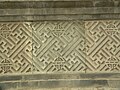 ผนังอาคารแห่งหนึ่งในประเทศจีน มีสัญลักษณ์สวัสติกะทั้งด้านซ้ายและขวาที่หมุนไป 45 องศา
การใช้ในศาสนาอิสลาม
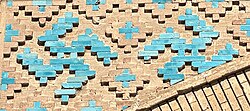
สัญลักษณ์สวัสติกะถูกใช้ในดินแดนก่อนยุคอิสลามและยังคงถูกใช้ต่อมาในยุคอิสลาม การใช้งานที่เก่าแก่ที่สุดบางส่วนที่มีบันทึกไว้มีอายุย้อนไปถึงพระราชวังของกาหลิบอุมัย ยะ ฮ์ วาลิด (705–715) และฮิชาม (724–743) ต่อมาสัญลักษณ์นี้ถูกใช้ในสมัยราชวงศ์อับบาสิดที่ประตู เมืองรัก กาในสเปนของชาวมุสลิมที่เมืองคอร์โดบาและโดยเฉพาะอย่างยิ่งใน โลก เปอร์เซีย (อนาโตเลียถึงอินเดีย) ตั้งแต่ สมัย เซลจุก (1037–1194) เป็นต้นไป นอกจากนี้ยังถูกใช้บนสิ่งทอและงานโลหะด้วย[ 135 ]การใช้สัญลักษณ์นี้บนสุสาน เช่นกอนบัด-เอ-ซอร์ค (1147) ดูเหมือนจะถูกใช้เพื่อเป็นสัญลักษณ์ของจิตวิญญาณและการฟื้นคืนชีพ[ 136 ] [ 137 ]การใช้สัญลักษณ์นี้บนประตูอาจถูกใช้เป็นสัญลักษณ์ของดวงอาทิตย์ในสมัยโบราณ ซึ่งเป็นสัญลักษณ์ของวันครีษมายันในฐานะประตูสู่สวรรค์[ 138 ]


ใน ดินแดนของมัมลุกในศตวรรษที่ 13 รูปแบบอักษร คูฟิกสี่เหลี่ยม ที่ซับซ้อน ซึ่งรู้จักกันในชื่อ 'มูฮัมหมัด/อาลีสี่คน' กลายเป็นที่โดดเด่น โดยมีการซ้ำคำว่า 'มูฮัมหมัด' สี่ครั้ง ซึ่งสามารถอ่านได้พร้อมกันว่า 'อาลี' ในช่องว่าง ทำให้เกิดสัญลักษณ์สวัสติกะอยู่ตรงกลาง รูปแบบนี้ได้รับความนิยมอย่างมาก แพร่กระจายไปทั่ว ดินแดน ออตโตมันและอิหร่าน[ 139 ]
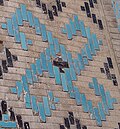


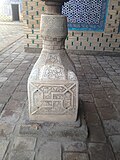 พระราชวังทอชโฮฟลีเมืองคีวา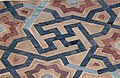
 ประตูหลักของสุสานอาฟัก โคจาที่ปกคลุมไปด้วยสัญลักษณ์สวัสติกะ เมืองคัชการ์
ยุโรปยุคคลาสสิก

การออกแบบสถาปัตยกรรม เครื่องแต่งกาย และเหรียญกษาปณ์ของกรีกโบราณ นั้นเต็มไปด้วยลวดลายสวัสติกะแบบเดี่ยวหรือแบบเชื่อมต่อกัน นอกจากนี้ยังมี เข็มกลัด ชุบทอง จากศตวรรษที่ 8 ก่อนคริสต์ศักราช ซึ่งตกแต่งด้วยสวัสติกะที่สลักไว้[ 140 ]สัญลักษณ์ที่เกี่ยวข้องในสถาปัตยกรรมตะวันตกแบบคลาสสิก ได้แก่ ไม้กางเขน ไตรสเกลสามขา หรือทริสเกลเลียนและลาบู รูทรงกลม สัญลักษณ์สวัสติกะยังเป็นที่รู้จักในบริบทเหล่านี้ด้วยชื่อต่างๆ โดยเฉพาะอย่างยิ่งแกมมาเดียน [ 141 ] หรือที่จริงแล้ว คือเตตระแกมมาเดียน ชื่อแกมมาเดียนมาจากการที่มันถูกมองว่าประกอบด้วยตัวอักษรกรีกแกมมา (Γ) สี่ตัว การออกแบบสถาปัตยกรรมของกรีกโบราณนั้นเต็มไปด้วยสัญลักษณ์ที่เชื่อมต่อกัน
ใน ศิลปะและสถาปัตยกรรม กรีก-โรมันรวมถึงศิลปะโรมาเนสก์และ โกธิก ในโลกตะวันตก สัญลักษณ์สวัสติกะเดี่ยวๆ นั้นค่อนข้างหายาก โดยทั่วไปแล้วจะพบสวัสติกะในรูปแบบองค์ประกอบซ้ำๆ ในขอบหรือลวดลายโมเสก สวัสติกะมักแสดงถึงการเคลื่อนไหวอย่างต่อเนื่อง สะท้อนถึงการออกแบบของกังหันลมหรือกังหันน้ำที่หมุนอยู่ เส้นโค้งของสวัสติกะที่เชื่อมต่อกันเป็นแถบขนาดใหญ่ที่ล้อมรอบแท่นบูชาแห่งสันติภาพ ( Ara Pacis ) ในสมัยออกัส ตัส
ลวดลายสวัสติกะที่เกี่ยวพันกันเป็นหนึ่งในลวดลายโมเสก หลายแบบ บนพื้นของมหาวิหารอาเมียงประเทศฝรั่งเศส[ 142 ]ขอบที่ประกอบด้วยสวัสติกะที่เชื่อมต่อกันเป็นลวดลายสถาปัตยกรรมโรมันที่พบได้ทั่วไป[ 143 ]และสามารถพบเห็นได้ในอาคารสมัยใหม่ในฐานะองค์ประกอบแบบนีโอคลาสสิก ขอบสวัสติกะเป็นรูปแบบหนึ่งของลวดลายคดเคี้ยวและสวัสติกะแต่ละอันในขอบดังกล่าวบางครั้งเรียกว่ากุญแจกรีกนอกจากนี้ยังพบสวัสติกะบนพื้นของปอมเปอีอีก ด้วย [ 144 ]
 กรีก tetraskelion ( lauburu )
 สัญลักษณ์สวัสติกะบนเหรียญเงินสเตเตอร์ ของกรีก จากเมืองโครินธ์ศตวรรษที่ 6 ก่อนคริสตกาล
 ภาพโมเสกโรมันแห่งลาโอลเมดาประเทศสเปน
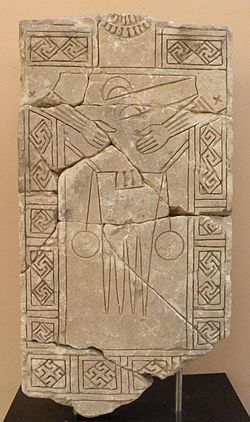
สัญลักษณ์สวัสติกะแพร่หลายในหมู่ชาวอิลลีเรียนซึ่งเป็นสัญลักษณ์ของดวงอาทิตย์และไฟ ลัทธิบูชาดวงอาทิตย์เป็นลัทธิหลักของชาวอิลลีเรียน โดยเฉพาะอย่างยิ่งสวัสติกะที่หมุนตามเข็มนาฬิกาจะถูกตีความว่าเป็นตัวแทนของการเคลื่อนที่ของดวงอาทิตย์[ 98 ] [ 145 ] [ 146 ]
สัญลักษณ์สวัสติกะได้รับการอนุรักษ์ไว้โดยชาวอัลบาเนียตั้งแต่สมัยอิลลีเรียนในฐานะ สัญลักษณ์ นอกรีตที่พบได้ทั่วไปในบริบทต่างๆ ของศิลปะพื้นบ้านอัลบาเนีย รวมถึงการสักแบบดั้งเดิมศิลปะบนหลุมศพ เครื่องประดับ เสื้อผ้า และงานแกะสลักบ้าน สวัสติกะ ( ภาษาอัลบาเนีย: kryqi grepçหรือkryqi i thyer , "ไม้กางเขนตะขอ") และไม้กางเขนอื่นๆ ในประเพณีอัลบาเนียเป็นตัวแทนของดวงอาทิตย์ ( Dielli ) และไฟ ( zjarriซึ่งเห็นได้ชัดว่าเรียกด้วยชื่อเทพเจ้าEnji ) ในศาสนานอกรีตของอัลบาเนียไฟถือเป็นลูกหลานของดวงอาทิตย์ และมีการปฏิบัติพิธีกรรมตามปฏิทินไฟเพื่อให้ความแข็งแกร่งแก่ดวงอาทิตย์และเพื่อขับไล่สิ่งชั่วร้าย[ 147 ] [ 148 ]
ยุโรปยุคกลางและยุคต้นสมัยใหม่
ยุคกลาง
ในศาสนาคริสต์ สัญลักษณ์สวัสติกะถูกใช้เป็นรูปแบบตะขอของไม้กางเขนคริสเตียนซึ่งเป็นสัญลักษณ์แห่งชัยชนะของพระคริสต์เหนือความตาย โบสถ์คริสเตียนบางแห่งที่สร้างขึ้นใน ยุค โรมาเนสก์และโกธิกได้รับการตกแต่งด้วยสวัสติกะ ซึ่งเป็นการสืบทอดมาจากการออกแบบของโรมันในยุคก่อนหน้า สวัสติกะปรากฏให้เห็นอย่างเด่นชัดในภาพโมเสกในมหาวิหารเซนต์โซเฟีย กรุงเคียฟ ซึ่งมีอายุตั้งแต่ศตวรรษที่ 12 นอกจากนี้ยังปรากฏเป็นลวดลายประดับซ้ำๆ บนโลงศพที่เรียกว่าของสติลิโชในมหาวิหารซานต์แอมโบรจิโอในมิลาน[ 149 ]
ภาพวาดบนเพดานในปี 1910 ในพิพิธภัณฑ์โบราณคดีเกรโนเบิล (อดีตโบสถ์เซนต์ลอเรนต์) มีสัญลักษณ์สวัสติกะอยู่มากมาย ข้อเสนอแนะที่เชื่อมโยงโดยตรงระหว่างภาพวาดนี้กับภาพโมเสกบนพื้นรูปสวัสติกะในมหาวิหารอาเมียงซึ่งสร้างขึ้นบนพื้นที่โบราณสถานของศาสนาเพแกนที่อาเมียงประเทศฝรั่งเศส ในศตวรรษที่ 13 นั้น ถือว่าไม่น่าเป็นไปได้ ส่วนผ้าคลุมไหล่ที่นักบวชสวมใส่ในภาพวาด "ศีลศักดิ์สิทธิ์ทั้งเจ็ด"โดยโรเจียร์ ฟาน เดอร์ เวย์เดน ในปี 1445 นั้น แสดงสัญลักษณ์สวัสติกะเป็นเพียงวิธีหนึ่งในการแสดงภาพไม้กางเขนเท่านั้น
สัญลักษณ์สวัสติกะยังปรากฏในงานศิลปะและสถาปัตยกรรมในช่วง ยุค เรเนสซองส์และบาโรกภาพจิตรกรรมฝาผนังเรื่อง "โรงเรียนแห่งเอเธนส์"แสดงให้เห็นเครื่องประดับที่ทำจากสัญลักษณ์สวัสติกะ และสัญลักษณ์นี้ยังสามารถพบได้บนด้านหน้าของโบสถ์ซานตา มาเรีย เดลลา ซาลูเตซึ่งเป็นโบสถ์โรมันคาทอลิกและมหาวิหารขนาดเล็กที่ตั้งอยู่ที่ ปุ นตา เดลลา โดกานาในเขตดอร์โซดูโรของเมืองเวนิส
ในสาธารณรัฐโปแลนด์ที่หนึ่งสัญลักษณ์สวัสติกะก็เป็นที่นิยมในหมู่ขุนนางเช่นกัน ตระกูลขุนนางหลายตระกูล เช่น ตระกูลโบเรย์โก บอร์ซิม และราดซีโชฟสกี จากรูเทเนีย ก็ใช้สวัสติกะเป็นตราประจำ ตระกูลเช่น กัน ตระกูลนี้รุ่งเรืองที่สุดในศตวรรษที่ 14 และ 15 และตราประจำตระกูลนี้ปรากฏอยู่ในหนังสือเกี่ยวกับตราประจำตระกูลหลายเล่มจากยุคนั้น
สวัสติกะยังเป็นสัญลักษณ์ทางตราประจำตระกูล ตัวอย่างเช่น บนตราประจำตระกูลโบเรย์โกซึ่งใช้โดยขุนนางในโปแลนด์และยูเครน ในศตวรรษที่ 19 สวัสติกะเป็นหนึ่งในสัญลักษณ์ของจักรวรรดิรัสเซียและถูกใช้บนเหรียญกษาปณ์เป็นพื้นหลังของนกอินทรีรัสเซีย[ 150 ]
 สัญลักษณ์ของ ชาวบาสกีร์คือดวงอาทิตย์และความอุดมสมบูรณ์
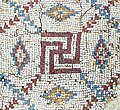 รูปสัญลักษณ์สวัสติกะที่ทำจากโมเสกใน โบสถ์ ไบแซนไทน์ ที่ขุดค้นพบ ในเมืองชาเวอี ซิออน (อิสราเอล)
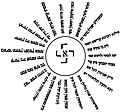 สัญลักษณ์สวัสติกะที่ประกอบด้วยอักษรฮีบรู เป็นสัญลักษณ์ลึกลับจาก ตำ ราคาบาล่าของ ชาวยิว เรื่อง "Parashat Eliezer" ซึ่งเขียนขึ้นในศตวรรษที่ 18 หรือก่อนหน้านั้น
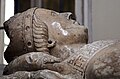 สัญลักษณ์สวัสติกะบนเครื่องแต่งกายของรูปปั้นบิชอปวิลเลียม เอดิงตัน (เสียชีวิตปี 1366) ในมหาวิหารวินเชสเตอร์
 รูปสลักสวัสติกะจำลองสมัยวิคตอเรียนบนทุ่งอิลค์ลีย์ ตั้งอยู่ใกล้กับของจริงเพื่อช่วยให้นักท่องเที่ยวตีความความหมายของรูปสลักได้ง่ายขึ้น
การค้นพบใหม่โดยไฮน์ริช ชลีมันน์
At Troy near the Dardanelles, Heinrich Schliemann's 1871–1875 archaeological excavations discovered objects decorated with swastikas.[151]:101–105[152][153]:31[154]:31 Hearing of this, the director of the French School at Athens, Émile-Louis Burnouf, wrote to Schliemann in 1872, stating "the Swastika should be regarded as a sign of the Aryan race". Burnouf told Schliemann that "It should also be noted that the Jews have completely rejected it".[155]:89 Accordingly, Schliemann believed the Trojans to have been Aryans: "The primitive Trojans, therefore, belonged to the Aryan race, which is further sufficiently proved by the symbols on the round terra-cottas".[151]:157[155]:90 Schliemann accepted Burnouf's interpretation.[155]:89
This winter, I have read in Athens many excellent works of celebrated scholars on Indian antiquities, especially Adalbert Kuhn, Die Herakunft des Feuers; Max Müller's Essays; Émile Burnouf, La Science des Religions and Essai sur le Vêda; as well as several works by Eugène Burnouf; and I now perceive that these crosses upon the Trojan terra-cottas are of the highest importance to archæology.
—Heinrich Schliemann, Troy and Its Remains, 1875[151]:101
Schliemann believed that the use of swastikas spread widely across Eurasia.[156]
... I am now able to prove that ... the 卍, which I find in Émile Burnouf's Sanscrit lexicon, under the name of "suastika," and with the meaning εὖ ἐστι, or as the sign of good wishes, were already regarded, thousands of years before Christ, as religious symbols of the very greatest importance among the early progenitors of the Aryan races in Bactria and in the villages of the Oxus, at a time when Germans, Indians, Pelasgians, Celts, Persians, Slavonians and Iranians still formed one nation and spoke one language.
—Heinrich Schliemann, Troy and Its Remains, 1875[151]:101–102
Schliemann established a link between the swastika and Germany. He connected objects he excavated at Troy to objects bearing swastikas found in Germany near Königswalde on the Oder.[152][153]:31[154]:31[155]:90

For I recognise at the first glance the "suastika" upon one of those three pot bottoms, which were discovered on Bishop's Island near Königswalde on the right bank of the Oder, and have given rise to very many learned discussions, while no one recognised the mark as that exceedingly significant religious symbol of our remote ancestors.
—Heinrich Schliemann, Troy and Its Remains, 1875[151]:102
Sarah Boxer, in an article in 2000 in The New York Times, described this as a "fateful link".[152] According to Steven Heller, "Schliemann presumed that the swastika was a religious symbol of his German ancestors which linked ancient Teutons, Homeric Greeks and Vedic India".[153]:31 According to Bernard Mees, "Of all of the pre-runic symbols, the swastika has always been the most popular among scholars" and "The origin of swastika studies must be traced to the excitement generated by the archaeological finds of Heinrich Schliemann at Troy".[157]
After his excavations at Troy, Schliemann began digging at Mycenae. According to Cathy Gere, "Having burdened the swastika symbol with such cultural, religious and racial significance in Troy and Its Remains, it was incumbent on Schliemann to find the symbol repeated at Mycenae, but its occurrence turned out to be disappointingly infrequent".[155]:91 Gere writes that "He did his best with what he had":[155]:91
The cross with the marks of four nails may often be seen; as well as the 卍, which is usually also represented with four points indicating the four nails, thus ࿘. These signs cannot but represent the suastika, formed by two pieces of wood, which were laid across and fixed with four nails, and in the joint of which the holy fire was produced by friction by a third piece of wood. But both the cross and the 卍 occur for the most part only on the vases with geometrical patterns.
—Heinrich Schliemann, Mycenæ, 1878[158]:66–68
Gere points out that although Schliemann wrote that the motif "may often be seen", his 1878 book Mycenæ contained no illustrations of examples.[155]:91 Schliemann described "a small and thick terra-cotta disk" on which "are engraved a number of 卍's, the sign which occurs so frequently in the ruins of Troy", but as Gere notes, he did not publish an illustration.[158]:77[155]:91

Among the gold grave goods at Grave Circles A and B was a repoussé roundel in grave III of Grave Circle A, the ornamentation of which Schliemann thought was "derived" from the swastika:
The curious ornamentation in the centre, which so often recurs here, seems to me to be derived from the ࿘, the more so as the points which are thought to be the marks of the nails, are seldom missing; the artist has only added two more arms and curved all of them.
—Heinrich Schliemann, Mycenæ, 1878[158]:165–166
According to Gere, this motif is "completely dissimilar" to the swastika, and that Schliemann was "straining desperately after the same connection".[155]:91 Nevertheless, the Mycenaean Greeks and the Trojan people both came to be identified as representatives of the Aryan race: "Despite the difficulties with linking the symbolism of Troy and Mycenae, the common Aryan roots of the two peoples became something of a truism".[155]:91
The house Schliemann had had built in Panepistimiou Street in Athens by 1880, Iliou Melathron, is decorated with swastika symbols and motifs in numerous places, including the ironwork railing and gates, the window bars, the ceiling fresco of the entrance hall, and the entire floor of one room.[155]:117–123
Following Schliemann, academic studies on the swastika were published by Ludvig Müller, Michał Żmigrodzki, Eugène Goblet d'Alviella, Thomas Wilson, Oscar Montelius and Joseph Déchelette.[157]
German occultism and pan-German nationalism
On 24 June 1875, Guido von List commemorated the 1500th anniversary of the German victory over the Roman Empire at the Battle of Carnuntum by burying a swastika of eight wine bottles beneath the Heidentor (lit.'Heathens' Gate') in the ruins of Carnuntum.[159]:35 In 1891, List began to claim that heraldry's division of the field was derived from the shapes of runes.[159]:71 He claimed that the medieval German Vehmgericht was a survival of the pre-Christian Armanistpriest-kings and that the cryptic letters "SSGG" inscribed on vehmic knives represented a double sig rune followed by two swastikas.[159]:76
In 1897, Max Ferdinand Sebaldt von Werth published Wanidis and Sexualreligion, which according to Nicholas Goodrick-Clarke in The Occult Roots of Nazism, "described the sexual-religion of the Aryans, a sacred practice of eugenics designed to maintain the purity of the race".[159]:51 Both works were "illustrated with the magical curved-armed armed swastika".[159]:51 Influenced by Sebaldt, List published in Der Scherer – erstes illustriertes Tiroler Witzblatt an article ("Germanischer Lichtdienst") which claimed the swastika was a sacred symbol of the Aryans representing the "fire-whisk" (Feuerquirl) with which the creator deityMundelföri had begun the world.[159]:52 In September 1903, List published an article discussing the creation of the universe, the "old-Aryan sexual religion", reincarnation, karma, "Wotanism", and "Armanism" from his theosophical viewpoint, which was illustrated by triskelions and various swastikas in the Viennese occult journal Die Gnosis.[159]:41,52 According to Goodrick-Clarke, "This article marked the first stage in List's articulation of a Germanic occult religion, the principal concern of which was racial purity".[159]:52
Between 1905 and 1907, List published articles in the Leipziger Illustrierte Zeitung arguing that the swastika, the triskelion, and the sun-wheel were all "Armanist" occult symbols (Armanen runes) concealed in German heraldry, and in 1908 his Das Geheimnis der Runen (lit.'The Secret of the Runes') argued that the swastika or Armanen rune "Gibor" was represented in blazons including different heraldic crosses and kinked versions of the ordinariespale, bend, and fess.[159]:72 List argued that the swastika, triskelion, and other Armanen runes had been concealed in 15th-century rose windows and curvilinear tracery in late Gothic architecture.[159]:74

List's 1908 book Die Rita der Ario-Germanen (lit.'The Rite of the Ario-Germans') featured chapter headings with triskelions, swastikas, and other symbols. The work laid out his belief in an ancient priestly Armanenschaft of Wotanist initiates and identified the "Ario-Germans" as a "race" identical with Helena Blavatsky's theosophical fifth "root race".[159]:52–53 List's 1910 Die Religion der Ario-Germanen (lit.'The Religion of the Ario-Germans') discussed Yuga cycles and the Kali Yuga, proposing a mathematical relationship with the Grímnismál of the Edda.[159]:53 His Die Bilderschrift der Ario-Germanen (lit.'The Picture-Writing of the Ario-Germans') of the same year connected Blavatsky's Hindu-inspired cosmic cycles (kalpas) with the realms of Muspelheim (Muspilheim), Asgard, Vanaheimr (Wanenheim), and Midgard, each with a corresponding symbol. Blavatsky's first Astral and second Hyperborean races List connected with the descendants of Ymir and Orgelmir, her third Lemurian race was his race of Thrudgelmir, her fourth Atlantean race his descendants of Bergelmir, and Blavatsky's fifth root race List identified as the "Ario-Germans".[159]:53–54 According to Goodrick-Clarke, List again argued that the clockwise swastika was a holy symbol of the "Ario-Germans":
A series of anti-clockwise triskelions and swastikas and inverted triangles symbolized stages of cosmic evolution in the downsweep of the cycle (i.e., the evolution from unity to multiplicity), while their clockwise and upright counterparts connoted the return path to the godhead. The skewed super-imposition of these 'falling' and 'rising' sigils created complex sigils like the hexagram and the Maltese Cross. List asserted that these latter symbols were utterly sacred, because they embraced the two antithetical forces of all creation: as the representative symbols of the zenith of multiplicity at the outermost limit of the cycle, they denoted the Ario-German god-man, the highest form of life ever to evolve in the universe.[159]:54
List's 1914 Die Ursprache der Ario-Germanen (lit.'The Proto-Language of the Ario-Germans') adopted the geological ideas of theosophist William Scott-Elliot and claimed that fragments of Atlantis remained part of Europe, pointing to rocking stones in Lower Austria and European megaliths as evidence. From Jörg Lanz von Liebenfels, List took on occult ideas about the Aryan homeland Arktogäa (a lost polar continent), and struggle the Ario-German master races and the non-Aryan slave races, and the Knights Templar.[159]:54–55 List believed that the Templars had been adepts of "Armanism" during the Middle Ages' Christian ascendancy, and that they had been suppressed for worshipping the Maltese cross that List believed to be derived from a superimposed clockwise and counter-clockwise swastika and which he identified with Baphomet.[159]:61–62 Members of the inner circle of the Guido von List Society, the Hoher Armanen-Orden (HAO), expressed their membership of the occult priesthood with swastikas. Heinrich Winter, Friedrich Oskar Wannieck, and Georg Hauerstein senior's first wife all had their graves decorated with swastikas.[159]:65

Lanz, a former Cistercian, established the Order of the New Templars or ONT (Ordo Novi Templilit.'Order of the New Temple') in imitation of the Knights Templar whose monastic rule had been written by the Cistercian Bernard of Clairvaux and whom Lanz believed had aimed to establish "a Greater Germanicorder-state, which would encompass the entire Mediterranean area and extend its sphere of influence deep into the Middle East" whose eventual suppression had been a triumph of racial inferiority over the "Ario-Christian" eugenics practised by the Templars.[159]:108 As the headquarters of his revived Templar Order and as a museum of Aryan anthropology, Lanz bought Burg Werfenstein on the Danube, where on Christmas Day 1907, he hoisted his heraldic banner (gules, an eagle's wing argent) and the flag of the ONT: a swastika gules surrounded by four fleurs-de-lisazure on a field or.[159]:106,109,113
Post-Schliemann popularity
The swastika symbol became a popular symbol in the Western world in the early 20th century, and was often used for ornamentation. It symbolised many things to Europeans, most commonly good luck and auspiciousness.[19]
The Benedictine choir school at Lambach Abbey, Upper Austria, which Hitler attended for several months as a boy, had a swastika chiselled into the monastery portal and also the wall above the spring grotto in the courtyard by 1868. Their origin was the personal coat of arms of Theoderich Hagn, abbot of the monastery in Lambach, which bore a golden swastika with slanted points on a blue field.[160]
The British author and poet Rudyard Kipling used the symbol on the cover art of several of his works, including The Five Nations (1903), which pairs it with an elephant. Once Adolf Hitler and the Nazis came to power, Kipling ordered that swastikas should no longer adorn his books. In 1927, a red swastika defaced by a Union Jack was proposed as a flag for the Union of South Africa.[161]
The logo of H/f. Eimskipafjelag Íslands[162] was a swastika, called "Thor's hammer", from its founding in 1914 until the Second World War, when it was discontinued and changed to read only the letters Eimskip.
The swastika was also used by the women's paramilitary organisation Lotta Svärd, which was banned in 1944 in accordance with the Moscow Armistice between Finland and the alliedSoviet Union and Britain.

Also, the insignias of the Cross of Liberty, designed by Gallen-Kallela in 1918, have swastikas. The 3rd class Cross of Liberty is depicted in the upper left corner of the standard of the President of Finland, who is the grand master of the order, too.[163]

Latvia adopted the swastika for its Air Force in 1918/1919 and continued its use until the Soviet occupation in 1940.[164][165] The cross itself was maroon on a white background, mirroring the colours of the Latvian flag. Earlier versions pointed counterclockwise, while later versions pointed clockwise and eliminated the white background.[166][167] Various other Latvian Army units and the Latvian War College[168] (the predecessor of the National Defence Academy) also had adopted the symbol in their battle flags and insignia during the Latvian War of Independence.[169] A stylised fire cross is the base of the Order of Lāčplēsis, the highest military decoration of Latvia for participants of the War of Independence.[170] The Pērkonkrusts, an ultra-nationalist political organisation active in the 1930s, also used the fire cross as one of its symbols.
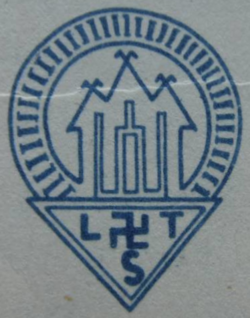

The swastika symbol (Lithuanian: sūkurėlis) is a traditional Baltic ornament,[107][171] found on relics dating from at least the 13th century.[172] The sūkurėlis for Lithuanians represents the history and memory of their Lithuanian ancestors as well as the Baltic people at large.[172] There are monuments in Lithuania, such as the Freedom Monument in Rokiškis, where swastikas can be found.[172] In Lithuania, the swastika was first used on a flag in 1924 by the Lithuanian Nationalist Union.[173]
Starting in 1917, Mikal Sylten's staunchly antisemitic periodical, Nationalt Tidsskrift took up the swastika as a symbol, three years before Adolf Hitler chose to do so.[174]
The left-handed swastika was a favourite sign of the last Russian Empress Alexandra Feodorovna. She wore a talisman in the form of a swastika, put it everywhere for happiness, including on her suicide letters from Tobolsk,[175] later drew with a pencil on the wall and in the window opening of the room in the Ipatiev House, which served as the place of the last imprisonment of the royal family and on the wallpaper above the bed.[176]
The Russian Provisional Government of 1917 printed several new banknotes with right-facing, diagonally rotated swastikas in their centres.[177] The banknote design was initially intended for the Mongolian national bank but was re-purposed for Russian rubles after the February revolution. Swastikas were depicted, and some Soviet credit cards (sovznaks) were printed with clichés in circulation in 1918–1922.[178]
During the Russian Civil War, swastikas were present in the symbolism of the uniform of some units of the White ArmyAsiatic Cavalry Division of Baron Ungern in Siberia and Bogd Khanate of Mongolia, which is explained by the significant number of Buddhists within it.[179] The Red Army's ethnic Kalmyk units wore distinct armbands featuring a swastika with "РСФСР" (Roman: "RSFSR") inscriptions on them.[180]
New religious movements
Besides its use as a religious symbol in Hinduism, Buddhism, and Jainism, which can be traced back to pre-modern traditions, the swastika was also incorporated into a large number of new religious movements which were established in the West in the modern period.
In the 1880s, the U.S.-origined Theosophical Society adopted a swastika as part of its seal, along with an Om, a hexagram or star of David, an Ankh, and an Ouroboros. Unlike the much more recent Raëlian movement, the Theosophical Society symbol has been free from controversy, and the seal is still used. The current seal also includes the text "There is no religion higher than truth."[181]
The Raëlian Movement, whose adherents believe extraterrestrials created all life on earth, uses a symbol that is often the source of considerable controversy: an interlaced star of David and a swastika. The Raëlians say the Star of David represents infinity in space, whereas the swastika represents infinity in time –no beginning and no end in time, and everything being cyclic.[182] In 1991, the symbol was changed to remove the swastika, out of respect to the victims of the Holocaust, but as of 2007 it has been restored to its original form.[183]
The swastika is a holy symbol in neopaganGermanic Heathenry, along with the hammer of Thor and runes. This tradition –which is found in Scandinavia, Germany, and elsewhere –considers the swastika to be derived from a Norse symbol for the sun. Their use of the symbol has led people to accuse them of being a neo-Nazi group.[184][185][186]
 The seal of the Theosophical Society
 The Raëlian symbol with the swastika
 The alternative Raëlian with the spiral
Nazism



Before the Nazis, the swastika (tilted at 45 degrees), was already in use as a symbol of the German nationalist Völkisch movement. In post-World War I Germany, the newly established Nazi Party formally adopted the swastika in 1920.[19][187] The Nazi Party emblem was a black swastika rotated 45 degrees on a white circle on a red background. This insignia was used on the party's flag, badge, and armband. Adolf Hitler also designed his personal standard using a black swastika sitting flat on one arm, not rotated.[188]


In his 1925 work Mein Kampf, Hitler writes: "I myself, meanwhile, after innumerable attempts, had laid down a final form; a flag with a red background, a white disk, and a black hooked cross in the middle. After long trials I also found a definite proportion between the size of the flag and the size of the white disk, as well as the shape and thickness of the hooked cross."
When Hitler created a flag for the Nazi Party, he sought to incorporate both the swastika and "those revered colours expressive of our homage to the glorious past and which once brought so much honour to the German nation". (Red, white, and black were the colours of the flag of the old German Empire.) He also stated: "As National Socialists, we see our program in our flag. In red, we see the social idea of the movement; in white, the nationalistic idea; in the hooked cross, the mission of the struggle for the victory of the Aryan man, and, by the same token, the victory of the idea of creative work."[189]
The swastika was also understood as "the symbol of the creating, effecting life" (das Symbol des schaffenden, wirkenden Lebens) and as "race emblem of Germanism" (Rasseabzeichen des Germanentums).[190]
The concepts of racial hygiene and scientific racism were central to Nazism.[191][192] High-ranking Nazi theorist Alfred Rosenberg noted that the Indo-Aryan peoples were both a model to be imitated and a warning of the dangers of the spiritual and racial "confusion" that, he believed, arose from the proximity of races. The Nazis co-opted the swastika as a symbol of the Aryan master race.
On 14 March 1933, shortly after Hitler's appointment as Chancellor of Germany, the NSDAP flag was hoisted alongside Germany's national colours. As part of the Nuremberg Laws, the NSDAP flag –with the swastika slightly offset from centre –was adopted as the sole national flag of Germany on 15 September 1935.[193]
 Heinrich Pudor's völkischTreu Deutsch ('True German') 1918 with a swastika. From the collections of the Leipzig City Museum.
 German World War I helmet with swastika used by a member of the Marinebrigade Ehrhardt, a right-wing paramilitary free corps, participating in the Kapp Putsch 1920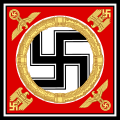
 Cross of Honour of the German Mother (1939–1945) given to German mothers of four or more children
Americas
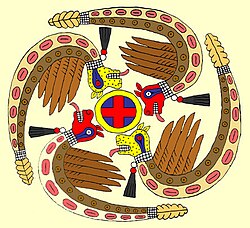
The swastika has been used in the art and iconography of multiple indigenous peoples of North America, including the Hopi, Navajo, and Tlingit.[195] Swastikas were founds on pottery from the Mississippi valley and on copper objects in the Hopewell Mounds in Ross County, Ohio, and on objects associated with the Southeastern Ceremonial Complex (S.E.C.C.).[196][197] To the Hopi it represents the wandering Hopi clan. The Navajo symbol, called tsin náálwołí ("whirling log"), represents humanity and life, and is used in healing rituals.[198][199] A brightly coloured First Nations saddle featuring swastika designs is on display at the Royal Saskatchewan Museum in Canada.[200]
Before the 1930s, the symbol for the 45th Infantry Division of the United States Army was a red diamond with a yellow swastika, a tribute to the large Native American population in the southwestern United States. It was later replaced with a thunderbird symbol.
In the 20th century, traders encouraged Native American artists to use the symbol in their crafts; it was used by the US Army 45th Infantry Division, an all-Native American division.[201][202][203] The symbol lost popularity in the 1930s due to its associations with Nazi Germany. In 1940, in part due to government encouragement, community leaders from several Native American tribes issued a statement promising not to use the symbol.[204][198][205][203] However, the symbol has continued to be used by Native American groups, both in reference to the original symbol and as a memorial to the 45th Division, despite external objections to its use.[8][203][205][206][207][208] The symbol was used on state road signs in Arizona from the 1920s until the 1940s.[209]
The town of Swastika, Ontario, and the hamlet of Swastika, New York were named after the symbol.
From 1909 to 1916, the K-R-I-T automobile, manufactured in Detroit, Michigan, used a right-facing swastika as its trademark.
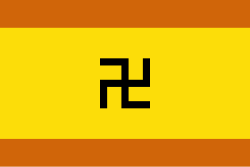
The flag of the Guna people (also "Kuna Yala" or "Guna Yala") of Panama, adopted in 1925, has a swastika symbol that they call Naa Ukuryaa. According to one explanation, this ancestral symbol symbolises the octopus that created the world, its tentacles pointing to the four cardinal points.[210] In 1942, a ring was added to the centre of the flag to distinguish it from the Nazi Party's symbol (this version subsequently fell into disuse).[211]
- The swastika in North America
 Chief William Neptune of the Passamaquoddy, wearing a headdress and outfit adorned with swastikas
 Chilocco Indian Agricultural School basketball team in 1909
 Fernie Swastikas hockey team in 1922
 Original insignia of the 45th Infantry Division
 Pillow cover offered by the Girls' Club in The Ladies Home Journal in 1912
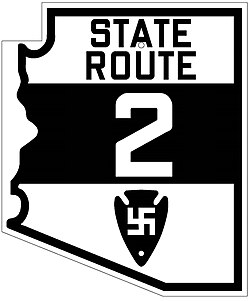 Arizona state highway marker (1927)
Africa
Swastikas can be seen in various African cultures. In Ethiopia a swastika is carved in the window of the famous 12th-century Biete Maryam, one of the Rock-Hewn Churches, Lalibela.[7] In Ghana, the adinkra symbolnkontim, used by the Akan people to represent loyalty, takes the form of a swastika. Nkontim symbols could be found on Ashanti gold weights and clothing.[212]
 Carved fretwork forming a swastika on the Biete Maryam in Ethiopia
 Nkontimadinkra symbol from Ghana, representing loyalty and readiness to serve
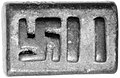 Ashanti weight in Africa
Modern adoptions
A ugunskrusts ('fire cross') is used by the Baltic neopagan religions Dievturība in Latvia and Romuva in Lithuania.[213]
In the early 1990s, the former dissident and one of the founders of Russian neo-paganism Alexey Dobrovolsky first gave the name "kolovrat" (Russian: коловрат, literally 'spinning wheel') to a four-beam swastika, identical to the Nazi symbol, and later transferred this name to an eight-beam rectangular swastika.[214] The eight-beam swastika dates back all the way to Ancient Greece, with some ceramics containing the eight-beamed symbol.[215][216] A necklace found in Ukraine via metal detection is estimated to date back to the 11th century and also contained the kolovrat symbol, providing some solid evidence of its presence among the Slavic people at the time. A six-beamed variant is located in the tower of the Vang Church in Karpacz, Poland.[217] According to the historian and religious scholar Roman Shizhensky, Dobrovolsky took the idea of the swastika from the work "The Chronicle of Oera Linda"[218] by the Nazi ideologist Herman Wirth, the first head of the Ahnenerbe.[219] Dobrovolsky introduced the eight-beam "kolovrat" as a symbol of "resurgent paganism."[220] He considered this version of the Kolovrat a pagan sign of the sun and, in 1996, declared it a symbol of the uncompromising "national liberation struggle" against the "Zhyd yoke".[221] According to Dobrovolsky, the meaning of the "kolovrat" completely coincides with the meaning of the Nazi swastika.[222] The kolovrat is the most commonly used religious symbol within neopagan Slavic Native Faith (a.k.a. Rodnovery).[223][224]
In 2005, authorities in Tajikistan called for the widespread adoption of the swastika as a national symbol. President Emomali Rahmonov declared the swastika an Aryan symbol, and 2006 "the year of Aryan culture", which would be a time to "study and popularise Aryan contributions to the history of the world civilisation, raise a new generation (of Tajiks) with the spirit of national self-determination, and develop deeper ties with other ethnicities and cultures".[225]
 The Baltic fire-cross
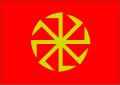 A kolovrat flag, introduced by Alexey Dobrovolsky. The flag's use of Red and Yellow intends to combine Dobrovolsky's ideology of neo-Nazism with Russian Imperialist-inspired Soviet nostalgia.
 A solar symbol compossed of grass snakes used by the Lithuanian Romuva
Modern controversy

Because of its use by Nazi Germany, the swastika since the 1930s has been largely associated with Nazism. In the aftermath of World War II, it has been considered a symbol of hate in the West,[226] and of white supremacy in many Western countries.[227]
As a result, all use of it, or its use as a Nazi or hate symbol, is prohibited in some countries, including Germany. In some countries, such as the United States (in the 2003 case Virginia v. Black), the highest courts have ruled that local governments can prohibit the use of the swastika, along with other symbols such as cross-burning, if the use is intended to intimidate others.[20]
Germany
The German and Austrian post-war criminal code makes the public showing of the swastika, the sig rune, the Celtic cross (specifically the variations used by white power activists), the wolfsangel, the Odal SS-rune and the Totenkopf skull illegal, except for certain enumerated exemptions. It is also censored from the reprints of 1930s railway timetables published by the Reichsbahn. The swastikas on Hindu, Buddhist, and Jain temples are exempt, as religious symbols cannot be banned in Germany.[228]
A controversy was stirred by the decision of several police departments to begin inquiries against anti-fascists.[229] In late 2005 police raided the offices of the punk rock label and mail order store "Nix Gut Records" and confiscated merchandise depicting crossed-out swastikas and fists smashing swastikas. In 2006, the Stade police department started an inquiry against anti-fascist youths using a placard depicting a person dumping a swastika into a trash can. The placard was displayed in opposition to the campaign of right-wing nationalist parties for local elections.[230]
On Friday, 17 March 2006, a member of the Bundestag, Claudia Roth reported herself to the German police for displaying a crossed-out swastika in multiple demonstrations against neo-Nazis, and subsequently got the Bundestag to suspend her immunity from prosecution. She intended to show the absurdity of charging anti-fascists with using fascist symbols: "We don't need prosecution of non-violent young people engaging against right-wing extremism." On 15 March 2007, the Federal Court of Justice of Germany (Bundesgerichtshof) held that the crossed-out symbols were "clearly directed against a revival of national-socialist endeavours", thereby settling the dispute for the future.[231][232][233]
On 9 August 2018, Germany lifted the ban on the usage of swastikas and other Nazi symbols in video games. "Through the change in the interpretation of the law, games that critically look at current affairs can for the first time be given a USK age rating," USK managing director Elisabeth Secker told CTV. "This has long been the case for films and with regards to the freedom of the arts, this is now rightly also the case with computer and videogames."[234][235]
Legislation in other European countries
- Until 2013 in Hungary, it was a criminal misdemeanour to publicly display "totalitarian symbols", including the swastika, the SS insignia, and the Arrow Cross, punishable by custodial arrest.[236][237] Display for academic, educational, artistic, or journalistic reasons was allowed at the time. The communist symbols of the hammer and sickle and the red star were also regarded as totalitarian symbols and were subject to the same restrictions under Hungarian criminal law until 2013.[236]
- In Latvia, public display of Nazi and Soviet symbols, including the Nazi swastika, has been prohibited in public events since 2013.[238][239] However, in a court case from 2007 a regional court in Riga held that the swastika can be used as an ethnographic symbol, in which case the ban does not apply.[240]
- In Lithuania, public display of Nazi and Soviet symbols, including the Nazi swastika, is an administrative offence, punishable by a fine from 150 to 300 euros. According to judicial practice, display of a non-Nazi swastika is legal.[241]
- In Poland, public display of Nazi symbols, including the Nazi swastika, is a criminal offence punishable by up to eight years of imprisonment. The use of the swastika as a religious symbol is legal.[242]
- In Geneva, Switzerland, a new constitution article banning the use of hate symbols, emblems, and other hateful images was passed in June 2024, which included banning the use of the swastika.[243]
The European Union's Executive Commission proposed a European Union-wide anti-racism law in 2001, but European Union states failed to agree on the balance between prohibiting racism and freedom of expression.[244] An attempt to ban the swastika across the EU in early 2005 failed after objections from the British Government and others. In early 2007, while Germany held the European Union presidency, Berlin proposed that the European Union should follow German Criminal Law and criminalise the denial of the Holocaust and the display of Nazi symbols, including the swastika, which is based on the Ban on the Symbols of Unconstitutional Organisations Act. This led to an opposition campaign by Hindu groups across Europe against a ban on the swastika. They pointed out that the swastika has been around for 5,000 years as a symbol of peace.[245][246] The proposal to ban the swastika was dropped by Berlin from the proposed European Union wide anti-racism laws on 29 January 2007.[244]
Outside Europe
The manufacture, distribution, or broadcasting of a swastika, with the intent to propagate Nazism, is a crime in Brazil as dictated by article 20, paragraph 1, of federal statute 7.716, passed in 1989. The penalty is a two- to five-year prison term and a fine.[247]
The public display of Nazi-era German flags (or any other flags) is protected by the First Amendment to the United States Constitution, which guarantees the right to freedom of speech.[248] The Nazi Reichskriegsflagge has also been seen on display at white supremacist events within United States borders, side by side with the Confederate battle flag.[249]
In 2010, the Anti-Defamation League (ADL) downgraded the swastika from its status as a Jewish hate symbol, saying "We know that the swastika has, for some, lost its meaning as the primary symbol of Nazism and instead become a more generalised symbol of hate."[250] The ADL notes on their website that the symbol is often used as "shock graffiti" by juveniles, rather than by individuals who hold white supremacist beliefs, but it is still a predominant symbol among American white supremacists (particularly as a tattoo design) and used with antisemitic intention.[251]
In 2022, Victoria was the first Australian state to ban the display of the Nazi swastika. People who intentionally break this law will face a one-year jail sentence, a fine of 120 penalty units ($23,077.20 AUD as of 2023, equivalent to £12,076.66 or US$15,385.57), or both.[252][253]
Media
In 2010, Microsoft officially spoke out against players of the first-person shooterCall of Duty: Black Ops using the swastika. In Black Ops, players can customise their name tags to represent whatever they want. The swastika can be created and used, but Stephen Toulouse, director of Xbox Live policy and enforcement, said players with the symbol on their name tag will be banned (if someone reports it as inappropriate) from Xbox Live.[254]
In the Indiana Jones Stunt Spectacular at Disney Hollywood Studios in Florida, the swastikas on German trucks, aircraft, and actor uniforms in the re-enactment of a scene from Raiders of the Lost Ark were removed in 2004.[255]
Use by neo-Nazis
As with many neo-Nazi groups across the world, the American Nazi Party used the swastika as part of its flag before its first dissolution in 1967. The symbol was chosen by the organisation's founder, George Lincoln Rockwell.[256] It was "re-used" by successor organisations in 1983, without the publicity Rockwell's organisation enjoyed.
The swastika, in various iconographic forms, is one of the hate symbols identified in use as graffiti in US schools, and is described as such in a 1999 US Department of Education document, "Responding to Hate at School: A Guide for Teachers, Counsellors and Administrators", edited by Jim Carnes, which provides advice to educators on how to support students targeted by such hate symbols and address hate graffiti. Examples given show that it is often used alongside other white supremacist symbols, such as those of the Ku Klux Klan, and note a "three-bladed" variation used by skinheads, white supremacists, and "some South African extremist groups".[257]
The neo-Nazi Russian National Unity group's branch in Estonia is officially registered under the name "Kolovrat" and published an extremist newspaper in 2001 under the same name.[258] A criminal investigation found the paper included an array of racial epithets. One Narva resident was sentenced to one year in jail for distribution of Kolovrat.[259] The Kolovrat has since been used by the Rusich Battalion, a Russian militant group known for its operation during the war in Donbas.[260][261] In 2014 and 2015, members of the Ukrainian Azov Regiment were seen with swastika tattoos.[262][263][264][265]
 Logo of the National Socialist Movement (U.S.)
 Logo of the Russian National Unity
Western misinterpretation of Asian use
Since the end of the 20th century and through the early 21st century, confusion and controversy have arisen when personal-use goods bearing traditional Jain, Buddhist, or Hindu symbols have been exported to the West, notably to North America and Europe, and have been interpreted by purchasers as Nazi symbols. This has resulted in several such products being boycotted or pulled from shelves.
When a ten-year-old boy in Lynbrook, New York, bought a set of Pokémon cards imported from Japan in 1999, two of the cards contained the left-facing Buddhist swastika. The boy's parents misinterpreted the symbol as the right-facing Nazi swastika and filed a complaint to the manufacturer. Nintendo of America announced that the cards would be discontinued, explaining that what was acceptable in one culture was not necessarily so in another; their action was welcomed by the Anti-Defamation League, which recognised that there was no intention to offend, but said that international commerce meant that "Isolating [the swastika] in Asia would just create more problems."[78]
In 2002, Christmas crackers containing plastic toy red pandas sporting swastikas were pulled from shelves after customer complaints in Canada. The manufacturer, based in China, said the symbol was presented in a traditional sense, not as a reference to the Nazis, and apologised to customers for the cross-cultural mix-up.[266]
In 2020, the retailer Shein pulled a necklace featuring a left-facing swastika pendant from its website after receiving backlash on social media. The retailer apologized for the lack of sensitivity but noted that the swastika was a Buddhist symbol.[267]
Swastika as distinct from Hakenkreuz debate
Beginning in the early 2000s, partially as a reaction to the publication of a book titled The Swastika: Symbol Beyond Redemption? by Steven Heller,[78] there has been a movement by Hindus, Buddhists, and Native Americans to "reclaim" the swastika as a sacred symbol.[6][268] These groups argue that the swastika is distinct from the Nazi symbol. However, Hitler said that the Nazi symbol was the same as the Oriental symbol. On 13 August 1920, speaking to his followers in the Hofbräuhaus am Platzl of Munich, Hitler said of the Nazi symbol: "You will find this cross as a swastika as far as India and Japan, carved in the temple pillars. It is the swastika, which was once a sign of established communities of Aryan Culture."[269]
The main barrier to the effort to "reclaim", "restore", or "reassess" the swastika comes from the decades of extremely negative association in the Western world following the Nazi Party's adoption of it in the 1920s. As well, white supremacist groups still cling to the symbol as an icon of power and identity.[251]
Many media organizations in the West also continue to describe neo-Nazi usage of the symbol as a swastika, or sometimes with the "Nazi" adjective written as "Nazi Swastika".[270][271] Groups that oppose this media terminology do not wish to censor such usage, but rather to shift coverage of antisemitic and hateful events to describe the symbol in this context as a Hakenkreuz or 'hooked cross'.[272]
See also
- Arevakhach – Ancient Armenian national symbol
- Borjgali – Georgian symbol of the Sun
- Brigid's cross – Cross woven from rushes, arms offset
- Camunian rose – Prehistoric symbol from the petroglyphs of Valcamonica
- Fasces – Bound bundle of wooden rods, sometimes with an axe
- Fascist symbolism – Use of certain images and symbols which are designed to represent aspects of fascism
- Flash and circle – Symbol of the British Union of Fascists
- Lauburu – Basque swastika
- Nazi symbolism – Symbols used by Nazis and neo-Nazis
- Sun cross – Circle containing four or more spokes
- Svastikasana – Ancient seated meditation posture in hatha yoga
- Triskelion – Symbol with three-fold rotational symmetry
- Tursaansydän – Ancient symbol used in Northern Europe
- Ugunskrusts – The swastika as a symbol in Latvian folklore
- Valknut – Germanic multi-triangular symbol, occurs in several forms
- Yoke and arrows – Badge of Spanish monarchy, fascist emblem
- Z (military symbol) – sometimes called a Zwastika
Notes
- ↑However, due to the precession of the rotational axis of the Earth the star Polaris has only been the pole star since medieval times. Before 500 CE, the star Kochab would have been the pole star, and 2700 BCE it would have been the star Thuban in the constellation of Draco.
Further reading
- McKay, George. Subcultures and New Religious Movements in Russia and East-Central Europe. p. 282.
- Quinn, Malcolm (2005). The Swastika: Constructing the Symbol. Routledge. ISBN 978-1-134-85495-0.
External links


- History of the Swastika—United States Holocaust Memorial Museum
- The Origins of the Swastika—BBC News
- Latvian signs, swastikas, and mittens