
อ่าน 83 นาที
คำศัพท์เกี่ยวกับหมากรุก
เปลี่ยนเส้นทางไปยังจุดยึดที่ฝังอยู่/เปลี่ยนเส้นทางไปยังรายการ
อธิบาย ศัพท์ หมากรุกในส่วนนี้เรียง ตาม ลำดับตัวอักษร บางคำมีหน้าแยกต่างหาก เช่นคำว่า "ส้อม" (fork)และปักหมุด.
คำศัพท์เกี่ยวกับหมากรุก
อธิบาย ศัพท์ หมากรุกในส่วนนี้เรียง ตาม ลำดับตัวอักษร บางคำมีหน้าแยกต่างหาก เช่นคำว่า "ส้อม" (fork)และปักหมุด.
สำหรับรายชื่อ:
- หมากรุกที่ไม่เป็นไปตามแบบแผน ดูที่ หมากรุกนางฟ้า ;
- สำหรับคำศัพท์เฉพาะที่ใช้ในโจทย์หมากรุกโปรดดูที่อภิธานศัพท์โจทย์หมากรุก
- บรรทัดเปิดที่ตั้งชื่อไว้โปรดดูรายชื่อการเปิดหมากรุก ;
- สำหรับเกมที่เกี่ยวข้องกับหมากรุก โปรดดูที่ รายชื่อเกมหมากรุกรูปแบบต่างๆ
- สำหรับคำศัพท์ที่เกี่ยวข้องกับเกมกระดานโดยทั่วไป โปรดดูที่ คำศัพท์เกี่ยวกับเกมกระดาน
เอ
- พินสัมบูรณ์
- การตรึงราชาเรียกว่าการ ตรึง แบบสัมบูรณ์เนื่องจากตัวหมากที่ถูกตรึงไม่สามารถเคลื่อนที่ออกจากแนวการโจมตี ได้อย่างถูกต้องตามกฎ (เนื่องจากการเคลื่อนที่จะทำให้ราชาเสี่ยงต่อการถูกรุกฆาต ) [ 1 ]เปรียบเทียบกับการตรึงแบบสัมพัทธ์
- คล่องแคล่ว
- อธิบายถึงตัวหมากที่คุกคามช่องสี่เหลี่ยมจำนวนหนึ่ง หรือมีช่องสี่เหลี่ยมจำนวนหนึ่งที่พร้อมสำหรับการเดินหมากครั้งต่อไป นอกจากนี้ยังอาจอธิบายถึงรูปแบบการเล่นที่ก้าวร้าวได้อีกด้วย[ 2 ]คำตรงข้าม: เฉื่อยชา
- การเลื่อนการประชุม
- การระงับเกมหมากรุกโดยมีเจตนาที่จะเล่นต่อในภายหลัง ครั้งหนึ่งเคยเป็นเรื่องปกติมากในการแข่งขันระดับสูง มักเกิดขึ้นไม่นานหลังจากการควบคุมเวลา ครั้งแรก แต่ส่วนใหญ่ถูกยกเลิกไปแล้วเนื่องจากการมาถึงของการวิเคราะห์ด้วยคอมพิวเตอร์[ 3 ]
- การตัดสิน
- วิธีการตัดสินผลการแข่งขันที่ยังไม่จบผู้อำนวยการการแข่งขันหรือผู้เล่นที่เป็นกลางและแข็งแกร่ง จะประเมินตำแหน่งสุดท้ายและตัดสินผลเป็นชนะ เสมอ หรือแพ้ โดยถือว่าผู้เล่นทั้งสองเล่นอย่างดีที่สุด[ 4 ]
- ปรับ
- ดูกฎการสัมผัส-เคลื่อนย้ายเพื่อปรับตำแหน่งของชิ้นส่วนบนช่องโดยไม่ต้องเคลื่อนย้าย ผู้เล่นสามารถทำได้เฉพาะในตาของตนเอง และต้องพูดว่า "ฉันปรับ" หรือคำภาษาฝรั่งเศสที่เทียบเท่าว่า "J'adoube" ก่อน[ 5 ]
- เบี้ยขั้นสูง
- เบี้ยที่อยู่ในฝั่งของฝ่ายตรงข้าม ( แถว ที่ห้าขึ้นไปสำหรับ ฝ่ายขาว แถวที่สี่หรือต่ำกว่าสำหรับฝ่ายดำ) เบี้ยที่รุกไปข้างหน้าอาจอ่อนแอหากรุกมากเกินไปขาดการสนับสนุน และยากต่อการป้องกัน หรืออาจแข็งแกร่งหากบีบให้ฝ่ายตรงข้ามเคลื่อนที่ลำบาก เบี้ยที่รุกไปข้างหน้าและขู่ว่าจะเลื่อนขั้นอาจแข็งแกร่งเป็นพิเศษ[ 6 ]
- ข้อได้เปรียบ
- ตำแหน่ง ที่ดีกว่าพร้อมโอกาสในการชนะเกม ปัจจัยการประเมินอาจรวมถึงพื้นที่เวลาวัสดุและภัยคุกคาม[ 2 ]
- ปืนของอเลคไคน์
- รูปแบบพิเศษของแบตเตอรี่ที่ควีนคอยสนับสนุนรุก สองตัว ในแถวเดียวกัน[ 7 ]
- สัญกรณ์พีชคณิต ("AN")
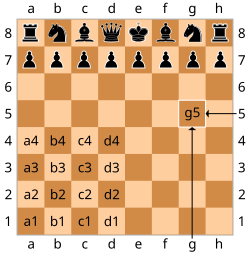
- วิธีการมาตรฐานในการบันทึกการเคลื่อนไหวของเกมหมากรุก โดยใช้พิกัดตัวอักษรและตัวเลขสำหรับช่องสี่เหลี่ยม[ 8 ]เรียกอีกอย่างว่า สัญกร ณ์มาตรฐาน[ 9 ]
- มือสมัครเล่น
- ผู้เล่นคนใดก็ตามที่อาชีพหลักไม่ใช่หมากรุก[ 10 ]ความแตกต่างระหว่างมืออาชีพและมือสมัครเล่นไม่สำคัญมากนักในหมากรุก เนื่องจากมือสมัครเล่นอาจได้รับรางวัล รับค่าตัว และได้รับตำแหน่งใดๆ ก็ได้ รวมถึงแชมป์โลก [ 10 ] [ 11 ] ในศตวรรษที่ 19 บางครั้งมีการใช้คำว่า "มือสมัครเล่น" ในผลการแข่งขันที่ตีพิมพ์เพื่อปกปิดชื่อของผู้เล่นที่แพ้ในการแข่งขันระหว่างปรมาจารย์กับมือสมัครเล่น การใช้ชื่อผู้เล่นโดยไม่ได้รับอนุญาตถือว่าไม่สุภาพ และมืออาชีพก็ไม่ต้องการเสี่ยงที่จะเสียลูกค้า[ 9 ]
- การวิเคราะห์
- การศึกษาเกมหรือตำแหน่งเพื่อประเมินคุณภาพของการเดินหมากและแง่มุมอื่นๆ ของเกมหรือตำแหน่งนั้นๆ เมื่อจบเกม ผู้เล่นมักจะทำการวิเคราะห์เกม[ 2 ]
- คำอธิบายประกอบ
- คำอธิบายเป็นลายลักษณ์อักษรเกี่ยวกับเกมหรือตำแหน่งโดยใช้คำพูดสัญลักษณ์หมากรุกหรือสัญกรณ์[ 2 ]
- ประกาศคู่ครอง
- การปฏิบัติที่พบได้ทั่วไปในศตวรรษที่ 19 โดยที่ผู้เล่นจะประกาศลำดับการเดินหมากที่พวกเขาเชื่อว่าเป็นการเดินหมากที่ดีที่สุดของทั้งสองฝ่าย ซึ่งจะนำไปสู่การรุกฆาตโดยบังคับสำหรับผู้เล่นที่ประกาศภายในจำนวนการเดินหมากที่กำหนด (ตัวอย่างเช่น "รุกฆาตในห้า") [ 12 ]
- ตำแหน่งตรงข้าม
- การเคลื่อนไหวหรือแผนการที่ไม่สอดคล้องกับหลักการของ การ เล่นตามตำแหน่ง[ 13 ]คำว่า Antipositional ใช้เพื่ออธิบายการเคลื่อนไหวที่เป็นส่วนหนึ่งของแผนการที่ไม่ถูกต้อง แทนที่จะเป็นความผิดพลาดที่เกิดขึ้นเมื่อพยายามทำตามแผนการที่ถูกต้อง การเคลื่อนไหวแบบ Antipositional มักเป็นการ เคลื่อนไหว ของเบี้ยเนื่องจากเบี้ยไม่สามารถเดินถอยหลังกลับไปยังช่องที่พวกมันจากมาได้ การเดินไปข้างหน้าของเบี้ยจึงอาจสร้างจุดอ่อนที่ไม่สามารถแก้ไขได้[ 14 ]
- ต่อต้านซิซิลี
- รูปแบบการเปิด เกม ที่ฝ่ายขาวใช้ต่อต้านการป้องกันซิซิเลียน (1.e4 c5) นอกเหนือจากแผนการทั่วไปคือ 2.Nf3 ตามด้วย 3.d4 cxd4 4.Nxd4 (ซิซิเลียนแบบเปิด) การป้องกันซิซิเลียนบางรูปแบบ ได้แก่รูปแบบอะลาปิน (2.c3), รูปแบบมอสโก (2.Nf3 d6 3.Bb5+), รูปแบบรอสโซลิโม (2.Nf3 Nc6 3.Bb5), การโจมตีแกรนด์ปรีซ์ (2.Nc3 Nc6 3.f4 g6 4.Nf3 Bg7 และตอนนี้ 5.Bc4 หรือ 5.Bb5), ซิซิเลียนแบบปิด (2.Nc3 ตามด้วย g3 และ Bg2), สมิธ-มอร์ราแกมบิต (2.d4 cxd4 3.c3) และวิงแกมบิต (2.b4) [ 15 ]
- เพื่อนร่วมเรือชาวอาหรับ
- การรุกฆาตที่เกิดขึ้นเมื่ออัศวินและเรือล้อมราชาฝ่ายตรงข้ามไว้ที่มุม[ 16 ]
- ผู้ตัดสิน
- เจ้าหน้าที่ผู้รับผิดชอบดูแลการแข่งขันหมากรุกและตรวจสอบให้แน่ใจว่ามีการปฏิบัติตามกฎของหมากรุก
- สนามประลอง
- ทัวร์นาเมนต์ประเภทหนึ่งที่ไม่มีจำนวนรอบที่แน่นอน[ 17 ]
- เกมวันสิ้นโลก
- เกมที่รับประกันว่าจะให้ผลลัพธ์ที่เด็ดขาด เพราะหากเสมอกันจะถือว่าเป็นฝ่ายดำชนะ เพื่อเป็นการชดเชย ฝ่ายขาวจะได้รับเวลาเพิ่มขึ้นบนนาฬิกา โดยทั่วไปฝ่ายขาวจะได้รับเวลาห้านาที และฝ่ายดำสี่นาที รูปแบบนี้มักใช้ในการแข่งขันตัดสินหาผู้ชนะในกรณีที่ เกม เร็ว ที่สั้นกว่า ไม่สามารถหาผู้ชนะได้[ 18 ]
- การหล่อเทียม
- เรียกอีกอย่างว่าการเข้าป้อมด้วยมือหมายถึงการเคลื่อนไหวแยกกันหลายครั้งของราชาและเรือซึ่งสุดท้ายแล้วดูเหมือนว่าพวกเขาเข้าป้อมแล้ว[ 19 ]
- จู่โจม
- การกระทำที่ก้าวร้าวบนกระดานหมากรุก หรือการขู่ว่าจะจับตัวหมากหรือเบี้ย[ 20 ]คำตรงข้าม: การป้องกัน
- สถานที่ท่องเที่ยว
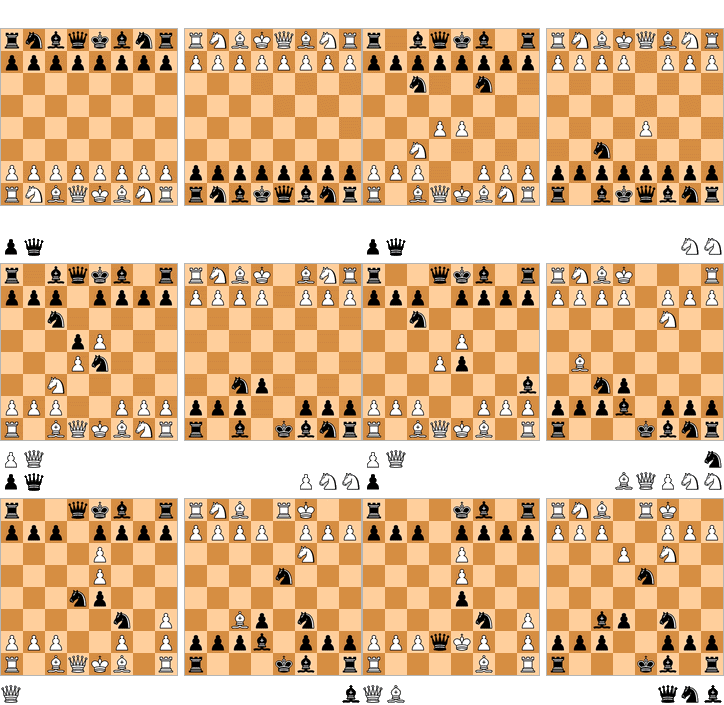
- ประเภทของตัวล่อที่เกี่ยวข้องกับการเสียสละตัว หมาก เล็กหรือใหญ่บนช่องถัดจากราชาของฝ่ายตรงข้าม บังคับให้ราชาต้องละทิ้งการป้องกันช่องอื่น ตัวอย่างเช่น ( ดูแผนภาพ ) ควีนสีดำได้เข้ามาขวางการรุกของควีนสีขาว และฝ่ายขาวสามารถรุกราชาจากทิศทางตรงกันข้ามเพื่อเอาชนะควีนได้[ 21 ]
- หุ่นยนต์
- ออโตมาตอน คือเครื่องจักรที่ทำงานได้ด้วยตนเอง ในหมากรุก ออโตมาตอนหมายถึงเครื่องจักรเล่นหมากรุกที่จริงแล้วเป็นของปลอมและอยู่ภายใต้การควบคุมของมนุษย์ที่ซ่อนตัวอยู่ ออโตมาตอนสร้างความสนใจอย่างมากในศตวรรษที่ 18 และ 19 และเป็นแรงบันดาลใจให้เกิดความคิดแรกเริ่มเกี่ยวกับความเป็นไปได้ของปัญญาประดิษฐ์ออโตมาตอนที่เล่นหมากรุกได้ที่มีชื่อเสียงที่สุดคือเดอะเติร์กซึ่งความลับเกี่ยวกับการควบคุมโดยมนุษย์ถูกเก็บรักษาไว้เป็นเวลานาน ออโตมาตอนตัวแรกที่แท้จริงคือเอล อาเจดเรซิสตาสร้างขึ้นโดยเลโอนาร์โด ตอร์เรส อี เกเวโด
| เอ | ข | ค | ง | อี | เอฟ | จี | ชม. | ||
| 8 |             | 8 | |||||||
| 7 | 7 | ||||||||
| 6 | 6 | ||||||||
| 5 | 5 | ||||||||
| 4 | 4 | ||||||||
| 3 | 3 | ||||||||
| 2 | 2 | ||||||||
| 1 | 1 | ||||||||
| เอ | ข | ค | ง | อี | เอฟ | จี | ชม. | ||
| เอ | ข | ค | ง | อี | เอฟ | จี | ชม. | ||
| 8 | | 8 | |||||||
| 7 | 7 | ||||||||
| 6 | 6 | ||||||||
| 5 | 5 | ||||||||
| 4 | 4 | ||||||||
| 3 | 3 | ||||||||
| 2 | 2 | ||||||||
| 1 | 1 | ||||||||
| เอ | ข | ค | ง | อี | เอฟ | จี | ชม. | ||
| เอ | ข | ค | ง | อี | เอฟ | จี | ชม. | ||
| 8 | | 8 | |||||||
| 7 | 7 | ||||||||
| 6 | 6 | ||||||||
| 5 | 5 | ||||||||
| 4 | 4 | ||||||||
| 3 | 3 | ||||||||
| 2 | 2 | ||||||||
| 1 | 1 | ||||||||
| เอ | ข | ค | ง | อี | เอฟ | จี | ชม. | ||
บี
- บี
- สัญลักษณ์ที่ใช้แทนบิชอปเมื่อบันทึกการเดินหมากรุกเป็นภาษาอังกฤษ[ 22 ]
- แถวหลัง
- แถวแรกของผู้เล่น(แถวที่ตัวหมากตั้งอยู่ ณตำแหน่งเริ่มต้น ) แถวหลังของฝ่ายขาวคือแถวที่แปดของฝ่ายดำ แถวหลังของฝ่ายดำคือแถวที่แปดของฝ่ายขาว[ 23 ]เรียกอีกอย่างว่าแถวบ้านและแถวแรก
- เพื่อนร่วมรบแถวหลัง
- การรุกฆาตที่เกิดขึ้นจากการเดินเรือหรือควีนตามแนวแถวหลังซึ่งราชาที่ถูกรุกฆาตไม่สามารถขยับได้เนื่องจากถูกขวางโดยตัวหมากที่เป็นมิตร (โดยปกติคือเบี้ย) หรือช่องที่ถูกโจมตีในแถวที่สองของผู้เล่น[ 23 ]เรียกอีกอย่างว่า การ รุกฆาตแถวหลัง
- ความอ่อนแอของแถวหลัง
- สถานการณ์ที่ผู้เล่นตกอยู่ในอันตรายจากการรุกฆาตแถวหลังและไม่มีเวลา/ทางเลือกที่จะสร้างทางหนีให้กับราชา จึงต้องคอยเฝ้าระวังและป้องกันภัยคุกคามนั้นอย่างต่อเนื่อง เช่น โดยการวางเรือไว้ที่แถวหลัง[ 23 ]
- เบี้ยถอยหลัง
- เบี้ยที่อยู่ด้านหลังเบี้ยสีเดียวกันบนแถว ที่อยู่ติดกัน และไม่สามารถขยับไปข้างหน้าโดยได้รับการสนับสนุนจากเบี้ยตัวอื่นได้[ 24 ]
- บาทหลวงเลว
- บิชอป ที่ถูกล้อมรอบ ด้วยเบี้ยของผู้เล่นเอง[ 25 ]เปรียบเทียบกับบิชอปที่ดี
- ราชาผู้ไร้ที่พึ่ง
- ตำแหน่งที่ราชาเป็นตัวเดียวที่มีสี เดียวกัน บนกระดาน[ 26 ]
- หมากรุกบาสก์
- หรือระบบบาสก์การแข่งขันหมากรุกที่ผู้เล่นเล่นพร้อมกันสองเกมบนกระดานสองกระดาน โดยแต่ละฝ่ายเล่นหมากขาวบนกระดานหนึ่งและหมากดำบนอีกกระดานหนึ่ง มีนาฬิกาอยู่ที่กระดานทั้งสอง วิธีนี้ช่วยขจัดโบนัสในการแข่งขันย่อยของการเล่นหมากขาวก่อน หมากรุกบาสก์มีการเล่นครั้งแรกในเทศกาลหมากรุกโดโนสเตียปี 2012 ในแคว้นบาสก์ ประเทศสเปน[ 27 ]
- แบตเตอรี่
- ชิ้นส่วนต่างๆ ถูกรวบรวมไว้ตามแนวการกระทำในรูปแบบที่แตกต่างกันเล็กน้อย ในเกม มักจะหมายถึงการวางเรือหรือควีนเรียงกันเป็นแถว หรือวางบิชอปและควีนไว้บนแนวทแยง[ 20 ]ในปัญหาหมากรุก แบตเตอรี่คือการจัดเรียงชิ้นส่วนสองชิ้นให้อยู่ในแนวเดียวกับราชา ของฝ่ายตรง ข้ามบนแถว แนว หรือแนวทแยง เพื่อให้หากชิ้นส่วนตรงกลางขยับ จะทำให้เกิด การรุกฆาตแบบเปิดเผย (หรือการคุกคามอื่นที่ไม่ใช่การรุกฆาต) [ 28 ] [ 29 ] [ 30 ]
- บีซีเอฟ
- สหพันธ์หมากรุกอังกฤษ ซึ่ง เป็นชื่อเดิมของสหพันธ์หมากรุกอังกฤษ [ 31 ]
- บีซีเอ็ม
- คำย่อของBritish Chess Magazine [ 32 ]
- บีซีโอ
- คำย่อของBatsford Chess Openings ซึ่ง เป็น หนังสืออ้างอิง การเปิดเกมหมากรุกปี 1982 โดยRaymond KeeneและGarry Kasparovฉบับพิมพ์ครั้งที่สอง (1989) มักเรียกว่าBCO- 2 [ 33 ]ดูECOและMCO
- การเล่นที่ดีที่สุด
- การเคลื่อนไหวที่ดีที่สุดตามทฤษฎีและอุดมคติจากตำแหน่งที่กำหนด[ 34 ]
- เบี้ยตัวใหญ่
- บิชอปที่ไม่ดีจะติดอยู่ด้านหลังเบี้ยของตัวเองและคอยปกป้องเบี้ยเหล่านั้น ซึ่งทำหน้าที่เหมือนเบี้ย[ 35 ]
- ผูก
- การยึดหรือควบคุมตำแหน่งอย่างแน่นหนาซึ่งยากที่ฝ่ายตรงข้ามจะทำลายได้ การผูกมัดมักเป็นข้อได้เปรียบในพื้นที่ที่สร้างขึ้นโดยเบี้ยที่รุกคืบการผูกมัดแบบ Maróczyเป็นตัวอย่างที่รู้จักกันดี[ 36 ]
- บิชอป
- ชิ้นส่วนที่สามารถเคลื่อนที่ไปตามแนวทแยงมุม ได้ โดยไม่ต้องกระโดด
- คู่บิชอป
- ผู้เล่นที่มีบิชอป สองตัว เรียกว่ามีคู่บิชอป บิชอปสองตัวสามารถควบคุมแนวทแยงของทั้งสองสีได้ ในตำแหน่งเปิดบิชอปสองตัวถือว่าได้เปรียบอัศวิน สองตัว หรืออัศวินและบิชอปหนึ่งตัว[ 20 ]เรียกอีกอย่างว่าบิชอปสองตัว
- บิชอปเบี้ย
- หรือเบี้ยของบิชอปเบี้ยที่ อยู่บน แถวของบิชอปเช่น แถว c หรือแถว f บางครั้งย่อว่า "BP" [ 37 ]
- บิชอปที่อยู่ฝั่งตรงข้าม
- หรือบิชอปสีตรงข้ามสถานการณ์ที่ผู้เล่นคนหนึ่งเหลือบิชอป สีอ่อนเพียงตัวเดียว ในขณะที่อีกฝ่ายเหลือบิชอปสีเข้มเพียงตัวเดียว ในช่วงท้ายเกมมักจะจบลงด้วยผลเสมอหากไม่มีตัวหมากอื่นนอกจากเบี้ย แม้ว่าฝ่ายหนึ่งจะมีเบี้ยมากกว่าหนึ่ง สอง หรือแม้แต่สามตัวก็ตาม เนื่องจากบิชอปควบคุมช่องที่แตกต่างกัน (ดูช่วงท้ายเกมบิชอปสีตรงข้าม ) อย่างไรก็ตาม ในช่วงกลางเกมการมีบิชอปสีตรงข้ามจะทำให้เกมเสียสมดุลและอาจนำไปสู่การโจมตีเพื่อรุกฆาตได้ เนื่องจากบิชอปแต่ละตัวโจมตีช่องที่ไม่สามารถป้องกันได้โดยบิชอปอีกตัว[ 38 ]
- สีดำ
- ช่องสี่เหลี่ยมสีเข้มบนกระดานหมากรุกมักถูกเรียกว่า "ช่องสี่เหลี่ยมสีดำ" แม้ว่ามักจะเป็นสีเข้มอื่นก็ตาม ในทำนองเดียวกัน "ตัวหมากสีดำ" บางครั้งก็เป็นสีอื่น (โดยปกติจะเป็นสีเข้ม) [ 39 ]
- สีดำ
- การกำหนดสำหรับผู้เล่นที่เดินเป็นคนที่สอง แม้ว่าตัวหมาก ("ตัวหมากสีดำ") บางครั้งจะเป็นสีอื่น (โดยปกติจะเป็นสีเข้ม) ก็ตาม[ 40 ]
- หมากรุกคนตาบอด
- ดูKriegspiel
- หมากรุกปิดตา
- หมากรุกรูปแบบหนึ่งที่ผู้เล่นคนใดคนหนึ่งหรือทั้งสองคนไม่ได้รับอนุญาตให้เห็นกระดาน[ 41 ]
- หมูตาบอด
- หมากรุกสองตัวบนแถวที่สองของฝ่ายตรงข้ามเรียกว่า "หมู" เพราะพวกมันมักจะกินเบี้ยและตัวหมากอื่นๆ และเรียกว่า "หมูตาบอด" หากพวกมันหาทางรุกฆาตไม่ได้[ 42 ]
- หมากรุกสายฟ้าแลบ
- [จากภาษาเยอรมัน : Blitz , "สายฟ้า"] หมากรุกรูปแบบเร็ว ที่มี เวลาจำกัดสั้นมากโดยปกติแล้วผู้เล่นแต่ละคนจะใช้เวลาเพียงสามหรือห้านาทีสำหรับเกมทั้งหมด ด้วยการมาถึงของนาฬิกาหมากรุก อิเล็กทรอนิกส์ เวลาที่เหลือมักจะเพิ่มขึ้นหนึ่งหรือสองวินาทีต่อการเดินหมาก[ 43 ]
- บลิทซ์ครีก
- บางครั้งมีการใช้คำ ว่า blitzkriegเพื่ออธิบายการโจมตีอย่างรวดเร็วบนช่อง f7 หรือ f2ในช่วงต้นเกม[ 44 ] [ 45 ]
- การปิดล้อม
- การวางหมากไว้ตรงหน้าเบี้ยของฝ่ายตรงข้ามโดยตรง ซึ่งจะขัดขวางการรุกของเบี้ย และขัดขวางการเคลื่อนไหวของหมากฝ่ายตรงข้ามตัวอื่นๆ เบี้ยของฝ่ายตรงข้ามจะให้ที่กำบังแก่หมากที่ขวางทาง ทำให้หมากนั้นได้รับการปกป้องจากการโจมตีของหมากฝ่ายตรงข้าม การปิดกั้นจะมีประสิทธิภาพมากที่สุดกับเบี้ยที่เดินไปข้างหน้าหรือเบี้ยโดดเดี่ยว หมากที่เหมาะสมที่สุดที่จะใช้ในการปิดกั้นคือม้า กลยุทธ์นี้ได้รับการคิดค้นขึ้นโดยAron Nimzowitschในปี 1924 [ 46 ] [ 47 ]
- ตำแหน่งที่ถูกบล็อก
- ตำแหน่งที่ทั้งสองฝ่ายถูกจำกัดไม่ให้ก้าวหน้า โดยทั่วไปเกิดจากโซ่เบี้ย ที่เกี่ยวพันกัน ซึ่งแบ่งพื้นที่ ที่มีอยู่ เป็นสองค่าย[ 48 ]
- ความผิดพลาด
- การเดินหมากที่แย่มาก ความผิดพลาด (ระบุด้วยเครื่องหมาย "?" ในคำอธิบาย หมากรุก ) [ 20 ]
- กระดาน
- 1. ดูกระดานหมากรุก
- 2. การแบ่งหน้าที่ในการเล่นหมากรุกแบบทีม เช่นกระดานแรกกระดานที่สอง เป็นต้น
- กระดานหนึ่ง
- ดูบอร์ดแรก
- เพื่อนของโบเดน
- Boden's mate ซึ่งตั้งชื่อตามSamuel Bodenเป็นรูปแบบการรุกฆาตที่ราชาซึ่งมักจะเข้าป้อมทางฝั่งควีน จะถูกรุกฆาตโดยบิชอปสองตัวที่ไขว้กัน ก่อนที่จะรุกฆาต ฝ่ายที่ชนะมักจะเสียสละควีนที่ c3 หรือ c6 เพื่อเตรียมตำแหน่งรุกฆาต[ 49 ]
- ลิ้นชักหนังสือ
- ตำแหน่งท้ายเกมที่ทราบกันว่าเป็นการเสมอเมื่อเล่นอย่างสมบูรณ์แบบในอดีตสิ่งนี้ได้รับการกำหนดโดยการอ้างอิงถึงวรรณกรรมท้ายเกมหมากรุกแต่ในตำแหน่งที่ง่ายขึ้นสามารถใช้ การวิเคราะห์ด้วยคอมพิวเตอร์ใน ฐานข้อมูลตารางท้ายเกม ได้ [ 50 ]เรียกอีกอย่างว่าการเสมอเชิงทฤษฎี
- ย้ายหนังสือ
- การ เดินหมาก เปิดเกมที่พบในหนังสืออ้างอิงมาตรฐานเกี่ยวกับทฤษฎีการเปิดเกมเกมจะเรียกว่า "อยู่ในหนังสือ" เมื่อผู้เล่นทั้งสองฝ่ายเดินหมากตามที่ระบุไว้ในหนังสืออ้างอิงการเปิดเกม เกมจะเรียกว่า "อยู่นอกหนังสือ" เมื่อผู้เล่นเดินหมากตามรูปแบบที่วิเคราะห์ไว้ในหนังสือการเปิดเกมจนครบ หรือหากผู้เล่นฝ่ายใดฝ่ายหนึ่งเดินหมากที่แปลกใหม่ (หรือการเดินหมากผิดพลาด ) [ 51 ]
- หนังสือชนะ
- ตำแหน่งท้ายเกมที่ทราบกันว่าชนะด้วยการเล่นที่สมบูรณ์แบบในอดีตสิ่งนี้ได้รับการกำหนดโดยอ้างอิงจากวรรณกรรมท้ายเกมหมากรุก แต่ในตำแหน่งที่ง่ายขึ้น (ปัจจุบันมีตัวหมากเจ็ดตัวหรือน้อยกว่า) สามารถใช้การวิเคราะห์ด้วยคอมพิวเตอร์ในฐานข้อมูลตารางท้ายเกม ได้ [ 52 ]
- หยุดพัก
- การเคลื่อนไหวที่ทำให้ได้พื้นที่และอิสระในการเคลื่อนไหว หรือการเปิดตำแหน่งที่ถูกปิดกั้นโดยการรุกหรือการจับเบี้ย[ 53 ]
- ความก้าวหน้า
- การเจาะเข้าไปในตำแหน่งของฝ่ายตรงข้าม หรือการทำลายการป้องกัน มักจะ ทำโดยการเสียสละ[ 20 ]
- ความกระชับ
- [ส่วนใหญ่ใช้ในสหราชอาณาจักร] ดูที่miniature
- ความฉลาดเฉลียว
- เกมที่มีแนวคิดเชิงกลยุทธ์ การผสมผสาน หรือแผนการดั้งเดิมที่น่าทึ่ง ลึกซึ้ง และสวยงาม[ 53 ]
- รางวัลแห่งความฉลาด
- รางวัลที่มอบให้ในบางทัวร์นาเมนต์สำหรับ การเล่น ที่ยอด เยี่ยมที่สุด ในทัวร์นาเมนต์[ 54 ]
- ความล่าช้าของบรอนสไตน์
- วิธีการควบคุมเวลาที่มีการหน่วงเวลาคิดค้นโดยเดวิด บรอนสไตน์เมื่อถึงตาของผู้เล่นที่จะเดินนาฬิกาจะรอตามระยะเวลาหน่วงเวลาก่อนที่จะเริ่มหักเวลาที่เหลือของผู้เล่น[ 55 ]
- หมากรุกบ้านแมลง
- รูปแบบหมากรุกยอดนิยมที่เล่นเป็นทีมตั้งแต่สองคนขึ้นไป[ 56 ]
- การสร้างสะพาน
- สร้างเส้นทางให้ราชาในช่วงท้ายเกมโดยให้การป้องกันจากการรุกของตัวหมากในแนวเดียวกันตัวอย่างที่รู้จักกันดีคือตำแหน่งลูเซนา[ 57 ]
- หมากรุกกระสุน
- แต่ละฝ่ายมีเวลา 1 นาทีในการเคลื่อนไหวทั้งหมด[ 58 ]
- หน้าอก
- [ภาษาพูด] การหักล้างการเปิดการเปิดประเด็น กลยุทธ์ หรือการวิเคราะห์ที่เผยแพร่ก่อนหน้านี้[ 59 ] [ 60 ]
- ลาก่อน
- รอบการแข่งขันที่ผู้เล่นไม่ต้องลงแข่ง มักเป็นเพราะจำนวนผู้เล่นเป็นเลขคี่ การได้บายโดยปกติจะนับเป็นชัยชนะ (1 คะแนน) แม้ว่าในการแข่งขันบางรายการ ผู้เล่นจะได้รับอนุญาตให้เลือกที่จะได้บาย (โดยปกติในรอบแรกหรือรอบสุดท้าย) และนับเป็นการเสมอ (½ คะแนน) [ 60 ]
| เอ | ข | ค | ง | อี | เอฟ | จี | ชม. | ||
| 8 |  | 8 | |||||||
| 7 | 7 | ||||||||
| 6 | 6 | ||||||||
| 5 | 5 | ||||||||
| 4 | 4 | ||||||||
| 3 | 3 | ||||||||
| 2 | 2 | ||||||||
| 1 | 1 | ||||||||
| เอ | ข | ค | ง | อี | เอฟ | จี | ชม. | ||
| เอ | ข | ค | ง | อี | เอฟ | จี | ชม. | ||
| 8 | | 8 | |||||||
| 7 | 7 | ||||||||
| 6 | 6 | ||||||||
| 5 | 5 | ||||||||
| 4 | 4 | ||||||||
| 3 | 3 | ||||||||
| 2 | 2 | ||||||||
| 1 | 1 | ||||||||
| เอ | ข | ค | ง | อี | เอฟ | จี | ชม. | ||
| เอ | ข | ค | ง | อี | เอฟ | จี | ชม. | ||
| 8 | | 8 | |||||||
| 7 | 7 | ||||||||
| 6 | 6 | ||||||||
| 5 | 5 | ||||||||
| 4 | 4 | ||||||||
| 3 | 3 | ||||||||
| 2 | 2 | ||||||||
| 1 | 1 | ||||||||
| เอ | ข | ค | ง | อี | เอฟ | จี | ชม. | ||
| เอ | ข | ค | ง | อี | เอฟ | จี | ชม. | ||
| 8 | | 8 | |||||||
| 7 | 7 | ||||||||
| 6 | 6 | ||||||||
| 5 | 5 | ||||||||
| 4 | 4 | ||||||||
| 3 | 3 | ||||||||
| 2 | 2 | ||||||||
| 1 | 1 | ||||||||
| เอ | ข | ค | ง | อี | เอฟ | จี | ชม. | ||
| เอ | ข | ค | ง | อี | เอฟ | จี | ชม. | ||
| 8 | | 8 | |||||||
| 7 | 7 | ||||||||
| 6 | 6 | ||||||||
| 5 | 5 | ||||||||
| 4 | 4 | ||||||||
| 3 | 3 | ||||||||
| 2 | 2 | ||||||||
| 1 | 1 | ||||||||
| เอ | ข | ค | ง | อี | เอฟ | จี | ชม. | ||
ซี
- ไคสซา
- เป็นที่รู้จักในฐานะเทพีหรือมิวส์แห่งหมากรุก ซึ่งชื่อของเธอมาจากนางไม้ในบทกวีCaïssa หรือ The Game at Chess ในปี ค.ศ. 1763 โดยWilliam Jones [ 61 ]
- คำนวณ
- วางแผนการเคลื่อนไหวต่างๆ ในใจและพิจารณาการตอบสนองที่เป็นไปได้ โดยไม่ต้องขยับหมากจริงๆ[ 20 ]
- ปริญญาโท ("CM")
- ตำแหน่งหมากรุกที่มีอันดับต่ำกว่าระดับFIDE Master [ 62 ]
- การย้ายตำแหน่งของผู้สมัคร
- การเคลื่อนไหวที่ดูเหมือนจะดีเมื่อพิจารณาตำแหน่งเบื้องต้น และสมควรได้รับการวิเคราะห์เพิ่มเติม[ 63 ]
- การจับคู่ผู้สมัคร
- การแข่งขัน แบบน็อกเอาต์ในการแข่งขัน Candidates Tournament [ 64 ]
- การแข่งขัน Candidates Tournament
- การแข่งขันที่จัดโดยFIDEซึ่งเป็นรอบคัดเลือกที่สามและรอบสุดท้ายของการแข่งขันชิงแชมป์โลกหมากรุกผู้เข้าร่วมคือผู้เล่นอันดับต้น ๆ ของการแข่งขัน Interzonalรวมถึงผู้เล่นอื่น ๆ ที่ได้รับการคัดเลือกตามอันดับหรือผลงานในการแข่งขัน Candidates Tournament ก่อนหน้านี้ ผู้เล่นที่มีอันดับสูงสุดจะผ่านเข้ารอบชิงแชมป์โลก[ 65 ]
- ที่เปิดกระป๋อง
- [ภาษาพูด] แผนการโจมตี ตำแหน่ง ฝั่งราชา (บางครั้งอาจเป็น ตำแหน่ง ฟิอันเชตโต ) โดยการเดินเบี้ย h ไปข้างหน้าโดยมีเจตนาที่จะเปิดช่องใกล้กับราชาของฝ่ายป้องกัน[ 66 ]
- ชิ้นส่วนปิดฝา
- ชิ้นส่วนเฉพาะที่ผู้เล่นพยายามใช้เพื่อรุกฆาต ข้อกำหนดในการรุกฆาตด้วยชิ้นส่วนที่ปิดอยู่ถือเป็นอุปสรรคเมื่อชิ้นส่วนที่ปิดอยู่เป็นเบี้ยจะเรียกว่าpion coiffé [จากภาษาฝรั่งเศส "เบี้ยปิด"] [ 67 ]
- การจับกุม
- การเดินของเบี้ยหรือตัวหมากที่นำเบี้ยหรือตัวหมากของฝ่ายตรงข้ามออกจากกระดาน ตัวหมากที่จับได้จะเข้าไปอยู่ในช่องของตัวหมากที่ถูกจับ ยกเว้นในกรณีของการจับแบบen passant [ 68 ]
- การเข้าป้อม
- การเดินหมากที่ทั้งราชาและเรือถูกย้ายพร้อมกัน การเดินหมากนี้จะย้ายราชาจากตรงกลางไปยังปีกซึ่งโดยปกติจะปลอดภัยกว่า และเป็นการพัฒนาเรือ การเดินหมากนี้เป็นเพียงครั้งเดียวที่มีการย้ายหมากสองตัวในตาเดียว การเข้าป้อมสามารถทำได้ทั้งทางฝั่งราชา (เขียนว่า 0-0) หรือทางฝั่งราชินี (0-0-0) การเข้าป้อมไม่สามารถทำได้เพื่อตอบโต้การรุกฆาตหรือหากราชาข้ามหรือลงบนช่องที่ถูกโจมตีโดยฝ่ายตรงข้าม หรือหากราชาหรือเรือที่เกี่ยวข้องได้ขยับไปแล้ว[ 69 ] [ 70 ]
- เข้าป้อมนั้น
- สถานการณ์ที่ฝ่ายหนึ่งเข้ายึดปราสาทและผลที่ตามมาคือกษัตริย์จะตกอยู่ในอันตรายมากขึ้นที่ปลายทางมากกว่าที่ช่องเริ่มต้น ไม่ว่าจะทันทีหรือเพราะสามารถเปิดแนวและแนวทแยงมุมโจมตีได้ง่ายขึ้น[ 71 ]
- การหล่อแบบยาว
- การเข้าป้อมด้านควีนไซด์ในสัญลักษณ์หมากรุก : 0-0-0 [ 69 ]เรียกอีกอย่างว่าการเข้าป้อมยาว[ 72 ]
- สิทธิ์ในการคัดตัว
- ความสามารถในการเข้าป้อมตามกฎของหมากรุก
- หล่อสั้น
- การเข้าป้อมฝั่งราชาในระบบหมากรุก : 0-0 [ 69 ]เรียกอีกอย่างว่าการเข้าป้อมสั้น[ 72 ]
- เกมแคชชวล
- ชมเกมกระชับมิตร
- หมวดหมู่
- ประเภทของทัวร์นาเมนต์เป็นการวัดความแข็งแกร่งโดยอิงจากคะแนน FIDE เฉลี่ย ของผู้เข้าร่วม การคำนวณประเภททำได้โดยการปัดเศษขึ้น: (คะแนนเฉลี่ย − 2250) ÷ 25 ดังนั้นแต่ละประเภทจะครอบคลุมช่วงคะแนน 25 คะแนน โดยเริ่มจากประเภทที่ 1 ซึ่งครอบคลุมคะแนนระหว่าง 2251 ถึง 2275 ทัวร์นาเมนต์ประเภทที่ 18 มีคะแนนเฉลี่ยระหว่าง 2676 ถึง 2700 [ 73 ]
- ซีซี
- คำย่อของหมากรุกทางไปรษณีย์หรือชมรมหมากรุก
- ศูนย์
- หรือศูนย์กลางสี่เหลี่ยมจัตุรัสสี่ช่องตรงกลางกระดาน[ 74 ]บางครั้งย่อมาจากศูนย์กลางเบี้ย ราชา "ในศูนย์กลาง" อาจหมายถึงราชาที่ยังไม่ได้เข้าป้อมบนแถว กลาง
- ไฟล์กลาง
- หรือแถวกลาง แถวของพระราชา (แถวอี) หรือแถวของพระราชินี (แถวดี)
- เบี้ยกลาง
- หรือเบี้ยกลางเบี้ยที่อยู่บนแถวของพระราชา (แถว e) หรือแถวของพระราชินี (แถว d) [ 75 ]
- ตะกวด
- หน่วยการประเมินที่ใช้โดยโปรแกรมหมากรุกเช่น การประเมิน +1.32 มีค่ามากกว่าการประเมิน +1.12 ถึง 20 เซนติพาวน์ ในอดีต เซนติพาวน์มีค่าเท่ากับ 0.01 ของเบี้ย แต่โปรแกรมหมากรุกสมัยใหม่ที่แข็งแกร่งที่สุดไม่ให้คะแนนเบี้ยเท่ากับ 1 อีกต่อไป[ 76 ]
- ไฟล์กลาง
- ดูไฟล์ตรงกลาง
- การรวมศูนย์
- การเคลื่อนย้ายตัวหมากหนึ่งตัวหรือหลายตัวไปยังจุดศูนย์กลางของกระดาน ซึ่งไม่เพียงแต่จะควบคุมจุดศูนย์กลาง เท่านั้น แต่ยังขยายอิทธิพลไปยังพื้นที่อื่นๆ ด้วย ตัวหมากควรวางไว้ใกล้จุดศูนย์กลางของกระดาน เพราะจะเพิ่มพลังและความคล่องตัวโดยเฉพาะอย่างยิ่งม้า จะได้รับประโยชน์จากการอยู่ตรงกลาง [ 77 ]คำตรงข้าม: การกระจายอำนาจ[ 78 ]
- เบี้ยกลาง
- ดู ตัว เบี้ยกลาง
- ราคาถูก
- คำสแลงสำหรับกับ ดักแบบดั้งเดิมมักตั้งขึ้นโดยหวังว่าจะโกงให้ได้ชัยชนะหรือเสมอจากตำแหน่งที่เสียเปรียบ[ 79 ]เรียกอีกอย่างว่าcheap shot
- ตรวจสอบ
- การโจมตีโดยตรงต่อพระราชาโดยหมาก ของฝ่ายตรงข้าม พระราชาที่ถูกโจมตีเรียกว่าอยู่ในสถานะถูกรุกมีการตอบสนองที่เป็นไปได้เพียงสามอย่างต่อการรุก ได้แก่ การจับหมากที่โจมตี การย้ายพระราชาไปยังช่องที่ไม่ถูกโจมตี หรือการวางหมากขวางระหว่างผู้โจมตีกับพระราชา ในเกมที่ไม่เป็นทางการ ผู้เล่นมักจะประกาศว่า "รุก" อย่างไรก็ตาม นี่ไม่ใช่ข้อกำหนดในเกมการแข่งขัน[ 80 ]
- รุกฆาต
- มักย่อเป็นmateตำแหน่งที่ราชา ของผู้เล่น ถูกรุกฆาตและผู้เล่นไม่มีการเดินที่ถูกต้อง (กล่าวคือไม่สามารถเดินออกหรือหลบหนีจากการรุกฆาตได้) ผู้เล่นที่ราชาถูกรุกฆาตจะแพ้เกม[ 81 ]
- คำอธิบายหมากรุก
- ดูคำอธิบายประกอบ
- ตาบอดหมากรุก
- ความล้มเหลวของผู้เล่นในการมองเห็นการเดินที่ดีหรืออันตรายที่ควรจะถือว่าชัดเจน คำนี้ถูกบัญญัติโดยSiegbert Tarraschคล้ายกับอาการ Kotov [ 82 ]
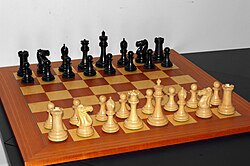
- กระดานหมากรุก
- กระดานหมากรุกที่ใช้เล่นหมากรุก ประกอบด้วยช่องสี่เหลี่ยม 64 ช่อง (แปดแถวแปดคอลัมน์) เรียงสลับสีกันสองสี คือสีอ่อนและสีเข้ม[ 83 ]
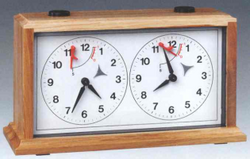
- นาฬิกาหมากรุก
- อุปกรณ์ที่ประกอบด้วยนาฬิกาสองเรือนที่อยู่ติดกันและปุ่มต่างๆ ทำหน้าที่ติดตามเวลาทั้งหมดที่ผู้เล่นแต่ละคนใช้ในการเดินหมาก ทันทีหลังจากเดินหมากเสร็จ ผู้เล่นจะกดปุ่มของตน ซึ่งจะหยุดนาฬิกาของตนและเริ่มนาฬิกาของฝ่ายตรงข้ามพร้อมกัน ภาพที่แสดงเป็นนาฬิกาแบบอนาล็อกซึ่งเป็นที่มาของคำว่าflag fallนาฬิกาสมัยใหม่เป็นแบบดิจิทัล[ 84 ]
- ชมรมหมากรุก
- องค์กรจัดการแข่งขันหมากรุกแบบพบปะตัวจริงในระดับท้องถิ่น
- หมากรุก
- ตัวหมากที่เคลื่อนย้ายได้ซึ่งวางอยู่ บนกระดานในเกมหมากรุก ประกอบด้วยทั้งตัวหมากและเบี้ย [ 85 ] คำนามเอกพจน์: chessman
- สัญกรณ์หมากรุก
- ดูสัญลักษณ์ประกอบ
- การเปิดหมากรุก
- ดูตอนต้นเรื่อง
- ปัญหาหมากรุก
- เรียกอีกอย่างว่าการจัดวาง ตำแหน่งหมากรุก คือตำแหน่งหมากรุกที่ผู้สร้างจัดวางขึ้นเพื่อมอบภารกิจเฉพาะเจาะจงให้แก่ผู้แก้ปริศนา ตัวอย่างเช่น "ขาวรุกฆาตในสองตา" (กล่าวคือ ขาวเป็นฝ่ายเดินและรุกฆาตดำในสองตา โดยไม่สนใจการป้องกันใดๆ ที่เป็นไปได้)
- ชุดหมากรุก
- ตัวหมาก 32 ชิ้นที่จำเป็นสำหรับการเล่นหมากรุก บวกกับกระดานหมากรุก
- รูปแบบหมากรุก
- เกมคล้ายหมากรุกที่เล่นโดยใช้กระดาน ตัวหมาก หรือกฎที่แตกต่างจากหมากรุกมาตรฐาน[ 86 ]
- เชส960
- เรียกอีกอย่างว่าหมากรุกสุ่มของฟิชเชอร์ เป็น รูปแบบ หนึ่งของหมากรุกที่คิดค้นและสนับสนุนโดยบ็อบบี้ ฟิชเชอร์ตัวหมากและเบี้ยมีการเดินตามปกติ แต่การจัดวางตัวหมากบนแถวแรกเป็นแบบสุ่ม ยกเว้นกฎสองข้อที่ต้องปฏิบัติตาม: พระราชาต้องวางบนช่องระหว่างเรือ และบิชอปต้องวางบนช่องที่มีสีตรงข้าม ตัวหมากของฝ่ายดำจะวางตรงข้ามกับตัวหมากของฝ่ายขาว สามารถทำการเข้าป้อมได้ กฎการเข้าป้อมพิเศษนี้รวมเอาการเข้าป้อมแบบปกติในหมากรุกคลาสสิกไว้ด้วย[ 87 ] [ 88 ]
- สับไม้
- คำสแลงสำหรับการยึดหรือแลกเปลี่ยนชิ้นส่วน[ 89 ]
- คลาสสิก
- 1. ระบบการเปิดที่มุ่งเน้นการสร้างศูนย์กลางเบี้ย เต็ม แนวคิดแบบคลาสสิกถูกท้าทายด้วยแนวคิดแบบไฮเปอร์โมเดิ ร์น [ 74 ]
- 2. เกมที่ใช้การควบคุมเวลา ที่นานกว่า เช่น 40/2 ซึ่งตรงข้ามกับ ประเภท หมากรุกเร็วเช่นหมากรุกเร็วหมากรุกสายฟ้าแลบหรือหมากรุกกระสุน[ 90 ]
- การเสียสละของบิชอปแบบคลาสสิก
- ดูการถวายบูชาแบบกรีก
- การเคลียร์
- การนำชิ้นส่วนออกจากช่องสี่เหลี่ยมแถวแนวหรือแนวทแยงเพื่อให้ชิ้นส่วนอื่นสามารถใช้ได้ มักจะเกี่ยวข้องกับการเสียสละชิ้นส่วนที่ขวางตำแหน่งนั้น[ 91 ]ดูการเสียสละเพื่อการเคลียร์พื้นที่
- นาฬิกาเคลื่อน
- ในเกมที่เล่นแบบนับเวลาการเดินหมากจะถือว่าเสร็จสมบูรณ์ก็ต่อเมื่อกดนาฬิกาเท่านั้น ตัวอย่างเช่น ผู้เล่นสามารถแตะหมากตัวหนึ่ง จากนั้นจึงย้ายหมากอีกตัวหนึ่งได้ ตราบใดที่ผู้เล่นยังไม่ได้กดปุ่มนาฬิกา วิธีการเล่นแบบนี้ไม่ค่อยพบเห็น แต่สามารถพบได้ในเกมทั่วไปหรือเกมเร็ว[ 92 ]
- เวลาตามนาฬิกา
- เวลา (ที่ใช้ไปหรือเหลืออยู่) บนนาฬิกาหมากรุกในเกมการแข่งขัน[ 93 ]
- ไฟล์ที่ปิดแล้ว
- ไฟล์ที่ฝ่ายขาวและฝ่ายดำต่างมีเบี้ย คนละ ตัว[ 94 ]
- เกมปิด
- หรือเกมปิดหรือตำแหน่งปิดเกมปิดมีเส้นเปิดน้อย ( แถวหรือแนวทแยง ) โดยทั่วไปจะมีลักษณะเป็นโซ่เบี้ย ที่เกี่ยวพันกัน ตำแหน่ง คับแคบที่ มีโอกาสใน การแลกเปลี่ยนน้อยและการเคลื่อนไหวอย่างกว้างขวางหลังเส้น เกมดังกล่าวอาจพัฒนาและต่อมากลายเป็นเกมเปิด[ 95 ]
- เกมปิด
- เกมปิด (Closed Game) คือการเปิดเกม เฉพาะ ที่เริ่มต้นด้วยการเดินหมาก 1.d4 d5 เรียกอีกอย่างว่า การเปิดเกม เบี้ยควีนคู่ (Double Queen's Pawn Opening)หรือเกมเบี้ยควีนคู่ (Double Queen's Pawn Game ) [ 96 ]เปรียบเทียบกับเกมเปิด (Open Game )
- การแข่งขันแบบปิด
- การแข่งขันที่อนุญาตให้เฉพาะผู้เล่นที่ได้รับเชิญหรือผ่านการคัดเลือกเท่านั้นเข้าร่วมได้ เรียกอีกอย่างว่าการแข่งขันแบบเชิญ (invitational tournament ) เปรียบเทียบกับการแข่งขันแบบเปิด (open tournament )
- ซีเอ็ม
- คำย่อของCandidate Master (ผู้สมัครระดับปริญญาโท )
- ร้านกาแฟ
- คำคุณศัพท์ที่ใช้อธิบายการเคลื่อนไหว ผู้เล่น หรือรูปแบบการเล่นที่มีลักษณะการเล่นที่เสี่ยงและน่าสงสัยในเชิงตำแหน่ง ซึ่งเป็นการวางกับดักให้กับฝ่ายตรงข้าม ชื่อนี้มาจากแนวคิดที่ว่าเราจะคาดหวังว่าจะได้เห็นการเล่นแบบนี้ใน เกม สกีตเทิลส์ที่เล่นในร้านกาแฟหรือสถานที่ที่คล้ายคลึงกัน โดยเฉพาะอย่างยิ่งในเกมที่เล่นเพื่อเดิมพันหรือหมากรุก สายฟ้าแลบ แบล็กเบิร์นชิลลิงแกมบิตเป็นตัวอย่างทั่วไปของการเล่นในร้านกาแฟ[ 97 ]
- การเคลื่อนที่แบบเส้นตรง
- การเดินหมากที่หมากสองตัวที่อยู่ตรงข้ามกันหันหน้าเข้าหากัน และหมากตัวหนึ่งเลื่อนไปตามแนวโจมตีโดยไม่จับหมากของฝ่ายตรงข้าม[ 99 ]
- สี
- หรือสี ตัวหมาก สีขาวหรือสีดำและช่องสี่เหลี่ยมสีขาวหรือสีดำ ตัวหมากและช่องสี่เหลี่ยมจริงอาจมีสีอื่น โดยปกติจะเป็นสีอ่อนและสีเข้ม แต่จะถูกเรียกว่าสีขาวและสีดำ[ 85 ]ดูสีขาวและสีดำในหมากรุก
- ขอบสี
- หรือ"ผูกติดกับสี " คือคุณสมบัติของตัวหมากที่สามารถเข้าถึงได้เฉพาะช่องที่มีสีเดียวเท่านั้น ในหมากรุกมาตรฐานบิชอป แต่ละตัว จะผูกติดกับช่องสีขาวหรือสีดำ เท่านั้น
- สีกลับด้าน
- หรือสลับสีกันการสลับสีหมายถึงการเดินหมากเปิดของฝ่ายขาวที่ปกติแล้วฝ่ายดำจะเป็นฝ่ายเดิน หรือในทางกลับกัน ตัวอย่างเช่นการโจมตีแบบอินเดียนแดงของกษัตริย์ซึ่งการจัดวางหมากเปิดของฝ่ายขาวจะเหมือนกับการจัดวางหมากเปิดของฝ่ายดำในการป้องกันแบบอินเดียนแดงของกษัตริย์ในการเปิดหมากแบบนี้ ฝ่ายขาวจะมีจังหวะการเดิน หมาก มากกว่าฝ่ายดำเสมอ เรียกอีกอย่างว่า การเปิด หมากแบบย้อนกลับ[ 100 ]
- การผสมผสาน
- ลำดับการเคลื่อนไหว ซึ่งรวมถึงการเคลื่อนไหวที่ถูกบังคับและมักเกี่ยวข้องกับการเสียสละเพื่อให้ได้เปรียบ[ 74 ]
- ค่าตอบแทน
- สิ่งที่ได้รับมาเพื่อแลกกับการสูญเสีย – มักจะเป็นการปรับปรุงตำแหน่งเพื่อแลกกับการสูญเสียวัสดุหากเสียสละ วัสดุ อาจมีการพัฒนา ที่ดีขึ้น หรือหากแลกเปลี่ยน ตัวหมากเล็ก กับเบี้ยสองหรือสามตัว เบี้ยเหล่านั้นจะเป็นค่าชดเชย[ 101 ]
- การย้ายคอมพิวเตอร์
- การเดินหมากที่ดูเหมือนว่าน่าจะเล่นโดยคอมพิวเตอร์มากกว่ามนุษย์ ไม่ว่าจะเป็นเพราะการเดินหมากนั้นดูขัดกับสัญชาตญาณ หรือไม่สมเหตุสมผลในทันที หรืออาจจะสมเหตุสมผลในที่สุดก็ต่อเมื่อเกมดำเนินไปจนลึกแล้ว การเดินหมากของคอมพิวเตอร์ดูเหมือนจะเป็นอย่างที่มันเป็น คือการเดินหมากที่อิงจากการคำนวณแบบใช้กำลังมหาศาลนับล้านครั้ง ไม่ใช่จากสัญชาตญาณ สุนทรียภาพ หรืออารมณ์ การเดินหมากของคอมพิวเตอร์จะมองข้ามการจับหมากที่น่าตื่นเต้นซึ่งอาจทำให้คู่ต่อสู้ยอมแพ้ ทันที เพื่อเลือกการเดินหมากที่ไม่ชัดเจนซึ่งอาจจะดีกว่าเพียงเล็กน้อยเท่านั้น ในอดีตคำนี้เคยถูกใช้ในเชิงดูถูก แต่ความหมายของมันได้พัฒนาไปตามการพัฒนาของคอมพิวเตอร์ บางครั้งคำนี้ถูกใช้เพื่อบอกว่าผู้เล่นได้รับการช่วยเหลือจากคอมพิวเตอร์[ 102 ] [ 103 ]
- เบี้ยที่เชื่อมต่อกัน
- เบี้ยที่ผ่านไปบนแถว ที่อยู่ติดกัน ถือว่ามีพลังมากเป็นพิเศษ (มักมีค่าเท่ากับตัวหมากเล็กหรือเรือ หากอยู่บนแถวที่หกขึ้นไปและไม่ถูกปิดกั้นอย่างเหมาะสม) เพราะพวกมันสามารถเคลื่อนที่ไปพร้อมกันได้ [ 74 ]
- หมากที่เชื่อมต่อกัน
- หมายถึงหมากเบี้ย สองตัวขึ้นไป ที่มีสีเดียวกันบนแถวที่อยู่ติดกัน[ 77 ]เปรียบเทียบกับหมากเบี้ยโดดเดี่ยว
- หมากรุกที่เชื่อมต่อกัน
- เรือสองตัวที่มีสีเดียวกันบนแถวหรือแนว เดียวกันโดยไม่มีเบี้ยหรือตัวหมากอื่นอยู่ระหว่างกัน เรือที่เชื่อมต่อกันมักเป็นที่ต้องการ ผู้เล่นมักจะเชื่อมต่อเรือบน แถวแรกของตนเองหรือตามแนวเปิด[ 104 ]
- การรวมกิจการ
- การปรับปรุงตำแหน่งของผู้เล่นโดยการจัดตำแหน่งชิ้นส่วนหนึ่งชิ้นหรือมากกว่านั้นใหม่ไปยังช่องที่ดีกว่า โดยทั่วไปหลังจากที่การโจมตีหรือการผสมผสาน ของผู้เล่น ทำให้ชิ้นส่วนของพวกเขาอยู่ในตำแหน่งที่ไม่ดีหรือไม่ประสานงานกัน[ 105 ]
- เกมให้คำปรึกษา
- เกมที่ผู้เล่นสองคนขึ้นไปปรึกษาหารือกันเพื่อตัดสินใจร่วมกันในการเคลื่อนไหวสำหรับฝ่ายใดฝ่ายหนึ่ง เกมปรึกษาหารืออาจเกี่ยวข้องกับทีมที่มีผู้เล่นสองคนขึ้นไปที่เล่นทั้งสองฝ่าย[ 106 ]
- ต่อเนื่อง
- ดูรูปแบบต่างๆ
- ควบคุม
- เมื่อเบี้ย ตัวหมาก หรือตัวหมากอื่นๆ ของผู้เล่นป้องกันช่องสี่เหลี่ยม ช่องสี่เหลี่ยม หรือแถว หรือแนวในลักษณะที่สามารถใช้พื้นที่นั้นได้อย่างได้เปรียบ และฝ่ายตรงข้ามไม่สามารถใช้พื้นที่นั้นได้[ 107 ]นอกจากนี้ ผู้เล่นที่มีความคิดริเริ่มก็จะมีอำนาจควบคุม
- การควบคุมศูนย์กลาง
- การมีหมากอย่างน้อยหนึ่งตัวที่โจมตีช่องกลางทั้งสี่ช่องถือเป็นกลยุทธ์ที่สำคัญ และเป็นหนึ่งในเป้าหมายหลักของการเปิดเกม[ 108 ]
- แปลง
- การชนะเกมหลังจากได้เปรียบมาก่อน; ดูเพิ่มเติมที่การรวมอำนาจ
- ทำอาหาร
- ในปัญหาหมากรุกวิธีแก้ปัญหาทางเลือกที่ไม่ตั้งใจ หรือการหักล้าง[ 109 ]
- การประสานงาน
- คุณภาพของชิ้นส่วนหลายชิ้นที่ทำงานร่วมกัน สนับสนุนซึ่งกันและกัน และเสริมซึ่งกันและกัน[ 110 ]
- corr.
- คำย่อของเกมส่งจดหมาย
- หมากรุกทางไปรษณีย์
- หมากรุกที่เล่นในช่วงเวลาควบคุมที่ ยาวนาน โดยการติดต่อทางไกล ตามธรรมเนียมแล้วหมากรุกแบบติดต่อจะเล่นผ่านทางไปรษณีย์ ปัจจุบันมักจะเล่นผ่านเซิร์ฟเวอร์หมากรุกแบบติดต่อหรือทางอีเมลโดยทั่วไปแล้วจะมีการส่งตาเดินหนึ่งครั้งในการติดต่อแต่ละครั้ง[ 111 ]
- ช่องสี่เหลี่ยมที่สอดคล้องกัน
- ช่องที่สอดคล้องกันคือคู่ของช่องที่เมื่อราชาเคลื่อนไปยังช่องหนึ่ง จะบังคับให้ราชาของฝ่ายตรงข้ามต้องครอบครองช่องอื่นเพื่อรักษาตำแหน่งนั้นไว้ ช่องที่สอดคล้องกันมักเกิดขึ้นในหมากรุก ช่วงท้ายเกม ที่มีเบี้ย ทฤษฎีของช่องที่สอดคล้องกันได้รับการพัฒนาให้รวมถึงการคำนวณที่ซับซ้อนโดยอิงจากสูตรทางคณิตศาสตร์[ 112 ]เรียกอีกอย่างว่าช่องที่เกี่ยวข้องเปรียบเทียบกับการต่อต้าน
- การโต้กลับ
- การโจมตีที่ตอบโต้การโจมตีของฝ่ายตรงข้ามด้วยวิธีอื่นนอกเหนือจากการป้องกันโดยตรง[ 113 ]
- เคาน์เตอร์แกมบิต
- นอกจากนี้ "counter-gambit" หรือ "counter gambit" ยังเป็นการเปิดเกม ที่ ฝ่ายดำเสนอ[ 114 ]นักเขียนบางคนนิยามคำนี้ให้แคบลงว่าเป็นการเปิดเกมที่ฝ่ายดำเสนอเพื่อตอบโต้การเปิดเกมของฝ่ายขาว[ 115 ]เช่นAlbin Countergambit (1.d4 d5 2.c4 e5) หรือFalkbeer Countergambit (1.e4 e5 2.f4 d5)
- การโต้ตอบ
- การกระทำเชิงรุกของฝ่ายป้องกัน[ 116 ]
- การย้ายประเทศ
- คำดูถูกสำหรับการเดินหมากที่ถือว่าไม่ซับซ้อน โดยเฉพาะอย่างยิ่งการเดินเบี้ยของเรือ เพียงก้าวเดียวโดยไม่จำเป็น ในช่วงเปิดเกมคำนี้เป็นที่นิยมในลอนดอนในช่วงปลายศตวรรษที่ 19 [ 114 ]
- ปิดบัง
- เพื่อปกป้องชิ้นส่วนหรือควบคุมพื้นที่สี่เหลี่ยม
- คับแคบ
- มีข้อจำกัด ใน การเคลื่อนไหวในตำแหน่ง[ 117 ]
- ตำแหน่งที่สำคัญ
- ช่วงเวลาในเกมหรือการเปิดเกมเมื่อการประเมินแสดงให้เห็นว่าสิ่งต่างๆ กำลังจะเปลี่ยนแปลงไป ไม่ว่าจะไปในทิศทางที่ผู้เล่นคนใดคนหนึ่งได้เปรียบหรือไปในทิศทางที่เสมอกัน การเดินหมากที่ผิดพลาดอาจส่งผลร้ายแรงได้[ 116 ]
- ตารางวิกฤต
- ดูช่องสี่เหลี่ยมสำคัญ
- ตรวจสอบซ้ำ
- การตรวจสอบแบบไขว้คือการตรวจสอบที่เล่นเพื่อตอบโต้การตรวจสอบ โดยเฉพาะอย่างยิ่งเมื่อการตรวจสอบเดิมถูกบล็อกโดยตัวหมากที่ส่งการตรวจสอบหรือเปิดเผยการตรวจสอบที่ค้นพบจากตัวหมากอื่น[ 118 ]
- ตารางไขว้
- ตารางแสดงผลลัพธ์ของการแข่งขัน ทุกเกม ในทัวร์นาเมนต์ โดยชื่อผู้เล่นจะเรียงลงมาทางด้านซ้ายของตารางเป็นแถวที่มีหมายเลขกำกับ ชื่ออาจเรียงตามลำดับผลการแข่งขัน เรียงตามตัวอักษร หรือเรียงตามลำดับการจับคู่ แต่การเรียงตามลำดับผลการแข่งขันเป็นวิธีที่พบได้บ่อยที่สุด อาจมีหนึ่งคอลัมน์สำหรับแต่ละรอบที่ต่อเนื่องกัน หรือในทัวร์นาเมนต์แบบรอบโรบินอาจมีหนึ่งคอลัมน์สำหรับผู้เล่นแต่ละคน โดยผู้เล่นจะอยู่ในลำดับเดียวกันในคอลัมน์และแถว สำหรับผู้เล่นแต่ละคน เซลล์ในแถวของผู้เล่นจะบันทึกผลการแข่งขันของผู้เล่น โดยใช้ 1 สำหรับชนะ 0 สำหรับแพ้ และ ½ สำหรับเสมอ (ใน ทัวร์นา เมนต์แบบรอบโรบิน สองรอบ แต่ละเซลล์จะมีสองรายการ เนื่องจากผู้เล่นแต่ละคู่จะเล่นสองเกมสลับกันระหว่างฝ่ายขาวและฝ่ายดำ ) [ 119 ]สำหรับตัวอย่าง โปรดดู ทัวร์นา เมนต์หมากรุก Hastings 1895 , ทัวร์นาเมนต์ หมากรุก Nottingham 1936และ ทัวร์นาเมน ต์AVRO
- บดขยี้
- เป็นสำนวนที่หมายถึงการเอาชนะอย่างรวดเร็ว โดยเฉพาะการโจมตี อย่างท่วมท้น ใส่แนวรับที่อ่อนแอ การเคลื่อนไหวที่เด็ดขาดเรียกว่า "Crushing move"
| เอ | ข | ค | ง | อี | เอฟ | จี | ชม. | ||
| 8 |  | 8 | |||||||
| 7 | 7 | ||||||||
| 6 | 6 | ||||||||
| 5 | 5 | ||||||||
| 4 | 4 | ||||||||
| 3 | 3 | ||||||||
| 2 | 2 | ||||||||
| 1 | 1 | ||||||||
| เอ | ข | ค | ง | อี | เอฟ | จี | ชม. | ||
| เอ | ข | ค | ง | อี | เอฟ | จี | ชม. | ||
| 8 | | 8 | |||||||
| 7 | 7 | ||||||||
| 6 | 6 | ||||||||
| 5 | 5 | ||||||||
| 4 | 4 | ||||||||
| 3 | 3 | ||||||||
| 2 | 2 | ||||||||
| 1 | 1 | ||||||||
| เอ | ข | ค | ง | อี | เอฟ | จี | ชม. | ||
| เอ | ข | ค | ง | อี | เอฟ | จี | ชม. | ||
| 8 | | 8 | |||||||
| 7 | 7 | ||||||||
| 6 | 6 | ||||||||
| 5 | 5 | ||||||||
| 4 | 4 | ||||||||
| 3 | 3 | ||||||||
| 2 | 2 | ||||||||
| 1 | 1 | ||||||||
| เอ | ข | ค | ง | อี | เอฟ | จี | ชม. | ||
ดี
- บิชอปสี่เหลี่ยมสีเข้ม
- มักย่อเป็นบิชอปสีดำ[ 78 ]หรือย่อว่าDSB บิชอปหนึ่งในสองตัวที่เคลื่อนที่ได้เฉพาะบนช่องสีดำ เท่านั้น ในตำแหน่งเริ่มต้นบิชอปสีดำของฝ่ายขาวอยู่บน c1 บิชอปสีดำของฝ่ายดำอยู่บน f8 [ 40 ]เปรียบเทียบกับบิชอปสีอ่อน
- ช่องสี่เหลี่ยมสีเข้ม
- ช่องสีเข้ม 32 ช่องบนกระดานหมากรุก เช่น a1 และ h8 ช่องสีเข้มจะอยู่ที่มุมซ้ายมือของผู้เล่นเสมอ[ 40 ]เปรียบเทียบกับช่องสีอ่อน
- dead draw
- A drawn position in which neither player has any realistic chance to win. In the strict sense, dead draw may refer to a position in which it is impossible for either player to win (such as insufficient material). In a broader sense, it may refer to a simple, lifeless position that would require a major blunder before either side would have a chance to win.[120]
- dead position
- A position where neither player can mate the opponent's king with any series of legal moves (e.g. knight and king against a bare king). This position is drawn.[121]
- decoy
- This is a tactic used to lure an enemy man away from its defensive position.[122][123]
- defense
- 1. A move or plan to meet the opponent's attack.[116]
- 2. Part of the name of openings played by Black; e.g. the Scandinavian Defense, King's Indian Defense, English Defense, etc.[116]
- deflection
- A decoy tactic that involves luring an enemy piece away from a good square; typically, away from a square on which it defends another piece or threat. Deflection is thus closely related to overloading.[124]
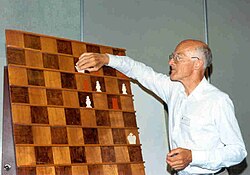
- demonstration board
- A large standing chess board used to analyze a game or show a game in progress. Johann Löwenthal invented the demonstration board in 1857.[125]
- descriptive notation
- A system of recording chess moves, used primarily in the English- and Spanish-speaking countries until the 1980s. Descriptive notation is based on natural language descriptions of chess moves rendered in abbreviated form, for example "pawn to queen's bishop's fourth" is rendered as "P-QB4". Now replaced by the standard algebraic notation.[126]
- desperado
- A piece that seems determined to give itself up, typically to bring about stalemate or perpetual check. Also an en prise or trapped piece that sacrifices itself for the maximum compensation possible.[127][128]
- development
- The movement of non-pawn pieces in the opening from their original squares to squares where they can be more active. Development of one's pieces is one of the objectives of the opening phase of the game.[122]
- diagonal
- A line of squares of the same color touching corner to corner, along which a queen or bishop moves.[129]
- dirty flag
- A scenario in which a player having a losing position on the board wins by virtue of the opponent exceeding the time control. It typically occurs in faster formats, such as blitz or bullet, where a player prioritizes making rapid (often sub-optimal) moves to exhaust the opponent's remaining seconds rather than seeking a tactical or positional advantage.[130]
- discovered attack
- An attack made by a queen, rook, or bishop when another piece or pawn moves out of its way.[122]
- discovered check
- A discovered attack to the king. This occurs when a player moves a piece, resulting in another piece putting their opponent's king in check.[131][132][133]
- diversionary sacrifice
- Especially in the middlegame, the sacrifice of a decoy piece.[134]
- domination
- From endgame studies, control of all movement squares of an enemy piece.[135]
- double attack
- Two attacks made with one move: these attacks may be made by the same piece (in which case it is a fork); or by different pieces, for example in a discovered attack when the moved piece also makes a threat.[122]
- double check
- การรุกฆาตที่กระทำโดยหมากสองตัวพร้อมกัน การรุกฆาตสองครั้งย่อมเกี่ยวข้องกับการรุกฆาตที่ค้นพบโดยธรรมชาติ การรุกฆาตสองครั้งไม่สามารถตอบโต้ได้ด้วยการวางหมากป้องกันในแนวโจมตี หรือด้วยการจับหมากโจมตี เมื่อถูกรุกฆาตสองครั้ง ราชาที่ถูกโจมตีจะต้องขยับ ทำให้การรุกฆาตสองครั้งมีประสิทธิภาพเป็นพิเศษในฐานะกลยุทธ์การโจมตี[ 136 ]
- เบี้ยคู่
- หมากเบี้ยสองตัวที่มีสีเดียวกันบนแถว เดียวกัน ถือเป็นจุดอ่อนโดยทั่วไปเนื่องจากไม่สามารถป้องกันซึ่งกันและกันได้[ 129 ]
- หมากรุกคู่
- การจัดวางที่ทรงพลังซึ่งผู้เล่นวางเรือสองตัวไว้ในแถวเดียวกันโดยไม่มีตัวหมาก อื่น อยู่ระหว่างนั้น พวกมันจะป้องกันซึ่งกันและกันและโจมตีตามแถวเดียวกัน รวมถึงแถวหรือแนวอื่นอีกสองแถว การจัดวางนี้อาจมีผลอย่างมากในช่วงท้ายเกม[ 137 ]
- ฟิอันเชตโตคู่
- บิชอปราชาและบิชอปราชินีของผู้เล่นต่างก็ถูกฟิอันเชตโต[ 138 ]
- วาด
- เกมที่จบลงโดยไม่มีฝ่ายใดฝ่ายหนึ่งได้รับชัยชนะ เกมที่เสมอกันส่วนใหญ่เป็นการเสมอกันโดยความเห็นชอบวิธีอื่นๆ ที่เกมสามารถจบลงด้วยการเสมอ ได้แก่การเสมอแบบไม่มีฝ่ายใด ได้ เปรียบ การเสมอแบบไม่มีฝ่ายใดได้ เปรียบกฎการซ้ำสามครั้งกฎห้าสิบตาเดินกฎการซ้ำห้าครั้งและกฎเจ็ดสิบห้าตาเดินตำแหน่งหนึ่งจะเรียกว่าเสมอ (หรือ "ตำแหน่งที่เสมอ" หรือ "การเสมอเชิงทฤษฎี") หากผู้เล่นฝ่ายใดฝ่ายหนึ่งสามารถบังคับให้เกมจบลงด้วยการเสมอได้ในที่สุดด้วยการเล่นที่ถูกต้อง โดยไม่คำนึงถึงตาเดินของอีกฝ่าย การเสมอมักจะได้คะแนน ½ คะแนน แม้ว่าในบางแมตช์จะนับเฉพาะชัยชนะและไม่นับการเสมอ[ 122 ]
- วาดตามข้อตกลง
- เกมที่จบลงเมื่อผู้เล่นทั้งสองฝ่ายยอมรับผลเสมอ[ 139 ]
- วาดความตาย
- สถานการณ์สมมติที่ผู้เล่นหมากรุกระดับสูงได้รับความช่วยเหลือจากการวิเคราะห์ด้วยคอมพิวเตอร์สมัยใหม่จนเก่งกาจจนไม่เคยทำผิดพลาด ส่งผลให้เกมจบลงด้วยการเสมอไม่รู้จบ (เนื่องจากเชื่อกันโดยทั่วไปว่าหมากรุกจะจบลงด้วยการเสมอเมื่อทั้งสองฝ่ายเล่นอย่างเต็มที่) [ 140 ]
- การวาดเส้น
- รูปแบบการเปิดเกมที่มักจะจบลงด้วยผลเสมอ[ 141 ]
- การชักอาวุธ
- ประโยคเปิดเกมที่เล่นโดยมีเจตนาให้เสมอกัน[ 142 ]
- วาด
- An adjective describing a position or game that is likely to end in a draw.[143]
- draw odds
- A type of chess handicap where one player (Black in an Armageddon game) has only to draw in order to win the match.[144]
- draw offer
- A proposal by a player to the opponent that the game be draw by agreement.[145]
- dynamism
- A style of play in which the activity of the pieces is favored over more positional considerations, even to the point of accepting permanent structural or spatial weaknesses. Dynamism stemmed from the teachings of the Hypermodern school and challenged the dogma found in more classical teachings, such as those put forward by Wilhelm Steinitz and Siegbert Tarrasch.[146]
| เอ | ข | ค | ง | อี | เอฟ | จี | ชม. | ||
| 8 | | 8 | |||||||
| 7 | 7 | ||||||||
| 6 | 6 | ||||||||
| 5 | 5 | ||||||||
| 4 | 4 | ||||||||
| 3 | 3 | ||||||||
| 2 | 2 | ||||||||
| 1 | 1 | ||||||||
| เอ | ข | ค | ง | อี | เอฟ | จี | ชม. | ||
| a | b | c | d | e | f | g | h | ||
| 8 | | 8 | |||||||
| 7 | 7 | ||||||||
| 6 | 6 | ||||||||
| 5 | 5 | ||||||||
| 4 | 4 | ||||||||
| 3 | 3 | ||||||||
| 2 | 2 | ||||||||
| 1 | 1 | ||||||||
| a | b | c | d | e | f | g | h | ||
E
- eat
- [slang] To remove the opponent's piece or pawn from the board by taking it with one's own piece or pawn.[147][148] Synonym: capture.
- ECF
- The English Chess Federation (ECF) is the governing chess organisation in England and is one of the federations of FIDE. It was known as the British Chess Federation (BCF) until 2005 when it was renamed.
- ECO
- An abbreviation for the Encyclopaedia of Chess Openings (ECO), a standard 5-volume chess opening reference. Also ECOcode, a classification system for openings that assigns an alphanumeric code from A00 to E99 to each opening.
- ECU
- The European Chess Union (ECU) is the continental association for chess in Europe.
- edge
- A small but meaningful advantage in position against one's opponent. It is often said that White has an edge in the starting position, since White moves first (see First-move advantage in chess).[149] Cf.initiative.
- eighth rank
- The rank on which pawns promote (rank eight for White; rank one for Black). Also called last rank.
- Elo rating system
- The Elo rating system, named after the Hungarian-American statistician and chess player Arpad Elo, is a method for calculating the relative skill levels of chess players based on their results in competition. FIDE adopted the system in 1970, initially publishing ratings annually. Over the years the list has been published with increasing frequency, and since 2012 it has been published monthly. The majority of national chess federations have their own rating system for use in domestic competition, usually based on the Elo system. [150]
- endgame
- The third and last phase of the game, when there are few pieces left on the board. The endgame follows the middlegame.[150]
- endgame tablebase
- A computerized database of endgames with a small number of pieces, providing perfect play for both players, and thus completely solving those endgames. As of 2012, tablebases have been calculated for all positions with up to seven pieces.[151]
- en passant ("e.p.")
- [from French, "in the act of passing"] The rule that allows a pawn that has just advanced two squares to be captured by an enemy pawn that is on the same rank and adjacent file. The pawn can be taken as if it had advanced only one square. Capturing en passant is possible only on the next move.[152]
- en prise
- [from French, "in a position to be taken",[153][154] often italicized] En prise describes a piece or pawn exposed to a material-winning capture by the opponent. This is either a hanging piece, an undefended pawn, a piece attacked by a less valuable attacker, or a piece or pawn defended insufficiently. For instance, 1.e4 Nf6 2.Nf3? leaves White's e-pawn en prise.[22][155]
- e.p.
- An abbreviation for en passant.
- epaulette mate
- A checkmate position where the king is blocked on both sides by its own rooks.[156]
- EPD
- An abbreviation for Extended Position Description.
- equalize
- หรือทำให้เสมอกันเพื่อให้ได้ตำแหน่งที่ผู้เล่นมีโอกาสชนะเท่ากัน ซึ่งเรียกว่าความเสมอภาคหรือ ตำแหน่งที่เท่าเทียมหรือ ตำแหน่งที่สมดุลในการเปิดเกมเนื่องจากฝ่ายขาวได้เปรียบในการเดินหมากก่อนเป้าหมายเร่งด่วนของฝ่ายดำคือการทำให้เสมอภาค[ 157 ]
- จัตุรัสหลบหนี
- ดูช่องเที่ยวบิน
- การประเมิน
- หรือเรียก ง่ายๆ ว่า การประเมิน การวิเคราะห์ตำแหน่ง การประเมินโดยคอมพิวเตอร์หรือโปรแกรมวิเคราะห์หมากรุกเป็นวิธีการกำหนดค่าตัวเลขให้กับตำแหน่ง โดยไม่ได้อาศัยสติปัญญา แต่ขึ้นอยู่กับอัลกอริทึม ซึ่งแตกต่างกันไปในแต่ละโปรแกรมและขึ้นอยู่กับความแข็งแกร่งของโปรแกรม การประเมินโดยโปรแกรมมีข้อบกพร่องและความไม่สมบูรณ์แม้ว่าจะทำงานได้ตามที่ออกแบบไว้ก็ตาม หากโปรแกรมอธิบายตำแหน่งว่า +2.50 เครื่องหมายบวก ("+") แสดงว่าตำแหน่งนั้นได้เปรียบฝ่ายขาว เครื่องหมายลบ ("−") แสดงว่าตำแหน่งนั้นได้เปรียบฝ่ายดำ ตัวเลขอาจสอดคล้องกับค่าโดยประมาณของตัวหมาก แม้ว่าโปรแกรมจะใช้ปัจจัยอื่นๆ นอกเหนือจากตัวหมากก็ตาม สัญลักษณ์ +2.50 แสดงว่าฝ่ายขาวนำอยู่สองตัวครึ่งเบี้ย สัญลักษณ์ +M4 (หรือบางครั้ง #4) แสดงว่าฝ่ายขาวสามารถรุกฆาตได้ในสี่ตาเดิน[ 158 ] [ 159 ] [ 160 ]ดูการวิเคราะห์
- แลกเปลี่ยน
- เพื่อแลกเปลี่ยนหรือซื้อขายตัวหมากโดยการจับกินโดยปกติแล้วตัวหมากจะมีมูลค่าเท่ากัน (เช่น เรือกับเรือ, อัศวินกับอัศวิน เป็นต้น) หรือบิชอปกับอัศวิน (ตัวหมากสองตัวที่ถือว่ามีมูลค่าใกล้เคียงกัน) แม้ว่าผู้เขียนบางคน[ 161 ] [ 162 ]จะกำหนดว่าการแลกเปลี่ยนจะต้องมีมูลค่าเท่ากันเสมอ แต่ผู้เขียนส่วนใหญ่[ 163 ] [ 164 ]ไม่ได้กำหนด เช่นนั้น [ 165 ] [ 166 ]
- การแลกเปลี่ยน
- ข้อได้เปรียบของเรือเหนือหมากตัวเล็ก (อัศวินหรือบิชอป) ผู้เล่นที่จับเรือเพื่อแลกกับหมากตัวเล็กได้เรียกว่า "ชนะการแลกเปลี่ยน" ส่วนผู้เล่นที่เสียเรือไปเรียกว่า "แพ้การแลกเปลี่ยน" การเสียสละเพื่อแลกเปลี่ยนคือการสละเรือเพื่อแลกกับหมากตัวเล็ก[ 22 ]
- การเปลี่ยนแปลงการแลกเปลี่ยน
- นี่เป็นการ เปิดประเภทหนึ่งซึ่งมีการแลกเปลี่ยนเบี้ยหรือตัวหมากโดยสมัครใจในช่วงต้นเกม[ 167 ]
- นิทรรศการ
- Chess games played for the public in various formats and for various purposes, often to promote the game, or a particular match or player, or as a fundraiser. An exhibition may pit two masters against each other, and normally use chess clocks. In a simultaneous exhibition, one player takes on a number of opponents at once, and it is often not timed. A blindfold exhibition is the same but more challenging, since the exhibitor plays without seeing the boards.[168]
- expanded center
- The central sixteen squares of the chessboard.[169]
- exposed king
- A king lacking pawns to shield it from enemy attack.[170]
- extended fianchetto
- See fianchetto.
- Extended Position Description ("EPD")
- A Forsyth–Edwards Notation derivative format that contains the position on the chessboard, but not the game. It is primarily used to test chess engines.[171]
| a | b | c | d | e | f | g | h | ||
| 8 | | 8 | |||||||
| 7 | 7 | ||||||||
| 6 | 6 | ||||||||
| 5 | 5 | ||||||||
| 4 | 4 | ||||||||
| 3 | 3 | ||||||||
| 2 | 2 | ||||||||
| 1 | 1 | ||||||||
| a | b | c | d | e | f | g | h | ||
| a | b | c | d | e | f | g | h | ||
| 8 | | 8 | |||||||
| 7 | 7 | ||||||||
| 6 | 6 | ||||||||
| 5 | 5 | ||||||||
| 4 | 4 | ||||||||
| 3 | 3 | ||||||||
| 2 | 2 | ||||||||
| 1 | 1 | ||||||||
| a | b | c | d | e | f | g | h | ||
F
- family fork
- A knight fork that simultaneously attacks the enemy king (giving check), queen, and possibly other pieces. Also known as a family check.[172]
- FAN
- An abbreviation for figurine algebraic notation, which substitutes symbols for letters to represent piece names (e.g. ♘f3 instead of Nf3).[173]
- fast chess
- A form of chess in which both sides are given less time to make their moves than under the normal tournament time controls.
- FEN
- An abbreviation for Forsyth–Edwards Notation.
- FGM
- An abbreviation for FICGS Grandmaster.
- fianchetto
- เพื่อพัฒนาบิชอปไปยังแนวทแยงที่ยาวที่สุดของกระดานบนแถวของอัศวินที่อยู่ติดกัน (b2 หรือ g2 สำหรับฝ่ายขาว; b7 หรือ g7 สำหรับฝ่ายดำ) การวางบิชอปทั้งสองตัวโดยผู้เล่นเรียกว่าดับเบิลฟิอันเชตโตการวางบิชอปไปยังแถวของเรือ (a3 หรือ h3 สำหรับฝ่ายขาว; a6 หรือ h6 สำหรับฝ่ายดำ) ซึ่งพบได้น้อยกว่า เรียกว่าเอ็กซ์เทนดัลฟิอันเชตโต[ 138 ]คำภาษาอิตาลี ("ปีกเล็ก") ออกเสียงว่า/ ˌ f i . ə n . ˈ k ɛ . t oʊ /หรือ/ ˌ f i . ə n . ˈ tʃ ɛ . t oʊ /ในภาษาอังกฤษ ในขณะที่ชื่อของมันฟังดูเหมือน[ fjaŋ.ˈket.to ]ในภาษาอิตาลี[ 174 ] [ 175 ]
- แกรนด์มาสเตอร์ FICGS
- ตำแหน่ง หมากรุกทางไปรษณีย์ที่คำนวณโดยองค์กร FICGS (Free Internet Correspondence Games Server) [ 176 ]
- สหพันธ์ฟุตบอล
- สหพันธ์หมากรุกโลก (Fédération Internationale des Échecs) เป็นองค์กรหลักในการจัดการและกำกับดูแลหมากรุกระดับนานาชาติ โดยทั่วไปมักใช้ชื่อย่อ FIDE แทนชื่อเต็มในภาษาฝรั่งเศส[ 177 ]
- เฟดีเอ มาสเตอร์ ("FM")
- ตำแหน่งหมากรุกที่มีอันดับต่ำกว่า ระดับ ปรมาจารย์สากล[ 178 ]
- เรตติ้ง FIDE
- ดูระบบการจัดอันดับ Elo
- กฎห้าสิบตาเดิน
- สามารถอ้างผลเสมอได้หากไม่มีการจับกินหรือการเดินเบี้ยเกิดขึ้นใน 50 ตาเดินล่าสุดจากฝ่ายใดฝ่ายหนึ่ง[ 179 ]ซึ่งเกี่ยวข้องกับกฎ 75 ตาเดินซึ่งกำหนดให้เสมอกันหลังจาก 75 ตาเดินดังกล่าว
- ไฟล์
- แถวของช่องสี่เหลี่ยมบนกระดานหมากรุกสามารถตั้งชื่อแถวเฉพาะโดยใช้ตำแหน่งในสัญลักษณ์พีชคณิต a–h หรือโดยใช้ตำแหน่งในสัญลักษณ์เชิงพรรณนาตัวอย่างเช่น "แถว f" และ "แถวราชาบิชอป" ต่างก็หมายถึงช่องสี่เหลี่ยม f1–f8 (หรือ KB1–KB8 ในสัญลักษณ์เชิงพรรณนา) [ 177 ]
- ความผิดพลาดของนิ้วมือ
- [จากภาษาเยอรมัน "ความผิดพลาดของนิ้ว"] ข้อผิดพลาดที่เกิดจากการสัมผัสชิ้นส่วนผิดโดยไม่คิด หรือปล่อยชิ้นส่วนบนช่องที่ไม่ถูกต้อง ทำให้ผู้เล่นต้องย้ายชิ้นส่วนนั้นตามกฎการสัมผัสแล้วย้าย[ 180 ]
- กระดานแรก
- ในหมากรุกแบบทีม ผู้เล่นที่ได้รับมอบหมายให้เผชิญหน้ากับคู่ต่อสู้ที่แข็งแกร่งที่สุด จะเรียกว่ากระดานบนสุดหรือกระดานที่หนึ่งกระดานที่สองจะเผชิญหน้ากับผู้เล่นที่แข็งแกร่งรองลงมา ตามด้วยกระดานที่สาม และต่อไปเรื่อยๆ โดยทั่วไป การกำหนดกระดานจะต้องทำก่อนเริ่มการแข่งขัน ผู้เล่นไม่สามารถเปลี่ยนกระดานได้ แม้ว่าผู้เล่นสำรองมักจะได้รับอนุญาตให้เปลี่ยนตัวได้ก็ตาม
- ข้อได้เปรียบในการเริ่มก่อน
- ข้อได้เปรียบเล็กน้อย (ตามรายงานส่วนใหญ่) ที่ฝ่ายขาวมีเนื่องจากเดินก่อน[ 177 ]
- ผู้เล่นคนแรก
- บางครั้งมีการใช้สำนวน "ผู้เล่นคนแรก" เพื่อหมายถึงฝ่ายขาว
- อันดับแรก
- ดูอันดับบ้าน
- ความล่าช้าของฟิชเชอร์
- วิธีการควบคุมเวลาที่มีการหน่วงเวลาซึ่งคิดค้นโดยBobby Fischerเมื่อถึงตาของผู้เล่นที่จะเดิน การหน่วงเวลาจะถูกเพิ่มเข้าไปในเวลาที่เหลือของผู้เล่น[ 181 ]
- ฟิชเชอแรนดอม
- ชื่อที่บ็อบบี้ ฟิชเชอร์ ตั้งให้ กับหมากรุกรูปแบบใหม่ที่เขาคิดค้นขึ้น ดูเพิ่มเติมได้ที่Chess960
- หมากรุกสุ่มฟิชเชอร์
- ดูที่Chess960
- ปลา
- [คำแสลงเชิงดูถูก] ผู้เล่นที่อ่อนแอหรือแพ้ง่าย
- การทำซ้ำห้าเท่า
- เกมจะเสมอกันหากตำแหน่งเดียวกันเกิดขึ้นห้าครั้งโดยผู้เล่นคนเดียวกันเป็นผู้เดิน และผู้เล่นแต่ละคนมีสิทธิ์เลือกชุดการเดินเดียวกันในแต่ละครั้ง รวมถึงสิทธิ์ในการจับแบบ en passant และสิทธิ์ในการเข้าป้อมกฎการซ้ำสามครั้งทำงานบนหลักการที่คล้ายกัน แต่จะถูกนำมาใช้ตามดุลยพินิจของผู้เล่นแทนที่จะเป็นไปโดยอัตโนมัติ[ 182 ]
- หมากรุกห้านาที
- ดูหมากรุกสายฟ้าแลบ (Blitz chess )
- ธง
- ส่วนหนึ่งของนาฬิกาหมากรุก แบบอนาล็อก ซึ่งมักจะเป็นสีแดง จะแสดงเมื่อเข็มนาทีผ่านชั่วโมง การ "ทำให้คู่ต่อสู้แพ้" หมายถึงการชนะเกมโดยอาศัยการที่คู่ต่อสู้ใช้เวลา เกิน กำหนด[ 177 ]
- การล้มธง
- เหตุการณ์เมื่อเวลาที่กำหนดของผู้เล่นหมดลง ผู้เล่นหมดเวลาแล้ว[ 183 ]
- ปีก
- แถวa, b และ c ฝั่งควีน หรือ แถว f, g และ h ฝั่ง คิง แยกจาก แถว d และ e ตรงกลาง[ 184 ] [ 185 ]เรียกอีกอย่างว่าปีก
- ช่องเปิดด้านข้าง
- การเปิดเกม ที่ฝ่าย ขาวเล่นและมีลักษณะเฉพาะคือการเล่นบนปีกข้างใดข้างหนึ่งหรือทั้งสองข้าง[ 186 ]
- จัตุรัสการบิน
- ช่องสี่เหลี่ยมที่ตัวหมากสามารถเคลื่อนที่ไปได้ ซึ่งช่วยให้หลีกหนีการโจมตีได้[ 172 ]เรียกอีกอย่างว่าช่องหลบหนี
- เอฟเอ็ม
- คำย่อของFIDE Master
- เอฟโอเอ
- คำย่อของFIDE Online Arena
- เพื่อนโง่
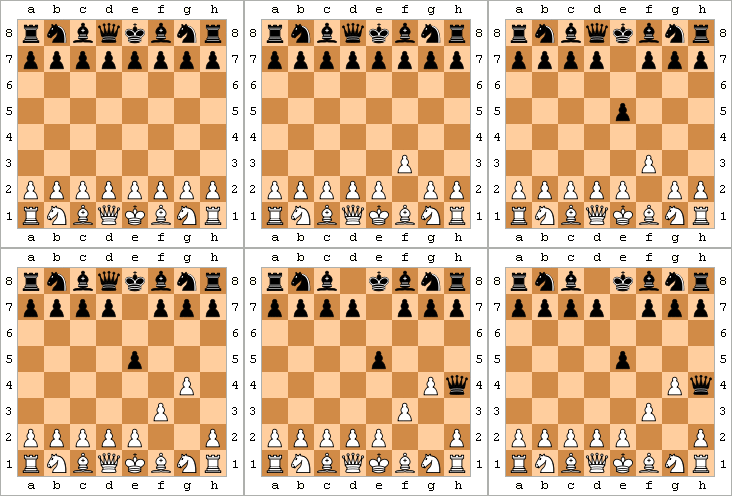
- เกมหมากรุกที่สั้นที่สุดที่จบลงด้วยการรุกฆาต : 1.f3 e5 2.g4 Qh4# (หรือรูปแบบย่อยเล็กน้อยของสิ่งนี้) [ 187 ]
- ถูกบังคับให้เป็นคู่ครอง
- ลำดับการเดินหมากสองตาขึ้นไปที่ จบลงด้วย การรุกฆาตที่ฝ่ายตรงข้ามไม่สามารถป้องกันได้[ 188 ]
- ถูกบังคับให้ย้าย
- การเดินหมากที่ถูกต้องตามกฎหมายเพียงทางเดียวในตำแหน่ง หรือการเดินหมากเพียงทางเดียวที่ไม่ส่งผลให้เกิดการสูญเสียทันทีหรือความเสียเปรียบอย่างร้ายแรง[ 187 ]เปรียบเทียบกับ การเดิน หมากบังคับ
- ชนะแบบบังคับ
- ชัยชนะ ที่แน่นอนได้จาก การเดินหมากที่เด็ดขาดหลายครั้งติดต่อกัน
- การบังคับเคลื่อนย้าย
- การเคลื่อนไหวที่ก่อให้เกิดภัยคุกคามและจำกัดการตอบสนองของฝ่ายตรงข้าม[ 189 ]เปรียบเทียบกับการเคลื่อนไหวที่ถูกบังคับ
- ริบ
- หมายถึงการแพ้เกมเนื่องจากการทำผิดกฎ การขาดงาน หรือการเกินเวลาที่กำหนด (แพ้เพราะหมดเวลา) [ 190 ]
- ส้อม
- การโจมตีพร้อมกันโดยตัวหมากตัวเดียวต่อตัวหมากของฝ่ายตรงข้ามสองตัว (หรือมากกว่า) (หรือเป้าหมายโดยตรงอื่นๆ เช่น การคุกคามการ รุกฆาต ) เมื่อผู้โจมตีเป็นอัศวินกลยุทธ์นี้มักเรียกว่าอัศวินฟอร์ก (knight fork ) โดยเฉพาะ แหล่งข้อมูลบางแห่งระบุว่ามีเพียงอัศวินเท่านั้นที่สามารถโจมตีแบบฟอร์กได้ และคำว่าการโจมตีสองครั้ง (double attack)นั้นถูกต้องเมื่อมีตัวหมากอื่นเกี่ยวข้อง แต่การใช้งานแบบนี้พบได้น้อย[ 5 ]
- สัญกรณ์ฟอร์ไซธ์-เอ็ดเวิร์ดส์ ("FEN")
- สัญลักษณ์มาตรฐานสำหรับอธิบายตำแหน่งกระดานหมากรุกที่เฉพาะเจาะจง จุดประสงค์ของสัญลักษณ์ FEN คือการให้ข้อมูลที่จำเป็นทั้งหมดเพื่อเริ่มเกมใหม่จากตำแหน่งที่เฉพาะเจาะจง[ 191 ] [ 192 ]
- ป้อม
- ใน ทฤษฎี เกม ช่วงท้าย ป้อมปราการคือตำแหน่งที่ไม่สามารถเจาะทะลุได้ ซึ่งหากฝ่ายที่เสียเปรียบด้านวัสดุได้ครอบครอง อาจส่งผลให้เสมอกันได้เนื่องจากฝ่ายที่แข็งแกร่งกว่าไม่สามารถรุกคืบได้[ 193 ]
- เฟรม
- พื้นที่สี่เหลี่ยมจัตุรัสบนกระดานที่ล้อมรอบพื้นที่อื่นซึ่งไม่ได้เป็นส่วนหนึ่งของกรอบที่กำหนด คล้ายกับกรอบรูปเรียกอีกอย่างว่าวงแหวน[ 194 ]กรอบด้านนอกประกอบด้วยสี่เหลี่ยมจัตุรัส 28 ช่องตามขอบกระดาน กรอบตรงกลางประกอบด้วยสี่เหลี่ยมจัตุรัส 20 ช่องที่อยู่ด้านในกรอบด้านนอก และกรอบด้านในประกอบด้วยสี่เหลี่ยมจัตุรัส 12 ช่องที่อยู่ด้านในกรอบตรงกลาง[ 195 ]แนวคิดของกรอบอาจขยายออกไปเพื่อรวมถึงจุดศูนย์กลางเองเป็นกรอบด้านในสุดการเคลื่อนที่ ของชิ้นส่วนมีความสัมพันธ์อย่างใกล้ชิดกับกรอบที่ชิ้นส่วน นั้นตั้งอยู่ โดยทั่วไป ชิ้นส่วนที่อยู่ใกล้จุดศูนย์กลางจะมีอิสระในการเคลื่อนที่มากกว่าชิ้นส่วนที่อยู่ใกล้ขอบกระดาน
- เกมกระชับมิตร
- เกมที่ไม่ได้เล่นเป็นส่วนหนึ่งของการแข่งขันทัวร์นาเมนต์หรือนิทรรศการมักจะไม่มีการจับเวลาแต่ถ้าใช้หมากรุกนาฬิกาการควบคุมเวลาอย่างรวดเร็วเป็นเรื่องปกติ คำนี้หมายถึงสถานการณ์ที่เกมถูกเล่นเท่านั้น ไม่ใช่ความสัมพันธ์ระหว่างผู้เล่นหรือความเข้มข้นของการแข่งขัน[ 196 ]เรียกอีกอย่างว่าเกมแบบไม่เป็นทางการและเกมแบบไม่เป็นทางการ
- เส้นเขตแดน
- เส้นสมมุติที่แบ่งกระดานออกเป็นสองส่วน โดยผ่านระหว่างแถวที่สี่และแถว ที่ ห้า[ 197 ] [ 198 ]เส้นแบ่งเขตแดนนี้แยกฝั่งของฝ่ายขาวออกจากฝั่งของฝ่ายดำ บัญญัติโดยAron Nimzowitsch [ 199 ] [ 200 ]
| เอ | ข | ค | ง | อี | เอฟ | จี | ชม. | ||
| 8 |  | 8 | |||||||
| 7 | 7 | ||||||||
| 6 | 6 | ||||||||
| 5 | 5 | ||||||||
| 4 | 4 | ||||||||
| 3 | 3 | ||||||||
| 2 | 2 | ||||||||
| 1 | 1 | ||||||||
| เอ | ข | ค | ง | อี | เอฟ | จี | ชม. | ||
จี
- กลเม็ด
- การเสียสละ (โดยปกติจะเป็นเบี้ย) เพื่อให้ได้เปรียบในช่วงต้นเกมในด้านพื้นที่หรือเวลาในการเปิดเกม[ 5 ]
- นาฬิกาเกม
- ดูนาฬิกาหมากรุก
- คะแนนเกม
- มักย่อเป็นคะแนนบันทึกผลการแข่งขันในรูปแบบการเขียน บางอย่าง โดยปกติจะเป็นการเขียนแบบพีชคณิตใน การแข่งขัน แบบตัวต่อตัว คะแนนการแข่งขันจะถูกบันทึกไว้ในใบบันทึกคะแนน[ 201 ]
- การ์เดซ
- [จากภาษาฝรั่งเศส : gardez la reine! , "ปกป้องราชินี!"] การประกาศให้ฝ่ายตรงข้ามทราบว่าราชินีของพวกเขากำลังถูกโจมตีโดยตรง คล้ายกับการประกาศ "รุกฆาต" คำเตือนนี้เป็นธรรมเนียมปฏิบัติจนถึงต้นศตวรรษที่ 20 [ 202 ]
- จีเอ็ม
- An abbreviation for Grandmaster.[203]
- God
- Metaphorical; a hypothetical player who always plays perfectly.[204]
- good bishop
- A bishop that has greater mobility, because the player's own pawns are on squares of the opposite color to that of the bishop.[205] Cf.bad bishop.
- Grandmaster ("GM")
- The highest title a chess player can attain (besides World Champion). Awarded by FIDE, the title is valid for life unless exceptional circumstances (such as cheating) occur.[206]
- grandmaster draw
- A game in which the players agree to a quick draw. Originally it referred to such games between grandmasters, but the term can now refer to any such game.[206]
- Greek gift sacrifice
- A typical sacrifice of a bishop by White playing Bxh7+ or by Black playing ...Bxh2+ against a castled king to initiate a mating attack. Also known as the classical bishop sacrifice.[207]
H
- half-open file
- A file on which only one player has pawns.[208] Also called semi-open file.
- handicap
- See odds.
- hanging
- Unprotected and exposed to capture. A hanging piece may also be said to be en prise.[206]
- hanging pawns
- Two pawns of the same color on adjacent files, with no pawns of the same color on the files to either side of them.[206]
- harmony
- See coordination.
- Harrwitz bishops
- See Horwitz bishops.
- Harry
- A nickname for the h-pawn, sometimes occurring in the expression, "Harry the h-pawn".[209][210]
- hauptturnier
- German word that is freely translated as "premiere tournament". In the early part of the 20th century, it was necessary for the ambitious European amateur to win a succession of prizes in small tournaments, to progress to a higher level of competition. The creation of the hauptturnier enabled the process to become more formalized, and they became a regular feature of the major German chess congresses. Winning such an event conferred the title of 'Master of the German Chess Federation', and this, in turn, could be used to gain admittance to prestigious international tournaments. Some of the best players in chess history, such as Emanuel Lasker and Siegbert Tarrasch, secured their Master titles and advanced their chess careers in this way.[211]
- heavy piece
- See major piece.
- hole
- A square that is inside or near a player's territory that cannot be controlled by a pawn. It is a gap in a player's pawn configuration, and especially dangerous when the hole is close to the center or near the king. A knight landing on a hole may be part of an attack. An example of a hole is the e4-square in the Stonewall Attack.[213]
- home rank
- The rank on which the pieces stand in the starting position (rank one for White; rank eight for Black).[214] Also called back rank and first rank.
- horizontal line
- See rank.
- Horwitz bishops
- A player's light-square bishop and dark-square bishop placed so that they occupy adjacent diagonals, creating a potent attack. Also called raking bishops, and sometimes Harrwitz bishops.[217][218]
- human move
- A move a human would make, as opposed to the kind of move that only a computer would make.[219]
- Hutton pairing
- A pairing technique invented in 1921 by George Dickson Hutton for matching teams of players in which only one game is required per player. It has been used regularly for correspondence team events and for matches between many teams conducted on one day.[220] Also called jamboree pairing.
- hypermodernism
- A school of thought that prefers controlling the center with pieces from the flanks as opposed to occupying it directly with pawns. Two major proponents of hypermodernism were Richard Réti and Aron Nimzowitsch.[221]
| a | b | c | d | e | f | g | h | ||
| 8 |  | 8 | |||||||
| 7 | 7 | ||||||||
| 6 | 6 | ||||||||
| 5 | 5 | ||||||||
| 4 | 4 | ||||||||
| 3 | 3 | ||||||||
| 2 | 2 | ||||||||
| 1 | 1 | ||||||||
| a | b | c | d | e | f | g | h | ||
I
- IA
- An abbreviation for International Arbiter.
- ICCA
- See International Correspondence Chess Federation.
- ICCF
- An abbreviation for International Correspondence Chess Federation.[222]
- ICS
- An abbreviation for Internet chess server.
- IGM
- An abbreviation for the older term International Grandmaster. The modern usage is Grandmaster (GM).
- illegal move
- A move that is not permitted by the rules of chess. An illegal move discovered during the course of a game must be corrected.[223]
- illegal position
- 1. A position in a game that is a consequence of an illegal move or an incorrect starting position
- 2. A position that is impossible to reach by any sequence of legal moves.
- [223]
- IM
- An abbreviation for International Master.[224]
- imbalance
- Any difference between the positions of White and Black. An imbalanced position is one where White and Black both have unique advantages. Conversely, a balanced position may be drawish.[221]
- inaccuracy
- A move that is not the best, but not as bad as a mistake or blunder.[224]
- inactive
- See passive.
- in check
- See check.
- increment
- Refers to the amount of time added to each player's time before each move. For instance, rapid chess might be played with "25 minutes plus 10 second per move increment", meaning that each player starts with 25 minutes on their clock, and this increments by 10 seconds after (or before) each move, usually using the Fischer Delay method.[43]
- Indian bishop
- A fianchettoedbishop, characteristic of the Indian defense, the King's Indian and the Queen's Indian.[225]
- Indian Defense
- An opening that begins 1.d4 Nf6. Originally used to describe queen's pawn defenses involving the fianchetto of one or both black bishops; now used to describe all Black defenses after 1.d4 Nf6 that do not transpose into the Queen's Gambit.[226]
- informal game
- See friendly game.
- initiative
- The ability to make attacking moves, and force the course of play. It is an aspect of time. The attacking player has the initiative, and the defending player attempts to seize it.[227]
- innovation
- A synonym for theoretical novelty.
- insufficient material
- An endgame scenario in which all pawns have been captured, and one side has only its king remaining while the other has only its king, a king plus a knight, or a king plus a bishop. A king plus bishop versus a king plus bishop with the bishops on the same color is also a draw, since neither side can checkmate, regardless of play. Situations where checkmate is possible only if the inferior side blunders are covered by the fifty-move rule.[228]
- interference
- The interruption of the line or diagonal between an attacked piece and its defender by interposing a piece.[227]
- intermediate move
- See zwischenzug.
- intermezzo
- See zwischenzug.
- International Arbiter ("IA")
- A tournament official who arbitrates disputes and performs other duties such as keeping the score when players are under time pressure.
- International Correspondence Chess Federation
- Organization founded in 1951 to replace the International Correspondence Chess Association (ICCA).[222]
- International Grandmaster ("IGM")
- The original name of the FIDE title, now simply called Grandmaster ("GM")
- International Master ("IM")
- A chess title that ranks below Grandmaster but above FIDE Master.
- International Woman Master
- Obsolete name for Woman International Master.
- Internet chess server ("ICS")
- An external server that provides the facility to play, discuss, and view chess over the Internet.
- interpose
- To move a piece between an attacking piece and its target, blocking the line or diagonal of attack. Interposing is not possible if the attacker is a knight, king, or pawn; it is only possible when the attacker is a rook, bishop, or queen. Interposing a piece is one of the three possible responses to a check.[5]
- Interzonal tournament
- A tournament organized by the FIDE starting from the 1950s to 1993. It was the second qualifying cycle of the World Chess Championship. The participants were selected from the top players of the Zonal tournaments. The top-ranking players qualified for the Candidates Tournament. Since 1998 the winners of the zonal tournaments have played short matches against each other over a few weeks in a knockout-style competition to determine who is eligible for the Candidates Tournament.
- IQP
- An abbreviation for isolated queen pawn. See isolani.
- irregular opening
- Early 19th-century chess literature classified all openings that did not begin with either 1.e4 e5 or 1.d4 d5 as "irregular". As opening theory developed and many openings previously considered "irregular" became standard (e.g. the Sicilian Defense), the term gradually became less common. Opening books today are more likely to describe debuts such as 1.b4 (the Sokolsky Opening) as "uncommon" or "unorthodox".[229]
- isolani
- Refers to a d-pawn with no pawns of the same color on the adjacent c-file and e-file, and is a synonym for isolated queen pawn. Aron Nimzowitsch, who coined the term, regarded the isolani as a weapon of attack in the middlegame but an endgame weakness; he saw the problem of hanging pawns as related.[230]
- isolated pawn
- A pawn with no pawn of the same color on an adjacent file.[231]
- isolated queen pawn ("IQP")
- Or isolated queen's pawn.
- Italian bishop
- A white bishop developed to c4 or a black bishop developed to c5. A bishop so developed is characteristic of the Italian Game. In the Giuoco Piano both players have Italian bishops. The Italian bishop stands in contrast to the Spanish bishop on b5 characteristic of the Ruy Lopez. "Italian" may be used as an adjective for an opening where one or both players have Italian bishops.[232]
| a | b | c | d | e | f | g | h | ||
| 8 | | 8 | |||||||
| 7 | 7 | ||||||||
| 6 | 6 | ||||||||
| 5 | 5 | ||||||||
| 4 | 4 | ||||||||
| 3 | 3 | ||||||||
| 2 | 2 | ||||||||
| 1 | 1 | ||||||||
| a | b | c | d | e | f | g | h | ||
| a | b | c | d | e | f | g | h | ||
| 8 | | 8 | |||||||
| 7 | 7 | ||||||||
| 6 | 6 | ||||||||
| 5 | 5 | ||||||||
| 4 | 4 | ||||||||
| 3 | 3 | ||||||||
| 2 | 2 | ||||||||
| 1 | 1 | ||||||||
| a | b | c | d | e | f | g | h | ||
J
- j'adoube
- (from French, "I adjust", pronounced[ʒa.dub]) The international signal of the intention to adjust the position of a piece on the board. When playing with the touch-move rule, a player must say this in order to be able to touch a piece without being subject to the touched piece rule. The verb adouber, literally "to dub" (raise to the knighthood), is rarely used in contemporary French outside of this context. A local language equivalent, e.g. "I am adjusting", is generally also acceptable.[5]
K
- K
- Symbol used for the king when recording chess moves in English.[22]
- key square
- 1. An important square.
- 2. In pawn endings, a square whose occupation by one side's king guarantees the achievement of a certain goal, such as the promotion of a pawn or the win of a pawn.[228] Also called critical square.
- KGA
- The King's Gambit Accepted opening.
- KGD
- The King's Gambit Declined opening.
- KIA
- The King's Indian Attack opening.
- kibitz
- As a spectator, making comments on a chess game that can be heard by the players. Kibitzing on a serious game while it is in progress (rather than during a post-mortem) is a serious breach of chess etiquette.[233]
- kick
- Attacking a piece, often a knight, with a pawn, so that it will move. Kicking a piece may lead to gaining a tempo, or may force the opponent to concede control of key squares.[233]
- KID
- The King's Indian Defense opening.
- king
- The most important piece in chess. It may move to any adjacent square, and it may castle. A king threatened with capture is in check; a player cannot end their move with their king in check. If a player's king is in check and there is no escape, then the king is in checkmate, and the player loses. If the player whose turn it is has no legal moves and their king is not in check, then it is stalemate, and the game is drawn.
- king bishop
- Or king's bishop. The bishop that is on the kingside at the start of the game. Sometimes abbreviated "KB".[85]
- king hunt
- A sustained attack on the enemy king that results in the king being driven a far distance from its initial position, typically resulting in its checkmate. Some of the most famous games featuring king hunts are Edward Lasker–Thomas, Polugaevsky–Nezhmetdinov, and Kasparov–Topalov.[234] Also called king chase.
- king knight
- Or king's knight. The knight that is on the kingside at the start of the game. Sometimes abbreviated "KN".[85]
- king pawn
- Or king's pawn. A pawn on the king's file, i.e. the e-file. Sometimes abbreviated "KP". Also king bishop pawn (KBP), king knight pawn (KNP), and king rook pawn (KRP) for a pawn on the f-, g-, or h-file, respectively.[85]
- king pawn opening
- Or king's pawn opening. An opening that begins 1.e4.
- king rook
- Or king's rook. The rook that is on the kingside at the start of the game. Sometimes abbreviated "KR".[85]
- kingside
- Or king's side. The side of the board (half-board) the kings are on at the start of the game (the e- through h-file), as opposed to the queenside.[37] Also called king's wing.
- king walk
- A consecutive series of king moves designed to bring the king to a safer square. For example, if a player has castled kingside but the opponent has sacrificed a piece to destroy the kingside pawn cover, they may choose to walk the king over to the queenside to shelter behind the queenside pawns.[235]
- knight
- A piece that may move to any nearest square not on a rank, file, or diagonal on which it stands. In other words, it may move two squares horizontally or vertically and then one square perpendicular to that (forming an L shape), jumping over any pieces in the way.
- knight pawn
- Or knight's pawn. A pawn on the knight's file, i.e. the b-file or g-file. Sometimes abbreviated "NP".[85]
- knight's tour
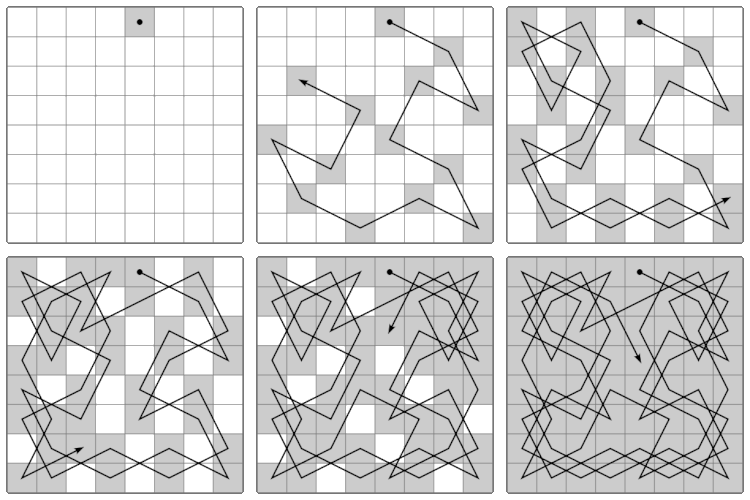
- A puzzle that challenges a person to set a knight on an empty chessboard, and make the piece move around (as it moves in a chess game), but to visit every square only once. The knight's tour is the best known of a variety of tours and puzzles based on chess pieces. A closed tour (also known as a re-entrant tour) ends on the same square on which it began and needs 64 moves. An open tour ends on a different square and needs only 63 moves.[236]
- knockout tournament
- See Single-elimination tournament. A tournament conducted as a series of matches in which the winner of each match advances to the next round and the loser is eliminated. Well-known chess tournaments held in the knockout format include London 1851 and the 2007 Chess World Cup. Cf.round-robin tournament and Swiss tournament.
- Kotov syndrome
- This phenomenon, described by Alexander Kotov in his 1971 book Think Like a Grandmaster, can occur when a player does not find a good plan after thinking long and hard on a position. The player, under time pressure, then suddenly decides to make a move that they have hardly thought about at all, and it may not be a good move for that reason.[237]
- Kriegspiel
- [from German, "war game"] Kriegspiel is a chess variant played by two opponents who can see only their own board, and one monitoring umpire who makes the moves of both players on a neutral board. It requires three chess sets and boards. The players make their moves based on limited information from the umpire. It was introduced in 1898. It is sometimes referred to as blind chess, not to be confused with blindfold chess.[238]
- Kt
- The symbol sometimes used for the knight when recording chess moves in descriptive notation, mainly in older literature. An N is used instead in algebraic notation and in later descriptive notation to avoid confusion with K, the symbol for the king.[22]
L
- last rank
- See eighth rank.
- laws of chess
- The rules of chess.[183]
- lightning chess
- A form of chess with an extremely short time limit, either blitz chess or bullet chess.[239]
- light-square bishop
- Often shortened to light bishop.[240] One of the two bishops that moves only on the light squares. In the starting position, White's light-square bishop is on f1; Black's is on c8.[228] Cf.dark-square bishop.
- light squares
- The 32 light-colored squares on the chessboard, such as h1 and a8.[241] Cf.dark squares.
- line
- 1. A sequence of moves, usually in the opening or in analyzing a position.
- 2. An open path for a piece (queen, rook, or bishop) to move or control squares.[239]
- line piece
- A piece whose movement is defined to be along straight lines of squares (i.e. the rook, bishop, and queen).[242]
- liquidation
- See simplification.
- long castling
- See castling long.
- long diagonal
- One of the two diagonals with eight squares (a1–h8 or h1–a8).[243]
- long fianchetto
- A fianchetto whereby the knight's pawn has advanced two squares (b4 or g4 for White; b5 or g5 for Black) instead of one.[138]
- long-range piece
- A bishop, rook, or queen.
- loose piece
- A piece vulnerable to opponent attacks because it is undefended and cannot easily be withdrawn or supported.[244]
- loose position
- A position vulnerable to opponent attacks because it is overextended or its pieces are uncoordinated.
- losing a tempo
- See tempo.
- loss
- A defeat for one of the two players, which may occur due to that player being checkmated by the other player, resigning, exceeding the time control, or being forfeited by the tournament director. In chess, a zero-sum game, this results in a win for the other player.[245]
- Lucena position
- A well-known rook and pawn versus rook endgame position in which the player with the extra pawn can force a win by cutting off the opponent's king and placing a rook on the 4th rank in order to block the opponent's rook checks, thereby allowing the pawn to queen.[57]
- luft
- [from German, "air"] Space made for a castled king to give it a flight square to prevent a back-rank mate. Usually luft is made by moving a pawn on the second rank in front of the king.[246]
| a | b | c | d | e | f | g | h | ||
| 8 | | 8 | |||||||
| 7 | 7 | ||||||||
| 6 | 6 | ||||||||
| 5 | 5 | ||||||||
| 4 | 4 | ||||||||
| 3 | 3 | ||||||||
| 2 | 2 | ||||||||
| 1 | 1 | ||||||||
| a | b | c | d | e | f | g | h | ||
M
- main line
- The principal, most important, or most often played variation of an opening.[247]
- majority
- A larger number of pawns on one flank opposed by a smaller number of the opponent's; often a player with a majority on one flank has a minority on the other.[248] A central pawn majority is a larger number of pawns on the center files.
- major piece
- A queen or rook, also known as a heavy piece.[249] The primary distinction of major pieces versus minor pieces is that major pieces are capable of checkmate with only their own king for support, as the enemy king is unable to step across the ranks and files they control. On an otherwise empty board, a major piece can move from any square to any other square in at most two moves.
- man
- A piece or a pawn, when the term "piece" is used as exclusive of pawns.[250]
- Maróczy Bind
- A bind on the light squares in the center, particularly d5, obtained by White by placing pawns on c4 and e4. Named for Géza Maróczy, it originally referred to formations arising in some variations of the Sicilian Defense, but the name is now also applied to similar setups in the English Opening and the Queen's Indian Defense. It was once greatly feared by Black but means of countering it have been developed since the 1980s and earlier.[251]
- master
- Loosely, a strong chess player who would be expected to beat most amateurs. It may also refer to a formal title such as International Master or National Master. Standards vary, but a master will usually have an Elo rating of over 2200.[252]
- match
- The term "match" does not refer to an individual game of chess, but to either a competition between two teams or a series of games between two individuals. A match may be the entire competition, or it may be a round in a knockout tournament or team tournament. A match between individuals usually consists of several games, continuing until one of the players has achieved either a set score or a set number of wins.[252]
- mate
- Short for checkmate.[253]
- material
- A player's pieces and pawns on the board. The player with pieces and pawns of total greater value is said to have a material advantage. Gaining a material advantage is called winning material.[254] See Chess piece relative value.
- materialism
- Playstyle characterized by a willingness to win material at the expense of positional considerations. Chess engines historically were often materialistic.[255]
- mating attack
- An attack aimed at checkmating the enemy king.[256]
- mating net
- A position or series of moves that leads to forced mate.[256]
- MCO
- An abbreviation for Modern Chess Openings, a popular chess opening reference. Often the edition is also given, as in MCO-14, the 14th edition. Cf.ECO.
- middlegame
- The part of a chess game that follows the opening and comes before the endgame, beginning after the pieces are developed in the opening. This is usually roughly moves 20 through 40.[254]
- miniature
- A short game (usually no more than 20 to 25 moves), for example: 1.e3 e5 2.Qf3 d5 3.Nc3 e4 4.Qf4?? Bd6! and White resigned in Spiel–Künzel, Europe 1900,[257] because the queen is trapped. However, some authors include games up to 30 moves.[258] Usually only decisive games (not draws) are considered miniatures. Ideally, a miniature should not be spoiled by an obvious blunder by the losing side. A miniature may also qualify as a brilliancy. The Opera Game is a famous example. Sometimes called a brevity [chiefly British].[54]
- minor exchange
- The exchange of a bishop for a knight.[259]
- minority
- A smaller number of pawns on one flank opposed by a larger number of the opponent's; often a player with a minority on one flank has a majority on the other.[248]
- minority attack
- An advance of pawns on the side of the board where one has fewer pawns than the opponent, an attack strategy usually carried out to provoke a weakness.[254]
- minor piece
- A bishop or knight.[254] Unlike major pieces, minor pieces are unable to contain the enemy king or block his advance alone, as he can simply pass through the holes in their line of attack. Compared to major pieces, minor pieces also find it difficult to navigate the entire board; a knight may require four moves to reach a square two squares away, while a bishop can only ever control half of all squares.
- mobile pawn center
- Pawns on central squares able to advance without becoming weak.[260]
- mobility
- The ability of a piece(s) to move around the board. Having space.[254]
- move
- 1. A turn taken by one of the players, moving a piece to a new square (sometimes with the capture of an opponent's piece or the promotion of a pawn) or castling.[261]
- 2. A turn by both players, White and Black: for example, in the context of the 50-move rule, or when referring to the duration or stage of a game (as in "the position after move 15" or "the game ended after 27 moves"). A turn by either White or Black may then be called a half-move, or (in computer contexts) one ply.[261]
- move order
- The sequence of moves one chooses to play an opening or execute a plan. Different move orders often have different advantages and disadvantages. A plan that uses certain moves can sometimes be improved by making the identical moves but in a different sequence.[262]
- mysterious rook move
- Coined by Nimzowitsch to refer to the placing of a rook on a closed file in anticipation that the opponent is going to open the file. This move may either achieve a position with a rook on an open file, or it may alternatively hinder the opponent's intentions (prophylaxis). The meaning of the word has since expanded to refer to any rook move that appears to have a hidden purpose.[263][264]
| a | b | c | d | e | f | g | h | ||
| 8 | | 8 | |||||||
| 7 | 7 | ||||||||
| 6 | 6 | ||||||||
| 5 | 5 | ||||||||
| 4 | 4 | ||||||||
| 3 | 3 | ||||||||
| 2 | 2 | ||||||||
| 1 | 1 | ||||||||
| a | b | c | d | e | f | g | h | ||
N
- N
- 1. Symbol used for the knight when recording chess moves in English.
- 2. An abbreviation for novelty.
- NCO
- An abbreviation for Nunn's Chess Openings, a chess openings reference. Cf.ECO and MCO.
- NN
- Traditionally used in game scores to indicate a player whose name is not known, or whose name the editor chooses not to publish (usually the loser). The origin is uncertain. It may be an abbreviation of the Latin nomina ("names"), or it may be short for the Latin phrase nomen nescio ("name unknown").[265] Sometimes N.N.
- norm
- A step toward earning a chess title, such as Grandmaster or International Master. To qualify for the award of norms, a tournament must be rated by FIDE, must be sufficiently strong, must include a mix of nationalities, must include a specified number of titled players, and must meet certain other requirements regarding time control and playing conditions. The score necessary to qualify for a norm depends on the strength of the tournament. In practice, three norms are usually required for a title, though regulations have varied over the years.[62][266]
- notation
- Any method of recording chess moves, allowing games to be later published, replayed and analyzed. The most common notation today is algebraic notation, which is used internationally. Formerly descriptive notation was standard in English language publications. There are also systems of notation for recording chess positions without the use of diagrams, the most common of which is Forsyth–Edwards Notation (FEN).[267] Cf.annotation.
- novelty
- See theoretical novelty.
O
- occupation
- Occupation of a rank or file means a rook or queen controls it; occupation of a square means a piece or pawn sits on it.[268]
- octopus
- A strongly positioned knight in enemy territory. A knight not near the edge reaches out in eight directions, like the eight tentacles of an octopus.[269]
- odds
- This refers to the stronger player giving the weaker player some sort of advantage in order to make the game more competitive. It may be an advantage in material, in extra moves, in time on the clock, or some combination of those elements. Since the advent of the chess clock, time odds have become more common than material odds.[270]
- offhand game
- See skittles.
- Olympiad
- An international team chess tournament organized biennially by FIDE. Each team represents a FIDE member country.
- open file
- A file on which there are no pawns.[5] Cf.half-open file.
- open game
- Or open position. A game in which exchanges have opened files and diagonals, and there are few pawns in the center, as opposed to a closed game.[271]
- Open Game
- Any opening that begins with the moves 1.e4 e5. Examples of Open Games include the Ruy Lopez, the Giuoco Piano, the Danish Gambit, and many others. The Open Game is also referred to as a Double King's Pawn Opening or Double King's Pawn Game. Cf.Closed Game.
- opening
- The beginning phase of the game, roughly the first dozen moves, but it can extend much farther. In the opening players set up their pawn structures, develop their pieces, and usually castle. The opening precedes the middlegame.[271]
- opening innovation
- A synonym for theoretical novelty.
- opening preparation
- Home study and analysis of openings and defenses that one expects to play, or meet, in later tournament or match games. In high-level play, an important part of this is the search for theoretical novelties that improve upon previous play or previously published analysis.[272]
- opening repertoire
- The set of openings played by a particular player. The breadth of different players' repertoires varies from very narrow to very broad.[273]
- opening system
- An opening that is defined by a series of moves by one player, where the moves can be made independently (to some extent) of the moves chosen by the opponent, and are usually not required to be made in a fixed move order, with the goal of reaching a certain type of middlegame position.[274] One example is the Colle System,[274] characterized by an early e3 from White, intending to place the queen's bishop on b2; the London System is another frequently played opening system. Openings for Black can also be described as opening systems, such as the King's Indian Defense.[274]
- open lines
- 1. n. Unobstructed files and diagonals.
- 2. v. To move or exchange pawns to bring about unobstructed files and diagonals.
- open tournament
- A tournament where anyone can enter, regardless of rating or invitation.[275] Cf.closed tournament.
- opposite castling
- Or opposite-side castling. Describes when one player has castled kingside and the opponent has castled queenside.
- opposite-colored bishops
- See bishops on opposite colors.
- opposition
- A position in which two kings stand on the same rank, file, or diagonal with one empty square between them. The player to move may be forced to move the king to a less advantageous square. Opposition is a particularly important concept in endgames.[276] One orthogonal square separation is direct opposition; one diagonal square is diagonal opposition; multiple squares separation is distant opposition. Cf.corresponding squares.
- optimal play
- See Best response. Both sides playing their best move at each turn, or one of equally good alternatives. One side tries to win as quickly as possible while the other side tries to delay it as long as possible, or optimal play may result in a draw. Cf.Solved game#Perfect play
- OTB
- An abbreviation for over the board.[277]
- outpost
- An outpost is a square protected by a pawn that is in or near the enemy's stronghold. Outposts are a favorable position from which one can launch an attack, particularly using a knight.[278]
- outside passed pawn
- A passed pawn near the edge of the board and not in the path of threats from the opponent's pawns. In the endgame, such a pawn can constitute a strong advantage, because it threatens to promote, and it also diverts the opponent's forces to restrain its advance.[279]
- overextended
- An overextended position results when a player has advanced pawns too far into the opponent's side without sufficient support. The premature advance can leave weaknesses in the player's camp or the advanced pawns themselves may be weak ("overextended pawns").[280][281]
- overloaded
- A piece that has too many defensive duties. An overloaded piece can sometimes be deflected, or required to abandon one of its defensive duties.[282]
- overprotection
- The strategy of protecting an important pawn or square more than is apparently necessary. This serves to dissuade the opponent from attacking that point, and the latent power of the "over protectors" assembled around an important point is a significant threat that can bear fruit at a small tactical change in the position. Aron Nimzowitsch coined the term and was a proponent of overprotection.[283]
- over the board
- 1. An over-the-board game is played face to face with the opponent, as opposed to a remote opponent as in online chess or correspondence chess.
- 2. Analysis carried out during a game in real time (not necessarily a face-to-face game) as opposed to during preparation. Finding accurate moves over the board is harder than finding them with computer assistance in one's own time. "I looked up the gambit Smith played and there's a line that refutes it, but I couldn't find it over the board."[277]
- Abbr. OTB.
- overworked
- See overloaded.[280][284][281]
| a | b | c | d | e | f | g | h | ||
| 8 | | 8 | |||||||
| 7 | 7 | ||||||||
| 6 | 6 | ||||||||
| 5 | 5 | ||||||||
| 4 | 4 | ||||||||
| 3 | 3 | ||||||||
| 2 | 2 | ||||||||
| 1 | 1 | ||||||||
| a | b | c | d | e | f | g | h | ||
P
- P
- Symbol used for the pawn when recording chess positions in English; a lowercase p is typically used for a Black pawn. Also used for the pawn when recording chess moves in descriptive notation, e.g. P-K4.
- paired bishops
- See bishop pair.
- pairing
- The assignment of opponents in a tournament. The most common pairing methods used in chess tournaments are round-robin and the Swiss system.[285]
- passar battaglia
- [from Italian, "to dodge the fight"] The former rule that a pawn could evade capture by an opposing pawn by its initial two-square advance, in contrast to the en passant rule. Passar battaglia remained the practice in several parts of Europe long after en passant was introduced, and it was not completely abandoned until 1880 when Italy adopted the en passant rule.[286]
- passed pawn
- A pawn that has no pawn of the opposite color on its file or on an adjacent file to challenge or threaten its potential for queening.[231]
- passer
- A passed pawn.[287]
- passive
- Describes a piece or pawn that is inactive and able to move to or control relatively few squares, or a position without possibilities for attack or counterplay.[283] Antonym: active.
- passive sacrifice
- The sacrifice of a piece, by moving a different piece, leaving the sacrificed piece under attack.
- pattern recognition
- A part of chess thinking that involves remembering and recognizing certain recurring positional aspects large and small, visual and dynamic. It is a kind of thinking that gives an advantage to a player with great experience. It is distinct from the intellectual activity of calculation. It uses intuitive thinking that is familiar to humans, but is foreign to computers. It can be developed by studying chess puzzles. It has been studied by Adriaan de Groot, and other scientists, who have attempted to discover how chess players think.[288][289]
- patzer
- A weak chess player (from German: patzen, "to bungle").[290]
- pawn
- A piece that can move one square directly forward, or on its first move, can move two squares directly forward. It can also move one square diagonally forward when capturing. It may capture en passant. Upon reaching its eighth rank, it is promoted to a same-colored queen, rook, bishop, or knight.
- pawn and move
- A type of odds game, common in the 18th and 19th centuries, in which the superior player plays Black and begins the game with one of their pawns, usually the king bishop pawn, removed from the board; plus White gets an extra move at the start.[291]
- pawn break
- A pawn move that attacks an enemy pawn in order to open up lines or challenge the opponent's pawn structure.
- pawn center
- Or pawn centre. A player's pawns in the center of the board. Pawns on the squares adjacent to the center may also be considered part of the pawn center. Having a strong pawn center was considered absolutely essential until the hypermodernist school introduced some new ideas.[292] Often shortened to center. See King's Indian Defense, Four Pawns Attack for an example of an opening leading to an extended pawn center.
- pawn chain
- Two or more pawns of the same color diagonally linked. A pawn chain's weakest point is the base because it is not protected by another pawn.[283]
- pawn island
- A group of pawns of one color on consecutive files with no other pawns of the same color on an adjacent file. A pawn island consisting of one pawn is an isolated pawn.[293]
- pawn majority
- See majority.
- pawn minority
- See minority.
- pawn race
- A situation where both opponents are pushing a passed pawn in effort to be first to promote.
- pawn roller
- Two connectedpassed pawns. "Roller" refers to their ability to defend one another as they advance toward promotion.
- pawn skeleton
- See pawn structure.
- pawn storm
- An attacking technique where a group of pawns on one wing is advanced to break up the defense.[294]
- pawn structure
- The placement of the pawns during the course of a game. As pawns are the least mobile of the pieces and the only pieces unable to move backwards, the position of the pawns greatly influences the character of the game.[295] Also called pawn skeleton.
- PCA
- An abbreviation for Professional Chess Association.
- PCO
- An abbreviation for Practical Chess Openings, the 1948 openings reference book by Reuben Fine.[296] In 2025, another openings reference book of the same name, written by Martyn Kravtsiv, was published.[297] Cf.ECO and MCO.
- performance rating ("PR")
- A number reflecting the approximate rating level at which a player performed in a particular tournament or match. It is often calculated by adding together the player's performances in each individual game, using the opponent's rating for a draw, adding 400 points to the opponent's rating for a win, and subtracting 400 points from the opponent's rating for a loss, then dividing by the total number of games. For example, a player who beat a 2400-rated player, lost to a 2600, drew a 2500, and beat a 2300, would have a performance rating of 2550 (i.e. 2800 + 2200 + 2500 + 2700, divided by 4).[298]
- perpetual check
- Often shortened to perpetual. When a player puts the opponent in check and the check could be repeated endlessly, the game will be declared a draw by repetition. This tactic can be resorted to as a form of insurance in a losing position.[299]
- PGN
- An abbreviation for Portable Game Notation.[300]
- Philidor position
- Usually refers to an important chess endgame that illustrates a drawing technique when the defender has a king and rook versus a king, rook, and pawn. It is also known as the third rank defense, because of the importance of the rook on the third rank cutting off the opposing king. It was analyzed by Philidor in 1777.[301]
- Philidor sacrifice
- The sacrifice of a minor piece for one or two pawns for greater pawn mobility as compensation.[302]
- piece
- 1. One of the chessmen or figures used to play the game – that is, a king, queen, rook, bishop, knight or pawn. Each piece type has its own rules of movement on the board and of capturing enemy pieces. This is the definition used in the context of rules of chess – for example, the touched piece rule.
- 2. When annotating or discussing chess games, the term "piece" usually excludes pawns. It may be used collectively for all "non-pawns" – for example, "White's pieces are well-posted." In some contexts, it may refer specifically to a minor piece – for example, "White is up two pieces for a rook."[303]
- pin
- When a piece is attacked but cannot legally move, because doing so would expose the player's own king to the attack ("absolute pin"); or when a piece is attacked and can legally move out of the line of attack, but such a move would expose a more valuable piece (or an unprotected piece) to capture ("relative pin").[261]
- playable
- Said of an opening, a position, or move that affords the person playing it a tenable position.[304]
- play by hand
- To make a move intuitively and without analyzing the move.[305]
- ply
- Term mainly used in computer chess to denote one play of either White or Black. Thus equal to half a move.
- poisoned pawn
- An unprotected pawn that, if captured, causes positional problems or material loss.[293]
- Poisoned Pawn Variation
- Any of several opening variations, the best-known of these being in the Najdorf Variation of the Sicilian Defense, in which there is a poisoned pawn.[306]
- Portable Game Notation ("PGN")
- This is a popular computer-processible ASCII format for recording chess games (both the moves and related data).[300] There are import and export versions: the import version is lax, while the export version is not.
- position
- "The disposition of pieces and pawns, of one or both colours, at any stage of the game or as set in a composition."[307] If one side has an overall advantage in strength, that side is said to have "the better position". If neither side has an overall advantage, the position might be called level or equal or balanced. The position of chessmen at the beginning of a game is called an array.[308]
- positional play
- Play based on strategy, on gaining and exploiting small advantages, and on analyzing the larger position, rather than calculating the more immediate tactics.[293] Cf.antipositional.
- positional player
- A player who specializes in positional play, as distinguished from a tactician.
- positional sacrifice
- A sacrifice in which the lost material is not regained via a combination, but instead gains positional compensation. These typically require deep positional understanding and are often overlooked by computers. Also known as a true sacrifice, as opposed to a pseudo sacrifice or sham sacrifice.
- postal chess
- See correspondence chess.
- post mortem
- Analysis of a game after it has concluded, typically by one or both players and sometimes with spectators (kibitzers) contributing as well. A player who has just lost the game thanks to a dubious move has the chance to "win the post-mortem" by finding a better one.[293]
- PR
- An abbreviation for performance rating.
- premove
- In online chess, a move input that is made during the opponent's turn, to take effect only after the opponent has moved. Premoving, the act of making premoves, is a popular way of saving time in blitz and bullet formats.[309]
- preparation
- See opening preparation.
- prepared variation
- A well-analyzed novelty in the opening that is not published but first used against an opponent in competitive play.[310]
- Principle of two weaknesses
- A technique of increasing one's advantage by causing the opponent, who has one weakness, to have a second weakness. Even if both weaknesses are minor, the fact of having two, in practice, becomes a major weakness.[311]
- priyome
- A Russian term for particular tactics that depend on pawn structure.[312]
- problem-like
- An elegant and counterintuitive tactical shot, of the type generally found in chess problems rather than in actual play, can be termed problem-like.
- promotion
- Advancing a pawn to the eighth rank, converting it to a queen, rook, bishop, or knight. Promotion to a piece other than a queen is called underpromotion.[261]
- prophylaxis
- A strategy that frustrates and protects against an opponent's plan or tactic for fear of the consequences.[293]
- protected passed pawn
- A passed pawn that is supported by another pawn.[313]
- protection
- A piece is protected when another friendly piece controls its square. This somewhat protects the first piece from capture, as there is the option to recapture. This is especially effective if the attacking piece is of greater value than the threatened piece.
- pruning
- Chess engines usually include an algorithm to eliminate certain moves from consideration, assuming that they are blunders and therefore irrelevant to the final move selection. Forward pruning runs the risk of overlooking the best move; this risk may be slight to moderate depending on how aggressively the pruning algorithm is set. Alpha–beta pruning is considered a form of backward pruning, which does not risk overlooking the best move.
- pseudo sacrifice
- See sham sacrifice.
- push
- 1. v. To move a pawn forward.
- 2. n. A pawn move forward.
| a | b | c | d | e | f | g | h | ||
| 8 | | 8 | |||||||
| 7 | 7 | ||||||||
| 6 | 6 | ||||||||
| 5 | 5 | ||||||||
| 4 | 4 | ||||||||
| 3 | 3 | ||||||||
| 2 | 2 | ||||||||
| 1 | 1 | ||||||||
| a | b | c | d | e | f | g | h | ||
White has a large pawn center in the King's Indian Defense, Four Pawns Attack. |
Pawn chains in the French Defense, Advance Variation | ||||||||||||||||||||||||||||||||||||||||||||||||||||||||||||||||||||||||||||||||||||||||
| a | b | c | d | e | f | g | h | ||
| 8 | | 8 | |||||||
| 7 | 7 | ||||||||
| 6 | 6 | ||||||||
| 5 | 5 | ||||||||
| 4 | 4 | ||||||||
| 3 | 3 | ||||||||
| 2 | 2 | ||||||||
| 1 | 1 | ||||||||
| a | b | c | d | e | f | g | h | ||
| a | b | c | d | e | f | g | h | ||
| 8 | | 8 | |||||||
| 7 | 7 | ||||||||
| 6 | 6 | ||||||||
| 5 | 5 | ||||||||
| 4 | 4 | ||||||||
| 3 | 3 | ||||||||
| 2 | 2 | ||||||||
| 1 | 1 | ||||||||
| a | b | c | d | e | f | g | h | ||
Q
- Q
- Symbol used for the queen when recording chess moves in English.[22]
- QGA
- The Queen's Gambit Accepted opening.[314]
- QGD
- The Queen's Gambit Declined opening.[315]
- QID
- The Queen's Indian Defense opening.[316]
- quad
- A round-robin style tournament between four players, where each participant plays every other participant once.
- queen
- 1. n. A piece that may move along ranks, files, and diagonals without jumping.
- 2. v. To promote a pawn.
- queen bishop
- Or queen's bishop. The bishop that is on the queenside at the start of the game. Sometimes abbreviated "QB".[317]
- queening
- Promotion to a queen.[85] Also called promoting. Rarely used to indicate promotion to a knight, rook, or bishop (i.e. underpromotion) as well.[231]
- queen knight
- Or queen's knight. The knight that is on the queenside at the start of the game. Sometimes abbreviated "QN".[85]
- queen pawn
- Or queen's pawn. A pawn on the queen's file, i.e. the d-file. Sometimes abbreviated "QP". Also queen rook pawn (QRP), queen knight pawn (QNP), and queen bishop pawn (QBP) for a pawn on the a-, b-, or c-file, respectively.[85]
- queen pawn opening
- Or queen's pawn opening. An opening that begins 1.d4.
- queen rook
- Or queen's rook. The rook that is on the queenside at the start of the game. Sometimes abbreviated "QR".[85]
- queenside
- Or queen's side. The side of the board (board-half) the queens are on at the start of the game (the a- through d-file), as opposed to the kingside.[37] Also called queen's wing.
- question
- Usually in the form "put the question to [a piece]", to force the opponent to commit to a strategic decision regarding the future of a piece. Most commonly used to refer to a one-square advance of a rook's pawn to attack a bishop that is pinning or pressuring a knight, forcing the opponent to decide whether to retreat the bishop or exchange it for the knight. "Putting the question to the bishop" may resolve the pin, but can also weaken the player's pawn structure. This usage originates in Aron Nimzowitsch's My System (1925).[318]
- quickplay finish
- The same as sudden death.[319]
- quiet move
- A move that does not attack or capture an enemy piece.[320]
R
- R
- Symbol used for the rook when recording chess moves in English.[22]
- Rabar Classification
- A system of opening classification codes introduced by Braslav Rabar for Chess Informant. The system was used by Informant publications from 1966 to 1981 but has since been replaced by ECO codes.[321]
- raking bishops
- Another term for Horwitz bishops.[322]
- randomized chess
- "A form of unorthodox chess designed to discount knowledge of the openings. The pawns are placed as in the array and behind them the pieces are placed in unorthodox fashion."[323]
- rank
- A row of squares of the chessboard. In algebraic notation, ranks are numbered 1–8 starting from White's side of the board; however, players customarily refer to ranks from their own perspectives. For example: White's king and other pieces start on their first (or "back" or "home") rank, whereas Black calls the same rank the "eighth" (or last) rank; White's seventh rank is Black's second; and so on. If neither perspective is given, White's view is assumed. This relative reference to ranks was formalized in the older descriptive notation.[324]
- rapid chess
- A form of chess with reduced time limit, usually 30 minutes per player. Also called active chess and action chess.[325]
- rating
- See Elo rating system.
- recapture
- The capture of an opponent's piece that previously made a capture, and usually played immediately following the opponent's capture move. The capture and recapture occur on the same square, and usually the pieces captured and recaptured have the same value.
- refute
- To demonstrate that a strategy, move, or opening is not as good as previously thought (often, that it leads to a loss), or that previously published analysis is unsound. A refutation is sometimes colloquially referred to as a bust. A refutation in the context of chess problems or endgame studies is often called a cook.[326]
- See corresponding squares.
- relative pin
- A pin where it is legal to move the pinned piece out of the line of attack. The piece is not pinned therefore to the king, but instead to some other piece. Contrast with absolute pin where the pinned piece is not permitted to move, because the piece it is pinned to is the king.
- remis
- [from French] A draw. It literally means "reset" and is somewhat archaic (the usual word for a draw in modern French is nulle), but is internationally understood and may be used between players without a common language.
- repertoire
- See opening repertoire.
- reply
- Any move by Black after a move by White, or vice versa.
- reserve tempo
- A move a player has available. Such a move may not be crucial to the position on the board, but being able to force the opponent to move by making a reserve move can on occasion result in a significant advantage.[327]
- resign
- To concede loss of the game. A resignation is usually indicated by stopping the clocks, sometimes by offering a handshake, or by saying "I resign". A traditional way to resign is by tipping over one's king. It is common for a game to be resigned, rather than for it to end with checkmate, because experienced players can foresee the checkmate.[328][329] However, under FIDE Laws, a player's resignation results in a draw if there is no sequence of legal moves that could lead to their opponent checkmating them.[330]
- resign on time
- A player who intentionally runs out of time to avoid having to resign in a hopeless position can be said to have resigned on time. This is usually performed in a more subtle manner than that of Curt von Bardeleben walking out of the tournament hall against Wilhelm Steinitz. A player low on time and in a losing position may simply "forget" to pay any attention to the clock. Resigning on time when a considerable amount of time was left beforehand is called "stalling" and is considered bad sportsmanship.
- reverse opening
- See colors reversed.
- roll
- To move a passed pawn forward, especially to promotion; see also pawn roller.
- Romantic chess
- Romantic chess was the style of chess prevalent in the 19th century. It is characterized by bold attacks and sacrifices.[331]
- rook
- A piece that may move along ranks and files without jumping.
- rook lift
- A maneuver that places a rook in front of its own pawns, often on the third or fourth rank. This can allow the rook to treat a half-open file as if it were an open file, or a closed file as if it were half-open.[332]
- rook pawn
- Or rook's pawn. A pawn on the rook's file, i.e. the a-file or h-file. Sometimes abbreviated "RP".[85]
- round-robin tournament
- This is a tournament in which each participant plays every other participant an equal number of times. In a double round-robin tournament the participants play each other exactly twice, once with white and once with black. A round robin tournament is commonly used if the number of participants is relatively small.[333]
- royal fork
- A fork threatening the king and queen, typically performed with a knight.[334]
- royal piece
- A king or queen.[85] In chess variants, the term refers to any piece that must be protected from capture; under this definition, only the king is royal in orthodox chess.
| a | b | c | d | e | f | g | h | ||
| 8 |         | 8 | |||||||
| 7 | 7 | ||||||||
| 6 | 6 | ||||||||
| 5 | 5 | ||||||||
| 4 | 4 | ||||||||
| 3 | 3 | ||||||||
| 2 | 2 | ||||||||
| 1 | 1 | ||||||||
| a | b | c | d | e | f | g | h | ||
S
- S
- [from German: Springer, "jumper"] Alternative notation for the knight. Used rather than K, which means king.
- sac
- Short for sacrifice, usually used to describe a sacrifice for a mating attack.[333]
- sacrifice
- A move or capture that voluntarily gives up material in return for an advantage such as space, development, or an attack. A sacrifice in the opening is called a gambit, especially when applied to a pawn.[328]
- SAN
- An abbreviation for standard algebraic notation or short algebraic notation (e.g. 1.Nf3), as opposed to long algebraic notation (e.g. 1.Ng1-f3).
- sans voir
- [from French] See blindfold chess.
- scalp
- [slang] To defeat a much higher-ranked player, especially a titled player.
- Scholar's mate
- A four-move checkmate (common among novices) in which White plays 1.e4, follows with Qh5 (or Qf3) and Bc4, and finishes with 4.Qxf7#.[187]
- score
- 1. The recorded moves in a game. See game score.
- 2. A player's score in a match or tournament, which is almost always 1 point for each win and ½ point for each draw. See Chess scoring.
- score sheet
- The sheet of paper used to record a game in progress. During formal games, it is usual for both players to record the game using a score sheet. A completed score sheet contains the game score.[201]
- sealed move
- To prevent unfair advantage when an OTB game is adjourned, the player whose turn it is to move is required to write down their next move and put it in a sealed envelope. Upon resumption, the arbiter opens the sealed envelope, makes the move and the game continues. The player may be disqualified if the sealed move is illegal, ambiguous or unclear. Adjournments and sealed moves are no longer standard practice.
- second
- An assistant hired to help a player in preparation for and during a major match or tournament. The second assists in areas such as opening preparation. The second also used to assist with adjournment analysis before the practice of adjournments was largely abandoned in the 1990s.[335]
- second player
- The expression "the second player" is sometimes used to refer to Black.
- seesaw
- See windmill.
- Semi-Closed Game
- An opening that begins with White playing 1.d4 and Black replying with a move other than 1...d5.[336] Also called half-closed game.[337]
- semi-open file
- See half-open file.
- Semi-Open Game
- An opening that begins with White playing 1.e4 and Black replying with a move other than 1...e5.[338] Also called half-open game.[337]
- seventy-five-move rule
- The game is drawn if no capture or pawn move has occurred in the last seventy-five moves by either side. The fifty-move rule operates on a similar principle but is invoked at a player's discretion instead of automatically.[339]
- sham sacrifice
- An offer of material that is made at no risk, as acceptance would lead to the gain of equal or greater material or checkmate. This is in contrast to a true sacrifice in which the compensation is less tangible. Also called pseudo sacrifice.[340]
- Highly tactical, risky, double-edged, few available accurate moves. Sharp can be used to describe moves, maneuvers, positions, opening lines, and styles of play.[341]
- short castling
- See castling short.
- shot
- Colloquial for an unexpected or sharp move that typically makes a tactical threat or technical challenge for the opponent.
- silent move
- A move that has a dynamic tactical effect on a position, but that does not capture or attack an enemy piece.[342][343]
- simplification
- A strategy of exchanging pieces, often with one of the following goals: as a defensive measure to reduce the size of an attacking force; when having the advantage to reduce the opponent's counterplay; to try to obtain a draw; or as an attempt to gain an advantage by players who are strong in endgame play with simplified positions.[344][328] Also called liquidation.
- simul
- Short for simultaneous exhibition.
- simultaneous chess
- A form of chess in which one player plays against several players simultaneously. It is usually an exhibition.[345]
- sitzfleisch
- [from German, "sitting flesh"] The ability to sit still.[346]
- skewer
- An attack on a valuable piece, compelling it to move to avoid capture and thus expose a less valuable piece which can then be taken.[347][348]
- skittles
- A casual or "pickup" game, usually played without a chess clock. At chess tournaments, a skittles room is where one goes to play for fun while waiting for the next formal game.[345]
- slow
- Describes a strategy that requires too many tempi to complete, allowing the opponent time to consolidate.
- smothered mate
- A checkmate delivered by a knight in which the mated king is unable to escape because it is surrounded (or "smothered") by its own pieces.[349]
- Sofia rules
- In the tournament played by Sofia rules, players are not allowed to draw by agreement. They could have draws by stalemate, threefold repetition, fifty-move rule, or insufficient material. Other draws are allowed only if the arbiter declares the game reached a drawn position.[350]
- solid
- An adjective used to describe a move, opening, or manner of play that is characterized by minimal risk-taking and emphasis on quietpositional play rather than wild tactics.
- sortie
- A queen development in front of its own pawns, often early in the opening, usually for the purpose of exploiting an advantage in space or punishing an error by the opponent. So called because the queen is usually developed behind its own pawns for its protection.
- sound
- A correct move or plan. A sound sacrifice has sufficient compensation, a sound opening or variation has no known refutation, and a sound puzzle or composition has no known cooks.[328] Antonym: unsound.
- space
- The squares controlled by each player. A player controlling more squares than the other is said to have a spatial advantage.[328]
- Spanish bishop
- A white king bishop developed to b5. This is characteristic of the Ruy Lopez, also known as the Spanish Opening.
- speed chess
- See blitz chess.
- spite check
- A harmless check given by a player who is about to lose the game, that serves no purpose other than to momentarily delay the defeat.[351]
- squeeze
- Making pawn moves that limit mobility, freedom and options for the opponent, typically causing a zugzwang.[352]
- staircase maneuver
- A tactic by which a queen, rook, or king progresses along a diagonal by making a series of lateral steps using a series of checks or alternating with pins and checks. Also called staircase movement.[353]
- stalemate
- A position in which the player whose turn it is to move has no legal move and their king is not in check. A stalemate results in an immediate draw.[81]
- standard notation
- See algebraic notation.
- starting square
- A piece's starting square is the square it occupies at the beginning of the game.
- Staunton chess set
- The standard design of chess pieces, required for use in competition.[354]
- stem game
- A stem game is the chess game featuring the first use of a particular openingvariation. Sometimes, the player or the venue of the stem game is then used to refer to that opening.
- strategic crush
- Win characterized by gradual accumulation of advantages and complete prevention of counterplay.
- strategy
- The basis of a player's moves. The evaluation of positions and ways to achieve goals. Strategy is often contrasted with tactics, which are the calculations of more immediate plans and combinations.[355]
- strong
- An effective and well-placed piece or pawn; a potential outpost; a forceful or good move; a position having good winning chances; a highly rated player or one successful in tournaments; or a tournament having a sizable number of strong players competing, such as grandmasters. A "strong showing" refers to a player's high win ratio in a tournament. Antonym: weak, e.g. a weak square.
- stronger side
- The side with a material or positional advantage.[356]
- strongpoint
- 1. A "strongpoint defense" means an opening that defends and retains a central pawn (White: e4 or d4; Black: e5 or d5), as opposed to exchanging the pawn and relinquishing occupation of that central square.
- 2. More generically, a strongpoint can be any square heavily defended.
- strong square
- A square on a player's 4th or greater rank on which the player can post a piece that cannot or will not be driven away by enemy pawns.[357] Cf.weak square.
- sudden death
- The most straightforward time control for a chess game: each player has a fixed amount of time available to make all moves.
- support point
- A square that cannot be attacked by a pawn, and that can be occupied as a home base for a piece, usually a knight.[355]
- swap
- See exchange.
- swindle
- A ruse or trick played from a position that is inferior.[355]
- Swiss tournament
- A system used in tournaments to determine pairings. In every round each player is paired with an opponent with the same or similar score.[358]
- symmetry
- A symmetrical position on the chessboard means the positions of one's pieces are exactly mirrored by the opponent's pieces. This most often occurs when Black mimics White's opening moves. Black is said to break symmetry when making a move that no longer imitates White's move.[355]
- system
- See opening system.
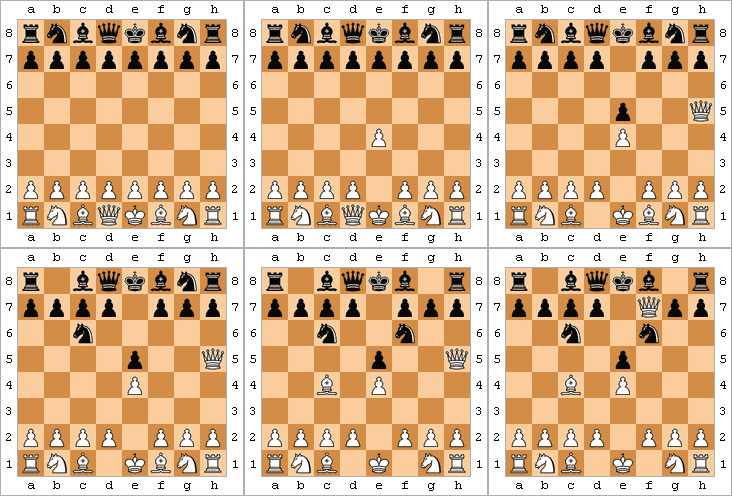
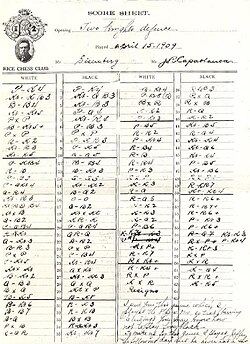
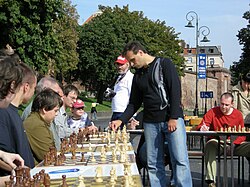
| a | b | c | d | e | f | g | h | ||
| 8 | | 8 | |||||||
| 7 | 7 | ||||||||
| 6 | 6 | ||||||||
| 5 | 5 | ||||||||
| 4 | 4 | ||||||||
| 3 | 3 | ||||||||
| 2 | 2 | ||||||||
| 1 | 1 | ||||||||
| a | b | c | d | e | f | g | h | ||
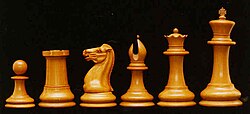
| a | b | c | d | e | f | g | h | ||
| 8 | | 8 | |||||||
| 7 | 7 | ||||||||
| 6 | 6 | ||||||||
| 5 | 5 | ||||||||
| 4 | 4 | ||||||||
| 3 | 3 | ||||||||
| 2 | 2 | ||||||||
| 1 | 1 | ||||||||
| a | b | c | d | e | f | g | h | ||
T
- tabia
- [from Arabic: طبيعة ṭabīʕa, "essence"] Also tabiya. In chess openings a tabia is a key point. It may be a well-known "point of departure" where variations branch off, it may be a position that is reached so often that the real game begins after this initial series of book moves.[360][361]
- tablebase
- See endgame tablebase.
- tactician
- A player who specializes in tactical play, as distinguished from a positional player.
- tactics
- Combinations, traps, and threats. Play characterized by short-term attacks, requiring calculation by the players, as distinguished from positional play.[355]
- takeback
- Used in casual games whereby both players agree to undo one or more moves.
- tall pawn
- [colloq.] An ineffective bishop, usually a bad bishop hemmed in by its own pawns.
- Tarrasch rule
- The general principle that rooks usually should be placed behind passed pawns, either one's own or one's opponent's. Named after Siegbert Tarrasch.[362]
- TC
- An abbreviation for time control.
- TD
- An abbreviation for tournament director.[358]
- technique
- The manner in which a player converts an advantageous position into a win.
- tempo
- A unit of time considered as one move. A player may gain a tempo in the opening when the opponent moves the same piece twice. In the endgame, one may wish to lose a tempo by triangulation in order to gain the opposition.[355] Plural: tempos or tempi.
- tension
- A position in which one or more exchanges are possible, such as a pair of pawns facing each other on a diagonal where either can capture the other, is said to contain tension. Such a situation differs from a threat in that it does not need to be immediately resolved – for example, if both pawns are defended. The consequences of resolving the tension must be constantly considered by both players, in case there is a possibility of winning or losing material. This makes calculating the best move more complicated, and so there is a natural temptation to "release the tension" by making a like-for-like exchange (see simplification) or by moving the attacked piece. To "keep the tension" is to avoid resolving it, which can be good advice depending on the position.
- text move
- This term is used in written analysis of chess games to refer to a move actually played in the game as opposed to other possible moves. Often shortened to text, for example "The text is inferior as it allows ...f5." Text moves are usually in bold whereas analysis moves are not.
- thematic
- Suited to the demands of the position. The term "thematic move" is often applied to the key move of a thematic plan.[363]
- theme tournament
- A chess tournament in which every game must begin with a particular opening specified by the organizers, for example the Budapest Gambit (1.d4 Nf6 2.c4 e5).
- theoretical draw
- See book draw.
- theoretical novelty ("TN" or "N")
- Or simply novelty. A move in the opening that has not been played before.[364]
- theory
- See book move.
- threat
- A plan or move that carries an intention to damage the opponent's position. A threat is a tactical weapon that must be defended against.[365]
- threefold repetition
- A draw may be claimed if the same position occurs three times with the same player to move and with each player having the choice of the same set of moves each time, including the right to capture en passant and the right to castle.[366] For the same position occurring five times, see fivefold repetition.
- tiebreaks
- See Tie-breaking in Swiss-system tournaments. This refers to a number of different systems that are used to break ties, and thus designate a single winner, where multiple players or teams tie for the same place in a Swiss system chess tournament.
- time
- 1. The amount of time each player has to think and calculate as measured by a chess clock.
- 2. The number of moves to complete an objective; for example, if a king is racing to stop a pawn from queening, and the king has too few moves, that may be referred to as "not enough time".[355]
- time control
- The allowed time to play a game, usually measured by a chess clock. A time control can require either a certain number of moves be made per time period (e.g. 40 moves in 2+1⁄2 hours) or it can limit the length of the entire game (e.g. five minutes per game for blitz). Hybrid schemes are used, and time delay controls have become popular since the widespread use of digital clocks.[90]
- time delay
- A time control that makes it possible for a player to avoid having an ever-decreasing amount of time remaining (as is the case with sudden death). The most important time delays in chess are Bronstein delay and Fischer delay.
- time pressure
- Or time trouble. Having very little time on one's clock (especially less than five minutes) to complete one's remaining moves. Also called zeitnot.
- TN
- An abbreviation for theoretical novelty.
- top board
- See first board.
- touch-move rule
- Or touched piece rule. The rule that requires a player who touches a piece to move that piece unless the piece has no legal moves. If a player moves a piece to a particular square and takes their hand off it, the move must be to that square if it is a legal move. Castling must be initiated by moving the king first, so a player who touches their rook may be required to move the rook, without castling. The rule also requires a player who touches an opponent's piece to capture it if possible. In order to adjust the position of a piece within its square without being required to move it, the player should say "J'adoube" or "I adjust".[365]
- tournament
- A competition involving more than two players or teams, generally played at a single venue (or series of venues) in a relatively short period of time. A tournament is divided into rounds, with each round consisting either of individual games or matches in the case of knockout tournaments and team tournaments. The assignment of opponents is called pairing, with the most popular systems being round-robin and Swiss. A tournament is usually referred to by the city in which it was played and the year, such as "London 1851", although there are well-known exceptions, such as "AVRO 1938".
- tournament book
- A book recording the scores of all the games in a tournament, usually with analysis of the best or most important games and some background on the event and its participants. One well-known example is Bronstein'sZurich International Chess Tournament 1953. The less comprehensive tournament bulletin is usually issued between the rounds of a prestigious event, giving the players and world media an instant record of the games of the previous round. Individual copies may be bundled together at the conclusion of the event to provide an inexpensive alternative to the tournament book.[367]
- tournament director ("TD")
- Also tournament controller [chiefly British]. Organizer and arbiter of a tournament, responsible for enforcing the tournament rules and the laws of chess.
- tournament performance rating ("TPR")
- The performance rating over the course of a tournament.
- trade
- See exchange.
- transposition
- Arriving at a position using a different sequence of moves than usual.[174]
- trap
- A move that may tempt the opponent to play a losing move.[368]
- trapped piece
- A piece is said to be "trapped" when it is en prise and cannot escape its capture in any way (i.e by capturing a piece, moving the piece, or blocking the attacking piece). Any piece—including the queen—can become "trapped" if a player is careless. A trapped king is said to be checkmated.
- trébuchet
- [from French, a type of siege engine] A theoretical position of mutual zugzwang in which either player would lose if it were their turn to move.[369]
- triangulation
- A technique of moving a king along the vertices of a triangle to renter the same position but inverting the player to move, often used in king and pawn endgames (less commonly seen with other pieces) to lose a tempo and gain the opposition.[370]
- tripled pawns
- Three pawns of the same color on the same file; considered a weakness due to their inability to defend each other.[371]
- Troitsky line
- Also Troitzky line. Endgame analysis by Alexey Troitsky of two knights versus a pawn found certain pawn positions that result in win, draw or loss. The resulting pawn positions on each file form what is known as the Troitsky line or Troitsky position.[372]
- two bishops
- Or the two bishops. A synonym for bishop pair.[373]
| a | b | c | d | e | f | g | h | ||
| 8 | | 8 | |||||||
| 7 | 7 | ||||||||
| 6 | 6 | ||||||||
| 5 | 5 | ||||||||
| 4 | 4 | ||||||||
| 3 | 3 | ||||||||
| 2 | 2 | ||||||||
| 1 | 1 | ||||||||
| a | b | c | d | e | f | g | h | ||
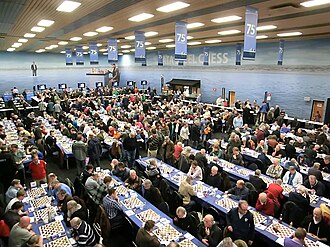
| a | b | c | d | e | f | g | h | ||
| 8 | | 8 | |||||||
| 7 | 7 | ||||||||
| 6 | 6 | ||||||||
| 5 | 5 | ||||||||
| 4 | 4 | ||||||||
| 3 | 3 | ||||||||
| 2 | 2 | ||||||||
| 1 | 1 | ||||||||
| a | b | c | d | e | f | g | h | ||
| a | b | c | d | e | f | g | h | ||
| 8 | | 8 | |||||||
| 7 | 7 | ||||||||
| 6 | 6 | ||||||||
| 5 | 5 | ||||||||
| 4 | 4 | ||||||||
| 3 | 3 | ||||||||
| 2 | 2 | ||||||||
| 1 | 1 | ||||||||
| a | b | c | d | e | f | g | h | ||
U
- unclear
- A position where it is unclear who (if anyone) has an advantage.[374]
- undermining
- A tactic (also known as "removal of the guard") in which a defensive piece is captured, leaving one of the opponent's pieces undefended or underdefended.[375]
- underpromotion
- Promoting a pawn to a rook, bishop, or knight instead of a queen. Rarely seen unless the knight can deliver a crucial check, or when promotion to a rook or a bishop instead of a queen is necessary to avoid stalemate.[261]
- United States Chess Federation
- This is a nonprofit organization, the governing chess organization within the United States, and one of the federations of the FIDE.
- unorthodox opening
- See irregular opening.
- unpinning
- The act of breaking a pin by interposing a second piece between the attacker and the target. This allows the piece that was formerly pinned to move.
- unsound
- Antonym of sound.
- USCF
- An abbreviation for United States Chess Federation.
| a | b | c | d | e | f | g | h | ||
| 8 | | 8 | |||||||
| 7 | 7 | ||||||||
| 6 | 6 | ||||||||
| 5 | 5 | ||||||||
| 4 | 4 | ||||||||
| 3 | 3 | ||||||||
| 2 | 2 | ||||||||
| 1 | 1 | ||||||||
| a | b | c | d | e | f | g | h | ||
V
- vacating sacrifice
- A sacrifice made for the purpose of clearing a square for a different piece of the same color.
- valve
- A move that opens one line and closes another.
- vanished center
- Or vanished centre. A position with no white or black center pawns.[376]
- variant
- See chess variant.
- variation
- 1. A sequence of moves or an alternative line of play, often applied to the opening. A variation does not have to have been played in a game; it may also be a possibility that occurs only in analysis.[368] Also called continuation.
- 2. The word "Variation" is also used to name specific sequences of moves within an opening. For an example, the Dragon Variation is part of the Sicilian Defense.[86]
- vertical line
- See file.
W
- waiting move
- A move whose sole purpose is to oblige the opponent to move. A waiting move is effective when the opponent has nothing but bad moves available (i.e. is in zugzwang).[377]
- WCC
- An abbreviation for World Chess Championship.[378]
- WCM
- An abbreviation for Woman Candidate Master.
- weakness
- A pawn or square that can be attacked and is hard to defend.[379]
- weak square
- A square that cannot be easily defended from attack by an opponent. Often a weak square is unable to be defended by pawns (a hole) and can be theoretically occupied by a piece. Exchange or loss of a bishop may make all squares of that bishop's color weak resulting in a "weak square complex" on the light squares or the dark squares.[380]
- WFM
- An abbreviation for Woman FIDE Master.[381]
- WGM
- An abbreviation for Woman Grandmaster.[381]
- white
- The light-colored squares on the chessboard are often referred to as "the white squares" even though they often are some other light color. Similarly, "the white pieces" are sometimes actually some other (usually light) color.[39]
- White
- The designation for the player who moves first, even though the corresponding pieces, referred to as "the white pieces", are sometimes actually some other (usually light) color.
- WIM
- An abbreviation for Woman International Master.[382]
- win
- A victory for one of the two players in a game, which may occur due to checkmate, resignation by the other player, the other player exceeding the time control, or the other player being forfeited by the tournament director. Chess being a zero-sum game, this results in a loss for the other player. In a tournament a bye may be scored as a win.[383]
- windmill
- A combination in which two pieces work together to deliver an alternating series of checks and discovered checks in such a way that the opposing king is required to move on each turn. It is a potent technique, since, on every other move, the discovered check may allow the non-checking piece to capture an enemy piece without losing a tempo. The most famous example is Torre–Lasker, Moscow 1925.[384] Also called seesaw.
- wing
- The queenside a-, b-, and c-files; or the kingside f-, g-, and h-files.[385] Also called flank.
- Wing Gambit
- The name given to variations of several openings in which one player gambits a wing pawn, usually the b-pawn.[386]
- winning percentage
- A number calculated by adding together the number of games won and half of the number of games drawn (i.e. ignoring the losses), then dividing that total by the total number of games that were played. Another way of calculating the winning percentage is by taking the percentage of games won by a player plus half the percentage of drawn games. Thus, if out of 100 games a player wins 40 percent, draws 32 percent, and loses 28 percent, the winning percentage is 40 plus half of 32, i.e. 56 percent.[387]
- winning position
- A position is said to be a winning one if one specified side, with correct play, can eventually force a checkmate against any defense (i.e. perfect defense).[388] Also called won game.
- Woman Candidate Master ("WCM")
- A women-only chess title ranking below Woman FIDE Master.[62]
- Woman FIDE Master ("WFM")
- A women-only chess title ranking below Woman International Master.[381]
- Woman Grandmaster ("WGM")
- The highest ranking gender-restricted chess title except for Women's World Champion.[381]
- Woman International Master ("WIM")
- A women-only chess title ranking below Woman Grandmaster and above Woman FIDE Master.[381]
- won game
- See winning position.
- wood
- Slang for pieces. "A lot of wood came off the board" conveys that several piece exchanges occurred.[89]
- woodpusher
- [colloq., typically derogatory] A weak chess player, also referred to as a patzer or duffer.[389]
- World Champion
- A winner of the World Chess Championship.[378]
- wrong bishop
- Or wrong-colored bishop. A bishop that, because of the color squares it is restricted to, suffers critical loss of utility in the game position.[390]
- wrong rook pawn
- With a bishop, a rook pawn may be the wrong rook pawn, depending on whether or not the bishop controls its promotion square.[391]
| a | b | c | d | e | f | g | h | ||
| 8 | | 8 | |||||||
| 7 | 7 | ||||||||
| 6 | 6 | ||||||||
| 5 | 5 | ||||||||
| 4 | 4 | ||||||||
| 3 | 3 | ||||||||
| 2 | 2 | ||||||||
| 1 | 1 | ||||||||
| a | b | c | d | e | f | g | h | ||
| a | b | c | d | e | f | g | h | ||
| 8 | | 8 | |||||||
| 7 | 7 | ||||||||
| 6 | 6 | ||||||||
| 5 | 5 | ||||||||
| 4 | 4 | ||||||||
| 3 | 3 | ||||||||
| 2 | 2 | ||||||||
| 1 | 1 | ||||||||
| a | b | c | d | e | f | g | h | ||
X
- X-ray
- When the power of a piece, either to attack or to defend, seems to pass through an intervening enemy piece. An X-ray attack, also known as a skewer, occurs when two pieces of the same color are caught in the same line of attack along a diagonal, rank, or file. The attacking piece forces the first and more valuable piece to move out of the way, which allows the second piece to be captured. An X-ray defense occurs when one piece is defended by another piece through an attacking enemy piece standing between the two.[392]
| a | b | c | d | e | f | g | h | ||
| 8 | | 8 | |||||||
| 7 | 7 | ||||||||
| 6 | 6 | ||||||||
| 5 | 5 | ||||||||
| 4 | 4 | ||||||||
| 3 | 3 | ||||||||
| 2 | 2 | ||||||||
| 1 | 1 | ||||||||
| a | b | c | d | e | f | g | h | ||
Z
- zeitnot
- [from German, "time need"] Having very little time on the clock to complete the remaining moves of a timed game.[393] Also called time pressure and time trouble.
- Zonal tournaments
- Tournaments organized by FIDE, the first qualifying cycle of the World Chess Championship. Each zonal tournament features top players of a certain geographical zone. Up until 1993 the winners went on to Interzonal tournaments. This was replaced by a system where the winners now play each other in knockout-style competitions to determine who goes on to the Candidates Tournament.[394]
- zugzwang
- [from German, "compulsion to move"] When a player is put at a disadvantage by having to make a move; where any legal move weakens the position. Zugzwang usually occurs in the endgame, and rarely in the middlegame.[395]
- zwischenschach
- [from German, "in-between check"] Playing a surprising check that the opponent did not consider when plotting a sequence of moves; a zwischenzug that is a check.[396]
- zwischenzug
- [from German, "in-between move"] An "in-between" move, or an intermezzo, played before an expected reply. Often, but not always, this involves responding to a threat by posing an even greater threat, forcing the opponent to respond to the threat first.[397]
See also
References
- ↑Wilkinson 2008, p. 128.
- 1234Seirawan & Silman 1994, p. 237.
- ↑United States Chess Federation 2003, p. 72.
- ↑United States Chess Federation 2003, pp. 84, 282.
- 123456Staunton 2009, p. 59.
- ↑Pandolfini 1995, pp. 22–23.
- ↑van de Oudeweetering 2014, p. 25.
- ↑Hochberg 2005, p. 14.
- 12Hooper & Whyld 1996, p. 389.
- 12Brace 1977, p. 17.
- ↑Hooper & Whyld 1996, p. 13.
- ↑Pandolfini 1995, p. 28.
- ↑Brace 1977, p. 22.
- ↑Hooper & Whyld 1996, p. 18.
- ↑Hoffman 1996, p. 12.
- ↑Renaud & Kahn 2015, p. 182.
- ↑"What are arena tournaments?". Chess.com.
- ↑"Chess grandmasters on track for possible 'Armageddon' at world championship" Payne, Marissa. Washington Post. 26 November 2016.
- ↑Kaufman 2014, p. 151.
- 123456Seirawan & Silman 1994, p. 238.
- ↑Pandolfini 1995, p. 34.
- 1234567Staunton 2009, p. 57.
- 123Fischer, Margulies & Mosenfelder 1982, p. 103.
- ↑Silman 1998, p. 236.
- ↑Grooten 2017, p. 199.
- ↑Pritchard 2012, p. 75.
- ↑"CHESS Magazine: Basque Chess – does it work for you?!". ChessBase. 29 February 2012.
- ↑Horton 1973, pp. 12–13.
- ↑Brace 1977, p. 29.
- ↑Hooper & Whyld 1996, p. 32.
- ↑Harding 2015, p. 424.
- ↑Hilbert 2013, p. 104.
- ↑Pandolfini 1989, p. 233.
- ↑Roycroft, A. J. (1981). The Chess Endgame Study: A Comprehensive Introduction. Courier Dover. p. 346. ISBN 9780486241869.
- ↑Soltis 2012, p. 11.
- ↑Pandolfini 2013, p. 42.
- 123Staunton 2009, p. 3.
- ↑Pandolfini 1995, p. 46.
- 12Staunton 2009, p. 1.
- 123Pandolfini 1995, p. 47.
- ↑Hooper & Whyld 1996, p. 45.
- ↑MacEnulty, David (2004). The Chess Kid's Book of Checkmate. Random House Puzzles & Games. p. 129. ISBN 9780812935943.
- 12Schiller 2003, p. 398.
- ↑Kidder, Harvey (1970). Illustrated Chess for Children. Doubleday. ISBN 0-385-05764-4.
- ↑"Chess: A Fortissimo Zuckertort? It's a Kevitz Blitzkrieg", New York Times, Dec. 7, 1964
- ↑Nimzowitsch 2016, p. 5.
- ↑Pandolfini 2013, p. 47.
- ↑Seirawan & Silman 1994, p. 100.
- ↑Schiller 2003, p. 299.
- ↑Haworth, G. M. (2005). "6-man chess solved". ICGA Journal. 28 (3): 153. doi:10.3233/ICG-2005-28304. ISSN 1389-6911.
- ↑Silman 1999, p. 428.
- ↑Hooper & Whyld 1996, p. 53.
- 12Silman 1999, p. 429.
- 12Pandolfini 1995, p. 55.
- ↑Kasparov 2017, pp. 52–54.
- ↑Pandolfini 1995, p. 56.
- 12Pandolfini 1992, p. 154.
- ↑Pandolfini 2005, p. 162.
- ↑de Firmian 1999, p. 3.
- 12Pandolfini 1995, p. 57.
- ↑Judovitz & Duchamp 2010, p. 137.
- 123"FIDE Handbook". B. Permanent Commissions / 01. International Title Regulations (Qualification Commission) / FIDE Title Regulations effective from 1 January 2024 / Article 0 Introduction / Section 0.6: "The Award of Titles". Retrieved 26 September 2025– via International Chess Federation.
- ↑Johnson 2010, p. 12.
- ↑Ólafsson 2014, p. 32.
- ↑Higgins, Andrew (30 March 2016). "Masters of Chess, Not Self-Promotion". The New York Times.
- ↑Souleidis 2017, p. 176.
- ↑Staunton 1875, p. 384.
- ↑Keene 1989, p. 178.
- 123Staunton 2009, p. 55.
- ↑"Chess Corner – Chess Tutorial – Castling". Archived from the original on 2019-07-05. Retrieved 2019-06-25.
- ↑Pandolfini 1989, p. 64.
- 12Hooper & Whyld 1996, p. 71.
- ↑Hooper & Whyld 1996, p. 426.
- 1234Seirawan & Silman 1994, p. 239.
- ↑Hooper & Whyld 1996, p. 72.
- ↑Stockfish source code .
- 12Silman 1999, p. 430.
- 12Hooper & Whyld 1996, p. 102.
- ↑Snyder 2007, p. 22.
- ↑Staunton 2014, p. 48.
- 12Staunton 2009, p. 53.
- ↑Hooper & Whyld 1996, p. 210.
- ↑Staunton 2014, p. 30.
- ↑Pandolfini 1995, p. 66.
- 12345678910111213Staunton 2009, pp. 2–7.
- 12Hochberg 2005, p. 13.
- ↑FIDE Laws of Chess 2023, Article II.3 "Chess960 castling rules".
- ↑Gligorić, Svetozar (2002). Shall We Play Fischerandom Chess?. B.T. Batsford Ltd. p. 40. ISBN 0-7134-8764-X.
- 12Shibut, Macon (2012). Paul Morphy and the Evolution of Chess Theory. Courier. p. 68. ISBN 9780486149875.
- 12United States Chess Federation 2003, p. 8.
- ↑Hertan 2014, p. 373.
- ↑Lawson 1992, pp. 25–26.
- ↑Pandolfini 1992, p. 181.
- ↑Seirawan & Silman 1994, p. 42.
- ↑Pandolfini 1995, p. 70.
- ↑de Firmian 1999, p. 389.
- ↑Avni 2014, pp. 35–37.
- ↑Przewoznik, Jan; Soszynski, Marek (2001). How to Think in Chess. Russell Enterprises. p. 234. ISBN 9781888690101.
- ↑Nunn 1998, pp. 55–57.
- ↑Hooper & Whyld 1996, p. 339.
- ↑Pandolfini 1995, p. 72.
- ↑Rasskin-Gutman, Diego (2009). Chess Metaphors: Artificial Intelligence and the Human Mind. MIT Press. p. 99. ISBN 9780262182676.
- ↑Hertan 2014, p. 7.
- ↑Pandolfini 1989, p. 223.
- ↑Pandolfini 1995, p. 76.
- ↑Hooper & Whyld 1996, p. 92.
- ↑Borders 2007, p. 102.
- ↑Seirawan & Silman 1994, pp. 44, 149.
- ↑Hochberg 2005, p. 20.
- ↑Yusupov, Artur (2010). Boost Your Chess 1: The Fundamentals. Quality Chess. p. 218. ISBN 9781906552404.
- ↑Dunne 1991, p. 1.
- ↑Dvoretsky 2006, p. 15.
- ↑Pandolfini 2005, p. 125.
- 12Hooper & Whyld 1996, p. 96.
- ↑Pandolfini 1995, p. 78.
- 1234Silman 1999, p. 431.
- ↑Pandolfini 1995, p. 79.
- ↑Pandolfini 1995, p. 81.
- ↑Lawson 1992, pp. 31–32, 53.
- ↑Webb 2006, p. 49.
- ↑FIDE Laws of Chess 2023, Article 5: "The Completion of the Game" / Section 5.2.2.
- 12345Seirawan & Silman 1994, p. 240.
- ↑Hooper & Whyld 1996, pp. 102–103.
- ↑Pandolfini 1988, p. 274.
- ↑Pandolfini 2005, p. 64.
- ↑Wilson 1994, p. 60.
- ↑Hooper & Whyld 1996, p. 106.
- ↑Pandolfini 1995, p. 89.
- 12Staunton 2009, p. 56.
- ↑Aronow, Isaac (2022-06-13). "The Words You Need to Know to Play Chess". The New York Times. ISSN 0362-4331. Retrieved 2026-02-10.
- ↑Staunton, Howard (1876). Chess: Theory and Practice. pp. 48–49.
When the King is directly attacked by an adverse man, the move is called simply check; when the Piece or Pawn moved does not itself attack the King, but unmasks another which does, it is called a discovered check; and when both the man moved and the one unmasked attack the King, they are said to give double check.
- ↑Reinfeld 2014, p. 74, Discovered check is really a kind of discovered attack, with this important difference: the 'discovering' piece moves away to allow its colleague to give check along the vacated line.
- ↑Staunton 2014, p. 50.
- ↑Hooper & Whyld 1996, p. 110.
- ↑Hooper & Whyld 1996, p. 111.
- ↑Staunton 2014, p. 51.
- ↑Pandolfini 2013, p. 75.
- 123Hooper & Whyld 1996, p. 133.
- ↑Pandolfini 1995, p. 96.
- ↑Grooten 2017, p. 289.
- ↑Soltis 2002, p. 146.
- ↑Desjarlais 2011, p. 99.
- ↑Edwards 2007, p. 258.
- ↑Capablanca 2002, p. 79.
- ↑Schiller 2003, p. 376.
- ↑Suba 2014, p. 104.
- ↑Nimzowitsch 2016, p. 281.
- ↑Silman 1998, p. 10.
- ↑Pandolfini 2009, p. 301.
- 12Seirawan & Silman 1994, p. 241.
- ↑Moore & Mertens 2011, p. 14.
- ↑Alburt & Parr 2003, pp. 22–23.
- ↑Brace 1977.
- ↑New Oxford American Dictionary
- ↑"En prise (Chess Term)" by Edward Winter
- ↑Pandolfini 1995, p. 102.
- ↑Wilson 1994, p. 55.
- ↑David, Netanyahu & Wolf 2016, pp. 88–96.
- ↑ChessMN16. "How to Read Engine Evaluations". Chess.com. April 29, 2015
- ↑Newborn 2013, pp. 1–14.
- ↑Golombek 1977, p. 113.
- ↑Silman 1999, p. 432.
- ↑Horton 1973, p. 63.
- ↑Brace 1977, p. 97.
- ↑Hooper & Whyld 1996, p. 130.
- ↑Seirawan & Silman 1994, p. 188.
- ↑Schiller 2003, p. 113.
- ↑Soltis 2002, p. 102.
- ↑Lawrence & Alburt 2010, p. 88.
- ↑Pandolfini 1992, pp. 56, 94, 118.
- ↑Pawlak, Robert (November 2001). "Your Computer as Opponent, Coach, and Training Assistant". Chess Life. 56 (11): 22–25.
- 12Pandolfini 1989, p. 225.
- ↑Soltis 2002, p. 71.
- 12Silman 1999, p. 433.
- ↑"Fianchetto". Dizionario Italiano. Retrieved 2 March 2022.
- ↑"FICGS correspondence chess titles".
- 1234Pandolfini 1995, p. 108.
- ↑Ashley 2007, p. 232.
- ↑Pandolfini 1988, p. 16.
- ↑Byrne, Robert (4 November 1990). "Pastimes; Chess". The New York Times.
- ↑Ólafsson 2014, p. 80.
- ↑FIDE Laws of Chess 2023, Article 9: The Drawn Game / Section 9.6.1.
- 12FIDE Laws of Chess 2023.
- ↑Seirawan & Silman 1994, p. 189.
- ↑Hooper & Whyld 1996, p. 141.
- ↑Pandolfini 1992, p. 234.
- 123Staunton 2009, p. 58.
- ↑Pandolfini 1988, p. 47.
- ↑Hendriks 2014, pp. 161–162.
- ↑United States Chess Federation 2003, pp. xxvii, 29, 34, 64, 69.
- ↑Brown 2012, p. 241.
- ↑Moore 2015, p. 77.
- ↑Soltis 2014, p. 31.
- ↑Ashley, Maurice (2009). The Most Valuable Skills in Chess. Gambit. pp. 15–16. ISBN 9781904600879.
- ↑Hooper & Whyld 1996, p. 144.
- ↑Hooper & Whyld 1996, p. 145.
- ↑Evans 1967, p. 121.
- ↑Horton 1973, pp. 76–77.
- ↑Nimzowitsch 2016, p. 15.
- ↑Pandolfini 1995, pp. 30, 114–115, 168.
- 12Pandolfini 1995, p. 134.
- ↑Murray 2012, pp. 390–391.
- ↑Ashley 2007, p. 233.
- ↑Kvanvig 2008, p. 229.
- ↑Schiller 2003, p. 165.
- 1234Silman 1999, p. 434.
- ↑Clarke 2000, p. 1.
- ↑Seirawan & Silman 1994, p. 242.
- ↑Barden 2017.
- ↑Cranston 2017, p. 1.
- ↑Lombardy & Daniels 1977, pp. 10, 11.
- ↑Evans 1967.
- ↑Znosko-Borovsky 2012, p. 39.
- ↑Pandolfini 2005, p. 69.
- ↑Hertan 2013, p. 109.
- ↑"London m4 Games". 365Chess.com.
- ↑Nimzowitsch 2016, p. 466.
- ↑Timman 2014, p. 71.
- ↑Lee 2016, p. 158.
- ↑Hooper & Whyld 1996, p. 178.
- 12Silman 1999, p. 435.
- 12Dunne 1991, p. 99
- 12Pandolfini 1995, p. 124.
- 12Pandolfini 1995, p. 125.
- ↑Lemos 2014, pp. 30–32.
- ↑Pandolfini 1995, p. 126.
- 12Pandolfini 1995, p. 128.
- 123Pandolfini 2009, p. 302.
- ↑Schiller 2003, p. 91.
- ↑Pandolfini 1989, p. 227.
- 123Staunton 2009, p. 61.
- ↑Hooper & Whyld 1996, p. 183.
- 12Pandolfini 1995, p. 136.
- ↑"Kasparov vs. Topalov, Wijk aan Zee 1999". Chessgames.com.
- ↑van de Oudeweetering 2014, p. 220.
- ↑Petković, Miodrag (1997). Mathematics and Chess: 110 Entertaining Problems and Solutions. Courier. pp. 50–55. ISBN 9780486294322.
- ↑Kotov 2012, p. 12.
- ↑Hochberg 2005, p. 73.
- 12Pandolfini 1995, p. 146.
- ↑Hooper & Whyld 1996, p. 226.
- ↑Staunton 2009, p. 46.
- ↑Pandolfini 1995, p. 147.
- ↑Pandolfini 1995, p. 148.
- ↑Euwe & Meiden 2013, p. 19.
- ↑Pandolfini 1995, p. 150.
- ↑Seirawan & Silman 1994, p. 243.
- ↑Pandolfini 1995, p. 152.
- 12Pandolfini 1992, p. 109.
- ↑Pandolfini 2009, p. 303.
- ↑Hooper & Whyld 1996, p. 244.
- ↑Kmoch 2013, p. 143.
- 12Ashley 2007, p. 234.
- ↑Pandolfini 2008, p. 351.
- 12345Silman 1999, p. 436.
- ↑Hartston 1997, p. 118.
- 12Waitzkin & Waitzkin 1995, p. 187.
- ↑"Chandler Cornered · 200 Miniatures Games part 2". Chess Edinburgh and Lothians. Archived from the original on 2011-09-16. Retrieved 2012-05-02.
- ↑Nunn 1999, p. 6.
- ↑Pandolfini 1992, p. 63.
- ↑Keene 1989, p. 73.
- 12345Hochberg 2005, p. 12.
- ↑Pandolfini 2005, p. 185.
- ↑Nimzowitsch 2014, p. 182.
- ↑Hallman 2013, p. 154.
- ↑Hooper & Whyld 1996, p. 274.
- ↑Agdestein 2013, p. 141.
- ↑Wilson 1994, p. 4.
- ↑Komarov & Djuric 2016, p. 10.
- ↑van de Oudeweetering 2014, p. 13.
- ↑Keene 1989, p. 182.
- 12Silman 1999, p. 437.
- ↑Schiller 2003, p. 19.
- ↑Pandolfini 1995, p. 166.
- 123Hooper & Whyld 1996, p. 405.
- ↑Pandolfini 1995, p. 167.
- ↑Staunton 2014, p. 60.
- 12Webb 2006, p. 72.
- ↑Pandolfini 1992, p. 113.
- ↑Pandolfini 2009, p. 305.
- 12Seirawan & Silman 1994, p. 246.
- 12Horton 1973, p. 147.
- ↑Pandolfini 1992, p. 237.
- 123Silman 1999, p. 438.
- ↑Brace 1977, p. 208.
- ↑Pandolfini 1995, p. 172.
- ↑Hooper & Whyld 1996, p. 291.
- ↑Kmoch 2013, p. 18.
- ↑de Groot 2008, pp. 189–203.
- ↑van de Oudeweetering 2014, p. 7.
- ↑Kaan 2016, p. 19.
- ↑Staunton 1875, p. 41.
- ↑Keene 1989, p. 183.
- 12345Silman 1999, p. 439.
- ↑Waitzkin & Waitzkin 1995, p. 83.
- ↑Pandolfini 1992, p. 238.
- ↑Fine 1948.
- ↑Kravtsiv 2025.
- ↑United States Chess Federation 2003, p. 202.
- ↑Seirawan & Silman 1994, p. 245.
- 12Hurst, John (2007). Professional SlickEdit. John Wiley & Sons. p. 365. ISBN 9780470251706.
- ↑Fine 1976, p. 4.
- ↑Hooper & Whyld 1996, p. 305.
- ↑Hochberg 2005, p. 11.
- ↑Kaan 2016, p. 16.
- ↑Kavalek, Lubomir. "Chess".The Washington Post. 16 July 2007
- ↑Watson 1998, p. 18.
- ↑Hooper & Whyld 1996, p. 316.
- ↑Hooper & Whyld 1996, p. 20.
- ↑"What are premoves and how do they work?". Chess.com. Retrieved 15 May 2022.
- ↑Pandolfini 1995, p. 188.
- ↑Dvoretsky 2006, p. 53.
- ↑Soltis 2013, p. 1.
- ↑Silman 1999, p. 440.
- ↑Staunton 2009, p. 355.
- ↑Staunton 2009, p. 360.
- ↑Kaan 2016, pp. 161–162.
- ↑Pandolfini 2009, p. 306.
- ↑Nimzowitsch 2016, pp. 116–120.
- ↑United States Chess Federation 2003, p. 337.
- ↑Hertan 2014, p. 193.
- ↑Hooper & Whyld 1996, p. 330.
- ↑Alburt & Parr 2003, p. 113.
- ↑Hooper & Whyld 1996, p. 331.
- ↑Hooper & Whyld 1996, pp. 331–332.
- ↑Seirawan & Stefanovic 1992, p. 312.
- ↑Soltis 2008, p. 210.
- ↑Pandolfini 2009, p. 96.
- 12345Silman 1999, p. 441.
- ↑Burgess 2000, p. 481.
- ↑FIDE Laws of Chess 2023, Article 5.1.2.
- ↑Grooten 2017, p. 51.
- ↑Pandolfini 1992, p. 102.
- 12Ashley 2007, p. 238.
- ↑Seirawan & Silman 1994, p. 247.
- ↑All The King's MenArchived 24 October 2009 at the Wayback Machine, Outlook Business, 31 October 2009
- ↑Hooper & Whyld 1996, p. 365, semi-close game.
- 12Hooper & Whyld 1996, p. 165, half-close game.
- ↑Hooper & Whyld 1996, p. 365, semi-open game.
- ↑FIDE Laws of Chess 2023, Article 9: The Drawn Game / Section 9.6.2.
- ↑Brace 1977, p. 257.
- ↑Kaan 2016, p. 244.
- ↑Rasskin-Gutman 2009, p. 136.
- ↑Timman 2014, p. 166.
- ↑Hooper & Whyld 1996, p. 373.
- 12Ashley 2007, p. 239.
- ↑Fine 2015, p. 87.
- ↑Reinfeld 2014, p. 151, The X-ray attack, or skewer attack, is the opposite of the pin. In the X-ray attack, a piece attacks a hostile piece which is situated on a line with another piece of lesser value. When the attacked piece moves off the line, it exposes the second piece to capture.
- ↑Pandolfini 1988, p. 267.
- ↑Staunton 2009, p. 25.
- ↑Giddins 2017, pp. 169–170.
- ↑Reinfeld 2016, p. 151.
- ↑Pandolfini 1988, p. 78.
- ↑Hooper & Whyld 1996, p. 387.
- ↑Stamp, Jimmy (3 April 2013). "How the Chess Set Got Its Look and Feel". Smithsonian.com.
- 1234567Silman 1999, p. 442.
- ↑Averbakh, Yuri. Comprehensive Chess Endings. Pergamon Press. p. viii.
- ↑Hooper & Whyld 1996, p. 400.
- 12Ashley 2007, p. 240.
- ↑"Capablanca vs. Maróczy, Lake Hopatcong 1926". Chessgames.com.
- ↑Steingass 1884, p. 752.
- ↑van de Oudeweetering 2014, p. 193.
- ↑Kotov 2012, p. 42.
- ↑Pandolfini 1995, p. 241.
- ↑Hooper & Whyld 1996, p. 418.
- 12Pandolfini 1992, p. 240.
- ↑Pandolfini 2009, p. 307.
- ↑Bronstein 2013, p. vii.
- 12Silman 1999, p. 443.
- ↑Soltis 2013, p. 33.
- ↑Soltis 2013, p. 22.
- ↑Pandolfini 1995, pp. 249–250.
- ↑de la Villa 2014, p. 246.
- ↑Pandolfini 2009, p. 310.
- ↑Matanović, Aleksander, ed. (1973). Šahovski Informator[Chess Informant]. Vol. 14. Belgrade: Šahovski Informator. pp. 8–9.
- ↑Pandolfini 1992, p. 241.
- ↑Hooper & Whyld 1996, p. 439.
- ↑Tarrasch 2012, p. 5.
- 12Schiller, Eric (2009). World Champion Openings. Cardoza. pp. 1–10. ISBN 9781580425612.
- ↑Seirawan & Silman 1994, p. 127.
- ↑Seirawan & Silman 1994, p. 250.
- 12345Goichberg, Bill; Jarecki, Carol; Riddle, Ira Lee (1993). U.S. Chess Federation's Official Rules of Chess. David McKay Chess Library. p. 329. ISBN 9780812922172.
- ↑Evans, Silman & Roberts 1991, p. 91.
- ↑Hertan 2016, p. 43.
- ↑Schiller 2003, p. 287.
- ↑Young & Howell 1894, p. 46.
- ↑Reinfeld 2016, p. 585.
- ↑Silver 2012, p. 270.
- ↑Capablanca 2002, p. 116.
- ↑Evans 2009, p. 92.
- ↑Soltis 2002, p. 87.
- ↑Benjamin 2015, pp. 215–216.
- ↑Pandolfini 1993, p. 46.
- ↑Galperin 2012, p. 64.
- ↑Williams 1997, p. 120.
- ↑Pandolfini 1992, p. 76.
- ↑Wilson & Alberston 2012, p. 10.
- ↑Waitzkin & Waitzkin 1995, p. 159.
Sources
- Agdestein, Simen (2013). How Magnus Carlsen Became the Youngest Chess Grandmaster in the World: The Story and the Games. New In Chess. ISBN 9789056914424.
- Alburt, Lev; Parr, Larry (2003). The Secrets of the Russian Chess Masters: Fundamentals of the Game. W. W. Norton & Company. ISBN 9780393324525.
- Ashley, Maurice (2007). Chess for Success: Using an Old Game to Build New Strengths in Children and Teens. Harmony/Rodale. ISBN 9780307418883.
- Avni, Amatzia (2014). Devious Chess: How to Bend the Rules and Win. Pavilion Books. ISBN 9781849941822.
- Barden, Leonard (20 January 2017). "Wesley So at top of Wijk standings going into weekend rounds". The Guardian.
- Benjamin, Joel (2015). Liquidation on the Chess Board: Mastering the Transition into the Pawn Ending. New In Chess. ISBN 9789056915544.
- Borders, Mark (2007). The Self-Improvement of Chess. Lulu. ISBN 9781430327646.
- Brace, Edward R. (1977). An Illustrated Dictionary of Chess. Hamlyn. ISBN 0-600-32920-8. (1989 reprint by Chartwell Books, ISBN 978-1555213947)
- Bronstein, David (2013). Zurich International Chess Tournament, 1953. Courier. ISBN 9780486319063.
- Brown, Isaac M. (2012). The British Chess Magazine, Volume 15. Nabu Press. ISBN 9781276679046.
- Burgess, Graham (2000). The Mammoth Book of Chess. Carroll & Graf. ISBN 0-7867-0725-9.
- Capablanca, Jose R. (2002). A Primer of Chess. Houghton Mifflin Harcourt. ISBN 9780156028073.
- Clarke, P. H. (2000) [1963]. 100 Soviet Chess Miniatures. Courier. ISBN 9780486408446.
- Cranston, Adam. (2017). "Heatwave Chess". Hammersmith Chess Club Newsletter.
- David, Omid E.; Netanyahu, Nathan S.; Wolf, Lior (2016). DeepChess: End-to-End Deep Neural Network for Automatic Learning in Chess. International Conference on Artificial Neural Networks (ICANN) Vol. 9887. Springer. ISBN 9783319447810.
- de Firmian, Nick (1999). Modern Chess Openings: MCO-14. Random House Puzzles & Games. ISBN 0-8129-3084-3.
- de Groot, Adriaan D. (2008). Thought and Choice in Chess. Amsterdam University Press. ISBN 9789053569986.
- de la Villa, Jesús (2014). 100 Endgames You Must Know: Vital Lessons for Every Chess Player Improved and Expanded. New In Chess. ISBN 9789056914547.
- Desjarlais, Robert R. (2011). Counterplay: An Anthropologist at the Chessboard. University of California Press. ISBN 9780520948204.
- Dunne, Alex (1991). Complete Guide to Correspondence Chess. Thinkers' Press. ISBN 9780938650522.
- Dvoretsky, Mark (2006). Dvoretsky's Endgame Manual (2nd ed.). Russell Enterprises. ISBN 1-888690-28-3.
- Edwards, Jon (2007). Teach Yourself VISUALLY Chess. John Wiley & Sons. ISBN 9780470121320.
- Euwe, Max; Meiden, Walter (2013). Chess Master vs. Chess Amateur. Courier. ISBN 9780486319896.
- Evans, Larry (1967). New Ideas in Chess (Dover 1984 ed.). Cornerstone Library. ISBN 0-486-28305-4.
- Evans, Larry; Silman, Jeremy; Roberts, Betty (1991). How to Get Better at Chess: Chess Masters on Their Art. Summit. ISBN 9780945806059.
- Evans, Larry (2009). This Crazy World of Chess. Cardoza. ISBN 9781580422376.
- "FIDE Handbook". E. MISCELLANEOUS / 01. Laws of Chess / FIDE Laws of Chess taking effect from 1 January 2023. Retrieved 26 September 2025– via International Chess Federation.
- Fine, Gary Alan (2015). Players and Pawns: How Chess Builds Community and Culture. University of Chicago Press. ISBN 9780226265032.
- Fine, Reuben (1948). Practical Chess Openings. David McKay. ISBN 9780812901696.
{{cite book}}: ISBN / Date incompatibility (help) - Fine, Reuben (1976). The World's Great Chess Games. Courier. ISBN 9780486245126.
- Fischer, Bobby; Margulies, Stuart; Mosenfelder, Donn (1982). Bobby Fischer Teaches Chess. Random House. ISBN 9780553263152.
- Galperin, Misha (2012). Reimagining Leadership in Jewish Organizations: Ten Practical Lessons to Help You Implement Change and Achieve Your Goals. Jewish Lights. ISBN 9781580234924.
- Giddins, Steve (2017). The New In Chess Book of Chess Improvement: Lessons From the Best Players in the World's Leading Chess Magazine. New In Chess. ISBN 9789056916954.
- Golombek, Harry, ed. (1977). Golombek's Encyclopedia of Chess. Batsford. ISBN 0-517-53146-1.
- Grooten, Herman (2017). Chess Strategy for Club Players: The Road to Positional Advantage. Siles Press. ISBN 9789056916947.
- Hallman, J.C. (2013). The Chess Artist: Genius, Obsession, and the World's Oldest Game. Macmillan. ISBN 9781466852235.
- Harding, Tim (2015). Joseph Henry Blackburne: A Chess Biography. McFarland. ISBN 9781476620282.
- Hartston, William (1997). Teach Yourself Better Chess. Hodder & Stoughton. ISBN 9780844239330.
- Hendriks, Willy (2014). Move First, Think Later: Sense and Nonsense in Improving Your Chess. New In Chess. ISBN 9789056915407.
- Hertan, Charles (2013). Power Chess for Kids: Learn How to Think Ahead and Become One of the Best Players in Your School. New In Chess. ISBN 9789056914448.
- Hertan, Charles (2014). Forcing Chess Moves: The Key to Better Calculation. New In Chess. ISBN 9789056914653.
- Hertan, Charles (2016). Start Playing Chess!: Learn the Rules of the Royal Game. New In Chess. ISBN 9789056916879.
- Hilbert, John S. (2013). Emil Kemeny: A Life in Chess. McFarland. ISBN 9780786473595.
- Hochberg, Burt (2005). Outrageous Chess Problems. Sterling. ISBN 9781402719097.
- Hoffman, Asa (1996). Chess Gladiator. International Chess Enterprises. ISBN 9781879479319.
- Hooper, David; Whyld, Kenneth (1996) [first pub. 1992]. The Oxford Companion to Chess (second ed.). Oxford: Oxford University Press. ISBN 0-19-280049-3.
- Horton, Byrne Joseph (1973) [1959]. Dictionary of Modern Chess. Owen. ISBN 0-8022-0746-4.
- Johnson, Joel (2010). Formation Attacks. Lulu. ISBN 9780557522699.
- Judovitz, Dalia; Duchamp, Marcel (2010). Drawing on Art: Duchamp and Company. University of Minnesota Press. ISBN 9780816665297.
- Kaan, Jef (2016). Better Chess Openings. Lulu. ISBN 9781326180775.
- Kasparov, Garry (2017). Deep Thinking: Where Machine Intelligence Ends and Human Creativity Begins. PublicAffairs. ISBN 9781610397872.
- Kaufman, Larry (2014). Sabotage the Grunfeld!: A Cutting-edge Repertoire for White based on 3.f3. New In Chess. ISBN 9789056915391.
- Keene, Raymond (1989). The Simon & Schuster Pocket Book of Chess. Simon and Schuster. ISBN 9780671679248.
- Kmoch, Hans (2013). Pawn Power in Chess. Courier. ISBN 9780486319698.
- Komarov, Dimitri; Djuric, Stefan (2016). Chess Opening Essentials: 1.d4 d5 / 1.d4 Various / Queen's Gambits. Microsoft Press. ISBN 9789056917289.
- Kotov, A. A. (2012). Think Like a Grandmaster. Pavilion Books. ISBN 9781849940535.
- Kravtsiv, Martyn (2025). PCO: Practical Chess Openings. Gambit Publications. ISBN 9781805041269.
- Kvanvig, Jonathan (2008). Oxford Studies in Philosophy of Religion, Volume 1 =Oxford University Press. Oxford University Press Oxford. ISBN 9780191562204.
- Lawrence, Al; Alburt, Lev (2010). Knack Chess for Everyone: A Step-by-Step Guide to Rules, Moves & Winning Strategies. Rowman & Littlefield. ISBN 9780762762712.
- Lawson, Kristan (1992). The Rules of Speed Chess. Jolly Roger Press. ISBN 9780963420572.
- Lee, Newton (2016). Google It: Total Information Awareness. Springer. ISBN 9781493964154.
- Lemos, Damien (2014). Opening Repertoire: The Fianchetto System. Everyman Chess. ISBN 9781781941621.
- Lombardy, William; Daniels, David (1977). Chess Panorama. Stein & Day. ISBN 0-8019-6078-9.
- Moore, Cristopher; Mertens, Stephan (2011). The Nature of Computation. Oxford University Press. ISBN 9780199233212.
- Moore, Ethan (2015). How To Beat Anyone At Chess: The Best Chess Tips, Moves, and Tactics. Simon and Schuster. ISBN 9781440592157.
- Murray, Harold James Ruthven (2012). A History of Chess. Skyhorse. ISBN 978-1620870624.
- Newborn, Monty (2013). Deep Blue: An Artificial Intelligence Milestone. Springer Science & Business Media. ISBN 9780387217901.
- Nimzowitsch, Aron (2014). Aron Nimzowitsch 1928-1935: Annotated Games & Essays. New In Chess. ISBN 9789056915162.
- Nimzowitsch, Aron (2016). My System & Chess Praxis: His Landmark Classics in One Edition. New In Chess. ISBN 9789056916602.
- Nunn, John (1999). 101 Brilliant Chess Miniatures. Gambit. ISBN 1-901983-16-1.
- Nunn, John (1998). Secrets of Practical Chess. B H B Distribution. ISBN 1901983013.
- Ólafsson, Helgi (2014). Bobby Fischer Comes Home: The Final Years in Iceland, a Saga of Friendship and Lost Illusions. New In Chess. ISBN 9789056914363.
- Pandolfini, Bruce (1988). Pandolfini's Endgame Course: Basic Endgame Concepts Explained. Simon and Schuster. ISBN 9780671656881.
- Pandolfini, Bruce (1989). Chess Openings: Traps And Zaps. Touchstone. ISBN 978-0671656904.
- Pandolfini, Bruce (1992). Pandolfini's Chess Complete: The Most Comprehensive Guide to the Game, from History to Strategy. Simon and Schuster. ISBN 9780671701864.
- Pandolfini, Bruce (1993). Beginning Chess: Over 300 Elementary Problems for Players New to the Game. Simon and Schuster. ISBN 9780671795016.
- Pandolfini, Bruce (1995). Chess Thinking: The Visual Dictionary of Chess Moves, Rules, Strategies and Concepts (Fireside Chess Library). Everyman Chess. ISBN 9780671795023.
- Pandolfini, Bruce (2005). The Q&A Way in Chess. Random House. ISBN 9780812936582.
- Pandolfini, Bruce (2008). Pandolfini's Ultimate Guide to Chess. Simon and Schuster. ISBN 9780743260985.
- Pandolfini, Bruce (2009). Pandolfini's Endgame Course. Simon and Schuster. ISBN 9780671656881.
- Pandolfini, Bruce (2013). Weapons of Chess: An Omnibus of Chess Strategies. Simon and Schuster. ISBN 9781476739700.
- Pritchard, David (2012). The Right Way to Play Chess. Little, Brown. ISBN 9780716023326.
- Reinfeld, Fred (2014) [1955]. 1001 Winning Chess Sacrifices and Combinations. Wilshire Book Company. ISBN 978-0-87980-111-3.
- Reinfeld, Fred (2016). The Complete Chess Course. Russell Enterprises. ISBN 9781941270240.
- Renaud, Georges; Kahn, Victor (2015). The Art of Checkmate. Batsford. ISBN 978-1849942706.
- Schiller, Eric (2003). Encyclopedia of Chess Wisdom. Simon and Schuster. ISBN 9781580420884.
- Seirawan, Yasser; Stefanovic, George (1992). No Regrets • Fischer–Spassky 1992. International Chess Enterprises. ISBN 1-879479-09-5.
- Seirawan, Yasser; Silman, Jeremy (1994). Winning Chess Strategies: Proven Principles from One of the U.S.A.'s Top Chess Players. Microsoft Press. ISBN 9781556156632.
- Silman, Jeremy (1998). The Complete Book of Chess Strategy: Grandmaster Techniques from A to Z. Siles Press. ISBN 9781890085018.
- Silman, Jeremy (1999). The Amateur's Mind: Turning Chess Misconceptions Into Chess Mastery. Siles Press. ISBN 978-1890085025.
- Silver, Nate (2012). The Signal and the Noise: Why So Many Predictions Fail-but Some Don't. Penguin. ISBN 9781101595954.
- Snyder, Robert M. (2007). Winning Chess Traps: Opening Tactics for the Advanced Beginner and Intermediate Player. iUniverse. ISBN 9780595453450.
- Soltis, Andrew (2002). Chess Lists, 2d ed. McFarland. ISBN 9780786412969.
- Soltis, Andrew (2008). The Wisest Things Ever Said About Chess. Pavilion Books. ISBN 9781849941020.
- Soltis, Andrew (2012). What It Takes to Become a Chess Master. Pavilion Books. ISBN 9781849940887.
- Soltis, Andrew (2013). 100 Chess Master Trade Secrets: From Sacrifices to Endgames. Pavilion Books. ISBN 9781849941556.
- Soltis, Andrew (2014). New Art of Defence in Chess: chess defence tactics classic. Batsford. ISBN 978-1849941600.
- Souleidis, Georgios (2017). Winning with the Slow (but Venomous!) Italian: An Easy-to-Grasp Chess Opening for White. New In Chess. ISBN 9789056916756.
- Staunton, Howard (1875). The Chess-Player's Companion: comprising a new Treatise on Odds, and a Collection of Games. George Bell and Sons.
- Staunton, Howard (2009). Staunton's Chess-Player's Handbook. Siles Press. ISBN 9784871878210.
- Staunton, Howard (2014). Chess: theory & practice; containing the laws & history of the game, together with an analysis of the openings, & a treatise of end games. Nabu Press. ISBN 978-1294776635.
- Steingass, Francis Joseph (1884). The Student's Arabic–English Dictionary. Crosby Lockwood and Son.
- Suba, Mihai (2014). Dynamic Chess Strategy: Extended & Updated Edition. New In Chess. ISBN 9789056914592.
- Tarrasch, Siegbert (2012). The Game of Chess. Courier. ISBN 9780486144559.
- Timman, Jan (2014). On The Attack: The Art of Attacking Chess According to the Modern Masters. MIT Press. ISBN 9789056914905.
- United States Chess Federation (2003). United States Chess Federation's Official Rules of Chess, Fifth Edition. Random House Puzzles & Games. ISBN 9780812935592.
- van de Oudeweetering, Arthur (2014). Improve Your Chess Pattern Recognition: Key Moves and Motifs in the Middlegame. New In Chess. ISBN 9789056915421.
- Waitzkin, Josh; Waitzkin, Fred (1995). Attacking Chess: Aggressive Strategies and Inside Moves from the U.S. Junior Chess Champion. Simon and Schuster. ISBN 9780684802503.
- Watson, John L. (1998). Secrets of Modern Chess Strategy: Advances Since Nimzowitsch. Gambit. ISBN 9781901983074.
- Webb, Simon (2006). Chess for Tigers. Batsford. ISBN 978-0713489880.
- Williams, Gareth (1997). Introduction to Chess: Learn to Play the World's Most Popular Game of Skill. Barnes & Noble Books. ISBN 9780760705339.
- Wilkinson, Sinclair L. (2008). Chess!: A Fun Game to Learn and Play. Xlibris. ISBN 9781453550397.
- Wilson, Fred (1994). 101 Questions on How to Play Chess. Dover. ISBN 9780486282732.
- Wilson, Fred; Alberston, Bruce (2012). 303 Tricky Chess Puzzles. Cardoza. ISBN 9781580425247.
- Young, Franklin Knowles; Howell, Edwin C. (1894). The Minor Tactics of Chess: A Treatise on the Deployment of the Forces in Obedience to the Strategic Principle. Roberts brothers.
- Znosko-Borovsky, Eugene A. (2012) [1959]. Reinfeld, Fred (ed.). How Not to Play Chess. Dover. ISBN 9780486158372.
Further reading
- Evans, Larry (2011). 10 Most Common Chess Mistakes. Cardoza. ISBN 978-1580422895.
- Levitt, Gerald M. (2006). Turk, Chess Automation. McFarland & Company. ISBN 978-0786429035.
- Nimzowitsch, Aron (1980). Blockade. Chess Enterprises. ISBN 9781476739700.
- Soltis, Andy (2019). "Out on a limb; What level of certainty do you need to confidently play a move?". Chess Life. United States Chess Federation.
- Standage, Tom (2004). Mechanical Turk: The True Story of the Chess Playing Machine That Fooled the World. Penguin USA. ISBN 978-0140299199.
- van de Oudeweetering, Arthur (2016). Train Your Chess Pattern Recognition: More Key Moves & Motives in the Middlegame. New In Chess. ISBN 9789056916145.
- Zelepukhin, N. P. (1982). Dictionary of Chess. French & European Pubns. ISBN 0-8288-2350-2.
- Znosko-Borovsky, Eugene A. (1971) [1935]. How to Play the Chess Openings. New York: Dover. ISBN 9780486158396.
| Outline | |||||||||
|---|---|---|---|---|---|---|---|---|---|
| Equipment | |||||||||
| History |
| ||||||||
| Rules | |||||||||
| Terms | |||||||||
| Tactics | |||||||||
| Strategy | |||||||||
| Openings |
| ||||||||
| Endgames | |||||||||
| Tournaments |
| ||||||||
| Art and media | |||||||||
| Related | |||||||||


สรุปเนื้อหา
ข้อมูลสำคัญจากบทความ
ข้อมูลสำคัญเกี่ยวกับ คำศัพท์เกี่ยวกับหมากรุก
อธิบาย ศัพท์ หมากรุกในส่วนนี้เรียง ตาม ลำดับตัวอักษร บางคำมีหน้าแยกต่างหาก เช่นคำว่า "ส้อม" (fork)และปักหมุด.
เอ
พินสัมบูรณ์การตรึงราชาเรียกว่าการ ตรึง แบบสัมบูรณ์เนื่องจากตัวหมากที่ถูกตรึงไม่สามารถเคลื่อนที่ออกจากแนวการโจมตี ได้อย่างถูกต้องตามกฎ (เนื่องจากการเคลื่อนที่จะทำให้ราชาเสี่ยงต่อการถูกรุกฆาต ) [ 1 ]เปรียบเทียบกับการตรึงแบบสัมพัทธ์...
บี
บีสัญลักษณ์ที่ใช้แทนบิชอปเมื่อบันทึกการเดินหมากรุกเป็นภาษาอังกฤษ[ 22 ]แถวหลังแถวแรกของผู้เล่น(แถวที่ตัวหมากตั้งอยู่ ณตำแหน่งเริ่มต้น ) แถวหลังของฝ่ายขาวคือแถวที่แปดของฝ่ายดำ แถวหลังของฝ่ายดำคือแถวที่แปดของฝ่ายขาว[ 23...
ซี
ไคสซาเทพีผู้อุปถัมภ์หมากรุก (ผู้แต่งไม่ทราบชื่อ ศตวรรษที่ 19)ไคสซาเป็นที่รู้จักในฐานะเทพีหรือมิวส์แห่งหมากรุก ซึ่งชื่อของเธอมาจากนางไม้ในบทกวีCaïssa หรือ The Game at Chess ในปี ค.ศ. 1763 โดยWilliam Jones [ 61 ]คำนวณวางแผนการเคลื่อนไหวต่างๆ...