
อภิธานศัพท์ศาสนาโรมันโบราณ
| ศาสนาในกรุงโรมโบราณ |
|---|
 |
| แนวปฏิบัติและความเชื่อ |
| ตำแหน่งนักบวช |
| เทพเจ้า |
| หัวข้อที่เกี่ยวข้อง |
คำศัพท์ของศาสนาโรมันโบราณมีความเฉพาะทางสูง การศึกษาคำศัพท์เหล่านี้ให้ข้อมูลสำคัญเกี่ยวกับศาสนา ประเพณี และความเชื่อของชาวโรมันโบราณ มรดกนี้ปรากฏให้เห็นอย่างชัดเจนในประวัติศาสตร์วัฒนธรรมยุโรป เนื่องจากมีอิทธิพลต่อคำศัพท์ทางกฎหมายและศาสนาในยุโรปในภายหลัง โดยเฉพาะอย่างยิ่งของคริสตจักร[ 1 ] อภิธานศัพท์นี้ให้คำอธิบายเกี่ยวกับแนวคิดต่างๆ ตามที่แสดงในภาษาละตินที่เกี่ยวข้องกับการปฏิบัติและความเชื่อทางศาสนาพร้อมลิงก์ไปยังบทความเกี่ยวกับหัวข้อสำคัญ เช่น ตำแหน่งนักบวช รูปแบบการทำนาย และพิธีกรรม
สำหรับชื่อและฉายาของเทพเจ้า โปรดดูที่ รายชื่อเทพเจ้าโรมันสำหรับวันหยุดทางศาสนา โปรดดูที่ เทศกาลโรมันสำหรับวิหาร โปรดดูที่ รายชื่อวิหารโรมันโบราณสถานที่สำคัญทางศาสนาแต่ละแห่งในกรุงโรมโบราณไม่ได้รวมอยู่ในรายการนี้ โปรดดู ที่ วิหารโรมัน
คำศัพท์เฉพาะ
เอ
อโบมินารี
คำกริยาabominari ("หลีกเลี่ยงลางร้าย" มาจากab- "ออกไป" และominari "ประกาศลางร้าย") เป็นคำทำนายสำหรับการกระทำที่ปฏิเสธหรือหลีกเลี่ยงลางร้ายที่ไม่พึงประสงค์ซึ่งบ่งชี้โดยsignum "สัญญาณ" คำนามคือabominatioซึ่งเป็นที่มาของคำว่า " abomination " ในภาษาอังกฤษ ในการทำนายดวงชะตาอย่างเป็นทางการ ( auspicia impetrativa ) ผู้สังเกตการณ์จะต้องรับทราบสัญญาณที่ไม่ดีที่อาจเกิดขึ้นภายในtemplumที่เขากำลังสังเกตอยู่ โดยไม่คำนึงถึงการตีความ[ 2 ]อย่างไรก็ตาม เขาอาจกระทำการบางอย่างเพื่อเพิกเฉยต่อsignaรวมถึงการหลีกเลี่ยงการมองเห็น และการตีความว่าเป็นสิ่งที่ดี กลยุทธ์หลังนี้ต้องการความรวดเร็ว ไหวพริบ และทักษะที่อิงจากวินัยและการเรียนรู้[ 3 ]ดังนั้นลางร้ายจึงไม่มีความถูกต้องหากปราศจากการสังเกต[ 4 ]
เอดีส
เอเดสเป็นที่ประทับของเทพเจ้า[ 5 ]ดังนั้นจึงเป็นโครงสร้างที่ประดิษฐานรูปเคารพของเทพเจ้า ซึ่งแตกต่างจากเทมพลัมหรือเขตศักดิ์สิทธิ์[ 6 ]เอเดสเป็นหนึ่งในคำภาษาละตินหลายคำที่สามารถแปลว่า "ศาลเจ้า" หรือ "วิหาร" ได้ ดูเพิ่มเติมที่เดลูบรัมและฟานุมตัวอย่างเช่นวิหารของเวสตาตามที่เรียกกันในภาษาอังกฤษ ในภาษาละตินคือเอเดส [ 7 ] ดูเพิ่มเติมที่เอดิคู ลา ซึ่งเป็นศาลเจ้า ขนาด เล็ก
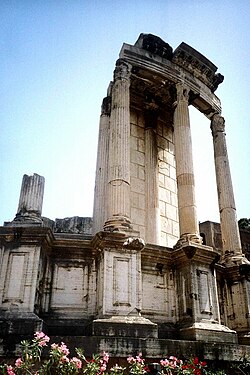
In his work On Architecture, Vitruvius always uses the word templum in the technical sense of a space defined through augury, with aedes the usual word for the building itself.[8] The design of a deity's aedes, he writes, should be appropriate to the characteristics of the deity. For a celestial deity such as Jupiter, Coelus, Sol or Luna, the building should be open to the sky; an aedes for a god embodying virtus (valour), such as Minerva, Mars, or Hercules, should be Doric and without frills; the Corinthian order is suited for goddesses such as Venus, Flora, Proserpina and the Lymphae; and the Ionic is a middle ground between the two for Juno, Diana, and Father Liber. Thus in theory, though not always in practice, architectural aesthetics had a theological dimension.[9]
The word aedilis (aedile), a public official, is related by etymology; among the duties of the aediles was the overseeing of public works, including the building and maintenance of temples.[10] The temple (aedes) of Flora, for instance, was built in 241 BC by two aediles acting on Sibylline oracles. The plebeian aediles had their headquarters at the aedes of Ceres.[11]
ager
ในการใช้งานทางศาสนาager (อาณาเขต ประเทศ แผ่นดิน ภูมิภาค) คือพื้นที่บนโลกที่กำหนดไว้เพื่อวัตถุประสงค์ในการทำนายโดยสัมพันธ์กับauspiciaมีager อยู่ห้าประเภท ได้แก่Romanus, Gabinus, peregrinus, hosticusและincertus ager Romanusเดิมทีรวมถึงพื้นที่เมืองนอกpomeriumและชนบทโดยรอบ[ 12 ] ตามที่Varro กล่าว ager Gabinusเกี่ยวข้องกับสถานการณ์พิเศษของoppidumของGabiiซึ่งเป็นเมืองแรกที่ลงนามในสนธิสัญญาศักดิ์สิทธิ์(pax)กับโรม[ 13 ] ager peregrinus [ 14 ]คือดินแดนอื่นที่อยู่ภายใต้สนธิสัญญา(pacatus) ager hosticusหมายถึงดินแดนต่างประเทศincertus หมายถึง "ไม่แน่นอน" หรือ "ไม่กำหนด" นั่นคือไม่เข้าข่ายหนึ่งในสี่ประเภทที่กำหนดไว้[ 15 ]อำนาจและการกระทำของผู้พิพากษาขึ้นอยู่กับและถูกจำกัดโดยลักษณะของเขตปกครองที่พวกเขายืนอยู่ และเขตปกครองในความหมายทั่วไปหมายถึงอาณาเขตที่กำหนดไว้ตามกฎหมายหรือทางการเมืองเขตปกครองโรมันไม่สามารถขยายออกไปนอกอิตาลี(terra Italia)ได้[ 16 ]
อารา
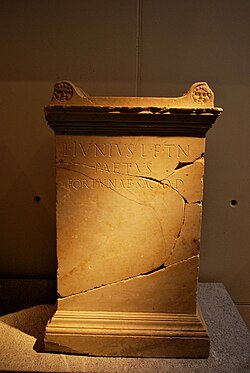
จุดศูนย์กลางของการบูชายัญคือแท่นบูชา ( ara , พหูพจน์arae ) แท่นบูชาส่วนใหญ่ทั่วเมืองโรมและในชนบทจะเป็นโครงสร้างแบบเปิดโล่งที่เรียบง่าย อาจตั้งอยู่ภายในเขตศักดิ์สิทธิ์ ( templum ) แต่บ่อยครั้งที่ไม่มีaedesที่ประดิษฐานรูปเคารพ[ 17 ]แท่นบูชาที่รับเครื่องบูชาอาหารอาจเรียกว่าmensa ซึ่งหมาย ถึง "โต๊ะ" [ 18 ]
บางทีแท่นบูชาโรมันที่รู้จักกันดีที่สุดก็คือ Ara Pacis ที่ประณีตและได้รับอิทธิพลจากกรีกซึ่งได้รับการขนานนามว่า "ผลงาน ศิลปะ ออกัสตัส ที่เป็นตัวแทนมากที่สุด " [ 19 ]แท่นบูชาสาธารณะที่สำคัญอื่นๆ ได้แก่Ara Maxima
อาร์เบอร์ เฟลิกซ์
ต้นไม้บางต้นเป็นfelixและบางต้น เป็น infelixต้นไม้(arbor)จะถูกจัดประเภทเป็นfelixหากอยู่ภายใต้การคุ้มครองของเทพเจ้าแห่งสวรรค์(di superi)คำคุณศัพท์felixในที่นี้ไม่ได้หมายความเพียงแค่ "มีผล" ตามตัวอักษร แต่หมายความกว้างกว่านั้นคือ "เป็นมงคล" Macrobius [ 20 ]ระบุarbores felices (พหูพจน์) ว่าเป็นต้นโอ๊ก (สี่สายพันธุ์) ต้นเบิร์ช ต้นเฮเซลนัท ต้นซอร์บัส ต้นมะเดื่อขาว ต้นลูกแพร์ ต้นแอปเปิล ต้นองุ่น ต้นพลัม ต้นคอร์นัส และต้นบัว ต้นโอ๊กเป็นต้นไม้ศักดิ์สิทธิ์ของจูปิเตอร์และกิ่งของต้นโอ๊กถูกใช้โดยเวสทัลเพื่อจุดไฟศักดิ์สิทธิ์ในเดือนมีนาคมของทุกปี นอกจากนี้ในบรรดาfelices ยัง มีต้นมะกอก ซึ่งกิ่งของมันถูกติดไว้บนหมวกของFlamen Dialisและต้นลอเรลและต้นป็อปลาร์ ซึ่งใช้สวมมงกุฎให้กับนักบวชSalian [ 21 ]
Arbores infelicesคือต้นไม้ที่อยู่ภายใต้การคุ้มครองของ เทพเจ้า แห่งโลกใต้ดินหรือเทพเจ้าที่มีอำนาจในการปัดเป่าความโชคร้าย ( avertentium ) ตามที่Tarquitius Priscus ระบุไว้ ในostentarium ที่สูญหายของเขา เกี่ยวกับต้นไม้[ 22 ]ได้แก่buckthorn , red cornel , เฟิร์น , มะเดื่อดำ , "ต้นไม้ที่ออกผลสีดำและผลสีดำ" , holly , woodland pear , butcher's broom , briarและbrambles [ 23 ]
ดึงดูดใจ
คำกริยาattrectare ("สัมผัส จับต้อง วางมือบน") ในบริบทการใช้งานทางศาสนาเฉพาะ หมายถึงการสัมผัสวัตถุศักดิ์สิทธิ์ขณะประกอบพิธีกรรมทางศาสนาAttrectareมีความหมายเชิงบวกเฉพาะเมื่อกล่าวถึงการกระทำของsacerdotes populi Romani ("นักบวชของชาวโรมัน") เท่านั้น และมีความหมายเชิงลบว่า "ปนเปื้อน" (= contaminare)หรือทำให้สกปรก เมื่อกล่าวถึงการสัมผัสวัตถุศักดิ์สิทธิ์โดยผู้ที่ไม่ได้รับอนุญาต แต่งตั้ง หรือชำระล้างตามพิธีกรรม[ 24 ]
ออเกอร์
โหร (ภาษาละติน พหูพจน์augures ) คือข้าราชการและนักบวชที่ทำหน้าที่ขอคำแนะนำและตีความพระประสงค์ของเทพเจ้าเกี่ยวกับการกระทำที่เสนอ โหรจะกำหนดtemplumหรือพื้นที่ศักดิ์สิทธิ์ตามพิธีกรรม ประกาศวัตถุประสงค์ของการปรึกษาหารือ ถวายเครื่องบูชา และสังเกตสัญญาณที่ส่งกลับมา โดยเฉพาะอย่างยิ่งการกระทำและการบินของนก หากโหรได้รับสัญญาณที่ไม่เป็นมงคล เขาสามารถระงับ เลื่อน หรือยกเลิกการกระทำนั้นได้ ( obnuntiatio ) การ "ขอพร" เป็นส่วนสำคัญของกิจการทางราชการที่สำคัญทั้งหมด รวมถึงพิธีการแต่งตั้ง การอภิปรายในวุฒิสภา การออกกฎหมาย การเลือกตั้ง และสงคราม และถือเป็นสิทธิพิเศษโบราณของกษัตริย์และขุนนาง ในสมัยสาธารณรัฐสิทธินี้ได้ขยายไปยังข้าราชการอื่นๆ หลังจาก 300 ปีก่อนคริสตกาลสามัญชนสามารถเป็นโหรได้
ออราคูลัม
การขอพรอย่างเป็นทางการจำเป็นต้องมีการกำหนดพื้นที่ประกอบพิธีกรรม ( auguraculum ) จากภายในซึ่งโหรจะสังเกตtemplumรวมถึงการสร้างเต็นท์หรือกระท่อมสำหรับทำพิธี ( tabernaculum ) มีสถานที่ดังกล่าวสามแห่งในกรุงโรม ได้แก่ บนป้อมปราการ ( arx ) บนเนินเขา Quirinalและบน เนิน เขาPalatine Festusกล่าวว่าเดิมทีauguraculumก็คือarx นั่นเอง มันหันหน้าไปทางทิศตะวันออก ทำให้ทิศเหนืออยู่ทางด้านซ้ายหรือด้านที่โชคดีของโหร[ 25 ]ผู้พิพากษาที่ทำหน้าที่เป็นผู้บัญชาการทหารก็ทำพิธีขอพรทุกวันเช่นกัน ดังนั้นส่วนหนึ่งของการสร้างค่ายในระหว่างการรณรงค์คือการสร้างtabernaculum augurageleเต็นท์ขอพรนี้เป็นศูนย์กลางของพิธีกรรมทางศาสนาและกฎหมายภายในค่าย[ 26 ]
ออกัสเรียม
ออเกอร์เรียม (พหูพจน์ออเกอร์เรีย ) เป็นคำนามนามธรรมที่เกี่ยวข้องกับออเกอร์ดูเหมือนว่าจะมีความหมายหลากหลาย: "การแต่งตั้งศักดิ์สิทธิ์" ของออเกอร์; [ 27 ] พิธีกรรมและการกระทำของออเกอร์; [ 28 ]กฎหมายการทำนาย(ius augurale) ; [ 29 ]และเครื่องหมายที่บันทึกไว้ซึ่งความหมายได้รับการกำหนดไว้แล้ว[ 30 ]คำนี้มีรากศัพท์มาจากรากศัพท์อินโด-ยุโรป*aug-ซึ่งหมายถึง "เพิ่มขึ้น" และอาจเป็นคำนามเพศกลางภาษาละตินโบราณ*augusซึ่งหมายถึง "สิ่งที่เต็มไปด้วยพลังลึกลับ" ในฐานะเครื่องหมายที่แสดงถึงพระประสงค์ของพระเจ้า[ 31 ]ออเกอร์เรียมสำหรับผู้พิพากษามีอายุหนึ่งปี สำหรับนักบวชมีอายุตลอดชีวิต สำหรับวิหารมีอายุตลอดไป[ 32 ]
ความแตกต่างระหว่างauguriumและauspiciumมักไม่ชัดเจนAuspiciaคือการสังเกตดูนกเพื่อเป็นสัญญาณของพระประสงค์ของพระเจ้า ซึ่งเชื่อกันว่าเป็นธรรมเนียมปฏิบัติที่ริเริ่มโดยโรมูลัส กษัตริย์ องค์แรกของโรมในขณะที่การทำนายดวงชะตาได้รับการยกให้เป็นของนูมา ผู้สืบทอดตำแหน่งต่อจาก เขา[ 33 ]สำหรับเซอร์วิอุสauguriumก็คือสิ่งเดียวกับauspicia impetrativaซึ่งเป็นชุดของสัญญาณที่แสวงหาผ่านพิธีกรรมที่กำหนดไว้[ 34 ]นักวิชาการบางคนคิดว่าauspicia น่าจะเป็นของ ฝ่ายปกครองและฝ่ายศาสนามากกว่า[ 35 ]ในขณะที่auguriumจะจำกัดอยู่เฉพาะกษัตริย์ศักดิ์สิทธิ์และนักบวชหลัก[ 36 ]
แหล่งข้อมูลโบราณบันทึกauguria ไว้ 3 รายการ ได้แก่ augurium salutisซึ่งทุกปีจะมีการถามเทพเจ้าว่าfas (อนุญาต, ถูกต้อง) ที่จะขอความปลอดภัยให้กับชาวโรมัน หรือไม่ (5 สิงหาคม); augurium canariumซึ่งเป็นการบูชายัญสุนัข (ดูsupplicia canum ด้วย ) เพื่อส่งเสริมการเจริญเติบโตของพืชผลทางการเกษตร จัดขึ้นต่อหน้าพระสังฆราชและนักทำนาย “เมื่อรวงข้าวสาลีก่อตัวขึ้นแล้วแต่ยังอยู่ในฝัก”; [ 37 ]และvernisera auguria ที่ Festusกล่าวถึงซึ่งน่าจะเป็นพิธีกรรมบูชาในฤดูใบไม้ผลิที่จัดขึ้นในช่วงเวลาเก็บเกี่ยว ( auguria messalia )
ออสเป็กซ์
ออ สเพ็ก ซ์ ( auspex ) ซึ่งเป็นคำนามพหูพจน์ของออสพิเซส ( auspices ) คือหมอดูที่ทำนายลางบอกเหตุจากพฤติกรรมการบินของนก ( avi-มาจากavisซึ่งแปลว่า "นก" และ-spexซึ่งแปลว่า "ผู้สังเกต" มาจากspicere ) ดู ออ สพิเซีย ( auspicia ) และออสพิเซส (auspice ) ต่อไป
ออสพิเซีย
อัสปิเซีย ( au- = avis , "นก"; -spic- , "นาฬิกา") เดิมทีเป็นสัญญาณที่ได้มาจากการสังเกตการบินของนกภายในเทมพลัมของท้องฟ้า อัสปิเซียจะถูกทำนายโดยนักทำนายเดิมทีเป็นสิทธิพิเศษของชนชั้นแพทริเซียน[ 38 ]แต่คณะนักทำนายได้เปิดให้สามัญชนเข้าร่วมได้ใน 300 ปีก่อนคริสตกาล[ 39 ] มี เพียงผู้พิพากษา เท่านั้น ที่ครอบครองอัสปิเซีย พับบลิกาพร้อมสิทธิและหน้าที่ในการทำนายที่เกี่ยวข้องกับรัฐโรมัน[ 40 ]อัสปิเซียที่เป็นมงคลจะบ่งบอกเวลาหรือสถานที่ว่าเป็นมงคล และจำเป็นสำหรับพิธีหรือเหตุการณ์สำคัญ รวมถึงการเลือกตั้ง การรณรงค์ทางทหาร และการรบแบบประจัญบาน
ตามที่เฟสตัส กล่าวไว้ มีauspicia ห้าประเภท ที่นักทำนายให้ความสนใจ ได้แก่ex caeloสัญญาณจากท้องฟ้า เช่น ฟ้าร้องและฟ้าผ่าex avibusสัญญาณจากนกex tripudiisสัญญาณที่เกิดจากการกระทำของไก่ศักดิ์สิทธิ์บางชนิดex quadrupedibusสัญญาณจากพฤติกรรมของสัตว์สี่ขา และex dirisลางร้ายที่คุกคาม[ 41 ]ในการทำนายดวงชะตาอย่างเป็นทางการของรัฐที่โรม มีเพียง auspicia ex caeloและex avibus เท่านั้น ที่ถูกนำมาใช้
การทำนายดวงชะตาต้องใช้ความเงียบตามพิธีกรรม(silentium)การเฝ้ารอสัญญาณเรียกว่าspectioหรือservare de caeloการปรากฏของสัญญาณที่คาดหวังเรียกว่าnuntiatioหรือหากเป็นสัญญาณที่ไม่เป็นมงคล เรียกว่า obnuntiatioหากพบสัญญาณที่ไม่เป็นมงคล เจ้าหน้าที่ผู้สังเกตการณ์จะหยุดกิจการที่กำลังดำเนินการอยู่และประกาศว่าalio die ("ในวันอื่น") [ 42 ]
การสังเกตลางบอกเหตุจากนกเป็นเรื่องปกติในหมู่ชนโบราณหลายกลุ่มที่มีมาก่อนและร่วมสมัยกับโรม รวมถึงชาวกรีก[ 43 ]ชาวเคลต์[ 44 ]และชาวเยอรมัน[ 45 ]
ออสพิเซีย อิมเพทราติวา
Auspicia impetrativaคือสัญญาณที่ถูกร้องขอภายใต้เงื่อนไขพิธีกรรมที่มีการควบคุมอย่างเข้มงวด (ดูspectio และ servare de caelo) ภายใน templum [ 46 ] ประเภทของ auspices ที่จำเป็นสำหรับการเรียกประชุมสาธารณะคือ impetrativa [ 47 ] และผู้พิพากษามี "สิทธิและหน้าที่ " ในการแสวงหาลางบอกเหตุเหล่านี้อย่างกระตือรือร้น[ 48 ] Auspices เหล่านี้สามารถแสวงหาได้จากauguraculum เท่านั้น ซึ่งเป็นเต็นท์หรือ "กระโจม" ( tabernaculum ) ที่สร้างขึ้นตามพิธีกรรม [ 49 ]เปรียบเทียบกับauspicia oblativa
ออสพิเซีย ไมโอรา
สิทธิ์ในการสังเกต "การทำนายที่ยิ่งใหญ่กว่า" ได้รับการมอบให้แก่ผู้พิพากษาโรมันที่ถืออำนาจปกครองอาจโดยLex curiata de imperioแม้ว่านักวิชาการจะไม่เห็นพ้องต้องกันในประเด็นปลีกย่อยของกฎหมายก็ตาม[ 50 ]ผู้ตรวจการมีอำนาจสูงสุด[ 51 ]นอกจากนี้ยังเชื่อกันว่าflamines maioresแตกต่างจากminoresโดยสิทธิ์ในการทำนายauspicia maioraดูFlamen
ออสพิเซีย ออบลาติวา
สัญญาณที่เกิดขึ้นโดยไม่ได้ตั้งใจแสวงหาผ่าน ขั้นตอน การทำนาย อย่างเป็นทางการ เรียกว่าauspicia oblativaสัญญาณที่ไม่ได้รับการร้องขอเหล่านี้ถือว่าส่งมาจากเทพเจ้าหรือเทพเจ้าเพื่อแสดงความเห็นชอบหรือไม่เห็นด้วยต่อการดำเนินการใดการดำเนินการหนึ่งโดยเฉพาะ ปรากฏการณ์มหัศจรรย์ ( prodigium ) เป็นรูปแบบหนึ่งของoblativaที่ ไม่เอื้ออำนวย [ 52 ]เปรียบเทียบกับauspicia impetrativa
ออสพิเซีย ไพรวาตา
ศาสนาส่วนตัวและศาสนาภายในครอบครัวมีความเชื่อมโยงกับสัญญาณศักดิ์สิทธิ์เช่นเดียวกับศาสนาของรัฐ เป็นธรรมเนียมในครอบครัวชนชั้นสูง ที่จะทำนาย ดวงชะตาสำหรับเรื่องสำคัญต่างๆ เช่น การแต่งงาน การเดินทาง และธุรกิจสำคัญ[ 53 ]ข้อมูลเพียงเล็กน้อยเกี่ยวกับการทำนายดวงชะตาส่วนตัวในงานเขียนของนักเขียนโบราณ[ 54 ]ชี้ให้เห็นว่าการทำนายดวงชะตาส่วนตัวนั้นโดยเนื้อแท้แล้วไม่แตกต่างจากการทำนายดวงชะตาสาธารณะ กล่าวคือ ต้องรักษาความเงียบสนิท[ 55 ]และผู้ที่ทำนายดวงชะตาสามารถเพิกเฉยต่อเหตุการณ์ที่ไม่พึงประสงค์หรือก่อกวนได้โดยแสร้งทำเป็นไม่เห็น[ 56 ]ในเรื่องที่เกี่ยวข้องกับครอบครัวหรือบุคคล ทั้งฟ้าผ่า[ 57 ]และ อวัยวะภายใน[ 58 ]อาจให้สัญญาณแก่พลเมืองส่วนตัวที่ไม่ได้รับอนุญาตให้ทำนายดวงชะตาอย่างเป็นทางการ ในบรรดาหน้าที่อื่นๆ ของเขาพระสังฆราชสูงสุด ยัง ให้คำแนะนำแก่พลเมืองส่วนตัวและนักบวชอย่างเป็นทางการเกี่ยวกับปาฏิหาริย์และการป้องกันปาฏิหาริย์เหล่านั้นด้วย[ 59 ]ในสมัยของซิเซโร การทำนายดวงชะตาส่วนตัวเริ่มไม่เป็นที่นิยมแล้ว[ 60 ]
averruncare
ในการใช้ภาษาของพระสันตะปาปา คำกริยาaverruncareซึ่งหมายถึง "การหลีกเลี่ยง" แสดงถึงพิธีกรรมที่มุ่งหลีกเลี่ยงความโชคร้ายที่บ่งบอกโดยลางร้าย ลางร้าย( portentaque prodigiaque mala)จะต้องถูกเผาโดยใช้ต้นไม้ที่อยู่ในการดูแลของเทพเจ้าแห่งโลกใต้ดินหรือเทพเจ้าผู้ "หลีกเลี่ยง" (ดูarbores infelicesข้างต้น) [ 61 ] Varroกล่าวว่าเทพเจ้าที่ดูแลการกระทำของการหลีกเลี่ยงคือ Averruncus [ 62 ]
บี
bellum iustum
“ สงครามที่ชอบธรรม ” คือสงครามที่ถือว่าชอบธรรมตามหลักการของกฎหมายเกี่ยวกับทารกในครรภ์(ius fetiale) [ 63 ] เนื่องจากสงครามอาจก่อให้เกิดมลภาวะทางศาสนา สงครามจึงถือเป็นnefasซึ่งหมายถึง “ผิด” และอาจทำให้เทพเจ้าพิโรธได้ เว้นแต่จะเป็นiustumซึ่งหมายถึง “ยุติธรรม” [ 64 ]ข้อกำหนดสำหรับสงครามที่ชอบธรรมนั้นมีทั้งในเชิงรูปแบบและเชิงเนื้อหา ในเชิงรูปแบบสงครามจะต้องประกาศตามขั้นตอนของius fetialeในเชิงเนื้อหา สงครามต้องมี “สาเหตุที่ชอบธรรม” ซึ่งอาจรวมถึงrerum repetitioการแก้แค้นต่อชนชาติอื่นที่ปล้นสะดม หรือการละเมิดหรือการถอนตัวฝ่ายเดียวจากสนธิสัญญา หรือความจำเป็น เช่น ในกรณีของการขับไล่การรุกราน[ 65 ]ดูเพิ่มเติมที่Jus ad bellum
ซี
แครีโมเนีย
คำภาษาอังกฤษ "ceremony" มาจากคำภาษาละตินcaerimoniaหรือcaeremoniaซึ่งเป็นคำที่มีที่มาของคำ ไม่ชัดเจน พบครั้งแรกในวรรณกรรมและจารึกตั้งแต่สมัยของซิเซโร (กลางศตวรรษที่ 1 ก่อนคริสต์ศักราช) แต่เชื่อกันว่ามีอายุเก่าแก่กว่านั้นมาก ความหมายของคำนี้เปลี่ยนแปลงไปตามกาลเวลา ซิเซโรใช้คำว่าcaerimoniaอย่างน้อย 40 ครั้ง ในความหมายที่แตกต่างกันสามหรือสี่ความหมาย ได้แก่ "ความศักดิ์สิทธิ์" หรือ "ความไม่ละเมิด" ซึ่งเป็นการใช้ของทาซิตัสด้วย "การเคารพอย่างเคร่งครัด" ควบคู่กับcura (ความระมัดระวัง ความห่วงใย) และที่ใช้กันทั่วไปในรูปพหูพจน์caerimoniaeเพื่อหมายถึง "ข้อกำหนดทางพิธีกรรม" หรือ "การกระทำทางพิธีกรรม" รูปแบบพหูพจน์ได้รับการรับรองโดยนักไวยากรณ์ชาวโรมัน
Hendrik Wagenvoortยืนยันว่าcaerimoniaeเดิมทีเป็นคำแนะนำพิธีกรรมลับที่กำหนดโดยNumaซึ่งอธิบายว่าเป็นstatae et sollemnes "ได้รับการสถาปนาและเคร่งขรึม" [ 66 ]สิ่งเหล่านี้ได้รับการตีความและกำกับดูแลโดยวิทยาลัยของ Pontiffs , flamens , rex sacrorumและVestalsต่อมาcaerimoniaeอาจหมายถึงพิธีกรรมอื่นๆ รวมถึงลัทธิ ต่างชาติ ด้วย[ 67 ]พิธีกรรมที่กำหนดไว้เหล่านี้ "รวมตัวตนภายในเข้ากับวัตถุทางศาสนาภายนอก" ผูกมัดอาณาจักรมนุษย์และอาณาจักรศักดิ์สิทธิ์ นักประวัติศาสตร์Valerius Maximusชี้แจงอย่างชัดเจนว่าcaerimoniaeต้องการให้ผู้ที่ประกอบพิธีกรรมบรรลุถึงสภาวะทางจิตวิญญาณที่เฉพาะเจาะจง ( animus "เจตนา") และเน้นย้ำถึงความสำคัญของcaerimoniaeในคำอุทิศและประโยคแรกของงานของเขา ในเวอร์ชันของวาเลริอุสเกี่ยวกับการล้อมกรุงโรมของชาวกอลเหล่าเวสตัลและฟลาเมน ควิรินาลิส ได้ช่วยกอบกู้สิ่งศักดิ์สิทธิ์ ( sacra ) ของกรุงโรมโดยนำไปที่คาเอเรดังนั้นพิธีกรรมจึงได้รับชื่อมาจากสถานที่นั้น[ 68 ]แม้ว่ารากศัพท์นี้จะสร้างความเชื่อมโยงเชิงเรื่องราวที่มีความหมายสำหรับวาเลริอุส[ 69 ]แต่ก็ไม่น่าจะถูกต้องตามหลักภาษาศาสตร์ วิทยาศาสตร์สมัยใหม่ บางครั้งมีการเสนอต้นกำเนิดจากภาษาเอตรัสกัน วาเกนวอร์ตคิดว่า caerimoniaมาจากcaerusซึ่งหมายถึง "มืด" ในความหมายของ "ซ่อนเร้น" ดังนั้นจึงหมายถึง "ความมืด ความลับ" [ 70 ]
ในEtymologiaeของ เขา Isidore แห่ง Sevilleกล่าวว่าคำที่เทียบเท่าในภาษากรีกคือorgiaแต่คำนี้มาจากcarendoซึ่งหมายถึง "ขาด" และกล่าวว่าบางคนคิดว่าควรใช้caerimoniae กับ พิธีกรรมของชาวยิวโดยเฉพาะกฎเกี่ยวกับอาหารที่กำหนดให้งดเว้นหรือ "ขาด" อาหารบางชนิด[ 71 ]
คาเลเตอร์
คาลาโตเรสเป็นผู้ช่วยที่ดำเนินการธุรกิจประจำวันในนามของนักบวชอาวุโสของรัฐ เช่นฟลามิเนส ไมโอเรส คาลาเตอร์เป็นทาสสาธารณะ[ 72 ]เฟสตัสได้นำคำนี้มาจากคำกริยาภาษากรีกkaleinซึ่งหมายถึง "เรียก"
capite velato
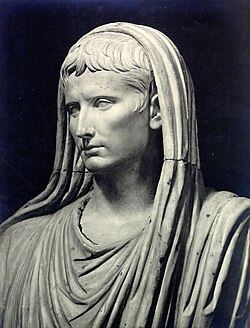
ในพิธีกรรมสาธารณะแบบดั้งเดิมของกรุงโรมโบราณ ผู้ประกอบพิธีกรรมจะสวดมนต์ บูชายัญ ถวายเครื่องบูชาและปฏิบัติaugury capite velato [ 73 ] "โดยคลุมศีรษะ" ด้วยผ้าโทกาที่พับขึ้นจากด้านหลัง การคลุมศีรษะนี้เป็นลักษณะเด่นของพิธีกรรมโรมันที่แตกต่างจากพิธีกรรมของชาวเอตรัสกัน[ 74 ]หรือritus graecus "พิธีกรรมกรีก" [ 75 ]ในศิลปะโรมัน ศีรษะที่ถูกคลุมเป็นสัญลักษณ์ของpietasและสถานะของบุคคลในฐานะpontifex , augurหรือนักบวชอื่นๆ[ 76 ]
มีการโต้แย้งว่าสำนวนโรมัน piety capite velatoมีอิทธิพลต่อข้อห้ามของเปาโล ที่ห้ามคริสเตียนผู้ชายสวดมนต์โดยคลุมศีรษะ: "ชายใดที่สวดมนต์หรือพยากรณ์โดยคลุมศีรษะก็ทำให้ศีรษะของตนเสื่อมเสียเกียรติ" [ 77 ]
คาร์เมน
ในภาษาละตินคลาสสิก คำ ว่า carmenมักหมายถึง "เพลง บทกวี บทสวด" ในการใช้ในเชิงเวทมนตร์และศาสนาcarmen (พหูพจน์carmina ) คือบทสวดบทเพลงบทคาถา หรือมนต์ โดยพื้นฐานแล้ว carmen คือ "คำพูดที่ขับร้องเพื่อจุดประสงค์ทางพิธีกรรม" ซึ่งมีลักษณะเฉพาะคือการแสดงออกตามสูตร ความซ้ำซ้อน และจังหวะ[ 78 ]มีการเก็บรักษาเศษเสี้ยวจากบทเพลงของนักบวชโบราณสองบท ได้แก่Carmen Arvaleของกลุ่ม Arval Brethren และCarmina Saliariaของกลุ่มSalii Carmen SaeculareของHorace แม้ว่าจะ มีเทคนิคทางวรรณกรรมที่ชัดเจน แต่ก็เป็นบทเพลงเช่นกัน ซึ่งขับร้องโดยคณะนักร้องประสานเสียงในงานSaecular Gamesในปี 17 ก่อนคริสต์ศักราช และแสดงถึงอุดมการณ์ Apollonian ของAugustus [ 79 ]
คาถาร้ายหรือคาถาอันตรายคือคาถาเวทมนตร์ที่อาจเป็นอันตราย ข้อความบางส่วนจากกฎสิบสองตารางที่อ่านว่าsi malum carmen incantassit (“หากใครก็ตามร่ายคาถาชั่วร้าย”) แสดงให้เห็นว่ากฎหมายโรมันมีความกังวลมายาวนานในการปราบปรามเวทมนตร์ที่มุ่งร้าย[ 80 ]คาถาเซพัลคราลคือคาถาที่เรียกวิญญาณคนตายจากหลุมศพ คาถา เวเนฟิคัมคือเครื่องราง “พิษ” [ 81 ]จากการปฏิบัติทางเวทมนตร์ คำว่าcarmenจึงมีความหมายถึงวัตถุที่จารึกคาถาไว้ด้วย ดังนั้นจึงหมายถึงเครื่องรางในความหมายทางกายภาพ[ 82 ]
คาสตัส, คาสติทัส
Castusเป็นคำคุณศัพท์ที่หมายถึงบริสุทธิ์ทางศีลธรรมหรือปราศจากความผิด (ภาษาอังกฤษ "chaste") ดังนั้นจึงหมายถึงบริสุทธิ์ทางศาสนาหรือบริสุทธิ์ตามพิธีกรรมในความหมายทางศาสนาCastitasเป็นคำนามนามธรรม มีการเสนอรากศัพท์ต่างๆ มากมาย รวมถึงรากศัพท์อินโด-ยุโรปสองราก ได้แก่ * k '(e)stos [ 83 ]ซึ่งหมายถึง "ผู้ที่ปฏิบัติตามข้อกำหนดของพิธีกรรม" หรือ * kas-ซึ่งเป็นที่มาของคำกริยาcareo "ฉันขาด, ถูกลิดรอน, ไม่มี..." เช่นvitia [ 84 ]ในศาสนาโรมัน ความบริสุทธิ์ของพิธีกรรมและผู้ที่ประกอบพิธีกรรมนั้นมีความสำคัญยิ่ง ผู้ที่ได้รับการชำระล้างอย่างถูกต้องและcastusในการเตรียมและการประกอบพิธีกรรมทางศาสนามีแนวโน้มที่จะทำให้เทพเจ้าพอใจ ความผิดพลาดในพิธีกรรมเป็นมลพิษ มัน ทำให้การประกอบพิธีกรรม เสื่อมเสียและเสี่ยงต่อความโกรธของเทพเจ้าCastusและcastitasเป็นคุณลักษณะของsacerdos (นักบวช) [ 85 ]แต่สารและวัตถุต่างๆ ก็สามารถเป็นcastusตาม พิธีกรรมได้เช่นกัน [ 86 ]
ซินคตัส กาบินัส
ซินคตัส กาบินัส ("ซินคตัส กาบินัส") เป็นวิธีการสวมโทกาที่เชื่อกันว่ามีต้นกำเนิดมาจากเมืองกาบีอีในภาษาละติน[ 87 ] [ 88 ]ต่อมามีการอ้างว่าเป็นส่วนหนึ่งของเครื่องแต่งกายของนักบวชชาวเอตรัสกัน [ 89 ] ซินคตัสช่วยให้สามารถใช้แขนทั้งสองข้างได้อย่างอิสระ[ 90 ] [ 91 ]ซึ่งจำเป็นเมื่อยังคงสวมโทกาในระหว่างการต่อสู้ และต่อมามีความสำคัญในบริบททางศาสนา บางอย่าง โดยเฉพาะอย่างยิ่งที่เกี่ยวข้องกับการใช้โทกาเพื่อคลุมศีรษะ ( capite velato ) [ 92 ]ความเกี่ยวข้องกับการต่อสู้ในสมัยโบราณของรูปแบบนี้ทำให้มีการสวมใส่ในระหว่างการประกาศสงครามของ โรมัน นอกจากนี้ยังถูกใช้โดยนักบวชหรือเจ้าหน้าที่ที่ได้รับมอบหมายให้ชี้นำไถนาเพื่อสร้างร่องsulcus primigeniusในระหว่างพิธีกรรมที่เกี่ยวข้องกับการก่อตั้งอาณานิคม ใหม่ [ 92 ]ในภาษาละติน ซิ นคตัส กาบินัสอาจหมายถึงซินคตัสเองหรือโทกาทั้งตัวที่สวมใส่ในลักษณะนี้ ในบริบททางศาสนา กล่าวกันว่าเสื้อคลุมแบบนี้สวมใส่ในพิธีกรรมกาบิโน ("ในพิธีกรรมกาบิโน")
clavum figere
Clavo trabali figere (“ยึดหรือตรึงด้วยตะปูขนาดใหญ่”) เป็นสำนวนที่หมายถึงการตรึงหรือยึดเรื่องใดเรื่องหนึ่ง[ 93 ]ตะปูเป็นหนึ่งในคุณลักษณะของเทพีNecessitas [ 94 ] และเทพี Athrpa ของชาวเอตรัสกัน ( Atroposของกรีก) ตามที่Livy กล่าวไว้ ทุกปีในวิหารNortiaซึ่งเป็นเทพีที่เทียบเท่ากับFortuna ของชาวเอตรัสกัน จะมีการตอกตะปูเพื่อทำเครื่องหมายเวลา ในกรุงโรม ผู้พิพากษาอาวุโส[ 95 ]ในวัน Ides ของเดือนกันยายน จะตอกตะปูที่เรียกว่าclavus annalis (“ตะปูประจำปี”) [ 96 ]เข้าไปในกำแพงของวิหาร Jupiter Optimus Maximusพิธีนี้เกิดขึ้นในวันdies natalis (“วันเกิด” หรือวันครบรอบการอุทิศ) ของวิหาร ซึ่งมีการจัด งานเลี้ยงสำหรับ Jupiter ( Epulum Jovis ) ด้วย อย่างไรก็ตาม พิธีตอกตะปูเกิดขึ้นในวิหารที่อุทิศให้กับมิเนอร์วาทางด้านขวาของเอดีสของจูปิเตอร์ เนื่องจากแนวคิดเรื่อง "ตัวเลข" ถูกคิดค้นโดยมิเนอร์วา และพิธีกรรมนี้เกิดขึ้นก่อนการใช้ตัวอักษรเขียนอย่างแพร่หลาย[ 97 ]
ความสำคัญของพิธีกรรมนี้สูญหายไปในความคลุมเครือ แต่ในสาธารณรัฐยุคแรก พิธีกรรมนี้เกี่ยวข้องกับการแต่งตั้งเผด็จการ clavi figendi causa ซึ่งหมายถึง " เผด็จการเพื่อจุดประสงค์ในการตอกตะปู" [ 98 ]โดยมีการแต่งตั้งเผด็จการหนึ่งคนสำหรับปี 363, 331, 313 และ 263 ก่อนคริสต์ศักราช[ 99 ]ลิวีกล่าวว่าการปฏิบัติเช่นนี้เกี่ยวข้องกับreligio ซึ่งหมายถึง ความละอายหรือภาระผูกพันทางศาสนา อาจเป็นไปได้ว่านอกเหนือจากพิธีกรรมประจำปีแล้ว ยังมีการ "กำหนด" ในช่วงเวลาที่เกิดโรคระบาดหรือความขัดแย้งภายใน ซึ่งทำหน้าที่เป็นpiaculum [100]ลิวีกล่าวว่าในปี 363 โรคระบาดได้ทำลายกรุงโรมมาเป็นเวลาสองปีแล้ว มีการระลึกว่าครั้งหนึ่งโรคระบาดเคยถูกทำลายลงได้เมื่อเผด็จการตอกตะปูตามพิธีกรรม และวุฒิสภาได้แต่งตั้งเผด็จการหนึ่งคนเพื่อจุดประสงค์นั้น[ 101 ]พิธีกรรม "การตอกตะปู" เป็นหนึ่งในพิธีกรรมที่ออกัสตัสได้ฟื้นฟูและปฏิรูป โดยในปี ค.ศ. 1 เขาได้ย้ายพิธีกรรมนี้ไปยังวิหารมาร์ส อุลทอร์ แห่งใหม่ นับจากนั้นเป็นต้นมาผู้ตรวจการจะตอกตะปูเมื่อสิ้นสุดวาระของเขา[ 102 ]
วิทยาลัย
คอลเลเจีย (collegium ) (“สมาคมที่รวมตัวกันตามกฎหมาย”) พหูพจน์ คือ คอลเลเจีย (collegia ) คือสมาคมใดๆ ที่มีสถานะเป็นนิติบุคคล วิทยาลัยของนักบวชดูแลประเพณีทางศาสนา และจนถึง 300 ปีก่อนคริสตกาล มีเพียง ขุนนาง เท่านั้น ที่มีสิทธิ์เป็นสมาชิก เมื่อสามัญชนเริ่มได้รับการยอมรับ ขนาดของวิทยาลัยก็ขยายใหญ่ขึ้น ในช่วงปลายสาธารณรัฐวิทยาลัยสามแห่งมีอำนาจมากกว่าวิทยาลัยอื่นๆ โดยมีวิทยาลัยที่สี่เริ่มมีบทบาทสำคัญในรัชสมัยของจักรพรรดิออกัสตัสองค์กรทางศาสนาที่ยิ่งใหญ่ทั้งสี่ ( quattuor amplissima collegia ) ได้แก่:
- Pontificesคือคณะพระสันตะปาปาซึ่งมีPontifex Maximus เป็น ประธาน
- การทำนายดวงชะตา ;
- Quindecimviri sacris faciundisนักบวชทั้งสิบห้าคนที่ดูแลหนังสือ Sibylline ;
- Septemviri epulonum , คณะนักบวชเจ็ดคนที่จัดงานเลี้ยงสาธารณะสำหรับวันหยุดทางศาสนา
ออกัสตัสเป็นสมาชิกของวิทยาลัย ทั้งสี่แห่ง แต่จำกัดสมาชิกภาพสำหรับวุฒิสมาชิกคน อื่นๆ ไว้เพียงหนึ่งแห่ง[ 103 ]
ในสังคมโรมันคำว่า "คอลเลเจียม"อาจหมายถึงสมาคมการค้าหรือสมาคมชุมชนก็ได้ ดูที่คอลเลเจียม (โรมโบราณ )
comitia calata
การ ประชุมที่เรียก ว่า comitia calata ("การประชุม calate") เป็นการ ประชุม(comitia)ที่ไม่มีสิทธิ์ออกเสียงซึ่งจัดขึ้นเพื่อวัตถุประสงค์ทางศาสนา คำกริยาcalareซึ่งเดิมหมายถึง "เรียก" เป็นศัพท์เฉพาะที่ใช้ในแวดวงพระสันตะปาปา พบได้ในcalendae ( Calends ) และcalator ด้วย ตามที่Aulus Gelliusกล่าว ไว้ [ 104 ]การประชุม comitiaเหล่านี้จัดขึ้นต่อหน้าคณะพระสันตะปาปาเพื่อประกอบพิธีสถาปนาrex ( กษัตริย์ในยุคราชวงศ์หรือrex sacrorumในสาธารณรัฐ ) [ 105 ]หรือflaminesพระสันตะปาปาผู้ทรงอำนาจสูงสุดเป็นผู้ให้พรและเป็นประธาน การประชุมที่มีผู้พิพากษาที่ได้รับการเลือกตั้งเป็นประธานจะไม่ถือเป็น calataและการประชุมเพื่อวัตถุประสงค์ทางโลกหรือการเลือกตั้งอื่น ๆ แม้จะมีพระสันตะปาปาเป็นประธานก็ไม่ใช่เช่นกัน[ 106 ]
สภาคาลาตาได้รับการจัดตั้งขึ้นโดยคูเรียหรือเซนทูเรีย [ 107 ] ประชาชนถูกเรียกตัวไปยังสภาคาลาตาเพื่อเป็นพยานในการอ่านพินัยกรรม หรือคำสาบานที่สละสิ่งศักดิ์สิทธิ์ ( เดเทสตาติโอ ซาโครรัม ) [ 108 ]พวกเขาไม่ได้มีบทบาทเชิงรุกและเป็นเพียงผู้สังเกตการณ์เท่านั้น[ 109 ]
Mommsenคิดว่าตัวย่อปฏิทินQRCFซึ่งเคยระบุไว้ครั้งหนึ่งว่าQ. Rex CF [ 110 ]และถือเป็นQuando Rex Comitiavit Fasนั้น หมายถึงวันที่กษัตริย์ สามารถ "เรียก" การประชุมcomitium ได้ตามหลักศาสนา ดังนั้นจึงเรียกว่าcomitia calata [ 111 ]
commentarii augures
คำอธิบายประกอบของโหรเป็นชุดคำเขียนที่น่าจะเป็นคำประกาศและคำตอบของคณะโหรอย่างไรก็ตาม นักวิชาการบางคนกล่าวว่าคำอธิบายประกอบนั้นไม่ใช่คำประกาศและคำตอบเสียทีเดียว[ 112 ]คำอธิบายประกอบนั้นแตกต่างจากหนังสือลับของโหร ซึ่งเป็นข้อความที่ไม่เปิดเผยต่อสาธารณะ[ 113 ]หนังสือเหล่านี้ถูกกล่าวถึงโดยซิเซโร [ 114 ]เฟสตัส [ 115 ] และเซอร์วิอุส ดาเนียลิส [ 116 ] ลิวี ได้รวมตัวอย่าง คำประกาศและคำตอบของโหรหลายตัวอย่างไว้ในประวัติศาสตร์ของเขา ซึ่งสันนิษฐานว่านำมาจากคำอธิบายประกอบ[ 117 ]
commentarii pontificum
คำอธิบายประกอบคำพิพากษาของพระสันตะปาปาประกอบด้วยบันทึกพระราชกฤษฎีกาและการดำเนินการอย่างเป็นทางการของวิทยาลัยพระสันตะปาปาวรรณกรรมของนักบวชเป็นหนึ่งในรูปแบบลายลักษณ์อักษรที่เก่าแก่ที่สุดของร้อยแก้วภาษาละตินและรวมถึงรายชื่อ การกระทำ ( acta ) และพงศาวดารที่เก็บรักษาโดยcollegia ต่างๆ [ 118 ]ตลอดจนขั้นตอนทางศาสนา[ 119 ]มักจะเป็นoccultum genus litterarum [ 120 ] ซึ่ง เป็นรูปแบบวรรณกรรมลึกลับที่ตามนิยามแล้วมีเพียงนักบวชเท่านั้นที่สามารถเข้าถึงได้อย่างไรก็ตาม commentariiอาจเปิดให้สาธารณชนปรึกษาได้ อย่างน้อยก็โดยวุฒิสมาชิก [ 121 ]เนื่องจากคำตัดสินในประเด็นทางกฎหมายอาจถูกอ้างถึงเป็นบรรทัดฐาน[ 122 ]ลักษณะสาธารณะของcommentariiได้รับการยืนยันโดยJerzy Linderskiในทางตรงกันข้ามกับlibri reconditi ซึ่ง เป็นหนังสือลับของนักบวช[ 123 ]
คำอธิบาย เหล่านี้ เหลือรอดมาได้เพียงผ่านการอ้างอิงหรือการกล่าวถึงในงานเขียนของนักเขียนโบราณเท่านั้น[ 124 ]บันทึกเหล่านี้ไม่สามารถแยกแยะได้ง่ายจากหนังสือของพระสันตะปาปานักวิชาการบางคนยืนยันว่าคำว่าคำอธิบายและหนังสือสำหรับงานเขียนของพระสันตะปาปาสามารถใช้แทนกันได้ ผู้ที่แยกความแตกต่างถือว่าหนังสือเป็นคลังลับที่บรรจุกฎและบัญญัติของius sacrum (กฎหมายศักดิ์สิทธิ์) ข้อความของสูตรคำพูด และคำแนะนำเกี่ยวกับวิธีการประกอบพิธีกรรม ในขณะที่คำอธิบาย เหล่านี้ เป็นคำตอบ (ความคิดเห็นและข้อโต้แย้ง) และdecreta (คำอธิบายหลักคำสอนที่มีผลผูกพัน) ที่สามารถนำมาใช้ปรึกษาได้ ไม่ว่าคำศัพท์เหล่านี้จะสามารถใช้เพื่อแยกแยะเนื้อหาสองประเภทได้หรือไม่ เอกสารของนักบวชจะถูกแบ่งออกเป็นเอกสารที่สงวนไว้สำหรับการใช้งานภายในโดยนักบวชเอง และเอกสารที่ใช้เป็นงานอ้างอิงเกี่ยวกับเรื่องภายนอกวิทยาลัย[ 125 ]โดยรวมแล้ว ชื่อเรื่องเหล่านี้จะครอบคลุมเรื่องทั้งหมดของกฎหมายของพระสันตะปาปา พิธีกรรม และการบำรุงรักษาลัทธิ พร้อมด้วยสูตรการสวดมนต์[ 126 ]และกฎเกณฑ์ของวิหาร[ 127 ]ดูเพิ่มเติมที่libri pontificalesและ libri auguorales
คอนอิคทูรา
Coniecturaคือการตีความสัญญาณที่ปรากฏขึ้นอย่างไม่คาดคิดโดยใช้เหตุผลแต่เป็นการคาดเดา กล่าวคือnovae resหรือ "ข้อมูลใหม่" สัญญาณ "ใหม่" เหล่านี้เป็นลางบอกเหตุหรือลางร้ายที่ไม่เคยพบเห็นมาก่อน หรือไม่เคยพบเห็นภายใต้สถานการณ์เฉพาะในขณะนั้น ดังนั้น Coniecturaจึงเป็นการตีความประเภทที่ใช้สำหรับostentaและportentaซึ่งประกอบเป็นสาขาหนึ่งของ " ศาสตร์แห่งเอตรัสกัน " ตรงกันข้ามกับobservatioที่นำมาใช้ในการตีความfulgura (ฟ้าร้องและฟ้าผ่า) และexta (เครื่องใน) มันถูกพิจารณาว่าเป็นarsซึ่งเป็น "วิธีการ" หรือ "ศิลปะ" ซึ่งแตกต่างจากdisciplina ซึ่ง เป็นชุดคำสอนที่เป็นทางการซึ่งต้องมีการศึกษาหรือฝึกฝน[ 128 ]
ที่มาของคำภาษาละตินconiecturaบ่งบอกถึงกระบวนการสร้างการเชื่อมต่อ มาจากคำกริยา conicioและ คำกริยา ในรูป participle coniectum ( con- แปลว่า "ด้วย, ร่วมกัน" และiacio แปล ว่า"โยน, วาง") Coniecturaยังเป็นคำศัพท์เชิงวาทศิลป์ที่ใช้กับรูปแบบของการโต้แย้ง รวมถึงคดีความในศาล[ 129 ]คำภาษาอังกฤษ " conjecture " มาจากconiectura
การอุทิศ
การอุทิศ (Consecratio)เป็นพิธีกรรมที่ส่งผลให้เกิดการสร้างaedesซึ่งเป็นศาลเจ้าที่ประดิษฐานรูปเคารพ หรือaraซึ่งเป็นแท่นบูชาJerzy Linderskiยืนยันว่าการอุทิศควรแตกต่างจากการเปิด (inauguratio ) ซึ่งก็คือพิธีกรรมที่นักทำนายสร้างสถานที่ศักดิ์สิทธิ์ ( locus ) หรือtemplum (เขตศักดิ์สิทธิ์) [ 130 ]การอุทิศกระทำโดยพระสันตะปาปาโดยการท่องสูตรจากlibri pontificalesซึ่งเป็นหนังสือของพระสันตะปาปา[ 131 ]องค์ประกอบหนึ่งของการอุทิศคือdedicatioหรือการอุทิศ ซึ่งเป็นรูปแบบหนึ่งของius publicum (กฎหมายสาธารณะ) ที่ดำเนินการโดยผู้พิพากษาที่เป็นตัวแทนของเจตจำนงของ ประชาชน ชาวโรมัน[ 132 ]พระสันตะปาปามีหน้าที่รับผิดชอบในการอุทิศโดยตรง[ 133 ]
ลัทธิ
ซิเซโรนิยามreligioว่าเป็นcultus deorumซึ่งหมายถึง "การบูชาเทพเจ้า" [ 134 ] "การบูชา" ที่จำเป็นต่อการรักษาเทพเจ้าองค์ใดองค์หนึ่งไว้ก็คือcultus หรือ "การบูชา" ของเทพเจ้าองค์นั้น และต้องอาศัย "ความรู้ในการถวายสิ่งที่ควรแก่เทพเจ้า" (scientia colendorum deorum) [ 135 ] คำนามcultusมาจากคำกริยาในรูปอดีตกาล colo , colere, colui, cultus ซึ่งหมายถึง "ดูแล บำรุงรักษา เพาะปลูก" เดิมทีหมายถึง "อาศัยอยู่" และด้วยเหตุนี้จึงหมายถึง "ดูแล เพาะปลูกที่ดิน(ager)ประกอบการเกษตร" ซึ่งเป็นกิจกรรมพื้นฐานต่อเอกลักษณ์ของชาวโรมัน แม้ว่ากรุงโรมในฐานะศูนย์กลางทางการเมืองจะกลายเป็นเมืองอย่างสมบูรณ์แล้วก็ตามCultusมักถูกแปลว่า " cult " โดยไม่มีความหมายเชิงลบเหมือนในภาษาอังกฤษ หรือใช้คำแองโกล-แซกซอนว่า " worship " แต่คำนี้หมายถึงความจำเป็นในการบำรุงรักษาอย่างแข็งขันนอกเหนือจากการบูชาแบบเฉื่อยชาCultusคาดว่าจะมีความสำคัญต่อเทพเจ้าในฐานะที่เป็นการแสดงความเคารพ ความนับถือ และความศรัทธา เป็นแง่มุมหนึ่งของลักษณะตามสัญญาของศาสนาโรมัน ( do ut des ) [ 136 ]นักบุญออกัสตินสะท้อนสูตรของซิเซโรเมื่อเขาประกาศว่า " ศาสนาไม่มีอะไรอื่นนอกจากcultusของพระเจ้า " [ 137 ]
ดี
เดเครตัม
Decreta (พหูพจน์) คือคำอธิบายหลักคำสอนที่มีผลผูกพันซึ่งออกโดยนักบวชทางการเกี่ยวกับคำถามเกี่ยวกับการปฏิบัติและการตีความทางศาสนา พวกมันถูกเก็บรักษาไว้ในรูปแบบลายลักษณ์อักษรและเก็บไว้ในหอจดหมายเหตุ[ 138 ]เปรียบเทียบกับresponsum
น้ำท่วม
เดลูบรัม (delubrum)คือศาลเจ้า วาร์โรกล่าวว่ามันเป็นอาคารที่ประดิษฐานรูปเคารพของเดอุส (deus ) หรือ "เทพเจ้า" [ 139 ]และเน้นย้ำถึงบทบาทของมนุษย์ในการอุทิศรูปปั้น[ 140 ]ตามที่วาร์โรกล่าว[ 141 ]เดลูบรัมเป็นรูปแบบที่เก่าแก่ที่สุดของเอเดส (aedes ) ซึ่งเป็นโครงสร้างที่ประดิษฐานเทพเจ้า เป็นคำที่มีความหมายกำกวมทั้งสำหรับอาคารและบริเวณโดยรอบubi aqua currit ("ที่ซึ่งน้ำไหล") ตามรากศัพท์ของนักโบราณคดีซินเซียส [ 142 ] เฟสตัสให้รากศัพท์ของเดลูบรัมว่าfustem delibratum "เสาที่ถูกลอกเปลือก" นั่นคือต้นไม้ที่ถูกฟ้าผ่าจนเปลือกหลุดออก (liber)เนื่องจากต้นไม้ดังกล่าวในสมัยโบราณได้รับการเคารพบูชาในฐานะเทพเจ้า ความหมายของคำนี้ต่อมาขยายไปหมายถึงศาลเจ้าที่สร้างขึ้นเพื่อประดิษฐานเสา[ 143 ]เปรียบเทียบยุงลายฟานัมและเทมพลัม
อิซิโดร์เชื่อมโยงdelubrumกับคำกริยาdiluereซึ่งหมายถึง "ล้าง" โดยอธิบายว่าเป็น "ศาลเจ้าแห่งน้ำพุ" บางครั้งมีสระน้ำอยู่ติดกัน ซึ่งผู้คนจะล้างตัวก่อนเข้าไป จึงเปรียบได้กับอ่างล้างบาปของ คริสเตียน [ 144 ]
detestatio sacrorum
เมื่อบุคคลหนึ่งส่งต่อจากตระกูล หนึ่ง ไปยังอีกตระกูลหนึ่ง เช่น โดยการรับบุตรบุญธรรมเขาจะสละหน้าที่ทางศาสนา( sacra )ที่เขาเคยถือครองไว้ก่อนหน้านี้ เพื่อรับหน้าที่ของครอบครัวที่เขากำลังจะเข้าไป[ 145 ]ขั้นตอนพิธีกรรมdetestatio sacrorumจะถูกดำเนินการต่อหน้าที่ประชุมcalate [ 146 ]
เดอุส เดอา ดิ ดิ
Deus หมายถึง "เทพเจ้า"; dea หมายถึง "เทพี" (พหูพจน์deae) ; diหรือdii หมายถึง "เทพเจ้า" (พหูพจน์ หรือ "เทพเจ้าหลายองค์") ที่มีเพศผสมกัน คำที่เทียบเท่าในภาษากรีกคือtheosซึ่งชาวโรมันแปลเป็นdeus Servius กล่าว[ 147 ]ว่าdeusหรือdeaเป็น "คำทั่วไป" (generale nomen)สำหรับเทพเจ้าทั้งหมด[ 148 ]ในงานเขียนที่สูญหายของเขาAntiquitates rerum divinarumซึ่งสันนิษฐานว่าอิงตามหลักคำสอนของพระสันตะปาปา[ 149 ] Varroจัดประเภทdiiเป็นcerti, incerti, praecipuiหรือselectiกล่าวคือ "เทพเจ้าที่มีหน้าที่สามารถระบุได้" [ 150 ]เทพเจ้าที่มีหน้าที่ไม่เป็นที่รู้จักหรือไม่สามารถระบุได้ เทพเจ้าหลักหรือเทพเจ้าที่เลือก[ 151 ] เปรียบเทียบกับdivusสำหรับการอภิปรายทางด้านนิรุกติศาสตร์ โปรดดูDeusและDyeusดูเพิ่มเติมที่ รายชื่อเทพเจ้าโรมัน
ความศรัทธา
devotio เป็นรูปแบบสุดขั้วของvotum ซึ่งแม่ทัพโรมันสาบานว่าจะสละชีวิตของตนเองในการรบร่วมกับศัตรูเพื่อ เทพเจ้า แห่งโลกใต้ดินเพื่อแลกกับชัยชนะ คำอธิบายที่ละเอียดที่สุดของพิธีกรรมนี้มาจากLivyซึ่งกล่าวถึงการเสียสละตนเองของDecius Mus [ 152 ] คำว่า " devotion " ในภาษาอังกฤษมาจากภาษาละติน สำหรับvotum อื่น ที่แม่ทัพอาจทำในสนามรบ โปรดดูevocatio
dies imperii
วันขึ้นครองราชย์ ของจักรพรรดิโรมัน ( dies imperii)คือวันที่พระองค์ขึ้นครองราชย์ซึ่งก็คือวันครบรอบการขึ้นครองราชย์เป็นจักรพรรดิ วันดังกล่าวมีการเฉลิมฉลองเป็นประจำทุกปี โดยมีการกล่าวคำสัตย์ปฏิญาณแสดงความจงรักภักดีและ คำปฏิญาณ บูชา (vota pro salute imperatoris) เพื่อขอพรให้ จักรพรรดิมีสุข( salus ) การเฉลิมฉลองคล้ายคลึงกับการเฉลิมฉลองในวันที่ 3 มกราคม ซึ่งเข้ามาแทนที่คำปฏิญาณบูชาแบบดั้งเดิมเพื่อขอพรให้ สาธารณรัฐมีสุข (salus)หลังจากการเปลี่ยนผ่านไปสู่การปกครองแบบเผด็จการภายใต้จักรพรรดิออกัสตัส วันขึ้นครองราชย์ (dies imperii)เป็นการยอมรับว่าการสืบทอดตำแหน่งในสมัยจักรวรรดิอาจเกิดขึ้นอย่างไม่สม่ำเสมอเนื่องจากการสิ้นพระชนม์หรือการโค่นล้มจักรพรรดิ ซึ่งแตกต่างจากการดำรงตำแหน่งกงสุลประจำปีในสมัยสาธารณรัฐที่ปีนั้นกำหนดโดยชื่อของกงสุลที่ดำรงตำแหน่งวาระละหนึ่งปี[ 153 ]
dies Augustiหรือdies Augustusโดยทั่วไปหมายถึงวันครบรอบใดๆ ที่เกี่ยวข้องกับราชวงศ์ เช่น วันเกิดหรือวันแต่งงาน ซึ่งปรากฏอยู่ในปฏิทินทางการในฐานะส่วนหนึ่งของการบูชาจักรพรรดิ[ 154 ] นอกจากนี้ยังพบ การอ้างอิงถึงdies Caesarisด้วย แต่ไม่ชัดเจนว่าแตกต่างจากdies Augusti อย่างไร [ 155 ]
dies lustricus
dies lustricus (“วันแห่งการชำระล้าง”) เป็นพิธีกรรมที่กระทำสำหรับทารกแรกเกิดในวันที่แปดของชีวิตสำหรับเด็กหญิงและวันที่เก้าสำหรับเด็กชาย มีข้อมูลเพียงเล็กน้อยเกี่ยวกับขั้นตอนของพิธีกรรม แต่เด็กจะต้องได้รับชื่อในวันนั้น จารึกงานศพสำหรับทารกที่เสียชีวิตก่อนdies lustricusจะไม่มีชื่อ[ 156 ]บุคคลที่อายุน้อยที่สุดที่พบว่าได้รับการจารึกชื่อบนศิลาจารึกหลุมศพของชาวโรมันคือทารกชายอายุเก้าวัน (หรือ 10 วันในการนับแบบ โรมัน ) [ 157 ]เนื่องจากอัตราการเสียชีวิตของทารกอาจสูงถึง 40 เปอร์เซ็นต์[ 158 ]ทารกแรกเกิดในช่วงสองสามวันแรกของชีวิตจึงถูกมองว่าอยู่ใน ช่วง เปลี่ยนผ่านที่อ่อนแอต่อพลังชั่วร้าย (ดูรายชื่อเทพเจ้าแห่งการเกิดและวัยเด็กของชาวโรมัน ) ในทางสังคม เด็กนั้นไม่มีตัวตน[ 159 ]วันdies lustricusอาจเป็นวันที่เด็กได้รับbulla ซึ่ง เป็นเครื่องรางป้องกันที่เก็บไว้เมื่อเด็กชายเติบโตเป็นผู้ใหญ่[ 160 ]
dies natalis
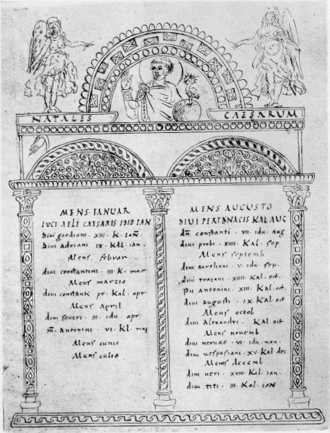
dies natalisหมายถึงวันเกิด (“วันเกิด”; ดูเพิ่มเติมที่dies lustricusด้านบน) หรือโดยทั่วไปหมายถึงวันครบรอบเหตุการณ์สำคัญ ชาวโรมันเฉลิมฉลองวันเกิดของบุคคลเป็นประจำทุกปี ซึ่งแตกต่างจากธรรมเนียมของชาวกรีกที่ทำเครื่องหมายวันที่ในแต่ละเดือนด้วยการรินเครื่องดื่ม อย่างง่ายๆ dies natalisของชาวโรมันเชื่อมโยงกับการบูชาเทพเจ้าGenius [ 161 ]บุคคลสำคัญอาจกำหนดเหตุการณ์สำคัญในวันเกิดของตน: ปอมเปียส แม็กนัส (“ปอมเปย์ผู้ยิ่งใหญ่”)รอเจ็ดเดือนหลังจากที่เขากลับจากการรบในภาคตะวันออกก่อนที่จะจัดงานฉลองชัยชนะเพื่อที่เขาจะได้ฉลองในวันเกิดของเขา[ 162 ]การตรงกันของวันเกิดและวันครบรอบอาจมีความสำคัญในเชิงบวกหรือลบ: ข่าวชัยชนะ ของ เดซิมัส บรูตุสที่ มูตินา ได้รับการประกาศในกรุงโรมในวันเกิดของเขา ในขณะที่ คาสเซีย ส ผู้ลอบสังหารซีซาร์ประสบความพ่ายแพ้ที่ฟิลิปปีในวันเกิดของเขาและฆ่าตัวตาย[ 163 ]วันเกิดเป็นหนึ่งในวันที่ใช้ในการระลึกถึงผู้ตาย[ 164 ]
วันที่ก่อตั้งวิหาร หรือวันที่อุทิศวิหารอีกครั้งหลังจากการบูรณะหรือสร้างใหม่ครั้งใหญ่ ก็ถือเป็นวันประสูติ (dies natalis) เช่นกัน และอาจถือได้ว่าเป็น "วันเกิด" ของเทพเจ้าที่ประดิษฐานอยู่ในวิหารนั้นด้วย ดังนั้น วันประกอบพิธีกรรมดังกล่าวจึงถูกเลือกโดยพระสันตะปาปาโดยคำนึงถึงตำแหน่งในปฏิทินทางศาสนา "วันเกิด" หรือวันก่อตั้งกรุงโรมมีการเฉลิมฉลองในวันที่ 21 เมษายน ซึ่งเป็นวันปาริเลีย (Parilia)ซึ่งเป็นเทศกาลเลี้ยงแกะโบราณ[ 165 ]ในช่วงการปฏิรูปและฟื้นฟูศาสนาอย่างมากมายระหว่างปี 38 ก่อนคริสต์ศักราชถึง 17 หลังคริสต์ศักราช มีวิหารไม่น้อยกว่าสิบสี่แห่งที่วันประสูติ (dies natalis)ถูกย้ายไปเป็นวันอื่น บางครั้งด้วยจุดประสงค์ที่ชัดเจนในการปรับให้สอดคล้องกับเทววิทยาของจักรวรรดิใหม่หลังจากการล่มสลายของสาธารณรัฐ[ 166 ]
วันเกิดของจักรพรรดิได้รับการเฉลิมฉลองด้วยพิธีสาธารณะซึ่งเป็นส่วนหนึ่งของลัทธิบูชาจักรพรรดิ ปฏิทินทางทหารเกี่ยวกับการเฉลิมฉลองทางศาสนาที่เรียก ว่า Feriale DuranumมีวันเกิดของจักรพรรดิจำนวนมากจักรพรรดิออกัสตัสมีวันเกิดตรงกับวันครบรอบวิหารอพอลโลในCampus Martius (23 กันยายน) และทรงอธิบายถึงความเชื่อมโยงของพระองค์กับอพอลโลในการพัฒนาสถานะทางศาสนาพิเศษของพระองค์[ 163 ]
การระลึกถึงวันเกิดยังเรียกว่าnataliciumซึ่งอาจอยู่ในรูปแบบของบทกวี กวีคริสเตียนยุคแรก เช่นPaulinus แห่ง Nolaได้นำ บทกวี natalicium มาใช้ เพื่อระลึกถึงนักบุญ[ 167 ]วันที่ผู้พลีชีพชาวคริสต์เสียชีวิตถือเป็นdies natalis ของพวกเขา ดูปฏิทินนักบุญ
dies religiosus
ตามที่เฟสตัส กล่าวไว้ การกระทำใดๆ ที่นอกเหนือจากการดูแลความจำเป็นพื้นฐานในวันที่เรียกว่าreligiosus ตามปฏิทินนั้น ถือเป็นเรื่องผิด( nefas )ในวันเหล่านี้ จะไม่มีการแต่งงานการชุมนุมทางการเมือง หรือการสู้รบ ห้ามเกณฑ์ทหาร หรือเริ่มต้นการเดินทางใดๆ ห้ามเริ่มต้นสิ่งใหม่ใดๆ และห้ามประกอบ พิธีกรรมทางศาสนา ( res divinae ) อูลุส เกลลิอุสกล่าวว่าdies religiosiนั้นแตกต่างจากdies nefasti [ 168 ]
ตายวิเชียส
วลีdiem vitiare ("ทำให้วันหนึ่งเสื่อมเสีย") ในการปฏิบัติพิธีเปิดหมายความว่ากิจกรรมปกติของกิจการสาธารณะถูกห้ามในวันใดวันหนึ่ง โดยสันนิษฐานว่าโดยobnuntiatioเนื่องจากสังเกตเห็นสัญญาณที่บ่งชี้ถึงความบกพร่อง(morbusดูvitium ) [ 169 ]แตกต่างจากdies religiosusหรือdies ater ("วันดำ" ซึ่งโดยทั่วไปคือวันครบรอบของภัยพิบัติ) วันที่ใดวันหนึ่งไม่ได้กลายเป็นvitiosus อย่างถาวร ยกเว้นเพียงกรณีเดียว ปฏิทินโรมันบางฉบับ( fasti )ที่ผลิตขึ้นในสมัยของออกัสตัสและจนถึงสมัยของคลอเดียส[ 170 ]กำหนดให้วันที่ 14 มกราคมเป็นdies vitiosusซึ่งเป็นวันที่ "เสื่อมเสีย" โดยเนื้อแท้ วันที่ 14 มกราคมเป็นวันเดียวที่ถูกกำหนดอย่างเป็นทางการทุกปีโดยพระราชกฤษฎีกาของวุฒิสภาโรมัน( senatus consultum )ให้เป็นvitiosus ลิ นเดอร์สกีเรียกสิ่งนี้ว่า "นวัตกรรมที่น่าทึ่งมาก" [ 171 ]ปฏิทินเล่มหนึ่งชื่อFasti Verulani (ค.ศ. 17–37) อธิบายการกำหนดชื่อนี้โดยระบุว่าเป็นวันเกิดของมาร์ค แอนโทนี ซึ่ง แคสเซียส ดิโอนักประวัติศาสตร์ชาวกรีกและวุฒิสมาชิกโรมัน กล่าวว่า ออกัสตัสได้ประกาศให้เป็น ἡμέρα μιαρά (hēmera miara) (= dies vitiosus ) [ 172 ]จักรพรรดิคลอเดียส ซึ่งเป็นหลานชายของแอนโทนี ได้ฟื้นฟูวันดังกล่าว[ 173 ]
ไดราเอ
คำคุณศัพท์dirusเมื่อนำมาใช้กับลางบอกเหตุ หมายถึง "ร้ายแรง น่ากลัว" มักปรากฏใน รูปพหูพจน์ เพศหญิงในความหมายว่า "ลางร้าย" Diraeเป็นลางบอกเหตุที่เลวร้ายที่สุดในบรรดาลางบอกเหตุทั้งห้าประเภทที่นักทำนาย รู้จัก และเป็นลางบอกเหตุประเภทหนึ่งที่ไม่ได้รับการร้องขอหรือเป็นลางบอกเหตุที่ทำนายถึงผลลัพธ์ที่เลวร้าย การออกเดินทางอันโชคร้ายของมาร์คัส ครัสซัสเพื่อบุกปาร์เธียนั้นมีdirae เกิดขึ้นอย่างเห็นได้ชัด (ดูAteius Capito ) ในการตีความนิรุกติศาสตร์ของนักเขียนโบราณ[ 174 ] diraeถูกคิดว่ามาจากdei iraeซึ่งหมายถึงความแค้นหรือความโกรธของเทพเจ้า นั่นคือความโกรธของ เทพเจ้า Diraeเป็นฉายาของฟิวรีส์และยังสามารถหมายถึงคำสาปแช่งหรือคำสาปแช่ง[ 175 ]โดยเฉพาะอย่างยิ่งในบริบทของเวทมนตร์และเกี่ยวข้องกับdefixiones ( แผ่นจารึกคำสาปแช่ง ) [ 176 ]ในการอธิบายว่าทำไมคลอเดียสจึงรู้สึกว่าจำเป็นต้องห้ามศาสนาของพวกดรูอิดซูเอโตนิอุส[ 177 ]กล่าวถึงศาสนานี้ว่าdirusซึ่งหมายถึงการปฏิบัติบูชายัญมนุษย์[ 178 ]
วินัยของชาวเอตรัสกา
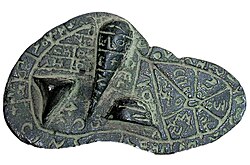
The collective body of knowledge pertaining to the doctrine, ritual practices, laws, and science of Etruscan religion and cosmology was known as the disciplina Etrusca.[179] Divination was a particular feature of the disciplina. The Etruscan texts on the disciplina that were known to the Romans are of three kinds: the libri haruspicini (on haruspicy), the libri fulgurales (lightning), and the libri rituales (ritual).[180]Nigidius Figulus, the Late Republican scholar and praetor of 58 BC, was noted for his expertise in the disciplina.[181] Extant ancient sources on the Etrusca disciplina include Pliny the Elder, Seneca, Cicero, Johannes Lydus, Macrobius and Festus.
divus
The adjectivedivus, feminine diva, is usually translated as "divine." As a substantive, divus refers to a "deified" or divinized mortal. Both deus and divus derive from Indo-European*deywos, Old Latindeivos. Servius confirms[182] that deus is used for "perpetual deities" (deos perpetuos), but divus for people who become divine (divos ex hominibus factos = gods who once were men). While this distinction is useful in considering the theological foundations of Imperial cult, it sometimes vanishes in practice, particularly in Latin poetry; Virgil, for instance, mostly uses deus and divus interchangeably. Varro and Ateius,[183] however, maintained that the definitions should be reversed.[184]
do ut des
สูตรdo ut des (“ฉันให้เพื่อที่คุณจะได้ให้”) แสดงถึงการแลกเปลี่ยนซึ่งกันและกันระหว่างมนุษย์และเทพเจ้า สะท้อนให้เห็นถึงความสำคัญของการให้ของขวัญในฐานะภาระผูกพันร่วมกันในสังคมโบราณและลักษณะตามสัญญาของศาสนาโรมัน ของขวัญที่มนุษย์มอบให้นั้นอยู่ในรูปแบบของการบูชายัญ โดยคาดหวังว่าเทพเจ้าจะตอบแทนสิ่งที่มีค่า กระตุ้นให้เกิดความกตัญญูและการบูชายัญเพิ่มเติมในวัฏจักรที่ต่อเนื่อง[ 185 ]หลักการdo ut desมีบทบาทอย่างมากในเวทมนตร์และพิธีกรรมส่วนตัว[ 186 ] Do ut desยังเป็นแนวคิดทางกฎหมายของกฎหมายสัญญา อีกด้วย [ 187 ]
ในเทววิทยาของเปาโล do ut desถูกมองว่าเป็นรูปแบบหนึ่งของความศรัทธาที่ลดทอนลง เป็นเพียง "ธุรกรรมทางธุรกิจ" ตรงกันข้ามกับพระคุณฝ่ายเดียวของพระเจ้า (χάρις, charis ) [ 188 ]แม็กซ์ เวเบอร์ในหนังสือสังคมวิทยาของศาสนามองว่ามันเป็น "จริยธรรมเชิงรูปแบบล้วนๆ" [ 189 ]อย่างไรก็ตามในหนังสือรูปแบบพื้นฐานของชีวิตทางศาสนาเอมิล ดูร์เคมมองว่าแนวคิดนี้ไม่ใช่เพียงแค่ประโยชน์นิยมแต่เป็นการแสดงออกถึง "กลไกของระบบการบูชายัญเอง" ในฐานะ "การแลกเปลี่ยนการกระทำดีที่เสริมสร้างซึ่งกันและกันระหว่างพระเจ้าและผู้ศรัทธาของพระองค์" [ 190 ]
อี
เอฟเฟติโอ
กริยาeffariซึ่งเป็นกริยาช่อง 3 effatusหมายถึง "การสร้างขอบเขต( fines )โดยใช้สูตรคำพูดที่กำหนดไว้ " [ 191 ] Effatioเป็นคำนามนามธรรมเป็นหนึ่งในสามส่วนของพิธีเปิด templum (พื้นที่ศักดิ์สิทธิ์) ซึ่งนำหน้าด้วยการปรึกษาสัญลักษณ์และliberatioซึ่ง "ปลดปล่อย" พื้นที่จากอิทธิพลทางจิตวิญญาณที่เป็นอันตรายหรือแข่งขันกัน และผลกระทบจากมนุษย์[ 192 ] site liberatus et effatusจึง "ได้รับการขับไล่และพร้อมใช้งาน" [ 31 ]ผลลัพธ์คือlocus inauguratus ("สถานที่ที่เปิดอย่างเป็นทางการ") ซึ่งรูปแบบที่พบได้บ่อยที่สุดคือtemplum [ 193 ]ขอบเขตมีเครื่องหมายถาวร ( cippiหรือtermini ) และเมื่อสิ่งเหล่านี้เสียหายหรือถูกถอดออกeffatioจะต้องได้รับการต่ออายุ[ 194 ]
evocatio

การ "เรียก" หรือ "อัญเชิญ" เทพเจ้าเรียกว่าevocatioซึ่งมาจากevoco, evocare ที่แปลว่า "อัญเชิญ" พิธีกรรมนี้ดำเนินการในบริบททางทหาร ไม่ว่าจะเพื่อเป็นการข่มขู่ระหว่างการล้อมเมืองหรือเป็นผลมาจากการยอมจำนน และมีจุดมุ่งหมายเพื่อเบี่ยงเบนความโปรดปรานของเทพเจ้าผู้พิทักษ์จากเมืองฝ่ายตรงข้ามมาสู่ฝ่ายโรมัน ตามธรรมเนียมแล้วจะมีการสัญญาว่าจะมอบการบูชาที่ดีกว่าหรือวิหารที่หรูหรากว่า[ 195 ]ในฐานะยุทธวิธีของสงครามจิตวิทยา evocatio บ่อนทำลายความรู้สึกมั่นคงของศัตรูโดยการคุกคามความศักดิ์สิทธิ์ของกำแพงเมือง (ดูpomerium ) และรูปแบบอื่น ๆ ของการคุ้มครอง จากเทพเจ้า ในทางปฏิบัติevocatioเป็นวิธีหนึ่งในการลดทอนการปล้นสะดมรูปภาพทางศาสนาจากศาลเจ้าซึ่งถือเป็นการลบหลู่ศาสนา[ 196 ]
Recorded examples of evocations include the transferral of Juno Regina ("Juno the Queen", originally EtruscanUni) from Veii in 396 BC;[197] the ritual performed by Scipio Aemilianus in 146 BC at the defeat of Carthage, involving Tanit (Juno Caelestis);[198] and the dedication of a temple to an unnamed, gender-indeterminate deity at Isaura Vetus in Asia Minor in 75 BC.[199] Some scholars think that Vortumnus (Etruscan Voltumna) was brought by evocation to Rome in 264 BC as a result of M. Fulvius Flaccus's defeat of the Volsinii.[200] In Roman myth, a similar concept motivates the transferral of the Palladium from Troy to Rome, where it served as one of the pignora imperii, sacred tokens of Roman sovereignty.[201] Compare invocatio, the "calling on" of a deity.
Formal evocations are known only during the Republic.[202] Other forms of religious assimilation appear from the time of Augustus, often in connection with the establishment of the Imperial cult in the provinces.[203]
Evocatio, "summons", was also a term of Roman law without evident reference to its magico-religious sense.[204]
exauguratio
สถานที่ที่ได้รับการเปิดอย่างเป็นทางการ(locus inauguratus)ซึ่งกำหนดไว้ผ่านขั้นตอนการเปิดอย่างเป็นทางการนั้น ไม่สามารถเปลี่ยนแปลงวัตถุประสงค์ได้หากไม่มีพิธีการกลับคืน[ 205 ] การถอดเทพเจ้าออกจากสถานที่นั้นจำเป็นต้องมีการอัญเชิญตามพิธีกรรมที่ถูกต้อง[ 206 ]เมื่อทาร์ควินสร้างเขตวิหารขึ้นใหม่บนคาปิโตลีนเทพเจ้าจำนวนหนึ่งถูกย้ายออกไปโดยพิธี exauguratioแม้ว่าเทอร์มินัสและฮูเวนตัสจะ "ปฏิเสธ" และถูกรวมเข้ากับโครงสร้างใหม่[ 207 ]ความแตกต่างระหว่างพิธีexauguratioของเทพเจ้าและพิธีevocatioอาจไม่ชัดเจน[ 208 ]ในทั้งสองกรณี ขั้นตอนนี้เกิดขึ้นไม่บ่อยนัก และจำเป็นเฉพาะเมื่อเทพเจ้าต้องหลีกทางให้เทพเจ้าองค์อื่น หรือเมื่อสถานที่นั้นถูกทำให้เป็นฆราวาส ไม่จำเป็นต้องใช้เมื่อสถานที่นั้นได้รับการปรับปรุง เช่น หากแท่นบูชากลางแจ้งจะถูกแทนที่ด้วยอาคารวิหารสำหรับเทพเจ้าองค์เดียวกัน[ 209 ]
คำนี้ยังสามารถใช้สำหรับการถอดถอนใครบางคนออกจากตำแหน่งนักบวช(sacerdotium)ได้ อีกด้วย [ 210 ]เปรียบเทียบกับinauguratio
เอ็กซิเมียส
คำคุณศัพท์ "เลือก, คัดสรร" ใช้เพื่อบ่งบอกถึงคุณภาพสูงที่จำเป็นสำหรับเหยื่อบูชายัญ: "เหยื่อ( hostiae )เรียกว่า 'คัดสรร' (eximiae)เพราะพวกเขาถูกเลือก(eximantur)จากฝูงและถูกกำหนดให้เป็นเครื่องบูชา หรือเพราะพวกเขาถูกเลือกเนื่องจากรูปลักษณ์ที่เลือก(eximia) ของพวกเขา เป็นเครื่องบูชาแด่สิ่งศักดิ์สิทธิ์( numinibus ) " [ 211 ]คำคุณศัพท์ในที่นี้มีความหมายเหมือนกับegregius "เลือกจากฝูง(grex, gregis) " [ 212 ] Macrobiusกล่าวว่าเป็นคำศัพท์เฉพาะของนักบวชและไม่ใช่ " คำคุณศัพท์ เชิงกวี " (poeticum ἐπίθετον )
เอ็กซ์ตา
เครื่องใน (exta)คืออวัยวะภายในของสัตว์ที่ถูกบูชายัญซึ่งตาม การนับของ ซิเซโร ประกอบด้วย ถุงน้ำดี ( fel ), ตับ ( iecur ), หัวใจ ( cor ) และปอด ( pulmones ) [ 213 ]เครื่องในเหล่านี้ถูกนำมาแสดงเพื่อขอ การอนุมัติจากเทพเจ้า ( litation ) ซึ่งเป็นส่วนหนึ่งของพิธีกรรมของโรมัน แต่จะถูก "อ่าน" ในบริบทของdisciplina Etruscaเนื่องจากเป็นผลผลิตจากการบูชายัญของชาวโรมันเครื่องในและเลือดจึงสงวนไว้สำหรับเทพเจ้า ในขณะที่เนื้อ(viscera)จะถูกแบ่งปันกันในหมู่มนุษย์ในมื้ออาหารร่วมกันเครื่องในของวัวมักจะถูกตุ๋นในหม้อ ( ollaหรือaula ) ในขณะที่เครื่องในของแกะหรือหมูจะถูกย่างบนไม้เสียบ เมื่อส่วนของเทพเจ้าสุกแล้ว จะถูกโรยด้วยmola salsa (แป้งเค็มที่เตรียมตามพิธีกรรม) และไวน์ จากนั้นจึงนำไปวางในกองไฟบนแท่นบูชาเพื่อถวาย คำกริยาทางเทคนิคสำหรับการกระทำนี้คือ porricere [ 214 ]
เอฟ
แฟนติคัส
Fanaticusหมายถึง "ผู้ที่เกี่ยวข้องกับfanum " ซึ่งหมายถึงศาลเจ้าหรือเขตศักดิ์สิทธิ์[ 215 ] เมื่อนำมาใช้กับบุคคล คำว่า Fanaticiหมายถึงผู้ดูแลวิหารหรือผู้ศรัทธาในลัทธิ ซึ่งมักจะเป็น ศาสนา ที่เน้นความปีติยินดีหรือพิธีกรรมทางเพศเช่น ศาสนาของCybele (โดยอ้างอิงถึงGalli ) [ 216 ] Bellona-Ma [ 217 ] หรืออาจจะเป็นSilvanus [ 218 ]จารึกบ่งชี้ว่าบุคคลที่อุทิศตนอาจเรียกตัวเองว่าfanaticusในความหมายทั่วไปของ "ผู้ศรัทธา" [ 219 ] Tacitusใช้fanaticusเพื่ออธิบายกลุ่มดรูอิดที่รับใช้ราชินีBoudicaแห่งIcenia [ 220 ]คำนี้มักถูกใช้ในเชิงดูหมิ่นโดยชาวโรมันโบราณเพื่อเปรียบเทียบพิธีกรรมที่เน้นอารมณ์ความรู้สึกเหล่านี้กับขั้นตอนที่กำหนดไว้อย่างเข้มงวดของศาสนาสาธารณะ[ 221 ]และต่อมาโดยคริสเตียนยุคแรกเพื่อดูหมิ่นศาสนาอื่นที่ไม่ใช่ศาสนาของตนเอง ดังนั้นจึงเกิดความหมายเชิงลบของคำว่า " คลั่งไคล้ " ในภาษาอังกฤษ
เฟสตัสกล่าวว่าต้นไม้ที่ถูกฟ้าผ่าเรียกว่าfanaticus [ 222 ] ซึ่งเป็นการอ้างอิงถึงความเชื่อ ของชาวโรมัน-เอตรัสกันที่มองว่าฟ้าผ่าเป็นสัญญาณศักดิ์สิทธิ์[ 223 ]บิชอปซีซาริอุสแห่งอาร์ลส์ชาว กอล ซึ่งเขียนในศตวรรษที่ 5 ระบุว่าต้นไม้ดังกล่าวคงความศักดิ์สิทธิ์ไว้ได้จนถึงสมัยของเขาเอง[ 224 ]และกระตุ้นให้ผู้ศรัทธาชาวคริสต์เผาทำลายarbores fanaticaeต้นไม้เหล่านี้ตั้งอยู่ในfanum และถูกทำเครื่องหมาย ไว้ หรือถือว่าเป็นfanum เอง ซีซาริอุสไม่แน่ใจนักว่าผู้ศรัทธาถือว่าต้นไม้นั้นศักดิ์สิทธิ์หรือไม่ หรือพวกเขาคิดว่าการทำลายต้นไม้จะฆ่าnumenที่สถิตอยู่ภายในนั้น ไม่ว่าในกรณีใด แม้แต่การขาดแคลนฟืนก็ไม่สามารถโน้มน้าวให้พวกเขาใช้ไม้ศักดิ์สิทธิ์เป็นเชื้อเพลิง ซึ่งเป็นความลังเลใจที่เขาเยาะเย้ยพวกเขา[ 225 ]
แฟนุม
ฟานุม (fanum)คือพื้นที่ศักดิ์สิทธิ์ สถานที่ศักดิ์สิทธิ์[ 226 ]และจากนั้นก็มีการสร้างวิหารหรือศาลเจ้าขึ้นที่นั่น[ 227 ]ฟานุมอาจเป็นพื้นที่ศักดิ์สิทธิ์ตามประเพณี เช่นป่า ศักดิ์สิทธิ์ ( lucus ) ของไดอานา เนโมเรนซิสหรือพื้นที่ศักดิ์สิทธิ์หรือสิ่งก่อสร้างสำหรับศาสนาที่ไม่ใช่โรมัน เช่น อิเซียม (วิหารของไอซิส)หรือมิธราเอียมคำที่เกี่ยวข้องเช่นOscan fíísnú [ 228 ] Umbrian fesnaf-e [ 229 ] และ Paelignian fesn บ่งชี้ว่าแนวคิดนี้เป็นที่ยอมรับร่วมกันในหมู่ชนชาวอิตาลิก [ 230 ] เทเมนอส (temenos ) ของกรีกก็เป็นแนวคิดเดียวกันนี้เช่นกัน ในช่วงสมัยออกัสตัส ฟา นุ ม เอเด ส เท มพลัมและเดลูบรัมแทบจะแยกแยะความแตกต่างในการใช้งานไม่ได้[ 231 ]แต่ฟานุมเป็นคำที่ครอบคลุมและทั่วไปมากกว่า[ 232 ]
ฟานุมวิหารโรมัน-เซลติกหรือ วิหาร แบบเดินรอบของชาวโรมันกอลมักถูกสร้างขึ้นบน สถานที่ทางศาสนาของชาว เซลติก แต่เดิม และแผนผังของวิหารได้รับอิทธิพลจากสถาปัตยกรรมพิธีกรรมของสถานที่ศักดิ์สิทธิ์ของชาวเซลติกในยุคก่อนหน้า การสร้างวิหารก่ออิฐในยุคกอล-โรมันมีพื้นที่ส่วนกลาง ( เซลลา ) และโครงสร้างระเบียงรอบนอก ซึ่งทั้งสองส่วนเป็นรูปสี่เหลี่ยมจัตุรัส[ 233 ]ฟานุมโรมัน-เซลติกประเภทนี้ยังพบได้ในบริเตนโรมัน ด้วย [ 234 ]
คำภาษาอังกฤษ " profane " มาจากภาษาละตินpro fano [ 235 ] ซึ่ง หมายถึง "ก่อน กล่าวคือ นอกวิหาร" "อยู่หน้าสถานที่ศักดิ์สิทธิ์" ดังนั้นจึงไม่ได้อยู่ภายในพื้นที่ศักดิ์สิทธิ์
fata deorum
Fata deorumหรือรูปแบบย่อfata deumคือคำกล่าวของเทพเจ้า นั่นคือคำพยากรณ์[ 236 ]คำพยากรณ์เหล่านี้ถูกบันทึกไว้เป็นลายลักษณ์อักษรและเก็บรักษาไว้โดยนักบวชของรัฐแห่งโรมเพื่อใช้ปรึกษาFataหมายถึง "โชคชะตา" ที่รู้และกำหนดโดยเทพเจ้า หรือการแสดงออกถึงพระประสงค์ของพระเจ้าในรูปแบบของคำพยากรณ์ด้วยวาจา[ 237 ] Fata deumเป็นหัวข้อหนึ่งของAeneid มหา กาพย์แห่งชาติของโรมที่ประพันธ์โดยเวอร์จิล[ 238 ]
หนังสือซิวิลลีน(Fata SibyllinaหรือLibri Fatales)ซึ่งแต่งขึ้นด้วยฉันทลักษณ์เฮกซาเมเตอร์ของกรีก เป็นตัวอย่างของฟาตา ที่เขียนขึ้น หนังสือเหล่านี้ไม่ได้มีต้นกำเนิดมาจากโรมัน แต่เชื่อกันว่าลูเซียส ทาร์ควินิอุส ซูเปอร์บุส ได้มาในรูปแบบที่ไม่สมบูรณ์ หนังสือเหล่านี้ ได้รับการดูแลโดยคณะนักบวชเดเซมวิริ ซาคริส ฟาซิอุนดิส "ชายสิบคนเพื่อประกอบพิธีกรรมศักดิ์สิทธิ์" ต่อมาเพิ่มเป็นสิบห้าคน: ควินเดซิมวิริ ซาคริส ฟาซิอุนดิสไม่มีใครอ่านหนังสือเหล่านี้ทั้งหมด มีการนำมาปรึกษาเฉพาะเมื่อจำเป็นเท่านั้น มีการเลือกข้อความแบบสุ่ม และความเกี่ยวข้องกับสถานการณ์ปัจจุบันเป็นเรื่องของการตีความโดยผู้เชี่ยวชาญ[ 239 ]เชื่อกันว่าหนังสือเหล่านี้มีฟาตา เร พับบลาเอ เอเทอร์นา "คำพยากรณ์ที่ใช้ได้ตลอดกาลสำหรับโรม" [ 240 ]หนังสือเหล่านี้ยังคงถูกนำมาใช้ตลอดช่วงยุคจักรวรรดิจนถึงยุคที่คริสเตียนมีอำนาจเหนือกว่าออกัสตัสได้ติดตั้งหนังสือซิวิลลีนไว้ในหีบเก็บทองคำพิเศษใต้รูปปั้นอพอลโลในวิหารอพอลโลพาลาตินัส [ 241 ] จักรพรรดิออเรเลียนตำหนิวุฒิสภาที่ยอมจำนนต่ออิทธิพลของคริสเตียนและไม่ปรึกษาหนังสือเหล่านั้น[ 242 ]จูเลียนได้ปรึกษาหนังสือเหล่านั้นเกี่ยวกับการรณรงค์ต่อต้านเปอร์เซีย แต่จากไปก่อนที่จะได้รับคำตอบที่ไม่เป็นที่พอใจจากวิทยาลัย จูเลียนถูกสังหารและวิหารอพอลโลพาลาตินัสถูกเผา[ 243 ]
ฟาส
Fasเป็นแนวคิดหลักในศาสนาโรมัน แม้ว่าในบางบริบทจะแปลว่า "กฎหมายศักดิ์สิทธิ์" [ 244 ] แต่ fasนั้นหมายถึงสิ่งที่ "ถูกต้องตามหลักศาสนา" [ 245 ]หรือการกระทำที่ถูกต้องตามกฎหมายในสายตาของเทพเจ้า[ 246 ]ในศาสนาสาธารณะ จะมีการประกาศ fas estก่อนที่จะประกาศการกระทำที่จำเป็นหรือได้รับอนุญาตตามธรรมเนียมทางศาสนาโรมันและกฎหมายศักดิ์สิทธิ์[ 247 ] ดังนั้น Fasจึงทั้งแตกต่างและเชื่อมโยงกับius (พหูพจน์iura ) ซึ่งหมายถึง "กฎหมาย ความถูกต้อง ความยุติธรรม" ดังที่เวอร์จิลได้กล่าวไว้บ่อยครั้งว่าfas et iura sinunt ซึ่ง Servius อธิบายว่า "กฎหมายศักดิ์สิทธิ์และกฎหมายของมนุษย์อนุญาต (สิ่งนี้) เพราะfasเกี่ยวข้องกับศาสนาส่วน iura เกี่ยวข้อง กับมนุษย์" [ 248 ]
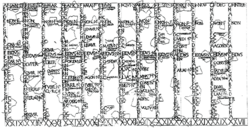
ในปฏิทินโรมันวันที่ทำเครื่องหมายFคือdies fastiซึ่งเป็นวันที่fasให้ความสนใจกับเรื่องต่างๆ ในชีวิตประจำวัน[ 249 ] ในการใช้งานทั่วไปfas estอาจหมายถึง "อนุญาตได้ ถูกต้อง" โดยทั่วไป
รากศัพท์ของfasเป็นที่ถกเถียงกัน โดยทั่วไปมักเกี่ยวข้องกับขอบเขตความหมายของคำกริยาfor, fari ซึ่งหมายถึง "พูด" [ 250 ]ซึ่งเป็นที่มาที่Varro เน้น ย้ำ[ 251 ]ในแหล่งข้อมูลอื่น ๆ ทั้งโบราณและสมัยใหม่ เชื่อกัน ว่าfasมีต้นกำเนิดมาจากรากศัพท์อินโด-ยุโรปที่มีความหมายว่า "สถาปนา" เช่นเดียวกับfanumและferiae [ 252 ]ดูเพิ่มเติมที่ Fastiและnefas
ฟาสติ
บันทึกหรือแผนการของเหตุการณ์อย่างเป็นทางการและได้รับการรับรองทางศาสนา ธุรกิจของรัฐและสังคมทั้งหมดต้องดำเนินการในวัน dies fastiหรือ "วันอนุญาต" fastiคือบันทึกรายละเอียดทั้งหมดที่เกี่ยวข้องกับเหตุการณ์เหล่านี้ คำนี้ใช้ในความหมายทั่วไปโดยลำพัง หรือใช้ร่วมกับคำคุณศัพท์เพื่อหมายถึงบันทึกประเภทเฉพาะ สิ่งที่เกี่ยวข้องอย่างใกล้ชิดกับfastiและใช้ในการกำหนดเวลาคือการแบ่งช่วงเวลาในปฏิทินโรมัน
Fasti ยังเป็นชื่อของบทกวีหกเล่มที่เขียนโดยโอวิด ซึ่งอิงจากปฏิทินทางศาสนาของโรมัน บท กวีนี้เป็นแหล่งข้อมูลสำคัญเกี่ยวกับหลักปฏิบัติทางศาสนาของชาวโรมัน และได้รับการแปลเป็นภาษาอังกฤษโดยเจ.จี. เฟรเซอร์
เฟลิกซ์
ในความหมายทางศาสนาfelixหมายถึง "ได้รับพร อยู่ภายใต้การคุ้มครองหรือความโปรดปรานของเทพเจ้า มีความสุข" สิ่งที่เป็นfelixได้บรรลุถึงpax divomซึ่งเป็นสภาวะแห่งความกลมกลืนหรือสันติสุขกับโลกแห่งเทพเจ้า[ 253 ] คำนี้มีรากศัพท์มาจากภาษาอินโด-ยุโรป*dhe(i)lซึ่งหมายถึง "มีความสุข อุดมสมบูรณ์ ผลิตผลดี เต็มไปด้วยอาหาร" คำภาษาละตินที่เกี่ยวข้อง ได้แก่femina "ผู้หญิง" (บุคคลที่ให้การเลี้ยงดูหรือให้นม) felo "ให้นม" และfilius "ลูกชาย" (บุคคลที่ได้รับการเลี้ยงดู) [ 254 ]ดูเพิ่มเติมที่Felicitasซึ่งเป็นทั้งนามธรรมที่แสดงถึงคุณสมบัติของการเป็นfelixและเทพเจ้าในศาสนาของรัฐโรมัน
เฟเรีย
ในปฏิทินโรมัน คำว่า " เฟเรีย " หมายถึง "วันหยุด" หรือวันที่ไม่มีการทำงานใดๆ ไม่มีการพิจารณาคดีในศาล หรือการดำเนินกิจการสาธารณะใดๆ พนักงานมีสิทธิ์หยุดงาน และแม้แต่ทาสก็ไม่ต้องทำงาน วันเหล่านี้ถูกกำหนดเป็นระบบวันหยุดราชการตามกฎหมาย เรียกว่า เฟเรีย พับบลีเวจ (feriae publicae)ซึ่งอาจเป็น...
- stativaeหมายถึง "วันหยุดที่อยู่กับที่, กำหนดไว้ตายตัว" ซึ่งตรงกับวันเดียวกันทุกปี
- conceptivaeคือวันหยุดที่เกิดขึ้นซ้ำๆ ซึ่งวันที่ของวันหยุดเหล่านั้นขึ้นอยู่กับปัจจัยอื่นๆ โดยปกติแล้วจะเป็นวัฏจักรทางการเกษตร วันหยุดเหล่านี้ได้แก่Compitalia , Paganalia , SementivaeและLatinae (เปรียบเทียบกับวันหยุดทางศาสนาคริสต์ที่เปลี่ยนแปลงวันอย่างวันอีสเตอร์ )
- วัน หยุดราชการที่กำหนดขึ้นเพียงครั้งเดียวเพื่อเฉลิมฉลองโอกาสพิเศษ โดยอาศัยอำนาจตามคำสั่งของเจ้าหน้าที่ศาล
In the Christian Roman Rite, a feria is a day of the week other than Saturday or Sunday.[255] The custom throughout Europe of holding markets on the same day gave rise to the word "fair" (Spanish Feria, Italian Fiera, Catalan Fira).
festus
In the Roman calendar, a dies festus is a festive or holy day, that is, a day dedicated to a deity or deities. On such days it was forbidden to undertake any profane activity, especially official or public business. All dies festi were thus nefasti. Some days, however, were not festi and yet might not be permissible as business days (fasti) for other reasons. The days on which profane activities were permitted are profesti.[256]
fetial
The fetiales, or fetial priests.
finis
The finis (limit, border, boundary), plural fines, was an essential concept in augural practice, which was concerned with the definition of the templum. Establishing fines was an important part of a magistrate's duties.[257] Most scholars regard the finis as having been defined physically by ropes, trees, stones, or other markers, as were fields and property boundaries in general. It was connected with the god Terminus and his cult.[258]
flamen

The fifteen flamines formed part of the College of Pontiffs. Each flamen served as the high priest to one of the official deities of Roman religion, and led the rituals relating to that deity. The flamines were regarded as the most ancient among the sacerdotes, as many of them were assigned to deities who dated back to the prehistory of Latium and whose significance had already become obscure by classical times.
The archaic nature of the flamens is indicated by their presence among Latin tribes. They officiated at ceremonies with their head covered by a velum and always wore a filamen, thread, in contrast to public rituals conducted by Greek rite (ritus graecus) which were established later. Ancient authors derive the word flamen from the custom of covering the head with the filamen, but it may be cognate to Vedicbrahmin. The distinctive headgear of the flamen was the apex.
Fratres Arvales
The "Brothers of the Field" were a college of priests whose duties were concerned with agriculture and farming. They were the most ancient religious sodalitas: according to tradition they were created by Romulus, but probably predated the foundation of Rome.
G
Gabinus
The adjective gabinus describes an element of religion that the Romans attributed to practices from Gabii, a town of Latium with municipal status about 12 miles from Rome. The incorporation of Gabinian traditions indicates their special status under treaty with Rome. See cinctus gabinus and ager gabinus.[90]
H
hostia

The hostia was the offering, usually an animal, in a sacrifice. The word is used interchangeably with victima by Ovid and others, but some ancient authors attempt to distinguish between the two.[259]Servius says[260] that the hostia is sacrificed before battle, the victima afterward, which accords with Ovid's etymology in relating the "host" to the "hostiles" or enemy (hostis), and the "victim" to the "victor."[261]
The difference between the victima and hostia is elsewhere said to be a matter of size, with the hostia smaller (minor).[262]Hostiae were also classified by age: lactentes were young enough to be still taking milk, but had reached the age to be purae; bidentes had reached two years of age[263] or had the two longer (bi-)incisor teeth (dentes) that are an indication of age.[264]
Hostiae could be classified in various ways. A hostia consultatoria was an offering for the purpose of consulting with a deity, that is, in order to know the will of a deity; the hostia animalis, to increase the force (mactare) of the deity.[265]
The victim might also be classified by occasion and timing. The hostia praecidanea was an "anticipatory offering" made the day before a sacrifice.[266] It was an advance atonement "to implore divine indulgence" should an error be committed on the day of the formal sacrifice.[267] A preliminary pig was offered as a praecidanea the day before the harvest began.[268] The hostia praecidanea was offered to Ceres a day in advance of a religious festival (sacrum, before the beginning of the harvest) in expiation for negligences in the duties of piety towards the deceased. The hostia praesentanaea was a pig offered to Ceres during a part of the funeral rites conducted within sight of the deceased, whose family was thereby ritually absolved.[269] A hostia succidanea was offered at any rite after the first sacrifice had failed owing to a ritual impropriety (vitium).[270] Compare piaculum, an expiatory offering.
Hostia is the origin of the word "host" for the Eucharistic sacrament of the Western Church; see Sacramental bread: Catholic Church. See also votum, a dedication or a vow of an offering to a deity as well as that which fulfilled the vow.
I
inauguratio
A rite performed by augurs by which the concerned person received the approval of the gods for his appointment or their investiture. The augur would ask for the appearance of certain signs (auspicia impetrativa) while standing beside the appointee on the auguraculum. In the Regal period, inauguratio concerned the king and the major sacerdotes.[271] After the establishment of the Republic, the rex sacrorum,[272] the three flamines maiores,[273] the augurs, and the pontiffs[274] all had to be inaugurated.
The term may also refer to the ritual establishing of the augural templum and the tracing of the wall of a new city.
indigitamenta
The indigitamenta were lists of gods maintained by the College of Pontiffs to assure that the correct divine names were invoked for public prayers. It is sometimes unclear whether these names represent distinct minor entities, or epithets pertaining to an aspect of a major deity's sphere of influence, that is, an indigitation, or name intended to "fix" or focalize the local action of the god so invoked.[275]Varro is assumed to have drawn on direct knowledge of the lists in writing his theological books, as evidenced by the catalogues of minor deities mocked by the Church Fathers who used his work[276] as a reference.[277] Another source is likely to have been the non-extant work De indigitamentis of Granius Flaccus, Varro's contemporary.[278] Not to be confused with the di indigetes.
invocatio
The addressing of a deity in a prayer or magic spell is the invocatio, from invoco, invocare, "to call upon" the gods or spirits of the dead.[279] The efficacy of the invocatio depends on the correct naming of the deity, which may include epithets, descriptive phrases, honorifics or titles, and arcane names. The list of names (nomina) is often extensive, particularly in magic spells; many prayers and hymns are composed largely of invocations.[280] The name is invoked in either the vocative[281] or the accusativecase.[282] In specialized usage pertaining to augural procedure, invocatio is a synonym for precatio, but specifically aimed at averting mala, evil occurrences.[283] Compare evocatio.
The equivalent term in ancient Greek religion is epiklesis.[284]Pausanias distinguished among the categories of theonym proper, poetic epithet, the epiclesis of local cult, and an epiclesis that might be used universally among the Greeks.[285]Epiclesis remains in use by some Christian churches for the invocation of the Holy Spirit during the Eucharistic prayer.
ius
Ius is the Latin word for justice, right, equity, fairness and all which came to be understood as the sphere of law. It is defined in the opening words of the Digesta with the words of Celsus as "the art of that which is good and fair" and similarly by Paulus as "that which is always just and fair".[286] The polymath Varro and the jurist Gaius[287] consider the distinction between divine and human ius essential[288] but divine order is the source of all laws, whether natural or human, so the pontifex is considered the final judge (iudex) and arbiter.[289] The jurist Ulpian defines jurisprudence as "the knowledge of human and divine affairs, of what is just and unjust".[290]
ius divinum
"Sacred law"[291] or "divine law", particularly in regard to the gods' rights pertaining to their "property", that which is rightfully theirs.[292] Recognition of the ius divinum was fundamental to maintaining right relations between human beings and their deities. The concern for law and legal procedure that was characteristic of ancient Roman society was also inherent in Roman religion.[293] See also pax deorum.
ius pontificum
Pontifical law governing Roman religion covered sacra, rites; vota, pledges; feriae, holy days; and sepulchra, graves.[294] Cicero describes it as absconditum, secret.[295] A book on pontifical law, probably the one written in the mid-2nd century BC by Fabius Pictor, was consulted by Aulus Gellius in the 2nd century AD as a source on the flamen and flaminica Dialis.[296]
L
lavatio
The bathing of the cult image of a deity, particularly goddesses, might be prescribed in an annual ritual. A lavatio was an especial part of the imported cult of Cybele, whose statue and associated objects were carried in procession for bathing in the river Almo.[297] Ovid says that the statue of Venus Verticordia was bathed as part of the Veneralia on the first of April, but the absence of this lavatio in any other source may indicate that since it was meant to be conducted by women, the magistrates did not attend.[298]
lectisternium
The lectisternium was a propitiatory ceremony that took the form of a meal offered to divinities, as if seated for banqueting on a couch (lectus).
lex
The word lex (plural leges) derives from the Indo-European root *leg, as do the Latin verbs lego, legare, ligo, ligare ("to appoint, bequeath") and lego, legere (" to gather, choose, select, discern, read": cf. also Greek verb legein "to collect, tell, speak"), and the abstract noun religio.[299] Parties to legal proceedings and contracts bound themselves to observance by the offer of sacrifice to witnessing deities.[300]
Even though the word lex underwent the frequent semantic shift in Latin towards the legal area, its original meaning of set, formulaic words was preserved in some instances. Some cult formulae are leges: an augur's request for particular signs that would betoken divine approval in an augural rite (augurium), or in the inauguration of magistrates and some sacerdotes is named legum dictio.[301] The formula quaqua lege volet ("by whatever lex, i.e. wording he wishes") allowed a cult performer discretion in his choice of ritual words.[302] The leges templi regulated cult actions at various temples.[303][304]
In civil law, ritualised sets of words and gestures known as legis actiones were in use as a legal procedure in civil cases; they were regulated by custom and tradition (mos maiorum) and were thought to involve protection of the performers from malign or occult influences.[305]

libatio
Libation (Latin libatio, Greek spondai) was one of the simplest religious acts, regularly performed in daily life. At home, a Roman who was about to drink wine would pour the first few drops onto the household altar.[306] The drink offering might also be poured on the ground or at a public altar. Milk and honey, water, and oil were also used.[307]
liberatio
The liberatio (from the verb liberare, "to free") was the "liberating" of a place (locus) from "all unwanted or hostile spirits and of all human influences," as part of the ceremony inaugurating the templum (sacred space). It was preceded by the consulting of signs and followed by the effatio, the creation of boundaries (fines).[308] A site liberatus et effatus was "exorcized and available" for its sacred purpose.[46]
libri augurales
The augural books (libri augurales) represented the collective, core knowledge of the augural college. Some scholars[309] consider them distinct from the commentarii augurum (commentaries of the augurs) which recorded the collegial acts of the augurs, including the decreta and responsa.[310] The books were central to the practice of augury. They have not survived, but Cicero, who was an augur himself, offers a summary in De Legibus[311] that represents "precise dispositions based certainly on an official collection edited in a professional fashion."[312]
libri pontificales
The libri pontificales (pontifical books) are core texts in Roman religion, which survive as fragmentary transcripts and commentaries. They may have been partly annalistic, part priestly; different Roman authors refer to them as libri and commentarii (commentaries), described by Livy as incomplete "owing to the long time elapsed and the rare use of writing" and by Quintillian as unintelligibly archaic and obscure. The earliest were credited to Numa, second king of Rome, who was thought to have codified the core texts and principles of Rome's religious and civil law (ius divinum and ius civile).[313] See also commentarii pontificum.
litatio
In animal sacrifice, the litatio followed the opening up of the body cavity for the inspection of the entrails (inspicere exta). Litatio was not a part of divinatory practice as derived from the Etruscans (see extispicy and Liver of Piacenza), but rather a certification according to Roman liturgy of the gods' approval. The point was not that those sacrificing had to make sure that the victim was perfect inside and out; rather, the good internal condition of the animal was evidence of divine acceptance of the offering. The need for the deity to approve and accept (litare) underscores that the reciprocity of sacrifice (do ut des) was not to be taken for granted.[314]
If the organs were diseased or defective, the procedure had to be restarted with a new victim (hostia). In 176 BC[315] the presiding consuls attempted to sacrifice an ox, only to find that its liver had been consumed by a wasting disease. After three more oxen failed to pass the test, the senate's instructions were to keep sacrificing bigger victims until litatio could be obtained.[316]
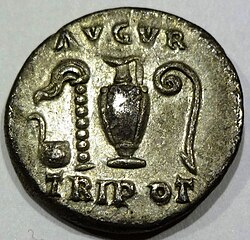
lituus
The lituus is the distinctively curved staff of an augur, frequently depicted on Roman coins and most often accompanied by a ritual jug or pitcher. The presence of the lituus indicates that either the moneyer or person honored on the obverse was an augur.
lucus
ในทางศาสนาลูคัสหมายถึงป่าหรือพื้นที่ป่าขนาดเล็กที่ถือว่าศักดิ์สิทธิ์สำหรับเทพเจ้า การเข้าถึงอาจถูกจำกัดอย่างเข้มงวด: Paulus [ 317 ]อธิบายว่าcapitalis lucusได้รับการคุ้มครองจากการเข้าถึงของมนุษย์โดยมีโทษถึงตายLeges sacratae (กฎหมายที่ผู้ฝ่าฝืนจะถูกเนรเทศ) [ 318 ]เกี่ยวกับป่าศักดิ์สิทธิ์พบได้บนcippiที่SpoletoในUmbriaและLuceraในApulia [ 319 ] ดูเพิ่มเติมที่nemus
ลูดี
ลูดี (Ludi)คือเกมที่จัดขึ้นเป็นส่วนหนึ่งของเทศกาลทางศาสนาและบางเกมก็มี ลักษณะ ศักดิ์สิทธิ์ แต่เดิม เกมเหล่านี้รวมถึงการแข่งรถม้าและเวนาติโอ (Venatio)หรือกีฬาเลือด ที่จัดแสดงขึ้นระหว่างสัตว์กับมนุษย์ ซึ่งอาจมีองค์ประกอบของการบูชายัญ อยู่ด้วย
ลูเพอร์ซี
"นักบวชหมาป่า" ซึ่งจัดตั้งเป็นสองคณะและต่อมาเป็นสามคณะ มีส่วนร่วมในเทศกาลลูเปอร์คาเลียบุคคลที่มีชื่อเสียงที่สุดที่ทำหน้าที่เป็นนักบวชหมาป่าคือมาร์ค แอนโทนี
ลัสตราติโอ
พิธีลัสตราติโอเป็นพิธีกรรมการชำระล้างที่จัดขึ้นทุกห้าปีภายใต้อำนาจของเซนซอรีในกรุงโรม ความหมายดั้งเดิมคือการชำระล้างด้วยน้ำ (ภาษาละตินlustrumมาจากคำกริยา luoซึ่งแปลว่า "ฉันล้างในน้ำ") เนื่องจากระยะเวลาที่ผ่านไประหว่างพิธีลัสตราติโอสองครั้งติดต่อกันคือห้าปี คำว่าlustrumจึงมีความหมายว่าช่วงเวลาห้าปี[ 320 ]
เอ็ม
มานูเบีย
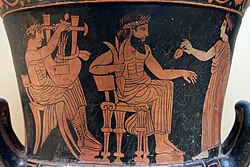
Manubia is a technical term of the Etruscan discipline, and refers to the power of a deity to wield lightning, represented in divine icons by a lightning bolt in the hand. It may be either a Latinized word from Etruscan or less likely a formation from manus, "hand," and habere, "to have, hold."[321] It is not apparently related to the more common Latin word manubiae meaning "booty (taken by a general in war)."[322]Seneca uses the term in an extended discussion of lightning.[323]Jupiter, as identified withEtruscanTinia,[324] held three types of manubiae[325] sent from three different celestial regions.[326] Stefan Weinstock describes these as:
- mild, or "perforating" lightning;
- harmful or "crushing" lightning, which is sent on the advice of the twelve Di Consentes and occasionally does some good;
- destructive or "burning" lightning, which is sent on the advice of the di superiores et involuti (hidden gods of the "higher" sphere) and changes the state of public and private affairs.[327]
Jupiter makes use of the first type of beneficial lightning to persuade or dissuade.[328] Books on how to read lightning were one of the three main forms of Etruscan learning on the subject of divination.[329]
miraculum
One of several words for portent or sign, miraculum is a non-technical term that places emphasis on the observer's response (mirum, "a wonder, marvel").[330]Livy uses the word miraculum, for instance, to describe the sign visited upon Servius Tullius as a child, when divine flames burst forth from his head and the royal household witnessed the event.[331] Compare monstrum, ostentum, portentum, and prodigium.
Miraculum is the origin of the English word "miracle." Christian writers later developed a distinction between miracula, the true forms of which were evidence of divine power in the world, and mere mirabilia, things to be marveled at but not resulting from God's intervention. "Pagan" marvels were relegated to the category of mirabilia and attributed to the work of demons.[332]

mola salsa
Flour mixed with salt was sprinkled on the forehead and between the horns of sacrificial victims, as well as on the altar and in the sacred fire. This mola salsa ('salted flour') was prepared ritually from toasted wheat or emmer, spelt, or barley by the Vestals, who thus contributed to every official sacrifice in Rome.[333]Servius uses the words pius and castus to describe the product.[334] The mola was so fundamental to sacrifice that "to put on the mola" (Latin immolare) came to mean "to sacrifice." Its use was one of the numerous religious traditions ascribed to Numa, the Sabine second king of Rome.[335]
monstrum
A monstrum is a sign or portent that disrupts the natural order as evidence of divine displeasure.[336] The word monstrum is usually assumed to derive, as Cicero says, from the verb monstro, "show" (compare English "demonstrate"), but according to Varro it comes from moneo, "warn."[337] Because a sign must be startling or deviant to have an impact, monstrum came to mean "unnatural event"[338] or "a malfunctioning of nature."[339]Suetonius said that "a monstrum is contrary to nature (or exceeds the nature) we are familiar with, like a snake with feet or a bird with four wings."[340] The Greek equivalent was teras.[341] The English word "monster" derived from the negative sense of the word. Compare miraculum, ostentum, portentum, and prodigium.
In one of the most famous uses of the word in Latin literature, the Augustan poet Horace calls Cleopatra a fatale monstrum, something deadly and outside normal human bounds.[342] Cicero calls Catilinemonstrum atque prodigium[343] and uses the phrase several times to insult various objects of his attacks as depraved and beyond the human pale. For Seneca, the monstrum is, like tragedy, "a visual and horrific revelation of the truth."[344]
mundus
Literally "the world", also a pit supposedly dug and sealed by Romulus as part of Rome's foundation rites. Its interpretation is problematic; it was normally sealed, and was ritually opened only on three occasions during the year. Still, in the most ancient Fasti, these days were marked C(omitiales)[345] (days when the Comitia met) suggesting the idea that the whole ritual was a later Greek import.[346] However Cato and Varro as quoted by Macrobius considered them religiosi.[347] When opened, the pit served as a cache for offerings to underworld deities, particularly Ceres, goddess of the fruitful earth. It offered a portal between the upper and lower worlds; its shape was said to be an inversion of the dome of the upper heavens.[348]
N
nefandum
An adjective derived from nefas (following). The gerund of verb fari, to speak, is commonly used to form derivate or inflected forms of fas. See Virgil's fandi as genitive of fas. This use has been invoked to support the derivation of fas from IE root *bha, Latin fari.
nefas
Any thing or action contrary to divine law and will is nefas (in archaic legalese, ne (not) ... fas).[349]Nefas forbids a thing as religiously and morally offensive, or indicates a failure to fulfill a religious duty.[350] It might be nuanced as "a religious duty not to", as in Festus' statement that "a man condemned by the people for a heinous action is sacer" — that is, given over to the gods for judgment and disposal — "it is not a religious duty to execute him, but whoever kills him will not be prosecuted".[351]
Livy records that the patricians opposed legislation that would allow a plebeian to hold the office of consul on the grounds that it was nefas: a plebeian, they claimed, would lack the arcane knowledge of religious matters that by tradition was a patrician prerogative. The plebeian tribuneGaius Canuleius, whose lex it was, retorted that it was arcane because the patricians kept it secret.[352]
nefastus
Usually found with dies (singular or plural), as dies nefasti, days on which official transactions were forbidden on religious grounds. See also nefas, fasti and fas.
nemus
Nemus, plural nemora, was one of four Latin words that meant "forest, woodland, woods." Lucus is more strictly a sacred grove,[353] as defined by Servius as "a large number of trees with a religious significance",[354] and distinguished from the silva, a natural forest; saltus, territory that is wilderness; and a nemus, an arboretum that is not consecrated (but compare Celtic nemeton).[355] In Latin poetry, a nemus is often a place conducive to poetic inspiration, and particularly in the Augustan period takes on a sacral aura.[356]
Named nemora include:
nuntiatio
หน้าที่หลักของนักพยากรณ์คือการสังเกตสัญญาณ( observatio )และรายงานผลลัพธ์(nuntiatio) [ 359 ] การประกาศจะทำต่อหน้าที่ประชุม ข้อความในงานเขียนของซิเซโรระบุว่านักพยากรณ์มีสิทธิ์รายงานสัญญาณที่สังเกตเห็นก่อนหรือระหว่างการประชุม และผู้พิพากษามีสิทธิ์เฝ้าดูสัญญาณ (spectio) รวมถึงประกาศ (nuntiatio) ก่อนดำเนินการกิจการสาธารณะแต่ความหมายที่แท้จริงของการแบ่งแยกของซิเซโรยังคงเป็นเรื่องที่นักวิชาการถกเถียงกันอยู่[ 360 ]
โอ
การลงโทษ
Obnuntiatioคือการประกาศสัญญาณที่ไม่เป็นมงคลโดยนักพยากรณ์เพื่อระงับ ยกเลิก หรือเลื่อนการดำเนินการสาธารณะที่เสนอไว้ ขั้นตอนนี้สามารถดำเนินการได้โดยเจ้าหน้าที่ที่มีสิทธิ์สังเกตลางบอกเหตุ ( spectio ) เท่านั้น [ 361 ]
แหล่งที่มาเดียวของคำนี้คือซิเซโรซึ่งเป็นนักพยากรณ์เช่นกัน โดยเขาอ้างถึงคำนี้ในสุนทรพจน์หลายครั้งว่าเป็นปราการทางศาสนาเพื่อต่อต้าน นักการเมือง ประชานิยมและผู้แทนราษฎร กฎหมายLex Aelia Fufia (ประมาณ 150 ปี ก่อนคริสต์ศักราช) อาจขยายสิทธิ์ของobnuntiatioไปไกลกว่าคณะนักพยากรณ์ไปยังผู้พิพากษาทั้งหมด กฎหมายที่คลอเดีย สออก ในฐานะผู้แทนราษฎรในปี 58 ก่อนคริสต์ศักราชมีจุดมุ่งหมายเพื่อยุติการปฏิบัติ[ 362 ]หรืออย่างน้อยก็ลดศักยภาพในการใช้ในทางที่ผิดobnuntiatioถูกนำมาใช้ในปีที่แล้วในฐานะกลยุทธ์ขัดขวางโดย บิบูลัส เพื่อนร่วมงานกงสุลของจูเลียส ซีซาร์การที่กฎหมายของคลอเดียสไม่ได้ตัดสิทธิ์นักพยากรณ์หรือผู้พิพากษา ทั้งหมด นั้นเห็นได้จากการที่มาร์ค แอนโทนีใช้obnuntatioในช่วงต้นปี 44 ก่อนคริสต์ศักราชเพื่อหยุดการเลือกตั้งกงสุล[ 363 ]
การสังเกตการณ์
Observatioคือการตีความสัญญาณตามประเพณีของ " ศาสตร์แห่งชาวเอตรัสกัน " หรือตามที่บันทึกไว้ในหนังสือต่างๆ เช่นlibri auguralesหมอดูจะตีความfulgura (ฟ้าร้องและฟ้าผ่า) และexta (เครื่องใน) โดยใช้observatioคำนี้มีความหมายที่เกี่ยวข้องกันอย่างใกล้ชิดสามประการในศาสตร์การทำนาย: การสังเกตสัญญาณโดยหมอดูหรือผู้ทำนายอื่นๆ; กระบวนการสังเกต บันทึก และกำหนดความหมายของสัญญาณเมื่อเวลาผ่านไป; และองค์ความรู้ที่ถูกรวบรวมโดยการสังเกตอย่างเป็นระบบ นั่นคือ "กฎที่ไม่เปลี่ยนแปลง" ซึ่งถือว่าเป็นกลางหรืออยู่นอกเหนือการสังเกตของแต่ละบุคคลในโอกาสใดโอกาสหนึ่งสัญญาณที่จำเป็นหรือสัญญาณที่ค้นหาโดยขั้นตอนการทำนายมาตรฐาน จะถูกตีความตามobservatioผู้สังเกตมีอิสระในการตีความน้อยมากหรือไม่มีเลยObservatioอาจใช้ได้กับ สัญญาณ บังคับหรือสัญญาณที่ไม่คาดคิด หลายอย่างด้วย Observatioถือเป็นความรู้ประเภทscientiaหรือ "ความรู้ทางวิทยาศาสตร์" ซึ่งแตกต่างจากconiecturaซึ่งเป็น "ศิลปะ" หรือ "วิธีการ" ( ars ) ที่เน้นการคาดเดามากกว่าตามความจำเป็นของสัญญาณใหม่[ 364 ]
ลาง
ลางบอกเหตุ (พหูพจน์คือโอมินา ) เป็นสัญญาณที่บ่งบอกถึงอนาคต ถือว่ามีความสำคัญต่อชุมชนน้อยกว่าปรากฏการณ์มหัศจรรย์แต่มีความสำคัญอย่างมากต่อบุคคลที่ได้ยินหรือเห็น[ 365 ]ลางบอกเหตุอาจเป็นได้ทั้งดีและร้าย ต่างจากปรากฏการณ์ มหัศจรรย์ ลางบอกเหตุร้ายจะไม่ได้รับการชดใช้ด้วยพิธีกรรมสาธารณะ แต่สามารถตีความใหม่ เปลี่ยนทิศทาง หรือหลีกเลี่ยงได้ (ดูอโบมินาริ )
ออสเทนทาเรียม
One form of arcane literature was the ostentarium, a written collection describing and interpreting signs (ostenta).[366]Tarquitius Priscus wrote an Ostentarium arborarium, a book on signs pertaining to trees, and an Ostentarium Tuscum, presumably translations of Etruscan works.[367]Pliny cites his contemporary Umbricius Melior for an ostentarium aviarium, concerning birds.[368] They were consulted until late antiquity; in the 4th century, for instance, the haruspices consulted the books of Tarquitius before the battle that proved fatal to the emperor Julian — according to Ammianus Marcellinus, because he failed to heed them.[369] Fragments of ostentaria survive as quotations in other literary works.[370]
ostentum
According to Varro, an ostentum is a sign so called because it shows (ostendit) something to a person.[371]Suetonius specified that "an ostentum shows itself to us without possessing a solid body and affects both our eyes and ears, like darkness or a light at night."[340] In his classic work on Roman divination, Auguste Bouché-Leclercq thus tried to distinguish theoretical usage of ostenta and portenta as applying to inanimate objects, monstra to biological signs, and prodigia for human acts or movements, but in non-technical writing the words tend to be used more loosely as synonyms.[372]
The theory of ostenta, portenta and monstra constituted one of the three branches of interpretation within the disciplina Etrusca, the other two being the more specific fulgura (thunder and lightning) and exta (entrails). Ostenta and portenta are not the signs that augurs are trained to solicit and interpret, but rather "new signs", the meaning of which had to be figured out through ratio (the application of analytical principles) and coniectura (more speculative reasoning, in contrast to augural observatio).[373]
ordo sacerdotum
A religious hierarchy implied by the seating arrangements of priests (sacerdotes) at sacrificial banquets. As "the most powerful", the rex sacrorum was positioned next to the gods, followed by the Flamen Dialis, then the Flamen Martialis, then the Flamen Quirinalis and lastly, the Pontifex Maximus.[374] The ordo sacerdotum observed and preserved ritual distinctions between divine and human power. In the human world, the Pontifex Maximus was the most influential and powerful of all sacerdotes.
P
paludatus
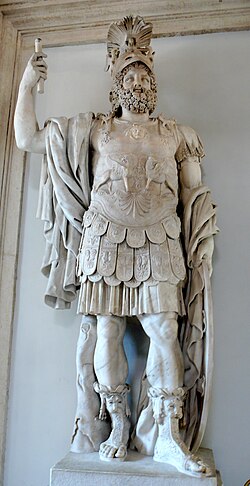
Paludatus (masculine singular, plural paludati) is an adjective meaning "wearing the paludamentum,"[375] the distinctive attire of the Roman military commander. Varro[376] and Festus say that any military ornament could be called a paludamentum, but other sources indicate that the cloak was primarily meant. According to Festus, paludati in the augural books meant "armed and adorned" (armati, ornati).[377] As the commander crossed from the sacred boundary of Rome (pomerium), he was paludatus, adorned with the attire he would wear to lead a battle and for official business.[378] This adornment was thus part of the commander's ritual investiture with imperium.[379] It followed upon the sacrifices and vows the commander offered up on the Capitol, and was concomitant with his possession of the auspices for war.[380]
Festus notes elsewhere that the "Salian virgins", whose relation to the Salian priests is unclear, performed their rituals paludatae,[381] dressed in military garb.[382]
pax deorum
Pax, though usually translated into English as "peace", was a compact, bargain, or agreement.[383] In religious usage, the harmony or accord between the divine and human was the pax deorum or pax divom ("the peace of the gods" or "divine peace").[384]Pax deorum was only given in return for correct religious practice. Religious error (vitium) and impiety led to divine disharmony and ira deorum (the anger of the gods).
piaculum
A piaculum is an expiatory sacrifice, or the victim used in the sacrifice; also, an act requiring expiation.[385]
Because Roman religion was contractual (do ut des), a piaculum might be offered as a sort of advance payment; the Arval Brethren, for instance, offered a piaculum before entering their sacred grove with an iron implement, which was forbidden, as well as after.[386] The pig was a common victim for a piaculum.[387] The Augustan historian Livy says P. Decius Mus is "like" a piaculum when he makes his vow to sacrifice himself in battle (see devotio).[388]
pietas
Pietas, from which English "piety" derives, was the devotion that bound a person to the gods, to the Roman state, and to his family. It was the outstanding quality of the Roman hero Aeneas, to whom the epithetpius is applied regularly throughout the Aeneid.
pius
In Latin and other Italic languages,[389]pius seems to have meant "that which is in accord with divine law." Later it was used to designate actions respectful of divine law and even people who acted with respect towards gods and godly rules. The pius person "strictly conforms his life to the ius divinum."[390] "Dutiful" is often a better translation of the adjective than the English derivative "pious."[391]Pius is a regular epithet of the Roman founding heroAeneas in Virgil's Aeneid, along with pater, "father."[392] See also pietas, the related abstract noun.
pollucere
A verb of unknown etymology meaning "to consecrate."[393]
pontifex
The pontifex was a priest of the highest-ranking college. The chief among the pontifices was the Pontifex Maximus. The word has been considered as related to pons, bridge, either because of the religious meaning of the pons Sublicius and its ritual use[394] (which has a parallel in Thebae and in its gephiarioi) or in the original IE meaning of way.[395] Pontifex in this case would be the "opener of the way" corresponding to the Vedic adharvayu, the only active and moving sacerdos in the sacrificial group who takes his title from the figurative designation of liturgy as a way.
Another hypothesis[396] considers the word as a loan from the Sabine language, in which it would mean a member of a college of five people, from Osco-Umbrian ponte, five. This explanation takes into account that the college was established by Sabine king Numa Pompilius and the institution is Italic: the expressions pontis and pomperias found in the Iguvine Tablets may denote a group or division of five or by five. The pontifex would thus be a member of a sacrificial college known as pomperia (Latin quinio).[397]
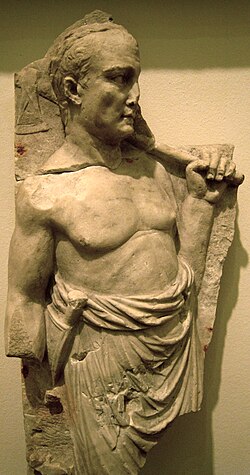
popa
The popa was one of the lesser-rank officiants at a sacrifice. In depictions of sacrificial processions, he carries a mallet or axe with which to strike the animal victim. Literary sources in late antiquity say that the popa was a public slave.[398] See also victimarius.
porricere
The verb porricere had the specialized religious meaning "to offer as a sacrifice," especially to offer the sacrificial entrails (exta) to the gods.[399] Both exta porricere and exta dare referred to the process by which the entrails were cooked, cut into pieces, and burnt on the altar. The Arval Brethren used the term exta reddere, "to return the entrails," that is, to render unto the deity what has already been given as due.[316]
portentum
A portentum is a kind of sign interpreted by a haruspex, not an augur, and by means of coniectura rather than observatio. Portentum is a close but not always exact synonym of ostentum, prodigium, and monstrum.[400]Cicero uses portentum frequently in his treatise De divinatione, where it seems to be a generic word for prodigies.[401] The word could also refer in non-technical usage to an unnatural occurrence without specific religious significance; for instance, Pliny calls an Egyptian with a pair of non-functional eyes on the back of his head a portentum.[402]Varro derives portentum from the verb portendere because it portends something that is going to happen.[403]
In the schema of A. Bouché-Leclercq, portenta and ostenta are the two types of signs that appear in inanimate nature, as distinguished from the monstrum (a biological singularity), prodigia (the unique acts or movements of living beings), and a miraculum, a non-technical term that emphasizes the viewer's reaction.[404] The sense of portentum has also been distinguished from that of ostentum by relative duration of time, with the ostentum of briefer manifestation.[405]
Although the English word "portent" derives from portentum and may be used to translate it, other Latin terms such as ostentum and prodigium will also be found translated as "portent".[406]Portentum offers an example of an ancient Roman religious term modified for Christian usage; in the Christian theology of miracles, a portentum occurring by the will of the Christian God could not be regarded as contrary to nature (contra naturam), thus Augustine specified that if such a sign appeared to be unnatural, it was only because it was contrary to nature as known (nota) by human beings.[407]
precatio
The precatio was the formal addressing of the deity or deities in a ritual. The word is related by etymology to prex, "prayer" (plural preces), and usually translated as if synonymous. Pliny says that the slaughter of a sacrificial victim is ineffectual without precatio, the recitation of the prayer formula.[408] Priestly texts that were collections of prayers were sometimes called precationes.[409]
Two late examples of the precatio are the Precatio Terrae Matris ("The Prayer of Mother Earth") and the Precatio omnium herbarum ("Prayer of All the Herbs"), which are charms or carmina written metrically,[410] the latter attached to the medical writings attributed to Antonius Musa.[411]Dirae precationes were "dire" prayers, that is, imprecations or curses.[412]
In augural procedure, precatio is not a prayer proper, but a form of invocation (invocatio) recited at the beginning of a ceremony or after accepting an oblative sign. The precatio maxima was recited for the augurium salutis, the ritual conducted by the augurs to obtain divine permission to pray for Rome's security (salus).[413]
In legal and rhetorical usage, precatio was a plea or request.[414]
prex
Prexซึ่งหมายถึง "คำอธิษฐาน" มักปรากฏในรูปพหูพจน์ คือprecesภายในโครงสร้างสามส่วนที่มักเป็นลักษณะเฉพาะของคำอธิษฐานแบบโบราณที่เป็นทางการprecesจะเป็นการแสดงออกขั้นสุดท้ายของสิ่งที่ขอจากเทพเจ้า ต่อจากคำวิงวอนและส่วนกลางที่เป็นเรื่องเล่า[ 415 ]คำขอที่ถูกต้องตามกฎหมายเป็นตัวอย่างของbonae precesซึ่งหมายถึง "คำอธิษฐานที่ดี" [ 416 ] Tacitae precesคือคำอธิษฐานเงียบๆ หรือsotto voceซึ่งอาจใช้ในพิธีกรรมส่วนตัวหรือเวทมนตร์คำอธิษฐานที่มีเจตนาร้ายจะถูกอธิบายด้วยคำคุณศัพท์ เช่นThyesteae (" Thyestean "), funestae ("deadly"), infelices (มุ่งหมายที่จะทำให้เกิดความทุกข์) , nefariae [ 417 ]หรือdirae [ 418 ]
โดยทั่วไปprecesอาจหมายถึงคำขอหรือการวิงวอนใดๆ รูปแบบกริยาคือprecor, precariซึ่งหมายถึง "อธิษฐาน วิงวอน" คำ ที่เกี่ยวข้องในภาษาอุมเบรีย คือperskluซึ่งหมายถึง "การวิงวอน" ความหมายอาจเป็น "ฉันพยายามและได้รับโดยการใช้ถ้อยคำที่เหมาะสมในสิ่งที่ฉันมีสิทธิ์ได้รับ" มักใช้ร่วมกับquaesoในสำนวนเช่นte precor quaesoque ซึ่งหมาย ถึง "ฉันอธิษฐานและวิงวอนท่าน" หรือprece quaesitซึ่งหมายถึง "เขาแสวงหาโดยวิธีการอธิษฐาน" [ 419 ]ในกฎหมายโรมันในยุคจักรวรรดิ preces หมายถึงคำร้อง ที่ บุคคลทั่วไปยื่นต่อจักรพรรดิ [ 420 ]
อัจฉริยะ
Prodigia (พหูพจน์) คือความผิดปกติที่ผิดธรรมชาติและเบี่ยงเบนไปจากระเบียบที่คาดการณ์ได้ของจักรวาลProdigiumเป็นสัญญาณบ่งบอกถึงความไม่พอพระทัยของพระเจ้าต่อการกระทำผิดทางศาสนาและต้องได้รับการชดใช้เพื่อหลีกเลี่ยงการแสดงออกถึงความพิโรธของพระเจ้าที่รุนแรงยิ่งขึ้น เปรียบเทียบกับostentumและportentumซึ่งเป็นสัญญาณบ่งบอกถึงปรากฏการณ์เหนือธรรมชาติที่ไม่มีชีวิต และmonstrumและmiraculumซึ่งเป็นลักษณะผิดปกติในมนุษย์
Prodigies were a type of auspicia oblativa; that is, they were "thrust upon" observers, not deliberately sought.[421] Suspected prodigies were reported as a civic duty. A system of official referrals filtered out those that seemed patently insignificant or false before the rest were reported to the senate, who held further inquiry; this procedure was the procuratio prodigiorum. Prodigies confirmed as genuine were referred to the pontiffs and augurs for ritual expiation.[422] For particularly serious or difficult cases, the decemviri sacris faciundis could seek guidance and suggestions from the Sibylline Books.[423]
The number of confirmed prodigies rose in troubled times. In 207 BC, during one of the worst crises of the Punic Wars, the senate dealt with an unprecedented number, the expiation of which would have involved "at least twenty days" of dedicated rites.[424] Major prodigies that year included the spontaneous combustion of weapons, the apparent shrinking of the sun's disc, two moons in a daylit sky, a cosmic battle between sun and moon, a rain of red-hot stones, a bloody sweat on statues, and blood in fountains and on ears of corn. These were expiated by the sacrifice of "greater victims". The minor prodigies were less warlike but equally unnatural; sheep became goats; a hen become a cock, and vice versa. The minor prodigies were duly expiated with "lesser victims". The discovery of a hermaphroditic four-year-old child was expiated by drowning[425] and a holy procession of 27 virgins to the temple of Juno Regina, singing a hymn to avert disaster; a lightning strike during the hymn rehearsals required further expiation.[426] Religious restitution was proved only by Rome's victory.[427]
The expiatory burial of living human victims in the Forum Boarium followed Rome's defeat at Cannae in the same wars. In Livy's account, Rome's victory follows its discharge of religious duties to the gods.[428] Livy remarked the scarcity of prodigies in his own day as a loss of communication between gods and men. In the later Republic and thereafter, the reporting of public prodigies was increasingly displaced by a "new interest in signs and omens associated with the charismatic individual."[429]
profanum
Profanum (literally, 'in front of the shrine'), therefore not within a sacred precinct; not belonging to the gods but to humankind.
propitius
An adjective of augural terminology meaning favourable. From pro-, "before", and petere, "seek" but originally "fly". It indicates a pattern in the flight of praepetes aves, birds that make the auspices favorable by flying before the person who is taking them or by pointing in the direction of that which is wished for. A synonym is secundus, "favorable" or "following".[430]
pulvinar
The pulvinar (plural pulvinaria) was a special couch used for displaying images of the gods, that they might receive offerings at ceremonies such as the lectisternium or supplicatio.[431] In the famous lectisternium of 217 BC, on orders of the Sibylline books, six pulvinaria were arranged, each for a divine male-female pair.[432] By extension, pulvinar can also mean the shrine or platform housing several of these couches and their images. At the Circus Maximus, the couches and images of the gods were placed on an elevated pulvinar to "watch" the games.
R
regina sacrorum
The regina sacrorum is the wife of the rex sacrorum, who served as a high priestess with her own specific religious duties.
religio
The word religio originally meant an obligation to the gods, something expected by them from human beings or a matter of particular care or concern as related to the gods.[433] In this sense, religio might be translated better as "religious scruple" than with the English word "religion".[434] One definition of religio offered by Cicero is cultus deorum, "the proper performance of rites in veneration of the gods."[435]
Religio among the Romans was not based on "faith", but on knowledge, including and especially correct practice.[436]Religio (plural religiones) was the pious practice of Rome's traditional cults, and was a cornerstone of the mos maiorum,[437] the traditional social norms that regulated public, private, and military life. To the Romans, their success was self-evidently due to their practice of proper, respectful religio, which gave the gods what was owed them and which was rewarded with social harmony, peace and prosperity.
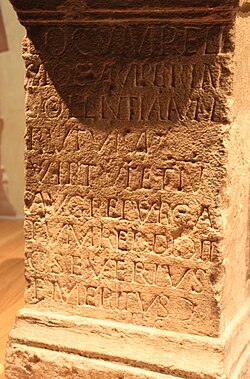
Religious law maintained the proprieties of divine honours, sacrifice and ritual. Impure sacrifice and incorrect ritual were vitia (faults, hence "vice," the English derivative); excessive devotion, fearful grovelling to deities, and the improper use or seeking of divine knowledge were superstitio; neglecting the religiones owed to the traditional gods was atheism, a charge leveled during the Empire at Jews,[439] Christians, and Epicureans.[440] Any of these moral deviations could cause divine anger (ira deorum) and therefore harm the State.[441] See Religion in ancient Rome.
religiosus
Religiosus was something pertaining to the gods or marked out by them as theirs, as distinct from sacer, which was something or someone given to them by humans. Hence, a graveyard was not primarily defined as sacer but a locus religiosus, because those who lay within its boundaries were considered belonging to the di Manes.[442] Places struck by lightning were taboo[443] because they had been marked as religiosus by Jupiter himself.[444] See also sacer and sanctus.
res divinae
Res divinae were "divine affairs," that is, the matters that pertained to the gods and the sphere of the divine in contrast to res humanae, "human affairs."[445]Rem divinam facere, "to do a divine thing," simply meant to do something that pertained to the divine sphere, such as perform a ceremony or rite. The equivalent Etruscan term is ais(u)na.[446]
The distinction between human and divine res was explored in the multivolume Antiquitates rerum humanarum et divinarum, one of the chief works of Varro (1st century BC). It survives only in fragments but was a major source of traditional Roman theology for the Church Fathers. Varro devoted 25 books of the Antiquitates to res humanae and 16 to res divinae. His proportional emphasis is deliberate, as he treats cult and ritual as human constructs.[447] Varro divides res divinae into three kinds:
- the mythic theology of the poets, or narrative elaboration;
- the natural theology of the philosophers, or theorizing on divinity among the intellectual elite;
- the civil theology concerned with the relation of the state to the divine.
The schema is Stoic in origin, though Varro has adapted it for his own purposes.[448]
Res divinae is an example of ancient Roman religious terminology that was appropriated for Christian usage; for St. Augustine, res divina is a "divine reality" as represented by a sacrum signum ("sacred sign") such as a sacrament.[449]
responsum
Responsa (plural) were the "responses," that is, the opinions and arguments, of the official priests on questions of religious practice and interpretation. These were preserved in written form and archived.[138] Compare decretum.
rex sacrorum
The rex sacrorum was a senatorial priesthood[450] reserved for patricians. Although in the historical era the Pontifex Maximus was the head of Roman state religion, Festus says[451] that in the ranking of priests, the rex sacrorum was of highest prestige, followed by the flamines maiores.[452]
ritus
Although ritus is the origin of the English word "rite" via ecclesiastical Latin, in classical usageritus meant the traditional and correct manner (of performance), that is, "way, custom". Festus defines it as a specific form of mos: "Ritus is the proven way (mos) in the performance of sacrifices." The adverb rite means "in good form, correctly."[453] This original meaning of ritus may be compared to the concept of ṛtá ("visible order", in contrast to dhāman, dhārman) in Vedic religion, a conceptual pairing analogous to Latin fas and ius.[454]
For Latin words meaning "ritual" or "rite", see sacra, caerimoniae, and religiones.[455]
ritus graecus
A small number of Roman religious practices and cult innovations were carried out according to "Greek rite" (ritus graecus), which the Romans characterized as Greek in origin or manner. A priest who conducted ritu graeco wore a Greek-style fringed tunic, with his head bare (capite aperto) or laurel-wreathed. By contrast, in most rites of Roman public religion, an officiant wore the distinctively Roman toga, specially folded to cover his head (see capite velato). Otherwise, "Greek rite" seems to have been a somewhat indefinite category, used for prayers uttered in Greek, and Greek methods of sacrifice within otherwise conventionally Roman cult.
Roman writers record elements of ritus graecus in the cult to Hercules at Rome's Ara Maxima, which according to tradition was established by the Greek king Evander even before the city of Rome was founded at the site. It thus represented one of the most ancient Roman cults. "Greek" elements were also found in the Saturnalia held in honor of the Golden Age deity Saturn, and in certain ceremonies of the Ludi saeculares. A Greek rite to Ceres (ritus graecus cereris) was imported from Magna Graecia and added to her existing Aventine cult in accordance with the Sibylline books, ancient oracles written in Greek. Official rites to Apollo are perhaps "the best illustration of the Graecus ritus in Rome."
The Romans regarded ritus graecus as part of their own mos maiorum (ancestral tradition), and not as novus aut externus ritus, novel or foreign rite. The thorough integration and reception of rite labeled "Greek" attests to the complex, multi-ethnic origins of Rome's people and religious life.[456]
S
sacellum
Sacellum, a diminutive from sacer ("belonging to a god"),[457] is a shrine. Varro and Verrius Flaccus give explanations that seem contradictory, the former defining a sacellum in its entirety as equivalent to a cella,[458] which is specifically an enclosed space, and the latter insisting that a sacellum had no roof.[459] "The sacellum," notes Jörg Rüpke, "was both less complex and less elaborately defined than a temple proper."[460] Each curia had its own sacellum.[461]
sacer
Sacer describes a thing or person given to the gods, thus "sacred" to them. Human beings had no legal or moral claims on anything sacer. Sacer could be highly nuanced; Varro associates it with "perfection".[462] Through association with ritual purity, sacer could also mean "sacred, untouchable, inviolable".
Anything not sacer was profanum: literally, "in front of (or outside) the shrine", therefore not belonging to it or the gods. A thing or person could be made sacer (consecrated), or could revert from sacer to profanum (deconsecrated), only through lawful rites (resecratio) performed by a pontiff on behalf of the state.[463] Part of the ver sacrum sacrificial vow of 217 BC stipulated that animals dedicated as sacer would revert to the condition of profanum if they died through natural cause or were stolen before the due sacrificial date. Similar conditions attached to sacrifices in archaic Rome.[464] A thing already owned by the gods or actively marked out by them as divine property was distinguished as religiosus, and hence could not be given to them or made sacer.[465][466]
Persons judged sacer under Roman law were placed beyond further civil judgment, sentence and protection; their lives, families and properties were forfeit to the gods. A person could be declared sacer who harmed a plebeian tribune, failed to bear legal witness,[467] failed to meet his obligations to clients, or illicitly moved the boundary markers of fields.[468] It was not a religious duty (fas) to execute a homo sacer, but he could be killed with impunity.[469][470]
Dies sacri ("sacred days") were nefasti, meaning that the ordinary human affairs permitted on dies profani (or fasti) were forbidden.
Sacer was a fundamental principle in Roman and Italic religions. In Oscan, cognate forms are sakoro, "sacred," and sakrim, "sacrificial victim". Oscan sakaraklum is cognate with Latin sacellum, a small shrine, as Oscan sakarater is with Latin sacratur, consecrare, "consecrated". The sacerdos is "one who performs a sacred action" or "renders a thing sacred", that is, a priest.[471]
sacerdos
A sacerdos (plural sacerdotes, a word of either masculine or feminine gender) was any priest or priestess, from *sakro-dho-ts, "the one who does the sacred act."[472] There was no priestly caste in ancient Rome, and in some sense every citizen was a priest in that he presided over the domestic cult of his household. Senators, magistrates, and the decurions of towns performed ritual acts, though they were not sacerdotes per se.[473] The sacerdos was one who held the title usually in relation to a specific deity or temple.[474] See also collegium and flamen.
sacra
Sacra (neuter plural of sacer) are the traditional cult practices of classical Roman religion, either publica or privata, both of which were overseen by the College of Pontiffs.
The sacra publica were those performed on behalf of the whole Roman people or its major subdivisions, the tribes and curiae. They included the sacra pro populo, "rites on behalf of the Roman people," i.e., all the feriae publicae of the Roman calendar year and the other feasts that were regarded of public interest, including those pertaining to the hills of Rome,[475] to the pagi and curiae, and to the sacella, "shrines".[476] The establishment of the sacra publica is ascribed to king Numa Pompilius, but many are thought to be of earlier origin, even predating the founding of Rome. Thus Numa may be seen as carrying out a reform and a reorganisation of the sacra in accord with his own views and his education.[477]Sacra publica were performed at the expense of the state, according to the dispositions left by Numa, and were attended by all the senators and magistrates.[478]
Sacra privata were particular to a gens, to a family, or to an individual, and were carried out at the expense of those concerned. Individuals had sacra on dates peculiar to them, such as birthdays, the dies lustricus, and at other times of their life such as funerals and expiations, for instance of fulgurations.[479] Families had their own sacra in the home or at the tombs of their ancestors, such as those pertaining to the Lares, Manes and Penates of the family, and the Parentalia. These were regarded as necessary and imperishable, and the desire to perpetuate the family's sacra was among the reasons for adoption in adulthood.[480] In some cases, the state assumed the expenses even of sacra privata, if they were regarded as important to the maintenance of the Roman religious system as a whole; see sacra gentilicia following.
sacra gentilicia
Sacra gentilicia were the private rites (see sacra above) that were particular to a gens ("clan"). These rites are related to a belief in the shared ancestry of the members of a gens, since the Romans placed a high value on both family identity and commemorating the dead.[481] During the Gallic siege of Rome, a member of the gens Fabia risked his life to carry out the sacra of his clan on the Quirinal Hill; the Gauls were so impressed by his courageous piety that they allowed him to pass through their lines.[482] The Fabian sacra were performed in Gabine dress by a member of the gens who was possibly named a flamen.[483] There were sacra of Minerva in the care of the Nautii, and rites of Apollo that the Iulii oversaw.[484] The Claudii had recourse to a distinctive "propudial pig" sacrifice (propudialis porcus, "pig of shame") by way of expiation when they neglected any of their religious obligations.[485]
Roman practices of adoption, including so-called "testamentary adoption" when an adult heir was declared in a will, were aimed at perpetuating the sacra gentilicia as well as preserving the family name and property.[486] A person adopted into another family usually renounced the sacra of his birth (see detestatio sacrorum) in order to devote himself to those of his new family.[487]
Sacra gentilicia sometimes acquired public importance, and if the gens were in danger of dying out, the state might take over their maintenance. One of the myths attached to Hercules' time in Italy explained why his cult at the Ara Maxima was in the care of the patriciangens Potitia and the gens Pinaria; the diminution of these families by 312 BC caused the sacra to be transferred to the keeping of public slaves and supported with public funding.[488]
sacra municipalia
The sacra of an Italian town or community (municipium) might be perpetuated under the supervision of the Roman pontiffs when the locality was brought under Roman rule. Festus defined municipalia sacra as "those owned originally, before the granting of Roman citizenship; the pontiffs desired that the people continue to observe them and to practice them in the way (mos) they had been accustomed to from ancient times."[489] These sacra were regarded as preserving the core religious identity of a particular people.[490]
sacramentum
Sacramentum is an oath or vow that rendered the swearer sacer, "given to the gods," in the negative sense if he violated it.[491]Sacramentum also referred to a thing that was pledged as a sacred bond, and consequently forfeit if the oath were violated.[492] Both instances imply an underlying sacratio, act of consecration.
In Roman law, a thing given as a pledge or bond was a sacramentum. The sacramentum legis actio was a sum of money deposited in a legal procedure[493] to affirm that both parties to the litigation were acting in good faith.[494] If correct law and procedures had been followed, it could be assumed that the outcome was iustum, right or valid. The losing side had thus in effect committed perjury, and forfeited his sacramentum as a form of piaculum; the winner got his deposit back. The forfeited sacramentum was normally allotted by the state to the funding of sacra publica.[495]
The sacramentum militare (also as militum or militiae) was the oath taken by soldiers in pledging their loyalty to the consul or emperor. The sacramentum that renders the soldier sacer helps explain why he was subjected to harsher penalties, such as execution and corporal punishment, that were considered inappropriate for civilian citizens, at least under the Republic.[496] In effect, he had put his life on deposit, a condition also of the fearsome sacramentum sworn by gladiators.[497] In the later empire, the oath of loyalty created conflict for Christians serving in the military, and produced a number of soldier-martyrs.[498]Sacramentum is the origin of the English word "sacrament", a transition in meaning pointed to by Apuleius's use of the word to refer to religious initiation.[499]
The sacramentum as pertaining to both the military and the law indicates the religious basis for these institutions. The term differs from iusiurandum, which is more common in legal application, as for instance swearing an oath in court. A sacramentum establishes a direct relation between the person swearing (or the thing pledged in the swearing of the oath) and the gods; the iusiurandum is an oath of good faith within the human community that is in accordance with ius as witnessed by the gods.[500]
sacrarium
ศีลศักดิ์สิทธิ์เป็นสถานที่จัดเก็บหรือฝาก วัตถุศักดิ์สิทธิ์ ( ศักดิ์สิทธิ์ ) ไว้เพื่อความปลอดภัย [ 501 ]คำนี้สามารถทับซ้อนกันในความหมายกับsacellumซึ่งเป็นศาลเจ้าขนาดเล็กที่ปิดล้อม sacella ของArgeiเรียกอีกอย่างว่าsacraria [ 502 ]ในนักเขียนชาวกรีก คำว่า ἱεροφυлάκιον hierophylakion ( อักษรอียิปต์โบราณ , "ศักดิ์สิทธิ์" และphylakionเป็นสิ่งที่ปกป้อง) [ 503 ]ดูซาเซลลัม เพื่อ ดูรายการศักดิ์สิทธิ์
ห้องศักดิ์สิทธิ์ของบ้านส่วนตัวเอื้อต่อการเปลี่ยนแปลงทางศาสนาคริสต์ ดังที่บทกวีในศตวรรษที่ 4 โดยAusoniusแสดงให้เห็น[ 504 ]ในการใช้งานทางศาสนาคริสต์ในปัจจุบัน ห้องศักดิ์สิทธิ์คือ "อ่างล้างพิเศษที่ใช้สำหรับการกำจัดสารศักดิ์สิทธิ์อย่างเคารพ" (ดูpiscina ) [ 505 ]
การเสียสละ
เหตุการณ์หรือสิ่งใดสิ่งหนึ่งที่อุทิศแด่เทพเจ้าเพื่อการใช้ประโยชน์ การถวายเครื่องบูชาเป็นสิ่งสำคัญพื้นฐานในศาสนาดูเพิ่มเติมที่Sacerและศาสนาในกรุงโรมโบราณ: การบูชายัญ
ศักดิ์สิทธิ์
กฎหมาย ของ วาเลริโอ-โฮราเชียนในปี 449 ก่อนคริสต์ศักราช ได้นำคำคุณศัพท์sacrosanctus มาใช้ เพื่อกำหนดความศักดิ์สิทธิ์ของอำนาจ(potestas)ของผู้แทนราษฎรและผู้พิพากษาอื่น ๆ ที่ได้รับการรับรองตามกฎหมาย (Livy 3.55.1) ความศักดิ์สิทธิ์ของหน้าที่ของผู้แทนราษฎรได้รับการสถาปนาขึ้นในสมัยก่อนผ่านทางreligioและsacramentum (Livy 2.33.1; 3.19.10) แต่มีผลผูกพันเฉพาะคู่สัญญาเท่านั้น การที่จะทำให้เป็นข้อผูกพันสำหรับทุกคนนั้น จำเป็นต้องมี sanctioที่ไม่เพียงแต่เป็นทางแพ่งแต่เป็นทางศาสนาด้วย กล่าวคือ ผู้ละเมิดจะถูกประกาศว่าsacerและครอบครัวและทรัพย์สินของเขาจะถูกขาย ตามที่นักประวัติศาสตร์ชาวกรีกไดโอนิเซียส กล่าวไว้ (6.89.3) ดังนั้น sacerจึงกำหนดข้อตกลงทางศาสนา และsanctus กำหนดกฎหมาย ตามข้อความอื่นๆ ใน Livy กฎหมายนี้ไม่ได้รับการอนุมัติจากนักกฎหมายบางคนในสมัยนั้น ซึ่งยืนยันว่าเฉพาะผู้ที่ละเมิดกฎหมายศักดิ์สิทธิ์ที่ได้รับการยอมรับโดยทั่วไปเท่านั้นที่จะตกอยู่ในประเภทของผู้ที่ถูกประกาศว่าเป็นsacri Livy ยังกล่าวอีกว่า (Livy 4.3.6, 44.5; 20.20.11) ว่ามีเพียงpotestas เท่านั้นที่เป็น sacrosanctaไม่ใช่ตัวบุคคลของ tribune ผู้ที่วิพากษ์วิจารณ์กฎหมายนี้คัดค้านว่า "คนเหล่านี้คิดว่าตัวเองควรเป็นsacrosanctiหรือ พวกเขาไม่แม้แต่จะเคารพเทพเจ้าว่าเป็นนักบุญหรือ?" [ 506 ]
H. Fugier ให้ความหมายของsacrosanctusว่าได้รับการรับรองโดยคำสาบานแต่ M. Morani ตีความส่วนแรกของคำประสมว่าเป็นผลสืบเนื่องมาจากส่วนที่สอง: sanxit tribunum sacrumซึ่งหมายความว่าผู้แทนราษฎรได้รับการรับรองโดยกฎหมายว่าเป็นผู้ศักดิ์สิทธิ์ (sacer ) การประกอบคำในลักษณะนี้โดยอาศัยรูปแบบทางนิรุกติศาสตร์มีลักษณะคล้ายคลึงกันในภาษาอินโด-ยุโรปอื่นๆ ในโครงสร้างโบราณ
ซาลี
ชาว ซาลีคือ "นักบวชผู้กระโดด" ของเทพเจ้ามาร์ส
ซานซิโอ
คำกริยาที่มีความหมายว่าให้สัตยาบันข้อตกลงและนำไปไว้ภายใต้การคุ้มครองของsanctioซึ่งหมายถึงการลงโทษหรือบทลงโทษ การก่อตัวและความหมายดั้งเดิมของคำกริยานี้ยังเป็นที่ถกเถียงกันอยู่ นักวิชาการบางคนคิดว่ามันมาจากรากศัพท์ IE * sak (เช่นเดียวกับsacer ) ผ่านการแทรกเสียงนาสิกn [ 507 ]และคำต่อท้าย-yoดังนั้นsancioจึงหมายถึงการทำให้บางสิ่งศักดิ์สิทธิ์กล่าวคือเป็นของเทพเจ้าในแง่ของการได้รับการรับประกันและการคุ้มครองจากพวกเขา[ 508 ]คนอื่นๆ คิดว่ามันมาจากชื่อเทพเจ้าSancusเทพเจ้าแห่งการให้สัตยาบันfoedera (สนธิสัญญา) และการคุ้มครองความสุจริต จากรากศัพท์sancu-บวกคำต่อท้าย-io [ 509 ] ในกรณีนั้น คำกริยาจะหมายถึงการกระทำที่สะท้อนหรือสอดคล้องกับหน้าที่ของเทพเจ้าองค์นี้ กล่าวคือ การให้สัตยาบันและการรับประกันข้อตกลง
ศักดิ์สิทธิ์
Sanctus ซึ่งเป็นคำคุณศัพท์ที่สร้างขึ้นจากคำกริยา sancioในรูปกริยาช่อง 3 อธิบายถึงสิ่งที่ "ได้รับการสถาปนาให้เป็นสิ่งที่ไม่อาจละเมิดได้" หรือ "ศักดิ์สิทธิ์" โดยส่วนใหญ่ในความหมายจะแตกต่างจากsacerและreligiosusความหมายดั้งเดิมของมันคือ "สิ่งที่ได้รับการคุ้มครองโดยการรับรอง" ( sanctio ) แนวคิดนี้เชื่อมโยงกับชื่อของเทพเจ้าผู้ก่อตั้งชาวอุมเบรียหรือซาบีนSancusในภาษาอุมเบรียคือSanciusซึ่งหน้าที่ที่โดดเด่นที่สุดของเขาคือการให้สัตยาบันและปกป้องสนธิสัญญา ( foedera ) [ 510 ]
นักกฎหมายโรมันUlpianแยกแยะsanctusว่า "ไม่ใช่ทั้งศักดิ์สิทธิ์ ( sacer ) หรือทางโลก ( profanum ) ... และไม่ใช่religiosus " [ 511 ] Gaiusเขียนว่าอาคารที่อุทิศให้กับเทพเจ้าคือsacrumแต่กำแพงและประตูเมืองเป็นres sanctaeเพราะเป็นของ "ในทางใดทางหนึ่ง" กฎหมายศักดิ์สิทธิ์ ในขณะที่สุสานเป็นreligiosusเพราะถูกยกให้แก่di Manes นักวิชาการ บางคนคิดว่าsanctusเดิมทีเป็นแนวคิดที่เกี่ยวข้องกับพื้นที่ในแง่ของสถานที่ที่ได้รับการเปิดอย่างเป็นทางการ เพราะสถานที่เหล่านั้นได้รับความคุ้มครอง ( sanctio ) จากเทพเจ้า[ 512 ] [ 513 ]
เทพเจ้า วัตถุ สถานที่ และบุคคลต่างๆ โดยเฉพาะวุฒิสมาชิกและผู้พิพากษา สามารถเป็นsanctus ได้ Claudia Quintaได้รับการอธิบายว่าเป็นsanctissima femina (สตรีผู้มีคุณธรรมสูงสุด) และCato the Youngerเป็นsanctus civis (พลเมืองผู้มีคุณธรรม) [ 514 ] [ 515 ]ดูเพิ่มเติมที่sanctuary
ต่อมามีการมอบฉายาsanctusให้กับเทพเจ้าหลายองค์ รวมทั้งApollo PythiusโดยNaevius , VenusและTiberinusโดยEnniusและLivyเอนเนียสแปลHomeric dia theaoonเป็นsancta dearum ในช่วงต้นยุคจักรวรรดิโอวิดกล่าวถึงเทอร์มินัสเทพเจ้าผู้ชำระขอบเขตดินแดนให้บริสุทธิ์ ว่าเป็นแซงทัส[ 516 ]และเทียบระหว่างแซงกาตากับออกัสตา (เดือนสิงหาคม) [ 517 ]การใช้แซงค์ตัสเป็นฉายาของแม่น้ำไทเบอร์และเทพเจ้าแห่งเขตแดน เทอร์มินัส ยังคงรักษาความรู้สึกดั้งเดิมและโบราณของการกำหนดขอบเขต: พรมแดนเป็นสิ่งศักดิ์สิทธิ์ตามคำจำกัดความ และแม่น้ำมักเป็นเครื่องหมายของเขตแดน
เมื่อนำมาใช้กับผู้คนในระยะเวลาต่อมา คำว่า Sanctusก็มีความหมายคล้ายคลึงกับคำในภาษาละตินcastus (บริสุทธิ์ทางศีลธรรมหรือปราศจากความผิด) และpius (เคร่งศาสนา ) โดยไม่มีความกำกวมเหมือนกับคำว่าsacerและreligiosus
ในภาษาละตินทางศาสนาsanctusเป็นคำที่หมายถึงนักบุญแต่แม้ในยุคคริสต์ศาสนา คำนี้ก็ยังคงปรากฏในจารึกหลุมศพของผู้ที่ไม่ได้เปลี่ยนมานับถือศาสนาคริสต์[ 518 ]
servare de caelo
ตามตัวอักษรคือ "เฝ้าดู (บางสิ่ง) จากท้องฟ้า" กล่าวคือ สังเกตtemplumของท้องฟ้าเพื่อหาสัญญาณที่อาจตีความได้ว่าเป็นลางบอกเหตุ ลางร้ายส่งผลให้เกิดรายงานobnuntiatio [ 519 ]
สัญญาณ
ซิกนัมคือ "เครื่องหมาย สัญลักษณ์ หรือสิ่งบ่งชี้" [ 520 ]ในการใช้ทางศาสนาซิกนัมเป็นคำรวมสำหรับเหตุการณ์หรือสิ่งต่างๆ (รวมถึงเครื่องหมายและสัญลักษณ์) ที่บ่งบอกถึงเอกลักษณ์ กิจกรรม หรือการสื่อสารของพระเจ้า ซึ่งรวมถึงprodigia , auspicia , omina , portentaและostenta
ไซเลนเทียม
โดยทั่วไปแล้ว ความเงียบเป็นสิ่งจำเป็นในการประกอบพิธีกรรมทางศาสนาทุกอย่าง[ 521 ]คำสั่งในพิธีกรรมfavete linguisซึ่งแปลว่า "จงสุภาพด้วยลิ้นของท่าน" หมายถึง "จงเงียบ" โดยเฉพาะอย่างยิ่ง ความเงียบช่วยให้พิธีกรรมถูกต้องและปราศจากvitiaซึ่งแปลว่า "ความผิดพลาด" ในการรับพร[ 522 ]นอกจากนี้ยังจำเป็นต้องใช้ความเงียบในการแต่งตั้ง ( dictio ) ของเผด็จการด้วย[ 523 ]
ชั่วร้าย
ในสมัยโบราณโหร (augures ex caelo) จะหันหน้าไปทางทิศใต้ ดังนั้นทิศตะวันออกอันเป็นมงคลซึ่งเป็นที่ที่ดวงอาทิตย์ขึ้น จึงอยู่ทางด้านซ้ายของพวกเขา ด้วยเหตุนี้ คำว่าsinister (ภาษาละตินแปลว่าซ้าย) จึงหมายถึง โชคดี เมื่ออยู่ภายใต้อิทธิพลของกรีก โหรจึงเปลี่ยนมาหันหน้าไปทางทิศเหนือ คำว่า sinister จึงหมายถึงทิศตะวันตกอันเป็นมงคล ซึ่งเป็นที่ที่แสงสว่างเปลี่ยนเป็นความมืด ความหมายในภายหลังนี้เองที่ใช้กับคำว่า sinister ในภาษาอังกฤษ
โซดาลิตาส
| ส่วนหนึ่งของชุดบทความเกี่ยวกับ |
| ตำแหน่งนักบวชในกรุงโรมโบราณ |
|---|
|
| ภาพรวม |
| ตำแหน่งนักบวชในกรุงโรมโบราณ |
| วิทยาลัย หลัก ๆ |
| วิทยาลัยหรือชมรม อื่นๆ |
| นักบวช |
| นักบวชหญิง |
| หัวข้อที่เกี่ยวข้อง |
โซดาลิตัส (Sodalitas)เป็นรูปแบบหนึ่งของสมาคมหรือสังคมโดยสมัครใจ ความหมายของคำนี้ไม่จำเป็นต้องแตกต่างจากคอลเลเจียม (Collegium)ในแหล่งข้อมูลโบราณ และยังพบได้ในคำว่า โซดาลิเซียม (Sodalicium ) ซึ่งหมายถึง "ภราดรภาพ" [ 524 ]โซดาลิส (Sodalis)คือสมาชิกของโซดาลิตัสซึ่งอธิบายถึงความสัมพันธ์ระหว่างโซดาเลส (Sodales ) มากกว่าสถาบัน ตัวอย่างของโซดาลิตัสที่ เป็นนักบวช ได้แก่ลูเปอร์ซี (Luperci) , เฟเทียเลส ( Fetiales) , พี่น้องอาร์วัล (Arval brothers)และ ทิ ติ (Titii ) สิ่งเหล่านี้ยังถูกเรียกว่าคอลเลเจีย (Collegia) แต่การที่พวกเขาเป็น ภราดรภาพประเภทหนึ่งนั้นได้รับการเสนอแนะจากเพลงสังสรรค์ที่ เป็นเอกลักษณ์ ซึ่งเกี่ยวข้องกับบางกลุ่ม[ 525 ]สมาคมของโซดาเลสอาจจัดตั้งสมาคมฌาปนกิจหรืออุทิศส่วนกุศลให้เป็นกลุ่มจารึกบันทึกการบริจาคที่ทำโดยผู้หญิงเพื่อประโยชน์ของโซดาเลส[ 526 ]ชาวปิธาโกเรียนโรมันเช่นนิกิดิอุส ฟิกูลัสได้ก่อตั้ง สมาคม ( sodalicia ) ขึ้น [ 527 ]ซึ่งอัมมิอานัส มาร์เซลลินัสได้นำมาเปรียบเทียบกับสมาคม(sodalicia consortia)ของพวกดรูอิดในวัฒนธรรมกัลโล-โรมัน [ 528 ] เมื่อลัทธิบูชาไซเบลถูกนำเข้ามาในโรมการที่นักบวชของเธอ(galli) เป็น ขันที ทำให้ชายชาวโรมันไม่กล้าที่จะจัดตั้งคณะนักบวชอย่างเป็นทางการ แต่พวกเขากลับเข้าร่วมสมาคม (sodalitates)เพื่อจัดงานเลี้ยงและพิธีกรรมแบบโรมันดั้งเดิมอื่นๆเพื่อเป็นเกียรติแก่เธอ[ 529 ]
เชื่อกันว่าสมาคม โซดาลิเตสมีต้นกำเนิดมาจากกลุ่มภราดรภาพชนชั้นสูงที่มีหน้าที่ทางศาสนา และมีหลักฐานการดำรงอยู่ของพวกเขาตั้งแต่ปลายศตวรรษที่ 6 หรือต้นศตวรรษที่ 5 ก่อนคริสต์ศักราชกฎสิบสองตารางได้ควบคุมอิทธิพลของพวกเขาโดยห้ามไม่ให้พวกเขาขัดแย้งกับกฎหมายสาธารณะ( ius publicum ) [ 530 ]ในช่วงทศวรรษที่ 60 ก่อนคริสต์ศักราชสมาคมบางรูปแบบถูกยุบเลิกโดยกฎหมายเนื่องจากเป็นการก่อกวนทางการเมือง และในการใช้คำของซิเซโรคำว่าโซดาลิเตสอาจหมายถึงองค์กรที่ก่อกวนเหล่านี้ หรือในบริบททางศาสนาหมายถึงกลุ่มภราดรภาพของนักบวช[ 531 ]ดูเพิ่มเติมที่Sodales Augustalesสำหรับ แนวคิด คาทอลิกดูที่sodality
สเปซโต
Spectio (“การเฝ้าดู การมองเห็น การสังเกต”) คือการแสวงหาลางบอกเหตุผ่านการสังเกตท้องฟ้า การบินของนก หรือการให้อาหารนก เดิมทีมีเพียงผู้พิพากษาและโหรชั้นขุนนาง เท่านั้น ที่มีสิทธิ์ประกอบพิธีกรรมspectioซึ่งมาพร้อมกับอำนาจในการควบคุมการชุมนุมและด้านอื่นๆ ของชีวิตสาธารณะ ขึ้นอยู่กับว่าลางบอกเหตุนั้นเป็นลางดีหรือลางร้าย[ 532 ]ดูเพิ่มเติมที่obnuntiatio
สปอนซิโอ

Sponsioเป็นพันธะผูกพันอย่างเป็นทางการที่ได้รับการรับรองทางศาสนา อาจหมายถึงการหมั้นหมายตามที่ครอบครัวของฝ่ายหญิงให้คำมั่นไว้ หรือคำมั่นสัญญาอันศักดิ์สิทธิ์ของผู้พิพากษา ในสนธิสัญญาระหว่างประเทศในนามของ ชาวโรมัน[ 533 ]
คำภาษาละตินมาจากรากศัพท์ภาษาโปรโตอินโด-ยุโรป ที่มีความหมายว่า การถวายไวน์แด่เทพเจ้า เช่นเดียวกับคำกริยาภาษากรีกspendooและคำนามspondai, spondasและspant- ในภาษาฮิตไทต์ [ 534 ] ในภาษากรีก คำนี้ยังมีความหมายว่า "ข้อตกลง, อนุสัญญา, สนธิสัญญา" (เปรียบเทียบกับภาษาละตินfoedus ) เนื่องจากสิ่งเหล่านี้ได้รับการรับรองด้วยการถวายไวน์แด่เทพเจ้าบนแท่นบูชา ในภาษาละตินsponsioกลายเป็นสัญญาทางกฎหมายระหว่างสองฝ่าย หรือบางครั้งเป็นfoedusระหว่างสองประเทศ
ในภาษาละตินทางกฎหมาย คำว่าsponsioหมายถึงการมีอยู่ของบุคคลที่ทำหน้าที่เป็นผู้รับรองผู้ค้ำประกันภาระผูกพันที่ผู้อื่นรับไว้ คำกริยาคือspondeo, sponsusคำที่เกี่ยวข้องคือsponsaliaพิธีหมั้นsponsaคู่หมั้น และsponsusซึ่งเป็นทั้ง คำนาม ประเภทที่สองที่หมายถึงว่าที่สามี และคำนามประเภทที่สี่ที่หมายถึงการค้ำประกัน [ 535 ]ลักษณะเชิงพิธีกรรมของsponsioชี้ให้เห็น[ 536 ]ว่ารูปแบบการแต่งงาน แบบโบราณของละติน เช่นเดียวกับconfarreatioของขุนนางโรมันได้รับการรับรองทางศาสนาDumézilเสนอว่าเอกสารภาษาละตินที่เก่าแก่ที่สุดที่ยังหลงเหลืออยู่ คือจารึกDuenosสามารถตีความได้ในแง่ของsponsio [ 537 ]
ความเชื่อโชลาง
Superstitioคือความศรัทธาและความกระตือรือร้นที่มากเกินไปในการปฏิบัติทางศาสนา ในแง่ของ "การทำหรือเชื่อมากกว่าที่จำเป็น" [ 538 ]หรือการปฏิบัติทางศาสนาที่ "ไม่เป็นไปตามระเบียบ" ซึ่งขัดแย้งกับธรรมเนียมโรมัน คำว่า " ความศรัทธาทางศาสนา " ในความหมายเชิงลบอาจเป็นการแปลที่ดีกว่าคำว่า " ความเชื่อโชลาง " ซึ่งเป็นคำภาษาอังกฤษที่มาจากภาษาละติน[ 539 ]ซิเซโรนิยามsuperstitioว่าเป็น "ความกลัวเทพเจ้าที่ไร้ความหมาย" (timor inanis deorum)ซึ่งตรงข้ามกับการบูชาเทพเจ้าอย่างถูกต้องตามหลักศาสนาที่เรียกว่าreligio [ 540 ] ซึ่งเป็นมุมมองที่เซเนกาแสดงออกว่า " religioให้เกียรติเทพเจ้าsuperstitioทำร้ายเทพเจ้า" [ 541 ]เซเนกาเขียนตำราทั้งเล่มเกี่ยวกับsuperstitio ซึ่งนักบุญออกัสตินรู้จักแต่ปัจจุบันไม่มีอยู่แล้ว[ 542 ] การประณามอันโด่งดังของลูเครติอุส เกี่ยวกับสิ่งที่มัก แปล ว่า "ความเชื่อโชลาง" ใน มหากาพย์การสอนแบบเอ พิคิวเรียนของเขา De rerum naturaนั้น แท้จริงแล้วมุ่งเป้าไปที่Religio [ 543 ]
ก่อนคริสต์ศักราชความเชื่อโชลางถูกมองว่าเป็นความชั่วร้ายของแต่ละบุคคล การปฏิบัติที่เรียกว่า " เวทมนตร์ " อาจเป็นรูปแบบหนึ่งของความเชื่อโชลางในฐานะการแสวงหาความรู้ส่วนบุคคลที่มากเกินไปและอันตราย[ 544 ]ในช่วงต้นศตวรรษที่ 2 หลังคริสต์ศักราช ศาสนาของชนชาติอื่นที่ถูกมองว่าต่อต้านการผสมผสานทางศาสนาเริ่มถูกนักเขียนชาวละตินบางคนเรียกว่าความเชื่อโชลางซึ่งรวมถึงลัทธิดรูอิดศาสนายูดาย และศาสนาคริสต์[ 545 ]ภายใต้การปกครองของคริสต์ศาสนา ศาสนาและความเชื่อโชลาง ถูกนิยามใหม่ให้เป็นความแตกต่างระหว่างศาสนาคริสต์ ซึ่งถูกมองว่าเป็น ศาสนาที่แท้จริงและความเชื่อโชลางหรือศาสนาเท็จของผู้ที่ไม่ยอมเปลี่ยนศาสนา[ 546 ]
การวิงวอน
การวิงวอนเป็นวันแห่งการสวดภาวนาสาธารณะ ซึ่งชายหญิงและเด็กชาวโรมันจะเดินทางเป็นขบวนไปยังสถานที่ศักดิ์สิทธิ์รอบเมืองเพื่ออธิษฐานขอความช่วยเหลือจากพระเจ้าในยามวิกฤต การวิงวอนยังอาจเป็นการขอบคุณหลังจากได้รับความช่วยเหลือ [ 547 ]การวิงวอนอาจจัดขึ้นเพื่อตอบสนองต่อปาฏิหาริย์เช่นกัน โดยประชากรทั้งหมดจะสวมพวงหรีด ถือใบกระวาน และเข้าร่วมพิธีกรรมบูชายัญที่บริเวณวิหารทั่วเมือง [ 548 ]
ที
แทเบอร์นาคูลัม
ดูauguraculum ที่มาของคำภาษา อังกฤษ "tabernacle"
เทมพลัม
เทมพลัมเป็นพื้นที่ศักดิ์สิทธิ์ที่กำหนดโดยโหรเพื่อวัตถุประสงค์ทางพิธีกรรม โดยเฉพาะอย่างยิ่งการทำนายดวงชะตา เป็นสถานที่ "แยกออกมา" เพื่อความศักดิ์สิทธิ์เปรียบเทียบกับภาษากรีกtemenosจากtemneinที่แปลว่าตัด[ 549 ]สามารถสร้างเป็นชั่วคราวหรือถาวรก็ได้ ขึ้นอยู่กับวัตถุประสงค์ที่ถูกต้องตามกฎหมายของการเปิดพิธีการทำนายดวงชะตาและ การประชุม วุฒิสภาถือว่าผิดกฎหมาย เว้นแต่จะจัดขึ้นในเทมพลัมหากไม่สามารถใช้สภาวุฒิสภา ( Curia ) ได้ โหรสามารถใช้สูตรทางศาสนาที่เหมาะสมเพื่อจัดหาทางเลือกที่ถูกต้องตามกฎหมายได้[ 550 ]
เพื่อสร้างวิหารนักพยากรณ์จะจัดแนวเขตการสังเกตของเขา ( auguraculumซึ่งเป็นกรอบสี่เหลี่ยมที่เคลื่อนย้ายได้) ให้ตรงกับทิศหลักของสวรรค์และโลก แท่นบูชาและทางเข้าตั้งอยู่บนแกนตะวันออก-ตะวันตก ผู้ทำพิธีบูชาหันหน้าไปทางทิศตะวันออก ดังนั้นเขตจึง "ถูกกำหนดและปลดปล่อย" ( effatum et liberatum ) [ 551 ]ในกรณีส่วนใหญ่ สัญญาณทางด้านซ้ายของนักพยากรณ์ (ทิศเหนือ) แสดงถึงการอนุมัติจากพระเจ้า และสัญญาณทางด้านขวาของเขา (ทิศใต้) แสดงถึงการไม่เห็นด้วย[ 552 ] อาคารวิหารที่สร้างด้วยหินเป็นไปตามแผนผังนี้และถือเป็นสถานที่ศักดิ์สิทธิ์ตลอดไป[ 553 ]
กรุงโรมเองก็เป็นเหมือน วิหารชนิดหนึ่งโดยมีเขตแดนศักดิ์สิทธิ์ ( pomerium ) และป้อมปราการ ( arx ) รวม ถึงเนิน เขาควีรินัลและปาลาติน เป็นจุดอ้างอิงเมื่อมีการสร้าง วิหาร เฉพาะขึ้น ภายในกรุงโรม โหรมีอำนาจในการสร้างวิหาร หลายแห่ง นอกเหนือจากเขตแดนศักดิ์สิทธิ์โดยใช้หลักการเดียวกันในการทำนาย
วี
verba certa
Verba certa (ซึ่งมักพบในรูปแบบคำสั่งcerta verba เช่นกัน ) คือ "คำพูดที่แน่นอน" ของสูตรทางกฎหมายหรือศาสนา กล่าวคือ คำพูดที่ "กำหนดไว้ครั้งเดียวและตลอดไป ไม่เปลี่ยนแปลง" เปรียบเทียบกับcertae precationesซึ่งเป็นคำอธิษฐานที่กำหนดไว้และverba conceptaซึ่งในกฎหมายแพ่งโรมันและกฎหมายการทำนายได้อธิบายถึงสูตรคำพูดที่สามารถ "คิด" ได้อย่างยืดหยุ่นเพื่อให้เหมาะกับสถานการณ์[ 554 ]ด้วยการเน้นย้ำถึงการยึดมั่นอย่างแม่นยำverba certa โบราณ [ 555 ]จึงเป็นรูปแบบการอธิษฐานทางเวทมนตร์และศาสนา[ 556 ]ในบริบทของพิธีกรรม การอธิษฐาน ( prex ) ไม่ใช่รูปแบบของการแสดงออกอย่างเป็นธรรมชาติส่วนบุคคล แต่เป็นการแสดงให้เห็นว่าผู้พูดรู้ว่าควรพูดอะไร คำพูดถือว่ามีพลัง เพื่อให้มีประสิทธิภาพ สูตรจะต้องถูกท่องอย่างถูกต้อง ครบถ้วน และด้วยการออกเสียงที่ถูกต้อง เพื่อลดความเสี่ยงของข้อผิดพลาด ( vitium ) ผู้พิพากษาหรือนักบวชที่พูดจะได้รับการเตือนจากข้อความโดยผู้ช่วย[ 557 ]
verba concepta
ในการใช้งานทั้งทางศาสนาและทางกฎหมายverba concepta (“คำพูดที่กำหนดไว้ล่วงหน้า”) คือสูตรคำพูดที่สามารถปรับเปลี่ยนได้ตามสถานการณ์เฉพาะ เปรียบเทียบกับverba certa “คำพูดที่กำหนดไว้ตายตัว” การรวบรวมverba conceptaน่าจะเป็นส่วนหนึ่งของเอกสารสำคัญในพิธีเปิด Varro ได้เก็บรักษาตัวอย่างหนึ่งไว้ แม้ว่าข้อความจะค่อนข้างสับสนก็ตาม ของสูตรสำหรับการก่อตั้งtemplum [ 558 ]
ในทางกฎหมายconcepta verba (วลีนี้พบได้ทั้งสองลำดับคำ) คือคำแถลงที่ผู้พิพากษา ประจำศาลร่างขึ้น สำหรับรายละเอียดของคดี[ 559 ]ก่อนหน้านี้ในระบบกฎหมายโรมันโจทก์ต้องระบุข้อเรียกร้องของตนภายในชุดวลีที่กำหนดไว้อย่างแคบ(certa verba)ในช่วงกลางสาธารณรัฐสูตรที่ยืดหยุ่นกว่าทำให้สามารถอธิบายรายละเอียดของประเด็นที่กำลังพิจารณาได้อย่างแม่นยำยิ่งขึ้น แต่การปฏิบัตินี้อาจมีต้นกำเนิดมาจาก "การหลบเลี่ยง" เนื่องจากผู้พิพากษาอาจต้องรับโทษทางศาสนาหากเขาใช้certa verbaสำหรับการดำเนินการทางกฎหมายในวันที่ทำเครื่องหมายnefastusในปฏิทิน[ 560 ]
นักบุญออกัสตินได้นำวลีverba concepta ออก จากบริบททางศาสนาและกฎหมายเพื่ออธิบายกระบวนการทางปัญญาของความทรงจำ: "เมื่อมีการเล่าเรื่องราวที่แท้จริงของอดีต ความทรงจำไม่ได้สร้างเหตุการณ์จริงที่ผ่านไปแล้ว แต่สร้างคำพูดที่คิดขึ้น(verba concepta)จากภาพของเหตุการณ์เหล่านั้น ซึ่งถูกตรึงไว้ในจิตใจเหมือนรอยประทับขณะที่ผ่านประสาทสัมผัส" [ 561 ]แนวคิดของออกัสตินเกี่ยวกับความทรงจำในฐานะคำพูดได้ถูกนำมาใช้เพื่ออธิบายประเพณีบทกวีตะวันตกและต้นกำเนิดร่วมกันกับเพลงศักดิ์สิทธิ์และคาถาเวทมนตร์ (ดูเพิ่มเติมที่carmen ) และไม่ใช่การเบี่ยงเบนจากการใช้แบบโรมันมากนัก แต่เป็นการยอมรับความสัมพันธ์ดั้งเดิมระหว่างสูตรและความทรงจำในโลกก่อนยุคการเขียน[ 562 ]นักวิชาการบางคนมองว่าประเพณีของภาษาที่มีรูปแบบและสูตรเป็นประเพณีทางคำพูดที่วรรณกรรมละตินพัฒนามา โดยมีconcepta verbaปรากฏในบทกวีเช่นCarmen 34 ของCatullus [ 563 ]
เวอร์ แซครัม
บ่อน้ำศักดิ์สิทธิ์แห่งนี้เป็นสถานที่ประกอบพิธีกรรมการอพยพ
เหยื่อ

เหยื่อ ( victima)คือสัตว์ที่ถูกนำมาถวายในพิธีกรรมบูชายัญ หรือในบางกรณีอาจเป็นมนุษย์ เหยื่อจะต้องได้รับการตรวจสอบ ( probatio victimae ) โดยนักบวชระดับล่าง ( pontifex minor ) เพื่อพิจารณาว่าตรงตามเกณฑ์สำหรับการถวายบูชาหรือไม่[ 564 ]โดยมีข้อยกเว้นบางประการ เทพเจ้าเพศชายจะได้รับสัตว์ที่ถูกตอน เทพธิดามักจะได้รับเหยื่อเพศหญิง แม้ว่าตั้งแต่ช่วงประมาณปี ค.ศ. 160 เทพธิดาไซเบล จะได้รับวัวตัวผู้พร้อมกับเลือดและอัณฑะในพิธีกรรมเทาโรโบเลียมสีก็เป็นเกณฑ์เช่นกัน: สีขาวสำหรับเทพเจ้าชั้นสูง สีเข้มสำหรับเทพเจ้าใต้ดินสีแดงสำหรับวัลแคนและในพิธีกรรมโรบิกาเลียความเชื่อศักดิ์สิทธิ์ของการบูชายัญคือเหยื่อต้องให้ความยินยอม โดยปกติแล้วด้วยการพยักหน้าซึ่งอาจถูกชักจูงโดยผู้ทำพิธีบูชายัญที่ถือเชือกคล้องคอความกลัว ความตื่นตระหนก และความกระวนกระวายในสัตว์ถือเป็นลางร้าย[ 565 ] [ 566 ]
คำว่าvictimaถูกใช้สลับกับhostiaโดยOvidและคนอื่นๆ แต่ผู้เขียนโบราณบางคนพยายามแยกแยะความแตกต่างระหว่างทั้งสอง[ 567 ] Serviusกล่าว[ 568 ]ว่าhostiaถูกบูชายัญก่อนการรบ ส่วนvictima ถูกบูชายัญ หลังจากนั้น ซึ่งสอดคล้องกับรากศัพท์ ของ Ovid เกี่ยวกับ "เหยื่อ" ว่าคือสิ่งที่ถูกฆ่าโดยมือขวาของ "ผู้ชนะ" (โดยhostiaเกี่ยวข้องกับhostisซึ่งหมายถึง "ศัตรู") [ 569 ]
ความแตกต่างระหว่างvictimaและhostiaกล่าวกันว่าเป็นเรื่องของขนาด โดยvictima มี ขนาดใหญ่กว่า ( maior ) [ 262 ]ดูpiaculumและvotumด้วย
เหยื่อ
ผู้ ช่วยหรือผู้ดูแลสัตว์ในพิธีกรรม บูชายัญมีหน้าที่จัดการกับสัตว์[ 570 ]เขาจะใช้เชือกจูงหมู แกะ หรือวัวที่จะเป็นเหยื่อไปยังแท่นบูชา ในภาพวาดพิธีกรรมบูชายัญ ผู้ช่วย หรือผู้ดูแลสัตว์ ที่เรียกว่าโปปาจะถือค้อนหรือขวานเพื่อตีเหยื่อ บางครั้งจะมี ผู้ช่วยหรือผู้ดูแลสัตว์หลายคนคนหนึ่งอาจจับหัวเหยื่อไว้ในขณะที่อีกคนหนึ่งลงมือตี[ 571 ]ผู้ช่วยหรือผู้ดูแลสัตว์ จะ ตัดเส้นเลือดใหญ่ที่คอของสัตว์ด้วยมีดพิธีกรรม ( culter ) และตามภาพวาด ผู้ช่วยอีกคนหนึ่งจะยื่นผ้าเช็ดมือให้เขาหลังจากนั้น บางครั้งเขาจะสวมผ้ากันเปื้อน ( limus ) จารึกแสดงให้เห็นว่า ผู้ช่วยหรือผู้ดูแล สัตว์ ส่วนใหญ่ เป็นคนที่ได้รับการปลดปล่อย แต่แหล่งข้อมูลทางวรรณกรรมในสมัยโบราณตอนปลายกล่าวว่าโปปาเป็นทาสสาธารณะ[ 572 ]
วิตามิน
ความผิดพลาดที่เกิดขึ้นขณะประกอบพิธีกรรม หรือการขัดขวางขั้นตอนการเข้ารับตำแหน่ง รวมถึงการไม่เคารพต่อลางบอกเหตุ ถือเป็นวิเทียม ("ข้อบกพร่อง ความไม่สมบูรณ์ อุปสรรค") วิเทียมซึ่งเป็นพหูพจน์ อาจทำให้ผลการเลือกตั้ง ความถูกต้องของกฎหมาย และการปฏิบัติการทางทหาร แปดเปื้อนได้ โหร จะออกความเห็นเกี่ยวกับวิเทียม ที่เกิดขึ้น แต่ความเห็นเหล่านั้นไม่จำเป็นต้องมีผลผูกพัน ในปี 215 ก่อนคริสต์ศักราชกงสุลสามัญชน ที่ได้รับเลือกตั้งใหม่ ม. คลอเดียส มาร์เซลลัสลาออกเมื่อโหรและวุฒิสภาตัดสินว่าเสียงฟ้าร้องแสดงถึงความไม่พอใจของเทพเจ้าต่อการเลือกตั้งของเขา[ 573 ]ความหมายดั้งเดิมของรากศัพท์ในวิเทียมอาจเป็น "อุปสรรค" เกี่ยวข้องกับคำกริยาvito, vitareซึ่งหมายถึง "หลีกทาง" รูปแบบคำคุณศัพท์vitiosusอาจหมายถึง "ขัดขวาง" นั่นคือ "ทำให้เสื่อมเสีย ผิดพลาด" [ 574 ]
วิทูลารี
คำกริยาที่หมายถึงการสวดหรือท่องบทสวดด้วยน้ำเสียงและจังหวะที่ร่าเริง[ 575 ]คำนาม ที่เกี่ยวข้องVitulatioคือเครื่องบูชาขอบคุณประจำปีที่จัดขึ้นโดยพระสันตะปาปาในวันที่ 8 กรกฎาคม ซึ่งเป็นวันหลังจากNonae Caprotinaeสิ่งเหล่านี้เป็นการรำลึกถึงชัยชนะของโรมันหลังจากการรุกรานของชาวกอลแมคโครเบียสกล่าวว่าvitulariเทียบเท่ากับคำภาษากรีกpaianizein (παιανίζειν) ซึ่ง หมาย ถึง "การร้องเพลงสรรเสริญ " เพลงที่แสดงถึงชัยชนะหรือการขอบคุณ[ 576 ]
โหวต
ในบริบททางศาสนาvotum ซึ่งเป็น พหูพจน์ของ votaหมายถึงคำปฏิญาณหรือคำสัญญาที่ทำไว้กับเทพเจ้า คำนี้มาจากคำกริยาในรูปอดีตกาลของvoveo, vovereซึ่งเป็นผลมาจากการกระทำทางวาจาว่า "คำปฏิญาณ, คำสัญญา" จึงอาจหมายถึงการปฏิบัติตามคำปฏิญาณนั้นด้วย นั่นคือสิ่งที่สัญญาไว้ ดังนั้น votumจึงเป็นแง่มุมหนึ่งของลักษณะสัญญาในศาสนาโรมัน เป็นการต่อรองที่แสดงออกโดยdo ut desซึ่งหมายถึง "ข้าพเจ้าให้เพื่อท่านจะได้ให้" [ 577 ]