กลับไปหน้าบทความ

อ่าน 267 นาที

คำศัพท์ทางทะเล (A–L)

พจนานุกรมศัพท์เดินเรือนี้เป็นการรวบรวมคำศัพท์และสำนวนที่เกี่ยวข้องกับเรือ การขนส่ง การเดินเรือ และการนำทางในน้ำ (ส่วนใหญ่แต่ไม่จำเป็นต้องเป็นในทะเล)...

คำศัพท์ทางทะเล (A–L)

พจนานุกรมศัพท์เดินเรือนี้เป็นการรวบรวมคำศัพท์และสำนวนที่เกี่ยวข้องกับเรือ การขนส่ง การเดินเรือ และการนำทางในน้ำ (ส่วนใหญ่แต่ไม่จำเป็นต้องเป็นในทะเล) เรียงตามลำดับตัวอักษรบางคำยังคงใช้กันอยู่ในปัจจุบัน ในขณะที่หลายคำมีมาตั้งแต่ศตวรรษที่ 17 ถึง 19 คำว่า " nautical " มาจากภาษาละตินnauticus ซึ่งมาจาก ภาษากรีกnautikosซึ่งมาจากnautēsที่แปลว่า "กะลาสี" และจากnausที่แปลว่า "เรือ"

ข้อมูลเพิ่มเติมเกี่ยวกับศัพท์ทางทะเลสามารถดูได้ที่อุปมาอุปไมยทางทะเลในภาษาอังกฤษและคำศัพท์ทางทหารเพิ่มเติมสามารถดูได้ใน บทความ รหัสย่อทางยุทธวิธีของหลายเหล่าทัพส่วนคำศัพท์ที่ใช้ในสาขาอื่นๆ ที่เกี่ยวข้องกับแหล่งน้ำ สามารถดูได้ที่อภิธานศัพท์การประมงอภิธานศัพท์การดำน้ำใต้น้ำอภิธานศัพท์การพายเรือและอภิธานศัพท์อุตุนิยมวิทยา

สารบัญ: ด้านบน 

เอ

บี

ซี

ดี

อี

เอฟ

จี

ชม

ฉัน

เจ

เค

แอล

เอ็ม

เอ็น

โอ

พี

คิว

อาร์

เอส

ที

ยู

วี

X

วาย

ดูเพิ่มเติม

เอกสารอ้างอิง

เอ

เอเอดับบลิว
คำย่อของคำว่าการต่อต้านอากาศยาน
ถอยหลัง
(ของใบเรือ ) ถูกเติมเต็มด้วยลมจากด้านตรงข้ามกับด้านที่ปกติใช้ขับเคลื่อนเรือไปข้างหน้า บน เรือ ใบสี่เหลี่ยมใบเรือสี่เหลี่ยมใดๆ ก็สามารถดึงให้หันกลับไปด้านหลังได้ ซึ่งจุดประสงค์อาจเป็นการลดความเร็ว (เช่น เมื่อ เรือรบ รักษาระยะห่างกับเรือลำ อื่น) เพื่อ หยุดเรือ หรือเพื่อช่วยในการเคลื่อนหัวเรือผ่านจุดศูนย์กลางของลมเมื่อเปลี่ยนทิศทาง การเปลี่ยนแปลงทิศทางลมอย่างกะทันหันอาจทำให้เรือใบสี่เหลี่ยม "ถูกดึงกลับไปด้านหลัง" โดยไม่ตั้งใจโดยที่ใบเรือทั้งหมดหันกลับไปด้านหลัง ซึ่งเป็นสถานการณ์อันตรายที่เสี่ยงต่อความเสียหายร้ายแรง ในเรือใบแบบหน้า-หลัง ใบเรือหัวเรือจะถูกดึงกลับไปด้านหลังโดยการดึงข้ามไปพร้อมกับเชือกกันลมหรือโดยการเปลี่ยนทิศทางโดยไม่ปล่อยเชือก ใช้เพื่อหยุดเรือหรือเพื่อช่วยในการเปลี่ยนทิศทาง[ 1 ] [ 2 ]ดูเพิ่มเติมที่ back และ fill
อะแบฟท์
ไปทางท้ายเรือสัมพันธ์กับวัตถุบางอย่าง (เช่น "ท้ายห้องนักบิน") [ 3 ]
ด้านหลังคาน
ไกลออกไปทางท้าย เรือ มากกว่าแนวลำเรือ ; ทิศทางสัมพัทธ์ที่มากกว่า 90 องศาจากหัวเรือ ; เช่น "สองจุดที่อยู่ทางท้ายเรือฝั่งขวา" จะหมายถึง "วัตถุที่อยู่ 22.5 องศาไปทางท้ายเรือ โดยวัดตามเข็มนาฬิกาจากเส้นตั้งฉากจากด้านขวาตรงกลางของเรือไปยังเส้นขอบฟ้า" [ 4 ]
สละเรือ
คำสั่งให้รีบออกจากเรือทันที โดยปกติแล้วมักจะเกิดขึ้นเมื่อเผชิญกับอันตรายร้ายแรงที่ใกล้เข้ามา[ 5 ]เป็นคำสั่งที่ออกโดยกัปตันหรือผู้ที่ได้รับมอบหมายให้บังคับบัญชา และต้องเป็นคำสั่งด้วยวาจา โดยปกติแล้วจะเป็นมาตรการสุดท้ายหลังจากที่มาตรการบรรเทาอื่นๆ ล้มเหลวหรือเป็นไปไม่ได้ เมื่อเรือกำลังจะถูกทำลายหรือสูญหาย และมักจะตามมาด้วยคำสั่งให้ "ประจำการบนเรือชูชีพ " หรือแพชูชีพ[ 5 ] [ 6 ]
ด้านข้าง
บนคาน ; ทิศทางสัมพัทธ์ที่ตั้ง ฉาก กับ กระดูกงูเรือเช่น อธิบายวัตถุที่ตั้งอยู่ที่ทิศทาง 90 องศา ( ด้านกราบขวา ) หรือ 270 องศา ( ด้านกราบซ้าย ) เมื่อวัดตามเข็มนาฬิกาจาก หัวเรือ[ 7 ]
พลทหารเรือ (AB)
ลูกเรือพาณิชย์ที่มีคุณสมบัติเหมาะสมที่จะปฏิบัติหน้าที่ประจำบนเรือได้ทุกอย่าง หรือเป็นลูกเรือยศต่ำในกองทัพเรือบางแห่ง
บนเรือ
บนหรือในเรือ มีความหมายเหมือนกับ "บนเรือ" ดูเพิ่มเติมที่ " ใกล้ชิดบนเรือ "
เกี่ยวกับ
เพื่อเปลี่ยนทิศทางการเดินเรือโดยการแล่นทวนลม “เตรียมพร้อม” คือคำสั่งเพื่อเตรียมพร้อมสำหรับการแล่นทวนลม[ 8 ]
โปร่งใส
บนหรือเหนือพื้นดาดฟ้าเรือมองเห็นได้ชัดเจน ไม่ได้ซ่อนอะไรไว้ โจรสลัดมักจะซ่อนลูกเรือไว้ใต้ดาดฟ้าเรือ ทำให้เกิดความเข้าใจผิดว่าการเผชิญหน้ากับเรือลำอื่นเป็นเรื่องบังเอิญมากกว่าการวางแผนโจมตี
ตัวเรือเหนือน้ำ
ส่วนของตัวเรือที่อยู่เหนือน้ำ ; ส่วนที่มองเห็นได้ของเรือ ดูเพิ่มเติมที่ ส่วนบนของตัวเรือ(topsides )
ธงผู้ไม่อยู่
ธงพิเศษที่โบกสะบัดเพื่อบ่งบอกถึงการไม่อยู่ของผู้บังคับบัญชาเรือ พลเรือเอก เสนาธิการ หรือนายทหารที่ธงของตนยังคงโบกสะบัดอยู่ (เช่น ผู้บัญชาการกองเรือ กองร้อย หรือ กอง เรือน้อย )
แบริ่งสัมบูรณ์
ทิศทางของวัตถุเมื่อเทียบกับทิศเหนือ: อาจเป็นทิศทางจริง (โดยใช้ทิศเหนือทางภูมิศาสตร์หรือ ทิศ เหนือจริง ) หรือทิศทางแม่เหล็ก (โดยใช้ทิศเหนือแม่เหล็ก ) ดูเพิ่มเติมที่ ทิศทางและทิศทางสัมพัทธ์
บันไดที่พักอาศัย
บันไดพับได้สำหรับติดตั้งด้านข้างเรือ
เรือที่พัก
เรือหรือตัวเรือที่ใช้เป็นที่อยู่อาศัย โดยทั่วไปใช้ในกรณีที่ขาดแคลนที่พักบนฝั่ง เรือที่ยังใช้งานได้สามารถนำมาใช้ได้ แต่โดยทั่วไปแล้วมักใช้ตัวเรือที่ดัดแปลงเพื่อใช้เป็นที่พักอาศัยมากกว่า
การกระทำแห่งพระคุณ
พระราชบัญญัติอภัยโทษ
จดหมายจากรัฐหรือมหาอำนาจที่อนุญาตให้โจรสลัด ทำการรุกราน ดูเพิ่มเติมที่letter of marque
สถานีปฏิบัติการ
พลเรือเอก
นายทหารเรืออาวุโสระดับนายพล เรียงลำดับจากอาวุโสน้อยไปมากในราชนาวีอังกฤษได้แก่ พลเรือตรี พลเรือโท พลเรือเอก (จนถึงประมาณปี 2001 เมื่อยกเลิกยศระดับห้าดาวทั้งหมดของอังกฤษ) พลเรือเอกประจำกองเรือและลอร์ดไฮแอดมิรัลในกองทัพเรือสหรัฐฯได้แก่ พลเรือตรี (ระดับล่าง) พลเรือตรี พลเรือโท พลเรือเอก และ (ไม่ได้ใช้ตั้งแต่สงครามโลกครั้งที่สอง ) พลเรือเอกประจำกองเรือ
กองทัพเรือ
1. ผู้มีอำนาจระดับสูงในกองทัพเรือที่ดูแลกองทัพเรือ ของรัฐ หรือส่วนประกอบทางดินแดนที่สำคัญ ในกองทัพเรือหลวงของสหราช อาณาจักร คณะกรรมการกองทัพเรือ ( Board of Admiralty ) ซึ่งปฏิบัติหน้าที่แทน ลอร์ดไฮแอดมิรั ล (Lord High Admiral ) จะประกาศใช้กฎหมายกองทัพเรือในรูปแบบของข้อบังคับของพระมหากษัตริย์ (King's Regulations ) และคำสั่งของกองทัพเรือ (Admiralty Instructions)  
2. อีกชื่อหนึ่งของกฎหมายการเดินเรือ  
กฎหมายทางทะเล
กฎหมายที่เกี่ยวข้องกับคดีทางทะเล ในสหราชอาณาจักร กฎหมายนี้อยู่ภายใต้การดูแลของศาลทหารเรือ (Admiralty Court)ซึ่งเป็นศาลพิเศษในแผนก King's Benchของศาลสูง (High Court of Justice ) ปัจจุบันศาลทหารเรือตั้งอยู่ในอาคาร Rolls Building
ล่องลอย
1. ลอยอยู่และไม่ได้ผูกติดกับชายฝั่งหรือพื้นทะเลในทางใดทางหนึ่ง แต่ไม่ได้แล่นเมื่อกล่าวถึงเรือ หมายความว่าเรือนั้นไม่สามารถควบคุมได้ และจึงแล่นไปตามทิศทางลมและกระแสน้ำ เรือในสภาพนี้อาจถูกอธิบายว่า "หลุดจากที่จอด" หรือ "อยู่นอกที่" ก็ได้[ 9 ]  
2. อุปกรณ์ใดๆ ที่ไม่ได้ยึดหรือจัดเก็บอย่างเป็นระเบียบ  
3. บุคคลหรือสิ่งของใดๆ ที่ถูกวางผิดที่หรือสูญหาย เมื่อนำไปใช้กับสมาชิกของกองทัพเรือหรือนาวิกโยธิน บุคคลดังกล่าวจะเรียกว่า "ขาดราชการโดยไม่ได้รับอนุญาต" (AWOL) หรือในศัพท์ของกองทัพเรือสหรัฐฯ และนาวิกโยธินสหรัฐฯ จะมีความผิดฐาน "ขาดราชการโดยไม่ได้รับอนุญาต" (UA) [ 10 ]  
หมายเหตุล่วงหน้า
เอกสารแสดงรายได้ค่าจ้างหนึ่งเดือนที่ออกให้แก่ลูกเรือเมื่อลงนามในสัญญาจ้างงานบนเรือ
คำแนะนำ
ลอยน้ำ
1. (ของเรือ) ลอยอยู่ได้อย่างอิสระ (ไม่เกยตื้นหรือจม) คำนี้อาจใช้ในความหมายทั่วไปกับวัตถุหรือบุคคลที่ลอยน้ำได้เช่นกัน  
2. อยู่ในระหว่างการให้บริการ แม้ว่าจะไม่ได้กำลังแล่นอยู่ก็ตาม แต่ไม่ได้เกยตื้น ไม่มีลูกเรือ อยู่ระหว่างการซ่อมแซม หรืออยู่ระหว่างการก่อสร้าง (เช่น "บริษัทมีเรือลอยลำอยู่ 10 ลำ")  
ก่อนหน้านี้
1. ใน บน หรือไปทางด้านหน้าหรือด้านหน้าของเรือ[ 9 ]  
2. อยู่ด้านหน้าเรือ  
หลัง
ไปทางท้ายเรือหรือด้านท้ายเรือ สำหรับผู้ที่เคร่งครัดในหลักไวยากรณ์ นี่คือคำวิเศษณ์ (เช่น "เขาเดินไปทางท้ายเรือ") โดยมีคำคุณศัพท์ที่สอดคล้องกันคือafter (เช่น "หลักผูกเรือด้านท้าย") [ 11 ]
หลังจาก
ไปทางท้ายเรือ นี่เป็นคำคุณศัพท์ ต่างจาก คำว่า aftซึ่งเป็นคำวิเศษณ์[ 11 ]
หลังคิ้ว
บนเรือขนาดใหญ่ จะมีการติดตั้ง ทางเดิน ขึ้นเรือสำรอง ในบริเวณท้ายเรือเหนือกลางลำเรือ บนเรือรบบางลำ เช่น เรือรบของกองทัพเรือสหรัฐฯ บุคลากรระดับพลทหารที่ต่ำกว่า E-7 จะขึ้นเรือที่ท้ายเรือ ส่วนนายทหารและCPO / SCPO / MCPOจะขึ้นเรือที่หัวเรือ[ 12 ]
ปราสาทหลัง
ส่วนท้ายเรือ (Aftercastle) คือโครงสร้างที่อยู่ด้านหลังเสากระโดงท้ายและเหนือท้ายเรือในเรือใบขนาดใหญ่ มีขนาดใหญ่กว่าแต่พบได้น้อยกว่าส่วนหน้าเรือ ( Forecastle) ส่วนท้ายเรือนี้เป็นที่ตั้งของห้องกัปตันและบางครั้งก็มีห้องอื่นๆ ด้วย และมีดาดฟ้าท้ายเรือ (Poop deck ) อยู่ด้านบนสุด
ดาดฟ้าท้ายเรือ
ส่วนของดาดฟ้าที่อยู่ด้านท้าย เรือ เลยจาก จุด กึ่งกลางลำเรือ
ยามบ่าย
นาฬิกา 1200–1600 [ 9 ]
เกยตื้น
พักอยู่บนหรือสัมผัสพื้นดินหรือผืนดิน หรือก้นของแหล่งน้ำ (ไม่ว่าจะโดยไม่ได้ตั้งใจหรือโดยเจตนา เช่น ในท่าเรือที่กำลังแห้ง) ตรงข้ามกับการลอยอยู่บนน้ำ[ 9 ]
ข้างหน้า
ด้านหน้าของหัวเรือ
อาฮู
คำคุณศัพท์ที่บ่งบอกถึงสภาพที่ไม่เป็นระเบียบแบบชาวเรือ ใช้เพื่ออธิบายบางสิ่งที่ผิดเพี้ยน เอียง หรือแม้แต่กลมแต่ไม่ตรง[ 13 ] เช่น "ช่างเป็นภาพที่น่าเศร้าและเชื่องช้าของเรือลำนั้นที่กำลังแล่นอยู่! พวกเขายังคงลากบังโคลนอยู่ในคลื่น และใบเรือก็ส่งเสียงดังเอี๊ยดอ๊าด!"
อะฮอย
เสียงร้องเพื่อดึงดูดความสนใจ ใช้เพื่อเรียกเรือหรือเรือสินค้า เช่น "เรือมาแล้ว" [ 9 ]
อาฮัลล์
1. จอดหันข้างให้ทะเล  
2. ฝ่าพายุโดยไม่กางใบเรือและหันหางเสือไปทางทิศใต้ลม  
อุปกรณ์ช่วยนำทาง (ATON)
1.  อุปกรณ์ใดๆ ที่อยู่นอกตัวเรือหรืออากาศยาน ซึ่งมีจุดประสงค์เฉพาะเพื่อช่วยเหลือนักเดินเรือในการกำหนดตำแหน่งหรือเส้นทางที่ปลอดภัย หรือเพื่อเตือนพวกเขาถึงอันตรายหรือสิ่งกีดขวางการเดินเรือ
2. เครื่องหมายใดๆ ก็ตามที่ช่วยเหลือนักเดินทางในการนำทาง โดยเฉพาะอย่างยิ่งในการเดินทางทางทะเลหรือทางอากาศ สิ่งช่วยนำทางเหล่านี้โดยทั่วไปได้แก่ประภาคาร ทุ่นสัญญาณหมอกและสัญญาณ ไฟ บอกตำแหน่งในเวลากลางวัน  
เรือบรรทุกเครื่องบิน
เรือรบที่ออกแบบมาโดยมีภารกิจหลักคือการส่งและรับเครื่องบินขณะอยู่กลางทะเล จึงทำหน้าที่เป็นฐานทัพอากาศลอยน้ำ นับตั้งแต่ปี 1918 คำว่า "เรือรบลอยน้ำ" โดยทั่วไปมักหมายถึงเรือรบที่มีดาดฟ้าบินขนาดใหญ่ซึ่งออกแบบมาเพื่อใช้งานเครื่องบินปีกตรึงแบบทั่วไป ในศัพท์เฉพาะของกองทัพเรือสหรัฐฯ เรียกอีกอย่างว่า "flat top" หรือ "bird farm"
กระแสลม
ลมโกรก
ระยะแนวตั้งสูงสุดของส่วนใดส่วนหนึ่งของเรือเหนือผิวน้ำ ระยะห่างที่จำเป็นสำหรับการลอดใต้สะพาน[ 14 ]
หรือเรียกอีกอย่างว่า
ส่วนโครงสร้างของเรือที่เชื่อมต่อตัวเรือแต่ละลำเข้าด้วยกันในเรือหลายลำตัว
อาลี
1. ทาง ด้าน ที่ลมพัดผ่านของเรือ  
2. ไป ทางทิศ ที่ลมพัดผ่าน  
ทุกคน
ลูกเรือทั้งหมดของเรือ รวมทั้งนายทหารและพลทหาร[ 15 ]
ตลอดทั้งคืน
ไม่มีเวร ยาม กลางคืน
ทุกคนยืนอยู่
ทำให้คนหรือสิ่งของหยุดชะงักลงอย่างกะทันหัน เช่น การหยุดโดยไม่คาดคิดและฉับพลัน[ 10 ] [ 15 ]
การปะทะ
การชนกันระหว่างเรือที่กำลังเคลื่อนที่กับวัตถุที่อยู่กับที่ (ไม่จมน้ำ) เช่น เสาตอมสะพาน หรือฐานสะพาน ท่าเรือ หรือเรืออีกลำที่ผูกติดกับท่าเรือ ต้องมีการสัมผัสมากกว่าแค่การชนโดยบังเอิญ ในกรณีนี้ เรือจะ "ชน" กับวัตถุที่อยู่กับที่และถือว่ามีความผิด แตกต่างจากการชนกันแบบ ธรรมดา
สูงขึ้นไป
1. ในการติดตั้งใบเรือ[ 15 ]  
2. เหนือโครงสร้างแข็งส่วนบนสุดของเรือ[ 15 ]  
3. เหนือศีรษะ หรือสูงขึ้นไป  
เคียงข้าง
ข้างเรือหรือท่าเทียบเรือ[ 15 ]
อาม่า
ตัวเรือรองหรือทุ่นที่ติดอยู่กับตัวเรือหลักของเรือเพื่อเพิ่มความมั่นคง หรือตัวเรือของเรือคาตามารัน สมัยใหม่
กลางลำเรือ
1. ตำแหน่งกึ่งกลางตามความยาวของเรือหรือเรือเล็ก[ 16 ]  
2. ตำแหน่งกึ่งกลางระหว่างด้านซ้ายและด้านขวาของเรือหรือเรือเล็ก เช่น "หางเสืออยู่ตรงกลางลำเรือ" เมื่อหางเสืออยู่ในแนวเดียวกับกระดูกงู[ 16 ]  
เรือบรรทุกกระสุน
เรือช่วยรบของกองทัพเรือที่ได้รับการดัดแปลงเป็นพิเศษเพื่อบรรทุกกระสุน โดยปกติสำหรับเรือรบและเครื่องบินรบ
เรือรบสะเทินน้ำสะเทินบก
เรือรบหลากหลายประเภทได้รับการออกแบบมาเพื่อยกพลขึ้นบกและสนับสนุนนาวิกโยธินและกองกำลังภาคพื้นดินในการโจมตีสะ เทิงน้ำสะเทิงบก เรือรบสะเทิงน้ำสะเทิงบกมีขนาดและความสามารถแตกต่างกันไป ตั้งแต่เรือเดินสมุทรขนาดใหญ่ บางลำมี ดาดฟ้าบินยาวตลอด ลำ เรือ ไปจนถึงเรือขนาดเล็กที่ออกแบบมาเพื่อยกพลขึ้นบกและลำเลียงอุปกรณ์ลงบนชายหาดโดยตรง
แองเคอร์
1. วัตถุใดๆ ที่ออกแบบมาเพื่อป้องกันหรือชะลอการลอยของเรือ โดยผูกติดกับเรือด้วยเชือกหรือโซ่โดยปกติจะเป็นวัตถุที่ทำจากโลหะ ตะขอ หรือมีลักษณะคล้ายไถ ซึ่งออกแบบมาเพื่อยึดกับพื้นทะเลที่แข็งใต้น้ำ ดูเพิ่มเติมที่สมอทะเล[ 17 ]  
2. เพื่อทอดสมอ (เช่น "เธอทอดสมออยู่นอกชายฝั่ง") [ 18 ]  
ลูกบอลสมอ
รูปทรงกลมสีดำที่ถูกยกขึ้นบริเวณหัวเรือเพื่อแสดงว่าเรือจอดทอดสมออยู่
ตัวยึด
ชิ้นส่วนโลหะหรือชิ้นส่วนหล่อบนตัวเรือที่โซ่สมอลอดผ่าน และเป็นส่วนที่สมอลอวางพิงเมื่อเก็บเข้าที่อย่างสมบูรณ์ เรียกอีกอย่างว่าแผ่นรองรับ (bolster plate)
ทุ่นจอดเรือ
ทุ่นขนาดเล็กที่ผูกติดกับเชือกที่ติดอยู่กับส่วนบนของสมอเชือกนี้ช่วยให้สามารถปลดสมอออกจากสิ่งกีดขวาง เช่น หินหรือสายสมอของเรือลำอื่น ซึ่งป้องกันการยกสมอขึ้นตามปกติ[ 16 ]
โซ่สมอ
โซ่ที่เชื่อมต่อเรือกับสมอเรือ
รายละเอียดจุดยึด
กลุ่มผู้ชายที่ทำหน้าที่ควบคุมสมอเรือขณะจอดทอดสมอหรือออกเดินทาง
บ้านแองเคอร์
เมื่อสมอเรือถูกยึดไว้บนเรือเพื่อเตรียมออกทะเล กล่าวคือเมื่อไม่ได้ใช้งาน โดยปกติแล้วจะวางอยู่ด้านนอกของท่อร้อยสมอ (hawsepipe)บริเวณด้านนอกของตัวเรือที่หัวเรือ
ไฟสมอ
เรือจะแสดงไฟสีขาวเพื่อบ่งบอกว่าจอดทอดสมออยู่ เรือที่ มีความยาวมากกว่า 150 ฟุต (46 เมตร) จะแสดงไฟดังกล่าวสองดวง [ 19 ]
เชือกสมอ
สายสมอ เชือก หรือสายเคเบิลที่เชื่อมต่อโซ่สมอกับตัวเรือ
ขอบเขตสมอ
อัตราส่วนของความยาวเชือกสมอต่อความลึกของน้ำ
แองเคอร์เซนติเนล
ตุ้มถ่วงแยกต่างหากที่ผูกติดกับเชือกสมอ อย่างหลวมๆ เพื่อให้สามารถเลื่อนลงได้ง่าย โดยจะผูกติดในระยะที่ยาวกว่าความลึกของเรือเล็กน้อย ใช้เพื่อป้องกันไม่ให้เชือกสมอพันกับกระดูกงูหรือโครงสร้างใต้น้ำอื่นๆ เมื่อเรือจอดทอดสมอและเคลื่อนที่ไปมาอย่างไม่เป็นระเบียบในช่วงน้ำนิ่ง
เฝ้าระวังจุดยึด
ลูกเรือที่ได้รับมอบหมายให้ดูแลเรือขณะจอดทอดสมอหรือผูกติด และมีหน้าที่รับผิดชอบ เช่น ตรวจสอบให้แน่ใจว่าสมอเรือยึดแน่นและเรือไม่ลอยไปตามกระแสน้ำ อุปกรณ์ GPS สำหรับเรือส่วนใหญ่ มีฟังก์ชันแจ้งเตือนการเฝ้าระวังขณะทอดสมอ
วินช์สมอ
กว้านแนวนอนที่หัวเรือใช้สำหรับยกสมอ[ 2 ]
จุดจอด
สถานที่ใดก็ตามที่เหมาะสมสำหรับการจอดเรือ ซึ่งมักจะเป็นบริเวณท่าเรือหรืออ่าว
สมอเรือยกขึ้น
ใช้กล่าวถึงสมอเรือเพื่อบ่งบอกว่าสมอเรือพ้นจากพื้นทะเลแล้ว และเรือจึงไม่ได้จอดทอดสมออีกต่อไป
แอนดรูว์
เป็นคำแสลงดั้งเดิมของทหารเรือระดับล่างในกองทัพเรืออังกฤษ
เครื่องวัดความเร็วลม
อุปกรณ์ที่ใช้วัดความเร็วลม
บารอมิเตอร์แบบแอนเนอรอยด์
อุปกรณ์ที่ใช้ในการวัดความดันอากาศ ซึ่งมักใช้เพื่อพยากรณ์การเปลี่ยนแปลงของสภาพอากาศ
มุมปะทะ
มุมระหว่างลมปรากฏกับเส้นคอร์ดของใบเรือ
มุมบนหัวเรือ
เป็นศัพท์เฉพาะของทหารเรือดำน้ำที่ใช้เรียกมุมระหว่างเส้นทางของเป้าหมายกับเส้นสายตาของเรือดำน้ำ โดยจะแสดงเป็นมุมซ้ายหรือขวา ดังนั้นจึงไม่เกิน 180 องศา นี่เป็นหนึ่งในตัวเลขที่ป้อนเข้าไปในคอมพิวเตอร์คำนวณข้อมูลตอร์ปิโด ซึ่งจะทำการคำนวณทั้งหมดที่จำเป็นสำหรับ การโจมตีเป้าหมายด้วย ตอร์ปิโดอย่าสับสนกับการเพิ่มมุมที่หัวเรือเป็นสองเท่า
คำตอบ
การตอบสนองที่คาดหวังของเรือต่อกลไกควบคุม เช่น การเลี้ยวที่ "ตอบสนอง" ต่อพวงมาลัยและหางเสือ "เรือไม่ตอบสนอง" อาจเป็นรายงานจากคนคุมหางเสือเมื่อการหมุนพวงมาลัยตามคำสั่งของคนนำร่องไม่ทำให้ทิศทางเปลี่ยนไปตามที่คาดหวัง
ถังกันโคลง
ถังบรรจุของเหลวสองถังติดตั้งอยู่คนละด้านของเรือใต้ระดับน้ำถังทั้งสองเชื่อมต่อกันด้วยท่อหรือช่องระบายอากาศเพื่อให้ของเหลวไหลผ่านระหว่างกัน และที่ด้านบนมีช่องระบายอากาศหรือท่ออากาศ ขนาดของท่อถูกออกแบบมาเพื่อให้เมื่อของเหลวไหลจากด้านหนึ่งไปอีกด้านหนึ่ง มันจะช่วยลดการโคลงของเรือได้
ตาข่ายป้องกันเรือดำน้ำ
ตาข่ายใต้น้ำขนาดใหญ่ที่ยึดติดกับทุ่นและวางไว้เพื่อป้องกันท่าเรือ จุดจอดเรือ หรือช่องแคบจากการรุกล้ำของเรือดำน้ำ ที่ดำอยู่ใต้ น้ำ
ยอดเขา
ตั้งฉากมากหรือน้อย คือการดึงเชือกหรือโซ่สมอให้ตั้งฉากมากที่สุดเท่าที่จะเป็นไปได้โดยไม่ต้องปล่อยสมอ
ท่าเรือ
ไปทางด้านซ้ายของเรือ
ผ้ากันเปื้อน
ชิ้นไม้ที่ติดไว้กับด้านท้ายของเสาหัวเรือและด้านหน้าของเสาท้ายเรือของ เรือ ที่สร้างแบบคลินเกอร์ซึ่งเป็นจุดที่ยึดแผ่นไม้ไว้[ 20 ]
ลมปรากฏ
การรวมกันของลมจริงและลมต้านที่เกิดจากการเคลื่อนที่ไปข้างหน้าของเรือ ตัวอย่างเช่น ทำให้ลมด้านข้างเบาๆ ดูเหมือนพัดมาจากด้านหน้าของลำเรือ
ขอบเขตการมองเห็น
ส่วนของเส้นขอบฟ้าที่ สามารถมองเห็น เครื่องหมายบอกทิศทาง ที่มีไฟส่องสว่าง ได้จากทางทะเล
กระดานโค้ง
แผ่นไม้ตามท้ายเรือซึ่งมักจะทาสีชื่อเรือไว้[ 21 ]
กองเรือ
กองเรือรบขนาดใหญ่
อาวุธยุทโธปกรณ์
จำนวนอาวุธประจำเรือ
เข็มขัดเกราะ
ดูเกราะเข็มขัด
คลังอาวุธ
พื้นที่บนเรือรบสำหรับเก็บอาวุธขนาดเล็กและกระสุน
บทบัญญัติแห่งสงคราม
ข้อบังคับที่ควบคุมกองทัพบกและ กองทัพ เรือของสหราชอาณาจักรและสหรัฐอเมริกา จะต้องอ่านให้ลูกเรือ ทุกคนฟัง เมื่อขึ้นประจำการและในช่วงเวลาที่กำหนดระหว่างการประจำการ
เมื่อวัดตามเส้นตรง (แบบนกบิน)
วัดจากเส้นตรงระหว่างสองจุด (ซึ่งอาจตัดผ่านแผ่นดิน) ในลักษณะที่นกกาหรือนกชนิดอื่นสามารถเดินทางได้ ต่างจากเรือที่ต้องอ้อมแผ่นดิน ดูเพิ่มเติมที่วงกลมใหญ่
แอสไซดิค
กล่าวกันว่าเป็นคำย่อของ Allied Submarine Devices Investigation Committee และเป็นSONAR ประเภทหนึ่ง ที่ฝ่ายสัมพันธมิตรใช้ในการตรวจจับเรือดำน้ำในช่วงสงครามโลกครั้งที่หนึ่งและครั้งที่สอง คำนี้ถูกนำมาใช้โดยทั่วไปกับอุปกรณ์ "อุปกรณ์วัดระยะด้วยคลื่นเสียงสะท้อนใต้น้ำความเร็วเหนือเสียง" ของเรือดำน้ำและเรือประเภทอื่น[ 22 ]
ขึ้นฝั่ง
1. บนชายหาด ชายฝั่ง หรือบนบก (ตรงข้ามกับบนเรือ )  
2. มุ่งหน้าสู่ชายฝั่ง  
3. "ชนชายฝั่ง": หมายถึงการชนกับชายฝั่ง (ตรงข้ามกับ "เกยตื้น " ซึ่งหมายถึงการชนกับสิ่งกีดขวางใต้น้ำ เช่น แนวปะการังหรือสันดอนทราย)  
สถานีประกอบ
ดูจุดรวมพล
ด้านขวา
ไปทาง ด้าน ขวาของเรือ
ท้ายเรือ
1. ไปทางท้ายเรือหรือด้านท้ายของเรือ  
2. ด้านหลังเรือ  
เกียร์ท้ายเรือ
เฟืองหรือชุดเฟืองที่เมื่อทำงานร่วมกับเครื่องยนต์หรือมอเตอร์ จะทำให้เกิดการเคลื่อนที่หรือแรงถอยหลัง เทียบเท่ากับเกียร์ถอยหลังในรถยนต์เกียร์ธรรมดา
ท่าเรือลี้ภัย
ท่าเรือที่ใช้เป็นที่หลบภัยจากพายุ ดูท่าเรือลี้ภัย
เอเอสดับบลิว
คำย่อของคำว่าการต่อต้านสงครามเรือดำน้ำ
แอตแลนติกโบว์
หัวเรือที่ยกสูงขึ้นอย่างเห็นได้ชัด พร้อมความโค้งและส่วนขยายที่ เด่น ชัด ถูกนำมาใช้ในเรือรบ ของเยอรมัน ในช่วงปลายทศวรรษ 1930 เพื่อเพิ่มประสิทธิภาพในการเดินเรือโดยทำให้ส่วนหัวเรือแห้งขึ้น และเพื่อให้ใช้งานอาวุธได้ง่ายขึ้น
ข้าม
แนวขวาง
ตั้งฉากกับแนวหน้า - หลังหรือเส้นกึ่งกลางของเรือ
เสริม
1. เครื่องยนต์ที่ติดตั้งบนเรือใบเพื่อใช้เป็นกำลังขับเคลื่อนเมื่อเข้าเทียบท่า หรือในกรณีที่มีลมเบาหรือลมต้าน  
2. เรือที่อยู่ในราชการทหารเรือแต่มีลูกเรือส่วนใหญ่เป็นพลเรือน (เช่นใน Royal Fleet Auxiliary Service และ Royal Naval Auxiliary Service) [ 23 ]  
เรือช่วยรบ
เรือรบที่ออกแบบมาเพื่อปฏิบัติการในหลากหลายบทบาทเพื่อสนับสนุนเรือรบและปฏิบัติการทางทะเลอื่นๆ รวมถึงกิจกรรมต่างๆ ที่เกี่ยวข้องกับการเติมเสบียง การขนส่ง การซ่อมแซม บริการท่าเรือ และการวิจัย
อาวาส
หยุด, ยุติ หรือเลิกทำสิ่งใดก็ตามที่กำลังทำอยู่ มาจากภาษาดัตช์ : hou' vast แปลตรงตัวว่า ' ยึดมั่น'รูปแบบคำสั่งของภาษาดัตช์: vasthouden แปลตรง ตัว ว่า' ยึดมั่น'หรือภาษาอิตาลี: basta [ 10 ] เปรียบเทียบกับ¡Ya basta!
อาวิโซ
เรือ ประเภทนี้ ใช้สำหรับส่งข่าว หรือให้คำแนะนำ โดยเฉพาะอย่างยิ่งในกองทัพเรือฝรั่งเศส ถือว่ามีคุณสมบัติเทียบเท่ากับเรือสลูป ใน ปัจจุบัน
เปียกโชก
อยู่ต่ำมากจนน้ำไหลผ่านผิวน้ำอยู่ตลอดเวลา
อะเวห์
ตำแหน่งของสมอเรือที่อยู่ห่างจากพื้นทะเลเพียงเล็กน้อย
การยิงตามแนวแกน
การยิงแบบนี้จะเน้นไปที่ส่วนท้ายเรือ ซึ่งตรงข้ามกับ การยิง ด้านข้าง เรือ ในยุคเรือใบ การยิงแบบนี้เรียกว่า "การยิงเฉียง" (raking fire)
ใช่ ใช่
( / ˌ ˈ / ) การตอบรับคำสั่งหรือคำบัญชาเพื่อแสดงว่า ประการแรก ได้ยินแล้ว และประการที่สอง เข้าใจและจะปฏิบัติตาม (เช่น "ครับผม" กับเจ้าหน้าที่) นอกจากนี้ยังเป็นการตอบรับที่เหมาะสมจากเรือที่ถูกเรียก เพื่อแสดงว่ามีเจ้าหน้าที่อยู่บนเรือ
วงกลมอะซิมุธ
เครื่องมือที่ใช้ในการวัดทิศทางของวัตถุบนท้องฟ้า
เข็มทิศอะซิมุธ
เครื่องมือที่ใช้ในการตรวจสอบตำแหน่งของดวงอาทิตย์เทียบกับทิศเหนือแม่เหล็ก ค่า อะซิมุธของวัตถุคือมุมที่วัดจากผู้สังเกตตามเข็มนาฬิกาจาก ทิศ เหนือจริง
เครื่องขับดันอะซิมุธ
ขาขับเคลื่อนที่บังคับทิศทางได้ซึ่งติดตั้งผ่านด้านล่างของตัวเรือ โดยมีใบพัดอยู่ด้านบน เปรียบเทียบกับระบบขับเคลื่อนท้ายเรือและระบบขับเคลื่อนด้วยใบเรือ

สารบัญ: ด้านบน 

เอ

บี

ซี

ดี

อี

เอฟ

จี

ชม

ฉัน

เจ

เค

แอล

เอ็ม

เอ็น

โอ

พี

คิว

อาร์

เอส

ที

ยู

วี

X

วาย

ดูเพิ่มเติม

เอกสารอ้างอิง

บี

แท่นขุดเจาะ B & R
รูปแบบการติดตั้งเสากระโดงแบบหนึ่งที่ใช้กับเรือใบ ซึ่งไม่มีสายรัดท้ายเสา (backstay) กล่าวกันว่าเสากระโดงได้รับการรองรับเหมือน "ขาตั้งสามขา" โดยมีคานกระจายแรงที่โค้งไปด้านหลังและสายรัดหน้าเสา (forestay ) นิยมใช้กันอย่างแพร่หลายในเรือใบยี่ห้อ Hunter และยี่ห้ออื่นๆ ออกแบบและตั้งชื่อโดย Lars Bergstrom และ Sven Ridder
กลับ
1. เพื่อให้ใบเรือรับลมจากด้านตรงข้ามกับด้านที่ใช้แล่นเรือไปข้างหน้าตามปกติ ใบเรือหน้าแบบหน้าและหลังจะได้รับการสนับสนุนโดยการไม่ขยับใบเรือข้ามไปเมื่อเปลี่ยนทิศทาง หรือโดยการดึงใบเรือไปทางด้านรับลมด้วยเชือกกันลม ใบเรือสี่เหลี่ยมจะได้รับการสนับสนุนโดยการดึงคานใบเรือไปรอบๆ ด้วยเชือกยึด ใบเรือจึงจะได้รับการสนับสนุน[ 24 ]  
2. (ด้วยไม้พาย ) ผลักน้ำด้วยไม้พายในทิศทางตรงกันข้ามกับทิศทางปกติที่ใช้ในการเคลื่อนเรือไปข้างหน้า วิธีนี้ใช้เพื่อลดความเร็วของเรือ หรือเคลื่อนถอยหลังเมื่อทำการบังคับเลี้ยว[ 24 ]  
3. ในส่วนที่เกี่ยวกับลม การเปลี่ยนทิศทางทวนเข็มนาฬิกาเมื่อเทียบกับทิศทางปัจจุบันของเรือ[ 24 ]เมื่อการเปลี่ยนทิศทางนี้เป็นแบบตามเข็มนาฬิกา จะเรียกว่าการเบี่ยงทิศทาง[ 24 ]  
ย้อนกลับและเติมเต็ม
วิธีการควบคุม เรือ ใบสี่เหลี่ยมขณะลอยไปตามกระแสน้ำในช่องแคบ เรือจะหันข้างเข้าหากระแสน้ำ โดยใบเรือ หลักด้านบน จะถูกดึงกลับ และใบเรือหน้าและใบเรือท้ายจะกางเต็มที่ ซึ่งโดยพื้นฐานแล้วเป็น ตำแหน่ง จอดนิ่งการดึงกลับและกางใบเรือเหล่านี้อย่างเลือกสรรจะทำให้เรือเคลื่อนที่ไปข้างหน้าหรือข้างหลังทำให้สามารถรักษาตำแหน่งให้อยู่ในส่วนที่ดีที่สุดของช่องทางได้ใบเรือหน้าและใบเรือท้ายจะใช้เพื่อช่วยปรับสมดุลของแผนการเดินเรือ วิธีนี้ไม่สามารถใช้ได้หากลมพัดไปในทิศทางเดียวกันและมีความเร็วเท่ากับกระแสน้ำ[ 25 ]
สายรัดด้านหลัง
เชือกหรือสายเคเบิลที่ทอดจากยอดเสาของเสาบนสุด เสา บนสุดเสาหลวงเสาใบเรือไปยังด้านข้างของเรือด้านหลังเชือกล่าง ใช้เพื่อรองรับเสา[ 26 ]
การล้างย้อนกลับ
น้ำถูกผลักไปทางด้านท้ายเรือเนื่องจากการหมุนของใบพัดนอกจากนี้ คลื่นยังลดระดับลงด้วย
รอยย่นถุง
วัสดุหุ้มที่อ่อนนุ่มสำหรับอุปกรณ์ยึดตรึง (เช่นเชือกยึดเสาและเชือกค้ำ ) ที่ช่วยลดการเสียดสีของใบเรือ[ 24 ]
เครื่องอัดฟาง
อุปกรณ์ใดๆ ที่ใช้ในการกำจัดน้ำที่เข้าไปในภาชนะ
ประกันตัว
การแล่นเรือออกห่างจากเรือลำอื่นเพื่อหาพื้นที่โล่งสำหรับหายใจมักใช้ในสถานการณ์เริ่มต้นการเดินเรือ
หัวล้าน
เรือใบแบบสก็อตแลนด์ชนิดหนึ่งที่เริ่มใช้ในปี 1860 ใช้สำหรับทำการประมง เรือบัลดี (Baldie) สร้างด้วยวิธีคาร์เวล (Carvel ) โดยมีเสากระโดงอยู่ด้านหน้าสุด และติดตั้งใบเรือลัก (Lug sail) และบางครั้งก็มี ใบเรือจิ๊บ ( Jib)ด้วย นักประวัติศาสตร์บางคนเชื่อว่า "บัลดี" เป็นคำย่อของ "การิบัลดี" (Garibaldi) ซึ่งหมายถึงนายพลและนักชาตินิยมชาวอิตาลีจูเซปเป การิบัลดี (Giuseppe Garibaldi ) ซึ่งชื่อของเขาเป็นที่รู้จักกันดีในสมัยที่เรือบัลดีเริ่มใช้
หางเสือสมดุล
โดยปกติแล้วเรือกลไฟแบบล้อท้ายจะไม่ได้ใช้หางเสือเพียงอันเดียว แต่จะใช้หางเสือสามหรือสี่อันที่ทำงานร่วมกันเพื่อบังคับทิศทาง หางเสือสมดุลซึ่งวางอยู่ด้านหน้าของล้อพาย จะช่วยเพิ่มประสิทธิภาพของหางเสือสมดุลด้วยการไหลของน้ำที่เกิดจากใบพัด ทำให้เรือกลไฟประเภทนี้มีความคล่องตัวสูง[ 27 ]
หางเสือสมดุล
หางเสือที่มีพื้นที่จำนวนมากอยู่ด้านหน้าแกนหมุน ซึ่งทำให้ศูนย์กลางไฮโดรไดนามิกของหางเสือเคลื่อนเข้าใกล้แกนหมุนมากขึ้นและลดแรงบิดที่จำเป็นในการบังคับทิศทาง[ 28 ]
บัลลาสต์
วัสดุหนักที่วางไว้ในตำแหน่งต่ำในตัวเรือเพื่อให้เกิดความเสถียร อาจเป็นวัสดุที่เคลื่อนย้ายได้ เช่น กรวดหรือหิน ติดตั้งถาวรหรือกึ่งถาวร หรือเป็นส่วนหนึ่งของตัวเรือ เช่น กระดูกงูถ่วงน้ำหนักที่ทำจากตะกั่วหรือเหล็กหล่อ (โดยทั่วไป) ของเรือใบ ดูเพิ่มเติมในหัวข้อ บัลลาสต์[ 24 ]
ถังอับเฉา
ช่องที่สามารถบรรจุน้ำได้เต็มที่หรือบรรจุเพียงบางส่วน ใช้ในเรือเดินสมุทร เรือดำน้ำ และยานใต้น้ำอื่นๆ เพื่อควบคุมการลอยตัวและความเสถียร
บัลติมอร์ คลิปเปอร์
เรือใบเร็วรูปแบบแรกเริ่มของ เรือใบแบบ คลิปเปอร์ถูกสร้างขึ้นตามแนวชายฝั่งตอนกลางของมหาสมุทรแอตแลนติกของสหรัฐอเมริกา โดยเฉพาะที่เมืองบัลติมอร์ รัฐแมริแลนด์ เรือ ประเภทนี้ได้รับความนิยมในฐานะเรือสินค้าทั้งในสหรัฐอเมริกาและสหราชอาณาจักรในช่วงปลายศตวรรษที่ 18 โดยทั่วไปแล้ว เรือบัลติมอร์คลิปเปอร์จะเป็นเรือใบสองเสา แบบ สกูนเนอร์หรือบริแกนไทน์  
ลูกบอลสี่ลูกดู
เป็นศัพท์เฉพาะของกองทัพเรือสหรัฐฯ สำหรับช่วงเวลาเข้าเวร 00:00–04:00 น .
ธนาคาร
พื้นที่ขนาดใหญ่ของพื้นทะเลที่ยกสูงขึ้น มีความลึกเพียงพอที่จะเดินเรือได้[ 24 ]
ต้นไทร
เป็นคำศัพท์ดั้งเดิมของกองทัพเรืออังกฤษ หมายถึงการพักผ่อนหย่อนใจเป็นเวลาหนึ่งวันหรือน้อยกว่านั้น
บาร์
แนวสันดอนทรายหรือดินที่ยกตัวขึ้นเหนือระดับพื้นทะเลทั่วไปเนื่องจากการเคลื่อนที่ของน้ำ มักพบที่ปากแม่น้ำหรือทางเข้าท่าเรือ และอาจทำให้การเดินเรือผ่านแนวสันดอนเหล่านี้เป็นอันตรายอย่างยิ่งในบางสภาวะของน้ำขึ้นน้ำลงและกระแสน้ำ แต่ก็อาจสร้างความสงบในน่านน้ำชายฝั่งได้โดยทำหน้าที่เป็นกำแพงกั้นคลื่นขนาดใหญ่ ดูเพิ่มเติมที่การสัมผัสและแล่นต่อและการเกยตื้น
บาร์ ไพลอต
นักเดินเรือผู้ทำหน้าที่นำทางเรือผ่านสันดอนทรายอันตรายบริเวณปากแม่น้ำและอ่าว
รถขนช่างตัดผม
เทคนิคการปรับเชือกใบเรือหน้าชั่วคราวเพื่อให้เรือแล่นเข้าใกล้ลมมากขึ้น กล่าวคือ ใช้เชือกใบเรือหน้าดึงใบเรือหน้าให้เข้าใกล้เส้นกลางลำเรือมากขึ้น ทำให้ได้มุมการแล่นเรือที่ปกติแล้วจะไม่สามารถทำได้
บาร์เบ็ตต์
1. โครงสร้างหุ้มเกราะแบบตายตัวที่ใช้ป้องกันปืนใหญ่ของเรือรบที่ไม่มีป้อมปืน โดยทั่วไปจะมีลักษณะเป็นวงแหวนเกราะที่ปืนใหญ่ซึ่งติดตั้งอยู่บนแท่นหมุนแบบเปิดด้านบนสามารถยิงผ่านได้ โดยเฉพาะอย่างยิ่งในเรือที่สร้างขึ้นในช่วงครึ่งหลังของศตวรรษที่ 19  
2. ส่วนภายในที่ติดตั้งอยู่กับที่ของฐานปืนใหญ่บนเรือรบ ซึ่งเป็นฐานที่ป้อมปืนหมุนได้ โดยภายในบรรจุรอกสำหรับยกกระสุนและดินปืนจากห้องเก็บกระสุนและคลังกระสุน โดยเฉพาะอย่างยิ่งในเรือที่สร้างขึ้นหลังปลายศตวรรษที่ 19  
บาร์กา-ลองกา
เรือใบสองหรือสามเสาที่ใช้สำหรับการประมงตามชายฝั่งของสเปนและโปรตุเกส และในทะเลเมดิเตอร์เรเนียนโดยทั่วไปในช่วงปลายศตวรรษที่ 17 และ 18 กองทัพเรือ อังกฤษ ยังใช้เรือเหล่านี้สำหรับการโจมตีชายฝั่งและเป็นเรือส่งข่าวในทะเลเมดิเตอร์เรเนียนด้วย
เช่าเรือเปล่า
ข้อตกลงในการเช่าเหมาลำหรือว่าจ้างเรือ โดยที่เจ้าของเรือไม่ได้จัดหาลูกเรือหรือเสบียงอาหารให้ตามข้อตกลง แต่ผู้เช่าเรือจะเป็นผู้รับผิดชอบในการจัดหาลูกเรือและเสบียงอาหารเอง
เสาเปล่า
การแล่นเรือโดยไม่กางใบเรือมักเกิดขึ้นในขณะที่มีลมแรง
เรือ
1. เรือท้องแบนที่ลากจูงหรือขับเคลื่อนด้วยตนเอง สร้างขึ้นเพื่อใช้ในการขนส่งสินค้าหนักทางแม่น้ำ คลอง หรือชายฝั่งเป็นหลัก  
2. เรือของพลเรือเอก : เรือ (หรือเครื่องบิน) ที่อยู่ในความครอบครองของพลเรือเอก (หรือนายทหารระดับสูงอื่นๆ) สำหรับใช้เป็นพาหนะในการเดินทางระหว่างเรือขนาดใหญ่กับชายฝั่งหรือภายในท่าเรือ ในกองทัพเรืออังกฤษ สีของตัวเรือ (หรือเส้นคาดของเครื่องบิน) บ่งบอกถึงยศ โดยสีเขียวสำหรับผู้บัญชาการทหารสูงสุด และสีน้ำเงินเข้มสำหรับนายทหารระดับสูง อื่นๆ [ 29 ] [ 30 ]  
ท่าเทียบเรือบรรทุกสินค้า
ท่าเทียบเรือเฉพาะที่ออกแบบมาเพื่อรับเรือบรรทุกสินค้าหรือแพลอยน้ำที่ใช้ขนส่งยานพาหนะล้อเลียนข้ามผืนน้ำ
เห่า
การสะกดอีกแบบหนึ่งของ คำ ว่าbarque
บาร์เคนไทน์
การ สะกดอีกแบบหนึ่งของbarquentine
บาร์ค
เรือใบที่มีเสากระโดงตั้งแต่สามต้นขึ้นไป โดยเสากระโดงทุกต้นติดตั้งใบเรือแบบสี่เหลี่ยมยกเว้นเสากระโดงท้ายสุดซึ่ง ติดตั้งใบ เรือแบบหน้า-หลัง
บาร์เควนทีน
เรือใบที่มีเสากระโดงสามต้นขึ้นไป โดยเสากระโดงทุกต้นติดตั้งใบเรือแบบหน้า-หลังยกเว้นเสากระโดงหน้าซึ่งติดตั้งใบเรือแบบสี่เหลี่ยม
เรือค่ายทหาร
เรือหรือยานพาหนะที่ออกแบบมาเพื่อทำหน้าที่เป็นค่ายทหาร ลอยน้ำ สำหรับเป็นที่พักอาศัยของกำลังพลทางทหาร
การฉ้อโกง
ในกฎหมายทางทะเลการกระทำที่เป็นการประพฤติมิชอบอย่างร้ายแรงต่อเจ้าของเรือ หรือ ผู้เช่าเรือโดยกัปตันหรือลูกเรือ ซึ่งทำให้เรือหรือสินค้า เสียหาย การกระทำที่เข้าข่ายการฉ้อโกงทางทะเล ได้แก่ การ ละทิ้ง เรือ การจมเรือ โดยผิดกฎหมายการขโมยเรือหรือสินค้า และการกระทำใดๆ ที่อาจไม่เป็นประโยชน์สูงสุดต่อเจ้าของเรือหรือผู้เช่าเรือ
บารอมิเตอร์
อุปกรณ์สำหรับวัดความดันอากาศ ใช้ในการพยากรณ์อากาศ
คนถัง
กะลาสีเรือที่ประจำการอยู่บนหอสังเกตการณ์บนเรือ
ไม้ตี
1. แถบแข็งที่ใช้ค้ำส่วนโค้งของใบเรือเพื่อเพิ่มพื้นที่ใบเรือ  
2. แถบวัสดุบางๆ (เช่น ไม้ พลาสติก เป็นต้น)  
ปิดประตูหน้าต่างให้สนิท
เพื่อเตรียมรับมือกับสภาพอากาศเลวร้าย ให้ยึด ฝาปิด ช่องเก็บสินค้า ที่ปิดสนิท ด้วยไม้ระแนงเพื่อป้องกันไม่ให้น้ำเข้าจากทุกทิศทาง
สถานีรบ
1.  การประกาศบนเรือรบเพื่อส่งสัญญาณให้ลูกเรือเตรียมพร้อมสำหรับการรบ ความเสียหายที่กำลังจะเกิดขึ้น หรือเหตุฉุกเฉินอื่น ๆ (เช่น ไฟไหม้)
2. ตำแหน่งเฉพาะบนเรือรบที่ลูกเรืออย่างน้อยหนึ่งคนได้รับมอบหมายให้ประจำการเมื่อมีการประกาศเตรียมพร้อมรบ  
เรือรบประจัญบาน
เรือรบขนาดใหญ่ประเภทหนึ่งในช่วงครึ่งแรกของศตวรรษที่ 20 มีขนาด รูปลักษณ์ และราคาใกล้เคียงกับเรือรบประจัญบานและโดยทั่วไปแล้วจะติดตั้งปืนใหญ่ประเภทเดียวกัน แต่มีเกราะที่บางกว่ามาก (อยู่ในระดับเดียวกับเรือลาดตระเวน ) ดังนั้นจึงเร็วกว่าเรือรบประจัญบาน แต่ก็เปราะบางต่อความเสียหายมากกว่า
เรือรบ
เรือรบขนาดใหญ่หุ้มเกราะหนาประเภทหนึ่งในช่วงครึ่งหลังของศตวรรษที่ 19 และครึ่งแรกของศตวรรษที่ 20 ติดตั้งปืนใหญ่ขนาดลำกล้องใหญ่ และออกแบบมาเพื่อต่อสู้กับเรือรบขนาดใหญ่อื่นๆ ในแนวรบมันเป็นเรือรบที่พัฒนาต่อจากเรือรบแบบ " ship-of-the-line"ที่ใช้ในยุคเรือใบ
ชายหาด
เป็นคำที่ใช้ในความหมายกว้างๆ เพื่ออ้างถึงแผ่นดินหรือชายฝั่ง และไม่จำเป็นต้องหมายถึงชายหาด จริงๆ ตัวอย่างเช่นเรือที่หันเข้าหาชายฝั่งอาจกล่าวได้ว่าหันเข้าหาชายหาดและบุคคลหรือวัตถุที่อยู่บนบกอาจกล่าวได้ว่าอยู่บนชายหาดดูเพิ่มเติมที่บนชายหาด
การเกยตื้น
การจงใจนำเรือเกยตื้นเพื่อขนถ่ายสินค้า (เช่นเดียวกับเรือลำเลียงพล ) หรือบางครั้งเพื่อป้องกันไม่ให้เรือที่เสียหายจม หรือเพื่ออำนวยความสะดวกในการซ่อมแซมใต้น้ำ
บีคอน
สิ่งช่วยนำทางแบบถาวรที่มีแสงสว่างหรือไม่มีแสงสว่างซึ่งติดตั้งอยู่บนพื้นผิวโลกโดยตรง ตัวอย่างเช่น ประภาคารและทุ่นบอกตำแหน่งในเวลากลางวัน
หัวจงอยปาก
1. หัวเรือรูปตัวผู้ของเรือรบในสมัยโบราณและยุคกลาง  
2. ส่วนที่ยื่นออกมาของหัวเรือ ซึ่งเป็นส่วนหน้าสุดของเรือใบในศตวรรษที่ 16 ถึง 18 มักมีการตกแต่งอย่างหรูหรา ใช้เป็นแท่นทำงานสำหรับลูกเรือในการจัดการใบเรือของหัวเรือนอกจากนี้ยังเป็นที่ตั้งของห้องสุขาของลูกเรือด้วย  
ลำแสง
ความกว้างของเรือ ณ จุดที่กว้างที่สุด หรือจุดกึ่งกลางของความยาวเรือ
ปลายคาน
ด้านข้างของเรือ การอธิบายเรือว่า "เอียงไปด้านข้าง" อาจหมายความว่าเรือเอียงไปด้านข้างจริงๆ และอาจกำลังจะคว่ำ แต่โดยส่วนใหญ่แล้ว วลีนี้หมายความว่าเรือเอียงไป 45 องศาขึ้นไป
ลำแสงถึง
การแล่นเรือโดยให้ลมพัดขวาง ลำเรือนั้น โดยปกติแล้วจะเป็นทิศทางการแล่นเรือ ที่เร็วที่สุด สำหรับเรือใบที่มีเสากระโดงหน้าและเสากระโดงหลัง
ลำแสงทะเล
ทะเลที่มีคลื่นเคลื่อนที่ตั้งฉากกับเส้นทางเดินเรือ[ 31 ]
ลมลำแสง
ลมที่พัดตั้งฉากกับทิศทางการเดินเรือ
หมี
หินก้อนใหญ่ทรงสี่เหลี่ยม ใช้ร่วมกับทรายสำหรับขูดทำความสะอาดพื้นไม้
กดดัน
เพื่อหันหรือบังคับเรือให้ห่างจากลม โดยมักจะหมายถึงการแล่นผ่าน[ 2 ]
อดทนไว้
เพื่อหันหรือบังคับเรือให้แล่นสวนลม[ 2 ]
แบริ่ง
ทิศทางในแนวนอนของเส้นสายตาที่เชื่อมระหว่างวัตถุสองชิ้นบนพื้นผิวโลก ดูเพิ่มเติมที่ทิศทางสัมบูรณ์และทิศทางสัมพัทธ์
ชนะจนถึงรอบก่อนรองชนะเลิศ
เตรียมพร้อมสำหรับการรบ (ในที่นี้หมายถึงการตีกลองเพื่อส่งสัญญาณให้เตรียมพร้อมสำหรับการรบ)
เอาชนะ
การพนัน
การแล่นเรือโดยพยายามแล่นให้ชิดลมมากที่สุดเท่าที่จะเป็นไปได้ (อาจจะประมาณ 60° เท่านั้น) ในเส้นทางซิกแซก เพื่อให้ได้ทิศทางทวนลม ซึ่งเป็นทิศทางที่ไม่สามารถแล่นตรงไปได้โดยตรงหากใช้วิธีอื่น ดูเพิ่มเติมที่ การเปลี่ยนทิศทางเรือ(tacking )
มาตราโบฟอร์ต
มาตรวัดความเร็วลมที่คิดค้นโดยพลเรือเอกเซอร์ฟรานซิส โบฟอร์ตในปี ค.ศ. 1808 โดยแบ่งระดับความเร็วลมตามผลกระทบของแรงลมต่อผิวน้ำทะเลหรือต่อเรือ (เดิมทีวัดจากปริมาณใบเรือที่เรือฟริเกตที่ติดตั้งใบเรือเต็มลำสามารถบรรทุกได้)
สงบลง
การตัดเส้นทางลมของเรือใบ ไม่ว่าจะโดยการอยู่ใกล้ฝั่งหรือโดยเรือลำอื่น
สงบนิ่ง
ไม่สามารถเคลื่อนที่ได้เนื่องจากขาดลม ดังเช่นที่กล่าวไว้ในบริบทของเรือใบ ต้องยอมลอยไปตามกระแสน้ำแทนที่จะเคลื่อนที่โดยการควบคุมใบเรืออย่างมีระเบียบ
เบ็คเก็ต
เชือกเส้นสั้นๆที่มักจะต่อเป็นวงกลมหรือมีห่วงที่ปลายทั้งสองข้าง
ก่อนเสากระโดง
ตามความหมายตรงตัว คือ บริเวณของเรือที่อยู่หน้าเสากระโดงหน้า ( forecastle ) ส่วนใหญ่มักใช้หมายถึงลูกเรือที่มีที่พักอาศัยอยู่ในบริเวณนี้ โดยทั่วไปแล้วนายทหารจะพักอยู่ในบริเวณท้ายเรือ (ใกล้กับดาดฟ้าท้ายเรือ ) ในขณะที่นายทหารฝึกหัดจะอาศัยอยู่ระหว่างปลายทั้งสองด้านของเรือและเรียกกันว่า "นายทหารฝึกหัด" (midshipmen) ลูกเรือที่เริ่มต้นจากการเป็นกะลาสีแล้วกลายเป็นนายทหารฝึกหัด และต่อมาเป็นนายทหาร จะถูกกล่าวว่าได้เดินทางจาก "ปลายด้านหนึ่งของเรือไปยังอีกด้านหนึ่ง" ดูเพิ่มเติมที่hawsepiper
มัด
1. ใช้ผูกเชือกให้แน่นรอบอุปกรณ์ยึด เช่น ตัวยึดเชือกหรือหมุดสำหรับผูกเชือกปีนเขา  
2. เพื่อยึดตรึงผู้ที่กำลังปีนป่ายในลักษณะเดียวกัน  
3. คำสั่งให้ระงับกิจกรรมปัจจุบัน หรือยกเลิกคำสั่งก่อนที่จะมีการดำเนินการ  
หมุดผูกเชือก
แท่งเหล็กหรือไม้เนื้อแข็งที่เคลื่อนที่ได้สั้นๆ ซึ่งสามารถยึดหรือ "ผูก" เชือกได้ หมุดผูกจะถูกเสียบเข้าไปในรูบนรางหมุด[ 26 ]
กระดิ่ง
ดูระฆังเรือสิ
เชือกกระดิ่ง
เชือกเส้นสั้นๆผูกติดกับลูกตุ้มระฆังของเรือ
ทุ่นระฆัง
ทุ่นประเภทหนึ่งที่มีกระดิ่งขนาดใหญ่และค้อนแขวนที่ส่งเสียงเมื่อคลื่นกระทบ[ 32 ]
ด้านล่าง
บนหรือเข้าไปในชั้นล่างของอาคาร
ใต้ดาดฟ้าเรือ
ในหรือเข้าไปในพื้นที่ใดๆ ที่อยู่ต่ำกว่าดาดฟ้าหลักของเรือ
เกราะเข็มขัด
เกราะโลหะหนักชั้นหนึ่งที่หุ้มอยู่บนหรือภายในตัวเรือ ชั้นนอก ของเรือรบ โดยทั่วไปจะพบในเรือรบ ประเภทต่างๆ เช่น เรือประจัญบาน เรือลาดตระเวนเรือลาดตระเวนและเรือบรรทุกเครื่องบินโดยปกติจะครอบคลุมเรือรบตั้งแต่ดาดฟ้าหลักลงไปจนถึงระดับใต้น้ำหากสร้างไว้ภายในตัวเรือ แทนที่จะเป็นส่วนนอกของตัวเรือ เกราะนี้จะถูกติดตั้งในมุมเอียงเพื่อเพิ่มการป้องกันเรือรบจากกระสุนที่พุ่งชนตัวเรือ
โค้งงอ
1. ปมที่ใช้ผูกเชือกหรือสายสองเส้นเข้าด้วยกัน ดูเพิ่มเติมที่hitch [ 2 ]  
2. เพื่อผูกเชือกเข้ากับวัตถุ[ 2 ]  
3. เพื่อผูกใบเรือเข้ากับคานหรือเสาเพื่อให้สามารถกางได้[ 33 ] [ 34 ]  
แท่นขุดเจาะเบอร์มิวดา
แท่นขุดเจาะเบอร์มูดา
ใบเรือหลักรูปสามเหลี่ยมไม่มีคาน บน ซึ่งถูกชักขึ้นเสากระโดงด้วยเชือก เส้นเดียว ที่ผูกติดกับส่วนบนของใบเรือ การออกแบบนี้ซึ่งเริ่มใช้ในยุโรปประมาณปี 1920 ช่วยให้สามารถใช้เสากระโดงสูงได้ ทำให้สามารถกางใบเรือได้สูงขึ้นในบริเวณที่มีความเร็วลมมากกว่า
สลูปเบอร์มิวดา
เรือใบแบบมีเสากระโดงเดียว ติดตั้ง ใบเรือหลัก แบบเบอร์มิวดาและใบเรือหน้า หนึ่ง ใบ เรือใบแบบเบอร์มิวดาเป็นเรือใบสมัยใหม่ประเภทหนึ่งที่พบได้ทั่วไป
ท่าเทียบเรือ
1. บริเวณในท่าเรือที่ใช้สำหรับจอดเรือโดยเฉพาะขณะที่เรือไม่ได้ออกทะเล  
2. ระยะห่างที่ปลอดภัยที่เรือลำหนึ่งต้องเว้นจากเรืออีกลำหนึ่งหรือจากสิ่งกีดขวาง ดังนั้นจึงมีวลีว่า "เว้นระยะห่างให้มากพอ" [ 35 ]  
3. เตียงหรือที่นอนบนเรือหรือเรือเดินสมุทร  
4. งานหรือตำแหน่งงานบนเรือหรือบนเรือเดินทะเล  
ซุ้มที่ดีที่สุด
สมอ ขนาดใหญ่กว่าในสองสมอที่บรรทุกไว้ที่หัวเรือ ได้ รับชื่อเช่นนั้นเพราะมันเป็นความหวังสุดท้ายและ "ดีที่สุด" ในการทอดสมอเรือ
ระหว่างปีศาจกับทะเลสีครามอันลึก
ดู รอย ตะเข็บปีศาจ
ระหว่างลมและน้ำ
ส่วนของตัว เรือ ที่บางครั้งจมอยู่ใต้น้ำและบางครั้งโผล่พ้นน้ำเนื่องจากการโคลงของเรือ
อ่าว
1. ห่วงในเชือกหรือสาย – เงื่อนหรือปมที่ผูก "บนห่วง" คือปมที่ผูกตรงกลางเชือก โดยไม่สามารถเข้าถึงปลายทั้งสองข้างได้[ 2 ]  
2. รอยเว้าในแนวชายฝั่ง  
บิลันเดอร์
เรือใบสินค้าขนาดเล็กของยุโรปที่มีสองเสา เสาหลักกางใบแบบแลตีน (lateen-rigged)พร้อมใบเรือใหญ่รูปสี่เหลี่ยมคางหมู (trapezoide mainsail ) และเสาหน้ากางใบแบบสี่เหลี่ยมจัตุรัส (square course and topsail ) ทั่วไป ใช้ในเนเธอร์แลนด์สำหรับการขนส่งตามชายฝั่งและคลอง และบางครั้งในทะเลเหนือ แต่ส่วนใหญ่ใช้ในทะเลเมดิเตอร์เรเนียน
น้ำท้องเรือ
1. ส่วนของตัวเรือที่เรือวางอยู่หากเรือชนพื้นดิน ปลายด้านนอกของพื้น "ส่วนโค้งของท้องเรือ" คือส่วนของตัวเรือที่เปลี่ยนจากด้านข้างของตัวเรือที่ (โดยประมาณ) เป็นแนวตั้งไปเป็นด้านล่างของเรือที่เป็นแนวนอนมากขึ้น[ 36 ]  
2. (โดยปกติใช้ในรูปพหูพจน์: "bilges") ช่องที่อยู่ด้านล่างของตัวเรือหรือเรือเล็กซึ่งมีน้ำสะสมและต้องสูบน้ำออกจากเรือ พื้นที่ระหว่างแผ่นไม้ท้องเรือด้านล่างกับเพดานของห้องเก็บสินค้า[ 2 ]  
3. ทำให้ตัวเรือเสียหายบริเวณท้องเรือ ซึ่งมักเกิดจากการเกยตื้นหรือชนสิ่งกีดขวาง  
4. สอบตกวิชาเรียน ("bilge") หรือหลักสูตร ("bilge out")  
ท้องเรือ
กระดูกงูคู่หนึ่งที่อยู่ด้านข้างของตัวเรือ โดยปกติจะเอียงออกไปด้านนอก ในเรือยอชต์ กระดูกงูเหล่านี้ช่วยให้สามารถจอดเรือแบบตั้งตรงได้ โดยเรือจะตั้งตรงบนกระดูกงู (และมักจะมีแผ่นกันกระแทกด้านล่างด้วย ) เมื่อน้ำลง
ท้องเรือพลิกคว่ำขณะจอดทอดสมอ
เรือที่แล่นโดยใช้สมอ ของตัวเอง โดยที่สายสมอวิ่งอยู่ใต้ท้องเรือ
ใบแจ้งหนี้
ปลายสุดของแขนสมอเรือ ; จุดที่ยื่นออกมาจากปลายสมอ (หรือเลยไปกว่าปลายหางสมอ)
หัวแท่ง
1. สำหรับเรือขนาดเล็ก มักใช้การแกะสลักที่ไม่เป็นรูปคน โดยส่วนใหญ่จะเป็นรูปใบไม้ที่ม้วนงอ แทนหัว เรือ ที่เป็นรูปบุคคล  
2. ท่อนไม้กลมๆ ที่ติดตั้งไว้ที่หัวเรือหรือท้ายเรือล่าวาฬ ซึ่งใช้เป็นจุดยึดเชือกฉมวกเมื่อวาฬพุ่งหนีไป  
หลังคาบังแดด (Bimini top)
หลังคาผ้าใบแบบเปิดด้านหน้าสำหรับห้องคนขับเรือ โดยปกติจะมีโครงโลหะเป็นตัวรองรับ
บิมมี่
เครื่องมือลงโทษ
เข็มทิศ
ฐานสำหรับติดตั้งเข็มทิศของเรือ ซึ่งโดยปกติจะอยู่ใกล้กับหางเสือช่วยให้คนคุมหางเสือ สามารถดูเข็มทิศได้อย่างสะดวก
รายการเข็มทิศ
รายชื่อผู้ป่วยของเรือ รายชื่อของลูกเรือที่ไม่สามารถมารายงานตัวปฏิบัติหน้าที่ได้ จะถูกส่งมอบให้เจ้าหน้าที่หรือต้นหนเวรยามโดยแพทย์ประจำเรือ รายชื่อนี้จะถูกเก็บไว้ที่แท่นบอกทิศทาง เรือ
ฟาร์มนก
เป็นศัพท์เฉพาะของกองทัพเรือสหรัฐฯ สำหรับเรือบรรทุกเครื่องบิน
กัด
คำกริยาที่ใช้ในบริบทของหางเสือเช่น "หางเสือเริ่มจับตัว" เมื่อเรือมีทิศทางการบังคับเลี้ยว หางเสือจะทำหน้าที่บังคับทิศทางเรือ กล่าวคือ มีกระแสน้ำไหลผ่านมากพอที่จะใช้ในการบังคับทิศทางได้ ในทางกายภาพสามารถสังเกตได้จากการบังคับเลี้ยวด้วยคันบังคับหรือพวงมาลัยโดยไม่ใช้แรงช่วย โดยหางเสือจะแสดงแรงต้านเมื่อหมุนจากแนวตรงไปข้างหน้า – แรงต้านนี้คือหางเสือ "จับตัว" และเป็นวิธีที่คนคุมหางเสือรู้สึกได้เป็นครั้งแรกว่าเรือมีทิศทางการบังคับเลี้ยวแล้ว
บิต
1. เสาหรือเสาคู่ที่ติดตั้งอยู่บนหัว เรือ สำหรับยึดเชือกหรือสายเคเบิล  
2. โครงไม้หรือเหล็กแนวตั้งที่แข็งแรงซึ่งยึดผ่านคานพื้นดาดฟ้า ใช้สำหรับยึดเชือกหรือเชือกผูก[ 2 ]  
หัวกัด
ส่วนบนของไม้ขนาดใหญ่สองท่อนที่รองรับกว้านบนเรือบรรทุกสินค้า[ 2 ]
จุดจบที่ขมขื่น
ส่วนสุดท้ายหรือปลายหลวมของเชือกหรือสายเคเบิลสายเคเบิลสมอจะถูกผูกติดกับเสาผูกเชือกเมื่อสายเคเบิลถูกคลายออกจนสุด ก็จะถึงปลายเสาผูกเชือก (bitter end)
แก๊งดำ
ลูกเรือฝ่ายวิศวกรรมของเรือ หมายถึง ลูกเรือที่ทำงานในห้องเครื่องยนต์ ห้องดับเพลิง และ/หรือห้องหม้อไอน้ำของเรือ ซึ่งเรียกเช่นนั้นเพราะพวกเขาจะเต็มไปด้วยฝุ่นถ่านหินในยุคที่เรือกลไฟใช้ถ่านหินเป็นเชื้อเพลิง
ไฟเลี้ยว
ไฟส่องสว่างสำหรับส่งสัญญาณด้วยรหัส โดยปกติจะมีบานเกล็ดควบคุมด้วยสปริง
ปิดกั้น
รอกที่มีร่องหรือช่องหนึ่งช่องหรือมากกว่าซึ่งเชือกจะพันอยู่ สามารถใช้เพื่อเปลี่ยนทิศทางของเชือก หรือใช้คู่กันเพื่อสร้างรอกยก[ 2 ]
บล็อก, ฟิดเดิล
บล็อกที่มีร่อง สองร่อง อยู่ในระนาบเดียวกัน โดยร่องหนึ่งเล็กกว่าอีกร่องหนึ่ง ทำให้บล็อกดูคล้ายไวโอลิน
บล็อก, ฉก
รอก เดี่ยว ที่มีปลายด้าน หนึ่งของโครงยึดด้วยบานพับและสามารถเปิดออกได้ เพื่อให้สายสามารถลอดผ่านได้โดยไม่ต้องบังคับปลายสายให้ผ่านช่องเปิดนั้น
การปิดกั้น
เรือลำหนึ่งถูกจมลงโดยเจตนาเพื่อปิดกั้นเส้นทางน้ำ ป้องกันไม่ให้ศัตรูใช้เส้นทางน้ำนั้น
พัดลม
พัดลมที่ขับเคลื่อนด้วยกลไก ใช้เพื่อเพิ่มปริมาณอากาศเข้าสู่ห้องเผาไหม้ของหม้อไอน้ำในเรือกลไฟหรือเรือเดินสมุทร ทำให้เพิ่มการเผาไหม้และแรงดันไอน้ำ ส่งผลให้กำลังและความเร็วของเครื่องยนต์เพิ่มขึ้น
ธงสีน้ำเงิน
ธงที่ใช้เป็นธงประจำเรือของเรืออังกฤษบางลำ ก่อนปี 1864 เรือในกองเรือสีน้ำเงินของราชนาวีอังกฤษเป็นผู้ถือธงนี้ แต่หลังจากการปรับโครงสร้างราชนาวีในปี 1864 ทำให้ธงนี้เลิกใช้ในกองทัพเรือ จึงถูกใช้โดยเรือสินค้าของอังกฤษที่มีนายทหารและลูกเรือจำนวนหนึ่ง (ซึ่งเปลี่ยนแปลงไปตามกาลเวลา) ที่เกษียณอายุจากราชนาวีหรือกองหนุนราชนาวีหรืออยู่ภายใต้การบังคับบัญชาของนายทหารกองหนุนราชนาวีที่ได้รับอนุญาตจากรัฐบาล หรือเรือวิจัยของราชวงศ์ที่ได้รับอนุญาต ไม่ว่าจะมีนายทหารจากกองทัพเรือ กองหนุนราชนาวี หรือกองเรือสินค้าเป็น กำลังพล หรือ เรือยอชต์ที่จดทะเบียนในอังกฤษของสมาชิกชมรมเรือยอชต์ บางแห่ง อย่างไรก็ตาม เรือยอชต์ถูกห้ามไม่ให้ชักธงสีน้ำเงินในช่วงสงครามโลกครั้งที่ 1 และสงครามโลกครั้งที่ 2
บลูปีเตอร์
ธงสีฟ้าและขาว (ธงสำหรับตัวอักษรP ) ที่ชักขึ้นที่หัวเรือของเรือที่กำลังจะออกเดินทาง เดิมทีเป็นรูปเรือสีขาวบนพื้นสีฟ้า แต่ต่อมาเป็นรูปสี่เหลี่ยมสีขาวบนพื้นสีฟ้า
น้ำทะเลสีฟ้า
1. บริเวณมหาสมุทรที่อยู่ห่างจากชายฝั่งมากกว่าสองสามร้อยไมล์ทะเล และอยู่นอกขอบเขตของน่านน้ำสีเขียว  
2. โดยทั่วไปแล้ว หมายถึง มหาสมุทรเปิดหรือทะเลลึก  
กองทัพเรือน้ำลึก
1. กองทัพเรือที่มีความสามารถในการปฏิบัติการอย่างต่อเนื่องในมหาสมุทรเปิด ไกลออกไปจากชายฝั่งหลายร้อยไมล์ทะเล  
2. ส่วนหนึ่งของกองทัพเรือที่สามารถปฏิบัติการได้อย่างต่อเนื่องในมหาสมุทรเปิด ห่างจากชายฝั่งเกินสองสามร้อยไมล์ทะเล  
เสื้อแจ็คเก็ตสีน้ำเงิน
1.  พลทหารเรือหรือทหารเกณฑ์ของราชนาวีกองทัพ เรือ เครือจักรภพกองทัพเรือสหรัฐอเมริกาหรือหน่วยยามฝั่งสหรัฐอเมริกาคำว่า"บลูแจ็กเก็ต" มาจากเสื้อแจ็กเก็ตสีน้ำเงินที่พลทหารเรือเคยสวมใส่ขณะอยู่บนบก ในราชนาวีและกองทัพเรือเครือจักรภพ คำนี้โดยทั่วไปมีความหมายเหมือนกับ คำว่า "เรดิเคชั่น"และมักรวมถึงนายสิบและนายสิบเอกด้วย ในกองทัพเรือสหรัฐอเมริกาและหน่วยยามฝั่งสหรัฐอเมริกา คำนี้ไม่รวมถึงนายสิบเอก
2. ในความหมายกว้างๆ หมายถึง กะลาสีเรือหรือพลทหารในกองทัพเรือใดๆ ก็ตาม  
คู่มือของบลูแจ็กเก็ต
คู่มือพื้นฐานสำหรับบุคลากรของกองทัพเรือสหรัฐฯ
กระดาน
1. ก้าวขึ้นไป ปีนขึ้นไป หรือเข้าไปในเรือด้วยวิธีอื่นใด  
2. ด้านข้างของเรือ  
3. ระยะทางที่เรือใบแล่นระหว่างการเปลี่ยนทิศทางขณะ แล่น ทวนลม  
เรือ
1. เรือหรือยานพาหนะขนาดเล็กใด ๆ ที่ออกแบบมาเพื่อลอยอยู่บนน้ำและใช้สำหรับการขนส่งทั้งบนและใต้น้ำ  
2. ศัพท์เฉพาะของกองทัพเรือ หมายถึงเรือดำน้ำทุกขนาด  
3. เป็นคำที่ใช้ในแคนาดาและสหรัฐอเมริกาสำหรับเรือทุกขนาดที่ใช้ในทะเลสาบใหญ่ (Great Lakes)  
ตะขอเรือ
ไม้ที่มีปลายทู่และปลายด้านหนึ่งเป็นตะขอ บางครั้งอาจมีห่วงอยู่ที่ปลายอีกด้านสำหรับผูกเชือก โดยทั่วไปใช้เพื่อช่วยในการเทียบท่าและออกจากท่าเทียบเรือ โดยใช้ตะขอเพื่อดึงเรือเข้าหาท่า และใช้ปลายทู่เพื่อผลักเรือออกจากท่า รวมถึงใช้ยื่นลงไปในน้ำเพื่อช่วยคนจับทุ่นหรือวัตถุลอยน้ำอื่นๆ หรือเพื่อช่วยเหลือคนที่อยู่ในน้ำ
คนดูแลเรือ
คนคุมเรือคือลูกเรือที่รู้จักท่าเรือเป็นอย่างดีและสามารถทำหน้าที่เป็นคนนำร่องได้ เขาจะรับหน้าที่บังคับบัญชาหลังจากที่คนนำร่องคนสุดท้ายออกไปขึ้นเรือลำอื่นแล้ว และนำเรือนำร่องกลับเข้าท่าเรือ เขาจำเป็นต้องรู้วิธีใช้เครื่องวัดมุมดาว (sextant)เนื่องจากเขาอาจอยู่ห่างจากท่าเรือถึง 300 ไมล์
บ้านเรือ
อาคารที่ออกแบบมาเป็นพิเศษสำหรับเก็บเรือ โดยทั่วไปจะตั้งอยู่ริมน้ำเปิด เช่น ทะเลสาบหรือแม่น้ำ โรงเก็บเรือมักใช้สำหรับเก็บเรือกีฬาหรือเรือเพื่อการพักผ่อนหย่อนใจขนาดเล็ก มักจะเป็นเรือพายแต่บางครั้งก็อาจเป็นเรือประเภทอื่น เช่นเรือพายหรือเรือยนต์ ขนาดเล็ก
คนบังคับเรือ
ลูกเรือบนเรือล่าวาฬในศตวรรษที่ 19 มีหน้าที่ดึงไม้พายด้านหน้าของเรือล่าวาฬและใช้ฉมวกแทงวาฬ
ต้นหนเรือ
นายทหารชั้นประทวนผู้รับผิดชอบเรื่องใบเรือ เชือก อุปกรณ์บนเรือ และเรือเล็กบนเรือ รวมถึงผู้ที่ออกคำสั่งด้วยเสียงสัญญาณแก่ลูกเรือ
เสียงเรียกของต้นหนเรือ
เป็นท่อเสียงแหลมหรือนกหวีดแบบไม่ใช้กระบังลมที่ใช้บนเรือรบโดยต้นหนเรือในอดีตใช้เพื่อส่งคำสั่งไปยังลูกเรือ แต่ในยุคปัจจุบันจำกัดการใช้เฉพาะในพิธีการเท่านั้น
เก้าอี้ต้นหน
1.  แผ่นไม้สั้นๆ หรือผืนผ้าใบหนาๆ ที่ผูกด้วยเชือก ใช้สำหรับยกคนขึ้นไปบนที่สูงหรือข้ามข้างเรือเพื่อทาสีหรือทำงานอื่นๆ ที่คล้ายคลึงกัน เก้าอี้ของต้นหนเรือในปัจจุบันมีเข็มขัดนิรภัยเพื่อป้องกันไม่ให้ผู้ใช้งานตกจากเก้าอี้
2. เก้าอี้โลหะที่ใช้สำหรับขนย้ายบุคลากรระหว่างเรือขณะแล่นอยู่กลางทะเล  
ปี่ของต้นหนเรือ
นกหวีดต้นหน
ช่างต่อเรือ
ผู้ผลิตเรือ โดยเฉพาะเรือที่สร้างจากไม้แบบดั้งเดิม
บ็อบ
แมลงวันหัวเขียว
ธงหรือธงที่มีสีประจำเจ้าของและติดตั้งไว้บนลำต้นของใบเรือ[ 2 ]
บ็อบสเตย์
สายยึดที่ยึดหัวเรือลงด้านล่าง ต้านทานผลของสายยึดด้านหน้าและแรงยกของใบเรือ โดยปกติทำจากลวดหรือโซ่เพื่อป้องกันการยืดตัว[ 2 ]
แผนผังร่างกาย
ในงานต่อเรือภาพตัดขวางแสดงรูปทรงด้านข้างของเรือ ณ จุดต่างๆ ตามความยาวของเรือ
หม้อไอน้ำ
ส่วนประกอบของระบบผลิตไฟฟ้าที่ใช้ในการผลิตไอน้ำ
ช่างหม้อไอน้ำ
ห้องหม้อไอน้ำ
การดูดซับหม้อไอน้ำ
ไอเสียจากหม้อไอน้ำ ไม่รวมปล่องควัน
เชือกสลัก
เชือกที่เย็บติดเพื่อเสริมขอบใบเรือ[ 2 ]
เสาหลัก
มาจากคำว่า "bol" หรือ "bole" ซึ่งหมายถึงลำต้นกลมของต้นไม้ เสาตั้งตรงขนาดใหญ่ที่ใช้สำหรับผูกเชือก โดยทั่วไปจะอยู่บนท่าเรือมากกว่าบนเรือ
เรือระเบิด
เรือใบไม้ประเภทพิเศษสำหรับใช้ในกองทัพเรือ สร้างขึ้นในช่วงปลายศตวรรษที่ 17 ถึงกลางศตวรรษที่ 19 ออกแบบมาเพื่อระดมยิงเป้าหมายประจำที่บนบก โดยติดตั้งปืนครกไว้ด้านหน้าใกล้กับหัวเรือ เพื่อจุดประสงค์นี้
ระดมยิง
1.  เรือใบสองเสาขนาดเล็ก ซึ่งพบเห็นได้ทั่วไปในแถบทะเลเมดิเตอร์เรเนียนในช่วงศตวรรษที่ 18 และ 19 มีดีไซน์คล้ายกับเรือใบเคทช์ ของ อังกฤษ
2. ชื่อเรียกอีกชื่อหนึ่งที่ใช้ในศตวรรษที่ 18 และ 19 สำหรับเรือบรรทุกระเบิด  
นักวิ่งบอมเบย์
แมลงสาบตัวใหญ่
แจ็กกี้ที่ผูกพัน
ยาสูบชนิดหนึ่ง หรือเค้กหวานชนิดหนึ่ง
มีเศษกระดูกติดฟัน
วลีที่ใช้อธิบายลักษณะของเรือที่เกิดคลื่นหัวเรือ ขนาดใหญ่ ขณะแล่นด้วยความเร็วสูง จากมุมมองด้านหน้าเรือ คลื่นที่พุ่งขึ้นทั้งสองด้านของหัวเรือทำให้เกิดภาพเหมือนสุนัขคาบกระดูกอยู่ในปาก และกล่าวได้ว่าเรือลำนี้มีกระดูกติดอยู่ในฟัน
ฝากระโปรงหน้า
แถบผ้าใบเพิ่มเติมที่ผูกติดกับส่วนล่างของใบเรือเพื่อเพิ่มพื้นที่[ 37 ]ในเรือใบสี่เหลี่ยมในช่วงประมาณปี ค.ศ. 1350–1660ใบเรือไม่มีจุดผูกเชือก แต่สิ่งที่เทียบเท่ากับการผูกเชือกคือการถอดหมวกออก[ 38 ]
บูบี้
นกชนิดหนึ่งที่ไม่ค่อยกลัวอะไร จึงจับได้ง่ายเป็นพิเศษ
บูบี้แฮทช์
โครงสร้างยกสูงหรือฝาครอบคล้ายหลังคาที่ปิดช่องเปิด ขนาดเล็ก บนเรือ
บูม
1. สิ่งกีดขวางลอยน้ำสำหรับควบคุมการเดินเรือเข้าและออกจากแม่น้ำและท่าเรือ  
2. เสาที่ติดอยู่กับฐานของใบเรือแบบหน้า-หลัง[ 26 ]  
3. คานสำหรับต่อขยายส่วนล่างของใบเรือกัฟฟ์ ใบเรือไทรเซล หรือใบเรือจิ๊บ[ 26 ]  
3. คานสำหรับต่อขยาย เสากระโดงเรือ สี่เหลี่ยมเพื่อให้สามารถติดตั้งใบเรือเสริมได้[ 26 ]  
เรือป้องกันทุ่นระเบิด
เป็นอีกคำหนึ่งที่ใช้เรียกเรือวางอวน
บูมเมอร์
เป็นศัพท์เฉพาะในกองทัพเรือสหรัฐฯ สำหรับ เรือ ดำน้ำขีปนาวุธ
ไม้ค้ำยันบูม
โครงที่ใช้ รองรับ คานใบเรือเมื่อไม่ได้ชักใบเรือขึ้น
ตะแลงแกงบูม
คานขวางที่ยกสูงขึ้นเพื่อรองรับคานเมื่อลดใบเรือลง (และช่วยลดความจำเป็นในการใช้เชือกยกใบเรือ )
บูมมี่
เรือ บรรทุกสินค้าแบบ เคทช์ที่มีกัฟฟ์ (แทนที่จะเป็นสปริตเซล ) และบูมบนใบหลักและใบท้ายบูมส์ลริกอาจหมายถึงเรือบรรทุกสินค้าในยุคแรกที่มีคัตเตอร์ริกด้วย[ 2 ]
บูมแวง
อุปกรณ์ควบคุมใบเรือที่ช่วยให้สามารถปรับแรงดึงลงบนบูม เพื่อต้านแรงดึงขึ้นที่เกิดจากใบเรือ บูมแวง (Boom Vang) ช่วยเพิ่มการควบคุมรูปทรงของใบเรือเมื่อคลายเชือกควบคุมใบเรือ (Sheet) ออกมากพอจนไม่ดึงบูมลงอีกต่อไป แรงดึงของบูมแวงช่วยควบคุมการบิดตัวของขอบใบเรือ (Leech twist) ซึ่งเป็นองค์ประกอบหลักของกำลังใบเรือ
บูมคิน
บูม
เสาหรือคานเสาที่เก็บไว้บนเรือในสภาพสำรอง
บู๊ทท็อป
บริเวณตัว เรือ ตามแนวระดับน้ำมักทาสีที่ตัดกับสี ตัวเรือ
เจาะ
(เช่นเดียวกับbore upหรือbore away ) การเข้าประจำตำแหน่งเพื่อเข้าปะทะหรือถอนตัวออกจากเรือรบของข้าศึก
หัวหน้าคนงาน
เสียงเรียกของต้นหนเรือ
เก้าอี้ต้นหนเรือ
ท่อสูบยาของต้นหนเรือ
นกหวีดต้นหน
เกลียวขวด
อุปกรณ์สำหรับปรับความตึงในสายรัด เชือกคลุม และเชือกประเภทอื่นๆ ที่คล้ายกัน[ 2 ]
ด้านล่าง
1. ส่วนท้องเรือ; ส่วนของเรือที่อยู่ใต้น้ำตลอดเวลา  
2. เรือ โดยส่วนใหญ่จะเป็นเรือบรรทุกสินค้า  
3. ห้องเก็บสินค้า.  
บ่อเลี้ยงปลา
การนำเรือไปค้ำประกันในธุรกรรมทางการเงิน
โค้งคำนับ
1. ด้านหน้าของเรือ  
2. ด้านข้างทั้งสองของส่วนหน้า (หรือหัวเรือ) ของเรือ กล่าวคือหัวเรือด้านซ้าย (port bow)และหัวเรือด้านขวา (starboard bow ) สิ่งที่อยู่ข้างหน้าและทางซ้ายของเรือเรียกว่า "อยู่ทางด้านซ้ายของหัวเรือ" (off the port bow) ในขณะที่สิ่งที่อยู่ข้างหน้าและทางขวาของเรือเรียกว่า "อยู่ทางด้านขวาของหัวเรือ" (off the starboard bow) เมื่อใช้คำว่า "หัวเรือ" ในลักษณะนี้ บางครั้งส่วนหน้าของเรือก็เรียกว่า " หัวเรือหลายหัว " (พหูพจน์) ซึ่งเป็นการอ้างอิงถึงหัวเรือด้านซ้ายและด้านขวาของเรือโดยรวม ซึ่งมีความหมายเหมือนกับคำว่า " หัวเรือ" (เอกพจน์)  
นักล่าธนู
โบว์ไลน์
1. ปมประเภทหนึ่งที่สร้างห่วงที่แข็งแรงขนาดคงที่ มีลักษณะทางโทโพโลยีคล้ายกับการโค้งงอของแผ่น[ 2 ]  
2. เชือกที่ผูกติดกับด้านข้างของใบเรือเพื่อดึงใบเรือเข้าหาหัวเรือ (เพื่อรักษาขอบด้านที่รับลมของใบเรือให้มั่นคง) [ 2 ]  
3. เชือกที่ผูกติดกับใบเรือหน้าเพื่อยึดใบ เรือไว้ ด้านหลังเมื่อทำการเปลี่ยนทิศทาง[ 2 ]  
4. "การแล่นเรือโดยใช้เชือกผูกหัวเรือ" หมายถึงการแล่นเรือทวนลมโดยแล่นชิดลม  
โบว์แมน
บุคคลที่อยู่ใกล้หัวเรือที่สุดในทีมหรือในกลุ่มฝีพาย
นักเลือกธนู
เรือประมงที่ใช้แหอวนในการจับปลา โดยการปล่อยแหอวนจากหัวเรือ
โบว์ส
ดึงหรือยกขึ้น
โบว์ ซี
คลื่นที่เข้าใกล้เรือจากมุมระหว่าง 15° ถึง 75° ทางด้านซ้ายหรือด้านขวา[ 31 ]
โบว์บน
ใช้กล่าวถึงเรือที่กำลังแล่นเข้ามาหาผู้สังเกตโดยตรง เช่น "เรือลำนั้นแล่นเข้ามาหาเราโดยเอาหัวเรือเข้ามา "
คันธนู
เสาที่ยื่นออกมาจากหัวเรือซึ่งใช้เป็นสมอสำหรับเสาหน้าและอุปกรณ์อื่นๆ บนเรือบรรทุกสินค้าอาจหมุนได้เพื่อให้สามารถจอดเทียบท่าได้[ 2 ]
โค้งคำนับ
กล่าวถึงเรือที่น้ำไหลเข้าหัวเรือเช่น "เรือจมหัวลงขณะเกิดพายุ"
เครื่องขับดันหัวเรือ
ใบพัดขนาดเล็กหรือเจ็ทน้ำที่หัวเรือ ใช้สำหรับบังคับทิศทางเรือขนาดใหญ่ที่ความเร็วต่ำ อาจติดตั้งภายนอก หรือในอุโมงค์ที่วิ่งผ่านหัวเรือจากด้านหนึ่งไปอีกด้านหนึ่ง
บังแดดทรงโบว์
เป็นคุณลักษณะของเรือบางประเภท โดยเฉพาะเรือเฟอร์รี่และเรือขนส่งสินค้าแบบโรลออน/โรลออฟ ที่ช่วยให้ส่วนหัวเรือสามารถขยับขึ้นลงได้ เพื่อให้สามารถเข้าถึงทางลาดสำหรับขนถ่ายสินค้าและดาดฟ้าเก็บของใกล้ระดับน้ำได้
คลื่นหัวเรือ
คลื่นที่เกิดขึ้นทั้งสองด้านของหัวเรือขณะที่เรือแล่นผ่านน้ำ
กระจกบังลมด้านหน้า
โครงสร้างที่ติดตั้งบริเวณหัวเรือของเรือบรรทุกสินค้าบางประเภท เพื่อลดแรงต้านอากาศและเพิ่มประสิทธิภาพการใช้เชื้อเพลิง
การใส่กล่องเข็มทิศ
เพื่อระบุทิศทั้ง 32 ทิศ โดยเริ่มจากทิศเหนือและวนตามเข็มนาฬิกา บางครั้งใช้กับลมที่เปลี่ยนทิศทางอยู่ตลอดเวลา
กะลาสีเรือหนุ่ม
กะลาสีหนุ่มคนหนึ่ง ยังอยู่ระหว่างการฝึกฝน
ตัวยึด
ในเรือใบแบบเสาสี่เหลี่ยมเชือกที่ผูกติดกับปลายคานใบเรือจะใช้หมุนคานใบเรือรอบแกนตั้ง เพื่อปรับแต่งใบเรือเชือกค้ำยันจะติดตั้งเป็นคู่ที่ปลายคานใบเรือแต่ละด้าน ด้านละหนึ่งเส้น
ตัวยึดกล่อง
เพื่อดึงเสากระโดงเรือให้ราบไปด้านหลังเพื่อหยุดเรือ
อักษรเบรลล์
1. การม้วนใบเรือโดยดึงเข้าหาเสากระโดงและ/หรือคานหรือเสาที่ยึดไว้ หากการม้วนส่วนใหญ่เคลื่อนเข้าหาเสากระโดง จะเรียกว่า "ม้วนเข้า" หากใบเรือเคลื่อนขึ้นไปที่คาน จะเรียกว่า "ม้วนขึ้น" [ 39 ]  
2. เชือกที่ใช้ดึงขอบหรือมุมของใบเรือขึ้นหรือเข้าด้านใน ไม่ว่าจะเพื่อเตรียมการม้วนใบเรือหรือในระหว่างการม้วนใบเรือ เชือกบางเส้นไม่มีชื่อเฉพาะเจาะจง โดยเฉพาะอย่างยิ่งในใบเรือแบบหน้าและหลัง ในกรณีอื่นๆเชือก clewlines , buntlinesและ leechlines อาจถือเป็นเชือกประเภทหนึ่ง[ 40 ]  
ตาข่ายเบรลล์
อวนชนิดหนึ่งที่ผสมผสาน เส้นใย เบรลล์เข้ากับอวนจับปลาขนาดเล็กบนเรือ
เบรลเลอร์
อุปกรณ์ที่ประกอบด้วยตาข่ายตาข่ายขนาดเล็กติดอยู่กับโครง ใช้บนเรือประมงสำหรับขนถ่ายปลาจำนวนมาก
เบรค
ด้ามจับของปั๊มน้ำ ซึ่งเป็นส่วนที่ใช้ในการทำงาน
ลิงทองเหลืองลิงทองเหลือง สภาพอากาศ
ใช้ในสำนวน "อากาศหนาวจนลูกบอลหลุดออกจากโครงเหล็ก" (it is cold enough to freeze balls off a brass monkey) ตามความเชื่อที่ไม่เป็นทางการ มักมีการกล่าวอ้างว่า "โครงเหล็ก" (brass monkey) คือโครงที่ใช้สำหรับยึดลูกปืนใหญ่ และอุณหภูมิต่ำจะทำให้โครงหดตัวมากกว่าลูกเหล็ก จึงทำให้ลูกปืนใหญ่กลิ้งหลุดออกมา ดู ข้อมูลเพิ่มเติม เกี่ยวกับที่มาของคำที่แท้จริงได้ที่ "brass monkey"
ค้อนทองเหลือง
เป็นคำแสลงในช่วงต้นศตวรรษที่ 20 ใช้เรียกเจ้าหน้าที่วิทยุประจำเรือ ซึ่งเรียกเช่นนั้นเพราะเขาต้องกดปุ่มทองเหลืองบนเครื่องส่งสัญญาณซ้ำๆ เพื่อออกอากาศด้วยรหัสมอร์
ช่องโหว่
1. ชายฝั่งตามแนวร่องน้ำ  
2. พื้นที่ทั้งหมดรอบๆ บริเวณที่คลองบรรจบกับมหาสมุทร  
สินค้าเทกอง
สินค้าที่ต้องขนขึ้นเรือทีละชิ้น ไม่ใช่บรรจุในตู้คอนเทนเนอร์หรือขนส่งแบบเทกอง โดยเรือบรรทุกสินค้าทั่วไป
เบรกเกอร์
1. บริเวณตื้นของแนวปะการังที่คลื่นซัดเข้าหาฝั่ง  
2. คลื่น ที่ แตกตัวเป็นฟองกระทบชายฝั่ง สันดอน หิน หรือแนวปะการัง นักเดินเรือใช้สัญญาณคลื่นแตกเพื่อเตือนตนเองถึงระยะห่างของเรือจากอันตรายใต้น้ำต่อการเดินเรือ หรือในเวลากลางคืนหรือในช่วงที่ทัศนวิสัยไม่ดี เพื่อเตือนถึงระยะห่างของเรือจากชายฝั่ง  
3. โรงแยกชิ้นส่วนเรือมักใช้ในรูปพหูพจน์ เช่น "เรือลำเก่าถูกส่งไปโรงแยกชิ้นส่วนแล้ว"  
4. ถังบรรจุของเหลวขนาดเล็กที่เก็บไว้ในเรือเล็กของเรือ อย่างถาวร ในกรณีที่เรือพลัดหลงจากเรือใหญ่ หรือใช้เป็นเรือชูชีพ  
เขื่อนกันคลื่น
1. สิ่งก่อสร้างที่สร้างขึ้นบนชายฝั่งเพื่อเป็นส่วนหนึ่งของระบบป้องกันชายฝั่ง หรือเพื่อปกป้องจุดจอดเรือจากผลกระทบของสภาพอากาศและ การเคลื่อนตัว ของตะกอนตามแนวชายฝั่ง  
2. โครงสร้างที่สร้างขึ้นบนดาดฟ้าเรือส่วนหน้า เพื่อเบี่ยงน้ำออกจากส่วนหน้าของเรือหรือแท่นปืน  
ห่วงยางกางเกงว่ายน้ำ
ห่วงชูชีพที่ติดตั้งกางเกงผ้าใบ มีลักษณะการใช้งานคล้ายกับซิปไลน์ใช้สำหรับเคลื่อนย้ายผู้คนจากเรือลำหนึ่งไปยังอีกเรือหนึ่ง หรือช่วยเหลือผู้คนจากเรือที่อับปางหรือกำลังจม โดยการเคลื่อนย้ายพวกเขาไปยังเรือลำอื่นหรือไปยังชายฝั่ง
ตะขอหน้าอก
ข้อต่อแนวนอนที่เชื่อมด้านข้างของตัวเรือไม้แบบดั้งเดิมเข้ากับหัวเรือเพื่อเสริมความแข็งแรงในการเชื่อมต่อ[ 36 ]
เชือกผูกหน้าอก
เชือกผูกเรือที่ยึดไว้ที่ใดก็ได้บนด้านข้างของเรือซึ่งตรงไปยังท่าเทียบเรือ โดยตั้งฉากกับทั้งสองอย่างโดยประมาณ[ 34 ]
สะพาน
โครงสร้างที่อยู่เหนือดาดฟ้าเรือ ซึ่งทอดยาวตลอดความกว้างของเรือ เป็นที่ตั้งของศูนย์บัญชาการ ซึ่งเรียกโดยนัยว่าสะพานเดินเรือ
ปีกสะพาน
ทางเดินแคบๆ ที่ยื่นออกมาจากทั้งสองด้านของห้องบังคับการเรือไปจนถึงความกว้างเต็มที่ของเรือหรือเลยไปเล็กน้อย เพื่อให้ เจ้าหน้าที่ บนสะพานเดินเรือสามารถมองเห็นได้อย่างเต็มที่เพื่อช่วยในการบังคับเรือ เช่น ในขณะเทียบท่า
พลตรี
1. เรือที่มีเสากระโดงสี่เหลี่ยม สองต้น  
2. เป็นคำศัพท์อเมริกันที่ใช้เรียกพื้นที่ภายในเรือซึ่งใช้กักขังนักโทษ (อาจเป็นเชลยศึกในช่วงสงคราม) หรือผู้ลักลอบขึ้นเรือและใช้ลงโทษลูกเรือที่ประพฤติผิด โดยทั่วไปจะมีลักษณะคล้ายห้องขังที่มีลูกกรงและประตูบานพับที่ล็อกได้  
บริกสลูป
เรือรบแบบสลูปชนิดหนึ่งที่เริ่มใช้ในทศวรรษ 1770 มี เสากระโดง สี่เหลี่ยม สองต้น เหมือนเรือบริก (แตกต่างจากเรือสลูปในสมัยนั้นซึ่งมีสามเสากระโดง)
บริแกนไทน์
เรือใบสองเสาเสาหน้ามีใบเรือแบบสี่เหลี่ยมแต่เสาหลัก มีใบ เรือแบบหน้า-หลัง
งานตกแต่งที่สว่างสดใส
ไม้เคลือบเงาที่เปิดเผยบนเรือหรือเรือเดินทะเล[ 34 ]
นำมาให้
การทำให้เรือหยุดนิ่งโดยการปรับใบเรือ
เจาะ
1. เมื่อเรือใบหรือเรือยนต์สูญเสียการควบคุมทิศทางขณะแล่นไปในทะเลที่มีคลื่นตามหลัง เรือจะหันข้างเข้าหาลมและคลื่น และในกรณีที่รุนแรงกว่านั้นอาจพลิควคว่ำหรือเอียงได้คำแนะนำในการรับมือกับสภาพอากาศเลวร้ายประกอบด้วยกลยุทธ์ต่างๆ เพื่อหลีกเลี่ยงการเกิดเหตุการณ์นี้[ 41 ] [ 42 ]  
2. การที่ส่วนใดส่วนหนึ่งหรือทั้งหมดของเรือดำน้ำ ที่จมอยู่ใต้น้ำโผล่ขึ้นมาเหนือน้ำโดยไม่ตั้งใจ ซึ่งเป็นเหตุการณ์อันตรายเมื่อเรือดำน้ำอยู่ใกล้กับกองกำลังข้าศึกหรือเรือลำใด ๆ ที่อาจชนกับเรือดำน้ำได้  
กว้าง
เมื่อมองจากจุดสังเกตการณ์หรือบุคคลอื่นที่มองเห็นกิจกรรมในบริเวณใกล้เคียงกับเรือ เช่น เรืออีกลำที่อยู่ทางด้านขวาของหัวเรือ โดยหันด้านข้างเข้าหาเรือของผู้มอง อาจถูกอธิบายว่า "กว้างทางด้านขวาของหัวเรือ" ของเรือของผู้มองได้
บรอดโฟร์ทีนส์
บริเวณหนึ่งของทะเลเหนือ ตอนใต้ ซึ่งมีความลึกประมาณ 14 ฟาธอม (84 ฟุต; 26 เมตร) อย่างสม่ำเสมอ บนแผนที่เดินเรือที่ระบุความลึกเป็นฟาธอม บริเวณนี้จะปรากฏเป็นพื้นที่กว้างๆ ที่มีตัวเลข "14" กำกับอยู่มากมาย
บรอดฮอร์น
คำเรียกอีกอย่างหนึ่งของเรือท้องแบน
บรอดไซด์
1. ด้านใดด้านหนึ่งของเรือที่อยู่เหนือน้ำ  
2. ปืนทั้งหมดที่อยู่ด้านใดด้านหนึ่งของเรือรบ หรือติดตั้ง (ในป้อมปืนหมุนได้หรือป้อมปืนเล็ก ) เพื่อให้สามารถยิงไปยังด้านเดียวกันของเรือรบได้  
3. การยิงปืนทั้งหมดพร้อมกันในด้านใดด้านหนึ่งของเรือรบ หรือปืนที่สามารถยิงได้ในด้านเดียวกันของเรือรบ  
4. น้ำหนักการยิงด้านข้าง : น้ำหนักรวมของกระสุนทั้งหมดที่เรือลำหนึ่งสามารถยิงได้ในการยิงด้านข้าง หรือน้ำหนักรวมของกระสุนทั้งหมดที่กลุ่มเรือซึ่งตั้งแถวรบสามารถยิงพร้อมกันไปทางด้านเดียวกันได้  
เส้นทางบราวเวอร์
เส้นทางเดินเรือในศตวรรษที่ 17 ที่แล่นจากแหลมกูดโฮปไป ทางตะวันออกสู่หมู่ เกาะอินเดียตะวันออกของเนเธอร์แลนด์นั้น อาศัยประโยชน์จากลมตะวันตกที่แรงในมหาสมุทรอินเดีย ตอนใต้ ซึ่ง รู้จักกันในชื่อ " Roaring Forties " (สี่สิบเสียงคำราม) เพื่อเร่งความเร็วในการเดินทาง แต่จำเป็นต้องให้เรือหันไปทางเหนือในมหาสมุทรอินเดียตะวันออกเพื่อไปถึงหมู่เกาะอินเดียตะวันออก เนื่องจากในเวลานั้นยังไม่มีวิธีการกำหนดลองจิจูด ที่แม่นยำ เรือที่พลาดการเลี้ยวไปทางเหนือจึงเสี่ยงต่อการอับปางบนชายฝั่งตะวันตกของออสเตรเลีย
คิ้ว
น้ำสีน้ำตาล
1. คำเรียกโดยรวมสำหรับแม่น้ำและน่านน้ำชายฝั่ง  
2. น่านน้ำทางทะเลที่อยู่เหนือไหล่ทวีป  
กองทัพเรือน้ำสีน้ำตาล
1. กองทัพเรือที่มีความสามารถในการปฏิบัติการในแม่น้ำและ/หรือในพื้นที่ชายฝั่ง  
2. ส่วนหนึ่งของกองทัพเรือที่ออกแบบและตั้งใจจะปฏิบัติการในแม่น้ำและ/หรือในพื้นที่ชายฝั่งทะเล  
3. กองทัพเรือที่มีขีดความสามารถจำกัดในการปฏิบัติการเฉพาะในแม่น้ำและ/หรือในพื้นที่ชายฝั่ง  
ถัง
ชื่อเรียกอีกอย่างหนึ่งของใบพายบนล้อพาย
บัฟเฟอร์
หัวหน้าต้นหนเรือ (ในราชนาวี) มีหน้าที่รับผิดชอบด้านระเบียบวินัย
รองเท้าแมลง
วัสดุแข็งที่วางบนแผ่นท้ายเรือเพื่อป้องกันแผ่นท้ายเรือจากความเสียหายจาก หนอน เจาะไม้[ 43 ]
บูกอาย
เรือใบประเภทหนึ่งที่พัฒนาขึ้นในอ่าวเชซาพีคในช่วงต้นทศวรรษ 1880 เพื่อใช้ในการหาหอยนางรม ต่อมาถูกแทนที่ด้วยเรือ สคิปแจ็กในฐานะเรือหาหอยนางรมหลักในอ่าวในช่วงปลายศตวรรษที่ 19
คันธนูทรงกลม
ส่วนที่ยื่นออกมาคล้ายกระเปาะบริเวณหัวเรือ ใต้ระดับน้ำ เล็กน้อย ซึ่งปรับเปลี่ยนวิธีการไหลของน้ำรอบตัวเรือ ลดแรงต้าน ส่งผลให้เพิ่มความเร็ว ระยะทาง ประหยัดเชื้อเพลิง และเสถียรภาพ
สินค้าเทกอง
สินค้าโภคภัณฑ์ที่ขนส่งโดยไม่บรรจุหีบห่อในปริมาณมาก
เรือบรรทุกสินค้าขนาดใหญ่
เรือบรรทุกสินค้าที่ออกแบบมาเป็นพิเศษเพื่อขนส่งสินค้าเทกองที่ไม่ได้บรรจุหีบห่อในระวางบรรทุกสินค้า
ผนังกั้น
ผนังตั้งตรงภายในตัวเรือ โดยเฉพาะอย่างยิ่งผนังรับน้ำหนักที่กันน้ำได้
ธงวัว
นายทหารยศเรือตรีอาวุโสของหน่วยบัญชาการกองทัพเรือสหรัฐฯ (เช่น เรือ ฝูงบิน หรือหน่วยงานบนฝั่ง)
เป้าหมาย
หน้าต่างกระจกเหนือห้องกัปตัน เพื่อให้สามารถมองเห็นใบเรือด้านบนดาดฟ้าได้
บูลเวิร์ด
ป้อมปราการ
ป้อมปราการ (หรือกำแพงป้องกัน)
ส่วน ที่ ยื่นออกมาของด้านข้างเรือเหนือระดับดาดฟ้าเรือ
เรือโดยสาร
เรือส่วนตัวที่ขายสินค้า
คนบ้านนอก

1.  เสาคล้ายกับหัวเรือแต่ยื่นออกมาจากท้ายเรือแทนที่จะเป็นหัวเรืออาจใช้สำหรับยึดเชือกยึดท้ายเรือหรือเชือกใบเรือท้าย[ 26 ]

2. แท่งเหล็กที่ยื่นออกมาจากด้านข้างของเรือ ซึ่งบางครั้งใช้เกี่ยวรอกค้ำใบ เรือล่างและ ใบเรือบน  
เตียงสองชั้น
เตียงนอนแบบบิวท์อินบนเรือ
บังเกอร์
ภาชนะสำหรับเก็บถ่านหินหรือน้ำมันเชื้อเพลิงสำหรับเครื่องยนต์เรือ
น้ำมันเชื้อเพลิงสำหรับเรือเดินทะเล
น้ำมันเชื้อเพลิงสำหรับเรือ
บุนท์
1. ผ้าตรงกลางของใบเรือสี่เหลี่ยม[ 44 ]  
2. จุดศูนย์กลางของใบเรือสี่เหลี่ยมที่พับเก็บ[ 44 ]  
ปะเก็นบุนท์
ผ้ากันเปื้อนผ้าใบใช้สำหรับยึดชายผ้าใบสี่เหลี่ยมเข้ากับคานเมื่อม้วนเก็บ[ 44 ]
คนโยนธง
พลสัญญาณที่เตรียมและชักธงขึ้นสู่ยอดเสา ในกองทัพเรือสหรัฐฯ เรียกอีกอย่างว่า "สกิฟวี่เวฟเวอร์" (skivvy waver )
บันท์ไลน์
หนึ่งในสายที่ลากจากฐานของใบเรือสี่เหลี่ยมผ่านบล็อกที่หัวเรือและลงไปยังดาดฟ้า และใช้สำหรับดึงใบเรือขึ้นไปที่คานเมื่อม้วนเก็บ[ 44 ]
ทุ่น
วัตถุลอยน้ำ ซึ่งโดยปกติจะยึดตรึงไว้ในตำแหน่งที่กำหนด และทำหน้าที่อย่างใดอย่างหนึ่งในหลายๆ อย่าง โดยแต่ละอย่างจะมีรูปร่างและสีที่กำหนดไว้ เช่นอุปกรณ์ช่วยในการเดินเรือสัญญาณเตือนอันตราย เช่น ซากเรือจมหรือนักดำน้ำ หรือใช้สำหรับผูกเชือกจอดเรืออุปกรณ์จับกุ้งล็อบสเตอร์เป็นต้น
ลอยตัวขึ้น
ถูกยกขึ้นโดยทุ่นโดยเฉพาะอย่างยิ่งสายเคเบิลที่ถูกยกขึ้นเพื่อป้องกันไม่ให้ลากไปกับพื้นทะเล
ภาระ
หน่วยวัดระวางบรรทุกแบบเก่าของผู้สร้างเรือ ( Builder 's Old Measurement ) แสดงเป็น "ตันบีเอ็ม" หรือ "ตันบีเอ็ม" ซึ่งเป็นการวัดปริมาตรของสินค้าเป็นลูกบาศก์ฟุตไม่ใช่น้ำหนัก นี่คือระวางบรรทุกของเรือ โดยอิงจากจำนวนถังไวน์ที่เรือสามารถบรรทุกได้ในระวางบรรทุก ไวน์ 1 ถัง (252 แกลลอน) มีปริมาตรประมาณ 100 ลูกบาศก์ฟุต และหนัก 2,240 ปอนด์ (1 ตันยาวหรือ ตันอิมพีเรียล)
ธงสามเหลี่ยม
ธงขนาดเล็ก โดยทั่วไปมีรูปทรงสามเหลี่ยม จะถูกชักขึ้นที่ยอดเสากระโดงเรือยอชต์เพื่อแสดงถึงการเป็นสมาชิกชมรมเรือยอชต์
เบอร์กู
อาหารจานหนึ่งที่ประกอบด้วยเศษบิสกิตสำหรับเรือและหมูเค็มสับ มักเป็นอาหารมื้อสุดท้ายสำหรับนายทหารเมื่อเสบียงอาหารอื่นหมดลง
ก้น
ตรงจุดที่ปลายด้านหนึ่งของไม้กระดานแผ่นหนึ่งต่อกับปลายด้านหนึ่งของไม้กระดานอีกแผ่นหนึ่ง
โดยทั่วไป
" By " หมายถึงต้านลม ในขณะที่"large " หมายถึงไปตามลม ดังนั้น "By and large" จึงใช้เพื่อบ่งบอกถึงสถานการณ์ที่เป็นไปได้ทั้งหมด เช่น "เรือลำนี้บังคับได้ดีทั้งโดยทั่วไปและในภาพรวม"
[ 45 ]
โดยคณะกรรมการ
ทุกสิ่งทุกอย่างที่เกินเลยไป

สารบัญ: ด้านบน 

เอ

บี

ซี

ดี

อี

เอฟ

จี

ชม

ฉัน

เจ

เค

แอล

เอ็ม

เอ็น

โอ

พี

คิว

อาร์

เอส

ที

ยู

วี

X

วาย

ดูเพิ่มเติม

เอกสารอ้างอิง

ซี

ห้องโดยสาร
โครงสร้างปิดที่มีห้องอย่างน้อยหนึ่งห้องบนดาดฟ้าหรือพื้นราบ โดยเฉพาะอย่างยิ่งห้องที่ใช้เป็นที่พักอาศัย
เด็กรับใช้บนเรือ
พนักงานบริการผู้โดยสารและลูกเรือ มักเป็นชายหนุ่ม
เรือสำราญห้องโดยสาร
เรือสำราญที่ ขับเคลื่อนด้วยเครื่องยนต์เป็นประเภทหนึ่งที่ให้ที่พักแก่ลูกเรือและผู้โดยสารภายในโครงสร้างของตัวเรือ โดยทั่วไปแล้วเรือสำราญประเภทนี้มี ความยาว 7.6 ถึง 13.7 เมตร (25 ถึง 45 ฟุต) และเรือสำราญที่ขับเคลื่อนด้วยเครื่องยนต์จะมีขนาดใหญ่กว่าเรือยอชต์ที่เรียกกันว่าเรือยนต์
พื้นห้องโดยสาร
พื้นผิวสำหรับเดินภายในภาชนะ
สายเคเบิล
1. เชือกที่มีขนาดใหญ่หรือหนาเป็นพิเศษ  
2. ความยาวของสายเคเบิล  
ความยาวสายเคเบิล
หน่วยวัดความยาวหรือระยะทางที่เทียบเท่ากับ1/10 ไมล์ทะเล ( 608 ฟุต; 185 เมตร) ในสห ราชอาณาจักร และ 100 ฟาธอม (600 ฟุต; 183 เมตร) ในสหรัฐอเมริกา ประเทศอื่นๆ ใช้หน่วยวัดที่เทียบเท่ากันแตกต่างกัน
ตู้ท้ายรถ
ห้องครัวหรือ ห้องเตรียมอาหารขนาดเล็กบนดาดฟ้าเรือ
การเดินเรือชายฝั่ง
การขนส่งสินค้าหรือผู้โดยสารระหว่างสองจุดในประเทศเดียวกันตามเส้นทางชายฝั่งโดยเรือที่จดทะเบียนในอีกประเทศหนึ่ง เดิมทีคำนี้ใช้เฉพาะกับการขนส่งทางเรือ แต่ปัจจุบันยังใช้กับการขนส่งในลักษณะเดียวกันโดยทางอากาศทางรถไฟหรือทางถนนด้วย
เสากรง
ดูเสาโครงตาข่าย
อูฐ
1. เรือบรรทุกสินค้าที่บรรทุกเต็มลำจะถูกผูกมัดอย่างแน่นหนา โดยผูกลำหนึ่งไว้ด้านหนึ่งของเรืออีกลำ และอีกลำไว้ด้านตรงข้าม จากนั้นจึงเทสินค้าออกเพื่อให้เกิดแรงลอยตัวเพิ่มเติม ซึ่งจะช่วยลดระดับความลึกของเรือที่อยู่ตรงกลาง  
2. แท่นลอยน้ำที่นำมาเทียบท่าเพื่อใช้โดยคนงานหรือลูกเรือในอู่ต่อเรือ  
สามารถ
ทุ่นนำทาง ชนิดหนึ่งมักเป็นรูปทรงกระบอกแนวตั้ง แต่โดยทั่วไปจะมีรูปทรงสี่เหลี่ยมจัตุรัส มีสีแดงในเขต IALA A (ยุโรป แอฟริกา กรีนแลนด์ และส่วนใหญ่ของเอเชียและโอเชียเนีย) หรือสีเขียวในเขต IALA B (ทวีปอเมริกา ญี่ปุ่น เกาหลี และฟิลิปปินส์) ในการทำเครื่องหมายร่องน้ำ การใช้งานจะตรงกันข้ามกับทุ่น รูป แม่ชี
เรือคลอง
เรือเฉพาะที่ออกแบบมาเพื่อใช้งานในคลองในยุคเรือ ใบ เรือในคลองโดยทั่วไปจะไม่มี ใบ เรือและเสากระโดงและอาศัยเรือลาก จูง และล่อในการเคลื่อนที่จากที่หนึ่งไปยังอีกที่หนึ่ง[ 46 ]
เรือใบคลอง
เรือคลอง ชนิดพิเศษที่พัฒนาขึ้นในอเมริกาเหนือในช่วงต้นศตวรรษที่ 19 และใช้ในทะเลสาบใหญ่และทะเลสาบแชมเพลนแตกต่างจากเรือคลองทั่วไปในยุคนั้นซึ่งไม่มีระบบขับเคลื่อน เรือคลองแบบสกูเนอร์มีระบบใบเรือ แบบสกูเนอร์ ที่ช่วยให้สามารถแล่นเรือจากที่หนึ่งไปยังอีกที่หนึ่งได้ แต่สามารถลดเสากระโดงและยก กระดาน กลาง ขึ้นได้ ทำให้ล่อสามารถลากจูงผ่านคลองได้ การออกแบบนี้ช่วยให้ผู้ประกอบการประหยัดเงินได้โดยลดการพึ่งพาการลากจูงและจ่ายค่าลากจูงน้อยลง[ 46 ]
คลอง
เรือที่ออกแบบมาเพื่อแล่นผ่านประตูน้ำของคลองเวลแลนด์
กระป๋องยิง
กระสุนปืนใหญ่ต่อต้านบุคคลชนิดหนึ่ง ที่บรรจุลูกตะกั่วหรือวัตถุโลหะขนาดเล็กอื่นๆ ไว้ในเปลือกหุ้มดีบุกหรือเหล็ก เมื่อยิง เปลือกหุ้มจะแตกกระจาย ปล่อยวัตถุโลหะขนาดเล็กออกมาในลักษณะคล้ายกับการยิงปืนลูกซอง
ท้ายเรือแคนู
การออกแบบส่วนท้ายของเรือยอชต์ให้มีลักษณะแหลมเหมือนหัวเรือแทนที่จะเป็นทรงเหลี่ยมเหมือนท้ายเรือทั่วไป
ผ้าใบ
คำรวมที่ใช้เรียก ใบเรือทั้งหมดบนเรือลำหนึ่ง พื้นที่รวมของใบเรือทั้งหมดบนเรือลำนั้นอาจแสดงได้ว่าเป็นพื้นที่ผืนผ้าใบของเรือ
หมวก
อุปกรณ์หรือแถบที่ใช้เชื่อมต่อส่วนหัวของเสา ต้นหนึ่ง กับส่วนล่างของเสาด้านบน[ 44 ]
ไข้แหลมฮอร์น
การแสร้งป่วยเพื่อแกล้งทำเป็นป่วย
ลูกกลิ้งเคปฮอร์น
คลื่นทะเลขนาดใหญ่ชนิดหนึ่งที่พบได้ทั่วไปในทะเลที่มีพายุของมหาสมุทรใต้ ทางตอนใต้ของแหลมฮอร์นใน ทวีปอเมริกาใต้มักมีความสูงเกิน 60 ฟุต (18.3  เมตร) ภูมิประเทศของมหาสมุทรใต้ซึ่งไม่มีทวีปมาขวางกั้น ทำให้เกิดระยะทางที่คลื่น สามารถเคลื่อนที่ได้ไม่มีที่สิ้นสุด ซึ่งเอื้อต่อการแพร่กระจายของคลื่นประเภทนี้
ฐานยึด
สายยึดเสาที่ลากจากยอด เสา ไปยังด้านข้างของเรือ[ 44 ]
เรือรบหลวง
เรือรบขนาดใหญ่ คือหนึ่งในกลุ่มเรือรบที่ถือว่าสำคัญที่สุดของกองทัพเรือ โดยทั่วไปแล้วจะมีอำนาจการยิงและเกราะที่แข็งแกร่งที่สุด และมีขนาดใหญ่กว่าเรือรบอื่นๆ มาก แต่ก็ไม่ได้มีการกำหนดนิยามอย่างเป็นทางการ ในยุค เรือ ใบ เรือรบขนาดใหญ่โดยทั่วไปหมายถึงเรือรบประจำแนวรบในช่วงครึ่งหลังของศตวรรษที่ 19 และศตวรรษที่ 20 เรือรบขนาดใหญ่โดยทั่วไปหมายถึงเรือประจัญบานและ เรือ ลาดตระเวน ประจัญบาน และตั้งแต่กลางศตวรรษที่ 20 เป็นต้นมา คำนี้อาจรวมถึงเรือบรรทุกเครื่องบินและเรือดำน้ำขีปนาวุธด้วย
คว่ำ
(ของเรือ) เอียงอย่างรุนแรงจนเรือพลิกคว่ำ เผยให้เห็นกระดูกงูเรือในเรือขนาดใหญ่ มักส่งผลให้เรือจม เปรียบเทียบกับอาการเรือคว่ำ (turtling )
กว้าน
เครื่องกว้านขนาดใหญ่ที่มีแกนตั้ง ใช้สำหรับกว้านสมอหรือยกวัตถุหนักอื่นๆ และบางครั้งก็ใช้สำหรับเฆี่ยนตี เครื่องกว้านแบบใช้แรงคนขนาดเต็มรูปแบบ เป็นเครื่องจักรทรงกระบอกสูงระดับเอว ควบคุมโดยมือหลายๆ มือ โดยแต่ละคนจะเสียบแท่งกว้าน แนวนอน เข้าไปในรูบนตัวเครื่องกว้านแล้วเดินวนเป็นวงกลม
กัปตัน
1. บุคคลที่มีอำนาจบังคับบัญชาเรือโดยชอบด้วยกฎหมาย คำว่า " กัปตัน " เป็นคำเรียกขานอย่างไม่เป็นทางการที่แสดงความเคารพต่อผู้บัญชาการเรือรบ โดยไม่คำนึงถึงยศตำแหน่งอย่างเป็นทางการ บนเรือสินค้า กัปตันเรือจะถูกเรียกว่า " นายเรือ "  
2. นายทหารเรือยศระหว่างผู้บังคับการและพลเรือตรี  
3. ในกองทัพเรือสหรัฐฯ กองรักษาชายฝั่งสหรัฐฯ หน่วยบริการสาธารณสุขสหรัฐฯและองค์การบริหารมหาสมุทรและบรรยากาศแห่งชาตินายทหารสัญญาบัตรที่มียศสูงกว่าผู้บังคับบัญชาและต่ำกว่าพลเรือตรี (ระดับล่าง)เทียบเท่ากับยศหรือตำแหน่งพันเอกในกองทัพบกสหรัฐฯ กองทัพนาวิกโยธินสหรัฐฯ กองทัพอากาศสหรัฐฯ หรือกองทัพอวกาศสหรัฐฯ  
กัปตันท่าเรือ
1. ในสหราชอาณาจักร นายทหารเรือหลวง ซึ่งโดยปกติจะเป็นกัปตันมีหน้าที่รับผิดชอบการดำเนินงานประจำวันของอู่ต่อเรือ  
2. ในสหรัฐอเมริกา เจ้าหน้าที่หน่วยยามฝั่งสหรัฐฯ ซึ่งโดยปกติจะเป็นกัปตันมีหน้าที่รับผิดชอบในการบังคับใช้กฎระเบียบด้านความปลอดภัย ความมั่นคง และการคุ้มครองสิ่งแวดล้อมทางทะเลในท่าเรือพาณิชย์  
ลูกสาวกัปตัน
อีกชื่อหนึ่งของแส้เก้าหางซึ่งโดยหลักการแล้วจะใช้บนเรือได้ก็ต่อเมื่อได้รับคำสั่งส่วนตัวจากกัปตัน (หรือศาลทหาร) เท่านั้น
รถบรรทุกขนส่งรถยนต์
เรือบรรทุกสินค้าที่ออกแบบหรือดัดแปลงเป็นพิเศษเพื่อขนส่งรถยนต์จำนวนมากเรือขนส่งรถยนต์ โดยเฉพาะที่ทันสมัยจะมีโครงสร้างส่วนบนแบบกล่องปิดมิดชิดซึ่งทอดยาวไปตามความยาวและความกว้างทั้งหมดของเรือ โดยห่อหุ้มรถยนต์ไว้ภายใน ส่วนเรือ ขนส่งรถยนต์/รถบรรทุกโดยเฉพาะที่มีลักษณะคล้ายกันนั้นก็สามารถบรรทุกรถบรรทุกได้เช่นกัน
รถลอย
เรือ บรรทุกสินค้าไร้เครื่องยนต์ที่มีรางรถไฟติดตั้งอยู่บนดาดฟ้า ใช้สำหรับเคลื่อนย้ายตู้รถไฟข้ามสิ่งกีดขวางทางน้ำ
คาราเวล
เรือใบขนาดเล็กที่คล่องตัวสูง มีใบเรือแบบลาตินซึ่งชาวโปรตุเกสใช้ในศตวรรษที่ 15 และ 16 เพื่อสำรวจชายฝั่งแอฟริกาตะวันตกและเข้าสู่มหาสมุทรแอตแลนติก
พระคาร์ดินัล
หมายถึงทิศหลักทั้งสี่ของเข็มทิศ ได้แก่ ทิศเหนือ ทิศใต้ ทิศตะวันออก และทิศตะวันตก ดูเพิ่มเติมที่ทิศทางการวางตัว (bearing )
พุ่งชน
การเอียงเรือไปด้านข้าง โดยปกติจะทำเมื่อเรือเกยตื้นเพื่อทำความสะอาดหรือซ่อมแซมตัวเรือส่วนที่อยู่ใต้น้ำ
ซับในสินค้า
เรือสินค้าประเภทหนึ่งที่เริ่มแพร่หลายหลังกลางศตวรรษที่ 19 ถูกออกแบบมาเพื่อขนส่งสินค้าทั่วไปเป็นหลัก แต่ก็สามารถขนส่งผู้โดยสารได้บ้างเช่นกัน ต่อมาถูกแทนที่ด้วยเรือบรรทุกสินค้าเฉพาะทางมากขึ้นเกือบทั้งหมดในช่วงครึ่งหลังของศตวรรษที่ 20
เรือบรรทุกสินค้า
เรือหรือยานพาหนะทางน้ำใด ๆ ที่บรรทุกสินค้า วัสดุ และสิ่งของจากท่าเรือหนึ่งไปยังอีกท่าเรือหนึ่ง รวมถึงเรือบรรทุกสินค้าทั่วไป (ที่ออกแบบมาเพื่อขนส่งสินค้าเทกอง ) เรือ บรรทุกสินค้าเทกอง เรือคอนเทนเนอร์เรืออเนกประสงค์ และเรือบรรทุก น้ำมัน อย่างไรก็ตาม แม้ว่าเรือบรรทุกน้ำมันจะเป็นเรือบรรทุกสินค้าในทางเทคนิค แต่โดยทั่วไปแล้วมักถูกมองว่าเป็นประเภทที่แยกต่างหากอย่างสิ้นเชิง
คนขนส่งสินค้า
เรือบรรทุกสินค้า
ช่างไม้
1. ในยุคเรือใบ นายทหารชั้นประทวนมีหน้าที่รับผิดชอบตัวเรือเสากระโดงคานและเรือเล็กของเรือ รวมถึงการวัดระดับน้ำในท้องเรือเพื่อตรวจสอบว่าเรือมีน้ำรั่ว หรือ ไม่  
2. เจ้าหน้าที่ระดับสูงที่รับผิดชอบงานไม้ทั้งหมดบนเรือ  
ทางเดินช่างไม้
บนเรือใบขนาดใหญ่ทางเดินช่างไม้เป็นทางเดินแคบๆ ที่ไม่มีแสงสว่าง หรือเป็นผนังกั้นมักมีเพดานต่ำ (สี่ฟุต) ซึ่งติดตั้งรอบตัวเรือที่ระดับน้ำ ทางเดินช่างไม้ช่วยให้ช่างไม้ของเรือสามารถเดินสำรวจพื้นที่ระดับน้ำทั้งหมดของเรือเพื่อตรวจสอบการรั่วซึมของน้ำ[ 47 ] [ 48 ] เนื่องจากมีลักษณะมืดและไม่ค่อยมีคนเข้าไป และตั้งอยู่ลึกใต้ดาดฟ้า บางครั้งลูกเรือ ที่ก่อการกบฏ ก็ใช้เป็นสถานที่ลับเพื่อวางแผนการก่อกบฏต่อเจ้าหน้าที่ของเรือ[ 49 ]
คารัค
เรือใบเดินทะเลขนาดใหญ่ที่มีสามหรือสี่เสา ซึ่งชาวยุโรปตะวันตกใช้ในมหาสมุทรแอตแลนติกตั้งแต่ศตวรรษที่ 15 ถึงต้นศตวรรษที่ 17
ผู้ให้บริการ
เรือบรรทุกเครื่องบิน
คาร์โรเนด
ปืนใหญ่เรือรบแบบลำกล้องเรียบขนาดสั้น ทำจากเหล็กหล่อ ใช้ตั้งแต่ช่วงทศวรรษ 1770 ถึง 1850 เป็นอาวุธต่อต้านเรือและต่อต้านลูกเรือที่มีประสิทธิภาพสูงในระยะใกล้
นำไปทิ้ง
การหักเสาเชือก หรือส่วนอื่นๆ ของอุปกรณ์เรืออย่างกะทันหัน อาจเกิดจากสาเหตุต่างๆ เช่น การบรรทุกเกินพิกัด ความเครียดจากสภาพอากาศ การชน หรือความเสียหายจากการสู้รบ[ 24 ] [ 34 ] [ 50 ]
ดำเนินต่อไป
กลับมาทำงานหรือปฏิบัติหน้าที่ที่ได้รับมอบหมาย[ 51 ]
กลุ่มผูกขาด
เรือที่ใช้ในภารกิจด้านมนุษยธรรม โดยเฉพาะอย่างยิ่งในการขนส่งการสื่อสารหรือเชลยศึกระหว่างประเทศคู่สงครามในช่วงสงคราม เรือในกลุ่มนี้จะชักธงที่มีลักษณะเฉพาะ รวมถึงธงสงบศึกโดยปกติแล้วจะไม่มีอาวุธ ยกเว้นปืนส่งสัญญาณเพียงกระบอกเดียว และภายใต้กฎหมายระหว่างประเทศเรือเหล่านี้จะไม่ถูกยึดหรือจับกุมระหว่างการเดินทางขาไปและขากลับ ตราบใดที่เรือไม่ได้มีส่วนร่วมในการกระทำที่เป็นสงคราม
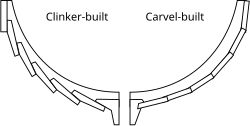
สร้างด้วยโครง
การเปรียบเทียบวิธีการต่อเรือ แบบ คลินเกอร์และ แบบ คาร์เวล
วิธีการสร้างตัวเรือ ไม้ โดยการนำแผ่นไม้มาวางชิดขอบบนโครงที่แข็งแรง ทำให้ได้พื้นผิวตัวเรือที่เรียบ โดยทั่วไปแล้วแผ่นไม้จะไม่ติดกันเอง แต่จะติดกับโครงเท่านั้น และจะมีเพียง วัสดุอุดร อยรั่วระหว่างแผ่นไม้เพื่อป้องกันการรั่วซึม[ 37 ]เปรียบเทียบกับการสร้างแบบ clinker
ปลอกหุ้ม
โครงสร้างโลหะน้ำหนักเบา ซึ่งมักมีดาดฟ้าสร้างขึ้นเหนือพื้นผิวด้านบนของตัวเรือรับแรงดันของเรือดำน้ำเพื่อสร้างพื้นผิวเรียบที่ลูกเรือสามารถเดินได้ เป็นลักษณะเฉพาะของเรือดำน้ำที่สร้างก่อนกลางศตวรรษที่ 20 แต่ไม่พบในเรือดำน้ำรุ่นใหม่กว่า
แมว
1. การเตรียมสมอหลังจากยกขึ้นโดยใช้รอกยกขึ้นไปยังหัวสมอก่อนที่จะผูก ( ยึด ) สมอไว้ข้างเรือในทะเล สมอที่ยกขึ้นถึงหัวสมอแล้วเรียกว่า "ผูกสมอ เรียบร้อยแล้ว" ( catted )  
2. แส้เก้าหาง  
3. เรือแคทโบ๊ทหรือเรือแคทโบ๊  
แส้เก้าหาง
แส้หรือกระบองสั้นที่มีหางหลายเส้นซึ่ง ต้นหน เรือ เก็บไว้ สำหรับเฆี่ยนตีลูกเรือ (และทหารในกองทัพ) ที่กระทำผิดขณะอยู่บนเรือ เมื่อไม่ได้ใช้งาน แส้นี้มักจะเก็บไว้ในถุงผ้าสักหลาด ซึ่งอาจเป็นที่มาของสำนวน "cat out of the bag" [ 52 ]สำนวน "not enough room to swing a cat" ก็มาจากสิ่งนี้เช่นกัน
คาตามารัน
เรือที่มีลำ ตัวสองลำ เปรียบเทียบกับเรือไตรมาแร
เรือแคทโบ๊ท
เรือ ใบ แบบแคทริก (Cat-rigged vessel)คือเรือใบที่มีเสากระโดงเดียวติดตั้งอยู่ใกล้หัวเรือและมีใบเรือเพียงใบเดียว โดยปกติจะเป็นใบเรือกัฟฟ์ (Gaff )
เส้นโค้งแคทเทนารี
ส่วนโค้งของโซ่สมอที่กางออก[ 53 ]
คาธาร์ปิน
เชือกสั้นหรือแคลมป์เหล็กใช้สำหรับยึดเชือกยึดเสากระโดงเรือ ให้ชิดกับ เสาเพื่อให้ใบเรือด้านข้างสามารถแกว่งได้อย่างอิสระมากขึ้น
หัวแมว
คานที่ยื่นออกมาจากตัวเรือใช้สำหรับรองรับสมอเมื่อยกขึ้นเพื่อยึดหรือ "ดึง" สมอขึ้นมา
อุ้งเท้าแมว
ลมเบาและแปรปรวนบนผืนน้ำสงบ ทำให้เกิดคลื่นขนาดเล็กกระจายอยู่เป็นบริเวณกว้าง
ยา
เพื่อสร้าง ซีล กันน้ำระหว่างโครงสร้าง ใน การก่อสร้าง แบบคาร์เวล แบบดั้งเดิม จะใช้การตอกปอก (เส้นใยเชือกรีไซเคิล) หรือสำลีอุดช่องว่างเล็กๆ ที่เรียวลงระหว่างแผ่นไม้ตัวเรือหรือดาดฟ้า และในวิธีการเก่าๆ จะใช้ยางมะตอยปิดทับ การขยายตัวของเส้นใยในน้ำจะทำให้ตัวเรือแน่นขึ้น ทำให้มีโอกาสน้อยที่จะเกิดการเคลื่อนตัวแบบบิดเบี้ยว รวมทั้งทำให้รอยต่อกันน้ำได้[ 36 ]
การนำทางด้วยดวงดาว
การนำทางโดยอาศัยตำแหน่งของวัตถุบนท้องฟ้า ได้แก่ ดาวฤกษ์ ดวงอาทิตย์ และดวงจันทร์ โดยใช้เครื่องมือบนเรือ เช่นเซ็กซ์แทนต์นาฬิกาจับเวลาและเข็มทิศ รวมถึงตารางที่ตีพิมพ์แสดงตำแหน่งที่คาดการณ์ไว้ของวัตถุบนท้องฟ้าในวันที่กำหนด การนำทางโดยอาศัยดวงดาวเป็นวิธีการนำทางหลักจนกระทั่งมีการพัฒนาระบบระบุตำแหน่งทั่วโลกแบบอิเล็กทรอนิกส์ เช่นLORANและGPS
เพดาน
แผ่นไม้ที่ติดอยู่ด้านในของโครงหรือพื้นของตัวเรือไม้ ทำหน้าที่แยกสินค้าออกจากแผ่นไม้ตัวเรือ แต่ยังมีบทบาททางโครงสร้างที่ช่วยเสริมความแข็งแรงของตัวเรือด้วย เพดานมีชื่อเรียกต่างกันไปในแต่ละที่ เช่นlimber boards , spirketting , quickworkเป็นต้น ส่วนล่างของเพดานนั้น สำหรับคนที่ไม่คุ้นเคยกับเรือ ก็คือส่วนที่คุณยืนอยู่ตรงก้นระวางของเรือไม้[ 37 ] [ 54 ] :อภิธานศัพท์
ศูนย์กลางของความพยายามภาษาอังกฤษแบบอเมริกัน
ศูนย์กลางความพยายามภาษาอังกฤษแบบบริติช
จุดกำเนิดของแรงทางอากาศพลศาสตร์สุทธิที่กระทำต่อใบเรือโดยประมาณจะอยู่บริเวณกึ่งกลางทางเรขาคณิตของใบเรือ แม้ว่าตำแหน่งที่แท้จริงของจุดศูนย์กลางของแรงจะแตกต่างกันไปตามรูปทรงของใบเรือการปรับแต่งใบเรือ หรือรูปทรงของปีกเครื่องบิน การปรับแต่งเรือ และทิศทางการแล่นเรือ
จุดศูนย์กลางของความต้านทานด้านข้าง(ภาษาอังกฤษแบบอเมริกัน)
ศูนย์กลางการต้านทานด้านข้าง(ภาษาอังกฤษแบบบริติช)
จุดกำเนิดของแรงต้านทานไฮโดรไดนามิกสุทธิบนโครงสร้างใต้น้ำของเรือ โดยเฉพาะเรือใบ จุดนี้เป็นจุดหมุนที่เรือจะหมุนรอบเมื่อมีแรงภายนอกที่ไม่สมดุลมากระทำ คล้ายกับจุดศูนย์ถ่วงในเรือใบที่สมดุลอย่างสมบูรณ์จุดศูนย์กลางของแรงกระทำจะอยู่ในแนวตั้งตรงกับจุดศูนย์กลางของแรงต้านทานด้านข้าง หากไม่เป็นเช่นนั้น เรือจะเสียสมดุลและจะแสดงอาการเอียงไปทางลมหรือไปทางน้ำและจะควบคุมได้ยาก
กระดานกลางเรือภาษาอังกฤษแบบอเมริกัน
กระดานกลางเรือภาษาอังกฤษ แบบบริติช
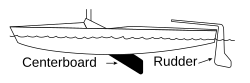
แผนภาพแสดงตำแหน่งของกระดูกงูเรือ
แผ่นไม้หรือแผ่นโลหะที่สามารถหมุนได้ผ่านช่องตามแนวยาวตรงกลางลำเรือของเรือใบ ทำหน้าที่เหมือนกระดูกงู ที่พับเก็บได้ ช่วยให้เรือต้านทานการโคลงเคลงโดยการเคลื่อนจุดศูนย์กลางแรงต้านด้านข้างพบได้ทั่วไปในเรือใบขนาดเล็กแต่ก็พบได้ในเรือขนาดใหญ่ บางลำเช่นกัน ส่วนแผ่นกระดานใต้ท้อง เรือ (Daggerboard)ทำหน้าที่เดียวกัน แต่เลื่อนขึ้นลงในแนวดิ่งแทนที่จะหมุน
เส้นกลางภาษาอังกฤษแบบอเมริกัน
เส้นกลางภาษาอังกฤษ แบบบริติช
เส้นสมมุติที่ลากลงมาตามแนวยาวของเรือ โครงสร้างหรือสิ่งของใดๆ ที่ติดตั้งหรือบรรทุกอยู่บนเรือซึ่งคร่อมเส้นนี้และอยู่ห่างจากด้านใดด้านหนึ่งของเรือเท่ากัน จะเรียกว่าอยู่ "บนเส้นกลางเรือ"
การเสียดสี
การสึกหรอของเชือกหรือใบเรือที่เกิดจากการเสียดสีกับพื้นผิวอื่นอย่างต่อเนื่อง
อุปกรณ์ป้องกันการเสียดสี
วัสดุที่ ใช้กับเส้นหรือเสาเพื่อป้องกันหรือลดการเสียดสีดูbaggywrinkleและpudden [ 44 ]
ตู้ล็อกเกอร์โซ่
ช่องว่างบริเวณส่วนหน้าของเรือ โดยทั่วไปจะอยู่ใต้หัวเรือด้านหน้าแผ่นกั้น การชนด้านหน้าสุด ซึ่งใช้สำหรับ เก็บ โซ่สมอเมื่อสมอถูกผูกไว้กับพื้นทะเล
การยิงโซ่
ลูกปืนใหญ่ที่เชื่อมต่อด้วยโซ่สั้นๆ ออกแบบมาเพื่อสร้างความเสียหายอย่างร้ายแรงต่อเชือกและเสากระโดงเรือ
แผ่นโซ่
แท่งเหล็กที่ยึดติดกับด้านข้างของเรือด้วยสลักเกลียว ซึ่งใช้ ยึดเดดอายหรือสกรูยึดของสายล่างและสายยึดด้านหลัง[ 44 ]
โซ่
แผ่นไม้หนาและกว้างที่ยื่นออกมาในแนวนอนจากด้านข้างของเรือแต่ละด้านตรงข้ามเสากระโดง (แยกแยะเป็นช่องด้านหน้า ช่องหลัก หรือช่องท้ายเรือตามลำดับ) ทำหน้าที่ขยายฐานสำหรับเชือกยึดเสากระโดง[ 44 ]
โซ่
แท่นขนาดเล็กที่สร้างขึ้นที่ด้านข้างของเรือเพื่อกางเชือกยึดเสาเรือออกเป็นมุมที่ได้เปรียบมากขึ้น นอกจากนี้ยังใช้เป็นแท่นสำหรับวัดความลึก ด้วยมือ อีก ด้วย
ชาลูป
ดูชาลูปา
ชาลูปา
1. เรือขนาดเล็กที่ทำหน้าที่เป็นเรือรับส่งผู้โดยสารทางน้ำเรือแท็กซี่น้ำหรือเรือกอนโดลา  
2. ในภาษาโปรตุเกสหมายถึงเรือขนาดเล็กที่ใช้ในการเดินเรือชายฝั่งโดยใช้ไม้พายหรือใบเรือในการขับเคลื่อน เรือที่ใช้ใบเรือจะมีเสากระโดงเดียว  
3. เรือล่าวาฬชนิดหนึ่งที่ชาวบาสก์ใช้ในกลางศตวรรษที่ 16 ในพื้นที่ซึ่งปัจจุบันคือรัฐนิวฟาวนด์แลนด์และแลบราดอร์  
เปลี่ยนทิศทาง
เพื่อ เปลี่ยนทิศทางหรือเส้นทาง
ไข้ช่องทาง
1. ความตื่นเต้นอย่างใจจดใจจ่อของลูกเรือเมื่อการเดินทางใกล้จะสิ้นสุดลง ลักษณะเด่นคือลูกเรือทำงานหนักขึ้นเพื่อให้เรือแล่นได้เร็วขึ้น พนักงานที่ไม่ได้เข้าเวรอยู่บนดาดฟ้าเพื่อติดตามความคืบหน้า และทุกคนเตรียมตัวพร้อมและสวมเสื้อผ้าสำหรับขึ้นฝั่ง (พร้อมที่จะได้รับเงินเดือน) ทันทีที่เรือเข้าเทียบท่า[ 55 ]  
2. (ความหมายที่ล้าสมัย) ลูกเรือที่หลีกเลี่ยงหน้าที่โดยแสร้งป่วย โดยปกติมักเกิดขึ้นหลังจากเรือออกจากท่าเทียบเรือแล้ว  
ชาร์ลี/ชาร์ลีย์ โนเบิล
ปล่องควันโลหะจากห้องครัวบนดาดฟ้าเรือ หรือจากเตาใน ห้องครัว บนเรือ
ชาร์รูอา
เรือใบขนาดใหญ่ที่ใช้เป็นเรือขนส่งทหาร
เรือเช่าเหมาลำ
คำที่บริษัทบริติชอีสต์อินเดีย ใช้ ตั้งแต่ศตวรรษที่ 17 ถึง 19 สำหรับเรือสินค้าที่บริษัทเช่าเหมาลำเพื่อเดินทางเที่ยวเดียว ซึ่งมักจะเป็นเที่ยวเดียว ระหว่างอังกฤษ (ต่อมาคือสหราชอาณาจักร ) และท่าเรือทางตะวันออกของแหลมกูดโฮปซึ่งเป็นการค้าที่บริษัทผูกขาดอย่างเข้มงวด เรือเช่าเหมาลำในระหว่างการเดินทางเที่ยวเดียวจะถูกใช้งานในลักษณะเดียวกับที่บริษัทเรียกว่าเรือเสริมแม้ว่าโดยปกติแล้วบริษัทจะเช่าเหมาลำเรือภายใต้เงื่อนไขพิเศษและในระยะเวลาที่สั้นกว่ามากก็ตาม[ 56 ]
ชาร์ตเฮาส์
ห้องที่ใช้ควบคุมการเดินเรือ โดยเฉพาะในกองทัพเรืออังกฤษ
เครื่องพล็อตแผนที่
อุปกรณ์อิเล็กทรอนิกส์ที่ระบุตำแหน่งของเรือ (จากเครื่องรับ GPS ) ลงบนแผนที่เดินเรือ ดิจิทัล ที่แสดงบนจอภาพ จึงทดแทนการนำทางด้วยมือทั้งหมด นอกจากนี้ เครื่องแสดงแผนที่เดินเรือยังแสดงข้อมูลที่รวบรวมจากอุปกรณ์อิเล็กทรอนิกส์บนเรือทั้งหมด และมักควบคุมระบบควบคุมการเดินเรืออัตโนมัติโดยตรง
ปืนไล่ล่า
ปืนใหญ่ที่หันไปข้างหน้าหรือข้างหลัง มักมีระยะยิงไกลกว่าปืนอื่นๆ ปืนที่อยู่หัวเรือ ( ปืนไล่ล่าหัวเรือ ) ใช้ยิงใส่เรือที่อยู่ข้างหน้า ในขณะที่ปืนที่อยู่ท้ายเรือ ( ปืนไล่ล่าท้ายเรือ ) ใช้ขับไล่เรือที่ไล่ตามมา ต่างจากปืนที่หันข้าง ปืนไล่ล่าสามารถใช้ในการไล่ล่าได้โดยไม่ต้องลดความเร็วของเรือ
ชัสส์-มาเร่
เรือใบพาณิชย์ที่มีดาดฟ้าหลายชั้น ใช้ขนส่งปลาสดจากแหล่งประมงไปยังท่าเรือในแคว้นบริตตานีระหว่างศตวรรษที่ 18 ถึงประมาณไตรมาสที่สามของศตวรรษที่ 19 เรือใบ สาม เสา เข้ามาแทนที่เรือที่เคยทำหน้าที่นี้ในตอนแรก จากนั้นเรือใบสามเสาก็ถูกแทนที่ด้วย เรือดันดีเรือบริกและเรือสกูนเนอร์ตามลำดับ
แก้ม
1. ท่อนไม้ที่ วางอยู่ข้างเสา  
2. แผ่นเหล็กหรือไม้แบนที่ยึดด้วยสลักเข้ากับส่วนบน สุดของเสา เพื่อสร้างตัวรองรับมุมสำหรับคานขวาง[ 44 ]  
3. ด้านข้างของบล็อกหรือแท่นปืน  
หัวหน้าวิศวกร
เจ้าหน้าที่วิศวกรรมอาวุโส (ย่อว่า ChEng)
จีน
1. มุมของตัวเรือ  
2. เส้นที่เกิดจากการที่ด้านข้างของเรือมาบรรจบกับท้องเรือ[ 2 ]สันเรือแบบอ่อนคือเมื่อด้านข้างทั้งสองมาบรรจบกันที่มุมตื้น และสันเรือแบบแข็งคือเมื่อด้านข้างทั้งสองมาบรรจบกันที่มุมชัน  
หนุน
รูหรือห่วงที่ติดอยู่กับตัวเรือเพื่อใช้เป็นแนวทางในการร้อยเชือกผ่านจุดนั้น; ช่องเปิดในกำแพงกันคลื่น ของเรือ ซึ่งโดยปกติจะมีรูปทรงวงรี ออกแบบมาเพื่อให้เชือกผูกเรือสามารถยึดติดกับหมุดหรือแท่งที่ติดตั้งอยู่บนดาดเรือได้ ดูเพิ่มเติมที่Panama chockและDutchman's chock
แน่นขนัด
บล็อกรอกที่แน่นมากจนไม่สามารถขันให้แน่นขึ้นได้อีก[ 2 ]
สับ
คลื่นที่เกิดจากลมมักมีขนาดเล็กกว่าและมีอายุสั้นกว่าคลื่นซัดฝั่ง
นาฬิกาจับเวลา
อุปกรณ์บอกเวลาที่มีความแม่นยำเพียงพอที่จะใช้บนเรือเพื่อกำหนดลองจิจูดโดยอาศัยการนำทางด้วยดวงดาว การประดิษฐ์นาฬิกาโครโนมิเตอร์สำหรับเรือเดินทะเลในศตวรรษที่ 18 ถือเป็นความสำเร็จทางเทคนิคครั้งสำคัญสำหรับการเดินเรือ
เรือบุหรี่
ดูเรือเร็วสิ
ป้อมปราการ
ห้องนิรภัยที่เสริมความแข็งแรงบนเรือ เพื่อใช้หลบภัยในกรณี ถูก โจรสลัดโจมตี ก่อนหน้านี้เคยเป็นห้องเสริมความแข็งแรงเพื่อป้องกันกระสุนและเครื่องจักรจากความเสียหาย
ธงแดงพลเรือน
ธงประจำกองทัพเรืออังกฤษ หรือธงประจำกองเรือพาณิชย์อังกฤษเป็นธงสีแดงที่มีธงสหราชอาณาจักรอยู่มุมบนซ้าย เรียกกันทั่วไปว่า "ธงปัดฝุ่นสีแดง"
ระดับ
1. โดยทั่วไป หมายถึง กลุ่มเรือของรัฐบาล โดยเฉพาะเรือรบ ที่มีแบบเดียวกันหรือคล้ายคลึงกัน  
2. โดยทั่วไป หมายถึง กลุ่มเรือส่วนตัวหรือเรือพาณิชย์ที่มีแบบเดียวกันหรือคล้ายคลึงกัน  
3. มาตรฐานการก่อสร้างเรือสินค้า รวมถึงมาตรฐานสำหรับประเภทเฉพาะหรือความสามารถพิเศษของเรือสินค้าบางประเภท (ดูตัวอย่างเช่นชั้นเรือสำหรับแล่นในเขตน้ำแข็ง ) เรือที่ตรงตามมาตรฐานจะอยู่ในชั้นที่กำหนดในขณะที่เรือที่ไม่ตรงตามมาตรฐานจะอยู่นอกชั้นที่กำหนด  
หัวหน้าชั้นเรียน
คำพ้องความหมายของเรือนำ
สมาคมจัดประเภท
ดูข้อมูลจากสมาคมจัดประเภทเรือ
ตรวจสุขภาพแล้วไม่มีปัญหา
ใบรับรองที่ออกโดยท่าเรือซึ่งระบุว่าเรือลำนั้นไม่มีโรคติดต่อ เรียกอีกอย่างว่าpratique
เริ่มต้นใหม่หมดจด
ขณะควบคุมเรือผู้เฝ้ายามจะบันทึกรายละเอียดต่างๆ เช่น ความเร็ว ระยะทาง ทิศทาง ฯลฯ ลงบนกระดานชนวน เมื่อเริ่มต้นเวรยามใหม่ กระดานชนวนจะถูกลบออกให้หมด
ชัดเจน
1. เพื่อดำเนินการ ตามขั้นตอนทางกฎหมาย ด้านศุลกากรและ ตรวจ คนเข้าเมืองก่อนออกจากท่าเรือ  
2. ในความหมายกว้างๆ คือ ออกจากท่าเรือ  
สตั๊ด
อุปกรณ์คงที่ที่ใช้ยึดเชือกบนเรือ[ 2 ]
กำมือแน่น
วิธีการยึดไม้สองชิ้นเข้าด้วยกัน โดยปกติจะเป็นแผ่นไม้ที่ซ้อนทับกัน โดยการตอกตะปูผ่านแผ่นไม้ทั้งสองแผ่น รวมถึงแหวนรองคล้ายหมุด จากนั้นจึงใช้ตะปูตอกทับหรือใช้หมุดย้ำเพื่อยึดให้แน่น
เบาะแส
มุมล่างมุมหนึ่งของใบเรือสี่เหลี่ยม หรือบน ใบเรือสามเหลี่ยม มุมที่ปลายคาน [ 2 ]
รอยแยก
เส้นคลีวไลน์
เชือกที่ใช้ผูกมัดมุมล่างของใบเรือสี่เหลี่ยม ใช้สำหรับลดและเก็บใบเรือบน ของเรือ บรรทุก [ 2 ]
สร้างด้วยคลินเกอร์
การเปรียบเทียบวิธีการต่อเรือ แบบ คลินเกอร์และ แบบ คาร์เวล
วิธีการสร้างตัวเรือ แบบหนึ่ง ที่ใช้แผ่นไม้และ/หรือแผ่นโลหะซ้อนทับกัน คล้ายกับเรือยาวของชาวไวกิง ทำให้เรือขนาดเล็กมีความเร็วและความยืดหยุ่น แตกต่างจากวิธี การสร้างตัวเรือแบบ คาร์เวล (carvel-built )
เครื่องตัด
1. เรือใบที่ออกแบบมาเพื่อความเร็วเป็นหลัก แม้ว่าเรือใบแบบคลิปเปอร์ที่มีเสากระโดงสี่เหลี่ยมในช่วงกลางศตวรรษที่ 19 จะเป็นที่รู้จักกันดี แต่เรือประเภทอื่น ๆ เช่นบัลติมอร์คลิปเปอร์และเรือขนส่งฝิ่น อาจมีการติดตั้งเสากระโดงที่แตกต่างกันออกไป มักจะเป็นเรือแบบสกูนเนอร์และเรือใบแบบคลิปเปอร์จำนวนเล็กน้อยในศตวรรษที่ 19 ถูกสร้างขึ้นในรูปแบบ เรือแบบ บาร์  
2. เรือใบจับปลาทูน่า  
ใกล้เรือ
ใกล้มาก (กับเรือ)
แล่นเรือในแนวดิ่ง
(ของเรือ) แล่นทวนลมให้ใกล้ที่สุดเท่าที่จะเป็นไปได้
มัดกานพลู
ส่วนที่โค้งงอใช้สำหรับผูกเชือกเข้ากับเสาหรือหลักยึดนอกจากนี้ยังใช้สำหรับผูกใบเรือหน้าให้ เสร็จด้วย [ 2 ]
การขนส่งคลับ
การที่เรือลำหนึ่งทิ้งสมอ ลงข้างหนึ่ง ด้วยความเร็วสูงเพื่อเลี้ยวอย่างฉับพลัน บางครั้งใช้เพื่อหาตำแหน่งยิงที่ดีให้กับเรือที่ไล่ตามมา ดูคำว่าkedge
ปลาปักเป้าไคลด์
เรือกลไฟสก็อตแลนด์ขนาดเล็ก แบบ เสาเดียว ใช้ถ่านหินเป็น เชื้อเพลิงสร้างขึ้นระหว่างปี 1856 ถึง 1939 โดยส่วนใหญ่ใช้ในคลองฟอร์ธและไคลด์ เรือ เหล่านี้ทำหน้าที่เป็นเรือบรรทุกสินค้าในคลองและน่านน้ำอื่นๆ ของสกอตแลนด์รวมถึงหมู่เกาะเฮบริดีสชื่อ "พัฟเฟอร์" มาจากข้อเท็จจริงที่ว่าเรือในยุคแรกๆ มีเครื่องยนต์ไอน้ำ แบบง่ายๆ ที่ไม่มีคอนเดนเซอร์ทำให้ไอน้ำ พุ่งออกมา จากปล่องควันเป็นชุดๆ ในลักษณะ "พัฟฟ์"
คอมโพสิชั่น
คอมโพสิชั่น
คำย่อของ คำว่า ผู้บังคับบัญชา
หลังคาโค้ช
ภาพภายนอกของหลังคาห้องโดยสาร ที่ดูใหญ่ โตมโหฬาร
ซากถ่านหิน
ซากเรือที่เคยใช้เก็บถ่านหิน
เครื่องตัดแต่งถ่านหิน
บุคคลที่รับผิดชอบในการตรวจสอบให้แน่ใจว่าเรือที่ใช้ถ่านหินเป็นเชื้อเพลิงยังคง " ทรงตัว " (สมดุลอย่างสม่ำเสมอ) ในขณะที่ถ่านหินถูกใช้ไปในระหว่างการเดินทาง
การถลุงถ่านหิน
การขนถ่านหินเพื่อใช้เป็นเชื้อเพลิงบนเรือกลไฟเป็นกระบวนการที่ใช้เวลานาน ยากลำบาก และสกปรก ซึ่งมักทำโดยลูกเรือทั้งหมด การขนถ่านหินเป็นสิ่งจำเป็นตั้งแต่ยุคแรก ๆ ของเรือกลไฟในศตวรรษที่ 19 จนถึงต้นศตวรรษที่ 20 เมื่อน้ำมันเข้ามาแทนที่ถ่านหินในฐานะเชื้อเพลิงที่ได้รับความนิยมสำหรับเรือกลไฟ
ขอบ
ขอบที่ยกสูงขึ้นของช่องเปิด ห้องโดยสาร หรือช่องแสง ออกแบบมาเพื่อช่วยป้องกันน้ำที่ขังอยู่บนพื้นผิวด้านบน
รถไฟเหาะ
เรือสินค้าชายฝั่ง ; เรือท้องแบนที่ใช้ในการค้าขายระหว่างสถานที่ต่างๆ บนเกาะหรือทวีปเดียวกัน
เคเบิล
เรือประมงแบบดั้งเดิมชนิดเปิดที่มีท้องแบนและหัวเรือสูง ซึ่งพัฒนาขึ้นในแถบชายฝั่งตะวันออกเฉียงเหนือของประเทศอังกฤษ
ปากไก่
เพื่อปรับมุมของเสาใบเรือสี่เหลี่ยม ให้เบี่ยงออกจากแนวราบ เพื่อไม่ให้กีดขวางการขนถ่ายสินค้า หรือเพื่อให้เรือสามารถจอดเทียบข้างเรือลำอื่นได้โดยที่เสาใบเรือไม่ชนกัน
ห้องนักบิน
บริเวณที่นั่ง (อย่าสับสนกับดาดฟ้า ) ทางด้านท้ายเรือของเรือขนาดเล็ก ซึ่งเป็นที่ตั้งของอุปกรณ์ควบคุมหางเสือ
เขื่อนชั่วคราว
ช่องว่างที่เป็นฉนวนกันความร้อนระหว่างผนังกั้นหรือพื้นดาดฟ้ากันน้ำสองชั้นภายในเรือ
ฟันเฟือง
เรือใบประเภทหนึ่งที่มีเสากระโดง เดียว และใบเรือสี่เหลี่ยม ใบเดียว พัฒนาขึ้นครั้งแรกในศตวรรษที่ 10 และใช้กันอย่างแพร่หลาย โดยเฉพาะใน ภูมิภาค ทะเลบอลติกในการค้าทางทะเลตั้งแต่ศตวรรษที่ 12 ถึง 14 มีการออกแบบตัวเรือที่โดดเด่น คือ พื้นท้องเรือแบนสร้างด้วยวิธีคาร์เวลและด้านข้างสร้างด้วยวิธีคลินเกอร์[ 57 ] : 225–227
คอยน์
ลิ่มที่ใช้ช่วยในการเล็งปืนใหญ่; เป็นคำเรียกเก่าของ "quoin"
คนงานเหมืองถ่านหิน
เรือบรรทุกสินค้าขนาดใหญ่ที่ออกแบบมาเพื่อขนส่งถ่านหิน โดยเฉพาะเรือที่ใช้ในกองทัพเรือเพื่อจัดหาถ่านหินให้กับเรือรบที่ใช้ถ่านหินเป็นเชื้อเพลิง
การโหลดต่อสู้
วิธีการบรรทุกเรือที่ช่วยให้กองกำลังทหารที่อยู่บนเรือสามารถเข้าถึงอาวุธ กระสุน และเสบียงที่จำเป็นได้ทันทีเมื่อทำการยกพลขึ้นบก ในการบรรทุกเพื่อการรบ สินค้าจะถูกจัดเก็บในลักษณะที่การขนถ่ายอุปกรณ์จะสอดคล้องกับจำนวนกำลังพลที่ขึ้นฝั่งและตามลำดับการขึ้นฝั่ง เพื่อให้พวกเขาสามารถเข้าถึงอุปกรณ์ที่จำเป็นสำหรับการรบได้ทันทีที่ขึ้นฝั่ง การบรรทุกเพื่อการรบให้ความสำคัญเป็นหลักกับความสะดวกและลำดับในการเตรียมความพร้อมของกำลังพล อุปกรณ์ และเสบียงสำหรับการรบ โดยอาจเสียสละประสิทธิภาพการใช้พื้นที่บรรทุกสินค้าที่ผู้ควบคุมเรือต้องการเมื่อบรรทุกเรือเพื่อการขนส่งกำลังพลและสินค้าตามปกติ
คอมเบอร์
คลื่นลูกยาวโค้งซัดเข้าฝั่ง
เกิดขึ้น
1. เพื่อติดตาม  
2. เพื่อเปลี่ยนทิศทาง  
3. การบังคับหัวเรือใบให้แล่นสวนลม เพื่อให้ลมเปลี่ยนทิศทางจากด้านหนึ่งของเรือไปยังอีกด้านหนึ่ง  
4. เพื่อกำหนดตำแหน่งของเรือให้สัมพันธ์กับทิศทางลมหลังจากเปลี่ยนทิศทางเรือ  
มาที่
เพื่อหยุดเรือใบ โดยเฉพาะอย่างยิ่งเมื่อแล่นทวนลม
ผู้บังคับบัญชา
นายทหารผู้บังคับบัญชาเรือรบ เรียกอีกอย่างว่า "CO", "กัปตัน" (ไม่ว่าจะมียศใดก็ตาม), "ผู้บังคับการเรือ" หรือ "ผู้อาวุโส"
คณะกรรมการ
การนำเรือรบเข้าประจำการอย่างเป็นทางการ ซึ่งหลังจากนั้นเรือลำนั้นจะเรียกว่า " เข้าประจำการ"บางครั้งอาจใช้ในความหมายที่ไม่เป็นทางการนัก เช่น การนำเรือพาณิชย์เข้าประจำการ
ธงประจำตำแหน่ง
ธงที่โบกสะบัดอยู่บนยอดเสากระโดงเรือรบเรียกอีกอย่างว่า ธงหัวเสา (masthead pennant )
พลเรือตรี
1. ( ยศ ) ก่อนปี 1997 เป็นคำที่ใช้ในราชนาวีสำหรับนายทหารยศนาวาเอกที่ได้รับมอบหมายให้บังคับบัญชาฝูงบิน ชั่วคราว เมื่อสิ้นสุดภารกิจของฝูงบิน หรือเมื่อมีพลเรือเอก อยู่ด้วย เขาจะกลับไปดำรงตำแหน่งนาวาเอกตามพฤตินัย  
2. ( ยศ ) ยศทางทหารที่ใช้ในกองทัพเรือหลายแห่ง ซึ่งสูงกว่านาวิกโยธินแต่ต่ำกว่าพลเรือตรีมักเทียบเท่ากับยศ "พลเรือเอกกองเรือ" หรือบางครั้งเรียกว่า "พลเรือเอกฝ่ายต่อต้าน" ในกองทัพเรือที่ไม่ใช้ภาษาอังกฤษ  
3. ( ผู้บัญชาการขบวนเรือ ) พลเรือนที่ได้รับมอบหมายให้ดูแลความเป็นระเบียบเรียบร้อยของเรือสินค้าในขบวนเรือของอังกฤษในช่วงสงครามโลกครั้งที่สองแต่ไม่มีอำนาจเหนือเรือรบที่คุ้มกันขบวนเรือ  
4. ( คอมโมดอร์ (สโมสรเรือยอชต์) ) เจ้าหน้าที่ของสโมสรเรือยอชต์  
5. ( นายพลเรือ (ลูกเสือทะเล) ) ตำแหน่งหนึ่งในโครงการลูกเสือทะเล ขององค์การลูกเสือ แห่งอเมริกา  
ท่อสื่อสาร
ท่อที่บรรจุอากาศ โดยปกติจะมีเกราะหุ้ม ทำหน้าที่สื่อสารระหว่างหอควบคุมและห้องควบคุมใต้ดาดฟ้าบนเรือรบ
ทางเดิน
ช่องเปิดบน ดาดฟ้าเรือที่มีหน้าต่างและยกสูงขึ้นพร้อมบันไดที่ทอดลงไปด้านล่าง และช่องทางเข้าที่มีหลังคาคลุมไปยังห้องโดยสารหลัก
ส่วนเติมเต็ม
1. จำนวนคนในลูกเรือรวมทั้งนายทหาร  
2. คำรวมที่ใช้เรียกบุคคลทั้งหมดในลูกเรือ รวมทั้งนายทหารด้วย  
ประกอบด้วย
รวมถึงหรือประกอบด้วย ในบริบทของกองกำลังเฉพาะกิจทางทะเล หมายถึง การระบุรายชื่อหน่วยทั้งหมดที่ได้รับมอบหมายเพื่อวัตถุประสงค์หรือภารกิจชั่วคราวเดียว (เช่น "กองกำลังเฉพาะกิจประกอบด้วยเรือ A เรือ B และเรือ C") คำว่า "ประกอบด้วย" หมายถึงการรวมอย่างครบถ้วน – ไม่มีส่วนอื่นใดในกองกำลังเฉพาะกิจ และเรือแต่ละลำมีสถานะเป็นกองเรือถาวรที่เป็นอิสระจากกองกำลังเฉพาะกิจ
เรือคอนกรีต
เรือที่สร้างจากเหล็กและเฟอร์โรซีเมนต์ ( คอนกรีตเสริมเหล็กชนิดหนึ่ง) แทนที่จะใช้วัสดุแบบดั้งเดิม เช่น เหล็ก เหล็กกล้า หรือไม้[ 58 ]
น้ำที่ถูกจำกัด
น่านน้ำที่มีพื้นที่จำกัดสำหรับการเคลื่อนพล
คอนน์
เพื่อสั่งการเรือหรือเรือดำน้ำจากตำแหน่งบังคับบัญชา ในขณะปฏิบัติหน้าที่นี้ นายทหารจะถูกเรียกว่ามีอำนาจควบคุม (conn )
เจ้าหน้าที่หลอกลวง
นายทหารประจำเรือรบมีหน้าที่สั่งการคนคุมหางเสือเกี่ยวกับเส้นทางการเดินเรือ ในขณะปฏิบัติหน้าที่นี้ นายทหารผู้นั้นจะถูกเรียกว่ามีอำนาจควบคุมการเดินเรือ (conn )
หอควบคุม
1. หอควบคุมหุ้มเกราะของเรือรบเหล็กหรือเหล็กกล้าที่สร้างขึ้นระหว่างกลางศตวรรษที่ 19 ถึงกลางศตวรรษที่ 20 ซึ่งใช้ควบคุมการเดินเรือในระหว่างการรบ  
2. โครงสร้างคล้ายหอคอยบนพื้นผิวด้านบน (ด้านท้ายเรือ) ของเรือดำน้ำ ซึ่งในเรือดำน้ำที่สร้างก่อนกลางศตวรรษที่ 20 ทำหน้าที่เป็นโครงสร้างเชื่อมต่อระหว่างสะพานเดินเรือและตัวเรือรับแรงดัน และเป็นที่ตั้งของอุปกรณ์และระบบควบคุมที่ใช้กล้องส่องทางไกลในการกำหนดทิศทางเรือดำน้ำและยิงตอร์ปิโดโจมตี ตั้งแต่กลางศตวรรษที่ 20 เป็นต้นมา โครงสร้างนี้ได้ถูกแทนที่ด้วยหอควบคุม (ในสหรัฐอเมริกา) หรือครีบ (ในยุโรปและเครือจักรภพ) ซึ่งมีลักษณะคล้ายกัน แต่ไม่มีบทบาทในการกำหนดทิศทางเรือดำน้ำอีกต่อไป  
คู่สมรส
เรือที่ไม่มีเครื่องยนต์ในทะเลสาบเกรตเลคส์ มักจะเป็น เรือใบสองเสา เรือบรรทุกสินค้าหรือ เรือ กลไฟ บรรทุกเต็มลำ ซึ่งถูกลากจูงโดยเรือกลไฟขนาดใหญ่กว่า ซึ่งมักจะลากเรือบรรทุกสินค้ามากกว่าหนึ่งลำ ระบบการขนส่งแบบนี้ถูกใช้ในทะเลสาบเกรตเลคส์ตั้งแต่ช่วงทศวรรษ 1860 จนถึงประมาณปี 1920
ทิศทางคงที่ ช่วงลดลง (อนุสัญญาว่าด้วยสิทธิพลเมืองและสิทธิทางเศรษฐกิจ (CBDR )
เมื่อเรือสองลำแล่นเข้าหากันจากมุมใดๆ และมุมนี้ยังคงเท่าเดิมตลอดเวลา ( ทิศทาง คงที่ ) แสดงว่าเรือทั้งสองลำกำลังแล่นเข้าหากันในเส้นทางที่จะชนกัน เนื่องจากความหมายแฝงของการชนกัน คำว่า "ทิศทางคงที่ ระยะทางลดลง" จึงมีความหมายถึงปัญหาหรืออุปสรรคที่กำลังเข้ามา[ 59 ]
เรือบรรทุกสินค้า
เรือบรรทุกสินค้าที่บรรทุกสินค้าทั้งหมดในตู้คอนเทนเนอร์ ขนาดเท่ารถ บรรทุก
ขบวนรถ
กลุ่มเรือที่เดินทางไปด้วยกันเพื่อช่วยเหลือและปกป้องซึ่งกันและกัน
โครินเธียน
เรือยอทช์สมัคร เล่น[ 60 ] [ 61 ]
ตัวแก้ไข
อุปกรณ์ที่ใช้ในการแก้ไขเข็มทิศของเรือ เช่น โดยการแก้ไขข้อผิดพลาดที่เกิดจากผลกระทบทางแม่เหล็กของตัวเรือเหล็ก
คอร์แซร์
1. เรือโจรสลัดฝรั่งเศสโดยเฉพาะอย่างยิ่งเรือที่มาจากท่าเรือแซงต์-มาโล  
2. โจรสลัดหรือเรือโจรสลัดรับจ้างใดๆ  
3. เรือที่ใช้โดยโจรสลัดหรือเรือรับจ้าง โดยเฉพาะอย่างยิ่งเรือที่มีสัญชาติฝรั่งเศส  
4. ( คอร์แซร์ (เรือใบเล็ก) ) เรือใบเล็กแบบสามคน ขนาด 16 ฟุต (4.9 เมตร)  
คอร์เว็ตต์
1.  เรือรบใบแล่นแบบดาดฟ้าเรียบในศตวรรษที่ 17, 18 และ 19 มีปืนเรียงชั้นเดียว จัดอยู่ในลำดับรองลงมาจากเรือฟริเกตในกองทัพเรือสหรัฐฯ เรียกว่าเรือสลูปออฟวอร์ (sloop-of-war )
2. เรือรบติดอาวุธและเกราะเบาในศตวรรษที่ 20 และ 21 มีขนาดเล็กกว่าเรือฟริเกต และสามารถปฏิบัติภารกิจข้ามมหาสมุทรได้  
คอตเชล
โหลดบางส่วน[ 62 ]
หุ้มด้วยผ้าฝ้าย
เรือรบไม้พลังไอน้ำที่ได้รับการปกป้องจากกระสุนของศัตรูด้วยการเรียงก้อนฝ้ายไว้ตามข้างลำเรือ ซึ่งมักเกี่ยวข้องกับเรือรบที่ฝ่ายสมาพันธรัฐอเมริกา ใช้ ในช่วงสงครามกลางเมืองอเมริกา (ค.ศ. 1861-1865)
เคาน์เตอร์
ส่วนของท้ายเรือที่อยู่เหนือน้ำซึ่งยื่นเลยแกนหางเสือไปจนสุดเป็นแผ่นท้ายเรือ ขนาดเล็ก แผ่นท้ายเรือที่ยาวจะทำให้ความยาวของเส้นน้ำเพิ่มขึ้นเมื่อเรือเอียงจึงทำให้ความเร็วของเรือเพิ่มขึ้น ดูเพิ่มเติมที่แผ่นท้ายเรือที่ถูกตัดทอน
น้ำท่วมย้อนกลับ
การจงใจปล่อยน้ำท่วมพื้นที่ฝั่งตรงข้ามกับพื้นที่ที่ถูกน้ำท่วมไปแล้ว โดยปกติจะทำเพื่อลดระดับความลาดชัน
เรือของประเทศ
คำว่า "เรือท้องถิ่น" (Country ships) เป็นคำที่บริษัทบริติชอีสต์อินเดีย ใช้ ตั้งแต่ศตวรรษที่ 17 ถึง 19 สำหรับเรือสินค้าที่เป็นของเจ้าของท้องถิ่นทางตะวันออกของแหลมกู๊ดโฮป ซึ่งทำการค้าขายภายในพื้นที่นั้น และรวบรวมสินค้าเพื่อส่งไปยังทางตะวันตกของแหลมกู๊ดโฮปไปยังอังกฤษ (ต่อมาคือ สหราชอาณาจักร ) โดย " เรือเช่าเหมาลำ " " เรือพิเศษ " และ " เรือปกติ " ของบริษัทเรือท้องถิ่นเหล่านี้ถูกห้ามอย่างเด็ดขาดไม่ให้ทำการค้าขายทางตะวันตกของแหลมกู๊ดโฮป ซึ่งจะเป็นการละเมิดการผูกขาดการค้าขายดังกล่าวของบริษัท[ 56 ]เรือท้องถิ่นเหล่านี้ยังมีความสำคัญในการค้าฝิ่นจากอินเดียไปยังจีน จนกระทั่งถูกแทนที่ด้วยเรือเร็วขนส่งฝิ่นที่เร็วกว่า[ 63 ] : 51
คอร์ส
1. ทิศทางที่เรือกำลังแล่นไป โดยปกติจะระบุเป็นองศา  
2. ใบเรือสี่เหลี่ยมที่ต่ำที่สุดบนเสากระโดงเรือแบบสี่เหลี่ยม ยกเว้นในกรณีที่เสากระโดงนั้นเป็นเสาท้ายเรือ ในกรณีนี้ จะใช้ชื่อว่าcro'jack (cross-jack) หรือ mizzen-sail [ 64 ]   
ผ้าคลุม
1. ช่องระบายอากาศของเรือที่มีส่วนบนเป็นรูปทรงระฆัง ซึ่งสามารถหมุนเพื่อรับลมและส่งลมลงด้านล่างได้  
2. ส่วนยื่นแนวตั้งของปล่องควันเรือที่ช่วยเบี่ยงควันออกจากสะพานเดินเรือ  
คนคุมเรือ
คน คุมหางเสือ หรือลูกเรือที่ทำหน้าที่บังคับบัญชาเรือ
ประเทศ CPO
ส่วนหนึ่งของเรือรบที่ประกอบด้วยที่พักอาศัยและห้องรับประทานอาหารสำหรับนายทหารชั้นประทวน (Chief Petty OfficerหรือCPO) นั้นห้ามมิให้พลทหารชั้นผู้น้อยกว่าเข้าไป เว้นแต่จะมีภารกิจราชการ
ปู
วินช์ที่ใช้สำหรับยกแผ่นกันตกด้านข้างพร้อมกระบอกสำหรับดึงเชือกใบเรือเล็ก[ 2 ]
คนจับปู
เรือประมงที่ติดตั้งอุปกรณ์สำหรับจับปู
เรือเครน
เรือเครน
เรือที่มีเครนและมีความเชี่ยวชาญในการยกของหนัก
เหล็กเครน
อุปกรณ์โลหะที่ติดตั้งอยู่ที่ปลายเสาหัวเรือซึ่งยึด กับ เสาหน้า (หรือเสาใบเรือหน้า) เสาหลัง และเสาหัวเรือ นอกจากนี้ยังเป็นจุด ที่ยึด กับเสา หัวเรือ ด้านนอกสุดอีกด้วย [ 65 ]
เรือชน
เรือกู้ภัยฉุกเฉิน
เป็นคำที่ใช้ในสหรัฐอเมริกาเพื่ออธิบายเรือกู้ภัยความเร็วสูงทางทหารที่ใช้ปฏิบัติการนอกชายฝั่ง มีขนาดและสมรรถนะคล้ายกับเรือตอร์ปิโดติดเครื่องยนต์ ใช้สำหรับช่วยเหลือนักบินและลูกเรือของเครื่องบินที่ประสบอุบัติเหตุ
อีวานสุดเพี้ยน
เป็นศัพท์เฉพาะของกองทัพเรือสหรัฐฯ ที่ใช้เรียกการซ้อมรบของเรือดำน้ำโซเวียตหรือรัสเซียที่อยู่ใต้น้ำ โดยเรือดำน้ำเหล่านั้นจะหันกลับ 180 องศาหรือ 360 องศาอย่างกะทันหันเพื่อตรวจจับเรือดำน้ำลำอื่นที่ติดตามมา
ลูกทีม
1. บนเรือรบและเรือสินค้า ลูกเรือทุกคนที่ไม่ใช่นายทหาร  
2. สำหรับเรือสำราญที่ไม่มีลำดับชั้นการบังคับบัญชาอย่างเป็นทางการ บุคคลทั้งหมดที่ไม่ใช่กัปตันหรือผู้โดยสาร  
เรือลูกเรือ
เรือที่ออกแบบมาเพื่อขนส่งบุคลากรสนับสนุนนอกชายฝั่งและสินค้าไปยังและจากแท่นขุดเจาะนอกชายฝั่ง เช่น แท่นผลิตน้ำมัน แท่นขุดเจาะน้ำมัน เรือขุดเจาะ เรือดำน้ำ และฟาร์มกังหันลม เรียกอีกอย่างว่าเรือสนับสนุนความเร็วสูงหรือเรือขนส่งเสบียงความเร็วสูง
การจัดการลูกเรือ
บริการที่บริษัทขนส่งทางทะเลเฉพาะทางให้บริการด้านการจัดการทรัพยากรบุคคลและการจัดกำลังคนสำหรับเรือทุกประเภท รวมถึงการสรรหา การจัดส่งไปยังเรือ การจัดตารางเวลา และการฝึกอบรม ตลอดจนการจัดการและหน้าที่ด้านธุรการอย่างต่อเนื่องของลูกเรือ เช่น การจ่ายเงินเดือน การจัดการการเดินทาง ประกันภัยและแผนสุขภาพ การพัฒนาอาชีพโดยรวม และสวัสดิการประจำวัน เรียกอีกอย่างว่า การจัดหาลูกเรือ (Crewing )
ย่น
ห่วงเชือก โดยปกติจะอยู่ที่มุมของใบเรือ สำหรับยึดใบเรือเข้ากับเสามักจะเสริมด้วยห่วงโลหะ[ 2 ]
โครแจ็ค
ใบเรือสี่เหลี่ยมที่ตั้งอยู่บนคานท้ายล่างของ เรือ ใบสี่เหลี่ยมเรือใบเต็มลำหลายลำจะไม่กางใบเรือในตำแหน่งนี้ เนื่องจากจะถูกขัดขวางโดยใบเรือท้าย[ 66 ]
ข้ามเส้น
ข้ามเส้นศูนย์สูตร
ครอสทรี
ค้ำยันแนวนอนสองอันที่ปลายด้านบนของเสากระโดงเรือใบ ใช้สำหรับยึดเชือกจากเสากระโดงเรือ ตัวกระจายด้านข้างสำหรับเชือกเสากระโดงเรือ (เชือกยึดเสา) [ 2 ]
รังอีกา
เสากระโดงเรือที่สร้างขึ้นโดยมีด้านข้างและบางครั้งก็มีหลังคาเพื่อป้องกันผู้สังเกตการณ์จากสภาพอากาศ โดยทั่วไปมักสร้างโดยเรือล่าวาฬ คำนี้ยังกลายเป็นคำทั่วไปสำหรับสิ่งที่เรียกว่าเสากระโดงเรืออย่างถูกต้องอีกด้วย
เรือสำราญ
เรือโดยสารที่ใช้สำหรับการเดินทางท่องเที่ยวเพื่อความเพลิดเพลิน โดยที่การเดินทางและสิ่งอำนวยความสะดวกบนเรือเป็นจุดประสงค์หลักของประสบการณ์ เช่นเดียวกับจุดหมายปลายทางต่างๆ ระหว่างทาง การขนส่งไม่ใช่จุดประสงค์หลัก เนื่องจากเรือสำราญส่วนใหญ่จะให้บริการในเส้นทางที่นำผู้โดยสารกลับไปยังท่าเรือต้นทาง เรือสำราญแตกต่างจากเรือโดยสาร ประจำ ทาง ซึ่งเป็นเรือโดยสารที่ให้บริการตามตารางเวลาที่กำหนดไว้ระหว่างท่าเรือต่างๆ โดยมีจุดประสงค์หลักเพื่อการขนส่ง เรือโดยสารขนาดใหญ่และหรูหราที่ใช้เพื่อวัตถุประสงค์ใดวัตถุประสงค์หนึ่งบางครั้งเรียกว่า เรือ เดินสมุทร
เรือลาดตระเวน
1. ตั้งแต่กลางศตวรรษที่ 19 ถึงกลางศตวรรษที่ 20 เรือลาดตระเวนเป็นการจัดประเภทเรือรบหลากหลายประเภทที่ติดตั้งปืนใหญ่และบางครั้งก็ ติดตั้ง ตอร์ปิโดโดยปกติแล้วจะเป็นเรือหุ้มเกราะ แต่ก็ไม่เสมอไป มีจุดประสงค์เพื่อลาดตระเวน โจมตี หรือคุ้มครองการค้าอย่างอิสระ บางลำถูกออกแบบมาเพื่อสนับสนุนกองเรือรบโดยตรงด้วย เรือลาดตระเวนทำหน้าที่ที่ก่อนหน้านี้เคยทำโดยเรือลาดตระเวน (เรือฟริเกตและเรือสลูป) ในยุคเรือใบ  
2. ตั้งแต่ต้นศตวรรษที่ 20 ถึงกลางศตวรรษที่ 20 เรือรบหุ้มเกราะประเภทหนึ่งที่มีอาวุธยุทโธปกรณ์และขนาดต่างๆ กัน แต่มีขนาดเล็กกว่าเรือประจัญบานและใหญ่กว่าเรือพิฆาต เสมอ สามารถให้การสนับสนุนโดยตรงแก่กองเรือประจัญบานและปฏิบัติการได้อย่างอิสระ ติดตั้งปืนใหญ่และบางครั้งก็ติดตั้งตอร์ปิโด  
3. หลังกลางศตวรรษที่ 20 เรือรบขนาดกลางประเภทต่างๆ ที่ติดตั้งขีปนาวุธนำวิถี และบางครั้งก็มีปืนใหญ่ ถูกสร้างขึ้นเพื่อป้องกันภัยทางอากาศแก่เรือบรรทุกเครื่องบินและกองกำลังเฉพาะกิจที่เกี่ยวข้อง หรือเพื่อโจมตีด้วยขีปนาวุธต่อต้านเรือต่อกองกำลังดังกล่าว โดยแทบจะแยกไม่ออกจากเรือพิฆาตขนาดใหญ่ตั้งแต่ปลายศตวรรษที่ 20 เป็นต้นมา  
4. เรือยอชต์ที่มีห้องโดยสารอย่างน้อยหนึ่งห้องซึ่งมีสิ่งอำนวยความสะดวกสำหรับการอยู่อาศัยบนเรือ จึงสามารถเดินทางไกลได้  
ไม้ค้ำยัน
หมุดโลหะรูปตัว Y ใช้สำหรับยึดไม้พายขณะพายเรือ
คัดดี้
ห้องโดยสารขนาดเล็กในเรือ; ห้องโดยสารสำหรับกัปตันใช้ในส่วนท้ายของเรือใบ ใต้ดาดฟ้าท้ายเรือ
คันนิงแฮม
เส้นที่คิดค้นโดยBriggs Cunninghamใช้เพื่อควบคุมรูปทรงของใบเรือ[ 67 ]
การต่อเชื่อมช่องคลอด
การต่อเชือกสองเส้นเข้าด้วยกัน คล้ายกับการต่อแบบห่วง โดยปลายเชือกแต่ละด้านจะต่อเข้ากับอีกด้านหนึ่งในระยะสั้นๆ ทำให้เกิดช่องเปิดที่ปิดลงเมื่อดึงให้ตึง
ช่องคลอด
ร่องระหว่างเส้นใยของเชือกหรือสายเคเบิล ก่อนที่จะทำการเสริมความแข็งแรงให้กับส่วนของเชือกที่ถักทอไว้ เช่น เพื่อป้องกันการเสียดสีอาจทำการ "เสริมความแข็งแรง" โดยการวางเส้นใยลงในร่องเพื่อให้ส่วนนั้นมีรูปทรงกระบอกที่สม่ำเสมอ
ตัดแล้วหนี
เมื่อต้องการหลบหนีอย่างรวดเร็ว เรืออาจตัดเชือกที่ผูกใบเรือหรือสายเคเบิลของสมอเรือ ทำให้เกิดความเสียหายต่ออุปกรณ์บนเรือ หรืออาจทำให้สมอเรือหลุดหายไป แต่การทำเช่นนี้จะช่วยลดเวลาที่ต้องใช้ในการเตรียมพร้อมลงได้เนื่องจากไม่ต้องปฏิบัติตามขั้นตอนที่ถูกต้อง
ตัดปากของเขาออก
"รูปทรง" ของใบเรือหมายถึงรูปร่างของมัน เนื่องจากรูปทรงนี้มักจะแตกต่างกันไปในแต่ละเรือ จึงสามารถใช้ในการระบุเรือที่คุ้นเคยจากระยะไกล และใช้ในการประเมินคุณสมบัติการเดินเรือที่เป็นไปได้ของเรือที่ไม่รู้จัก ในช่วงศตวรรษที่ 16 และ 17 เรือของชาติต่างๆ ใช้ใบเรือหน้า (jib)ที่มีลักษณะเฉพาะที่มองเห็นได้จากระยะไกล ทำให้สามารถแยกแยะมิตรจากศัตรูได้อย่างง่ายดาย[ 68 ]นอกจากนี้ยังใช้ในเชิงเปรียบเทียบกับผู้คนด้วย[ 69 ]
คัตเตอร์
การติดตั้งเสากระโดง เรือคัตเตอร์ทั่วไป: เสากระโดงหนึ่งต้นที่ติดตั้งใบเรือหลักแบบหน้า-หลัง (A) และใบเรือหน้า ( ใบเรือหน้าเสริม ) (B) คันธนู (C) ใบเรือหน้า (D) และใบเรือหน้าลอย (E)
1. เรือใบที่กำหนดโดยระบบใบเรือ ในน่านน้ำยุโรป หมายถึงเรือใบเสาเดียวแบบตั้งฉากกับท้ายเรือ ที่มี ใบเรือหน้าสองใบขึ้นไปในน่านน้ำอเมริกาเหนือ คำจำกัดความยังพิจารณาด้วยว่าคันธนูยึดติดอยู่กับที่อย่างถาวรหรือไม่ และยังคำนึงถึงตำแหน่งของเสาเรือด้วย คันธนูที่ยึดติดอยู่กับที่อย่างถาวรและตำแหน่งเสาเรืออยู่ด้านหน้า แต่มีใบเรือหน้าสองใบขึ้นไป จะจัดเป็นเรือสลูปตามคำจำกัดความของอเมริกาเหนือ ส่วนคันธนูที่เคลื่อนที่ได้ เสาหน้า (ที่รับใบเรือสเตย์เซล) ที่ยึดติดกับหัวเรือ ใบจิบที่กางออก และตำแหน่งเสาเรือที่อยู่ด้านท้ายเรือมากกว่า จะจัดเป็นเรือคัตเตอร์  
2. เรือเล็กชนิดหนึ่งที่ใช้พลังงานจากใบเรือหรือไม้พาย แต่เหมาะกับการใช้ใบเรือมากกว่าเรือเล็กประเภทอื่นๆ  
3. เรือขนาดเล็กหรือขนาดกลางที่หน่วยงานของรัฐหรือหน่วยงานบังคับใช้กฎหมายใช้ในการปฏิบัติอำนาจหน้าที่อย่างเป็นทางการ เช่นเรือนำร่องท่าเรือ เรือตรวจการณ์ชายฝั่งของสหรัฐฯและเรือตรวจการณ์ของสำนักงานตรวจคนเข้าเมืองของสหราชอาณาจักร  
4. เรือใบแบบมีดาดฟ้าชนิดหนึ่ง ซึ่งมีต้นกำเนิดในต้นศตวรรษที่ 18 ออกแบบมาเพื่อความเร็ว เรือประเภทนี้หลายลำถูกใช้เป็นเรือรบ ขนาดเล็ก เดิมที คำว่า "คัตเตอร์"หมายถึงเฉพาะชนิดของตัวเรือแต่ต่อมาได้หมายถึงระบบใบเรือซึ่งเป็นเรือเสา เดียว ที่มีทั้งใบเรือแบบหน้า-หลังและใบเรือสี่เหลี่ยม ระบบใบเรือของคัตเตอร์มีพื้นที่ใบเรือขนาดใหญ่มาก เหมาะสำหรับใช้ในสภาพลมเบา  
การตัดออก
การโจมตีแบบฉับพลันโดยเรือเล็ก มักเกิดขึ้นในเวลากลางคืน ต่อเรือที่จอดทอดสมออยู่ โดยลูกเรือบนเรือเล็กจะขึ้นไปบนเรือและยึดหรือทำลายเรือเป้าหมาย การโจมตีแบบฉับพลันนี้ได้รับความนิยมในช่วงปลายศตวรรษที่ 18 และถูกนำมาใช้อย่างกว้างขวางในสงครามนโปเลียนการโจมตีแบบฉับพลันยังคงถูกใช้ในกลางศตวรรษที่ 19 ในความขัดแย้งต่างๆ เช่นสงครามเม็กซิโก-อเมริกาและสงครามกลางเมืองอเมริกา
คัทวอเตอร์
ส่วนโค้งด้านหน้าของหัวเรือ

สารบัญ: ด้านบน 

เอ

บี

ซี

ดี

อี

เอฟ

จี

ชม

ฉัน

เจ

เค

แอล

เอ็ม

เอ็น

โอ

พี

คิว

อาร์

เอส

ที

ยู

วี

X

วาย

ดูเพิ่มเติม

เอกสารอ้างอิง

ดี

กระดานมีด
แผ่นกระดูกงูเรือชนิดหนึ่งที่มีน้ำหนักเบา สามารถยกขึ้นในแนวตั้งได้ บางครั้งอาจใช้เป็นคู่ โดย แผ่น ที่อยู่ด้านท้ายลมจะถูกลดลงเมื่อแล่นเรือทวนลม
แดน
ดาน-บอย
ทุ่นเครื่องหมายชั่วคราวประกอบด้วยเสายาวที่มีธงและ/หรือไฟอยู่ด้านบน และด้านล่างมีทุ่นและตุ้มถ่วงน้ำหนักเพื่อให้ลอยตัวในแนวตั้ง อาจใช้โดยมีหรือไม่มีสมอเพื่อยึดติดกับพื้นทะเล ในการใช้งานทางทะเล มักใช้เพื่อทำเครื่องหมายร่องน้ำที่กวาดล้างทุ่นระเบิด ในการใช้งานอื่นๆ อาจใช้ทำเครื่องหมายอุปกรณ์ประมง (อวนหรือกระชัง) สมอเรือ หรือที่พบได้บ่อยที่สุดคือ ติดกับห่วงชูชีพเพื่อโยนลงทะเลเพื่อทำเครื่องหมายตำแหน่งของคนตกน้ำ[ 70 ] [ 24 ]
แดนดี้
1. แท่นที่มีใบเรือท้าย เล็ก อยู่ด้านหลังเสาบังคับทิศทาง[ 2 ]  
2. ในภาษาพูดของอังกฤษ อีกชื่อหนึ่งของเรือใบแบบยอว์ล (yawl )  
3. ในภาษาพูดของอังกฤษ หมายถึง ใบเรือท้ายขนาดเล็กของเรือใบแบบยาว (yawl)  
แดนเลเยอร์
เรือวางทุ่นระเบิด ซึ่งโดยทั่วไปเป็น เรือประมงขนาดเล็กที่ดัดแปลงสำหรับวางทุ่นระเบิดเรือวางทุ่นระเบิดเหล่านี้ทำหน้าที่เป็นส่วนหนึ่งของกองเรือกวาดทุ่นระเบิด ในช่วงและหลังสงครามโลกครั้งที่สอง (ค.ศ. 1939–1945)
โผ
วิ่งเร็วเหมือนลูกดอก; วิ่งตายตามลม[ 2 ]
ดาวิต
1. เสาที่เคยใช้บนเรือเป็นเครนสำหรับยกปลายสมอขึ้นไปไว้บนหัวเรือโดยไม่ทำให้ด้านข้างของเรือเสียหาย  
2. เครน ซึ่งมักทำงานเป็นคู่และโดยทั่วไปทำจากเหล็ก ใช้สำหรับหย่อนสิ่งของลงจากข้างเรือ รวมถึงเรือชูชีพ  
ห้องล็อกเกอร์ของเดวี่ โจนส์
สำนวนที่หมายถึงก้นทะเล
สัญญาณไฟกลางวัน
โครงสร้างคงที่ที่ไม่มีไฟส่องสว่าง ติดตั้งป้ายสำหรับระบุตำแหน่งในเวลากลางวัน
ช่วงเวลารุ่งอรุณที่ผู้สังเกตการณ์จากจุดใดจุดหนึ่งบนเสากระโดงเรือสามารถมองเห็นเหนือหมอกต่ำที่ปกคลุมรอบเรือได้
เดย์บอร์ด
สัญลักษณ์แสดงตำแหน่งในเวลากลางวันของอุปกรณ์ช่วยนำทางซึ่งแสดงรูปทรงมาตรฐาน (สี่เหลี่ยมจัตุรัส สามเหลี่ยม หรือสี่เหลี่ยมผืนผ้า) และสี (แดง เขียว ขาว ส้ม เหลือง หรือดำ) อย่างใดอย่างหนึ่ง
เรือท่องเที่ยวรายวัน
1. เรือใบที่ไม่มีที่พักค้างคืน บางครั้งมีห้องโดยสารขนาดเล็ก ใช้สำหรับการล่องเรือเพื่อความเพลิดเพลิน โดยทั่วไปมีความยาวประมาณ 20 ฟุต (6.1 เมตร) [ 70 ]   
2. (สหรัฐอเมริกา): เรือกลไฟที่สร้างขึ้นเพื่อให้บริการในเวลากลางวัน ตรงข้ามกับ เรือกลไฟ สำหรับกลางคืน  
ตรงหน้า
ตรงไปข้างหน้าพอดี; ตรงไปข้างหน้า; อยู่ตรงหน้า
ม้าตาย
หนี้ที่ค้างชำระสำหรับการชำระเงินล่วงหน้า[ 51 ] พิธี " เฆี่ยนม้าที่ตายแล้ว " ในทะเลเป็นการเฉลิมฉลองการปลดหนี้
ตายสนิท
ไม่เคลื่อนที่ (ใช้เฉพาะเมื่อเรือลอยอยู่และไม่ได้ผูกหรือทอดสมอ) กองทัพเรือสหรัฐฯใช้คำย่อว่า DIW มักใช้เพื่อบ่งชี้ว่าเรือโจรสลัดหรือเรือขนยาเสพติดถูกทำให้เคลื่อนที่ไม่ได้แล้ว
วิ่งตาย
ดูการวิ่ง
ช้ามาก
ดู ที่ ทางเดินเรือ
ปลุกคนตาย
ร่องรอยของการรบกวนที่ค่อยๆ จางหายไปในน้ำ ดูเพิ่มเติมที่wake
สายตาแม่น
บล็อกไม้ที่มีรูสามรู (แต่ไม่มีรอก) ต่อเข้ากับเชือกยึดใช้สำหรับปรับความตึงของเชือกยึดใบเรือของเรือใบขนาดใหญ่ โดยการร้อยเชือกผ่านรูไปยังดาดฟ้า ทำหน้าที่เหมือนกับตัวปรับความตึงเชือก[ 2 ]
หัวตาย
ปัญหาติดขัด
แสงมรณะ
บานประตูหรือช่องเปิดที่แข็งแรง สามารถปิดได้ในสภาพอากาศเลวร้าย
การคำนวณโดยประมาณ
วิธีการนำทางที่ประมาณตำแหน่งของเรือจากระยะทางที่วัดได้จากบันทึกการเดินเรือและเส้นทางที่บังคับเรือ หากมีการแก้ไขปัจจัยต่างๆ เช่น น้ำขึ้นน้ำลงและการเบี่ยงเบนทิศทาง จะได้ตำแหน่งโดยประมาณ[ 71 ] การคำนวณตำแหน่ง โดยประมาณ (Dead reckoning) แตกต่างจากการกำหนดตำแหน่งด้วยการนำทางทางดาราศาสตร์หรือการนำทางด้วยดาวเทียม แหล่งข้อมูลบางแห่งถือว่าตำแหน่งที่คำนวณโดยประมาณนั้นรวมถึงการปรับค่าสำหรับลมและน้ำขึ้นน้ำลงด้วย ดังนั้นจึงต้องระมัดระวังในการตีความคำนี้[ 72 ]
มุมตาย
มุมของ พื้นผิว ตัวเรือเมื่อเทียบกับแนวนอน วัดจากด้านใดด้านหนึ่งของกระดูกงูบนเส้นที่ลากไปยังส่วนโค้งของท้องเรือหากไม่มีคำคุณศัพท์อื่นใด จะวัดที่หน้าตัดกลางลำเรือ สามารถแสดงเป็นองศาหรือบางครั้งเป็นการวัดเชิงเส้นแนวตั้ง (เช่น นิ้ว) ที่ระยะมาตรฐานจากกระดูกงู ตัวเรือที่มีมุมยกตัวมากจะมีรูปทรง "V" ที่ชัดเจนที่ด้านล่างของตัวเรือ ในขณะที่ไม่มีมุมยกตัวหมายถึงด้านข้างที่เรียบและตัวเรือท้องแบน โดยปกติจะถือเป็นหนึ่งในหลายๆ การวัด "ความคม" ของตัวเรือ อาจเรียกได้ว่า "ความชันของพื้น " [ 73 ]
ไม้ตาย
ในตัวเรือไม้แบบดั้งเดิม บล็อกไม้บนส่วนบนของกระดูกงูจะสร้างรูปทรงของตัวเรือในกรณีที่ส่วนตัดขวางแคบเกินไปสำหรับวิธีการก่อสร้างที่ใช้ที่อื่น มักจะใช้ด้านหน้าของเสาท้ายเรือ[ 36 ]
รายชื่อผู้เสียชีวิต
ในเรือใบที่มีกระดูกงู การหันหัวเรือไปทางทิศเหนือ จะทำให้ เสาใบสปินเนเกอร์จุ่มน้ำ และทำให้บูมและใบเรือหลักพลิกคว่ำอย่างรวดเร็วกวาดไปทั่วดาดเรือแล้วพุ่งลงไปในน้ำ ส่วนการพลิกคว่ำแบบมรณะ (Death Roll) นั้น เรือจะเอียงไปมาจนค่อยๆ ไม่มั่นคงมากขึ้นเรื่อยๆ จนกระทั่งพลิคว่ำหรือกัปตันเรือสามารถตอบสนองได้อย่างถูกต้องเพื่อป้องกันไม่ให้เกิดเหตุการณ์นั้นขึ้น
การห้ามเข้าประเทศ
กระบวนการออกจากเรือหรือเครื่องบิน หรือการขนย้ายสินค้าออกจากเรือหรือเครื่องบิน
หักล้าง
กระบวนการกำจัดเชื้อเพลิงออกจากเรือ หลังเรืออับปาง จะมีการดำเนินการ "การถ่ายเชื้อเพลิงออกจากเรือ" เพื่อลดความเสียหายและปกป้องสิ่งแวดล้อมจากการรั่วไหลของเชื้อเพลิง
ดาดฟ้า
1. ส่วนบนสุดของเรือหรือยานพาหนะทางน้ำ พื้นผิวที่ถูกตัดออกเพื่อใช้เป็นพื้นที่สำหรับที่นั่ง  
2. โครงสร้างใดๆ ที่ประกอบเป็นพื้นผิวแนวนอนโดยประมาณในโครงสร้างโดยรวมของเรือ ซึ่งแตกต่างจากแผ่นพื้นตรงที่โครงสร้างเหล่านี้เป็นส่วนประกอบโครงสร้างของเรือ  
ปืนใหญ่ประจำดาดฟ้า
ปืนใหญ่ที่ติดตั้งบนดาดฟ้าเรือดำน้ำสำหรับใช้ในการรบบนผิวน้ำ ปืนใหญ่ชนิดนี้พบได้ทั่วไปในเรือดำน้ำช่วงครึ่งแรกของศตวรรษที่ 20 แต่ก็ล้าสมัยไปเมื่อเรือดำน้ำสามารถปฏิบัติการใต้น้ำได้อย่างต่อเนื่องหลังสงครามโลกครั้งที่ 2
ลูกเรือ
บุคคลที่มีหน้าที่ช่วยเหลือหัวหน้างานบนดาดฟ้าเรือในการผูกและถอนสมอเรือ การทอดสมอ การบำรุงรักษา และการปฏิบัติงานทั่วไปบนดาดฟ้าเรือ
หัวหน้างานดาดฟ้า
บุคคลที่รับผิดชอบการปฏิบัติงานและการบำรุงรักษาทั้งหมดบนดาดฟ้าเรือ บางครั้งอาจแบ่งออกเป็นสองกลุ่ม ได้แก่ หัวหน้างานดาดฟ้าด้านหน้า และหัวหน้างานดาดฟ้าด้านท้ายเรือ
หัวดาดฟ้า
ส่วนใต้ของดาดฟ้าด้านบน ภายในเรือโดยปกติจะปิดด้วยแผ่นไม้เพื่อซ่อนโครงสร้าง ท่อ และสายไฟ อาจเป็นแผ่นไม้บางๆ ซึ่งมักหุ้มด้วยแผ่นไวนิล หรือแผ่นพีวีซีบางๆ หรือปัจจุบันอาจใช้แผ่นไฟเบอร์กลาสก็ได้
ดาดฟ้า
ห้องโดยสารที่ ยื่นออกมาเหนือพื้น ดาดฟ้าเรือ
ดาดฟ้าเรือที่เต็มไปด้วยน้ำ
สถานการณ์ที่ดาดฟ้าเรือจมอยู่ใต้น้ำบางส่วนหรือทั้งหมด อาจเป็นผลมาจากการเอียง มากเกินไป หรือการสูญเสียแรงลอยตัว
ปลดประจำการ
การปลดประจำการเรือรบอย่างเป็นทางการ ซึ่งหลังจากนั้นเรือลำนั้นจะถูกเรียกว่าหมดสภาพการใช้งานหรือปลดประจำการบางครั้งอาจใช้ในความหมายที่ไม่เป็นทางการนักเพื่อหมายถึงการปลดประจำการเรือพาณิชย์
การล้างสนามแม่เหล็ก
กระบวนการลดสัญญาณแม่เหล็กของเรือรบ
ค่าปรับล่าช้า
ค่าธรรมเนียมที่ผู้เช่าเรือจ่ายให้กับเจ้าของเรือ หากเวลาที่ใช้ในการขนถ่ายสินค้าขึ้นหรือลงจากเรือเกินกว่าเวลาขนถ่ายสินค้าที่กำหนดไว้ในสัญญาเช่าเรือแบบเที่ยวเดียว  
เรือคลังสินค้า
เรือที่ทำหน้าที่เป็นฐานเคลื่อนที่หรือฐานประจำที่สำหรับเรือและเรือดำน้ำลำอื่น ๆ หรือที่ใช้สนับสนุนฐานทัพเรือ
ความลึกของการยึด
ระยะห่างระหว่างด้านล่างของดาดฟ้า หลัก (หรือคานรองรับ) และด้านบนของแผ่นไม้ค้ำยัน (ส่วนของเพดานที่อยู่ติดกับกระดูกงู ) วัดที่โครงกลาง เป็นหนึ่งในการวัดที่สำคัญในการคำนวณระวางบรรทุกในระบบส่วนใหญ่[ 36 ]
เดอร์ริค
อุปกรณ์ยกที่ประกอบด้วยเสาหรือคานหนึ่งต้น และแขนหรือบูมที่สามารถขยับได้อย่างอิสระที่ส่วนล่าง
การจัดส่ง
ค่าธรรมเนียมที่เจ้าของเรือจ่ายให้แก่ผู้เช่าเรือ หากเวลาที่ใช้ในการขนถ่ายสินค้าขึ้นหรือลงจากเรือน้อยกว่าเวลาขนถ่ายสินค้าที่กำหนดไว้ในสัญญาเช่าเรือแบบเที่ยวเดียว  
เรือส่งสาร
การสะกดอีกแบบหนึ่งของdispatch boat
ทำลายล้าง
เรือรบขนาดเล็กที่มีความเร็วและคล่องตัวสูงชนิดหนึ่ง ถูกนำมาใช้ในทศวรรษ 1890 เพื่อปกป้องเรือรบหลักจาก การโจมตีของ เรือตอร์ปิโดและต่อมาได้พัฒนาขนาดและขีดความสามารถจนกลายเป็นเรือรบที่มีระยะปฏิบัติการยาวนาน มีจุดประสงค์เพื่อคุ้มกันเรือขนาดใหญ่ในกองเรือ ขบวนเรือ หรือกลุ่มเรือรบ และป้องกันเรือเหล่านั้นจากการโจมตีของเรือดำน้ำ เรือผิวน้ำ เครื่องบิน หรือขีปนาวุธ เดิมที เรียกว่า เรือพิฆาตเรือตอร์ปิโดในศัพท์เฉพาะของกองทัพเรือสหรัฐฯ เรียกอีกอย่างว่า " ทินแคน"หรือ"สมอลล์บอย "
เรือพิฆาต
ดูเรือสนับสนุนเรือพิฆาต
เรือพิฆาตคุ้มกัน
เป็นคำที่กองทัพเรือสหรัฐฯ ใช้เรียกเรือรบขนาดเล็ก ติดอาวุธเบา สร้างขึ้นเป็นจำนวนมากในช่วงสงครามโลกครั้งที่สอง (และจำนวนน้อยลงหลังจากนั้น) มีราคาถูกกว่า แล่นช้ากว่า และติดอาวุธน้อยกว่าเรือพิฆาตแต่มีขนาดใหญ่กว่าและติดอาวุธหนักกว่าเรือคอร์เว็ตออกแบบมาเพื่อคุ้มกันขบวนเรือสินค้า เรือช่วยรบ หรือกองกำลังทางเรือลำดับที่สอง ใช้เป็นหลักในการต่อต้านเรือดำน้ำ แต่ก็ใช้เพื่อป้องกันเครื่องบินและเรือผิวน้ำขนาดเล็กด้วย โดยทั่วไปเรียกว่าเรือฟริเกตในกองทัพเรืออื่นๆ และกองทัพเรือสหรัฐฯ ก็เรียกเช่นนั้นเช่นกันในช่วงทศวรรษ 1970
ผู้นำผู้ทำลายล้าง
เรือพิฆาตขนาดใหญ่ที่เหมาะสมสำหรับการบัญชาการกองเรือ พิฆาตหรือเรือรบขนาดเล็กอื่นๆ เป็น เรือนำกองเรือประเภทหนึ่ง
เรือพิฆาตสนับสนุน
เรือช่วยรบของกองทัพเรือที่ออกแบบมาเพื่อสนับสนุนการบำรุงรักษากองเรือพิฆาตหรือเรือรบขนาดเล็กอื่นๆ ในภาษาอังกฤษแบบบริติชเรียกว่าเรือสนับสนุนการบำรุงรักษาเรือพิฆาต (destroyer depot ship )
ตะเข็บปีศาจ
คำว่า "ปีศาจ" อาจเป็นคำสแลงที่หมายถึงรอยต่อระหว่างแผ่นไม้ด้านล่างของเรือ ดังนั้นวลี " ระหว่างปีศาจกับทะเลสีคราม " จึงเป็นการเปรียบเทียบถึงการลากกระดูกงูเรือ แต่ความหมายที่นิยมมากกว่าดูเหมือนจะเป็นรอยต่อระหว่างทางน้ำกับเสาหลักซึ่งเข้าถึงได้ยาก ต้องใช้เหล็กงัดยาแนวที่งอได้ และต้องจำกัดการเหวี่ยงค้อนยาแนวด้วย
ปีศาจต้องชดใช้
การ "จ่าย" ให้กับปีศาจก็คือการอุดรอยต่อของปีศาจนั่นเอง มันเป็นงานที่ยากและไม่น่าพึงพอใจ (โดยไม่มีทรัพยากร) เนื่องจากรูปทรงของรอยต่อ (ติดกับเสาหลัก) หรือถ้าปีศาจหมายถึงรอยต่อใต้ท้องเรือ ก็จะต้องทำในขณะที่เรือจอดนิ่งหรือเอียงอยู่
กรงเล็บปีศาจ
อุปกรณ์ล็อกโซ่ชนิดหนึ่ง มักใช้เพื่อยึดสมอเรือให้แน่นในท่อสมอประกอบด้วยตะขอสองง่ามที่เกี่ยวเข้ากับข้อโซ่ตัวปรับความตึงและโซ่สั้นที่ยึดติดกับจุดที่แข็งแรง
ดะห์ว
ชื่อเรียกทั่วไปของเรือใบแบบดั้งเดิมหลายประเภทที่มีเสากระโดงเรือหนึ่งต้นหรือมากกว่านั้น ใช้ ใบเรือแบบแลตีนในบริเวณทะเลแดงและมหาสมุทรอินเดีย โดยทั่วไปมีน้ำหนัก 300 ถึง 500 ตัน มีลำตัวยาวและแคบ เรือเหล่านี้เป็นเรือค้าขายที่ใช้ขนส่งสินค้าหนักเป็นหลัก เช่น ผลไม้ น้ำจืด หรือสินค้าอื่นๆ ลูกเรือมีจำนวนตั้งแต่ประมาณสามสิบถึงสิบสองคน ขึ้นอยู่กับขนาดของเรือ
เพชร
แท่งแก้วทรงปริซึมที่วางไว้ระหว่างแผ่นไม้พื้นระเบียงเพื่อให้แสงธรรมชาติส่องลงมาด้านล่างนั้น ถูกเรียกว่า "เพชร" เนื่องจากประกายระยิบระยับที่มันเปล่งออกมาเมื่อกระทบกับแสงแดด
เรือเล็ก
1. เรือขนาดเล็กชนิดหนึ่ง มักถูกบรรทุกหรือลากจูงโดยเรือขนาดใหญ่กว่า เพื่อใช้เป็น เรือเล็กประจำเรือ  
2. เรือใบแข่งขนาดเล็ก หรือเรือใบเปิดโล่งสำหรับพักผ่อนหย่อนใจ มักใช้สำหรับการฝึกหัดของผู้เริ่มต้น มากกว่าการแล่นเรือใบขนาดใหญ่  
3. เรืออเนกประสงค์มักจะเป็นเรือพายหรือมีเครื่องยนต์ติดท้าย แต่บางลำก็ดัดแปลงสำหรับแล่นเรือใบ  
จุ่มตา
จุ่มตา
วิธีการผูก เชือก มากกว่าหนึ่ง เส้นเข้ากับ เสาหลักเดียวกันเพื่อให้สามารถยกเชือกแต่ละเส้นขึ้นได้โดยไม่รบกวนเชือกเส้นอื่น โดยเชือกเส้นที่สองจะลอดใต้เชือกเส้นแรก จากนั้นลอดขึ้นผ่านรูของเชือกเส้นแรก (จึงเป็นที่มาของชื่อ) ก่อนที่จะผูกยึดไว้กับเสาหลัก
การชักธงลง
วิธีการแสดงความเคารพในทะเลโดยการลดและชักธงของเรือขึ้นลง
แสงส่องทิศทาง
ไฟที่ส่องสว่างเฉพาะส่วนหรือมุมแคบมาก และมีจุดประสงค์เพื่อระบุทิศทางที่จะต้องเดินตาม
ลงจากเรือ
การลงจากเรือ
เรือส่งกำลัง
เรือที่มีขนาดตั้งแต่เรือเล็กไปจนถึงเรือขนาดใหญ่ มีหน้าที่ขนส่งข่าวสารทางทหารจากเรือสู่เรือ จากเรือสู่ฝั่ง หรือบางครั้งก็จากฝั่งหนึ่งไปยังอีกฝั่งหนึ่ง
การเคลื่อนย้าย
น้ำหนักของน้ำที่ถูกแทนที่โดยปริมาตรส่วนที่จมอยู่ของตัวเรือ จะเท่ากับน้ำหนักของเรือทั้งลำพอดี
ตัวเรือระวางขับน้ำ
ตัวเรือได้รับการออกแบบมาเพื่อแล่นผ่านน้ำ ไม่ใช่เพื่อลอยอยู่บนผิวน้ำ
เรือใช้แล้วทิ้ง
เรือที่แทบจะไม่สามารถแล่นในทะเลได้ในศตวรรษที่ 19 สร้างขึ้นจากไม้ท่อนขนาดใหญ่ที่มัดหรือตอกเข้าด้วยกัน ออกแบบมาเพื่อเดินทางเพียงครั้งเดียวจากอเมริกาเหนือไปยังสหราชอาณาจักร แล้วก็ถูกรื้อถอนเพื่อขายไม้ ซึ่งเป็นวิธีที่ช่วยหลีกเลี่ยงภาษีสูงของอังกฤษสำหรับไม้ที่นำเข้าเป็นสินค้า เมื่อภาษีของอังกฤษสำหรับไม้ที่นำเข้าลดลง การสร้างเรือแบบใช้แล้วทิ้งก็หยุดลง
ลดอัตรา
ลดตำแหน่งหรือลำดับชั้น; ลดขั้น
เครื่องหมายที่โดดเด่น
ธงที่ใช้เพื่อแยกแยะเรือของหน่วยงานเดินเรือหนึ่งของประเทศหนึ่งๆ ออกจากเรือของหน่วยงานเดินเรืออื่นๆ ของประเทศนั้น ในกรณีที่เรือจากหน่วยงานเดินเรือมากกว่าหนึ่งแห่งของประเทศนั้นใช้ธงเดียวกัน
ถุงใส่ของจุกจิก
กระเป๋าหรือกล่องสำหรับใส่ของใช้ส่วนตัว[ 51 ]
แผนก
1. โดยเฉพาะอย่างยิ่งในช่วงปลายศตวรรษที่ 19 และต้นศตวรรษที่ 20 การจัดรูปขบวนรบถาวรของกองเรือ ซึ่งมักมีขนาดเล็กกว่ากองเรือเล็ก ได้รับการติดตั้งอุปกรณ์และฝึกฝนให้ปฏิบัติการในฐานะหน่วยทางยุทธวิธีภายใต้การบังคับบัญชาโดยรวมของหน่วยบัญชาการระดับสูงกว่า เช่น กองเรือหรือกองเรือเล็ก  
2. โดยเฉพาะอย่างยิ่งในการใช้งานสมัยใหม่ หมายถึง หน่วยบัญชาการทางเรือฝ่ายบริหาร ซึ่งมีขนาดเล็กกว่ากองเรือ และมักอยู่ภายใต้การบังคับบัญชาของกองเรือฝ่ายบริหาร มีหน้าที่รับผิดชอบด้านการจัดกำลังพล การฝึกฝน การจัดหาเสบียง และการบำรุงรักษากลุ่มเรือหรือเรือดำน้ำ แต่ไม่มีหน้าที่สั่งการปฏิบัติการในทะเล  
เจ้าหน้าที่ขนส่งประจำเขต
ในบริบทการใช้งานของอังกฤษ หมายถึงนายทหารเรือประจำฝั่งที่รับผิดชอบการปฏิบัติงานอย่างมีประสิทธิภาพของเรือขนส่งและเรือเล็กในกองเรือกองพลหรือฝูงบินที่อยู่ภายใต้การดูแลของเขา
ท่าเรือ
1. ในการใช้งานแบบอเมริกัน คำว่า "ท่าเทียบเรือ" หมายถึงโครงสร้างถาวรที่ยึดติดกับชายฝั่งซึ่งใช้สำหรับผูกเรือเมื่อจอดเทียบท่า โดยทั่วไปมีความหมายเหมือนกับคำว่า " ท่าเทียบเรือ"และ"ท่าเรือ"ยกเว้นว่า " ท่าเทียบเรือ " มักหมายถึงโครงสร้างที่ใช้สำหรับผูกเรือพาณิชย์และโครงสร้างที่ยื่นออกมาจากชายฝั่งเพื่อใช้ในการประมง ในขณะที่ " ท่าเทียบเรือ"โดยทั่วไปหมายถึงสิ่งอำนวยความสะดวกที่ใช้สำหรับผูกเรือหรือเรือเล็ก รวมถึงเรือเพื่อการพักผ่อนหย่อนใจด้วย  
2. ในบริบทการใช้งานของอังกฤษ หมายถึงผืนน้ำระหว่างท่าเทียบเรือหรือท่าจอดเรือสองแห่ง ซึ่งเป็นที่จอดเรือที่ผูกติดอยู่กับท่าเทียบเรือหรือท่าจอดเรือเหล่านั้น  
3. ผูกเรือไว้กับท่าเทียบเรือหรือท่าเรือ  
อู่ต่อเรือ
สถานที่ที่ใช้ในการสร้างและซ่อมแซมเรือหรือเรือเดินทะเล โดยทั่วไปมักใช้เป็นคำพ้องความหมายกับอู่ต่อเรือแม้ว่า บางครั้ง อู่ต่อเรือจะมีความเกี่ยวข้องใกล้ชิดกับสถานที่ที่ใช้สำหรับการซ่อมบำรุงและกิจกรรมฐานทัพ ในขณะที่อู่ต่อเรือบางครั้งก็มีความเกี่ยวข้องใกล้ชิดกับสถานที่ที่ใช้ในการก่อสร้างมากกว่า
ดอดเจอร์
ฝาครอบด้านหน้าของช่องเปิดหรือห้องนักบิน เพื่อป้องกันลูกเรือจากลมและละอองน้ำ อาจเป็นแบบอ่อนหรือแบบแข็งก็ได้
สุนัข
อุปกรณ์สำหรับล็อคประตูและช่องเปิด โดยทั่วไปใช้สำหรับช่องเปิดที่กันน้ำได้ แต่ก็สามารถใช้กับที่อื่นได้เช่นกัน วลี "ล็อคช่องเปิด" เป็นวลีที่ใช้กันทั่วไป
เฝ้าดูสุนัข
ระยะเวลา เข้าเวรสั้นลงโดยทั่วไปคือครึ่งหนึ่งของเวลาปกติ (เช่น เข้าเวรสองชั่วโมงแทนที่จะเป็นสี่ชั่วโมง) อาจมีการจัดเวรแบบนี้เพื่อสลับเวรกันในแต่ละวันเพื่อความยุติธรรม หรือเพื่อให้ผู้เข้าเวรทั้งสองคนได้พักรับประทานอาหารในเวลาปกติ
บ้านสุนัข
เป็นคำสแลง (ส่วนใหญ่ใช้ในสหรัฐอเมริกา) สำหรับส่วนที่ยกสูงขึ้นบนดาดฟ้าเรือ โดยปกติแล้วจะมีการเพิ่ม "doghouse" เพื่อเพิ่มพื้นที่เหนือศีรษะด้านล่าง หรือเพื่อเป็นที่กำบังสำหรับช่องเปิดบนดาดฟ้าเรือ
ใบพัดสุนัข
กังหันลมขนาดเล็กบางครั้งอาจทำขึ้นเองจากเศษผ้า เส้นด้าย หรือวัสดุเบาอื่นๆ ติดตั้งไว้ในตำแหน่งที่คนคุมหางเสือ มองเห็นได้ ดูคำว่า tell-tale ( กังหันลมที่บอกทิศทางลม)
ภาวะซบเซา
ร่องความกดอากาศต่ำบริเวณเส้นศูนย์สูตร โดยเฉพาะอย่างยิ่งลมที่มีน้ำหนักเบาและแปรปรวนซึ่งพบได้ทั่วไปในบริเวณนั้น[ 74 ]
รอกดอลลี่
วินช์ขนาดเล็กที่ติดตั้งบนกว้านใช้เป็นทางเลือกแทน วินช์ แบบรางเมื่อวินช์แบบรางถูกกีดขวางด้วยวิธีใดวิธีหนึ่ง (เช่น โดยสินค้าบนดาดฟ้า) [ 2 ]
ปลาโลมา
โครงสร้างที่ประกอบด้วยเสาเข็มจำนวนมากที่ตอกลงไปในพื้นทะเลหรือพื้นแม่น้ำเพื่อใช้เป็นเครื่องหมาย
โลมา สไตรเกอร์
คานที่ยื่นออกมาในแนวตั้งใต้คานหัวเรือโดยปกติจะติดอยู่กับส่วนบนของคานหัวเรือ ใช้เพื่อให้เชือกยึดเสาหลักและเชือกอื่นๆ ในระบบการเดินเรือ มีระยะการเคลื่อนที่ที่ได้เปรียบทางกลไก
เครื่องยนต์ลา
เครื่องยนต์เสริมขนาดเล็กที่ใช้เพื่อสตาร์ทเครื่องยนต์ขนาดใหญ่หรือใช้งานแยกต่างหาก เช่น สำหรับสูบน้ำบนเรือกลไฟ[ 75 ]
คนเลี้ยงลา
หนึ่งในลูกเรือฝ่ายวิศวกรรมของเรือ มักเป็นลูกเรือที่รับผิดชอบในการบำรุงรักษาเครื่องกำเนิดไฟฟ้าไอน้ำหรือเครื่องจักรอื่นๆ นอกเหนือจากเครื่องยนต์หลัก ในบางเรือ อาจเป็นนายทหารชั้นประทวนที่รับผิดชอบลูกเรือในห้องเครื่องยนต์
กล่องโดราเด
กล่องโดราเด (เรียกอีกอย่างว่า ช่องระบายอากาศโดราเด กล่องเก็บรวบรวม หรือเรียกง่ายๆ ว่า "ช่องระบายอากาศ") เป็นช่องระบายอากาศชนิดหนึ่งที่ช่วยให้อากาศไหลเข้าและออกจากห้องโดยสารหรือห้องเครื่องยนต์ของเรือได้ ในขณะเดียวกันก็ป้องกันไม่ให้ฝน ละอองน้ำ และน้ำทะเลเข้ามาภายใน
ดอรี่
เรือท้องแบน น้ำหนักเบา ยาวประมาณ 5 ถึง 7 เมตร (16 ถึง 23 ฟุต) มีผนังสูง ท้องแบน และหัวเรือ แหลม โดยทั่วไปใช้เป็นเรือประมง ทั้งในน่านน้ำชายฝั่งและในทะเลเปิด
สองชั้น
(เกี่ยวกับการจัดเรียงไม้พายบนเรือ) โดยมีคนพายสองคนนั่งบนที่นั่งขวาง แต่ละที่ โดยแต่ละคนพายไม้พายข้างละหนึ่งอัน ซึ่งแตกต่างจากแบบที่นั่งขวางเดียวที่มีคนพายเพียงคนเดียวนั่งบนที่นั่งขวางแต่ละที่ พายไม้พายข้างละหนึ่งอัน โดยไม้พายจะสลับกันระหว่างด้านซ้ายและด้านขวาตามความยาวของเรือ การจัดเรียงแบบที่สามคือมีคนพายหนึ่งคนนั่งบนที่นั่งขวางแต่ละที่ พายไม้พายสองอัน อันละข้างของเรือ[ 76 ] : 135
ดับเบิ้ลช็อต
การปฏิบัติในการบรรจุกระสุนปืนใหญ่ลำกล้องเรียบด้วยกระสุนปืนใหญ่สองลูก
เพิ่มมุมที่หัวเรือเป็นสองเท่า
เทคนิคสำหรับการกำหนดระยะทางจากจุดบนบก เช่น แหลมที่กำลังแล่นผ่าน นี่เป็นประเภทของการวัดระยะทางแบบต่อเนื่องซึ่งไม่จำเป็นต้องลงจุดบนแผนที่ เรือจะแล่นไปตามเส้นทางและความเร็วคงที่ ระยะทางที่แสดงบนบันทึกจะถูกบันทึกเมื่อ มีการวัด ระยะทางสัมพัทธ์ของจุดคงที่ และจะสังเกตการเพิ่มขึ้นของระยะทางนั้นจนกระทั่งเป็นสองเท่าของระยะทางเดิม แล้วจึงอ่านบันทึกอีกครั้ง ระยะทางที่เดินทางระหว่างระยะทางทั้งสองครั้งคือระยะทางของเรือจากจุดคงที่เมื่อวัดระยะทางครั้งที่สอง อาจมีการคำนึงถึงกระแสน้ำขึ้นลงหรือไม่ก็ได้ ขึ้นอยู่กับความแม่นยำที่ต้องการ[ 77 ] [ 70 ]
หน้าผาโดเวอร์
เป็นคำสแลงที่ใช้เรียกทะเลที่มีคลื่นลมแรงมากและมีคลื่นลูกใหญ่ปกคลุมด้วยฟองขาว
ขาลง
1. เดินทางตามกระแสน้ำ[ 78 ]  
2. การเดินทางไปทางทิศตะวันออกใน ภูมิภาค เกรตเลคส์ (คำศัพท์ที่ใช้โดยGreat Lakes St. Lawrence Seaway Development Corporation ) [ 79 ]  
น้ำท่วม
การที่น้ำไหลเข้าสู่ตัวเรือหรือโครงสร้างส่วนบนของเรือที่ไม่ได้รับความเสียหายผ่านช่องเปิดใดๆ เช่น ประตูหรือช่องหน้าต่าง ที่เปิดอยู่ ฝาปิดช่องระบายอากาศที่หลวมหรือเปิดอยู่ ช่องระบายอากาศ ฯลฯ อาจเกิดขึ้นได้เนื่องจาก การทรงตัวของเรือหากเรือเอียงหรือโคลงหรือหากเรือจมน้ำทั้งหมดหรือบางส่วน
ดาวน์ฮอล
เชือกที่ใช้ควบคุมเสา ใบเรือ หรือรูปทรงของใบเรือ เชือกดึงลง (downhaul) ยังสามารถใช้ดึงใบเรือกลับขึ้นมาบนดาดเรือได้อีกด้วย
ดราบเบลอร์
แถบผ้าใบเพิ่มเติมที่ยึดไว้ใต้หมวกเพื่อเพิ่มพื้นที่ของเส้นทางให้มากขึ้น
ร่าง
ความลึกของ กระดูกงู เรือใต้ระดับน้ำ
ลากจูง
1. เรือ ประมงลากอวน  
2. เรือขุดลอก  
เรือมังกร
เรือมังกรเป็นเรือพายแบบดั้งเดิมชนิดหนึ่งที่มีรูปทรงและขนาดหลากหลาย พบได้ทั่วเอเชีย แอฟริกา และหมู่เกาะแปซิฟิก สำหรับการแข่งขัน เรือมังกรโดยทั่วไปจะตกแต่งด้วยหัวและหางมังกรจีน การแข่งเรือมังกรเป็นประเพณีที่จัดขึ้นในช่วงเทศกาลครีษมายันประจำปี
ร่าง
เรือรบขนาดใหญ่
เรือรบแบบเดรดนอต (Dreadnought) เป็น เรือรบประเภทหนึ่งที่ออกแบบมาโดยมีรูปแบบการติดตั้งอาวุธแบบ "ปืนใหญ่ทั้งหมด" ซึ่งอำนาจการยิงหลักของเรืออยู่ที่ปืนใหญ่ชุดหลักที่ออกแบบมาเพื่อใช้ในระยะไกล ส่วนอาวุธปืนอื่นๆ จะจำกัดไว้เฉพาะอาวุธขนาดเล็กที่ใช้สำหรับการป้องกันในระยะใกล้จากเรือตอร์ปิโดและเรือรบขนาดเล็กอื่นๆ เรือรบเดรดนอตส่วนใหญ่ (แต่ไม่ใช่ทั้งหมด) ใช้ระบบขับเคลื่อนด้วยกังหันไอน้ำ เรือรบเดรดนอตซึ่งเป็นที่นิยมตั้งแต่ปี 1906 แตกต่างจากเรือรบไอน้ำรุ่นก่อนๆ ซึ่งต่อมาถูกเรียกว่า "พรีเดรดนอต" ( Predreadnought ) เนื่องจากมีปืนใหญ่เพียงไม่กี่กระบอก อาศัยปืนใหญ่ชุดรองขนาดกลางที่ใช้ในระยะใกล้เป็นหลักในการโจมตี และใช้เครื่องยนต์ไอน้ำแบบสามขั้นตอนการขยายตัว
เรือขุด
เรือที่ออกแบบมาเป็นพิเศษสำหรับการขุดค้นวัสดุจากแหล่งน้ำ และติดตั้งเครื่องจักรหนักเพื่อวัตถุประสงค์นี้
การแต่งกายโดยรวม
การ ประดับธง ตามรหัสสัญญาณสากลโดยจัดเรียงแบบสุ่ม จากหัวเรือถึงยอดเสาระหว่างยอดเสา (หากเรือมีเสามากกว่าหนึ่งต้น) และลงมาถึงท้ายเรือ ในเรือที่จอดอยู่ในท่าเรือ เป็นสัญลักษณ์ของการเฉลิมฉลองวันครบรอบ เหตุการณ์ วันหยุด หรือโอกาสสำคัญระดับชาติ ระดับท้องถิ่น หรือส่วนบุคคล เมื่อเรือประดับประดาอย่างเหมาะสมแล้วธงประจำ เรือ จะโบกสะบัดอยู่ที่ยอดเสาแต่ละต้น เว้นแต่จะถูกธงอื่น (เช่น ธงของนายทหารระดับสูงบนเรือ) แย่งตำแหน่งไป นอกเหนือจากธงประจำเรือที่โบกสะบัดในตำแหน่งปกติที่ท้ายเรือ
การแต่งกาย
1. การบำรุงรักษาใบเรือเก่าด้วยน้ำมันหรือแว็กซ์เพื่อฟื้นฟูสภาพ  
2. การตักเตือนด้วยวาจา  
แนวการแต่งตัว
เส้นเชือกที่ลากจากหัวเรือไปยังยอดเสาระหว่างยอดเสา และลงมาถึงท้ายเรือซึ่งเป็นที่ติดธงเมื่อเรือได้ รับการประดับประดา อย่างสมบูรณ์
คนเร่ร่อน
เรือประมงชนิดหนึ่งที่ออกแบบมาเพื่อจับปลาเฮอริ่ง ด้วย อวนลอยยาวซึ่งใช้กันมานานในเนเธอร์แลนด์และสหราชอาณาจักร
ดื่ม
ตกน้ำ (เช่น "มันตกลงไปในน้ำ")
คนขับ
ใบเรือขนาดใหญ่ที่กางออกจากคานท้ายเรือ
เสาขับเคลื่อน
เสาที่ห้า ของ เรือใบแบบบาร์เควนไทน์หรือเรือใบแบบกัฟฟ์สคูนเนอ ร์ที่มีหก เสา จะอยู่ถัดจากเสาจิ๊กเกอร์และถัดจากเสาสแปงเกอร์ เสาที่หกของเรือใบแบบกัฟฟ์สคูนเนอร์เพียงลำเดียวที่มีเจ็ดเสา คือเรือโทมัส ดับเบิลยู ลอว์สันมักเรียกว่าเสาพุชเชอร์
ดร็อกเกอร์
ดูเรือแบบใช้แล้วทิ้ง
ดร็อก
อุปกรณ์ที่ใช้ชะลอความเร็วของเรือในระหว่างพายุ เพื่อไม่ให้เรือแล่นเร็วเกินไปตามความชันของคลื่นและชนกับคลื่นลูกถัดไป โดยทั่วไปแล้วจะทำจากวัสดุที่แข็งแรงและยืดหยุ่นได้ในรูปทรงกรวย ดูเพิ่มเติมที่สมอทะเล
การทำงานหนัก
เทคนิคการรักษาทิศทางขณะแล่นเรือตามกระแสน้ำโดยไม่มีเครื่องยนต์หรือลมช่วย เรือจะใช้สมอเพื่อดึงหัวเรือเข้าหากระแสน้ำ จากนั้นยกสมอขึ้นและปล่อยให้เรือลอยไปตามกระแสน้ำโดยเอาท้ายเรือนำหน้า เพื่อรักษาระตำแหน่งภายในกระแสน้ำ เมื่อการควบคุมทิศทางเริ่มลดลง เรือจะทอดสมออีกครั้ง แล้วทำซ้ำขั้นตอนทั้งหมดตามความจำเป็น
อู่แห้ง
อ่างหรือภาชนะแคบๆ ที่ใช้ในการสร้าง บำรุงรักษา และซ่อมแซมเรือ เรือเล็ก และยานพาหนะทางน้ำอื่นๆ ซึ่งสามารถเติมน้ำเพื่อให้สินค้าลอยเข้าไปได้ จากนั้นจึงระบายน้ำออกเพื่อให้สินค้าไปหยุดนิ่งบนแท่นแห้ง
ท่าเรือที่กำลังแห้ง
ท่าเรือที่ระดับน้ำลดลงทั้งหมดหรือบางส่วนเมื่อน้ำลง ทำให้เรือที่จอดอยู่เกยตื้น
เรือบรรทุกขยะ
เรือท้องแบนชนิดหนึ่งที่ออกแบบมาเพื่อทิ้งขยะลงทะเล
ลังบรรจุสินค้า
1. วัสดุบรรจุภัณฑ์แบบหลวมๆ ที่ใช้เพื่อป้องกันสินค้าบนเรือจากการเสียหายระหว่างการขนส่ง ดูเพิ่มเติมที่fardage  
2. สัมภาระส่วนตัว  
เรือบรรทุกสินค้าดัตช์
เรือบรรทุกสินค้าแบบดั้งเดิมที่มีท้องเรือแบนและแล่นในน้ำตื้นหลายประเภท ซึ่งเดิมใช้สำหรับขนส่งสินค้าในทะเลซุยเดอร์ซีและแม่น้ำต่างๆ ในประเทศเนเธอร์แลนด์
ชาวดัตช์สร้าง
คำด่าที่สื่อถึงความห่วยแตก หรือ (เมื่อใช้กับบุคคล) ความโง่เขลาหรือความดื้อรั้น โดยมักจะมีการเติมคำสาปแช่งและคำดูถูกอื่นๆ ต่อท้าย

สารบัญ: ด้านบน 

เอ

บี

ซี

ดี

อี

เอฟ

จี

ชม

ฉัน

เจ

เค

แอล

เอ็ม

เอ็น

โอ

พี

คิว

อาร์

เอส

ที

ยู

วี

X

วาย

ดูเพิ่มเติม

เอกสารอ้างอิง

อี

ต่างหู
เชือกเส้นเล็กๆ ที่ใช้ยึดมุมบนสุดของใบเรือขนาดใหญ่ที่สุดเข้ากับคานเสาเรือ
เรืออินเดียตะวันออก
เรือลำใดก็ตามที่ปฏิบัติการภายใต้สัญญาเช่าหรือใบอนุญาตจากบริษัทอินเดียตะวันออก (อังกฤษ) หรือบริษัทอินเดียตะวันออกของเดนมาร์กบริษัทอินเดียตะวันออกของฝรั่งเศสบริษัทอินเดียตะวันออกของเนเธอร์แลนด์บริษัทอินเดียตะวันออกของโปรตุเกสหรือบริษัทอินเดียตะวันออกของสวีเดนตั้งแต่ศตวรรษที่ 17 ถึง 19
การวัดความลึกด้วยคลื่นเสียง
การวัดความลึกของแหล่งน้ำโดยใช้ อุปกรณ์ โซนาร์ดูเพิ่มเติมที่การวัดความลึกด้วยวิธี อื่น และการแกว่งตะกั่ว
ยื่นออกไป
สภาวะที่เรือใบ (โดยเฉพาะเรือที่แล่นทวนลม ได้ไม่ดี ) ถูกจำกัดอยู่ระหว่างแหลมหรือหัวเรือสองแห่งเนื่องจากลมพัดเข้าฝั่งโดยตรง
เอน เอเชลอน
แผนภาพแสดง เรือรบชั้น มินาส เฌเรสโดยมีปืนใหญ่ประจำตำแหน่งเรียงกันเป็นแนวเฉียง
การจัดวางป้อมปืนโดยที่ป้อมปืนด้านหนึ่งของเรือจะอยู่ค่อนไปทางท้าย เรือ มากกว่าป้อมปืนอีกด้านหนึ่ง เพื่อให้ป้อมปืนทั้งสองสามารถยิงไปยังด้านใดด้านหนึ่งก็ได้
โทรเลขคำสั่งเครื่องยนต์
อุปกรณ์สื่อสารที่นักบินใช้สั่งการวิศวกรในห้องเครื่องยนต์ให้เร่งเครื่องยนต์เรือให้ได้ความเร็วตามที่ต้องการ
ห้องเครื่องยนต์
ห้องเครื่องยนต์ห้องหนึ่งของเรือ ซึ่งโดยปกติจะเป็นห้องที่ใหญ่ที่สุด เป็นที่ตั้งของเครื่องยนต์หลักของเรือ (โดยทั่วไปคือเครื่องยนต์ดีเซลหรือไอน้ำ หรือกังหันแก๊สหรือกังหันไอน้ำ) เรือขนาดใหญ่อาจมีห้องเครื่องยนต์มากกว่าหนึ่งห้อง
ธง
1. (ธง)ธงหรือป้ายหลักที่เรือชักขึ้นเพื่อแสดงสัญชาติของเรือนั้น  
2. ( ยศ ) ยศต่ำสุดของนายทหารสัญญาบัตรในกองทัพเรือสหรัฐฯ  
พาหนะคุ้มกัน
เรือบรรทุกเครื่องบินชนิดหนึ่งมีขนาดเล็กกว่าและแล่นช้ากว่าเรือบรรทุกเครื่องบินประจำกองเรือซึ่งกองทัพเรือบางประเทศใช้ในสงครามโลกครั้งที่สองเพื่อคุ้มกันขบวนเรือ ขนส่งเครื่องบิน ปฏิบัติการต่อต้านเรือดำน้ำและให้การสนับสนุนทางอากาศสำหรับ การ ปฏิบัติการยกพลขึ้นบก
ตำแหน่งโดยประมาณ
ตำแหน่งทางภูมิศาสตร์โดยประมาณที่ได้จากการคำนึงถึงการเบี่ยงเบนจากแนวดิ่ง น้ำขึ้นน้ำลง และกระแสน้ำ เพื่อให้ได้ ตำแหน่ง โดยประมาณ (ซึ่งคำนวณจากระยะทางที่แล่นและเส้นทางที่บังคับเรือ)
เครื่องระเหย
อุปกรณ์บนเรือชิ้นหนึ่งที่ใช้ในการผลิตน้ำดื่มสะอาดจากน้ำทะเลโดยกระบวนการกลั่น
เจ้าหน้าที่บริหาร
นายทหารลำดับที่สองในเรือรบ ในสหรัฐอเมริกาเรียกว่า "XO" และในกองทัพเรืออังกฤษและกองทัพเรือเครือจักรภพเรียกว่า "Number One"
เรือด่วน
เป็นอีกคำหนึ่งที่ใช้เรียกเรือฟลายโบ๊ท ซึ่งเป็น เรือเร็วที่ใช้ในคลองในประเทศอังกฤษในช่วงทศวรรษ 1830 และ 1840
เรือลำพิเศษ
คำว่า "เรือพิเศษ" (Extra ships ) เป็นคำที่บริษัทบริติชอีสต์อินเดีย ใช้ ตั้งแต่ศตวรรษที่ 17 ถึง 19 สำหรับเรือสินค้าที่บริษัทเช่าเพื่อทำการเดินเรือระหว่างอังกฤษ (ต่อมาคือสหราชอาณาจักร ) และท่าเรือทางตะวันออกของแหลมกูดโฮปซึ่งเป็นการค้าที่บริษัทผูกขาดอย่างเข้มงวด เรือพิเศษเหล่านี้จะถูกเช่าเหมาลำสำหรับการเดินทางไปกลับเพียงครั้งเดียว โดยเริ่มในช่วงฤดูกาลเดินเรือเดียว (กันยายนถึงเมษายน) และเสริมการเดินทางของ " เรือปกติ " ซึ่งเป็นเรือสินค้าที่เช่าเหมาลำระยะยาวเพื่อทำการเดินเรือซ้ำๆ ให้กับบริษัทในหลายฤดูกาล อย่างไรก็ตาม หาก "เรือพิเศษ" ลำใดลำหนึ่งทำงานได้ดีและบริษัทต้องการใช้บริการ บริษัทมักจะเช่าเหมาลำเรือนั้นซ้ำๆ ในหลายฤดูกาล[ 56 ]
สุดขั้ว
ตามกฎจราจรทางน้ำระหว่างประเทศ ( กฎการเดินเรือ ) จุดที่เรือที่มีสิทธิ์ (หรือเรือที่รออยู่ข้างหน้า) ซึ่งกำลังแล่นอยู่ในเส้นทางที่จะชนกับเรือที่เสียเปรียบ (หรือเรือที่ต้องหลีกทาง) ตัดสินใจว่าจะต้องทำการหลบหลีกเพื่อหลีกเลี่ยงการชน ก่อนถึงจุดวิกฤต เรือที่มีสิทธิ์จะต้องรักษาเส้นทางและความเร็วไว้ และเรือที่เสียเปรียบจะต้องทำการหลบหลีกเพื่อหลีกเลี่ยงการชน
รอยต่อตา
การต่อแบบห่วงปิดหรือตาที่ปลายเชือก สาย หรือสายเคเบิล เป็นต้น ทำได้โดยการคลายปลายเชือกออกแล้วต่อเข้ากับตัวเองโดยการพันเข้าไปในเนื้อเชือกการต่อแบบ ห่วงปิด มีความแข็งแรงและกะทัดรัดมาก และมักใช้ในการผูกเรือและเชือกเทียบท่า รวมถึงการใช้งานอื่นๆ ด้วย

สารบัญ: ด้านบน 

เอ

บี

ซี

ดี

อี

เอฟ

จี

ชม

ฉัน

เจ

เค

แอล

เอ็ม

เอ็น

โอ

พี

คิว

อาร์

เอส

ที

ยู

วี

X

วาย

ดูเพิ่มเติม

เอกสารอ้างอิง

เอฟ

เรือโรงงาน
เรือเดินสมุทรขนาดใหญ่ที่มีสิ่งอำนวยความสะดวกครบครันบนเรือสำหรับการแปรรูปและแช่แข็งปลาหรือวาฬที่จับได้ บางลำยังทำหน้าที่เป็นเรือแม่สำหรับเรือประมงหรือเรือล่าวาฬขนาดเล็กกว่า เรือที่ใช้สำหรับการแปรรูปปลาเรียกอีกอย่างว่าเรือแปรรูปปลา
ยุติธรรม
1. เส้นโค้งที่เรียบเนียน ซึ่งโดยทั่วไปหมายถึงเส้นของตัวเรือที่มีการเบี่ยงเบนเฉพาะจุดน้อยที่สุด  
2. ทำให้บางสิ่งบางอย่างเรียบเสมอกัน  
3. เส้นทาง ที่ยุติธรรมคือ เส้นทางที่มีทางวิ่งโล่งสะดวก  
4. ลมหรือกระแสน้ำที่ยุติธรรมคือลมหรือกระแสน้ำที่เอื้อประโยชน์ต่อเรือ  
ขอให้ลมพัดดีและคลื่นสงบ
คำอวยพรให้ผู้รับเดินทางปลอดภัยและโชคดี
แฟร์ลีด
อุปกรณ์ที่ใช้เพื่อให้สายหรือโซ่วิ่งไปในทิศทางที่ถูกต้องหรือเพื่อให้สายหรือโซ่มีระยะนำที่เหมาะสม เพื่อป้องกันการเสียดสีหรือพันกัน[ 2 ]
แฟริ่ง
1. (คำนาม) โครงสร้างที่ช่วยเพิ่มความลื่นไหลในการเคลื่อนที่ของเรือ  
2.  (verb) The process of making a curve or structure fair.
fairwater
1.  A structure that improves the streamlining of a vessel.
2.  On submarines: The superstructure ( sail ) of the boat. The fairwater serves as a streamlined housing for the submarine's periscopes and other sensor masts, as well as the air intake, snorkel masts (if applicable). It also provides a degree of elevation above the sea, and is therefore typically equipped with a small bridge (nautical). If the submarine is equipped with a conning tower, this structure will also be located somewhere inside of the fairwater.
fairway
1.  A navigable channel (e.g., in a harbor or offshore) that is the usual course taken by vessels in the area.
2.  In military and naval terms, a channel from offshore, in a river, or in a harbor that has enough depth to accommodate the draft of large vessels.
fake
A single turn of rope in a coil or on a drum. A group of fakes is known as a tier. See also fake down.[80][24][50]:200,286
fake down
To lay a coil of rope down so that it will run easily; that is, with rope feeding off the top of the coil and the bitter end at the bottom. Often confused with flake. See also range.[24]
falkuša
A traditional fishing boat with a lateen sail on a single mast used by fishermen from the town of Komiža on the Adriatic island of Vis.
fall
The part of the tackle that is hauled upon.[2]
fall off
To change the direction of sail so as to point in a direction that is more downwind; to bring the bowleeward. This is the opposite of pointing up or heading up.
fantail
The aft end of a ship, also known as the poop deck.
fardage
Wood placed in the bottom of a ship to keep cargo dry. See also dunnage.
fashion boards
Loose boards that slide in grooves to close off a companionway or cabin entrance.[2]
fast
Fastened or held firmly (e.g. "fast aground": stuck on the seabed; or "made fast": tied securely).[2]
fast attack craft
A small, fast, agile warship armed with anti-ship missiles, guns, or torpedoes. The fast attack craft replaced the torpedo boat during the second half of the 20th century in the role of a cheap, offensively-oriented inshore warship.
fast combat support ship
The largest type of US Navy combat logistics ship, designed to serve as a combined oiler, ammunition ship, and supply ship. The first fast combat support ship entered service in the mid-1960s.
fast supply vessel
fast support vessel
fathom
1.  A unit of length equal to 6 feet (1.8 m), roughly measured as the distance between a man's outstretched hands. Particularly used in sounding as a measurement of the depth of a body of water.
2.  To measure the depth of water; to engage in sounding.
fathomer
A person engaged in sounding to determine the depth of water.
fathometer
A depth finder that uses sound waves to determine the depth of water.
favored side
The side of the course that gets you to the next mark faster, due to more wind, favorable shifts, less current, smaller waves, etc.
felucca
A traditional wooden sailing boat with a rig consisting of one or two lateen sails, used in protected waters of the Red Sea and eastern Mediterranean and particularly along the Nile in Egypt and Sudan, as well as in Iraq.
fend off
A command given to the crew to stop what they are now doing and to immediately manually prevent the boat from banging into the docks or other boats.
fender
A flexible bumper used in boating to keep boats from banging into docks or each other. Often an old car tire.[2]
ferry
A merchant ship used to carry passengers, and sometimes vehicles and cargo, across a body of water.
ferry glide
To hold a vessel against and at an angle to the current/stream such that the vessel moves sideways over the bottom due to the effect of the current operating on the upstream side of the vessel.
ferry slip
A specialized docking facility designed to receive a ferryboat or train ferry.
fetch
1.  The distance across water a wind or waves have traveled.
2.  To reach a mark without tacking.
fid
1.  A tapered wooden tool used for separating the strands of rope for splicing.
2.  A bar used to fix an upper mast in place.[81]
Fiddley
the vertical space above a vessel's engine room extending into its stack, usually covered by an iron grating. Also applied to the framework around the opening itself
fife rail
A freestanding pinrail surrounding the base of a mast and used for securing that mast's sails' halyards with a series of belaying pins.[81]
Fifie
A sailing boat with two masts with a standard rig consisting of a main dipping lug sail and a mizzen standing lug sail. Developed in Scotland and used for commercial fishing from the 1850s until the 20th century.
fig
US Navy slang for a guided-missile frigate, especially of the Oliver Hazard Perry class, derived from its class designation ("FFG").
fight his ship
To fight his ship (or to fight her ship) is a naval term that denotes a captain taking their vessel into combat or directing their vessel in combat.
fighting top
An enlarged top designed to allow gunfire downward onto an enemy ship. A fighting top could have small guns installed in it or could serve as a platform for snipers armed with muskets or rifles.
figure of eight
A stopper knot.[2]
figurehead
A symbolic image, particularly a carved effigy, at the head of a traditional sailing ship or early steamer.
fin
A term used in European and Commonwealth countries for a tower-like structure on the dorsal (topside) surface of a submarine; called a sail in the United States.
fine
Narrow in appearance from the vantage point of a lookout or other person viewing activity in the vicinity of a ship, e.g. another ship off the starboardbow with her bow or stern facing the viewer's ship could be described as "fine on the starboard bow" of the viewer's ship.
fine lines
Descriptive term for a vessel with a hull shape designed for an efficient flow of water around the hull. Simply described by comparing the hull shape to a rectangular cuboid with the same length, breadth and height as the submerged part of the hull. The more that you have to carve off that cuboid to get the hull's shape, the finer the lines. More accurately this is measured as the block coefficient or the prismatic coefficient.
fireboat
A specialized vessel equipped with firefighting equipment such as pumps and nozzles for fighting shipboard and shoreline fires.
fireman
1. A job associated with tending the fire for a boiler.
2.  A US Navy rate in the engineering department equivalent to seaman.
fire ship
A ship loaded with flammable materials and explosives and sailed into an enemy port or fleet either already burning or ready to be set alight by its crew (who would then abandon it) in order to collide with and set fire to enemy ships.
fire room
The compartment in which a ship's boilers or furnaces are stoked and fired.
first-rate
The classification for the largest sailing warships of the 17th through the 19th centuries. Such vessels often had up to three masts, 850+ crew, and 100+ guns.
first lieutenant
1.  In the Royal Navy, the senior lieutenant on board; responsible to the commanding officer for the domestic affairs of the ship's company. Also known as 'Jimmy the One' or 'Number One'. Removes his cap when visiting the mess decks as a token of respect for the privacy of the crew in those quarters. Officer in charge of cables on the forecastle.
2.  In the US Navy, the officer on a ship serving as the senior person in charge of all deck hands.
first mate
The second-in-command of a commercial ship.
fish
1.  To repair a mast or spar with a fillet of wood.
2.  To secure an anchor on the side of a ship for sea (otherwise known as "catting".)
3.  A slang term for a self-propelled torpedo.
fisherman's reef
A sailing tactic for handling winds too strong for the sail area hoisted when reefing the sails is not feasible or possible. The headsail is set normally while the mainsail is let out until it is constantly luffing. This creates a loss of force on the main and also reduces the efficiency of the headsail while still retaining sailing control of the vessel.
fisherman's sail
On a staysailschooner, the fisherman is a quadrilateral sail set between the two masts above the main staysail. It is used in light to moderate airs.
fitting-out
The period after a ship is launched during which all the remaining construction of the ship is completed and she is readied for sea trials and delivery to her owners.
fixed propeller
A propeller mounted on a rigid shaft protruding from the hull of a vessel, usually driven by an inboard motor; steering must be done using a rudder. See also outboard motor and sterndrive.
flag hoist
A number of signal flags strung together to convey a message, e.g. "England expects that every man will do his duty".
flag of convenience
The business practice of registering a merchant ship in a sovereign state different from that of the ship's owners, and flying that state's civil ensign on the ship. The practice allows the ship's owner to reduce operating costs or avoid the regulations of the owner's country.
flag officer
1.  A commissioned officer senior enough to be entitled to fly a flag to mark the ship or installation under his or her command, in English-speaking countries usually referring to the senior officers of a navy, specifically to those who hold any of the admiral ranks and in some cases to those holding the rank of commodore. In modern American usage, additionally applied to U.S. Coast Guard, National Oceanic and Atmospheric Administration Commissioned Officer Corps, and U.S. Public Health Service Commissioned Corps officers and general officers in the U.S. Army, U.S. Air Force, and U.S. Marine Corps entitled to fly their own flags.
2.  A formal rank in the mid-19th century United States Navy, conveyed temporarily upon senior captains in command of squadrons of ships, soon rendered obsolete by the creation of the ranks of commodore and rear admiral.
flagship
1.  A vessel used by the commanding officer of a group of naval ships. The term derives from the custom of a commander of such a group of ships, characteristically a flag officer, flying a distinguishing flag aboard the ship on which he or she is embarked.
2.  Used more loosely, the lead ship in a fleet of naval or commercial vessels, typically the first, largest, fastest, most heavily armed, or, in terms of media coverage, best-known.
flake
To set down in folds, as in stowing a sail or to range a cable on deck so that it is clear to run. Not to be confused with fake down.[80]
flank
The maximum speed of a ship. Faster than "full speed".
flare
1.  A curvature of the topsides outward towards the gunwale.
2.  A pyrotechnic signalling device, usually used to indicate distress.
flatback
A Great Lakes slang term for a vessel without any self-unloading equipment.
flatboat
A rectangular, flat-bottomed boat with square ends used to transport freight and passengers on inland waterways in the United States during the 18th and 19th centuries.
flattop
A slang term for an aircraft carrier.
fleet
1.  Naval fleet: The highest operational echelon of command of ships commanded by a single person in a navy, and typically the largest type of naval formation commanded by a single person. In modern times, usually (but not necessarily) a permanent formation.
2.  During the Age of Sail, a Royal Navy term for any naval command larger than a squadron in size, or commanded by a rear admiral and composed of five ships-of-the-line and any number of smaller vessels.
3.  Merchant fleet, a collective term for the merchant marine (known in the United Kingdom and Commonwealth countries as the merchant navy) of a particular country.
4.  Fishing fleet: A term for an aggregate of commercial fishing vessels, commonly used either to describe all fishing vessels belonging to a single country, operating in a single region, operating out of a particular port, or engaged in particular type of fishing (e.g., the tuna fishing fleet). The term does not imply that the vessels operate as part of a single organization.
5.  Informally, any grouping (based on physical proximity or sharing of a common organizational subordination) of naval or civilian vessels.
6.  Of a person, to move from one location to another aboard a vessel, or to change positions within a naval organization.
7.  To move up a rope especially when drawing the blocks of a tackle part to allow a greater advantage in hauling.
8.  To cause a rope or chain to slip down the barrel of a capstan or windlass.
9.  A former term for the process aboard a vessel of moving deadeyes when the shrouds become too long.
10.  A location where barges are secured.
fleet in being
A naval force that extends a controlling influence on maritime operations without ever leaving port by forcing an opposing navy to maintain forces on station to blockade it in port and oppose it if it comes out to fight. A navy which operates its forces as a fleet in being generally seeks to avoid actual combat with an enemy fleet for fear of losing a naval battle and thereby its ability to influence events and activities at sea.[82]
flemish
To coil a line that is not in use so that it lies flat on the deck.
flettner rotor
A spinning cylinder that uses the Magnus effect to harness wind power to propel a ship.
flight deck
A flat deck on an aircraft carrier used for the launch and recovery of aircraft. In the United States Navy, the term flight deck also refers to a helicopter deck on other types of ships.
floating futtock
A futtock that is not attached to the other futtocks in the frame of which it is part. Instead, it is attached to the hull planking, ceiling and other longitudinal members. This demonstrates that building was done either shell-first or was frame-led, with phases of planking, then fitting of futtocks, followed by another band of planking.[83]:81,125,258,274
flog the glass
The act of vibrating or shaking a half-hour marine sandglass — used until the early 19th century to time the length of a watch — to speed the passage of the sand in order to get off watch duty earlier.[84]
floor
Transverse structural timbers which form that part of the lower frame of a traditional wooden ship's hull that sits immediately above the keel. The frames continue upwards as pieces called futtocks. A keelson is usually fastened over the top of the floors.[85]
floorhead
Any of the upper extremities of the floor of a vessel.
flotilla
1.  In naval usage, a group of warships under a single commander that is smaller than a fleet but otherwise not formally defined. A flotilla often is larger than a squadron, and usually is made up of smaller vessels than those assigned to a squadron, but some flotillas are smaller than squadrons and some include larger vessels. In some navies, the term flotilla is reserved for naval formations that operate on inland bodies of water, while the terms fleet and squadron denote naval formations that operate at sea. A flotilla may be a permanent or temporary formation. In modern times, a flotilla sometimes is an administrative naval unit responsible for maintaining and supporting vessels but not for commanding their operations at sea.
2.  Informally, a group of naval or civilian vessels operating together or in close proximity to one another.
flotilla holiday
A group of chartered yachts that set out together on the same route.
flotilla leader
A warship suitable for commanding a flotilla of destroyers or other small warships, typically a small cruiser or a large destroyer, in the latter case known as a destroyer leader.
flotsam
Debris or cargo that remains afloat after a shipwreck. See also jetsam.
fluke
The wedge-shaped part of an anchor's arms that digs into the solid bottom beneath a body of water.
flush deck
An upper deck of a vessel that extends unbroken from stem to stern.
flush decker
1.  Any vessel with a flush deck.
2.  A US Navy destroyer of the World War I-era Caldwell, Wickes, or Clemson class, produced in very large numbers.
flushing board
A board inserted vertically in a cabin entrance.[2]
fluyt
A Dutch transoceanic sailing cargo vessel, square-rigged with two or three masts that were much taller than the masts of a galleon, developed in the 16th century and widely used in the 17th and 18th centuries.
flyboat
1.  A light, agile vessel of Dutch origin used in Europe in the late 16th and early 17th centuries. Flyboats were designed as merchant cargo vessels, but many served as auxiliary warships. The flyboat was replaced by the fluyt in the early 17th century.
2.  In England, a term used for the Dutch fluyt.
3.  A high-speed horsedrawn canal boat operated in England in the 1830s and 1840s. Also called an "express boat" or a "gig boat."
4.  A narrowboat operating day and night without mooring on the canal system in England to provide an express cargo service. These "flyboats" were common by 1834 and operated until ca. 1914.
fly by night
A large sail used only for sailing downwind, requiring little attention.
folding propeller
A propeller with folding blades, furling so as to reduce drag on a sailing vessel when not in use.
following sea
Waves going in the same direction as a ship, or within 15° of the heading, at a speed slower than the ship. See overtaking sea for waves travelling faster than the ship.[31]
foo-foo band
An impromptu musical band on late 19th-century sailing vessels, made up from members of the ship's crew.[86][87]
1.  The lower edge of any sail.[2]
2.  The bottom of a mast.
3.  An Imperial unit of length equivalent to 12 inches (30 cm).
footloose
If the foot of a sail is not secured properly, it is footloose, blowing around in the wind.
footboat
A barge's boat or dinghy.[2]
footrope
Each yard on a square-rigged sailing ship is equipped with a footrope for sailors to stand on while setting or stowing the sails.
force
fore
Toward the bow of a vessel.
fore-and-aft rig
A sailing rig consisting mainly of sails that are set along the line of the keel rather than perpendicular to it. Such sails, and the vessel itself, are said to be fore-and-aft-rigged.
fore-and-afters
Removable wooded beams running along the centre of the hold openings, beneath the hatches that they support.[2]
fore horse
A transverse wooden or iron beam afore the main mast to which the foresail sheet is attached.[2]
forecastle
(pronounced /ˈfksəl/) A partial deck above the upper deck and at the head of the vessel; traditionally the location of the sailors' living quarters. The name is derived from the castle fitted to bear archers in time of war.[2]
foredeck
The portion of the deck that is forward of the forward mast.
forefoot
The lower part of the stem of a ship.
forehold
The forward (i.e., front) part of a hold.
foremast jack
An enlisted sailor, one who is housed before the foremast.
forepeak
The part of the hold of a ship within the angle of the bow.
foresail
1.  A fore-and-aft-rigged sail set on the foremast.
2.  The lowest sail set on the foremast of a full-rigged ship or other square-rigged vessel.
forestay
A long line or cable reaching from the bow of the vessel to the mastheads, used to support the mast.[2]
forestaysail
A triangular sail set on the forestay.[2]
fother
To cover a leak in a hull with a sail or other piece of canvas, usually by hauling it down the ships side using ropes passing under the keel.[24]
foul
1.  Having freedom of motion interfered with by collision or entanglement; entangled; the opposite of clear. For instance, a rope is foul when it does not run straight or smoothly, and an anchor is foul when it is caught on an obstruction.
2.  A ship's bottom is foul when it is overgrown with marine life such as barnacles.
3.  An area of water treacherous to navigation due to many shallow obstructions such as reefs, sandbars, rocks, etc.
4.  A breach of racing rules.
5.  Foul the range: To block another vessel from firing her guns at a target.
foulies
A slang term for oilskins, the foul-weather clothing worn by sailors.
founder
To fill with water and sink.
four piper
A term sometimes used to refer to United States Navy four-funneled destroyers of the Bainbridge, Paulding, Wickes, and Clemson classes, all built for service in World War I.
fourth rate
In the British Royal Navy during the first half of the 18th century, a ship-of-the-line mounting between 46 and 60 guns.
frame
A transverse structural member that gives the hull strength and shape. Wooden frames may be sawn, bent, or laminated into shape; planking is then fastened to the frames. In traditional wooden ship building, an individual frame may be made of the following individual parts: floor, several futtocks, then a top timber as the last component closest to the deck. If the hull is built frame-first, these frame components are fastened to each other. In a shell-first (or planking-first) construction, they are only fastened to the hull planking.[88]
freeboard
The height of a ship's hull (excluding the superstructure) above the waterline; the vertical distance from the current waterline to the lowest point on the highest continuous watertight deck. This usually varies from one part to another.
freighter
A cargo ship.
frigate
1.  In the 17th century, any warship built for speed and maneuverability.
2.  In the 18th and early 19th centuries, a sailing warship with a single continuous gun deck, typically used for patrolling, blockading, etc., but not in line of battle.
3.  In the second half of the 19th century, a type of warship combining sail and steam propulsion, typically of ironclad timber construction, with all guns on one deck.
4.  In the 20th and 21st centuries, a warship, smaller than a destroyer, originally introduced during World War II as an anti-submarine vessel but now general-purpose.
5.  In the US Navy from the 1950s until the 1970s, a type of guided-missileantiaircraft ship built on a destroyer-sized hull, all of which were reclassified as "guided-missile cruisers" in 1975.
full and by
Sailing into the wind (by), but not as close-hauled as might be possible, so as to make sure the sails are kept full. This provides a margin for error to avoid being taken aback in a tricky sea (a serious risk for square-rigged vessels). Figuratively it implies getting on with the job but in a steady, relaxed way, without undue urgency or strain.
full-rigged ship
A sailing vessel with three or more masts, all of them square-rigged. A full-rigged ship is said to have a "ship rig".
full steam ahead
With as much speed as possible.
funnel
1.  (funnel) Also stack. The smokestack of a ship, used to expel boiler steam and smoke or engine exhaust.
2.  Ventilation funnel: A curved, rotatable tube protruding from the deck of a vessel, designed to direct fresh air into her interior.
Furious Fifties
Strong westerly winds found in the Southern Hemisphere, generally between the latitudes of 50 and 60 degrees. They are stronger than the similar "Roaring Forties" to their north.
furl
To roll or gather a sail against its mast or spar.[81]
furnace
Boiler component where fuel is burned.
furring
A method of improving the stability of a wooden vessel by increasing the breadth of the hull. The planking is removed and pieces of wood are added to the outside of the frames. Then the planking is replaced. An increase in breadth of about 1 foot (300 mm) could typically be achieved on each side. This was a common remedial technique at a time before shipwrights were able to carry out mathematical stability calculations.[54]:ch 6 the Gresham Ship
fusta
A narrow, light, and fast ship with a shallow draft, powered both by oars and sail, with a single mast carrying a lateen sail; a favorite of North African corsairs during the 16th and 17th centuries.
futtock shrouds
Rope, wire, or chain links in the rigging of a traditional square-rigged ship running from the outer edges of a top downwards and inwards to a point on the mast or lower shrouds. They carry the load of the shrouds that rise from the edge of the top, preventing the top from tilting relative to the mast.[81]
futtock
The part of a ship's frame that continues the structure above the floors. These often exist as individual pieces termed first futtock, second futtock and third futtock, numbered moving away from the keel.[88] See also floating futtock

Contents: Top

A

B

C

D

E

F

G

H

I

J

K

L

M

N

O

P

Q

R

S

T

U

V

W

X

Y

Z

See also

References

G

gabbart
The typical Scottish sailingbarge or lighter of the 17th through 19th centuries, used mainly on inland waterways and especially on the River Clyde. A gabbart was a long, narrow, flat, single-masted vessel with a hatchway that extendied almost the full length of her deck, and some gabbarts had a mast that could be lowered to allow them to pass under bridges. Most later Scottish canal craft had their design origins in that of the gabbart.
gaff
1.  (gaff rig) A spar that holds the upper edge of a four-sided fore-and-aft-mounted sail. On a hoisting gaff, the lower end is supported by gaff jaws which partly encircle the mast; it is hoisted using peak and throathalliards. A standing gaff remains aloft, its sails brailed when not in use.[81]
2.  (fishing gaff) A hook on a long pole used to haul in fish.
gaff rig
A boat rigged with a four-sided fore-and-aft sail set abaft the mast, its head being spread by a gaff. The gaff may be standing (permanently in position) with the sail being brailed up to the gaff when not in use, or, more commonly, is hoisted using two halliards: the peak and the throat.[81]
gaff topsail
A fore-and-aft sail set above a gaff-rigged sail, with the clew sheeted to the end of the gaff.[81]
gaff vang
A line rigged to the end of a gaff and used to adjust a gaff sail's trim.
gale
gali
galiot
1. Also foist and fuste, a narrow, light, and fast ship with a shallow draft, powered both by oars and sail, with a single mast carrying a lateen sail; a favorite of North Africancorsairs during the 16th and 17th centuries.
2.  A type of Dutch or German merchant ship of the 17th through 19th centuries, similar to a ketch, with a rounded bow and stern like a fluyt and a nearly flat bottom, used especially for coastal navigation in the North Sea and Baltic Sea. Modernized after 1830 with a sharper bow similar to a schooner.
3.  Also galiote, a type of French warship of the 17th through 19th centuries with one or two masts, lateen sails, and a bank of oars. When built with only one mast, little more than a large chaloupe or launch. A galiote a bombes was a galiote armed with a mortar for use in bombarding the coast.
4.  Also galiote, a horse-drawn barge used on canals and rivers in France from the mid-17th century through the 19th century.
5.  Also galiote or scute, a flat-bottomed boat with a simple sail used to transport wine in the Anjou region of France.
galleass
1.  An oared warship of the 16th century equipped with a gun deck; larger and equipped with more sails than a galley.
2.  A flat-bottomed commercial sailing vessel of the North Sea and western Baltic Sea.
galleon
Illustration of a typical 15th-century galleon
A large, multi-decked sailing ship with a prominent, squared-off, raised stern, generally carrying three or more masts, typically lateenfore-and-aft-rigged on the rear mast and square-rigged on the mainmast and foremast. Galleons were used primarily as armed cargo carriers and sometimes as warships by European states from the 16th to the 18th centuries.
galley
1.  (galley (kitchen)) The compartment of a ship where food is cooked or prepared; a ship's kitchen.
2.  (galley) A type of ship propelled by oars, used especially in the Mediterranean for warfare, piracy, and trade from the 8th century BC to the 16th century AD, with some in use until the early 19th century.
3.  A type of oared gunboat built by the United States in the late 18th century, akin to a brigantine but termed "galley" for administrative and funding purposes.
galliot
gam
A meeting of two (or more) whaling ships at sea. The ships each send out a boat to the other, and the two captains meet on one ship, while the two chief mates meet on the other.[89]
gammon iron
The bow fitting that clamps the bowsprit to the stem.[81]
gangplank
A movable bridge used in boarding or leaving a ship at a pier.
gangway
An opening in the bulwark of a ship to allow passengers to board or leave the ship.
gantline
A rope running through a block at or near the masthead, with both ends reaching the deck. It is used solely for hoisting and lowering crew members and/or tools into the rigging for maintenance and repair work.
garbling
The illegal practice of mixing cargo with garbage.
garboard
The strake closest to the keel (from Dutch gaarboard).
garboard planks
The planks immediately on either side of the keel.
garland
A frame of wood or rope for holding shot, usually attached to a coaming or ledge on a ship's deck.
gash
Any refuse or rubbish discarded into a refuse container or dustbin, also known as "gash fanny" (South African Navy).
gasket (sailing)
A rope used to secure a sail (particularly the topsail) when stowed.[2]
gate ship
An alternative term for a net-laying ship.
gear
A collective term for a vessel's sails and rigging.[2]
geedunk
Ice cream, snacks, etc. Also the place selling such items.[51]
general quarters
gennaker
A large, lightweight sail used for sailing a fore-and-aft rig down or across the wind, intermediate between a genoa and a spinnaker.
genoa
A large jib, strongly overlapping the mainmast.
ghali
Any of several types of galley-like ships from the Nusantara archipelago in Southeast Asia. The term refers both to Mediterranean vessels built by local people and to native vessels with Mediterranean influence.
ghost
To sail slowly when there is apparently no wind.
ghost fleet
In the modern United States, an informal term for a reserve fleet.
gibe
gig
A type of open boat designed primarily for propulsion under oar, but often fitted with a sailing rig for appropriate conditions. Used most often for the swift transport of one or a few people, as in a pilot gig or as a naval ship's boat. In US Navy usage, a captain's gig is reserved for use by a ship's captain and, in modern times, is a power-boat.
gig boat
An alternative term for a flyboat, a high-speed canal boat operating in England in the 1830s and 1840s.
gillnetter
A fishing vessel that employs gillnetting as its means of catching fish.
gin-pole
A pole that is attached perpendicular to a mast, to be used as a lever for raising the mast.
girt
1.  Said of a vessel moored by cables to two anchors in such a way that the force of a current or tide causes her to swing against one of the cables.
2.  To capsize because of forces exerted on a cable by another vessel attached to it. Tug girting specifically refers to girting that causes a tugboat to capsize because of forces placed on a cable attached to her by another vessel attached to the same cable.
give-way
In a situation where two vessels are approaching one another so as to involve a risk of collision, the vessel directed to keep out of the way of the other.
glass
1.  A marine barometer. Older barometers used mercury-filled glass tubes to measure and indicate barometric pressure.
2.  A marine sandglass.
Global Positioning System (GPS)
A satellite-based radionavigation system providing continuous worldwide coverage of geolocation and time information to air, marine, and land users wherever there is an unobstructed line of sight to at least four GPS satellites developed and operated by the United States Department of Defense but publicly available for use by anyone with an enabled GPS receiver.
go-fast boat
A small, fast boat designed with a long narrow platform and a planing hull to enable it to reach high speeds. Colloquially equivalent to a "rum-runner" or a "cigarette boat".
goat locker
A mess hall reserved for chief petty officers in the United States Navy.
going about
Changing from one tack to another by going through the wind. See also gybe.
gondola
1.  A traditional, flat-bottomed Venetian rowing boat.
2.  An alternative term for a gundalow.
gooseneck
A fitting that attaches a boom to a mast yet allows it to move freely.[81]
goosewinged
(of a fore-and-aft-rigged vessel) Sailing directly away from the wind, with the sails set on opposite sides of the vessel (e.g. with the mainsail to port and the jib to starboard) so as to maximize the amount of canvas exposed to the wind. See also running.
Gozo boat
A type of settee-rigged sailing vessel used as the main means of transportation across the Gozo Channel between Gozo and the island of Malta in Malta beginning in the 1880s. Gozo boats were converted into fishing vessels or abandoned during the 1960s and 1970s, when steamships replaced them.
GPS
grapeshot
Small balls of lead fired from a cannon, analogous to shotgun shot but on a larger scale; similar to canister shot but with larger individual shot. Intended specifically to injure personnel and damage rigging more than to cause structural damage.
grave
To clean a ship's bottom.
graving dock
A narrow basin, usually made of earthen berms and concrete, closed by gates or by a caisson, into which a vessel may be floated and the water pumped out, leaving the vessel supported on blocks; the classic form of drydock.
graybeard
great-circle navigation
The practice of navigating a vessel along the arc of a great circle. Such routes yield the shortest possible distance between any given pair of points on the surface of the Earth.
green-to-green
A passage of two vessels moving in the opposite direction on their starboard sides, so called because the green navigation light on one of the vessels faces the green light on the other vessel.
Greenlandman
A British term used in the 18th and 19th centuries for any whaling ship operating in the Arctic Ocean or northern waters near the Arctic.
green water
1.  That portion of the ocean lying generally within a few hundred nautical miles of shore but beyond the edge of the continental shelf, and thus between "brown water" over the continental shelf and "blue water" farther out to sea.
2.  A large amount of water on or passing over or across a ship's deck or superstructure after a large wave strikes her, e.g., The ship took green water over her bow during the storm.
green-water navy
A navy capable of sustained operations beyond coastal areas out to a few hundred nautical miles from shore, i.e., in "green water," but not farther into the open ocean, i.e., in "blue water." While a green-water navy can possess ships capable of operating farther out to sea than in "green water," it requires logistical support from foreign countries to sustain such longer-range operations.
gridiron
A large metal cross-frame on which vessels are placed at high water for examination, cleaning, and repairs after the tide falls.
gripe
A temporary eye in a line (rope).
griping
The tendency of a ship to turn into the wind despite the efforts of the helmsman, usually due to either the design of a ship or more commonly the incorrect distribution of weight on and within the hull.
gripie
A Cockney (London dialect) name for a barge.[2]
grog
Watered-down pusser's rum consisting of half a gill with an equal part of water, issued to all seamen over twenty (CPOs and POs were issued with neat rum). From the British Admiral Vernon who, in 1740, ordered the men's ration of rum to be watered down. He was called "Old Grogram" because he often wore a grogram coat, and the watered rum came to be called grog. Specific quantities of grog were often traded illegally as a form of currency; a sailor might repay a colleague for a favour by giving him part or all of his grog ration, ranging from "sippers" (a small amount) via "gulpers" (a larger quantity) to "grounders" (the entire tot). Additional issues of grog were made on the command "splice the mainbrace" for celebrations or as a reward for performing especially onerous duties. The Royal Navy discontinued the practice of issuing rum in 1970.
groggy
Drunk from having consumed a lot of grog.
grommet
1.  A metal or plastic ring inserted in canvas to prevent wear.
2.  A ring of rope.[81]
3.  An inexperienced surfer or extreme sports participant.
ground
The bed of the sea; the underwater surface or sea floor to which an anchor holds.
grounding
When a ship (while afloat) touches the bed of the sea, or runs aground. A moored vessel that grounds as the tide goes out is said to "take the ground".
groundway
A substantial foundation of wood or stone for the blocks on which a vessel is built, typically lying on either side of the keel of a ship under construction, which also serves to support and guide the blocks when they slide to carry the vessel into the water when she is launched.
growler
A small iceberg or ice floe barely visible above the surface of the water.
Guineaman
Another name for a slave ship, coined after the emergence of the transatlantic slave trade from Africa in the 15th century.
guards
1. (on an oceangoing sidewheel steamship) Horizontal structures, usually of wood, built around the paddle boxes just above their lowest point and extending a short distance forward and aft, designed to protect them from damage and to provide additional support for the paddle shaft.[90]
2.  (on an American sidewheel steamboat) Extensions of the main deck beyond the hull to the outer extremity of the paddle boxes, and tapering to the bow and stern (thus giving the deck a characteristic oval shape), to increase the available deck space for passengers, cargo, and/or machinery.[90]
guard ship
1.  Any vessel that makes the rounds of a fleet at anchor to see that due watch is kept at night.
2.  A warship stationed at a port or harbour to act as a guard there.
3.  In former times in the British Royal Navy, a ship that received men impressed for naval service, often the flagship of the admiral commanding along the coast.
4.  In Soviet and Russian terminology, a guard ship (storozhevoj korabl') is a small, general-purpose patrol or escort vessel.
gun deck
1.  Up through the 19th century, a deck aboard a ship that was primarily used for the mounting of cannon to be fired in broadsides.
2.  On smaller vessels (of frigate size or smaller) up through the 19th century, the completely covered level under the upper deck, though in such smaller ships it carried none of the ship's guns.
3.  On marine seismic survey vessels, the lowest deck on the ship, which carries the seismic source arrays, consisting of air guns arranged in clusters.
4.  In naval slang, to fabricate or falsify something; in modern usage, meaning especially to falsify documentation in order to avoid doing work or make present conditions seem acceptable without having made a real effort to improve them.
gundecking
Falsifying of records and reports.[51]
gundalow
A type of flat-bottomed sailing barge with a single large lateen sailbrailed to a heavy yard, used on rivers in Maine and New Hampshire from the mid-17th century to the early 20th century. Sometimes referred to as a gondola in period accounts.[91]
gunner's daughter
gunport
An opening in the side of a ship or in a turret through which a gun fires or protrudes.
gunroom
In a sailing vessel, the compartment in the stern in which stern chasers were mounted. This is also where the tiller enters through a tiller port, and so either the lower end of the whipstaff or the steering ropes that run to the wheel are present. In later ships, a mess in a warship used by sub-lieutenants, midshipmen and cadets.[92]
gunter rig
A fore-and-aft sail set abaft (behind) the mast, approximately triangular in shape, with the top half of the luff (front) of the sail attached to a yard which extends the sail above the top of the mast. The yard is raised and lowered with the sail.[93] This traditional sail is popular in small boats and produces aerodynamic performance close to that of the highly developed Bermuda rig.[94]
gunwale
Generally, the upper edge of the hull; more specifically, in an open (undecked) boat of timber construction, the longitudinal stringer that connects the top of the ribs.[93][92]
gurdy
A mechanical crank used to set and retrieve fishing lines.
guy
1.  A rope or stay leading to the side of the vessel.[81]
2.  A rope used to steady a boom.[81]
gybe
To change from one tack to the other away from the wind, with the stern of the vessel turning through the wind. See also going about and wearing ship.[2]
gypsy winch
A type or component of an anchor winch. The "gypsy" or "gypsy wheel" engages the anchor chain.

Contents: Top

A

B

C

D

E

F

G

H

I

J

K

L

M

N

O

P

Q

R

S

T

U

V

W

X

Y

Z

See also

References

H

half-breadth plan
In shipbuilding, an elevation of the lines of a ship, viewed from above and divided lengthwise.
halyard
Originally, ropes used for hoisting a spar with a sail attached; today, a line used to raise the head of any sail.[2]
hammock
Canvas sheets, slung from the deckhead in messdecks, in which seamen slept. "Lash up and stow" was a piped command to tie up hammocks and stow them (typically) in racks inboard of the ship's side so as to protect the crew from splinters from shot and provide a ready means of preventing flooding caused by damage.
hamper
Articles that normally are indispensable aboard ship but at certain times are in the way.
hand
To lower or furl a sail.[95]
hand bomber
A ship using coal-fired boilers shoveled in by hand.
hand over fist
To climb steadily upwards, from the motion of a sailor climbing shrouds on a sailing ship (originally "hand over hand").
handsomely
With a slow even motion, as when hauling on a line "handsomely".
handy billy
A loose block and tackle with a hook or tail on each end, which can be used wherever it is needed. Usually made up of one single and one double block.
hangar deck
An enclosed deck on an aircraft carrier, usually beneath the flight deck and intended for use as a hangar in servicing and storing aircraft.
hank
A fastener attached to the luff of the headsail that attaches the headsail to the forestay. Typical designs include a bronze or plastic hook with a spring-operated gate, or a strip of cloth webbing with a snap fastener.[96]
harbor of refugeAmerican English
harbour of refugeBritish English
An artificial harbour constructed on a coast without a natural harbour to provide shelter for small vessels.[24]
harborAmerican English
harbourBritish English
A place where ships or smaller craft may shelter from the weather, are unloaded/loaded, or stored. Harbours can be man-made or natural.[24]
harbor duesAmerican English
harbour duesBritish English
The fees charged by the owners or operators of a harbour to those vessels using the harbour. Under British legislation, the person in charge of a vessel must report to the harbourmaster within 24 hours of arrival in a port where harbour dues are payable.[95][24]
harbormasterAmerican English
harbourmasterBritish English
A person in charge of a harbour, with powers including the collection of the harbour dues, instructing the masters of vessels where to moor, and overall safety within the area of the harbour, often including pilotage and navigational aids. In most countries the powers of a harbour master are laid down by legislation, and can be quite extensive.[95][24]
hard
A section of otherwise muddy shoreline suitable for mooring or hauling out.
hard-a-lee
harden in
To haul in the sheet and tighten the sails.[2]
harden up
To turn towards the wind; to sail closer to the wind.
harness cask
A large, usually round tub lashed to a vessel's deck and containing dried and salted provisions for daily use.
hardtack
A hard and long-lasting dry biscuit, used as food on long journeys. Also called a "ship's biscuit".
hatch
hatchway
A covered opening in a ship's deck through which cargo can be loaded or access made to a lower deck; the cover to the opening is called a hatch.
haul
1.  To steer (a vessel) closer to the direction of the wind.
2.  To shift forward, i.e. more toward the bow of the vessel.
hauling wind
Pointing the ship towards the direction of the wind; generally not the fastest point of travel on a sailing vessel.
hawsepipe
The shaft or hole in the side of a vessel's bow through which the anchor chain passes. "In through the hawsepipe" describes someone with experience and savvy.[51]
hawsepiper
An informal term for an officer of a merchant ship who began their career as an unlicensed merchant seaman, and so did not attend a traditional maritime academy to earn their officer's licence. See also before the mast.
hawser
A large cable or rope used for mooring or towing a vessel.
1.  The forwardmost or uppermost portion of the ship.
2.  The forwardmost or uppermost portion of any individual part of the ship, e.g. masthead, beakhead, stemhead, etc.
3.  The top edge of a sail.[2]
4.  The toilet or latrine of a vessel, which in sailing ships usually projected from the bow and therefore was located in the "head" of the vessel.
head boat
A fishing boat that takes recreational fishermen out for a fee paid individually by each person (i.e. per head). A head boat differs from a charter boat, which is a fishing boat that a party of fishermen hires for an agreed-upon period.
Head of navigation
The farthest point above the mouth of a river that can be navigated by ships.
head rail
A curved rail that extends from the figurehead to the bow of a ship.
head rope
1.  The mooring rope that goes from the bow of a vessel to a point on a jetty a distance ahead of the bows.[24]
2.  Part of the bolt rope, at the head of a sail, running from the mast to the sprit.[2]
head sea
A sea in which waves are directly opposing the motion of the ship, or approaching within 15° of ahead.[31]
head-sail
1.  Jibs and staysails set between the bowsprit and the fore[96]
2.  Sometimes refers to the square sails on the fore-mast of a square rigged vessel.[96]
head-stays
Stays between the bowsprit and the foremost mast. [96]
A change in the wind direction that forces the helmsman of a close-hauled sailboat to steer away from its current course to a less favorable one. This is the opposite of a lift.
heading
The direction in which the nose of a vessel is pointing (which is not necessarily the same as the direction in which the vessel is actually moving).
headsail
Any sail set in front of the most forward mast. A sailing vessel may have one or more headsails. A headsail may be hanked to a stay, or may be set flying, with the luff being kept taut by the tension of the halyard. Where several headsails are set, a complex arrangement might be termed (from the front and top) flying jib, outer jib, inner jib, and (fore) staysail; less complex would be jib and staysail[97]
headstick
The spar laced to the head of the topsail.[2]
heave
A vessel's transient, vertical, up-and-down motion.
heave down
To turn a ship on its side (for cleaning), a process which is also known as careening.
heave ho!
An exclamation sailors make when pulling forcefully on a rope.
heave to
heavy weather
A combination of high winds and rough seas that may be dangerous for a ship or boat, sometimes requiring changes to a passage plan (such as a precautionary diversion to a safe harbour), heaving to, running under bare poles, or other similar survival strategies.
heel
1.  The lean caused by the wind's force on the sails of a sailing vessel.
2.  The inclination or canting of a vessel to one side or the other from the vertical as she maneuvers, e.g. "The ship heeled to port as she turned to starboard".
3.  The lowest or last part of something, such as the heel of the mast or the heel of the vessel.
helicopter deck
A helicopter pad on the deck of a ship. In the United States Navy, a helicopter deck is referred to as a flight deck.
helm
1.  A ship's steering mechanism, such as a tiller or ship's wheel.
2.  The wheel and/or wheelhouse area.
3.  (v.) To take over the steering of a vessel.[2]
helmsman
A member of the crew who is responsible for steering the ship.
herring buss
A type of seagoing fishing vessel used by Dutch and Flemish herring fishermen from the 15th through the early 19th century.
highfield lever
A type of tensioning lever, usually for running backstays. Their use allows the leeward backstay to be completely slackened so that the boom can be let fully out.
hitch
A knot used to tie a rope or line to a fixed object. See also bend.[2]
hobby horsing
Harmonic pitching of a vessel forward and backward.
hog
1.  A fore-and-aft structural member of the hull fitted over the keel to provide a fixing for the garboard planks.
2.  A rough, flat scrubbing brush for cleaning a ship's bottom under water.
3.  A semi-permanent bend in a ship's keel, especially in wooden-hulled ships, caused over time by the ship's center being more buoyant than her bow or stern.
hog frame
A heavy wooden truss fitted lengthwise along each side of a large American steamboat, secured to the hull and rising above deck just outside the superstructure, to provide support for the hull and prevent hogging. Similar in appearance and function to a truss bridge. See also king post.
Hog Islander
Slang term used for Design 1022cargo ships and Design 1024troop transports constructed at Hog Island in Philadelphia, Pennsylvania, to address merchant marine shortfalls in the United States during World War I. Completed too late for World War I, Hog Islanders saw United States Navy and United States Merchant Marine service prior to and during World War II.
hogging
1.  A condition in which the hull of a vessel bends upward such that the ends of the keel are lower than the middle. Hogging can occur when the peak of a wave is amidships or during loading or unloading of a vessel and can damage her or even break her in half. Contrast sagging.
2.  A permanent distortion of the hull in the same manner as above, caused over time by the bow and stern of a ship being less buoyant than the midships section. During the Age of Sail, shipwrights employed a number of different designs of braces to stiffen ships' hulls against this warping.
hogging line
A line passed under a ship from side to side to pull a collision mat into place over a leak.[98] Also a line passed under a ship from side to side used as a reference to indicate position of a frame during underwater inspections.[99]
hoist
The height of a fore-and-aft-rigged sail as measured next to the mast or stay.
hold
The lower part of the interior of a ship's hull, especially when considered as storage space, as for cargo. In earlier use, the term referred to all interior spaces below the orlop deck; in later merchant vessels it extended up through the decks to the underside of the weather deck.
holiday
A gap in the coverage of newly applied paint, slush, tar, or another preservative.
holystone
A chunk of sandstone used to scrub a ship's decks. The name comes from both the kneeling position sailors adopt to scrub the deck (reminiscent of genuflection for prayer), and the stone itself (which resembled a Bible in shape and size).
home port
The port at which a vessel is based. Often confused with the ship's port of registry, which is the port listed in the vessel's registration documents and lettered on her stern but which may differ from her home port. In the cruise ship industry, the term "home port" is often incorrectly used to refer to a ship's port of departure.
homeward bounder
A slang term for a sail repair, especially one done with large herringbone stitches.[2]
honey barge
Slang term for a vessel that transports sewage.
hoop
Wooden or metal hoops used to secure the topsail to the topmast so it can be speedily raised or lowered.[2]
horn
A sound signal that uses electricity or compressed air to vibrate a disc diaphragm.
hornpipe
A type of dance.
horns
Shaped ends to the chocks where the main horse is bolted.[2]
horn timber
A fore-and-aft structural member of the hull sloping up and backwards from the keel to support the counter.
horse
1.  A metal bar (sometimes a shaped aluminium extrusion), running athwartships, to which a sheet is attached with a traveller that slides along the horse or is adjusted to be fixed in one position on it. Commonly used for a mainsheet, but also seen with some headsails, particularly a staysail fitted with a boom.[95]
2.  Sand lying mid-channel.[2]
3.  (verb) To move or adjust a sail by manual force (i.e. directly with the hands) rather than by using running rigging.
4.  (verb) A term used since the end of the 17th century for the action of a strong, favorable current on a sailing vessel allowing her to make good progress despite insufficient wind for sailing; the vessel is considered to be horsed by the current, riding it in the way a human rides a horse.
horse latitudes
The latitudes between 30 and 35 degrees in the Northern Hemisphere and between 30 and 35 degrees in the Southern Hemisphere in which weather patterns often result in sailing vessels being becalmed in mid-ocean.
hospital ship
A ship designated and equipped to serve primarily as a floating medical healthcare facility or hospital, usually operated by military forces such as navies for use in or near war zones, or for the support of disaster relief and other humanitarian operations.
hounds
Attachments point of stays to masts.[2]
hotel load
The electrical load for all non-propulsion systems on a ship, including lighting, climate control, and services used by the crew and passengers.
hove to
1.  In a sailing vessel, stopping her by backing some of the sails and lashing the helm to leeward. In a fore-and-aft-riggedsloop, this involves backing the headsail and allowing the mainsail to fill somewhat (the precise arrangement varies from one vessel to another). The vessel will gradually drift to leeward, with the speed of the drift depending on the vessel's design.
2.  In a powered vessel, stopping her by stopping her engines.
hoveller
1.  Someone who does salvage work, such as that done by Deal boatmen.[100]
2.  An additional crewman who assists getting a vessel in and out of harbour. See also huffler (regional usage of these words varies substantially, with strongly held views on the differences).[101][100]
how's your head?
A question asked of the helmsman to report the vessel's course at that moment. The actual course may differ from the course to steer that has been ordered.
hoy
1.  A cutter-rigged craft, having a pole masted with a boomless gaffmainsail and a steeved-up bowsprit. Hoys were square, swim-headed Thames estuary barges of 40 to 150 tons burthen.[102]
2.  A barge making regular passages on a fixed route with mixed third-party cargoes. Also passage barge or goods barge.[2][102]
hufflers
Additional crew taken on to enter harbour or navigate in confined waters, particularly applying to Thames barges. See also hoveller.[100]
hulk
Hulk: A ship, often an old ship or one that has become obsolete or uneconomical to operate, that has had its rigging or internal equipment removed and is incapable of going to sea, but that is still afloat and continues to serve a useful function, such as providing living, office, training, storage, or prison space..  
2.  (v.) To convert a ship into a hulk.
3.  A ship that has been launched but not completed.
4.  An abandoned wreck or shell of a ship.
5.  Hulk, also holk: A type of medieval ship of Europe which apparently originated as a river vessel in the Low Countries sometime prior to 1000. A hulk had a forecastle, an aftercastle, and a single mastamidships with a square sail. Hulks apparently were employed as cargo ships by England and the Hanseatic League, although some may have operated as warships. The caravel replaced the hulk in the 15th century.
hull
The shell and framework of the basic flotation-oriented part of a ship.
hull speed
The maximum efficient speed of a displacement-hulled vessel.
hull-down
Of a vessel when only her upper parts (e.g. funnel, masts, and superstructure) are visible on the horizon but her hull remains below the horizon. Contrast hull-up.
hull-up
Of a vessel when her hull as well as her upper parts (e.g., funnel, masts, and superstructure) are visible on the horizon. Contrast hull-down.
hydrofoil
A boat with wing-like foils mounted on struts below the hull, lifting the hull entirely out of the water at speed and therefore greatly reducing water resistance.
hydroplane
A fast motorboat with a hull shaped so that at speed planing forces support the boat's weight, rather than simple buoyancy. A hydroplane moving at speed thus relies on the water for lift instead of buoyancy.

Contents: Top

A

B

C

D

E

F

G

H

I

J

K

L

M

N

O

P

Q

R

S

T

U

V

W

X

Y

Z

See also

References

  • I
ice class
A notation assigned by a ship classification society or a national government authority to denote a ship's level of strengthening and other arrangements enabling her to navigate through sea ice. In some cases, an ice class also establishes the performance requirements for a vessel operating in sea ice.
icebreaker
A special-purpose ship or boat designed to move and navigate through ice-covered waters.
icing
A serious hazard where cold temperatures — below about −10 °C (14 °F) — combined with high wind speed (typically force 8 or above on the Beaufort scale) result in spray blown off the sea freezing immediately upon contact with the ship. If the weight of the ice becomes too great, the ship will become top-heavy and capsize.
idlers
Members of a ship's company not required to serve watches. In general, these were specialist tradesmen such as the carpenter and the sailmaker.
in ballast
(of a vessel) Having only ballast, and no cargo, as a load.
in irons
When a sailing vessel has lost all power in its sails along with all of its forward momentum preventing the vessel from steering. In high enough wind, backwards momentum can be reached from the wind pushing the vessel backwards. [2]
in ordinary
An 18th- and 19th-century term originally used to refer to a naval vessel that is out of service for repair or maintenance, later coming to mean naval ships in reserve with no more than a caretaker crew.
in the way
Humorous slang for when a crew's sole role on a sailboat, typically on a racing vessel, is to be used as a human ballast, or more commonly referred to as railmeat by sailors, by sitting on the rail or edge of the vessel to balance the weight. [103]
in-water survey
A method of surveying the underwater parts of a ship while it is still afloat instead of having to drydock it for examination of these areas as was conventionally done.
in way of
In the vicinity of; in the area of.
inboard
1.  Situated within a vessel.
2.  Situated within a vessel and positioned close (or closer relative to another object) to her centerline.
3.  Situated outside a vessel but nearer to her hull, e.g. "The larger boat was tied up alongside the ship inboard of the smaller boat."
4.  Nearer the pier or shore, e.g. "The tanker and cargo ship were tied up at the pier alongside one another with the tanker inboard of the cargo ship."
inboard motor
An engine mounted within the hull of a vessel, usually driving a fixed propeller by a shaft protruding through the stern. Generally used on larger vessels. See also sterndrive and outboard motor.
inboard-outboard drive system
Inglefield clip
A type of clip for attaching a flag to a flag halyard.
inshore
1.  Near (especially in sight of) or toward the shore.
2.  (of a wind) Blowing from the sea to the land.
interloper
A term used by the British East India Company in the seventeenth century for a merchant ship operating in violation of the company's monopoly over trade between England (later the United Kingdom) and ports east of the Cape of Good Hope. If caught, an "interloper" and her cargo could be confiscated, and her crew faced harsh penalties.[56]
invoke
To signal another ship.
Iron Mike
A slang term for autopilot.
iron topsail
An auxiliary motor on a schooner.
iron wind
What sailors call inboard engines.
ironboat
A Great Lakes term for a vessel primarily used in the transport of iron ore.
ironclad
A steam-propelled warship protected by iron or steel armor plates of the period from 1859 until the 1890s (when the term "ironclad" fell out of use).
island
The superstructure of an aircraft carrier that extends above the flight deck. A carrier that lacks one is said to be flush-decked.

Contents: Top

A

B

C

D

E

F

G

H

I

J

K

L

M

N

O

P

Q

R

S

T

U

V

W

X

Y

Z

See also

References

J

jack
1.  Also jack tar or just tar. A sailor.
2.  (jack (flag)) A national or other official flag flown on a short jackstaff at the bow of a vessel indicating nationality or subordination to a navy or other particular seagoing service or to a government department or subnational government (such as a state or province), or to indicate membership in a yacht club. Typically, crew members spoke of the jack as if it were a member of the crew. A jack contrasts with an ensign, which is a flag with a generally similar purpose flown from the vessel's stern. Typically, vessels fly a jack while in port and an ensign while at sea (in daylight hours).
3.  Informally, any flag flown by a ship.
jackass-barque
A sailing ship with three or more masts, of which the foremast is square-rigged and the main is partially square-rigged (topsail, topgallant, etc.) and partially fore-and-aft-rigged (course). The mizzen mast is fore-and-aft-rigged.
jack dusty
A naval stores clerk.
jack tar
A sailor dressed in "square rig" with square collar. Formerly with a tarred pigtail.
jackline
On a yacht, a deck lifeline of rope or (preferably) flat tape, running fore and aft, to which the crew can clip their harnesses for safety. Sometimes called a jackstay, though this is a misnomer as a jackline is a line rather than a stay. The line must be very strong to take the weight of all crew clipped to it.
jackstaff
A small vertical pole on the bow of a vessel upon which is flown its flag, or jack. The jackstaff was introduced in the 18th century.
jackstay
1.  A rope, bar, or batten running along a ship's yard, to which is attached the head of a square sail.[96]
2.  A stay for racing or cruising vessels used to steady the mast against the strain of the gaff.
3.  A cable between two ships or from a ship to a fixed point that supports a load during transfer of personnel or materiel along the cable.
4.  On a yacht, a deck lifeline of rope or (preferably) flat tape may be called a jackstay, though this is a misnomer as a jackstay is a stay rather than a line.[2]
Jacob's ladder
1. A flexible hanging ladder consisting of vertical ropes or chains supporting horizontal rungs, used to allow access over the side of a ship, either to transfer between the ship and another vessel alongside it or to perform maintenance tasks along the side of the ship. Sometimes mistakenly referred to as a pilot ladder, which differs from a Jacob's ladder in its use of spreaders and in terms of specific regulations governing step size and step spacing.
2.  A vertical ladder from the ratlines found on square-rigged ships, used to get around the top while climbing between the lower mast and the topmast.
jetty
A man-made pier in a marina or open water, typically made of wood or rocks and rising several feet above high tide in order to create a breakwater, shelter, pr channel, to control erosion, or to perform another function.
jetsam
Floating debris ejected from a ship. See also flotsam.
jib
A triangular headsail at the front of a sailing vessel. The tack is attached to the bow or to a bowsprit. May be the only headsail, or one of several in which case the jib is set forward of the fore staysail. A large jib that overlaps the mainmast is called a genoa or genny.
jib top
A high-clewed overlapping headsail for beam reaching in medium to strong winds[104]
jibboom
A spar used to extend the bowsprit.[96]
jibe
jibe-ho
jigger-mast
The fourth mast on a ship, or the aftmost mast where it is smallest on vessels of less than four masts.[96]
joggle
A slender, triangular recess cut into the faying surface of a frame or steamed timber to fit over the land of clinker planking, or cut into the faying edge of a plank or rebate to avoid feather ends on a strake of planking. The feather end is cut off to produce a nib. The joggle and nib in this case is made wide enough to allow a caulking iron to enter the seam.
jollies
Traditional Royal Navy nickname for the Royal Marines.
jolly boat
A type of ship's boat used to ferry crew and stores.
Jonah
A person (either a sailor or a passenger) who carries a jinx, one whose presence on board brings bad luck and endangers the ship.
Jonah's lift
The throwing overboard of a man considered to be a Jonah, almost always in the dark of night.
junk
1.  Old cordage past its useful service life as lines aboard a ship. The strands of old junk were teased apart in a process known as "picking oakum".
2.  A sailing ship of classic Chinese design with characteristic full batten sails that span the masts usually on unstayed rigs.
jury rig
Both the act of rigging a temporary mast and/or sails and the name of the resulting rig. A jury rig would be built at sea when the original rig was damaged, and then used to sail to a harbor or other safe place for permanent repairs. Also used as a general term for a temporary repair, hence "jury rudder", "jury tiller", etc.[105]

Contents: Top

A

B

C

D

E

F

G

H

I

J

K

L

M

N

O

P

Q

R

S

T

U

V

W

X

Y

Z

See also

References

K

kaep
A type of proa native to Palau.[106]
K BO Line
A line or mark on the aft end of a ship indicating the true centerline of the transom.
kedge
A type of relatively light anchor.
kedging
A technique for moving or turning a ship by using a kedge. The kedge anchor may be dropped while in motion to create a pivot and thus perform a sharp turn. It may also be carried away from the ship in a smaller boat, dropped, and then weighed, pulling the ship forward.
keel
The principal central longitudinal structural member of a hull, positioned at or close to the lowest point of the hull. Where the keel protrudes below the surface of the hull, it provides hydrodynamic resistance to the lateral forces that give rise to leeway. A ballast keel of (typically) lead or cast iron may be fastened underneath the structural keel in sailing vessels to provide stability and usually also additional hydrodynamic lift and lateral resistance effects.[107] See also bilge keel.
keel draft
keel draught
Depth of water occupied by the vessel from the waterline to the underside of the keel.[28] Compare with moulded draught.
keelhauling
A type of maritime punishment by which one is dragged under the keel of a ship.
keelson
A baulk of timber or a steel girder immediately above the keel that forms the backbone of a wooden ship. A chine keelson of more modest proportions is fitted at the junction of the floors and frames.[2]
kellet
kentledge
Weights, usually pig iron, used as permanent, high-density ballast.
ketch
A two-masted fore-and-aft-rigged sailboat with the aft mast (the mizzen) mounted (stepped) afore the rudder.
killick
1.  A small anchor.
2.  A seaman promoted to the first step of the promotion ladder in the British Royal Navy. A fouled anchor is the substantive badge of non-commissioned officers, signifying that the wearer is an able seaman skilled to cope with the awkward job of dealing with a fouled killick.
kicking strap
1.  A rope, tackle, or hydraulic ram running from the mast at or just above deck level to a point partway along the boom of a yacht's mainsail or mizzen. Its function is to pull the boom down, flattening the sail in strong winds, reducing twist, and preventing the boom from kicking up when running.
2.  A chain rigged from rudder to quarter that is tight at anchor, stopping the rudder from kicking and reducing pressure on its gudgeons.[2]
king plank
The centerline plank of a laid deck. Its sides are often recessed, or nibbed, to take the ends of their parallel curved deck planks.
king post
1.  On an American wooden-hulled steamboat, a type of mast or stanchion located along the vessel's centerline from which heavy chains (and later cables) were suspended to support the weight of the hull and provide stiffening, in much the same manner as the cables on a suspension bridge; usually used in conjunction with a hog frame.[108]
2.  On a cargo ship, a strong vertical post from which a derrick or boom is suspended.
Kingston valve
A type of seacock designed so that the water pressure from the sea keeps it closed under normal operating conditions, but can be opened from the inside of the ship, allowing seawater to enter internal fuel, water, or ballast tanks. Kingston valves can be opened to scuttle a ship.
kissing the gunner's daughter
Bending over the barrel of a gun for punitive beating with a cane or cat o' nine tails.
kitchen rudder
A hinged cowling around a fixed propeller, allowing the drive to be directed to the side or forwards in order to manoeuvre the vessel.
kite
A spinnaker.
knee
1.  A structural element connecting two parts roughly at right angles, e.g. deck beams to frames.
2.  A vertical rubber fender used on pushboats or piers, sometimes shaped like a human leg bent slightly at the knee.
knighthead
1.  A mitred backing timber that extends the after line of the rabbet in the stem to give extra support to the ends of the planks and the bowsprit.
2.  A bollard or bitt.
3.  Either of two timbers rising from the keel of a sailing ship and supporting the inner end of the bowsprit.
knock
knockdown
The condition of a sailboat being pushed abruptly over on its side, i.e. to horizontal or "on its beam ends", with the masts parallel to the water surface.
knot
A unit of speed equivalent to 1 nautical mile (1.8520 km; 1.1508 mi) per hour. Originally the speed of a moving vessel was measured by paying out a line from the stern; the line was tied into a knot every 47 feet 3 inches (14.40 m), and the number of knots paid out in 30 seconds gave the speed through the water in nautical miles per hour. Sometimes "knots" is mistakenly stated as "knots per hour", but the latter is a measure of acceleration (i.e. "nautical miles per hour per hour") rather than of speed. Both vessel speed and wind speed are commonly reported in knots.
know the ropes
A sailor who knows the ropes can identify all the many ropes used in working a sailing vessel. On a square rigged ship, there would typically be more than 130 named ropes in the running rigging which are made fast at deck level – the majority of these are duplicated on both the port and starboard sides, so doubling that count.[109] In order to know the ropes, a sailor must first learn the ropes. There were conventions with the positioning of all the many ropes belayed at deck level on a square-rigged ship, so a newly signed-on hand would quickly know where to find a particular rope on a strange ship.

Contents: Top

A

B

C

D

E

F

G

H

I

J

K

L

M

N

O

P

Q

R

S

T

U

V

W

X

Y

Z

See also

References

L

lace
To attach a sail to a spar by passing a rope through eyelet holes and around the spar or its jackstay.[2]
ladder
On board a ship, all "stairs" are called ladders, except for literal staircases aboard passenger ships. Most "stairs" on a ship are extremely narrow and nearly vertical, hence the name.
lagan
Cargo that has been thrown overboard, sunk to the seabed, and buoyed so it can be found later.[24]
laid up
To be placed in reserve or mothballed. The latter usage in modern times refers to a specific set of procedures used by the United States Navy to preserve ships in good condition.
lake freighter
A bulk carrier that operates on the Great Lakes of North America.
lakeboat
laker
1.  Great Lakes slang for a vessel that spends all of her time on any of the five Great Lakes.
2.  A lake freighter.
lakeshoring
A Great Lakes term for the general cargo and passenger trade between settlements on the Great Lakes during the 19th and early 20th centuries. Lakeshoring usually was conducted by schooners of 50 to 60 feet (15 to 18 m) in length, sometimes referred to as lakeshoring schooners.[110]
land lubber
A person unfamiliar with being on the sea or with the workings of a seafaring vessel.
landfall
1.  Arrival at a coastline by ship.
2.  In now-obsolete usage, the first land discovered after a sea voyage.
landmark
An object ashore that is visible from sea and sufficiently distinct such that it is marked on nautical charts for the purpose of fixing position while at sea.
landsman
A military rank for a naval recruit, used in the United Kingdom in the 18th century and the first half of the 19th century and in the United States in the 19th and early 20th centuries.
langrage
langridge
1.  Another name for canister shot.
2.  Solid shot suitable for damaging rigging.[24]
lang's lay
Rope in which the lay of the strands is on the same hand as the lay of the constituents of the strands.[24]
lanyard
A light rope that suspends a small item to prevent loss or is used to operate something by pulling on it.[24]
larboard
An obsolete term for the left side of a ship.[24] Derived from "lay-board", which provided access between a ship and a quay when ships normally docked with the left side to the wharf. Later replaced by "port side" or "port", to avoid confusion with starboard.
large
lateen sail
A triangular, sometimes quadrilateral, fore-and-aftsail set on a long yard mounted at an angle to the mast.[24]
lateral system
A system of aids to navigation in which characteristics of buoys and beacons indicate the sides of the channel or route relative to a conventional direction of buoyage (usually upstream).
lattice mast
A type of observation mast constructed with a hyperboloid structure using an array of thin columns at angles, crossing each other in a double-helical spiral configuration. Lattice masts were most common aboard major United States Navy warships in the early 20th century, particularly on dreadnoughtbattleships and armored cruisers; they were largely replaced by tripod masts during the 1920s and 1930s.
launch
1.  The largest ship's boat carried by a warship – usually an open boat and, in more recent times, fitted with an engine. Historically, fitted both to be rowed or sailed.[24]
2.  In modern usage, a large motorboat; e.g,. a harbourmaster's launch.[24]
3.  An elegant power boat of traditional character with a displacement hull; e.g., a slipper launch.[111]
4.  To dispatch a newly built ship down a slipway, usually with ceremony, prior to fitting-out and commissioning.[24]
5.  To put into the water any boat that is stored or temporarily kept out of the water; e.g., "launch the lifeboat" or "launch a dinghy".
lay
1.  To come and go, used in giving orders to the crew, e.g., "lay forward" or "lay aloft", respectively indicating that the crew should move to the forward part of the ship or take up positions aloft.
2.  To direct the course of a vessel.
3.  (verb) To twist the strands of a rope together. (n) The direction of twist in cordage made from twisted strands
4.  To travel in a direction which will reach or pass just upwind of a mark, buoy, or harbor, e.g., "We will lay the mark".
lay day
An unexpected delay time during a voyage often spent at anchor or in a harbor. It is usually caused by bad weather, equipment failure, or needed maintenance.
lay to
To bring a vessel into the wind and hold her stationary. A vessel doing this is said to be laying to.
laying down
Laying the keel of a ship in a shipyard, and thereby beginning her construction. The age of a ship is often indicated by giving the date it was laid down.
laytime
The amount of time stipulated in a voyage charter for a vessel to be loaded or unloaded. If a vessel is loaded or unloaded in less than the laytime, the shipowner may be required to pay despatch to the charter party. If the loading or unloading takes longer than the laytime, the charter party may be required to pay demurrage to the shipowner.
lazaret
1. A small stowage locker at the aft end of a boat.
2.  A ship or building used for the quarantine of sick patients.
3.  An area on some merchant ships where provisions are stored.
4.  In modern shipbuilding and on powerboats of all sizes, the location of the steering gear equipment for the vessel.
lazy jacks
lazyjacks
A network of cordage rigged to a point on the mast and to a series of points on either side of the boom that cradles and guides the sail onto the boom when the sail is lowered.
lazy line
A line used for stern-to mooring attached to a floating pontoon or harbor wall which leads back to a seabed mooring.[112]
LBP
leach
lead
1.  A plummet or mass of lead attached to a line, used in sounding depth at sea.
2.  In former usage, to estimate velocity in knots.
3.  The path or route of a line (cordage).
4.  Lead (sea ice): Large fracture in sea ice creating a navigable waterway.
lead ship
The first in a series or class of ships. The lead ship is usually, but not always, the first of her class to be completed and often, but not always, the class as a whole is known by her name. In the latter case, the lead ship is also the name ship of the class.
leadline
An instrument used in navigation to measure water depth; the line attached to a lead.
leadsman
A sailor who takes soundings with a lead, measuring the depth of the water.
league
A unit of length used to measure distances, normally equal to three nautical miles, but varies by nationality.
learn the ropes
To be trained in the identification and proper use of the many various ropes used on a sailing ship. An apprentice sailor, especially on a square-rigged ship, needs to know which rope of the many that are belayed at deck level does which job. A small square sail will have, at a minimum, two sheets, two clewlines, several buntlines, and two braces, and may also have a halyard. A single mast may have up to five square sails. To do his job, a sailor must be able to identify each rope from all the many options – and in the dark. Slacking or hauling the wrong one may not only be inefficient but also potentially dangerous. Once proficient in these tasks, a sailor is said to "know the ropes".
lee helm
The tendency of a sailboat to turn to leeward in a strong wind when there is no change in the rudder's position. This is the opposite of weather helm and is the result of a dynamically unbalanced condition. See also center of lateral resistance.
lee side
The side of a ship that is sheltered from the wind; i.e. the side that is downwind, or in the direction toward which the wind is blowing. Contrast weather side or windward.
lee shore
A shore downwind of a ship. A ship that cannot sail well to windward risks being blown onto a lee shore and grounded.
leeboard
A large fan-shaped wooden board or fin mounted in pairs on the side of a boat. They can be lowered on the lee side of the ship to reduce leeway (similarly to a centerboard on a dinghy).[2]
leeboard irons
The iron bars that run from the mainmast case to the head of each leeboard, which they support.[2]
leeboard pendant
A wire connecting the fan of the leeboard to a winch on the barges quarter. They control the fall of the leeboard.[2]
leech
The aft or trailing edge of a fore-and-aft sail, the leeward edge of a spinnaker, or a vertical edge of a square sail. The leech is susceptible to twist, which is controlled by the boom vang, mainsheet, and, if rigged with one, the gaff vang.[2]
lee-oh
A command to come about (tack through the wind) on a sailing boat. The response by the helmsman to indicate the order has been carried out, is "helm's alee"
leeward
(pronounced /ˈljərd/ in nautical use) In the direction toward which the wind is blowing. Contrast windward.
leeway
The amount that a ship is blown leeward by the wind. Also the amount of open free sailing space available to the lee side of a vessel before encountering hazards. See also weatherly.[2]
leg
In navigation, a segment of a voyage between two waypoints.
length between perpendiculars
The length of a vessel along the waterline from the forward surface of the stem or main bow perpendicular member, to the after surface of the sternpost or main stern perpendicular member. The measure generally allows for a reasonable estimate of the vessel's carrying capacity, as it excludes the small, often unusable volume contained in her overhanging ends.
length overall (LOA)
The maximum length of a vessel's hull measured parallel to the waterline, usually measured on the hull alone, and including overhanging ends that extend beyond the main bow and main stern perpendicular members. For sailing vessels, this may exclude the bowsprit and other fittings added to the hull, but sometimes bowsprits are included.
let go and haul
An order indicating that the ship is now on the desired course relative to the wind and that the sails should be trimmed (hauled) to suit.
letter of marque
letter of marque and reprisal
An official warrant granted to a privateer condoning specific acts of piracy against a specific target as a redress for grievances.
liberty
A relatively short period when a sailor is allowed ashore for recreation. See also shore leave.
licensed ship
A term used by the British East India Company from the 17th to the 19th centuries for merchant ships not under charter to it which it nevertheless permitted under a license issued by the company to trade between England (later the United Kingdom) and ports east of the Cape of Good Hope, a trade over which the company otherwise held a strict monopoly. The company placed strict controls on what ports a licensed ship could visit and what kinds of trade it could engage in. A licensed ship that violated these rules became an interloper and faced harsh penalties if caught.[56]
lie to
To arrange a ship's sails so that they counteract each other. A ship in this condition or in the process of achieving this condition is said to be lying to.
lifebelt
A portable or wearable device such as a buoyant ring or inflatable jacket designed to keep a person afloat in the water.
lifeboat
1.  (shipboard lifeboat) A small boat kept on board a vessel and used to take crew and passengers to safety in the event of the ship being abandoned.
2.  (rescue lifeboat) A small boat usually launched from shore and used to rescue people from the water or from vessels in difficulty.
liferaft
An inflatable, sometimes covered raft used in the event of a vessel being abandoned or in the evacuation of an aircraft after a water landing.
lift
1.  A rope that supports a spar on a sailing vessel. Examples include the topping lift on the boom of a fore and aft rigged sail, or the lifts on the yard of a square rigged sail, which can adjust the yard to the horizontal or cock-bill the yard to get it out of the way when unloading cargo or alongside another vessel.[34]
2.  An enabling shift in the direction of the wind that allows a close-hauled sailing ship to point up from its current course to a more favorable one. This is the opposite of a header.
light irons
Iron bars mounted near the main shrouds that support the navigation lights.[2]
light screens
Boards on which the navigation lights are hooked and which shield the direction that the red or green light shows.[2]
lighter
A flat-bottomed barge used to transfer goods and passengers to and from moored ships, traditionally unpowered and moved and steered using "sweeps" (long oars), with their motive power provided by water currents.
lightering
The process of transferring cargo from one vessel to another in order to reduce the draft of the first vessel, typically done to allow a vessel to enter a port with limited depth or to help free a grounded vessel.
lightship
lightvessel
A permanently anchored vessel performing the functions of a lighthouse, typically in a location where construction of the latter is impractical. These have largely been replaced by buoys or, as construction techniques have improved, actual lighthouses.
limber board
A part of the ceiling alongside the keelson, easily removable for cleaning out the limber holes.[36]
limber hole
A channel cut in the underside of a frame, close to the keel, to allow bilge water to drain away to the pump well, rather than being trapped between each set of frames.[36]
limber strake
In traditional timber construction, the lowest permanently fastened strake of ceiling, positioned close to the keelson. It performs a structural role, usually binding together each pair of floor and first futtock.[54]:glossary
line
The correct nautical term for the majority of the cordage or "ropes" used on a vessel. An individual line will always have a more specific name (e.g,. the mizzentopsailhalyard) that specifies its use.
lines
hull lines
lines drawing
1.  The depiction of the shape of a hull with three views: sheer plan, body plan and half breadth plan. The lines on these drawings denote the shape of the hull similarly to the contours of a map.[113]
2.  A general term for the shape of a hull.
3.  See fine lines.
line astern
In naval warfare, a line of battle formed behind a flagship.
liner
1.  During the Age of Sail, a ship-of-the-line, or a major warship capable of taking its place in the main battle line of fighting ships.
2.  Any cargo or passenger ship running scheduled service along a specific route with published ports of call, excluding ferries and other vessels engaged in short-sea trading. When referring to cargo ships, "liner" contrasts with "tramp", which refers to a ship engaged in spot-market trade that does not follow a regular schedule or make regular calls at specific ports. When referring to passenger ships, "ocean liner" refers to ships providing scheduled transportation between regular ports of call, but excludes cruise ships, which voyage for recreational purposes and not primarily as a form of transportation between ports.
list
A ship with severe list
The degree or angle to which a vessel leans or tilts to one side, on the roll axis, at equilibrium, i.e. with no external forces acting upon it. The term typically refers to a lean caused by flooding or improperly loaded or shifted cargo, as opposed to heeling, which is a consequence of external forces. A vessel with such a lean is said to be listing.[24] Compare loll.
lizard
A short length of rope with an eye, used to hold another rope in position.[2]
LOA
loaded to the gunwales
Literally, having cargo loaded as high as the ship's rail. The term is also used as an idiom meaning "extremely drunk".
lofting
In boat construction, a drafting technique used to convert a scaled drawing to full size.
loggerhead
1.  A bollard mounted in the sternsheets of a whaleboat for snubbing the whale line as a harpooned whale swam away from the boat.[114]:144
2.  An iron ball attached to a long handle, used for driving caulking into seams and (occasionally) in a fight; hence the expression "at loggerheads".
loll
lolling
A list to either side caused by inadequate transverse stability in the upright condition.[24]
Long Forties
An area of the northern North Sea which is fairly consistently 40 fathoms (240 feet; 73 metres) deep. On nautical charts with depths indicated in fathoms, it appears as a long area with many "40" notations.
long stay
The relative slackness of an anchor chain; this term means taut and extended.
longboat
1.  In the Age of Sail, a double-banked open boat carried by a sailing ship, rowed by eight or ten oarsmen, two per thwart, although designed also to be rigged for sailing; more seaworthy than a cutter or dinghy and with a beam greater than that of a gig. Eventually supplanted by the whaleboat.
2.  The largest, and thus the most capable, of boats carried on a ship.
3.  Great Lakes slang for a vessel that spends all of her time on any of the five Great Lakes, referring to the slender appearance of such vessels.
longliner
A fishing vessel rigged for longline fishing ("longlining").
longship
A type of ship invented and used by the Vikings for trade, commerce, exploration, and warfare, evolving over several centuries and appearing in its complete form between the 9th and 13th centuries.
lookout
A member of the crew specifically assigned to watch surrounding waters for other vessels, land, objects in the water, hazards, threats, etc. Lookouts usually have duty stations high on a vessel's superstructure, in a specially designed top or crow's nest, or in her rigging, in order to enhance their field of view.
loose cannon
An irresponsible and reckless individual whose behavior (either intentionally or unintentionally) endangers the group he or she belongs to. The term refers to a hypothetical literal loose cannon which, weighing thousands of pounds, would crush anything and anyone in its path, and possibly even break a hole in the hull, thus endangering the seaworthiness of the whole ship.
loose-footed
A fore-and-aftmainsail that is not connected to a boom along its foot.[2]
lorcha
A sailing vessel of 30 to 150 tons burthen developed around 1550 that has a junkrig with Cantonese or other Chinese-style battensails on a Portuguese or other European-style hull. The design combines the ease of handling of a junk rig with the greater speed, cargo capacity, and ease of repair of the European-style hull.
lower deck
1.  The deck of a ship immediately above the hold.
2.  In British usage, those members of a ship's company who are not officers, often used in the plural (e.g., "the lower decks").
lowers
The lower brails on the mainsail.[2]
lubber's hole
A port cut into the bottom of a masthead or top (crow's-nest) allowing easy entry and exit. It was considered "un-seamanlike" to use this method rather than going over the side from the shrouds, and few sailors would risk the scorn of their shipmates by doing so (at least if there were witnesses). In practice, it is often actually quicker and easier for a fit sailor to climb outside the masthead than through the lubber's hole.[115]
lubber's line
A line or mark inside or on a compass case or binnacle indicating the direction of the ship's head.[24]
lucky bag
1.  A locker or compartment for storage of unclaimed articles.[116]
2.  US Naval Academy yearbook.
luff
1.  The forward edge of a sail.[2]
2.  The fullest or roundest part of a ship's bow.[117][50]
3.  To point a sailing vessel closer to the wind.[118][2]
luff and touch her
To bring a vessel so close to the wind that the sails shake.[119]
luff barge
An 18th-century term for a sailing barge with a rounded bow and not a swim-head.[120]
luff perpendicular (LP)
The shortest distance between the clew and the luff, which is a perpendicular line from the luff to the clew. Commonly given as a percentage of the "J" measurement.[121]
luff up
To steer a sailing vessel more towards the direction of the wind until the pressure is eased on the sheet.
luffing
1.  (of a sailing vessel) Being steered far enough to windward that the sail is no longer completely filled with wind; in such a state, the luff of a fore-and-aft sail begins to flap first.
2.  Loosening a sheet so far past optimal trim that the sail no longer completely fills with wind.
3.  The flapping of a sail from having no wind at all.
lumber hooker
A Great Lakes ship designed to simultaneously carry her own deck load of lumber and to tow one or two barges. The barges were big old schooners stripped of their masts and running gear to carry large cargoes of lumber.
lugger
A sailing vessel with lug sails set on one, two, or more masts and perhaps lug topsails, widely used as traditional fishing boats, particularly off the coasts of France, England, and Scotland; also used as privateers and smugglers.
lug sail
A four-sided fore-and-aftsail supported by a spar along the top that is fixed to the mast at a point some distance from the center of the spar. A dipping lug had to be moved to the other side of the mast when tacking (in larger vessels, by partially lowering the sail and hauling down either the peak or the throat to move the yard across). A standing lug can be used on either tack in the same position. It was common for British fishing luggers to have a dipping lug on the foremast and a standing lug on the mizzen.[122]
lying ahull
Waiting out a storm by dousing all sails and simply letting the boat drift.
lying to

Contents: Top

A

B

C

D

E

F

G

H

I

J

K

L

M

N

O

P

Q

R

S

T

U

V

W

X

Y

Z

See also

References

See also

  1. Harland 1984, pp. 181–188, 222, 225–228.
  2. 123456789101112131415161718192021222324252627282930313233343536373839404142434445464748495051525354555657585960616263646566676869707172737475767778798081Renouf, David (2017). "Glossary of Barge terms". Thames Sailing Barges. Archived from the original on 2016-10-23.
  3. Palmer 1975, p. 3.
  4. "Naval Slang Dictionary"(PDF). Archived from the original(PDF) on 2013-11-02. Retrieved 2014-02-19.
  5. 12Hope, Ranger (2007). "A Seaman's Dictionary"(PDF). Hope Ranger. Retrieved 2014-02-15.
  6. Layton, C.W.T.; Clissold, Peter; Miller, A.G.W. (1994). "Dictionary of Nautical Words and Terms: 8000 Definitions in Navigation, Seamanship, Rigging, Meteorology, Astronomy, Naval Architecture, Average, Ship Economics, Hydrography, Cargo Stowage, Marine Engineering, Ice Terminology, Buoyage, Yachting, etc"(PDF) (Revised Fourth ed.). Glasgow: Brown, Son & Ferguson, Ltd., Nautical publishers. Archived from the original(PDF) on 2014-02-27. Retrieved 2014-02-23.
  7. "Abeam", Hydrographic Dictionary, International Hydrographic Organization, archived from the original on 2016-10-18, retrieved 2016-10-17
  8. Hamersly (1884), p. 13.
  9. 12345Palmer 1975, p. 5.
  10. 123Commander A. Covey-Crump R.N. (2000). "1775 Naval Terms and Slang". H.M.S. Richmond. Retrieved 2014-02-19.
  11. 12Mayne 2000, p. 6.
  12. "Module 1 – Basics of Shipboard life". Ready-for-Sea Modular Course & Handbook. Federation of American Scientists. Retrieved 2015-07-19.
  13. "ahoo". Oxford English Dictionary. Oxford University Press. Retrieved 2023-06-07.
  14. "Marine Safety Alert 090-14: Air Draft is Critical!"(PDF) (Press release). United States Coast Guard Inspections and Compliance Directorate. 2014-09-09. Retrieved 2015-02-15.
  15. 12345Palmer 1975, p. 6.
  16. 123Read (2014a). "A". In Read (2014).
  17. Palmer 1975, p. 8.
  18. Palmer 1975, pp. 8–9.
  19. Palmer 1975, p. 9.
  20. Admiralty Manual of Seamanship 1972, p. 242.
  21. "How To Come Up With A Great Boat Name". boatplanet.com. Boat Planet. Retrieved 2019-10-28.
  22. "World War II Naval Dictionary". U.S.S. Abbot DD-629. Archived from the original on 2025-05-30. Retrieved 2025-05-30.
  23. Palmer 1975, p. 11.
  24. 1234567891011121314151617181920212223242526272829Palmer 1975.
  25. Harland 1984, pp. 199–202.
  26. 123456Underhill 1955, p. 107.
  27. Hunter 1993. pp. 173–174.
  28. 12John P. Comstock, ed. (1967). Principles of Naval Architecture (Revised ed.). SNAME.
  29. Manual of Seamanship, Volume 1. HMSO. 1937.
  30. "Photograph of de Havilland Sea Dove XJ319, 'The Green Parrot', Admiral's barge, C-in-C HMS Heron, 1973". alamy.co.uk. Retrieved 2024-10-25.
  31. 1234Saunders, Harold E. (1965). "10: Definitions and nomenclature for Seakeeping". In Taggart, Robert (ed.). Hydrodynamics in ship design. Vol. 3. New York, NY: Society of Naval Architects and Marine Engineers. p. 156.
  32. "Nature's Submarines: How we guard our commerce against them". Scientific American Supplement. 86 (2235). Munn and Company: 280–281. 1918-11-02. doi:10.1038/scientificamerican11021918-280supp. Retrieved 2019-04-17.
  33. Biddlecombe 1990, p. 2.
  34. 12345Mayne 2000.
  35. Bathe, Basil W.; Villiers, Alan (March 1978). The Visual Encyclopedia of Nautical Terms Under Sail. New York Crown Publishers Inc. ISBN 0-517-53317-0.{{cite book}}: CS1 maint: location missing publisher (link)ISBN 978-0-517-53317-8
  36. 1234567Steffy 2013.
  37. 123March 1972, p. 359.
  38. Harland 1984, p. 137.
  39. Harland 1984, pp. 31–33.
  40. Harland 1984, pp. 31–33, 84.
  41. Read (2014b). "B". In Read (2014).
  42. "Powering in Heavy Weather". Ocean Navigator. 2010-09-15. Retrieved 2019-12-02.
  43. "AFSC Historical Corner: Scoter, the Agency's Bristol Bay Boat". NOAA. Retrieved 2018-04-06.
  44. 12345678910Underhill 1955, p. 108.
  45. "Definition of BY AND LARGE". www.merriam-webster.com. 2026-03-10.
  46. 12"A Brief History of Sailing Canal Schooners – Lake Champlain Maritime Museum". www.lcmm.org.
  47. James McGuire (2002). Heart of Oak: A Sailor's Life in Nelson's Navy. p. 146.
  48. John McKay (2020). Sovereign of the Seas, 1637.
  49. Richard Platt (2019). Stephen Biesty's Cross-Sections Man-of-War. p. 23.
  50. 123Smyth, William Henry (1867). The Sailor's Word-Book. Glasgow: Blackie & Co.
  51. 123456"Origin of Navy Terminology". Naval History and Heritage Command. Retrieved 2022-03-22.
  52. Martin, Gary (2023-12-11). "'Let the cat out of the bag' – the meaning and origin of this phrase". Phrasefinder.
  53. Hancock, Jim (2004-07-20). "Anchoring Principals". www.sailmagazine.com. Retrieved 2022-04-19.
  54. 123Adams, Jonathan (2013). A maritime archaeology of ships: innovation and social change in late medieval and early modern Europe. Oxford: Oxbow Books. ISBN 9781782970453.
  55. Oxford English Dictionary. Oxford: Oxford University Press. 1939.
  56. 12345"East India Company Ships – The Maritime Service 1600 to 1834". eicships.threedecks.org.
  57. Greenhill, Basil (1995). The archaeology of boats & ships : an introduction. Annapolis, Md.: Naval Institute Press. ISBN 1-55750-039-8.
  58. "Concrete Ships: History". www.concreteships.org.
  59. "CBDR". Free Dictionary. Retrieved 2011-06-24.
  60. Oxford English Dictionary, s.v. "corinthian".
  61. "corinthian". Dictionary.com.
  62. Benham, Finch & Kershaw 1986, p. 186.
  63. Trocki, Carl A. (1999). Opium, Empire, and the Global Political Economy : a study of the Asian opium trade, 1750-1950 (Kindle ed.). London: Routledge. ISBN 0-415-21500-5.
  64. Bennett 2005, p. 8.
  65. Read (2014c). "C". In Read (2014).
  66. Underhill 1946, p. 12.
  67. Lloyd, Barbara (2003-07-05). "Briggs Cunningham, 96, Racecar Pioneer and Sailing Champ". The New York Times. Retrieved 2020-05-21.
  68. "Definition of cut of one's jib | Dictionary.com". www.dictionary.com.
  69. Jeans, Peter D (1998). Ship to Shore. Oxford, England: ABC-Clio. ISBN 1-85109-321-4.
  70. 123Read (2014d). "D". In Read (2014).
  71. Anderson, Bill (1974). Navigation Exercises for Yachtsmen. London: Stanford Maritime. p. 14. ISBN 0-540-07142-0.
  72. Oxford English Dictionary. Oxford: Oxford University Press. Retrieved 2019-09-03.
  73. Gardiner, Robert (1993). "glossary". The Advent of Steam – The Merchant Steamship before 1900. London: Conway Maritime Press. ISBN 0-85177-563-2.
  74. Glickman, Todd S., ed. (June 2000). "Meteorology Glossary". Doldrums(electronic) (2nd ed.). Cambridge, Massachusetts: American Meteorological Society. Retrieved 2014-03-10.
  75. Encarta: World English Dictionary. New York: St. Martin's Press, Microsoft. 1999. p. 533.
  76. McKee, Eric (1983). Working Boats of Britain, Their Shape and Purpose (1997 ed.). London: Conway Maritime Press. ISBN 0-85177-277-3.
  77. "Double the angle on the bow". Deckskills. Retrieved 2021-02-18.
  78. "Navigational Rules: International—Inland"(PDF). United States Coast Guard. pp. 21, 31. Archived(PDF) from the original on 2019-05-03. Retrieved 2019-11-17.
  79. "Great Lakes/St. Lawrence Seaway System: An overview of North America's most dynamic waterway"(PDF). Saint Lawrence Seaway Development Corporation. Archived(PDF) from the original on 2019-02-21. Retrieved 2019-11-17.
  80. 12Read (2014f). "F". In Read (2014).
  81. 123456789101112Underhill 1955, p. 109.
  82. "Hattendorf, John B. "The Idea of a "Fleet in Being" in Historical Perspective," Naval War College Review (Winter 2014)". Archived from the original on 2014-05-08. Retrieved 2021-07-22.
  83. Grenier, Robert (2007). Grenier, Robert; Bernier, Marc-Andre; Stevens, Willis (eds.). The Underwater Archaeology of Red Bay. Vol. 3: The 24M Hull. Ottawa: Parks Canada. ISBN 9780660196527.
  84. "to flog the glass". Oxford Reference. doi:10.1093/oi/authority.20110803095824410.
  85. Greenhill 1988, pp. 114–115, 236.
  86. "The Foo Foo Band". Arhoolie Records. Archived from the original on 2014-03-11.
  87. Lubbock, B. (1921): The Colonial Clippers pp. 158–59. – Via Internet Archive.
  88. 12Steffy 1994, p. 271.
  89. Melville, Herman (1851). "53". Moby-Dick; or, The Whale. Harper and Brothers.
  90. 12Ridgely-Nevitt 1981. p. 371.
  91. "The Gundalow Company : About Us : Gundalows | Gundalow Company". 2009-11-11.
  92. 12Palmer 1975, p. 101.
  93. 12Read (2014g). "G". In Read (2014).
  94. Nichols, David L (2014). The Working Guide to Traditional Small-Boat Sails: A How-To Handbook for Owners and Builders. Halcotsville NY: Breakaway Books. ISBN 978-1-62124-017-4.
  95. 1234Read (2014h). "H". In Read (2014).
  96. 1234567Underhill 1955, p. 110.
  97. Mayne 2000, p. 142.
  98. "Hogging line". merriam-webster.com. Retrieved 2020-08-10.
  99. "17: Inspection procedures". S0600-AA-PRO-170 Underwater ship husbandry manual(PDF) (Change B ed.). Naval Sea Systems Command. 2003-05-15.
  100. 123Carr 1951, p. 96.
  101. Stuckey 2000, p. 97.
  102. 12Carr 1951, p. 55.
  103. Hartman, Sierra (2019-06-01). "If You've Ever Wanted to Try Sailing, This Is Your Chance".
  104. "Sail Geeks Dictionary".
  105. Mayne 2000, p. 158.
  106. Blackburn, Graham (2002-11-21). The Illustrated Encyclopaedia of Ships and Boats (Hardcover). London: I.B.Tauris. p. 263. ISBN 1-86064-839-8.
  107. Read (2014k). "K". In Read (2014).
  108. Harvey, Steven (2007). It Started with a Steamboat: An American Saga. Bloomington, IN: AuthorHouse. p. 64. ISBN 9781425967192.
  109. Underhill 1946, pp. 280–288.
  110. Karamanski, Theodore J., Schooner Passage: Sailing Ships and the Lake Michigan Frontier, Detroit: Wayne State University Press, 2000, ISBN 0-8143-2911-X, pp. 46, 47 Accessed July 8, 2021
  111. Read (2014l). "L". In Read (2014).
  112. "Slime-line slashers". Windbag the Sailor. 2014-06-22. Retrieved 2022-04-19.
  113. Steffy 1994, p. 15-19, 274.
  114. Ansel, Willits Dyer (1978). The Whaleboat : a study of design, construction, and use from 1850 to 1970. [Mystic, Conn.]: Mystic Seaport Museum. ISBN 0-913372-39-0.
  115. Underhill 1955, p. 111.
  116. "Merriam-Webster: "Lucky Bag"". www.merriam-webster.com. Retrieved 2022-03-22.
  117. Carr 1951, p. 60.
  118. Hamersly (1884), p. 451.
  119. Hamersly (1884), p. 451, "Luff".
  120. Carr 1951, p. 59.
  121. "Encyclopedia – 4.2 -Genoas and Other Jibs". Uksailmakers. UK Sailmakers International. Retrieved 2018-08-11.
  122. March 1972, p. passim.

Sources

  • Admiralty Manual of Seamanship BR 67(1). Vol. 1 (Consolidated Edition 1972 ed.). London: Her Majesty's Stationery Office. 1972. ISBN 0-11-770973-5.
  • Benham, Hervey; Finch, Roger; Kershaw, Philip (1986). Down tops'l: the story of the East Coast sailing-barges (3rd ed.). London: Harrap. ISBN 0-245-54487-9.
  • Bennett, Jenny (2005). Sailing Rigs, an Illustrated Guide. London: Chatham Publishing. ISBN 1-86176-243-7.
  • Biddlecombe, George (1990) [1848]. The art of rigging: containing an explanation of terms and phrases and the progressive method of rigging expressly adapted for sailing ships. New York: Dover Publications. ISBN 0-486-26343-6. (1848 edition)
  • Carr, Frank (1951). Sailing Barges (Revised ed.). London: Peter Davies.
  • Cunliffe, Tom (2016). Hand, Reef and Steer: Traditional Sailing Skills for Classic Boats (second, Kindle ed.). London and New York: Adlard Coles Nautical. ISBN 978-1-4729-2588-6.
  • Greenhill, Basil (1988). The Evolution of the Wooden Ship (B. T. Batsford Ltd. reprint ed.). Caldwell, New Jersey: The Blackburn Press. ISBN 978-1932846195.
  • Hamersly, Lewis R., ed. (1884). A Naval Encyclopædia: Comprising a Dictionary of Nautical Words and Phrases; ... Philadelphia: L. R. Hamersly & Co. via Internet Archive.
  • Harland, John (1984). Seamanship in the Age of Sail: an account of the shiphandling of the sailing man-of-war 1600-1860, based on contemporary sources. London: Conway Maritime Press. ISBN 978-1-8448-6309-9.
  • Hunter, Louis C. (1993) [1949]. Steamboats on the Western Rivers: An Economic and Technological History (Corrected ed.). New York: Dover Publications. pp. 173–174. ISBN 0-486-27863-8.
  • March, Edgar J. (1972). Sailing Drifters: the Story of the Herring Luggers of England, Scotland and the Isle of Man. Newton Abbot: David & Charles (Publishers). ISBN 0-7153-4679-2.
  • Mayne, Richard (2000). The Language of Sailing. Abingdon: Routledge. ISBN 978-1-57958-278-4.
  • Palmer, Joseph (1975). Jane's Dictionary of Naval Terms. London: Macdonald and Janes. ISBN 0-356-08258-X via Internet Archive.
  • Read, David (2014-11-11). "Glossary of Nautical Terms". Practical Boat Owner. Archived from the original on 2025-05-02.
  • Ridgely-Nevitt, Cedric (1981). American Steamships on the Atlantic. East Brunswick, New Jersey: Associated University Presses. p. 371. ISBN 0-87413-140-5.
  • สเตฟฟี, เจ. ริชาร์ด (1994). การต่อเรือไม้และการตีความซากเรืออับปาง (  ฉบับพิมพ์ครั้งที่ 5). คอลเลจสเตชั่น, เท็กซัส: สำนักพิมพ์มหาวิทยาลัยเท็กซัสเอแอนด์เอ็ม. ISBN 9781603445207.
  • Steffy, J. Richard (2013) [1994]. "อภิธานศัพท์เกี่ยวกับเรือและเรือยนต์พร้อมภาพประกอบ"ใน Catsambis, Alexis (บรรณาธิการ). คู่มือโบราณคดีทางทะเลแห่งออกซ์ฟอร์ด (คู่มือออกซ์ฟอร์ด)ออกซ์ฟอร์ด: สำนักพิมพ์มหาวิทยาลัยออกซ์ฟอร์ดISBN 978-0-19-537517-6.
  • Stuckey, PJ (2000). นักเดินเรือนำร่องแห่งช่องแคบบริสตอล (ฉบับปรับปรุงและเพิ่มเติม ). บริสตอล: เรดคลิฟฟ์. ISBN 1-900178-32-X.
  • อันเดอร์ฮิลล์, ฮาโรลด์ (1946). การติดตั้งเสาและอุปกรณ์การเดินเรือ เรือใบคลิปเปอร์ และเรือบรรทุกสินค้า (ฉบับพิมพ์ซ้ำ 1958  ). กลาสโกว์: บราวน์ ซัน แอนด์ เฟอร์กูสัน.
  • อันเดอร์ฮิลล์, ฮาโรลด์ (1952). การแล่นเรือใบในทะเลลึก (  ฉบับที่ 2). กลาสโกว์: บราวน์, ซัน แอนด์ เฟอร์กูสัน, สำนักพิมพ์การเดินเรือ.
  • อันเดอร์ฮิลล์, ฮาโรลด์ (1955). เรือใบ ระบบใบเรือ และการติดตั้งอุปกรณ์ . กลาสโกว์: บราวน์ ซัน แอนด์ เฟอร์กูสัน สำนักพิมพ์เดินเรือ.

อ่านเพิ่มเติม

สรุปเนื้อหา

ข้อมูลสำคัญจากบทความ

ข้อมูลสำคัญเกี่ยวกับ คำศัพท์ทางทะเล (A–L)

พจนานุกรมศัพท์เดินเรือนี้เป็นการรวบรวมคำศัพท์และสำนวนที่เกี่ยวข้องกับเรือ การขนส่ง การเดินเรือ และการนำทางในน้ำ (ส่วนใหญ่แต่ไม่จำเป็นต้องเป็นในทะเล)...

บี

1. เสาคล้ายกับ หัวเรือ แต่ยื่นออกมาจาก ท้ายเรือ แทนที่จะเป็น หัว เรือ อาจใช้สำหรับยึดเชือก ยึดท้ายเรือ หรือเชือกใบเรือท้าย [ 26 ]

See also

Articles that link to this glossary Glossary of nautical terms (M–Z) List of ship directions ↑ Harland 1984 , pp. 181–188, 222, 225–228.

Sources

{{harvc |last= Read |year= 2014 |anchor-year= 2014a |c= A |in= Read |url= https://web.archive.org/web/http://www.pbo.co.