
ลายสก็อต
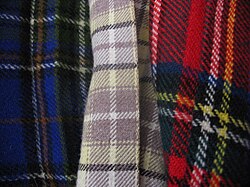
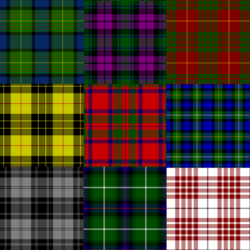

ผ้าลายตาร์ตัน(ภาษาเกลิกสกอต: breacan [ˈpɾʲɛxkən]) หรือที่รู้จักกันโดยเฉพาะในภาษาอังกฤษแบบอเมริกันว่า plaid (/plæd / ) คือผ้าที่มีลวดลายประกอบด้วยแถบแนวนอน และแนวตั้งตัดกันหลายสี forming เป็นลวดลายสมมาตรซ้ำๆ ที่เรียกว่าsettsลวดลายตาร์ตันมีความซับซ้อนแตกต่างกันไป ตั้งแต่แบบสองสีง่ายๆ ไปจนถึงลวดลายที่ซับซ้อนกว่ายี่สิบเฉดสี ตาร์ตันมีต้นกำเนิดมาจากผ้าขนสัตว์ทอ และมีความเกี่ยวข้องอย่างมากกับสกอตแลนด์ซึ่งมีการใช้มานานหลายศตวรรษในเครื่องแต่งกายแบบดั้งเดิม เช่นกระโปรงกิลต์ ตาร์ตัน เฉพาะเจาะจงนั้นเชื่อมโยงกับตระกูลครอบครัว หรือภูมิภาคของชาวสกอต โดยลวดลายและสีสันได้มาจากสีย้อมธรรมชาติในท้องถิ่น (ปัจจุบันถูกแทนที่ด้วยสีย้อมสังเคราะห์) ตาร์ตันยังทำหน้าที่ในเชิงสถาบัน รวมถึงเครื่องแบบทหารและตราสินค้าขององค์กรต่างๆ
ผ้าลาย ตาร์ตันกลายเป็นสัญลักษณ์ของเอกลักษณ์ชาวสกอตโดยเฉพาะอย่างยิ่งตั้งแต่ศตวรรษที่ 17 เป็นต้นมา แม้ว่าจะมีการห้ามใช้ภายใต้พระราชบัญญัติการแต่งกายปี 1746ซึ่งกินเวลานานประมาณสองชั่วอายุคนหลังจากการก่อกบฏของจาโคไบต์ในปี 1745 การฟื้นฟูวัฒนธรรมไฮแลนด์ในศตวรรษที่ 19 ทำให้ผ้าลายตาร์ตันเป็นที่นิยมไปทั่วโลกโดยเชื่อมโยงกับเครื่องแต่งกายของชาวไฮแลนด์และชาวสกอตพลัดถิ่นปัจจุบัน ผ้าลายตาร์ตันถูกนำมาใช้ทั่วโลกในเสื้อผ้า เครื่องประดับ และงานออกแบบ โดยก้าวข้ามรากเหง้าดั้งเดิมไปแล้ว ผ้าลายตาร์ตันสมัยใหม่ได้รับการจดทะเบียนสำหรับองค์กร บุคคล และเพื่อวัตถุประสงค์ในการรำลึก โดยมีแบบต่างๆ นับพันแบบในทะเบียนผ้าลายตาร์ตันของสกอตแลนด์
แม้ว่าลายตาร์ตันมักจะเชื่อมโยงกับมรดกทางวัฒนธรรมของสกอตแลนด์ แต่ก็มีอยู่ในวัฒนธรรมอื่นๆ เช่น แอฟริกา เอเชียตะวันออกและใต้ และยุโรปตะวันออก ตัวอย่างผ้าลายตาร์ตันที่เก่าแก่ที่สุดที่ยังหลงเหลืออยู่มีอายุประมาณ 3,000 ปี และถูกค้นพบในซินเจียงประเทศจีน
ที่มาของคำและศัพท์เฉพาะ
คำว่าtartan ในภาษาอังกฤษและสกอตแลนด์อาจมาจากคำว่า tiretaineในภาษาฝรั่งเศสซึ่งหมายถึง ' ผ้าลินซีย์-วูลซีย์ ' [ 1 ] [ 2 ] [ 3 ]สมมติฐานอื่นๆ คือมาจาก คำว่า tarsainnหรือtarsuinnในภาษาเกลิกของสกอตแลนด์ซึ่งหมายถึง 'ข้าม' หรือ 'ข้ามผ่าน' [ 2 ] [ 3 ]หรือมาจาก คำว่า tartarinหรือtartaryn ในภาษาฝรั่งเศส (ปรากฏในปี ค.ศ. 1454 สะกดว่าtartyn ) [ 4 ]ซึ่งหมายถึง ' ผ้าทาร์ทาร์ ' [ 1 ]มันไม่เกี่ยวข้องกับคำว่าtarlatan ที่ดูคล้ายกัน ซึ่งหมายถึง ผ้าฝ้ายเนื้อบางมากคล้ายกับผ้าชีสคลอธ Tartan เป็นทั้งคำนามนับไม่ได้ ("ผ้าทาร์ทัน 12 เมตร") และคำนามนับได้ ("ผ้าทาร์ทันที่แตกต่างกัน 12 แบบ")
ปัจจุบัน คำว่า tartanหมายถึงลวดลายสีต่างๆ แม้ว่าเดิมทีไม่จำเป็นต้องมีลวดลายเลยก็ได้ เพราะหมายถึงประเภทของการทอ แม้กระทั่งในช่วงปี 1820 ผ้า tartan บางชนิดก็ยังถูกอธิบายว่าเป็น "สีพื้นเรียบ ...ไม่มีลวดลาย" [ 5 ] [ 6 ]ผ้าที่มีลวดลายจากที่ราบสูงสกอตแลนด์ที่พูดภาษาเกลิกเรียกว่าbreacanซึ่งหมายถึง 'หลายสี' เมื่อเวลาผ่านไป ความหมายของtartanและbreacanได้ถูกนำมารวมกันเพื่ออธิบายลวดลายบางประเภทบนผ้าบางประเภท[ 6 ]
เซตต์
รูปแบบของผ้าทาร์ตันเฉพาะเรียกว่าsett sett ประกอบด้วยเส้นหลายเส้นที่มีความกว้างเฉพาะซึ่งตัดกันเป็นมุมฉากและผสานเข้าด้วยกัน[ 6 ]บางครั้งมีการใช้คำว่า settingในความหมายที่ยาวกว่า[ 7 ] settอาจหมายถึงการนำเสนอภาพขั้นต่ำของรูปแบบผ้าทาร์ตันทั้งหมด หรือการแสดงเป็นข้อความ (ในจำนวนเส้นด้าย ) [ 6 ]
ศัพท์เฉพาะสมัยใหม่
ปัจจุบันคำว่า "ลายตาราง"ถูกนำมาใช้ในความหมายทั่วไปมากขึ้น เพื่ออธิบายลวดลาย ไม่จำกัดเฉพาะสิ่งทอ แต่ยังปรากฏบนสื่อต่างๆ เช่น กระดาษ พลาสติก บรรจุภัณฑ์ และวัสดุปิดผนัง[ 8 ] [ 6 ] [ 9 ] [ 10 ]
ลายตารางหมากรุก
ในอเมริกาเหนือ คำว่าplaidมักใช้เพื่ออ้างถึงผ้าลายตาราง[ 11 ] [ 12 ] [ 13 ] [ a ] Plaidซึ่งมาจากภาษาเกลิกสกอตplaideที่แปลว่า 'ผ้าห่ม' [ 16 ] [ b ]เดิมทีใช้เรียกเสื้อผ้าสี่เหลี่ยมผืนผ้าใดๆ ซึ่งบางครั้งทำจากผ้าลายตาราง[ c ]ซึ่งสามารถสวมใส่ได้หลายวิธี เช่นผ้า plaid คาดเข็มขัด ( breacan féile ) หรือ "กระโปรงสก็อตขนาดใหญ่" ซึ่งเป็นต้นกำเนิดของกระโปรงสก็อต สมัยใหม่ ; arisaid ( earasaid ) ผ้าคลุมไหล่ขนาดใหญ่ที่สามารถพันเป็นชุดได้; และผ้าคลุมไหล่หลายประเภท เช่นfull plaidและfly plaidเมื่อเวลาผ่านไปplaidถูกนำมาใช้เพื่ออธิบายผ้าห่มเอง[ 12 ]ในสมัยก่อน คำว่าplaiding [ 19 ]หรือpladding [ 20 ]บางครั้งถูกใช้เพื่ออ้างถึงผ้าลายตาราง
การทอและการออกแบบ
การก่อสร้างแบบทอผ้า
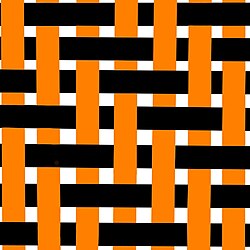
ทะเบียนผ้าทาร์ตันของสกอตแลนด์ให้คำจำกัดความสรุปของผ้าทาร์ตันดังต่อไปนี้: [ 21 ]
ลายตาร์ตัน (ลวดลาย) คือลวดลายที่ประกอบด้วยแถบสีทึบสองสีขึ้นไปที่แตกต่างกัน ซึ่งอาจคล้ายกัน แต่โดยทั่วไปจะมีสัดส่วนที่แตกต่างกัน และจะซ้ำกันในลำดับที่กำหนดไว้ ลำดับของสีเส้นด้ายยืน (เส้นด้ายตามแนวยาว) จะถูกทำซ้ำในลำดับและขนาดเดียวกันในเส้นด้ายพุ่ง (เส้นด้ายตามแนวขวาง) ลวดลายส่วนใหญ่ (หรือเซ็ตต์) จะสมมาตร กล่าวคือ ลวดลายจะซ้ำกันในลำดับสีและสัดส่วนเดียวกันในทุกทิศทางจากจุดหมุนสองจุด ในลวดลายอสมมาตรที่พบได้น้อยกว่า ลำดับสีจะซ้ำกันเป็นบล็อกแทนที่จะสลับกันรอบจุดหมุน แต่ขนาดและลำดับสีของเส้นด้ายยืนและเส้นด้ายพุ่งยังคงเหมือนเดิม
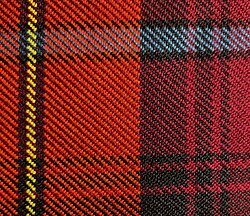
โดยรายละเอียดเพิ่มเติม ผ้าลายตาร์ตันแบบดั้งเดิมเป็น ผ้าทอทวิ ล ล์ 2/2 ที่แน่นและสลับกัน ของ ขน แกะวอร์สเต็ด : เส้นด้ายพุ่ง แนวนอน (หรือเส้นด้ายพุ่งหรือเส้นด้ายเติม ) ทอในรูปแบบง่ายๆ สองเส้นทับสองเส้นใต้เส้นด้ายยืนแนวตั้งที่คงที่โดยเลื่อนเส้นด้ายหนึ่งเส้นในแต่ละรอบ[ 15 ]เนื่องจากเส้นด้ายพุ่งแต่ละเส้นตัดกับเส้นด้ายยืน การสลับกันหนึ่งเส้นหมายความว่าเส้นด้ายยืนแต่ละเส้นจะตัดกับเส้นด้ายพุ่งสองเส้นด้วย ผลลัพธ์เมื่อตรวจสอบวัสดุอย่างใกล้ชิดคือลวดลาย "ซี่โครง" แนวทแยงมุม 45 องศาที่เป็นเอกลักษณ์ซึ่งสีต่างๆ ตัดกัน[ 6 ] [ 22 ]เมื่อเส้นด้ายพุ่งตัดกับเส้นด้ายยืนที่มีสีเดียวกัน จะทำให้เกิดสีทึบบนลายตาร์ตัน ในขณะที่เส้นด้ายพุ่งที่ตัดกับเส้นด้ายยืนที่มีสีต่างกัน จะทำให้เกิดการผสมสีสองสีสลับกันอย่างเท่าๆ กัน ทำให้เกิดลักษณะสีที่สาม – การผสมสีแบบ ฮาล์ฟโทน – เมื่อมองจากระยะไกล[ 23 ] [ 6 ] [ 21 ] (ผลที่ได้คล้ายกับ การพิมพ์ ฮาล์ฟโทน หลายสี หรือการแรเงาไขว้ในงานศิลปะดินสอสี) [ 6 ]ดังนั้น ชุดสีพื้นฐานสองสีจะสร้างสีที่แตกต่างกันสามสี รวมถึงการผสมสีหนึ่งสี ซึ่งจะเพิ่มขึ้นเป็นกำลัง สอง ตามจำนวนสีพื้นฐาน ดังนั้นชุดสีพื้นฐานหกสีจะสร้างการผสมสีสิบห้าแบบ และสีที่มองเห็นได้แตกต่างกันทั้งหมด 21 สี[ 6 ] [ 24 ] [ d ]ซึ่งหมายความว่ายิ่งใช้ลายเส้นและสีมากเท่าไร ลวดลายของลายตาร์ตันก็จะยิ่งเบลอและจางลงเท่านั้น[ 6 ] [ 23 ]ต่างจากลายตารางหมากรุกธรรมดา (chequer)หรือ ลาย ลูกเต๋า (เช่น กระดานหมากรุก) ที่ไม่มีสีทึบในลายตารางหมากรุกปรากฏอยู่ติดกับสีทึบอื่น มีเพียงการผสมสีเท่านั้น[ 6 ] (สีทึบอาจสัมผัสกันที่มุม) [ 25 ]
James D. Scarlett (2008) เสนอคำจำกัดความของรูปแบบลายตาร์ตันทั่วไป (ลายตาร์ตันบางประเภทอาจเบี่ยงเบนจากรายละเอียดของคำจำกัดความนี้): [ 6 ]
หน่วยพื้นฐานของลายตาร์ตัน หรือ ที่เรียกว่า " เซ็ตต์"คือรูปสี่เหลี่ยมจัตุรัสที่ประกอบด้วยสี่เหลี่ยมผืนผ้าหลายรูป ทั้งสี่เหลี่ยมจัตุรัสและสี่เหลี่ยมผืนผ้า จัดเรียงอย่างสมมาตรอยู่รอบสี่เหลี่ยมจัตุรัสตรงกลาง แต่ละองค์ประกอบเหล่านี้จะปรากฏขึ้นสี่ครั้ง โดยเว้นระยะห่าง 90 องศา และแต่ละองค์ประกอบจะหมุนไป 90 องศาเมื่อเทียบกับองค์ประกอบอื่นๆ สัดส่วนขององค์ประกอบต่างๆ จะถูกกำหนดโดยความกว้างสัมพัทธ์ของแถบที่ประกอบกันเป็นรูปเหล่านั้น
ลำดับสีของเส้นด้ายในเซ็ตต์ (การออกแบบขั้นต่ำของลายตาร์ตัน ซึ่งจะถูกทำซ้ำ[ 6 ] – "ดีเอ็นเอของลายตาร์ตัน") [ 26 ]เริ่มต้นที่ขอบและจะกลับทิศทางหรือ (ไม่ค่อยพบ) ทำซ้ำที่จุดที่เรียกว่าจุดหมุนหรือแกนหมุน [ 27 ] ในแผนภาพ A เซ็ตต์เริ่มต้นที่แกนหมุนแรก กลับทิศทางที่แกนหมุนที่สอง ดำเนินต่อไป จากนั้นกลับทิศทางอีกครั้งที่แกนหมุนถัดไป และจะดำเนินต่อไปในลักษณะนี้ในแนวนอน ในแผนภาพ B เซ็ตต์ดำเนินไปในลักษณะเดียวกับในเส้นด้ายยืน แต่ในแนวตั้ง แผนภาพเหล่านี้แสดงให้เห็นถึงการสร้างลายตาร์ตัน แบบ สมมาตร ทั่วไป [ 28 ] (หรือสมมาตร [ 26 ]สะท้อน[ 26 ]กลับทิศทาง[ 29 ]หรือสะท้อนภาพ ) [ 30 ] [ e ]อย่างไรก็ตาม ใน ผ้าทาร์ตันแบบ ไม่สมมาตรที่ หายาก [ 32 ] ( ไม่สมมาตร [ 26 ]หรือไม่กลับด้าน ) [ 32 ] [ f ]การจัดวางเส้นด้ายจะไม่กลับด้านที่จุดหมุน แต่จะทำซ้ำที่จุดหมุน[ g ]คำเก่าสำหรับประเภทหลังนี้คือลวดลายแก้มหรือลวดลายแก้ม[ 34 ]นอกจากนี้ ผ้าทาร์ตันบางผืน (มีน้อยมากในบรรดาผ้าทาร์ตันสก็อตแบบดั้งเดิม) ไม่มีการจัดวางเส้นด้ายสำหรับเส้นยืนและเส้นพุ่งที่เหมือนกันทุกประการ ซึ่งหมายความว่าเส้นยืนและเส้นพุ่งจะมีจำนวนเส้นด้ายที่แตกต่างกัน[ h ] ลวดลายแบบไม่สมมาตรและเส้นยืนและเส้นพุ่งที่แตกต่างกันนั้นพบได้บ่อยในผ้ามาดราสและประเพณีการทอผ้าอื่นๆ มากกว่าในผ้าทาร์ตันสก็อต
 แผนภาพ A, การบิดเบี้ยว
 แผนภาพ B, เส้นด้ายพุ่ง
 แผนภาพ C ลายตาร์ตัน การรวมกันของเส้นด้ายยืนและเส้นด้ายพุ่ง
การบันทึกลายตาร์ตันทำได้โดยการนับเส้นด้ายแต่ละสีที่ปรากฏในลายทอ[ i ]จำนวนเส้นด้าย ( หรือthreadcount , thread-count ) ไม่เพียงแต่ระบุความกว้างของแถบในลายทอเท่านั้น แต่ยังระบุสีที่ใช้ด้วย (โดยทั่วไปจะใช้ตัวย่อ) [ 26 ]โดยปกติแล้วตัวเลขทุกตัวในจำนวนเส้นด้ายจะเป็นเลขคู่[ 41 ]เพื่อช่วยในการผลิต เส้นด้ายแรกและเส้นด้ายสุดท้ายของจำนวนเส้นด้ายคือจุดหมุน[ 27 ]จำนวนเส้นด้ายที่รวมกับข้อมูลสีที่แน่นอนและรายละเอียดการทออื่นๆ เรียกว่าตราประทับตั๋ว[ 42 ]หรือเรียกง่ายๆว่าตั๋ว[ 43 ]
ไม่มีวิธีการเขียนจำนวนเธรดที่เป็นมาตรฐานสากล[ 36 ]แต่ระบบต่างๆ นั้นสามารถแยกแยะได้ง่าย ตัวอย่างเช่น:
- จำนวนเส้นด้าย "/K4 R24 K24 Y4/" สอดคล้องกับรูปแบบการสะท้อนของเส้นด้ายสีดำ 4 เส้น เส้นด้ายสีแดง 24 เส้น เส้นด้ายสีดำ 24 เส้น เส้นด้ายสีเหลือง 4 เส้น โดยที่เส้นด้ายสีดำที่เริ่มต้นและเส้นด้ายสีเหลืองที่สิ้นสุดจะไม่ซ้ำกัน (หลังจาก Y4/ สีจะกลับกัน โดยเริ่มจาก K24 แล้วตามด้วย R24) นี่คือจำนวนเส้นด้ายแบบ " เต็มจำนวนที่จุดหมุน" [ 27 ]
- สัญลักษณ์ที่เทียบเท่ากันคือการทำตัวหนาให้กับตัวย่อของแกนหมุน: K 4 R24 K24 Y 4
- ลายตาร์ตันเดียวกันนี้ยังสามารถแสดงได้เป็น "K/2 R24 K24 Y/2" ในเครื่องหมายที่ระบุว่าสีดำนำหน้าและสีเหลืองตามหลังจะถูกทำซ้ำก่อนที่จะต่อเนื่องจากจุดหมุนเหล่านี้ (หลังจาก Y/2 สีจะกลับกันเป็น Y/2 อีกครั้ง จากนั้น K24 จากนั้น R24) นี่คือการนับเส้นด้ายแบบ " ครึ่งจำนวนที่จุดหมุน" [ 26 ]
- ในรูปแบบการนับเส้นด้ายแบบเก่าและอาจกำกวม หากไม่มีเครื่องหมาย "/" (หรือตัวหนา) การนับเส้นด้ายเช่น "K4 R24 K24 Y4" จะถือว่าเป็นการนับเต็มจำนวนที่จุดหมุน เว้นแต่ผู้เขียนจะระบุไว้อย่างชัดเจนเป็นอย่างอื่น[ 27 ] [ 36 ] [ j ]
ในทุกกรณีเหล่านี้ ผลลัพธ์ที่ได้คือ จำนวนเส้นด้าย แบบครึ่งเซ็ตซึ่งแสดงถึงการร้อยด้ายก่อนที่ลวดลายจะสะท้อนและสมบูรณ์ จำนวนเส้นด้ายแบบเต็มเซ็ตสำหรับลายตาร์ตันแบบสะท้อน (สมมาตร) นั้นไม่จำเป็น[ 36 ]สามารถใช้เครื่องหมาย "/" ระหว่างรหัสสีสองรหัส (เช่น "W/Y24" สำหรับ "ขาว/เหลือง 24") เพื่อสร้างจำนวนเส้นด้ายแบบย่อสำหรับลายตาร์ตันแบบง่ายๆ ซึ่งครึ่งหนึ่งของลวดลายแบบครึ่งเซ็ตจะแตกต่างจากอีกครึ่งหนึ่งเพียงแค่การสลับสี[ 44 ]แต่นี่ไม่ใช่รูปแบบการนับเส้นด้ายที่พบได้ทั่วไป
- ลายตาร์ตันแบบไม่สมมาตร ซึ่งไม่สะท้อน จะแสดงด้วย จำนวนเส้นด้าย เต็มจำนวนพร้อมเครื่องหมาย "..." เช่น "...K4 R24 K24 Y4..." (หลังจาก Y4 รูปแบบทั้งหมดจะเริ่มต้นใหม่อีกครั้งจาก K4) [ 26 ]
นักเขียนและฐานข้อมูลลายตาร์ตันต่างๆ ไม่ได้ใช้ชุดชื่อสีและตัวย่อ ที่สอดคล้องกัน [ 45 ]ดังนั้นจำนวนเส้นด้ายอาจไม่สามารถเข้าใจได้โดยทั่วไปหากไม่มีคำอธิบาย/คำอธิบายสี ผู้บันทึกบางรายชอบที่จะเริ่มนับเส้นด้ายที่จุดหมุนด้วยชื่อสี (หรือตัวย่อ) ที่ขึ้นต้นตามลำดับตัวอักษร (เช่น หากมีจุดหมุนสีขาวและสีน้ำเงิน ให้เริ่มด้วยสีน้ำเงิน) [ 26 ]แต่จริงๆ แล้วนี่เป็นไปโดยพลการ
แม้ว่าจำนวนเส้นด้ายจะค่อนข้างเฉพาะเจาะจง แต่ก็สามารถปรับเปลี่ยนได้ขึ้นอยู่กับขนาดของลายตาร์ตันที่ต้องการ ตัวอย่างเช่น ขนาดของลายตาร์ตัน (เช่น 6 นิ้วสี่เหลี่ยม – ขนาดทั่วไปสำหรับกระโปรงสก็อต) [ 26 ]อาจใหญ่เกินไปที่จะพอดีกับหน้าเนคไทในกรณีนี้ จำนวนเส้นด้ายจะลดลงตามสัดส่วน (เช่น เหลือ 3 นิ้วต่อด้าน) [ 36 ]ในบางงาน จำนวนเส้นด้ายจะลดลงเหลือจำนวนเส้นด้ายคู่ที่น้อยที่สุด (มักจะเหลือเพียง 2 เส้น) ที่จำเป็นในการสร้างลวดลายขึ้นมาใหม่ได้อย่างแม่นยำ[ 27 ]ในกรณีเช่นนี้ มักจำเป็นต้องเพิ่มขนาดจำนวนเส้นด้ายตามสัดส่วนสำหรับการใช้งานทั่วไปในกระโปรงสก็อตและผ้าลายสก็อต
ก่อนศตวรรษที่ 19 ผ้าลายตารางมักจะทอด้วยเส้นด้ายพุ่งที่หนากว่าเส้นด้ายยืนถึง 1/3 [ 6 ]ซึ่งจะทำให้เกิดลวดลายสี่เหลี่ยมผืนผ้าแทนที่จะเป็นสี่เหลี่ยมจัตุรัส วิธีแก้ปัญหาคือการปรับจำนวนเส้นด้ายพุ่งเพื่อให้ลวดลายกลับมาเป็นสี่เหลี่ยมจัตุรัส[ 22 ]หรือทำให้ไม่เป็นสี่เหลี่ยมจัตุรัสโดยเจตนา ดังที่ยังคงทำกันในผ้าลายตารางแบบดั้งเดิมบางส่วน[ h ]ความหนาของเส้นด้ายพุ่งและเส้นด้ายยืนที่ไม่เท่ากันยังอาจส่งผลให้เกิดลวดลายเป็นแถบแทนที่จะเป็นลายตารางในตัวอย่างผ้าลายตารางบางชนิด[ 46 ]
สีเด่นของลายตาราง (แถบที่กว้างที่สุด) เรียกว่าunder-check (หรือunder check , undercheck , under-cheque ); [ 47 ]บางครั้งอาจใช้คำว่าground , [ k ] background , [ 49 ]หรือbase [ 49 ]แทน โดยเฉพาะอย่างยิ่งหากมีสีเด่นเพียงสีเดียว เส้นบางๆ ที่ตัดกันเรียกว่าover-check [ 50 ] [ 49 ] (หรือover-stripeหรือoverstripe ) [ 51 ]บางครั้ง over-check ที่เป็นคู่ๆ เรียกว่าtram lines , tramlinesหรือtram tracks [ 52 ] over -check สีสดใสบางครั้งจะมีขอบทั้งสองด้าน (โดยปกติทั้งสองด้าน) เพื่อเพิ่มความคมชัดด้วยเส้นบางๆ เพิ่มเติม ซึ่งมักเป็นสีดำ เรียกว่าguard lines หรือguards [ 52 ]ในอดีต ช่างทอผ้า William Wilson & Son แห่ง Bannockburn บางครั้งทอผ้าลายตารางสีสดใสด้วยไหม เพื่อเพิ่มความเงางาม[ 53 ] [ 54 ] (ในเชิงพาณิชย์ประมาณปี 1820–30 แต่ในผ้าลายตารางของนายทหารในกรมทหารย้อนกลับไปอย่างน้อยถึงปี 1794) [ 55 ] [ l ]ผ้าลายตารางที่ใช้สำหรับผ้าลายตาราง (ไม่ใช่ผ้าลายตารางแบบมีเข็มขัด) มักจะมีขอบเป็นพู่[ 56 ]
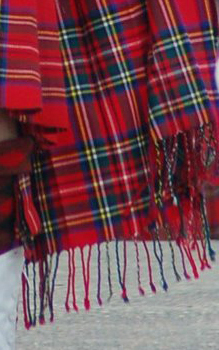
ธรรมเนียมปฏิบัติเก่าแก่จนถึงศตวรรษที่ 18 คือการเพิ่มขอบสีให้กับผ้าลายสก็อตหรือบางครั้งก็กระโปรงกิลต์ในรูปแบบของขอบผ้าทอลายก้างปลาที่ขอบ กว้าง 1–3 นิ้ว (2.5–7.6 ซม.) แต่ยังคงเข้ากับรูปแบบสีของลายทอ[ 56 ] [ 57 ]ช่างทอผ้าสมัยใหม่บางรายยังคงผลิตผ้าลายสก็อตในสไตล์นี้อยู่ บางครั้งก็มีการใช้ขอบผ้าที่ตกแต่งมากขึ้น: ขอบผ้าเป็นขอบ (โดยปกติอยู่ด้านเดียวเท่านั้น) ที่เกิดจากการทำซ้ำสีจากลายทอในแถบกว้าง (มักจะเป็นลายก้างปลา) บางครั้งอาจมีขอบเป็นแถบสีอื่นจากลายทอหรือตกแต่งตรงกลางขอบด้วยแถบสีบางๆ สองแถบ โดยทั่วไปจะใช้สำหรับด้านล่างของผ้าลายสก็อตและกระโปรงกิลต์ที่มีเข็มขัด[ 56 ] [ 58 ]และมักจะเป็นสีดำในผ้าลายสก็อตของทหาร แต่สามารถมีสีสันมากกว่าในผ้าลายสก็อตของพลเรือน[ 59 ]ลวดลายขอบผ้าที่ซับซ้อนกว่านั้นเป็นแถบแคบๆ ที่กว้างขึ้น โดยใช้สีบางส่วนหรือทั้งหมดของลายผ้า ซึ่งส่วนใหญ่ใช้กับผ้าทาร์ทันสำหรับใช้ในครัวเรือน (ผ้าห่ม ผ้าม่าน ฯลฯ) และบนด้านตรงข้ามสองด้านของผ้า[ 59 ] [ 56 ]ขอบผ้าทั้งหมดซึ่งหายากมากคือขอบผ้าทั้งสี่ด้านที่มีลายผ้าที่แตกต่างกันอย่างสิ้นเชิง ซึ่งปีเตอร์ เอสเลีย แมคโดนัลด์ (2019) อธิบายว่าเป็น "ลักษณะที่ทอยากเป็นพิเศษและถือได้ว่าเป็นจุดสูงสุดของศิลปะการทอผ้าทาร์ทัน" [ 56 ]ซึ่งยังคงหลงเหลืออยู่ในผ้าทาร์ทันสไตล์สก็อตแลนด์ในรูปแบบตัวอย่างจากศตวรรษที่ 18 เพียงไม่กี่ชิ้น (ในสกอตแลนด์[ 60 ]และโนวาสโกเชียประเทศแคนาดา แต่เดิมน่าจะมาจากสกอตแลนด์) [ 61 ]รูปแบบนี้ยังถูกนำมาใช้ในเอสโตเนียในการทอผ้าคลุมไหล่/ผ้าลายสก็อต suurrättด้วย

 ผ้าลายสก็อตสมัยศตวรรษที่ 18 มีขอบด้านล่างเป็นลาย ก้างปลา
 ผ้าลายสก็อต Black Watch มีรอยเย็บที่ขอบด้านล่าง (หรือลายก้างปลา)
 ผ้าห่มลายตาร์ตันวิลสัน ปี 1819 ที่มีลวดลายขอบผ้าด้านขวา
 มุมล่างขวาของผ้าห่มที่มีขอบผ้าสมบูรณ์ ภาพนี้เป็นการประมาณการจากภาพถ่ายของผ้าห่มจริงที่ค้นพบในโนวาสโกเชีย แต่คาดว่าน่าจะเป็นของสกอตแลนด์ ประมาณปี 1780
ผ้าลายตาร์ตันมักจะทอแบบสมดุล (หรือเรียกสั้นๆ ว่าสมดุล ) โดยจะทอซ้ำอย่างสม่ำเสมอจากจุดหมุนตรงกลางออกไปด้านนอก และสิ้นสุดที่ขอบด้านนอกอย่างสมบูรณ์[ 7 ] [ 62 ] [ 63 ]เช่น ผ้าลายตาร์ตันสำหรับทำผ้าห่มลายสก็อตอาจมีความยาว 24 เซ็ตและกว้าง 4 เซ็ต การทอ แบบออฟเซ็ตออฟเซ็ตหรือไม่สมดุลคือการทอที่ลวดลายสิ้นสุดที่ขอบตรงกลางของสีจุดหมุน ซึ่งโดยทั่วไปจะทำกับชิ้นส่วนที่ตั้งใจจะนำมาต่อกัน (เช่น สำหรับผ้าห่มลายสก็อตแบบมีเข็มขัดหรือผ้าห่ม) เพื่อให้ได้ผ้าผืนใหญ่ขึ้นโดยที่ลวดลายต่อเนื่องไปตามรอยเย็บ[ 7 ] [ 63 ]หากผ้าลายตาร์ตันมีเครื่องหมายขอบหรือลวดลายขอบ ก็จะอยู่ด้านตรงข้ามของเส้นด้ายยืน[ 64 ]
คำว่าhard tartanหมายถึงผ้าชนิดหนึ่งที่ทอด้วยเส้นด้ายที่พันกันแน่นมากและไม่มีขน ทำให้ได้วัสดุที่ค่อนข้างหยาบและหนาแน่นกว่า (แต่บางกว่า) เมื่อเทียบกับผ้าที่ใช้ทำกิลต์ทั่วไปในปัจจุบัน[ 65 ] [ 66 ]มีการใช้กันอย่างแพร่หลายจนถึงช่วงปี 1830 [ 46 ]มีตัวอย่าง hard tartan จากต้นศตวรรษที่ 18 ที่ยังหลงเหลืออยู่แต่หายาก ซึ่งใช้การทอแบบก้างปลาที่ซับซ้อนกว่าแทนการทอแบบทวิลล์ตลอดทั้งผืนผ้า[ 67 ]
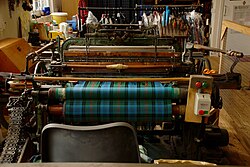
ในขณะที่ผ้าลายตาร์ตันสมัยใหม่ส่วนใหญ่เป็นธุรกิจเชิงพาณิชย์บนเครื่องทอผ้า ขนาดใหญ่ แต่ เดิมผ้าลายตาร์ตันเป็นผลิตภัณฑ์ของช่างทอผ้าในชนบทในยุคก่อนอุตสาหกรรม และสามารถผลิตได้โดยผู้ที่ชื่นชอบงานอดิเรกที่มีเครื่องทอผ้ามือที่แข็งแรงและมั่นคง[ 68 ] [ 69 ] [ 70 ]ตั้งแต่ประมาณปี 1808 ขนาดดั้งเดิมของหวี ทอผ้า สำหรับผ้าลายตาร์ตันคือ37 นิ้ว (94 ซม.)ซึ่งเป็นความยาวของเอลล์ ของชาวสกอต (ขนาดก่อนหน้านี้บางครั้งคือ 34 และ 40 นิ้ว) [ 71 ] Telfer Dunbar (1979) อธิบายการตั้งค่าดังนี้: [ 71 ]
ความหนาของหวีทอผ้าจะแตกต่างกันไปตามเนื้อสัมผัสของวัสดุที่จะทอ หวีทอผ้าแบบ 30 พอร์เตอร์ (ซึ่งประกอบด้วยหวี 20 แฉก) หรือหวี 600 พอร์เตอร์ จะแบ่งออกเป็น 600 ช่องในความกว้าง 37 นิ้ว ยี่สิบช่องในจำนวนนี้เรียกว่า พอร์เตอร์ และในแต่ละช่องจะใส่เส้นด้ายสองเส้น ทำให้ได้เส้นด้ายยืน 1,200 เส้น และเส้นด้ายพุ่งจำนวนเท่ากันในผ้าลายตารางหนึ่งตารางหลา เมื่อใช้หวีทอผ้าแบบ 30 พอร์เตอร์
รอยแตกยังถูกเรียกว่ารอยบุ๋มและคนแบกหามยังถูกเรียกว่าแก๊งอีก ด้วย [ 72 ]
รูปแบบและหลักการออกแบบ
ลวดลายตาร์ตันแบบดั้งเดิมสามารถแบ่งออกได้เป็นหลายประเภท แบบพื้นฐานที่สุดคือลายตารางสองสีเรียบง่าย โดยใช้แถบหนา (อาจมีหรือไม่มีแถบสีอื่นแทรกบางๆ) อีกแบบหนึ่งคือการแบ่งแถบสีหนึ่งหรือหลายแถบออกเป็นช่องสี่เหลี่ยมเล็กๆ แทนที่จะเป็นช่องสี่เหลี่ยมขนาดใหญ่ ซึ่งเป็นรูปแบบที่นิยมมากในVestiarium Scoticumระดับความซับซ้อนขึ้นไปคือลายตารางซ้อนทับ โดยใช้สีที่สามวางไว้ตรงกลาง "ด้านบน" หรือ "ด้านใน" (ล้อมรอบด้วย) สีพื้นฐานด้านล่าง ทำให้เกิดลวดลายช่องสี่เหลี่ยมซ้อนกัน ซึ่งอาจมีแถบสีสดใสและ/หรือสีดำแทรกบางๆ เพิ่มเข้ามา อีกกลุ่มหนึ่งคือลายตารางหลายชั้น โดยทั่วไปจะเป็นแถบสีสองแถบกว้างๆ บนพื้นหลังสีเดียวที่เด่นชัด (เช่น แดง น้ำเงิน แดง เขียว แดง – อาจมีแถบสีตัดกันแคบๆ แทรกอยู่ด้วย) ประเภทต่างๆ ที่กล่าวมาข้างต้นสามารถนำมาผสมผสานกันเป็นลายตาร์ตันที่ซับซ้อนมากขึ้นได้ ในรูปแบบใดๆ เหล่านี้ บางครั้งลายตารางซ้อนอาจไม่ใช่สีใหม่ แต่เป็นสีหนึ่งในลายตารางล่าง "ทับ" ลายตารางล่างอีกสีหนึ่ง รูปแบบที่หายาก ซึ่งเดิมใช้สำหรับผ้าทาร์ตันอา ริไซด์ ( เอียราไซด์ ) แต่ปัจจุบันไม่ค่อยมีการใช้ในสกอตแลนด์แล้ว คือรูปแบบที่ประกอบด้วยลายตารางซ้อนบางๆ ทั้งหมด บางครั้งจัดกลุ่ม "บน" สีพื้นเดียว ซึ่งโดยปกติจะเป็นสีขาว[ 73 ]เอ็ม. มาร์ติน (1703) รายงานว่าสีเส้นมักจะเป็นสีน้ำเงิน สีดำ และสีแดง[ 74 ]ตัวอย่างของรูปแบบนี้ไม่หลงเหลืออยู่[ 75 ]อย่างน้อยก็ไม่มีอยู่ในฐานข้อมูลผ้าทาร์ตัน (อาจมีชิ้นงานในพิพิธภัณฑ์ที่เก็บรักษาไว้ซึ่งมีรูปแบบดังกล่าว) [ m ]รูปแบบผ้าทาร์ตันบางแบบมีความเป็นนามธรรมมากกว่าและไม่เข้ากับรูปแบบใดๆ เหล่านี้[ 77 ]โดยเฉพาะอย่างยิ่งในผ้ามาดราส
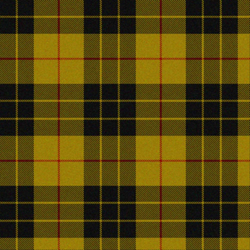
 เช็คแบบพื้นฐานที่สุด คือ เช็ค MacGregor สีแดงและดำ (Rob Roy) ซึ่งเรียบง่ายที่สุด คือมีสัดส่วนของสองสีเท่ากัน
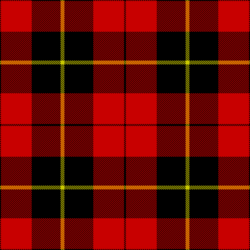 ลายตารางพื้นฐานที่ปรับเปลี่ยน – สีแดง วอลเลซ /ชุดเดรส สีดำบนพื้นสีแดงที่ใหญ่กว่าเล็กน้อย ประดับด้วยลายตารางซ้อนสีเหลืองและดำ
 ลายตารางหมากรุกแบบแยกส่วน – ลายสีแดงและเขียวของ MacGregor โดยมีแถบสีเขียวกว้างแบ่งออกเป็นสามส่วนเพื่อสร้างเป็น "สี่เหลี่ยมจัตุรัสซ้อนสี่เหลี่ยมจัตุรัส" แล้วมีลายตารางหมากรุกสีขาวทับซ้อนอยู่ด้านบน
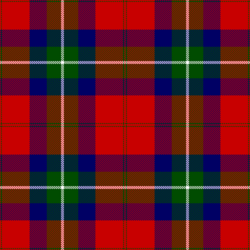 ลายตารางซ้อนกัน – รูธเวนพื้นสีแดง มีแถบสีเขียวขนาดใหญ่ "อยู่ด้านใน" แถบสีน้ำเงินที่ใหญ่กว่า จากนั้นมีลายตารางสีขาวและสีเขียวซ้อนทับอยู่
 ลายตารางหมากรุกหลายแบบ – เดวิดสันพื้นสีเขียว มีแถบสีน้ำเงินและดำเท่าๆ กัน จากนั้นมีลายตารางหมากรุกสีแดง สีน้ำเงิน และสีดำซ้อนทับกัน
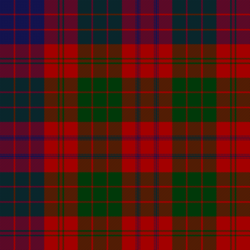 ตัวอย่างที่ซับซ้อน – รอสส์ผสมผสานรูปแบบการแบ่งช่องและการใช้ช่องทำเครื่องหมายหลายช่อง โดยมีช่องทำเครื่องหมายสีน้ำเงินหนึ่งช่องและสีเขียวสองช่องบนพื้นสีแดง พร้อมด้วยช่องทำเครื่องหมายทับซ้อนสีน้ำเงินและสีเขียว
ไม่มีกฎเกณฑ์หรือหลักการที่กำหนดไว้ตายตัวสำหรับการออกแบบลายตาร์ตัน แต่มีนักเขียนบางคนได้เสนอความคิดเห็นที่รอบคอบไว้บ้าง Banks & de La Chapelle (2007) สรุปโดยคำนึงถึงการใช้งานลายตาร์ตันในวงกว้างและทั่วไป รวมถึงในด้านแฟชั่นว่า "สี – และวิธีการใช้งาน – เป็นสิ่งสำคัญในการออกแบบลายตาร์ตัน... ดังนั้น ลายตาร์ตันควรประกอบด้วยสีที่ชัดเจนและสดใส แต่ควรเป็นสีที่นุ่มนวลพอที่จะผสมผสานกันได้ดีและสร้างเฉดสีใหม่" James D. Scarlett (2008) ตั้งข้อสังเกตว่า "ยิ่งมีสีมากเท่าไหร่ ผลลัพธ์สุดท้ายก็จะยิ่งดูนุ่มนวลมากขึ้นเท่านั้น" [ 49 ]หรือกล่าวให้แม่นยำยิ่งขึ้นว่า "ยิ่งมีลายเส้นในลายตาร์ตันมากเท่าไหร่ และยิ่งใช้สีมากเท่าไหร่ ลวดลายก็จะยิ่งดูฟุ้งกระจายและ 'เบลอ' มากขึ้นเท่านั้น" [ 6 ]ซึ่งไม่ได้หมายความว่าจะดูละเอียดอ่อนเสมอไป ลายตาร์ตันที่มีสีและลายเส้นมากมายอาจดู "รก" [ 78 ]
สการ์เล็ตต์ (2008) หลังจากการวิจัยอย่างละเอียดเกี่ยวกับรูปแบบไฮแลนด์ในอดีต (ซึ่งส่วนใหญ่ประกอบด้วยสีแดงเข้มและสีเขียวปานกลางในน้ำหนักที่เท่ากันโดยประมาณ โดยมีสีน้ำเงินเข้มเป็นสีเน้น – โดยไม่คำนึงถึงเส้นสีดำทั่วไป) แนะนำว่าสำหรับรูปแบบที่สมดุลและ แบบ ดั้งเดิม : [ 6 ]
ลายตาร์ตันพื้นฐานใดๆ ควรมีสีพื้นหลังเป็นสี "เด่น" หนึ่งสี และอีกสองสี โดยสีหนึ่งควรเป็นสีที่ตรงข้ามกับสีแรก และอีกสีหนึ่งควรเป็นสีที่เข้มกว่าและเป็นกลางกว่า ส่วนสีอื่นๆ ที่เพิ่มเข้ามาเพื่อทำให้ลวดลายดูไม่น่าเบื่อ หรือใช้เป็นสีเน้น ควรขึ้นอยู่กับรสนิยม สิ่งสำคัญคือไม่ควรมีสีใดสีหนึ่งเด่นจนเกินไปจน "กลบ" สีอื่น มิเช่นนั้น การผสมผสานของสีตรงจุดตัดจะเสียไป ... ลายตาร์ตันเป็นรูปแบบศิลปะนามธรรมที่ซับซ้อน มีพื้นฐานทางคณิตศาสตร์ที่แข็งแกร่ง แตกต่างจากลายตารางธรรมดาที่มีเส้นสีตัดกันเพียงไม่กี่เส้นกระจายอยู่ทั่ว
สการ์เล็ตต์ (1990) ให้คำอธิบายทั่วไปเพิ่มเติม โดยไม่นับรวมรูปแบบดั้งเดิม: [ 79 ]
สีที่ใช้ในการปักผ้าลายตารางต้องมีความชัดเจน ไม่คลุมเครือ สดใสแต่ไม่ฉูดฉาด เพื่อให้เกิดความตัดกันที่ดีทั้งในด้านสีและความสว่าง และผสมกันได้ดีเพื่อให้ได้เฉดสีใหม่ที่ชัดเจนตรงจุดที่สีสองสีตัดกันโดยที่ไม่มีสีใดสีหนึ่งกลบอีกสีหนึ่ง
นอกจากนี้ Scarlett (1990) ยังกล่าวว่า “การตรวจสอบพื้นหลังจะแสดงความแตกต่างที่ชัดเจนแต่ไม่รุนแรง และการตรวจสอบด้านบนจะแสดงออกมาอย่างชัดเจน” บนสีด้านล่าง (หรือ “พื้นหลัง”) [ 49 ]เขาได้สรุปผลลัพธ์โดยรวมที่ต้องการว่า “เป็นการผสมผสานที่กลมกลืนของสีและลวดลายที่ควรค่าแก่การมองว่าเป็นรูปแบบศิลปะในตัวของมันเอง” [ 80 ]
การละเว้นเส้นสีดำแบบดั้งเดิมมีผลทำให้ดูนุ่มนวลอย่างมาก ดังเช่นในชุดแฟชั่นของมิสโซนีในช่วงทศวรรษ 1970 และในลวดลายมาดราสหลายแบบลวดลายสก็อตที่ไม่มีสีดำ (ปัจจุบัน คือลายตาร์ตันชุด มาร์ ) มีมาตั้งแต่ศตวรรษที่ 18 [ 81 ]อีกแบบหนึ่งคือ รูธเวน (1842 ) และลายตาร์ตันรอสส์หลายแบบ (เช่น 1886 ) รวมถึงลวดลายแมคดูกัล[l] ในยุควิกตอเรีย-เอ็ดเวิร์ดหลายแบบ [ 82 ]เป็นตัวอย่างเพิ่มเติม ลายตาร์ตันสมัยใหม่หลายแบบก็ใช้เอฟเฟกต์นี้เช่นกัน เช่น ลายใบเมเปิลของแคนาดา (1964 ) การใช้สีดำหรือสีเข้มอื่นอย่างชาญฉลาดสามารถสร้างการรับรู้ถึงความลึกได้[ 83 ]
สีสัน โทนสี และความหมาย
ไม่มีมาตรฐานสีที่แน่นอนสำหรับเฉดสีของผ้าลายตารางหมากรุก สีของเส้นด้ายจะแตกต่างกันไปในแต่ละผู้ทอ แม้แต่สำหรับสี "เดียวกัน" ก็ตาม[ 84 ]อย่างไรก็ตาม ช่วงสีทั่วไปบางช่วงถือเป็นสีดั้งเดิมในผ้าลายตารางหมากรุกของสกอตแลนด์ ซึ่งได้แก่ สีน้ำเงิน (เข้ม), สีแดงเข้ม (สีชมพูหรือสีแดงเข้ม), สีเขียว (เข้มปานกลาง), สีดำ, สีเทา (เข้มปานกลาง), สีม่วง, สีแดง (สีแดงสดหรือสีแดงสด), สีน้ำตาลอ่อน/น้ำตาลเข้ม, สีขาว (จริงๆ แล้วคือขนแกะธรรมชาติที่ไม่ได้ย้อมสี เรียกว่าlachdannในภาษาเกลิก) [ 85 ] [ n ]และสีเหลือง[ 44 ] [ 6 ] [ o ]สีเพิ่มเติมบางสีที่ใช้ไม่บ่อยนัก ได้แก่ สีฟ้าอ่อน (สีฟ้าอ่อนหรือสีฟ้าท้องฟ้า), สีม่วงแดง และสีเขียวสด (สีเขียวสดใสหรือสีเขียวหญ้า) [ 44 ]รวมถึงสีเทาอ่อน (ดังที่เห็นในผ้าลายตารางหมากรุก Balmoral แม้ว่าบางครั้งจะระบุว่าเป็นสีลาเวนเดอร์) [ 88 ]นับตั้งแต่การเปิดฐานข้อมูลลายตาร์ตันเพื่อลงทะเบียนลายตาร์ตันที่ออกแบบใหม่ ซึ่งรวมถึงลายตาร์ตันจำนวนมากที่ใช้เพื่อวัตถุประสงค์ขององค์กรและแฟชั่น ได้มีการนำสีที่หลากหลายมากขึ้นมาใช้ เช่น สีส้ม[ 89 ]และสีชมพู[ 90 ]ซึ่งไม่ค่อยได้ใช้ (เป็นสีที่แตกต่างกันมากกว่าการใช้สีแดง) ในลายตาร์ตันแบบดั้งเดิม[ p ]ทะเบียนลายตาร์ตันของสกอตแลนด์ใช้รายการสีจำนวนมากที่เข้ารหัสเป็น " สีเว็บ " เลขฐานสิบหก โดยจัดเรียงกลุ่มเฉดสีลงในชุดรหัสพื้นฐานที่จำกัด (แต่ขยายจากรายการแบบดั้งเดิมข้างต้น โดยมีตัวเลือกเพิ่มเติม เช่น สีส้มเข้ม สีเหลืองเข้ม สีม่วงอ่อน เป็นต้น) [ 91 ]สิ่งนี้ช่วยให้นักออกแบบสามารถปรับลายตาร์ตันที่สร้างสรรค์ของตนให้เข้ากับระบบการเข้ารหัส ในขณะเดียวกันก็ช่วยให้ช่างทอสามารถผลิตงานออกแบบที่ใกล้เคียงกับงานออกแบบนั้นได้จากเส้นด้ายที่มีอยู่
ในช่วงกลางศตวรรษที่ 19 สีย้อมธรรมชาติที่ใช้กันมาแต่ดั้งเดิมในไฮแลนด์[ 23 ] [ 92 ] [ 93 ] [ q ] (เช่นไลเคนชนิด ต่างๆ เปลือกต้นอัล เด อร์ บิลเบอร์รี่โคชิ นีล เฮเธอร์อินดิโกวูดและหญ้าเหลือง ) เริ่มถูกแทนที่ด้วยสีย้อมสังเคราะห์ซึ่งใช้งานง่ายกว่าและประหยัดกว่าสำหรับอุตสาหกรรมผ้าลายตารางที่กำลังเฟื่องฟู[ 94 ]แม้ว่าจะมีความละเอียดอ่อนน้อยกว่าก็ตาม[ 95 ]แม้ว่าวิลเลียม มอร์ริสในช่วงปลายศตวรรษที่ 19 ในขบวนการศิลปะและหัตถกรรมจะพยายามฟื้นฟูการใช้สีย้อมธรรมชาติของอังกฤษ แต่ส่วนใหญ่มีผลผลิตต่ำและไม่สม่ำเสมอในแต่ละพื้นที่ (ซึ่งเป็นส่วนหนึ่งของเหตุผลที่ทำให้ผ้าลายตารางในอดีตมีความแตกต่างกันตามพื้นที่) ทำให้พิสูจน์ได้ว่ามีศักยภาพในการผลิตจำนวนมากน้อย แม้ว่าจะมีความพยายามในการทำการตลาดสีย้อมสีม่วง ( คัดแบร์ ) ในกลาสโกว์ในศตวรรษที่ 18 ก็ตาม [ 94 ]ขนแกะเนื้อละเอียดที่พันกันแน่นซึ่งใช้ในการทอผ้าลายตาร์ตันนั้นค่อนข้างทนต่อสีย้อมธรรมชาติ และบางครั้งการย้อมต้องใช้เวลาหลายวันหรือหลายสัปดาห์[ 94 ]การย้อมยังต้องใช้สารช่วยยึดสีเพื่อให้สีติดทนถาวร ซึ่งโดยทั่วไปคือเกลือโลหะ เช่นสารส้มมีบันทึกตั้งแต่ปี ค.ศ. 1491 ว่ามีการนำเข้าสารส้มมายังเมืองลีธแม้ว่าจะไม่จำเป็นต้องใช้ทั้งหมดเพื่อการผลิตผ้าลายตาร์ตันโดยเฉพาะก็ตาม[ 96 ]สีย้อมบางสีมักนำเข้าจากต่างประเทศ โดยเฉพาะสีแดงโคชินีลและสีน้ำเงินอินดิโก (ซึ่งมีราคาแพงและใช้เพื่อเพิ่มความเข้มของสีย้อมพื้นเมือง) จากประเทศต่ำซึ่งสกอตแลนด์มีการค้าขายอย่างกว้างขวางมาตั้งแต่ศตวรรษที่ 15 [ 97 ]ปัสสาวะของมนุษย์ที่เก็บไว้นาน (เรียกว่าfualหรือgraith ) ก็ถูกนำมาใช้เช่นกัน ในฐานะสารเพิ่มความเข้มของสี สาร ช่วย ละลาย สีย้อม สารหมักไลเคนและการบำบัดขั้นสุดท้ายเพื่อความคงทนของสี[ 98 ]ผ้าทาร์ตันที่ผลิตเชิงพาณิชย์ทั้งหมดในปัจจุบันย้อมสีโดยใช้สีย้อมสังเคราะห์ ไม่ใช่สีย้อมธรรมชาติ แม้แต่ในโทนสีที่มีความอิ่มตัวน้อยกว่าก็ตาม[ 99 ] [ 100 ]
เฉดสีในลายตาร์ตันที่กำหนดไว้แล้วสามารถเปลี่ยนแปลงได้เพื่อสร้างความหลากหลายของลายตาร์ตันเดียวกัน การเปลี่ยนแปลงเฉดสีตามความชอบดังกล่าวมีมาอย่างน้อยตั้งแต่หนังสือแบบแผนปี 1788 ของผู้ผลิต William Wilson & Son แห่ง Bannockburn [ 101 ] ปัจจุบัน รูปแบบสีหรือ ชุดสีแบบกึ่งมาตรฐาน(สิ่งที่นักการตลาดอาจเรียกว่า " ชุดสี ") [ 102 ]โดยทั่วไปจะแบ่งออกเป็นแบบสมัยใหม่แบบโบราณแบบหม่นและแบบเก่า (บางครั้งอาจมีชื่ออื่น ขึ้นอยู่กับผู้ทอ) คำเหล่านี้หมายถึง ระดับ ความอิ่มตัวของ "ความมีสีสัน" ของสีย้อม เท่านั้น และไม่ได้แสดงถึงลายตาร์ตันที่แตกต่างกัน[ 103 ] [ 104 ]
- ทันสมัย
- เรียกอีกอย่างว่าแบบธรรมดาหมายถึงลายตารางหมากรุกสีเข้มที่มีสีอิ่มตัวเต็มที่[ 100 ] [ 104 ]ใน จานสี สมัยใหม่ลายตารางหมากรุกที่ประกอบด้วยสีน้ำเงิน สีดำ และสีเขียว มักจะถูกบดบังเนื่องจากความเข้มของสีในโทนสีนี้[ 100 ]
- โบราณ
- หรือที่รู้จักกันในชื่อสีเก่า (OC) หมายถึงโทนสีที่อ่อนกว่าของผ้าลายตารางหมากรุก เฉดสีเหล่านี้มีจุดประสงค์เพื่อแสดงถึงสีที่จะเกิดขึ้นจากผ้าที่ย้อมด้วยสีธรรมชาติที่เสื่อมสภาพไปตามกาลเวลา อย่างไรก็ตาม ผลลัพธ์ที่ได้ไม่ถูกต้อง (เช่น ในตัวอย่างผ้าลายตารางหมากรุกที่เก่ามาก สีดำมักจะจางลงเป็นสีกากี[ 100 ]หรือสีเขียว[ 105 ]ในขณะที่สีน้ำเงินยังคงเข้ม[ 100 ]และสีย้อมธรรมชาติสามารถสร้างสีที่สดใสมากได้ตั้งแต่แรก แม้ว่าจะไม่สม่ำเสมอมากนักก็ตาม) [ 104 ] [ 79 ] [ 106 ]สไตล์นี้มีต้นกำเนิดในช่วงครึ่งแรกของศตวรรษที่ 20 [ 107 ] [ 104 ] คำว่า "โบราณ " นี้ไม่ควรสับสนกับคำเดียวกันในชื่อของผ้าลายตารางหมากรุกบางชื่อ เช่น "แคมป์เบลล์โบราณ"
- ผุกร่อน
- เรียกอีกอย่างว่าสีซีดหมายถึงลายตาร์ตันที่สีอ่อนกว่า (ความอิ่มตัวน้อยกว่า) แบบดั้งเดิมราวกับว่าถูกทิ้งไว้กลางแจ้งเป็นเวลานานมาก[ 104 ]สไตล์นี้ถูกคิดค้นขึ้นในช่วงปลายทศวรรษ 1940 [ 107 ]
- ปิดเสียง
- หมายถึงลายตารางหมากรุกที่มีความสดใสระหว่างแบบสมัยใหม่และแบบโบราณแม้ว่าการลงสีแบบนี้จะเพิ่งเกิดขึ้นไม่นาน โดยเริ่มตั้งแต่ช่วงต้นทศวรรษ 1970 แต่เฉดสีเหล่านี้ถือว่าใกล้เคียงที่สุดกับสีที่ได้จากสีย้อมธรรมชาติที่ใช้ก่อนกลางศตวรรษที่ 19 [ 104 ]
โรงงานทอผ้าลายตาร์ตันบางแห่งได้นำรูปแบบสีอื่นๆ ที่เป็นเอกลักษณ์เฉพาะของช่างทอนั้นๆ มาใช้ และมีให้เลือกเฉพาะในผ้าลายตาร์ตันบางแบบเท่านั้น ตัวอย่างสองอย่างคือผ้าลายโบราณ ของ Lochcarron [ 104 ]ซึ่งอยู่ระหว่างผ้าสมัยใหม่และผ้าโบราณและผ้าลายจำลองของ D. C. Dalgliesh ซึ่งเป็นผ้าลาย ที่สึกหรอเล็กน้อย[ 103 ]ซึ่งมีอายุย้อนไปถึงทศวรรษ 1940 และอ้างว่ามีพื้นฐานมาจากตัวอย่างในศตวรรษที่ 18 [ 108 ]
ข้อสังเกตทั่วไปเกี่ยวกับผ้า ทาร์ ตันแบบโบราณ/เก่า , สึกหรอ/ซีดจางและหม่นหมองคือ ผ้าเหล่านี้จะลดความอิ่มตัวของสีทั้งหมดลงอย่างสม่ำเสมอ ในขณะที่ตัวอย่างผ้าทาร์ตันที่ย้อมสีธรรมชาติแสดงให้เห็นว่า ในอดีตมักจะจับคู่สีที่อิ่มตัวหนึ่งสีหรือมากกว่านั้นกับสีอ่อนหนึ่งสีหรือมากกว่านั้น เพื่อความชัดเจนและความลึกที่มากขึ้น ซึ่งเป็น "ความสมดุลที่กลมกลืน" [ 109 ] [ 104 ] [ 103 ]ตามที่ Scarlett (1990) กล่าวไว้ว่า: "สีมีความชัดเจน สดใส และนุ่มนวล แตกต่างอย่างสิ้นเชิงจากความสว่างจ้าที่แสบตาหรือความหมองคล้ำที่ซีดจางของผ้าทาร์ตันสมัยใหม่" [ 80 ]
ผ้าลายตารางหมากรุกแบบเดียวกันในโทนสีเดียวกันจากผู้ผลิตสองรายจะไม่ตรงกันเป๊ะ เพราะมีอิสระทางศิลปะอย่างมากในการกำหนดความอิ่มตัวของสี[ 100 ]
ซอฟต์แวร์สร้างลายตาร์ตันสามารถจำลองลักษณะของลายตาร์ตันในชุดสีเหล่านี้ได้ ตัวอย่างด้านล่างทั้งหมดเป็นลายตาร์ตัน "Prince Charles Edward Stuart": [ 110 ]
 โทนสีที่ทันสมัย
 ชุดสีโบราณหรือ สีเก่าแก่
 โทนสีที่ดูเก่าหรือซีดจาง
 โทนสีอ่อน
 จานสีโบราณสไตล์ Lochcarron
 จานสีการทำสำเนา สไตล์ D.C. Dalgliesh
ผ้าลายสก็อตที่ใช้เฉดสีพื้นฐานเดียวกันสองเฉดขึ้นไปนั้นค่อนข้างหายาก ที่รู้จักกันดีที่สุดคือ Balmoral ของราชวงศ์อังกฤษ[ 111 ] (ปี ค.ศ. 1853 สีเทาสองเฉด ทั้งสองเฉดเป็นลายตาราง) อื่นๆ ได้แก่: Akins [ 112 ] (1850, สีแดงสองผืน, ผืนหนึ่งเป็นลายตารางทับซ้อน และบางครั้งก็ทำเป็นสีม่วง), MacBean [ 113 ] (1872, สีแดงสองผืน, ผืนหนึ่งเป็นลายตารางทับซ้อน และบางครั้งก็ทำเป็นสีม่วง), Childers Universal regimental [ 114 ] (1907, สีเขียวสองผืน, ทั้งสองผืนเป็นลายตารางทับซ้อน), Gordon red [ 115 ] (บันทึกไว้ระหว่างปี 1930–1950 แต่คาดว่าเก่ากว่านั้นมาก; สีน้ำเงินสองผืนและสีแดงสองผืน, อย่างละผืนใช้เป็นลายตารางทับซ้อน), Galloway district hunting/green [ 116 ] [ 117 ] (ปี 1939/1950s, สีเขียวสองผืน, ทั้งสองผืนเป็นลายตารางทับซ้อน), US Air Force Reserve Pipe Band [ 118 ] (1988, สีน้ำเงินสองผืน, ทั้งสองผืนเป็นลายตารางทับซ้อน), McCandlish [ 119 ] [ 120 ] [ 121 ] (1992, สามแบบ, ลายตาร์ตันทั้งหมดถูกตรวจสอบอย่างละเอียด), เขตเกาะสกาย[ 122 ] (ปี 1992, สีเขียวสามผืน ซึ่งทั้งหมดอาจถูกตรวจสอบอย่างละเอียด ซ้อนกันอยู่ภายใน) และชิสโฮล์ม โคโลเนียล[ 123 ] (ปี 2008, สีน้ำเงินสองผืน ผืนหนึ่งเป็นลายตาร์ตันแบบโอเวอร์เช็ค อีกผืนหนึ่งเกือบกลืนไปกับสีเขียว) การปฏิบัติเช่นนี้พบได้บ่อยในลายตาร์ตันเชิงพาณิชย์รุ่นใหม่ๆ ที่ไม่มีความเกี่ยวข้องกับครอบครัวหรือเขตต่างๆ ของสกอตแลนด์ เช่นลายตาร์ตันของแบรนด์แฟชั่นLoverboy [ 124 ] (ปี 2018, สีน้ำเงินสามผืน ผืนหนึ่งเป็นลายตาร์ตันแบบโอเวอร์เช็ค)
แนวคิดที่ว่าสีต่างๆ ที่ใช้ในผ้าลายตารางมีความหมายเฉพาะเจาะจงนั้นเป็นแนวคิดสมัยใหม่ล้วนๆ[ 125 ]แม้จะมีตำนานเล่าว่าผ้าลายตารางสีแดงเป็น "ผ้าลายตารางสำหรับการต่อสู้" ซึ่งออกแบบมาเพื่อไม่ให้เห็นเลือดก็ตาม ผ้าลายตารางที่สร้างขึ้นเมื่อไม่นานมานี้ เช่นผ้าลายตารางประจำจังหวัดและดินแดนของแคนาดา (เริ่มตั้งแต่ทศวรรษ 1950) และผ้าลายตารางประจำรัฐของสหรัฐอเมริกา (เริ่มตั้งแต่ทศวรรษ 1980) ระบุว่าได้รับการออกแบบโดยมีความหมายเชิงสัญลักษณ์สำหรับสีที่ใช้ ตัวอย่างเช่น สีเขียวบางครั้งหมายถึงทุ่งหญ้าหรือป่าไม้ สีฟ้าอาจหมายถึงทะเลสาบและแม่น้ำ และสีเหลืองอาจหมายถึงพืชผลต่างๆ[ 126 ]ในทะเบียนผ้าลายตารางของสกอตแลนด์ (และฐานข้อมูลก่อนหน้านั้น) นักออกแบบผ้าลายตารางมักบันทึกบันทึกแรงบันดาลใจของสีไว้ อย่างไรก็ตาม ไม่มีชุดสีหรือลวดลาย "โมทีฟ" ของผ้าลายตารางทั่วไปที่มี ความหมาย โดยนัยที่ใช้ร่วมกันในหมู่นักออกแบบ[ r ]
ในเชิงนามธรรมมากขึ้น จาก มุมมอง ของการวิจารณ์ศิลปะนักประวัติศาสตร์การออกแบบRichard Martin (1988) เขียนถึงผ้าลายตารางหมากรุกว่าเป็นงานออกแบบและผ้าลายตารางหมากรุกในฐานะสิ่งทอประเภทหนึ่งที่ไม่มีความหมายเฉพาะถิ่นหรือเป็นรูปธรรมอย่างแท้จริง แต่เป็นศิลปะที่ "มีคุณสมบัติในการเป็นภาชนะหรือภาชนะบรรจุความหมาย เป็นรูปแบบการออกแบบที่ดำรงอยู่ไม่เพียงแต่ในประวัติศาสตร์ แต่ผ่านประวัติศาสตร์" สามารถถ่ายทอดความหมายเชิงบริบทที่แตกต่างกันอย่างสิ้นเชิง แม้กระทั่งขัดแย้งกัน "เปลี่ยนแปลงและพัฒนาอยู่เสมอ" ผ่านการเปลี่ยนแปลงทางสังคมและวัฒนธรรมของการใช้ผ้า ดังนั้นผ้าลายตารางหมากรุกจึงสามารถเปลี่ยนจากสัญลักษณ์ของการต่อต้านสหภาพและการกบฏของชาวไฮแลนด์จาโคไบต์ไปเป็นสัญลักษณ์ของความจงรักภักดีของชาวอังกฤษต่อจักรวรรดิได้ภายในสองชั่วอายุคน หรือรับใช้ตลาดแฟชั่นที่แตกต่างกันในช่วงไม่กี่ทศวรรษที่ผ่านมาในฐานะทั้งสัญลักษณ์สถานะทางเครื่องแต่งกายของค่านิยมดั้งเดิมและธงกบฏของพังก์และกรันจ์[ 129 ]
ประวัติศาสตร์ยุคแรก
ต้นกำเนิดก่อนยุคกลาง
ปัจจุบัน ผ้าลายตาร์ตันส่วนใหญ่มักเกี่ยวข้องกับสกอตแลนด์ อย่างไรก็ตาม ผ้าทวิลล์ลายตาร์ตันที่เก่าแก่ที่สุด[ 130 ]ที่เคยค้นพบนั้นมีอายุย้อนไปถึงวัฒนธรรมที่หลากหลายของแอ่งทาริมประมาณ 2100 ปีก่อนคริสตกาลจนถึงศตวรรษแรก ๆ ของ คริสต์ศักราช[ 130 ] [ 131 ] [ 132 ]ในพื้นที่ซึ่งปัจจุบันคือซินเจียงประเทศจีน ทางตะวันออกเฉียงใต้ของคาซัคสถาน ผ้าลายตาร์ตัน (รวมถึงผ้าเรียบและผ้ามีลวดลายประเภทอื่น ๆ) ถูกค้นพบในการขุดค้นที่เริ่มต้นในปี 1978 พร้อมกับสิ่งของฝังศพอื่น ๆ ของมัมมี่ทาริมหรืออูรุมฉี[ 133 ] ซึ่งเป็นกลุ่มของศพที่มักเป็นชาวคอเคซอยด์ (ผมสีอ่อน ตากลม) [ 134 ] [ 135 ]ที่ได้รับการอนุรักษ์ไว้ตามธรรมชาติโดยทะเลทรายที่แห้งแล้ง แทนที่จะถูกทำเป็นมัมมี่โดย เจตนา ที่มีชื่อเสียงที่สุดคือChärchän Manซึ่งถูกฝังไว้ราว 1,000 ปีก่อนคริสตกาลพร้อมกับกางเกงรัดรูปคล้ายผ้าลายตารางในทะเลทรายทาคลามากัน [ 136 ] [ 133 ] ตัวอย่างผ้าลายตารางแบบทวิลล์อื่นๆ (ที่มีเส้นด้ายยืนและเส้นด้ายพุ่งที่แตกต่างกัน) ถูกค้นพบในภูมิภาคนี้จากแหล่งโบราณคดี Qizilchoqa ในปี 1979 ซึ่งมีอายุราว 1,200 ปีก่อนคริสตกาล วัสดุนี้ทอด้วยสีมากถึงหกสีและต้องใช้เครื่องทอที่ซับซ้อน[ 130 ] [ 137 ] (ซึ่งดูเหมือนจะมีต้นกำเนิดมาจากทางตะวันตก) [ 133 ] [ s ] Victor H. Mairนักโบราณคดีและนักภาษาศาสตร์ที่เกี่ยวข้องกับการขุดค้นเขียนว่า: "ผู้อยู่อาศัยในสมัยโบราณ ...ไม่ต้องสงสัยเลยว่ามีปฏิสัมพันธ์ที่คึกคักกับผู้คนในเอเชียกลางตะวันตกและไกลออกไปทางตะวันตก เนื่องจากสิ่งทออันงดงามของพวกเขามีลวดลาย สีย้อม และการทอที่เป็นลักษณะเฉพาะของวัฒนธรรมที่อยู่ในทิศทางนั้น" [ 130 ]
การวิเคราะห์สิ่งทอของผ้าผืนนั้นแสดงให้เห็นว่ามีความคล้ายคลึงกับผ้าของยุโรปโบราณ[ 138 ]ตามที่นักประวัติศาสตร์สิ่งทอElizabeth J. Wayland Barber กล่าวไว้ วัฒนธรรม Hallstattซึ่งเป็น วัฒนธรรมของผู้คน ในยุคสำริดตอนปลายถึงยุคเหล็ก ตอนต้น ของยุโรปกลาง ซึ่งเชื่อมโยงกับประชากรชาว เซลติก โบราณ และเจริญรุ่งเรืองระหว่างศตวรรษที่ 8 ถึง 6 ก่อนคริสต์ศักราช ได้ผลิตสิ่งทอที่มีลักษณะคล้ายผ้าลายตารางหมากรุก บางส่วนถูกค้นพบในปี 2004 โดยได้รับการอนุรักษ์ไว้อย่างน่าทึ่งในเหมืองเกลือ Hallstatt ใกล้เมืองซาลซ์บูร์กประเทศออสเตรีย สิ่งทอเหล่านี้มีส่วนผสมของขนสัตว์สีธรรมชาติและขนสัตว์ย้อมสี[ 2 ] [ t ]บางชิ้นมีอายุเก่าแก่ถึง 1200 ปีก่อนคริสต์ศักราช และ Wayland Barber กล่าวถึงสิ่งทอเหล่านี้ว่า: "ความคล้ายคลึงโดยรวมระหว่างผ้าทวิลล์ลายตารางหมากรุกของ Hallstatt กับผ้าของสกอตแลนด์ในปัจจุบัน ไปจนถึงน้ำหนักของผ้าโดยทั่วไป บ่งชี้ถึงความต่อเนื่องของประเพณีอย่างชัดเจน ความแตกต่างหลักคือผ้าลายตารางหมากรุกของ Hallstatt มีสีไม่เกินสองสี" [ 139 ]มีการค้นพบที่คล้ายกันในที่อื่นๆ ในยุโรปกลางและสแกนดิเนเวีย[ 6 ]
นักเขียนโรมันโบราณได้กล่าวถึงชาวกอลบน แผ่นดินใหญ่ ทางใต้ของบริเตนว่าสวมใส่เสื้อผ้าลายทางหรือลายผสมต่างๆ ดูเหมือนว่าภาษาละตินจะไม่มีคำที่ตรงกับคำว่า 'ลายตาราง' ตัวอย่างเช่นเวอร์จิลในมหากาพย์เอนีอิด (29–19 ปีก่อนคริสต์ศักราช เล่มที่ 8 บรรทัดที่ 660) บรรยายถึงชาวกอลว่าvirgatis lucent sagulis (หรือsagalis ) ซึ่งหมายความว่า 'พวกเขาเปล่งประกายในเสื้อคลุมลายทาง' หรือ 'เสื้อคลุมของพวกเขามีลายทางสดใส' [ 140 ] [ 141 ] [ 142 ]นักเขียนคนอื่นๆ ใช้คำเช่นpictaeและvirgatae [ 143 ]โดยมีการแปลเช่น 'marled', 'variegated', 'particoloured' เป็นต้น Scarlett (1990) เตือนว่า: "สิ่งที่ไม่สมเหตุสมผลคือการสันนิษฐานอย่างง่ายดายของนักเขียนสมัยใหม่หลายคนว่าทุกครั้งที่มีการใช้คำเหล่านี้หรือคำที่คล้ายกันนั้น หมายถึงผ้าลายตาราง" [ 144 ]บางครั้งอาจตั้งใจเช่นนั้น หรือนักเขียนอาจหมายถึงลายเส้นตรงเหมือน ผ้า ซีร์ซักเกอร์ทั้ง Scarlett และ Thompson (1992) ประณามการสันนิษฐานที่ไม่ยั่งยืนของนักเขียนสมัยใหม่บางคน (เช่น James Grant, 1886) ที่ว่าชาวกอลต้องวิ่งไปมาในชุดผ้าลายตารางของตระกูล[ 144 ] [ 140 ]โดยเฉพาะอย่างยิ่งชาวโรมันเขียนถึงชาวกอลว่าสวมbraccae (กางเกง) ลายทาง อี. จี. โคดี้ ในข้อสังเกตในฉบับปี 1885 ของหนังสือประวัติศาสตร์สกอตแลนด์ของจอห์น เลสลีย์ได้ตั้งสมมติฐานว่าคำนี้เป็นคำยืม จากภาษาแกลลิช และมีความสัมพันธ์กับคำว่า breacan ในภาษาเกลิ ก[ 143 ]นี่เป็นหนึ่งใน "ตำนานผ้าลายสก็อต" มากมายที่ไม่ได้รับการยอมรับโดยทั่วไป ในทางกลับกันนักภาษาศาสตร์สมัยใหม่ถือว่าbraccaeเป็นคำที่มีความสัมพันธ์กับคำว่าbreeches ในภาษาอังกฤษ และ briogais ในภาษา เกลิก('กางเกงขายาว') เป็นต้น[ 145 ]
ผ้าลายตารางหมากรุกที่เก่าแก่ที่สุดที่มีการบันทึกไว้ในสหราชอาณาจักร ซึ่งรู้จักกันในชื่อ "ผ้าลายตารางหมากรุกฟอล์เคิร์ก" [ 146 ]มีอายุย้อนไปถึงศตวรรษที่ 3 หลัง คริสต์ศักราช[ 147 ]ค้นพบที่ฟอล์เคิร์กในสเตอร์ลิงเชียร์ สก็อตแลนด์ ใกล้กับกำแพงแอนโทนีนชิ้นส่วนที่เก็บรักษาไว้ในพิพิธภัณฑ์แห่งชาติสก็อตแลนด์ นั้น ถูกยัดไว้ในปากหม้อดินเผาที่บรรจุเหรียญโรมัน เกือบ 2,000 เหรียญ [ 148 ] ผ้าลายตารางหมากรุกฟอล์เคิร์กมีลวดลาย "ลายตารางขอบ" ที่ เรียบง่ายทำจากขนแกะสีอ่อนและสีเข้มที่ไม่ได้ย้อมสี[ u ]หลักฐานอื่นๆ จากช่วงเวลานี้คือชิ้นส่วนที่ยังหลงเหลืออยู่ของรูปปั้นจักรพรรดิโรมันคาราคัลลาซึ่งครั้งหนึ่งเคยเป็นส่วนหนึ่งของ ซุ้มประตูชัย ของโวลูบิลิสที่สร้างเสร็จในปี 217 หลังคริสต์ศักราช ภาพนี้แสดงให้เห็น นักโทษ ชาวพิคท์แห่งคาเลโดเนียสวมกางเกงลาย ตาราง (แสดงโดยการแกะสลักลวดลายตารางแล้วฝังด้วยโลหะผสม บรอนซ์และเงิน เพื่อให้มีลักษณะหลากหลาย) [ 149 ] [ v ]จากหลักฐานดังกล่าว นักวิจัยลายตาราง James D. Scarlett (1990) เชื่อว่าลายตารางสก็อตมี "ต้นกำเนิดมาจากชาวพิคท์หรือก่อนหน้านั้น" [ 150 ]แม้ว่า Brown (2012) จะตั้งข้อสังเกตว่าไม่มีวิธีใดที่จะพิสูจน์หรือหักล้างเรื่องนี้ได้[ 151 ]
เชื่อกันว่าผ้าลายตารางหมากรุกรูปแบบแรกๆ เช่นนี้ถูกคิดค้นขึ้นในยุคก่อนโรมัน และน่าจะเป็นที่นิยมในหมู่ผู้อยู่อาศัยในจังหวัดทางตอนเหนือของโรมัน[ 152 ] [ 153 ]เช่นเดียวกับในส่วนอื่นๆ ของยุโรปเหนือเช่นยุตแลนด์ซึ่งมีรูปแบบเดียวกันนี้แพร่หลาย[ 154 ] [ 155 ] [ 156 ]และสวีเดนในยุคสำริด[ 157 ]
การ เลือกใช้การทอ แบบทวิลล์แม้แต่ในสมัยโบราณ ก็คงไม่ใช่เรื่องบังเอิญ "การทอแบบทวิลล์ธรรมดา (2/2) สำหรับเส้นด้ายขนาดที่กำหนด จะทำให้ผ้ามีน้ำหนักมากกว่า [หนาแน่นกว่า] ถึง 50% – และด้วยเหตุนี้จึงทนต่อสภาพอากาศได้ดีกว่า – การทอแบบ 1/1 ธรรมดา " [ 6 ]ตามที่ Scarlett (2008) กล่าวไว้ว่า: [ 6 ]
มีเหตุผลที่ดีที่ว่าทำไมสิ่งทอที่มีลวดลายแบบนี้จึงพัฒนาขึ้นโดยอัตโนมัติใน ชุมชนที่โดดเดี่ยวและพึ่งพาตนเองได้... ชุมชนเหล่านั้นไม่น่าจะมีถังย้อมขนาดใหญ่ ดังนั้นจึงไม่สามารถย้อมผ้าทอเป็นชิ้นๆ ได้ กระบวนการต่างๆ เช่นบาติกและมัดย้อมจึงไม่สามารถทำได้ ... ลายทางเป็นทางออกที่ใช้งานได้จริง เนื่องจากใช้สีในปริมาณน้อยในแต่ละครั้งและสลับกับสีอื่นๆ แต่ขอบเขตมีจำกัด ... ลายทางขวางจะทำให้สีสดใสขึ้นและเพิ่มการผสมผสานได้มากมาย จากนั้นก็เป็นเพียงเรื่องของการจัดระเบียบเท่านั้น ลวดลายเรขาคณิตในปัจจุบันลดลงเหลือหน่วยเล็กๆ จำและปฏิบัติตามได้ง่ายขึ้นในโลกที่การเขียนบันทึกมีน้อย นอกจากนี้ยังง่ายขึ้นไปอีกโดยการแบ่งออกเป็นสองส่วนเท่าๆ กัน และเมื่อใช้เส้นด้ายพุ่งเป็นเส้นด้ายยืน ลวดลายของเส้นด้ายพุ่งก็สามารถติดตามได้จากเส้นด้ายยืน
ยุคกลาง
มีหลักฐานเป็นลายลักษณ์อักษรหรือภาพวาดเกี่ยวกับผ้าลายตาราง (ยิ่งไปกว่านั้นคือผ้าลายตารางที่ยังหลงเหลืออยู่) จากยุคกลาง น้อยมาก การใช้ผ้าลายตารางในบริเตนระหว่างผ้าลายตารางฟอลเคิร์กในศตวรรษที่ 3 และตัวอย่าง งานเขียน และงานศิลปะในศตวรรษที่ 16 นั้นไม่ชัดเจน[ 158 ] [ 159 ] Cosmo Innes (1860) เขียนว่า ตามชีวประวัติของนักบุญในยุคกลางชาวสกอตในศตวรรษที่ 7-8 "ใช้เสื้อคลุมหลากสีสัน ซึ่งเห็นได้ชัดว่าผลิตเองที่บ้าน" [ 160 ]จากความคล้ายคลึงกันของผ้าลายตารางที่ใช้โดยตระกูลต่างๆ รวมถึงตระกูลMurray , SutherlandและGordonและประวัติการปฏิสัมพันธ์ของครอบครัวของพวกเขาตลอดหลายศตวรรษThomas Innes แห่ง Learneyประมาณการว่ารูปแบบ "ต้นกำเนิด" ระดับภูมิภาคที่มีรูปแบบทั่วไปมากกว่า อาจมีอายุย้อนไปถึงศตวรรษที่ 12 หรือ 13 [ 161 ]แต่นี่เป็นการคาดเดาค่อนข้างมาก เอกสารของเมืองอเบอร์ดีนในศตวรรษที่ 13 ห้ามมิให้นักบวชสวมเสื้อผ้าลายทาง ซึ่งอาจหมายถึงผ้าลายตารางหมากรุก[ 162 ]
ในปี ค.ศ. 1333 ศิลปินโกธิค ชาวอิตาลี ซิโมเน มาร์ตินีและลิปโป เมมมีได้สร้างสรรค์ภาพเขียนบนแผ่นไม้ชื่อ “ การประกาศข่าวดีกับนักบุญมาร์กาเร็ตและนักบุญอันซานัส” ซึ่งใช้ สีเทมเพราและแผ่นทองคำเปลวภาพนี้ แสดง ให้เห็นอัครทูตสวรรค์กาเบรียลสวมเสื้อคลุมลายตาร์ตันโดยมีแสงสะท้อนสว่างตรงจุดที่ลายเส้นสีเข้มมาบรรจบกัน ซึ่งอาจสื่อถึงอัญมณีงานปักหรือการทอเพิ่มเติมนักประวัติศาสตร์ศิลปะถือว่าภาพนี้เป็นตัวอย่างของอิทธิพลจากสิ่งทอแบบ “ตาร์ตาร์” (มองโกล)และอาจไม่มีความเกี่ยวข้องกับผ้าตาร์ตันของสกอตแลนด์[ w ]ผ้า “ตาร์ตาร์” มีลวดลายมากมายหลายแบบ ซึ่งซับซ้อนกว่าผ้าตาร์ตันทั่วไป (เช่น รายละเอียดที่ประณีตบนเสื้อคลุมของกาเบรียลในภาพเดียวกัน) ลวดลายประเภทนี้มีอิทธิพลอย่างมากต่อศิลปะอิตาลีในศตวรรษที่ 14

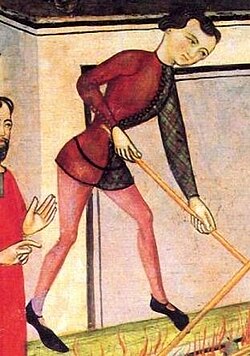
มีภาพวาดจากทวีปยุโรปอีกหลายภาพที่แสดงถึงเสื้อผ้าที่มีลักษณะคล้ายผ้าลายตารางหมากรุกจากยุคเดียวกันนี้ (ย้อนไปถึงศตวรรษที่ 13 ด้วยซ้ำ) แต่ส่วนใหญ่แสดงให้เห็น ลวดลาย ตารางหมากรุกพื้นฐาน สองสีที่เรียบง่าย หรือ (เช่น ตัวอย่าง ภาพการประกาศของมาร์ตินีและเมมมี) สี่เหลี่ยมจัตุรัสขนาดใหญ่ที่ทำจากเส้นบางๆ สีหนึ่งบนพื้นหลังอีกสีหนึ่ง ภาพเหล่านั้นอาจเป็นการปักหรือการเย็บปะติดปะต่อมากกว่าผ้าลายตารางหมากรุกที่ทอขึ้น ดูเหมือนว่าจะไม่มีหลักฐานใดๆ ในบันทึกที่หลงเหลืออยู่เกี่ยวกับการนำเข้าผ้าลายตารางหมากรุกจากสกอตแลนด์ในช่วงเวลานี้ ในช่วงครึ่งหลังของศตวรรษที่ 14 ศิลปินที่รู้จักกันในนาม "ปรมาจารย์แห่งเอสตามาริอู " (ในแคว้นกาตาลุญญา ประเทศสเปน) ได้วาดภาพแท่นบูชาของนักบุญวินเซนต์รายละเอียดอย่างหนึ่งคือชายคนหนึ่งสวมเสื้อคลุมยาวสีแดงครึ่งหนึ่งและผ้าลายตารางหมากรุกสามสีที่ซับซ้อนอีกครึ่งหนึ่ง ซึ่งคล้ายกับผ้าลายตารางหมากรุกของสกอตแลนด์ที่ปรากฏในหลักฐานในภายหลังมาก

เซอร์ฟรานซิส เจมส์ แกรนต์ลอร์ดไลออนคิงออฟอาร์มส์ในช่วงกลางศตวรรษที่ 20 ตั้งข้อสังเกตว่าบันทึกแสดงให้เห็นว่ามีการสวมใส่ผ้าลายตาร์ตันในสกอตแลนด์มาตั้งแต่ปี 1440 [ 163 ]อย่างไรก็ตาม ไม่ชัดเจนว่าเขาอ้างถึงบันทึกใด และนักวิจัยคนอื่นๆ ในภายหลังก็ไม่ได้ยืนยันวันที่ดังกล่าว
ศตวรรษที่ 16
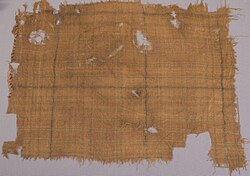

ตัวอย่างผ้าทาร์ทันขนแกะย้อมสีที่ซับซ้อนที่เก่าแก่ที่สุดที่ยังหลงเหลืออยู่ในสกอตแลนด์ (ไม่ใช่แค่ลายตารางธรรมดา) ได้รับการพิสูจน์โดยการหาอายุด้วยคาร์บอนกัมมันตรังสีว่ามีอายุตั้งแต่ศตวรรษที่ 16 รู้จักกันในชื่อ "ผ้าทาร์ทันเกลนแอฟฟริก" ซึ่งถูกค้นพบในช่วงต้นทศวรรษ 1980 ในบึงพีทใกล้กับเกลนแอฟฟ ริก ในที่ราบสูงสกอตแลนด์ สีที่ซีดจางของมันประกอบด้วยสีเขียว น้ำตาล แดง และเหลือง วัตถุโบราณขนาด 55 ซม. × 42 ซม. (22 นิ้ว × 17 นิ้ว)นี้ ได้รับการยืมมาจาก Scottish Tartans Authorityและจัดแสดงที่ พิพิธภัณฑ์ V&A Dundeeในเดือนเมษายน 2023 [ 147 ] [ 164 ] [ 165 ] [ 166 ] [ x ]
การอ้างอิงเป็นลายลักษณ์อักษรที่เก่าแก่ที่สุดที่กล่าวถึงผ้าลายตารางหมากรุกโดยชื่อนั้น ปรากฏอยู่ในบัญชีของเหรัญญิกแห่งสกอตแลนด์ ในปี ค.ศ. 1532–33 : " Ane uthir tartane galcoit gevin to the king be the Maister Forbes " ('เสื้อคลุมผ้าลายตารางหมากรุกอีกตัวหนึ่งที่มอบให้แก่กษัตริย์โดยมาสเตอร์ฟอร์บส์') [ 4 ]ไม่นานหลังจากนั้นก็มีบันทึกเกี่ยวกับเสื้อผ้าที่ทำโดยโทมัส อาร์เธอร์สำหรับกษัตริย์เจมส์ที่ 5 แห่งสกอตแลนด์ ในปี ค.ศ. 1538 ซึ่งรวมถึง " heland tertane to be hoiss " ('ผ้าลายตารางหมากรุกไฮแลนด์สำหรับกางเกง ') [ 167 ] [ 168 ] [ 169 ] [ y ]ผ้าลายตารางหมากรุกปรากฏให้เห็นก่อนหน้านั้นเล็กน้อย กวีวิลเลียม ดันบาร์ (ประมาณ ค.ศ. 1459 – ประมาณ ค.ศ. 1530) กล่าวถึง " Five thousand ellis ... Of Hieland pladdis " [ 170 ] ภาพ ที่เก่าแก่ที่สุดที่ยังหลงเหลืออยู่ของชาวไฮแลนด์ที่สวมใส่เสื้อผ้าที่น่าจะหมายถึงผ้าลายตารางหมากรุกคือภาพสีน้ำของลูคัส เดอ เฮียร์ ในช่วงปี 1567–80 ซึ่งแสดงให้เห็นชายคนหนึ่งสวมเสื้อคลุมสีเหลืองมีเข็มขัดและจีบ มีลายตารางหมากรุกเส้นบางๆ เสื้อคลุมสีแดงอ่อน และกางเกงขาสั้นสีน้ำเงินรัดรูป (ซึ่งเป็นแบบเดียวกับที่พบในงานศิลปะไอริชในยุคนั้น) พร้อมกับ ดาบ เคลย์มอร์และมีดสั้น [ 171 ] ภาพนี้ดูคล้ายกับภาพประกอบผ้า "ทาร์ทาร์" ในยุคกลาง ดังนั้นจึงไม่สามารถแน่ใจได้ว่าเป็นผ้าลายตารางหมากรุกที่แท้จริง ในช่วงปลายศตวรรษที่ 16 มีการอ้างอิงถึงผ้าลายทางหรือลายตารางหมากรุกจำนวนมาก กล่าว กันว่าลวดลายที่เก่าแก่ที่สุดที่ยังคงผลิตอยู่ในปัจจุบัน (แม้ว่าจะไม่ได้ใช้อย่างต่อเนื่อง) คือลายตาร์ตันของเขตเลนน็อกซ์[ 172 ] (ซึ่งถูกนำมาใช้เป็นลายตาร์ตันประจำตระกูลเลนน็อกซ์ ด้วย ) [ 173 ]ซึ่งกล่าวกันว่า D. W. Stewart ได้ทำซ้ำ ในปี 1893 จากภาพเหมือนของมาร์กาเร็ต ดักลาสเคาน์เตสแห่งเลนน็อกซ์ ซึ่งมีอายุราวปี 1575 [ 174 ]อย่างไรก็ตาม ดูเหมือนว่านี่จะเป็นเพียงตำนาน เนื่องจากไม่มีนักวิจัยลายตาร์ตันหรือนักประวัติศาสตร์ศิลปะสมัยใหม่คนใดระบุภาพเหมือนดังกล่าวได้ และภาพเหมือนจริงที่เก่าแก่ที่สุดที่รู้จักกันของผู้หญิงในชุดลายตาร์ตันนั้นมีอายุเก่าแก่กว่ามาก คือราวปี 1700 [ 175 ]ภาพเหมือนของมาร์กาเร็ตที่ยังคงเหลืออยู่แสดงให้เห็นว่าเธอสวมชุดกำมะหยี่และผ้าไหมปักดิ้นทอง[ 176 ]
.jpg)
กล่าวกันว่าผ้าลายตารางและชุดไฮแลนด์ในยุคเอลิซาเบธ ได้กลายเป็นสิ่งที่ ไม่มีชนชั้น[ z ] โดยสวมใส่ในไฮแลนด์โดยทุกคนตั้งแต่ ขุนนาง ชั้นสูงไปจนถึงชาวนาสามัญ[ 182 ]อย่างน้อยก็ในช่วงปลายศตวรรษที่ 16 นักประวัติศาสตร์จอห์น เมเจอร์เขียนไว้ในปี 1521 ว่าเป็นชนชั้นสูง รวมถึงนักรบ ที่สวมใส่ผ้าลายตาราง ในขณะที่สามัญชนในหมู่พวกเขาสวมใส่ผ้าลินิน ซึ่งแสดงให้เห็นว่าผ้าขนสัตว์เป็นของฟุ่มเฟือย[ 183 ]แต่ในปี 1578 บิชอปจอห์น เลสลีย์แห่งรอสส์ เขียนว่าผ้าลายตารางคาดเข็มขัดเป็นเครื่องแต่งกายทั่วไปของชาวไฮแลนด์ทั้งคนรวยและคนจน โดยขุนนางสามารถซื้อผ้าลายตารางขนาดใหญ่กว่าและมีสีสันมากกว่าได้[ 180 ] (ต่อมา เบิร์ต (1726) ก็เขียนถึงสุภาพบุรุษที่มีผ้าลายตารางขนาดใหญ่กว่าสามัญชนด้วย) [ 19 ]หากสีสื่อถึงความแตกต่าง ก็เป็นความแตกต่างทางชนชั้นทางสังคม ไม่ใช่ทางตระกูล[ 184 ] DW Stewart (1893) ระบุว่าการเปลี่ยนแปลงจากผ้าลินินไปสู่ผ้าขนสัตว์นั้นเกิดจากการผลิตที่แพร่หลายมากขึ้นและ "ความมั่งคั่งที่เพิ่มขึ้นของประชาชน" [ 180 ]
นักเขียนหลายคนในยุคนั้นได้เปรียบเทียบเครื่องแต่งกายของชาวไอริชและชาวไฮแลนด์ โดยเฉพาะอย่างยิ่งการสวมเสื้อเชิ้ตยาวสีเหลืองที่เรียกว่าléineหรือเสื้อเชิ้ตสีเหลือง (แม้ว่าอาจจะไม่ได้ย้อมด้วยหญ้าฝรั่น นำเข้าที่มีราคาแพงก็ตาม ) [ 185 ]ซึ่งสวมทับด้วยเสื้อคลุม (ผ้าคลุม) และบางครั้งก็สวมทับด้วยกางเกงขายาว[ 186 ]ยังไม่เป็นที่แน่ชัดว่าเสื้อคลุมเหล่านี้ทำจากผ้าลายตารางในไฮแลนด์เป็นครั้งแรกเมื่อใด แต่ผ้าที่มีลักษณะเฉพาะนี้ดูเหมือนจะได้รับการกล่าวถึงเป็นครั้งแรกในศตวรรษที่ 16 โดยเริ่มจากเมเจอร์ (1521) ในปี 1556 ฌอง เดอ โบเกนักประวัติศาสตร์ชาวฝรั่งเศสผู้เห็นเหตุการณ์ทหารสก็อตแลนด์ในการล้อมเมืองแฮดดิงตัน ในปี 1548 ได้แยกแยะชาวโลว์แลนด์ออกจาก "คนป่าเถื่อน" แห่งไฮแลนด์ และเขียนถึงคนหลังว่าสวมเสื้อเชิ้ตย้อมสี "และผ้าคลุมบางๆ ที่ทำจากขนสัตว์หลากสี" [ 187 ] [ 188 ] [ 189 ]จอร์จ บูคานันเขียนไว้ในปี 1582 ว่า "ผ้าลายสก็อตหลากสี" มีประเพณีมายาวนาน แต่แฟชั่นของชาวไฮแลนด์ในยุคของเขาส่วนใหญ่เปลี่ยนไปเป็นลวดลายที่เรียบง่ายกว่า โดยเฉพาะโทนสีน้ำตาล เพื่อการพรางตัวในทางปฏิบัติ[ 190 ] [ aa ]ไฟนส์ มอรีสันเขียนไว้ในปี 1598 (ตีพิมพ์ในปี 1617) ว่าผู้หญิงชาวไฮแลนด์ทั่วไปสวมใส่ " plodan " ซึ่งเป็น " ผ้าเนื้อหยาบ สองหรือสามสี ทอเป็นลายตารางหมากรุก " [ 193 ]

ผ้าลายตาร์ตันมีลักษณะการทอที่หนาแน่น ต้องใช้ทักษะและอุปกรณ์เฉพาะทาง โดยทั่วไปแล้วผ้าลายตาร์ตันไม่ได้เป็นงานของบุคคลใดบุคคลหนึ่ง แต่เป็นอุตสาหกรรมในครัวเรือนยุคแรกๆในไฮแลนด์ ซึ่งมักเป็นกิจกรรมร่วมกันที่เรียกว่า คาลานาส (calanas) รวมถึงประเพณีการร้องเพลงพื้นบ้านที่เกี่ยวข้อง โดยมีอาชีพเฉพาะทางที่เกี่ยวข้องหลายอย่าง (คนหวีขนแกะ คนย้อมคนทอ คนม้วนด้ายคนทอผ้า)ในหมู่คนในหมู่บ้าน ทำงานพาร์ทไทม์หรือเต็มเวลา[ 195 ]โดยเฉพาะผู้หญิง[ 196 ] [ ac ]เครื่องปั่นด้ายเป็นเทคโนโลยีที่เข้ามาในไฮแลนด์ช้า และผ้าลายตาร์ตันในยุคนี้ทอจากเส้นด้ายปั่นละเอียด (แต่ค่อนข้างไม่สม่ำเสมอ) ที่ปั่นด้วยมือบนแกนปั่นด้ายแบบดรอปสปิน เดิ ล[ 6 ]การค้าผ้าลายตาร์ตันในยุคนั้นมีศูนย์กลางอยู่ที่อินเวอร์เนสส์ซึ่งบันทึกทางธุรกิจในยุคแรกๆ เต็มไปด้วยการอ้างอิงถึงสินค้าผ้าลายตาร์ตันมากมาย[ 199 ]ลวดลายผ้าทาร์ตันมีความเกี่ยวข้องอย่างหลวมๆ กับช่างทอผ้าในพื้นที่เฉพาะ ซึ่งส่วนหนึ่งเป็นผลมาจากความแตกต่างของความพร้อมของสีย้อมธรรมชาติ[ 94 ] [ 200 ] [ 92 ] [ 201 ]และเป็นเรื่องปกติที่ชาวไฮแลนด์จะสวมใส่สิ่งใดก็ตามที่หาได้[ 9 ]บ่อยครั้งที่สวมใส่ผ้าทาร์ตันหลายแบบพร้อมกัน[ 202 ] [ ad ]ผ้าทาร์ตันยุคแรกที่พบในชายฝั่งตะวันออกของสกอตแลนด์มักใช้สีแดงมากกว่า อาจเป็นเพราะการค้าสีย้อมโคชินีล สีแดงระหว่างทวีปยุโรปทำได้ง่ายกว่า ในขณะที่ผ้าทาร์ตันทางตะวันตกมักใช้สีน้ำเงินและสีเขียวมากกว่า เนื่องจากมีสีย้อมในท้องถิ่น[ 174 ]ค่าใช้จ่ายที่สูงกว่าของสีย้อมสีแดงอาจทำให้มันกลายเป็นสัญลักษณ์แสดงสถานะ[ 204 ]ผ้าทาร์ตันแพร่กระจายออกไปนอกไฮแลนด์บ้าง แต่ก็ไม่ได้รับการยอมรับอย่างกว้างขวาง สมัชชาใหญ่แห่งคริสตจักรแห่งสกอตแลนด์ในปี ค.ศ. 1575 ห้ามมิให้บาทหลวงและผู้อ่านของคริสตจักร (และภรรยาของพวกเขา) สวมใส่ผ้าลายสกอตและเสื้อผ้า " หรูหรา " อื่นๆ [ 205 ] [ 206 ]ในขณะที่สภาเมืองอะเบอร์ดีน "เขตที่ไม่ใช่ไฮแลนด์เลย" ในปี ค.ศ. 1576 ห้ามการสวมใส่ผ้าลายสกอต (น่าจะหมายถึงผ้าลายสกอตแบบมีเข็มขัด) [ 207 ]
บันทึกของชาวไอริชในปี 1594 โดยLughaidh Ó Cléirighเกี่ยวกับทหารรับจ้างชาวสก็อตในไอร์แลนด์ได้อธิบายผ้าลายสก็อตแบบมีเข็มขัดไว้อย่างชัดเจนว่า "เสื้อผ้าลายจุดที่มีสีสันมากมายห้อยเป็นจีบยาวถึงน่อง โดยมีเข็มขัดคาดเอวทับเสื้อผ้า" [ 208 ]การตั้งถิ่นฐานในยุคแรกๆ ที่จัดตั้งโดยเอกชน(อาณานิคม) และการตั้งถิ่นฐานของรัฐบาลในอัลสเตอร์ ในภายหลัง ได้นำการทอผ้าลายสก็อตมาสู่ไอร์แลนด์เหนือในช่วงปลายศตวรรษที่ 16 ถึงต้นศตวรรษที่ 17 [ 209 ]ผู้ตั้งถิ่นฐานใหม่จำนวนมากเป็นชาวสก็อต และพวกเขาร่วมกับประชากรที่ตั้งรกรากอยู่ที่นั่นมานานหลายศตวรรษโดยทหารรับจ้างและผู้อพยพอื่นๆ ในปี 1956 ผ้าลายสก็อตไอริชที่เก่าแก่ที่สุดที่ยังหลงเหลืออยู่ถูกค้นพบในดินร่วนปนพีทนอกเมืองดังกิเวนในไอร์แลนด์เหนือในรูปแบบของกางเกง ลายสก็อต พร้อมกับเสื้อผ้าอื่นๆ ที่ไม่ใช่ลายสก็อต[ 210 ]มันถูกเรียกว่า "ผ้าทาร์ตันดันกิเวน" หรือ "ผ้าทาร์ตันอัลสเตอร์" [ 211 ]ตัวอย่างถูกกำหนดอายุโดยใช้พาลินวิทยาเป็นประมาณ ค.ศ. 1590–1650 [ 212 ] [ 213 ] (ดินที่ล้อมรอบผ้าอิ่มตัวด้วยละอองเรณูจากต้นสนสก็อตซึ่งเป็นสายพันธุ์ที่นำเข้าอัลสเตอร์จากสกอตแลนด์โดยผู้ตั้งถิ่นฐาน) [ 214 ] [ 18 ]ตามที่ผู้เชี่ยวชาญด้านสิ่งทอทางโบราณคดีออเดรย์ เฮนชอลล์ กล่าว ผ้าผืนนี้น่าจะทอในเคาน์ตีโดเนกัลประเทศไอร์แลนด์ แต่กางเกงตัดเย็บในที่ราบสูงสกอตแลนด์[ 214 ] [ 215 ]ด้วยค่าใช้จ่ายที่สูง บ่งบอกถึงบุคคลที่มีฐานะ[ 216 ]อาจเป็นกัลโลว์กลาส[ 212 ]เฮนชอลล์ได้จำลองผ้าทาร์ตันนี้สำหรับการจัดแสดงในปี 1958 [ 214 ] [ 18 ]ได้รับความนิยม (และได้รับการส่งเสริมอย่างมาก) ในฐานะผ้าลายตาร์ตันประจำเขตของอัลสเตอร์[ 18 ] (ทั้งในรูปแบบที่ซีดจาง เหมือนที่พบ[ 217 ]และโทนสีสดใสที่พยายามจำลองสิ่งที่อาจมีลักษณะดั้งเดิม) [ 218 ]และดูเหมือนว่าจะเป็นแรงบันดาลใจให้เกิดการสร้างผ้าลายตาร์ตันประจำเขตของไอร์แลนด์เพิ่มเติมในภายหลัง[ 18 ] [ 219 ]แทบไม่มีหลักฐานใดๆ ในแหล่งข้อมูลในยุคนั้นที่บ่งชี้ว่าชาวไอริชมักสวมผ้าลายตารางหมากรุก แหล่งข้อมูลเพียงแหล่งเดียวที่อาจตีความได้ว่าสนับสนุนแนวคิดนี้คือWilliam Camdenซึ่งเขียนไว้ในBritannia ของเขา (อย่างน้อยก็ตั้งแต่ฉบับปี 1607) ว่า "ชาวไฮแลนด์ ...สวมเสื้อคลุมลายทางตามแบบชาวไอริช" [ 220 ] [ 221 ] [ ae ]
ศตวรรษที่ 17

ภาพที่ เก่าแก่ที่สุดที่ยังหลงเหลืออยู่ซึ่ง แสดง ถึงชาวไฮแลนด์ในชุดลายตาร์ตัน อย่างไม่คลุมเครือ คือภาพสีน้ำ ซึ่งมีอายุราวปี ค.ศ. 1603–1616 และถูกค้นพบอีกครั้งในช่วงปลายศตวรรษที่ 20 โดยHieronymus Tielschหรือ Tielssch ภาพนี้แสดงให้เห็นผ้าลายตาร์ตันของผู้ชายที่คาดเข็มขัด และผ้าลายตาร์ตันของผู้หญิง (arisaid, earasaid ) ที่สวมเป็นผ้าคลุมไหล่หรือเสื้อคลุมทับชุดเดรส นอกจากนี้ยังแสดงให้เห็นถุงเท้าสั้นลายตารางและหมวกสีน้ำเงิน[ 194 ] [ 222 ] [ ab ] กลุ่มตระกูลต่างๆ ได้จัดตั้งกองกำลัง อาสาสมัครขึ้นเองเป็นเวลานานและเริ่มตั้งแต่ปี ค.ศ. 1603 รัฐบาลอังกฤษเองก็ได้จัดตั้ง หน่วยทหารอาสาสมัคร ที่ไม่เป็นทางการในไฮแลนด์ ซึ่งรู้จักกันในชื่อIndependent Highland Companies (IHCs) [ 223 ]เนื่องจากเป็นชาวไฮแลนด์ พวกเขาน่าจะสวมใส่ผ้าลายตาร์ตัน (ทหารรับจ้างชาวไฮแลนด์ในปี 1631 สวมใส่แน่นอน และ ICHs ก็สวมใส่ผ้าลายตาร์ตันในปี 1709 [ 223 ]และมีเครื่องแบบที่ทำจากผ้าลายตาร์ตันจริง ๆ ในปี 1725) [ 224 ] [ 225 ] [ 226 ]ผ้าลายตาร์ตันถูกใช้เป็นผ้าสำหรับตกแต่งรวมถึงผ้าม่านเตียงที่ปราสาทอาร์ดสตินชาร์ในปี 1605 [ 227 ]หลังจากมีการกล่าวถึง "เสื้อคลุมลายทาง" ของชาวไฮแลนด์ในหนังสือ Britannia ของแคมเดน ในปี 1607 [ 220 ]กวีจอห์น เทย์เลอร์ได้เขียนรายละเอียดเกี่ยวกับเครื่องแต่งกาย "ผ้าลายตาร์ตัน" ของชาวไฮแลนด์ใน หนังสือ The Pennyless Pilgrimage ในปี 1618 (ในแง่ที่โดยทั่วไปตรงกับสิ่งที่อธิบายและวาดภาพประกอบแม้กระทั่งสองศตวรรษต่อมา) เขาสังเกตว่าไม่เพียงแต่คนท้องถิ่นเท่านั้นที่สวมใส่ แต่ยังรวมถึงสุภาพบุรุษชาวอังกฤษที่มาเยือนด้วย[ af ] [ ag ]สภาเมืองอะเบอร์ดีนได้ปราบปรามผ้าลายสก็อตอีกครั้งในปี 1621 คราวนี้เป็นการปราบปรามการใช้ผ้าลายสก็อตเป็นเครื่องประดับศีรษะของผู้หญิง[ 207 ] และ ก่อนหน้านี้ในปี 1604 โบสถ์ในกลาสโกว์ ได้ห้ามการสวมใส่ผ้าลายสก็อตในระหว่างพิธี [ 229 ]คำตัดสินของสภาโบสถ์ที่คล้ายกันปรากฏขึ้นในเอลกินในปี 1624 ในคิงฮอร์นในปี 1642 และ 1644 และโมนิฟีธในปี 1643 โดยผ้าลายสก็อตของผู้หญิงถูกวิพากษ์วิจารณ์ในเชิงวรรณกรรมมากขึ้นในเอดินบะระในปี 1633 โดยวิลเลียม ลิธโกว์ [ 230 ] ในปี 1622 ศาลบารอนแห่งเบรดัลเบนกำหนดราคาคงที่สำหรับความซับซ้อนที่แตกต่างกันของผ้าลายตารางและผ้าเรียบ[ 231 ]

ในปี ค.ศ. 1627 กองทหารพลธนูชาวไฮแลนด์ที่สวมชุดลายตาร์ตันรับใช้ภายใต้เอิร์ลแห่งมอร์ตัน [ 232 ] มีการจัดตั้งกองทหารอิสระเพิ่มขึ้นในปี ค.ศ. 1667 [ 223 ]ภาพแรกสุดของทหารสก็อตในชุดลายตาร์ตันคือภาพพิมพ์ทองแดง ในปี ค.ศ. 1631 โดยGeorg Köler (ค.ศ. 1600–1638) ซึ่งแสดงให้เห็นทหารรับจ้างชาวไฮแลนด์ในสงครามสามสิบปีในกองกำลังของGustavus Adolphusแห่งสวีเดน[ 233 ] [ 234 ]ไม่นานหลังจากนั้น James Gordon บาทหลวงแห่งRothiemayได้เขียนไว้ในA History of Scots Affairs ตั้งแต่ปี ค.ศ. 1637 ถึง 1641เกี่ยวกับผ้าลายตาร์ตันที่คาดเข็มขัดว่า " เสื้อคลุมหลวมๆ หลายชิ้นมีลายทางและสีตัดกัน ซึ่งพวกเขาคาดเข็มขัดหนังไว้ด้านข้าง.... " เขายังอธิบายถึงกางเกงขาสั้นและกางเกงขายาว ("trowzes") ด้วย[ 235 ]แผนที่Scotia Antiqua ปี ค.ศ. 1653 โดยJoan Blaeuมีกรอบภาพที่แสดงภาพผู้ชายสวมกางเกงขายาวและผ้าลายสก็อตคาดเข็มขัด โดยลายสก็อตถูกวาดอย่างหยาบๆ ด้วยเส้นบางๆ บนพื้นหลังเรียบๆ[ 236 ]และสำเนาที่มีอยู่หลายฉบับถูกระบายสีด้วยมือแตกต่างกันDaniel DefoeในMemoirs of a Cavalier (ประมาณ ค.ศ. 1720) เขียนโดยใช้ข้อมูลที่อาจมีอายุย้อนไปถึงสงครามกลางเมืองอังกฤษเกี่ยวกับชาวไฮแลนด์ที่บุกอังกฤษตอนเหนือในปี ค.ศ. 1639 ว่าพวกเขาสวม "เสื้อคลุม กางเกงขายาว และถุงเท้า ทำจากผ้าที่พวกเขาเรียกว่าผ้าลายสก็อต มีลายทางสีแดงและเหลือง พร้อมเสื้อคลุมสั้นสีเดียวกัน" [ 237 ]


นอกจากการสวมผ้าลายสก็อตในโบสถ์ซึ่งในอดีตมักถูกตำหนิแล้ว เครื่องแต่งกายของผู้หญิงมักไม่ค่อยมีการบรรยาย (ยกเว้นในสมัยก่อนที่คล้ายกับของผู้ชาย) [ ah ]สำหรับผู้หญิงในที่ราบสูงและหมู่เกาะ ผ้าลายสก็อตที่คาดเข็มขัดนั้นเทียบเท่ากับผ้าลายสก็อตแบบมีเข็มขัด คืออาริซาอิด ( earasaid ) ซึ่ง เป็น ผ้าลาย สก็อตที่สามารถสวมเป็นผ้าคลุมไหล่ผืนใหญ่หรือพันเป็นชุดได้ เซอร์วิลเลียม เบรเรตันได้เขียนไว้ในปี 1634–35 (ตีพิมพ์ในปี 1844) เกี่ยวกับผู้หญิงในที่ราบต่ำในเอดินบะระว่า: "หลายคนสวม (โดยเฉพาะแบบที่ด้อยกว่า) ผ้าลายสก็อต ... ซึ่งคลุมศีรษะและปิดบังใบหน้าทั้งสองข้าง และจะยาวเกือบถึงพื้น แต่พวกเธอดึงขึ้นมาและสวมไว้ใต้แขน" เขายังรายงานอีกว่าผู้หญิงที่นั่นสวมใส่ "เครื่องแต่งกายและแฟชั่นที่แตกต่างกันหกหรือเจ็ดแบบ บางแบบใช้เพื่อแยกแยะแม่ม่าย ภรรยา และสาวใช้" ซึ่งรวมถึงชุดเดรส เสื้อคลุม/เสื้อคลุมยาว หมวกคลุมผมพร้อม ผ้าคลุม หน้าและปกคอระบาย แม้ว่าเขาจะไม่ได้กล่าวถึงลวดลายผ้าลายตารางในเครื่องแต่งกายเหล่านั้นโดยเฉพาะก็ตาม[ 239 ]
แม้ว่าผ้าลายตารางยังคงผลิตในไฮแลนด์ในฐานะอุตสาหกรรมในครัวเรือน แต่ในปี ค.ศ. 1655 การผลิตได้ย้ายไปอยู่ที่อะเบอร์ดีนโดยผลิตที่นั่น "ในปริมาณที่มากกว่าที่อื่นใดในประเทศ" [ 20 ]แม้ว่าจะมีการผลิตในกลาสโกว์มอนโทรสและดันดี ด้วย โดยส่วนใหญ่ส่งออก[ 20 ]อย่างน้อยในกลาสโกว์ การค้าบางส่วนเป็นการค้าผ้าลายตารางที่ผลิตในไฮแลนด์และหมู่เกาะเฮบริดีส และนำเข้ามาขายพร้อมกับหนังสัตว์และสินค้าอื่นๆ[ 20 ]ริชาร์ด แฟรงค์ประทับใจกับการค้าในกลาสโกว์ จึงเขียนไว้ใน Northern Memoirsของเขาในปี ค.ศ. 1658 ว่าผ้าชนิดนี้เป็น "สินค้าหลักของประเทศนี้" [ 240 ]ในปี ค.ศ. 1662 นักธรรมชาติวิทยาจอห์น เรย์ได้เขียนถึง "ผ้าห่มหลากสีที่ [ชาวสกอต] เรียกว่า plad คลุมศีรษะและไหล่" และแสดงความคิดเห็นว่าชาวสกอตแม้แต่ชนชั้นล่างก็ "แต่งกายเหมือนสุภาพบุรุษ" เพราะธรรมเนียมในสมัยนั้นคือการใช้จ่ายอย่างฟุ่มเฟือยกับเสื้อผ้า[ 241 ]ซึ่งเป็นธรรมเนียมที่ดูเหมือนจะย้อนกลับไปถึงปลายศตวรรษที่ 16 [ 242 ]โทมัส เคิร์ก จากยอร์กเชอร์ได้แสดงความคิดเห็นเกี่ยวกับกางเกงขายาว ผ้าคลุมไหล่ และอาจรวมถึงกระโปรงกิลต์ "สีลายตาราง" ในปี ค.ศ. 1677 [ 243 ] เนื้อหาเพิ่มเติมของเคิร์กได้รับการตีพิมพ์ในหนังสือ Early Travellers in Scotlandปี ค.ศ. 1891 ซึ่งแก้ไขโดยปีเตอร์ ฮูม บราวน์โดยบันทึก "การสวมใส่ plad" ในรูปแบบของผ้าคลุมไหล่แบบมีเข็มขัด กางเกงขายาว และถุงเท้า[ 244 ]บทกวีของวิลเลียม เคลแลนด์ในปี 1678 กล่าวถึงนายทหารชาวสกอตที่สวมกางเกงขายาวและผ้าคลุมไหล่ และทหารที่สวมผ้าคลุมไหล่คาดเข็มขัด[ 245 ]ในปี 1689 โทมัส มอเรอร์ นักบวชชาวอังกฤษประจำกองทหารสก็อตแลนด์ บรรยายถึงสตรีชาวโลว์แลนด์ที่มักสวมผ้าคลุมไหล่ แม้ว่าโดยทั่วไปแล้วจะแต่งกายเหมือนชาวอังกฤษก็ตาม[ 246 ]

ภาพเหมือนจริงที่เก่าแก่ ที่สุดที่รู้จักในชุดผ้าลายสก็อตแบบไฮแลนด์คือผลงาน (ซึ่งมีอยู่สามเวอร์ชัน) โดยJohn Michael Wrightซึ่งแสดงให้เห็นผ้าลายสก็อตที่ซับซ้อนมาก ประกอบด้วยสีน้ำตาล สีดำ และสีแดงสองเฉด[ 247 ]มีอายุราวปี ค.ศ. 1683 และเป็นภาพของ Mungo Murray บุตรชายของJohn Murray มาร์ควิสแห่ง Atholl [ 248 ] [ ai ]
,_1668_-_1700._Son_of_1st_Marquess_of_Atholl_-_Google_Art_Project.jpg)
ในปี ค.ศ. 1688 วิลเลียม ซาเชเวอเรลล์รองผู้ว่าการเกาะแมนได้เขียนถึงผ้าลายสก็อตของผู้หญิงแห่งมัลล์ในหมู่เกาะอินเนอร์เฮบริดีสว่า "ละเอียดกว่ามาก สีสันสดใสกว่า และช่องสี่เหลี่ยมใหญ่กว่าของผู้ชาย ... สิ่งนี้ใช้เป็นผ้าคลุมหน้า และคลุมทั้งศีรษะและลำตัว" [ 250 ]ในบทกวีThe Grameidใน ปี ค.ศ. 1691 [ 251 ]เจมส์ ฟิลิปแห่งอัลเมอรีโคลส ได้ บรรยายถึง ยุทธการคิลลีแครนกีในปี ค.ศ. 1689 ในลักษณะที่ดูเหมือนจะบ่งชี้ว่ากองกำลังทหารของบางเผ่ามีเครื่องแบบลาย สก็อตที่เป็นแบบเดียวกัน และนักประวัติศาสตร์บางคนได้ตีความเช่นนั้น[ 252 ] [ 253 ]
ศตวรรษที่ 18
จนกระทั่งต้นศตวรรษที่ 18 จึงมีรายงานว่ามีการใช้ลายตาร์ตันที่เป็นเอกภาพในระดับภูมิภาคเพียงพอที่จะระบุพื้นที่ต้นกำเนิดได้[ 158 ]มาร์ติน มาร์ตินในหนังสือ A Description of the Western Islands of Scotland ที่ตีพิมพ์ในปี 1703 ได้เขียนไว้หลังจากบรรยายถึงกางเกงและผ้าลายตา ร์ตัน ที่มีเข็มขัด "หลากสีสัน...ที่น่าพึงพอใจสำหรับรสนิยมชั้นสูง " ว่าลายตาร์ตันสามารถใช้เพื่อแยกแยะผู้อยู่อาศัยในสถานที่ต่างๆ ได้[ aj ]มาร์ตินไม่ได้กล่าวถึงการใช้รูปแบบพิเศษของแต่ละครอบครัวแต่อย่างใด
ในปี ค.ศ. 1709 กองร้อยไฮแลนด์อิสระสวมใส่ชุดไฮแลนด์ทั่วไป ไม่ใช่เครื่องแบบลายตาร์ตันแบบใดแบบหนึ่งโดยเฉพาะ เพื่อให้กลมกลืนกับพลเรือนและตรวจจับการทรยศของจาโคไบต์ ได้ดียิ่งขึ้น [ 223 ]ในปี ค.ศ. 1713 กองร้อยพลธนูหลวง (หน่วยองครักษ์หลวงที่ก่อตั้งขึ้นครั้งแรกในปี ค.ศ. 1676) [ 256 ]กลายเป็นหน่วยแรกที่รับใช้ราชบัลลังก์อังกฤษที่ใช้ลายตาร์ตันแบบใดแบบหนึ่งเป็นส่วนหนึ่งของเครื่องแบบทางการ ทหารอาสาสมัครของตระกูลแกรนต์อาจสวมชุดลายตาร์ตันสีเขียวและแดง (รายละเอียดไม่ระบุ) ตั้งแต่ปี ค.ศ. 1703–04 [ 257 ] [ 174 ]และสวมเครื่องแบบลายตาร์ตันแบบเดียวกันในปี ค.ศ. 1715 [ 258 ]แต่รูปแบบนี้ไม่หลงเหลืออยู่ และลายตาร์ตันของตระกูลแกรนต์ในปัจจุบันมีอายุเก่าแก่กว่ามาก[ 259 ]
บันทึกเกี่ยวกับชายชาวไฮแลนด์ในปี 1711 ระบุว่าพวกเขาทั้งหมด รวมถึง "ผู้ที่มีฐานะดี" สวมผ้าลายสก็อตแบบมีเข็มขัด[ 260 ]บันทึกในปี 1723 ชี้ให้เห็นว่าสุภาพบุรุษ อย่างน้อยเมื่อปะปนกับชาวอังกฤษ มักจะสวมกางเกงขายาวและถุงเท้าลายสก็อตพร้อมกับผู้ติดตามที่สวมผ้าลายสก็อตแบบมีเข็มขัด[ 260 ]ซึ่งเบิร์ตก็สังเกตเห็นเช่นกัน[ 261 ]กางเกงขายาวยังใช้งานได้จริงมากกว่าสำหรับการขี่ม้า[ 262 ]นอกจากนี้ ในช่วงประมาณปี 1723 เสื้อแจ็กเก็ตสั้นลายสก็อต ซึ่งในภาษาเกลิกเรียกว่าcòta-goirid บางครั้งมีแขนเสื้อผ่าและสวมคู่กับเสื้อกั๊กที่เข้าชุดกัน ได้ปรากฏตัวครั้งแรกและเริ่มเข้ามาแทนที่ เสื้อคลุมสีพื้นเรียบๆที่นิยมสวมใส่กันทั่วไปในชุดของชาวยุโรปในยุคนั้น ในเครื่องแต่งกายของชาวไฮแลนด์ còta -goiridมักจะสวมใส่คู่กับกางเกงขายาวที่เข้าชุดกันและผ้าคลุมไหล่ลายสก็อตที่อาจจะเข้าชุดกันหรือไม่ก็ได้ แต่ก็สามารถสวมใส่คู่กับผ้าคลุมไหล่ลายสก็อตแบบมีเข็มขัดได้เช่นกัน[ 263 ] [ ak ]

เอ็ม. มาร์ติน (1703) เขียนว่าผู้หญิงชาวเฮบริดีสที่ "ธรรมดา" ยังคงสวม ชุดคลุม/ชุดเดรสแบบอาริไซด์[ 264 ]โดยอธิบายว่าเป็น "ผ้าลายสก็อตสีขาว มีแถบสีดำ สีน้ำเงิน และสีแดงเล็กๆ น้อยๆ ยาวจากคอถึงส้นเท้า และผูกไว้ที่หน้าอกด้วยหัวเข็มขัดเงินหรือทองเหลือง" ซึ่งบางแบบก็ประดับประดาอย่างสวยงาม เขากล่าวว่าพวกเธอยังสวมเข็มขัดที่ตกแต่งอย่างสวยงาม แขนเสื้อสีแดงสด และผ้าคลุมศีรษะทำจากผ้าลินิน[ 265 ]มาร์ตินไม่ใช่แหล่งข้อมูลในยุคนั้นเพียงแหล่งเดียวที่เสนอว่าชุดนี้เป็นเครื่องแต่งกายของผู้หญิงทั่วไปเป็นหลัก โดยสุภาพสตรีชาวไฮแลนด์ชนชั้นสูงในศตวรรษที่ 18 มักจะสวมชุดราตรี ชุดเดรส และชุดขี่ม้า ที่ตัดเย็บอย่าง ประณีต ซึ่งมักทำจากวัสดุที่นำเข้า เช่นเดียวกับผู้หญิงชาวโลว์แลนด์และชาวอังกฤษ[ 175 ] [ 266 ]บางครั้งชุดของสตรีชาวไฮแลนด์ก็เป็นเพียงแถบเส้นตรงแทนที่จะเป็นลายสก็อต ซึ่งเป็นผ้าที่เรียกว่าiomairt ( drugget ) [ 175 ]ตั้งแต่ปลายศตวรรษที่ 18 เมื่อผ้าอริไซด์ถูกละทิ้งมากขึ้นสำหรับเสื้อผ้าสตรีร่วมสมัย ในขณะที่ผู้ชายชาวไฮแลนด์ยังคงสวมผ้าลายสก็อตแบบมีเข็มขัด[ 267 ]ผ้าลายสก็อตของผู้หญิงจึงลดขนาดลงเป็น "ฉากกั้น" ขนาดเล็กกว่า ซึ่งเป็นผ้าคลุมไหล่มีพู่ที่ใช้เป็นเครื่องประดับศีรษะและเครื่องประดับชุด[ 266 ] "การยกระดับผ้าอริไซด์" [ 175 ] (วิลสันส์ยังคงผลิตสิ่งเหล่านี้ต่อไปในช่วงครึ่งแรกของศตวรรษที่ 19) [ 175 ]จอห์น แม็กกีใน หนังสือ A Journey Through Scotland (1723) เขียนถึงผู้หญิงชาวสก็อตที่สวมผ้าลายสก็อตคลุมศีรษะและลำตัวทับชุดสไตล์อังกฤษ และเปรียบเทียบการปฏิบัตินี้กับผู้หญิงในทวีปยุโรปที่สวมผ้าคลุมสีดำไปโบสถ์ ตลาด และงานอื่นๆ[ 246 ]เอ็ดมันด์ เบิร์ตชาวอังกฤษที่ใช้เวลาหลายปีในและรอบๆ อินเวอร์เนส เขียนไว้ในปี 1727–1737 (ตีพิมพ์ในปี 1754) ว่าผู้หญิงที่นั่นก็สวมผ้าลายสก็อตเช่นกัน ทำจาก ขน แกะเนื้อ ดี หรือแม้แต่ผ้าไหมบางครั้งใช้คลุมศีรษะ และสวมยาวถึงข้อเท้าด้านใดด้านหนึ่ง เขากล่าวเสริมว่าในเอดินบะระ (ไกลออกไปทางตะวันออกเฉียงใต้) ก็มีการสวมใส่เช่นกัน โดยสุภาพสตรีจะแสดงจุดยืนทางการเมืองของตนว่าเป็นพรรควิกหรือพรรคทอรีโดยการเลือกด้านที่สวมยาว (แม้ว่าเขาจะจำไม่ได้ว่าด้านไหนเป็นด้านใด) [ 268 ]ในเอดินบะระ การไม่เห็นด้วยอย่างต่อเนื่องกับ " เครื่องแต่งกายที่ป่าเถื่อน "“ภาพของผู้หญิงที่สวมผ้าลายสก็อตคลุมศีรษะกลับมาปรากฏอีกครั้งในงานเขียนของวิลเลียม เมตแลนด์ ในปี ค.ศ. 1753 ผู้หญิงปรากฏตัวครั้งแรกในภาพวาดบุคคลที่รู้จักกันซึ่งสวมผ้าลายสก็อตราวปี ค.ศ. 1700 โดยภาพของราเชล กอร์ดอนแห่งอาเบอร์เกลดี ตัวอย่างที่เก่ากว่านั้นพบได้ในภาพวาดปี ค.ศ. 1742 และ 1749 โดยวิลเลียม มอสแมนพวกเขาแสดงให้เห็นผ้าลายสก็อต (ในลายสก็อตที่ไม่เหลือรอดมาเป็นลวดลายสมัยใหม่) ที่สวมหลวมๆ รอบไหล่โดยผู้ที่สวมชุดแฟชั่นแบบยุโรปทั่วไป[ 269 ]ชุดผ้าลายสก็อตทั้งชุดปรากฏในภาพบุคคลช่วงกลางศตวรรษที่ 18 แต่ก็ไม่ค่อยพบเห็น[ 175 ]ในยุคจาโคไบต์ บางครั้งผ้าลายสก็อตก็ถูกใช้เป็นเครื่องประดับ เช่น บนหมวก ผ้าลายสก็อตยังถูกสวมใส่เป็นส่วนหนึ่งของชุดแต่งงาน ผู้มีฐานะร่ำรวยบางครั้งมีชุดแต่งงานทั้งชุดเป็นผ้าลายสก็อต บางชุดทำจากผ้าไหม และถึงกับออกแบบผ้าลายสก็อตแบบกำหนดเองสำหรับงานแต่งงาน โดยทั่วไปจะอิงจากลวดลายที่มีอยู่แล้วโดยเปลี่ยนสี[ 266 ]

ภาพเหมือนเริ่มเป็นที่นิยมในหมู่ชนชั้นสูงของไฮแลนด์ตั้งแต่ต้นศตวรรษที่ 18 [ 271 ]ผ้าที่คล้ายกับที่ใช้ใน ภาพเหมือนของ Mungo Murray ประมาณปี ค.ศ. 1683 ปรากฏใน ภาพเหมือน ของJohn Campbell แห่ง Glenorchy ใน ปี ค.ศ. 1708ซึ่งเชื่อกันว่าเป็นผลงานของCharles Jervasและ ภาพเหมือน ของKenneth Sutherland, Lord Duffus ประมาณปี ค.ศ. 1712โดยRichard Waitt [ 272 ] รูปแบบของผ้าลายตารางหมากรุกที่ "ยุ่ง" แต่เน้นสีน้ำตาลนี้ดูเหมือนจะค่อนข้างแพร่หลายในช่วงต้นศตวรรษที่ 18 และค่อนข้างแตกต่างจากลวดลายในภายหลัง[ 273 ]เมื่อเวลาผ่านไป ลวดลายที่เด่นชัดขึ้นก็เริ่มมีบทบาทมากขึ้น เมื่อพิจารณาจากภาพเหมือนในภายหลังและตัวอย่างผ้าและเสื้อผ้าที่ยังหลงเหลืออยู่ ในช่วงต้นศตวรรษที่ 18 การผลิตผ้าลายตารางหมากรุก (และการทอผ้าโดยทั่วไป) มีศูนย์กลางอยู่ที่Bannockburn , Stirling ซึ่งเป็นที่ตั้งของ William Wilson & Son ผู้ทอผ้าลายตารางหมากรุกที่ในที่สุดก็มีบทบาทสำคัญ ก่อตั้งขึ้นประมาณปี ค.ศ. 1708 1765 ตั้งอยู่บนพื้นฐาน[ 274 ] [ am ]
_-_John_Campbell_(1696–1782),_3rd_Earl_of_Breadalbane,_as_a_Child_in_Highland_Costume_-_PG_2934_-_National_Galleries_of_Scotland.jpg)

จากการพิจารณาตัวอย่างที่หลงเหลืออยู่เพียงเล็กน้อย สีผ้าลายตารางหมากรุกของพลเรือนที่โดดเด่นในยุคนี้ นอกเหนือจากสีขาว (ขนแกะที่ไม่ได้ย้อม) และสีดำแล้ว ยังเป็นสีแดงและสีเขียวเข้ม และสีน้ำเงินเข้ม ซึ่งไม่สม่ำเสมอในแต่ละพื้นที่ หากมีสีดำที่ดี สีน้ำเงินเข้มก็จะถูกใช้น้อยลง[ 6 ]ลวดลายของผ้าลายตารางหมากรุกแบบไฮแลนด์ทั่วไปในยุคนั้น ดังที่แสดงในภาพเหมือน คือ สีแดงที่มีแถบสีเขียวและ/หรือสีน้ำเงินกว้าง บางครั้งก็มีลายตารางหมากรุกเส้นเล็กๆ[ 6 ] [ an ]การวาดภาพสีน้ำมันเป็นเรื่องของชนชั้นสูง และผ้าลายตารางหมากรุก " ชุด ที่ดีที่สุดสำหรับวันอาทิตย์ " ที่มีพื้นสีแดงมักถูกสวมใส่เพื่อเป็นสัญลักษณ์แสดงสถานะ ตั้งแต่ต้นศตวรรษที่ 18 โดยทั่วไปแล้วสีย้อมจะทำจาก โคชินีล นำเข้าที่มี ราคาแพง[ 175 ] [ 276 ]โดยทั่วไปแล้วสีเขียวและสีน้ำเงินจะเด่นกว่าเนื่องจากผลิตได้ง่ายกว่าด้วยสีย้อมที่หาได้ในท้องถิ่น ในขณะที่สีเหลือง[ ao ]และสีแดงที่ผลิตได้ยากกว่ามักจะถูกเก็บไว้สำหรับเส้นลายตารางบางๆ[ 278 ] (ซึ่งเป็นแนวปฏิบัติที่ยังคงดำเนินต่อไป เช่น ในผ้าลายตารางของกองทัพและตระกูลต่างๆ จนถึงศตวรรษที่ 19 ) อย่างไรก็ตาม แม้แต่สีน้ำเงินที่ย้อมด้วยสีย้อมในท้องถิ่นก็มักจะถูกย้อมซ้ำด้วย ครามที่นำเข้าในปริมาณเล็กน้อยเพื่อให้ได้สีที่เข้มขึ้น[ 48 ]
การประท้วงของฝ่ายสหภาพและการกบฏของจาโคไบต์
สนธิสัญญาและพระราชบัญญัติสหภาพ ใน ปีค.ศ. 1706–07 ซึ่งยกเลิกรัฐสภาแยกต่างหากของสกอตแลนด์ส่งผลให้ชาวสกอตแลนด์ตอนล่างจำนวนมากเริ่มใช้ผ้าลายตาร์ตันเป็นครั้งแรก เพื่อเป็นสัญลักษณ์ของการประท้วงต่อต้านสหภาพ[ 279 ] [ 280 ]ไม่เพียงแต่ผู้ชายเท่านั้นที่สวมใส่ (โดยไม่คำนึงถึงชนชั้นทางสังคม) [ 281 ]แต่แม้แต่สุภาพสตรีผู้มีอิทธิพลในเอดินบะระ[ 279 ] [ 282 ] ก็ยังสวมใส่กัน ไปจนถึงช่วงปี ค.ศ. 1790 [ 283 ] ในช่วงต้นศตวรรษที่ 18ยังมีความต้องการผ้าลายตาร์ตันในอังกฤษ เพื่อใช้สำหรับทำผ้าม่าน เครื่องนอน ชุดนอน ฯลฯ และช่างทอผ้าในนอริช นอร์ฟอล์ก และเมืองอื่นๆ ในอังกฤษบางแห่งพยายามเลียนแบบผลิตภัณฑ์ของสกอตแลนด์ แต่ถูกมองว่าเป็นตัวเลือกที่มีคุณภาพต่ำกว่า[ 260 ]

นักรบที่มีประสิทธิภาพมากที่สุดสำหรับลัทธิจาโคไบต์คือกลุ่มตระกูลชาวสก็อตที่ให้การสนับสนุน ซึ่งนำไปสู่การเชื่อมโยงผ้าลายตาร์ตันและเครื่องแต่งกายแบบไฮแลนด์กับอุดมการณ์จาโคไบต์ในการฟื้นฟูราชวงศ์สจวร์ต คาทอลิกให้กลับคืน สู่บัลลังก์ของอังกฤษ สก็อตแลนด์ และไอร์แลนด์ ซึ่งรวมถึงกระโปรงกิลต์ขนาดใหญ่และกางเกงขายาว (trews) พร้อมเสื้อโค้ทขนาดใหญ่ ซึ่งโดยทั่วไปทำจากผ้าลายตาร์ตัน เช่นเดียวกับหมวกสีน้ำเงินรัฐสภาอังกฤษเคยพิจารณาที่จะห้ามผ้าลายตาร์ตันแบบมีเข็มขัดหลังจากการก่อกบฏของจาโคไบต์ในปี 1715แต่ก็ไม่ได้ทำ[ 284 ]เครื่องแต่งกายแบบไฮแลนด์กลายเป็นเครื่องแบบของจาโคไบต์[ 283 ] [ 285 ] แม้แต่เจ้าชายชา ร์ลส์ เอ็ดเวิร์ด สจวร์ต ("บอนนี่ พรินซ์ ชาร์ลี") เอง ก็สวมใส่ในช่วงกลางศตวรรษที่ 18 [ 286 ] [ ap ]ส่วนใหญ่ในภาพถ่ายโฆษณาชวนเชื่อ (ด้วยผ้าลายตาร์ตันที่ไม่สอดคล้องกัน) แต่ยังรวมถึงบันทึกของผู้เห็นเหตุการณ์ที่คัลโลเดนด้วย[ 292 ]ในช่วงเวลานี้ บางครั้งมีการสวมผ้าลายสก็อตแบบมีเข็มขัดทับกางเกงและแจ็คเก็ตลายสก็อต (โดยไม่จำเป็นต้องเข้าชุดกัน) [ 293 ]

เบิร์ตเห็นด้วยราวปี ค.ศ. 1728 เช่นเดียวกับโรเบิร์ต เจมี สัน บรรณาธิการของเขาในปี ค.ศ. 1818 กับข้อสังเกตของบูคานันเมื่อปี ค.ศ. 1582 ที่ว่าผ้าลายตารางมักมีสีที่ตั้งใจให้กลมกลืนกับต้นเฮเธอร์และสภาพแวดล้อมทางธรรมชาติอื่นๆ[ 294 ]อย่างไรก็ตาม นี่อาจเป็นเพียงอคติของนักเขียนชาวอังกฤษในยุคนั้น อย่างน้อยก็ในช่วงกลางศตวรรษที่ 18 ตัวอย่างผ้าในยุคคัลโลเดนที่ยังหลงเหลืออยู่บางครั้งก็มีสีสันมาก ตัวอย่างหนึ่งคือลวดลายที่พบในเสื้อโค้ท (น่าจะเป็นของจาโคไบต์) ที่ทราบกันว่ามีอายุราวปี ค.ศ. 1745 แม้ว่าสีจะซีดจางเป็นสีเขียวมะกอกและสีน้ำเงินเข้ม แต่ลายปักนั้นเป็นลายที่โดดเด่นด้วยสีเขียว น้ำเงิน ดำ แดง เหลือง ขาว และฟ้าอ่อน (ในสัดส่วนที่ลดลง) แม้ว่าการประมาณลวดลายจะได้รับการตีพิมพ์ครั้งแรกใน D. W. Stewart (1893) แต่สีและสัดส่วนนั้นไม่ถูกต้อง เสื้อโค้ทตัวเดิมถูกค้นพบและตรวจสอบอีกครั้งในปี 2550 [ 295 ] [ 296 ]ตัวอย่างคัลโลเดนที่ยังหลงเหลืออยู่อีกชิ้นหนึ่ง ส่วนใหญ่เป็นสีแดง มีแถบสีน้ำเงิน เขียว และดำกว้างๆ และมีเส้นลายตารางบางๆ ซ้อนทับอยู่บ้าง ประกอบด้วยผ้าลายตารางทั้งผืนที่ยังคงสภาพสมบูรณ์เกือบทั้งหมด ซึ่งเคยเป็นของจอห์น มัวร์ และได้บริจาคให้กับพิพิธภัณฑ์แห่งชาติสกอตแลนด์ในปี 2562 [ 297 ]

มีตำนานเล่าว่าผ้าลายตาร์ตันที่ยังคงมีอยู่ผืนหนึ่งถูกใช้โดยพวกจาโคไบต์เป็นเครื่องบ่งชี้ตัวตนแม้กระทั่งก่อน " ปี ค.ศ. 1815 " เรื่องราวนี้สามารถสืบย้อนไปถึง W. & A. Smith (1850) ในAuthenticated Tartans of the Clans and Families of Scotlandซึ่งพวกเขาอ้างว่ารูปแบบที่พวกเขาตีพิมพ์ได้รับมาจากผู้หญิงนิรนามที่ยังมีชีวิตอยู่ ซึ่งอ้างว่าประเพณีของครอบครัวระบุว่าผ้าลายตาร์ตันนี้มีอายุย้อนไปถึงปี ค.ศ. 1712 นานก่อนที่เธอจะเกิด แต่ไม่มีหลักฐานใดๆ[ 31 ]เรื่องเล่าที่ได้ยินมานี้ถูกนำมาเล่าซ้ำในภายหลังราวกับเป็นข้อเท็จจริงที่ทราบกันดีในหนังสือเล่มอื่นๆ เช่นWhat Is My Tartan? ของ Adam Frank ในปี ค.ศ. 1896 [ 298 ] และการแก้ไข Clans and Tartans of Scotlandของ Robert Bain ในปี ค.ศ. 1938 โดย Margaret MacDougall ในปี ค.ศ. 1974 [ aq ] แม้แต่ Innes of Learney (1938) ผู้ซึ่งมักจะเชื่อคนง่ายก็ยังไม่เชื่อเรื่องนี้[ 301 ]รูปแบบดังกล่าวมีอายุอย่างน้อยประมาณ ค.ศ. 1815–26 เนื่องจากได้รับการรวบรวมโดย สมาคมไฮแลนด์แห่งลอนดอน ในช่วงเวลานั้น[ 31 ] แต่ไม่มีหลักฐานยืนยันที่แน่ชัดว่าพวกจาโคไบต์ใช้ผ้าลายตารางหมากรุกที่สม่ำเสมอ หรือแม้แต่ผ้าลาย ตารางหมากรุกที่ยังคงหลงเหลือมาจนถึงปัจจุบัน
กองร้อยไฮแลนด์อิสระได้รับการจัดตั้งขึ้นใหม่จากกลุ่มชนชาวสกอตที่ภักดีต่อราชวงศ์ฮันโนเวอร์ในช่วงปี 1725–29 [ 302 ] [ ar ] [ 303 ]ในครั้งนี้พวกเขาสวมชุดลายตาร์ตันสีน้ำเงิน ดำ และเขียว ซึ่งคาดว่ามีเส้นลายตารางที่แตกต่างกัน[ 304 ] [ 303 ] [ 224 ]พวกเขาทั้งหมดถูกปรับให้ใช้ลายตาร์ตันเดียวในช่วงปี 1725–33 [ 224 ] [ 226 ] [ 225 ] [ 305 ] (ซึ่งเป็นรูปแบบที่อาจไม่คงอยู่จนถึงปัจจุบัน) [ 174 ]ดูเหมือนว่าลายตาร์ตันของเครื่องแบบจะเปลี่ยนเป็นลายตาร์ตันใหม่ ซึ่งปัจจุบันรู้จักกันในชื่อ Black Watch หรือ Government เมื่อกองร้อยต่างๆ รวมกันเป็น กรมทหาร ที่ 42 (Black Watch)ในปี 1739
การสั่งห้ามและการผลที่ตามมา
หลังจากความล้มเหลวของการก่อกบฏของจาโคไบต์ในปี 1745ความพยายามที่จะทำให้ไฮแลนด์สงบลงและลดทอนอำนาจทางวัฒนธรรมและการเมืองของกลุ่มชน[ 306 ] [ 307 ]นำไปสู่พระราชบัญญัติการแต่งกายปี 1746ซึ่งเป็นส่วนหนึ่งของพระราชบัญญัติการสั่ง ห้าม เพื่อปลดอาวุธชาวไฮแลนด์ เนื่องจากเครื่องแต่งกายลายสก็อตของชาวไฮแลนด์มีความเชื่อมโยงเชิงสัญลักษณ์อย่างมากกับอุดมการณ์จาโคไบต์ที่แข็งกร้าว[ 308 ]พระราชบัญญัตินี้ ซึ่งเป็นการย้อนกลับไปสู่ กฎหมายควบคุมการใช้จ่ายฟุ่มเฟือย ที่ถูกยกเลิกไปนานแล้ว[ 308 ]ห้ามการสวมใส่เครื่องแต่งกายของชาวไฮแลนด์โดยผู้ชายและเด็กชายในสกอตแลนด์ทางเหนือของแม่น้ำฟอร์ธ ( เช่นในไฮแลนด์) [ ]ยกเว้นชนชั้นสูงเจ้าของที่ดิน[ที่]และกองทหารไฮแลนด์ของกองทัพอังกฤษ[ 310 ]กฎหมายนี้มีพื้นฐานมาจากการห้ามสวมใส่เสื้อผ้าแบบดั้งเดิมของชาวไอริชในราชอาณาจักรไอร์แลนด์ ในศตวรรษที่ 16 โดยฝ่ายบริหารปราสาทดับลิน[ 311 ]เซอร์วอลเตอร์ สก็อตต์เขียนเกี่ยวกับพระราชบัญญัติการแต่งกายว่า: "การห้ามดังกล่าวเป็นความรู้ของมนุษยชาติ เนื่องจากเป็นการปลดเปลื้องชาวไฮแลนด์จากการแต่งกายซึ่งมีความเกี่ยวข้องอย่างใกล้ชิดกับธรรมเนียมปฏิบัติของตระกูลและสงครามของพวกเขา" [ 312 ]
ผ้าลายตารางที่บันทึกไว้ไม่นานหลังจากพระราชบัญญัติ (ดังนั้นจึงน่าจะเป็นรูปแบบที่ใช้ในยุคก่อนการห้าม) แสดงให้เห็นว่ารูปแบบทั่วไปถูกใช้ในพื้นที่กว้าง โดยมีการเปลี่ยนแปลงเล็กน้อยโดยช่างทอแต่ละรายตามรสนิยม[ 233 ]ตัวอย่างเช่น ผ้าลายตารางที่ใช้ในปัจจุบันเป็นผ้าลายตารางหลัก (สีแดง) ของตระกูลแมคอินทอช[ 313 ]ซึ่งบันทึกโดยสมาคมไฮแลนด์แห่งลอนดอนราวปี 1815 พบในรูปแบบต่างๆ จากเพิร์ธเชียร์และบาเดนอค ตามแนว เกรท เกลน ไปจนถึงล็อคมอย [ 233 ] สามารถพบกลุ่มอื่นๆ ดังกล่าวได้ เช่น กลุ่ม เมอร์เรย์ / ซัทเธอร์แลนด์ / กอร์ดอนที่มีศูนย์กลางอยู่ ที่ฮันท์ลีย์ ซึ่งได้ รับการวิเคราะห์ว่ามีความเกี่ยวข้องอย่างชัดเจนโดยอินเนสแห่งเลียร์นีย์ (1938) [ 161 ] – ซึ่งแตกต่างจากกลุ่มฮั น ท์ลีย์/ แมคเร / รอสส์ / แก รนต์ที่แตกต่างกันซึ่งระบุโดยทะเบียนผ้าลายตารางของสกอตแลนด์ และนักวิจัยผ้าลายตารางปีเตอร์ เอสเลีย แมคโดนั ลด์แห่งหน่วยงานผ้าลายตารางของสกอตแลนด์[ 314 ] [ 315 ]แต่สการ์เล็ตต์ (1990) กล่าวว่า "รูปแบบเก่าที่มีอยู่มีจำนวนน้อยเกินไปที่จะอนุญาตให้ทำการศึกษารายละเอียดเกี่ยวกับการกระจายรูปแบบดังกล่าว" ทั่วทั้งไฮแลนด์[ 233 ]ภาพเหมือนของยุคนั้นยังแสดงให้เห็นว่าผ้าลายตารางถูกผลิตขึ้นมากขึ้นโดยใช้ รูปแบบ เส้นด้ายยืนและเส้นด้ายพุ่งที่ เหมือนกันหรือเกือบเหมือนกัน ซึ่งก่อนหน้านี้ไม่ได้เป็นเช่นนั้นเสมอไป และผ้าลายตารางที่ใช้เป็นผ้าทวิลล์ละเอียด มีความหนาของเส้นด้ายยืนและเส้นด้ายพุ่งเท่ากัน ซึ่งยังคงใช้ในปัจจุบันสำหรับกระโปรงกิลต์[ 253 ] [ 271 ]
แม้ว่าพระราชบัญญัติการแต่งกายจะไม่ได้ห้ามผ้าลายตารางทั้งหมด[ 316 ] (หรือปี่สก็อต หรือภาษาเกลิก) และผู้หญิง ขุนนาง และทหารยังคงสวมใส่ผ้าลายตาราง[ 317 ]ก็ตาม แต่พระราชบัญญัตินี้ได้ตัดขาดประเพณีการสวมใส่ผ้าลายตารางในชีวิตประจำวันของชาวไฮแลนด์อย่างมีประสิทธิภาพ เนื่องจากบังคับให้สวมใส่เสื้อผ้าที่ไม่ใช่ของชาวไฮแลนด์ซึ่งเป็นที่นิยมในส่วนอื่นๆ ของยุโรปเป็นเวลาสองชั่วอายุคน[ 310 ] [ 318 ] (แม้ว่าชาวไฮแลนด์บางคนจะฝ่าฝืนพระราชบัญญัตินี้[ 319 ] [ 320 ]แต่ก็มีบทลงโทษทางอาญาที่รุนแรง) [ 321 ]มันมีผลทำให้เสียขวัญกำลังใจ[ au ]และเป้าหมายของมาตรการนี้และมาตรการที่เกี่ยวข้องในการบูรณาการชาวไฮแลนด์เข้าสู่สังคมโลว์แลนด์และสังคมอังกฤษโดยรวม[ 311 ]ประสบความสำเร็จอย่างมาก[ 308 ] [ 323 ]ในช่วงทศวรรษ 1770 การแต่งกายของชาวไฮแลนด์ดูเหมือนจะสูญพันธุ์ไปเกือบหมดแล้ว[ 324 ]อย่างไรก็ตาม การกระทำดังกล่าวอาจช่วย "ปลุกจิตสำนึกของตระกูล" ภายใต้การปราบปรามนั้นได้เช่นกัน[ 325 ]ตระกูลชาวสก็อตในรูปแบบโรแมนติกจะกลับมาเฟื่องฟูอีกครั้งในยุค "ผ้าลายสก็อตของตระกูล" ซึ่งดำเนินมาตั้งแต่สมัยรีเจนซี (ปลายสมัยจอร์เจียน ) จนถึงสมัยวิกตอเรียน
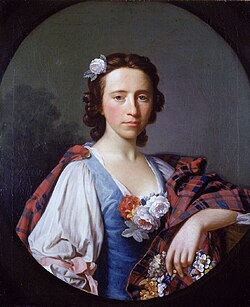
ในระหว่างนั้น สตรีชาวจาโคไบต์ยังคงใช้ผ้าลายตาร์ตันอย่างมากมาย ทั้งสำหรับเสื้อผ้า (ตั้งแต่ชุดเดรสไปจนถึงรองเท้า) ผ้าม่าน และของใช้ในชีวิตประจำวัน[ 327 ] [ 317 ]ในขณะที่ ภาพเหมือนของขุนนางตระกูลต่างๆ ในศตวรรษที่ 18 ซึ่งได้รับอิทธิพลจาก ลัทธิคลาสสิก (มักวาดนอกสกอตแลนด์) มักแสดงให้เห็นพวกเขาในชุดผ้าลายตาร์ตันและชุด "ไฮแลนด์" แต่ส่วนใหญ่เป็นรูปแบบทางทหารของฝ่ายภักดี ซึ่งเป็นสิ่งที่ตรงกันข้ามกับข้อความของจาโคไบต์[ 328 ]มันเป็นลางบอกเหตุถึงการเปลี่ยนแปลงครั้งสำคัญในทางการเมืองของผ้าลายตาร์ตันอย่างไรก็ตาม การใช้ผ้าลายตาร์ตันอย่างมากมายนี้อาจถูกมองว่าเป็นการกบฏในระดับหนึ่ง โดยชาว ไฮแลนด์ ที่ถูกทำให้เป็นรูปธรรมกลายเป็น "บุคคลผู้กล้าหาญและคลาสสิก ผู้สืบทอดคุณธรรมดั้งเดิม" [ 329 ]และในช่วงทศวรรษ 1760 ผ้าลายตาร์ตันก็เริ่มมีความเกี่ยวข้องกับสกอตแลนด์โดยทั่วไปมากขึ้น ไม่ใช่แค่ไฮแลนด์ โดยเฉพาะอย่างยิ่งในความคิดของชาวอังกฤษ[ 330 ]

หลังจากมีการประท้วงอย่างมาก (เนื่องจากข้อห้ามนี้ใช้กับทั้งฝ่ายจาคอบไนต์และฝ่ายภักดี) พระราชบัญญัติการแต่งกายจึงถูกยกเลิกในปี 1782 โดยส่วนใหญ่เกิดจากความพยายามของสมาคมไฮแลนด์แห่งลอนดอน[ 332 ]ร่างกฎหมายยกเลิกนี้เสนอโดยเจมส์ เกรแฮม มาร์ควิสแห่งเกรแฮม (ต่อมาคือดยุคแห่งมอนโทรส) [ 333 ]ชาวไฮแลนด์บางส่วนกลับมาสวมชุดแบบดั้งเดิมอีกครั้ง[ 334 ]แต่โดยรวมแล้วชุดแบบนี้ถูกละทิ้งโดยชาวนาผู้สวมใส่ในอดีต และถูกนำไปใช้โดยชนชั้นสูงและชนชั้นกลางแทนในฐานะแฟชั่น[ 335 ]ผ้าลายตารางได้ถูก "ย้ายทางวัฒนธรรมให้เป็นชุดที่งดงามหรือเป็นเครื่องแต่งกายของกองกำลังต่อสู้ที่แข็งแกร่งและมีประสิทธิภาพ" สำหรับราชบัลลังก์ ไม่ใช่สัญลักษณ์ของการกบฏโดยตรง[ 336 ] R. Martin (1988) เรียกการเปลี่ยนแปลงนี้ว่า " การแยกสาขา ครั้งใหญ่ ในชุดผ้าลายตาร์ตัน" [ 337 ]ผ้าชนิดนี้ถูกละทิ้งไปเป็นส่วนใหญ่ (โดยถูกบังคับ) โดยชาวไฮแลนด์ดั้งเดิม จากนั้นจึงถูกนำไปใช้โดยกองทัพ และต่อมาโดยพลเรือนที่ไม่ใช่ชาวไฮแลนด์ ในช่วงที่มีการห้าม เทคนิคการปั่นและย้อมขนสัตว์แบบดั้งเดิมของชาวไฮแลนด์ และการทอผ้าลายตาร์ตันก็ลดลงอย่างมาก[ 94 ] [ 309 ] [ 103 ]การผลิตผ้าลายตาร์ตันเชิงพาณิชย์จึงกลับมารวมศูนย์อยู่ที่โลว์แลนด์ ในหมู่บ้านโรงงานตามแนวชายขอบของไฮแลนด์[ 338 ]ในหมู่บริษัทต่างๆ เช่น Wilsons of Bannockburn (ซึ่งเป็นผู้ผลิตรายใหญ่ในขณะนั้น) [ 339 ]พร้อมกับความต้องการผ้าลายตาร์ตันสำหรับชุดเครื่องแบบทหารที่ เพิ่มขึ้น [ 340 ]การทอผ้าลายตาร์ตันบางส่วนยังคงดำเนินต่อไปในไฮแลนด์[ 341 ] [ 342 ]และยังได้รับความนิยมเพิ่มขึ้นในช่วงปลายยุคจอร์เจียน[ 341 ]ในยุคนี้ ผ้าลายตาร์ตันยังได้รับความนิยมในพื้นที่ราบต่ำ รวมถึงไฟฟ์และโลเธียนและศูนย์กลางเมืองเอดินบะระและสเตอร์ลิง [ 316 ] ตั้งแต่ปี 1797 ถึง 1830 [ 274 ]วิลสันส์ได้ส่งออกผ้าลายตาร์ตันจำนวนมาก (สำหรับเสื้อผ้าทั้งชายและหญิง) ไปยังอาณานิคมของอังกฤษในเกรนาดาและจาเมกา ก่อน (ซึ่งวัสดุราคาไม่แพง ทนทาน และสีสันสดใสนี้เป็นที่นิยมสำหรับการทำเสื้อผ้าให้กับทาส ) [338 ]และมีลูกค้าในอังกฤษ ยุโรปเหนือและกลาง และต่อมาในอเมริกาเหนือและใต้ และแถบเมดิเตอร์เรเนียน [ 343 ] [ 344 ]อย่างไรก็ตาม เมื่อถึงปลายศตวรรษที่ 18 วิลสันส์ก็ประสบกับ "การแข่งขันที่ดุเดือด" (ในเรื่องผ้าลายตารางสำหรับพลเรือน) จากช่างทอผ้าชาวอังกฤษในเมืองนอริช [ 345 ]
เนื่องจากพระราชบัญญัติการแต่งกายไม่ได้บังคับใช้กับทหารหรือชนชั้นสูง ผ้าลายตารางจึงค่อยๆ กลายมาเกี่ยวข้องกับคนมีฐานะร่ำรวยมากกว่า ชาว ไฮแลนด์ผู้สูงศักดิ์[ 346 ] [ 347 ] [ 348 ]ตั้งแต่ปลายศตวรรษที่ 18 จนถึงศตวรรษที่ 19 [ 349 ]พร้อมกับรูปแบบการแต่งกายที่ได้รับอิทธิพลจากทหารและแสดงถึงความรักชาติโดยทั่วไป[ 350 ]ผ้าลายตารางและเครื่องแต่งกายแบบไฮแลนด์ที่ได้รับอิทธิพลจากทหารกำลังได้รับการฟื้นฟูในหมู่ผู้ที่ใส่ใจแฟชั่นทั่วสหราชอาณาจักร แม้แต่ในหมู่ผู้หญิงที่มีญาติเป็นทหาร[ 351 ]กลุ่มตระกูล ลัทธิจาคอบิสต์ และการต่อต้านสหภาพ (ซึ่งไม่มีสิ่งใดเป็นภัยคุกคามต่อความไม่สงบในสังคมอีกต่อไป) ถูกมองด้วยความรู้สึกโหยหามากขึ้นเรื่อยๆ[ 182 ] [ 352 ] [ 353 ] [ 348 ]โดยเฉพาะอย่างยิ่งหลังจากการสิ้นพระชนม์ของเจ้าชายชาร์ลส์ เอ็ดเวิร์ด สจวร์ต ในปี 1788 [ 354 ]แม้ว่ากองทหารไฮแลนด์จะพิสูจน์ความจงรักภักดีและคุณค่าของตนแล้วก็ตาม[ 348 ]การนำเอาท่าทีแบบ" ไฮแลนด์ " ที่มีลวดลายสก็อต แบบพวกอนุรักษ์นิยมมาใช้ [ 355 ]ทำให้เกิดความรู้สึกหลังการรวมชาติและยอมรับความแตกต่างทางชาติ (และชนชั้นนำทางทหาร) จากส่วนที่เหลือของบริเตน โดยไม่คุกคามจักรวรรดิ[ 356 ] แม้แต่พระเจ้า จอร์จที่ 4ในอนาคตก็ยังทรงสวมเครื่องทรงไฮแลนด์เพื่อไปงานเต้นรำสวมหน้ากากในปี 1789 [ 357 ]ในช่วงทศวรรษ 1790 ขุนนางบางส่วนได้ช่วยออกแบบผ้าลายตาร์ตันสำหรับใช้ส่วนตัว ตามบันทึกที่หลงเหลืออยู่จากวิลสันส์[ 182 ]เจน (แม็กซ์เวลล์) กอร์ดอน ดัชเชสแห่งกอร์ดอนกล่าวกันว่า "ทรงนำผ้าลายตาร์ตันมาสู่ราชสำนัก ... โดยทรงสวมผ้าลายตาร์ตันของกองทหารแบล็กวอช ซึ่งพระโอรสของพระองค์เพิ่งได้รับการแต่งตั้ง" ในปี 1792 พระองค์ทรงจุดประกายแฟชั่นการสวมผ้าลายตาร์ตันในลอนดอนและปารีส แม้ว่าจะไม่รอดพ้นจากการล้อเลียนโดยผู้ที่ไม่เห็นด้วยก็ตาม[ 358 ]
R. Martin (1988) เขียนจาก มุมมอง ทางประวัติศาสตร์ว่าหลังจากพระราชบัญญัติการแต่งกาย: [ 337 ]
แนวคิดเรื่องเครื่องแต่งกายแบบไฮแลนด์ถูกเก็บไว้ในห้องใต้หลังคาทางประวัติศาสตร์ส่วนรวม เมื่อมีการฟื้นฟูขึ้นมาอีกครั้งในช่วงก่อนปี 1822 เครื่องแต่งกายแบบนี้ก็ถูกลืมไปโดยคนรุ่นหลังที่แต่งกายแบบพลเรือนประมาณสองหรือสามรุ่น และอาจจำได้ (แม้จะบิดเบือนไปบ้าง) ว่าเป็นเครื่องแต่งกายโบราณของชาวไฮแลนด์ ไม่ใช่เครื่องแต่งกายแบบชาวนาทั่วไปที่สวมใส่กันก่อนปี 1746 การห้ามใช้ผ้าลายตาร์ตันประสบความสำเร็จอย่างมาก แต่ก็เป็นปฏิปักษ์ต่อกระบวนการทางประวัติศาสตร์ตามธรรมชาติ จนกระตุ้นให้เกิดการกลับมาใช้ผ้าลายตาร์ตันอย่างรุนแรงอีกครั้ง โดยได้รับการรับรองจากความรู้สึกทางประวัติศาสตร์ที่ผิดเพี้ยนในศตวรรษถัดมา
เหตุการณ์วุ่นวายในสกอตแลนด์ช่วงศตวรรษที่ 18 ไม่เพียงแต่นำไปสู่การใช้ผ้าลายตารางหมากรุกในวงกว้างมากขึ้นเท่านั้น แต่ยังก่อให้เกิดผ้าลายตารางหมากรุกสองประเภทที่คงอยู่มาอย่างยาวนาน ได้แก่ ผ้าลายตารางหมากรุกประจำกรมทหาร และในที่สุดก็กลายเป็นผ้าลายตารางหมากรุกประจำตระกูลต่างๆ
ผ้าลายสก็อตประจำกรมทหาร

หลังจากช่วงเวลาของกองกำลังติดอาวุธของตระกูลในยุคแรกและกองร้อยไฮแลนด์อิสระ (IHCs) มีการจัดตั้งกองพันทหารประจำการ ทหารรักษาดินแดน ทหารอาสาสมัคร และกองทหารมากกว่า 100 กองพัน ระหว่างประมาณปี 1739 จนถึงสิ้นสุดสงครามนโปเลียนในปี 1815 ในหรือส่วนใหญ่ในไฮแลนด์[ 359 ]โดยมีสัดส่วนที่สำคัญสวมเครื่องแบบไฮแลนด์ ในบรรดาหน่วยเหล่านี้ มีเพียงบางหน่วยเท่านั้นที่มีลายตาร์ตันเครื่องแบบที่แตกต่างกัน และในจำนวนนั้น มีเพียงจำนวนเล็กน้อยเท่านั้นที่ได้รับการบันทึกไว้จนถึงปัจจุบัน

The IHCs were amalgamated in 1739 to become the 43rd (later 42nd) Regiment of Foot,[360] called the Black Watch.[361] It was the first proper governmental Highland regiment, part of the British Army, and they wore the belted plaid ("great kilt") for dress, and the tailored small kilt for undress uniform.[362][303][363] For the former garment,[364] they used a distinctive tartan, which was designed for the unit.[365] It was originally called the "42nd tartan",[365] so it probably was not adopted until after the unit was renumbered the 42nd in 1749.[224] It seems likely that the tartan was based on those used by the IHCs earlier, but with double black "tram line" over-checks added.[224][366] The Black Watch pattern was used by various other regiments, and it has been estimated that to clothe them all, some 30–40 miles (48–64 km) of the tartan had to be woven before 1750 alone.[58] It became the basis of various later regimental (and eventually clan) tartans.[224] It remains popular in general-public use under the names "Black Watch", "Government", and any of "old Campbell", "hunting Grant", or "hunting Munro",[224] but today officially called "Government No. 1" by the military. The 42nd had separate tartans for its small kilt until c. 1814[364][367] (also used for grenadiers' belted plaids),[364] for pipers,[368][369] and for drummers.[370]
After the Jacobite uprisings, raising a regiment in service to the king was, for many Scottish lairds, a way of rehabilitating the family name, assuring new-found loyalty to the Hanoverian crown, and currying royal favour (even regaining forfeited estates).[371] Exempt from the Dress Act, men in these Highland regiments of the empire were given Highland dress, and the "kilts and pipes that were once considered barbaric were now seen as 'safe' nationalism" within the army.[372] From c. 1770 onward into the 19th century, virtually all the regimental tartan was produced by the company William Wilson & Son of Bannockburn, the dominant tartan weaver.[339] Regimental uniforms, including tartans, were left – usually within the general Black Watch-based colour scheme of black, blue, and green – to their commanders.[373][374]

Some surviving early regimental tartans include:
- Loudoun's Highlanders (64th, raised in 1745), used a tartan similar to Black Watch, but with over-checks of red and yellow, and lacking the two black "tram lines" of Black Watch.[375][376]
- The 78th (Highlanders) or Ross-shire Buffs (raised 1793), MacLeod's Highlanders (73rd, later 71st, raised 1777–78), and the original Seaforth Highland Regiment (78th, later 72nd, raised 1778)[av] first used Black Watch, then in 1787 adopted a variant of it with thin over-checks of red and white.[377][378][379] It eventually became the Clan Mackenzie tartan,[378] and it remains used as an official British military tartan, designated "Government No. 5A". A slight variation, with yellow in place of white, became one of the Clan MacLeod tartans.[380]
- The 74th (Highland) Regiment of Foot (raised 1787)[aw] used another variant of the Black Watch tartan with a black-guarded white over-check.[381] Also in 1787, the 75th (Highland) Regiment, later 75th (Stirlingshire), probably used a more distinct tartan, not based on Black Watch, of purple and black on a green ground, with thin white and black over-checks; it was later called "No. 64 or Abercromby" by Wilsons, and though it did not become adopted as an Abercromby/Abercrombie clan tartan, variants of it became two unrelated clan patterns.[382]
- The Gordon Highlanders (100th, later 92nd, raised 1794) also wore an altered Black Watch, this time with a thin yellow over-check.[383][384] In a rare show of competition to Wilsons, the pattern was designed in 1793 and supplied by weaver William Forsyth of Huntly, Aberdeen.[385] This pattern became the main tartan of Clan Gordon.[386][387] Something nearly identical (perhaps with the yellow over-check in a different width) was also used by the 8th (Rothesay and Caithness) Fencibles.[388]
- The Cameronian Volunteers (79th, later Queen's Own Cameron Highlanders, raised 1793) used a comparatively distinct tartan, later the family tartan of the Cameron of Erracht branch of Clan Cameron.[55][389][390] It is structurally much like Black Watch, but without black over-checks and with a number of yellow and red over-checks. It has been said to have been designed by the unit leaderor a family member.[55][391]
- The Fraser Fencibles (raised 1794–95) used a tartan with a red ground and green and blue bands, unrelated to the Black Watch style.[392][393]
- The Sutherland Highlanders (93rd) raised 1799, and later the Argyll and Sutherland Highlanders (Princess Louise's, formed 1881 by amalgamation of the 93rd with the 91st Argyllshire Highlanders), may have worn a lightened version of Black Watch,[394][395] now sometimes used as one of the Clan Sutherland tartans;[396][397] it is also still militarily used as sett "Government No. 1A".
- The Loyal Clan Donnachie Volunteers (raised in 1803) had its own uniform tartan, which was later adopted as the hunting Robertson/Donnachie/Duncan clan tartan.[398][399]
- The Duke of Albany's Own Highlanders (formerly Seaforth's 72nd), during a trews-wearing period of 1823–1881, wore a tartan called Prince Charles Edward Stuart, similar to royal Stewart,[110] as shown in a period painting. Identified in surviving cloth samples from the mid-18th century[62] (before the regiment) it is one of the oldest setts in continuous production.[62]
_Regiment,_tileable.png)
_tartan,_tileable.png)


By the turn of the 18th and 19th centuries, women in Scotland were especially "desirous to dress in the uniform plaids of their husbands", in particularly fine-quality cloth, according to records of Wilsons of Bannockburn.[358] After the Highland regiments proved themselves fearless and effective in various military campaigns, the glory associated with them did much to keep alive, initially among the gentry and later the general public, an interest in tartan and kilts, which might have otherwise slipped into obscurity due to the Dress Act's prohibition.[400] The belted plaid was abandoned in favour of the small kilt, around 1814.[347][364] After the "clan tartanry" rush of the early to mid-19th century , various later Highland regiments adopted some of the recently minted clan tartans for their uniforms (reversing the original regimental-into-clan-tartan flow). Some of these adoptions remain in regimental use today.
The Lowland regiments (dating in some form to 1633 and never before dressed in Highland garb but in a variant of regular army uniform) were outfitted in tartan trews in 1881. This both linked them with and distinguished them from the tartan-kilted Highland regiments.[401] Typically the "Government" (Black Watch) tartan was used, though some units later diversified. Several Highland regiments were again assigned new tartans that were clan tartans rather than unit-specific ones, into the early 20th century.[302]
Today, about a dozen tartans are officially used (and half a dozen more unofficially) between all of the surviving historical Scottish regiments, which have largely been amalgamated since 2006 as battalions into the Royal Regiment of Scotland, part of the Scottish, Welsh and Irish Division.[402] These tartans are only worn in dress and pipe-band uniforms, after the practical uniform changes introduced in the early part of World War II, which did away with tartan kilts and trews in undress uniforms. Some military units in other countries also have their own tartans. In all, there are at least 38 documented tartans that have at one time or another been associated with regiments, though many of them also with clans.[ax]
Clan tartans
With an exception dating to 1618[404] and another to c. 1703–1715[258] (neither of which appear to have survived), it is generally regarded that tartans associated by name with Scottish clans mostly date to the early-to-mid 19th century,[9][405][406][407][140][408][409] some few to the late 18th at the earliest,[92][410][348] depending on how one defines "clan tartan". The belief that the clan tartans are an "ancient" system of symbolic family differentiation is pervasive, even passionate, but lacks substantive evidence even as it is overwhelmed by counter-evidence. It is what J. C. Thompson (1992) called "the Great Tartan Myth",[140] and James D. Scarlett (1990) "the Tartan Cult".[255] Lt.-Col. M. M. Haldane (1931) called it an assumption, which "has acquired such a formidable weight from mere reiteration" without "critical examination of evidence".[411] Barnes & Allen (1956) observed:[92]
There is no doubt that many 'setts' had been traditional to certain districts for centuries, but the theory that they were a sort of Clan uniform seems now to have been quite discredited.
Responding to the claim that clan tartans have "an ancient political significance", Richard Martin, curator of the Fashion Institute of Technology museum and later the Costume Institute at the Metropolitan Museum of Art, wrote (1988): "[This] assertion about history is wrong and can be demonstrated to be perniciously wrong".[412] According to National Galleries of Scotland curator A. E. Haswell Miller (1956):[408]
To sum up, the presumed heraldic or "family badge" significance of the tartan has no documentary support, and the establishment of the myth can be accounted for by a happy coincidence of the desire of the potential customers, the manufacturer and the salesman. Although the antiquity of the "clan tartans" is exaggerated, what might be termed their unofficial registration took place during the nineteenth century, and if we are prepared to accept some hundred and fifty years as sufficient to create "tradition", it may be excusable to accept the fait accompli as a pleasant – and perhaps not entirely useless – national vanity.
Highland-dress researcher and curator John Telfer Dunbar added:[413]
The desire to give to relics of all kinds greater antiquity than they truly possess is manifold. It is a pity that tradition should be degraded in this way and the acceptance of such claims by later students has been a constant obstacle to research. The more difficult task of searching back to original sources has often been avoided in favour of easy acceptance.
Just that sort of research was performed by Peter Eslea MacDonald of the Scottish Tartans Authority, who – using every available surviving company record and sample – reconstructed and traced the history of tartan patterns from the leading weaver of the late Georgian through Edwardian eras, a company instrumental in the actual design, spread, and acceptance of clan tartans. His conclusion:[409]
Today, books and shops dealing with Highland dress will be mainly, if not exclusively, concerned with clan tartans. They may seek to suggest that these are the actual patterns worn by the Scottish clans throughout history, up to and including the Battle of Culloden in 1746. This is not the case. The majority of the pre-1850 patterns bearing clan names can only be traced back to the early 19th century and to the famous weaving firm of William Wilson & Son of Bannockburn, near Stirling.
The notion of clan tartans has been called "an astonishingly successful marketing story"[405] and an example of an invented tradition,[414] though one that became very well-accepted by the clans to whom it pertained and by the weaving industry starting in 1815, as well as by the general public from around 1822 – "adopted enthusiastically by both wearer and seller alike".[415]
Precursors of clan tartans were regionally distinctive tartans (since at least the early 18th century, perhaps even the 16th), regimental uniform tartans (from 1725 onward), and personal tartans of nobles (dating to perhaps the mid-18th century if not earlier).
Today, clan tartans are an important aspect of Scottish clans, and every clan has at least one tartan attributed to its name (some officially, some not, and in a few cases one tartan is shared between multiple clans). Clan tartans may not have actually been traditional, but they became conventional.
Long-running debate
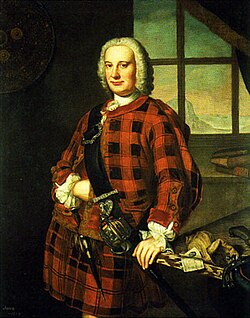
Various writers on tartans have supported or opposed the idea of clans long using distinctive tartans as an identifying badge, interpreting the scarce evidence as suited their viewpoint.[ay] Where one saw a militia uniform, or an individual noble's plaid, another saw a clan identifier. The 19th-century Celtic scholar John Francis Campbell of Islay was certain that while tartans in general were quite old, "uniform clan tartans are no older than clan regiments", a view backed by Haldane (1931) in a series of articles in The Scots Magazine,[418] followed by many tartan writers later.
The earliest evidence summarised below could have been more a matter of militia uniform than clan-wide dress; a distinction in that era is difficult to be certain of today, because troops then were led by landed gentry and a unit was raised largely on its commander's land from his clansmen.[az] Such definitional uncertainty could also apply to the 1691 Grameid poem;[251] describing what appear to be some soldierly uniform tartans,[ba] it could be reinterpreted as supporting an early notion of clan tartans, if one wanted to define that as 'what most of the men of a clan were wearing into battle'; Scarlett (1990) confirms that there has been "fiery argument" in favour of a clan tartans interpretation.[253] However, Robert Jamieson (1818) reported that the "field dress" plaids of Highland men, for war and hunting, were different from their everyday dress – made of coarser material and using patterns intended to blend into natural surroundings, the cath dath or cath da' ('war colour').[93][bb] This casts some doubt on interpretation of militia tartans as general clan tartans. Most of the later regimental uniform tartans (which did not become adopted as clan tartans until around the early 19th century or the late 18th in a few cases, when they did at all) were variations on the dark, green-based Black Watch tartan, as detailed above.
J. C. Thompson (1992) noted "a typical Victorian inclination to cite previous authors with little or no attempt to evaluate their statements .... Modern analysis cannot afford to be so uncritical."[420] Scarlett (1990) relatedly observed:[421]
Wishful proofs are found in profusion in the literature of tartan, early and late, and consist of stating an opinion as a fact and adding some more or less relevant historical reference in support, either implying or stating that this proves the point. That it proves nothing at all is neither here nor there, so long as the manner of the presentation is sufficiently authoritative; given this treatment the wildest theory will be accepted, copied from one book to the next and so enter tartan lore. It is almost axiomatic that the wilder the theory the more acceptable it will be ....
Even D. W. Stewart (1893), who had sometimes been sympathetic toward the idea of clan tartans existing before the 19th century, wrote:[422]
Some ... assure us that the antiquity of the so-called clan patterns is very great, and many writers allege in general terms that these designs were used as a clan distinction from the earliest period. ... The halo of romance surrounding the Jacobite struggle inclined many, and still induces others, to accept as authentic and reliable, statements which in different circumstances would be more closely sifted. Thus it is that the tartans ... have won much favour, and those who find one represented as bearing their name accept it as their ancient clan pattern without the inconvenience of investigation, or of posing any awkward questions.
The Victorians also engaged in some imaginative invention. Aside from the outright forgery of the "Sobieski Stuarts" , another extreme case is Charles Rogers, who in his Social Life in Scotland (1884–86) fantastically claimed that the ancient Picts' figural designs – which were painted or tattooed on their bodies, and they went into battle nude [423]– must have been "denoting the families or septs to which they belonged" and thus "This practice originated the tartan of Celtic clans."[424] Another asserted that tartan was invented around a thousand years ago by Saint Margaret of Scotland.[424]
Aside from the unreliability of early writers (and later copiers of them), part of the confusion and debate about clan tartans comes down to definitions. Sir Thomas Innes of Learney, writing in 1938 and described as "immensely keen on [tartan] codification and the importance of it",[425] was one of the firmest proponents of the idea of very old clan tartans (in the particular sense of 'patterns consistently used for a period by certain clans', not 'patterns named for certain clans and claimed by them to the present').[bc] He held that some setts gradually became associated with particular families (clans and septs thereof) over time;[426] clan territories had mostly become stable by the 16th century.[427] D. W. Stewart's 1893 reference shows various cases of old district tartans later sometimes being identified for a time with specific families before 19th-century adoption of their own (usually different) clan tartans.[bd] Innes of Learney wrote of clan tartans that (notwithstanding the unusual 1618 case covered below) "the tendency was rather to insist upon a similarity of general hue than on similarity of detail",[430] a vague sense that is not what "clan tartan" usually refers to. He also reasoned that "it was not until about the 18th century that the clan tartans became conscious and acknowledged badges of identification".[431] However, the surviving period source material lacks this "acknowledgement" and does not actually suggest broad adoption of formal clan tartans (with clan names, particularity of detail, and a symbolic, identifying intent) until the early 19th century.
Earliest evidence
The "Sobieski Stuarts" (1842) and later D. W. Stewart (1893) made much of some changes to the feu duty paid in woven cloth by locals of Noraboll on the island of Islay to their lords. In 1587, under the Macleans, the cloth was to be white, black, and green; in 1617, under the Mackenzies, the demanded cloth-rent changed to white, black, and grey. These writers were sure, without any further evidence, that this represented a change of clan tartans.[432][be]
The only clear instance of a clan-based and specific livery tartan to an early date, rather than simply regional and later regimental uniformity, is found in a 1618 letter from Sir Robert Gordon of Gordonstoun (in the employ of the Earl of Sutherland) to Murray of Pulrossie, chieftain of the Murray branch in Sutherland but subordinate to the Earl of Sutherland, chief of Clan Sutherland (in turn recently become subordinate to the Gordon earls). The letter (rediscovered in 1909) requested Pulrossie "to remove the red and white lines from the plaides of his men so as to bring their dress into harmony with that of the other septs" of Sutherland.[404] The letter does not specify the tartan to which to conform; there have been sharply conflicting interpretations, and it is not even certain that it was a tartan that survived to the present.[bf]
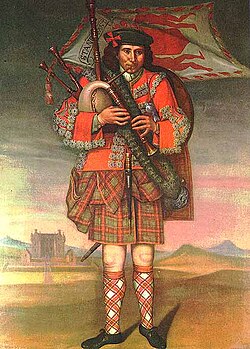
A case of general colour-matching: In 1703–04, the chief of Clan Grant ordered that his "fencible" men obtain clothing in red and green tartan[257] (vaguely described as "broad springed"[257] but not specified in detail).[174] The material seems not to have been provided by Grant for them in a centralised way, but left to each man to furnish by his own means (on penalty of a fine).[257] "He did not order them to wear the 'Clan Grant Tartan', as one would expect if such a tartan existed at that time."[440] Some of the modern Grant tartans also use red and green; one was designed by Wilsons of Bannockburn in 1819 as "New Bruce" and shortly adopted by both Grant of Redcastle[441] and Clan Drummond;[442] one was reconstructed from an 1838 portrait;[443] another first appeared in the dubious Vestiarium Scoticum of 1842[444][445]; and so on – none with pre-19th-century history. Nevertheless, D. W. Stewart (1893) proclaimed on this thin material that here was "a complete chain of evidence ... of the existence of a uniform clan pattern at the very start of the eighteenth century" – despite his own observation that portraits of leading members of the Grant family in this era do not show them wearing consistent tartans,[257][253] much less ones that agree with modern "official" Grant tartans.[406][446][bh] Scarlett (1990), though thinking this presaged "the Clan Tartan Idea", notes that "had the men of Strathspey been accustomed to wearing uniform tartans it would not have been necessary to order them to do so"[253] (twice over). He also observes that the lairds of Grant in this period were unusually bent on uniformity, one of them even issuing moustache regulations for clansmen;[253] the Grant red-and-green order cannot be taken as typical of everyday Highland practice. Telfer Dunbar (1979) notes that Highland military discipline hardly existed: "To these independent Highland chieftains restraint of any kind was irksome and unbearable, and to impose any rigid military discipline on their followers ... [was] found to be impossible."[447] Nevertheless, Mackay (1924) corroborates Grant militia wearing a livery tartan in 1715.[258]
In 1718, Allan Ramsay (the writer, father of the artist by the same name) published the poem Tartana, which combined colours with Latinised family names: "... If shining red Campbella's cheeks adorn .... If lin'd with green Stuarta's Plaid we view ... Or thine Ramseia, edg'd around with blue ...." This has sometimes been taken as evidence of early clan tartans, despite possibly just referring to the edging and lining of garments (coloured facings were common on jackets of the time).[448][bi] Worse for this hypothesis, the Campbell tartans are predominantly green, Stuart/Stewart red, and Ramsay red and green. The extant red Campbell tartans are all modern reconstructions of patterns (that are unlike each other) from portraits;[450][451][452] Stewart/Stuart tartans with significant green date to the early 19th century[453][454][455][456][457] or much later;[458][459][460] and the Ramsay blue hunting sett dates to 1950.[461]
A Victorian volume, Old and New Edinburgh (1884) by James Grant,[462] stated that one Rev. Joseph Robertson MacGregor "attired himself in a full suit of the MacGregor tartan" in 1782, upon repeal of the Dress Act. But it misquoted the original source (and contained other errors). The original, A Series of Original Portraits and Caricature Etchings (1842) by John Kay, read: "dressed himself in the Highland costume peculiar to his clan", and says nothing of tartan, much less a suit of clan tartan.[463] While 1782 is within the late-18th-century range accepted by some researchers for some informal early clan tartans, this is not clear evidence of one.
Lack of further evidence of early adoption
John Lesley, bishop of Ross, in 1578 wrote a great deal about Highland customs, including dress, but did not include clan tartans (despite later being claimed to have been the original keeper of the Vestiarium Scoticum clan-tartans manuscript, now known to be a 19th-century forgery).[464] In 1688, William Sacheverell, a Manx politician, described Hebrideans of the Isle of Mull all wearing plaids, but the women in a different style of colour and pattern – not a consistent "clan" tartan.[250] Rev. Thomas Morer in 1689 described Highland garb in some detail, including tartan plaids and hose (made from the same cloth), but mentions no clan patterns.[465]Daniel Defoe (c. 1720) wrote also in considerable detail of Highland warriors of the prior century, and noted that the men were organised into "companies, all of a name", each led by "one of their own clan or family", yet he never mentions any distinction between tartans of these different groups, instead describing them all as wearing tartan with red and yellow over-checks,[237] strongly implying a regional style. This pattern of 17th- through 18th-century writings providing specifics of tartan and Highland dress, but nothing about clan tartans, is consistent.
Contemporary portraits show that although tartan is of an early date, the pattern worn depended not on the wearer's clan, but rather regional style and personal taste. They frequently depict subjects wearing multiple tartans at once.[431] Nor do the tartans shown match current clan tartans.[466][467] For example, the famous painting The MacDonald Boys Playing Golf (1740s), attributed usually to William Mosman but sometimes to Jeremiah Davison, shows them wearing five different tartans, and they are not surviving patterns (except as later reconstructions from the painting).[bj] Period tartans were also often of differing warp and weft (giving more of a striped than checked appearance), unlike modern symmetrical patterns.[469] Sometimes the portraits were copied, but with tartans that do not match, as if the designs were up to artistic whim.[470] As Scarlett (1990) put it:[471]

"[T]hese portraits have one thing in common: in no case does the tartan shown bear any close resemblance to the modern 'Clan' tartan. ... There is a great lack of evidence to show that the pattern of a tartan had any important significance in the early eighteenth century
D. W. Stewart (1893) had also noted this, about both portrait tartans and "examples of tartan fabrics which can be proved to date from the risings of 1715 and 1745".[422] Many of the portraits by Allan Ramsay the younger show the same shoulder plaid but with colours changed, suggesting it was the artist's own studio prop and used for modelling purposes by his clients who apparently did not care about the tartan pattern.[25][175][326] According to Scottish National Portrait Gallery keeper A. E. Haswell Miller (1956):[408]
Authentic documentation of the tartan previous to the 19th century is limited to a comparatively small number of contemporary portraits, and is negative so far as it provides any suggestion of heraldic significance or "clan badge" intention.
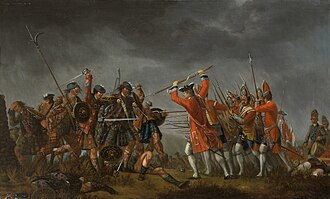
According to Trevor-Roper (1983):[472]
contemporary evidence concerning the rebellion of 1745 – whether pictorial, sartorial, or literary – shows no differentiation of clans, no continuity of setts.... Tartans were a matter of private taste, or necessity, only.
David Morier's well-known mid-18th-century painting of the Highland charge at the 1745 Battle of Culloden shows eight Highlanders wearing over twenty different tartans which have been analysed in detail;[473] very few of the setts painted resemble today's clan tartans,[304][312] though they are similar to existing samples of tartan cloth from the era.[474][bk] The method of identifying Highlander friend from foe was not through tartans but by the colour of the bonnet's cockade or ribbon, or perhaps by the different plant sprigs worn in the cockade of the bonnet.[184][140][bl][bm] In particular, the government Highland militia forces wore a badge in the form of a black cockade with red saltire; according to Mackay Scobie (1946), "each individual wore his own Highland dress with varied tartans, with the only uniform part being the 'Hanoverian' cockade and large coloured cross on the bonnet."[481] A 1745 letter on the Jacobite troops at Culloden describes "all ye Forces as well Horse as foot were in Highland Dress except ye body Guards wh. wore Blue bound wth Red"; i.e., only the bodyguards were wearing a uniform, and it was not of Highland dress.[482]
One of many tartan legends has it that the Highland-dress ban of the Dress Act was enacted because tartans were used as clan-identifying symbols or uniforms, but not a trace of this idea can be found in period sources. To the contrary, Burt (1727–37) was explicit that English objection to Highland dress (since perhaps 1703–04)[338] was general, because the garb served to distinguish the Highlanders as a people apart from the Lowlanders and other British (not distinguish Highlander from Highlander).[483][bn] Defoe (c. 1720) likewise mocked Highland dress as what he saw as a clownish costume that set Highlanders apart from everyone else, not each other.[237] Similarly, in an account of Jacobite trials, it was asked whether defendants had worn "Highland cloaths" in general, with no mention of clan-identifying patterns.[484] Extant MacDonald tartan fragments from the Battle of Culloden do not match each other or any current clan tartan named MacDonald.[480]Lord PresidentDuncan Forbes of Culloden, keen on punishing the Jacobites with disarmament and other penalties, wrote a detailed letter laying out pro and con points (mostly con) regarding the proposed Highland-dress ban before Parliament passed it, yet never indicated anything like clan tartans, something that would have been a key argument to address.[485]
C. C. P. Lawson (1967) raised a point of logic: "Remembering the continuous clan feuds and the consequent state of more or less perpetual hostilities, a recognisable clan plaid would have been a positive danger to the wearer outside his own territory."[486] This may explain why the handful of early apparent examples of groups of men in similar tartan seem to have the nature of militia uniforms and are mentioned in the context of "fencible" bodies or outright battle (possibly aside from the 1618 case).[bo] Lawson also states: "The '45 supplies no evidence that tartans were used as clan insignia .... Relics of those tartans which were worn at Culloden or of the pre-1745 period bear no resemblance to any known modern tartan."[486] The Lord Lyon King of Arms in 1948, Sir Francis James Grant, wrote that pre-1745 tartans were qualitatively different from those of the 19th century and later.[487]Scottish United Services Museum curator Dunbar (1979) notes this as well.[488]
The Jacobite poets wrote much about the rousing appeal of Highland clans and Highland dress, even tartan specifically, but never mentioned clan tartans.[489] Similarly, multiple large volumes of traditional Highland folklore were collected and published by John Francis Campbell in 1860–62 (revised 1890–93), and Alexander Carmichael (who also collected tartan samples) in 1900, but the period materials in them are devoid of any recorded references to clan tartans[489] (despite post-dating the popularisation of the notion among city-dwellers and the upper class).
The idea of groups of men wearing the exact same tartan as an identifier is thought to originate (aside, again, from the odd 1618 case) from Highland regiment units in the 18th century, starting with the Black Watch in 1739/1749.[304][224] According to Trevor-Roper (1983):[490]
[I]t was probably their use of it which gave birth to the idea of differentiating tartan by clans; for as the Highland regiments were multiplied ... so their tartan uniforms were differentiated; and when the wearing of tartan by civilians was resumed, and the romantic movement encouraged the cult of the clan, the same principle of differentiation was easily transferred from regiment to clan.
Particular regiments were often dominated by men raised from the same clan lands, and this may have blurred the line between regimental uniform and clan-identifying tartan. (And several tartans of extinct regiments survive today as clan tartans.) Newsome (2006) writes: "the practice of clans wearing these regimental tartans may have in fact been the inspiration for the 'clan tartan' system as we now know it."[224] Telfer Dunbar (1979), on the idea of the early Independent Highland Companies using distinct uniform tartans: "I feel sure that here we have much of the 'clan tartan' origin."[491] The end of the 18th and beginning of the 19th centuries brought an unprecedented level of influence of military clothing styles, including Highland regimental, on civilian attire (even for women), especially among the social elite connected to regiments.[350] Some regimental tartans appear to have been named after their commanding officers, and this may be how they came to be associated with family/clan names over time.[492][378] Banks & de La Chapelle (2007):[333]
the notion of differentiation of tartan by clans might have evolved from this desire to distinguish on Highland regiment uniform from another. Certainly, its classification for military use laid the groundwork for many subsequent designs and the movement toward uniformity.
Scarlett (1990) also observed the connection to regional or "district" tartans:[255]
[B]asic patterns prevailed over wide areas and were modified by local weavers for their own ends. It can easily be seen that a local pattern of this kind, made for a captive clientele, might have become identified with the people of that locality who were themselves predominantly of one Clan or family group and its adherents and, when the belief grew up that Clan tartans had been worn since the beginning of time, have become, by retrospection, the Clan tartan of that group. There is no evidence that the Highlanders themselves looked on tartan in that light, however ....

Haswell Miller (1956) similarly noted: "We can ... readily accept that certain dyes would prevail in different regions and that traditional types of pattern might be followed in various parts."[408]Martin Martin in 1703 had described tartans as being identifiably specific to particular regions, but not clans.[254] There are numerous cases of tartans loosely associated with districts later becoming clan tartans. The best-documented case[7] is the Tullibardine pattern, one of the few modern clan tartans that can be traced (at all, not as a clan tartan) to the pre-proscription period.[326][7] It was long associated with Perthshire, and later adopted as the Murray of Tullibardine clan tartan, but sold by Wilsons as simply "Tullibardine" as late as c. 1830–40, and it was found for sale in a market by W. & A. Smith around 1850, who also said it was worn then by Charles Murray, Earl of Dunmore;[326] the first record of the pattern as "Murray of Tullibardine" is in their 1850 book.[7] It appears in at least five early portraits; four date to c. 1740–1750, the first of an unknown female sitter attributed to Cosmo Alexander,[bp] and three by Allan Ramsay (with the cloth painting completed by Joseph van Aken) which are not of any known Murrays (but of a Campbell, a MacLeod, and a MacDonald).[326] It is not until 1770 that a known Murray is painted wearing it (John Murray, Earl of Dunmore, by Joshua Reynolds),[326] which still does not necessarily make it a "clan tartan" at that early a date ("evidence for its historic use by that branch [of Clan Murray] is circumstantial at best").[7] The oldest version of it differs slightly as to colours and sett from the modern clan version.[7][bq]
Similarly, according to the Scottish Register of Tartans, the district tartan for Huntly,[314] originating in more complex form as the personal tartan of a Marchioness of Huntly[494] (probably Henrietta Mordaunt), was in use as a regional tartan since at least "the '45", and worn at Culloden by clansmen of Brodie, Forbes, Gordon, MacRae, Munro, and Ross, "which gives a strong indication of the greater antiquity of the 'District' setts compared to the Clan tartans."[494]

Some surviving early records of tartan manufacture are those of the Orphan Hospital Manufactory and Paul's Work, in Edinburgh, for the period 1734–37 and 1751–52; tartans were not named but given numeric designations such as "No. 2nd".[168] In 1745, the Caledonian Mercury of Edinburgh carried an advertisement for a "Great Choice of Tartans, the newest Patterns" – not clan or even district tartans, but newly devised ones, suggesting a fashion market driven by novelty not supposed "heraldic" traditions. Even clan-tartans booster D. W. Stewart (1893) conceded: "This advertisement, it may be urged, is a stumbling-block in the way of those who argue for the antiquity of clan patterns; for it seems peculiar that, when the city was filled with Highlanders of all ranks and many clans, they should be offered not their ancient setts ...."[495] Other advertisements for tartan from 1745 to the early 19th century did not mention clans, or focus on the patterns at all, but rather on the forms in which the cloth could be ordered.[496] Even immediately after the repeal of the Dress Act in 1782, the demand was for "latest patterns and bright colours",[497] with no hint of a family heraldry aspect.
William Wilson & Son of Bannockburn, just south of the dividing line between the Highlands and Lowlands,[498] were the first large-scale commercial tartan producers;[104] founded c. 1765,[9] they had become the foremost supplier of tartan to the military by around 1770, and the dominant tartan weaver in general.[339] It was an endeavor that required the introduction of tartan recording, of standardisation of setts and dyes, and of consistency and quality control.[9][499][498] Wilsons corresponded with their agents (especially the son, James Wilson)[101] in the Highlands to get information and samples of cloth from the various districts to enable them to reproduce "perfectly genuine patterns". Wilsons recorded over 200 setts in addition to ones they designed in-house, collected in their 1819 Key Pattern Book of around 250 setts[9] (among earlier in-house volumes to the 1770s). These tartans were numbered, named after places, or given fanciful names such as "Rob Roy", later sometimes family names (after prominent members), sometimes foreign names like "Coburg", but usually not those of clans,[274][398][500][140] nor, when they did, often matching present clan patterns.[501][br] A large proportion of the modern clan tartans, however, can be traced to this work – just often originally with numbers or unrelated names.[398] The evidence of direct adoption from Wilsons happening frequently completely overwhelms "ancient clan tartans" sentiment.[bs]
The Scottish National Dictionary, in providing an unusually discursive definition of tartan, includes: "[T]owards the end of the 18th century and largely through the enterprise of Messrs Wilson, weavers in Bannockburn, a series of tartans, each ascribed to a certain clan, was devised and is now accepted as authoritative, though almost entirely unhistorical."[514] Analysing the direct and strong influence of Wilsons' Key Pattern Book (KPB) on the later adoption of clan tartans , Eslea MacDonald (2012) concluded:[515]
Some of the 1819 KPB setts no longer retain their original names, others were altered or were the basis for a number of variations which were named or simply numbered .... Whatever their origins, these patterns gave rise to the idea of clan tartans as we know them today. In a very few cases a pattern's origins may have indeed been a lot older than the 1819 KPB but their contemporary names were almost always the work of Wilsons or subsequent writers.
The Cockburn Collection of 56 tartan samples (some of them duplicates) was put together between 1810 and c. 1825 (most likely 1816–25)[516][398] by Lt.-Gen. Sir William Cockburn, and is now in the Mitchell Library in Glasgow.[398][517] This collection does ascribe particular family names to many of these setts (probably naming them after prominent individuals),[516] but only sometimes corresponding to current clan tartan associations (indeed, some patterns that are today associated with particular clans were given multiple different names in the Cockburn Collection).[bt] There are many conflicts in name-to-pattern associations between this collection and that of the Highland Society of London around the same time.[516]
Even David Stewart of Garth, who was to become one of the chief proponents of the idea of clan tartans, observed in 1814 only that various heads of families seemed to have selected personal tartans and that there were also district tartans.[519] When Garth and his Highland Society of London solicited clan tartans from chiefs in 1815 , Col. Alexander Robertson of Struan, Chief of Clan Robertson/Donnachaidh/Duncan, wrote back:[520]
It does not appear to be appertained, either by tradition or by authentick history, that the different Clans in the Highlands of Scotland, wore any distinctive pattern or tartan. It is well known that they all had particular Colours, or Standards, emblematical of some of their most honourable attachments, but as far as I have been able to discover, they wore no uniform Garb.
At the beginning of the 19th century, a letter from an Inverness tailor to Wilsons of Bannockburn requested fine tartan cloth to be used for women's clothing, because the fashion was to wear husbands' regimental tartans (not clan tartans).[358] In 1829, responding negatively to the idea of Lowland and Borders "clans" wearing their own tartans, Sir Walter Scott – who was instrumental in helping start the clan-tartans fervour in the first place – wrote "where had slept this universal custom that nowhere, unless in this MS. [the draft Vestiarium Scoticum, published ultimately in 1842] is it even heard of? ... I would rather suppose that the author had been some tartan-weaver zealous for his craft, who wished to extend the use of tartan over the whole kingdom."[521] Also in the same year, he wrote: "The idea of distinguishing the clans by their tartans is but a fashion of modern date in the Highlands themselves".[522]
Another of the tartan legends has it that Alexander Gordon, 4th Duke of Gordon, commissioned the design of a clan tartan based on Black Watch in 1793, kept one of three designs, then passed the other two on to cadet branches of the family.[523] This tale can be traced in unembellished form to 1793 records of weaver William Forsyth of Huntly which do not say this at all, only that Forsyth provided three potential designs for a regiment tartan, with yellow over-checks in various configurations, of which the Duke selected no. 2 for the unit, the 92nd Gordon Highlanders.[385]
Scarlett (1990) surmises that there must have been some informal clan tartans – a confluence of district tartans that had become associated with particular families, and adoptions of regimental uniform tartans by them – by the late 18th century, otherwise there is no explanation for where Stewart of Garth got the idea.[524] Scottish United Services Museum curator Maj. I. H. Mackay Scobie (1942),[410] Haswell Miller (1947),[525] and Barnes & Allen (1956),[92] also zeroed in on this timeframe. Eslea MacDonald (2010-11) observes, for example, the Murrays using the common Tullibardine regional pattern in portraits and in bed hangings at their clan seat, Blair Castle, 1770 – c. 1780 and possibly earlier.[326] Telfer Dunbar (1979), considering the 1703–04 Grant proclamation and the early regiments, suggests that "any uniformity of tartan was only to be found in an organised body of troops, or the 'tail' or following of a chief."[440] These possible comparatively early, informal clan tartans of the late-18th-century simply cannot usually be identified (when they survived) until the early 19th century.
19th century broad adoption
It has been suggested by a modern chief of Clan Campbell and another of the clan executives that the clan had informally adopted what is now known as old Campbell or Black Watch tartan by the early 19th century, because so many of their men were already wearing it as part of regimental uniform[416] (three of the Independent Highland Companies that amalgamated into the Black Watch regiment in 1739–1751 were Campbell units).[491] Some time in or after 1806, when he became clan chief, the city-dwelling politician George Campbell, 6th Duke of Argyll, created his own personal tartan, of Black Watch with a thin over-check of white and yellow added,[526] "to differentiate himself from the rest of the Campbells", i.e. because they were already so often wearing Black Watch.[416] This essentially may have been one of the earliest attested surviving clan tartans (and the duke's variant was an early declared personal tartan of a noble).[bu]

The idea arose among Scottish expatriates (especially in the Celtic societies, which encouraged members to wear "appropriate" tartans),[527] eager to "preserve" Highland culture,[9][527][528] that tartans had traditionally been named and that the names represented clan affiliations.[9] Among them was Maj.-Gen. David Stewart of Garth, a Black Watch veteran and vice-president of the Highland Society of London[529] (founded 1778).[398] He and fellow members Sir John Sinclair and Andrew Robertson were among the first proponents of the idea of clans being identified by tartans, despite the lack of evidence.[529][530][531][516][bv] The society also counted among its members the Prince of Wales[533] (the future George IV, who was to become instrumental to clan "tartanry" in 1822) and two dukes, among various itinerant actual Scots[534] – including James Macpherson of "Ossian" fame (or infamy).[535]

On 8 April 1815, the society resolved that the clan chiefs each "be respectfully solicited to furnish the Society with as much of the Tartan of his Lordship's Clan as will serve to Show the Pattern and to Authenticate the Same by Attaching Thereunto a Card bearing the Impression of his Lordship's Arms."[536] Many had no idea of what their tartan might be or whether they had one,[537] some provided only a vague description, and some claimed they had none.[533] But plenty were keen to comply and to provide authentic signed and sealed samples;[536][533][538] many (possibly most) turned to Wilsons of Bannockburn for a design,[527][503] while some directly adopted a regimental tartan as their own,[398][9][bw] and still others adapted designs from old portraits of clan nobles.[533][bx]Alexander Wentworth Macdonald, Baron Macdonald, wrote back to the society: "Being really ignorant of what is exactly The Macdonald Tartan, I request you will have the goodness to exert every Means in your power to Obtain a perfectly genuine Pattern, Such as Will Warrant me in Authenticating it with my Arms."[536] Finding no agreement within his clan on a pattern, Robertson of Struan ended up adopting the regimental tartan of the Loyal Clan Donnachie (Robertson) Volunteers; being based on the Black Watch pattern, it could not pre-date the late 18th century.[541] On the other hand, Sir John Macgregor Murray of Clan Gregor, who had spent most of his life in England and India, was writing instructions on the use of his clan's tartan by December 1818.[542] In 1819, Wilsons were engaged in correspondence to "send ... specimens of all coloured Tartans used by these Clans ...said to exceed thirty in number", to a writer in Italy preparing a book on clan tartans;[543] the same year, they also produced their Key Pattern Book of over 200 tartans (representing only a fraction of their total tartan output, presumably the most marketable designs, and not always under the same names as found in contemporary collections of Wilsons' tartan samples such as the Cockburn collection and that of the Highland Society).[544]
According to Trevor-Roper (1983), Wilsons were in a direct "alliance" with the Highland Society of London by 1819; the former saw a great marketing opportunity, and the latter provided a veneer of respectability as Wilsons helped the society pin tartans to clan names.[545][546] Banks & de La Chapelle (2007) concur: "The Wilson firm worked in tandem with the Highland Society, preparing tartan samples for the latter to certify as belonging to one clan or another."[501] Clan nobles (who sometimes contradicted each other, within the same clan, on what their tartan was or should be)[547] were apparently also "ready to adopt changes at the mere dictation of fancy" to improve designs.[548] From the "authentications" they received 1815–26, the society built up a clan-tartan collection (now in the National Museum of Scotland), with 34 authenticated specimens and about 40 others.[533][549][by] Other such societies generated more interest, belief, and demand.[550] According to the analysis by Eslea MacDonald (2012), "Most of the pieces sealed [by clan chiefs] and deposited with the Society at that time were patterns woven, and in the majority of cases appear to have been designed, by Wilsons. This obviously means they could not have existed prior to c1765 when William Wilson started his business."[541] So many of Wilsons' stock tartans from their Key Pattern Book of 1819 were being renamed for clans that J. C. Thompson (1992) wrote: "Clearly the naming of tartans was just getting started in 1819",[140] and: "There was nothing people wanted more than an ancient clan tartan system, and they were determined to have one."[551] By 1821, advertisements for tartan cloth had shifted to include language like "true", "warranted", and "original", and began to stress antiquity and family connections.[552]
The 1822 visit of George IV to Scotland, in Highland garb and with a great deal of tartan-festooned public ceremony (arranged by Stewart of Garth and romanticist writer Sir Walter Scott of the Celtic Society of Edinburgh), had a profound tartan-boosting effect, including the invention of new clan-specific tartans to suit[553][398][554] (or renaming of old tartans to have clan names),[9][555] as clan chiefs had been asked to attend in clan tartans.[9] It caused a boom in the tartan-weaving business,[502] and a broader public notion that tartans should be named for families.[398][9] "When these two [Scott and Stewart of Garth] stage-managed the King's visit ... they fixed the Clan Tartan idea in the public mind."[555] Wilsons' pattern book in 1822 had expanded significantly with tartans named for clans, in addition to all their numbered setts.[513] According to R. Martin (1988), Wilsons and other weavers were made aware of the king's planned visit three or four years in advance, and had all that time to pad their catalogues with additional designs and to assign clan names to patterns often "probably picked entirely out of the air."[556] He added that "anyone looking at the tartan pattern books of 1819 to 1822 would have realized the cacophony of different names for the same [pattern], the chaos of clan attributions, and the complete capriciousness of that association."[557] A telling letter from a tailor, archived among the Wilsons papers, to the company in 1822 asked: "Please send me a piece of Rose tartan, and if there isn't one, please send me a different pattern and call it Rose."[504]
By 1824, an invitation to the Atholl Gathering, one of the earliest of the modern Highland games festivals, made it clear that participants should arrive "in the plaids or Tartans of their Clans".[558] In 1829, Sir Thomas Dick Lauder complained to Walter Scott about all the "uncouth, spurious, modern [tartans] which are every day manufactured, christened after particular names, and worn as genuine",[559] and also of "clans ... at this moment ignorantly disputing for the right to the same tartans which in fact belong to none of them but are merely modern inventions for clothing Regimental Highlanders".[560] Scott himself was backpedalling away from what he had helped create, and was suspicious of the recent claims about "ancient" clan tartans: "it has been the bane of Scottish literature and disgrace of her antiquities, that we have manifested an eager propensity to believe without inquiry and propagate the errors which we adopt too hastily ourselves."[561]
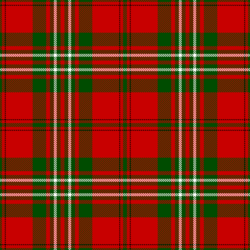
A wave of highly dubious books were published, all purporting to reveal true clan histories and tartans; they presented little in the way of evidence, but they caused enthusiastic adoption of clan tartans. The first of these, in 1831, was The Scottish Gaël or Celtic Manners, as Preserved Among the Highlanders by James Logan, containing 54 tartans (based on Wilsons' collection, that of the Highland Society of London, and other sources he alleged but did not name, plus some he collected or devised himself); the author ignored advice from Wilsons on which were actually old tartans, and included some erroneous, fictitious, and incomplete setts.[563][564][bz] He also included untenable assertions about the designs' antiquity; "Logan took the line that everything Highland was rooted impossibly far in the past", and was mocked in The Pall Mall Gazette for it.[555] Meanwhile, Wilsons and other weavers simply adopted some patterns from his book due to demand,[565][502][566] and also took to inventing all-new "clan tartans" to keep up with the growing market for patterns associated with names.[567] The archived correspondence of Wilsons in the 1830s shows that the company was frequently pressured by merchants for the "truest" and "real" clan patterns.[568] Logan, despite himself being involved in sham clan tartanry, observed that "fanciful varieties of tartan ... were being passed off as genuine" by Wilsons and other weavers.[504]
Logan was followed in 1842 by Vestiarium Scoticum by the so-called Sobieski Stuarts, purporting to contain 75 centuries-old clan tartans, illustrated in great detail but from vague textual descriptions.[569] Although it is now known to have been largely a forgery,[570][571][ca] many of the visual tartan designs in this "final – and fantastic – codification"[571] of clan tartans were nevertheless adopted and still survive as accepted tartans of clans,[575][576] especially for Lowland clan names (which had hitherto never been associated with tartan or Highland garb at all).[398][182][577][578] Starting in 1822, Borders families had been redefining themselves as clans, and the book encouraged more of them to take on clan tartans and open clan societies.[579] Modern critics have even praised the lasting socio-cultural accomplishement of the Sobieski-Stuarts' works in helping establish a systemic clan-tartans legend while recognizing the bogus nature of their material.[cb]
Trevor-Roper (1983) believed that the Sobieski Stuarts had been in direct communication with manufacturers like Wilsons, and were advising clan chiefs on which tartans to choose, from as early as 1819;[581] J. C. Thompson (1992) agreed.[551] Dick Lauder certainly said they were doing so by 1829, and that Wilsons were already weaving many Sobieski Stuart samples by that year;[582] the company's own records the same year confirm orders for designs from the Sobieski Stuarts.[583]Vestiarium was followed soon after by The Costume of the Clans published by the Sobieski Stuarts in 1845;[565] the illustrations it provided, allegedly based on portraits, have proven to be largely a mixture of error and invention.[584] By 1849, John Sobieski Stuart was in discussion with a publisher to produce a new, cheaper edition of Vestiarium, in a series of small volumes "so that it might be rendered as available as possible to manufacturers and the trades in general concerned in Tartan ... and it was for the[ir] advantage and use ... that I consented to the publication." The same letter also proposed binding the manufacturers by contract to produce tartans that conformed exactly to the Sobieski Stuarts' specifications.[585]
Weavers like Wilsons were complicit, not passive, in the tartan boom. They had lost much of their military and export markets after major wars ended and colonies in the Americas and elsewhere had become more self-sufficient.[508] "The concept of differentiated clan tartans, newly popularized, was codified and developed by canny manufacturers .... Since the repeal of the [Dress Act], these tartan makers saw the prospect of a vast new market."[275] According to Alastair Campbell of Airds:[415]
One factor which has been decisive throughout the history of the development of the modern system [of clan tartans] has been the influence of the tartan manufacturers .... As with any marketing organisation it was important to maintain a steady flow of "new products", and every year new patterns were produced .... The idea of individual tartans providing a clan or family identity was a most attractive one, which was adopted enthusiastically by both wearer and seller alike.
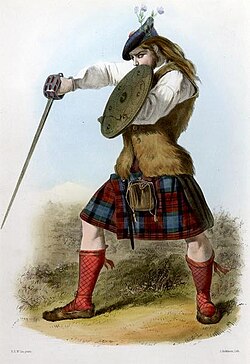
This heavy promotion for decades of the clan-tartans idea has been described as "inciting a rush to lay claim to the tartan to which one's family was 'entitled'".[586] Other 19th-century clan-tartan works followed.[575] Logan (by then president of the Highland Society of London)[581] returned, with illustrator Robert Ranald McIan, with The Clans of the Scottish Highlands in several volumes 1843–1849, which had inconsistently hand-coloured portraits of chiefs in clan tartans, which he stated were "acknowledged by the present chiefs and clans".[398]The Clans of the Highlands of Scotland in 1850 by Thomas Smibert drew heavily on Wilsons' patterns and on Logan.[587] In the same year, Authenticated Tartans of the Clans and Families of Scotland by William & Andrew Smith was based on trade sources such as Wilsons, competing mill Romanes & Paterson of Edinburgh, and army clothier George Hunter's pre-1822 collection of setts (and some consultation with historian W. F. Skene).[587][420] Also in 1850, Gen. James Browne published History of the Highlands and the Highland Clans, another Vestiarium knock-off.[581]
In 1871, Gaelic folklorist and Highland dress fancier John Francis Campbell of Islay wrote in Clan Tartans:[588]
I have come to the conclusion that Sir Walter Scott and my friends the Editors of the Vestiarium Scoticum and Scotch Manufacturers of tartans are together responsible for the present flourishing and luxuriant crop of brilliant clan tartans .... I do not believe that the distinctions which are now made as to Clan Tartans ever prevailed at all, till Tartan became an important manufacture in Scotland in the reign of George the 4th
J. Claude produced the tartan pattern sample book Clans Originaux in Paris c. 1880, and some tartans were adopted from it,[cc] though its 185 samples were mostly of already-known tartans.[18] A second edition of The Costume of the Clans was published in 1892.[591] Another influential book was Donald W. Stewart's Old & Rare Scottish Tartans (1893), which included swatches of fabric; several accepted clan tartans date to this work.[592]
Books of this era also introduced lists of alleged clan septs, families of different surnames (often of English, Norman, or other non-Gaelic derivation) supposedly linked to particular clans as "extended family". It was a means of greatly increasing tartan sales by attaching many more names to extant tartan designs, but not well-grounded in any historical reality.[593][594][411] Two such works, both published by W. & A. K. Johnston were: Tartans of the Clans and Septs of Scotland by James Grant in 1886, revised by Henry Whyte in 1906 in more of a picture-book format (three tartans make their first appearance in the 1886 edition,[595] and various more in the 1906 version, with no provenance);[596] and What Is My Tartan? or, The Clans of Scotland, with Their Septs and Dependents by Adam Frank in 1896.[398]
The romanticised notion of clan tartans had become deeply embedded in the Scottish imagination and further afield.[182][597] "[I]t all got mixed up in the public mind and the myth of tartan as a kind of heraldry became established, not only in the eyes of outsiders, even the Clansfolk believed it".[598] On the cusp of the Scottish Renaissance and Gaelic Revival, most clans (including major Lowland families) had been assigned and had generally accepted one or more tartans by the late 19th century.
20th century consolidation

The first Edwardian book on the subject (aside from a larger 1906 "library edition" of Whyte as The Scottish Clans and Their Tartans with Notes),[596] was Frank Adam's 1908 The Clans, Septs & Regiments of the Scottish Highlands, which remains in print today (though in drastically edited form, by Sir Thomas Innes of Learney).[398][599] A variety of books, with colour plates, had been affordably and widely published about clan tartans by the mid-20th century. Three popular ones were The Clans and Tartans of Scotland by Robert Bain, 1938 (the first to use photographic halftone prints; revised and updated many times through 1983);[600]The Tartans of the Clans and Families of Scotland by Innes of Learney (later to become the Lord Lyon King of Arms as well as a founder of the Scottish Tartans Society),[601] 1938, advancing some clan-tartanry ideas his Lord Lyon predecessor Sir Francis James Grant considered "humbug";[599] and The Scottish Clans & Their Tartans published by W. & A. K. Johnston, 1945 (later editions re-titled The Scottish Tartans with Historical Sketches, edited by Innes of Learney), and based on previous works by Grant and Whyte. Many others followed in successive decades.[398]
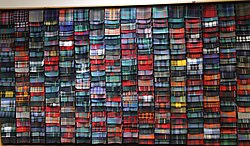
The mass-market books (some with over 200 tartans illustrated) did much to cement the idea of clan tartans in the public imagination, as well as to consistently anchor particular tartans to particular clans. And the works were in more general agreement with one another than had been the Victorian "authorities".[cd] They also simultaneously increased the number of clans with their own assigned tartans, and reduced the number of tartans claimed to be those of certain clans to a more manageable number, probably after consultation with clan chiefs and clan society officers. They did, however, typically include sept lists, which today are widely regarded as bogus[593] (though many present-day clan associations still use them, as a means of attracting larger membership).
Almost every extant clan (with or without a chief) had at least one tartan associated with it by this era. Many clans have several well-accepted tartans. Sometimes they represent different branches of the family; e.g., there are separate tartans for Campbell of Breadalbane, Campbell of Cawdor, and Campbell of Loudoun, in addition to the general "old" Campbell tartan. In other cases, they are (at least ostensibly) for specific purposes such as hunting, mourning, formal dress occasions, or Highland dance competition; e.g., the MacFarlane dress[603] and hunting tartans[604] are different.
An important, more scholarly work was 1950's The Setts of the Scottish Tartans by Donald C. Stewart[605][ce] (son of the aforementioned D. W. Stewart).[398] The younger Stewart has been hailed as "the founder of serious tartan research"; originated now-standard methods for indexing tartans; and would go on to help expose the Vestiarium Scoticum as a fraud, in Scotland's Forged Tartans, co-authored with J. Charles Thompson in 1980.[398][607]
In the late 20th century to present, clan and other tartans also have been catalogued in databases. A small number of new official clan tartans (mostly specific-purpose "side" tartans, like dance tartans) were registered in tartan databases in the 21st century.[cf]
Regarding modern misrepresentations of clan tartans on historical figures in films and even museums, Scarlett (1990) wrote: "so widely have the tartan myths been spread that any script- or guide-book writer will, in complete ignorance, write the most arrant nonsense and never think that it might not be true. ... Once false information has been disseminated by a supposedly authoritative body it is virtually impossible to correct it."[609]
Recognition by clan chiefs
The "officialness" of clan tartans has varied widely, and still does today. Although it is possible for anyone to create a tartan and assign it any name they wish, the only person with the authority to make a clan's tartan "official" is the chief.[398]
Some clans have had no chiefs for some time, while only a majority subset of those with living chiefs in the modern era made direct proclamations as to their clan tartans and registered them with the Lord Lyon.[cg] Some time after the launch of the Scottish Register of Tartans (SRT) in 2009, the Lord Lyon stopped recording clan tartans, deferring to SRT for this purpose. Some of the clan tartans were simply adopted by custom,[ch] and have remained rather consistent into the 21st century. A clan booth at a Highland games event is likely to proudly display at least their best-known clan tartan, regardless whether a chief has declared it official.
However, some chiefs have been quite adamant about what their clan's legitimate tartans are. Some time prior to 1890, George Campbell, 8th Duke of Argyll, chief of Clan Campbell, is said to have specified the main Campbell tartan, as distinct from that of the Campbell of Cawdor sett, after a portrait had depicted him in the latter and also supposedly at the prompting of the War Office, perhaps with regard to Argyll and Sutherland Highlanders uniforms.[612]Ian Campbell, 12th Duke of Argyll, Clan Campbell chief in the late 20th century, excoriated attempts to claim there were other than the four aforementioned particular Campbell tartans (and specifically rejected the personal-variant tartan of the 6th Duke).[416] Similarly, Sir Malcolm MacGregor, chief of Clan Gregor, wrote in 2012 that only four MacGregor tartans (plus a newer dance tartan) are legitimate, out of 10 or more alleged ones found in a tartan database, which he blamed on "indiscriminate commercialisation ... disingenuous and lead[ing] to confusion".[613]
In at least one instance, a clan tartan appears in the coat of arms of a clan chief and is considered by the Lord Lyon as the "proper" tartan of the clan: The crest of the chief of Clan MacLennan is A demi-piper all Proper, garbed in the proper tartan of the Clan Maclennan.[614][ci]
Some chief-authenticated clan tartans are quite late arrivals. In 1961, the Clan Davidson main tartan was replaced (and registered with the Lord Lyon) by one of multiple disputed chiefs, Sir David Davidson of Allt Dinnie, with a design dating to 1893, in place of an older white-striped version.[615] Chief Charles Shaw of Tordarroch in 1971 replaced the old Shaw tartan (a Black Watch variant based on a misprinted image in Logan & McIan (1847))[616] with a new pair (dress[617] and hunting)[618] designed in 1969 by D. C. Stewart based on more historical sources.[619]Clan Mar had no approved tartan until Chief Margaret of Mar registered one in 1978 (from a design that may pre-date 1850);[620] their dress/red tartan was not adopted until 1992 (from a design dating to the 18th century).[81] The MacLeod red tartan was approved by Chief John MacLeod of MacLeod in 1982, to join much longer-standing yellow and blue tartans of the clan; it was based loosely on what appears in a 1748 portrait of Chief Norman MacLeod by Allan Ramsay and Joseph van Aken.[621] Baron David Lumsden of Cushnie-Lumsden in 1996 approved the Clan Lumsden hunting sett by Peter Eslea MacDonald[622] (though technically the baron was just the chieftain of the Cushnie-Lumsden branch). In 1998, Chief Dugald MacTavish of Dunardry approved a 1958 design as the MacTavish dress tartan.[623] In 2005, Chief Gillem Lumsden of that Ilk registered a new main Lumsden tartan with the Lord Lyon,[624] based closely on that of a c. 1790 Lumsden family waistcoat.[625] Also in 2005, a pattern for Duncan of Sketraw was approved by Chieftain John Duncan of Sketraw, based on a 1930s design.[626] In 2007, Chief Fergus D. H. Macdowall of Garthland designed the Clan MacDowall tartan (the clan previously used MacDougall or Galloway district); he registered it with the Lord Lyon and Scottish Tartans Authority in 2008.[627][628] The Cochrane hunting tartan was designed personally by Chief Iain A. D. B. Cochrane, Earl of Dundonald, in 2008.[629] The Clan Carruthers tartan was approved by Chief Simon Peter Carruthers of Holmains in 2017.[630]
Modern general use
Aside from regimental and clan usage, tartan has seen broad (and sometimes highly politicised) use by the general public in the modern era. By the 19th century, the Highland romantic revival, inspired by James Macpherson's "Ossian" poems and the writings of Sir Walter Scott, led to wider interest in tartan and other things felt to be Gaelic and Celtic. Clubs like the Celtic societies welcomed Lowlanders, and tartan was rapidly appropriated[556] as part of the Scottish national identity[631][632] (and part of broader British dress as a familiar exoticism).[633][634]
Late Georgian

The period of widened public interest in tartan and Highland dress after the repeal of the Dress Act in 1782 has been called the Highland Revival.[31][cj] While tartan had already seen more nationwide use from 1707, as a Scottish nationalism symbol against union with England,[280] it was turned on its ear to become a romanticised symbol of union loyalism in the early 19th century,[182][636] an era in which prominent conflicts caused a patriotic influence of military (including Highland) style on civilian clothing,[ck] even among women[350][639] despite its overtly masculine focus.[640][641][175] First among the northern gentry and later among the common people more broadly, there was a renewed interest in tartan and Highland dress, despite the long period of prohibition – largely due to the glory associated with the Highland regiments' exemplary service in various military campaigns.[400] "Highlandism"[642] became a romantic, mythologised (even fictionalised) and colourful escapism[643][348] even as Lowland Scotland itself was becoming one of the most industrialised places on earth, and the entire nation was undergoing the social upheavals of union and empire, of large-scale warfare, of urbanisation, and of modernisation during the Scottish Enlightenment.[644] The bloody French Revolution of 1789–1799 had also helped inspire a British setting aside of old Stuart and Hanoverian rivalry.[645]
Before the clan tartans rush began in 1815, tartan was already being aggressively marketed to the general public as "fancy" cloth with names that commemorated famous events and people, even fictional characters from books and songs, e.g. "Waterloo", "Flora MacDonald", "Sir Walter Scott", "Wellington", "Maggie Lauder", and "Meg Merrilees". This inspired a novel perception that tartans should be named.[646] Some of the designs by leading weaver Wilsons of Bannockburn by this period were considered recognisable on sight.[647]
In 1822, Maj.-Gen. David Stewart of Garth, who was with both the Highland Society of London and the Celtic Society of Edinburgh,[648][531] published Sketches of the Character, Manners, and Present State of the Highlanders of Scotland, the first of a number of 19th-century books lionising the Highlanders, the clans, and the tartaned regiments.[640][538] The various Celtic/Highland societies throughout Britain had already been driving a rise in tartan demand since the late 18th century.[649][374] The societies liked wearing Highland dress – in their own assimilated, urban idiom,[cl] such as tartan frock coats[354] – and devising new tartans; it has been suggested that they were engaging in a sort of "internal colonisation", imposing what they wanted to see rather than simply recording what was traditionally Highland.[650] Aside from tartan fabric's increasing use in non-Highland styles of clothing, Highland dress itself had already become highly stylised, quite removed from the simplicity of its peasant origins;[651] this was a trend that would continue throughout the later Victorian period.
The King's jaunt in tartan

The popularity of tartan was greatly increased by the royal visit of King George IV of the United Kingdom to Edinburgh in 1822, with other nobles including Lord Mayor of London Sir William Curtis,[653] in Highland garb. George was the first reigning monarch to visit Scotland in 171 years.[553] The pageantry invented for the event, which was nicknamed "the King's Jaunt", brought a sudden consumer-driven demand for tartan cloth[502] and made it the national dress of the whole of Scotland.[553][654][631][655] The 21 days of festivities were organised by the Jacobitism-romanticising but staunchly unionist[182] Walter Scott, who was another co-founder of the Celtic Society of Edinburgh, and military officer David Stewart of Garth.[529] They urged Scots (most of whom were Lowlanders) to attend "all plaided and plumed in their tartan array"[656] in "complete national costume".[654] One contemporary writer sarcastically described the pomp that surrounded the celebrations as "Sir Walter's Celtified Pageantry",[656][657] and another as a "plaided panorama".[654] Clan chiefs, expected to be kilted, had little choice but to take the event seriously, and arrived to show their loyalty in something of a panic, with tartaned retinues of half a dozen[275] to up to 50 per clan[658] (equipped at great expense, and with only about a month's official notice), in a city overflowing with Highlanders, Lowlanders, and English spectators decked in tartan,[659][503] a sight that Scott's own son-in-law and biographer John Gibson Lockhart called a "Celtic hallucination".[501] Thousands of spectators attended the many events arranged for the visit.[275] The formal ball, reserved for the gentry, required Highland dress for admittance, and some 300 tailors were employed to supply it.[658]
The royal endorsement of tartan and Highland-wear did much to erase any lingering association of them with the servile peasant class of the Highlands[660] (or the region's bands of mountain bandits, for that matter).[658] Because Scott had become "the acknowledged preserver of Scotland's past" through his historical novels, the legend he helped create of tartan and Highland dress as a Scotland-wide tradition rooted in antiquity was widely and quickly accepted, despite its ignoring and erasing of cultural diversity within the country[651] (of Gaels, Norse–Gaels, Scoto-Normans, and Lowlanders of largely Anglo-Saxon extraction). "A bogus tartan caricature of [Scotland] had been drawn and accepted, even by those who mocked it, and it would develop in perspective and colour."[661] George IV's visit – which was not just theatrical but thoroughly political, in marrying Hanoverian power and loyalty to Stuart ideology and pride[662] – has been described in by Angus Calder (1994) as the catalyst by which "a Union of practical convenience became a Union of irrational love and fears, sublimated in militarism, tartanry, royalism and, eventually imperialism".[663] R. Martin (1988) added: "it would seem that this visit presages the acts of orchestrated political propaganda that we have come to know very well in the 20th century."[556]

Following the royal visit, the tartan industry boomed,[664] and the number of available tartans increased tenfold;[665] in 1822, Wilsons' pattern book had numbered setts in the hundreds, and introduced many more with proper names.[513] Scarlett (1990) writes that "Tartan was no longer the dress of northern barbarians or political dissidents; it had become respectable and the garb of loyal subjects."[666] Books which documented tartans began to appear and added to the "tartanry" craze. James Logan's romanticised work[566]The Scottish Gaël (1831) was the first such publication, and led the weaving industry to adopt new patterns, even Logan's invented or erroneous ones.[565]
The result of these flurries of attention has been described as an "astonishing frenzy of excitement into which [patronage of tartanry] threw the citizens of Edinburgh and much of the rest of Scotland".[667]
Civilian spread
From the 1820s, Georgian and then Victorian portraiture of clan nobles continued the earlier theme of regimentally re-styled Highland dress, with jewels, gold, and other symbols of aristocracy – a "synthetic Gaelicism".[668] The funerals of Sir John Macgregor Murray and Alasdair Ranaldson Macdonell of Glengarry, in 1822 and 1823 respectively, were marked by tartan, bagpipes, and "wailing" of clansmen – "a feudal sight in an increasingly industrial age".[669] A large public tartan affair was the 1824 Atholl Gathering[558] (an annual event that, after a period of abeyance, continues to the present). From the end of proscription through the Georgian promotion, "distrust of the Highlands became fascination",[670] and tartan and Highland garb "moved from the periphery to the very center, accompanied by all the processes of forgetting and imaginative re-creation".[671] Tartan, no longer the everyday traditional dress of Highland "barbarians", had become, in altered form, all the rage among the Scottish upper and even middle classes as formal attire.[672] This popularisation of tartan increased its marketability in the Lowlands, in England, and in the colonies, and provided a boost to the Scottish textile industry.[341]
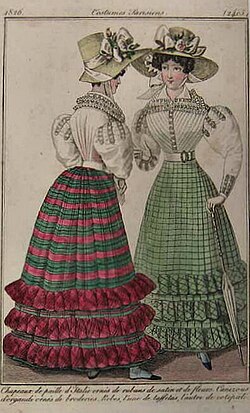
Tartan had begun making appearances in civilian Georgian fashion throughout Britain and into continental Europe, as illustrated in publications such as London's Gallery of Fashion (1787) and La Belle Assemblée (1808), and (after Paris was famously occupied by Highland regiments during the Waterloo campaign and the fall of Napoleon in 1815)[673][640][674] in the French periodicals Le Prétexte (1815)[675] and Costumes Parisiens (1826); tartan was in vogue in Paris in particular in this period,[676][677] and approximations of Highland soldiers even appeared in Parisian plays at the time.[678] Tartans associated with family names became popular, but there was also a brisk trade in new tartans commissioned for societies, to commemorate events, in honour of famous persons, and designed simply to personal aesthetic taste.[679] Manufacturers struggled to keep up with demand.[680][631] By 1819, dominant tartan weaver Wilsons of Bannockburn[339] (also a carpet and ribbon weaver)[681] was keenly interested in exploiting the civilian market, due to a reduction in regimental demand, and introduced many more patterns, providing cloth in various grades.[682] By 1820, the company had access to 132 looms;[683] they experienced a four-fold increase in output in 1821, leading up to George IV's visit,[654] after which they acquired 40 more looms[504][665] in an add-on building,[680] named the Royal George after the king,[504] and expanded into a new mill in 1822, mechanising more and more to keep up with demand.[683] They stopped weaving muslin to focus on tartan,[680] and produced it in a range of qualities from finest merino wool to cheap linsey-woolsey blends, demonstrating that whatever high-class associations tartan had taken on, there was significant working-class demand.[684] In 1829, a merchant wrote to Wilsons that "We are like to be torn to pieces for tartan; the demand is so great we cannot supply our customers", and there was great demand for the newest patterns.[568]
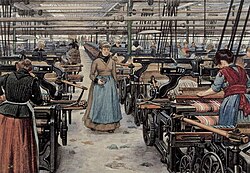
Georgian and later Victorian entrepreneurs not only created new tartans, but new tartan objects called tartanware, starting as far back as the proscription period in the form of wine glasses decorated with tartan and enamel Jacobite portraits.[312] Tartan decorated an assortment of common household objects, such as snuffboxes, jewellery cases, tableware, sewing accessories, desk items, and even doorknobs and furniture – a tartan knick-knack market for tourists that continues through the present in the Highlands.[685] Visitors to the Highlands went home with tartanware, and Scotland-based businesses sent tartanware out as gifts to customers. Some of the more popular tartans used were the Stewart, MacDonald, MacGregor, MacDuff, MacBeth, and one fancifully named "Prince Charlie".[686][687][688] Today, tartanware is widely collected in England and Scotland.[689] There was a symbiotic relationship between tartanware production and interest in tartans generated by books on the subject: a tartanware manufacturer from 1820 onward was W. & A. Smith, of Mauchline, also incidentally the publishers of Authenticated Tartans of the Clans and Families of Scotland (1850).;[690] tartanware was sometimes more specifically called Mauchlinware.[691]
Victorian
Leading up to the beginning of Queen Victoria's reign in 1837, tartan was a brisk trade in London, Manchester, and other English cities and towns.[692] In 1839, the Eglinton Tournament, a medieval re-enactment featuring jousting and a ball, was organised in North Ayrshire by Archibald Montgomerie, Earl of Eglinton; it drew some 100,000 spectators, who had been asked to attend in plaids, and included George Murray, Duke of Atholl, arriving with an entire regiment in tartan, his newly re-formed Atholl Highlanders[693] (which still exists as Europe's last remaining private military force).

Vestiarium Scoticum
The first publication showing colour plates of an array of tartans was the Vestiarium Scoticum (meaning 'wardrobe of the Scots'), published in 1842,[575] and it included a first: tartans for Lowland families. It was the work of two brothers: John Carter Allen and Charles Manning Allen, from Surrey, England, who used a variety of assumed names. The two implied they were grandsons of Prince Charles Edward Stuart and Princess Louise of Stolberg-Gedern, and consequently later became known as the "Sobieski Stuarts". They claimed further that the Vestiarium was based on a 1571 manuscript on clan tartans – a manuscript which they never managed to produce. It was not known at the time, but many of the tartans were simply invented by the brothers, and others were taken from early-19th-century sources like the Cockburn and Wilson collections.[694][398] The brothers heavily favoured basic checks, or crudely divided checks, with thin over-checks added; they had an identifiable style of tartans, assessment of which has varied from "few can be called inspired"[49] to "quite novel and singularly gorgeous".[695] The Vestiarium was followed by their equally dubious The Costume of the Clans in 1845.[565] The books, which "added mystery, romance and some spurious historical documentation to the subject",[571] triggered another wave of interest in tartans, and the enthusiasm generated by these publications led the way for numerous tartan books in the later 19th century.[656][575][cn]
The sudden availability (and almost unquestioning acceptance) of Lowland tartans helped spread tartan further in popularity. "The [tartan] cult was gathering strength and tartan was no longer 'Highland', it had become 'Scottish'."[598]
The Queen and "Balmorality"

Twenty years after her uncle's royal visit to Scotland, Victoria and her husband Prince Albert made their first trip to the Scottish Highlands in 1842; she was the first monarch to set foot in the Highlands since Mary, Queen of Scots, in the 16th century.[696] The visit involved her large royal party being met with several theatrical tartan-kilted welcomes by Highland nobility and their retinues, with much sycophantic newspaper fanfare (while the common people were experiencing considerable misery); the Queen wrote: "It seemed as if a great chieftain in olden feudal times was receiving his sovereign".[697] The monarch's early trips to Scotland were seen as a royal endorsement and had a transformative effect on the image of the country, as a now-loyal land of tartan, pipers, and kilted martial display.[698]
Victoria and Albert leased Balmoral Castle, in Aberdeenshire, in 1848 (and bought it in 1852)[699] as a private royal demesne and hired a local architect to re-model the estate in feudalised Scots baronial style, starting a "sham-castles" trend.[700] Prince Albert personally took care of the interior design, where he made great use of tartan. He used the royal Stewart (red) and the hunting Stewart (green) tartans for carpets, while using the dress Stewart (red and white) for curtains and upholstery.[576] Prince Albert (who often wore the kilt at Balmoral) is said to have created the Balmoral tartan, still used as a royal tartan today.[701] They even decorated their carriage with tartan.[702][703] Their adoption of a showy form of Highland dress inspired adoption by subject "who would have previously left Highland dress to the festivals of the Scots."[691]
The royal couple spent a considerable amount of time at their Scottish estate (nearly 7 years in total),[704][co] and in doing so hosted "Highland" activities. Victoria was attended by pipers,[706] and her children were attired in Highland dress.[707] Prince Albert himself loved watching the Highland games[708] and the pair became patrons of the Braemar Gathering.[709] (Support from and attendance by various nobles may have helped preserve such events to the present, but it also "tartanised" them permanently, all the way into the 21st century.)[710] The royal enthusiasm for and patronage of Highland things generated more early tourism to the Highlands,[586][711][cp] and a boost to business in the region as far as Perth and Edinburgh.[713] It also spread tartan-wearing to other northern British lords and ladies, who began to invent complicated etiquette rules of dress for Highland garb, which had the effect of increasing the sense that it was upper-class attire.[182][714][598] Adoption of tartan continued to spread into England; Thomas Osborne, Duke of Leeds, in West Yorkshire, devised a livery tartan for his men in 1848.[715] Tartan, though a "pseudo-Caledonian masquerade",[716] had become "the stuff of loyalty to the crown",[717] with "a spurious royal and aristocratic cachet".[718] This royal promotion was also noted abroad, with the effect that tartan became one of the widest-recognised cultural-identity symbols for the entire British country.[719]
Despite their considerable devotion to charity (up to 20% of their Privy Purse income),[720] Victoria and Albert, along with their friends in the northern gentry, have been accused of using their "Balmorality" – a term coined by George Scott-Moncrieff (1932) to refer to upper-class appropriation of Highland cultural trappings, marked by "hypocrisy" and "false sentiment" – to trivialise and even fictionalise history.[721] According to Fiona K. Armstrong (2017), they engaged in long-term, tartan-blanketed escapism from the uncertainties of modernising, industrialised society and from pressing British societal problems, while worsening those problems in the actual Highlands.[721] The queen's Balmoral residency also had another detrimental effect on the Scottish Highlands; inspired by her residency, aristocrats who lived outside the Highlands began purchasing estates in the region, resulting in land-ownership disparities that persist into the present day.[722] The Highlands during Victoria's reign also became more accessible by road, rail, and boat.[708]

As the tartan and "romantic Highlands" craze swept over Scotland, the real Highland population suffered grievously from the Hungry Forties as well as the Highland Clearances, when thousands of Gaelic-speaking Scots from the Highlands and Isles were evicted by landlords (often the very men who would have been their clan chiefs) to make way for sheep[656][723] and for expansive deer-hunting preserves.[724] Scots were also largely disenfranchised from voting, and the Highlands were running out of young men, in great regimental demand to fight and die in foreign wars for the empire, and many emigrating otherwise,[725] with Victoria and Albert directly patronising emigration societies.[726] Nearly 2 million Scots moved to non-European destinations during the Victorian era (more than half the native-born Scottish people of the period), and took a measure of Highlandism with them[727] – "many of the generally understood images of the Highlands were held to be 'real' by people at the time".[728] This would have strong tartan-promoting results among the Scottish diaspora later;[729] Scarlett (1990) calls it a "tartan hunger that has been abroad from late Victorian times to the present day".[730]
Ripple effects
Thomas Babington Macaulay wrote in 1848 of the romantic reinvention of Highland customs as somehow generally Scottish: "Soon the vulgar imagination was so completely occupied by plaids, targets, and claymores, that, by most Englishmen, Scotchman and Highlander were regarded as synonymous words."[731] In 1849, Sir John Graham Dalyell asserted that "forty years ago no reputable gentleman would have appeared in a kilt in the streets of Edinburgh."[732] Scott-Moncrieff (1932) likewise wrote of tartans being "misconceived" and worn all over Scotland (and even England) in the Victorian era as a part of the Queen's influence.[733] Increasingly urban Scotland was putting on a "rural face"[734] (a trend that would continue with "kailyard" literature). Tartanry and Highlandism were popular in part as a counter to a sense (especially among the aristocracy) that Scotland was losing its separate national identity in the Georgian to Victorian era, being ever more Anglicised as just "North Britain" amid empire-wide modernisation.[735]

In an 1849 letter to a publisher about a planned second edition of Vestiarium Scoticum, John Sobieski Stuart noted that tartan had become "extensively worn and manufactured" on the continent, as far away as France, Germany, Bohemia, and Hungary; he also expressed an interest in working directly with tartanware and tartan book makers W. & A. Smith of Mauchline.[736] The same year, the Duke and Duchess of Atholl (whose entire estate was prescribed tartan livery)[737] hosted a Highland-dress affair in London, the Royal Caledonian Ball, the first known charity ball (still a sold-out annual event today).[738] The 1859 opening of the massive Loch Katrine waterworks (to pump fresh water to Glasgow, running out of well water) was attended by Queen Victoria, with the Atholl Highlanders (cannon in tow), the Celtic Society of Glasgow, and an honour-guard unit called the Glasgow Volunteers putting on a tartan- and piper-laden display for the newspapers; it was a confluence of modern engineering and romantic–patriotic tartanry.[739] When the Prince Consort died in 1861, Victoria commissioned a tartan-kilted statue of Albert at Balmoral by William Theed.[740]
According to Jonathan Faiers (2008), Victoria had actually intentionally made tartan more popular for the benefit of the British textile industry.[741] By the 1860s, tartan was not only as popular in London as in Scotland,[742] leading weaver Wilsons of Bannockburn produced £80,000 of product per year, and employed 500–600 people. (It amalgamated with another of the family businesses, a carpet-weaving operation, in 1867, which continued to 1924.)[274] Around 1860, new synthetic aniline dyes allowed for production of tartans in vivid colours at more affordable prices, and their lower cost translated into more consumption of tartan by the middle class.[706]
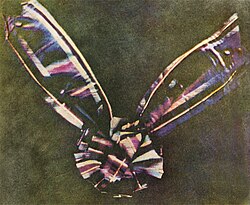
As modernisation marched on, the world's first permanent colour photograph, taken by Thomas Sutton (using the three-colour process developed by Scottish physicist James Clerk Maxwell) in 1861, was of a tartan ribbon.[743] It was created by using red, blue, and yellow filters to create three photographs which were then combined into a composite. R. Martin (1988) notes that there was a confluence of unrelated technological "junctions and serendipities" in the mid-19th century that together broadly promoted tartan, including photography, consistently bright and more economical artificial dyes, affordable colour book printing, mass-production of soft but durable fine textiles, and applicability of printed patterns to middle-class products like tartanware – all "far-removed from the true peasant history of tartan."[744] Ian Brown (2012), a professor with a focus on Scottish literature and culture, has written that while George IV and Victoria (not to mention business interests in their wake, like the Wilsons of Bannockburn and the Smiths of Mauchline) seemed to have been "the winner taking over the loser's tokens", the renewed public interest in tartan within and beyond Scotland was not entirely owing to them, especially given the international interest in Highland-romantic works of Walter Scott and "Ossian". The acceptance of and even enthusiasm for tartan among the post-proscription upper class can be seen as a necessary attempt at reconciliation within a culturally diverse country, and the influence ran both ways, with old Scottish nationalism transmuting into a new unionism that demanded recognition of Scottish interests and institutions. "In short, it is an open question whether George IV in a kilt and Victoria and Albert at Balmoral are appropriating and subverting a set of values, or whether they are being appropriated and subverted."[745] Even the 1822 "King's Jaunt" had been stage-managed by two Scots with a keen interest in romanticising and promoting Gaelic and broader Scottish culture (historico-traditional accuracy notwithstanding),[651] and the Atholls' deep and tartan-arrayed involvement in Victoria's activities in the north can be viewed in the same light.[746] Both George IV[747][748][749] and Victoria,[750] primarily of German House of Hanover stock, came to identify strongly with their quite thin Scottish House of Stuart genealogy.

The 1864 funeral of the Sixth Duke of Atholl was another anachronistically feudal, tartan-and-pipers pageant.[751] In 1866–1870, Victoria and the Duchess of Atholl commissioned artist Kenneth MacLeay in Edinburgh to produce a series of watercolours of statuesque men in tartan Highland gear, representing common people from ghillies to shepherds and fishermen, "as they now are". Prints were published in 1870 as Highlanders of Scotland: Portraits Illustrative of the Principal Clans and Followings, and the Retainers of the Royal Household at Balmoral, with text by Amelia (Emily) Murray MacGregor, an attendant of Victoria as well as a Clan Gregor historian and the first female Gaelic lecturer. A tartanistical fantasy, as well as another exercise in "Highlander as noble savage", the art book necessitated canvassing Scottish aristocrats for outfits and suitable models ("specimens"), as the everyday people did not look the hyper-masculine part, were not able to afford such Highland-dress extravagances as were to be illustrated, and were more likely to be wearing trousers than kilts.[752] The resulting book is the most detailed record of the "proper", codified Victorian-era Highland dress and accessories, which "removed tartan from its blustery nonchalance to an ordered set of adornments"[742] – most of which survive to the present, Highland dress being remarkably resistant to further major stylistic changes, Victorian styles having become "traditional". Tartan had also become more established throughout the 1850s and 1860s as a textile for European-fashionable rather than Highland women's clothing, from bodices and dresses to sashes and shawls (the never-extinguished ladies' plaids).[742] The tartan sash in particular was a favourite of the Queen,[742] and remains a common womenswear option, worn several different ways in modern Highland dress,[753] though it has little to do with original Highland clothing before the 19th century; it is an adaptation of the plaid to a style of the European nobility.
In 1871, at the Waverley Ball, a fancy dress affair in London, the Prince of Wales (the future King Edward VII) and his brother Prince Arthur, long accustomed to Highland dress, arrived tartaned out as an old-time Lord of the Isles and as Bonnie Prince Charlie, respectively.[754] In 1872, ethnologist Jacob Falke wrote that "In Scotland indeed the plaid has still some importance, but it is an object of manufacture, and ... its motives have long ago become the common property of fashion, and indeed have become so permeated by it that what is genuine and old in it is scarcely to be recognised".[755] Since its 1880 re-opening, the Gaelic Society of Perth in the Lowlands held festivities that involved much piping and tartan-wear, into the early 20th century, despite the language-preservation organisation having nothing to do with Highland dress or pibroch; being swathed in tartan had somehow become vital to such events.[756] By 1883, Highland dress as proper courtly attire had become highly regulated, aristocratic, and formal, but "inclusive" in one sense – the tartan-wear was permitted at court for essentially anyone claiming Highland origins or land-ownership (even if natively English), not just the gentles of the well-established clans.[757]
In the Victorian era, tartan garments for women as well as men continued to be featured in fashion catalogues, in styles not derived from Highland costume, such as everyday suits and dresses.[586] Tartan had also become popular for children's clothing in continental Europe,[758] inspired by the royal children of Victoria.[759] In the United States, tartan was similarly worked into school uniforms, especially at Catholic schools.[760] The late 19th century saw tartan (sometimes in silk) in fashion throughout Europe, including in France (e.g. Paris, Lyon, and Alsace) and Italy,[761] and as far from Britain as Russia.[762] Founded in 1898, Walker's Shortbread has long been sold in royal Stewart tartan packaging around the world (especially for Christmas and Hogmanay).[763]
20th century to present

In the Edwardian era, tartan had become less a component of men's clothing (with the decline in kilt-wearing) but more an important part of women's fashion,[75] including fanciful haute couture designs from Paris that had no connection to Highland style,[586] and many accessories such as petticoats, stockings, and blouses; masculine accessories included braces (suspenders), neckties, cummerbunds, and socks.[75]
Edward VII himself had grown up wearing Highland dress frequently.[707] There was also in this period into the 1920s a market for Highland-dress etiquette booklets, which tied into the era's "dress sense" of decorum and class[425]. Because of its associations with the British aristocracy, Scottish clans, and Highland military, tartan had developed an air of dignity and exclusivity.[764] Because of this, tartan was to make periodic resurgences in the world of fashion. The tartan uniforms of the Scottish Regiments were an important recruiting tool during World War I; as Archibald Primrose, Lord Rosebery, put it: "there is nothing so magnificent in our army as the swing of a kilted regiment".[765] Tartan's Georgian re-orientation as a symbol representing unionism and empire continued well into the first half of the 20th century,[766] though outright tartanry and Highlandism on the part of the upper class waned, especially after about 1920.[767] Nevertheless, Edward VIII, later Duke of Windsor, was a life-long devotee of tartan, often wearing more than one at a time.[586]
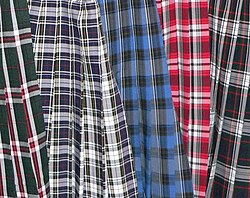
Tartan patterns (often simple, unnamed ones) remained commonly used for skirts and pinafore dresses (jumper dresses) in Catholic and other private school uniform codes in North America and also in public and private schools in New Zealand. The style spread to many other places, including South America, Japan[684] (which sometimes imports tartan directly from Scotland),[768] and Hong Kong.
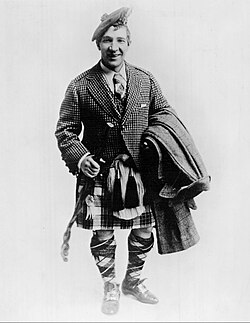
Harry Lauder (properly Sir Henry – he was knighted for his war-effort fundraising during World War I) became world-famous in the 1910s and 1920s, on a dance hall and vaudeville entertainment platform of tartan Highland dress, a thick Scots accent, and folksy songs about an idealised, rural Scotland, like his hit "Roamin' in the Gloamin'". At one point, he was the highest-paid performer in the world, and toured the United States, Australia, South Africa, and of course the UK to sold-out audiences. A Lowlander himself, Lauder has been credited with (and blamed for) keeping alive a tartanry-and-Highlandism image of Scotland, with critics calling him a "kilted clown" who promoted the idea of Scotsmen "clothed like the chieftain of Clan McCrazy".[769]
Diaspora and globalisation
By the mid-20th century,[770] annual Highland games events, modelled on the traditional events in Scotland, had been established not just in Scotland but throughout the United States, Canada, Australia, New Zealand, and South Africa, among other places with a notable Scottish diaspora, which totals about 50 million people worldwide.[771] There are dozens of such events in Scotland,[772] and at least 260 annual Highland games events worldwide as of 2000,[773] more than 100 of them in the US alone, and dozens more in Canada.[772] They are closely intertwined with bagpipe band competitions (which date to 1781), a lasting source of tartan imagery in their regiment-inspired Highland uniforms.[774]
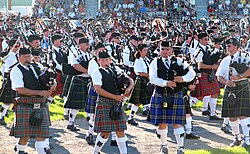
The games' rather flamboyantly[775] tartaned subculture is sustained outside Scotland primarily by multi-generational Scottish descendants rather than by direct Scottish expatriates.[776][777]
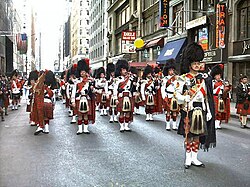
Tartan Day, an annual symbolic ethnicity holiday among the Scottish diaspora, is a growing affair celebrated on 6 April, the date on which the Declaration of Arbroath was signed in 1320. Tartan Day was first declared in Nova Scotia in 1987, and was essentially nation-wide in Canada by the 1990s. It has since spread to Australia (with varying levels of official recognition, 1989–1996), the US (1998), and other places including New Zealand,[778] and even Argentina[779] and Paris, France.[780] In New York City, it has turned into an entire Tartan Week since 1999, with honorary "grand marshals" that are usually Scottish celebrities.[781]
The term tartanism (as distinct from tartanry) has been coined by Ian Brown (2012) for this international tokenisation of tartan as an ethnic-identity symbol, evolving to some degree independently to suit diasporic cultural needs and unrestrained by the views of the originating Scottish "home" culture.[782] According to Ian Maitland Hume (2001), tartan and the kilt are powerful symbols that "encapsulate many facets of a heritage which people aspire to access ... a part-mythical family origin for those seeking roots".[783]
The Scottish Tartans Museum and Heritage Center was opened by the Scottish Tartans Society in 1988 in Highlands, North Carolina; in 1994, it moved to nearby Franklin. The museum, which runs independently of STS, features over 600 tartans on display, including specimens dating to c. 1725, and Highland dress examples to ca. 1800.[784] (STS also operated a Scottish Tartans Museum in Edinburgh,[785] but it closed when STS did in 2000.) A major exhibition on tartan was produced by the Fashion Institute of Technology in New York 1988–89, and another was created for the Edinburgh Festival in 1989.[786] Others followed in Italy in 2003, and Japan in 2018.[787] In April 2023, the Victoria and Albert Museum of Dundee (V&A Dundee) opened a design exhibit (running until January 2024) about tartan and its "shifting context", with goals of "challenging preconceptions of what tartan is, whether that be from a historical sense or fashion sense".[788][789]
D. Gordon Teall of Teallach, of the Scottish Tartans Society, observed in 1994:[790]
Tartans have always formed part of Scotland's historic heritage and it is a compliment to their country that they have become so widespread throughout the English and Gaelic speaking world. They are probably more popular now than they have ever been because they have come to symbolise the spirit of families, clans and districts and, more recently, corporate institutions.
Even as tartan has been bent to the cultural needs of the diaspora, as "the most straightforward and outward sign of ... affinity with Scottishness", and bent to the commercial intents of fashion, tourism, entertainment, and other industries, tartan's reception by native Scots in Scotland has been less favourable for decades, even the last century or so. Reasons include a feeling that it is not really a symbol of broad Scottish national identity because of its specifically Gaelic and Highland origin; the "Highlandist" and imperialist foisting of it on the entire country as national costume in the late Georgian through Victorian eras; distorted views of Scottish people promulgated by Lauder and other tartaned entertainers of a century ago; an academic view of tartary and Lowland kailyard literature as two halves of a low-brow, romanticising vulgarity (reinforced in recent decades by the "Tartan Army" fandom of the Scotland national football team reinvigorating a working-class attachment to kilts and tartan); and historically inaccurate portrayal of Scotland by tartan-heavy Hollywood productions like Brigadoon (1954) and Braveheart (1995).[791] Brancaz (2016) argues that "looking at tartan through the lens of the intelligentsia fails to account for its enduring appeal and resilience. ... [T]he wearing of kilts and tartans at weddings, funerals, and cèilidhs in Scotland has increasingly been interpreted as a form of cultural reappropriation."[792]
Industry and politics
In 2006, the British Ministry of Defence sparked controversy when it allowed foreign woollen mills to bid for the government contracts to provide the tartans used by the Scottish troops (newly amalgamated as battalions into the Royal Regiment of Scotland), and lowered the formerly very high standards for the cloth.[224]
Following a bill submitted in the Scottish Parliament in February 2007,[793] Scotland's enterprise minister announced in July 2007 that the National Archives of Scotland would set up a national register of tartans.[794] The announcement stated that "Tartan's importance to Scotland cannot be overestimated. It is deeply embedded in Scottish culture and is an internationally recognised symbol of Scotland."[794] This was later reiterated in 2013 through the BBC.[795] The ministry cited an industry report indicating that "the tartan industry is a significant contributor to the overall Scottish economy; and larger ... than suggested by previous industry estimates", and is the basis for some 200 businesses, 4,000 jobs, and £350 million in annual GDP in Scotland.[794] The bill passed in October 2008, and the Scottish Register of Tartans launched in February 2009.[793]
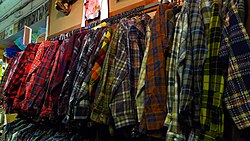
The Observer reported in 2010 that tartan clothing had become more popular than ever before, crossing subcultural, social-class, and age-group lines, and showing in that year a 540% sales increase in Britain from only two years earlier.[796] Around the same time, there began a resurgence in tartan kilt wearing among Scottish young people "as a mark of a vibrant, modern Scotland".[797][798][799][800] This has interrupted a generations-long trend of native Scottish disaffection toward tartan as stereotyping kitsch.[801][802] An online survey by BBC in 2012 found that 52% of respondents strongly or very strongly disagreed with the premise "Walter Scott's re-branding of all Scots as tartan-wearing Highlanders has been a hindrance to Scotland's cultural development", and only a third agreed.[803] Tartan in mainstream, international fashion experienced another resurgence starting in 2019.[804]
Contemporary Scottish nationalism has been said to be "fed, in part, by tartan and Jacobite nostalgia".[805] After avoidance of tartan since the 1970s (especially by Scottish liberals),[806] the cloth has been politicised again as a nationalist symbol (as it was in the early 18th century), especially during the 2014 Scottish independence referendum and in the Scottish National Party's 2015 campaign.[799] (Perhaps owing to this messaging shift, the VisitScotland agency around the same time changed its tourism advertising to minimise, though not eliminate, tartan imagery.)[807]Murray Pittock (2002) writes that the neo-Jacobitism is "both irritating kitsch and a language of identity" for modern Scots.[808] After several decades of intellectual hostility toward tartan (e.g. in Tom Nairn's 1977 The Break-up of Britain: Crisis and Neo-nationalism, and Hugh Trevor-Roper's posthumous 2008 The Invention of Scotland), an "academic re-assessment of tartan" began in the early 21st century, relying on a wider range of early and modern source material,[809] in historiographical, multidisciplinary edited volumes including Scottish History: The Power of the Past (eds. Edward J. Cowan and Richard J. Finlay, 2002) and From Tartan to Tartany (ed. Ian Brown, 2010).
Major commercial weavers (tartan mills) of traditional tartan cloth that are operating today include Lochcarron of Scotland[810][811] in Lochcarron and Selkirk; Ingles Buchan in Glasgow;[398][811] House of Edgar (also a Highland dress vendor, and a subsidiary of Macnaughton Holdings) in Perth;[398] Johnstons of Elgin (also a wool clothing maker),[398] Strathmore Woollen in Forfar,[398] and D. C. Dalgliesh in Selkirk,[104] all three of which are now part of the Edinburgh-based Scotweb, under the trade name Clan;[812] Prickly Thistle (also a women's clothing maker) in Evanton and Edinburgh;[813] The Tartan Weaving Mill (also a weaving museum, and a subsidiary of Gold Brothers) in Edinburgh;[814] Andrew Elliot Ltd in Selkirk; Stevens & Graham (specialising mostly in tartan rugs and carpet) in Rutherglen; Marton Mills in West Yorkshire, England; Cambrian Woollen Mill, in Powys, Wales; West Coast Woollen Mills in Vancouver, British Columbia, Canada;[815] GK Textiles in Port Moody, BC (formerly Fraser & Kirkbright, Vancouver);[816] and Pendleton Woolen Mills in Portland, Oregon, US.[215] The modern trade in wool tartan fabric has three principal markets: Highland dress, high fashion (with significant business from France and Italy), and furnishing.[817][18]
Popular tartans (including for kilts and other Highland dress, as well as for school uniforms) have increasingly been manufactured, primarily in the UK, in poly-viscose (PV),[818] a blend of the artificial materials polyester and viscose (rayon), typically in a 65% polyester to 35% viscose ratio.[819][820] PV is promoted as washable, durable, crease-resistant but heat-settable for permanent pleating, shrinkage-resistant, stain-resistant, colour-fast, low-pilling, hypoallergenic, not attractive to clothes moths, more "breatheable" than polyester (thus good for athletics), lower cost than wool, and lighter weight than wool, but said to have a wool-like texture.[821][822][823][824][825] It also does not rely on animal industry, so it appeals to vegans.[821][822] Large-scale global manufacturers of tartan-patterned cloth in a variety of cotton, polyester, viscose, nylon, etc., materials and blends include Başkan Tekstil in Istanbul and Bursa, Turkey; and Jeen Wei Enterprises in Taichung, Taiwan; while a leading maker of tartan ribbon is Satab in Saint-Just-Malmont, France.[826] Tartan designs have long been produced in low-cost cotton in large quantities in China.[815]
Carol Craig (2003) writes: "Like it or not, tartan is a very sophisticated branding and marketing tool for Scotland."[827] In a tartan-as-marketing analysis, Paterson (2001) observed that continued internationalisation of tartan manufacture, design, and consumption has diluted the associative "Scottishness" of tartan and its value as a national identifier. He blames this in part on Scottish weavers' failure to adapt to market demands for a wider range of fabric applications, as well as the businesses' own complicity in broadening tartan's perceived cultural identity, e.g. in creating tartans for non-Scottish families, places, and organisations.[828]
In popular culture
In 1947, the tartan-laden Broadway musical Brigadoon (followed by a film version in 1954 and a television adaptation in 1966) renewed an excessively romanticised notion of the Highlands and Highland dress. A critical review called it a "whimsical dream-world" that was "overloaded with Hollywood-Scottish trappings".[829] (The production is generally not well received by actual Scots.)[830][831]
Tartan suits were popular in the mod subculture of Great Britain of the early to mid-1960s and its late 1970s revival.
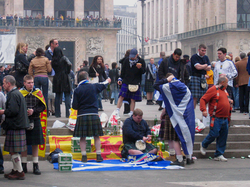
Since the 1970s, the fandom of the Scotland men's national football (soccer) team have been collectively referred to by the nickname "Tartan Army", with fans often sporting tartan clothing (including kilts) at matches.
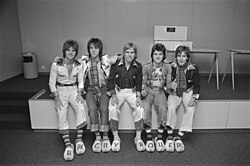
Popular in the mid-1970s, Scottish teeny-bopper band the Bay City Rollers were described by the British Hit Singles & Albums reference book as "tartan teen sensations from Edinburgh".[832]
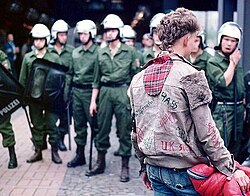
Tartan became a common element of punk subculture starting in the late 1970s. Punk music was a way for youth in the British Isles to voice their discontent with the ruling class and with modern society. The unorthodox use of tartan (especially the royal Stewart), which had long been associated with authority and gentility, was then seen as an expression of that discontent. In this way, tartan – worn unconventionally – became an anti-establishment symbol. This was entirely on purpose according to Vivienne Westwood, a designer deeply involved in early punk fashion;[764][833] the idea was "to seize the very fabric of the Establishment in order to reverse its meaning and perhaps to challenge society's design."[834] American punks often wore tartan skirts, a "subversion" of the Catholic school-girl uniform, and kilts have also been worn in the punk scene since the late 1970s, especially in the UK.[800] Baggy tartan pants later proved popular among pop-punks and skate punks, and tartan-lined jackets among ska punks. From the late 1990s, kilts (mostly modernised "utility kilts" but sometimes traditional ones) have become relatively popular even in North American post-punk subculture (e.g. the goth–industrial, emo, and steampunk scenes), though often in black rather than tartan.
After the 1970s, Westwood, who continued to work extenstively with tartan, was joined by other big-name couturiers. These included Ralph Lauren and Laura Ashley, whose designs promoted tartan as a mainstream modern clothing option "with traditional grace and style" for both women and men;[810][834]Stephen Sprouse,[834] credited with a 1980s combination of "uptown sophistication in clothing with a downtown punk and pop sensibility";[835] and later Alexander McQueen,[836] who was "consciously repoliticising the cloth".[318] Others have included Jean Paul Gaultier, Tommy Hilfiger (who made tartan central to his fall 2000 collection), Christian Lacroix, Yves Saint Laurent, Giorgio Armani, and Gianfranco Ferré.[837][834] A tartan outfit designed by Westwood featured on a commemorative UK postage stamp issued by the Royal Mail in 2012 celebrating "Great British Fashion".[838]
Tartan/plaid flannel shirts, emblematic of the working class, re-entered mainstream fashion through a series of subcultural adoptions, originating primarily in the western United States. First, the style became a staple of cholo style in and around Los Angeles, from the 1970s. From there, the style later became adopted by hip hop fashion in the 1990s, especially the West Coast hip hop lifestyle.[839] Tartan flannel shirts also became quintessentially part of (and androgynous within) the grunge scene (starting in Seattle) of the late 1980s to 2000s.[840] There was fashion cross-pollination between these youth-culture movements,[841] and the fashion industry has found this confluence very marketable.[842]
A resurgence of interest in tartan and kilts (and even Scottish tourism)[831][843] has been generated in recent times by major Hollywood productions[844] like the Highlander franchise (1986–2007),[845][844]Four Weddings and a Funeral (1994),[846]Braveheart (1995),[847][848][849]Rob Roy (1995),[847][849][850]Brave (2012),[851] and the television series Outlander (2014–, with a follow-on travelogue documentary series, Men in Kilts).[852] Many of these featured custom-designed tartans.[845][853]
Tartan clothing has appeared frequently in Doctor Who. The Fourth Doctor (Tom Baker) wore a Wallace tartan scarf on Terror of the Zygons,[854] and his robot-dog companion K9 had a tartan collar.[853] The Sixth Doctor (Colin Baker) had a signature patchwork frock coat that included segments in three different tartans, and also typically wore a tartan waistcoat in a fourth sett under it.[855] The Seventh Doctor (Sylvester McCoy) wore a crimson and black tartan scarf on Time and the Rani. Clara Oswald (Jenna Coleman), the companion of the Eleventh Doctor (Matt Smith) and the Twelfth Doctor (Peter Capaldi), wore a Campbell tartan dress on "The Name of the Doctor" and a Wallace skirt on "The Time of the Doctor" and "Deep Breath".[856]Annabel Scholey as Claire Brown, in the Thirteenth Doctor (Jodie Whittaker) serial Flux, wears a 1960s-style muted tartan dress.[857] The Fourteenth Doctor (David Tennant) wore a brown tartan suit in the 60th anniversary specials.[858]
 1980s Doctor Who patchwork costume of the Sixth Doctor, with at least three tartans involved
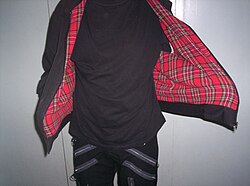 Royal Stewart again, as a mod/ska-punk jacket lining, 2007
 Rita Ora performing in Glasgow in 2018, wearing a tartan trench coat made of at least five different setts
 Grunge fashion still alive and well in 2019, featuring a lot of tartan/plaid shirts
 A rather impractical tartan gown by Christopher John Rogers, 2020–21, on display at the Metropolitan Museum of Art Costume Institute's exhibit In America: A Lexicon of Fashion
Popular designs
One of the most popular tartans is the royal Stewart, ostensibly the personal tartan of the British monarch, since George IV declared it his own (though it was probably designed by the Sobieski Stuarts,[699] albeit based on mid-18th-century pattern called "Prince Charles Edward Stuart").[110][62] The "royal" sett was first published in 1831 in the book The Scottish Gaël by James Logan. In addition to its use in clothing, such as skirts and scarves, royal Stewart tartan has also appeared on biscuit tins for Scottish shortbread,[859] and it has also long been favoured by the British punk scene.
Another tartan in very common use by the general public is Black Watch (also known as old Campbell, Grant hunting, and Government).[126] This tartan, a dark variant (and ancestor) of the main Clan Campbell tartan, has long been used by military units in the British Army and other Commonwealth forces.
Early manufacturer Wilsons of Bannockburn made many "fashion", "fancy", or "national" tartans with catalogue numbers or fanciful names, without any association with particular families, districts, or organisations; two popular ones still in use are both usually called "Caledonia". Wilsons No. 3 is found in their 1819 Key Pattern Book and is comparatively simple,[860] while No. 144 is more complex, though of a similar colour scheme, and seems to date to the late 18th century.[861] (The numbering suggests the other does as well.) Some other tartans in this "Caledonia" group were later claimed by clans; e.g. Caledonia No. 43 or "Kidd" became one of the MacPherson tartans.[862][860]
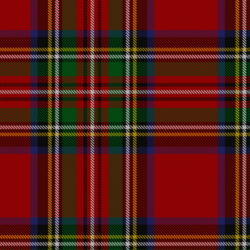 Royal Stewart tartan
 Black Watch tartan
 Wilsons' No. 3 tartan, named Caledonia
 Wilsons' No. 155, also often called Caledonia
In the general fashion industry, various patterns are technically tartan but are not treated as tartans in the clan or district sense. The very basic red-and-black Rob Roy or Robert Roy MacGregor pattern, the oldest of the Clan Gregor setts (though named after Rob Roy in the Victorian period),[863] is also in broad use (often with changed colours) as one of the most common patterns used in flannel cloth for clothing and bedding; in the US, it is often called "buffalo plaid",[864] a term of uncertain derivation.[865] When the Rob Roy sett is changed to a white ground with any other colour this forms the most common gingham cloth style. Gingham is often given a wider setting, to form a lattice appearance (sometimes called "windowpane plaid" or "windowpane check").[866] When that pattern is given one or more additional over-check colours, the result is the pattern known as tattersall.[866]
 One of the most common flannel patterns, "buffalo plaid" is just Rob Roy MacGregor tartan (originally red and black) rendered in any of various colours
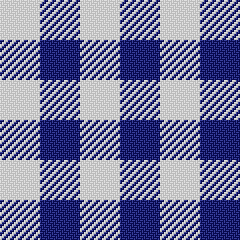 Rob Roy changed to white and any other colour becomes gingham
 Windowpane gingham
 Windowpane gingham with two or more over-checks becomes tattersall
Tartans for specific purposes

In addition to clan tartans, many tartan patterns have been developed for individuals, families, districts and towns, institutions, corporations, and events.[9] They have even been created for particular religious and ethnic groups,[cq] and for sociological groups like the LGBT community.[798][872] Tartan has had a long history with the military, and today some military units – particularly those within the Commonwealth – have tartan dress uniforms.[873]
Regional
Many districts, cities, and towns in Scotland have their own tartans, mostly dating to the 20th century (though some few district tartans are quite old),[cr] and not always official; many were just created for marketing to tourists,[874] and some are copyrighted works tied to specific vendors.[875] They are intended primarily for those to whom a clan tartan does not seem to apply . At least two local government councils in Scotland have official tartans.[876]
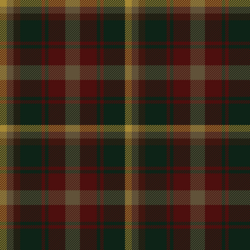
In addition to the traditional district and modern geographic tartans of Scotland, new designs have been created for places in other countries. Only some regional tartans are officially recognised by the government bodies of the places the designs represent.
The pan-Celticism movement has inspired the creation of "national" (in the sense of Celtic nations) and sometimes regional tartans "to emphasise the ... bonds with other Celtic countries"[879] outside of Scotland; none of these appear to have any official recognition. There are tartans of Cornwall, long a part of Devonshire in England (the designs date from 1963 to the 1980s);[cs]Wales (from 1967 onward[ct] – sometimes with false claims of antiquity by marketers);[890] the Isle of Man (from 1946, many by D. G. Teall of the Scottish Tartans Society, and several asymmetric);[cu]Brittany in France (from 2002);[cv]Galicia in Spain (from 1990);[cw] and especially Ireland (from 1956).
After the discovery of the "Dungiven tartan" and its marketing as a district tartan for Ulster, Scottish weavers (and in two cases English, and in another American) decided to tap an Irish and especially Irish-American market by introducing a profusion of national, province, and county tartans for Ireland and Northern Ireland, generally based on established Scottish tartans with some colour changes.[18][215] These geographical tartans, which (aside from the Dungiven/Ulster reconstruction of 1956) date to 1970 and later,[219] do not have any official recognition, and are purely a product of the industry.[18][213] One weaver even introduced a competing set of Irish national and county tartans in 1996, different from the previous offerings.[213] "The influence of native Irish people, either as suppliers or consumers of Irish tartans, would appear to be minimal."[18]
Further afield, all but two Canadian provinces and territories have official tartans, with the first dating from 1956. Neither Quebec nor Nunavut, Canada's newest territory, have formally adopted patterns. Alberta, meanwhile, has two official tartans, including a dress one. All but Quebec's were registered with the Court of the Lord Lyon in Scotland.[907] Canada has an official national tartan that was originally designed to commemorate the introduction of its new maple leaf flag, and was made an official national emblem in 2011.[878] Various Canadian regions (like Labrador and Cape Breton Island), counties, municipalities, and institutions also have official tartans.[cx]
Tartans have been created for Australia; its capital city, Canberra; each of its states; and some of its local government areas; but only some of those tartans have been officially adopted or recognised by the relevant governments in Australia. US states have official tartans, with the first dating from 1988.
Hunting, mourning, dress, and dance
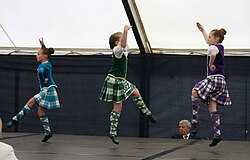
A tartan is sometimes differentiated from another with the same name by a label: hunting, mourning, dress, or dance. The first three of these ideas are the result of Victorian fondness for dress etiquette and show[910] (and weaver marketing);[65] the last is more recent.
Hunting tartans tend to be made up of subdued colours, such as dark blues, greens, and browns.[911] Although there is some evidence of early tartans with camouflage colours going back to the 16th century, hunting tartans, despite the name, have very little to do with actual hunting.[12]
Mourning tartans, though quite rare, are associated with death and funerals. They are usually designed using combinations of black and white, or by replacing bright colours such as reds and yellows in a traditional tartan with black, white, or grey.[912]
Dress tartans are usually special tartans for formal-dress occasions[913] (e.g. dress Stewart[914] is distinct from both the main royal Stewart tartan and the hunting Stewart,[915] among several other tartans attributed to Stewart/Stuart). In a few cases, a dress tartan is simply the main tartan of the clan.[cy] Dress tartans that do differ from main clan tartans are sometimes entirely different (e.g. MacMillan[35] and MacMillan dress[920] are unrelated designs), while in most cases they are based on the main tartan but with colour differences (e.g. Stewart). Some dress tartans are very modern,[81][623] but some date back to the era of the Vestiarium Scoticum.[921]
Dance tartans, intended for Highland dance outfits, for either sex, are inspired (like most dress tartans before them) by the arisaid (earasaid tartans thought to have been worn by Highland women in the 17th and 18th centuries, which often featured white as a major colour, as do typical dance tartans today (most or all of which date to the 20th century or later). Some dance tartans are named "arisaid" rather than "dance", e.g. Fraser arisaid.[922][cz]
There has been some confusion between dress and dance tartans, especially since the idea of the latter developed from the former.[da] Most dress tartans, including some of the oldest, also have white in them, and have been used for dance competition in lieu of a dance-specific tartan, so are easy to mistake for dance tartans, which almost invariably have white in them.[925][db]
Family and individual
A large proportion of non-clan tartans in all of the modern tartan databases have always been family tartans, promulgated mostly from the late 20th century for family names that are not clans or listed as septs of clans. These are usually Scottish surnames, but the Scottish Register of Tartans (SRT) database increasingly includes new family tartans for names that are not Scottish or even British. Most family tartans have no copyright claim, since they are intended for use by anyone with the surname or an extended-family connection. The SRT classifies them together with clan tartans in a "clan/family" category if they have history that pre-dates SRT or if they are newer and are approved by a legally recognized clan chief or family head, but in a "name" category if they are newer and lack such imprimatur.
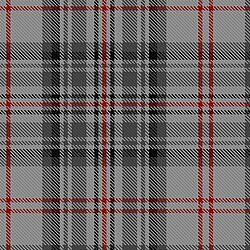
A few non-clan family tartans have an older pedigree. The best known is Balmoral tartan, reserved for the British royal family and personal pipers thereof, since its creation by Prince Albert c. 1852.[dc] Some clans recognise tartans for specific family branches and septs that are not themselves generally regarded as clans. For example, Clan Robertson/Donnachaidh/Duncan acknowledges separate, established tartans (some of them quite old) for Inches, MacGlashan, MacInroy, MacLagan, MacPhee, MacWilliam, Reid, and Robinson,[927] and they are all registered in the SRT.
Since the late 1960s, various weavers have marketed (primarily to Irish Americans) some tartans with Irish family names, without any involvement by family members.[215] There had also been a legend that the rare Clans Originaux (1880) contained Irish family tartans, but this was finally disproven in 2003.[18][dd] There is one case of a formal Irish clan/family tartan, however: The Clan Cian Society commissioned a tartan for Cian of Ely, and registered it with the Chief Herald of Ireland in 1983.[18][215] (Even this has an Irish-American connection, as the chief resided in California, and the society is US-headquartered.)[929] Similarly, a commercial operation in Cardiff named Wales Tartan Centre (supplied by Cambrian Woollen Mill) has since the early 2000s promoted a long series of tartans named for common or prominent Welsh family names; they are unusual in often having odd-numbered thread counts, and having a different warp and weft (producing rectangular rather than square patterns), probably to distinguish them from the Scottish style.[890][930]
For the much narrower sense of family, the SRT registers also as "name" tartans those that are created by individuals for only themselves and their immediate-family members, often for weddings; these usually have a copyright claim. One of the earliest tartans named for a specific person[de] is the "Janet Wilson sett", entered into the late 1770s records of Wilsons of Bannockburn and believed to refer to the company founder's wife or daughter-in-law, though made as one of their publicly available patterns.[316][df]
Corporate and commercial
Numerous Scottish brands use tartan, and some have unique tartans. Various not-for-profit organisations also have corporate tartans. Probably the earliest case was that of the Ancient Caledonian Society of London (founded in 1786 and defunct since 1837), which used what is believed to have been a consistent tartan[933] for its members' frock coats (which, unusually, featured brocade woven into the tartan, of Jacobite white roses – it may be what 1767 advertisements called "flowered tartan"); only one known example of the coat survives.[354][934]

As an example of a modern commercial tartan, Irn-Bru (introduced in 1901), the best-selling soft drink in Scotland,[935] has its own tartan.[936] Scottish regional airline Loganair uses tartan livery, including on the tails of its planes, and has two registered corporate tartans.[937] "Racing Stewart"[938] is a pattern created in 1995 for the Jackie Stewart Formula One car-racing team.[939]
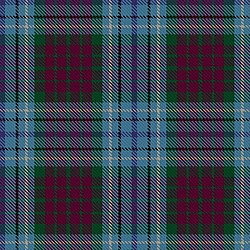
The "corporate" category is one of the fastest-growing in the official Scottish Register of Tartans (SRT) database, with a large number of Scottish (and American and other) companies and societies registering organisational tartans. These are generally protected by copyright and sometimes trademark law. These tartans vary in purpose from general corporate livery, to special event tartans, to tartans for fictional characters.
Two examples of the latter are Sanrio's 2004 creation of a predominantly pink tartan for Hello Kitty;[90] and the 2011 creation by Disney/Pixar of the DunBroch tartan for the family of the main character, Mérida, of the animated Highland fantasy/adventure film Brave.[940]
Fashion
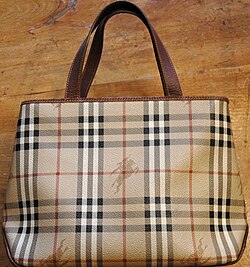
An early example of a tartan created by and for the fashion industry, and surely the most famous, is "Burberry check". It was introduced in the 1920s for the lining of trench coats made by Burberry of London, but has been used for all manner of clothing and accessories since 1967[941] (with another major marketing push in 2001) and is emblematic of the company and its upscale product line.[942]
A fast-growing category in the SRT is that of "fashion" tartans, created by companies and individual designers simply for aesthetic reasons, without any association with a particular clan, family, region, etc. Like organisational tartans, most of these have a copyright claim attached to them.
A prominent example: In 2017, Scottish fashion designer Charles Jeffrey designed a signature tartan for his Loverboy label, registering it in the SRT.[124]
Regulation
Manufacture and use of tartan (at least in the Scottish context) is regulated, formally and informally, in three ways: registration (recording of a tartan and its association, if any, with a particular family, organisation, person, event, etc.); legal protection of a tartan as intellectual property (trademark, copyright); and etiquette (socio-cultural norms regarding the use of tartan and Highland dress).
Registration

The naming and registration of "official" clan tartans began in 1815, when the Highland Society of London solicited clan tartans from clan chiefs.
Following recognition by a clan chief of a tartan as a clan tartan, the chief was formerly able to petition the Lord Lyon King of Arms, the Scottish heraldic authority, to register it as a formal clan tartan.[dg] Once approved by the Lord Lyon, after recommendation by the Advisory Committee on Tartan, the clan tartan was then recorded in the Lyon Court Books.[304] However, leading up to the launch of the Scottish Register of Tartans in 2009 , the office of the Lord Lyon stopped providing this tartan-recording process (though its statutory authority was not changed by the Tartans Bill).
Modern-day tartans can be created and registered by anyone, with the Scottish Register of Tartans. Modern registered tartans include ones for Scottish and other districts, cities, and towns; for Irish counties (devised since the 1990s)[104] and families (for example, the surname Fitzpatrick has two registered tartans[943]); for organisations and companies; and even for specific events or individuals. Tartans are also being created in record numbers among the Scottish diaspora in the United States, Canada, Australia, New Zealand, etc., especially for places, military divisions, pipe bands, and individuals and their immediate families.
Until the late 20th century, instead of a central official tartan registry, independent organisations located in Scotland, Canada, and the United States documented and recorded tartans.[944] In 1963, an organisation called the Scottish Tartans Society (now defunct, and originally named Scottish Tartans Information Centre)[601] was created to record and preserve every known tartan design.[945] The society's Register of All Publicly Known Tartans (RAPKT) contained about 2,700 different designs of tartan.[946] Registration of new designs was not free of charge. The society, however, ran into financial troubles in 2000, and folded.[947][398]
Former members of that society formed two new Scotland-based entities – the Scottish Tartans Authority (STA, 1996 – before STS closed) and the Scottish Tartans World Register (STWR, 2000 – the trade name of a private company, Tartan Registration Ltd).[398] Both of these organisations initially based their databases on the RAPKT. STA's database, the International Tartan Index (ITI) consisted of about 3,500 different tartans (with over 7,000, counting variants) as of 2004.[946] The online ITI was later rebranded The Tartan Ferret. STWR's self-titled Scottish Tartans World Register database was made up of about 3,000 different designs as of 2004.[946] Both organisations were registered as Scottish charities and recorded new tartans (free in the case of STA and for a fee in the case of STWR) on request.[948][949]
In the interim, a jointly Scotland- and US-based organisation, International Association of Tartan Studies and Tartan Educational & Cultural Association (IATS/TECA) emerged in 1984[398] and published its own TartanArt database in the early 1990s as Microsoft Windows software which was much used in the North American kilt-making trade. IATS/TECA was absorbed by STA by 2005.[398]
The Scottish Register of Tartans (SRT) is Scotland's official tartan register, and was established in 2009.[950] SRT is maintained and administered by the National Archives of Scotland (NAS), a statutory body based in Edinburgh.[951] The aim of the register is to provide a definitive and accessible resource to promote and preserve tartans. It is also intended to be the definitive source for the registration of new tartans (if they pass criteria for inclusion and a registration fee is paid). The database itself – also named simply Scottish Register of Tartans, and sometimes called TartanRegister from its domain name – is made up of the pre-existing registers of STA and STWR as they were at the time of SRT's launch (preserving the STA's and STWR's registration numbers, dates, and other details in the SRT data), plus new registrations from 5 February 2009 onward. On the register's website, users can register new tartans, search for existing tartans and request their thread counts, and receive notifications of newly registered tartans.[950][952]
STWR became defunct some time after 2008. STA later closed the ITI/Tartan Ferret to new registrations, and in late 2022 removed the search feature from the STA website (pending a site redesign), deferring to the Scottish Register of Tartans, which now appears to be the only operating tartan registry. STA continues offline work on the ITI database, correcting errors, importing new SRT additions, and recording historical patterns newly discovered in museum holdings, etc.
Legal protection
Some modern tartans are protected by trademark law, and the trademark proprietor can, in certain circumstances, prevent others from selling that tartan.[126] An example is the "Burberry check" of the English fashion house, an instantly recognisable tartan that is very well known around the world.[953][dh]
Unlike trademark registration and copyright registration, the Scottish Register of Tartans (SRT) and its authorising Tartans Bill do not create any new or enhanced intellectual property rights through the act of registration (nor provide any enforcement mechanism other than removal of infringing entries from the registry).[957]
SRT, however, permits registrants optionally to assert and record copyright and/or trademark claims over their new tartans, for designs that are eligible for such protection under other established law[958] (such as the Copyright, Designs and Patents Act 1988; and the Scotland Act 1998, which took over copyright and trademark registration and enforcement in Scotland)[959] and lists such tartans as restricted. An SRT registration "provides evidence of the existence and date of [the] design",[960] which helps establish the copyright date under the Berne Copyright Convention. Such legal protections apply only to comparatively recently created tartans; old clan, regimental, and district tartans are outside the protection periods of such intellectual property laws.[42]
SRT also permits the listing of intended use and manufacture restriction preferences, but has no enforcement capability,[961] and also includes a statement that "No other rights can be conferred."[960] British tartan weavers, such as Lochcarron and D. C. Dalgliesh, generally will not produce material in an SRT "restricted" tartan without written evidence of permission from the copyright/trademark claimant. In additional furtherance of intellectual property concerns, the SRT also refuses to register a new tartan that is confusingly similar to any existing one (as determined by an SRT review process).[962]
The application of copyright law to tartans is not well tested. The leading British legal case on textile copyright, concerned with designs printed on fabric, is Designer Guild Ltd v Russell Williams (Textiles) Ltd (2000), finding for fairly broad copyright protection in textile works that involve creative originality.[963] In 2008, two tartan pattern copyright holders, Rosemary Nicolson Samios and weaver Lochcarron of Scotland, took legal action for infringement of an Isle of Skye district sett (designed 1993) and the Princess Diana Memorial sett (designed 1997), respectively, against the Gold Brothers firm of Surinder, Galab, Malap, and Dildar Singh, who operate dozens of stores in Scotland and online that sell primarily Chinese-made tartan objects or "tartan-tat", including cheap Highland-dress outfits, for the tourist market.[875] The Isle of Skye tartan was considerably profitable for Samios, after the pattern was popularised by Queen Elizabeth II wearing it in 1999. The Princess Diana sett was designed by Alistair Buchan of Lochcanrron and of the Scottish Tartans Authority as a charity fundraiser. A British court on 2 July 2008 issued an interim interdict (preliminary injunction) against Gold Brothers' sale of Isle of Skye goods, after a police search found hundreds of metres of the pattern in Chinese-made cloth in the company's warehouse.[875][964][965][966] Both cases may have been settled out-of-court because published news regarding them ceases in 2008. A more recent case, Abraham Moon & Sons Ltd v. Thornber & Others (2012), actually involved tartan. It held that the textual ticket stamp (a detailed set of weaving instructions, i.e. a thread count with additional information on precise colours, etc.) used to produce a tartan designed in-house by the claimant had been infringed, was protected as a literary work, and also constituted a "recording" of the graphical work of the tartan and thus was independently protected as a work of artistic craftsmanship.[42][967]As of 2020, the decision was being appealed, as it conflicted with previous caselaw, e.g. Hensher v Restawile (1976), holding such instructions to be uncopyrightable.[968][42]
While tartan arguably could be classified as a form of intangible cultural heritage,[969] and its value to identifying Scottish products both in Scotland and internationally has been recognised and exploited for a long time,[939] tartan is not protected by either geographical indication (protected designation of origin) law, nor sui generis legislation specific to that kind of product.[970]Harris tweed, another textile associated more narrowly with Scotland, does have such protection. In 1998, Keith Lumsden, research officer of the Scottish Tartans Society, proposed that the word tartan be prohibited for use to market a textile, unless the design was accepted in an official governmental tartan registry (which did not then exist).[939] When the Scottish Parliament finally authorised the Scottish Register of Tartans in 2008, it did not include anything like this sort of trade protection. According to Michael B. Paterson (2001): "No mechanism exists to protect [traditional Scottish] tartan from 'misuse' by interests having nothing to do with Scotland or Scotland's interests", though the tartan registries "play an important, if weak, role in asserting Scotland's cultural rights in relation to tartan."[971]
Etiquette
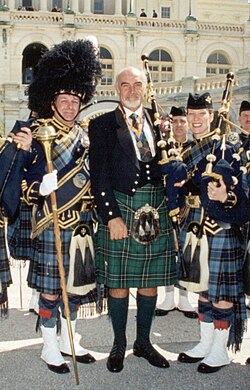
Since the Victorian era, authorities on tartan have claimed that there is an etiquette to wearing tartan, specifically tartan attributed to clans or families. In the same line of opinion, some tartans attributed to the British royal family have been claimed to be "off limits" to non-royalty.[972][973] Even so, there are no laws or universally accepted rules on who can or cannot wear a particular tartan. (Some writers have nevertheless asserted their existence anyway, e.g. Alexander Campbell in 1890, regarding different Campbell tartans.)[974] The concept of the entitlement to certain tartans has led to the term universal tartan, or free tartan, which describes tartan which can be worn by anyone without controversy. Traditional examples of such are the Black Watch, Caledonia, hunting Stewart, and Jacobite tartans, shepherds' check, and district tartans.[975][798][976] The published marketing of tartans for simple fashion purposes without any association to a place or body dates back to at least 1745,[495] and much of Wilsons' output through the 19th century consisted of "fancy" patterns for the general public.[977] Some recently created designs intended for everyone (though some are exclusive to particular weavers or Highland-dress outfitters) have names including Braveheart, Clansman, European Union, Highlander, Independence, Pride of Scotland, Rainbow, Scotland 2000, Scotland the Brave, Scottish National, Scottish Parliament, Spirit of Scotland, Stone of Destiny, and Twenty First Century.[978]
Books on Scottish clans list guidelines,[126] but are not always in agreement. One such opinion is that people not bearing a clan surname, or surname claimed as a sept of a clan, should not wear the tartan of their mother's clan.[979] This opinion is reinforced by the fact that in the Scottish clan system, the Lord Lyon states that membership to a clan technically passes through the surname. This means that children who bear their father's surname belong to the father's clan (if any), and that children who bear their mother's surname (her maiden name) belong to their mother's clan (if any).[980] Also, the Lord Lyon states that a clan tartan should only be worn by those who profess allegiance to that clan's chief.[981]
Some clan societies even claim that certain tartans are the personal property of a chief or chieftain, and in some cases they allow or deny their clansfolk "permission" to wear that tartan.[di] According to the Scottish Tartans Authority – which is an establishment of the Scottish tartan industry – the Balmoral tartan should not be worn by anyone who is not part of the British royal family. Even so, some weavers outside of the United Kingdom ignore the "longstanding convention" of the British royal family's "right" to this tartan. The society also claims that non-royals who wear this tartan are treated with "great disdain" by the Scottish tartan industry.[983][dj]
Generally, a more liberal attitude had been taken by those in the business of selling tartan, holding that anyone may wear any tartan they like. Under the liberal view, claimed "rules" are mere conventions (some of which are recent creations), with different levels of importance depending on the symbolic meaning of the tartan on some particular occasion.
The Standing Council of Scottish Chiefs has also taken a fairly flexible position (organisationally; some specific individual chiefs may have a narrower or looser take, and not all chiefs are members). Aside from opposing the creation of a new tartan using a clan's name without the chief's permission, their website states (adopting more loosely some ideas from the Lord Lyon view):[986]
There are no strict rules on who has the right to wear a particular tartan. People normally wear only the tartan (if any) of their surname, or a "district tartan" connected with where they live or where their family come from. Wearing a particular clan tartan indicates that the wearer bears an allegiance to the chief of that clan.
Some Highland-dress historians have taken a dim view of regulatory intents and proclamations with regard to tartans; Scottish National Portrait Gallery curator A. E. Haswell Miller wrote that "to claim special entitlement to a tartan in the same manner as heraldic arms is certainly absurd", because evidence suggests that the idea was just invented by writers of the late 18th to mid-19th centuries.[987] Sir Thomas Dick Lauder expressed similar views as far back as 1829, right in the middle of the "clan tartanry" rush, dismissing both the then-new adoption of "official" clan tartans and attempts by clans to claim regimental ones.[560]
In other cultures
While tartan has been most closely associated with Scotland, and dating back to the Roman period was perhaps associated with Northwestern Europe in general, it is likely that the idea of using patterns of rectangles and lines has independently occurred many times, in any cultures with weaving.[988] Basic tartan "is almost as primitive a weave as it is possible to make ... probably the earliest form of patterened fabric anywhere."[2] Surviving pre-modern historical examples seem sparse, however.
Modern tartan-style cloth in a wide variety of materials and patterns from simple to complex is available and used today around the world, often simply as a style of cloth and without any association with Scotland.
Africa
Maasai shúkà

Among the Maasai people of Kenya and Tanzania, the shúkà is a cotton blanket-like garment (what Scots would call a plaid) worn as a wrap, and very commonly in a tartan pattern, though sometimes linearly striped or of one colour.[989]Shúkà are predominantly red, though sometimes seen in blue and other colours.
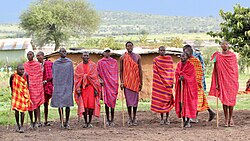
Shúkà were originally of painted (typically red) leather, but Maasai have had access to plain-weave cotton fabric for some time, imported to the region by Americans since the 1860s.[989]Joseph Thomas Last, a British missionary, in 1883 described the Maasai as particularly fond of red and white cloth, to be worn by higher-status men (though he did not mention tartan in particular);[990] a 1903 report also had them typically wearing red blanket-like garments, after a time of favouring blue.[989] The Maasai were loosely allied with the British, 1895–1904,[991] and the latter made heavy use of Scottish regiments in African conflicts, bringing tartan with them. However, "Guinea cloth" (mostly produced in India), sometimes red and blue checked, was a common commodity in 18th-century western Africa, pre-dating British West Africa; whether it relates at all to shúkà is unknown.[992]Shúkà patterns usually lack the thin black lines common in Scottish tartans.
A nomadic cattle-pastoralist culture, without their own weaving tradition, the Maasai have been described as unusually culturally conservative and resistant to modernisation.[993] Nevertheless, they have always engaged in trade to get goods they do not make themselves,[990] and have made local traditional use of modern materials.[994] The Maasai approach has been to resist yet assimilate colonial and post-colonial influences.[995]
Although there is evidence of tartan usage among the Maasai to at least the period 1906–1918, when Walther Dobbertin photographed a tartan shúkà in what was then German East Africa, the current bright tartan and striped style of shúkà appears to have been adopted primarily in the 1960s[992][996] (partly in response to national-level clothing modernisation pressure), supplanting leather but keeping the same form-factor.[995] The shift in outward form without affecting function led one writer to quip that Maasai dress "has undergone dramatic changes while not changing at all".[997] Tartan-patterned cloth is not typically used for other Maasai garments besides shúkà.
The shúkà has become so emblematic of the Maasai that there is some discussion (driven by the Maasai themselves) at the national and regional level about protecting it as a form of cultural property.[998] While it has been claimed that shúkà patterns, at least at one time, conveyed particular meanings,[dk] and there historically have long been weaving operations in various African areas,[999] most shúkà today that are not mass-manufactured in Dar es Salaam or Mombasa actually come from China, not Africa.[992]
East and South Asia
The earliest-discovered tartan fabric in the world was discovered in Western China, in the context of the Tarim mummies, dated to c. 2100 BC through the first centuries BC . Today, tartan is still woven in China, both as a traditional fabric and in large commercial quantities for export.[815]
 Chinese man in traditional hat of silk tartan with wool pompons, 2008
 Historical brocade of the Zhuang people in Yunnan, China (photo 2011). It is often very complex material, but sometimes simple tartan like this.
 Tartan and other textiles for sale in bulk at Yen Chow Street Hawker Bazaar, Hong Kong, 2022
 A simple three-colour tartan pattern being woven on a hand loom in Pilikula heritage village, India, 2016
 Indian sari in a two-colour tartan pattern with highlights at the crossings of the black lines, which may be embroidery or supplementary weaving
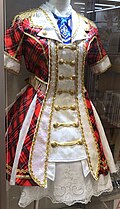 A modern, elaborate kōshijima dress from Japan's lolita fashion subculture, 2018
Bhutanese mathra
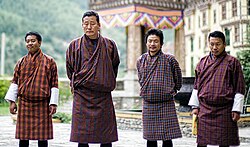
In Bhutan, traditional men's robes (gho)[1000] and knee-stockings (omso, similar to argyle socks),[1001] and women's dresses (kira)[1002] are traditional national costume styles that are largely mandatory for public dress since 1963.[1003][dl] Tartan (generally called mathra or, after the district of its primary production, Bumthang mathra,[1005][dm] among other names for specific patterns) is among the many common textile styles for these garments, some much more elaborate (generally called yathra)[1007] than tartan. The tartan cloths are woven traditionally in yak and sheep wool, but today also in cotton and raw silk.[1008]

Mathra is woven primarily with a red ground. Some specific tartan/plaid styles of Bhutan are: broad-checked thra bom; narrow-checked thra charuru; sethra ('golden pattern'), an orange or rust ground with yellow and sometimes black checks (with black, it is more specifically called sethra dokhana, and without, dalapgi sethra); red, blue, and black patterns on a white ground, in at least four varieties called pangtsi (specifically red and black on white),[1009]Decheling kamtham, and other names;[1010] and another style is named burai mathra.[1011] Some of these fabrics feature supplementary weft decorative patterns (flowers, etc.) added to the tartan, with an embroidered or brocaded appearance, generally called pesar ('new pattern'); one such style is more specifically called sethra metho chen, the yellow-orange pattern with flowers added. There are also patterns of simple linear stripes that do not cross each other (generally called adha[ng] mathra or aikapur), with various names for specific styles.[1012]
Indian madras

Madras is a patterned, light-weight, breatheable, cotton cloth named for the Madras (now Chennai) area of India.[1013] Traditional madras is hand-woven from lumpy, carded-cotton thread, and coloured with natural dyes which may bleed together upon washing to create a more muted pattern than typical tartan, as well as a rougher texture.[1014] Madras also has a "softer" look because it typically lacks the black lines found in most Scottish tartans. Madras cloth dates to at least the 16th century, produced in a variety of patterns, including religious designs and floral prints.[1014] It is unclear if tartan patterns were among the original designs, though they became very popular later. Weaving, primarily for export, in Madras/Chennai became a large-scale commercial enterprise after the British East India Company came to control the area in the mid-17th century.[1015] Major production of this style of cloth also took place in Cambay State (present-day Gujarat).[1016]
Madras, ideal for warm-weather wear, became popular in the Philippines (where it is known as cambaya)[1016] and the Caribbean;[1014] mainly in undyed form, it was also exported to Europe.[1014] Tartan madras reached America by 1718, and appeared in the 1897 Sears catalogue.[1014] It was popular in the United States in the 1930s and again in the 1960s, often associated with preppy style.[1014] Substantial export of the cloth to South Africa began in 1958.[1014]
Modern madras cloth is commonly in tartan patterns, but also simply striped (seersucker). Unlike Scottish-style tartan, madras is not woven in 2/2 twill pattern, but is a muslin of plain weave;[1014] it thus, when viewed up close, features a "pepper and salt" colour mixture where colours cross[6] (a dot matrix, technically), not staggered diagonal lines . It also usually lacks black lines.
Japanese kōshi

In Japan, tartan patterns called kōshi格子 (also koushi or goushi, literally 'lattice') or kōshijima格子縞 date back to at least the 18th century,[408] possibly the 17th[1017] in the Edo period (1603–1867), and were popular for kabuki theatrical costuming, which inspired general public use by both sexes, for the kosode (precursor of the kimono), the obi, and other garments.[1018] The name is a reference to the details of shoji room dividers, the grid pattern said to stand for strength, with larger stripes representing more power.[1018]Kōshi range from simple checked patterns to complex multi-colour weaves. Ikat thread-dyeing techniques were sometimes employed before the weaving, such that a colour in the pattern was mottled,[1018] and parts of the design may sometimes have been embroidered, supplementary-woven, or dyed-over for additional highlight or contrast.[1018] Some styles have particular names, such as misuji-kōshi ('three-striped lattice')[1018] and futasuji-kōshi ('forked lattice').[1019] A pattern with larger squares is more generally called ogoshi or with smaller squares kogoshi.[1020]
It is unclear whether there was a Scottish tartan influence on the development of kōshi. The Edo period pre-dates the Perry Expedition of 1853–1854 and its opening of Japan to general Western trade, but mostly post-dates early European contact from 1543 to the closure of Japan to outsiders in 1639 under the sakoku isolationist policy.
Nothing suggests that particular patterns have been associated with specific families or Japanese clans.
Today, kōshijima is the general Japanese word for 'tartan/plaid, checked pattern'.[1021] Tartan is popular in present-day Japan, both for high fashion and for streetwear,[318] as well as school uniforms.[684] Since the 1960s, the Japanese department store chain Isetan has used an emblematic tartan as a marketing tool (e.g. on all its shopping bags); the pattern is based on some MacMillan tartans.[1022] Japan hosted a major museum exhibit about tartan in 2018.[1023]
Eastern Europe to Western Asia
Tartan-style patterns are common throughout Southeastern Europe.
John Francis Campbell (1862) described the native weaving of the Sámi (Lapps) of northern Europe as being hand-loom tartan.[988]
Considerably to the southeast, the Tatars[dn] and Chuvash, Turkic peoples of Tatarstan and Chuvashia, respectively, in the Russian Federation, have worn tartan, striped, and other patterns since at least the 19th century.

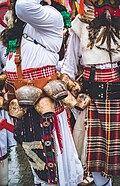 Tartan patterns used in a Bulgarian folk costume
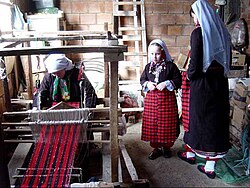 Simple shepherd's check tartan being woven by Pomaks in Greece, 2007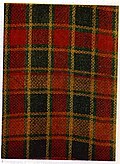
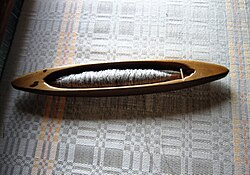 Silk tartan cloth of white, grey, and golden thread from Lithuania
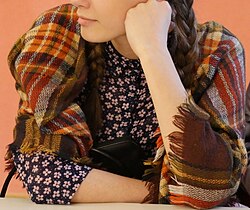 Estonian woman wearing a tartan suurrätt (plaid/shawl)
 Another Estonian suurrätt, with a total-border pattern of more complexity than the simple central pattern
 Chuvashian example, c. 1870
Russian shotlandka
Robert Jamieson, writing in 1818 as editor of Edmund Burt's 1727–1737 Letters of a Gentleman in the North of Scotland, said that in his era, married women of the north-western provinces of Russia wore tartan plaids "of massy silk, richly varied, with broad cross-bars of gold and silver tissue".[93] This seems quite distinct from Scottish-style construction.
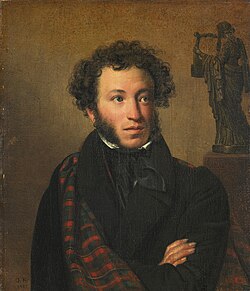
The Russian poet Alexander Pushkin (1799–1837), who was influenced by the romantic-Highlands writings of Walter Scott,[1024][1025] posed for one of the most famous paintings in Russia, the 1827 portrait by Orest Kiprensky. Pushkin wears what looks at first like a Scottish-style tartan shoulder plaid, but is more probably a sleeveless "Almaviva" cape/cloak, a style in fashion at the time and known to have been worn by Pushkin.[762]
Tartan was commented on in the Moscow Telegraph in 1826 as being in broad fashion in the city for all sorts of garments (often as a decorative accent).[762] Scottish-style plaids apparently did come into some fashion in Russia as women's wear for a space during the mid-to-late 19th century, a style picked up from stage productions; some 19th-century Russian paintings illustrate use of plaids as shawls.[762] Tartan (and plain-striped) shawls were also common among the Volga Germans and Bessarabia Germans in Russia; a mixture of hand-woven (originally as bedclothes and other household goods) and mass-produced in Russia, the shawls became emblematic of the German-from-Russia diaspora in North and South America from the nineteenth century to the mid-20th.[1026][1027]
Around the end of the 19th century, the Russian equivalent of Regency and Victorian British tartanware objects, such as decorative Fedoskino boxes with tartan accents in a style called ShotlandkaШотландка (literally 'Scotlandish'), were produced by companies like the Lukutin Manufactory on the outskirts of Moscow.[1028]
Today, shotlandka or shotlandkiшотландки are simply Russian words for 'tartan/plaid' generally.[1029]
 1839 portrait of Maria Arkadievna Bek by Pimen Orlov may illustrate one of the Russian plaids with silver thread
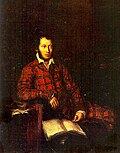 Posthumous portrait of Alexander Pushkin by Carl Peter Mazer, 1839, shows him in a red and green tartan dressing gown[762]
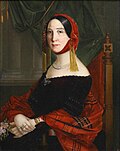 Tatyana Petrovna Musina-Pushkina, Princess Kropotkina (1800–1865), portrait c. 1840s by unknown artist
Oceania
Adoption by the Māori
Pōtatau Te Wherowhero, the first Māoriking, adopted a particular house tartan with design elements symbolizing his ancestry, such as inner stripes representing migration canoes that first arrived in Aotearoa New Zealand; this tartan was presented by his descendant Tūheitia Paki to Charles III in the former's visit to Buckingham Palace in May 2023.[1030] His following tribes concentrated around Northland have also adopted green tartans.[1031]
See also
- Drugget, a coarse and often linearly striped cloth that was common in the Scottish Western Isles
- Flannel, a type of fuzzy cloth often produced in a tartan pattern
- Hodden, a non-tartan cloth of undyed wool, sometimes also used for kilts, especially for non-Scottish pipe bands
- List of tartans
- Mackinaw cloth, a dense woollen cloth often produced in tartan patterns
- Madras (cloth), cotton cloth of India often woven in tartan patterns
- Tartan Day, a day of celebration, in Canada, Australia, the US, and some other countries, recognising the influence of Scottish immigration
- Tartanry
Patterns
- Argyle (pattern)
- Battenburg markings, a check (dicing) pattern used on UK emergency vehicles
- Border tartan
- Check (pattern) or chequer
- Gingham (Vichy check)
- Glen plaid
- Harlequin print
- Herringbone (cloth)
- Houndstooth
- Sillitoe tartan, a check (dicing, not actually tartan) pattern commonly used on police headgear
- Tattersall (cloth)
Notes
- ↑The use of plaid to mean 'tartan' has not been exclusively North American; in 1808, the London publication La Belle Assemblée referred to "plaid scarfs".[14] Also, it has sometimes been claimed that plaid refers to all such patterns generally, and tartan only to patterns of Scottish clans,[15] but there is no support for this idea in works of tartan scholarship.
- ↑MacBain (1911), p. 277. Cognate words in other languages are the Luwianpldtmn and later Latinpaludamentum for 'cloak'. The paludamentum was a cloak put on by Roman officers in time of war.[17]
- ↑Solid-colour, non-tartan kilts were often thought to be an Irish invention of the late 19th century, but an example of a belted plaid or "great kilt" from Scotland was found in a 1635 portrait of Sir Duncan Campbell of Loch Awe,[18] among other Scottish examples.
- ↑The two Scarlett sources provide two exact formulas which seem at first to be contradictory, but one is for number of blends and the other for number of colours total.
- ↑The term mirroring can be ambiguous, because the longer phrase mirror pattern may refer to "one in which ... two alternating ground motifs are the same size and arrangement but in different colours."[31]
- ↑The term repeating[26] has also been used, as distinct from mirroring, but is so ambiguous that sometimes the same patterns are referred to as non-repeating.[32] Neither term will be used further in this article.
- ↑A well-known example is the main Buchanan tartan.[33]
- 12An example is the most popular MacMillan tartan, in which the warp and weft are different, though similar; the largest blocks of colour are green rectangles instead of squares.[35]
- ↑Early collectors of tartan, like Logan in 1831, recorded setts by measuring the width of each stripe in eighths of an inch.[36][37] A persistent legend that tartans were originally recorded on little "pattern sticks" has been dispelled as a "telephone game"–style progressive, willful misunderstanding of an early description of the warp as wrapped on a warp beam/roller for the loom. It was poorly described by Martin Martin in 1703 as "an exact Pattern of the Plad on a piece of Wood", which Logan (1831) misunderstood as a small stick used as a perpetual "record" of the tartan pattern on it, after which the "Sobieski Stuarts" in 1842 blatantly falsified a supposed 16th-century description of "pattern sticks", and Archibald Campbell (1890) repeated the story again as factual. No such artefact has ever been found by modern researchers, and the idea has been described as impractical because the threads would not stay put indefinitely, and it would make much more sense to simply write or draw the pattern on paper, or keep a strip of the woven material.[38][39] Mackay (1924) claimed he had seen some examples and appeared to describe warp beams, but then claimed they were used as a long-term record of "clan tartans" of the area.[40] Eslea MacDonald (2015) points out that Mackay had a tendency toward "manipulating the evidence" when advancing his ideas about very old clan tartans, and that he made up a fake-Gaelic name for the alleged pattern sticks.[39]
- ↑For example, Stewart, D. C. (1974), Scarlett (1990), and Scottish Register of Tartans (2009–) all use full-count-at-pivots "bare" thread counts, without slash or bold notation, while Eslea MacDonald (2012) uses them to represent half-count-at-pivots, but states this explicitly.
- ↑Ground in this sense dates to at least 1895. Telfer Dunbar (1979), pp. 112–113, quoting 1895 letter: "... dress Stuart tartan on a white instead of on a red ground .... the 'Stuart hunting-tartan' on a green ground". However, ground has a different meaning at the thread-dyeing stage, where it refers to a first layer of colour which is then over-dyed with another, either to deepen the hue or make a new ones, e.g. purple from blue over red.[48]
- ↑Wilsons, the near-exclusive producer of Georgian through Victorian regimental tartan, produced different grades of cloth for officers, sergeants, and enlisted.[55]
- ↑Scarlett (1990) provided a reconstruction of what 17th- to early 18th-century arisaid tartans probably basically looked like, based on the appearance of later wider-banded "bar blanket" tartans which evolved from the arisaid setts. His sample is modernised in being simplified, symmetrical, mirroring, and not having a decorative selvedge.[76]
- ↑The French term écru has also been applied,[86] but is ambiguous, as it technically refers to the colour of undyed linen not wool, and has been taken to indicate a richer, sandy range of hues in English usage than in French.[87]
- ↑The Lord Lyon's colour-coding system actually had three reds: "gules/scarlet", "red" (a dull red), and "crimson".[44] But it is not entirely clear what the difference between them is.
- ↑Multiple hues of pink appear in Wilsons' colour lists around the early 19th century, which included colours for wool and other weaving, but orange does not.[86]
- ↑For lists of such natural dye materials and their preparation, see: Kok, Annette (1979) [1962]. "Appendix: Early Scottish Highland Dyes"". In Dunbar, John Telfer (ed.). History of Highland Dress. London: B. T. Batsford Ltd. pp. 222–240. Some additional such information is available in: Mackay (1924), pp. 59–64; and Eslea MacDonald (2012), pp. 76–77. See also: Campbell, J. F. (1893), p. 335.
- ↑A romantic legend about such a thing goes back quite a way, however. According to Innes of Learney (1971): "The late J. G. Mackay, like Lord Archibald Campbell, claimed that clan tartans were not only deliberately arranged, but formed an elaborate system of identification by dress, as technical as armorial bearings .... [T]artans were never intended to, and did not, have the precise distinctions and ready recognisability of armorial bearings. Mr Mackay gives much interesting information ...; he does not, however, succeed in adducing evidence that there was a scientific system of arrangement, and circumstances are against the existence of a science."[127] In summary, Mackay believed that lines of various colours formed a heraldic system of cadency (differencing) between related family branches.[128] The argument depends on the Victorian-era clan tartans having been used in the 17th–18th centuries, but all modern tartan scholarship shows this idea to be broadly false.
- ↑For a photograph of one of the Tarim cloth fragments and a reproduction of what the fabric may have originally looked like, see: Spada (2019).[137]
- ↑For a photograph of one of the Salzburg cloth fragments, see: Belfrage, Anna (30 April 2016). "Of mummies in tartan". AnnaBelfrage.com. Retrieved 10 June 2023.
- ↑For a photograph of the Falkirk cloth fragment, see: "Record: Cloth (Fragment) – found at Falkirk Stirlingshire". NMS.Scran.ac.uk. National Museums Scotland. 2015. Retrieved 3 June 2023.
- ↑For a photograph of the Caracalla statue fragment, see (about 1/3 down the page): Lamley, Hamish (21 February 2022). "Pictish Fashion". PictaviaLeather.co.uk. Retrieved 10 June 2023.
- ↑Nor any relation to the modern Tatar people.
- ↑This historic Glen Affric tartan is not to be confused with various competing modern district tartans named "Glen Affic" available from some vendors such as Clan/Scotweb, Stevens & Graham, and Spoonflower.
- ↑There are possible mentions earlier, to the 14th century, in both Early Scots and Middle English using the French-borrowed terms tiretain and tartarin in various spellings, but they do not clearly refer to tartan, either the cloth or the pattern, but rather seem to refer to valued cloth in general.[4]
- ↑There is a legend that during some period there was a "caste" system by which chiefs were entitled to up to seven colours in a tartan, fewer colours were allowed for clansmen according to position in the social hierarchy, and just single-coloured cloth for servants. Barnes & Allen (1956)[92] attributed the idea to Frank Adam (1908). He did indeed write that "it is said" there was such a system, but cited no evidence.[142] The fancy is from Logan (1831), who cites nothing but an ancient "Achy Edgathach" of Ireland.[177] That was a legendary ancient Irish king in the Lebor Gabála Érenn, said to have passed a sumptuary law limiting clothing colours by social status, during his very short reign of only four years (some time between 1537 and 1155 BC).[178] It is old Irish folklore and nothing to do with history of Scottish tartan. Scarlett (1990): "it is difficult to allow such a tale any credibility".[144] No modern Highland-dress scholars repeat it seriously (the last one to do so seems to have been Mackay (1924) who said it applied to "Druidical times"),[179] and the idea is contradicted by existence of old regional tartans of complexity, and by chiefs adopting tartans of marked simplicity. Practically, the extra dye and weaving-labour expenses of complicated tartans meant that they cost more and so were more often worn by monied persons,[144] as clearly reported by John Lesley (1578)[180] and Robert Heron (1799).[181]
- ↑Buchanan (1582): "They delight in marbled cloths, especially that have stripes of sundrie colours; they love chiefly purple and blue; their predecessors used short mantles or plaids of divers colours, sundrie ways divided, and among some the same custom is observed to this day, but for the most part they are brown, most near to the colour of the hadder [heather], to the effect, when they lie among the hadders, the bright colour of their plaids shall not bewray them."[191] (Buchanan's wording was recycled in 1603, in the anonymous Certayn Mattere Concerning Scotland.)[192]
- 12The attempt to depict tartan is fairly crude, done as divided stripes, instead of a staggered pattern of blending rectangles, though it is possible it represents a weave with differing warp and weft, which could produce more of a striped pattern. The exact details shown in the image are open to other question, because the artist illustrated an imaginative sword that is a combination of a Scottish claymore hilt with the blade and quillions of a German Landsknecht sword of a type more familiar to the German (Silesian) artist. Also, Telfer Dunbar (1979) called the colours yellow, blue, and red (not green, blue, and red), so the palette accuracy of the photo could be in doubt.[194] The original art is in Huntington Library MSS: HM 25863, f. 28r.
- ↑There is a recurrent legend running through Victorian works on tartan that the tartan cloth for each Highland man was usually made at home singly by his wife or mother,[197] but this proves to be an impractical idea,[198] for which there is no evidence, and considerable evidence against, including rich folk tradition of (mostly women's) group labour.
- ↑Innes of Learney (1938/1971) believed that Highlanders wore multiple tartans because some were personal (perhaps inherited), some geographical, and some clan-specific,[203] but presented no real evidence for this hypothesis. The idea can be traced to Lord Archibald Campbell (1890), who asserted (with no evidence at all) that a Highlander wearing multiple tartans at once could be explained by him donning the pattern of his commander, his own paternal clan, and maternal clan.[197]
- ↑Even this, however, is ambiguous, and could mean that the Highlanders wore striped mantles, and worse their mantles in the same fashion that the Irish wore their own mantles, striped or not. And "striped" does not necessarily mean tartan. The Camden material is also contemporaneous with the Plantation of Ulster.
- ↑Taylor: " ... all and every man in generall in one habit .... For once in the yeere, ... many of the nobility and gentry of the kingdome (for their pleasure) doe come into these Highland countries to hunt, where they doe conforme themselves to the habite of the Highlandmen, who for the most part speake nothing but Irish [i.e. Gaelic] .... Their habite is shooes, with but one sole apiece; stockings (which they call short hose) made of a warm stuff of divers colours, which they call tartane; as for breeches, many of them, nor their forefathers, never wore any, but a jerkin of the same stuff that their hose is of; their garters being bands, or wreathes of hay or straw; with a plaed about their shoulders, which is a mantle of divers colours, much finer and lighter stuffe than their hose; with blue flat caps on their heads ...."[228]
- ↑Adam (1908/1970) makes the surprising claim that in Taylor's time, "any one who assumed the tartan of the clan was considered as being under the special protection of that clan" and implies that Taylor said this.[189] Adam invented it, as nothing like this is in Taylor's original material. Taylor simply said that visitors wearing Highland dress would be "conquered with kindnesse, and the sport will be plentifull".
- ↑E.g. in the revised 1707 edition of Rev. James Brome's Travels over England, Scotland and Wales, is material partly adapted from Buchanan (1582): "They go habited in Mantles striped, or streaked with divers colours about the Shoulders, which they call Plodden, with a Coat girt close to their Bodies, and commonly are naked up their Legs, but wear Sandals upon the Soles of their Feet, and their Women go clad much after the same Fashion."[238] This suggests a span of at least 1582–1707 of Highland fashion being rather consistent and unisex.
- ↑The same artist earlier painted a three-in-one portrait of actor-playwright John Lacy, in 1675, which featured trews and belted plaid,[249] but the tartan there is very casually represented as simple red and blue lines on white.
- ↑Martin Martin (1703) wrote: "each Isle differs from the other in their fancy of making Plaids, as to the Stripes in Breadth and Colours. This Humour is as different thro the main Land of the Highlands, in-so-far that they who have seen these Places are able, at the first view of a Man's Plaid to guess the Place of his Residence ...."[254] Scarlett (1990) says some earlier writers used this to just assume "a fully organised system of District tartans at that time" though Martin said nothing of the sort.[255] Scarlett considered Martin's account to have "a rather sweeping style that suggests some exaggeration", but generally plausible on other evidence of particular patterns, with minor variations, being common across wide areas.[255]
- ↑These tartan jackets are not to be confused with the later short regimental Highland doublet styles, borrowed directly from the military Highland regiments starting in the late 18th century; these are also of plain colour, not tartan.
- ↑Sources conflict sharply on the date. Telfer Dunbar (1979), relying on Mackay Scobie, says 1717-1739;[270] while Eslea MacDonald (2016), relying on R. W. Munro's Highland Clans & Tartans (1977), says 1754.[175]
- ↑Banks & de La Chapelle (2007) give an implausible 1724 date for the founding of Wilsons,[275] which does not agree with other scholarship, and they cite no source for the assertion.
- ↑Scarlett (2008): "Red, blue and green have been recorded as the first colours to appear in all primitive art, so there may be some deep physiological or psychological reason for the predominance of these colours."[6]
- ↑Britain has many native plants that can produce at least a thin yellow, but they seem not to have been favoured, except as a ground-colour for over-dyeing with blue to create green.[277]
- ↑A small piece of tartan believed to be from a plaid of Bonnie Prince Charlie, given in 1746 to Lady Anne Mackintosh of Clan Farquharson, survives in the National Records of Scotland.[168] The prince apparently had a habit of giving out plaids as thanks for hospitality, and several recorded (but quite different) tartans are said to have come from these plaids, e.g. SRT 4220,[287] 4421,[288] 4422,[289] and 4423.[290] According to Telfer Dunbar (1979), various museums and other collections hold at least 40 pieces of tartan claimed to have been worn by "the Young Pretender", eight at the Battle of Culloden, and they cannot all be genuine.[291] One sample in particular is more likely than the others to be legitimate.[63]
- ↑There are several other tartans called "Jacobite". One dates to c. 1850,[66] or might be a bit older and is probably a Wilsons design,[31] and the others are more recent commercial inventions of c. 1930[299] and the late 20th century.[300]
- ↑Telfer Dunbar (1979) says the correct year is 1725 and that 1729 was an error introduced by Stewart of Garth (1822) and copied by later authors.[223]
- ↑Specifically, as defined in an earlier act of Parliament, north of the "Highland line" running from Perth in the east to Dumbarton in the west.[309]
- ↑The Dress Act per se did not enumerate exceptions for the nobility, but the enclosing Act of Proscription did.
- ↑Lt.-Col. Sir John MacGregor Murray, newly chief of Clan Gregor and later vice-president of the Highland Society of London, wrote of the difficulty of raising a new regiment, in 1803: "It will require much to rekindle the martial spirit of our ancestors, which has, unfortunately, been systematically broken down – we were so long degraded by the privation of our arms and dress, and so much unmanned by being converted into manufacturers".[322]
- ↑Not to be confused with the second Seaforth's Highlanders, also raised as the 78th, in 1793. The original Seaforth's Highlanders were amalgamated with other units under the Childers Reforms to become the 1881 Seaforth Highlanders.
- ↑Not to be confused with the earlier 74th Regiment of (Highland) Foot, raised 1777.
- ↑The commercial tartan weaver D. C. Dalgliesh provides a list of those that they supply, and it includes a mix of obscure tartans from defunct regiments, ones still used today for surviving regiments, tartans of overseas units that were "Highland" only in name, some that are now only associated with clans, and a number that are/were reserved for military pipe-band use and were not used in regular dress or undress uniforms.[403]
- ↑As one example, in The Lockhart Papers, first published in 1714, is a passage describing how opposing battatlions of MacDonalds from different places could only tell each other apart by colour of bonnet cockade. D. W. Stewart (1893) leapt to the conclusion they must have worn the same tartan, despite the material saying nothing of the sort[417] (they could have been wearing whatever tartans they happened to have, not uniforms, making tartan meaningless for distinguishing units of men).[140]
- ↑D. W. Stewart (1893) sometimes leaned toward the uniform interpretation: "It appears from the regulations issued to the retainers of the Clan Grantanent the wearing of a uniform tartan that distinctive patterns were in use, at least for military purpose, or on occasion of great gatherings".[260] The Grant case is covered in detail later.
- ↑D. W. Stewart (1893) again came down on the "uniform" side, despite otherwise being a booster of the idea of early clan tartans;[252] so did Scarlett (1990).[253]
- ↑Adam (1908/1970) confirmed that there were two different grades of tartan worn,[189] as did Logan (1831), but both are sources of dubious quality. Scarlett (1990, 2008) also observes that there were once at least two kinds of tartan weave, a coarse, dense sort in which the weft threads were thicker than the warp,[6] and a finer equal-twill weave, seen often in portraits, that is more like the kilt cloth produced today.[271] (But he does not describe one as being specially intended for war.) Such a fineness split seems to have continued for a long time; Wilsons of Bannockburn manufactured regimental tartan in both coarse ("hard tartan") and fine qualities as late as 1819,[419] perhaps as an undress and dress distinction, or enlisted and officer.
- ↑Innes of Learney's motte-and-bailey tactic when it comes to what "clan tartan" means is exemplified by his supposition that similar tartans used in lands of Murray, Murray of Athol, and Sutherland must mean they went back to a common tribal tartan "from the twelfth century" (which is not attested), and that: "It was no doubt 'the Murrays' tartan' without being 'The Murray tartan'".[161]
- ↑E.g., the district tartan of Huntly[314] was sometimes called Brodie, sometimes associated instead with Forbes or Gordon, while Forbes did not have a distinct clan tartan until the key date of 1822, nor Brodie until the beginning of the 19th century.[428] The several tartans named Gordon all date to 1798 or later (and that earliest one was adopted from a 1793 regimental tartan).[429]
- ↑However, not only is it not certain that a single cloth of mixed colours was intended, rather than three cloths of distinct colours, Stewart contradicted himself: When the lands in question were restored to the MacLeans in 1630, the grey did not revert to green but remained gras, i.e. grey. Nevertheless, Stewart asserted: "The explanation is simple enough. White and black and green are the only colours in the oldest authenticated Mac Lean tartan."[433] But that design dates only to the fraudulent 1842 Vestiarium Scoticum and is not "authenticated" by anything;[434] several other (red-based) MacLean tartans date to at least 1819 (STR reference nos. 2603, 2605, and 2606).
- ↑The Scottish Tartans Society seemed to think it was something very similar to Black Watch, with the red-and-white-striped Murray of Pulrossie version somehow, despite its 1618 prohibition, eventually becoming the primary Sutherland tartan.[435] Innes of Learney also supported the interpretation that it was a dark Black Watch-style tartan, related to others used in the region.[404] On the other hand, House of Gordon USA, a clan society, proclaims: "It was a Red Gordon!",[436] referring to a primarily red and teal tartan, also known as old Huntly, recorded in 1819,[437] and appearing in a "stripey" variant, with differing warp and weft, in the 1766 painting of William Gordon. The society does not publish any basis for their assertion.
- ↑The piper's name was William Cumming. Telfer Dunbar (1979) describes this tartan, and that of a companion portrait of Alastair Grant Mòr "the Champion", as also showing thin yellow over-checks which are not really visible in this photo. He also describes the green as "grey".[439]
- ↑This problem of no consistent tartans in old family portraits recurs in other clans, such as Murray and MacDonald, going back to the 18th century.[406] Trevor-Roper (1983) also notes this inconsistency among Highland portraits,[184] as does Haswell Miller (1956).[408]
- ↑Willie Scobie, in 2012, railed against "an influential and determined body of opinion set against the idea of clan tartans having existed prior to the late 18th century", analysed the Tartana lines in light of known clan tartans, found no correspondences aside from the Royal Company of Archers (supposedly using a Stuart tartan, which in reality they did not,[256] and not being a clan anyway) having green edging on their jackets, and nevertheless decided: "we have in this piece of literature strong (one is almost tempted to say irrefutable) evidence of the existence of clan tartans in the year 1718."[449]
- ↑Thompson (1992)[140] said none of them survive; but the coat of the older boy is in what is now known as "MacDonald, Lord of the Isles", though the sett was reconstructed from the painting.[468]
- ↑A legend started by Lord Archibald Campbell (1890), who was working from a copy of the painting not the original, is that in his words: "No more conclusive proof of distinctive clan colours has been exhibited and it silences all dispute on the question at once and for all time."[475] Modern researchers do not take this seriously. E.g., J. Telfer Dunbar's evaluation: "This is an extraordinary claim as the tartans are clearly and accurately shown and not one of them agree with any clan tartans as known when Lord Archibald was writing or even to-day."[197] Scarlett (1990) pointed out that Campbell himself claimed, later in 1899, that the models for the painting were Jacobite prisoners.[476] If that were the case, they could be wearing whatever they were told to put on, even material supplied by the painter; i.e. the tartans depicted would be accurate representations of the cloth of the period but could not signify anything, even if they did match. The Jacobite Relics and Rare Scottish Antiquities Exhibition of 1946 agreed that the models were prisoners.[477]
- ↑James Ray, who served in the government forces at the Battle of Culloden, wrote in 1752: "In their flight I came up with a pretty young Highlander, who called out to me, Hold your Hand, I'm a Cambell. On which I asked him, Where's your Bonnet? He reply'd, Somebody have snatched it off my Head. I only mention this to shew how we distinguished our loyal Clans from the Rebels; they being dress'd and equip'd all in one Way, except the Bonnet; ours having a red or yellow Cross of Cloath or Ribbon; theirs a white Cockade".[478] Telfer Dunbar (1979): "If it had been possible to distinguish a Campbell by a 'Clan Campbell' tartan, either Ray would have done so or else remarked on the fact that the man was not wearing an identifiable tartan."[479]
- ↑A Journal of the Expedition of Prince Charles Edward in 1745, by a Highland Officer provides this account: "We M'Donalds were much preplex'd, in the event of ane ingagement, how to distinguish ourselves from our bretheren and nighbours the M'Donalds of Sky, seeing we were both Highlanders and both wore heather in our bonnets, only our white cockades made some distinction".[417] Telfer Dunbar (1979): "If all the MacDonalds wore the same tartan, surely the writer would have mentioned this rather than the heather which they wore in their bonnets. A common tartan would have been much more confusing than a sprig of heather."[480] Also, this particular case does not demonstrate that all the clans had different emblematic plants. Clan plants, like clan tartans, were solicited from chiefs in the early 19th century by the Highland Society of London, and there is no evidence of widespread assignment before then – only this single-clan mention in one period source.
- ↑And because the belted plaid in particular, as very practical for outdoor wear but not as work clothing, was believed to be conducive to a life of idle shirking and outright banditry.[483]
- ↑Even the Sutherland/Pulrossie letter of 1618 referred specifically to "the plaides of his men",[404] which is suggestive of his militia, not his entire clan.
- ↑Sometimes said to be Jean "Jenny" Cameron, without conclusive evidence; there are five other identity candidates.[493]
- ↑Another legend, started by James Grant (1886), has it that the tartan goes back to "Charles, first Earl of Dunmore, second son of the first Marquis of Tullibardine", but this was just a bad mis-reading of the Smith brothers (1850), from whom Grant plagiarised, referring to the then-current Earl of Dunmore.[326][7]
- ↑E.g., Telfer Dunbar (1979) provides this example: Wilsons' popular "Gordon" was green, purple, and black with over-checks of seven colours, and "unlike the present clan pattern".[441]
- ↑One example is today's Macpherson, adopted in 1817, which was originally "Caledonia" then "No. 43", "No. 155", or "Kidd" in Wilsons' pattern books.[398][502] (There is no "Clan Kidd"; the Kidd in question was a bulk orderer who used the tartan to clothe slaves in the West Indies.[503] Confusion seems to have arisen when Wilson also assigned the pattern the name "Macpherson" after another West Indies customer by that name.[504] Another is Campbell of Cawdor, originally "No. 230" or "Argyll", after the county.[505][506] A complex example is the case of Abercrombie or Abercromby.[507] Logan (1831) first published the tartan usually used for this name, but he modified it[508] from an 1805 Wilsons tartan record for "No. 64" or "Abercrombie", named for Sir Ralph Abercrombie not an entire family.[509] The design first popular for "Abercrombie" in the early 18th century changed names somehow[508] to Graham then later became today's Graham of Montrose tartan.[510] Wilsons' "Abercromby with yellow"[508] is today's Campbell of Breadalbane[511] after also being used by a fencible regiment.[512] The main Buchanan tartan, famous for being asymmetric, originated as a Wilsons fashion tartan around 1800 and was not adopted as a clan tartan until the 1830s.[33] "Logan" was invented by Wilsons, named after a merchant, and changed several times until it sold well.[513] "Drummond" was originally Wilsons' "Perth".[513] Wilson's 1819 pattern "Regent" turned into the MacLaren clan tartan by 1830, with a shift from purple to blue.[95] Scarlett (1990) and the Scottish Register of Tartans provide numerous other examples of modern "clan" tartans actually just being renamed generic/fashion/fancy, regimental, and famous-individual tartans from Wilsons, when they were not taken from the later forgery Vestiarium Scoticum.
- ↑A prime example is the Black Watch tartan, which Cockburn collected four times and assigned the names "Campbell Argyll", "Grant", "Munro" and "Sutherland".[518][516]
- ↑According to a documentary, Clan Gregor, the Gordons, and a MacDonald branch might also have had early informal clan tartans around this period.[182] However, the chief of the MacDonalds indicated not knowing of a clan tartan in 1815, and the tartan that was the subject of the 1618 Gordon/Murray/Sutherland letter is uncertain.
- ↑Stewart of Garth may have had financial motivations for promoting an aristocratic "tartanry" or "Highlandism" and attaching his name to it prominently – like many other Scottish lairds, he was in dire fiscal shape.[532]
- ↑At least six at once claimed the Black Watch regimental tartan,[516][533] and "Several chiefs were asked to resubmit a different tartan in order to be seen to be different and thus support the idea of historical clan tartans."[516] In some cases, minor alterations were made, e.g. Forbes was devised in 1822 by adding a white over-check to Black Watch.[539]
- ↑There are numerous examples, but a prominent case is that two of the Lord of the Isles tartan variants were taken from portraits dating to the third quarter of the 18th century.[540] This practice, incidentally, has contributed to confusion about the age of clan tartans; a tartan adopted officially by a clan in 1850 from a painting dating to 1750 might misleadingly be said to be "a clan tartan dating to 1750".
- ↑The authenticated samples bore seals of clan chiefs, while submissions received without such authentications were sealed by society secretary George Wedderburn.[55] The society collected tartans in general as well, and amassed 586 by 1987.[533]
- ↑Some faulty (according to Wilsons) clan patterns included in Logan (1831) were those for Abercrombie, Douglas, and Graham, but there were more.[563]
- ↑In fairness, only most of the tartans in Vestiarium were made up; almost a dozen had previously appeared in collections like those of Cockburn and Wilson.[572] Telfer Dunbar (1979) also considered that the Sobieski Stuarts' more general material on the history and then-present of Highland dress was of considerable value, at least when its sources could be traced.[573] Of the tartans material, Walter Scott fairly charitably wrote that the brothers had "an exaggerating imagination, which possibly deceives even themselves".[574]
- ↑R. Martin (1988): "I would like to excuse the prevarications of the Sobieski-Stuart brothers with a nod to Baudrillard; they lied and they cheated, but they did something quite extraordinary in ascribing a meaning to textile design that has more or less stuck: false as it is, the Sobieski-Stuarts fostered a myth of textile identification and implication that has served a continuing and compelling social need for well over a hundred years. They may have been factually wrong, but culturally very right."[580]
- ↑E.g., the usual tartan of Clan Home dates to Clans Originaux.[589] Another is Brodie hunting;[590] it was also later included in Old & Rare Scottish Tartans. A third is MacBean.[113]
- ↑See Scarlett (1990), chapter "The Setts of the Tartans", for numerous examples of names with 5 or even 10 "clan tartans", most of them traceable to Wilsons, Logan, or the Sobieski Stewarts.[602] For a quick visual example of conflicting claimed clan tartans, many of them dating to the Victorian to Edwardian periods, see the "MacDougal" search results in the Scottish Register of Tartans;[82] the list for that name is not much polluted by recent individual and "fashion" entries.
- ↑Revised in 1974, D. C. Stewart's The Setts of the Scottish Tartans has been further updated and expanded by James D. Scarlett in 1990 as Tartan: The Highland Textile,[606] perhaps the most definitive work on tartan published so far (though by no means the largest in terms of number of tartans illustrated; it is a book of research not of pictures).
- ↑E.g. the red variant of the 1975 MacGregor dance tartan dates to 2005.[608]
- ↑Electric Scotland published an annotated list of clans and their tartans' Lord Lyon registration status. The list is much shorter than some other clan lists, because it omits clans that have not applied to the Lord Lyon for tartan registry at all; it lists only those with Lyon-recorded tartans or those then in process of such registration.[610]
- ↑Example: The Clan Watson tartan dates to c. 1932 and appears to have been created by one of two ministers (sources disagree), based on the MacRae hunting and Gordon tartans.[611]
- ↑The Highland MacLennans use the same tartan as the Lowland Logans. Clan Logan is without a chief.
- ↑Eslea MacDonald (2022) defines this "Highland Revival" period as the 1782 end of the Dress Act to the beginning of Victoria's reign in 1837.[31] The utility and accuracy of this term when constratined to Victoria's accession is questionable, because revivalism of Highland cultural trappings did not abate during her reign but actually intensified markedly. Also, the term tartan revival has been used, with essentially the same meaning, though without closely prescribed dates.[635]
- ↑In this era, soldiering, especially as an officer, was the "aristocratic profession par excellence",[637] and this had a strong effect on fashion. In Highland dress of the period, sometimes civilian and military styles were commingled.[638]
- ↑Not to universal approval. The chief of Clan MacDonell of Glengarry wrote of a Celtic Society of Edinburgh gathering: "I never saw so much tartan before in my life, with so little Highland material ... they have no right to burlesque the national character or dress of the Highlands."[538]
- ↑David Wilkie's portrait of George IV depicts the king as being much slimmer than he actually was. Wilkie covered up the fact that the king's kilt was too short – sitting well above the knees – and also left out the pink tights the king wore to hide his bare legs.[652]
- ↑A detailed summary of the 19th-century tartan books can be found in D. W. Stewart (1893), pp. 57–61.
- ↑Queen Victoria wrote of her time in Scotland: "... I feel a sort of reverence in going over these scenes in this most beautiful country, which I am proud to call my own, where there was such devoted loyalty to the family of my ancestors – for Stuart blood is in my veins, and I am now their representative, and the people are as devoted and loyal to me as they were to that unhappy race".[705]
- ↑There were "tartanitis"-infused travel books of the era to go along with the tourism, e.g. A Tour in Tartan-land by Rev. Edward "Cuthbert Bede" Bradley (1863).[712]
- ↑As examples, modern tartans have been created for Chinese, Jewish,[868]Muslim,[869] and Sikh[870] communities, as well as Italian Scots.[871]
- ↑Wilsons of Bannockburn created several of the comparatively old ones – Aberdeen, Crieff, Dundee, Glasgow, and Perth – simply by naming patterns after the places in which they were the most popular.[441]
- ↑Cornish "national" examples:[880][881][882][883][884][885]
- ↑Welsh national examples:[879][886][887][888][889]
- ↑Manx national examples:[891][892][893][894][895][896][897][898][899][900][901] The last of these is inexplicably assigned a date of 1863 in SRT, but with a note that seems to indicate it was designed by D. G. Teall of STS in 1981.
- ↑Breton "national" examples:[780][902][903]
- ↑Galician "national" examples:,[904][905][906]
- ↑For example, Bruce County has an official tartan.[908] An example of a Canadian municipality with an official tartan is Beauport, Quebec City.[909]
- ↑E.g., Matheson dress[916] is also known simply as Matheson, and is distinguished from a Matheson hunting tartan.[917] As with many Scottish names, there are an accumulation of other fashion and individual tartan designs named "Matheson",[918] but the only two recognised by the Clan Matheson Society are Matheson [dress] and Matheson hunting.[919] Similarly, Shaw of Tordarroch dress[617] is the main tartan, and is distinguished from a hunting variant,[618] with the old, erroneous "Shaw" tartan being retained only as a memorial tartan for a particular family figure.[616]
- ↑A photo in Adam (1908/1970) confirms that tartans with white stripes were used for Highland dance outfits at least as far back as the Edwardian period, though the style of female dance-competition dress has notably changed toward kilt-length instead of mid-calf skirts since then.[923]
- ↑Some writers have confused them as late as the 1980s (which suggests that dance tartans as a conventional category unto themselves may date to the 1990s and later, though some specific dance tartans date to at least the mid-1970s).[924] E.g., J. C. Thompson (1989) conflates dance and dress tartans and treats all dress tartans as if they were white-bearing,[100] despite the clear fact that some dress tartans of considerable age do not have white in them, e.g. Matheson dress from c. 1850.[916]
- ↑The white-heavy MacGregor dance tartan (in three colour variants dating to 1975–2005) is confusingly listed in the Scottish Register of Tartans as both dance and dress,[924] but the chief of Clan Gregor insists it is for dancers only,[613] so it is demonstrably not a general dress-wear tartan. Several other dance tartans are listed also as dress tartans in the SRT, but most appear to be "fashion" inventions by individuals or by woollen mills and are not associated with clans or districts.[925]
- ↑Possibly as early as 1850, and based on the Hay Stewart tartan or on royal Stewart, both probably by the Sobieski Stuarts.[699] It is often misdated to 1853.[926]
- ↑An example of a writer uncritically perpetuating the story can be found in M. B. Paterson (2001).[928]
- ↑As noted above, an early regimental tartan of 1787 was for a while called "Mackenzie–MacLeod" after two commanders, but this was a troop uniform tartan, not one for the named individuals.
- ↑The sett actually survives in two variants in the SRT, created for an 1880 wedding; they are now sometimes used as Wilson family tartans.[931][932]
- ↑The Lord Lyon would only accept formal clan tartan registrations from clan chiefs; this excluded chiefless armigerous clans from tartan registration with the Lord Lyon, whether or not they had latter-day clan associations/societies. However, many now-armigerous clans were able to register tartans with the Lord Lyon before they became chiefless, and these registrations remain in the Lyon Court Books. The Lord Lyon seemed to consider a clan that has had a chief to remain a clan and not just a family/surname (the Lord Lyon did not do any registration of family tartans, i.e. those for non-clan surnames), though a statement by the Lord Lyon on this matter in 2002 is not as clearly worded as it could have been.[610]
- ↑In 2003, Burberry demanded members of the tartan industry to stop trading a certain Thomson Camel tartan.[954] Burberry claimed this tartan was confusingly similar to their Burberry check and that it thus infringed their registered trademark.[955] Burberry took legal action again in 2013 to protect its tartan trademark in China.[956]
- ↑For example, the Clan Cameron Association website states that the Cameron of Lochiel tartan "is the personal tartan of the Chief and his immediate family; as a rule it should not be worn by clansfolk".[982]
- ↑Since 1937, the only non-royals permitted by the British royal family to wear the Balmoral tartan are the monarch's own personal piper and pipers at the royal Balmoral estate. Even royal family members only wear it with the permission of the monarch.[699] The official website of the monarchy of the United Kingdom claims the tartan is not available for purchase.[984][985]
- ↑Oyange-Ngando (2018): "the intentional and specific arrangement of colour where each bears a certain meaning, for example a colour arrangement could represent age, clan or marital status of an individual". Oyange-Ngando's paper cites many sources, but cites none at all for this claim. Modern photos of Maasai show members of the same tribe/clan wearing a wide variety of shúkà patterns, seemingly to taste.
- ↑They are prescribed dress in at least in the more populous places. Remote areas, inhabited largely by ethnic minorities, still exhibit local traditional dress norms that differ from area to area.[1004]
- ↑Just Bumthang by itself is a term for a type of woolen cloth, regardless of pattern.[1006]
- ↑Not to be confused with the Mongols, who were called "Ta[r]tars" by medieval Europeans, and supplied patterned cloth among other trade goods .


_tartan,_tileable.png)

External links


- McIan, Robert Ranald (2013) [1843]. "Clans of the Scottish Highlands Fashion Plates". Metropolitan Museum of Art Libraries– via OCLC.org. A collection of illustrations from James Logan's The Clans of the Scottish Highlands (1843) without Logan's dubious text.
- "The Scottish Register of Tartans". TartanRegister.gov.uk. – the Scottish government's official tartan registry